Intelligence agencies fail to protect us from pandemic

CSIS and CSE headquarters
By Yves Engler · April 16, 2020
With millions forced out of work and many more stuck at home, Canadians need to ask tough questions of organizations receiving billions of dollars to protect them from foreign threats. The country’s intelligence/security sector has done little to respond to the ongoing social and economic calamity. Even worse, their thinking and practices are an obstacle to what’s required to overcome a global pandemic.
A recent Canadian Press article highlights the failure of intelligence agencies to warn of the COVID-19 outbreak. They largely ignore health-related threats despite receiving huge sums of federal money.
The Canadian Security Intelligence Service’s (CSIS) has more than 3,000 employees and a $500 million budget, which is nearly equal to that of the lead agency dealing with the pandemic. The Public Health Agency of Canada’s (PHAC) budget is $675 million and it has 2,200 employees. For its part, the Communications Security Establishment (CSE) employs 2,500 and receives over $600 million annually. In 2011 Department of National Defence run CSE moved into a new $1.2 billion, 110,000 square metre, seven-building, complex connected to CSIS’ main compound.
CSE is but one component of DND’s intelligence juggernaut. Not counting CSE, the Canadian Forces has greater intelligence gathering capacities than any organization in the country. While their budget and size are not public information, the government’s 2017 Defence Policy review notes that “CFINTCOM [Canadian Forces Intelligence Command] is the only entity within the Government of Canada that employs the full spectrum of intelligence collection capabilities while providing multi-source analysis.” The Defence Policy Paper called for adding 300 military intelligence positions and expanding CFINTCOM’s scope.
CFINTCOM has a medical intelligence (MEDINT) cell to track how global health trends and contagions impact military operations. Apparently, they reported on the coronavirus outbreak in January but it’s unclear who received that information.
The $2 billion spent on CSIS/CSE/CFINTCOM annually — let alone the more than $30 billion devoted to DND/Veterans Affairs — could have purchased a lot of personal protective equipment for health care workers. It could have paid for many ventilators and it could also have been used to raise the abysmally low wages of many who work in long-term care and nursing homes.
But, it’s not only that CSIS/CSE/CFINTCOM resources could be better used. Their ideology and structures are an obstacle to avoiding/overcoming a global pandemic. Two weeks ago, CSE put out a statement warning Canadian coronavirus researchers to beware of malign international forces seeking to steal their research. A Canadian Centre for Cyber Security statement noted, “these actors may attempt to gain intelligence on COVID-19 response efforts and potential political responses to the crisis or to steal ongoing key research toward a vaccine or other medical remedies.” But, wouldn’t it, in fact, be great if our ‘enemies’ in Russia, China, Iran, or anywhere else employed Canadian research to develop a cure or vaccine for COVID-19? Who, except extreme right-wing ideologues could believe a vaccine or cure should be patented and profited from?
It won’t be easy to shift their orientation to include pandemics. In a recent commentary, prominent intelligence agency insider Wesley Wark notes, “our security and intelligence agencies have never seen health emergency reporting as part of their core mandate, despite a plan laid down in the National Security Policy announced after SARS that unfortunately went nowhere.” For a time after the 2003 SARS outbreak the CSIS-based Integrated Threat Assessment Centre reported regularly on pandemic dangers, but the unit was soon collapsed into the Integrated Terrorism Assessment Centre. For the intelligence agencies “terrorism” is appealing because it justifies militarism and a ‘security’ state. Health emergencies, on the other hand, justify better work conditions for long-term care providers.
The CSIS/CSE/CFINTCOM definition of ‘security’ is heavily shaped by corporate Canada, state power projection and ties to the US Empire. In criticizing Canadian intelligence agencies’ failure to warn/protect us from the pandemic, Wark highlights the dangerously narrow outlook of the intelligence community. He suggests CSIS/CSE/CFINTCOM could have helped prevent the calamity by gathering better intelligence on China. But, if Beijing hid early information on COVID-19, it’s at least partly because China is locked in a destructive geopolitical competition with the US empire, which was instigated by Washington and its allies (from 1949 to 1970 Canada refused to recognize China and in 1950 sent 27,000 troops to Korea largely to check Chinese nationalism). In recent months CSIS/CSE/CFINTCOM have sought to identify China as a threat.
Wark’s thinking must be rejected. Avoiding and overcoming global pandemics requires a free exchange of health information. It also requires international solidarity.
After the COVID-19 crisis dies down, progressives should renew their push to devote intelligence agencies’ resources towards initiatives that protect ordinary Canadians’ security, rather than the interests of the rich and powerful.
Ottawa dances with the Saudi kingdom
By Yves Engler · April 11, 2020
As Canadians focus on the coronavirus pandemic the Trudeau government announced it was lifting its suspension of arms export permits to Saudi Arabia. It has also renegotiated the government’s $14 billion armoured vehicle deal with the belligerent, repressive, monarchy.
This is not surprising. The government set the stage for this decision with its September review that found no evidence linking Canadian military exports to human rights violations committed by the Saudis. The Global Affairs review claimed there was no “credible” link between arms exports to the Saudis and human rights abuses even though the April 2016 memo to foreign minister Stéphane Dion originally approving the armoured vehicle export permits claimed they would assist Riyadh in “countering instability in Yemen.” The five year old Saudi led war against Yemen has left 100,000 dead. Throughout their time in office the Liberals have largely ignored Saudi violence in Yemen.
Despite a great deal of public attention devoted to a diplomatic spat, after Riyadh withdrew its ambassador over an innocuous tweet from the Canadian Embassy in August 2018, the Liberals have sought to mend relations and continue business as usual. In December 2018 HMCS Regina assumed command of a 33-nation Combined Maritime Forces naval coalition patrolling the region from Saudi Arabia. Last September foreign Minister Chrystia Freeland said, “Saudi Arabia is an important partner for Canada and we continue to work with Saudi Arabia on a number of different issues at a number of different levels.” For its part, the Canadian Embassy’s website continues to claim, “the Saudi government plays an important role in promoting regional peace and stability.”
According to an access to information request by PhD researcher Anthony Fenton, Freeland phoned new Saudi foreign minister Ibrahim Abdulaziz Al-Assaf in January 2019. In briefing notes for the (unannounced) discussion Freeland was encouraged to tell her counterpart (under the headline “points to register” regarding Yemen): “Appreciate the hard work and heavy lifting by the Saudis and encourage ongoing efforts in this regard.”
After Crown Prince Mohammad bin Salman’s (MBS) thugs killed and dismembered journalist Jamal Khashoggi in October 2018, Trudeau treaded carefully regarding the murder. Ten days after the Canadian Press reported, “the prime minister said only that Canada has ‘serious issues’ with reports the Washington Post columnist was killed by Saudi Arabian operatives inside Saudi Arabia’s consulate in Turkey.” Six weeks later the Liberals sanctioned 17 Saudi nationals over the issue but none of them were in positions of significant authority.
Foreign minister Freeland looked the other way when Saudi student Mohammed Zuraibi Alzoabi fled Canada last year — presumably with help from the embassy — to avoid sexual assault charges in Cape Breton. While Freeland told reporters that Global Affairs was investigating the matter, Halifax Chronicle Herald journalist Aaron Beswick’s Access to Information request suggested they didn’t even bother contacting the Saudi embassy concerning the matter.
In April 2019 the Saudis beheaded 37 mostly minority Shiites. Ottawa waited 48 hours — after many other countries criticized the mass execution — to release a “muted” statement. The Trudeau government stayed mum on the Saudi’s effort to derail pro-democracy demonstrations in Sudan and Algeria in 2018/19 as well as Riyadh’s funding for Libyan warlord Khalifa Haftar’s bid to seize Tripoli by force.
While they implemented a freeze on new export permit approvals, shipments of Canadian weaponry continued. The year 2018 set a record for Canadian rifle and armoured vehicle sales to the Saudis. Over $17 million in rifles were exported to the kingdom in 2018 and a similar amount in 2019. Canada exported $2 billion worth of “tanks and other armoured fighting vehicles” to the Saudis in 2019. In February Canada exported $155.5 million worth of “Tanks and other armoured fighting vehicles” to Saudi Arabia.
The Global Affairs review that claimed there was no “credible” link between Canadian weapons exports to the Saudis and human rights abuses noted there were 48 arms export permit applications awaiting government approval.
As Fenton has documented in detail, armoured vehicles made by Canadian company Streit Group in the UAE have repeatedly been videoed in Yemen. Equipment from three other Canadian armoured vehicle makers — Terradyne, IAG Guardian and General Dynamics — was found with Saudi-backed forces in Yemen. Fenton has shown many examples of the Saudi-led coalition using Canadian-made rifles as well.
The Trudeau government arming the monarchy’s military while saying little about its brutal war in Yemen should be understood for what it was: War profiteering and enabling of massive human rights abuses.
Canadian Government’s Response to COVID-19 Has Been Terrible – WEXIT Alberta Founder
Sputnik – April 7, 2020
While the number of coronavirus cases in Canada has risen from zero to 17,046 in just two months, some politicians are becoming increasingly critical of Justin Trudeau’s “globalist” approach in countering the pandemic.
Peter Dowining, the founder of WEXIT Alberta – a secession movement, which is part of the broader network of organizations calling for the independence of the Prairie Provinces – Saskatchewan, Alberta, British Columbia and Manitoba, from the rest of Canada, said in an interview with Sputnik, that from the moment when Canada saw its first COVID-19 patient in January this year, the country’s citizens have been receiving mixed messages from Ottawa.
“We’ve been told very early on that there was very low risk of contracting COVID-19 or coronavirus. Then we were told there was no reason to shut down airports or international flights, or borders, because that’s somehow “racist”. And then we are being told that this is the “worst new crisis”, we have to go into “world war spending mode”, ”you’re going to have to accept austerity”, we are going to accept the stripping of our freedoms and our civil liberties.”
According to the WEXIT Alberta founder. “not everything that Trudeau’s government is saying is coming from the Canadian government independently”, since, in his opinion, instead of using domestic expertise in evaluating the coronavirus threat, Ottawa was relying on advice from international organizations:
“The Canadian government’s response [to COVID-19] has been terrible. If more people have contracted the coronavirus, it’s simply because of the government’s inaction and unwillingness to take independent values-based action.”
Downing’s position on the matter is similar to the opinion of another Canadian politician – the leader of the People’s Party of Canada Maxime Bernier, who doubted that Ottawa should have been following the advice from the World Health Organization on the excessive character of travel restrictions at the early stage of the pandemic in January.
Downing says that the overall mood in Canada is being affected by the negative messages in the media and is certain that when the pandemic is over, the country’s voters will start asking questions.
“Right now people are very-very scared, we’ve been hearing nothing but “doom and gloom and COVID-19” 24/7 on our news channels, and our corporations are getting involved in promoting these messages as well.” – says Peter Downing. – “Maybe some of the corporations are receiving bailouts, I’m not quite sure. But it’s going to come to when people really ask the questions “what happened here?”
According to WEXIT Alberta founder, the political aftermath of the pandemic might eventually affect in a negative both Canada’s federal and provincial branches of power:
“I think people are going to be very-very angry at what the federal and provincial governments have been doing to them.”
Canadian provincial authorities have been recently taking their own steps in thwarting the pandemic, with Quebec establishing police checkpoints to limit “non-essential travel” at the border with Ontario, and with Ontario hitting locals with heavy fines for outdoor activities
Justin Trudeau’s government is planning to spend 275 million Canadian dollars on coronavirus research and medical countermeasures, allocating a total of more than $1 billion to a COVID-19 Response Fund.
According to data by Johns Hopkins University, by 7 april Canada has 17,046 registered coronavirus cases and 344 COVID-19-related deaths.
House of Mirrors: Justin Trudeau’s Foreign Policy – Book Review
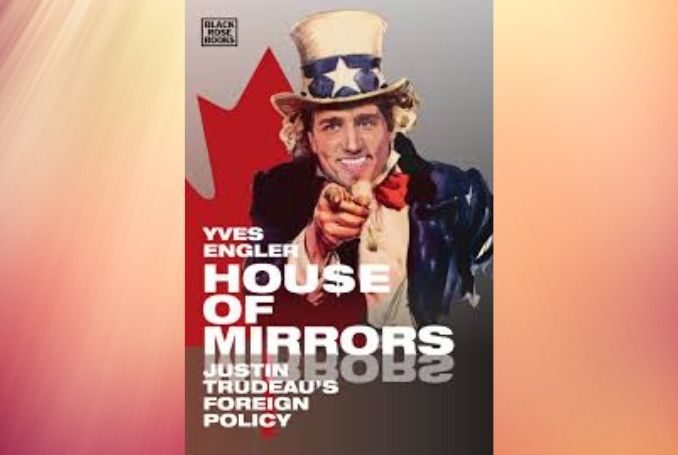
House of Mirrors, by Yves Engler. (Photo: Book Cover)
By Jim Miles | Palestine Chronicle | March 23, 2020
(House of Mirrors – Justin Trudeau’s Foreign Policy. Yves Engler. RED Publishing, Saskatoon/Black Rose Books, Montreal. 2020)
Some book covers are better than others, and that of Yves Engler’s House of Mirrors is beautifully expressive of the contents of his latest work. It shows a very friendly face and happy smiling Justin Trudeau in an iconic pose that says it all: America first.
This is Engler’s eleventh book exposing the downside of Canadian politics. It covers two main themes, the obvious first one is that of Canada’s involvement in the U.S. imperial-hegemonic demands around the world.
The second, more domestic, is that the Liberal’s and Conservatives, Canada’s two main parties, are essentially the same thing when it comes to foreign policy. Whereas the Conservatives are much more aggressive with their terminology while the Trudeau Liberals couch their words in a fancier more humanistic sounding language, the end results are the same: following the U.S. corporate-industrial-military complex and in certain cases being ahead of that curve.
With that as its underlying theme, Engler covers many topics concerning the Trudeau Liberals. The first long section deals with “The Canadian Monroe Policy” discussing how Canada fits into U.S. initiatives throughout Latin America with the overthrow, attempted overthrows, and manipulations of various organizations (OAS) in order to control the western hemisphere.
While paralleling U.S. interests, in terms of Venezuela, Canada, under Chrystia Freeland’ tutelage, has taken a leading interest with its support of the Lima Group (all sycophantic governments to U.S. corporate interests) against Venezuela.
A long essay on the Middle East, “Loving Monarchies, Hating Palestinians” discusses how Canada relates to the Arab countries, Israel, and the Palestinians. An earlier chapter, “The Sun Never Sets on the Canadian Military”, ties in with this chapter in exploring the numerous military sales and security contacts with Middle Eastern countries.
Large orders of military materials are sent to the likes of Saudi Arabia in support of its war on Yemen. Much information and technological information for security is exchanged between Canada and Israel (fun fact: Canada developed apartheid long before South Africa and Israel). The official position for Palestine is the stillborn two-state peace process while the actual position is more one of asking why the Palestinians do not acquiesce to Israeli demands.
Many other important topics are presented: around the world from China and North Korea through to Freeland’s favorite bogeyman, Russia, and on into Africa (military and mining interests); around the world from its domestic carbon dioxide/environmental policies; another hit on Canada’s mining interests in particular with South America; and the language of “Judge What I Say, Not What I Do”.
It is interesting how often Chrystia Freeland’s name rises in connection with Trudeau’s foreign policy. She is foremost in using the platitude about “international order based on rules” and the “rule of laws”. Whatever the foreign policy, as Foreign Affairs Minister and now as Deputy Prime Minister (a conveniently invented position), she carries considerable sway concerning Russia, Ukraine, Venezuela, Syria and other global hotspots (coronavirus notwithstanding). She inverts the colonial role, making Canada a victim rather than a colonizer and exploiter, “Canada has never been an imperialist power…we’ve been the colony.”
In his conclusion, Engler reprises comments about Canadian banks, the mining industry, Russia, Israel, Iran, the military, and business in general. He summarizes, “corporate Canada is highly international” with “segments… tied to extreme capitalism.” Extreme capitalism being capitalism dominated by and supported by the military-industrial complex with assistance from the financial community and the mainstream media.
As with all of Yves Engler’s books, House of Mirrors is tightly written, with little philosophizing, allowing the information to speak for itself, information that is highly notated and well referenced. The smiling man on the cover, Justin Trudeau, is essentially another true believer in an oligarchic world order (along with Ms. Freeland) supported by an international array of corporate and military liaisons.
– Jim Miles is a Canadian educator and a regular contributor/columnist of opinion pieces and book reviews to Palestine Chronicles. His interest in this topic stems originally from an environmental perspective, which encompasses the militarization and economic subjugation of the global community and its commodification by corporate governance and by the American government.
Amid viral pandemic UK photographer captures images of Canadian polar bear cubs
By Susan Crockford | Polar Bear Science | March 23, 2020
The Sun ran a photo-essay yesterday (22 March 2020, below) taken by a UK photographer who went to Wapusk National Park just south of Churchill, Manitoba in order to get much-coveted images of polar bear mothers and cubs newly emerged from winter maternity dens. The photos were said to have been taken “early last week” (16-17 March?).

The trees in the photos are a give-away to the location: no other subpopulation regions except Western and Southern Hudson Bay are below the treeline. Scrubby little spruces but ‘trees’ nonetheless. Mothers in more northern regions won’t come out with their cubs until April.
The question is: what was this photographer thinking to travel to a remote Arctic location in the middle of a global pandemic?
Let’s just hope “Brian Matthews, 41, from Hartlepool, Co Durham” didn’t take the Chinese coronovirus with him when he went to Canada. By the end of February, it was quite apparent that something very serious was going on and travel was ill-advised.
I therefore found it surprising that with a deadly pandemic in play across the world, Mr Matthews was not only willing to risk exposing the aboriginal people who run these spring polar bear cub emergence tours to this novel virus but all other people he came in contact with along the way. Perhaps Sun reporter John Sturgis, responsible for putting the feature together, should have thought to ask. As it is, we don’t know the details: perhaps Matthew had been in Canada for weeks, well before the seriousness of the global situation was apparent.
Ultimately, however, his timing was lucky on this trip: at 12:01 a.m. on Thursday 19 March, Wapusk National Park was closed because of the Chinese virus and on Wednesday 18 March, Canada banned entry of virtually all non-Canadian travelers into the country.
Suggested reading:
Amstrup, S.C. and Gardner, C. 1994. Polar bear maternity denning in the Beaufort Sea. The Journal of Wildlife Management 58:1-10. http://www.jstor.org/discover/10.2307/3809542?uid=3739400&uid=2&uid=3737720&uid=4&sid=21101008172123
Ramsay, M.A. and Stirling, I. 1988. Reproductive biology and ecology of female polar bears (Ursus maritimus). Journal of Zoology London 214:601-624. http://onlinelibrary.wiley.com/doi/10.1111/j.1469-7998.1988.tb03762.x/abstract
Obbard, M. E. and Walton, L.R. 2004. The importance of polar bear provincial park to the southern Hudson Bay polar bear population in the context of future climate change. Proceedings of the Parks Research Forum of Ontario (PRFO):105-116. [added July 26, 2013] pdf here.
Van de Velde (OMI), F., Stirling, I. and Richardson, E. 2003. Polar bear (Ursus maritimus) denning in the area of the Simpson Peninsula, Nunavut. Arctic 56:191-197. http://arctic.synergiesprairies.ca/arctic/index.php/arctic/article/view/615
‘Arm’s-length’ military institution promotes belligerent worldview
By Yves Engler · March 12, 2020
 Not satisfied with Canada’s largest public relations machine, the Canadian Forces also employ various “arm’s-length” institutions to push their influence over the discussion of military and international affairs.
For example, the Conference of Defence Associations (CDA) Institute recently published a half-page ad in the Globe and Mail to announce its Conference on Security and Defence. The March 3 and 4 meeting at the venerable Château Laurier was sponsored by the Department of National Defence (DND) and Global Affairs as well as Lockheed Martin, Raytheon and other arms companies. As in previous years, CDA’s confab in Ottawa drew leading military and political officials, including the Chief of the Defence Staff, who heard speakers hype security threats and push for increased military spending.
The headlines the conference generated included: “Russia poses most immediate military threat to Canada, top general says” (Globe and Mail ), “Canada and the West are at war with Russia whether they want it or not: military experts” (Global ) and “Top Canadian general calls out Russia and China for ‘antagonistic actions’” (CTV).
None of these stories explained what the CDA Institute actually is. The group describes itself as a “non-partisan, independent, non-profit organization [that] expresses its ideas and opinions with a view to influencing government security and defence policy.” Established in 1932, then Minister of Defence Donald Matheson Sutherland backed CDA’s creation. Since its inception CDA has been directly or indirectly financed by DND. Initially, member associations paid a small part of the funds they received from DND to CDA. But, three decades later the role was reversed. CDA received a block grant from DND and parcelled out the money to its various member associations.
Since its creation, defence ministers and governor generals (as commander in chief) have regularly appeared at CDA’s annual conference. The governor general, prime minister, defence minister and chief of the defence staff are honorary patrons or vice patrons of the organization.
At the height of Canada’s war in Afghanistan CDA received a highly politicized five-year $500,000 contract from DND. University of Ottawa professor Amir Attaran wrote, “that money comes not with strings, but with an entire leash.” To receive the money CDA committed to producing 15 opinion pieces or letters to the editor in major Canadian newspapers, generating 29 media references to the organization and eliciting 100 requests for radio/television interviews. The media work was part of a requirement to “support activities that give evidence of contributing to Canada’s national policies.” CDA didn’t initially disclose its 2007–12 DND sponsorship agreement, which was reviewed by cabinet.
CDA represents over 50 military associations ranging from the Naval Association of Canada to the Canadian Infantry Association, Royal Canadian Legion to the Military Intelligence Association. It is run by high-ranking former officers.
CDA publishes Security and Defence Briefings, Vimy Papers and Presentations and Position Papers. The organization’s quarterly journal ON TRACK “promotes informed public debate on security and defence issues and the vital role played by the Canadian Armed forces in society.” CDA has also published influential books such as Queens professor Douglas Bland’s A Nation at Risk: The Decline of the Canadian Forces.
To encourage militarist research, CDA awards a number of prizes. It puts on an annual graduate student symposium where $3,000 goes to the winning paper, $2,000 to second place and $1,000 to third place. CDA co-sponsors the Ross Munro Media Award to a “journalist who has made a significant contribution to understanding defence and security issues” and gives the Vimy Award to a “Canadian who has made a significant and outstanding contribution to the defence and security of Canada and the preservation of (its) democratic values.”
CDA advocates militarism. Its first official resolution noted “the urgent need for an increased appropriation for national defence.” At almost every CDA convention between 1946 and 1959 a resolution passed in favour of compulsory military training. A 1968 resolution called for universal military training, expressing concern that a generation of Canadians had become “unused to the idea of military service.”
In the 1980s CDA developed the idea of the “Total Defence of Canada”. In 1985 Colonel H. A. J. Hutchinson told a CDA meeting: “I would say that the Total Defence of Canada requires much more than just the support of the Canadian Armed Forces, it involves the organization of our total economy, our industrial base, towards a single objective — the defence of this country.” Hinting at the need to talk up US President Ronald Reagan’s revival of Cold War rhetoric, Hutchison said this “can only be made [possible] if the Canadian people perceive that it is necessary and that, in fact, it is the only course of action open to them.”
A 2000 CDA report funded by the Business Council on National Issues, the Molson Foundation and DND advocated increased military spending to defend free trade. It claimed “the defence establishment, including the Canadian Forces, plays a key role in an international policy which provides the insurance and the means which allow the national interest to flourish. It contributes to stability at home and abroad, thus supporting the development of an environment congenial to trade.”
In November Richard Fadden told CDA’s Vimy Dinner Canada had to be “clear-eyed” about Russia and China, which are prepared to “use virtually any means to attain their goals.” Fadden claimed, “the risks posed by these two countries are certainly different, but they are generally based on advancing all their interests to the detriment of the West.”
For the military and the industries that profit from militarism, it is important to have “arms-length” organizations that create the illusion of a diversity of voices. But honest writers should be blunt about the CDA. It is a war machine front group, created and controlled by the military.
Must… have… oil…
Climate Discussion Nexus | March 11, 2020
The implosion of investment in Canadian energy, most recently the cancellation of the Teck Frontier oilsands mine and Warren Buffett bailing on Quebec’s giant Énergie Saguenay LNG plant, brings home that if all this airy talk of transitioning away from fossil fuels actually lands, it will land on us very hard. (Mind you poor shy Canada finally got the world’s attention, if it’s any consolation.) As Anjli Raval warns in a major piece in The Financial Times, other countries are expanding their capacity as we crush ours because “The world runs on oil.” It accounts for 34% of world energy consumption, followed by its hydrocarbon cousins coal (27%) and natural gas (24%). But, as climate activists are often reminded in vain about their own lifestyles and protest accessories, “the fossil fuel has also quietly seeped into other aspects of our lives: from paint, washing detergents and nail polish to plastic packaging, medical equipment, mattress foams, clothing and coatings for television screens. Last year, global demand reached a record 100 million barrels a day”. And in Canada we’re part of the demand. Just increasingly not the supply.
Raval’s piece is not triumphal. Far from it. She says oil is bad. Bad bad bad. “Even as our thirst for oil seems insatiable, it is becoming politically and environmentally toxic. As the world wakes up to the catastrophic impact of climate change, from rising sea levels and drought to wildfires and crop failure, scientists have warned of a need to rapidly shift away from fossil fuels. Yet when it comes to oil demand, there is little sign of this happening. Our usage has jumped 62 per cent over the course of a few decades — up from 61.6 million b/d in 1986.” Almost as if we didn’t believe all that talk we keep… emitting.
Raval says “How the world can provide abundant energy supplies while dramatically reducing emissions has become one of the defining issues of our time. The challenge is huge. In order to keep global warming ‘well below’ a 2 C increase, the IEA says the world would need to stomach a fall in oil consumption to 67 million b/d by 2040. Environment analysts argue that we need to learn to survive on far lower levels — about 10 million b/d — and ultimately remove it from our energy system entirely.” Ah. Analysts. Cousins of experts.
If the challenge is huge, the response is not. She notes that “Governments are beginning to take some action, from incentivizing the purchase of low emissions vehicles to funding cleaner energy research.” But doing actual stuff that might matter is a lot harder because, wait for it, oil is vital. “While coal and gas are starting to be displaced by lower-cost renewables in electricity generation, oil has a stranglehold over the transport sector, and the petrochemicals industry is a fast-growing consumer of refined products. Aside from the commercial interests of oil-producer nations and corporations, there is a practical question: How will the world function without a material on which we depend so deeply?… Throughout history, energy has been at the heart of how civilizations have prospered.”
In keeping with the realism of half of the piece, she’s very clear that crude oil did wonders to advance prosperity, a sentiment with which we entirely agree. Then she goes unreal: “Yet humanity’s improved well-being has come at the expense of the planet’s. The earth has warmed by 1 C since pre-industrial times and is likely to heat up by another 2 C by the turn of the century — overshooting the targets of the 2015 Paris climate agreement.”
If so, what happens? Well, we all might sort of die. “A 2018 UN Intergovernmental Panel on Climate Change report showed warming beyond 1.5 C risked irreversible changes — from the mass extinction of species to extreme weather and ecosystem changes that threaten global stability.” Scary yet vague. We’re not quite ready to open the sixth seal. But we still commend the piece because it is quite realistic about the situation if not the future.
“Even after the world began moving from coal to other fuels, coal did not disappear. With the emergence of each new source, we have simply added it to the mix rather than replace old ones.” And she quotes Greta Thunberg (who else?) on the urgency of getting not to “net” zero but “real zero”. (Sort of like Canada’s energy industry the way things are going.) But Raval warns, “Cars, trucks and other road vehicles make up more than 40 per cent of global oil usage. When you add in aircraft, ships and trains, transport accounts for about 60 per cent. So any attempt to reduce our oil habit hinges on this sector.” Buildings and industry are also big, so pretty much the stuff that we do that makes us warm, fed and happy or at least entertained. So maybe we can go for “offsets such as planting trees.” It’s gonna take quite a few.
Next Raval makes a daffy claim indeed. She quotes “Jason Bordoff, who heads the Centre on Global Energy Policy at Columbia University” that “Ultimately, the world has to make value judgments about what temperature target it wants to hit.” Value judgements?
To hear the great and good tell it, we already did. We know what temperature target we want to hit. And we’re also arrogant enough to think we don’t just know the ideal temperature (for some reason it’s what we had in 1950, not 1850 or 1150), we also know how to hit it. Except for the tricky bit where we risk turning First World countries into Third World countries and kill vast numbers in Third World countries gone Fourth World by shutting off their path out of poverty because otherwise bad things will happen.
No really. Raval says “The world’s addiction to oil is often compared with tobacco. But while smoking is something people can choose to do, using energy is not…. Yet the cost of climate change could be far greater — and the world is running out of time.”
The piece does at least make plain just how high the cost of giving up oil would be in theory unless and until we find something better. Meanwhile in Canada we’re toying with demonstrating it in practice.
Maiming Palestinians for Sport is a War Crime
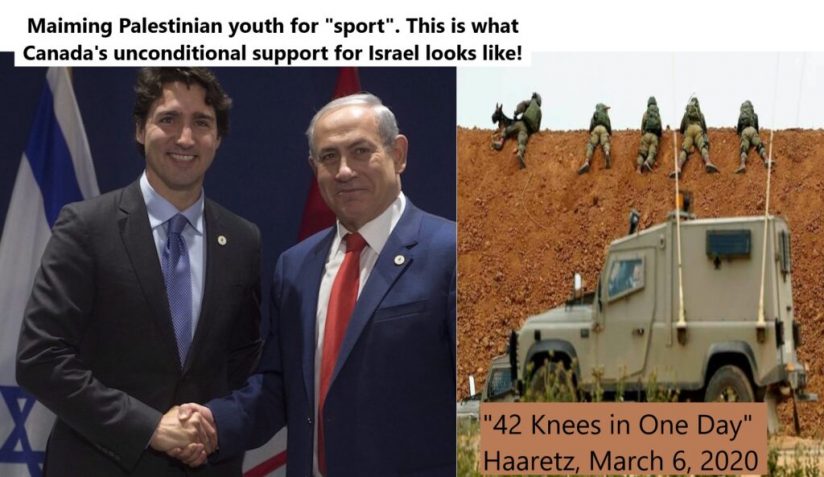
By Marion Kawas | Palestine Chronicle | March 10, 2020
The new Haaretz report entitled “42 Knees in One Day” is a difficult and painful read, and many people of conscience have responded with disgust and rage.
For those few who have not seen the report, it details in chilling fashion the accounts of 6 Israeli snipers who were stationed at the border with Gaza during the Great Return March protests. The report is long and gruesome; I had to put it down and then return to it several times. The “42 knees” reference is the “high count” for how many Palestinians were maimed by a single sniper team in one day.
The overall message is one of devastating impunity and disregard for the sanctity of Palestinian life. Palestinians and their long-time supporters have always known this was the mentality at play, but to see it all compiled in one place, in black and white, in the soldiers’ own words, was damning. Especially here in Canada, where barely a week earlier, it was revealed that the Trudeau government had called on the International Criminal Court not to investigate war crimes accusations against Israel.
“Canada’s longstanding position is that it does not recognize a Palestinian state… In the absence of a Palestinian state, it is Canada’s view that the Court does not have jurisdiction in this matter under international law,” Canada’s Foreign Ministry reportedly told various media outlets.
This is the same Canadian government that is busy traveling the world trying to get (or buy) votes for a UN Security Council seat. That has sent Joe Clark, a former Prime Minister, to visit multiple Arab countries looking for support; the Joe Clark that pioneered the idea of moving Canada’s embassy from Tel Aviv to Jerusalem back in 1979, an election promise that he was later forced to abandon.
The same government whose Deputy PM and former foreign minister, Chrystia Freeland, informed an Israeli audience in late 2018 that Canada would be an “asset for Israel” at the UN Security Council if it got one of the non-permanent member seats.
Canada, and other governments, must understand that there is a direct trajectory from their unconditional support for Israel to the continuation of Israeli war crimes against the Palestinian people.
Hampering the ICC investigation, refusing to accept your own court’s decision on labeling of Israeli settlement wines, smearing pro-Palestinian advocates as “anti-semitic” as happened at York University last year, all of this enables the Israeli government and military to feel they are immune to any sort of accountability.
This new report on Israeli sniper violence against Palestinians is most profound in what lies in the shadows: the Israeli military’s crude but effective approach. Promoting the concept that maiming these Palestinian youth is somehow “more humane” than killing them outright. But permanently disabling them in a poor society with few resources for the healthy let alone the injured, is an equally cruel fate. And a poignant and daily reminder to the rest of that society of the price to be paid for rebellion.
Most of the sniper accounts demonstrated a total lack of appreciation of the consequences or severity of their actions. One said, when talking about the other soldiers and their initial reaction to maiming their victims:
“He has fulfilled himself just now, it’s a rare moment. Actually, the more he does it, the more indifferent he’ll become. He will no longer be especially happy, or sad. He’ll just be.”
The snipers work in a team with a locator and the “42 in one day” soldier, related how he suggested to his locator to take over the shooting when they were getting close to the end of their shift because “he didn’t have knees”.
And “you want to leave with the feeling that you did something”. (Note its just “knees”, not Palestinian lives or limbs.) The parallel here with how sports teams allow rookie players to be involved at the end of a game that they know they are winning, is unmistakable. And it also highlights that these snipers didn’t seem to feel threatened and had few concerns about their own safety.
I realize that the Israeli snipers are themselves indoctrinated kids. But I hate the system and ideology that brought them to this, that placed them on those dirt embankments overlooking the people of Gaza, that made them think this was all “sport” or a video game where the player with the most points wins.
And if I feel such rage thousands of miles away, I can only imagine (and will never judge) how the youth of Gaza and their families must feel.
– Marion Kawas is a member of the Canada Palestine Association and co-host of Voice of Palestine.
Haiti petition challenges foreign policy apparatus
By Yves Engler · March 8, 2020
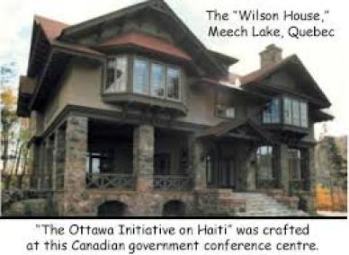 While it may seem to be a simple call to release documents, Solidarité Québec-Haïti’s House of Commons petition is an indictment of Canada’s entire foreign policy/media apparatus.
In my research about Canadian foreign policy I have come across no equivalent to the “Ottawa Initiative on Haiti”. In early 2003 the federal government organized a private meeting of US, French and Organization of American States officials to discuss replacing Haiti’s elected government, putting the country under UN trusteeship and re-establishing its army. In what was likely a government-organized trial balloon, a prominent journalist working for Québec’s top news magazine reported on it at the time. A year later what was reported/discussed largely transpired.
Nonetheless, after the February 29, 2004, coup the dominant media refused to investigate the “Ottawa Initiative on Haiti” and barely mentioned the meeting. A Canadian Newsstand search found not one single English language report about the meeting (except two opinion pieces by me and another solidarity activist that mentioned it). La Presse may be the only corporate newspaper to have reported on the “Ottawa Initiative on Haiti” in the 15 years after the coup. In that case progressive journalist Jooned Khan used space made available during Haiti’s February 2006 election upheaval to briefly mention the gathering on two occasions.
Recently a major media outlet looked back on the “Ottawa Initiative on Haiti”. In a 45-minute report tied to the 10thanniversary of the 2010 earthquake Radio-Canada’s flagship news program “Enquête” reported on it. They interviewed Denis Paradis, the Liberal minister responsible for organizing the meeting, who admitted no Haitian officials were invited to discuss their own country’s future during the get together in 2003. They also interviewed Solidarité Québec-Haïti member Jean Saint-Vil who offered a critical perspective.
In a bid to build on this media breakthrough, Solidarité Québec-Haïti has launched a House of Commons petition referencing Enquête’s report and calling on the government to “Publish all documents relating to the ‘Ottawa Initiative on Haiti’” and to “Hold a hearing of the Standing Committee on Foreign Affairs and International Development to learn everything there is to know about the ‘Ottawa Initiative on Haiti,’ including its link to the “Core Group.” Bloc Québecois MP Mario Beaulieu has sponsored it.
Just after the coup then NDP MP Svend Robinson requested minutes of the private meeting be made available. Subsequently, researcher Anthony Fenton placed an Access to Information request for all documents related to the “Ottawa Initiative on Haiti”. What he received was heavily redacted. In Haiti Betrayed, a powerful new documentary about Canadian imperialism, Elaine Brière notes that the government refused to release documents related to the Ottawa Initiative on Haiti.
The meeting remains politically relevant. Enquête suggested the Ottawa Initiative on Haiti led to the creation of the “Core Group,” an alliance of foreign ambassadors that largely determines Haitian affairs. Solidarité Québec-Haïti is using the petition to pressure Ottawa to withdraw from the “Core Group”, which is the real power behind corrupt, repressive and illegitimate president Jovenel Moïse.
The petition requires 175 more signatures to be presented in the House of Commons, which will force the government to formally respond. If you are a citizen or permanent resident of Canada please sign it.
On the ICC and Canadian Government Hypocrisy
By Yves Engler | Palestine Chronicle | March 4, 2020
Just when you think Canadian government hypocrisy could hit no greater heights, the Liberals launch a double standards rocket to the stars.
The Trudeau government recently pressed the International Criminal Court to stop investigating Israeli war crimes. Ottawa sent a letter to the ICC saying it didn’t believe the court had jurisdiction over Palestine.
“Canada’s longstanding position is that it does not recognize a Palestinian state and therefore does not recognize the accession of such a state to international treaties, including the Rome Statute.
In the absence of a Palestinian state, it is Canada’s view that the Court does not have jurisdiction in this matter,” a Global Affairs official told the Jerusalem Post. But, it doesn’t matter if Canada recognizes Palestine. The vast majority of UN member states recognized Palestine and it joined the ICC in 2015.
In response to Ottawa’s letter to the ICC, PLO Secretary-General Saeb Erekat tweeted that Canada supported “Israel’s campaign for impunity.” Erekat added, “it is not about jurisdiction: It’s about war crimes. This is an encouragement to continue the war crimes.”
Canada’s letter to the ICC implies it could sever funding if the ICC pursued an investigation of Israeli crimes. Reportedly, it reminds the court that Canada’s “financial contribution to the ICC will be $10.6 million this year.”
Ottawa’s letter was a response to ICC chief prosecutor Fatou Bensouda’s statement in December that “I am satisfied that war crimes have been or are being committed in the West Bank, including East Jerusalem and the Gaza Strip.” At the time Bensouda called for a full-fledged investigation into Israeli war crimes, which could lead to arrest warrants being issued for Israeli officials.
Since then Tel Aviv has unleashed a vicious campaign against the ICC. Prime Minister Benjamin Netanyahu labeled the court’s investigation “pure anti-Semitism”. Israel has pushed other countries to join their attacks. Netanyahu sent a letter to Justin Trudeau calling on Canada to condemn any ICC investigation of Israeli war crimes.
Trudeau’s willingness to bow to Israeli pressure on the issue is remarkable. Not only does it claim to support the ICC, but the institution is also closely linked to how it markets its foreign policy.
In his recent mandate letter to the foreign minister, Trudeau told Francois-Philippe Champagne to “reinforce international institutions like the International Criminal Court.” In March Global Affairs noted, “we are proud to support the International Criminal Court and the important work that it does.”
The press release boasted that Canada helped “bring the ICC into existence” and was “the first country in the world to adopt comprehensive legislation implementing the Rome Statute” that created the ICC. The statement adds that “Canada firmly supports the rules-based international order and the multilateral institutions that underpin it.”
When Trudeau addressed the UN General Assembly in September 2018, the ICC was central to his talk. The government announced Canada was taking Venezuela to the ICC and the prime minister described the court as a “useful and important way of promoting an international rules-based order.”
On dozens of occasions, former foreign minister Chrystia Freeland, Trudeau and other Liberal officials have referred to the “international rules-based order”, “international order based on rules” or “international system based on rules”. The top stated “aim” laid out in Freeland’s major June 2017 foreign policy pronouncement was: “First, we will robustly support the rules-based international order, and all its institutions, and seek ways to strengthen and improve them.” The number one priority on Global Affairs website is “revitalizing the rules-based international order.”
By threatening the ICC on behalf of Israel the Trudeau government is not simply enabling Palestinian dispossession. The Liberals are also making a mockery of their foreign policy rhetoric.
– Yves Engler is the author of Canada and Israel: Building Apartheid and a number of other books.
Fighting the Canadian Media Crackdown – Dan Dicks on The Corbett Report
Corbett • 03/02/2020
The Canadian government has recently considered a proposal to require all Canadian media to be licensed by the government. The proposal has been rejected for now, but how long can independent media continue to function in the increasingly draconian Canadian police state? Dan Dicks of PressForTruth.ca joins us to discuss the issue.
Watch this video on BitChute / Flote.app / Minds.com / YouTube or Download the mp4
SHOW NOTES:
PressForTruth.ca
Trudeau’s Digital Charter And The $600M Media Bailout Explained
Ezra Levant of Rebel News Interrorgated For His Book Exposing Justin Trudeau
Licensing The Global News Circuit Soon To Be A Reality in Canada Despite Claims They Won’t Do It
Into the Fire – Dan Dicks on The Corbett Report
Dan Dicks on BitChute / Flote.app / Minds / Steemit / YouTube
Canada Joins ‘Friendly States’ in Opposing ICC War Crimes Investigation in Palestine
Palestine Chronicle | February 26, 2020
The Canadian government has submitted a letter to the International Criminal Court (ICC), in which it declared support for the Israeli position, thus rejecting the ICC jurisdiction over cases of alleged war crimes committed by Israel in Palestine.
The Canadian Jewish News (CJN), which reported on the letter, said that Ottawa has communicated its position to the Court on February 14, although the content of the letter has not been made public until today.
In the letter, Canada, which reminded the Court that its “financial contribution to the ICC will be $10.6 million this year,” stated that it does not recognize Palestine as a state and that the ICC has no jurisdiction on the case that is presented by the State of Palestine.
The Canadian decision followed a public demand last December by Israeli Prime Minister Benjamin Netanyahu to Canadian Prime Minister Justin Trudeau to condemn a preliminary report by the ICC that has a “reasonable basis” to investigate Israeli war crimes in the occupied territories.
Netanyahu’s letter, which was obtained by the Canadian Globe and Mail newspaper, asserted the position which was eventually adopted by the Canadian government, that the ICC has no jurisdiction over the case because Palestine does not meet the criteria of statehood.
Netanyahu’s letter read in part:
“In light of our special relations and the steadfast friendship between our countries, I urge you to publicly condemn this erroneous decision, to acknowledge there is not a Palestinian state, that the court has no jurisdiction in this matter, which involves political issues to be determined by the parties, and to voice your deep concerns regarding its dangerous ramifications to the court and the region.”
The intense Israeli lobbying followed a statement by the ICC chief prosecutor Fatou Bensouda, in which she declared to be “satisfied that there is a reasonable basis to proceed with an investigation into the situation in Palestine”.
“In brief, I am satisfied that war crimes have been or are being committed in the West Bank, including East Jerusalem, and the Gaza Strip,” she said.
Two days after Ottawa communicated its position to the ICC, Netanyahu praised what he called “efforts” by “friendly states” to prevent the ICC from launching an investigation.
Featured Video

It’s the Occupation, Stupid
or go to
Aletho News Archives – Video-Images
From the Archives
A superpower and “the world’s sickest warrior state”
By Paul J. Balles | March 8, 2010
Living through five or six major wars has hardened me to what I thought were the extremes of inhuman cruelty and brutality.
Two things made those extremes almost bearable: the brutality always revealed – at least according to the media coverage – the viciousness of the enemy. It was therefore quite understandable when our “brave men and women” pulverized the enemy.
Films of Japanese torturing captive Americans somehow justified holding Japanese Americans in internment camps during World War II; and only a small percentage of Americans found the bombing of Hiroshima and Nagasaki unreasonably vengeful at best, at worst, depraved.
The media giants in America portrayed the North Koreans as barbaric beasts with their captives, quite unlike their southern counterpoints – our allies during the Korean War. No one ever felt the need to explain how the South Koreans were a civilized breed while the North Koreans were absolute savages, at least according to the official line.
In Vietnam, our warriors justifiably (or so the media made us believe) dropped napalm on the North Vietnamese who had the gall to hide in villages and tunnels to ravage our invaders. At least it was accepted practice until some rogue photojournalist filmed a young girl screaming down a Vietnamese road in flames. … continue
Blog Roll
 Aletho News
- Pro-Palestinian French member of European Parliament denied entry to Canada
- Pakistan to Host US-Iran Talks
- How Indonesia’s tilt toward the US left it stranded in the Strait of Hormuz
- US has no choice but to retreat from Iranian borders: Top commander
- Iran Retaliation Strikes Chemical Plant Near Dimona
- AWACS’ Destruction is a Major Loss for US Military – Ex-DoW Analyst
- Israel’s Iran Strategy Uses US Military & Gulf States as Its Pawns
- Iran: Trump wanted regime change, now just begging for Hormuz to open
- IRGC: Israeli, US universities in region legitimate targets after strikes on Iranian university
- Trump admits Iran hit USS Ford carrier: ‘We ran for our lives’
- If Americans Knew
- Israeli police block Catholic cardinal from entering Church of the Holy Sepulchre on Palm Sunday
- Israel is assassinating journalists again, more than any other nation, anywhere, ever – Not a ceasefire Day 170
- Over 300 US service members wounded, majority have brain injuries – Not a ceasefire Day 169
- Researchers at Human Rights Watch Resign Over Blocked Report on Palestinian Refugee Return
- Jewish Groups Are Backing a War Americans Don’t Want
- Eric Fingerhut Thinks He’s the President of the Jews
- Top Jewish Philanthropists, Rabbis Urge Israeli President to Take Action Against ‘Jewish Extremists’
- Don’t Be Fooled. Zionist Leaders Have Always Wanted to Control Southern Lebanon
- Israel’s widespread use of torture is a core element of its genocide against the Palestinian people
- In Israel’s War on Iran, Many Middle East US Bases Rendered “All But Uninhabitable”
- No Tricks Zone
- German Science Blog Accuses PIK Climate Institute Of Hallucinating Climate Tipping Points
- Devastating Assessment Of Comirnaty Vaccine By Former Senior Pfizer Europe Toxicologist
- New Study: CO2 Is ‘Effectively Negligible’ As An Explanatory Climate Change Factor Since 2000
- Former Pfizer Toxicologist Dr. Helmut Sterz Tells Bundestag Hearing Pfizer Vaccine Should Have Never Been Approved
- Energy Expert: Germany’s Nuclear Phaseout Was A “500 Billion Euro Mistake”
- New Research: South Australia’s Mid-Holocene Sea Surface Temperatures Were 4°C Warmer Than Today
- Storing Green Energy To Last Germany 10 Days Would Require A 60-Million Tonne Battery
- New Studies: UK Sea Levels Were 4 Meters Higher Than Today During The Mid-Holocene
- Destructive Green New Deal: German Energy And Metal Group Warns Of Drastic Crisis
- New Study Documents A 20-Year Pause In Arctic Sea Ice Decline – Driven By Internal Variability
 Aletho News