Canada Wants to Be an ‘Asset of Israel’ at the UN Security Council
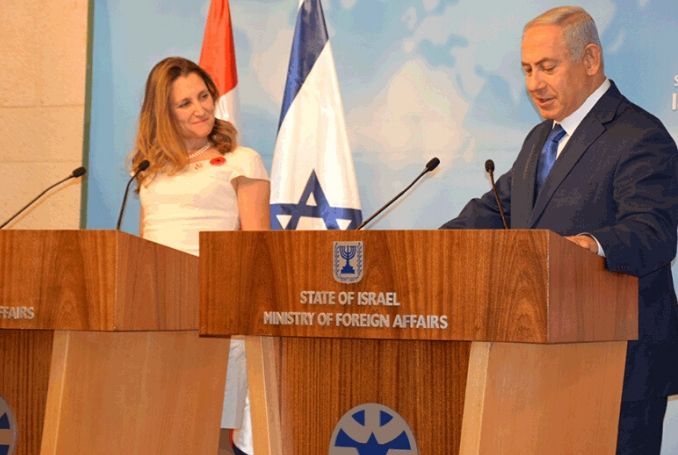
Deputy PM of Canada, Christya Freeland (L), and Israeli PM Benjamin Netanyahu. (Photo: Supplied)
By Hanna Kawas | Palestine Chronicle | December 30, 2019
Canadian activists have compiled a study of Canada’s 2019 voting record at the United Nations on resolutions that document and censure Israeli violations of international law.
There was much fanfare made about Canada’s orphan “yes” vote at the UN General Assembly this year on “The right of the Palestinian people to self-determination” resolution. But in the broader context of the other 17 resolutions calling out Israel’s war crimes, that Canada either voted against (15) or abstained on (2), this lone vote can only be seen as deceptive and hypocritical.
Justin Trudeau, explaining his government’s vote to Canadian Zionists, stated:
“The government felt that it was important to reiterate its commitment to a two-states-for-two-peoples solution at a time when its prospects appear increasingly under threat”.
However, if the Trudeau government was really committed to a “two-states-for-two-peoples solution”, it is inconceivable that at the same time they also voted against:
- A resolution to support the work of the “Committee on the Exercise of the Inalienable Rights of the Palestinian People” that affirms the UN “has a permanent responsibility towards the question of Palestine until the question is resolved in all its aspects”;
- The “Peaceful settlement of the question of Palestine” resolution that calls “on Member States not to recognize any changes to the pre-1967 borders, including with regards to Jerusalem”;
- “The Syrian Golan” resolution that “Demands once more that Israel withdraw from all the occupied Syrian Golan to the line of 4 June 1967 in implementation of the relevant Security Council resolutions”;
- “Permanent sovereignty of the Palestinian people in the Occupied Palestinian Territory, including East Jerusalem, and of the Arab population in the occupied Syrian Golan over their natural resources” resolution;
- The resolution that condemns the “Israeli settlements in the Occupied Palestinian Territory, including East Jerusalem, and the occupied Syrian Golan” and reaffirms the “inadmissibility of the acquisition of territory by force”; and
- The resolution concerning “Israeli practices affecting the human rights of the Palestinian people in the Occupied Palestinian Territory, including East Jerusalem” that expresses “grave concern about the continuing systematic violation of the human rights of the Palestinian people by Israel”.
And finally, why would Canada vote against a resolution to uphold the rights of “Persons displaced as a result of the June 1967 and subsequent hostilities”, unless it supports Israel’s ethnic cleansing of the West Bank and the “Greater Israel Project”?!
Some observers have speculated that Canada’s lone vote was motivated by Trudeau’s desire to obtain a seat on the UN Security Council. Over a year ago, then Foreign and now Deputy PM Chrystia Freeland was quoted as follows during a visit to Israel:
“She also mentioned Canada’s current bid for one of 10 non-permanent seats on the UN Security Council for 2021-2022, which she hoped would allow Canada to serve as an ‘asset for Israel and… strengthen our collaboration’.”
So, this is what Canada plans to do if it gets sufficient votes for a seat, be an “asset for Israel”?
Canada is relying on the votes, and possible lobbying, of some Arab reactionary regimes to get the backing required for the Security Council seat; one example is Jordan.
Just last month during a visit, “Jordan’s King Abdullah II told Prime Minister Justin Trudeau that the Middle Eastern kingdom supports Canada’s bid for a seat on the United Nations Security Council”. This was according to Jordan’s ambassador to Canada, Majed Alqatarneh, who also said Jordan “believes it is important that Canada have a seat on the Security Council”.
Canada also seems to be counting on the support of certain diplomatic circles from the US; former U.S. ambassador to Ottawa, Bruce Heyman stated:
“For me, today, when the U.N. General Assembly is all together, a Canadian seat on the U.N. Security Council is more important than ever”.
We tell Mr. Trudeau that instead of your objective of getting a seat at the UN Security Council, you may end up with a seat in front of the ICC. If the “two-states-for-two-peoples solution… prospects appear increasingly under threat”, it is because of Canada’s (and others) unconditional support for Israeli occupation, war crimes, and apartheid.
– Hanna Kawas is Chairperson of the Canada Palestine Association and co-host of Voice of Palestine. Visit: http://www.cpavancouver.org.
Media ignores explosives revelations about chemical weapons in Syria
By Yves Engler · December 22, 2019
The Canadian media gets a failing grade when it comes to its coverage of chemical weapons in Syria.
Among the basic principles of reporting, as taught in every journalism school, are: Constantly strive for the truth; Give voice to all sides of a story; When new information comes to light about a story you reported, a correction must be issued or a follow-up produced.
But the Canadian media has ignored explosives revelations from the Organisation for the Prohibition of Chemical Weapons. It’s a stark example of their complicity with belligerent Canadian foreign policy in Syria.
In May 2019 a member of the OPCW Fact Finding Mission in Syria, Ian Henderson, released a document claiming the management of the organization misled the public about the purported chemical attack in Douma in April 2018. It showed that the organization suppressed an assessment that contradicted the claim that a gas cylinder fell from the air. In November another OPCW whistleblower added to the Henderson revelations, saying that his conclusion that the incident was “a non chemical-related event” was twisted to imply the opposite. Last week WikiLeaks released a series of internal documents demonstrating that the team who wrote the OPCW’s report on Douma didn’t go to Syria. One memo noted that 20 OPCW inspectors felt the report released “did not reflect the views of the team members that deployed to [Syria].”
I couldn’t find a single report about the whistleblowers/leaks in any major Canadian media outlet. They also ignored explicit suppression of the leaks.
Journalist Tareq Haddad “resigned from Newsweek after my attempts to publish newsworthy revelations about the leaked OPCW letter were refused for no valid reason.” Haddad wrote a long article explaining his resignation, which detailed how an editor who previously worked at the European Council on Foreign Relations blocked it.
There is an important Canadian angle to this story. Twenty-four hours after the alleged April 7, 2018, chemical attack foreign affairs minister Chrystia Freeland put out a statement claiming, “it is clear to Canada that chemical weapons were used and that they were used by the Assad regime.” Five days later Prime Minister Justin Trudeau supported cruise missile strikes on a Syrian military base stating, “Canada supports the decision by the United States, the United Kingdom, and France to take action to degrade the Assad regime’s ability to launch chemical weapons attacks against its own people.”
Canadian officials have pushed for the organization to blame Bashar al-Assad’s government for chemical attacks since Syria joined the OPCW and had its declared chemical weapon stockpile destroyed in 2013–14. Canada’s special envoy to the OPCW, Sabine Nolke, has repeatedly accused Assad’s forces of employing chemical weapons. Instead of expressing concern over political manipulation of evidence, Nolke criticized the leak.In a statement after Henderson’s position was made public she noted, “Canada remains steadfast in its confidence in the professionalism and integrity of the FFM [Fact-Finding Mission] and its methods. However, Mr. Chair, we are unsettled with the leak of official confidential documents from the Technical Secretariat.”
Amidst efforts to blame the Syrian government for chemical weapons use, Canadian officials lauded the OPCW and plowed tens of millions of dollars into the organization. A June 2017 Global Affairs release boasted that “Canada and the United States are the largest national contributors to the JIM [OPCW-UN Joint Investigative Mechanism for Attributing Responsibility for Chemical Weapons Attacks in Syria].” The statement added that Canada “is the largest voluntary cash contributor to the organization, having provided nearly $25 million since 2012 to help destroy chemical weapons in Libya and Syria and to support special missions and contingency operations related to chemical weapons use, investigation, verification and monitoring in Syria.” Two months after the Douma incident Freeland announced a $7.5 million contribution to the OPCW in a statement heavily focused on Syria.In August Governor General Julie Payette even traveled to The Hague to push OPCW Director-General, Fernando Arias, on Syria. After a “meeting focused on OPCW activities in Syria”, Payette highlighted Canada’s “$23 million in voluntary funds for Syria-related activities.”
Ottawa backed the group that produced the (probably staged) video purporting to show chemical weapons use in Douma. The Liberals backed the White Helmets diplomatically and financially. In a release about the purported attack in Douma Freeland expressed Canada’s “admiration for … the White Helmets”, later calling them “heroes.” Representatives of the White Helmet repeatedly came to Ottawa to meet government officials and Canadian officials helped members of the group escape Syria via Israel in July 2018. Alongside tens of millions of dollars from the US, British, Dutch, German and French governments, Global Affairs announced “$12 million for groups in Syria, such as the White Helmets, that are saving lives by providing communities with emergency response services and removing explosives.”
Credited with rescuing people from bombed out buildings, the White Helmets fostered opposition to Assad and promoted western intervention. Founded by former British army officer James Le Mesurier, the White Helmets operated almost entirely in areas of Syria occupied by the Saudi Arabia–Washington backed Al Nusra/Al Qaeda insurgents and other rebels. They criticized the Syrian government and disseminated images of its purported violence while largely ignoring civilians targeted by the opposition. Their members were repeatedly photographed with Al Qaeda-linked Jihadists and reportedly enabled their executions.
The White Helmets helped establish an early warning system for airstrikes that benefited opposition insurgents. Framed as a way to save civilians, the ‘Sentry’ system tracked and validated information about potential airstrikes.
Canada funded the Hala Systems’ air warning, which was set up by former Syria focused US diplomat John Jaeger. It’s unclear how much Canadian money was put into the initiative but in September 2018 Global Affairs boasted that “Canada is the largest contributor to the ‘Sentry’ project.”
Ottawa is dedicated to a particular depiction of the Syrian war and clearly so is the dominant media. Committed to a highly simplistic account of a messy and multilayered conflict, they’ve suppressed evidence suggesting that an important international organization has doctored evidence to align with a narrative used to justify military strikes.
Journalists are supposed to seek the truth, not simply what their government says. In fact, according to what is taught in J-school, journalists have a special responsibility to question what their government claims to be true.
No journalism program in Canada teaches that governments should always be believed, especially on military and foreign affairs. But that is how the dominant media has acted in the case of Syrian chemical weapons.
Goldman Sachs operative Carney slithers from BoE to UN climate con job
Tallbloke’s Talkshop | December 20, 2019
Bank of England governor Mark Carney, who previously served as Canada’s top central banker, will be taking on a new role as the United Nations’ special envoy on climate action and climate finance.
UN Secretary-General Antonio Guterres made the announcement while speaking to reporters in Madrid on Sunday, adding the move will take effect next year.
Carney, who spent 13 years at Goldman Sachs, is now moving into the role the company , with it’s huge Green Portfolio Investments, wants him to be in.
Boris Johnson has wisely banned ministers from attending Davos this year.
Czech think tank funded by NATO govts calls for EU BLANKET BAN on Russian outlets like RT
‘European values’?
By Nebojsa Malic | RT | December 17, 2019
A pro-NATO Czech think tank has another piece of unsolicited advice for Western governments. Now they should refuse to give access or interviews to Russian media, who are ”not real journalists”, according to the ”wise censor”.
At first blush, the ‘Kremlin Watch Strategy’ paper published last week by the Prague-based ‘European Values Center for Security Policy’ sounds like another self-serving attempt to cash in on the anti-Russian hysteria that has gripped many a Western capital for the past several years.
There are some two dozen mentions of “funding,” mostly in the context of urging the European Union to spend more money on “independent” NGOs – such as themselves, obviously – to battle “hostile Russian interference” the authors see under every bed. There is even a proposal for every EU government to conduct its own version of the Mueller probe – which famously found zero evidence of “collusion” between US President Donald Trump and Russia, and its evidence of Russian “meddling” amounted to unsubstantiated assertions from indictments, as its lawyers had to admit in court.
So far, so laughable, right? Except the NGO argues that all European countries should:
“stop legitimising Russian disinformation tools posing as “journalistic platforms”. Communication channels effectively run by the Russian government, be it RT, Sputnik, or Russian state-run TV channels, do not represent journalism, they merely pretend to.”
Since ‘Russians’ are not free media, argues ‘European Values,’ the EU countries should “ban them from press conferences and not give access that is granted only to journalists, which they are not.”
This is not the first time that EV has tried to urge a ban and boycott of “Russian” outlets. In fact, it first emerged from obscurity in 2017, when it compiled an (error-riddled) blacklist of 2,327 “useful idiots” who had appeared on RT, in an effort to intimidate others.
A mere month later, the same outfit sponsored something called the “Prague Declaration,” which was signed by a who’s who of the most prominent Russiagate conspiracy-pushers, along with someone named “Bumfrey McDoogle.”
While it is tempting to dismiss the call for censorship on account that it originates from a low-rent Czech think-tank with an embarrassing history, doing so might be premature. EV gets much of its funding from NATO governments – Dutch, British, German and American, as of 2018. Indeed, they openly admit that London has been “a clear European leader in responding” to the so-called Russin threat, mobilizing the EU “response” and funding “much of the European civil society.”
Could it be mere coincidence that EV’s “new” censorship proposal sounds much like the one formerly peddled by the Institute for Statecraft, a sock-puppet project of the British government that was “burned” at the end of last year, following public exposure??
Far more sinister is that this “recommendation” has already been implemented to some extent. The US government withdrew RT America’s credentials in 2017, after forcing the outlet to register as a “foreign agent.” French President Emmanuel Macron has refused to talk to or accredit RT or Sputnik. The British government canceled RT’s credentials to a press freedom conference in July this year.
In February, Canada refused Sputnik credentials to report from the Lima Group meeting on Venezuela, devoted to US-backed regime change in Caracas. RT Spanish has been taken off air in Ecuador, after reporting on anti-austerity protests – and soon thereafter in Bolivia, by the US-backed unelected government that had violently ousted elected president Evo Morales to praise from Washington.
Last month, Ukrainian activists tried to shout down RT’s head of communications Anna Belkina as she spoke about freedom of the press in Strasbourg. Just like EV, they chanted “propaganda, not journalism.”
Once is a coincidence. Twice is happenstance. This many times is enemy action. Which raises the question of whether free speech really is a “liberal European” value – or do ‘European Values’ and their paymasters actually believe these values only apply to them, and not Others?
Award-Winning Journalist Vanessa Beeley Faces “Deplatforming” at Six Canadian Venues
By Michael Welch | Global Research | December 12, 2019
 Vanessa Beeley, the award-winning journalist who has gained notoriety for her on the ground reporting on the Syrian conflict has faced opposition in her efforts to speak to Canadian audiences at the invitation of local anti war activists.
According to Ken Stone of the Hamilton Coalition to Stop the War, a lead organizer of Beeley’s cross-Canada speaking tour, six venues have so far backed away from hosting the UK journalist’s talks. These include Palestine House in Mississauga, the Steelworkers Hall in Toronto, St. Paul’s University in Ottawa, the University of Montreal, the University of Winnipeg, and the Millenium Library, also in Winnipeg.
Stone explains that the withdrawal from agreements at each venue to host Beeley were preceded by the circulation of at least two hit pieces on the journalist upon her arrival in Canada – one by La Presse in Quebec and one by the Huffington Post. Stone explained that the decision to cancel in each case was precipitated by the circulation of these articles by unknown actors.
Says Stone,
“There wasn’t an organized effort, but there were people in individual cities where she was speaking who took it upon themselves to circulate these articles behind the scenes – shadowy figures who tried their very best to scare the managers of various venues into cancelling, and they did so six times.”
The proper name of the tour is ‘Canada’s Dirty War on Syria: The White Helmets and the Regime Change War billionaires.’ Ms. Beeley was intent on presenting her research into Canada’s role in undermining the government of President Bachar Al Assad. Beeley’s message directly contradicts mainstream reporting on the conflict, particularly her research into the White Helmets, which she and other independent journalists classify as a propaganda construct providing public relations cover for regime change efforts and continued economic sanctions that are decimating the country.
The justification for one venue after another cancelling is not clear, as none have officially provided any explanation. According to Stone, however, there were two venues on the tour that allowed the Beeley presentation to take place in spite of this unexpected opposition. One was the New Vision Church in Hamilton. The other was the Knox Metropolitan United Church in Regina. Both Ministers highlighted concerns from a complainant about ‘hate speech’ being directed toward the White Helmets, and the prospect of traumatizing vulnerable Syrian refugees.
Organizers explained to the Ministers that the talks were not about hate speech but rather about highlighting the findings of an independent journalist and war correspondent ‘whose research methods are very thorough’ about the true nature of the Syrian conflict and the role of the White Helmets.
According to an email, forwarded to this author, from the pastor at the Hamilton venue, there was concern expressed about Beeley engaging in ‘hate speech’ toward the White Helmets. According to the pastor at the Regina venue, the letter he received essentially echoed the common, mainstream media reinforced perception that the White Helmets are heroes, that Syrian civilians are fleeing a despotic Syrian regime, and that Beeley is spreading “lies for war criminal Bashar Assad.”
Stone added, “one of the people who spoke to both Ministers about the ‘traumatization’ turned out to be traced back to an address in the state of Washington, USA. She was claiming that she was going to be traumatized by Vanessa speaking 4000 miles away!”
Full disclosure: this author was active in trying to secure a venue for Vanessa Beeley at the University of Winnipeg. The deplatforming in this case was a little more complicated. I had apparently used an improper process to secure the space on campus initially. However, when the event coordinator on campus got hold of me and explained the problems with the process, she directed me to find a venue elsewhere. When I asked about the prospects for booking the space by following the proper procedure, and paying the appropriate fees, I was told the event would likely not go ahead owing to problems the President’s Office had with the content.
In spite of multiple attempts to get more details over several days, the university has yet to provide an explanation of precisely what they found objectionable about the ‘content.’
A second venue, the Millennium Library in downtown Winnipeg was secured through friendly staff six days in advance of the event date. However, on Tuesday (Human Rights Day as it turns out) two days before the event was to take place, I received a call from a higher up – the Manager of Library Services. He had expressed regret but that after lengthy deliberations he had with other team members, he determined that the event would violate their guidelines and that he was exercising his right under the contractual agreement to cancel the booking.
No official explanation was offered beyond this although when pressed, this individual did indicate an ‘opinion’ on his part that after reviewing the speaker’s content, the content of the presentation could be construed as hate speech. Overtures to have this manager meet with myself and other organizers to assuage concerns about the event, were rejected. He said his decision was final. He did relent to sending a written explanation of his reasons for cancelling the booking:
“We considered our room usage Regulations and Conditions of use, event content, and community interests in this decision.”
Further correspondence was forwarded to me through a third party about the event planned for the University of Winnipeg from another member of the campus community. The concerns could be summarized as follows:
- Ms. Beeley is promoting ‘harmful’ theories in defence of President Assad.
- She is promoting ‘anti-semitic’ and harmful messaging against the White Helmets, ‘a group that provides vital humanitarian search and rescue operations in areas of Syria subject to intense bombing.’
- the content could be ‘traumatizing’ to the Syrian refugee population at the university.
About a day later, a representative of the university’s student executive had private messaged the organizers through the Winnipeg facebook event page expressing concern about the event. This person echoed the points above. The individual’s facebook page, however, reveals a clear effort to deplatform Vanessa Beeley.
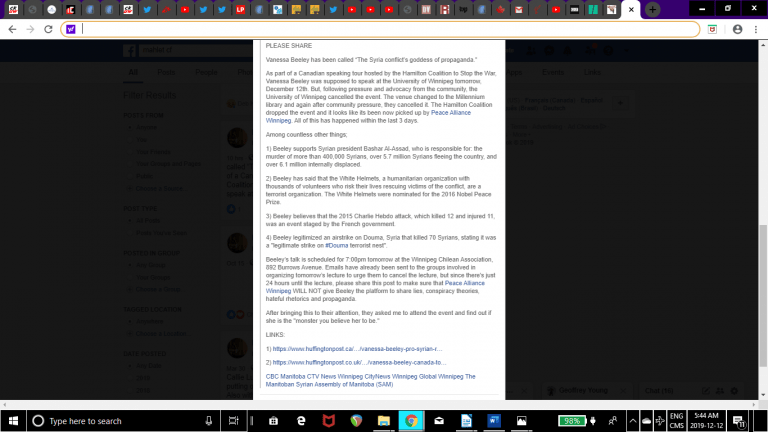
Excerpts (emphasis added)
PLEASE SHARE
“Vanessa Beeley has been called “The Syria conflict’s goddess of propaganda.”
As part of a Canadian speaking tour hosted by the Hamilton Coalition to Stop the War, Vanessa Beeley was supposed to speak at the University of Winnipeg tomorrow, December 12th. But, following pressure and advocacy from the community, the University of Winnipeg cancelled the event. The venue changed to the Millennium library and again after community pressure, they cancelled it. The Hamilton Coalition dropped the event and it looks like its been now picked up by Peace Alliance Winnipeg. All of this has happened within the last 3 days.
Among countless other things;
1) Beeley supports Syrian president Bashar Al-Assad, who is responsible for: the murder of more than 400,000 Syrians, over 5.7 million Syrians fleeing the country, and over 6.1 million internally displaced.
2) Beeley has said that the White Helmets, a humanitarian organization with thousands of volunteers who risk their lives rescuing victims of the conflict, are a terrorist organization. The White Helmets were nominated for the 2016 Nobel Peace Prize.
3) Beeley believes that the 2015 Charlie Hebdo attack, which killed 12 and injured 11, was an event staged by the French government.
4) Beeley legitimized an airstrike on Douma, Syria that killed 70 Syrians, stating it was a “legitimate strike on #Douma terrorist nest”.
Beeley’s talk is scheduled for 7:00pm tomorrow at the Winnipeg Chilean Association, 892 Burrows Avenue. Emails have already been sent to the groups involved in organizing tomorrow’s lecture to urge them to cancel the lecture, but since there’s just 24 hours until the lecture, please share this post to make sure that Peace Alliance Winnipeg WILL NOT give Beeley the platform to share lies, conspiracy theories, hateful rhetorics and propaganda.
Vanessa Beeley is apparently by no means unique or distinct in experiencing this kind of character assassination. A September 2019 article for Mint Press News, authored by Alexander Rubinstein, detailed how three prominent journalists: Rania Khalek, Anya Parampil and Max Blumenthal, were seeing their work suppressed at the hands of so-called journalists with suspicious links to think tanks and media institutions. To quote the Mint Press article (emphasis added):
The tactics employed to silence these reporters have included death and rape threats, spurious lawsuits, threatening phone calls, pressure campaigns to have them fired, and persistent harassment against any institutions publishing their work or hosting their talks, books, or documentary tours.
This article, and Vanessa Beeley’s own reporting reveals that there is a sophisticated network of entities aligned with think tanks and media institutions who have been actively involved in this campaign to contain the Syria narrative. Individuals like Chris York of the Huffington Post UK, the link to whose article is being shared by Winnipeg based agitators, has been a leading critic of Beeley’s since January of 2017.
According to Beeley, York’s series of articles discrediting her work typically relied on familiar tropes about being ‘Russia-centric’ and ‘Assadist’. These were quickly followed by Olivia Solon’s hit piece for the Guardian, and articles in a similar vein by The UK’s Times newspaper, former Guardian correspondent, Brian Whitaker, Bellingcat, the BBC, journalist Nafeez Ahmed, academic Idrees Ahmad, and a 48-page report from the White Helmet PR agency, Syria Campaign.
While the campaign to discredit Beeley and others trying to expose the reality behind the Syrian conflict seems daunting, Ken Stone of the Hamilton Coalition to Stop the War sees a silver lining behind the dark cloud of suppression of dissent. He believes that the forces of empire are effectively on the ropes.
“They are unable to manufacture consent for their foreign policy and their regime change wars and so the only resort they have left is to try and silence the opposition… Even the idea of local citizens in a community being able to rent a hall and bring in a speaker by invitation and open it to the public. What does that say about our Charter Rights of freedom of expression and freedom of assembly? Nonetheless, despite all that, we had, so far six successful meetings for Vanessa.”
More details at the event’s facebook page.
Copyright © Michael Welch, Global Research, 2019
UN Renews Agency Helping Palestinian Refugees in Defiance of US
teleSUR | December 13, 2019
With 169 votes in favor, nine abstentions, and two votes against, the United Nations General Assembly (UNGA) Friday extended the mandate for the United Nations Relief and Works Agency for Palestine Refugees in the Near East (UNRWA) until June 30, 2023.
“The General Assembly… expresses special commendation to the Agency for the essential role that it has played for almost seven decades since its establishment in providing vital services for the well-being, human development and protection of the Palestine refugees and the amelioration of their plight and for the stability of the region,” the UN resolution states.
Favorable reactions to the UNGA decision were immediate, especially among those who know from their own experience the consequences of the Israeli military occupation.
“We welcome the decision to renew the international mandate to UNRWA and we see it as another failure to hostile U.S. policies to the Palestinian rights,” the Hamas spokesperson Sami Abu Zuhri said.
Established in 1949, the UN humanitarian agency provides housing, education, health, relief services, and microfinance assistance to more than 5 million Palestinian refugees who are currently living in Jordan, Lebanon, Syria, the Gaza Strip, and East Jerusalem.
Palestine Liberation Organization (PLO) spokeswoman Hanan Ashrawi also praised the vote and said it was the UN’s responsibility to combat the U.S. and Israeli attacks on Palestinian refugees.
“All attempts at trying to limit the mandate of the UNRWA, defund it or attack it have failed, and we hope that the international community will continue to come to the rescue,” she said.
The U.S. and Israel, which have been leading a smear campaign accusing UNRWA of mismanagement and anti-Israeli incitement, voted against the resolution entitled “Assistance to Palestine Refugees.”
The nine abstentions came from Cameroon, Canada, Guatemala, Kiribati, Marshall Islands, Federated States of Micronesia, Nauru, Palau, and Vanuatu.
Sun never sets on Canadian military
By Yves Engler · December 6, 2019
 Most Canadians would be surprised to learn that the sun never sets on the military their taxes pay for.
This country is not formally at war yet more than 2,100 Canadian troops are sprinkled across the globe. According to the Armed Forces, these soldiers are involved in 28 international missions.
There are 850 Canadian troops in Iraq and its environs. Two hundred highly skilled special forces have provided training and combat support to Kurdish forces often accused of ethnic cleansing areas of Iraq they captured. A tactical helicopter detachment, intelligence officers and a combat hospital, as well as 200 Canadians at a base in Kuwait, support the special forces in Iraq.
Alongside the special forces mission, Canada commands the NATO mission in Iraq. Canadian Brigadier General Jennifer Carrigan commands nearly 600 NATO troops, including 250 Canadians.
A comparable number of troops are stationed on Russia’s borders. About 600 Canadians are part of a Canadian-led NATO mission in Latvia while 200 troops are part of a training effort in the Ukraine. Seventy-five Canadian Air Force personnel are currently in Romania.
Some of the smaller operations are also highly political. Through Operation Proteus a dozen troops contribute to the Office of the United States Security Coordinator, which is supporting a security apparatus to protect the Palestinian Authority from popular disgust over its compliance in the face of ongoing Israeli settlement building.
Through Operation Foundation 15 troops are contributing to a US counter-terrorism effort in the Middle East, North Africa and Southwest Asia. As part of Operation Foundation General A. R. DAY, for instance, Directs the Combined Aerospace Operations Center at the US military’s Al Udeid base in Qatar.
The 2,100 number offered up by the military doesn’t count the hundreds, maybe a thousand, naval personnel patrolling hot spots across the globe. Recently one or two Canadian naval vessels — with about 200 personnel each — has patrolled in East Asia. The ships are helping the US-led campaign to isolate North Korea and enforce UN sanctions. These Canadian vessels have also been involved in belligerent “freedom of navigation” exercises through international waters that Beijing claims in the South China Sea, Strait of Taiwan and East China Sea.
A Canadian vessel is also patrolling in the Persian Gulf/Arabian Sea. Recently Canadian vessels have also entered the Black Sea, which borders Russia. And Canadian vessels regularly deploy to the Caribbean.
Nor does the 2,100 number count the colonels supported by sergeants and sometimes a second officer who are defence attachés based in 30 diplomatic posts around the world (with cross-accreditation to neighbouring countries). Another 150 Canadian military personnel are stationed at the North American Aerospace Defense Command headquarters in Colorado and a smaller number at NORAD’s hub near Tampa Bay, Florida. These bases assist US airstrikes in a number of places.
Dozens of Canadian soldiers are also stationed at NATO headquarters in Brussels. They assist that organization in its international deployments.
There may be other deployments not listed here. Dozens of Canadian soldiers are on exchange programs with the US and other militaries and some of them may be part of deployments abroad. Additionally, Canadian Special forces can be deployed without public announcement, which has taken place on numerous occasions.
The scope of the military’s international footprint is hard to square with the idea of a force defending Canada. That’s why military types promote the importance of “forward defence”. The government’s 2017 “Strong, Secure, Engaged: Canada’s Defence Policy” claims Canada has to “actively address threats abroad for stability at home” and that “defending Canada and Canadian interests … requires active engagement abroad.”
That logic, of course, can be used to justify participating in endless US-led military endeavors. That is the real reason the sun never sets on the Canadian military.
A Second Whistle Blown on the OPCW’s Doctored Report
By Jeremy Salt | American Herald Tribune | December 3, 2019
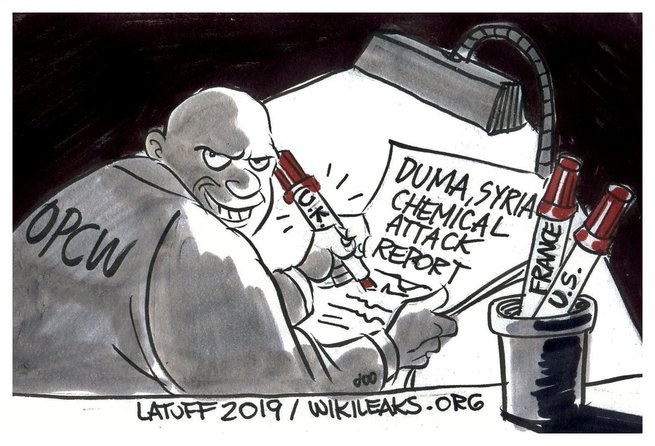
Another whistleblower leak has exposed the fraudulent nature of the Organization for the Prevention of Chemical Weapons (OPCW) report on the alleged chemical weapons attack in the Syrian city of Douma, close to Damascus, on April 7 last year.
The first leak came from the Fact-Finding Mission’s engineering sub-group. After investigating the two sites where industrial gas cylinders were found in Douma and taking into account the possibility that the cylinders had been dropped from the air it concluded that there was a “higher probability” that both cylinders were placed at both sites by hand. This finding was entirely suppressed in the final report.
The engineering sub-group prepared its draft report “for internal review” between February 1-27, 2018. By March 1 the OPCW final report had been approved, published and released, indicating that the engineers’ findings had not been properly evaluated, if evaluated at all. In its final report the OPCW, referring to the findings of independent experts in mechanical engineering, ballistics and metallurgy, claimed that the structural damage had been caused at one location by an “impacting object” (i.e. the cylinder) and that at the second location the cylinder had passed through the ceiling, fallen to the floor and somehow bounced back up on to the bed where it was found.
None of this was even suggested by the engineers. Instead, the OPCW issued a falsified report intended to keep alive the accusation that the cylinders had been dropped by the Syrian Air Force.
Now there is a second leak, this time an internal email sent by a member of the Fact-Finding Mission (FFM) on June 22, 2018, to Robert Fairweather, the British career diplomat who was at the time Chief of Cabinet at the OPCW, and copied to his deputy, Aamir Shouket. The writer claims to have been the only FFM member to have read the redacted report before its release. He says it misrepresents the facts: “Some crucial facts that have remained in the redacted version have morphed into something quite different from what was originally drafted.”
The email says the final version statement that the team “has sufficent evidence to determine that chlorine or another reactive chlorine-containing chemical was likely released from the cylinders is highly misleading and not supported by the facts.” The writer states that the only evidence is that some samples collected at locations 2 and 4 (where the gas cylinders were found) had been in contact with one or more chemicals that contain a reactive chlorine atom.
“Such chemicals,” he continues, “could include molecular chlorine, phosgene, cyanogen chloride, hydrochloric acid, hydrogen chloride or sodium hypochlorite (the major element in household chlorine-based bleach.” Purposely singling out chlorine as one of the possibilities was disingenuous and demonstrated “partiality” that negatively affected the final report’s credibility.
The writer says the final report’s reference to “high levels of various chlorinated organic derivatives detected in environmental samples” overstates the draft report’s findings. “In most cases” these derivatives were present only in part per billion range, as low as 1-2 ppb, which is essentially trace qualitiea.” In such microscopic quantities, detected inside apartment buildings, it would seem, although the writer only hints at the likelihood, that the chlorine trace elements could have come from household bleach stored in the kitchen or bathroom.
The writer notes that the original draft discussed in detail the inconsistency between the victims’ symptoms after the alleged attack as reported by witnesses and seen on video recordings. This section of the draft, including the epidemiology, was removed from the final version in its entirety. As it was inextricably linked to the chemical agent as identified, the impact on the final report was “seriously negative.” The writer says the draft report was “modified” at the behest of the office of Director-General, a post held at the time by a Turkish diplomat, Ahmet Uzumcu.
The OPCW has made no attempt to deny the substance of these claims. After the engineers’ report made its way to Wikileaks its priority was to hunt down the leaker. Following the leaking of the recent email, the Director-General, Fernando Arias, simply defended the final report as it stood.
These two exposures are triply devastating for the OPCW. Its Douma report is completely discredited but all its findings on the use of chemical weapons in Syria must now be regarded as suspect even by those who did not regard them as suspect in the first place. The same shadow hangs over all UN agencies that have relied on the OPCW for evidence, especially the UN’s Independent International Commission of Inquiry on the Syrian Arab Republic, an arm of the OHCHR (Office of the High Commissioner for Human Rights).
This body is closely linked to the OPCW and while both mostly hide the sources of their information it is evident that where chemical weapons allegations have been made, the commission of inquiry has drawn on the OPCW.
As of January 2018, the commission reported on 34 “documented incidents” of chemical weapons use by various parties in Syria. It held the Syrian government responsible for 23 of them and, remarkably, did not hold the armed groups responsible even for one, despite the weight of evidence showing their preparation and use of such weapons over a long period of time.
The commission has made repeated accusations of chlorine barrel bombs being dropped by government forces. On the worst of the alleged chemical weapons attacks, on August 21, 2013, in the eastern Ghouta district just outside Damascus, it refers to sarin being used in a “well-planned indiscriminate attack targetting residential areas [and] causing mass casualties. The perpetrators likely had access to the Syrian military chemical weapons stockpile and expertise and equipment to manipulate large amounts of chemical weapons.”
This is such a travesty of the best evidence that no report by this body can be regarded as impartial, objective and neutral. No chemical weapons or nerve agents were moved from Syrian stocks, according to the findings of renowned journalist Seymour Hersh. The best evidence, including a report by Hersh (‘The Red Line and the Rat Line,’ London Review of Books, April 17, 2014), suggests a staged attack by terrorist groups, including Jaysh al Islam and Ahrar al Sham, who at the time were being routed in a government offensive. The military would have had no reason to use chemical weapons: furthermore, the ‘attack’ was launched just as UN chemical weapons inspectors were arriving in the Syrian capital and it is not even remotely credible that the Syrian government would have authorized a chemical weapons attack at such a time.
Even the CIA warned Barack Obama that the Syrian government may not have been/probably was not responsible for the attack and that he was being lured into launching an air attack in Syria now that his self-declared ‘red line’ had been crossed. At the last moment, Obama backed off.
It remains possible that the victims of this ‘attack’ were killed for propaganda purposes. Certainly, no cruelty involving the takfiri groups, the most brutal people on the face of the planet, can be ruled out. Having used the occasion to blame the Syrian government, the media quickly moved on. The identities of the dead, many of them children, who they were, where they might have been buried – if in fact they had been killed and not just used as props – were immediately tossed into the memory hole. Eastern Ghouta remains one of the darkest unexplained episodes in the war on Syria.
The UN’s Syria commission of inquiry’s modus operandi is much the same as the OPCW’s. Witnesses are not identified; there is no indication of how their claims were substantiated; the countries outside Syria where many have been interviewed are not identified, although Turkey is clearly one; and where samples have had to be tested, the chain of custody is not transparent.
It is worth stepping back a little bit to consider early responses to the OPCW report on Douma. The Syrian government raised a number of questions, all of them fobbed off by the OPCW. Russia entered the picture by arranging a press conference for alleged victims of the ‘attack’ at the OPCW headquarters in the Hague. They included an 11-year-old boy, Hassan Diab, who said he did not know why he was suddenly hosed down in the hospital clinic, as shown in the White Helmets propaganda video.
All the witnesses dismissed claims of a chemical weapons attack. Seventeen countries (Australia, Bulgaria, Canada, the Czech Republic, Denmark, Estonia, France, Germany, Iceland, Italy, Latvia, Lithuania, the Netherlands, Poland, Slovakia, the United Kingdom and the US) then put out a joint statement (April 26, 2018) expressing their full support for the OPCW report and dismissing the “so-called” information session at the Hague as a Russian propaganda exercise. Their statement claimed the authenticity of the information in the OPCW report was “unassailable.”
Russia followed up with a series of questions directed at the OPCW’s technical secretariat. It noted that the OPCW report did not mention that samples taken from Douma were “split” in the OPCW’s central laboratory in the Netherlands and not in the Syrian Arab republic. Fractions of samples were handed to Syria only after six months of insistent pressure (OPCW response: its terms of reference provided for Syria to be provided with samples “to the extent possible” but do not specify when or where samples should be ‘split’).
Russia also referred to the collection of 129 samples and their transfer to OPCW-designated laboratories. 31 were selected for the first round of analysis and an additional batch of 13 sent later. Of the 129 samples 39 were obtained from individuals living outside territory controlled by the Syrian army. Of 44 samples analyzed 33 were environmental and 11 biomedical: of the 44, 11 (four environmental and seven biomedical) were obtained from alleged witnesses.
As remarked by the Russian Federation, the OPCW report does not explain the circumstances in which these samples were obtained. Neither is there any information on the individuals from whom they were taken; neither is there any evidence demonstrating compliance with the chain of custody (OPCW response: there was respect for the chain of custody, without this being explained; the “standard methodology” in collecting samples was applied, without details being given. It stressed the need for privacy and the protection of witness identities).
Russia observed that the samples were analyzed in two unnamed OPCW laboratories and on the evidence of techniques and results, it raised the question of whether the same laboratories had been used to investigate earlier ‘incidents’ involving the alleged use of chlorine. Of the 13 laboratories that had technical agreements with the OPCW, why were samples analyzed at only two, apparently the same two as used before? Russia also observed that of the 33 environmental samples tested for chlorinated products, there was a match (bornyl chloride) in only one case.
Samples taken from location 4, where a gas cylinder was allegedly dropped from the air, showed the presence of the explosive trinitrotoluene, leading to the conclusion that the hole in the roof was made by an explosion and not by a cylinder falling through it (OPCW response: the Fact-Finding Mission did not select the labs and information about them is confidential. As there had been intense warfare for weeks around location four, the presence of explosive material in a broad range of samples was to be expected but this did not – in the OPCW view – lead to the conclusion that an explosion caused the hole in the roof).
Russia pointed out that the FFM interviewed 39 people but did not interview the actual witnesses of the ‘incident’ inside the Douma hospital who appeared and were easily identifiable in the staged videos (OPCW response: the secretariat neither confirms nor denies whether it interviewed any of the witnesses presented by Russia at the OPCW headquarters “as any statement to that effect would be contrary to the witness protection principles applied by the secretariat”).
Russia also pointed out the contradictions in the report on the number of alleged dead. In one paragraph the FFM says it could not establish a precise figure for casualties which “some sources” said ranged between 70 and 500. Yet elsewhere “witnesses” give the number of dead as 43 (OPCW response: the specific figure of 43 was based on the evidence of “witnesses” who claimed to have seen bodies at different locations).
Russia also pointed out that no victims were found at locations 2 and 4, where the ventilation was good because of the holes in the roof/ceiling. Referring to location 2, it asked how could chlorine released in a small hole from a cylinder in a well-ventilated room on the fourth floor have had such a strong effect on people living on the first or second floors? (OPCW response: the FFM did not establish a correlation between the number of dead and the quantity of the toxic chemical. In order to establish such a correlation, factors unknown to the FFM – condition of the building, air circulation and so on – would have had to be taken into account. It does not explain why this was not attempted and how it could reach its conclusions without taking these “unknown factors” into account).
Finally, Russia raised the question of the height from which the cylinders could have been dropped. It referred to the lack of specific calculations in the OPCW report. The ‘experts’ who did the simulation did not indicate the drop height. The charts and diagrams indicated a drop height of 45-180 meters. However, Syrian Air Force helicopters do not fly at altitudes of less than 2000 meters when cruising over towns because they would come under small arms fire “at least” and would inevitably be shot down.
Furthermore, if the cylinders had been dropped from 2000 meters, both the roof and the cylinders would have been more seriously damaged (OPCW response: there were no statements or assumptions in the FFM report on the use of helicopters or the use of other aircraft “or the height of the flight. The FFM did not base its modeling on the height from which the cylinders could have been dropped. “In accordance with its mandate,” the FFM did not comment on the possible altitude of aircraft. The OPCW did not explain why these crucial factors were not taken into account).
In its conclusion, Russia said there was a “high probability” that the cylinders were placed manually at locations 2 and 4 and that the factual material in the OPCW report did not allow it to draw the conclusion that a toxic chemical had been used as a weapon. These conclusions have now been confirmed in the release of information deliberately suppressed by the OPCW secretariat.
As the leaked material proves, its report was doctored: by suppressing, ignoring or distorting the findings of its own investigators to make it appear that the Syrian government was responsible for the Douma ‘attack’ the OPCW can be justly accused of giving aid and comfort to terrorists and their White Helmet auxiliaries whom – the evidence overwhelmingly shows – set this staged ‘attack ’up.
Critical evidence ignored by the OPCW included the videoed discovery of an underground facility set up by Jaysh al Islam for the production of chemical weapons. All the OPCW said was that the FFM inspectors paid on-site visits to the warehouse and “facility” suspected of producing chemical weapons and found no evidence of their manufacture. There is no reference to the makeshift facility found underground and shown in several minutes of video evidence.
Since the release of the report, the three senior figures in the OPCW secretariat have moved/been moved on. The Director-General at the time, Hasan Uzumlu, a Turkish career diplomat, stepped out of the office in July 2018: Sir Robert Fairweather, a British career diplomat and Chief of Cabinet at the OPCW, was appointed the UK’s special representative to Sudan and South Sudan on March 11, 2019: his deputy, Aamir Shouket, left the OPCW in August 2018, to return to Pakistan as Director-General of the Foreign Ministry’s Europe division. The governments which signed the statement that the evidence in the OPCW report was “unassailable” remain in place.
Jeremy Salt has taught at the University of Melbourne, Bosporus University (Istanbul) and Bilkent University (Ankara), specialising in the modern history of the Middle East. His most recent book is “The Unmaking of the Middle East. A History of Western Disorder in Arab Lands” (Berkeley: University of California Press, 2008.)
Remember traditional knowledge?
Climate Discussion Nexus | November 27, 2019
If not, don’t worry. Apparently Canadian authorities don’t either. Outgoing Environment Minister Catherine McKenna decided to reduce the number of polar bears the Inuit can hunt in Nunavik, in northern Quebec, despite their claim that from living on the land they knew there were lots. Now a judge has ruled that all that stuff about the wisdom of the ancestors was just virtue-signaling with forked tongue and that when it matters Eurocentric science elbows the ancestors aside. Which is ironic since even Eurocentric science actually says polar bears are flourishing, even if saying so out loud did get Susan Crockford fired.
The back story is that the Makivik Corporation, which represents the Inuit of Nunavik in legal matters, launched a suit in 2016 saying “By and large, Nunavik residents have observed an increase in the polar bear population, and a particularly notable increase since the 1980s.” Despite which Stephen Harper’s environment minister, Peter Kent, had written to the local wildlife board in 2012 asking them to establish the first-ever quota to limit hunting of the big white cute really scary grizzly bears. (Yes, polar bears are a subspecies of grizzlies.) The board, charged with melding western and traditional ways of thinking, ended up establishing a quota of 28 which the federal and Nunavut governments both rejected, annoying the board, which said the federal decision “clearly disregards the extensive body of Inuit traditional knowledge” relying instead “solely on the scientific population estimate.”
Catherine McKenna then cut the quota to 23, prompting Makavik to accuse her of setting “aside entirely the Inuit traditional knowledge” and failing “to even attempt the integration of the two systems of knowledge.” Not that anyone ever said what to do if they seemed to disagree.
The government of course oozed the usual rhetoric about their great respect for Inuit knowledge and claimed the quota was actually above the sustainable harvest rate of 4.5% if the numbers were as western science claimed. And a Federal Court just upheld the decision, though calling for “better communication”, while a spokesman for the minister said “Indigenous peoples are key partners in conserving and protecting nature, and we recognize their unique perspectives, knowledge, rights and responsibilities that can improve conservation outcomes”. But when they say there are so many bears it’s dangerous, well, our global warming computer model says there aren’t and since we’re in Ottawa we’re not worried if we’re wrong.
Anti-Russian sanctions based on fraudster’s tales? Spiegel finds Magnitsky narrative fed to West by Browder is riddled with lies
RT | November 24, 2019
British investor Bill Browder has made a name for himself in the West through blaming Moscow for the death of his auditor, Sergey Magnitsky. Der Spiegel has picked apart his story and uncovers it has major credibility problems.
For years Browder – Russian President Vladimir Putin’s self-proclaimed “enemy number one” and head of the Hermitage Capital Management fund – has been waging what can only be described as his personal anti-Russian campaign.
The passionate Kremlin critic relentlessly lobbied for sanctions against Russian officials everywhere from the US to Europe – all under the premise of seeking justice for his deceased employee, who died in Russia, while in pre-trial detention, where he’d been placed while accused of complicity in a major tax evasion scheme.
Browder, who was himself sentenced in absentia by a Russian court to nine years in prison for tax evasion, and was later found guilty of embezzlement as well, presented Magnitsky as a fearless whistleblower who exposed a grand corruption scheme within the Russian law enforcement system, and who was then mercilessly killed out of revenge.
The investor has succeeded in feeding this narrative to the Western governments and the mainstream media alike, prompting the US to adopt the Magnitsky Act in 2012, which allowed the US to sanction numerous Russian officials and businessmen over alleged human rights violations. Some American allies, including Canada and the UK, later followed suit and passed similar motions, which either allowed the sanctioning of Russian officials or called on their governments to do it.
Yet, the businessman, who has over the years donned the mantle of a human rights campaigner, does not plan to stop at that and is now lobbying for an EU-wide equivalent of the Magnitsky Act, which would allow the banning of Russian officials from the bloc’s countries and the freezing of their accounts.
On the tenth anniversary of the auditor’s death, the German weekly Der Spiegel has decided to take a closer look at Browder’s story about Magnitsky. And the paper found out that the narrative doesn’t quite flow as smoothly as Western politicians and the MSM would like it to.
No hero
The whistleblower image Browder has built for Magnitsky starts splitting at the seams from the very beginning, as Browder appears to be dishonest, even in minor details like his claim that Magnitsky was his lawyer, Der Spiegel’s Benjamin Bidder reveals in his investigative bombshell.
The problem is that he was not. The man was an auditor, who was hired by Browder’s company as a tax specialist and then worked in this capacity for years with the US-born British investor. Browder himself had to admit this fact when he was questioned in a US court while seeking to make the US impose sanctions on yet another group of Russian entrepreneurs.
Magnitsky’s role as a whistleblower also comes into question as the deceased auditor’s former lawyer confirmed to Der Spiegel’s Bidder that his client had, in fact, been summoned by Russian investigators to provide testimony in a tax evasion case that opened at least months before he came up with his corruption allegations.
Other documents obtained by Der Spiegel, including Magnitsky’s unpublished emails, also suggest that Magnitksy acted not of his own volition but on the instructions of Browder’s senior lawyer, at a time when the Russian authorities had already been investigating dubious letterbox companies Browder supposedly had used in his tax evasion scheme for years.
Finally, the records of Magnitsky’s interrogation, released by Browder’s own people on the internet and seen by Der Spiegel, show that he’d never explicitly accused Russian police officers Artyom Kuznetsov and Pavel Karpov, whom Browder declared to be the masterminds behind the supposed corruption affair, and ultimately behind the auditor’s murder.
This fact was also implicitly confirmed by a UK court, which issued a ruling on a libel lawsuit filed by Karpov against Browder in 2012. Although the court ruled that Karpov simply had no prior reputation to defend in the UK and rejected his claim, it still called Browder a “storyteller,” arguing that he could not even come “close to substantiating his allegations with facts.” The British media, however, presented the verdict as a resounding victory for Browder.
No murder
The German weekly also found similar inconsistencies in the story of the auditor’s supposed murder, as told by Browder. In his claims, the businessman constantly refers to a report by the Moscow Public Monitoring Commissions (PMC) – an independent, non-governmental body consisting of rights advocates that conducted its own thorough investigation into Magnitsky’s death.
Browder maintains that Magnitsky was deliberately murdered. Yet, the commission’s report, which is still freely available on its website, contains no claim of this sort. The commission does decry the harsh jail conditions which the auditor was kept in, and accuses the Russian authorities of failing to fulfil its duty to protect his life. However, it says nothing of murder.
It is not just the text of this report that Browder has apparently distorted, though. In August, the European Court of Human Rights (ECHR) issued a ruling on Magnitsky’s case, ordering Russia to pay his widow and mother €34,000 ($38,000) in damages.
Browder was quick to hail this decision as “destroying the Russian government’s narrative” and proving that “the Russian government murdered Magnitsky.” However, it would seem Browder’s own narrative was dealt a blow instead.
The ECHR never even mentioned the word “murder” in its ruling. Instead it said that Russia basically failed “to protect Mr Magnitsky’s right to life” by providing inadequate medical care and failed “to ensure an effective investigation into the circumstances of his death.”
It even concluded that Magnitsky’s arrest “was not arbitrary, and that it was based on reasonable suspicion of his having committed a criminal offence” – though it did also say there was no “justification” for his lengthy pre-trial detention.
Buying into convenient narrative
In his investigative report, Der Spiegel’s Benjamin Bidder eventually concludes that, although Magnitsky might have fallen victim to some “gruesome injustice,” his image is still far from that painted by Browder in his efforts to pit Russia and the West against each other.
“A question arises whether there has ever been a perfidious political murder plot or the West simply was made to buy into the lie of a fraudster.”
The journalist says that Browder’s “justice for Magnitsky” campaign might have, in fact, been part of his own “personal revenge” on Russia, one that uses the auditor’s fate as fuel for an “argumentative perpetual motion” that helps the businessman himself stay afloat in the sea of Western politics.
Yet, there is another question that needs to be asked: Why did Western politicians and the media support Browder’s narrative so eagerly, without even fact-checking it first? The answer is simple.
According to Bidder, Browder is “so successful because his narrative seems to fit perfectly with the devastating image” that Russia has in the West, making it much more convenient for the media to just toe the line instead of questioning it.
Also on rt.com:
Tycoon who pushed Magnitsky Act warns EU minister that opposing Russia-bashing is ‘career ruining’
Tehran rejects Canada-drafted human rights resolution against Iran
Press TV – November 15, 2019
Tehran has rejected a United Nations human rights resolution against Iran as a “politically motivated” instance of hypocrisy and “abuse” of UN mechanisms by Western governments targeting independent states.
Foreign Ministry spokesman Abbas Mousavi made the comments on Thursday shortly after the Third Committee of the United Nations General Assembly passed a Canada-drafted resolution criticizing Iran’s human rights record earlier in the day.
Of a total number of 182 countries participating in the vote, 84 voted in favor of the resolution while 30 voted against it. Another 66 states abstained.
During the voting session, representatives from countries including Pakistan, Syria, Venezuela and Belarus expressed opposition to the motion.
China and Russia also rejected the resolution as “politicization” of human rights issues while North Korea and Cuba described the vote as an excuse for destabilizing and pressuring other governments.
Double standards
Speaking on Thursday, Mousavi said that among the states backing the resolution were “governments with a long record in the systematic violation of human rights.”
The spokesman added that countries whose interventions in foreign countries and “their allies’ dictatorships and occupation” have left “bitter memories for people across the world” are “in no position to make human rights recommendations for Iran.”
“One of the main backers of this resolution, the United States, is violating the most basic rights of more than 83 million Iranian citizens by engaging in economic terrorism, specifically targeting women, children, seniors and medical patients,” he said.
Mousavi highlighted that certain backers of the resolution, such as Israel and other “backward regimes” in the region, are guilty of killing the people of Palestine, Yemen and oppressing domestic dissidents.
The spokesman added that the Universal Periodic Review, a periodic review of the rights situation held on a rotational basis for all UN member states every three years, presented a suitable opportunity to evaluate the conduct of states far from any sort of discrimination.
“Iran, as a religious democracy, seeks to take steps in the betterment of human and citizen rights on a domestic, regional and international level within the framework of its constitutional and civil commitments and international undertakings,” he said.
Canada, under the heavy influence of Zionist interest groups, is known to regularly draft an anti-Iran resolution every year.
Tehran has in response highlighted that Ottawa itself has long been involved in a broad range of human rights abuses at home and elsewhere.
Canada has proceeded with its plans to supply Saudi Arabia with weapons in the past year despite human rights concerns regarding their use in the ongoing war on Yemen.
Canada has also been accused of a wide range of abuses targeting its aboriginal population.
The word they won’t use to describe Canada’s role in Haiti

Molotov cocktail thrown at Canadian Embassy in Port-au-Prince
By Yves Engler · November 9, 2019
Something you can’t name is very difficult to talk about. Canada’s role in Haiti is a perfect example. Even when the dominant media and mainstream politicians mention the remarkable ongoing revolt or protesters targeting Canada, they fall on their faces in explaining it.
Not one journalist or politician has spoken this truth, easily verified by all sorts of evidence: “Sixteen years ago Ottawa initiated an effort to overthrow Haiti’s elected government and has directly shaped the country’s politics since. Many Haitians are unhappy about the subversion of their sovereignty, undermining of their democracy and resulting impoverishment.”
Last Sunday protesters tried to burn the Canadian Embassy in Port-au-Prince. Voice of America reported, “some protesters successfully set fire to business establishments and attempted to burn down the Canadian Embassy.” A few days earlier protesters threw rocks at the Canadian Embassy and demonstrators have repeatedly speechified against Canadian “imperialism”. In response to the targeting of Canada’s diplomatic representation in the country, Haiti’s puppet government released a statement apologizing to Ottawa and the embassy was closed for a number of days.
Echoing the protesters immediate demand for Jovenel Moïse to go, an open letter was released last Tuesday calling on Justin Trudeau’s government to stop propping up the repressive and corrupt Haitian president. David Suzuki, Roger Waters, Amir Khadir, Maude Barlow, Linda McQuaig, Will Prosper, Tariq Ali, Yann Martel and more than 100 other writers, musicians, activists and professors signed a letter calling on “the Canadian government to stop backing a corrupt, repressive and illegitimate Haitian president.”
While a number of left media ran the letter, major news outlets failed to publish or report on it. Interestingly, reporters at La Presse, Radio Canada and Le Devoir all expressed interest in covering it but then failed to follow through. A Le Devoir editor’s reaction was particularly shameful since the leftish, highbrow, paper regularly publishes these types of letters. The editor I communicated with said she’d probably run it and when I called back three days later to ask where things were at, she said the format was difficult. When I mentioned its added relevance after protesters attempted to burn the Canadian embassy, which she was aware of, she recommitted to publishing it. Le Devoir did not publish the letter when it was submitted to them, although an article published in their paper two weeks later did mention it.
My impression from interacting with the media on the issue is that they knew the letter deserved attention, particularly the media in Québec that cover Haiti. But, there was discomfort because the letter focused on Canada’s negative role. (The letter is actually quite mild, not even mentioning the 2004 coup, militarization after the earthquake, etc.)
On Thursday Québec’s National Assembly unanimously endorsed a motion put forward by Liberal party foreign affairs critic, Paule Robitaille, declaring “our unreserved solidarity with the Haitian people and their desire to find a stable and secure society.” It urges “support for any peaceful and democratic exit from the crisis coming from Haitian civil society actors.”
In March Québec Solidaire’s international affairs critic Catherine Dorion released a slightly better statement “in solidarity with the Haitian people”. While the left party’s release was a positive step, it also ignored Canada’s diplomatic, financial and policing support to Moise (not to mention Canada’s role in the 2004 coup or Moise’s rise to power). Québec Solidaire deputies refused to sign the open letter calling on “the Canadian government to stop backing a corrupt, repressive and illegitimate Haitian president.”
Even when media mention protests against Canada, they can’t give a coherent explanation for why they would target the great White North. On Wednesday Radio Canada began a TV clip on the uprising in Haiti by mentioning the targeting of the Canadian embassy and with the image of a protester holding a sign saying: “Fuck USA. Merde la France. Fuck Canada.” The eight-minute interview with Haiti based Québec reporter Etienne Côté-Paluck went downhill from there. As Jean Saint-Vil responded angrily on Facebook, these three countries are not targeted “because of the ‘humanitarian aid’ that the ‘benevolent self-proclaimed friends of Haiti’ bring to the ‘young democracy in difficulty’. This is only racist, paternalistic and imperialist propaganda! They say ‘Fuck Canada’, ‘Shit France’, ‘Fuck USA”’ because they are not blind, dumb or idiots.”
A few days earlier Radio Canada’s Luc Chartrand also mentioned that Canada, France and the US were targeted by protesters when he recently traveled to Haiti. While mentioning those three countries together is an implicit reference to the 2004 coup triumvirate, the interview focused on how it was because they were major donors to Haiti. Yet seconds before Chartrand talked about protesters targeting the Canada-France-US “aid donors” he mentioned a multi-billion dollar Venezuelan aid program (accountability for corruption in the subsidized Venezuelan oil program is an important demand of protesters). So, if they are angry with “aid donors” why aren’t Haitians protesters targeting Venezuela?
Chartrand knows better. Solidarité Québec-Haiti founder Marie Dimanche and I met him before he left for Haiti and I sent Chartrand two critical pieces of information chosen specifically because they couldn’t be dismissed as coming from a radical and are irreconcilable with the ‘benevolent Canada’ silliness pushed by the dominant media. I emailed him a March 15, 2003, L’actualité story by prominent Québec journalist Michel Vastel titled “Haïti mise en tutelle par l’ONU ? Il faut renverser Aristide. Et ce n’est pas l’opposition haïtienne qui le réclame, mais une coalition de pays rassemblée à l’initiative du Canada!” (Haiti under UN trusteeship? We must overthrow Aristide. And it is not the Haitian opposition calling for it, but a coalition of countries gathered at the initiative of Canada!)
Vastel’s article was about a meeting to discuss Haiti’s future that Jean Chretien’s government hosted on January 31 and February 1 2003. No Haitian representative was invited to the meeting where high level U.S., Canadian and French officials discussed overthrowing elected president Jean-Bertrand Aristide, putting the country under international trusteeship and resurrecting Haiti’s dreaded military. Thirteen months after the Ottawa Initiative meeting, US, French and Canadian troops pushed Aristide out and a quasi-UN trusteeship had begun. The Haitian police were subsequently militarized.
The second piece of information I sent Chartrand was the Canadian Press’ revelation (confirmation) that after the deadly 2010 earthquake, Canadian officials continued their inhumane and antidemocratic course. According to internal government documents the Canadian Press examined a year after the disaster, officials in Ottawa feared a post-earthquake power vacuum could lead to a “popular uprising.” One briefing note marked “secret” explained: “Political fragility has increased the risks of a popular uprising, and has fed the rumour that ex-president Jean-Bertrand Aristide, currently in exile in South Africa, wants to organize a return to power.” The documents also explained the importance of strengthening the Haitian authorities’ ability “to contain the risks of a popular uprising.”
To police Haiti’s traumatized and suffering population 2,050 Canadian troops were deployed alongside 12,000 U.S. soldiers and 1,500 UN troops (8,000 UN soldiers were already there). Even though there was no war, for a period there were more foreign troops in Haiti per square kilometer than in Afghanistan or Iraq (and about as many per capita). Though Ottawa rapidly deployed 2,050 troops officials ignored calls to dispatch this country’s Heavy Urban Search and Rescue (HUSAR) Teams, which are trained to “locate trapped persons in collapsed structures.”
Of course, these two pieces of information run completely counter to the dominant narrative about Canada’s role in Haiti. In fact, they flip it on its head. But, these two pieces of information — combined with hundreds of stories published by left-wing Canadian and Haitian media — help explain why some might want to burn the Canadian Embassy.
Haiti is the site of the most sustained popular uprising among the many that are currently sweeping the globe. Haitians are revolting against the IMF, racism, imperialism and extreme economic inequality. It’s also a fight against Canadian foreign policy.
The latter battle is the most important one for Canadians. Solidarity activists should highlight Haitians’ rejection of 16 years of Canadian disregard for their democratic rights. And they should not be afraid to use the words that describes this best: Canadian imperialism.
Featured Video
Yemen joins the war – Red Sea could be blocked next – Saudi regime at risk
or go to
Aletho News Archives – Video-Images
From the Archives
A superpower and “the world’s sickest warrior state”
By Paul J. Balles | March 8, 2010
Living through five or six major wars has hardened me to what I thought were the extremes of inhuman cruelty and brutality.
Two things made those extremes almost bearable: the brutality always revealed – at least according to the media coverage – the viciousness of the enemy. It was therefore quite understandable when our “brave men and women” pulverized the enemy.
Films of Japanese torturing captive Americans somehow justified holding Japanese Americans in internment camps during World War II; and only a small percentage of Americans found the bombing of Hiroshima and Nagasaki unreasonably vengeful at best, at worst, depraved.
The media giants in America portrayed the North Koreans as barbaric beasts with their captives, quite unlike their southern counterpoints – our allies during the Korean War. No one ever felt the need to explain how the South Koreans were a civilized breed while the North Koreans were absolute savages, at least according to the official line.
In Vietnam, our warriors justifiably (or so the media made us believe) dropped napalm on the North Vietnamese who had the gall to hide in villages and tunnels to ravage our invaders. At least it was accepted practice until some rogue photojournalist filmed a young girl screaming down a Vietnamese road in flames. … continue
Blog Roll
 Aletho News
- Russian tanker approaches Cuba despite US oil blockade
- Marandi: Yemen joins the war – Red Sea could be blocked next – Saudi regime at risk
- Pro-Palestinian French member of European Parliament denied entry to Canada
- Pakistan to Host US-Iran Talks
- How Indonesia’s tilt toward the US left it stranded in the Strait of Hormuz
- US has no choice but to retreat from Iranian borders: Top commander
- Iran Retaliation Strikes Chemical Plant Near Dimona
- AWACS’ Destruction is a Major Loss for US Military – Ex-DoW Analyst
- Israel’s Iran Strategy Uses US Military & Gulf States as Its Pawns
- Iran: Trump wanted regime change, now just begging for Hormuz to open
- If Americans Knew
- Israeli police block Catholic cardinal from entering Church of the Holy Sepulchre on Palm Sunday
- Israel is assassinating journalists again, more than any other nation, anywhere, ever – Not a ceasefire Day 170
- Over 300 US service members wounded, majority have brain injuries – Not a ceasefire Day 169
- Researchers at Human Rights Watch Resign Over Blocked Report on Palestinian Refugee Return
- Jewish Groups Are Backing a War Americans Don’t Want
- Eric Fingerhut Thinks He’s the President of the Jews
- Top Jewish Philanthropists, Rabbis Urge Israeli President to Take Action Against ‘Jewish Extremists’
- Don’t Be Fooled. Zionist Leaders Have Always Wanted to Control Southern Lebanon
- Israel’s widespread use of torture is a core element of its genocide against the Palestinian people
- In Israel’s War on Iran, Many Middle East US Bases Rendered “All But Uninhabitable”
- No Tricks Zone
- German Science Blog Accuses PIK Climate Institute Of Hallucinating Climate Tipping Points
- Devastating Assessment Of Comirnaty Vaccine By Former Senior Pfizer Europe Toxicologist
- New Study: CO2 Is ‘Effectively Negligible’ As An Explanatory Climate Change Factor Since 2000
- Former Pfizer Toxicologist Dr. Helmut Sterz Tells Bundestag Hearing Pfizer Vaccine Should Have Never Been Approved
- Energy Expert: Germany’s Nuclear Phaseout Was A “500 Billion Euro Mistake”
- New Research: South Australia’s Mid-Holocene Sea Surface Temperatures Were 4°C Warmer Than Today
- Storing Green Energy To Last Germany 10 Days Would Require A 60-Million Tonne Battery
- New Studies: UK Sea Levels Were 4 Meters Higher Than Today During The Mid-Holocene
- Destructive Green New Deal: German Energy And Metal Group Warns Of Drastic Crisis
- New Study Documents A 20-Year Pause In Arctic Sea Ice Decline – Driven By Internal Variability
 Aletho News