Canada sells Iran’s properties, gives money away to ‘terror victims’
Press TV – September 13, 2019
Canada has gifted some $30 million worth of Iranian assets to the victims of terrorist attacks in which Iran says has not been involved, Canadian media reported.
The victims have received their share of the money earned through the sale of two Iranian-owned buildings in Ottawa and Toronto, according to a document filed in the Ontario Superior Court of Justice in August.
The valuable Ottawa property, sold for $26.5 million, was used as the Iranian Cultural Center, and the Toronto building, sold for $1.85 million, served as the Center for Iranian Studies, the Global News reported.
In addition to the $28 million earned from the sale of the two properties, the victims were also awarded a share of some $2.6 million seized from Iran’s bank accounts. Documents also list a Toyota Camry and Mazda MPV.
The recipients include several American families who have filed claims in the Ontario and Nova Scotia courts, seeking a share of Iran’s assets seized by the Canadian government.
In particular, they include the family of Marla Bennett, a US citizen killed in a 2002 bombing that rocked the Hebrew University in Jerusalem al-Quds.
The attacks are mostly blamed on Palestinian and Lebanese resistance movements Hamas and Hezbollah. The families claimed that the Iranian government supported the two organizations and was therefore responsible for their actions.
The complaints were first filed in the US but the claimants turned to Canada after finding out that the Iranian government had more properties and bank accounts there.
In July 2017, a Canadian court required the Islamic Republic to pay around $1.7 billion in damages to “American victims of terrorism.”
Iran has denied any role in the attacks which the courts have based their cases on to appropriate the country’s frozen assets.
Tehran had argued that the victims had to prove Iran’s role in each attack instead of just repeating the US government’s baseless allegations.
The seizure and sale of Iranian assets in Canada come as the country has turned into a center of fraud and a safe haven for embezzlers who manage to escape justice in the Islamic Republic of Iran, according to Iran’s prosecutor general Mohammad Jafar Montazeri.
Mahmoud Reza Khavari, a former Iranian banker, fled to Canada after a $2.6 billion financial fraud came to light in 2011. He was sentenced to 30 years in prison and the Interpol issued a warrant for him in December 2017.
Marjan Sheikholeslami, accused of embezzling public funds in Iran in two separate cases, has also fled to Canada. In 2010, amid the international sanctions on Iran, she founded various companies in Iran and Turkey to help Iran bypass the sanctions and sell its petrochemical products, but has reportedly refused to pay back the government’s money.
The company Irwin Cotler keeps: Paul Kagame, Alan Dershowitz and (maybe) the Montreal mob and Jeffrey Epstein
By Yves Engler · September 8, 2019
 If the ancient storyteller Aesop was correct and “a man is known by the company he keeps” what can we learn about Irwin Cotler from his friends and associates?
As I’ve written, the former Liberal justice minister has been a leading anti-Palestinian activist for decades. More recently, he has sought to unseat Venezuela’s government and stoke confrontation with Iran and Russia. Since writing two stories about Cotler earlier this year I’ve come across more about his dubious human rights credentials and links to some questionable characters, including:
- The MEK. Cotler has enabled the violent, cult like, Iranian Mujahedin-e Khalq. In 2012 the Jewish Telegraphic Agency cited Cotler, alongside Alan Dershowitz and Elie Wiesel, as prominent pro-Israel activists who worked with Iranians dissidents to convince the State Department to remove the MEK from the US terrorism list, which paved the way for Ottawa to follow suit. In 2014 Cotler invited MEK leader, Maryam Rajavi, to speak at Iran Accountability Week on Parliament Hill. In “We asked Canadian politicians why they engaged with a ‘cult’-like group from Iran”, Shenaz Kermalli points out that Cotler regularly attends events organized by the MEK-aligned groups Canadian Friends of a Democratic Iran and National Council of Resistance of Iran. The MEK backed Iraq in the 1980s Iran-Iraq war and, according to US government sources, teamed up with Israel to assassinate Iranian scientists more recently. It is thought to be funded by Saudi Arabia.
- Paul Kagame. Asked about Kagame’s human rights record on the sidelines of an event on Rwanda in April, Cotler refused to criticize Africa’s most bloodstained leader. Cotler and the Rwandan president both attended the 2017 American Israel Public Affairs Committee (AIPAC) conference in Washington, DC, and the self-declared human rights champion spoke alongside the “Butcher of Africa’s Great Lakes region” later that year. Cotler has also participated in events put on by the Rwandan High Commission in Ottawa. In 2008 Cotler pushed a House of Commons motion to commemorate genocide prevention/Rwanda’s genocide on April 7. The choice of the day reflects the simplistic, one-sided, version of Rwanda’s tragedy Kagame promotes to legitimate his dictatorship and belligerence in the region. On April 6, 1994, the plane carrying Rwandan President Juvénal Habyarimana and Burundian President Cyprien Ntaryamira was shot down, unleashing the genocidal killings. So why choose April 7, rather than April 6, to commemorate genocide prevention/Rwanda’s genocide? Because Kagame’s RPF shot down the plane carrying the two Hutu presidents and most of Rwanda’s military command, which facilitated their seizing power after a multi-year war
- Proponents of the Responsibility to Protect (R2P) doctrine. A high-minded cover for Western imperialism, R2P was cited by Paul Martin’s government, which included Cotler as justice minister, to justify overthrowing elected Haitian president Jean Bertrand Aristide. Thousands were killed in post-coup violence. Cotler called R2P “arguably the most significant development in the defence of human rights since the 1948 Universal Declaration of Human Rights.” In 2011 Cotler pushed for R2P to be invoked in Libya. He co-wrote a New York Times op-ed headlined “Libya and the Responsibility to Protect” that argued for ousting Muammar Gaddafi. They wrote, “the Security Council should adopt a new resolution to immediately extend recognition to the nascent provisional government of the country, authorize a NATO-supported no-flight zone over Libya to preclude any bombing of civilians, and permit all U.N. members to provide direct support to the provisional government.” That’s largely what transpired. But the NATO war has been a disaster. Eight years later Libya remains divided and the NATO bombing destabilized large parts of Africa’s Sahel region.
- Proponents of the Magnitsky Act. Cotler led the campaign for Canada to adopt sanctions legislation modeled after the 2012 US Magnitsky Act. Designed to demonize Russia, Ottawa immediately sanctioned Russian and Venezuelan officials under legislation that allows the government to freeze individuals’ assets/visas and prohibit Canadian companies from dealing with sanctioned individuals. Cotler recently called for Canada to invoke the 2017 Magnitsky Act to “impose sanctions in the form of travel bans and asset freezes” on Iranian officials. The legislation is named after Sergey Magnitsky who proponents claim was tortured to death for exposing Russian state corruption. The source of the claim is William Browder, an American who got rich amidst the fire sale of Russian state assets in the 1990s. With billionaire banker Edmond J. Safra, Browder co-founded Hermitage Capital Management, which became the largest hedge fund in Russia. Hermitage Capital earned a staggering 2,697% return between 1996 and 2007. Those who question the western-backed story line say Magnitsky was an accountant who helped Browder claim illicit tax breaks. According to this version of the story, Browder exploited Magnitsky’s death – caused by inhumane jail conditions – to avoid being extradited to Russia on tax fraud charges. Investigative journalist Adrian duPlessis recently emailed me about Cotler being “the person who’s opened doors for Browder and his scam in Ottawa.” duPlessis has followed Browder for years, receiving a 1998 National Newspaper Award for Business Reporting about Russian mafia money in North America. As part of the campaign for Canada to adopt the Magnitsky Act, Cotler held multiple press conferences and public meetings with Browder. (While it’s hard to be confident about the truth, I find it difficult to believe that a US capitalist who got rich in Russia in the 1990s would simply turn into a human rights activist. On the other hand, the idea that a wealthy and powerful individual meshed self-preservation with growing Russophobia seems plausible.)
- Organized crime. duPlessis pointed me to Le Journal de Montréal coverage of Cotler’s business associates’ ties to the Montréal mafia. In one of two stories from 2015 the newspaper noted, “for the last decade or so, former Minister of Justice Irwin Cotler has been a shareholder in a company that has financed promoters close to organized crime.” In one of the firms, Faybess Investments, Cotler owned a third of the shares and in the other, Ace Investments, 1/6 of the company. Cotler’s main associates in these companies — Hyman Bloom and Richard Dubrovsky — invested millions of dollars with the notorious Rizzuto family. The police bugged Dubrovsky and Bloom’s offices and their names came up at the Charbonneau inquiry into corruption in Québec. Cotler claimed his role in the companies was passive even though he was vice president of Faybess, which he co-founded with Dubrovsky, for part of the period in question.
- Alan Dershowitz, an important figure in the Jeffrey Epstein pedophilia/rape scandal. Dershowitz negotiated (partly through intimidation) the scandalous “non-prosecution agreement” under which Epstein served 13 months in a Florida jail, which was largely spent on “work release” in an office. A close friend of Epstein, Dershowitz is accused of raping two of Epstein’s sex slaves. In a court filing Virginia Roberts said, “Dershowitz was so comfortable with the sex that was going on that he would even come and chat with Epstein while I was giving oral sex to Epstein.” Roberts added that she had sex with Dershowitz “at least six times”. In the 2015 article “Israel defender Alan Dershowitz has long history of attacking sex abuse victims” Rania Khalek details his aggressive anti-woman positions. In 1997 Dershowitz argued that “puberty is arriving earlier, particularly among some ethnic groups.” As such, the eminent lawyer called for — a position repeated recently — the age of consent to be lowered (if a child reaches puberty at ten should they be legitimate targets for sexual predators?). A close friend and political ally, Cotler would have almost certainly been aware of Dershowitz’s position. In 2004 the Globe and Mail reported, “Dershowitz and Mr. Cotler met at Yale Law School in the early 1960s and are so close that the first person Mr. Cotler called after being appointed to cabinet last December was his friend at Harvard.” In 2014 Dershowitz called Cotler “my mirror image in Canada” and nominated him for the Nobel Peace Prize in 2016. They are both currently part of the Honorary Board of the Jewish Coalition for Kurdistan and Dershowitz is a Senior Fellow at the Cotler chaired/founded Raoul Wallenberg Centre for Human Rights. According to Cotler, “everyone regards Alan as not only the best defender of Israel, but the best defender of the most just of causes in the court of public opinion.” In the Acknowledgments section for The Vanishing American Jew Dershowitz lists Cotler’s name right before Epstein’s. They are both also listed in the Acknowledgments for The Case for Israel.
- Leslie Wexner. Cotler has done a series of events with the Wexner Foundation, including serving as “distinguished faculty member” at the Wexner Israel Fellowship Alumni Institute in Haifa. Jeffrey Epstein was one of three trustees of the Wexner Foundation for over a decade and its namesake, Leslie Wexner, was the main source of Epstein’s wealth. Epstein had power of attorney for a significant portion of Wexner’s fortune and in May 1997 Epstein posed as a talent scout for Victoria’s Secret — owned by Wexner — to lure model Alicia Arden to his hotel room where he sexually assaulted her.
- Other key figures in the Epstein sex scandal. Epstein’s decades-long sex ring coordinator/partner Ghislaine Maxwell is the daughter of Robert Maxwell, a crooked British press baron and Mossad spy. Bill Browder worked for Robert Maxwell before he died in a mysterious boating incident in 1991. Additionally, the co-founder of Hermitage Capital with Browder was Edmond Safra whose name is cited in Epstein’s little black book. Cotler has repeatedly spoken at the Edmond J. Safra synagogue and, as mentioned previously, Cotler hosted a series of events with Browder.
Perhaps all this company that Cotler has kept means nothing, but you’d think, at a minimum, the political, corporate and media establishment that promote his ‘human rights’ credentials might be made anxious by the possibilities it suggests. You’d also think that some mainstream investigative journalist would ask questions. I emailed Cotler to ask if he had met Jeffrey Epstein, been on his private plane or private island. Of course he failed to respond to my repeated messages, but maybe Cotler would feel compelled to answer a CBC, CTV, Globe and Mail, Montreal Gazette or Toronto Star journalist.
Canada and the Palestinians: Out of Balance
By Faisal Bhabha | MEMO | September 1, 2019
As Canada approaches a federal election next month, there appears to be little difference between the two main rival parties – the Liberals and the Conservatives – when it comes to supporting Israel at the expense of Palestinian human rights. The main difference is that the Conservatives have been clear and open about their one-sided support for Israel, while the Liberals claim to be balanced while acting in a partisan manner.
To be sure, Canadian policy on Israel-Palestine has always walked a fine line. On the one hand, Canada is committed to international law, which includes viewing the Israeli occupation of Palestinian territory as necessarily temporary, Israeli settlements as clearly illegal, Jerusalem as a mixed, shared city, and Palestinian refugees as presumptively entitled to return to their homeland.
On the other hand, Canada views Israel as a close ally and a fellow liberal democracy. Canada has always endorsed the Zionist idea that the world’s Jews are entitled to a state in the Middle East. Regardless of whether Canadian governments have been Liberal or Conservative, support for Israel as a Jewish state has been constant.
Yet during a decade of Conservative rule (2006-2015), the Canadian tradition of encouraging respect for international law and promoting a just peace in the Middle East gave way to hyper-partisan support for the most right-wing government in Israel’s history.
During Israel’s 2014 assault on Gaza, which killed hundreds of innocent Palestinians (including scores of children), Canadian government officials blamed the Palestinians and trumpeted Israel’s “right” to defend itself. Canada punished the Palestinians by holding back aid, blocking Canadian doctors from volunteering in Gaza, and refusing visas to injured Palestinian children invited to receive treatment in Canada.
The election of a Liberal government in 2015, with its young, charismatic prime minister, was expected to usher in a new era in Canadian politics. The Liberal caucus was more diverse than any in the past. Justin Trudeau was unapologetic in his efforts to enhance representation and promote equality. He boldly declared, in response to a question about why gender parity in cabinet was important to him, “because it’s 2015”. Virtue needs no justification.
Those looking for a principled approach to Canadian policy in the Middle East might have dared to hope for a return to even-handedness. However, they would quickly discover that Trudeau’s progressive idealism does not include Palestinian human rights.
Even before the election, Trudeau had taken aim at BDS – the call for boycott, divestment and sanctions against Israel. Since around 2005, Palestinian activists have called for the use of this non-violent advocacy tactic – modelled on South Africa’s struggle against Apartheid – in the face of failed diplomatic efforts to bring an end to Israel’s decades-long military occupation.
BDS seeks to pressure Israel to comply with international law. It has been promoted through various initiatives, including campus awareness events like Israeli Apartheid Week, which was pioneered in Toronto and has spread to more than 50 cities around the world.
Yet instead of aligning himself with the global justice movement, Trudeau allied himself with Israel’s most hardline supporters. In March 2015, he tweeted: “The BDS movement, like Israeli Apartheid Week, has no place on Canadian campuses.”
Trudeau must have been either being ignorant or strategic. He certainly was aware that plenty of reputable individuals and groups have endorsed BDS, and many more have refused to condemn it.
However, Trudeau was also aware that standing up for human rights – at least when it comes to Palestine – attracts a high political cost. For example, in 2006 the highly respected former US President, Jimmy Carter, published his book, Palestine: Peace Not Apartheid. The reaction was swift and strong. Abraham Foxman, then long-serving head of the US Anti-Defamation League (ADL), labelled Carter an anti-Semite. The US’ Brandeis University lost donors after hosting a book talk by Carter. The Nobel Laureate faced a frontal assault to his reputation.
From December 2008 to January 2009, Israel carried out Operation Cast Lead. The relentless battering of the impoverished Gaza Strip was ostensibly provoked by missile attacks. Israel killed 1,409 Palestinians, the overwhelming majority of whom were civilians, including hundreds of children. On the Israeli side, three civilians and ten combatants were killed, four by friendly fire.
The Israeli assault on Gaza led to a UN-initiated investigation, headed by South African jurist Richard Goldstone. His September 2009 report was critical of Israel, finding its military had intentionally used disproportionate force against Palestinian civilians.
Later that year, Benjamin Netanyahu was elected Prime Minister of Israel. He immediately began working to improve Israel’s diminishing global reputation. The apartheid analogy, the call for BDS, the Goldstone Report – these all signaled a shift in opinion that deeply unsettled Netanyahu. Goldstone was viciously smeared and shunned. Netanyahu’s “number one fan”, Harvard law professor Alan Dershowitz, called Goldstone (a former colleague and friend) a “traitor to the Jewish people”.
In May 2010, the Israeli daily Haaretz reported that Israel’s Foreign Ministry was planning to use front groups to transmit hasbara (propaganda, or public relations) messages in order to influence “senior politicians, opinion shapers and journalists” in the West. Hasbara operates by seeking to explain and re-frame Israel’s record of abuse, while attacking its critics.
Hasbara found enthusiastic foot soldiers in Canada. Canada’s Jewish population today is one of the most pro-Israel diaspora communities in the world.
The group Hasbara Fellowships claims to have taken more than 3,000 university and college students from 250 different North American campuses to Israel for 16-day trips where the students learn “positive messaging” tactics to brand Israel.
Aish Toronto, which runs Hasbara Fellowship Canada, states that it takes “hundreds of students” to Israel every summer and winter, “giving them the information and tools to return to their campuses as educators about Israel”. Other groups, such as StandWithUs Canada, are likewise trained to act as “campus emissaries of the Jewish state”.
The Canadian Centre for Israel and Jewish Affairs (CIJA), the dominant pro-Israel lobby group established in 2004, contributes millions of dollars to campus hasbara activism. It has a staff of 50 and a $10 million budget to provide “advocacy support to 25 campuses in 9 provinces”. CIJA works closely with Hillel and other on-campus student groups to sanitise Israel’s reputation and delegitimise BDS activism.
B’nai Brith and the Simon Wiesenthal Center Canada have also, in recent years, focused their activities on demonising Palestinian solidarity activists and spreading the smear that BDS is anti-Semitic. Much of their work is concentrated on pushing pro-Israel campus advocacy.
In the US, B’nai Brith created “The Lawfare Project”, whose raison d’être is to intimidate and silence Palestinian solidarity activism. In Canada, the recently created Canadians for the Rule of Law (CFRL) seeks to mimic the Lawfare Project, and has already held a controversial “teach-in” to mobilise anti-Palestinian activists.
All of this appears to be working. In February 2016, the opposition Conservatives, just six months after their electoral defeat, introduced a motion in the House of Commons condemning “any and all attempts by Canadian organisations, groups or individuals to promote the BDS movement, both here at home and abroad”.
Despite a Liberal majority in the House, the Conservatives’ anti-BDS motion passed by a vote of 229 to 51. In a rare moment of bipartisanship, virtually every Liberal and Conservative Member of Parliament (MP) supported it.
More than three years before the US Congress gained its two outspoken Muslim Representatives, Rashida Tlaib and Ilhan Omar, the Canadian House of Commons had the arrival of an unprecedented number of Muslim MPs: ten Liberal and one Conservative. Yet not one stood up for Palestinian human rights by voting against the anti-BDS motion, despite the fact that three out of four Canadian Muslims surveyed would support some sort of international sanctions against Israel.
In fact, a silent majority of nearly two thirds of Canadians believe their government is biased in Israel’s favour. Yet, prominent Liberal MP Anthony Housefather (Mount Royal) recently took pride in highlighting in a Canadian Jewish newspaper the fact that the Liberal government has been more pro-Israel in international relations than any previous government of either major party:
We [Liberals] have voted against 87% of the resolutions singling out Israel for condemnation at the General Assembly versus 61% for the [Conservative] Harper government, 19% for the [Liberal] Martin and [Conservative] Mulroney governments and 3% for the [Liberal] Chrétien government. We have also supported 0% of these resolutions, compared to 23% support under Harper, 52% under Mulroney, 71% under Martin and 79% under Chrétien.
How a Liberal government that fancies itself a champion of social justice could denigrate a legitimate human rights movement and brag about it for expected political gain is no mystery. Canada has a vibrant and active Palestinian solidarity movement, but it pales in comparison to the well-resourced pro-Israel lobby.
Leftists and civil libertarians, including the Ontario Civil Liberties Association and a number of labour organisations, have pushed back against the embrace of anti-BDS politics. Tyler Levitan of Independent Jewish Voices said: “It is outrageous for our elected representatives to publicly chastise human rights supporters, and falsely accuse them of hatred and bigotry for standing in solidarity with the victims of Israeli state violence and oppression.”
In January 2019, Trudeau doubled down on his condemnation of BDS. Claiming concern for Jewish students who “still feel unwelcome and uncomfortable in some of our college and university campuses because of BDS-related intimidation”, Trudeau remained silent on the rising number of innocent Palestinians injured and killed at the Gaza border after months of mostly peaceful protest.
Organisations like Amnesty International, Human Rights Watch, B’Tselem and the UN High Commission for Human Rights have called Israel’s actions disproportionate, unjustified and illegal.
Trudeau attacked human rights defenders, while Israel pummeled Palestinian civilians.
For those who were still waiting for a sliver of principle from a prime minister seeking re-election, he has left little room for question as to how he lines up his priorities. Sadly for Canadians, the main alternative in the upcoming election – the populist Conservatives – could care even less about the Palestinians or their defenders. Conservative concern for free speech ends precisely where the subject of Palestine begins.
Canadians should be – but are not apparently – alarmed by the demise of integrity in our country’s approach to Middle East policy and international human rights. While most Canadians may acknowledge the imbalance in Canadian foreign policy, few seem sufficiently bothered to make it an election issue. Perhaps Trudeau’s gamble with duplicity will pay off after all.
Read also:
41 US Democrats land in Israel for AIPAC-affiliated tour
‘In US universities students who criticise Israel are under attack’
Liberals use RCMP in attempt to silence critics of their foreign policy
By Yves Engler · August 30, 2019

On Tuesday two RCMP agents came to my house. Two large men in suits asked for me and when my partner said I wasn’t there they asked who she was.
Why didn’t they email or call me to talk or set up a meeting? If they have my address, the RCMP certainly has my email, Facebook, Skype or phone number. My partner asked for their badges, took their photo and asked them to leave the stairway they had entered.
They returned the next day. Not wanting to interact, my partner ignored them. They rang the doorbell multiple times over many minutes. After she saw people at the restaurant across the street wondering what was going on – from the ground you can see into the front of our place – she poked her head down the stairway where they caught her eye. They asked why I didn’t call even though they didn’t leave a number.
The visits are a transparent effort to intimidate me from directly challenging the government’s pro-corporate and pro-empire international policies.
The day before their first visit to my house two RCMP officers physically removed me from a press conference when I asked Transportation Minister Marc Garneau about Canadian arm sales to Saudi Arabia. When I sat down at an event that was already underway an officer took the seat next to me. When I began to ask a question at the end of the press conference he used the cover of private property to try to block me. On this video one can see the RCMP agent asking the building security twice if I’m welcome in the space. Deferring to police, the security guard tells him I’m not welcome. The RCMP agent, who doesn’t have the right to remove me from the room without a directive, then uses the authority derived from a representative of the building to physically eject me and threaten arrest.
Last Wednesday lawyer Dimitri Lascaris and I were blocked from a talk by the prime minister at the Bonaventure Hotel in a similar way. In my case an RCMP agent called out my name as I entered the hotel and then accompanied me in the elevator, through a long lobby and down an escalator to ‘introduce’ me to hotel security. The representative of the hotel then said I wasn’t welcome, which gave the officer the legal authority to ask me to leave. Lascaris details the incident in “The RCMP’s Speech Police Block Yves Engler and Me From Attending A Speech By Justin Trudeau.”
After starting to write this story, I was targeted by the RCMP for removal from a press conference by Justice Minister David Lametti. On Thursday, a Concordia University security guard, who I walked past to enter the room, came up to me 15 minutes later and asked for my press credentials. There were two dozen people in the room who didn’t have press credentials and the release for the event said nothing about needing them. The RCMP agent admitted that he asked Concordia security to approach me. He also said he was only there for the physical — not political — protection of the minister, but refused my suggestion that he and the Concordia security agents sit next/in front of me to ensure the minister’s physical safety.
(Here is the question I planned to ask the Justice Minister: “Minister Lametti you have an important decision to make in the coming days about whether you believe in international law and consumer rights. As you know the Federal Court recently ruled against your government’s decision to allow wines produced on illegal settlements in the West Bank to be labeled as ‘Products of Israel’. While anti-Palestinian groups are pressuring your government to appeal the decision, the NDP and Greens want you to stop wasting taxpayer money on this anti-Palestinian agenda. Will you commit to accepting the court’s sensible ruling that respects consumers, international law and Palestinian rights?”)
Over the past six months Lascaris, I and other members of Solidarité Québec-Haiti and Mouvement Québécois pour la Paix have interrupted a dozen speeches/press conferences by Liberal ministers/prime minister to question their anti-Palestinian positions, efforts to topple Venezuela’s government, support for a corrupt, repressive and illegitimate Haitian president, etc. We are open about our actions and intentions, as you can read in this commentary. We film the interruptions and post them online. (If any illegal act were committed the RCMP could easily find all they need to charge me on my Facebook page!) The interruptions usually last no more than a couple of minutes. No politician has been stopped from speaking, let alone threatened or touched.
Did the RCMP receive a directive from a minister to put a stop to our challenging their policies? The federal election is on the horizon and government officials will increasingly be in public. The Trudeau government is playing up its ‘progressive’ credentials, but the interventions highlight how on one international policy after another the Liberals have sided with corporations and empire.
From the government’s perspective, having their PR announcements disrupted is a headache, but that’s democracy. The right to protest, to question, to challenge policies outweighs politicians’ comfort.
Creator Of Global-Warming’s Infamous “Hockey Stick” Chart Loses ‘Climate-Science’ Lawsuit
By Tyler Durden – Zero Hedge – 08/27/2019
Update 1: Michael Mann disputes the notion that he lost (and more): “There have been some wildly untruthful claims about the recent dismissal of libel litigation against Tim Ball circulating on social media.”
There have been some wildly untruthful claims about the recent dismissal of libel litigation against Tim Ball circulating on social media. Here is our statement (https://t.co/8tGoBZnE3Y): pic.twitter.com/ySeJcOktX9
— Michael E. Mann (@MichaelEMann) August 23, 2019
* * *
Update 2: technology.news has a rather different take than Mann, noting that further legal steps are on their way.
Penn State climate scientist, Michael ‘hockey stick’ Mann commits contempt of court in the ‘climate science trial of the century.’ Prominent alarmist shockingly defies judge and refuses to surrender data for open court examination. Only possible outcome: Mann’s humiliation, defeat and likely criminal investigation in the U.S.
The defendant in the libel trial, the 79-year-old Canadian climatologist, Dr Tim Ball … is expected to instruct his British Columbia attorneys to trigger mandatory punitive court sanctions, including a ruling that Mann did act with criminal intent when using public funds to commit climate data fraud. Mann’s imminent defeat is set to send shock waves worldwide within the climate science community as the outcome will be both a legal and scientific vindication of U.S. President Donald Trump’s claims that climate scare stories are a “hoax.” (snip)
Michael Mann, who chose to file what many consider to be a cynical SLAPP (Strategic Lawsuit Against Public Participation) libel suit in the British Columbia Supreme Court, Vancouver six long years ago, has astonished legal experts by refusing to comply with the court direction to hand over all his disputed graph’s data. Mann’s iconic hockey stick has been relied upon by the UN’s IPCC and western governments as crucial evidence for the science of ‘man-made global warming.’ (snip)
The negative and unresponsive actions of Dr Mann and his lawyer, Roger McConchie, are expected to infuriate the judge and be the signal for the collapse of Mann’s multi-million dollar libel suit against Dr Ball. It will be music to the ears of so-called ‘climate deniers’ like President Donald Trump and his EPA Chief, Scott Pruitt.
As Dr Ball explains:
“Michael Mann moved for an adjournment of the trial scheduled for February 20, 2017. We had little choice because Canadian courts always grant adjournments before a trial in their belief that an out of court settlement is preferable. We agreed to an adjournment with conditions. The major one was that he [Mann] produce all documents including computer codes by February 20th, 2017. He failed to meet the deadline.”
Punishment for Civil Contempt
Mann’s now proven contempt of court means Ball is entitled to have the court serve upon Mann the fullest punishment. Contempt sanctions could reasonably include the judge ruling that Dr. Ball’s statement that Mann “belongs in the state pen, not Penn. State’ is a precise and true statement of fact. This is because under Canada’s unique ‘Truth Defense’, Mann is now proven to have wilfully hidden his data, so the court may rule he hid it because it is fake. As such, the court must then dismiss Mann’s entire libel suit with costs awarded to Ball and his team.
* * *
Authored by Thomas Lifson via AmericanThinker,
Michael Mann, a climatologist at Penn State University, is the creator of the “hockey stick graph” that appears to show global temperatures taking a noticeable swing upward in the era when humanity has been burning fossil fuels and dumping CO2 into the atmosphere.
The graph was first published in 1998, prominently featured in the 2001 UN Climate Report, and formed part of Al Gore’s 2006 movie, An Inconvenient Truth.

The graph’s methodology and accuracy have been and continue to be hotly contested, but Mann has taken the tack of suing two of his most prominent critics for defamation or libel.
One case, against Mark Steyn, is called by Steyn likely to end up in the Supreme Court. But another case, against Dr. Tim Ball was decided by the Supreme Court of British Columbia, with Mann’s case thrown out, and him ordered to pay the defendant’s legal costs, no doubt a tidy sum of money. News first broke in Wattsupwiththat, via an email Ball sent to Anthony Watt. Later, Principia-Scientific offered extensive details, including much background on the hockey stick.
The Canadian court issued it’s final ruling in favor of the Dismissal motion that was filed in May 2019 by Dr Tim Ball’s libel lawyers.
Not only did the court grant Ball’s application for dismissal of the nine-year, multi-million dollar lawsuit, it also took the additional step of awarding full legal costs to Ball. A detailed public statement from the world-renowned skeptical climatologist is expected in due course.
This extraordinary outcome is expected to trigger severe legal repercussions for Dr Mann in the U.S. and may prove fatal to climate science claims that modern temperatures are “unprecedented.” […]
Dr Mann lost his case because he refused to show in open court his R2 regression numbers (the ‘working out’) behind the world-famous ‘hockey stick’ graph (shown above).
Real science, not the phony “consensus” version, requires open access to data, so that skeptics (who play a key role in science) can see if results are reproducible. Of course, there are no falsifiable experimental data associated with the global warming predictions of doom, so it doesn’t really stand as science as Karl Popper defined it.
This is an important victory in the process of debunking the warmist scare.
Time to Breach the Wall of Silence on Supporting Israeli War Crimes!
By Marion Kawas | Palestine Chronicle | August 25, 2019
The federal election in Canada is coming up on October 21, 2019, and once again there is a debate, both within the Palestinian community and the solidarity movement, on the best tactics and strategies to hold politicians to account. Parameters have shifted dramatically since 2015; four years ago, current PM Justin Trudeau of the Liberal Party was still a shiny new commodity with untested big promises, and the Trump/Netanyahu racist “shock and awe” assault had yet to launch. Successive Canadian governments have been complicit in dispossessing Palestinians for over 70 years now, a legacy that has cut across party lines; activists are more determined than ever that politicians will not escape responsibility for their callous and racist anti-Palestinian stands.
Trudeau has lost credibility with many in Canada who thought he would bring a fresh perspective to foreign policy, especially on the issue of support for Palestinian rights. His government has voted the same way as the previous Conservative one at the United Nations on multiple resolutions, and one Liberal MP even bragged that the Trudeau government’s record surpassed its predecessor and was “almost identical” to the U.S. in protecting Israel; they helped pass a nasty anti-BDS motion in the House of Commons which condemned even individuals who support boycotting Israel; and a government minister wrapped it all up by endorsing the dangerous IHRA definition of anti-Semitism in June of this year. The government also reversed an initial decision by the Canadian Food Inspection Agency on the correct labeling of settlement wines, something that was successfully challenged in Federal Court with a recent ruling that determined the “Product of Israel” label was “false, misleading and deceptive”; whether there will be an appeal of this court decision has not yet been announced.
Meanwhile, the opposition New Democratic Party under the helm of new leader Jagmeet Singh has been sending extremely mixed signals as to where their position stands. The party voted against the federal anti-BDS motion, has expressed clear reservations about the IHRA definition, and their recent statement welcoming the court decision on labeling of settlement wines was timely and, in the landscape of Canadian politics, could be considered strongly worded. However, they also blocked a pro-Palestine resolution at their national conference in 2018 and again at a provincial Ontario NDP conference in May of this year. And they have already “de-nominated” one new candidate, Rana Zaman, for comments made about the Palestinian Great Return March (a pattern started in 2015).
Such political opportunism seems to have gripped the Green Party as well. There is a good resolution on Palestine passed by the Green Party at their December 2016 convention, arguably the best amongst the major federal parties, but the leader Elizabeth May seems determined to either ignore it or flout it. Just recently, the Party also issued a statement supporting the Federal Court decision on settlement wines, but then in the same release, May was quoted as referring to the occupied Palestinian territories as “disputed”. After strong pushback from activists and Green Party members, the “disputed” was eventually replaced by “occupied”. This followed a statement last spring, where May inferred that the BDS movement was “anti-Semitic”, saying “We are not a party that condones BDS. We would never tolerate anybody in our party who violates our core values, who are anti-Semitic.”
The Conservative Party needs no further analysis, they are simply continuing the legacy of former PM Stephen Harper, who Netanyahu greeted in 2014 by saying, “You are a great friend of Israel”; their new leader has even promised to move the Canadian embassy to Jerusalem.
In the last election, the “strategic voting” card was played to great advantage by the Liberal Party who convinced many that voting for them was the best way to ensure that the regressive policies of the previous government would be ended. But here we are in 2019, with not only a continuation of the same old tired pro-Israel caravan on Parliament Hill but also a trashing of indigenous and environmental rights along with corruption scandals. And political and financial support for Trump’s attempted coup against Venezuela.
So, what are voters to do who are interested in a fair and just foreign policy and who realize that in today’s world, global issues are of strategic importance?
Palestinian activists in Canada are promoting a new approach and rather than trying to endorse one party or the other, want to make candidates accountable on complicity in Israeli war crimes and have pro-Palestinian policies put forward in as many forums as possible. They have launched a campaign entitled #IVotePalestine which lists 9 basic demands that can be presented to candidates and has already been endorsed and supported by 17 local and national organizations.
Last federal elections, BDS Quebec registered with third-party status and ran a pro-Palestinian poster campaign; the city of Montreal took down many of the posters, which resulted in a court case that BDS Quebec finally won in late 2018 and even received damage payments. Activists are also now publicly challenging Canadian politicians and cabinet ministers during press conferences and campaign launches regarding government policy on Palestine, and also other foreign policy issues like Venezuela, Saudi Arabia and Haiti.
Lawyer Dimitri Lascaris, author Yves Engler and filmmaker Malcolm Guy were part of one of the most publicized interventions to date that targeted leading Zionist and former Canadian Justice Minister Irwin Cotler (who has also been involved in the campaign to destabilize Venezuela). Lascaris explained the importance of such actions this way: “When it comes to the imperative that we hold Israel truly accountable for its human rights violations, there is a virtual wall of silence in the Liberal and Conservative Parties. Disrupting Liberal and Conservative advocates for Israel at public events is one of the most effective ways to breach that wall of silence.”
The time is long overdue for a hard look at the records of all candidates on Palestine policy. It is not enough to simply claim you will be better than the worst of the worst; it is not enough to say you stand with Palestine and then proceed to stay silent or even be complicit in enacting policy and legislation that does the exact opposite. It is not enough to appear for a photo-op at an Eid celebration and then claim you are sensitive to the daily oppression faced by Palestinian and Arab Muslims.
This summer saw the nascent signs of a significant shift in Canadian opinion, with support for Palestine breaking into new domains like the Federal Court and Vancouver City Council. It also showed that the Zionist lobby is not invincible; however, all of the recent achievements for Palestinian rights in Canada were not the result of any initiatives on the part of the traditional political parties nor of their “moral awakening”, but rather the hard work of grass-roots activists who were organized, loud and persistent.
If enough candidates from various parties are pressured and held accountable to actually “walk the walk” instead of just playing political football with the lives, dignity, and suffering of the Palestinian people, then this emerging shift will eventually have to reach the still-insulated House of Commons. Although federal politicians always seem to be the last to grasp what the public supports, it is time that they are made to understand that there will be a price to pay for complicity in the oppression of the Palestinian people.
– Marion Kawas is a member of the Canada Palestine Association and co-host of Voice of Palestine. Visit: www.cpavancouver.org.
Dr. Tim Ball wins @MichaelEMann lawsuit – Mann has to pay
By Anthony Watts | Watts Up With That? | August 22, 2019
Readers surely recall that the easily offended Dr. Michael Mann launched a court case for defamation against climate skeptic Dr. Tim Ball of Canada.
In Feburary 2018 there was a complete dismissal in the lawsuit brought against Dr. Ball by Andrew Weaver of Canada, also for “defamation”.
The Weaver defamation case involved an article Ball wrote saying that the IPCC had diverted almost all climate research funding and scientific investigation to anthropogenic global warming (AGW). This meant that there was virtually no advance in the wider understanding of climate and climate change. Ball referenced an interview with Weaver and attempts by a student to arrange a debate. Ball made some comments that were not fully substantiated, so they became the base of the defamation lawsuit.
That case was completely dismissed, you can read more here.
Now in the Mann case, which goes back to 2011, there’s also a complete dismissal. Ball wrote to me less than an hour ago, asking me to announce it here.
He writes:
Hi Anthony
Michael Mann’s case against me was dismissed this morning by the BC Supreme Court and they awarded me [court] costs.
Tim Ball
This is a developing story, I’ll add more as we know more.
U.S. To “Drown The World” In Oil
By Nick Cunningham – Oilprice.com – August 21, 2019
The U.S. could “drown the world in oil” over the next decade, which, according to Global Witness, would “spell disaster” for the world’s attempts to address climate change.
The U.S. is set to account for 61 percent of all new oil and gas production over the next decade. A recent report from this organization says that to avoid the worst effects of climate change, “we can’t afford to drill up any oil and gas from new fields anywhere in the world.” This, of course, would quickly cause a global deficit, as the world continues to consume around 100 million barrels per day (bpd) of oil.
Global Witness notes that the industry is not slowing down in the United States, notwithstanding recent spending cuts by independent and financially-strapped oil and gas firms. If anything, the consolidation in the Permian and other shale basins, increasingly led by the oil majors, ensures that drilling will continue at a steady pace for years to come.
It isn’t as if the rest of the world is slowing down either. The global oil industry is set to greenlight $123 billion worth of new offshore oil projects this year, nearly double the $69 billion that moved forward last year, according to Rystad Energy. In fact, while shale drilling has slowed a bit over the past year amid investor skepticism and poor financial returns, offshore projects have begun to pick up pace.
But that trend might turn out to be just a blip. The U.S. is still expected to account of the bulk of new drilling and the vast majority of new production, with much of that coming from shale. Already, the U.S. is the world’s largest producer of both oil and natural gas. And the pace has accelerated in recent years. In 2018, U.S. oil and gas production increased by 16 and 12 percent, respectively. According to the EIA, the U.S. surpassed Russia in terms of gas production in 2011, claiming the top spot, and it surpassed Saudi Arabia in oil production last year.
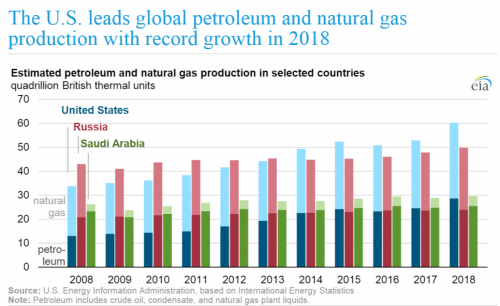
Going forward, new production from the U.S. will be eight times larger than the next largest source of growth, which is Canada. In fact, the U.S. will add 1.5 times more oil and gas than the rest of the world combined, according to Global Witness.
But because so much drilling in the U.S. is concentrated in a few areas, individual U.S. states on their own tower over the rest of the world. If Texas were a country, it would account for the most new oil and gas production in the world. Between 2020 and 2029, Texas could account for 28 percent of all additional output, Global Witness says.
Canada and Pennsylvania tie for second and third with 7 percent each. Then comes New Mexico at 5 percent of the growth and North Dakota at 4 percent. Oklahoma, Brazil, Colorado, Russia and Ohio are all tied at 3 percent a piece.
In other words, 7 out of the top 10 sources of new oil and gas production globally over the next decade are U.S. states.
“If things don’t change, by the end of the next decade, new oil and gas fields in the US will produce more than twice what Saudi Arabia produces today,” Global Witness said in its report.
This presents a massive challenge. “To avoid the worst impacts of climate change, our analysis shows that global oil and gas production needs to drop by 40% over the next decade. Yet, instead of declining, US oil and gas output is set to rise by 25% over this time, fueled by expansion in new fields,” the report warned.
Trudeau ignores threat of nuclear annihilation
By Yves Engler · August 6, 2019

Justin Trudeau presents himself as “progressive” on foreign affairs. The Liberals claim to have brought Canada “back” after the disastrous Harper Conservatives. But their nuclear weapons policy demonstrates the emptiness of this rhetoric.
Reducing the chance nuclear weapons are used again should be a priority for any “progressive” government. But, powerful Canadian allies oppose nuclear arms controls so Trudeau’s government isn’t interested in the “international rules based order” needed to curb the existential threat nukes pose to humankind.
The Liberals have voted against UN nuclear disarmament efforts supported by most countries. At the behest of Washington, they voted against an important initiative designed to stigmatize and ultimately criminalize nuclear weapons. They refused to join 122 countries represented at the 2017 Conference to Negotiate a Legally Binding Instrument to Prohibit Nuclear Weapons, Leading Towards their Total Elimination.
Last month Swedish Foreign Minister Margot Wallström hosted a high-level meeting to reinvigorate nuclear disarmament commitments made by states party to the Nuclear Non-Proliferation Treaty (NPT). While most of the 16 countries were represented in Stockholm by their foreign ministers, Chrystia Freeland did not attend. Instead, the government dispatched Parliamentary Secretary for Consular Affairs Pamela Goldsmith-Jones.
Reducing or eliminating the threat of nuclear weapons isn’t mentioned in the Liberals 2017 defence policy statement (North Korean nukes receive one mention). Instead, Strong, Secure, Engaged: Canada’s Defence Policy makes two dozen references to Canada’s commitment (“unwavering”) to the North Atlantic Treaty Organization. Ghastly nuclear weapons are fundamental to NATO’s strategic planning. According to the official description, “nuclear weapons are a core component of the Alliance’s overall capabilities.”
Through NATO, Canada has effectively committed to fighting a nuclear war if any country breached its boundaries. Additionally, the alliance does not restrict its members from using nuclear weapons first. Canada participates in the NATO Nuclear Planning Group and contributes personnel and financial support to NATO’s Nuclear Policy Directorate.
While NATO maintains nuclear weapons in Turkey and various European countries, Canadian officials blame Russia for the arms control impasse and the recent demise of the Intermediate-Range Nuclear Forces (INF) Treaty, which banned an entire class of nuclear weapons. In April Director General of International Security Policy at Global Affairs Canada, Cindy Termorshuizen said, “we call on Russia to return to compliance with the INF Treaty.” But, it’s not clear Russia violated one of the most significant nuclear accords ever signed. The Trump administration, on the other hand, began to develop new ground-launched intermediate-range missiles prohibited under the pact long before it formally withdrew from the INF. US military planners want to deploy intermediate-range missiles against China, which is not party to the INF.
In December Canada voted against a UN General Assembly resolution for “Strengthening Russian-United States Compliance with Intermediate-Range Nuclear Forces Treaty.”
At that vote Canada’s representative said Moscow’s position on the INF reflects its “aggressive actions in neighbouring countries and beyond.” But, it is Washington that broke its word in expanding NATO into Eastern Europe, withdrew from the Anti-Ballistic Missile treaty in 2001 and established missile ‘defence’ systems near Russia. As part of NATO Canadian troops are stationed on Russia’s border in Latvia and Ukraine, which isn’t conducive to nuclear retrenchment.
A look elsewhere demonstrates the Liberals’ ambivalence to nuclear disarmament. They strengthened the Stephen Harper government’s agreement to export nuclear reactors to India, even though New Delhi has refused to sign the NPT (India developed atomic weapons with Canadian technology). The Trudeau government wouldn’t dare mention Israel’s 100+ nuclear bombs or endorse a nuclear free Middle East. While they’ve publicly stated their support for the Iran nuclear accord, they have not supported European efforts to save the Joint Comprehensive Plan of Action. (Or restarted diplomatic relations with Iran as promised.)
Despite some progressives claiming otherwise, Canada has never been an antinuclear country. In fact, if one were to rank the world’s 200 countries in order of their contribution to the nuclear arms race Canada would fall just behind the nine nuclear armed states. Among many examples of nuclear complicity, Canada spent tens of millions of dollars to help develop the first atomic bombs, CF-104 Starfighters stationed in Europe carried a nuclear weapon and various US nukes were stationed in Canada.
Still, governments from the 1970s through the 1990s expended some political capital on nuclear non-proliferation. While the follow-through was disappointing, Trudeau Père at least spoke about ”suffocating” the nuclear arms race.
His son, on the other hand, responded to a call to participate in a widely endorsed nuclear disarmament initiative by stating “there can be all sorts of people talking about nuclear disarmament, but if they do not actually have nuclear arms, it is sort of useless to have them around, talking.” Justin Trudeau also refused to congratulate Canadian campaigner Setsuko Thurlow, a survivor of the atomic bombing of Hiroshima, who accepted the 2017 Nobel Peace Prize on behalf of the International Campaign to Abolish Nuclear Weapons.
Justin Trudeau’s government does not even talk the talk, let alone walk the walk when it comes to ending the threat of nuclear annihilation.
As part of its 50th anniversary commemoration Black Rose Books – initially Our Generation Against Nuclear War – will host a conference on nuclear disarmament in Montréal on September 21, 2019.
United Church should come clean on anti-Palestinian accord
By Yves Engler · August 2, 2019
Toronto church Trinity-St. Paul’s shameful suppression of a Palestinian youth cultural event highlights anti-Palestinian rot festering in the United Church of Canada. It ought to also shine a light on a little discussed anti-Palestinian accord UCC leaders signed with Israel lobby groups five decades ago.
Under pressure from B’nai B’rith and the Jewish Defence League the Trinity-St. Paul Centre for Faith, Justice and the Arts recently canceled a room booking “to celebrate the artistic and cultural contributions of Palestinians in the diaspora.” The Palestinian Youth Movement’s spoken word event was to “showcase the winners of the Ghassan Kanafani Resistance Arts Scholarship”, which the JDL and B’nai B’rith chose to target on the grounds the famous novelist was a spokesperson for the Popular Front for the Liberation of Palestine in the early 1970s. After Kanafani and his 17-year old niece were assassinated by the Mossad in Beirut, Lebanon’s Daily Star labeled the novelist “a commando who never fired a gun, whose weapon was a ball-point pen, and his arena the newspaper pages.”
As I detailed in this article Trinity-St. Paul’s spiritual leader is anti-Palestinian leftist Cheri DiNovo. Since publishing that piece the former NDP MPP admitted — to vicious anti-Palestinian/Islamophobe Toronto Sun columnist Sue-Ann Levy, of all people — that she forwarded B’nai B’rith’s concerns to the church’s board, which then cancelled the event. Dropping her progressive standing further, DiNovo unfriended a number of individuals on Facebook who politely questioned her role in suppressing the Palestinian cultural event.
To be fair to DiNovo she isn’t the only Progressive Except for Palestine voice in the UCC. “What happened at Trinity St. Paul’s is not isolated”, wrote Karen Rodman, an ordained UCC minister and prominent Palestine solidarity activist. Last year the UCC seminary at the University of Toronto’s Victoria University withdrew from a Palestinian Liberation Theology program with Reverend Naim Ateek. According to Rodman, work had been underway on Emmanuel College’s continuous learning initiative with Ateek for a year when pressure was brought to bear by Israeli nationalist groups.
Resolutions endorsed at UCC conventions in the 2000s called on Palestinians to recognize Israel as an ethnic/religious supremacist state. The 2009 motion called for “the emergent State of Palestine” to recognize “Israel’s right to exist as a Jewish state within safe and secure borders.” In an interview after the 2009 convention Palestinian Canadian journalist Hanna Kawas complained the UCC was asking the victims of a European colonial movement to endorse the supremacist ideology that dispossessed them. In 2012 the UCC “advised against the use of ‘the language of apartheid’ when applied to Israel” and called for a solution to the Palestinian refugees’ right of return so long as it “maintains the demographic integrity of Israel.”
In another sign of the church hierarchy’s encouragement of a colonial ideology, Rodman was harassed and bullied for supporting Palestinian rights. Church officials purportedly called her a “terrorist” for traveling to the West Bank. In response to attacks and biased review process, Rodman filed a complaint with the Human Rights Tribunal of Ontario (HRTO) against the UCC for discriminating against her anti-Zionist worldview. Last year the HRTO granted Rodman a hearing, which awaits scheduling, to show her anti-Zionist worldview/creed is not just a political view.
(The UCC has supported labelling settlement goods and condemned other aspect of Israel’s occupation. But these resolutions have not been implemented. As an example, no congregation or UCC body implemented a 2012 resolution calling for divestment from companies profiting or supporting the occupation even though a resolution was passed at the subsequent General Council requesting implementation of the 2012 resolution.)
An anti-Palestinian deal UCC leaders brokered decades ago has influenced the church’s indifference to the plight of Palestinians. In the 1950s and 60s the UCC passed a number of resolutions upholding the rights of Palestinians, including those of the refugees to return to their homes. More significantly, the UCC’s influential magazine championed the Palestinian cause. With a circulation of 350,000 in the early 1970s, The Observer criticized Israeli human rights violations. But editor Rev. A.C. Forrest’s support for Palestinians prompted vicious attacks. Emboldened by the blow Israel delivered against pan-Arabism in the 1967 war, B’nai B’rith dubbed Forrest a “Haman”, “Pharaoh” and “anti-Semitic”.
In response, Forrest threatened to sue for libel. B’nai B’rith countersued. A high-profile battle between B’nai B’rith and the UCC ensued. But, new UCC leaders didn’t care much about Palestinians and opposed Forrest, as well as a pro-Palestinian resolution passed at the 1972 UCC convention. Moderator Bruce McLeod and General Secretary George Morris soon sought a “gentleman’s agreement” in which both the UCC and B’nai B’rith would drop the lawsuits. Couched in the language of interfaith sensitivity, the 1973 “peace pact” was about deterring criticism of Israel. As then Canadian Jewish Congress (CJC) President Sol Kanee wrote in a private letter, “it would appear the United Church is determined to chart a more positive course with regard to Israel and the Jewish people, which we hope will be reflected in the ‘Observer.’”
Dozens of pages detail the B’nai B’rith-UCC battle at the Canadian Jewish Archives in Montréal. In one internal file CJC officials say only part of the B’nai B’rith-UCC agreement was published (a similar agreement is thought to have been made between the UCC and CJC and/or Canadian Council of Churches). Part of the “peace pact” published noted, “we recognize and appreciate the interests of Jews everywhere and of the United Church for the events in the Middle East and in the survival of Israel.”
As part of the agreement, the UCC seems to have committed to inform B’nai B’rith/CJC about Israel related affairs or even seek their consent before implementing policy approved by the grassroots. A 2009 Globe and Mail article reported that UCC general council officer Bruce Gregersen indicated that CJC president Bernie Farber “gave his blessing to the UCC resolution” on Israel.
Rodman and others have pushed the church hierarchy to reveal whether the anti-Palestinian agreement is still respected. But UCC leaders have failed to release the full agreement or say it is no longer being followed.
The agreement with B’nai B’rith/CJC has undercut grassroots initiatives within the church that challenge Canada’s complicity in Palestinian dispossession. But, the decision to succumb to B’nai B’rith’s disingenuous attacks 45 years ago has had another equally damaging impact on Palestinians. It has emboldened the anti-Palestinian group to make evermore outrageous demands.
After a half-century more of Israeli land theft and violence, B’nai B’rith demanded a Toronto church suppress an event because it included the name of a famous novelist driven from his home as a child and then blown up by Israel (a quintessential victim of terrorism). If Kanafani’s name “glorifies terrorists and murderers”, as B’nai B’rith claims, then what should we say of a group that defends every act of Israeli violence, including the assassination of a novelist and his niece?
If the UCC won’t have anything to do with a Palestinian youth group that mentions Kanafani’s name they sure better sever all ties to groups promoting Israeli “terrorists and murderers”.
Trudeau ‘feminizes’ support for corrupt and repressive Haitian president
By Yves Engler ·July 31, 2019

Justin Trudeau and Jovenel Moïse
The Trudeau Liberals are attempting to “feminize” their support of an illegitimate government hated by the vast majority of Haitians. And Radio-Canada seems to have fallen for it.
After Radio-Canada published a story about nine of eighteen ministers in Jovenel Moïse’s newly proposed government being women, Haitian Canadian feminist Jennie-Laure Sully replied, “Haitians of all social classes have been demonstrating for more than a year demanding the resignation of the president and a change in the political system. But what does Radio-Canada talk about in this country? A cosmetic measure adopted by this fraudulently elected government accused of embezzlement and human rights violations. Gender parity in such conditions is a smokescreen (“poudre aux yeux”). Radio-Canada is doing identity politics of the lowest order while ignoring Canada’s role in maintaining corruption in Haiti.”
With little support among Haitians, Moïse needs good press in the two main countries sustaining his presidency. Recently he has been on a campaign to shore up his image in the US, publishing an op-ed in the Miami Herald and hiring a new Washington, DC, based lobbyist.
In presenting a gender balanced cabinet Moïse’s proposed Prime Minister, Fritz William Michel, deftly aligned with a stated foreign policy objective of Justin Trudeau. Along with praise for Moïse, Global Affairs Canada’s webpage about “Canada’s international assistance in Haiti” focusses on gender equity. At the top of the page, it lists a series of feminist goals under the heading of “To strengthen Haiti’s Government capacity to respond to gender equality issues.”
(In 2017 the Trudeau government launched a much-hyped Feminist International Assistance Policy, but their commitment to feminist internationalism is paper-thin. Since July 21, for instance, Ottawa joined Washington as the only country to vote against a UN Economic and Social Council resolution stating, “the Israeli occupation remains a major obstacle for Palestinian women and girls with regard to the fulfillment of their rights”; Canada signed a Memorandum of Understanding with the misogynist UAE; the Trudeau government was criticized by the chair of the UN Working Group on Business and Human Rights Surya Deva for gutting their promise to rein in Canadian mining abuses abroad, which disproportionately affect women.)
Moïse has faced massive popular protests in recent months, including multiple general strikes. As I detail here and here, the only reason he remains in power is because of support from Washington, Ottawa and a number of other countries. Canada has provided financial, policing and diplomatic support to the unpopular government. In the latest indication of diplomatic backing, Canada’s ambassador in Port-au-Prince, André Frenette, met Moïse to discuss “bilateral cooperation” two weeks ago. The embassy also continues to support a police force responsible for countless abuses. On Sunday Global Affairs Canada’s Haïti account tweeted “congratulations” to police graduates who they trained in collaboration with the US.
On July 15 Solidarité Québec-Haïti #Petrochallenge 2019 activists interrupted a press conference by Minister of La Francophonie and Tourism Mélanie Joly to call on the Trudeau government to stop propping up a corrupt, illegitimate and murderous Haitian president. As this video shows, Joly was unable to respond to our simple question.
While the disruption was reported on by various media outlets, Radio Canada wasn’t interested. More than any other major media outlet, the French language public broadcaster has been the mouthpiece for Canadian imperialism in Haiti over the past 15 years. Unlike other outlets, Radio Canada covers Haitian affairs fairly regularly. But, it is almost entirely from the perspective of ‘Ottawa/Canada doing good’ in the impoverished nation.
Radio Canada largely failed to report on Canada’s role in planning the 2004 coup; destabilizing Jean-Bertrand Aristide’s government; building a repressive Haitian police force; justifying politically motivated arrests and killings; militarizing post-earthquake disaster relief; pushing the exclusion of Haiti’s most popular party, Fanmi Lavalas, from participating in elections.
When active with Haiti Action Montréal in the mid 2000s I experienced the politicized nature of the subject at Radio Canada. I called the news editor to inquire if they’d received our press release and instead of a yes/no we might/we can’t send anyone to cover the event that is usually part of this type of media outreach, the news editor somewhat angrily accused me of being an Aristide supporter, which was odd both because the event was focused on Canada’s role in Haiti and Aristide was elected by the country’s historically excluded.
In a 2008 article titled “Embedding CBC Reporters in Haiti’s Elitist Media” Richard Sanders describes Radio Canada’s participation in a Canadian government funded project to support media outlets that were part of L’Association Nationale des Médias Haïtiens (ANMH), which officially joined the Group of 184 that campaigned to oust Aristide. Sanders writes about Québec journalists sent to “train” Haitian reporters for a month, but who were in fact being “submerged in the propaganda campaigns of Haiti’s elite media.” Assistant program director for Radio Canada news, Guy Filion was one of the reporters who interned with ANMH. Even though ANMH outlets barred Haiti’s elected president from its airwaves in the lead-up to the coup, Filion described those who “formed the ANMH” as “pro-Haitian and they are pro neutral journalistic people … as much as it can be said in this country.” Filion also praised the media’s coverage of the 2006 election in which Aristide’s Lavalas was excluded. In a coded reference to Aristide supporters, Filion noted, “even thugs from [large slum neighbourhood] Cité Soleil were giving interviews on television!”
Radio-Canada’s reporting on gender parity in a proposed new government helps legitimate Trudeau’s support of Moïse. It puts a progressive veneer on a corrupt, repressive and unpopular president who is dependent upon Radio-Canada’s patron. It is yet another attempt to justify Canadian policy that sides with the interests of multinational corporations and a small elite over the needs of Haiti’s impoverished majority.
Featured Video
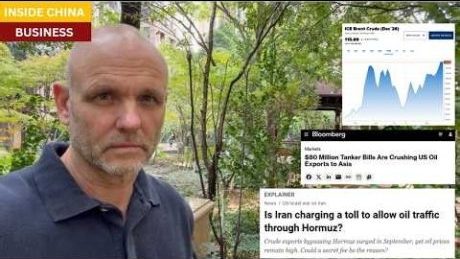
Iran is (probably) collecting tolls, and why Asia stopped buying oil from the US
or go to
Aletho News Archives – Video-Images
From the Archives
The Great Recycling Scam
By Dr. Vernon Coleman – 21st Century Wire – September 2, 2022
Recycling was introduced, worldwide, as a tool to teach citizens to become compliant.
Forcing citizens to sort their rubbish into up to nine separate bags or boxes every week had absolutely nothing to do with ‘saving the planet’ and everything to do with teaching citizens (through a mixture of fines and shame) to behave ‘responsibly’ i.e. to do as they were told without looking too closely at the rationale of what they were being told to do.
The recycling never had anything to do with protecting the planet, of course. Most of the rubbish sorted, washed and collected in the UK was taken abroad, by lorry or ship or train, and burnt or dumped. It was, quite simply, impractical and not cost effective to recycle the material that had been collected. And, of course, collecting the sorted rubbish involved massive costs in terms of cash and pollution.
Today, the recycling business has reached an apogee of lunacy. Councils introduce ever more complex rules and fees. They refuse to take away much of the waste that is collected. And those wanting to take their rubbish to a ‘recycling’ centre will probably have to make an appointment and answer a host of questions.
It is no surprise that fly-tipping has become a major problem. The biggest causes of plastic in the sea are dumped fishing gear and plastic waste (much of it officially designated as recycled) which has been dumped by ships.
The good news, however, is that in Britain, recycling rates are falling. More and more people have become aware that the whole recycling movement was just another piece of manipulative trickery.
Blog Roll
 Aletho News
- Lithuania plans universal conscription
- Lies, Damn Lies, and Ukraine News
- Financial Times rejects Nordic demands to correct Putin call story – media
- The Case for Less Unity in Europe
- Ukraine expands minority rights under EU pressure – but Russians remain excluded
- Albania takes anti-riot crackdown cue from France
- The interest of the House of Rothschild in Ukraine
- Pentagon fires top military planner
- Three tankers hit mines on unauthorized Hormuz route: IRGC Navy
- Iran is (probably) collecting tolls, and why Asia stopped buying oil from the US
- If Americans Knew
- An error has occurred; the feed is probably down. Try again later.
- No Tricks Zone
- Germany’s Green Energy Transition Becoming Increasingly Expensive…Another 6 Trillion Euros!
- Sudden Stratospheric Warming, Powerful El Niño Combination May Lead To Extreme Europe Cold, Energy Crisis!
- Two New Studies Find Thwaites Glacier Melt Cannot Be Driven By Human Activity Or A Warming Ocean
- E-Cars Reduce CO2 Emissions By Only 41% Compared To Internal Combustion Engine Vehicles
- Predictions Made By Renowned Climate Professor Over Past Decades Have Been Proven To Be Poor
- New Study Suggests Large Regions Of The Pacific Ocean Have Been Cooling For The Last 80 Years
- Germany’s Green Energy Debacle: High Energy Costs Force Kahla Porzellan to Close After 182 Years!
- New Study: 50 Years Of The Most Aggressive ‘Net Zero’ Policies Can Only Affect The Global Climate By 0.03°C
- US September “Heat” Was No Record…Many Records Set Decades Ago
- Latest European Green Energy Debacle; Portugal’s Largest Flagship Solar Park Insolvent!


