When Government Lies to You
By Donna Laframboise | Big Picture News | April 3, 2019
Fake news is everywhere, and governments can be a rich source. For example, a flyer distributed in the mail last week by Canada’s Revenue Agency – aka the taxman – tells us a pack of lies.
Against the will of elected leaders in four provinces, our federal government has just imposed a carbon tax. The price of gasoline has jumped at the pumps. Home heating costs have risen. This is just stage one, since the tax bite will increase every year.
The flyer begins by declaring:
Pollution has a cost. It impacts the air we breathe, our children’s health, and our economy. That’s why the Government of Canada has put a price on carbon pollution.
What nonsense. Carbon taxes are supposed to discourage people from burning fossil fuels not because of dirty black soot (sophisticated, anti-pollution technologies already exist), but because an invisible, odourless gas gets emitted whenever fossil fuels are used.
The entire climate scare rests on the idea that humanity is adding too much carbon dioxide – CO2 – to the atmosphere, and that this will hypothetically destabilize the climate.
Now is a good time to point out that the Canadian government admits this country is responsible for a mere 1.6 percent of global CO2 emissions. Between them, China (26 percent), America (14 percent), and India (6.4) are responsible for nearly half of all human-produced CO2 (46 percent).
It’s also a good time to remember that, over the past 50 years, experts have predicted one environmental catastrophe after another, none of which materialized. Even smart scientists with powerful computers are terrible at forecasting the future.
The flyer says this measure is all about fighting pollution. But CO2 wasn’t pollution when Al Gore called it that. It wasn’t pollution when Barack Obama called it that. And it isn’t pollution now.
As we all learned in Biology 101, bears, bunnies, and humans all exhale CO2 – which is then absorbed by grass, flowers, and trees. Without CO2, there would be no plants. Without plants, there would be no oxygen for wildlife or humanity to breathe.
CO2 is therefore an integral part of the natural, virtuous circle of life. It does no harm to our air quality. It does no harm to our children’s health.
And whatever harm a climate crisis might one day inflict on Canada’s economy must surely be balanced against the genuine hardship being experienced right now.
Every time people near the bottom of the economic ladder fill up their car in order to get to work, they’re being punished. Every time they pay their heating bill they’re being penalized by their own government. That’s what carbon taxes do.
We can argue endlessly about whether more CO2 in the atmosphere will be perilous over the long term. But the ‘pollution’ angle is total hogwash, dreamed up by political sleazeballs.
A planet without CO2 would be a wasteland, bereft of both plants and animals. Calling CO2 pollution is therefore abjectly dishonest.
Let me say this one more time: If CO2 is pollution, every human being is a non-stop pollution factory. Your neighbour’s newborn. Your grandmother. That blind child.
What a sick, dangerous perspective on the world.
NATO propaganda promotes war, military spending
Third in a four-part series on the 70th anniversary of the North Atlantic Treaty Organization.
By Yves Engler · April 1, 2019
 The first two installments of the series showed how NATO was set up to blunt the European left and to justify European/North American dominance across the globe. Recently, the alliance has intensified pressure on Canada to increase spending on the military and participate in more wars.
As its Cold War pretext fades further from view, NATO has become more belligerent. In 1999 Canadian fighter jets dropped 530 bombs in NATO’s illegal 78-day bombing of Serbia. During the 2000s tens of thousands of Canadian troops fought in a NATO war in Afghanistan. In 2011 a Canadian general led NATO’s attack on Libya in which seven CF-18 fighter jets and two Canadian naval vessels participated.
In a dangerous game of brinksmanship, NATO has massed troops and fighter jets on Russia’s border. Five hundred Canadian troops lead an alliance mission in Latvia while the US, Britain and Germany head missions in Poland, Lithuania and Estonia. Over the past decade Canadian naval vessels have almost constantly engaged in NATO patrols in the Mediterranean and Indian Ocean.
In addition to spurring deployments and war, militarists use the alliance to boost socially and ecologically damaging military spending. “Canada’s defence spending questioned at NATO parliamentary meeting”, noted a November CBC headline while a National Post editorial bemoaned “Canada’s continuing failure to honour our pledge to NATO allies to spend 2 per cent of GDP on defence.” In 2006 NATO countries adopted a pledge to put 2% of economic output into their military.
NATO has also been used to push weapons procurement. Calling for expanding the jet fleet, senior military officials told the Globe and Mail in 2017 that “Canada’s fighter fleet is not big enough to meet its NORAD and NATO obligations at the same time.” In a history of the first century of the navy Marc Milner describes a series of reports in the mid-1960s concluding that the Royal Canadian Navy was “too small to meet Canada’s NATO obligations” and should be expanded “to meet NATO and North American commitments.”
NATO has also been invoked to justify arming the US war machine. In 1967 the Prime Minister responded to calls by opponents of the war in Vietnam to end the Defence Production Sharing Agreement, the arrangement under which Canada sold the US weapons, with the claim that to do so would imperil NATO. Lester Pearson claimed this “would be interpreted as a notice of withdrawal on our part from continental defense and even from the collective defence arrangements of the Atlantic alliance.”
In 2017 the Justin Trudeau government “hid behind Canada’s NATO membership”, according to NDP foreign critic Hélène Laverdière, when it opposed international efforts to ban nuclear weapons. At a time when he made a big display about “suffocating” the (nuclear) arms race Pierre Trudeau justified nuclear tipped cruise missiles testing in Canada. In 1983 the Prime Minister said, “having declared our support for the two track strategy, Canada should bear its fair share of the burden which that policy imposes on the NATO alliance.”
NATO is a nuclear weapons club. These monstrous bombs have been “a fundamental component” of the alliance’s military planning. Through NATO Canada has effectively committed to fighting a nuclear war if any country breached its boundaries. Additionally, the alliance does not restrict its members from using nuclear weapons first.
NATO supports various militarist organizations in this country and operates a public diplomacy division. Founded in 1966 the NATO Association of Canada, formerly Atlantic Council of Canada, promotes the alliance. With an office in Toronto its staff and interns organize public events and publish different materials. A decade older than the NATO Association of Canada, the Canadian NATO Parliamentary Association seeks “to increase knowledge of the concerns of the NATO Parliamentary Assembly among parliamentarians.”
A number of Canadian organizations receive NATO’s largess. Conference of Defense Associations conferences in Ottawa have received support from NATO while the Canadian Global Affairs Institute has held numerous joint symposiums with NATO. The annual Halifax International Security Forum, which brings together hundreds of academics and policymakers, is sponsored by NATO. In the late 1980s the Canadian Institute for Strategic Studies had “agreements with NATO’s Information Service to conduct a national/regional speakers tour.”
In other words NATO spends money (which ultimately come from our taxes) to convince Canadians that wars and military spending are good for us.
Defence of European empires was original NATO goal
Second in a four-part series on the 70th anniversary of the North Atlantic Treaty Organization
By Yves Engler · March 30, 2019
The first installment in this series discussed how NATO was set up partly to blunt the European Left. The other major factor driving the creation of NATO was a desire to bolster colonial authority and bring the world under a US geopolitical umbrella.
From the outset Canadian officials had an incredibly expansive definition of NATO’s supposed defensive character, which says an “attack against one ally is considered as an attack against all allies.” As part of the Parliamentary debate over NATO external minister Lester Pearson said: “There is no better way of ensuring the security of the Pacific Ocean at this particular moment than by working out, between the great democratic powers, a security arrangement the effects of which will be felt all over the world, including the Pacific area.” Two years later he said: “The defence of the Middle East is vital to the successful defence of Europe and north Atlantic area.” In 1953 Pearson went even further: “There is now only a relatively small [5000 kilometre] geographical gap between southeast Asia and the area covered by the North Atlantic treaty, which goes to the eastern boundaries of Turkey.”
In one sense the popular portrayal of NATO as a defensive arrangement was apt. After Europe’s second Great War the colonial powers were economically weak while anti-colonial movements could increasingly garner outside support. The Soviets and Mao’s China, for instance, aided the Vietnamese. Similarly, Egypt supported Algerian nationalists and Angola benefited from highly altruistic Cuban backing. The international balance of forces had swung away from the colonial powers.
To maintain their colonies European powers increasingly depended on North American diplomatic and financial assistance. NATO passed numerous resolutions supporting European colonial authority. In the fall of 1951 Pearson responded to moves in Iran and Egypt to weaken British influence by telling Parliament: “The Middle East is strategically far too important to the defence of the North Atlantic area to allow it to become a power vacuum or to pass into unfriendly hands.”
The next year Ottawa recognized the colonies of Vietnam, Cambodia and Laos as “associated states” of France, according to an internal report, “to assist a NATO colleague, sorely tried by foreign and domestic problems.” More significantly, Canada gave France hundreds of millions of dollars in military equipment through NATO’s Mutual Assistance Program. These weapons were mostly used to suppress the Vietnamese and Algerian independence movements. In 1953 Pearson told the House: “The assistance we have given to France as a member of the NATO association may have helped her recently in the discharge of some of her obligations in Indo-China.” Similarly, Canadian and US aid was used by the Dutch to maintain their dominance over Indonesia and West Papua New Guinea, by the Belgians in the Congo, Rwanda and Burundi, by the Portuguese in Angola, Mozambique and Guinea-Bissau and by the British in numerous places. Between 1950 and 1958 Ottawa donated a whopping $1,526,956,000 ($8 billion today) in ammunition, fighter jets, military training, etc. to European countries through the NATO Mutual Assistance Program.
The role NATO played in North American/European subjugation of the Global South made Asians and Africans wary of the organization. The Nigerian Labour Party’s 1964 pamphlet The NATO Conspiracy in Africa documents that organization’s military involvement on the continent from bases to naval agreements. In 1956 NATO established a Committee for Africa and in June 1959 NATO’s North Atlantic Council, the organization’s main political decision-making body, warned that the communists would take advantage of African independence to the detriment of Western political and economic interests.
The north Atlantic alliance was designed to maintain unity among the historic colonial powers — and the US — in the midst of a de-colonizing world. It was also meant to strengthen US influence around the world. In a history of the 1950-53 US-led Korean war David Bercuson writes that Canada’s external minister “agreed with [President] Truman, [Secretary of State] Dean Acheson, and other American leaders that the Korean conflict was NATO’s first true test, even if it was taking place half a world away.”
Designed to maintain internal unity among the leading capitalist powers, NATO was the military alliance of the post-WWII US-centered multilateral order, which included the International Monetary Fund (IMF), World Bank, International Trade Organization (ITO) and the United Nations. (For its first two decades the UN was little more than an arm of the State Department.)
A growing capitalist power, Canada was well placed to benefit from US-centered multilateral imperialism. The Canadian elite’s business, cultural, familial and racial ties with their US counterparts meant their position and profits were likely to expand alongside Washington’s global position.
NATO bolstered colonial authority and helped bring the world under the US geopolitical umbrella, from which the Canadian elite hoped to benefit.
CARICOM Confronts the Big House: Trump Attempts to Split the Caribbean over Venezuela
By Maximilian C. Forte | Zero Anthropology | March 25, 2019
It’s a simple matter, even if one might lose oneself in the various details, names, places, and dates. The Caribbean Community and Common Market (CARICOM), mostly made up of Anglophone Caribbean states, decisively stood up for non-intervention in the internal affairs of states by going against the push to recognize the illegitimate and illegal claim to power by Juán Guaidó in Venezuela. Such a policy, pushed by the US’ regime change agenda, would have clearly served to undermine the authority of the elected government of President Nicolás Maduro, while legitimating foreign intervention. Just as the US today seeks the overthrow of Venezuela’s government, tomorrow it could seek the overthrow of any other government in the Americas. It is thus the Caribbean’s voice that matters most right now.
Trump: Against Sovereignty
On the other side, Trump’s White House is not only pushing for regime change in Venezuela, Trump’s NSA, John Bolton, has stated repeatedly that the US intends to resurrect and impose the neocolonial and plainly imperialist Monroe Doctrine—claiming effective authority to rule the Western Hemisphere. (That includes Canada, not that Canadians have bothered to take note.) Given Trump’s own stated belief that “to the victor go the spoils,” and the US’ validation of the acquisition of territory by force—backing Israel’s claim to Syria’s Golan Heights—even respect for the territorial integrity of states has gone out the window. Fundamental and basic principles of the UN Charter have thus been unilaterally shredded by the US. CARICOM stands as one impediment. Trump clearly will not let that stand.
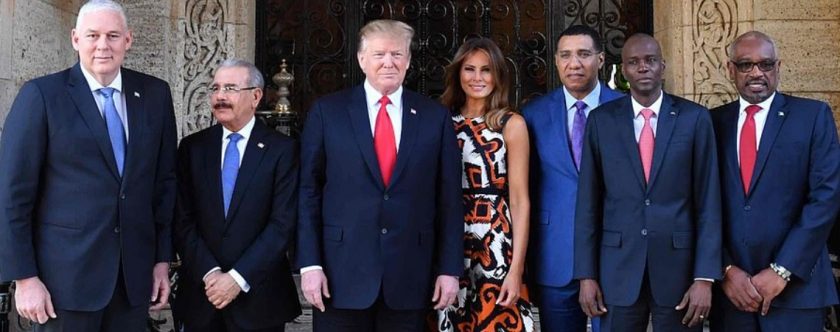
Trump has apparently resuscitated divide et impera, trying to not only pry some CARICOM members away from the main body by “dangling investment” promises in front of their eyes, but also setting the stage for CARICOM members to turn on each other. What Trump did was to invite a small, select group of Caribbean leaders—those belonging to the Lima Group (standing outside of any international body, because the Group supports regime change in violation of international law)—to visit him at his Mar-a-Lago estate. Trump thus met with St Lucia Prime Minister Allen Chastanet, Dominican Republic President Danilo Medina, Jamaica Prime Minister Andrew Holness, Haiti President Jovenel Moise, and Bahamas Prime Minister Hubert Minnis at the Mar-a-Lago estate in Palm Beach, Florida. These countries, “have all either criticized Venezuela’s Nicolas Maduro, or recognized Juan Guaido [sic] as the country’s rightful leader”.

Jamaica’s Minister of Foreign Affairs and Trade, Kamina Johnson Smith
Among those in attendance, Jamaica recently announced the closure of its embassy in Venezuela, despite the parliamentary opposition in Kingston voicing serious criticisms. Reporting on these events, the Jamaica Observer instead backed CARICOM’s approach to the Venezuelan crisis, reaffirming the value of the UN Charter. As for Jamaica’s Prime Minister, Andrew Holness, he spoke of being pleased with his meeting with Trump, saying that Trump, “wants to encourage and promote a stronger relationship with the region”. (Holness appears to be confusing a “stronger relationship” with a relationship of strength.) Holness’ main concern appeared to be the promise of US investments, saying that he hoped it was “not just talk” but that there would be “instrumental action”. Yet Trump is in no position to order US companies to invest in the Caribbean—he cannot even do that in the US itself. The US is not a state-run socialist economy, where public companies obey public policy—surely Holness understands this? Nonetheless, the affair smelled of something akin to bribery, and if this was representative of Caribbean leaders “standing tall” then language has been inverted, and standing tall is a reference to the humility of beggars. One might recall how the British Colonial Office used to refer to visiting Caribbean Chief Ministers as a “beggars’ opera”.
Rowley: Standing Up for the Caribbean
Once more, the figure standing up to Trump, and standing up for CARICOM and international law, is Trinidad & Tobago’s Prime Minister: Dr. Keith Rowley, of the ruling People’s National Movement (PNM). Dr. Rowley noted that this minority which met with Trump, which was not empowered to speak for CARICOM, were at Mar-a-Lago because they are members of the Lima Group whose objective is regime change in Venezuela. Apparently the US ambassador to Trinidad & Tobago, Joseph Mondello, said that he “viewed with concern” comments made by Rowley last month—in response, Rowley was reportedly angered and he redoubled his efforts to push CARICOM on the path of anti-intervention.
The fact that other Caribbean states such as Trinidad & Tobago and the majority of CARICOM members, who oppose the Lima Group, were logically not invited—why would they be?—has been seized upon by quislings in the region who think the Caribbean’s primary duty is servitude to whomever occupies the Big House in the US. Failure to show deference to US interests, these proxies think, somehow entails a loss of status, a “loss of leadership” even. Real leaders stand up for American interests, apparently. This has been translated into accusations that those who were not at Mar-a-Lago were thus “snubbed,” and missed out on something “special”.
Representative of this pro-US faction are figures such as Ralph Maraj, a former foreign minister of Trinidad & Tobago, and a member of the opposition United National Congress (UNC). According to Maraj, the fact that Trinidad was “excluded” from the Mar-a-Lago meeting means that the US now has a diminished view of the country. He continued:
“We do not stand tall, contrary to what Dr. Rowley has stated, we stand diminished in the region, we have lost our leadership of Caricom which we had. Jamaica now is leading the way…. We’ve really abdicated the leadership in Caricom and we have obviously offended the United States, and while we have sovereign right to deal with our foreign relations we stand by the principles and so, we must also protect our relationships…. The United States does not need to invest in our petrochemical industry anymore. They have the most gas, natural gas in the world…. They don’t need our gas, they don’t need our oil. They are a net exporter now of both oil and gas. We have lost our economic clout”.
Maraj’s message was, at best, confusing. If the US no longer needs Trinidad, and Trinidad has lost its economic clout as a result, then how would a lunch at Mar-a-Lago have altered those basic, objective economic facts? It’s not clear where Maraj’s complaint lies, but it’s also far from obvious that the facts are on his side.
Trinidad & Tobago’s Leadership: The US View
The US previously recognized Trinidad’s leadership in CARICOM and its high standing in the region—according to the US Embassy in Port of Spain in 2006:
“In regional politics, it could be said that T&T is an opinion shaper. [Prime Minister Patrick] Manning [of the PNM] just completed a six-month tenure as Chairman of CARICOM, a period marked by a renewed emphasis on regional economic integration. T&T receives high marks for its commitment to the needs of the smaller countries of the Eastern Caribbean. Beyond CARICOM, T&T maintains correct but cool relations with Venezuela, largely due to differences of opinion over Petrocaribe and Chavez’s regional aspirations. T&T views Cuba as a Caribbean brother and maintains amicable ties. Manning regularly goes to Cuba for medical attention”.
Did having an independent foreign policy diminish Trinidad, as Maraj argued above? The US Embassy recognized Trinidad & Tobago’s influential leadership position, even as it pointed to serious foreign policy differences between the US and Trinidad & Tobago (repeated here):
“T&T in many ways demonstrates a fierce independence; it has been immovable on several key recent U.S. foreign policy priorities. Because of former President Robinson’s role as a ‘father’ of the International Criminal Court (ICC), T&T was one of the first ICC signatories. It has not signed an Article 98 agreement with the U.S. and likely never will. T&T continues to desire and work towards good relations with Venezuela as they share a long maritime border and common energy concerns. It often defends Cuba, which it sees as a Caribbean brother. T&T, along with its neighbors, did not recognize Haiti’s interim government in the absence of a CARICOM consensus. T&T did not support the U.S. intervention in Iraq, and its media have been openly critical on this issue. T&T’s voting record at the U.N. also leaves much to be desired from a U.S. policy perspective. Most notably, T&T voted, together with its CARICOM partners, in favor of Venezuela’s candidacy for the vacant Latin American Caribbean seat on the UN Security Council”.
If standing up for Trinidad & Tobago’s interests—which are not the same as American interests—is somehow weak or diminished leadership, then that case has not been proven, not even when we refer to the opinions of US diplomats themselves.
Furthermore, during the same weekend that Trump was hosting a small group of Caribbean leaders, CARICOM itself held a dialogue with Juán Guaidó, in an effort to promote peaceful mediation towards an end to the crisis. Unfortunate however was the praise given by CARICOM leaders to Canada, which helped to organize the encounter. The point however is that if CARICOM did not matter, then not even Trump’s instrument in Venezuela would seem to agree—as Trump met with a splinter group, Guaidó spoke with representatives of the larger body, and both events happened at nearly the same time.
Who Was Invited to the Man’s House?
To have them assembled in one place, here are the comments made by Prime Minister Rowley about this weekend’s event at Mar-a-Lago, and what it signifies, gleaned from several sources as indicated below:

Prime Minister of Trinidad & Tobago, Dr. Keith Rowley
“There are people in Trinidad and Tobago who believe that because Trinidad and Tobago was not invited to the private residence of an American president we are somehow diminished…. Ladies and gentlemen, we have never stood taller, we have never stood prouder; and, as I speak to you now, Caricom’s position, as reaffirmed in the last meeting of heads in St Kitts-Nevis, is that there are three people representing and authorised to represent Caricom outside of its heads and caucus, and that’s the chairman of Caricom, who is the prime minister of St Kitts-Nevis (Dr Timothy Harris); Trinidad and Tobago’s prime minister or designate; and Barbados, through its prime minister or designate”. (source)
“A man’s home is his castle—you are free to invite who you want to your house. We can’t stay outside and say we shoulda be invited. Since when are we measuring our stature and station by who invites us to their house? If it is we’re being ‘blanked’ or ‘snubbed’ for steadfastly standing for the principles of the United Nations Charter, history will absolve us”. (source)
“Our foreign policy has always given us an indication of the road ahead. What we’re reacting to is an invitation to a man’s house—a meeting of the Lima Group at the private residence of the US President”. (source)
“I don’t know that T&T or anyone was deliberately, unwittingly or accidentally invited to anyone’s private home. The invitation wasn’t to Caricom, we don’t go around begging for invitations”. (source)
“What we are going to do resolutely and without apology, as a tiny speck on the world’s map, is to stand with the principles of the United Nations where we all have signed on and accept as the best way for peace and security, not only in our region, but the world. We, from early—St Kitts-Nevis, Dominica, Trinidad and Tobago, St Vincent and the Grenadines—we did not sign on to the Lima Group. So we are not reacting to an invitation to a man’s house”. (source)
“There are 14 Caricom countries, how many have gone to Mar-a-Lago? Yet the convseration is about four. The ones who’ve agreed are part of the Lima Group. What’s the group’s objective? Regime change in Venezuela. How that’s to be achieved is for those who’ve embarked on that course”. (source)
“As far as I’m aware, there’s no tear in TT-US relations. The US remains a friendly country and in so far as having a disagreement on the approach of Venezuela, it has nothing to do with the relations between the people of T&T and the people of the US—notwithstanding Opposition’s efforts to create that kind of division!” (source)
“Force Multipliers”
Rather than come out and call them “treacherous servants,” the politically correct term for amplifiers of US power is “force multipliers”. On the same day that Trump announced his Mar-a-Lago meeting, the Leader of the Opposition in Trinidad & Tobago, former Prime Minister Kamla Persad-Bissessar of the United National Congress, met with the US Ambassador in Port of Spain. It’s not the first time that Persad-Bissessar, while in the Opposition, has gone to the US Embassy to have private meetings to talk about Trinidadian affairs, slanted in a way that always favoured American interests and those of her party. The party attacking Prime Minister Rowley for not being servile enough to get an invitation to Mar-a-Lago, has a history of going in secret to the US Embassy to lay out its complaints about domestic political matters for the American ambassador to consider—perhaps this is what they mean by “leadership”. From their perspective a figure like Juán Guaidó must be one of the world’s greatest living “leaders”.

Ralph Maraj
The UNC is a party that mostly represents Trinidad’s population of East Indian descendants, which for generations have vied for power against the African-descended population that is mostly represented by the ruling People’s National Movement (PNM). The PNM led the country to independence in 1962, and its leadership was responsible for expelling the US from its air and naval bases in Trinidad. The PNM also nationalized Trinidad & Tobago’s oil and gas industry, and did substantial work in trying to build a nation.
The UNC has long had a particularly cozy relationship with the US, and it’s no secret that many of its followers tend to hold in high esteem all things coded White, looking up to the Global North, with neither the White House nor Donald Trump personally being any exception of course. In fact, the UNC’s long-standing former leader, Basdeo Panday, was the Prime Minister who personally hosted Donald Trump when he traveled to Trinidad for the 1999 Miss Universe Pageant. Trump and Panday spent time dining and golfing together, and apparently the experience made a positive impression on Trump. A few years later, Panday would find himself jailed on corruption charges.
While Trinidadian politics are not organized along left vs. right lines (mistakenly assumed to be universal by most North American and many European writers)—the UNC has nevertheless on occasion lambasted opponents, in a manner uncharacteristic of Trinidad politicians, as “communists”. The UNC’s stance on Venezuela, since the rise of Hugo Chávez, has been consistently hostile to the Bolivarian Revolution.
It was thus telling that this cable, as published by WikiLeaks, showed that, “on October 3 [2006], the [US] Ambassador met with Opposition United National Congress (UNC) Deputy Political Leader Senator Wade Mark, at Mark’s request,” and during that meeting the UNC’s Wade Mark not only assured the US that a future UNC government would favour US interests, but he went as far as linking the then PNM Prime Minister, Patrick Manning, with radical Muslim terrorism—and then linked the PNM and Hugo Chávez to Muslim terrorism. Wade Mark was purposely baiting the US, knowing that the US Embassy was keeping a keen eye on Muslim groups in the country, at the height of the US’ so-called “Global War on Terror”.
Let’s read that document from the US Embassy in Port of Spain in greater depth, which was previously publicized thanks to Guanaguanare—the emphases in bold print are mine:
“Mark said his purpose was to express to the Ambassador the UNC’s shock at the sudden assault on the United States unleashed by Prime Minister Patrick Manning, in his September 5 address before energy industry executives and members of the diplomatic corps…. Mark wished to reassure the Ambassador that a UNC administration would re-establish with the US the same friendly and cooperative relations which has characterized the 1995-2001 period when then UNC Prime Minister Basdeo Panday and Secretary of State Warren Christopher signed an extradition treaty, a mutual legal assistance treaty and an agreement on maritime law enforcement. Mark went on to say that UNC concern with Manning’s undiplomatic outburst was heightened by the fact that Minister of Energy and Energy Industries Dr. Lenny Saith has reportedly signed a memorandum of understanding with Mexico according to which a portion of the liquefied natural gas currently exported by T&T to the US would be assigned to Mexico instead. Such an action could not help but have serious national security implications for T&T, given that T&T depends for much of its food imports on the US. The Ambassador listened to Mark and acknowledged that the Prime Minister’s September 5 criticism of the US had taken him by surprise, too.
“Mark then launched into a litany of allegations and rumors whose veracity it is impossible to gauge. He said it was the UNC’s understanding that newly-appointed foreign minister Arnold Piggott… had, while serving as High Commissioner to Canada, met with elements associated with Al-Qaeda and Hezbollah. (Note: Post has no reason to believe that this is true and has not heard this rumor from any other source). He went on to say that three ships carrying rocket launchers as well as members of Hezbollah, which had left Syria in August en route to Argentina, were diverted to Venezuela’s Margarita island where a Hezbollah base was to be established with the aim of targeting the US. (Note: Post has heard this claim elsewhere, although embassy Caracas would be better placed to ascertain whether it is fact or fiction).
“Mark also drew a connection between Prime Minister Manning, Imam Yasin Abu Bakr, leader of the extremist Jamaat al Muslimeen (JAM) group, and Venezuelan President Hugo Chavez. Referring to Abu Bakr’s release from prison on bail and to his court-authorized leave to travel to Venezuela, Mark said it strains credulity that such a development could have taken place without the knowledge and intervention of the powers that be. Mark said that Abu Bakr is treated like a head of state by the Chavez regime, and hypothesized that his leave to travel to Venezuela could have been intended to cement Manning’s anti-American credentials in return for the JAM’s assistance with voter recruitment at the next election….”
It is from within this fold that Prime Minister Rowley was seen as being “snubbed” by Trump, and that Trinidad lost its leadership status. It’s not surprising then, and in fact it’s quite logical, that on a previous occasion in Parliament, Dr. Rowley blasted the opposition UNC as “traitors”.
A Perspective on Canada
Canada’s government could learn a great deal—first of all, about international law and the UN Charter—from listening to Prime Minister Rowley. Instead, rather than having the post-national state as Justin Trudeau remarked, Canada has more of a post-government state, one that functions almost on auto-pilot by hiring technocrats who are “skilled” in “reading the signals coming out of Washington”. As studious imitators, they would have been well prepared by “universities” in Canada since they are largely just retail outlets for American academic production, training Canadians in the high art of consuming American books, American journals, and traveling to American conferences.
Canada helped found the Lima Group, in an effort to overthrow Venezuela’s government. While Trudeau is defending Canadian corporate interests, he does so using the language and techniques that shore up US interests. It has reached the point where, instead of taking an independent and correct stand like Trinidad & Tobago and CARICOM, Canada instead imagines that Venezuela is part of its “global backyard”. Chrystia Freeland, Trudeau’s minister for foreign affairs, stated to the press:
“the crisis in Venezuela is unfolding in Canada’s global backyard. This is our neighbourhood. We have a direct interest in what happens in our hemisphere”.
Peter Boehm, a Canadian “diplomat,” seconded Freeland, telling the CBC: “This is our backyard, the Western hemisphere. We have a role here too”.
Funny, how the front yard thinks it owns a backyard, ignoring the Big House standing between the two and claiming ownership of both. What both Freeland and Boehm miss, obviously, is that from the US’ standpoint, we are all backyard.
Canada itself has no backyard, apart from its internal colonies—and there is no such thing as a “global backyard”. It is a semi-peripheral state which, like two centuries ago, still specializes in exporting raw materials. Lacking national leadership means that, in practice, there has been virtually no distinction of any substance that can be made between Donald Trump and Justin Trudeau, apart from superficial matters like style, tone, and virtue signalling (and sometimes not even then). Lacking an independent national government, and worse yet having one that thinks it’s American, means that it has been easy for Trump to effectively dictate terms to Canada and offload some of the costs of US foreign policy onto Canada, with no reward in return for Canada. Whether it is unrelenting trade tariffs, surrender/renegotiation of NAFTA to favour US interests even more, the transfer of asylum-seekers, or the consequences of dragging Canada into the geopolitical conflict between the US and China—Canada under Justin Trudeau has been haemorrhaging both political and economic capital to the US. One ironic and sad consequence is that this has only strengthened Canada’s Conservatives—with all of their supposed “agency,” Canadians vote for either Tweedledee or Tweedledum, generation after generation, and all of the parties are beginning to look and sound alike. With respect to Venezuela, that means more of the same.
References
Alexander, Gail. (2019). “PM dismisses Trump meeting snub talk: We’ve never stood taller”. The Guardian, March 21.
————— . (2019). “Trump announces new sanctions on Venezuela; Caricom division not new – PM”. The Guardian, March 22.
CARICOM. (2019). “Meeting Between CARICOM Foreign Ministers Delegation and Mr. Juan Guaidó”. CARICOM Today, March 24.
CBS. (2019). “Trump meets with Caribbean leaders at Mar-a-Lago”. CBS News, March 22.
Christopher, Peter. (2019). “Maraj: T&T has lost leadership of Caricom”. The Guardian, March 22.
Editors. (2019). “Resolving the Venezuelan crisis”. Jamaica Observer, March 24.
Engler, Yves. (2019). “Is Trudeau’s Venezuela policy the Monroe Doctrine reborn?” Canadian Dimension, February 20.
Forte, Maximilian C. (2018). “Trade War and the Nationalist Exchange: Trudeau Trails Trump”. Zero Anthropology, June 1.
————— . (2018). “Better Off Without NAFTA, Part 2: Canada—Localized Profit, but a Net Outflow of Capital”. Zero Anthropology, June 7.
————— . (2018). “Review of 2018, Part 4 (October–December): Nationalism, Deglobalization, plus the US exit from Syria”. Zero Anthropology, December 23.
————— . (2019). “Against Intervention in Venezuela: The Case of the Caribbean Community”. Zero Anthropology, February 6.
————— . (2019). “A War for Oil: The US Economic War on Venezuela”. Zero Anthropology, February 12.
Gleaner. (2019). “Jamaica to temporarily close Venezuelan embassy”. The Gleaner, March 20.
————— . (2019). “Jamaica not abandoning Venezuela – Johnson Smith”. The Gleaner, March 22.
————— . (2019). “CARICOM foreign ministers hail meeting with Venezuela’s Guaido as a significant step to peaceful resolution to crisis”. The Gleaner, March 24.
Guanaguanare. (2011). “Slouching Towards The National Security State…”. Guanaguanare: The Laughing Gull, November 24.
Hassanali, Shaliza. (2019). “Rowley’s ‘traitor’ comment causes Parliament uproar”. The Guardian, February 1.
Jamaica Observer. (2019). “Trump meeting scorn: Rowley dismisses suggestion T’dad snubbed by US, says countries invited are part of Lima Group”. Jamaica Observer, March 22.
————— . (2019). “Holness pleased with two-hour talks with Trump”. Jamaica Observer, March 24.
Kennedy-Glans, Donna, & Hill, Don. (2018). “Trudeau’s neglect of the nation has led us to this place”. CBC News, December 8.
Larison, Daniel. (2017). “Venezuela and Our Stupid Obsession with U.S. ‘Leadership’”. The American Conservative, April 17.
Lawrence, Ken. (2005). The World According to Trump: An Unauthorized Portrait in His Own Words. Kansas City: Andrews McMeel Publishing.
Pagliccia, Nino. (2019). “Is Venezuela Canada’s Modern Day El Dorado?” Venezuelanalysis.com, February 18.
Rampton, Roberta. (2019). “Trump Dangles Investment to Caribbean Leaders Who Back Venezuela’s Guaido”. U.S. News & World Report, March 22.
RT. (2019). “Bolton’s ‘Monroe Doctrine’ remark on Venezuela arrogant & insulting to all of Latin America – Lavrov”. RT.com, March 4.
————— . “Bolton says Trump ‘very serious’ about ‘all options’ as Venezuela dismantles ‘terrorist cell’”. RT.com, March 22.
Starr, Katharine. (2019). “What to expect from Monday’s emergency summit on Venezuela”. CBC News, February 2.
Todd, Douglas. (2016). “The dangers of Trudeau’s ‘postnational’ Canada”. Vancouver Sun, April 28.
US Embassy—Trinidad & Tobago. (2006). “Trinidad: Bi-Weekly Political Roundup”. Port of Spain, Trinidad: US Embassy, February 1. Cable ID: 06PORTOFSPAIN152_a.
————— . (2006). “UNC Executive: PNM’s Out to Get Us, but Panday’s Still Fighting”. Port of Spain, Trinidad: US Embassy, April 28. Cable ID: 06PORTOFSPAIN521_a.
————— . (2006). “Scenesetter for DHS Secretary Chertoff’s Visit To T&T”. Port of Spain, Trinidad: US Embassy, August 3. Cable ID: 06PORTOFSPAIN920_a.
————— . (2006). “Opposition Leader: PM has Terrorist Links, is Anti-American and Dictatorial”. Port of Spain, Trinidad: US Embassy, October 20. Cable ID: 06PORTOFSPAIN1214_a.
————— . (2007). “Scenesetter for Energy Infrastructure Pre-Assessment Visit”. Port of Spain, Trinidad: US Embassy, October 10. Cable ID: 07PORTOFSPAIN1019_a.
————— . (2008). “Scenesetter for Visit of Secretary of Energy”. Port of Spain, Trinidad: US Embassy, October 10. Cable ID: 08PORTOFSPAIN208_a.
————— . (2008). “Scenesetter for Visit of Deputy Secretary of Defense and SOUTHCOM Deputy Commander General Spears”. Port of Spain, Trinidad: US Embassy, September 30. Cable ID: 08PORTOFSPAIN443_a.
————— . (2008). “Scenesetter for Visit of WHA Director of Caribbean Affairs Velia De Pirro”. Port of Spain, Trinidad: US Embassy, October 10. Cable ID: 08PORTOFSPAIN144_a.
————— . (2009). “US Embassy Meets with Opposition to Discuss Legislative Agenda”. Port of Spain, Trinidad: US Embassy, June 9. Cable ID: 09PORTOFSPAIN256_a.
Vlach, John Michael. (1993). Back of the Big House: The Architecture of Plantation Slavery. Chapel Hill, NC: University of North Carolina Press.
Wittes, Tamara Cofman, & Goldenberg, Ilan. (2019). “Trump’s Golan Fiasco”. Politico, March 22.
Zimonjic, Peter, & Kapelos, Vassy. (2019). “Time for Canada to drop the ‘white gloves’ in diplomatic feud with China, says ex-diplomat”. CBC News, March 22.
Beware foreign policy ‘experts’ who are shills for imperialism
By Yves Engler · March 20, 2019
 Aside from government officials the dominant media is fond of quoting “experts” from foreign policy think tanks when discussing Canada’s role in the world. While presented as neutral specialists, these opinion shapers are generally entangled with powerful, wealthy, elites.
Take the case of Venezuela and Canada’s leading foreign policy ‘ideas organization’. Recently Canadian International Council President Ben Rowswell has been widely quoted promoting Ottawa’s regime change efforts in Venezuela. After 25 years in Canada’s diplomatic service, including stints as chargé d’affaires in Iraq and ambassador in Caracas, Rowswell joined the CIC in November. Rowswell’s move highlights the close relationship between Global Affairs Canada and this corporate funded think tank, which has deep imperial roots.
Formerly the Canadian Institute of International Affairs, CIC has 15 (mostly university based) regional branches that hold dozens of conferences and seminars annually. The head office publishes International Journal, Behind the Headlines as well as reports and books. It also does media outreach.
Officially formed in 1928, CIIA’s stated aim was to promote “an understanding of international questions and problems, particularly in so far as these may relate to Canada and the British Empire.” Its first meeting was held at the Ottawa home of staunch imperialist Sir Robert Borden, prime minister between 1911 and 1920.(Borden publicly encouraged Canadian businessmen to buy up southern Mexico and sought to annex the British Caribbean colonies after World War I.) Borden was made first president of CIIA and another former prime minister, Arthur Meighen, became vice-president in 1936. On hand to launch CIIA was the owner of six Canadian newspapers, Frederick Southam, as well as Winnipeg Free Press editor John W. Dafoe and Ottawa Citizen editor Charles Bowman.“The CIIA’s early leadership constituted a roster of Canada’s business, political, and intellectual elite”, explains Priscilla Roberts in Tweaking the Lion’s Tail: Edgar J. Tarr, the Canadian Institute of International Affairs, and the British Empire, 1931–1950.
CIIA’s genesis was in the post-World War I Paris Peace Conference. At the 1919 conference British and US delegates discussed establishing internationally focused institutes. The next year the Royal Institute of International Affairs (RIIA), or Chatham House Study Group, was founded in London and in 1921 the Council on Foreign Relations was set up, notes Imperial Brain Trust: The Council on Foreign Relations and United States Foreign Policy, “to equip the United States of America for an imperial rule on the world scene.”
The driving force behind these international affairs institutes was British historian Lionel Curtis. An “indefatigable proponent of Imperial Federation” and former Colonial Office official in South Africa, Curtis set up a network of semi-secret Round Table Groups in the British Dominions and US. The aim was “to federate the English-speaking world along lines laid down by Cecil Rhodes”, the famous British imperialist. The Rhodes Trust and South African mining magnet Sir Abe Bailey financed the Round Table Groups and former British Secretary of State for War Lord Milner promoted the initiative.
Before its official formation CIIA sought to affiliate with RIIA. A number of prominent Canadians were part of Chatham House and the Canadian elite was largely pro-British at the time. “Much of the impetus and funding to” launch CIIA, Roberts writes, “came from Sir Joseph Flavelle, a meatpacking and banking magnate who strongly supported British Imperial unity. Other key Anglophile supporters included Newton W. Rowell, a leading Liberal politician, the wealthy Liberal politician and diplomat, Vincent Massey, and Sir Arthur Currie, commander of Canadian forces on the Western front during the war, who became principal of McGill University in 1920.”
The CIIA’s early powerbrokers generally identified with British imperialism. But its younger members and staff tended to back Washington’s foreign policy. In subsequent decades US foundation funding strengthened their hand. The Rockefeller Foundation accounted for as much as half of CIIA’s budget by the early 1940s. Alongside Rockefeller money, the Carnegie Corporation and Ford Foundation supported the institute. Set up by US capitalists responsible for significant labour and human rights abuses, the Big 3 foundations were not disinterested organizations. In The Influence of the Carnegie, Ford and Rockefeller Foundations on American Foreign Policy Edward Berman writes: “The Carnegie, Ford, and Rockefeller foundations have consistently supported the major aims of United States foreign policy, while simultaneously helping to construct an intellectual framework supportive of that policies major tenants.”
In subsequent decades CIIA would receive significant funding from Canada’s External Affairs and the Department of National Defence. But the institute’s nonfinancial ties to the government have always been more significant. After nearly two decades at External Affairs, John Holmes returned to lead the institute in 1960. In Canada’s Voice: The Public Life of John Wendell Holmes Adam Chapnick notes, “during [Prime Minister Lester] Pearson’s time in office [1963-68] Holmes had unprecedented access to the highest levels of government. He could reach Pearson personally when he was in Ottawa, and the Prime Minister promoted the CIIA while entertaining. Holmes also drafted speeches for Minister of Trade and Commerce Robin Winters.”
Upon leaving office external ministers Lester Pearson, Paul Martin Senior and Mitchell Sharp all took up honorary positions with CIIA. In 1999 former foreign minister Barbara McDougall took charge of the institute and many chapters continue to be dominated by retired diplomats. Active Canadian diplomats regularly speak to CIIA meetings, as did Prime Ministers Pierre Trudeau and Jean Chretien.
Alongside Ottawa and US foundations, Canadian capitalists with foreign policy interests also funded CIIA. Annual reports I analyzed from the late 1960s to mid-1990s list numerous globally focused corporate sponsors and corporate council members, including Bata Shoes, Toronto Dominion, Bank of Montréal, Bank of Nova Scotia, Brascan, Barrick Gold and Power Corporation.
In 2006 CIIA’s operations were subsumed into CIC. With financing from Research In Motion (RIM) co-founder Jim Balsillie, CIIA partnered with the Balsillie-created Centre for International Governance Innovation (CIGI) to establish CIC. The CIIA library and its publications were maintained while an infusion of cash bolstered local chapters. The new organization also added a major national fellowship program, which is headquartered at the University of Toronto’s Munk Centre for Global Affairs.
Balsillie was made founding chair of CIC and the initial vice chairs were former foreign ministers Bill Graham and Perrin Beattie. “The CIC promises to transform the debate about and understanding of Canadian foreign policy,” said Balsillie in 2007.
Balsillie put up $1-million in seed funding and launched a fundraising drive in the corporate community. Trying to drum up support for CIC, Balsillie wrote a commentary for the Globe and Mail Report on Business, explaining that “in return for their support, contributing business leaders would be offered seats in a CIC corporate senate that would give them influence over the research agenda and priorities of the new council.” In another piece for the National Post Balsillie wrote: “To create a research base on Canadian foreign policy, I have spearheaded the creation of the Canada-wide Canadian International Council (CIC). The Americans have their powerful Council on Foreign Relations, which offers non-partisan analysis of international issues and integrates business leaders with the best researchers and public policy leaders.”
The CIC Senate has included the CEOs of Barrick Gold, Power Corporation, Sun Life Financial and RBC. According to the most recent financial statement on its website, half of CIC’s funding comes from corporate donations (a quarter is from its International Journal and another quarter from dues).
Ben Rowswell’s transition from Global Affairs Canada to President of the Canadian International Council reflects the institute’s long-standing ties to government. His aggressive promotion of regime change in Venezuela also fit with the politics of an ‘ideas organization’ tied to the corporate world.
Polar Bear Numbers Could Have Quadrupled
Researcher says attempts to silence her have failed
Climate Depot | March 20, 2019
Polar bear numbers could easily exceed 40,000, up from a low point of 10,000 or fewer in the 1960s.
In The Polar Bear Catastrophe that Never Happened, a book published today by the Global Warming Policy Foundation (GWPF), Dr Susan Crockford uses the latest data as well as revisiting some of the absurd values used in official estimates, and concludes that polar bears are actually thriving:
“My scientific estimates make perfect sense and they tally with what the Inuit and other Arctic residents are seeing on the ground. Almost everywhere polar bears come into contact with people, they are much more common than they used to be. It’s a wonderful conservation success story.”
Crockford also describes how, despite the good news, polar bear specialists have consistently tried to low-ball polar bear population figures.
They have also engaged in a relentless smear campaign in an attempt to silence her in order to protect the story of a polar bear catastrophe, and the funding that comes with it.
“A few unscrupulous people have been trying to destroy my reputation”, she says. “But the facts are against them, and they have failed”.
The Polar Bear Catastrophe that Never Happened — published by the Global Warming Policy Foundation

Available in paperback
or Kindle ebook
About the book
The Polar Bear Catastrophe That Never Happened explains why the catastrophic decline in polar bear numbers we were promised in 2007 failed to materialize. It’s the story of how and why the polar bear came to be considered ‘Threatened’ with extinction, and tracks its rise and fall as an icon of the global warming movement. The book also tells the story of Crockford’s role in bringing that failure to public attention and the backlash against her that ensued – and why, among all others who have attempted to do so previously, she was uniquely positioned to do so. In general, this is a cautionary tale of scientific hubris and of scientific failure, of researchers staking their careers on untested computer simulations and later obfuscating inconvenient facts.For the first time, you’ll see a frank and detailed account of attempts by scientists to conceal population growth as numbers rose from an historical low in the 1960s to the astonishing highs that surely must exist after almost 50 years of protection from overhunting. There is also a blunt account of what truly abundant populations of bears mean for the millions of people who live and work in areas of the Arctic inhabited by polar bears.
About the author
Dr Susan Crockford is an evolutionary biologist and has been working for 35 years in archaeozoology, paleozoology and forensic zoology. She is an adjunct professor at the University of Victoria, British Columbia, but works full time for a private consulting company she co-owns (Pacific Identifications Inc). Susan Crockford blogs at www.polarbearscience.com
The Polar Bear Catastrophe That Never Happened is now for sale
Venezuela’s Electric Grid Was Attacked From Abroad: Russia
teleSUR | March 15, 2019
Russia’s Foreign Ministry spokeswoman Maria Zakharova said Friday her country considers that Venezuela’s blackout was due to a cyber attack from abroad, the same version provided by the Venezuelan government for the massive loss of electric services across most of the country for five days.
“According to the country’s legitimate government headed by President Nicolas Maduro, as well as to information from other credible sources, Venezuela’s power grid was attacked from abroad,” Zakharova said and pointed out that “it was an attempt to remotely influence control systems at major electrical substations where Canadian-made equipment is installed.”
Last week Maduro denounced that the Venezuelan opposition and its United State allies were behind the blackout, which began Thursday, Feb. 7 and caused multiple damages for the Bolivarian country.
Foreign Ministry spokeswoman also said that Russia could investigate the cyber attack.
“If we receive an official request for expert assistance, we will give it proper attention,” Zakharova said in relation to a recent statement by President Maduro’s through which he announced that his country will ask Russia, China, Iran and Cuba to assist in investigating the attack on the electricity grid.
In addition, the Russian senior diplomat said the perpetrators of this aggression against the Venezuelan people are fully responsible for the deaths the blackout caused as many hospitals were left without electricity.
“We hope that this responsibility will sooner or later take the form of a court ruling,” Zakharova stated, as reported by Sputnik.
‘Unhinged Russophobia’: Moscow slams new barrage of US & Canada sanctions over Kerch standoff
RT | March 16, 2019
The Russian Foreign Ministry has vowed retaliation to the new portion of economic sanctions rolled out by Washington and Ottawa over the November showdown near Crimean shores.
The ministry has called “groundless” the allegations by the US and Canadian governments that Russia was the aggressor in the November 25 incident in the Black Sea, when three Ukrainian warships sailed into Russian territorial waters.
Moscow said that the Ukrainian vessels had not obtained proper permits to cross the strait and ignored repeated warnings by the Russian coast guard to stop when they entered the Russian waters near Crimea. Three Ukrainian sailors were injured in the standoff, and a total of 24 Ukrainian personnel were detained and put on trial in Russia for violating Russian state borders.
The ships were later found to be armed and were reportedly intended on crossing the waterway that separates mainland Russia from Crimea in a “stealthy” manner.
On Friday, Washington imposed sanctions on six businessmen and politicians and eight enterprises, while Ottawa slapped economic restrictions on 114 individuals and 15 entities. The ministry specifically took aim at Canada for racing to keep up with the US’ Russia-bashing.
“It seems that from a normal logic standpoint, it would be more important for [Canadian Prime Minister Justin] Trudeau’s team to concentrate on resolving rather complex problems at home, than play its ‘Russophobia card’ in vain.”
Both US and Canada continue to follow a “perilous course” aimed at a “total destruction” of relations with Russia, already at rock bottom due to “unhinged Russophobia that has engulfed Washington and Ottawa,” the ministry said.
Moscow has vowed to mount a “practical response” to the new sanctions.
Shipyards based in St. Petersburg and Crimea and Russian officials that were responding to the incident in the Kerch Strait were among those included in Washington’s black list. Canada also targeted prominent Russian politicians and business executives, such as the head of the Russian oil giant Rosneft, Igor Sechin, and the head of the National Guard, Victor Zolotov.
Oleg Deripaska, Russian aluminum tycoon, sanctioned by the US last year, is meanwhile taking the US government to court arguing that the restrictions were based “on false rumor and innuendo” and violated the US constitution.
Deripaska was forced to lower his stake in the aluminum giant Rusal to spare it from sanctions, but sanctions targeting him personally remain in place.
SNC Lavalin the corporate face of Ugly Canadian
By Yves Engler · March 11, 2019
While the Justin Trudeau government’s interference in the prosecution of SNC Lavalin highlights corporate influence over politics, it is also a story about a firm at the centre of Canadian foreign policy.
In a recent story titled “Canada’s Corrupt Foreign Policy Comes Home to Roost” I detailed some of SNC’s controversial international undertakings, corruption and government support. But, there’s a great deal more to say about the global behemoth.
“With offices and operations in over 160 countries”, the company has long been the corporate face of this country’s foreign policy. In fact, it is not much of an exaggeration to describe some Canadian diplomatic posts as PR arms for the Montréal-based firm. What’s good for SNC has been defined as good for Canada.
Even as evidence of its extensive bribery began seeping out six years ago, SNC continued to receive diplomatic support and rich government contracts. Since then the Crown Corporation Export Development Canada issued SNC or its international customers at least $800-million in loans; SNC and a partner were awarded part of a contract worth up to $400 million to manage Canadian Forces bases abroad; Canada’s aid agency profiled a venture SNC co-led to curb pollution in Vietnam; Canada’s High Commissioner Gérard Latulippe and Canadian Commercial Corporation vice president Mariette Fyfe-Fortin sought “to arrange an untendered, closed-door” contract for SNC to build a $163-million hospital complex in Trinidad and Tobago.
Ottawa’s support for SNC despite corruption allegations in 15 countries is not altogether surprising since the company has proven to be a loyal foot soldier fighting for controversial foreign policy decisions under both Liberal and Conservative governments.
SNC’s nuclear division participated in a delegation to India led by International Trade Minister Stockwell Day a few months after Ottawa signed a 2008 agreement to export nuclear reactors to India, even though New Delhi refused to sign the Nuclear non-Proliferation Treaty (India developed atomic weapons with Canadian technology). Describing it as the “biggest private contractor to [the] Canadian mission” in Afghanistan, the Ottawa Citizen referred to SNC in 2007 as “an indispensable part of Canada’s war effort.” In Haiti SNC participated in a Francophonie Business Forum trip seven months after the US, Canada and France overthrew the country’s elected President Jean-Bertrand Aristide. Amidst the coup government’s vast political repression, the Montreal firm met foreign installed prime minister Gérard Latortue and thecompany received a series of Canadian government funded contracts in Haiti.
SNC certainly does not shy away from ethically dubious business. For years it manufactured grenades for the Canadian military and others at its plant in Le Gardeur, Quebec. According to its website, SNC opened an office in Johannesburg, South Africa, in 1982 amidst the international campaign to boycott the apartheid regime. Later that decade SNC worked on the Canadian government funded Manantali Dam, which led to “economic ruin, malnutrition and disease to hundreds of thousands of West African farmers.”
More recently, SNC has been part of numerous controversial mining projects in Africa. It had a major stake in a Sherritt-led consortium that initiated one of the world’s largest nickel and cobalt mines in Ambatovy Madagascar. Backed by Canadian diplomats and Export Development Canada, the gigantic open pit mine tore up more than 1,300 acres of biologically rich rain forest home to a thousand species of flowering plants, fourteen species of lemurs and a hundred types of frogs.
According to West Africa Leaks, SNC dodged its tax obligations in Senegal. With no construction equipment or office of its own, SNC created a shell company in Mauritius to avoid paying tax. Senegal missed out on $8.9 million the Montréal firm should have paid the country because its ‘office’ was listed in tax free Mauritius. SNC has subsidiaries in low tax jurisdictions Jersey and Panama and the company was cited in the “Panama Papers” leak of offshore accounts for making a $22 million payment to a British Virgin Islands-based firm to secure contracts in Algeria. (In a case of the tax-avoiding fox protecting the public’s hen house, former SNC president and chairman of the board, Guy Saint-Pierre, was appointed to Conservative Finance Minister Jim Flaherty’s 2007 advisory panel on Canada’s System of International Taxation.)
SNC has benefited from Ottawa’s international push for neoliberal reforms and Canada’s power within the World Bank. A strong proponent of neoliberalism, the Montréal firm has worked on and promoted privatizing water services in a number of countries. Alongside Global Affairs Canada, SNC promotes the idea that the public cannot build, operate or manage services and that the way forward is through Public-Private Partnerships (PPPs), which often go beyond a standard design-and-build-construction contract to include private sector participation in service operation, financing and decision making. SNC is represented on the Canadian Council for Public-Private Partnerships, which promotes PPPs globally. The Montréal firm has also sponsored many pro-privatization forums.With Rio Tinto, Alcan, Teck Resources and the Canadian International Development Agency, SNC funded and presented at a 2012 conference at McGill University on Public-Private Partnerships for Sustainable Development: Towards a Framework for Resource Extraction Industries.
In an embarrassing comment on the PPP lobby, the year before SNC was charged with paying $22.5 million in bribes to gain the contract to build the McGill University Health Centre (MUHC) the Canadian Council for Public-Private Partnerships and Thomson Reuters both awarded the MUHC project a prize for best PPP.
Further proof that in the corporate world what is good for SNC is seen as good for Canada, the Canadian Institute of Chartered Accountants gave SNC its award for excellence in corporate governance in seven of the ten years before the company’s corruption received widespread attention.
In an indication of the impunity that reigns in the corporate world, the directors that oversaw SNC’s global corruption have faced little sanction. After the corruption scandal was revealed board chairman Gwyn Morgan, founder of EnCana, continued to write a regular column for the Globe and Mail Report on Business (currently Financial Post) and continues his membership in the Order of Canada. Ditto for another long serving SNC director who is also a member of the Order of Canada. In fact, Conservative Senator Hugh Segal was subsequently made a member of the Order of Ontario. Another Order of Canada and Order of Ontario member on SNC’s board, Lorna Marsden, also maintained her awards. Other long serving board members — Claude Mongeau, Pierre Lessard, Dee Marcoux, Lawrence Stevenson and David Goldman – received corporate positions and awards after overseeing SNC’s corruption.
The corporate face of this country’s foreign policy is not pretty. While Trudeau’s SNC scandal highlights corporate influence over politics, it’s also the story of the Ugly Canadian abroad.
Understanding How Canadian Diplomats Shape the News
By Yves Engler | Dissident Voice | March 3, 2019
Canadian diplomats abroad seek to shape coverage of their work. And the more nefarious their actions the harder they toil to “spin” what they’re doing as something positive.
During a recent interview Real News Network founder Paul Jay described how Canadian officials in Caracas attempted to shape his views of the country’s politics. Jay noted:
My first trip to Venezuela in 2004, I was producing the big debate show on Canadian TV called Counterspin on CBC Newsworld. … . I was a known quantity in Canada. And so when I was in Venezuela, I said I’ll go say hello to the Canadian embassy. I was trying to figure out what was going on in Venezuela. I figured some Counselor would pat me on the head and say welcome to Venezuela.
No, I got the number two chargé d’affaires that greeted me and brings me into a meeting room with seven members of the opposition who then for two hours beat me over the head with how corrupt the regime was, how awful it was, and so on…
What business does a Canadian embassy have with bringing a Canadian journalist into a room with opposition people, essentially trying to involve me in a conspiracy against the Venezuelan government. Canadian government role in Venezuela was promote and nurture the opposition.
Around the same time Canadian officials sought to convince Jay that Hugo Chavez’s government was corrupt, former Montréal Gazette reporter Sue Montgomery had a similar experience in Port-au-Prince. In “Parachute Journalism in Haiti: Media Sourcing in the 2003-2004 Political Crisis”, Isabel Macdonald writes:
Montgomery recalled being given anti-[President Jean-Bertrand] Aristide disinformation when she called the Canadian embassy immediately after she had been held up by armed men while driving through Port-au-Prince days before the [US/France/Canada] coup. Canada’s ambassador to Haiti, Kenneth Cook, told her, ‘We’ve got word that Aristide has given the order to the chimeres [purported pro- Aristide thugs] to do this kind of thing to international journalists because he’s not getting any support.’ According to Montgomery, Cook had urged her to tell the other international journalists who were staying at the same hotel: ‘I think you should let all your colleagues at the Montana know that it’s not safe for them.’
Given only two days to prepare for her assignment, Montgomery was ripe for official manipulation. Though she later realized the ambassador’s claim was ridiculous, Montgomery told other journalists at Hotel Montana (where most international journalists stay in Port-au-Prince) that Aristide’s supporters were targeting them.
The Canadian embassy in Port-au-Prince succeeded in influencing Canadian reporters’ coverage of the country. In her MA thesis titled “Covering the coup: Canadian news reporting, journalists, and sources in the 2004 Haiti crisis,” Isabel Macdonald concludes that the reporters dispatched to Port-au-Prince largely took their cues from official Canada. “My interviews revealed that journalists’ contacts with people working in the Canadian foreign policy establishment appear to have played a particularly important role in helping journalists to identify appropriate ‘legitimate’ sources.”
CBC reporter Neil MacDonald told Isabel MacDonald his most trusted sources for background information in Haiti came from Canadian diplomatic circles, notably the Canadian International Development Agency where his cousins worked. MacDonald also said he consulted the Canadian Ambassador in Port-au-Prince to determine the most credible human rights advocate in Haiti. Ambassador Cook directed him to Pierre Espérance, a coup backer who fabricated a “massacre” used to justify imprisoning the constitutional prime minister and interior minister. (When pressed for physical evidence Espérance actually said the 50 bodies “might have been eaten by wild dogs.”)
Almost all Canadian correspondents develop ties to diplomats in the field. Long-time Globe and Mail development reporter John Stackhouse acknowledges “Canadian political officers” in Indonesia for their “valuable insights” into the country during General Suharto’s rule. In Out of Poverty, Stackhouse also thanks “the Canadian diplomatic missions in Accra, Abidjan and Bamako [for their] … invaluable service in arranging interviews and field trips.” During a period in the mid-2000s when she wrote for the Globe and Mail and CBC, Madeleine Drohan conducted media workshops in Zambia, Tanzania, Kenya and elsewhere sponsored by the Canadian embassy, High Commission and Foreign Affairs (she taught journalist ethics!).
“One of the best Canadian foreign correspondents of the 1970s,” Jack Cahill discusses some ways diplomats relate to reporters in If You Don’t Like the War, Switch the Damn Thing Off!: The Adventures of a Foreign Correspondent. “The Canadian government”, the former Toronto Star reporter notes, “can be good to foreign correspondents if it thinks they are reliable and I had two passports, one for general purposes and one for difficult countries.”
In what may reflect his nationalism, Cahill dubs Canadian diplomats “more reliable” than their southern counterparts. Disparaging his US colleagues, he writes:
There is little doubt, however, that some US foreign correspondents depend almost entirely on their embassies, and thus indirectly the CIA, for their information. It is, after all, the natural thing to be attracted to the truth as propounded by one’s own countrymen in the Embassy offices, at the official briefings, and on the cocktail circuit. It’s this information, with its American slant on world affairs, that eventually fills much of Canada’s and the Western world’s news space.
Jay described his experience at the Embassy in Caracas mostly to highlight Canada’s long-standing hostility to the Hugo Chavez/Nicolas Maduro governments. But, his story also helps make sense of the dominant media’s alignment with Ottawa’s push for regime change in Venezuela today.
Globe and Mail Latin America correspondent Stephanie Nolen, for instance, promotes Canada’s last ambassador to Venezuela. Describing Ben Rowswell as “widely respected by Venezuelans while he was there”, Nolen recently retweeted Rowswell claiming: “the coup happened in July 2017 when Maduro suspended the constitution. The question now is how to fill the void – by backing the president who uses force to remain in power after his term expires, or the leader of Venezuela’s last remaining democratically elected body?” Rowswell has been quoted in at least a half dozen Globe and Mail articles about Venezuela in recent weeks.
Diplomats’ influence over international correspondents is one way the foreign policy establishment shapes discussion of Canadian foreign policy.
Featured Video
China’s new canal, Baltimore’s new bridge, and NYC’s wheelchair ramps
or go to
Aletho News Archives – Video-Images
From the Archives
The United States and Human Trafficking
By Vladimir Danilov – New Eastern Outlook – 11.10.2020
In the beginning of October, US President Donald Trump signed an executive order about imposing sanctions on countries that, in Washington’s opinion, “do not put forth sufficient efforts to combat human trafficking”. The list of countries put together by Washington specifically includes Russia, China, Iran, Syria, Cuba, and the DPRK. In addition, US representatives in the IMF and multilateral banks have been ordered to vote against certain projects in which funds will be provided to Russia, China, Cuba, the DPRK, Iran, Syria, and several other countries. … continue
Blog Roll
Recent Comments
papasha408 on First Gaza, then the world: Th… papasha408 on Is Nixing Aid to Israel a Pois… papasha408 on Japan to Sign Up For NATO’s Uk… Redracam on Iran Willing to Dilute Enriche… loongtip on When Threats Replace Evid… loongtip on Zelensky tried to kill the cha… eddieb on I might get killed for posting… Bill Francis on I might get killed for posting… loongtip on Beijing cancels Panama deals a… loongtip on Showdown loongtip on New York Bans Israel-Linked Te… loongtip on Trump tells India to stop purc…


 Aletho News
- Nouri al-Maliki defends Hashd al-Shaabi as inseparable part of Iraqi security system
- First Gaza, then the world: The global danger of Israeli exceptionalism
- Iran received no concrete US proposal in Oman talks: Security chief
- US mulling new pressure tactic on Iran – WSJ
- World on the verge of uncontrolled deployment of nuclear weapons in space
- Russia warns of countermeasures if Greenland militarized
- Von der Leyen to have new security unit under her command
- Ukrainian agents illegally bugged investigator probing Zelensky ally – officials
- Grooming the Gulf: How Epstein Forged Emirati Elites Into Tools for Israel
- Epstein and the Structure of Impunity
- If Americans Knew
- Horrific situation in Gaza, West Bank – Not a ceasefire Day 124
- Mysterious ‘peace’ groups are sending Americans pro-Israel texts
- Epstein files: Western media must stop burying the Israel connection
- Software developer exposes Israeli nonprofits’ massive spending to influence Americans
- Israel preparing for another, more intense Gaza offensive – Not a ceasefire Day 123
- Ronald Lauder’s son-in-law Kevin Warsh emerges as the next Fed chair
- A 14-year-old Palestinian Bled to Death for 45 Minutes as Israeli Soldiers Stood Nearby
- The toxic legacy of genocide
- Global Sumud Flotilla to launch ‘largest relief operation in history’ for Gaza
- Pentagon Makes Largest Known Arms Purchase From Israel — For Banned Cluster Weapons
- No Tricks Zone
- German Gas Crisis…Chancellor Merz Allegedly Bans Gas Debate Ahead of Elections!
- Pollen Reconstructions Show The Last Glacial’s Warming Events Were Global, 10x Greater Than Modern
- Germany’s Natural Gas Storage Level Dwindles To Just 28%… Increasingly Critical
- New Study Rebuts The Assumption That Anthropogenic CO2 Molecules Have ‘Special’ Properties
- Climate Scientist Who Predicted End Of “Heavy Frost And Snow” Now Refuses Media Inquiries
- Polar Bear Numbers Rising And Health Improving In Areas With The Most Rapid Sea Ice Decline
- One Reason Only For Germany’s Heating Gas Crisis: Its Hardcore-Dumbass Energy Policy
- 130 Years Later: The CO2 Greenhouse Effect Is Still Only An Imaginary-World Thought Experiment
- New Study Affirms Rising CO2’s Greening Impact Across India – A Region With No Net Warming In 75 Years
- Germany’s Natural Gas Crisis Escalates … One Storage Site Near Empty …Government Silent
 Aletho News