CIA leaves explosives on school bus borrowed for training
RT | April 1, 2016
For at least two days a school bus in northern Virginia has been carrying students with explosive material hidden in its engine compartment. The explosives fell out of a container, which was used by the CIA for training last week.
“During the exercise, explosive training material was inadvertently left by the CIA K-9 unit in one of the buses used in the exercise,” the CIA said in a statement. The agency attested that the explosives were “incredibly stable” and “benign” and didn’t put anyone in danger.
The explosive was discovered on Wednesday during a routine maintenance check. It had been unnoticed for nearly a week since March 24.
The CIA was called to retrieve the material. Neither the federal agency nor local authorities would go into detail about what kind of explosive was involved.
“The exact nature of the training material used in this exercise is not being released at the request of the CIA so as not to compromise its training techniques,” Loudoun County officials said.
Loudoun schools spokesman Wayde Byard described the explosive as a “putty-type” material designed for use on the battlefield and which requires a special detonator. Putty or plastic explosives, including the well-known C-4, are easily shaped and well-suited for demolition works.
The Briar Woods High School, which provided its premises to the CIA for the spring break training, said the vehicle was used for eight runs on Monday and Tuesday before the explosives were discovered. It carried 26 students attending Rock Ridge High School, Buffalo Trail Elementary School and Pinebrook Elementary School.
The CIA said the training was routine and part of exercises its agents do with local law enforcement. The container with explosive was designed to see how good sniffer dogs would be at finding it.
A ‘Silent Coup’ for Brazil?
By Ted Snider | Consortium News | March 30, 2016
Brazil keeps its coups quiet (or at least quieter than many other Latin American countries). During the Cold War, there was much more attention to overt military regime changes often backed by the CIA, such as the overthrow of Guatemala’s Jacobo Arbenz in 1954, the ouster of Chile’s Salvador Allende in 1973 and even Argentina’s “dirty war” coup in 1976, than to Brazil’s 1964 coup that removed President João Goulart from power.
Noam Chomsky has called Goulart’s government “mildly social democratic.” Its replacement was a brutal military dictatorship.
In more modern times, Latin American coups have shed their image of overt military takeovers or covert CIA actions. Rather than tanks in the streets and grim-looking generals rounding up political opponents – today’s coups are more like the “color revolutions” used in Eastern Europe and the Mideast in which leftist, socialist or perceived anti-American governments were targeted with “soft power” tactics, such as economic dislocation, sophisticated propaganda, and political disorder often financed by “pro-democracy” non-governmental organizations (or NGOs).
This strategy began to take shape in the latter days of the Cold War as the CIA program of arming Nicaraguan Contra rebels gave way to a U.S. economic strategy of driving Sandinista-led Nicaragua into abject poverty, combined with a political strategy of spending on election-related NGOs by the U.S.-funded National Endowment for Democracy, setting the stage for the Sandinistas’ political defeat in 1990.
During the Obama administration, this strategy of non-violent “regime change” in Latin America has gained increasing favor, as with Secretary of State Hillary Clinton’s decisive support for the 2009 ouster of Honduran President Manuel Zelaya who had pursued a moderately progressive domestic policy that threatened the interests of the Central American nation’s traditional oligarchy and foreign investors.
Unlike the earlier military-style coups, the “silent coups” never take off their masks and reveal themselves as coups. They are coups disguised as domestic popular uprisings which are blamed on the misrule of the targeted government. Indeed, the U.S. mainstream media will go to great lengths to deny that these coups are even coups.
The new coups are cloaked in one of two disguises. In the first, a rightist minority that lost at the polls will allege “fraud” and move its message to the streets as an expression of “democracy”; in the second type, the minority cloaks its power grab behind the legal or constitutional workings of the legislature or the courts, such as was the case in ousting President Zelaya in Honduras in 2009.
Both strategies usually deploy accusations of corruption or dictatorial intent against the sitting government, charges that are trumpeted by rightist-owned news outlets and U.S.-funded NGOs that portray themselves as “promoting democracy,” seeking “good government” or defending “human rights.” Brazil today is showing signs of both strategies.
Brazil’s Boom
First, some background: In 2002, the Workers’ Party’s (PT) Luiz Inacio Lula da Silva came to power with 61.3 percent of the vote. Four years later, he was returned to power with a still overwhelming 60.83 percent. Lula da Silva’s presidency was marked by extraordinary growth in Brazil’s economy and by landmark social reforms and domestic infrastructure investments.
In 2010, at the end of Lula da Silva’s presidency, the BBC provided a typical account of his successes: “Number-crunchers say rising incomes have catapulted more than 29 million Brazilians into the middle class during the eight-year presidency of Luiz Inacio Lula da Silva, a former trade unionist elected in 2002. Some of these people are beneficiaries of government handouts and others of a steadily improving education system. Brazilians are staying in school longer, which secures them higher wages, which drives consumption, which in turn fuels a booming domestic economy.”
However, in Brazil, a two-term president must sit out a full term before running again. So, in 2010, Dilma Rousseff ran as Lula da Silva’s chosen successor. She won a majority 56.05 percent of the vote. When, in 2014, Rousseff won re-election with 52 percent of the vote, the right-wing opposition Brazilian Social Democratic Party (PSDB) went into a panic.
This panic was not just because democracy was failing as a method for advancing right-wing goals, nor was the panic just over the fourth consecutive victory by the more left-wing PT. The panic became desperation when it became clear that, after the PT had succeeded in holding onto power while Lula da Silva was constitutionally sidelined, he was likely returning as the PT’s presidential candidate in 2018.
After all, Lula da Silva left office with an 80 percent approval rating. Democracy, it seemed, might never work for the PSDB. So, the “silent coup” playbook was opened. As the prescribed first play, the opposition refused to accept the 2014 electoral results despite never proffering a credible complaint. The second move was taking to the streets.
A well-organized and well-funded minority whose numbers were too small to prevail at the polls can still create lots of noise and disruption in the streets, manufacturing the appearance of a powerful democratic movement. Plus, these protests received sympathetic coverage from the corporate media of both Brazil and the United States.
The next step was to cite corruption and begin the process for a constitutional coup in the form of impeachment proceedings against President Rousseff. Corruption, of course, is a reliable weapon in this arsenal because there is always some corruption in government which can be exaggerated or ignored as political interests dictate.
Allegations of corruption also can be useful in dirtying up popular politicians by making them appear to be only interested in lining their pockets, a particularly effective line of attack against leaders who appear to be working to benefit the people. Meanwhile, the corruption of U.S.-favored politicians who are lining their own pockets much more egregiously is often ignored by the same media and NGOs.
Removing Leaders
In recent years, this type of “constitutional” coup was used in Honduras to get rid of democratically elected President Zelaya. He was whisked out of Honduras through a kidnapping at gunpoint that was dressed up as a constitutional obligation mandated by a court after Zelaya announced a plebiscite to determine whether Hondurans wanted to draft a new constitution.
The hostile political establishment in Honduras falsely translated his announcement into an unconstitutional intention to seek reelection, i.e., the abuse-of-power ruse. The ability to stand for a second term would be considered in the constitutional discussions, but was never announced as an intention by Zelaya.
Nevertheless, the Supreme Court declared the President’s plebiscite unconstitutional and the military kidnapped Zelaya. The Supreme Court charged Zelaya with treason and declared a new president: a coup in constitutional disguise, one that was condemned by many Latin American nations but was embraced by then-Secretary of State Hillary Clinton.
This coup pattern reoccurred in Paraguay when right-wing Frederico Franco took the presidency from democratically elected, left-leaning Fernando Lugo in what has been called a parliamentary coup. As in Honduras, the coup was made to look like a constitutional transition. In the Paraguay case, the right-wing opposition opportunistically capitalized on a skirmish over disputed land that left at least 11 people dead to unfairly blame the deaths on President Lugo. It then impeached him after giving him only 24 hours to prepare his defense and only two hours to deliver it.
Brazil is manifesting what could be the third example of this sort of coup in Latin America during the Obama administration.
Operation Lava Jato began in Brazil in March of 2014 as a judicial and police investigation into government corruption. Lava Jato is usually translated as “Car Wash” but, apparently, is better captured as “speed laundering” with the connotation of corruption and money laundering.
Operation Lava Jato began as the uncovering of political bribery and misuse of money, revolving around Brazil’s massive oil company Petrobras. The dirt – or political influence-buying – that needed washing stuck to all major political parties in a corrupt system, according to Alfredo Saad Filho, Professor of Political Economy at the SAOS University of London.
But Brazil’s political Right hijacked the investigation and turned a legitimate judicial investigation into a political coup attempt.
According to Boaventura de Sousa Santos, Professor of Sociology at the University of Coimbra in Portugal and Distinguished Legal Scholar at the University of Wisconsin-Madison, although Operation Lava Jato “involves the leaders of various parties, the fact is that Operation Lava Jato – and its media accomplices – have shown to be majorly inclined towards implicating the leaders of PT (the Workers’ Party), with the by now unmistakable purpose of bringing about the political assassination of President Dilma Rousseff and former President Lula da Silva.”
De Sousa Santos called the political repurposing of the judicial investigation “glaringly” and “crassly selective,” and he indicts the entire operation in its refitted form as “blatantly illegal and unconstitutional.” Alfredo Saad Filho said the goal is to “inflict maximum damage” on the PT “while shielding other parties.”
Neutralizing Lula
The ultimate goal of the coup in democratic disguise is to neutralize Lula da Silva. Criminal charges — which Filho describes as “stretched” — have been brought against Lula da Silva. On March 4, he was detained for questioning. President Rousseff then appointed Lula da Silva as her Chief of Staff, a move which the opposition represented as an attempt to use ministerial status to protect him from prosecution by any body other than the Supreme Court.
But Filho says this representation is based on an illegally recorded and illegally released conversation between Rousseff and Lula da Silva. The conversation, Filho says, was then “misinterpreted” to allow it to be “presented as ‘proof’ of a conspiracy to protect Lula.” De Sousa Santos added that “President Dilma Rousseff’s cabinet has decided to include Lula da Silva among its ministers. It is its right to do so and no institution, least of all the judiciary, has the power to prevent it.”
No “presidential crime warranting an impeachment has emerged,” according to Filho.
As in Honduras and Paraguay, an opposition that despairs of its ability to remove the elected government through democratic instruments has turned to undemocratic means that it hopes to disguise as judicial and constitutional. In the case of Brazil, Professor de Sousa Santos calls this coup in democratic disguise a “political-judicial coup.”
In both Honduras and Paraguay, the U.S. government, though publicly insisting that it wasn’t involved, privately knew the machinations were coups. Less than a month after the Honduran coup, the White House, State Department and many others were in receipt of a frank cable from the U.S. embassy in Honduras calling the coup a coup.
Entitled “Open and Shut: the Case of the Honduran Coup,” the embassy said, “There is no doubt that the military, Supreme Court and National Congress conspired on June 28 in what constituted an illegal and unconstitutional coup.” The cable added, “none of the . . . arguments [of the coup defenders] has any substantive validity under the Honduran constitution.”
As for Paraguay, U.S. embassy cables said Lugo’s political opposition had as its goal to “Capitalize on any Lugo missteps” and “impeach Lugo and assure their own political supremacy.” The cable noted that to achieve their goal, they are willing to “legally” impeach Lugo “even if on spurious grounds.”
Professor de Sousa Santos said U.S. imperialism has returned to its Latin American “backyard” in the form of NGO development projects, “organizations whose gestures in defense of democracy are just a front for covert, aggressive attacks and provocations directed at progressive governments.”
He said the U.S. goal is “replacing progressive governments with conservative governments while maintaining the democratic façade.” He claimed that Brazil is awash in financing from American sources, including “CIA-related organizations.” (The National Endowment for Democracy was created in 1983, in part to do somewhat openly what the CIA had previously done covertly, i.e., finance political movements that bent to Washington’s will.)
History will tell whether Brazil’s silent coup will succeed. History may also reveal what the U.S. government’s knowledge and involvement may be.
Langley’s Latest Themed Revolution: the Yellow Duck Revolution in Brazil
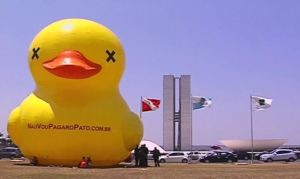
BY Wayne MADSEN | Strategic Culture Foundation | 24.03.2016
The latest themed revolution concocted by the Central Intelligence Agency’s «soft power» agents in the Brazilian federal and state legislatures, corporate media, and courts and prosecutors’ offices – all spurred on with the financial help of George Soros’s nongovernmental organizations – is the «Yellow Duck Revolution».
Large inflatable yellow ducks – said to represent the economic «quackery» of President Dilma Rousseff and her Workers’ Party government – have appeared at US-financed street demonstrations in Brasilia, Rio de Janeiro, and Sao Paulo. The main coordinators of these protests are found in Brazil’s largest corporate federations and corporate-owned media conglomerates and all of them have links to domestic non-profit organizations like Vem Pra Rua (To the Street) – a typical Soros appellation – and Free Brazil Movement, in turn funded by the usual suspects of the National Endowment for Democracy (NED), US Agency for International Development (USAID), and Soros’s Open Society Institute.
After trying to mount an electoral defeat of Brazil’s progressive leftist president, Dilma Rousseff, through a combination of presidential candidate assassination (the aerial assassination of Eduardo Campos in 2014 to pave the way to the presidency for the Wall Street-owned Green candidate Marina Silva, Campos’s vice presidential running mate), «rent-a-mob» street demonstrations, and corporate media propaganda, the Langley spooks are now trying to run Rousseff from office through a «Made in America» impeachment process. Aware that Rousseff’s progressive predecessor and mentor, Luiz Inacio Lula da Silva, has been targeted by Brazilian prosecutors on the CIA’s payroll, for arrest and prosecution for bribery, she appointed him to her government with ministerial rank and prosecutorial immunity. Lula only became a target because he signaled his desire to run for the presidency after Rousseff’s term ends in 2019.
The Workers’ Party correctly points out that the legislative impeachment maneuvers against Rousseff and the judicial operations against both Rousseff and Lula emanate from Washington. The same «color of law» but CIA-advanced operations were directed against presidents Cristina Fernandez de Kirchner in Argentina, Rafael Correa in Ecuador, Evo Morales in Bolivia, Nicolas Maduro in Venezuela, Fernando Lugo in Paraguay, and Manuel Zelaya in Honduras. In the cases of Lugo and Zelaya, the operations were successful and both leaders were removed from power by CIA-backed rightist forces.
Street protests against Rousseff have, since they began in 2014, taken on the typical Soros themed revolution construct. As with the disastrous Soros-inspired and CIA-nurtured Arab Spring protests in Egypt, Libya, Syria, and Tunisia and Euromaidan protest in Ukraine, the Vem Pra Rua movement and the associated Free Brazil Movement are basically nothing more than politically-motivated capitalist campaigns relying on Facebook, Twitter, and pro-insurrection television and radio networks, newspapers, and websites.
In addition to the inflatable yellow ducks, street protests have been marked by quickly-manufactured inflatable dolls of Lula in black and white prison garb and a placard cartoon drawing of Rousseff with a red diagonal «No» sign drawn through it. Street protest devices, which also include green and yellow banners and clothing, are telltale signs of significant amounts of money backing the psychological warfare gimmickry.
Brazilian prosecutors on Langley’s payroll arrested the popular Lula after staging a massive police raid on his house. Police also arrested the former First Lady of Brazil, Lula’s wife Marisa Leticia. Lula said he felt that he was kidnapped by the police. In 2009, Honduran troops actually kidnapped President Manuel Zelaya in the middle of the night and detained him in a military cell prior to expelling him from the country. That operation, like the one against Lula and Rousseff, was backed not only by the CIA and NSA, but by the US Southern Command in Miami. The Honduran coup was also backed by the Supreme Court of Honduras. To prevent a further political arrest of her predecessor, Rousseff made Lula her chief of staff, a cabinet position that affords Lula some protection from continuing prosecutorial harassment and legal proceedings by the federal court.
On March 16, Judge Sergio Moro, who is in charge of Operation «Lava-jato» («Car wash»), the two-year investigation of Petrobras and the alleged bribery involving Rousseff and Lula, released two taped intercepts of phone calls between the president and former president. The bugged phone conversation involved Rousseff’s plans to appoint Lula as her chief of staff, a Cabinet rank, as a way to afford him some protection from the CIA’s judicial-backed coup operation now in play. Rousseff previously served as Lula’s chief of staff. Classified National Security Agency documents leaked by whistleblower Ed Snowden illustrate how the NSA has spied on Rousseff’s office and mobile phones. President Obama claimed he ordered an end to such spying on world leaders friendly to the United States. Obama’s statement was false.
Judge Sergio Moro’s name appears in one of the leaked State Department cables. On October 30, 2009, the US embassy in Brasilia reported that Moro attended an embassy-sponsored conference in Rio de Janeiro held from October 4-9. Titled «Illicit Financial Crimes», the conference appears have been an avenue for the CIA and other US intelligence agencies to train Brazilian federal and state law enforcement, as well as other Latin American police officials from Argentina, Paraguay, Panama, and Uruguay, in procedures to mount bogus criminal prosecutions of Latin American leaders considered unfriendly to the United States. The State Department cable from Brasilia states: «Moro… discussed the 15 most common issues he sees in money laundering cases in the Brazilian Courts».
One item that was not on the agenda for the US embassy seminar was the NSA’s covert spying on the communications of Rousseff, Lula, and the state-owned Brazilian oil company Petrobras. In a technique known as prosecutorial «parallel construction», US prosecutors given access to illegally-intercepted communications, have initiated prosecution of American citizens based on the selective use of warrantless intercepts. If such tactics can be used in the United States, they can certainly be used against leaders like Rousseff, Lula, and others. The Operation Car wash intercepts of the Rousseff-Lula phone conversations that were released by Judge Moro to the media may have originated with NSA and its XKEYSCORE database of intercepts of Brazilian government and corporate communications conducted through bugging operations codenamed KATEEL, POCOMOKE, and SILVERZEPHYR.
In what could be called the «Obama Doctrine», the CIA has changed its game plan in overthrowing legitimate governments by using ostensibly «legal» means. Rather than rely on junta generals and tanks in the street to enforce its will, the CIA has, instead, employed prosecutors, judges, opposition party leaders, newspaper editors, and website administrators, as well as mobs using gimmicks – everything from inflatable yellow ducks, paper mâché puppets, and freshly silk screen-printed t-shirts, flags, and banners – as themed revolution facilitators.
As shown by the leaked State Department cables, the CIA has identified a number of agents of influence it can rely on for providing intelligence on both Rousseff and Lula. These sources have included the senior leadership of the Workers’ Party; officials of Petrobras eager to see their company sold off to the highest-bidding foreign vultures; Brazilian Central Bank executives; and Brazilian military intelligence officers who were originally trained by US intelligence and military agencies.
In addition to BRICS member Brazil, other BRICS nations have also seen the US increasing its efforts to organize themed revolutions. South Africa is on the target list, as are Russia and China.
Soros Disruption: American-Style
By Wayne MADSEN – Strategic Culture Foundation – 20.03.2016
Eastern Europeans and Arabs are all-too-familiar with the political street hooliganism sponsored by global «provocateur» George Soros and his minions. Lately, middle-class Americans have had a taste of the type of violent protest provocations during the current US presidential campaign that have previously been visited upon governments from Macedonia and Moldova to Syria and Libya.
Recently, Donald Trump campaign rallies have seen highly-coordinated and well-planned political demonstrations in Chicago, Cleveland, St. Louis, Dayton, and other cities. The rallies were disrupted by highly-coordinated and well-planned protesters waving freshly-printed protest signs before awaiting television cameras. Such «rent-a-mob» actions are trademark signs of the involvement of George Soros and the «godfather» of political street violence, Gene Sharp, in disrupting the normal political process.
One of the favored methods proposed by Sharp and embraced by Soros-financed groups is the taunting of individuals. Sharp’s advice to taunt speakers is being played out in the US presidential campaign: «instead of predominantly silent and dignified behavior… people may mock and insult officials, either at a certain place or by following them for a period». Sharp suggests that taunting individuals, such as presidential candidates, be combined with a refusal to disperse when either asked or ordered to do so. Sharp claims that these methods are «non-violent». However, when the US Secret Service, charged with protecting presidential candidates from assassination or bodily harm, order protesters to leave a campaign venue and there is a subsequent refusal to do so, violence is a certainty.
Soros and Sharp honed their street revolution tactics on the streets of Belgrade in the Bulldozer Revolution that overthrew Serbian president Slobodan Milosevic on October 5, 2000. Two Soros-financed and Sharp-inspired groups, OPTOR! and the Center for Applied Nonviolent Action and Strategies (CANVAS), as well as their leader Srdja Popovic, a so-called «pro-democracy» agitator, have all been unmasked as US intelligence assets. Popovic has received funding from the CIA-linked US Institute of Peace, a creation of neo-conservatives to advance the type of undemocratic political street disruptions first seen in Serbia and that soon expanded to Ukraine, Georgia, Egypt, Venezuela, Russia, Macedonia, and other countries. Today, Soros-inspired political violence has targeted Trump rallies across the United States.
Popovic first began to infiltrate American politics by ostensibly supporting the Occupy Wall Street movement. As his ties to the CIA and Goldman Sachs later showed, his intent and that of his financiers were to derail the anti-capitalist popular movement.
Several veteran «agents provocateurs» of the Occupy Wall Street movement who are now part of the Bernie Sanders presidential campaign have been enlisted by groups like Unbound Philanthropy, an immigrant rights group, to disrupt Trump rallies. Together with the Soros-financed group Black Lives Matter, these professional street hooligans have carefully, and in compliance with the Sharp model, staged their demonstrations to achieve maximum media coverage while achieving the maximum level of disruption to the primary election process.
Unbound Philanthropy is funded by Obama’s deep-pocketed friend and frequent vacation host in Hawaii, William Reeves, a former JP Morgan executive who now heads up BlueCrest Capital. In some cases, the political protesters masquerade as Trump supporters by wearing pro-Trump shirts and hats in order to gain access to Trump campaign venues. This methodology of disruption employs another Sharp tactic, that of using false identities. Coupled with the tactic of «non-violent harassment» of individuals, the use of employing false identities to gain admittance to Trump rallies, followed by coordinated protests in the form of placard-waving «stand-ins», are textbook examples of Sharp tactics being employed with the financial support of Soros and his gang, which includes Reeves and pro-immigration Hispanic groups and Black Lives Matter. Many of the anti-Trump street actions are coordinated by MoveOn.org, another group financed principally by Soros and the Hyatt Hotels’ Pritzker family of Chicago. One member of the Pritzker family, Penny Pritzker, serves as the Secretary of Commerce in the Obama administration.
MoveOn.org, which has endorsed Sanders, is actually using its protests at Trump rallies as a fundraising gimmick. It promises to disrupt future Trump campaign rallies and it will use every weapon in the Sharp/Soros handbook.
Another Sharp/Soros tactic employed against Trump is the «speak-in». During a Trump campaign appearance in Dayton, a pro-Bernie Sanders protester jumped a barrier and rushed the stage in an attempt to grab the microphone from Trump. The Secret Service tackled the protester who was arrested by police. The protester previously took part in a 2015 protest at Wright State University in Dayton where he dragged a US flag on the ground. Destruction of property, including US flags, is another hallmark disruption tactic proposed by Sharp.
The Sharp definition of a «speak-in» is a «special form of nonviolent intervention… when actionists interrupt a meeting… or other gathering for the purpose of expressing viewpoints on issues which may or may not be related directly to the occasion». Soros classifies the action as «social intervention», with «psychological and physical aspects». Regardless of Sharp’s definition of such actions as «nonviolent», the Secret Service does not take lightly anyone lunging at a presidential candidate, especially after the assassination of candidate Robert F. Kennedy in Los Angeles in 1968 and the shooting and attempted assassination of candidate George Wallace in 1972. Soros’s operatives are dangerously playing with fire by bringing such violence-tinged street protest tactics to the American presidential political scene.
The stench of Popovic and Soros in the street operations against Trump, who has railed against Wall Street’s «free trade agreements» and neo-conservative «wars of choice», can be seen in the links between the street protest groups and corporate giants like Goldman Sachs.
Popovic and his CANVAS non-governmental organization (NGO) has received funding from a former Goldman Sachs executive named Muneer Satter.
Satter happened to work at Goldman Sachs with fellow corporate executive Heidi Cruz, the wife of Trump’s opponent for the Republican presidential nomination, Senator Ted Cruz of Texas. Although Satter retired from Goldman Sachs in 2012 he continues to serve as vice chairman of the Goldman Sachs Foundation. In 2012, the year that Satter retired from Goldman Sachs, the firm loaned more than $1 million to Cruz’s Texas US Senate campaign.
Satter also happens to be close to both President Barack Obama and anti-Trump GOP operative Karl Rove. Satter has donated to both Obama and Rove’s Crossroads political action committee. Satter was also the national finance co-chair of Mitt Romney’s 2008 and 2012 presidential campaigns.
This year, Satter joined the Senator Marco Rubio campaign as Illinois Finance Committee co-chairman. Such background players, Heidi Cruz and her Goldman Sachs friend Satter, as well as Rove, Romney, Reeves, Soros, the Pritzkers, and Popovic – a Central Intelligence Agency-linked foreign interloper in the United States political system – are the actual movers and shakers behind America’s presidential election. Their jobs and those of other deep-pocketed political financiers like Paul Singer, Haim Saban, Sheldon Adelson, Michael Bloomberg, Sam Zell, and Norman Braman, are to ensure that no «unfiltered outsiders» ever become the President of the United States. These and other wealthy backroom political maestros owe their undemocratic but massive political influence to insider politicians residing at 1600 Pennsylvania Avenue in Washington. They will do everything in their power to prevent an «unfiltered» candidate from becoming the next American president.
How Propaganda Feeds War on Syria
By Rick Sterling | Consortium News | March 17, 2016
There has been a pattern of sensational but untrue reports that lead to public acceptance of U.S. and Western military intervention in countries around the world.
For instance, in Gulf War 1 (1990-91), there were reports of Iraqi troops stealing incubators from Kuwait, leaving babies to die on the cold floor. Relying on the testimony of a Red Crescent doctor, Amnesty Interenational ‘verified’ the false claims.
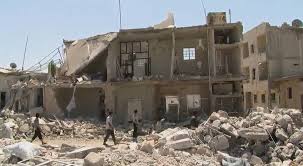
Scene of destruction after aerial bombing in Azaz, Syria, Aug. 16, 2012.
(U.S. government photo)
Ten years later, there were reports of yellow cake uranium going to Iraq for development of weapons of mass destruction.
One decade later, there were reports of Libyan soldiers drugged on viagra and raping women as they advanced.
In 2012, NBC broadcaster Richard Engel was supposedly kidnapped by a pro-Assad Syrian militia but luckily freed by Syrian opposition fighters, the “Free Syrian Army.”
All these reports were later confirmed to be fabrications and lies. They all had the goal of manipulating public opinion and they all succeeded in one way or another. Despite the consequences, which were often disastrous, none of the perpetrators were punished or paid any price.
It has been famously said, “Those who do not learn from the past are doomed to repeat it.” This report is a critical review of the so-called “Caesar Torture Photos” story. As will be shown, there is strong evidence the accusations are entirely or substantially false.
Overview of ‘Caesar Torture Photos’
On Jan. 20, 2014, two days before negotiations about the Syrian conflict were scheduled to begin in Switzerland, a sensational report burst onto television and front pages around the world. The story was that a former Syrian army photographer had 55,000 photographs documenting the torture and killing of 11,000 detainees by the Syrian security establishment.
The Syrian photographer was given the code-name “Caesar.” The story became known as the “Caesar Torture Photos.” A team of lawyers plus digital and forensic experts were hired by the Carter-Ruck law firm, on contract to Qatar, to go to the Middle East and check the veracity of “Caesar” and his story. They concluded that “Caesar” was truthful and the photographs indicated “industrial scale killing.”
CNN, London’s Guardian and LeMonde broke the story which was subsequently broadcast in news reports around the world. The Caesar photo accusations were announced as negotiations began in Switzerland. With the opposition demanding the resignation of the Syrian government, negotiations quickly broke down.
For the past two years the story has been preserved with occasional bursts of publicity and supposedly corroborating reports. Most recently, in December 2015 Human Rights Watch (HRW) released a report titled “If the Dead Could Speak” with significant focus on the Caesar accusations.
Following are 12 significant problems with the “Caesar torture photos” story:
- Almost half the photos show the opposite of the allegations.
The Carter Ruck Inquiry Team claimed there were about 55,000 photos total with about half of them taken by “Caesar” and the other half by other photographers. The Carter Ruck team claimed the photos were all “similar.” Together they are all known as “Caesar’s Torture Photos.”
The photographs are in the custody of an opposition organization called the Syrian Association for Missing and Conscience Detainees (SAFMCD). In 2015, they allowed Human Rights Watch (HRW) to study all the photographs which have otherwise been secret. In December 2015, HRW released their report titled “If the Dead Could Speak.”
The biggest revelation is that over 46 percent of the photographs (24,568) do not show people “tortured to death” by the Syrian government. On the contrary, they show dead Syrian soldiers and victims of car bombs and other violence (HRW pp 2-3). Thus, nearly half the photos show the opposite of what was alleged. These photos, never revealed to the public, confirm that the opposition is violent and has killed large numbers of Syrian security forces and civilians.
- The claim that other photos only show “tortured detainees” is exaggerated or false.
The Carter Ruck report says “Caesar” only photographed bodies brought from Syrian government detention centers. In its December 2015 report, HRW said, “ The largest category of photographs, 28,707 images, are photographs Human Rights Watch understands to have died in government custody, either in one of several detention facilities or after being transferred to a military hospital.” They estimate 6,786 dead individuals in the set.
The photos and the deceased are real, but how they died and the circumstances are unclear. There is strong evidence some died in conflict. Others died in the hospital. Others died and their bodies were decomposing before they were picked up. These photographs seem to document a war-time situation where many combatants and civilians are killed.
It seems the military hospital was doing what it had always done: maintaining a photographic and documentary record of the deceased. Bodies were picked up by different military or intelligence branches. While some may have died in detention; the big majority probably died in the conflict zones. The accusations by “Caesar.” the Carter Ruck report and HRW that these are all victims of “death in detention” or “death by torture” or death in “government custody” are almost certainly false.
- The true identity of “Caesar” is probably not as claimed.
The Carter Ruck Report says “This witness who defected from Syria and who had been working for the Syrian government was given the code-name ‘Caesar’ by the inquiry team to protect the witness and members of his family.” (CRR p12)
However if his story is true, it would be easy for the Syrian government to determine who he really is. After all, how many military photographers took photos at Tishreen and Military 601 Hospitals during those years and then disappeared? According to the Carter Ruck report, Caesar’s family left Syria around the same time. Considering this, why is “Caesar” keeping his identity secret from the Western audience? Why does “Caesar” refuse to meet even with highly sympathetic journalists or researchers?
The fact that 46 percent of the total photographic set is substantially the opposite of what was claimed indicates two possibilities: Caesar and his promoters knew the contents but lied about them expecting nobody to look. Or, Caesar and his promoters did not know the contents and falsely assumed they were like the others. The latter seems more likely which supports the theory that Caesar is not who he claims to be.
- The Carter Ruck Inquiry was faulty, rushed and politically biased.
The credibility of the “Caesar” story has been substantially based on the Carter-Ruck Inquiry Team which “verified” the defecting photographer and his photographs. The following facts suggest the team was biased with a political motive:
–The investigation was financed by the government of Qatar which is a major supporter of the armed opposition.
–The contracted law firm, Carter Ruck and Co, has previously represented Turkey’s President Recep Tayyip Erdogan, also known for his avid support of the armed opposition.
–The American on the legal inquiry team, Professor David M. Crane, has a long history working for the U.S. Defense Department and Defense Intelligence Agency. The U.S. government has been deeply involved in the attempt at “regime change” with demands that President Bashar “Assad must go” beginning in summer 2011 and continuing until recently.
–Crane is personally partisan in the conflict. He has campaigned for a Syrian War Crimes Tribunal and testified before Congress in October 2013, three months before the Caesar revelations.
–By their own admission, the inquiry team was under “time constraints” (CRR, p11).
–By their own admission, the inquiry team did not even survey most of the photographs
–The inquiry team was either ignorant of the content or intentionally lied about the 46 percent showing dead Syrian soldiers and attack victims.
–The inquiry team did its last interview with “Caesar” on Jan. 18, 2014, quickly finalized a report and rushed it into the media on Jan. 20, two days prior to the start of United Nations-sponsored negotiations.
The self-proclaimed “rigor” of the Carter Ruck investigation is without foundation. The claims to a “scientific” investigation are similarly without substance and verging on the ludicrous.
- The U.S. Central Intelligence Agency (CIA) is involved.
In an interview on France24, David Crane of the inquiry team describes how “Caesar” was brought to meet them by “his handler, his case officer.” The expression “case officer” usually refers to the CIA. This would be a common expression for Professor Crane who previously worked in the Defense Intelligence Agency. The involvement of the CIA additionally makes sense since there was a CIA budget of $1 billion for Syria operations in 2013. Crane’s “Syria Accountability Project” is based at Syracuse University where the CIA actively recruits new officers despite student resistance.
Why does it matter if the CIA is connected to the “Caesar” story? Because the CIA has a long history of disinformation campaigns. In 2011, false reports of viagra fueled rape by Libyan soldiers were widely broadcast in Western media as the U.S. pushed for a military mandate. Decades earlier, the world was shocked to hear about Cuban troops fighting in Angola raping Angolan women. The CIA chief of station for Angola, John Stockwell, later described how they invented the false report and spread it around the world. The CIA was very proud of that disinformation achievement. Stockwell’s book, In Search of Enemies, is still relevant.
- The accusers portray simple administrative procedures as mysterious and sinister.
The Carter Ruck inquiry team falsely claimed there were about 11,000 tortured and killed detainees. They then posed the question: Why would the Syrian government photograph and document the people they just killed? The Carter Ruck Report speculates that the military hospital photographed the dead to prove that the “orders to kill” had been followed. The “orders to kill” are assumed.
A more logical explanation is that dead bodies were photographed as part of normal hospital / morgue procedure to maintain a file of the deceased who were received or treated at the hospital. The same applies to the body labeling / numbering system. The Carter Ruck report suggests there is something mysterious and possibly sinister in the coded tagging system. But all morgues need to have a tagging and identification system.
- The photos have been manipulated.
Many of the photos at the SAFMCD website have been manipulated. The information card and tape identity are covered over and sections of documents are obscured. It must have been very time-consuming to do this for thousands of photos. The explanation that they are doing this to “protect identity” is not credible since the faces of victims are visible. What are they hiding?
- The Photo Catalog has duplicates and other errors.
There are numerous errors and anomalies in the photo catalog as presented at the SAFMCD website. For example, some deceased persons are shown twice with different case numbers and dates. There are other errors where different individuals are given the same identity number.
Researcher Adam Larson at A Closer Look at Syria website has done detailed investigation which reveals more errors and curious error patterns in the SAFMCD photo catalog.
9. With few exceptions, Western media uncritically accepted and promoted the story.
The Carter Ruck report was labeled “Confidential” but distributed to CNN, the Guardian and LeMonde. CNN’s Christiane Amanpour gushed over the story as she interviewed three of the inquiry team under the headline “EXCLUSIVE: Gruesome Syria photos may prove torture by Assad regime.” Critical journalism was replaced by leading questions and affirmation. David Crane said “This is a smoking gun.” Desmond de Silva “likened the images to those of holocaust survivors.”
The Guardian report was titled “Syrian regime document trove shows evidence of ‘industrial scale’ killing of detainees” with the subtitle, “Senior war crimes prosecutors say photographs and documents provide ‘clear evidence’ of systematic killing of 11,000 detainees”
One of the very few skeptical reports was by Dan Murphy in the Christian Science Monitor. Murphy echoed standard accusations about Syria but went on to say incisively, “the report itself is nowhere near as credible as it makes out and should be viewed for what it is: A well-timed propaganda exercise funded by Qatar, a regime opponent who has funded rebels fighting Assad who have committed war crimes of their own.”
Unfortunately that was one of very few critical reports in the mainstream media. In 2012, foreign affairs journalist Jonathan Steele wrote an article describing the overall media bias on Syria. His article was titled “Most Syrians back Assad but you’d never know from western media.” The media campaign and propaganda has continued without stop. It was in this context that the Carter Ruck Report was delivered and widely accepted without question.
- Politicians have used the Caesar story to push for more US/NATO aggression.
Politicians seeking direct U.S. intervention for “regime change” in Syria were quick to accept and broadcast the “Caesar” story. They used it to demonize the Assad government and argue that the U.S. must act so as to prevent “another holocaust,” “another Rwanda,” “another Cambodia.”
When Caesar’s photos were displayed at the House Foreign Affairs Committee in Congress, Chairman Ed Royce said “It is far past time that the world act…. It is far past time for the United States to say there is going to be a safe zone across this area in northern Syria.”
The top-ranking Democrat on the House Foreign Affairs Committee is Eliot Engel. In November 2015 he said, “We’re reminded of the photographer, known as Caesar, who sat in this room a year ago, showing us in searing, graphic detail what Assad has done to his own people.” Engel went on to advocate for a new authorization for the use of military force.
Rep. Adam Kinzinger is another advocate for aggression against Syria. At an event at the Holocaust Memorial Museum in July 2015, he said, “If we want to destroy ISIS we have to destroy the incubator of ISIS, Bashar al-Assad.”
The irony and hypocrisy is doubly profound since Rep. Kinzinger has met and coordinated with opposition leader Okaidi who is a confirmed ally of ISIS. In contrast with Kinzinger’s false claims, it is widely known that ISIS ideology and initial funding came from Saudi Arabia and much of its recent wealth from oil sales via Turkey. The Syrian Army has fought huge battles against ISIS, winning some but losing others with horrific scenes of mass beheading carried out by ISIS.
- The Human Rights Watch assessment is biased.
HRW has been very active around Syria. After the chemical attacks in greater Damascus on Aug. 21, 2013, HRW rushed a report which concluded that, based on a vector analysis of incoming projectiles, the source of the sarin carrying rockets must have been Syrian government territory. This analysis was later debunked as a “junk heap of bad evidence” by highly respected investigative journalist Robert Parry.
HRW’s assumption about the chemical weapon rocket flight distance was faulty. Additionally it was unrealistic to think you could determine rocket trajectory with 1 percent accuracy from a canister on the ground, especially from a canister on the ground that had deflected off a building wall.
In spite of this, HRW stuck by its analysis which blamed the Assad government. HRW Director Ken Roth publicly indicated dissatisfaction when an agreement to remove Syrian chemical weapons was reached. Roth wanted more than a “symbolic” attack on Syrian government forces.
Regarding the claims of “Caesar,” HRW seems to be the only non-governmental organization to receive the full set of photo files from the custodian. To its credit, HRW acknowledged that nearly half the photos do not show what has been claimed for two years: they show dead Syrian soldiers and militia along with scenes from crime scenes, car bombings, etc.
But HRW’s bias is clearly shown in how it handles this huge contradiction. Amazingly, HRW suggests the incorrectly identified photographs support the overall claim. They say, “This report focuses on deaths in detention. However other types of photographs are also important. From an evidentiary perspective, they reinforce the credibility of the claims of Caesar about his role as a forensic photographer of the Syrian security forces or at least with someone who has access to their photographs.” (HRW, p31) This seems like saying if someone lies to you half the time that proves they are truthful.
The files disprove the assertion that the files all show people who were tortured and killed. The photographs show a wide range of deceased persons, from Syrian soldiers to Syrian militia members to opposition fighters to civilians trapped in conflict zones to regular deaths in the military hospital. There may be some photos of detainees who died in custody after being tortured, or who were simply executed. We know that this happened in Iraqi detention centers under U.S. occupation. Ugly and brutal things happen in war times. But the facts strongly suggest that the “Caesar” account is basically untrue or a gross exaggeration.
It is striking that the HRW report has no acknowledgment of the war conditions and circumstances in Syria. There is no acknowledgment that the government and Syrian Arab Army have been under attack by tens of thousands of weaponized fighters openly funded and supported by many of the wealthiest countries in the world.
There is no hint at the huge loss of life suffered by the Syrian army and supporters defending their country. The current estimates indicate from 80,000 to 120,000 Syrian soldiers, militia and allies having died in the conflict. During the three years 2011-2013, including the period covered by the “Caesar” photos, it is estimated that over 52,000 Syrian soldiers and civilian militia died versus 29,000 anti-government forces.
HRW had access to the full set of photographs including the Syrian army and civilian militia members killed in the conflict. Why did they not list the number of Syrian soldiers and security forces they identified? Why did they not show a single image of those victims?
HRW goes beyond endorsing the falsehoods in the “Caesar story”; HRW suggests the cataloguing is only a partial listing. On page 5, the report says, “Therefore, the number of bodies from detention facilities that appear in the Caesar photographs represent only a part of those who died in detention in Damascus.”
On the contrary, the Caesar photographs seem to mostly show victims who died in a variety of ways in the armed conflict. The HRW assertions seem to be biased and inaccurate.
- The legal accusations are biased and ignore the supreme crime of aggression.
The Christian Science Monitor journalist Dan Murphy gave an apt warning in his article on the Carter Ruck report about “Caesar.” While many journalists treated the prosecutors with uncritical deference, he said, “Association with war crime prosecutions is no guarantor of credibility – far from it. Just consider Luis Moreno Ocampo’s absurd claims about Viagra and mass rape in Muammar Qaddafi’s Libya in 2011. War crimes prosecutors have, unsurprisingly, a bias towards wanting to bolster cases against people they consider war criminals (like Assad or Qaddafi) and so should be treated with caution. They also frequently favor, as a class, humanitarian interventions.”
The Carter Ruck legal team demonstrated how accurate Murphy’s cautions could be. The legal team was eager to accuse the Syrian government of “crimes against humanity” but the evidence of “industrial killing,” “mass killing,” “torturing to kill” is dubious and much of the hard evidence shows something else.
In contrast, there is clear and solid evidence that a “Crime against Peace” is being committed against Syria. It is public knowledge that the “armed opposition” in Syria has been funded, supplied and supported in myriad ways by various outside governments. Most of the fighters, both Syrian and foreign, receive salaries from one or another outside power. Their supplies, weapons and necessary equipment are all supplied to them. Like the “Contras” in Nicaragua in the 1980’s, the use of such proxy armies is a violation of customary international law.
It is also a violation of the UN Charter which says “All Members shall refrain in their international relations from the threat or use of force against the territorial integrity or political independence of any state, or in any other matter inconsistent with the Purposes of the United Nations”.
The government of Qatar has been a major supporter of the mercenaries and fanatics attacking the sovereign state of Syria. Given that fact, isn’t it hugely ironic to hear the legal contractors for Qatar accusing the Syrian government of “crimes against humanity”?
Isn’t it time for the United Nations to make reforms so that it can start living up to its purposes? That will require demanding and enforcing compliance with the UN Charter and International Law.
Rick Sterling is an independent research/writer and member of Syria Solidarity Movement. He can be contacted at rsterling1@gmail.com
UK suppresses documents on Gitmo ‘torture collusion’

Press TV – March 6, 2016
The British government is withholding key documents which could shed light on allegations of UK’s involvement in the torture of detainees in Guantanamo prison, according to a new report.
A number of files have been recently found which reveal confidential exchanges between top former US and UK authorities on the torture and rendition of detainees.
Based on a lawsuit by a British parliamentary group, the US administration is obliged to make public documents which relate to Britain’s involvement.
Former Guantanamo detainees have previously said British officials have either been present at, or submitted questions for, “extreme” interrogation by US officials, according to the Independent.
The documents indicate that former UK prime minister Tony Blair and former US president George W. Bush had been in consultation about the treatment of detainees at the US-run prison in Cuba.
Now, the US State Department is said to have reported that all related documents have been withheld from public disclosure.
At least 12 documents, found in the US State Department’s search, relate to interventions by British politicians and officials over the treatment of detainees and torture techniques.
The State Department has reported, “After reviewing the documents, the UK Government’s Foreign and Commonwealth Office requested that all 12 documents be withheld in full from public disclosure.”
Guantanamo was established by former president Bush in 2002 as a prison for alleged foreign terrorism suspects following the September 11, 2001, attacks in the US.
As many as 775 suspects are said to have been brought to the facility ever since its establishment.
US President Barack Obama had promised to close the Guantanamo Bay prison in his 2008 election campaign, citing its damage to America’s reputation abroad. However, he has so far failed to deliver on that pledge due to stiff opposition from Congress.
A US Senate report in December 2014 revealed that the CIA used a wide array of torture as part of its interrogation methods against Guantanamo prisoners.
A Nasty Piece of Work: Bill Maher’s Politics are Unreal

By Eoin Higgins | February 28, 2016
I have a writing prompt on my blog’s dashboard reading: “Bill Maher’s latest repulsive comments.”
It’s a perennially useful prompt, even though most of what I write about him doesn’t see print.
The nominally liberal comedian uses his weekly discussion show on HBO, Real Time With Bill Maher, to pretentiously preen to a reliably sycophantic audience and spread xenophobic hate speech, barely veiled racism, and dismissive misogyny. It’s a nasty piece of work that enjoys a substantial influence in mainstream liberal circles.
Maher’s base is expanding out of the liberal mainstream, though, thanks to his virulent hatred of Islam and its adherents. Much like evangelical atheist Richard Dawkins, whose views on Islam and the Global South have won him fans across the rising right wing in Europe, Maher is enjoying something of a career renaissance as he garners praise from the American hard right.
Maher’s speechifying last week was at its most inspired when he was speaking with his new buddy Michael Hayden, the former head of the CIA. Hayden came on the show to promote his new memoir/torture apologia. Maher had a lot of fun squawking to one of the architects of the modern surveillance state about how Apple should give the FBI the tech to unlock the iPhone- tech the company claims it has specifically not designed in response to consumer concerns over privacy.
Bad enough, but the real horror show came, as it often does, on the internet-only post-show discussion called “Overtime.”
During Overtime on February 26, Maher and his guests debated the efficacy and wisdom of closing the extralegal Guantanamo Bay Prison Camp which houses upwards of seventy men who have never been tried for any crimes. Most men in the prison were scooped up in the aftermath of the immediate US invasion and destruction of Afghanistan after the 9/11 attacks.
Now, Maher is on the right side here- he believes the prison should be closed and the prisoners given trials- but for the wrong reason. Maher thinks the US should give the Guantanamo Bay prisoners trials because “it works.”
“It works.”
This sounds reasonable enough. It’s not.
What constitutes the judicial system “working” in trying terror suspects in Bill Maher’s world? Why, it’s the fact that the trials have a 100 percent success rate.
That success rate is not necessarily an indication of guilt.
The trial process is heavily weighted towards the prosecution. Much of the evidence that is presented at these trials is deemed far too sensitive for the public and a threat to national security. The deck is so stacked against the defense that the entire process functions more as going through the motions; a military tribunal rather than an actual trial.
This is the system that Maher believes works- a system that is designed to maintain the power of the state to the detriment of the powerless, irrespective of their crimes- because it reliably returns the result he believes it should.
It’s the same logical fallacy that maintains inequality of power, access, and justice, promoted by the same kind of person the fallacy requires: An ignorant, well-to-do blowhard, untouched by the reality of the inequity, all too ready to trumpet it to his receptive audience.
Like Bill Maher.
I couldn’t fit the rest of Maher’s comments from this week into the story, but they can be found here.
The Caesar photo fraud that undermined Syrian negotiations

By Rick Sterling | American Herald Tribune | March 4, 2016
A 30 page investigative report on the “Caesar Torture Photos” has been released and is available online here. The following is a condensed version of the report. Readers who are especially interested are advised to get the full report which includes additional details, photographs, sources and recommendations.
Introduction
There is a pattern of sensational but untrue reports that lead to public acceptance of US and Western military intervention in countries around the world:
* In Gulf War 1, there were reports of Iraqi troops stealing incubators from Kuwait, leaving babies to die on the cold floor. Relying on the testimony of a Red Crescent doctor, Amnesty Interenational ‘verified’ the false claims.
* Ten years later, there were reports of yellow cake uranium going to Iraq for development of weapons of mass destruction.
* One decade later, there were reports of Libyan soldiers drugged on viagra and raping women as they advanced.
* In 2012, NBC broadcaster Richard Engel was supposedly kidnapped by pro-Assad Syrian militia but luckily freed by Syrian opposition fighters, the “Free Syrian Army”.
All these reports were later confirmed to be fabrications and lies. They all had the goal of manipulating public opinion and they all succeeded in one way or another. Despite the consequences, which were often disastrous, none of the perpetrators were punished or paid any price.
It has been famously said “Those who do not learn from the past are doomed to repeat it.” This report is a critical review of the “Caesar Torture Photos” story. As will be shown, there is strong evidence the accusations are entirely or substantially false.
Overview of ‘Caesar Torture Photos’
On 20 January 2014, two days before negotiations about the Syrian conflict were scheduled to begin in Switzerland, a sensational report burst onto television and front pages around the world. The story was that a former Syrian army photographer had 55,000 photographs documenting the torture and killing of 11,000 detainees by the Syrian security establishment.
The Syrian photographer was given the code-name ‘Caesar’. The story became known as the “Caesar Torture Photos”. A team of lawyers plus digital and forensic experts were hired by the Carter-Ruck law firm, on contract to Qatar, to go to the Middle East and check the veracity of “Caesar” and his story. They concluded that “Caesar” was truthful and the photographs indicated “industrial scale killing”. CNN, London’s Guardian and LeMonde broke the story which was subsequently broadcast in news reports around the world. The Caesar photo accusations were announced as negotiations began in Switzerland. With the opposition demanding the resignation of the Syrian government, negotiations quickly broke down.
For the past two years the story has been preserved with occasional bursts of publicity and supposedly corroborating reports. Most recently, in December 2015 Human Rights Watch (HRW) released a report titled “If the Dead Could Speak” with significant focus on the Caesar accusations.
Following are 12 significant problems with the ‘Caesar torture photos’ story.
1. Almost half the photos show the opposite of the allegations.
The Carter Ruck Inquiry Team claimed there were about 55,000 photos total with about half of them taken by ‘Caesar’ and the other half by other photographers. The Carter Ruck team claimed the photos were all ‘similar’. Together they are all known as ‘Caesar’s Torture Photos’.
The photographs are in the custody of an opposition organization called the Syrian Association for Missing and Conscience Detainees (SAFMCD). In 2015, they allowed Human Rights Watch (HRW) to study all the photographs which have otherwise been secret. In December 2015, HRW released their report titled “If the Dead Could Speak”. The biggest revelation is that over 46% of the photographs (24,568) do not show people ‘tortured to death” by the Syrian government. On the contrary, they show dead Syrian soldiers and victims of car bombs and other violence (HRW pp2-3). Thus, nearly half the photos show the opposite of what was alleged. These photos, never revealed to the public, confirm that the opposition is violent and has killed large numbers of Syrian security forces and civilians.
2. The claim that other photos only show ‘tortured detainees’ is exaggerated or false.
The Carter Ruck report says ‘Caesar’ only photographed bodies brought from Syrian government detention centers. In their December 2015 report, HRW said, “The largest category of photographs, 28,707 images, are photographs Human Rights Watch understands to have died in government custody, either in one of several detention facilities or after being transferred to a military hospital.” They estimate 6,786 dead individuals in the set.
The photos and the deceased are real, but how they died and the circumstances are unclear. There is strong evidence some died in conflict. Others died in the hospital. Others died and their bodies were decomposing before they were picked up. These photographs seem to document a war time situation where many combatants and civilians are killed. It seems the military hospital was doing what it had always done: maintaining a photographic and documentary record of the deceased. Bodies were picked up by different military or intelligence branches. While some may have died in detention; the great majority probably died in the conflict zones. The accusations by ‘Caesar’, the Carter Ruck report and HRW that these are all victims of “death in detention” or “death by torture” or death in ‘government custody” are almost certainly false.
3. The true identity of “Caesar” is probably not as claimed.
The Carter Ruck Report says “This witness who defected from Syria and who had been working for the Syrian government was given the code-name ‘Caesar’ by the inquiry team to protect the witness and members of his family.” (CRR p12) However if his story is true, it would be easy for the Syrian government to determine who he really is. After all, how many military photographers took photos at Tishreen and Military 601 Hospitals during those years and then disappeared? According to the Carter Ruck report, Caesar’s family left Syria around the same time. Considering this, why is “Caesar” keeping his identity secret from the western audience? Why does “Caesar” refuse to meet even with highly sympathetic journalists or researchers?
The fact that 46% of the total photographic set is substantially the opposite of what was claimed indicates two possibilities:
* Caesar and his promoters knew the contents but lied about them expecting nobody to look.
* Caesar and his promoters did not know the contents and falsely assumed they were like the others.
The latter seems more likely which supports the theory that Caesar is not who he claims to be.
4. The Carter Ruck Inquiry was faulty, rushed and politically biased.
The credibility of the “Caesar” story has been substantially based on the Carter-Ruck Inquiry Team which “verified” the defecting photographer and his photographs. The following facts suggest the team was biased with a political motive:
* the investigation was financed by the government of Qatar which is a major supporter of the armed opposition.
* the contracted law firm, Carter Ruck and Co, has previously represented Turkey’s President Erdogan, also known for his avid support of the armed opposition.
* the American on the legal inquiry team, Prof David M. Crane, has a long history working for U.S. Dept of Defense and Defense Intelligence Agency. The U.S. Government has been deeply involved in the attempt at ‘regime change’ with demands that ‘Assad must go’ beginning in summer 2011 and continuing until recently.
* Prof Crane is personally partisan in the conflict. He has campaigned for a Syrian War Crimes Tribunal and testified before Congress in October 2013, three months before the Caesar revelations.
* by their own admission, the inquiry team was under “time constraints” (CRR, p11).
* by their own admission, the inquiry team did not even survey most of the photographs
* the inquiry team was either ignorant of the content or intentionally lied about the 46% showing dead Syrian soldiers and attack victims.
* the inquiry team did their last interview with “Caesar” on January 18, quickly finalized a report and rushed it into the media on January 20, two days prior to the start of UN sponsored negotiations.
The self-proclaimed “rigor” of the Carter Ruck investigation is without foundation. The claims to a ‘scientific’ investigation are similarly without substance and verging on the ludicrous.
5. The U.S. Central Intelligence Agency (CIA) is involved.
In an interview on France24, Prof. David Crane of the inquiry team describes how ‘Caesar’ was brought to meet them by “his handler, his case officer”. The expression ‘case officer’ usually refers to the CIA. This would be a common expression for Prof. Crane who previously worked in the Defense Intelligence Agency. The involvement of the CIA additionally makes sense since there was a CIA budget of $1Billion for Syria operations in 2013.
Prof. Crane’s “Syria Accountability Project” is based at Syracuse University where the CIA actively recruits new officers despite student resistance.
Why does it matter if the CIA is connected to the ‘Caesar’ story? Because the CIA has a long history of disinformation campaigns. In 2011, false reports of viagra fueled rape by Libyan soldiers were widely broadcast in western media as the U.S. pushed for a military mandate. Decades earlier, the world was shocked to hear about Cuban troops fighting in Angola raping Angolan women. The CIA chief of station for Angola, John Stockwell, later described how they invented the false report and spread it round the world. The CIA was very proud of that disinformation achievement. Stockwell’s book, “In Search of Enemies” is still relevant.
6. The prosecutors portray simple administrative procedures as mysterious and sinister.
The Carter Ruck inquiry team falsely claimed there were about 11,000 tortured and killed detainees. They then posed the question: Why would the Syrian government photograph and document the people they just killed? The Carter Ruck Report speculates that the military hospital photographed the dead to prove that the “orders to kill” had been followed. The “orders to kill” are assumed.
A more logical explanation is that dead bodies were photographed as part of normal hospital / morgue procedure to maintain a file of the deceased who were received or treated at the hospital.
The same applies to the body labeling / numbering system. The Carter Ruck report suggests there is something mysterious and possibly sinister in the coded tagging system. But all morgues need to have a tagging and identification system.
7. The photos have been manipulated.
Many of the photos at the SAFMCD website have been manipulated. The information card and tape identity are covered over and sections of documents are obscured. It must have been very time consuming to do this for thousands of photos. The explanation that they are doing this to ‘protect identity’ is not credible since the faces of victims are visible. What are they hiding?
8. The Photo Catalog has duplicates and other errors.
There are numerous errors and anomalies in the photo catalog as presented at the SAFMCD website.
For example, some deceased persons are shown twice with different case numbers and dates.
There are other errors where different individuals are given the same identity number.
Researcher Adam Larson at A Closer Look at Syria website has done detailed investigation which reveals more errors and curious error patterns in the SAFMCD photo catalog.
9. With few exceptions, Western media uncritically accepted and promoted the story.
The Carter Ruck report was labeled “Confidential” but distributed to CNN, the Guardian and LeMonde.
CNN’s Christiane Amanpour gushed the story as she interviewed three of the inquiry team under the headline “EXCLUSIVE: Gruesome Syria photos may prove torture by Assad regime”. Critical journalism was replaced by leading questions and affirmation. David Crane said “This is a smoking gun”. Desmond de Silva “likened the images to those of holocaust survivors”.
The Guardian report was titled “Syrian regime document trove shows evidence of ‘industrial scale’ killing of detainees” with subtitle “Senior war crimes prosecutors say photographs and documents provide ‘clear evidence’ of systematic killing of 11,000 detainees”
One of the very few skeptical reports was by Dan Murphy in the Christian Science Monitor. Murphy echoed standard accusations about Syria but went on to say incisively, “the report itself is nowhere near as credible as it makes out and should be viewed for what it is: A well-timed propaganda exercise funded by Qatar, a regime opponent who has funded rebels fighting Assad who have committed war crimes of their own.”
Unfortunately that was one of very few critical reports in the mainstream media.
In 2012, foreign affairs journalist Jonathan Steele wrote an article describing the overall media bias on Syria.. His article was titled “Most Syrians back Assad but you’d never know from western media”. The media campaign and propaganda has continued without stop. It was in this context that the Carter Ruck Report was delivered and widely accepted without question.
10. Politicians have used the Caesar story to push for more US/NATO aggression.
Politicians seeking direct US intervention for ‘regime change’ in Syria were quick to accept and broadcast the ‘Caesar’ story. They used it to demonize the Assad government and argue that the US must act so as to prevent “another holocaust’, ‘another Rwanda’, ‘another Cambodia’.
When Caesar’s photos were displayed at the House Foreign Affairs Committee in Congress, Chairman Ed Royce said “It is far past time that the world act…. It is far past time for the United States to say there is going to be a safe zone across this area in northern Syria.”
The top ranking Democrat in the House Foreign Affairs Committee is Eliot Engel. In November 2015 he said “We’re reminded of the photographer, known as Caesar, who sat in this room a year ago, showing us in searing, graphic detail what Assad has done to his own people.” Engel went on to advocate for a new authorization for the use of military force.
Rep Adam Kinzinger is another advocate for aggression against Syria. At an event at the Holocaust Memorial Museum in July 2015 he said, “If we want to destroy ISIS we have to destroy the incubator of ISIS, Bashar al-Assad.”
The irony and hypocrisy is doubly profound since Rep Kinzinger has met and coordinated with opposition leader Okaidi who is a confirmed ally of ISIS. In contrast with Kinzinger’s false claims, it is widely known that ISIS ideology and initial funding came from Saudi Arabia and much of its recent wealth from oil sales via Turkey. The Syrian Army has fought huge battles against ISIS, winning some but losing others with horrific scenes of mass beheading.
11. The Human Rights Watch assessment is biased.
HRW has been very active around Syria. After the chemical attacks in greater Damascus on August 21, 2013, HRW rushed a report which concluded that, based on a vector analysis of incoming projectiles, the source of the sarin carrying rockets must have been Syrian government territory. This analysis was later debunked as a “junk heap of bad evidence” by highly respected investigative journalist Robert Parry. HRW’s assumption about the chemical weapon rocket flight distance was faulty. Additionally it was unrealistic to think you could determine rocket trajectory with 1% accuracy from a canister on the ground. To think you could determine flight trajectory from a canister on the ground that had deflected off a building wall was preposterous.
In spite of this, HRW stuck by its analysis which blamed the Assad government. HRW Director Ken Roth publicly indicated dissatisfaction when an agreement to remove Syrian chemical weapons was reached. Mr. Roth wanted more than a ‘symbolic’ attack.
In light of the preceding, we note the December 2015 HRW report addressing the claims of Caesar.
HRW seems to be the only non-governmental organization to receive the full set of photo files from the custodian. To its credit, HRW acknowledged that nearly half the photos do not show what has been claimed for two years: they show dead Syrian soldiers and militia along with scenes from crime scenes, car bombings, etc…
But HRW’s bias is clearly shown in how they handle this huge contradiction. Amazingly, they suggest the incorrectly identified photographs support the overall claim. They say, “This report focuses on deaths in detention. However other types of photographs are also important. From an evidentiary perspective, they reinforce the credibility of the claims of Caesar about his role as a forensic photographer of the Syrian security forces or at least with someone who has access to their photographs.” (HRW, p31) This seems like saying if someone lies to you half the time that proves they are truthful.
The files disprove the assertion that the files all show tortured and killed. The photographs show a wide range of deceased persons, from Syrian soldiers to Syrian militia members to opposition fighters to civilians trapped in conflict zones to regular deaths in the military hospital. There may be some photos of detainees who died in custody after being tortured, or who were simply executed. We know that this happened in Iraqi detention centers under U.S. occupation. Ugly and brutal things happen in war times. But the facts strongly suggest that the ‘Caesar’ account is basically untrue or a gross exaggeration.
It is striking that the HRW report has no acknowledgment of the war conditions and circumstances in Syria. There is no acknowledgment that the government and Syrian Arab Army have been under attack by tens of thousands of weaponized fighters openly funded and supported by many of the wealthiest countries in the world.
There is no hint at the huge loss of life suffered by the Syrian army and supporters defending their country. The current estimates indicate from eighty to one hundred and twenty thousand Syrian soldiers, militia and allies having died in the conflict. During the three years 2011 – 2013, including the period covered by Caesar photos, it is estimated that over 52,000 Syrian soldiers and civilian militia died versus 29,000 anti-government forces.
HRW had access to the full set of photographs including the Syrian army and civilian militia members killed in the conflict. Why did they not list the number of Syrian soldiers and security forces they identified? Why did they not show a single image of those victims?
HRW goes beyond endorsing the falsehoods in the ‘Caesar’ story; they suggest it is a partial listing. On page 5 the report says, “Therefore, the number of bodies from detention facilities that appear in the Caesar photographs represent only a part of those who died in detention in Damascus.”
On the contrary, the Caesar photographs seem to mostly show victims who died in a variety of ways in the armed conflict. The HRW assertions seem to be biased and inaccurate.
12. The legal accusations are biased and ignore the supreme crime of aggression.
The Christian Science Monitor journalist Dan Murphy gave an apt warning in his article on the Carter Ruck report about ‘Caesar’. While many journalists treated the prosecutors with uncritical deference, he said, “Association with war crime prosecutions is no guarantor of credibility – far from it. Just consider Luis Moreno Ocampo’s absurd claims about Viagra and mass rape in Muammar Qaddafi’s Libya in 2011. War crimes prosecutors have, unsurprisingly, a bias towards wanting to bolster cases against people they consider war criminals (like Assad or Qaddafi) and so should be treated with caution. They also frequently favor, as a class, humanitarian interventions.”
The Carter Ruck legal team demonstrated how accurate those cautions were. They were eager to accuse the Syrian government of “crimes against humanity” but the evidence of “industrial killing”, “mass killing”, “torturing to kill” is dubious and much of the hard evidence shows something else.
In contrast, there is clear and solid evidence that a “Crime against Peace” is being committed against Syria. It is public knowledge that the “armed opposition” in Syria has been funded, supplied and supported in myriad ways by various outside governments. Most of the fighters, both Syrian and foreign, receive salaries from one or another outside power. Their supplies, weapons and necessary equipment are all supplied to them. Like the “Contras” in Nicaragua in the 1980’s, the use of such proxy armies is a violation of customary international law.
It is also a violation of the UN Charter which says “All Members shall refrain in their international relations from the threat or use of force against the territorial integrity or political independence of any state, or in any other matter inconsistent with the Purposes of the United Nations”.
The government of Qatar has been a major supporter of the mercenaries and fanatics attacking the sovereign state of Syria. Given that fact, isn’t it hugely ironic to hear the legal contractors for Qatar accusing the Syrian government of “crimes against humanity”?
Isn’t it time for the United Nations to make reforms so that it can start living up to its purposes? That will require demanding and enforcing compliance with the UN Charter and International Law.
Featured Video
What is AZAPAC? Why is it important?
or go to
Aletho News Archives – Video-Images
From the Archives
Chris Matthews got it: Neocons want to destroy the Middle East for Israel
By Jonas E. Alexis | Veterans Today | August 4, 2107
Chris Matthews attacked the Neocon project in 2015 by saying that the Neocons and warmongers in the United States aspire to create complete chaos in the Middle East, presumably for Israel. His words are worth quoting in full:
“Why were the people in the administration like [Paul] Wolfowitz and the others talking about going into Iraq from the very beginning, when they got into the white house long before there was a 911 long before there was WMD. It seemed like there was a deeper reason. I don’t get it. It seemed like WMD was a cover story.
“The reason I go back to that is there’s a consistent pattern: the people who wanted that war in the worst ways, neocons so called, Wolfowitz, certainly Cheney.. it’s the same crowd of people that want us to overthrow Bashar Assad, .. it’s the same group of people that don’t want to negotiate at all with the Iranians, don’t want any kind of rapprochement with the Iranians, they want to fight that war. They’re willing to go in there and bomb.
“They have a consistent impulsive desire to make war on Arab and Islamic states in a never-ending campaign, almost like an Orwellian campaign they will never outlive, that’s why I have a problem with that thinking. … we’ve got to get to the bottom of it. Why did they take us to Iraq, because that’s the same reason they want to take us into Damascus and why they want to have permanent war with Iran.”
Yours truly and many others have been saying the same thing for years. We would not have perpetual wars in the Middle East if the Neocons did not take their orders from Israel. Even George W. Bush implicitly admitted this.
George W. Bush once asked his father to define Neoconservatism. “‘What’s a neocon?’ ‘Do you want names, or a description?’ answered [the elder Bush]. ‘Description.’ ‘Well,’ said the former president of the United States, ‘I’ll give it to you in one word: Israel.’”[1] … continue
Blog Roll
Recent Comments
loongtip on When Threats Replace Evid… loongtip on Zelensky tried to kill the cha… eddieb on I might get killed for posting… Bill Francis on I might get killed for posting… loongtip on Beijing cancels Panama deals a… loongtip on Showdown loongtip on New York Bans Israel-Linked Te… loongtip on Trump tells India to stop purc… eddieb on The Old Testament and the Geno… papasha408 on Trump’s war posturing against… Coronistan on This is How We Should Have Res… Coronistan on NO MANDATES, NO PROFITS: MODER…


 Aletho News
- What is AZAPAC? Why is it important?
- The Toxic Border: How Israel’s Chemical Spraying is Reshaping Life in South Lebanon
- Zelensky tried to kill the chance for Russia-Ukraine peace, again
- Somalia president warns against Israeli interference, vows to prevent any military base in Somaliland
- Iranian FM says uranium enrichment to continue ‘even at cost of war’
- No, Al-Jazeera, Climate Change Hasn’t Altered African Flood and Drought Patterns
- Bad Science, Big Consequences
- New Study Rebuts The Assumption That Anthropogenic CO2 Molecules Have ‘Special’ Properties
- Racketeering Scheme?: Vaccine Makers Profit Twice by Selling Drugs to Treat Vaccine Injuries
- When Threats Replace Evidence
- If Americans Knew
- In Gaza, marriage is a form of resistance – Not a ceasefire Day 121
- Israel returns bodies with evidence of organ theft and severe mutilation – Not a ceasefire Day 120
- AIPAC Coordinates Donors in Illinois House Primaries
- Geneva Academy warns Gaza death toll could top 200,000
- Media ignore allegations that Israel raped German journalist
- Former Israeli PM: Settlers are Aiding and Abetting Jewish Rioters in the West Bank
- Tucker Carlson sheds light on Christian-Muslim harmony in Palestine, Jordan
- Revealed: Private jet owned by Trump friend used by ICE to deport Palestinians to West Bank
- Bypassing Oversight to Rush Billions in Arms to Israel
- Aid trickles into Gaza, medical evacuations trickle out – Not a ceasefire Day 119
- No Tricks Zone
- Germany’s Natural Gas Storage Level Dwindles To Just 28%… Increasingly Critical
- New Study Rebuts The Assumption That Anthropogenic CO2 Molecules Have ‘Special’ Properties
- Climate Scientist Who Predicted End Of “Heavy Frost And Snow” Now Refuses Media Inquiries
- Polar Bear Numbers Rising And Health Improving In Areas With The Most Rapid Sea Ice Decline
- One Reason Only For Germany’s Heating Gas Crisis: Its Hardcore-Dumbass Energy Policy
- 130 Years Later: The CO2 Greenhouse Effect Is Still Only An Imaginary-World Thought Experiment
- New Study Affirms Rising CO2’s Greening Impact Across India – A Region With No Net Warming In 75 Years
- Germany’s Natural Gas Crisis Escalates … One Storage Site Near Empty …Government Silent
- Polar Colding…Antarctica Saw Its Coldest October In 44 Years!
- New Study: Sea Levels Rose 20 Times The Modern Rate During The Roman Warm Period
 Aletho News