Iran War Supporters Invent a New and Absurd Justification: It Is All About China
By Cole Crystal – SYSTEM UPDATE – March 9, 2026
Before Operation Epic Fury began, the Trump administration spent very little energy trying to justify the looming war with Iran. The few defenses they did offer were banal platitudes, just echoes of the case for the Iraq War from more than twenty years ago: that Iran was weeks away from obtaining a nuclear device, that their ballistic missile program posed a significant threat to American assets and allies in the region, and that the Iranian people deserved liberation via regime change.
But not long after the bombing began, a new (admittedly more creative) justification emerged online and in the pro-Israel media that war supporters assume will be more persuasive to those doubting the wisdom of yet another Middle East conflict. The war with Iran, we are now told by many, is not really about Iran at all. It is, instead, all about China.
“Some argue Israel dragged the U.S. into war,” a post from The Free Press reads, “But this conflict is bigger than Israel and Iran — it’s about China.” Another article from The Spectator, a British conservative outlet, sang the same tune: “Trump’s ultimate target in this war is China.” Glenn Beck, on March 2, unveiled C.R.I.N.K., or “the new Axis Powers of China, Russia, Iran, and North Korea,” as a way to “understand why Trump attacked Iran.” Fox News’ Jesse Watters told his audience last week that “we are killing two birds with one stone: we stop the number-one sponsor of terror, and we checkmate the Chinese.”
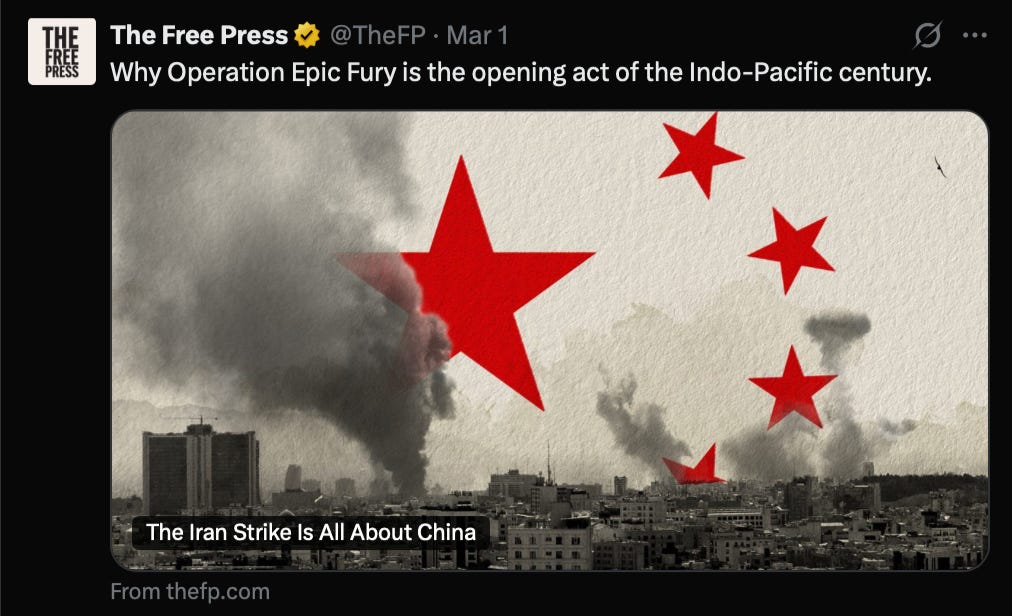
A viral graphic circulated by the Free Press about the motivations for the American-Israeli war against Iran.
At the very least, if China were really the motive, one would have expected the Trump administration to offer this theory — “this is the chance to counter America’s greatest geopolitical rival” — as a major justification to the American people. One would think they would be particularly motivated to do so, given the consensus of polling data showing that public support for this war is far weaker than for any American war in decades.
But Trump officials never mentioned China as a core motive. In fact, even now, the administration and its backers have hardly mentioned China. This is a theory invented out of whole cloth by Iran-war supporters and/or Trump supporters, grasping for some cogent reason why this new war is in Americans’ interests.
Late last week, Senator Lindsey Graham claimed that this conflict is “a religious war” waged by “radical Islamic terrorists.” On March 2, House Speaker Mike Johnson explained to a group of reporters that the United States “determined, because of the exquisite intelligence that [it] had, that if Israel fired on Iran,” then “[Iran] would have immediately retaliated against U.S. personnel and assets.” Therefore, the House Speaker insisted, because the U.S. would be attacked either way, it had to hit Iran with Israel. President Trump announced on Friday that the U.S. intends to select “GREAT & ACCEPTABLE Leader(s)” for the Iranian people, in order to make their country “economically bigger, better, and stronger than ever before.”
These politicians, and many more inside and around the administration, are not talking about China. It has not been cited as a significant motivator for starting this war. Yet if China is really the reason, did the most prominent war supporters simply forget why they went to war, or did they decide it was best to present a false, pretextual case to the American people about why this war was necessary?
Admittedly, this new justification is, at least on the surface, cogent, even if pretextual. China is the most powerful geopolitical competitor to the U.S. No other country buys more sanctioned crude oil from the Iranians, and only Russia has worked more closely with Iran to beef up its military. In 2021, Iran signed a 25-year partnership with China that would reportedly bring $400 billion to Iran’s energy industry. Various weapons deals between the two countries have been reported in recent years, including one to purchase Chinese supersonic missiles that can sink American ships.
Still, none of these events really pertain to, let alone prove, this new claim — that this war with Iran is somehow really about China. At most, they suggest that China may be negatively affected, losing access to cheap oil and its investments. If simply being negatively impacted by this war is the standard for it being “about” another country, then this war is also about Kuwait, Qatar, the United Arab Emirates, and the rest of the Middle East.
Indeed, many countries could be harmed by the Trump-Netanyahu war in Iran. Japan’s economy could face severe consequences if oil is trapped in the Strait of Hormuz. The South Korean economy last week erased nearly half a trillion dollars, marking the largest drop in their stock market’s 46-year history. Is the war about both of these East Asian countries as well?
Further complicating this point is that China has not exclusively invested in or done business with Iran. Indeed, the People’s Republic has, at least publicly, invested more in Saudi Arabia, Iraq, and the United Arab Emirates. (That aforementioned $400 billion agreement between Beijing and Tehran still has not materialized.)
Nor is China the largest buyer only of Iran’s oil. It is also often the leading export destination for Iraqi, Kuwaiti, Omani, Saudi, and Qatari crude. Chinese money, in all its forms, is present across the Middle East, from port construction to the telecommunications industry. What’s more, the Chinese are filling gaps that have opened as a result of American reluctance or negligence.
American foreign policy in the Middle East, including wars, has far more often boosted Chinese interests than undermined them. When the United States in the mid-2010s refused to sell MQ-9 Reaper drones to the Saudis and Emiratis, China filled the gap by selling its CH-4 Rainbow and GJ-1 Wing Loong II models. After the United States invaded Iraq, killing hundreds of thousands of people, the Chinese were still the first to secure foreign contracts. (To this day, the Chinese are a dominant player in Iraq’s oil industry.) President Biden’s poor relations with the Saudis reportedly played a role in their consideration of settling contracts in Chinese yuan.
One would be forgiven for thinking that many of China’s relationships exist not because of an ideological competition with the U.S., but because capricious or draconian American policy often creates the conditions for Chinese success. This is no less true with Iran, as even the articles proffering this all-about-China theory acknowledge.
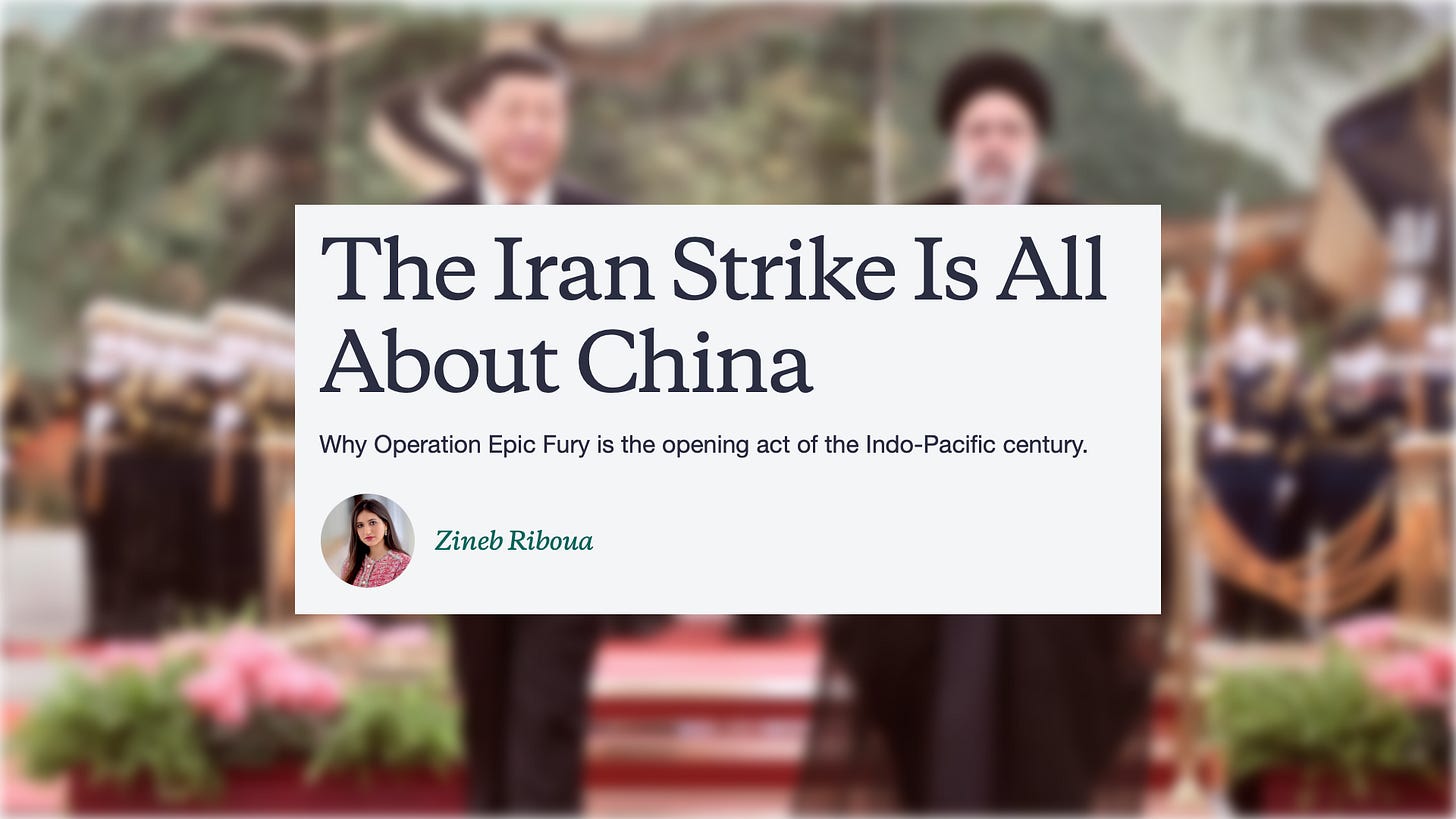
“Squeezed by decades of American sanctions and increasingly isolated,” the Israeli journalist Haviv Rettig Gur writes in The Free Press, “Iran turned to China as its economic lifeline.” This lifeline, moreover, “[is] the main reason the Islamic Republic has not gone bankrupt,” according to the conservative Hudson Institute, which is also pushing this about-China theory for the Iran war (see, for instance, its article titled, “The Iran Strike Is All About China”). In other words, the U.S. — not the Chinese — created the conditions for a competitor’s presence in the Middle East.
Theories like this one raise another problem. All of these arguments struggle to provide a comprehensive explanation of how China will be “devastated” by regime change in Iran, but they paint a fairly clear picture of how Iran became dependent on the People’s Republic. Of course, the U.S. gaining total control of the Middle East has implications for Chinese commerce and strategy, as these articles acknowledge. But no serious journalists or scholars have argued that China can currently project military power across the globe, with or without Iran.
Is that not why many of these ideologically aligned institutions warn about China’s nascent, but developing, blue-water navy? If one believes China will one day ‘imperialize’ like the U.S., Americans can wrest the Panama Canal from Chinese companies, attack China’s allies, and encircle the Chinese mainland — for now. Those kinds of actions could very well devastate China. (It would not be the first time Western powers have done something like it.) But Iran is hardly a necessary component of said devastation. If the U.S. really wants to wreck China, it does not need to pulverize Persia.
On top of all this, many of the videos and articles that have virally promoted this claim — that this war is about China, not Iran — seem to ignore the very foreign policy establishment that gave them this war. Mainstream American scholarship on China has been fairly clear: from a strategic perspective, the Chinese are perfectly happy to allow the United States to remain entangled in the Middle East because, by definition, it delays an American “pivot to Asia.” Bizarrely, some of these articles acknowledge this, making the Orwellian argument that the U.S. has to go to war with Iran in order to stop going to war in the Middle East.
And, of course, it would be difficult to ignore the lowest-hanging fruit. Far and away the most common thread that exists between those promoting this all-about-China theory is a devotion to Israel: the Free Press, the Hudson Institute, the Spectator, Fox News, etc. All of these institutions constitute the pro-Israel establishment in the U.S. and U.K. So, when Haviv Rettig Gur writes that Marco Rubio “struggled to explain” why the U.S. was at war with Iran, it is not because Rubio denied that Israel forced America’s hand. He, in fact, confirmed that Israel had compelled an American strike.
Apart from various reports that confirm Rubio’s initial account, such as in the New York Times and the Financial Times, Antony Blinken (his predecessor) recently described an identical story: that the Israelis tried to pressure former President Obama into war with Iran by claiming that if he failed to act, they would strike Iran alone. But, according to Rettig Gur, “It’s hard to take [Rubio’s] explanation at face value,” so the Secretary of State’s candor can be disregarded for another, entirely dreamed up claim. Rettig Gur continues, “If the trigger was simply an Israeli strike, America could have told the Israelis to sit tight. … Goodness knows the U.S. has the leverage to do it again.” That statement seems highly accurate. Unfortunately, some unclear entity — most likely China — prevented the United States from doing that.
Altogether, the claim that Trump went to war with Iran to fight China is more sensational than substantive. It entertains theories of 4D Chess when Yahtzee is a more apt comparison. The Trump administration is rolling the dice for Israel: it has already financed their genocide in Gaza, vaporized prayer circles in Yemen, destroyed Iranian nuclear facilities, granted Benjamin Netanyahu’s wildest wishes, and is now officially at war with Iran. For any hawks eager to embroil the United States in a head-to-head clash with the People’s Republic, the question is not if this latest war was about China — it is whether any of them will be.
Cole Crystal (@colecrystal) was producer and editor for SYSTEM UPDATE with Glenn Greenwald and now has the same title for this Substack. Before joining, he worked for media outlets in the United States. He graduated from Cornell University with a bachelor’s degree in government and online social movements.
A Second Vietnam War? Hanoi Waits and Prepares
By José Niño | The Libertarian Institute | March 9, 2026
On the surface, everything between Vietnam and the United States looked better than it ever had. In September 2023, President Joe Biden and General Secretary Nguyễn Phú Trọng signed a Comprehensive Strategic Partnership, elevating relations to their highest diplomatic tier. American officials toasted prosperity. Vietnamese leaders smiled for cameras. The messaging suggested a new chapter in a relationship once defined by napalm and body counts.
Then, in early February 2026, a very different story emerged from behind the curtain. The 88 Project, a U.S.-based human rights organization focused on Vietnam, exposed a classified internal military document that shattered the diplomatic facade. The revelation was subsequently covered by AP News, The Diplomat, and Le Monde. Vietnam’s Foreign Ministry did not respond to requests for comment.
The document bore the formal designation 357/KH-BTL and carried the title “The 2nd U.S. Invasion Plan.” Signed by Vice Admiral Tran Thanh Nghiem and certified by Rear Admiral Vu Van Nam, it was issued by Vietnam’s Navy Command in August 2024, months before Donald Trump returned to office for his second term. Its contents painted a picture of a government that publicly embraced Washington while privately treating it as the gravest threat to its survival.
Vietnamese military planners described the United States in the document as a “belligerent” superpower with a pattern of “creating a pretext” to launch wars against nations that “deviate from its orbit.” The plan acknowledged that the present risk of armed conflict remained low, yet insisted that America’s aggressive nature demanded constant vigilance.
The operational scenarios imagined within the plan read like something from a Cold War thriller. Vietnamese planners envisioned a full-scale American assault involving two to three aircraft carrier strike groups, three to four Marine brigades, and amphibious landings along the country’s vast coastline. In the most alarming passage, the document speculated that if conventional methods failed, the United States “may use biochemical and tactical nuclear weapons.”
Vietnamese analysts traced what they saw as an escalating pattern across three administrations. They pointed to President Barack Obama’s pivot to Asia, Trump’s first term (described as inciting an arms race), and Biden’s institutionalization of the Indo-Pacific Strategy. All of it, according to Le Monde, was portrayed as Washington forging a united front against China.
Ben Swanton, co-director of The 88 Project and author of the analysis, emphasized that this thinking was not confined to one paranoid faction. “There’s a consensus here across the government and across different ministries,” he told AP News. “This isn’t just some kind of a fringe element or paranoid element within the party or within the government.”
Perhaps the most revealing element in the plan was how Vietnam’s military ranked its adversaries. According to The Vietnamese Magazine’s analysis, China occupied the position of a “Category 3” adversary. That meant Beijing was seen as a territorial rival that contested borders and maritime claims but did not threaten the Communist Party’s hold on power.
The United States occupied a far more dangerous position. American power was classified under “Category 1” and “Category 2” designations, meaning Washington represented an existential threat to the regime itself. In the eyes of Vietnamese military planners, China wanted territory. America wanted the party gone.
This distinction carried explosive implications. Nguyen Khac Giang of Singapore’s ISEAS-Yusof Ishak Institute, speaking about the Communist Party’s conservative and military-aligned faction, told AP News that the military had “never been too comfortable moving ahead with the Comprehensive Strategic Partnership with the United States.” The tensions had already surfaced publicly in June 2024, when an army television report accused the American-linked Fulbright University of fomenting a “color revolution.” The Foreign Ministry defended the university, which American and Vietnamese officials had highlighted when the two countries upgraded ties, but the episode revealed how deep institutional suspicion ran.
The most dangerous element in the leaked plan was never the fantasy of aircraft carriers and nuclear weapons. It was the way the document conflated civil society with warfare. Vietnamese planners drew explicit parallels to Ukraine’s 2004 Orange Revolution and the Philippines’ 1986 Yellow Revolution, portraying the American promotion of freedom, democracy, and human rights as opening salvos designed to “undermine and ultimately dismantle Vietnam’s socialist political system.”
By branding activists, journalists, and pro-democracy reformers as foot soldiers in a CIA-directed Color Revolution, the Communist Party of Vietnam (CPV) used this subversion as a pretext to justify a major domestic crackdown. Starting around 2020, the CPV mobilized all branches of government to “prevent the US and its allies from fomenting a color revolution in the country,” according to a report by Le Monde. Advocacy for religious freedom or labor rights became, in the party’s framing, acts of war.
None of this meant Vietnam was irrational, or even unusual. Military contingency planning for worst-case scenarios is standard practice everywhere. Even the leaked document itself acknowledged that war remained “low risk.” The United States maintains its own history of drafting invasion plans against allies, from “War Plan Red” for Canada in the 1930s to plans to seize Middle Eastern oil fields in 1973. The “Hague Invasion Act” of 2002, still active, authorizes the president to use military force to free U.S. personnel held by the International Criminal Court. Washington’s abduction of Venezuelan President Nicolás Maduro in January 2026 only deepened Vietnamese fears that the pattern was accelerating.
Vietnam’s foreign policy framework reflected this pragmatic paranoia. Hanoi’s famous “Four Nos” defense policy, reaffirmed by Prime Minister Phạm Minh Chính in August 2023, pledged no participation in military alliances, no siding with one country against another, no foreign military bases on Vietnamese soil, and no use or threat of force in international relations. Under this doctrine, Vietnam maintained comprehensive strategic partnerships with the United States, China, and Russia simultaneously. The approach, often described as “bamboo diplomacy” after a metaphor coined by the late General Secretary Trọng, allowed Hanoi to bend with shifting geopolitical winds without breaking.
The history of the Vietnam War gave these calculations a visceral dimension. The conflict killed approximately 3.1 million Vietnamese people according to the government’s own 1995 estimates, including roughly two million civilians. The National Archives records 58,220 American military fatalities. That staggering asymmetry reflected the reality of a war fought entirely on Vietnamese soil with industrial-scale firepower. For Vietnamese military planners, the idea of a second American invasion was not a paranoid abstraction. It was a memory that shaped every calculation they made.
It doesn’t help that the United States has a long track record of intervening and destabilizing countries in all corners of the globe. Such a track record of U.S. perfidy is being considered by Vietnamese strategists. Washington will dismiss this document as the paranoia of aging generals. Hanoi will pretend it never existed. But somewhere between the diplomatic toasts and the classified war games, the truth sits undisturbed. Vietnam remembers what America did the first time. And with a track record of interventions stretching from Guatemala to Venezuela, the United States has given Hanoi every reason to believe it could happen again.
Forget Oil: Natural Gas Prices Are About to Go Through the Roof If Hormuz Isn’t Reopened Soon
Sputnik – 01.03.2026
“Gas prices may rise, because approximately 20% of the world’s LNG transits through the Strait of Hormuz, including all of Qatar’s production,” Igor Yushkov, a top Russian energy expert, told Sputnik, commenting on the Persian Gulf crisis.
“Qatar is one of the largest producers of LNG in the world, second only to Australia and the US. If there’s a shortage of LNG on the global market…the exchange price could easily exceed $1k or even 1.5k. We’ve seen similar prices in Europe even without such a shortage. So the price could skyrocket.”
According to Yushkov, “everything will depend on how long the tension in the Strait of Hormuz lasts,” including not only Iran’s readiness to reopen it, but gas producers’ willingness to resume transit.
“In any case, we will see higher shipping costs, higher insurance costs for ships,” with the situation “further exacerbated” by the fact that the Northern Hemisphere is still in the heating season, with Europe’s underground gas storage facilities being gradually depleted.
“Even though Qatar gas physically goes primarily to Asian markets, the exchange price will rise everywhere,” same as oil, Yushkov clarified. Qatar itself also has no alternative to Hormuz. “Therefore, if it is unable to export LNG, Qatar will simply have to stop production.”
Message to China
The current crisis is also “a major wake-up call for China,” with the US demonstrating its readiness to flout international law, Yushkov says.
“China is being shown that anything coming from the south is unsafe. Passage through the Strait of Hormuz may be interrupted today as part of the current conflict, but tomorrow the Americans could close it off to Qatari LNG supplies to the Chinese market.”
“Or they could close the Strait of Malacca, through which all the hydrocarbons going to China from Africa and the entire Middle East flow. Therefore, this is a signal to China that anything coming from the north is much safer, and much more difficult to shut down,” the observer summed up.
Daniel Davis: China & Russia Will Defend Iran
Glenn Diesen | February 26, 2026
Lt. Col. Daniel Davis is a 4x combat veteran, the recipient of the Ridenhour Prize for Truth-Telling, and is the host of the Daniel Davis Deep Dive YouTube channel. Lt. Col. Davis discusses why diplomacy in Iran has failed, how there is no off-ramp, and why this war will likely be a disaster.
Daniel Davis Deep Dive: https://www.youtube.com/@DanielDavisDeepDive/videos
Follow Prof. Glenn Diesen:
- Substack: https://glenndiesen.substack.com/
- X/Twitter: https://x.com/Glenn_Diesen
- Patreon: https://www.patreon.com/glenndiesen
Support the research by Prof. Glenn Diesen:
- PayPal: https://www.paypal.com/paypalme/glenndiesen
- Buy me a Coffee: buymeacoffee.com/gdieseng
- Go Fund Me: https://gofund.me/09ea012f
The US’ self-directed ‘China nuclear threat’ will only be a waste of effort: Global Times editorial
Global Times | February 27, 2026
On Wednesday, US Secretary of State Marco Rubio again touched upon China in terms of nuclear weapons negotiations, claiming that any nuclear arms treaty must include China. In the same few days, CNN published an “exclusive report,” citing so-called intelligence sources, to hype up the so-called “Chinese nuclear test.” These coordinated efforts are just a carefully orchestrated show by Washington. Earlier this month, Christopher Yeaw, assistant secretary for the Bureau of Arms Control and Nonproliferation at the US Department of State, disclosed a so-called “breaking news,” claiming that China conducted nuclear testing in 2020, causing a stir in international public opinion. Since then, the “China nuclear threat” rhetoric, directed by Washington, has been launched.
With high-ranking officials making statements, the so-called “insiders” disclosing information to the media, and a number of mainstream media outlets echoing the sentiment, Washington’s elaborate efforts are clearly driven by self-interest. The intention is obvious: Simultaneously with Yeaw’s alleged “Chinese nuclear test” revelations, he also conveniently stated that the US will return to testing on an “equal basis.” This timing coincides with the expiration of the New START Treaty between the US and Russia, a time when the US faces immense international pressure. Clearly, hyping up the “Chinese nuclear threat” is a two-pronged approach: It allows the US to deflect responsibility for deliberately delaying or even abandoning US-Russia nuclear negotiations, while simultaneously providing a fig leaf for its shady ambition to resume nuclear testing.
Washington’s close monitoring of China’s nuclear development is no secret. Take last year as an example. The Arms Control Treaty Compliance Report published in April focused solely on Russia’s suspected supercritical tests, while the Report to Congress on Military and Security Developments Involving the People’s Republic of China released in December detailed the so-called ‘China’s nuclear arsenal expansion and missile deployments,’ making no mention of so-called nuclear tests. It’s worth noting that these reports, in order to prove the so-called “China threat,” gathered various rumors from different sources. If there were truly “concrete information,” would Washington have kept it hidden from 2020 until now? Why didn’t it disclose it in official reports, but instead waited until the expiration of the New START Treaty between the US and Russia to release it? Moreover, global seismic networks, including the US Geological Survey under the Department of the Interior, did not record any abnormal seismic events at that time.
But this blame-shifting spectacle isn’t merely friction between China and the US. The US possesses more than 5,000 nuclear warheads, a considerable number of which are deployed in a ready-to-launch posture. It also stations tactical nuclear weapons in six NATO countries capable of conducting nuclear strikes. Under such circumstances, how could China engage in so-called “equal negotiations”? As the country with a vast nuclear arsenal and the greatest impact on global strategic balance, the US should shoulder special and primary responsibility for nuclear disarmament and demonstrate genuine sincerity. The reality, however, is that Washington not only shows no intention of reducing its arsenal, but is accelerating nuclear expansion. Should Washington fail to restrain its nuclear ambitions, the consequences for the world would be disastrous.
Facts indicate that the US itself has become the greatest hidden danger to global nuclear security. It has withdrawn from multiple international arms control agreements, while continuing to modernize its nuclear arsenal, develop new nuclear weapons, expand the scope of nuclear strike capabilities, and even lower the threshold for nuclear use. By introducing nuclear deterrence into regional conflicts, it has seriously undermined the stability of the global nuclear security architecture. More ironically, while frequently accusing other countries of “developing nuclear capabilities,” the US simultaneously engages in nuclear deterrence cooperation with its allies, transfers nuclear technology, and deploys nuclear equipment abroad. The double standard is evident.
It is the strong expectation of the international community that the US assumes its due responsibility as a major power in safeguarding global nuclear security. What Washington should do first is stop shifting blame. It should immediately resume strategic stability dialogue with Russia and discuss follow-up arrangements to the New Strategic Arms Reduction Treaty. In addition, AUKUS, which has raised concerns about nuclear proliferation, should be halted, and Washington should exercise restraint over its “close ally” Tokyo’s increasingly swelling nuclear ambitions. The waste contamination left behind by dozens of US nuclear tests in the South Pacific also urgently requires remediation. In the nuclear issue, Washington has many pressing responsibilities to fulfill, rather than “finding faults” with China.
Nuclear arms control is a shared security issue for all humanity. Safeguarding it requires major powers to take proactive responsibility. During the Conference on Disarmament in Geneva, China said it is willing to maintain communication with all parties and exchange views on the work of the Conference and on the Review Conference of the Parties to the Treaty on the Non-Proliferation of Nuclear Weapons. China has long participated in and supported a range of arms control, disarmament, and non-proliferation mechanisms – actions and contributions that are visible to the international community. Washington’s elaborate scheme, full of hidden motives, lacks both persuasiveness and credibility, and will ultimately be a waste of effort. Hopefully, it could do something genuinely meaningful that contributes to world peace and security.
China, Russia slam US threat, force against Iran ahead of talks
Al Mayadeen | February 26, 2026
China on Thursday called for restraint and dialogue between the United States and Iran, as Washington continues a significant military buildup in the Persian Gulf ahead of renewed diplomatic talks.
Speaking in Beijing, Chinese Foreign Ministry spokeswoman Mao Ning said China was “closely following developments in Iran” amid rising regional tensions.
“China advocates the resolution of issues through political and diplomatic channels and opposes the use of threat or force in international affairs,” Mao told reporters when asked whether Beijing would join Moscow in backing Tehran against what was described as potential US aggression.
Mao emphasized the longstanding ties between the two countries, stating that the “Chinese and Iranian people are traditionally friendly.” She added that China supports the Iranian government and people in safeguarding their “legitimate rights, interests, and national stability.”
Reiterating Beijing’s position, Mao stressed the importance of de-escalation. “We hope all sides exercise restraint and solve disputes through dialogue,” she said, adding that China is ready to continue playing a “constructive role as a responsible major country.”
Russia blames US ‘irresponsible escalation of regional tensions’
Likewise, Russian Foreign Ministry spokeswoman Maria Zakharova said that Moscow sees the constant threats against Iran, as well as the irresponsible escalation of regional tensions by the United States.
“We see constant threats against Tehran and saber-rattling, intimidation, and Washington’s irresponsible escalation of regional tensions,” Zakharova said during a briefing.
Moscow and Tehran are developing mutually beneficial cooperation, despite Washington’s escalation of regional tensions, the Russian spokesperson added.
US build-up escalates significantly
Amid these developments, US military buildup in the Middle East has expanded significantly, with Washington assembling 16 warships, about 40,000 troops, and at least seven air wings in the region, the Financial Times reported, citing rising US-Iran tensions.
US President Donald Trump said on February 19 that he will decide within 10 to 15 days whether to pursue diplomacy with Iran or take military action, Axios reported. Speaking in Washington, he said the coming days would be decisive for US policy. “Now we may have to take it a step further, or we may not,” Trump said, adding, “Maybe we are going to make a deal [with Iran].”
The United States had already maintained five air wings, command units of roughly 70 aircraft each, at bases in Jordan, Kuwait, Qatar, Saudi Arabia, and the United Arab Emirates. It has since added two more aboard the aircraft carriers USS Abraham Lincoln and USS Gerald R. Ford, reinforcing what Trump described as a “massive armada” of 16 vessels and expanding Washington’s operational reach.
The overall US troop presence in the region now stands at around 40,000 personnel. Citing data from Tel Aviv University, the Financial Times reported that Jordan’s Muwaffaq Salti military base hosts at least 66 fighter jets, including 18 F-35s, 17 F-15s, and eight A-10s, along with EA-18 electronic warfare aircraft and transport planes. Satellite data also show an increase in fighter jets at a Saudi air base, reflecting the broader expansion of the US air footprint across Jordan and the Gulf.
China supplies Iran with radar, surveillance tech to track US stealth aircraft: Report
The Cradle | February 23, 2026
China’s Ministry of State Security (MSS) has provided Iran with new technology in an effort to prevent infiltration by US and Israeli intelligence, and to help Tehran defend itself from advanced US and Israeli warplanes in the case of a renewed war, according to a 10 February report by Modern Diplomacy.
The report states that Beijing is urging its ally, Tehran, to abandon US and Israeli-made software and replace it with closed, encrypted Chinese systems that are difficult to penetrate.
This includes supplying Iran with advanced Chinese sensor systems and radars, such as the YLC-8B, capable of tracking stealth aircraft and conducting electronic surveillance.
Defense Security Asia stated that according to one analyst, the “YLC-8B is one of the few radars of its type in the world which can continuously detect and track a Western fifth-generation (stealth) aircraft at long range.”
The YLC-8B was developed by China’s Nanjing Research Institute of Electronics Technology. It uses UHF-band low-frequency surveillance to undermine the effectiveness of radar-absorbent shaping used by advanced US aircraft such as the F-35 warplane and B-2 bomber. The Israeli Air Force (IAF) reportedly has 48 F-35 stealth fighter jets in its fleet.
Beijing is also encouraging Iran to transition to the Chinese BeiDou satellite navigation system as an alternative to the US-created GPS system to avoid manipulation and prevent US intelligence from using it to track Iranian targets within the country, Modern Diplomacy reported.
The report comes as the US has amassed a significant amount of its naval and air power in the West Asia region, threatening a major attack on Iran.
China is seeking to assist Tehran to protect its massive investments in Iran, made as part of a 25-year strategic agreement signed under Beijing’s Belt and Road Initiative (BRI).
Beijing also fears the loss of access to Iranian oil if Washington launches an attack, leading Iran to close the Strait of Hormuz.
Iran is China’s largest supplier of oil, while some 20 to 30 percent of the world’s crude passes through the strategic straits on Iran’s southern coast.
Despite seeking to assist Iran with new technology, Beijing has made it clear it will not intervene militarily to assist Iran in the case of a war, Modern Diplomacy noted.
China has extensive economic relations with both the US and Israel.
Instead, China is expected to limit its support to the diplomatic sphere and condemn any unprovoked US or Israeli attack as a serious violation of international law and the UN Charter.
“Beijing remains wary of sliding into a full-blown conflict that could threaten the flow of oil from the Gulf. This is what prompts it to consistently call for restraint and a return to diplomatic solutions to avoid ‘catastrophic consequences’ for the global economy,” Modern Diplomacy added.
US ramps up nuclear claims against China
RT | February 18, 2026
China carried out an underground “nuclear explosive test” in June 2020, a senior US State Department official has claimed, citing “fresh intelligence” on the matter. Beijing has repeatedly dismissed such allegations as “entirely unfounded,” while independent observers say the evidence is inconclusive.
The US assistant secretary for arms control and nonproliferation, Christopher Yeaw, made the latest claims on Tuesday during an event hosted by the conservative Hudson Institute think tank in Washington.
He cited seismic data “quite consistent with what you would expect from a nuclear explosive test.”
“I’ve looked at additional data since then. There is very little possibility, I would say, that it is anything but an explosion, a singular explosion,” Yeaw stated.
The minor 2.75 magnitude seismic event was registered by a remote station in Kazakhstan. Its epicenter was located some 725km away at the Lop Nur nuclear testing grounds in China, prompting the US to claim that it was caused by an underground blast.
China has repeatedly dismissed the American allegations as “entirely unfounded” and used only as a pretext to justify Washington’s own intent to resume nuclear testing. Yeaw’s remarks invoked a similar reaction, with a spokesperson for the Chinese embassy in Washington telling Reuters the latest claims were “political manipulation aimed at pursuing nuclear hegemony and evading its own nuclear disarmament responsibilities.”
Moscow has backed Beijing, repeatedly stating no evidence to support Washington’s claims exists. “Neither Russia nor China has conducted any nuclear tests. And we also know that these claims were firmly denied by representatives of China,” Kremlin spokesman Dmitry Preskov told reporters on Wednesday.
Independent observers have said there is too little evidence to positively establish the nature of the June 2020 incident. The Comprehensive Nuclear-Test-Ban Treaty Organization, for instance, said that the monitoring station in Kazakhstan merely picked up “two very small seismic events, 12 seconds apart,” and it was not possible “with this data alone” to assess “the cause of these events with confidence.”
Trump stalls over Iran strike plan, Iran holds all the aces
By Martin Jay | Strategic Culture Foundation | February 17, 2026
Trump has the option of going to war with Iran and receiving much-needed campaign funds from Israel for the midterms – or opting to defy Bibi and facing certain defeat by losing both houses and facing certain impeachment. Can the Iranians save him?
Is Trump serious about going to war with Iran? To understand this, it’s important to examine his relationship with Netanyahu and to see who has the advantage when it comes to dragging the U.S. into a war, and whether Israel can actually be a greater threat to the U.S. than Tehran can ever be.
The trap that Trump is falling into is one where he has little or no wiggle room at all to control the Iran crisis, whereby Israel can threaten him with isolation while it goes ahead with its strike.
There are two dynamics at play here which are struggling to find a compromise. Trump wants a deal with Iran which takes away their nuclear capability, while Israel wants a war which overthrows the Iranian regime and installs a Mossad/CIA puppet. The problem, though, is that Israel is not an honest broker and keeps shifting the goalposts. The latest demand now is that removing Iran’s ballistic missiles should be at the heart of any deal that Trump pulls off.
Trump is ensnared and is aware of how Bibi is manipulating him. He may, on occasion, swear at journalists and pretend he is his own boss and his own president and that Israel is a client state of Washington which has to toe the line, but in reality, it is clear that Israel is calling the shots.
In recent days, we have heard that the one aircraft carrier the U.S. had in the region, the USS Abraham Lincoln, is to be joined by a second called the USS Gerald Ford. U.S. media report that the Lincoln is in the “Arabian Sea,” which is a comical way of saying that it’s keeping its distance from Iran’s shores and Houthi missiles off the coast of Yemen. But other reports are suggesting that the reason why Trump claims he has sent a second carrier – to beef up the “flotilla” in case of a war breaking out with Iran – is untrue. Some insiders are briefing journalists that the Lincoln has technical problems which will render it useless in a combat situation and so needs to be replaced with the more advanced Ford.
However, even this might be a false narrative offered by Pentagon insiders who are not supporters of Trump. A second explanation about the carriers is that it buys Trump time. He has even told reporters that it will take about a month for the Ford to get there, which he believes should be ample time for a deal to be struck with Iran, or at least will give him four more weeks to work out a way of dealing with the threat – that’s the threat from Israel, not Iran.
Israel threatened Trump before when he went ahead with his bunker buster bombs in June of last year by saying simply, “If you don’t do it, we’ll nuke Iran.” It worked. This time around, the threat is, “If you don’t join us, then we’ll strike Iran alone and you will have to deal with the consequences of being the first U.S. president to have to explain to the Jewish lobby why Iran is wiping Israel off the face of the map.” This second threat is multi-layered and also might work with Trump, given that the midterm elections, which are approaching, will cost twice what the elections cost which got him into office. It will be Jewish money which bankrolls him this time around, with the intention of saving him from losing both houses and facing inevitable impeachment.
And so, in many ways, Trump is closer to and more dependent on the regime in Tehran to help him out. A deal which limits the enrichment of uranium and can guarantee no nuclear bomb can be made might be something he can present to the American people as a great victory. The irony is that the deal might be more or less a carbon copy of Obama’s, which he, Trump, rejected while in his first term in office, a rejection which has created the present crisis.
The trouble with any deal now about enrichment is that it is unlikely to satisfy the Israelis, who have become more aware in recent weeks about the capability of Iran’s latest generation of ballistic missiles both in terms of defence and attack. Moreover, the U.S. attack on Iran last year for 12 days has now raised the stakes to a fever pitch, making the Iranians clearer and more focused about any kind of attack happening against them: all-out war.
According to some credible reports, Trump was recently asking Pentagon chiefs if the U.S. could carry out a single in-and-out strike operation which could be used to warn Iran while satisfying Israel at the same time about the U.S. threat, and he was told no such options are feasible. This is due to Iran being much more prepared now for such attacks, both militarily and intelligence-wise, while the Mossad operation of creating civil strife on the ground failed spectacularly. The U.S. is in a very tight corner right now, as its forces and its allies in the region are in the crosshairs of Iran the moment the first bomb is dropped, and so Trump’s options to go to war are very limited. It would be suicidal for Trump to strike Iran, as the losses to U.S. forces and the disruption to oil distribution via the Straits of Hormuz would be too great, not to mention the destruction of infrastructure in Israel itself.
But there is also another factor which is putting all the pressure on Trump to get a deal with Iran. Since last June’s attack and more recently Trump’s betrayal of cordial relations with Putin conjured up at Alaska, along with the Venezuela coup, both Russia and China have upped their support for Iran. This is a critical factor now preventing Trump from hitting Iran with anything. China recently gave Iran its latest state-of-the-art new radar system which can identify U.S. stealth bombers at a range of 700km. Game changer. If you consider Iran, Israel, and the U.S. as three poker players at the table, it is clear that Iran now has the best hand with the most options. It can maximize its role now and exploit Trump’s vulnerability by going for a deal which involves sanctions being relieved, or it could hold out and play a long game way beyond Trump’s one-month breathing space and really turn up the heat on him leading up to the midterms in November. Iran always plays for time and is good at this strategy. And given that even the kindest analysis of America’s strike capability in Iran is two weeks before depletion of all missile stocks is reached, any hawks close to Trump who are pushing for a strike must have the destruction of the U.S. in their strategy as well, as Iran cannot be pounded into a state of submission in such a short space of time. Surely that can’t be the aim of Bibi. Surely not!
Russia and China Are Expanding Their Cooperation to Counter US Efforts to Bully Iran and Cuba
By Larry C. Johnson | SONAR 21 | February 14, 2026
This will be a rather lengthy article, but you need to know what Russia and China are doing in a closely coordinated series of actions that show a serious commitment to counter US actions to punish and isolate Iran and Cuba. Let’s start with Iran… Since the June 2025 12-day Iran–Israel war (which ended with a US-brokered ceasefire on 24 June 2025), Russia and China have provided Iran with a combination of diplomatic, economic, military-technical, and strategic support. This has helped Tehran recover from strikes on its nuclear sites, air defenses, and missile infrastructure, while deepening their “axis” alignment against Western pressure. Support has been pragmatic rather than unconditional—neither offered direct intervention during the conflict, leading to some Iranian frustration—but has accelerated in the months since.
The biggest news — a development that has been largely ignored in the West — was the signing of the Trilateral Strategic Pact (signed 29 January 2026), which provides a comprehensive framework for diplomatic, economic, and security coordination (emphasizing sovereignty, sanctions resistance, and multipolarity; no formal defense alliance). The signing occurred through simultaneous ceremonies in Tehran, Beijing, and Moscow, as confirmed by state media in all three countries and reported across outlets like Middle East Monitor, GV Wire, and others. It represents a significant escalation in coordination among the three nations, building directly on their existing bilateral frameworks.
It formalizes a trilateral coordination mechanism for the first time, linking the three powers in a shared strategic framework. It builds on the bilateral agreements that Iran had signed previously with Russia and China:
The Iran-Russia 20-year Comprehensive Strategic Partnership Treaty (signed January 17, 2025, entered into force October 2025), focused on economic, political, defense, and sanctions-evasion ties.
The Iran-China 25-year Comprehensive Cooperation Agreement (signed 2021), emphasizing trade, infrastructure, energy, and Belt and Road Initiative projects.
While the full text has been released incrementally (with portions still emerging as of early February 2026), public descriptions and official statements highlight the following core elements:
- Diplomatic coordination — Unified stances on international issues, including opposition to Western sanctions, support for multipolarity, and mutual backing in forums like the UN.
- Economic resilience and cooperation — Enhanced trade (e.g., energy exports, yuan/ruble-based mechanisms), sanctions circumvention, and infrastructure projects (e.g., expanding Belt and Road ties, North-South Transport Corridor involvement).
- Strategic and security alignment — Military-technical cooperation, intelligence sharing, and joint exercises (e.g., building on annual “Maritime Security Belt” drills; a major joint naval exercise involving all three that will take place in the Gulf of Oman and northern Indian Ocean in the coming weeks).
- Nuclear sovereignty — Emphasis on Iran’s right to peaceful nuclear development and resistance to external interference.
- Trilateral nuclear and military talks — Including IAEA discussions and coordinated exercises.
- No mutual defense clause — It explicitly stops short of a formal military alliance (unlike NATO’s Article 5), focusing instead on coordination and mutual support without automatic defense obligations.
State media in Tehran, Beijing, and Moscow described it as a “cornerstone” for a new multipolar world order, with Chinese messaging highlighting opposition to “unilateral coercion” and Russian/Iranian outlets framing it as bolstering sovereignty against external threats. While I do not believe that Russia and China will join the fray if Iran is attacked, they are making a concerted, substantive effort to ensure that Iran can effectively defend itself and thwart US attempts at regime change.
Both Russia and China are providing important military assistance to Iran, but China appears to be playing a bigger role in supplying hardware while Russia is supplying Iran with critical intelligence. According to press reports and photographic evidence, Russia has deliveried Mi-28NE attack helicopters (confirmed in early 2026) and possible MiG-29 fighters. Russia also has sent a large number of military transport flights to Iran, but there are no reports about what was on board. The most likely case is that Russia is fulfilling supplies of weapons based on prior contracts and in defiance of reinstated UN/EU arms sanctions via the JCPOA “snapback” mechanism.
China has focused on upgrading Iran’s air defense system by supplying HQ-9B surface-to-air missile systems (a long-range SAMs comparable to Russia’s S-300; deliveries reported from July 2025 onward, with Iranian officials confirming integration to replace losses from Israeli strikes). In addition, China has deployed the YLC-8B long-range surveillance radars (for detecting stealth aircraft like the F-35), and shipped missile components (e.g., solid-fuel propellants, guidance systems) to rebuild ballistic missile production lines damaged in the war. Iran is in a much stronger position militarily than it was on June 13, 2025, when Israel launched its surprise attack.
CUBA
Russia and China also are providing significant political, economic, humanitarian, energy, and material support to Cuba, especially amid the island’s severe fuel/energy crisis, food shortages, and economic strains intensified by the longstanding US blockade and recent US actions under President Trump (e.g., pressure on Venezuelan/Mexican oil supplies and threats of tariffs on countries aiding Cuba).
Russia and China are coordinating rhetorically (both denounce US “inhumane” tactics and reaffirm support in bilateral calls and statements). They also are coordinating the kind of aid that each supplies to Cuba… Russia focuses on supplying direct oil/fuel while China is aiding Cuba with financial/renewables/food assistance. There is not a formal trilateral mechanism like the one they signed with Iran, but both countries frame their support as countering US pressure in the Western Hemisphere. This support is ongoing and responsive to Cuba’s acute needs (fuel rationing, blackouts, food scarcity). Deliveries and projects continue despite US threats, with both countries emphasizing it as humanitarian and sovereign cooperation.
Russia’s Support
Russia emphasizes solidarity, political backing, and practical material/energy assistance, framing it as opposition to “suffocating” US measures. Russia’s help consists of the following:
Energy Aid (Oil and Fuel): Russia is preparing to deliver crude oil and petroleum products to Cuba “in the near future” as humanitarian aid. The Russian Embassy in Havana confirmed this to Izvestia. Russia last sent a major shipment in February 2025 (100,000 metric tons of crude under a $60 million state-backed loan approved by Putin). The Kremlin (via spokesman Dmitry Peskov) states it is in active contact with Havana to discuss assistance options and has described Cuba’s fuel situation as “critical.” Deputy Foreign Minister Sergei Ryabkov (Feb 13, 2026) confirmed Russia is providing material assistance, including supplies already underway.
Political and Diplomatic Support: Foreign Minister Sergei Lavrov (phone call with Cuban FM Bruno Rodríguez Parrilla, Feb 2, 2026) reaffirmed Russia’s “principled position” that economic/military pressure on Cuba is unacceptable and committed to continued political and material/financial support. Russia repeatedly condemns the US blockade, opposes any military intervention, and expresses solidarity with Cuba (and Venezuela). Ambassador Viktor Koronelli has stated Russia “will not abandon Cuba.”
Historical/Longer-Term Ties: Russia wrote off ~90% of Cuba’s Soviet-era debt (~$32 billion) in 2014. Ongoing cooperation includes trade, scientific/academic exchanges, and past energy deals.
China’s Support
China has positioned itself as a major strategic partner, focusing on humanitarian aid, energy infrastructure, food security, and debt/investment cooperation (Cuba is a Belt and Road Initiative partner). The recent Emergency Aid Package (Approved by Xi Jinping, Jan 2026) provides $80 million in financial assistance (in euros equivalent) for purchasing electrical equipment and other urgent needs — specifically to help resolve the energy crisis (blackouts affecting >60% of the country). China also donated 60,000 tons of rice in emergency mode (first shipment of ~4,800 tons arrived Jan 2026; rest in coming months) for food security.
China also is expanding support that builds on prior commitments. Previously it was helping Cuba with a 200 MW photovoltaic (solar) energy projects and, recent days, has delivered 5,000 solar panel kits for isolated homes (new executing company established with Cuba’s Ministry of Foreign Trade). Shortly after Venezuelan President Maduro was abducted, China, acting under an emergency program, delivered 30,000 tons of rice (first shipments in Jan 2026)… This was in addition to prior donations of solar lamps, roofing materials, mattresses, and generator sets.
In the face of the US effort to crush Cuba economically, China is helping Cuba with debt restructuring negotiations (banking/financial/corporate debts). Cuba also is being Integrated into China’s CIPS payment system and increased use of yuan in trade (announced 2025). China is in effect helping wean Cuba off of the US dollar. China also is helping Cuba with biopharma (e.g., technology transfers for aspirin production), digital transformation (Phase 4 program), high-definition TV projects, mining, oil exploration, sugar industry recovery, and renewables (China investing in solar to help Cuba reach 25% renewables by 2030).
The support that Russia and China are providing to Iran and Cuba sends a clear message to Donald Trump and to the nations of the global south: i.e., Russia and China are building a new financial and security infrastructure designed to immunize countries against US coercion and threats. They are doing more than just offering words of solidarity… They are backing up their words with concrete economic, diplomatic and military actions. The foundation of the American hegemon is crumbling.
I started my vlogging day with Nima and Colonel Wilkerson:
Ray McGovern and I discussed the latest developments with Iran and the war in Ukraine with Judge Napolitano:
And here’s my interview with Alastair Crooke… we analyzed the impending attack on Iran and the prospects for a negotiated end to the war in Ukraine:
Populations in key NATO nations balk at sacrifices for military spending – poll
RT | February 13, 2026
People in key NATO nations are reluctant to tighten their belts to fund increased defense spending, despite believing that the world is “heading toward global war,” according to a Politico poll published on Friday.
The poll, which surveyed at least 2,000 people from the US, Canada, the UK, France, and Germany each, found that majorities in four of the five countries think “the world is becoming more dangerous” and expect World War III to break out within five years.
Nearly half of Americans (46%) consider a new world war ‘likely’ or ‘very likely’ by 2031, up from 38% last year. In the UK, 43% share this belief, up from 30% in March 2025.
French respondents matched British levels at 43%, and 40% of Canadians expect war within five years. Only Germans remain skeptical, with a majority believing that a global conflict is unlikely in the near term.
The survey suggested a stark disconnect, however, between the growing alarm and willingness to pay for a defense buildup. While respondents support increased military spending in principle, support fell dramatically when specific trade-offs were mentioned.
In France, support dropped from 40% to 28% when those being surveyed were told about the potential financial and fiscal consequences. In Germany, it fell from 37% to 24%, with defense spending ranking as one of the least popular uses of money.
The survey also suggested significant skepticism about creating an EU army under a central command, with support at 22% in Germany and 17% in France.
While the poll suggests that Russia is perceived as the ‘biggest threat’ to Europe, Canadians view the administration of US President Donald Trump as the greatest danger to their security. Respondents in France, Germany, and the UK rank the US as the second-biggest threat – cited far more often than China.
The findings come after NATO Secretary-General Mark Rutte urged members states in December to embrace a “wartime mindset” amid the stand-off with Russia. This also comes amid Western media speculation that Russia could attack European NATO members within several years. Moscow has dismissed the claims as “nonsense,” while accusing EU countries of manufacturing anti-Russia hysteria to justify reckless militarization.
Featured Video

No Threat Can Force Iran’s Surrender /Trita Parsi & Lt Cl Daniel Davis
or go to
Aletho News Archives – Video-Images
From the Archives
What is the Israeli Lobby in Australia Doing in Interfaith Dialogue?
By Ali Kazak | Dissident Voice | October 11, 2015
For years Israel and its lobby around the world have been trying to normalise their relations with Arabs and Muslims without solving the Palestine Question.
One of the methods they resorted to in the last few years is using human rights and community organizations such as interfaith dialogue and Multiculturalism to achieve this objective and to: isolate the Palestinians, marginalise the Palestine question, end Israel’s isolation, and prevent criticism of Israel, knowing that these organisations will be the first to stand against Israel’s violations, racial and religious discrimination.
The group responsible for this task in Australia is The Australia/Israel & Jewish Affairs Council (AIJAC); its Director of International & Community Affairs, Jeremy Jones is in charge of lobbying religious community organizations, specifically Muslims and Christians. Consequently he convened the Faith Communities for Reconciliation, founding participant in the Australian Partnership of Religious Organisations and the Australian National Dialogue of Christians, Muslims & Jews.
AIJAC is a private political propaganda group. It is recognised as the main Israeli lobby in Australia. It coordinates its activities and works intimately with the Israeli embassy in Canberra and different institutions in Israel. It is privately funded by some Jewish businessmen. It monitors closely Australian politicians, the media, ethnic and religious groups, (especially Arabs and Muslims), unions and academics on their stands towards Israel and the Palestine question. … continue
Blog Roll
 Aletho News
- Theodore Postol: Iran’s Missiles & Drones Were Underestimated
- Iran To Target Military Industrial-Tech Complex That Facilitated Gaza Genocide
- Collapsing Empire: The Resistance Disarms ‘Israel’
- Suicide Should Not Be a Government Service
- Rethinking America’s greatest threat: Iran vs. Israel-Firsters
- Iran accuses adversaries of false flags to strain Turkey ties
- Poland rules out sending Patriot missiles to US/Israel amid war on Iran
- Tehran approves new Hormuz plan with major restrictions
- No Threat Can Force Iran’s Surrender /Trita Parsi & Lt Cl Daniel Davis
- UK’s New Pandemic Plan Would Turn Big Tech Into a Mass Location Tracking Network
- If Americans Knew
- Ann Coulter Rips Into Fox News for Iran War Coverage, Compares to False Rigged 2020 Election Reporting
- Joe Kent Urges Americans To Call White House and Congress To Object To Sending Troops Into Iran
- DNC Resolution to Reject AIPAC Funding Puts Democratic Leaders in the Hot Seat
- Swedish foundation to build 400 schools as over 650,000 Gaza children remain without education for 2 years
- Israeli army admits photshopping image of slain Lebanese journalist
- This is how Israel is systematically killing health workers under the cover of war in Lebanon
- Carrying life under fire: Israeli invasion of Lebanon leaves pregnant women facing deadly risks
- Champagne all around for the new death penalty (for Palestinians) law – Not a ceasefire Day 172
- Why are Palestinian books struggling to be seen on Amazon?
- The Line Between Affinity and Conspiracy
- No Tricks Zone
- New Study Finds Warming Saves Lives…Cold Temperatures 12 Times More Deadly Than Excess Heat
- German Science Blog Accuses PIK Climate Institute Of Hallucinating Climate Tipping Points
- Devastating Assessment Of Comirnaty Vaccine By Former Senior Pfizer Europe Toxicologist
- New Study: CO2 Is ‘Effectively Negligible’ As An Explanatory Climate Change Factor Since 2000
- Former Pfizer Toxicologist Dr. Helmut Sterz Tells Bundestag Hearing Pfizer Vaccine Should Have Never Been Approved
- Energy Expert: Germany’s Nuclear Phaseout Was A “500 Billion Euro Mistake”
- New Research: South Australia’s Mid-Holocene Sea Surface Temperatures Were 4°C Warmer Than Today
- Storing Green Energy To Last Germany 10 Days Would Require A 60-Million Tonne Battery
- New Studies: UK Sea Levels Were 4 Meters Higher Than Today During The Mid-Holocene
- Destructive Green New Deal: German Energy And Metal Group Warns Of Drastic Crisis
 Aletho News