Hungarian PM Orban Heads to China After Ukraine, Russia and Azerbaijan Visits

Sputnik – 07.07.2024
BUDAPEST – Hungarian Prime Minister Viktor Orban is on his way to China, where he is scheduled to arrive in the early hours of July 8, Hungarian news outlet 444.hu reported on Sunday, citing sources familiar with the situation. Prior to China, Orban went to Kiev, Moscow and Azerbaijan.
“After Kiev, Moscow, and Azerbaijan, according to our information, Viktor Orban is heading to China. As far as we know, the Hungarian Prime Minister will arrive in the Asian country at dawn on Monday,” the report said.
Orban visited Russia on Friday to hold talks with Russian President Vladimir Putin. Hungary’s prime minister described his visit as a continuation of his “peace mission” after a visit to Kiev, which took place on Tuesday. He has also announced more “equally surprising” meetings coming up next week. Some EU leaders have been critical of the Hungarian leader’s recent international engagements.
What Will Iran’s Foreign Policy Be Under New President Pezeshkian?
Sputnik – 06.07.2024
Masoud Pezeshkian has emerged as the winner of the presidential runoff in Iran this week, receiving 54 percent of the votes.
The newly elected President of Iran Masoud Pezeshkian spoke to Sputnik on the eve of the election about the main priorities of Iran’s foreign policy, which include: strengthening relations with Russia and China; Iran’s active presence in BRICS and the Shanghai Cooperation Organisation; restoration of the Joint Comprehensive Plan of Action (JCPOA) and the lifting of sanctions.
“Russia is a friend and partner of Iran, and I consider it a priority to deepen and expand relations with Russia and China, as well as intensify foreign policy activities in the Asian direction in general,” Pezeshkian said. “And we, of course, at all levels – bilateral, regional and international – will continue our efforts to expand interaction with the Russian Federation.”
According to him, Iran “opposes the policy of unidirectionality” and supports “the principle of multipolarity.”
“One of the priorities of my foreign policy program is regional cooperation, and for this purpose, Iran will expand its presence in BRICS and the SCO, as well as strive for more active cooperation with the Eurasian Economic Union to more fully realize the potential of trade and economic relations with the member countries of these organizations,” Pezeshkian explained.
Regarding the JCPOA, Pezeshkian pointed out that it is “an international agreement approved by the UN,” and that the United States’ unilateral withdrawal from this agreement “caused serious damage to Iran and the Iranian people.”
“As the Russian side has repeatedly emphasized, Iran has fulfilled its obligations, and we see our task as returning the other participants to this agreement as soon as possible and achieving the lifting of sanctions. I am confident that the friendly governments of Russia and China will support Iran and assist it in resolving this issue,” he added.
Chinese embassy dismisses US allegations of bases in Cuba as slander
Al Mayadeen | July 2, 2024
In response to ongoing allegations by the US regarding Chinese military bases in Cuba, the Chinese Embassy in Washington vehemently refuted these claims, labeling them as slanderous and malicious.
The remarks come after US think-tank Center for Strategic and International Studies (CSIS) published a report using satellite imagery to identify four alleged Chinese listening stations in Cuba, including one located near Guantanamo Bay.
“The US side has repeatedly hyped up China’s establishment of spy bases or conducting surveillance activities in Cuba. Such claims are nothing but slander. The Cuban side has already made a clarification,” Chinese Embassy spokesperson Liu Pengyu told Sputnik on Tuesday.
Liu stressed the need for the US to halt its ongoing effort to make malicious accusations against China without delay.
Additionally, Liu highlighted that the US maintains a leading role in global surveillance operations, which encompass monitoring its allies as well.
Washington is Sprinting (Not Sleepwalking) Into War With China
By Joseph Solis-Mullen | The Libertarian Institute | July 2, 2024
The narrative that America is “sleepwalking” toward war with China is a dangerously misleading myth. Far from a somnambulant stumble, the United States is being deliberately led by national security and military elites into a conflict with China, with Congress eagerly tripping over itself to out-hawk each other. The motivation? A toxic blend of defense industry contributions and a misguided sense of geopolitical dominance.
Since becoming president, Joe Biden’s pronouncements have starkly reversed the longstanding U.S. policy of “Strategic Ambiguity” concerning Taiwan. Historically, this policy served to keep both China and Taiwan guessing about American intentions, thus maintaining a precarious balance and deterring rash actions from either side. However, Biden’s statements have ushered in an era of “Strategic Clarity,” unequivocally asserting that the United States would intervene militarily if China were to invade Taiwan. This stance is a profound shift, especially given that the U.S. has no treaty obligation to defend Taiwan, and Congress has not granted the president the authority to engage militarily in such a conflict—at least not yet.
Moreover, the presence of U.S. military personnel on Taiwan and on the Kinmen islands, the latter a mere few miles from the Chinese mainland, underscores this aggressive posture. This deployment is not a defensive measure but a provocative act, practically begging for a confrontation. It signals to China that the United States is not merely interested in protecting Taiwan’s sovereignty but is actively preparing for potential hostilities.
Escalated arms sales to Taiwan further exacerbate the situation. Washington’s increased military aid and sophisticated weaponry to Taipei are perceived by Beijing as an unmistakable threat, pushing the region closer to the brink of war. These actions are complemented by Washington’s broader strategy of economic warfare against China, including tariffs, sanctions, and efforts to decouple the two economies. This economic aggression, designed to weaken China’s global standing, only serves to heighten tensions and fuel the fire of conflict.
Washington’s belligerence extends beyond Taiwan, with the United States promising to intervene in various territorial disputes between China and its neighbors. The South China Sea is a hotbed of such conflicts, with the Philippines’ claims over certain shoals leading to live clashes in recent months. The U.S. backing of these claims, regardless of their merit, is a clear signal of its intent to challenge China’s regional influence aggressively.
Adding to this volatile mix, Kurt Campbell, the architect of Obama’s “Pivot to East Asia” policy, recently declared that the era of positive engagement with China is over. This “Pivot” was always a transparent move to begin containing China, but Campbell’s recent statements mark a shift toward outright confrontation. Both the former and current heads of U.S. Indo-Pacific Command have also in the past year bluntly stated that they are preparing for an immediate war with China, further illustrating the calculated and deliberate nature of Washington’s actions.
This orchestrated march toward conflict is not driven by some irrational fear or a defensive need to protect American interests. Instead, it is a strategic choice made by the U.S. leadership to assert dominance in the Asia-Pacific region. This approach disregards the catastrophic potential of such a conflict, which could easily escalate into a global disaster, if not total annihilation.
It is crucial to understand that this is not a one-sided issue where China is the sole aggressor. Unlike the U.S., China is not conducting military exercises in the Gulf of Mexico or deploying troops near American borders. Instead, it is the United States that is aggressively poking around the South China Sea and positioning itself as a hegemonic force in a region far from its shores.
Media portrayal of the situation as a sleepwalk toward war is not just inaccurate but dangerous. It obscures the calculated and provocative actions of the United States, misleading the public into believing that conflict is an inadvertent outcome rather than a deliberate strategy. The reality is that Washington is not passively drifting into war but sprinting headlong into it, driven by a blend of military ambition and geopolitical strategy.
In conclusion, the responsibility for the escalating tensions and the imminent threat of conflict with China lies squarely with Washington. The U.S. is actively choosing a path of confrontation, one that threatens not just regional stability but global peace—in a recent visit Xi Jinping said as much to the European Commission President Ursula von der Leyen, saying he felt Washington was trying to “goad” China into starting a war over Taiwan; it being a serious red line for Beijing, that may just be what happens (see: Ukraine).
It is imperative that Washington’s aggressive stance is recognized for what it is by the American public: a reckless and potentially world-destroying gamble that serves the interests of a few at the expense of many. Only by acknowledging this can we hope to steer away from the brink of disaster and seek a more peaceful and sustainable approach to international relations.
Turkish, Syrian officials to meet in Baghdad for rapprochement: Report
Press TV – June 30, 2024
Turkish and Syrian officials are expected to meet in the Iraqi capital Baghdad for potential rapprochement between their respective countries, and restoration of diplomatic relations which were severed more than 12 years ago.
Syria’s al-Watan daily newspaper, citing informed sources who asked not to be named, reported that the upcoming meeting will be the first step on the path of a long process of negotiations that would result in political understandings.
The sources added that Ankara has called on Moscow and Baghdad to prepare the ground for Turkish diplomats to sit at the negotiating table with the Syrian side without any third party or members of the press present.
Al-Watan noted that the initiative for Turkey-Syria rapprochement, and restoration of their diplomatic ties has received broad support from Arab states, especially from Saudi Arabia and the United Arab Emirates, as well as from Russia, China and Iran.
On Friday, Turkish President Recep Tayyip Erdogan said there is no reason for his country not to forge renewed ties with neighboring Syria.
“There is no reason not to establish (relations with Syria),” Erdogan told reporters after Friday prayers in Istanbul.
He emphasized that Ankara has no plans or goals to interfere in Syria’s internal affairs.
“Just as we once developed relations between Turkey and Syria, we will act together in the same way again,” he added.
Turkey severed its relations with Syria in March 2012, a year after the Arab country found itself in the grip of rampant and deadly violence waged by foreign-backed militants, including those allegedly supported by Ankara.
The process of normalizing ties between Ankara and Damascus kicked off on December 28, 2022, when the Russian, Syrian and Turkish defense ministers met in Moscow, in what was the highest-level meeting between the two sides since the outbreak of the Syria conflict.
Since 2016, Turkey has conducted three major ground operations against US-backed militants based in northern Syria.
The Turkish government accuses the US-backed Kurdish People’s Protection Units (YPG) militants of bearing ties with the Kurdistan Workers’ Party (PKK) militant group.
Syria considers the Turkish presence on its soil to be illegal, saying it reserves the right to defend its sovereignty against the occupying forces.
Syrian President Bashar al-Assad has tied rapprochement with Turkey to Ankara’s ending its occupation of the northern parts of the Arab country and its support for militant groups wreaking havoc and fighting against the Damascus government.
Magazine Depth and Shields
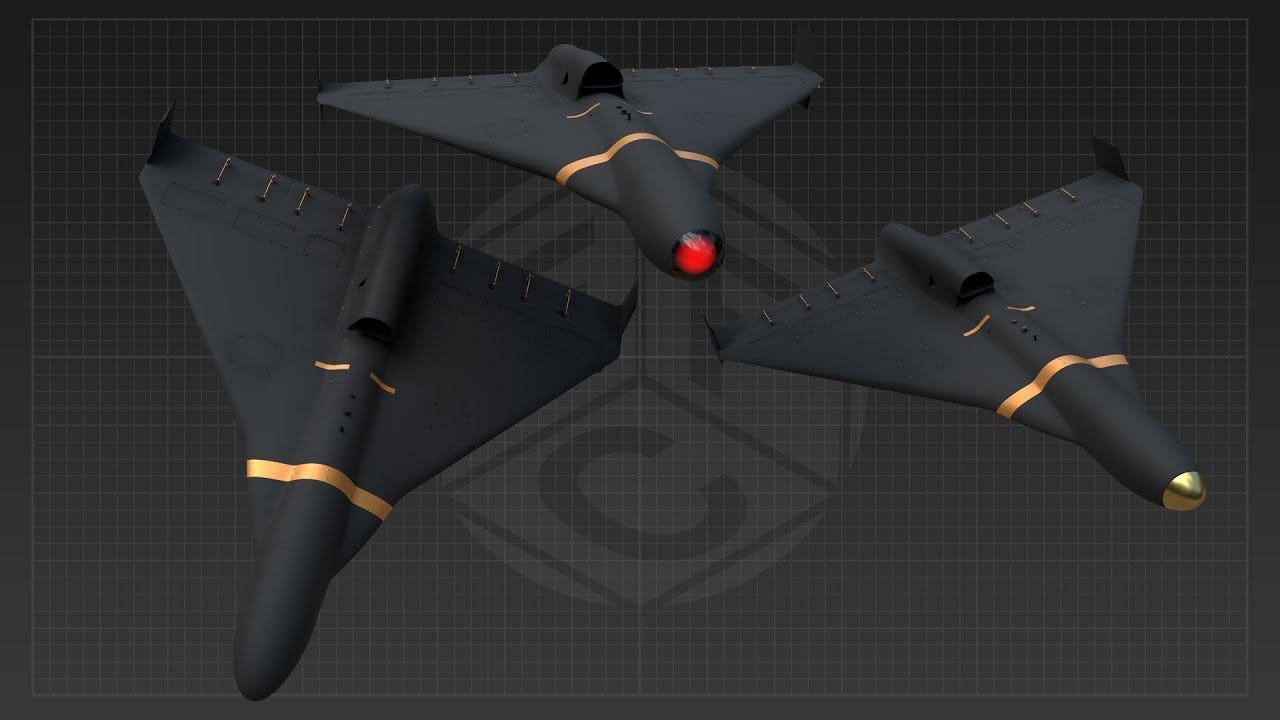
Iranian Shahed Drones – Three Variants
By William Schryver – imetatronink – June 26, 2024
In addition to the already-in-progress wars in Ukraine, Gaza, and the Red Sea, we are now staring down the barrel of yet another — rumored to be imminent in southern Lebanon.
There is no doubt Israel (just like its great benefactor, the United States) is, in the context of a “big war”, capable of executing several damaging strikes against a potential peer or near-peer adversary.
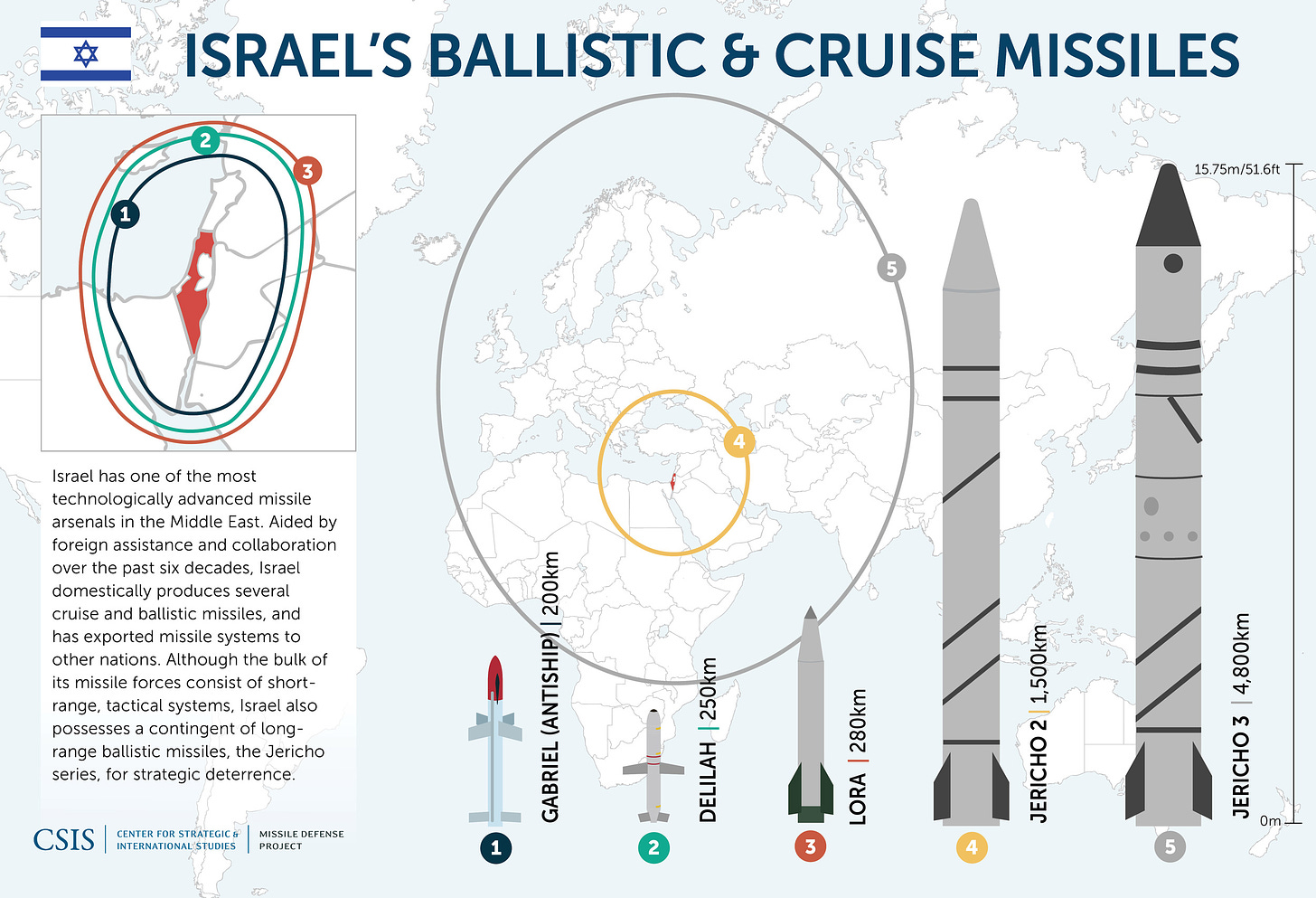
Israeli Ballistic and Cruise Missiles and Ranges
But, throughout the imperial domain, there are fatal weaknesses that exist right now, and which cannot be turned into strengths at any point in the near- or medium-term.
The first is what military types call “magazine depth”: munitions stockpiles sufficient to offensively overwhelm, defensively defeat, and strategically outlast the enemy.
Neither the United States, nor any of its largely impotent client nations, possess “magazine depth” sufficient to prosecute anything more than a relatively brief campaign against their potential peer adversaries: Russia, China, Iran — and all or any of their lesser-power partners.
The second problem is a corollary of the first. It is what I will term “shields”: the capacity to defeat a decisive proportion of the strikes one’s enemy can launch against you.
Neither the United States, nor any of its largely impotent client nations — by their own admission — possess anything even approximating comprehensive and effective “shields” against the quantity and quality of the types of strike weapons its potential adversaries can launch against them.
NATO sources themselves recently confessed that they only have about 5% potential air defense coverage against Russian missile strikes.
Now, of course, many will reflexively argue that, for example, the US could, with a massive “shock and awe” first-strike air campaign, effectively disarm Russian counterstrike capabilities.
This is patently ridiculous wishful thinking.
No one who actually understands the parameters of the military equation believes this to be true. And one need only examine the results of the months-long campaign against the lowly Yemenis to see confirmation of this incontrovertible fact.
Earlier this year we witnessed the Iranians launch a relatively modest missile strike against Israel, whose defenses were massively reinforced by American air and naval assets.
Using maybe 300 antiquated long-range strike drones and cruise missiles as decoys, the air defense response of both the US and Israel was massively attrited. And then, with a mere dozen or so seriously capable ballistic missiles, the Iranians blew right through the interception attempts of both the multiple land-based Patriot systems and a US guided-missile destroyer positioned off the eastern Mediterranean coast.
The Patriot systems were a total bust, and the Israelis summarily retired them in the immediate aftermath of the Iranian strike.
The US destroyer is reported to have launched eight top-shelf SM-3 missile defense interceptors (quite likely its entire “magazine depth”) at the incoming Iranian strike package.
They might have damaged one of the 12-15 incoming Iranian missiles.
The others hit with precision comparable to the 5-meter CEP Iran achieved in its 2020 strikes against the US airbase at Ayn al-Asad in Iraq.
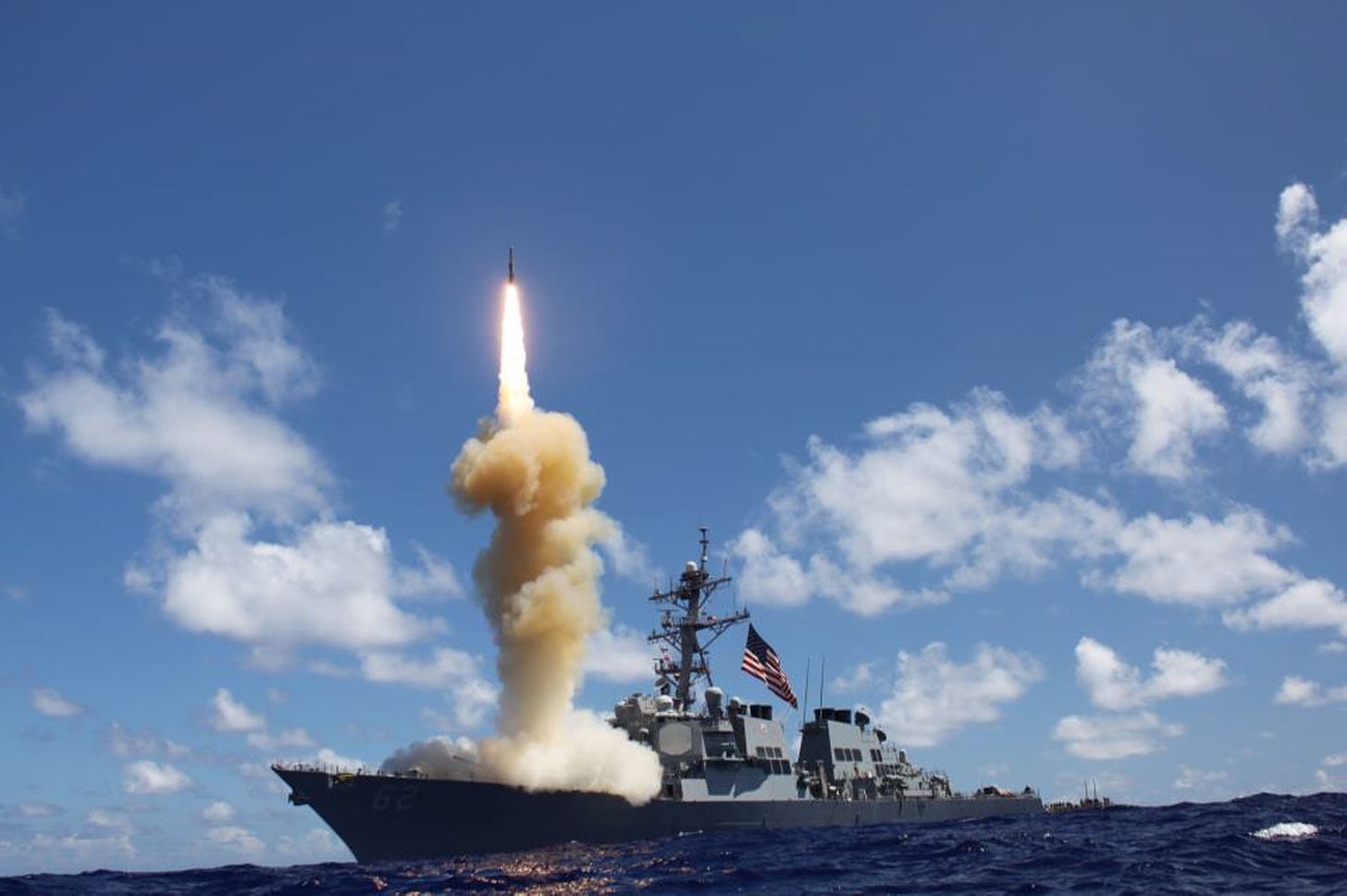
SM-3 Missile Interceptor Launched from a US Guided-Missile Destroyer
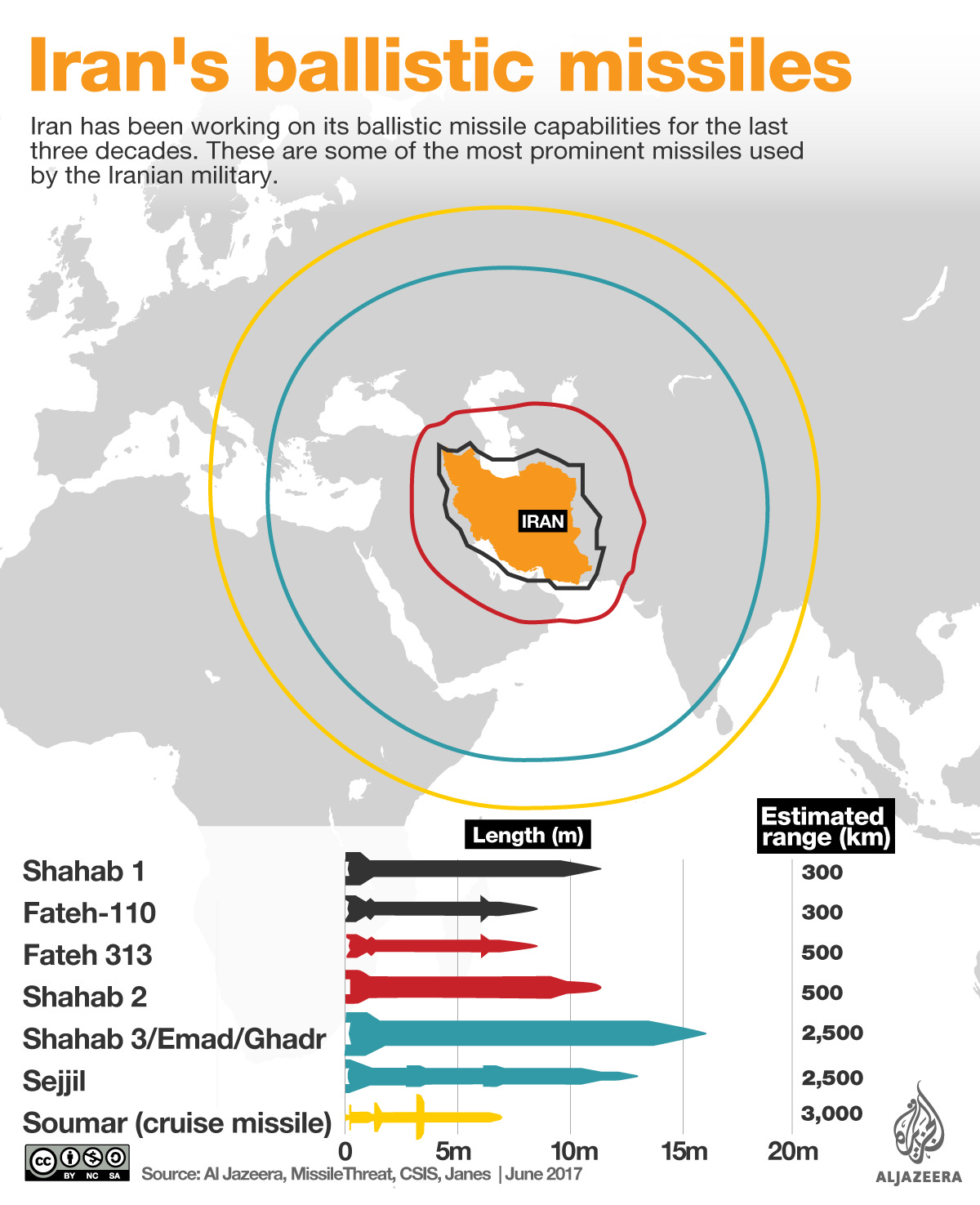
Iranian Ballistic Missiles and Ranges
Had Iran, at that moment in time, opted to follow up with an even larger strike consisting of several hundred of its best ballistic missiles, the US and Israeli defenses would have been penetrated to an overwhelming degree. It would have put to shame the opening-night show of the Americans’ 1991 “shock and awe” cruise missile attack against Baghdad.
Fortunately the Iranians didn’t press the matter, and let their modest yet impressive demonstration of strength suffice for the time being.
In recent months, Iran’s close partner Hezbollah — which is reputed to possess at least 100,000 missiles and drones of various types — has been routinely penetrating Israel’s once-vaunted “Iron Dome” missile defense system.
Indeed, Hezbollah has almost appeared to be mocking the Israelis’ impotence at times.
In any case, the Iron Dome has been revealed to be acutely vulnerable to penetration by Hezbollah drones and missiles.
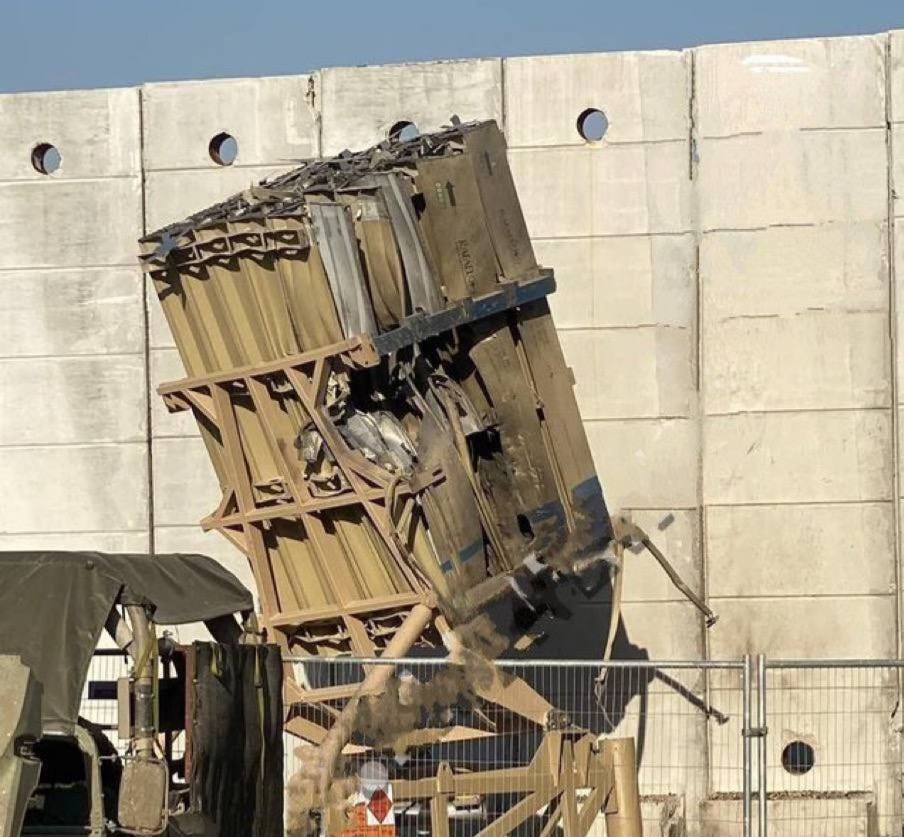
Israeli Iron Dome Launcher Destroyed by Hezbollah Drone Strike
It is not known with precision how many missiles and drones of various types Iran possesses. But it is reasonable to assume that their “magazine depth” is considerably larger than that of Hezbollah.
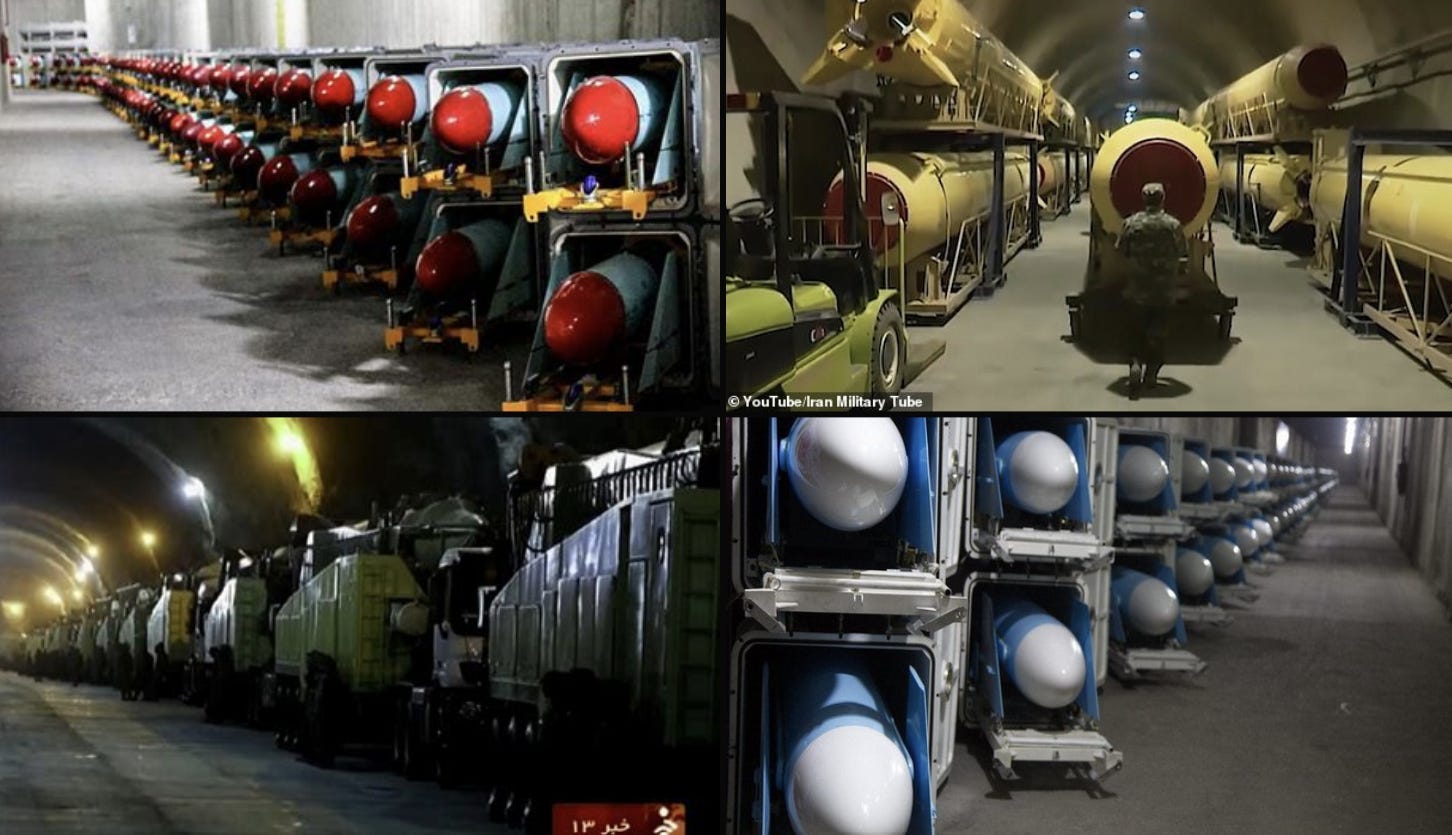
Iranian Missiles
It is also not known with precision how many missiles and drones of various types Russia possesses. But it is reasonable to assume that their “magazine depth” is considerably larger — and exceedingly more potent — than that of Hezbollah and Iran combined.
Even more importantly, the Russians have, over the course of the war in Ukraine, demonstrated an unprecedented capability to routinely shoot down the best strike missiles the US and its NATO vassals have been able to launch against them.
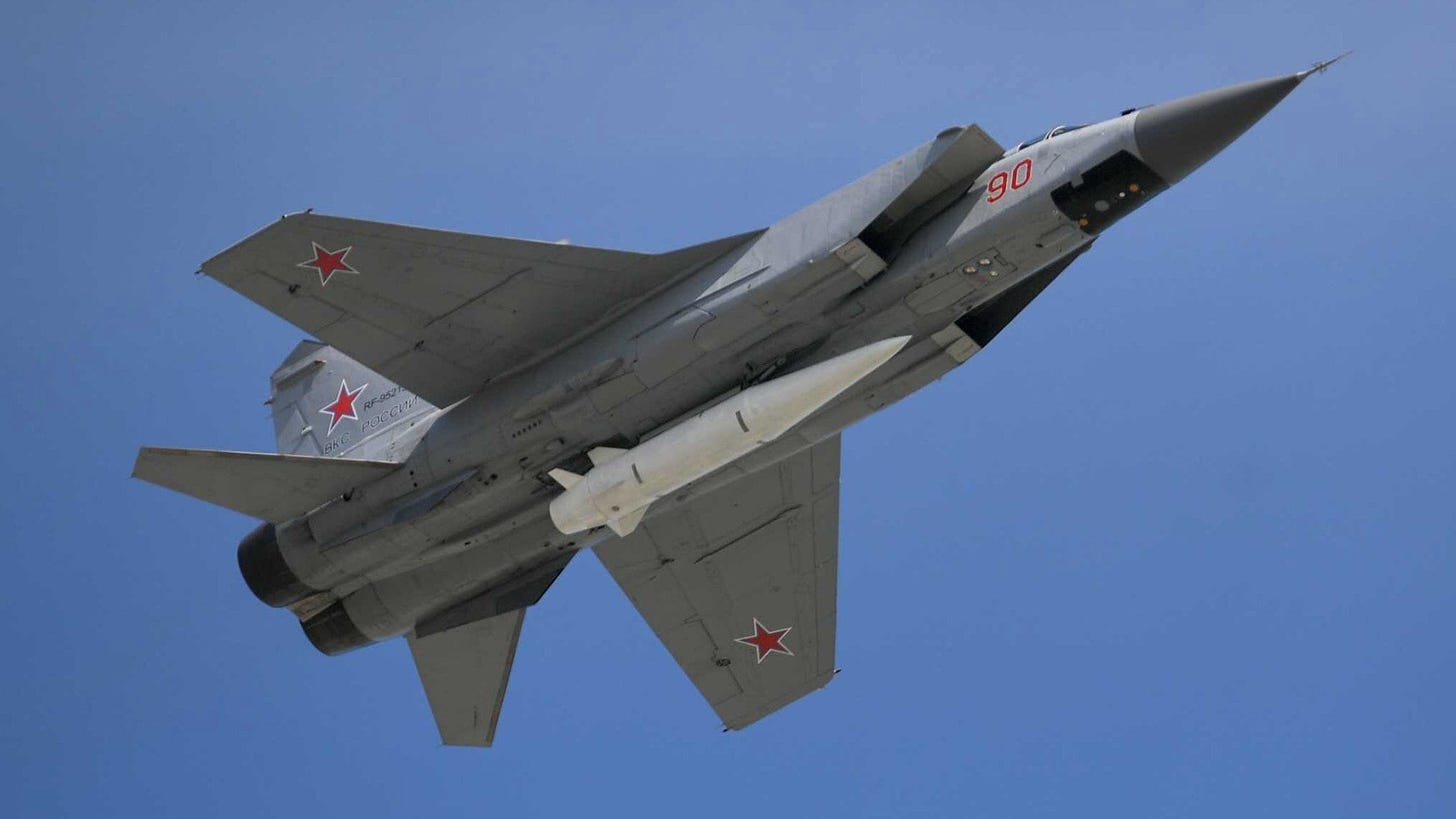
Russian MiG-31 Carrying a Hypersonic Kinzhal Missile
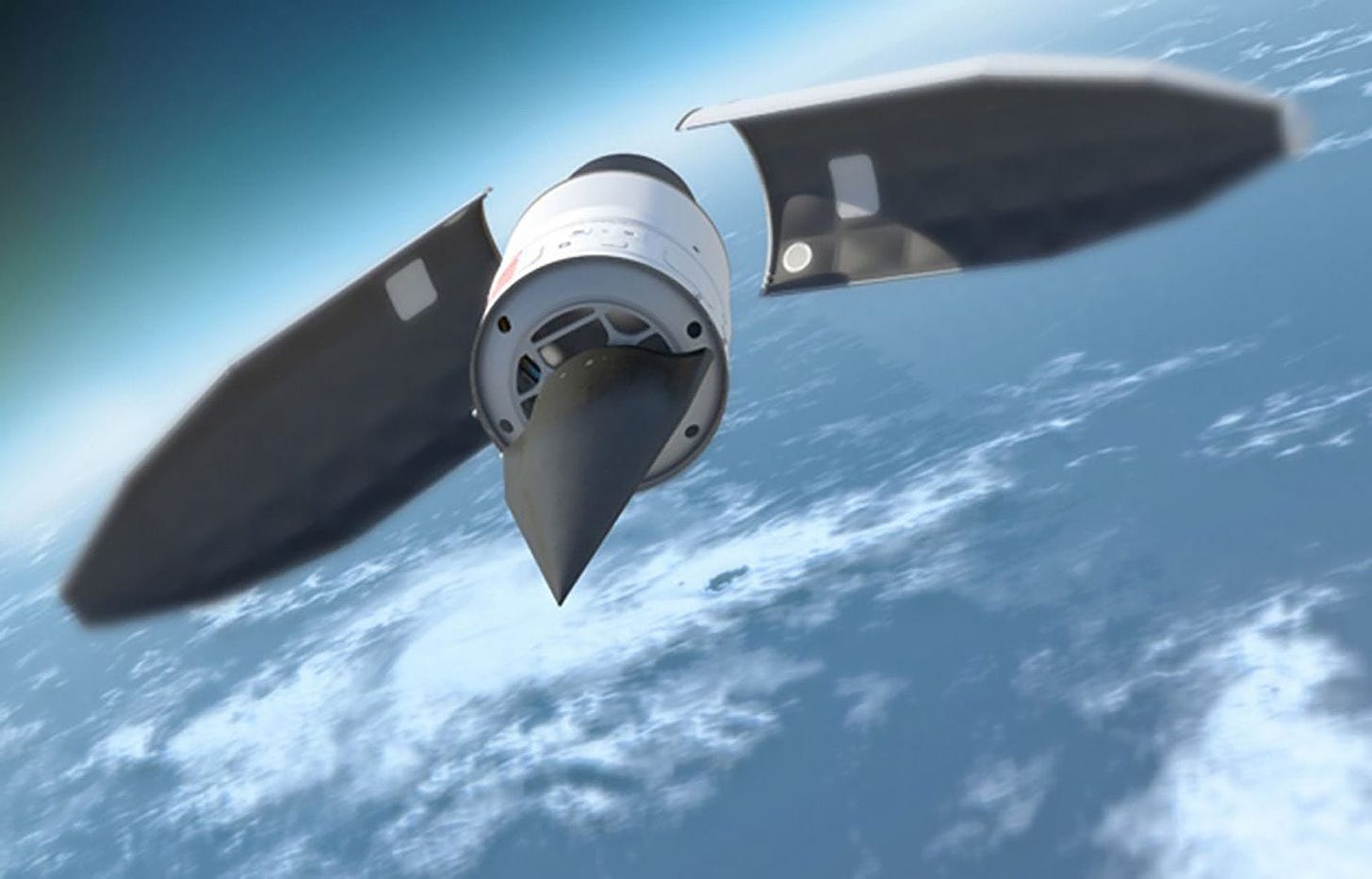
Russian Avangard Hypersonic Missile
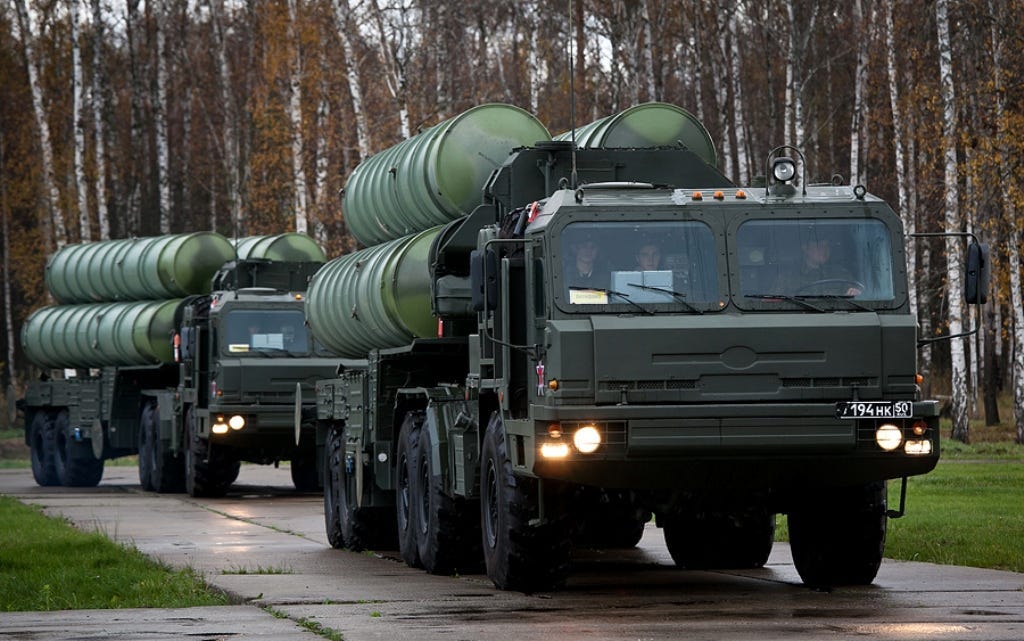
Russian S-400 Air Defense System
Lastly, it is not known with precision how many missiles and drones of various types China possesses. But it is reasonable to assume that their “magazine depth” is at least an order of magnitude larger than Hezbollah, Iran, and Russia combined.
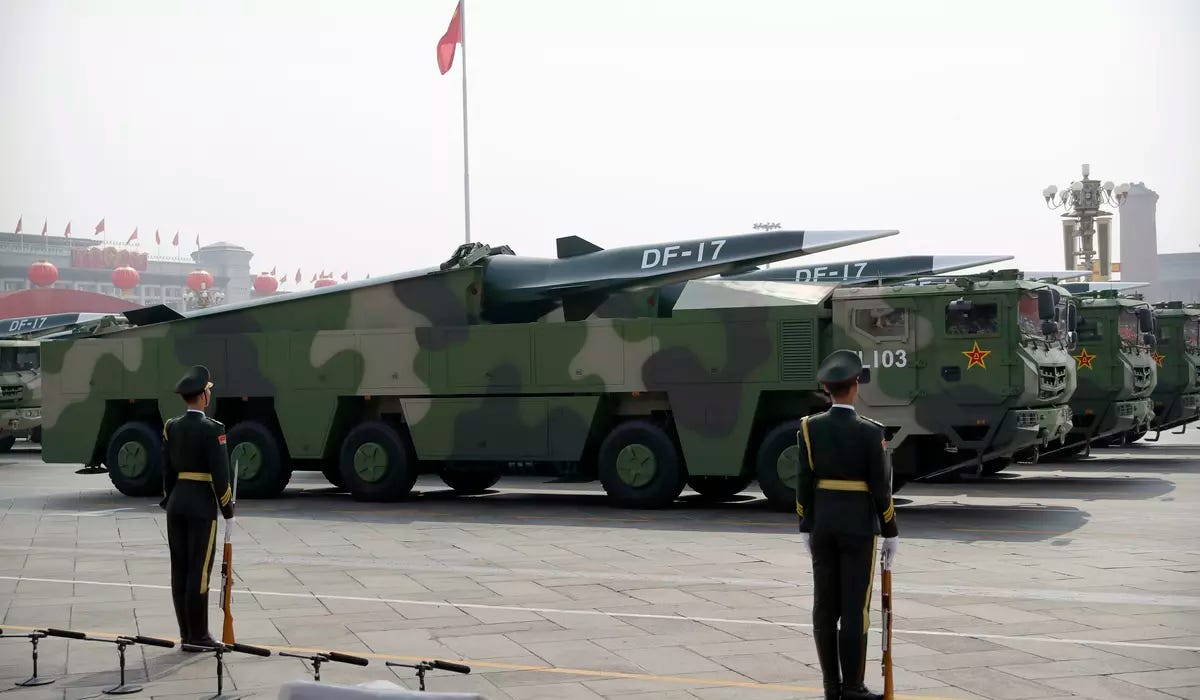
Chinese DF-17 Hypersonic Missiles
Of course, I’ve not yet made any mention of North Korea, who has now been formally received into the Russia, China, Iran mutual-defense partnership. People love to mock Kim Jong-Un and his people, but the empire underestimates them at their peril.
The Israelis can talk tough about making war against Hezbollah and its friends, but if they actually attempt it, it will end very, very badly for them.
The Americans and their almost laughably impotent allies can talk tough about making war against Russia or China, but if they actually attempt it, it will end catastrophically for them.
Then we’ll really have a dangerous situation on our hands.
US condemned for attempting to sow discord between China and Russia, North Korea
Global Times | June 24, 2024
Experts have rebuked the US for trying to sow discord between China and Russia, and North Korea, noting that the closer relationship between the two Chinese neighbors is based on current realities, as their mutual support can break through Western blockades.
The remarks came after US Air Force General C.Q. Brown, chairman of the Joint Chiefs of Staff, told reporters during an overseas trip on Sunday that the newly-signed strategic partnership agreement between Russia and North Korea could create friction with China, according to Reuters.
Reuters, citing anonymous analysts, claimed the pact, signed on Wednesday, “could undercut Beijing’s leverage over its two neighbors and any heightened instability could be negative for China’s global economic and strategic ambitions.”
Chinese experts refuted the claims.
“In fact, China is pleased to see strengthening friendly cooperation between these two neighboring countries,” said Lü Chao, an expert on the Korean Peninsula issue at the Liaoning Academy of Social Sciences. He believes the mutually supportive ties between Russia and North Korea are expected to contribute to regional security and the peace and stability of Northeast Asia.
China’s relations with both Russia and North Korea share a common goal of maintaining peace and stability in Northeast Asia, and their comprehensive cooperation is reasonable, Lü said.
The top leaders of the Democratic People’s Republic of Korea (DPRK) and Russia signed the Treaty on Comprehensive Strategic Partnership following their summit in Pyongyang on Wednesday, the Xinhua News Agency reported Thursday.
Russia and North Korea have agreed on mutual support in the event of external aggression, Russian media reported on Wednesday, citing Russian President Vladimir Putin. Russia does not rule out military-technical cooperation with North Korea in accordance with a newly signed comprehensive strategic partnership agreement, RIA Novosti reported, citing Putin at a press briefing following talks with North Korea’s top leader Kim Jong Un in Pyongyang.
In response to the development, Lin Jian, a spokesperson for the Chinese Foreign Ministry, said at a Thursday press conference that “the agreement between the DPRK and Russia is related to their bilateral cooperation. I have no comment on it.”
The closer relationship between North Korea and Russia is based on current realities, Chinese experts pointed out.
Currently, both Russia and North Korea face severe pressure from the US-led Western clique, including economic sanctions. In this situation, it is natural for the two countries to come together, especially since they have mutually beneficial aspects, such as Russia’s assistance in energy and food supplies to North Korea, according to Lü.
At the same time, some US and other Western politicians and media outlets are hyping “some kind of military alignment or military bloc” in Northeast Asia.
Such rumors also were debunked by Chinese experts.
The US is determined to implement its so-called Indo-Pacific Strategy in the region, creating a camp confrontation mentality, they said.
“China opposes any trend towards regional camps. But the US is fabricating this division,” Lü remarked.
He warned that the Western portrayal of a camp formation could further exacerbate tensions on the Korean Peninsula.
The expert explained that China has always advocated a fair and just stance on the Korean Peninsula issue, maintaining a fair and just position towards both North and South Korea, which has been widely recognized.
Lin said that on the Korean Peninsula issue, China’s position is consistent. “We always believe that upholding peace and stability on the Peninsula and advancing the political settlement of the Peninsula issue serve the common interests of all parties and hope various parties will make constructive efforts to this end,” Lin said.
Plan to establish US Marine regiment in Guam ‘to escalate camp confrontation, stir up regional tensions’
Global Times | June 23, 2024
The US Marines plan to deploy to Guam a littoral regiment capable of a flexible and rapid response in a “few years,” media revealed on Saturday, which Chinese observers said is aimed at preparing for great power competition, blatantly exposing the US’s combat intentions against China.
On Saturday, Japanese media outlet Kyodo News reported that General Eric Smith, commandant of the US Marine Corps, told a press conference in Washington that the Marine Littoral Regiment is “designed as a counter to PRC aggression,” to protect Japan, South Korea and the Philippines.
Smith said the regiment, due to be based on Guam, “will have responsibility to rapidly deploy inside the first island chain into the Philippines in order to spread the battlespace out and to protect those strategic lines of communication that emanate from Japan, back to the Philippines, back to Hawaii.”
The island chain refers to an area that includes Japan as well as the island of Taiwan and the northwest Philippines.
In the event of potential conflicts with China, such as China advancing its cause of national reunification, or conflicts erupting between China and the Philippines or Japan over territorial disputes, the US may use these deployments to strike against China, Chinese observers noted.
“This demonstrates the US’ relentless preparation to compete with China, with a clear Cold War mentality,” Zhang Junshe, a Chinese military expert, told the Global Times on Sunday.
The plan to establish a littoral regiment in Guam again demonstrated that the US is engaging in camp confrontation, seeking to rally countries like Japan and the Philippines, as well as to strengthen its control over these allies through military deployments and cooperation, enticing them to join the US’ chariot and making these countries work for its anti-China strategy, Zhang said.
This will undoubtedly add fuel to the fire and stir up regional tensions, Zhang warned, noting that the US wants to benefit from the chaos, such as selling more military equipment.
Kyodo reported that the new regiment in Guam will be the third of its kind that is capable of long-range detection and engagement using mobile missile batteries, as well as deploying small groups of marines to remote islands. The first unit was activated in March 2022 on Marine Corps Base Hawaii and the second was set up in Okinawa in November last year.
This exposed the US attempt to adopt a strategy of dispersion of its military forces, as the commandant of the US Marine Corps confirmed that the relocation of US Marines from Okinawa to Guam will begin in December.
Some observers believe that the US military forces’ shift from Okinawa to Guam is a strategic retreat, indicating a lack of security in Okinawa.
But Zhang sees it differently.
“Strategically, the US military is not retreating from Okinawa; it may withdraw its forces, but some weapons and firepower will remain in place. On the one hand, the US is instigating conflicts, while on the other hand, it does not want its forces to suffer losses. Therefore, it is pushing countries like the Philippines and Japan to be firmly tied to its warship as cannon fodder,” Zhang remarked.
Zhang also revealed the ongoing competition between the US Army and the Marine Corps for roles, funds and functions. He noted that the deployment of these assets is not actually the Marine Corps’ expertise, but should instead be a focus of the US Army.
The US Marine Corps primarily focuses on amphibious operations, but now there is a need for the corps to undergo a tactical transformation toward littoral operations, emphasizing land-sea integration. This in itself will bring about significant changes to the Marine Corps’ functions, which presents a considerable challenge, said another Chinese military expert, who requested anonymity.
If the Marine Corps insists on transformation, these disputes with the US Army will intensify, making the regiment’s implementation more challenging, some military experts warned. They believe that in reality, it is impractical for the regiment to target China.
A new multipolar security system based on ‘Pax Rossiya’
Strategic Culture Foundation | June 21, 2024
For several years now, Russia, China and other members of the expanding BRICS alliance have been formulating progressive trade and financial relations of the emerging multipolar world order. That order is based on mutual respect and partnership grounded in international law and the UN Charter.
The BRICS concept is rightly the zeitgeist of our time. It is rallying more nations to its fold especially those of the so-called Global South which for decades have been subjected to the unilateralism of Western hegemony.
The trouble is that for a new world order based on equality and fairness to succeed in practice, it needs to be secure from arbitrary military aggression and imperialist tyranny. In other words, a new security architecture is required to underpin the development of a multipolar world.
Russian President Vladimir Putin has been advocating for a new indivisible international security system. This week saw the plan for a new security arrangement put into action.
The Russian leader embarked on state visits to North Korea and Vietnam during which he signed new strategic partnership and defense accords.
Ahead of his trip to the Democratic People’s Republic of Korea, Putin outlined the integrated vision thus: “We are also ready for close cooperation to make international relations more democratic and stable… To do this, we will develop alternative mechanisms of trade and mutual settlements that are not controlled by the West, and jointly resist illegitimate unilateral restrictions. And at the same time – to build an architecture of equal and indivisible security in Eurasia.”
The concept of indivisible security is by no means limited to Eurasia. Russia has signaled the same principles apply to Latin America, Africa and indeed every other corner of the world.
During Putin’s meetings with Chairman Kim Jong Un of the DPRK and President Lo Tam of the Socialist Republic of Vietnam, the strategic partnerships agreed were not merely about military defense and security. They involved comprehensive partnerships for the development of trade, transport, technology, education, science and medicine.
Nevertheless, it was clear that the commitment to strategic partnership was underpinned by new mutual defense accords. This was most explicit in the treaty signed with the DPRK which furnished “mutual assistance in the event of aggression against one of the parties”.
This is a game-changer. It totally upends the geopolitical calculations of the United States and its NATO partners who have been unilaterally expanding military force and provocations in Eurasia and elsewhere.
U.S. President Joe Biden’s administration has ramped up aggression in the Asia-Pacific against China and North Korea with impunity. Under his watch, the US has increasingly moved nuclear forces into the region to intimidate not only Beijing and Pyongyang but also Moscow. The Biden administration has been assiduous in forming hostile military formations in the region with its NATO partners, including Australia, New Zealand, Japan and South Korea.
Year after year, the United States has built up weapon systems in Taiwan to provoke China and on the Korean Peninsula to threaten North Korea.
This unilateral aggression and “might is right” arrogance underpin the notion of Pax Americana that prevailed for decades after the Second World War. That notion was always a cruel euphemism for American imperialist violence to impose its economic and political interests. The Korean and Vietnam Wars in which millions of civilians were annihilated were the real-world grim translations of Pax Americana and its fraudulent “rules-based order”.
Geopolitical perceptions have dramatically changed in a few short years. The U.S. and its Western partners – a global minority – have come to be seen by most people of the world as rogue states that have trashed international law through illegal wars and unilateral bullying with economic sanctions. The U.S. dollar and Washington’s relentless debt spending are seen as instruments of imperialist looting.
The BRICS multipolar world order is a welcome alternative to the mayhem of the Western-dominated system. The principles of fairness and cooperation are laudable and necessary to implement. But such principles must be reinforced with military defense and security for all. This is far from the one-sided “defense and security” of the United States and its NATO partners, which in reality is an Orwellian cover for aggression.
The defense commitments given by Russia to the DPRK this week can be seen as long overdue. One may wonder how the U.S. and its allies got away with threatening the people of North Korea for so long and denying Pyongyang the sovereign right to self-defense. Admittedly, Russia did previously support UN sanctions on North Korea over its missile program. That’s over.
The U.S.-led proxy war in Ukraine against Russia that erupted in February 2022 was a wake-up call for Moscow and many people around the world.
Patently, the Western hegemonic system will stop at nothing to assert its neocolonialist privileges, even to the point of antagonizing a nuclear world war.
There is only one language that the U.S. and its minions understand – and that is the threat of devastating countervailing force.
Washington and its NATO lackeys think they can put missiles in Ukraine to hit Russia or in South Korea and Japan to hit North Korea – at no cost to their own security. Well, now, they might want to think again. There’s a new sheriff in town, as this week’s developments show.
A new global security system is being incarnate. Russia’s vision of indivisible, mutual security is shared by China and many other nations because it is fully compliant with international law and nations’ sovereignty.
Russia, China and other supporters of a multipolar world are not preemptively threatening anyone. But it takes the guarantee of unassailable nuclear powers, Russia and China, to make a new security system viable by restoring the deterrence towards the rogue states of the United States and NATO accomplices.
The defense accords between Russia, the DPRK and Vietnam are installments of the new security architecture that is needed in Eurasia and globally. The has-been American hegemon has been served notice that from now on its presumption of belligerence with impunity, to destroy nations, and to have a license to murder en masse is null and void.
Welcome to the new multipolar order and Pax Rossiya. All are welcome – except hegemonic rogue states.
Outgoing Stoltenberg is still laying mines for the world
Global Times | June 19, 2024
NATO Secretary General Jens Stoltenberg is about to leave his post, and the upcoming NATO summit to be held in the US next month will be his farewell tour, if nothing else. In the past two days, Stoltenberg went to Washington to warm up for the upcoming summit, at the same time showing off some of his own “achievements” to leave some political legacy for the past nine years in his post as NATO Secretary General. He touted that 23 of the 32-member bloc have met the target of spending 2 percent of GDP on defense, while revealing that NATO is discussing the deployment of more nuclear weapons. Stoltenberg’s remarks, which make the world feel great concerns and threats, are said with easiness and even great excitement. The NATO chief also continued to threaten China, saying that China cannot “have it both ways” between the West and Russia and that if it does not change course, “there should be consequences.”
In his nine years in office, the world saw the prolonged Syrian civil war, and the outbreak of the Russia-Ukraine conflict, as well as the Israel-Palestine conflict. The role of NATO, a product of the Cold War and the world’s largest military bloc, in the conflicts of such magnitude, is dishonorable. The Ukraine crisis, in particular, caused by the bloc’s eastward expansion, plunged Ukraine into war, further tore Europe apart, and brought NATO back to life. Even within the US and Europe, there has been harsh criticism and warnings about this.
Yet, Stoltenberg is not satisfied, as he continued to call on the West to supply more weapons to Ukraine on Monday in Washington, claiming it is the “path to peace.” Even he cannot justify it, admitting that this “may seem like a paradox.” This is Stoltenberg’s way of covering up his attempts at war and culpability, as well as the way of NATO as a whole: to create conflicts in the name of preventing crises and to exacerbate catastrophes in the name of managing crises. As one Western scholar summarized, invasion has been hailed as “humanitarian intervention,” coup d’état as “democratic revolution,” regime subversion as “democracy promotion,” gunboat diplomacy as “freedom of navigation,” military bloc expansion as “European integration,” and domination as “negotiation from a position of strength.”
Under Stoltenberg’s leadership, NATO has also been attempting to interfere in the Asia-Pacific region, aligning with the strategic direction of the US, and promoting “NATO’s Asia-Pacificization.” Although such attempts have encountered resistance from the majority of countries in the Asia-Pacific region, and thus remain limited to a small circle of US allies, regional countries must not be negligent. The desire of regional countries to maintain the regional peace and development does not mean that NATO has no intention of creating discord. NATO’s own history has proved that it strengthens its functions through crisis creation. Since it now intends to enhance its presence and functions on a global scale, it inevitably has to create larger crises.
On this point, insightful individuals internationally, including those in Western countries, have long provided incisive summaries. Organizations like NATO have interfered in nearly all wars and conflicts since its foundation, consistently exporting war and only bringing more problems. In the cycle of seeking enemies, creating crises, and extending its existence, NATO aims to make China the latest target. In recent years, NATO summit declarations have increasingly mentioned China, and provocative actions against China have become more frequent. Particularly, Stoltenberg himself has repeatedly issued threats this year, demanding that China must choose sides between the West and Russia. In February alone, he created a notable scene during his US visit by making seven provocative statements about China in six days. His speeches are filled with confrontational language and echoes of the Cold War. Given that some political elites in the US and Europe frequently champion moral causes such as “opposing coercion” and “defending peace,” they should feel embarrassed by Stoltenberg’s remarks.
Stoltenberg’s strenuous efforts to perform and use various occasions to promote the “China threat” narrative indirectly indicate that this task is difficult. China consistently participates in international affairs as a responsible major power, pursuing peace and bringing opportunities. Even within NATO, China is one of the main trading partners for the majority of its 32 member countries. This is one of the reasons why NATO labels China as a “systemic challenge.” For a war-dependent entity like NATO, a China that follows a path of peaceful development naturally becomes a “challenge.”
This year also marks NATO’s 75th anniversary. Stoltenberg’s warmongering rhetoric is the best commentary on the role NATO has played over the past 75 years. If Stoltenberg leaves any legacy during his term, it is conflict and war. People should be particularly wary of Stoltenberg’s promotion of the “threat narrative.” History has repeatedly shown that such rhetoric always runs counter to peace, development, and prosperity. The louder NATO’s voice becomes, the more vigilant peace-loving people should remain.
NATO chief says China should be punished
RT | June 18, 2024
NATO Secretary-General Jens Stoltenberg has called for making China pay a price for allegedly propping up Russia’s military campaign in Ukraine, saying Beijing is “fueling” the conflict by supplying microelectronics and other key components to Moscow.
“The reality is that China is fueling the largest armed conflict in Europe since World War II,” Stoltenberg said on Monday in a speech at the Wilson Center in Washington. “At the same time, it wants to maintain good relations with the West. Well, Beijing cannot have it both ways. At some point, unless China changes course, allies need to impose a cost.”
Stoltenberg has repeatedly attacked China since the Ukraine crisis began in February 2022, arguing that Beijing was enabling Russia to fight against Kiev, a “European friend” of NATO. He has made such comments even as NATO states prolonged the conflict by providing hundreds of billions of dollars’ in economic and military aid to Ukraine.
Monday’s rebuke marked some of his most pointed criticism yet, suggesting that NATO may ramp up sanctions against China. He also called out North Korea and Iran for being supportive of Russia’s defense-industrial complex.
Stoltenberg reiterated an assertion that NATO – a military bloc originally formed against the Soviet Union – needs to get more involved in the Indo-Pacific to counter the “growing alignment between Russia and its authoritarian friends in Asia.” He noted that he invited the leaders of Japan, South Korea, Australia and New Zealand to next month’s NATO summit in Washington to work together on upholding the “international rules-based order.”
China is providing Russia with semiconductors and other key technologies with military applications, including parts needed to make missiles and tanks, Stoltenberg said. He added that Beijing also has supplied Russia with improved satellite and imaging capabilities. “All of this enables Moscow to inflict more death and destruction on Ukraine, bolster Russia’s defense-industrial base, and evade the impact of sanctions and export controls.”
The NATO chief also spoke of his China concerns in an interview with the BBC on Monday. Asked about what the Western military bloc might do about the issue, he said there was an “ongoing conversation” about possible sanctions. “At some stage, we should consider some kind of economic cost if China doesn’t change their behavior,” he said.
Beijing has repeatedly defied demands from the US and other NATO nations to join in sanctioning and isolating Russia. Chinese leaders have pushed a peace plan to end the fighting and have pointed out that Russia’s legitimate security concerns cannot be ignored.
Earlier this year, the Chinese Foreign Ministry denounced NATO as a “walking war machine that causes chaos wherever it goes.” Beijing has accused NATO of meddling in Asian affairs, saying the bloc is a “terrible monster” and has extended a “black hand” toward the region.
Repeated Western narratives of China’s nuclear ‘threat’ are what lead to a dangerous world
Global Times | June 17, 2024
In an interview with The Telegraph published on Sunday, NATO chief Jens Stoltenberg claimed that the bloc is in talks of taking missiles out of storage and placing them on standby in the face of a growing threat from Russia and China. While giving a stark warning about the threat from China, he said a world where countries like China have nuclear weapons, and NATO does not, is “a more dangerous world.”
What truly constitutes a dangerous world is the world’s largest war machine hyping a nuclear war that could bring devastating consequences to mankind. Stoltenberg is telling the world that NATO would go beyond being just a conventional combat force, and become a nuclear alliance. He is trying to create an opinion condition favorable for NATO and the US to strengthen their nuclear-sharing capability. At a pre-ministerial press conference of NATO on June 12, Stoltenberg stated that the US is modernizing its nuclear weapons in Europe.
It is worth noting that the warnings of Stoltenberg came against the backdrop of the ongoing Ukraine crisis. The just concluded two-day peace summit in Switzerland did not achieve much to solve the crisis. The US-led West has no will to end the conflict as soon as possible. Instead, it sent out a nuclear deterrence against Russia, which is nothing but adding oil to the fire, according to Zhang Junshe, a Chinese military expert.
Zhang believes that the fundamental reason that the NATO chief made the irresponsible remarks is to coordinate US strategies to suppress its adversaries.
“The Cold War bloc aims to expand its role to the world, including the Asia-Pacific. It acts as a pawn of Washington to contain Russia in Europe and contain China in Asia,” said Zhang.
On June 7, Pranay Vaddi, a senior White House aide, said that the US may have to deploy more strategic nuclear weapons in coming years to deter growing threats from Russia, China and other adversaries.
Coincidentally or not, the Stockholm International Peace Research Institute (SIPRI) on Sunday launched its annual assessment of the state of armaments, disarmament and international security, in which it said that China is amid a “significant” expansion of its nuclear capabilities and may have as many intercontinental ballistic missiles as the US or Russia by 2030. The Stockholm-based watchdog also claimed that China is believed to have some warheads on high operational alert for the first time.
Reading through SIPRI’s report, one can feel a strong intention of thwarting China’s development of nuclear weapons, despite the fact that the US has 10 times as many nuclear warheads as China. The report has quickly raised the eyebrows of major Western media outlets which rush to report on China’s “fast-growing” nuclear stockpile.
The fact that nuclear arsenals are being strengthened around the world is the result of global conflicts such as the ones in Ukraine and Gaza and the suppression of Western countries against non-Western countries. “The SIPRI’s report and Western media’s narrative of China’s ‘fast-growing’ nuclear stockpile are deliberate suppression of China and a kind of nuclear blackmail,” Cui Heng, a research fellow from the Center for Russian Studies of East China Normal University, told the Global Times.
Now, the US has ripped off its veil of decency when dealing with China. The competition between China and the US will feature bilateral relations in the long run. Both sides strive to build “guardrails” to prevent relations from going off the track. However, China needs to show its strength. Strength can be best reflected by the nuclear weapons China owns. Nuclear power is the foundation of national security when China faces an increasingly hostile US with 10 times of nuclear warheads that China has.
Zhang, the military expert, noted that China’s expansion of its nuclear arsenal is imperative. It will help not only to effectively get by the West’s nuclear blackmail and threat, but also safeguard the country’s sovereignty and territorial integrity and break through the shackles and obstacles created by the West during the process of China’s development.
China is a nuclear power that formally maintains a no-first-use policy. Its nuclear policy is fundamentally different from that of the US and NATO. If the US and NATO do not want to live in a dangerous world, they should start by changing their own perception of China.
Featured Video
Laith Marouf: Hezbollah’s position on US-Iran ceasefire
or go to
Aletho News Archives – Video-Images
From the Archives
The Dirty Little Secret behind the “Global Terrorism Index”
The Omission of Israeli Terrorism in the Occupied Palestinian Territories
By Karin Brothers | Global Research | December 6, 2014
… The Israeli settlements — all of which are illegal – have been identified as a major impediment to peace. The refusal of a major “global” terrorism report to name the Israeli settlers as one of the groups most responsible for terrorism not only misrepresents a major source of regional violence but exposes the Global Terrorism Index as a propaganda tool that supports a U.S. agenda.
In recent years, governments have been attempting to thwart terrorism by blocking supportive fund-raising. When it comes to Israeli settlements, however, the US and Canada actually encourage fund-raising by giving organizations (such as Christian Friends of Israeli Communities (CFOIC) and the Jewish National Fund) financial support in the form of donor tax-deductions.
Charities which provide funds for the Israeli settlements should be regarded as terror-financing organizations. They should not only lose their tax-deductible status, but they should be banned because they support the violation of international humanitarian law. The terror-financing laws that are being strictly enforced for Muslim charities should be applied to Christian and Jewish charities as well. … Read full article
Blog Roll
 Aletho News
- The ‘Opposition Party’ Has Done Nothing to Stop the Iran War and Much to Goad Trump Into Continuing It
- Moscow backs Tehran on status of Lebanon in US-Iran deal
- How UK Regulator Ofcom Quietly Bypassed International Law to Police American Speech
- The Black Cube Files: How Former Mossad Operatives Flipped a Nation
- Laith Marouf: Hezbollah’s position on US-Iran ceasefire: What you’re not being told
- Israel’s priority lies in destroying chances of peace between Iran, US: Ex-UN nuclear chief
- Ceasefire for all or for none: Iran shuts Hormuz over Lebanon attacks
- Strait of Hormuz is Iran’s ‘nuclear weapon’ that forced US retreat: Medvedev
- Energy crisis will last for months – Kremlin envoy
- Europe’s quiet role in the war on Iran
- If Americans Knew
- This is ceasefire? Israel’s biggest massacre yet in Lebanon, another journalist killed in Gaza – Daily Update
- Tucker Carlson on Israel: This Is the Behavior of an Ally? Really?
- Gazans face a triple crisis: severe shortages of water and bread, healthcare in tatters
- NY Times reports how Netanyahu took the US into Iran War
- A sigh of relief over Iran, but Gaza and Lebanon in dire straits – Daily Update
- Thousands dead and neighborhoods razed to the ground: Aid agencies fear southern Lebanon is becoming the new Gaza
- The war the US is fighting for Israel could cost trillions
- ‘Cigarette Burns, Nail Wounds’: Toddler Tortured in Gaza to Coerce Father
- Trump Says US Sent ‘a Lot of Guns’ to Protesters in Iran
- Israeli forces destroy 17 UN peacekeeper cameras in south Lebanon
- No Tricks Zone
- An Inconvenient Tree: Uncovered In Alps… Europe Much Warmer Than Today 6000 Years Ago
- New Study Reports A 60% Slowdown In Greenland’s Ice Loss Rate In The Last Decade
- Low Intensity Tornado Wrecks Major Solar Farm, Creating A Potential Toxic Dump
- New Study Finds Warming Saves Lives…Cold Temperatures 12 Times More Deadly Than Excess Heat
- German Science Blog Accuses PIK Climate Institute Of Hallucinating Climate Tipping Points
- Devastating Assessment Of Comirnaty Vaccine By Former Senior Pfizer Europe Toxicologist
- New Study: CO2 Is ‘Effectively Negligible’ As An Explanatory Climate Change Factor Since 2000
- Former Pfizer Toxicologist Dr. Helmut Sterz Tells Bundestag Hearing Pfizer Vaccine Should Have Never Been Approved
- Energy Expert: Germany’s Nuclear Phaseout Was A “500 Billion Euro Mistake”
- New Research: South Australia’s Mid-Holocene Sea Surface Temperatures Were 4°C Warmer Than Today
 Aletho News