China hits back at entire Western industries with rare-earth elements restrictions
By Drago Bosnic | July 12, 2023
It seems that China has finally had enough of foreign attempts to slow down or effectively stop its technological advances. The Asian giant is now making very concrete moves against the United States and its numerous vassals and satellite states, targeting their own high-tech industries, including their massive Military Industrial Complex (MIC). The troubled Biden administration (but also the previous one) has started an essentially suicidal economic confrontation with Beijing, particularly against its high-tech sector, by far the fastest growing in the world. This includes a US attack on Chinese semiconductor advances.
In response, last week Beijing decided to impose export restrictions on two rare-earth elements it produces in abundance (up to 95% of global production, depending on the source) – gallium and germanium. The two metals are heavily imported by the countries of the political West and its satellites, particularly for semiconductor production. It also seems that China’s timing for this was perfect, as it greatly strengthened its negotiating position, particularly as it came mere days before US Treasury Secretary Janet Yellen visited China last week. In other words, Beijing is finally capitalizing on its absolute dominance in rare-earth mining and refining.
As such capacities are sorely lacking in the political West, China believes that this move would finally open up talks and “help convince” the US that any future restrictions on microchip and semiconductor development in China will be equally (if not more) painful for the political West. On July 7, The Wall Street Journal reported that Yellen and the Chinese Premier Li Qiang discussed economic competition that “would benefit both countries” and precisely this was almost certainly one of the hotly debated topics during closed doors talks. The US has a very clear and easy choice in this regard. Unfortunately, it’s extremely likely to choose confrontation once again.
China’s pushback is already yielding results, as the global prices of the aforementioned rare-earth elements have already spiked and continue to grow. Gallium soared 27% last week, traders who spoke with Bloomberg complained, adding that the gallium market, although well-supplied for the time being, will eventually be hit by export controls starting next month, causing a flurry of panic buying as traders are scrambling to purchase the metal in greater quantities than ever. On July 7, Fastmarkets data showed Gallium prices soared $43 on the week to $326 a kilogram. As of this writing, it has soared to at least $368 and is projected to grow further in August and beyond.
Starting on August 1, exporters must apply for special licenses with the Chinese Ministry of Commerce to ship gallium and germanium abroad. This will greatly impact Washington DC, as data from the US Geological Survey shows that the belligerent thalassocracy imported an estimated 14,000 kilograms of germanium in 2022 while consuming approximately 30,000. In that same year, imports of gallium were around 12,000 kilograms, while consumption was an estimated 18,000 kilograms. It can only be expected that the US will try to stockpile these metals and try to diversify imports, while there are some indications that the troubled Biden administration might move to increase domestic mining and refining of rare-earth elements.
However, this will require time and effort that will not prevent price spikes that are already affecting entire industries across the political West. According to Bernard Dahdah, an analyst at Natixis, the move by China is far from being the “nuclear option that it could have chosen”, but it’s the first “warning shot”, emphasizing that “China does control other metals through which it can inflict more severe consequences”. And this is certainly true. China’s dominance in rare-earth elements extraction and production is well known and while Beijing never intended to “weaponize” this, it is now being forced to do so as the US and its vassals and satellite states are targeting China’s economic growth and technological innovations.
In the meantime, the Pentagon seems to be in a quiet panic. On July 7, it announced that it’s invoking the Defense Production Act to boost the domestic mining and processing capacity of the two metals. This is because gallium is one of the key elements used in the production of advanced AESA (active electronically scanned array) radars used in modern fighter jets, air defense systems, ground and sea-based ISR (intelligence, surveillance, reconnaissance) equipment, etc. These radars heavily depend on the foundational materials of gallium arsenide (GaAs) and gallium nitride (GaN), with US MIC giants such as RTX (formerly Raytheon) and Northrop Grumman on the brink of launching new systems that primarily rely on GaN.
Such systems were supposed to provide superior performance over the older GaAs-based AESA radars and this advanced technology has already started being implemented into the radars for F/A-18E/F “Super Hornet” carrier-based fighters, as well as the deeply troubled F-35 stealth fighter jets. This will affect not only Washington DC, but also its vassals and satellite states that are taking part in US aggression in the Asia-Pacific, where they aim to “contain” China and curb its growth and development. The US (and now also the EU) routinely sends its fighter jets, strategic bombers and warships to the South and East China Seas, deliberately provoking the Asian giant.
Drago Bosnic is an independent geopolitical and military analyst.
Five Reasons Why India Could Mediate A Russian-Ukrainian Ceasefire
BY ANDREW KORYBKO | JULY 11, 2023
There’s a growing consensus that the failure of Kiev’s NATO–backed counteroffensive and Moscow’s edge over NATO in their “race of logistics”/”war of attrition” will result in the resumption of Russian-Ukrainian talks in some form by the end of the year as was explained here. This will at the very least be aimed at reaching a ceasefire, but Zelensky is prohibited by the Rada from conducting talks with Russia, ergo the need for a mediator. Here are five reasons why India could play this role:
———-
1. The US Wants To “De-Sinify” The Peace Process
China has the diplomatic power to implement its plan for freezing the NATO-Russian proxy war, but only if the US allows Kiev to participate in talks under its aegis, which is unlikely to be approved. There’s no way that Washington would let its systemic rival go down in history as the country that helped end the most geostrategically significant conflict since World War II, with it instead preferring to “de-Sinify” the peace process by having someone else play this role in order to deprive Beijing of that diplomatic victory.
2. Russia Might Not Trust Turkiye To Mediate Again
Turkish President Erdogan’s violation of the Azovstal deal that he reached last year with his Russian counterpart might have irreparably damaged trust between them to the point where President Putin no longer feels comfortable with Turkiye mediating between it and Kiev ever again. In that case and considering the seeming inevitability of talks resuming in some form by year’s end, then it therefore follows that Russia, Ukraine, and the US would have to agree on someone else to mediate in its place.
3. India Is Much More Appealing Than South Africa
Apart from South Africa, India is the only major country that’s consistently abstained from all anti–Russian UNGA Resolutions, thus proving its neutrality towards the NATO-Russian proxy war in Ukraine. Unlike Pretoria, however, Delhi isn’t a party to the ICC and its ties with Moscow are no longer criticized by Washington. These two factors combine to make India much more appealing than South Africa as Turkiye’s possible replacement for mediating between Russia and US-controlled Ukraine.
4. Russia & The US Have Excellent Relations With India
The decades-long Russian-Indian Strategic Partnership has impressively weathered unprecedented Western pressure upon it over the last sixteen and a half months while the Indian-US Strategic Partnership was recently strengthened without doing so at the expense of Moscow’s interests. Each of those two Great Powers have natural interests in further elevating India’s rapidly rising role in global affairs, hence why they could prospectively agree on having it mediate Russian-Ukrainian ceasefire talks.
5. The Optics Of Indian Mediation Are Acceptable To All
Russia and the US are competing for hearts and minds across the Global South so each would gain from the optics of them requesting the “Voice of the Global South” to mediate. Both would also receive supplementary benefits by doing so too: Russia wouldn’t have to worry about whatever compromises it might make being spun for divide-and-rule purposes as “Chinese-dictated”, while the US can present India’s prestigious diplomatic role as proof that the “Asian Century” doesn’t mean a “Chinese Century”.
———-
State Department spokesman Matt Miller confirmed on Monday that “we welcome a role that India or any other country could play” in stopping this conflict, which signaled that it could replace Turkiye if Russia no longer regards the latter as a trusted mediator. Should Delhi be interested, then it should begin talks with both about this right away because time is of the essence as other players vie for the chance to go down in history for helping end the most geostrategically significant conflict since World War II.
NATO is ‘malicious poison’ – former Australian PM
RT | July 10, 2023
NATO has no place in Asia and should stick to its original focus, that is the security of the Transatlantic region, former Australian Prime Minister Paul Keating has argued. The Labour politician, who served in office from 1991 to 1996, also warned against attempts to “circumscribe” China.
In his statement published on Sunday, Keating appeared to refer to a recent report in Politico, which claimed French President Emmanuel Macron had blocked NATO’s plans to establish a liaison office in Japan.
The former premier lauded the French head of state for “doing the world a service” by apparently emphasizing the military bloc’s focus on Europe and the Atlantic.
According to Keating, the alliance’s very existence past the end of the Cold War “has already denied peaceful unity to the broader Europe.”
Exporting such “malicious poison to Asia would be akin to Asia welcoming the plague upon itself,” he insisted. The former prime minister warned that NATO’s presence on the continent would negate most of the region’s recent advances.
Keating went on to describe NATO Secretary General Jens Stoltenberg as the “supreme fool” on the international stage who is conducting himself like an “American agent.”
He cited a comment Stoltenberg made back in February when he called for the West not to repeat the “mistake” it had made with regard to Russia, suggesting it should work to contain China.
The former Australian leader noted that the NATO chief conveniently ignored the fact that “China represents twenty per cent of humanity and now possesses the largest economy in the world.” He added that Beijing, unlike Washington, “has no record of attacking other states.”
Over the weekend, Politico cited an anonymous Elysee Palace official who claimed that Paris is against NATO expansion beyond the North Atlantic. “NATO means North Atlantic Treaty Organization,” the French presidential staffer reportedly emphasized.
Back in May, the Japanese ambassador to the US, Koji Tomita, revealed that his country was working toward opening a NATO liaison office in Tokyo, which would become the bloc’s first in Asia. Prime Minister Fumio Kishida confirmed the plans to Japanese lawmakers, noting that Tokyo did not intend to join the US-led organization.
Commenting on the news, Chinese Foreign Ministry spokesperson Mao Ning advised NATO against “extending its geopolitical reach.” The diplomat pointed out that the “Asia-Pacific does not welcome bloc confrontation or military blocs.”
Europe Says No to China Decoupling
By Salman Rafi Sheikh – New Eastern Outlook – 06.07.2023
Following active US diplomacy over the past few years, Europe seems to have now decided to say no to the US geopolitics of “decoupling” from China. This is nothing short of a major diplomatic blow for the US, although this blow has not received as much attention in the mainstream Western media due to its overt focus on events related to the Russia-Ukraine conflict. The recent visit of Chinese Premier Li Qiang to Europe, where Li not only met the German Chancellor but also addressed a conference on development financing organised by French President Macron. More than that, the fact that two of the European Union’s most powerful states received and interacted with China’s number two became possible, first and foremost, because of the available space for continuing trade partnership with China. That is one key reason why the EU now favours the politics of “de-risking” rather than “de-coupling”.
While the idea of “de-risking” would literally mean reducing dependence on China – which some might see as a good sign – “de-risking” mainly means better management of trade and economic ties with China. After all, the EU sees China as an economic competitor. Therefore, devising new strategies to manage this competition makes perfect sense not only for the EU but also for China. As a leading US media outlet said in one of its reports, the EU has basically decided not to “piss China off.”
The real question is: Why is the EU, despite China’s overall pro-Russia position on Ukraine, devising a strategy that does not involve the kind of “decoupling” that the EU has effected vis-à-vis Russia in terms of energy supplies? There are several crucial reasons for the ongoing strategic rethinking in the EU vis-à-vis China.
First of all, the EU leaders tend to believe that China itself is eager to maintain stable economic ties with the EU. As opposed to Beijing’s estranged ties with the US, China intends to maintain a healthy, although competitive, environment with the EU. Doing this is very much possible since the EU is not as deeply entangled with China in geopolitical flashpoints, such as Taiwan and the South China Sea, as the US is. For the EU, therefore, continuing trade ties with China present an opportunity that should be exploited to the best possible extent, even if this continuation does not fit very well with the nature of the US-China ties.
Secondly, the EU is a 27-member bloc, which can be – in fact, it is – internally very diverse, with many EU countries following or favouring alternative policy positions. This internal divergence makes it extremely difficult for any given actor within the EU to impose its position on the bloc. This internal divergence also means that finding consensus on minimum common ground is equally difficult.
We have seen that German and French leaders have visited China in the recent past, but we have also repeatedly seen President of the European Commission Ursula von der Leyen taking a tougher position on China, showing how the three key EU leaders are not necessarily unanimous, making it extremely difficult for a) the US to make the bloc follow a single set of policies of “decoupling”, and b) the EU to devise its best China policy that stresses “de-coupling” over “de-risking”.
Even though some countries advocate a tougher position, the declaration of the latest EU summit in Brussels said that “Despite their different political and economic systems, the European Union and China have a shared interest in pursuing constructive and stable relations, anchored in respect for the rules-based international order, balanced engagement and reciprocity,” adding that Europe “does not intend to decouple or to turn inwards” or adopt policies “to harm China, nor to thwart China’s economic progress and development.”
Thirdly, the EU does not see the kind of interest that “decoupling” would yield for the bloc, as a potential “decoupling” would supposedly serve the US and harm the EU. Unlike the US, the EU, as it stands, is not trying to preserve its own hegemony by engaging China in a conflict.
Therefore, the EU’s stance – and the language it has been expressed in – is markedly different from the language the US officials normally used to report on their interaction with China. For instance, after Blinken met Chinese officials in June, he said he “warned” China about its foreign policies. Earlier in February, Blinken had sent yet another warning to China about its support for Russia.
But the EU, as is evident from the latest declaration, has a position that stresses cooperation over warnings and conflict. Although the EU disagrees with various policies of China, including its Ukraine stance, there is no desire within the bloc, on the whole, to pick a conflict with Beijing and deliver yet another economic blow to the continent, which is still not fully recovered from the effects of “decoupling” from Russia. “Decoupling” from China, therefore, will “kill”, to quote Hungary’s foreign minister, “Europe’s economy.” Various assessments prove this scenario.
For instance, the Seeheimer Circle, an official think tank inside the party of the German Chancellor, released a paper last April on Germany’s relationship with China calling for a “multi-dimensional” – that is, open – policy towards the Asian giant. An “abrupt end to trade relations with China” would be “an economic disaster,” the paper argued, rejecting an “anti-China strategy.”
Therefore, while a potential “decoupling” from China might help the US regain its position of economic and financial dominance at the global level, the EU sees no glory. The EU leadership is cognizant of this fact, which is why key EU leaders are not in line with the US. Instead, various EU pronouncements show an ongoing struggle within the bloc with regard to developing a strictly European strategic vision vis-à-vis China.
Is China’s export control a precise counterattack against US, Japan and the Netherlands?
Global Times | July 6, 2023
The measures taken by China in recent years to safeguard national security and interests have often been subjected to excessive interpretation and reaction from the US and Western countries. The recent decision by China to implement export controls on gallium and germanium-related items is no exception. Although Chinese authorities have said this is a common international practice and not targeted at any specific country, certain countries have felt “targeted,” leading to a series of doubts, questions, and even accusations.
There are mainly two points that these people are criticizing about. First, they believe that China is indeed targeting specific countries by precisely counterattacking the semiconductor equipment export controls imposed by the US, Japan and the Netherlands. Does this contradict China’s consistent opposition to the abuse of export controls? Second, they claim China’s actions may violate regulations of the World Trade Organization (WTO) and are detrimental to the stability of the semiconductor supply chain. Both of these points are baseless.
Whether it is a precise counterattack against the discriminatory policies of the US, Japan, and the Netherlands toward China can be left for them to ponder. It is nothing wrong to make those who have done bad things to China feel uneasy and unsettled. Gallium and germanium are key raw materials used in the production of semiconductors, missile systems, solar cells, and other high-tech products. If China exports them to these countries, but they prohibit the export of high-tech products made from these materials to China, this is clearly unfair in terms of trade. If the US uses them to produce high-end military equipment, it may even pose a threat to China’s national security. China’s export control is justifiable in terms of reason and law. It needs to be emphasized that this is entirely different from the US’ abuse of export controls.
China’s export control measures have always adhered to the principles of fairness, reasonableness, and non-discrimination, and are committed to maintaining the security and stability of the global production and supply chains. As for whether these measures violate WTO regulations this time, it is more of a technical issue. China is recognized as an exemplary member of the WTO, in sharp contrast with the US, who has trampled on WTO rules and principles. Despite having larger reserves of germanium than China, the US has protected germanium as a defense reserve resource since 1984 and has hardly conducted any mining activities. In a sense, China’s implementation of export controls on gallium and germanium may have come a bit late. China has no reason to excessively deplete its strategic resources to meet the demands of unfriendly countries.
Currently, there is an abnormal phenomenon in the international community. The US has engaged in too many acts of undermining international rules and seems to be unconcerned about the accumulating “debts.” It is a bit taken for granted. On the other hand, China’s legitimate actions are often magnified and exaggerated by external forces. What’s even more despicable is that the US often takes the lead in pointing fingers at China, without any sense of guilt or shame. The US, which seriously lacks a moral bottom line in the international arena, enjoys morally blackmailing China, which is truly absurd. Dealing with such a US, China also needs to adapt.
To contain and suppress China, the US has imposed various export restrictions on China to an unprecedented extent, and these restrictions are escalating and expanding. There are currently no signs of any easing or cessation. It is reported that the Biden administration is considering a new round of high-tech investment bans on China. When the US treats China in this way, it should not expect China to remain silent and not fight back; that is impossible. However, China will not be as unscrupulous and rule-breaking as the US. Nevertheless, we do have a considerable toolbox to retaliate and make countries that harm China’s interests pay a price.
The US Secretary of the Treasury Janet Yellen is about to visit China. Is China announcing the export control measures at this time to give Yellen a warning? This is overthinking. China doesn’t need to do this, but it will not postpone or cancel planned measures just because a senior US official is coming to create a favorable atmosphere. That’s how things stand. The people who are most dramatic about China’s every move are often the ones with the strongest malicious intent toward China. Their interpretations are bound to be distorted, so it is necessary to make them feel uncomfortable.
Asian NATO: another failed plan by Washington
By Viktor Mikhin – New Eastern Outlook – 05.07.2023
There are increasing reports in the world media that the US-led NATO military alliance is planning to expand into the Asia-Pacific region. The idea was originally introduced by US President Joe Biden at the East Asia Summit on October 27, 2021, where he said: “We envision an Indo-Pacific region that is open, interconnected, prosperous, resilient and secure – and we are ready to work together with each of you to achieve this.” The White House later issued a report titled “Indo-Pacific Strategy of the United States” on February 11, 2022, outlining President Joe Biden’s strategy to reestablish “American leadership in the Indo-Pacific region.”
Among the remarks in the so-called “newsletter” that stood out was the declared necessity for the US to strengthen ties with Asian countries in order to tackle the “urgent” task of “competing with China.” But, according to its authors, NATO, which was formed to defend Europe against a fabricated Soviet threat, is allegedly a peace-loving alliance. In reality, it has evolved into a militarily aggressive bloc with a dominant presence in the North Atlantic region. This “peace-loving” coalition has militarized the continent to the point where war has broken out in Europe for the first time since World War II.
The question arises, do the countries of the Asia-Pacific region want to see their region also heavily militarized under the strict “guardianship” not only of the United States, but also of European “peace-loving” NATO? Jens Stoltenberg, the secretary general of this “peace-loving” bloc, insists on increasing the military alliance’s activities in Asia, as he stated publicly earlier this year during a meeting with Japanese Prime Minister Fumio Kishida. The “peacemaker” from Europe said: “What happens in Asia matters for Europe and what happens in Europe matters for Asia, and therefore it is even more important that NATO Allies are strengthening our partnership with our Indo Pacific partners.”
According to Japan’s Nikkei newspaper, NATO will establish a liaison office in Tokyo in 2024 and use it as a center for cooperation with Australia, Japan, New Zealand and South Korea. Geographically, these four countries are close to China and other states in the region. It should be emphasized that they are all strategically placed in the Asia-Pacific region and have common interests with the US and NATO, or serve them faithfully.
It doesn’t take a genius to figure out that their target in this situation is China. Speaking at a May 26 press briefing, a Chinese Foreign Ministry spokesperson rightly noted that NATO’s attempt to intervene in the Asia-Pacific region eastward would inevitably undermine regional peace and stability. For example, Japan intends to attend the upcoming NATO summit in Lithuania in July, where discussions on the development of the military bloc’s liaison office are expected to continue. Apparently, the Japanese leadership has already forgotten the tragic consequences of their country’s participation in World War II and the terrible consequences it had for the Japanese people.
The United States’ plan to establish a military alliance in the Asia-Pacific area, similar to NATO, will have disastrous effects. That is why this insidious scheme does not have the support of many Asian countries, which see all these maneuvers of the United States and NATO as aimed at limiting their freedom and security. In the past, the US tried to create a replica of NATO in the Persian Gulf, but failed in that endeavor. The countries of the region soon realized the instability that results from such a move and are now instead working together to bring security back to their own region. The desire of many Gulf countries to join the BRICS and build a new world without conflicts and wars at least testifies to this.
This is why the replica of NATO in Asia is also likely to fail, because no matter how much the Joe Biden administration insists on pursuing it, the idea lacks the support of many countries in the region. Asian states strongly oppose actions aimed at creating military blocs in the region and fomenting discord and conflict. “The majority of Asia-Pacific countries don’t welcome NATO’s outreach in Asia and certainly will not allow any Cold War or hot war to happen,” the Chinese Foreign Ministry stated earlier in May.
The position of most countries in the region is very clear. They oppose the emergence of military blocs in the region, do not welcome NATO expansion in Asia, do not want a repeat of bloc confrontation in Asia, and certainly will not allow a repeat of cold or hot war in Asia. If a NATO-like, US-led alliance were formed in Asia, it would put the region at risk of insecurity and possible conflict, as countries would be divided into alliances and military blocs.
But another stumbling block to the American move to create an Asian NATO is France. President Emmanuel Macron opposed the creation of the first NATO office in Asia, calling the move a “big mistake.” Macron recently made an official trip to China to strengthen bilateral ties and afterwards began to make the same argument as Beijing. Incidentally, US-led NATO activities have a clause in their charter that clearly limits the scope of the bloc to the North Atlantic. Expanding NATO beyond the North Atlantic would require the consent of all members of the alliance, and France could technically veto such a move.
Many, even members of NATO, understand why such a plan could lead to a serious escalation, with devastating economic and security consequences that would be felt negatively around the world, including Europe, a continent that has long been in deep crisis because of the United States.
Asia is famously one of the most economically developing regions in the world. This, in fact, is what the US is deathly afraid of – a new economically developed giant that poses a threat to limit US military and economic expansion. “Thinking” heads in Washington are unable to realize that China, becoming the world’s number one economy and a leading expert in technology and other major sectors, has no intention of competing with or challenging the US on a global scale.
This is where the paranoia of today’s American politicians and their unstable psyche, little adapted to the realities of the modern world, come into play. Washington and its masters are struggling to hold on to what few fragments remain of their once global hegemony, now going like the Titanic to the bottom of world politics. The US ruling elites no longer pursue their own country’s interests, bearing in mind that China is one of America’s largest trading partners, bringing them enormous benefits in various trade and industry. China’s rise as a superpower and its peaceful view of the world have had a dramatically negative impact on Washington, which has watched with apprehension as more and more countries have sought to strengthen ties with Beijing and join the BRICS.
On the security front, the world has witnessed US military adventurism and its disastrous consequences. And this at a time when China has one military mission outside its borders, and it is part of the UN peacekeeping mission in Africa. In essence, China maintains peace in an unstable part of the world, while the US provokes conflicts in crises it itself created, trying, as the proverb says, to fish in troubled waters of misfortunes and troubles of the peoples of the world.
On the technology front, more and more countries are buying from China as it quickly becomes a technological superpower. This has reduced US profits and caused Washington to bully the world against China over issues such as Huawei, Tiktok and semiconductors. In fact, this is all part of a broader US attempt to limit Chinese exports. But the world is different now than it was after World War II. The influence of the US has weakened dramatically, and many states prefer to build a new world on terms that are agreeable to them, put forward by Russian President Vladimir Putin.
There is also some danger here as US hegemony wanes and in a desperate attempt to maintain its influence it plays dangerous games around the world. It unleashed the crisis in Ukraine and pitted Ukrainians against Russians, and now it seeks to create similar crises in other countries, such as China and North Korea, instead of following the diplomatic path and coming to realize a multipolar world. But this would be asking too much of the current American leadership, too difficult for their heads and limited thinking, accustomed to think and act only in terms of war.
Has China Just Checkmated the US by Banning Rare Earth Exports?
By Ekaterina Blinova – Sputnik – 04.07.2023
China’s ban is a response to the West’s not-so-well thought out strategy of economically decoupling from the People’s Republic, Asia-Pacific consultant Thomas W. Pauken told Sputnik.
China has imposed restrictions on exporting two strategic raw materials, gallium and germanium, which are crucial for the world’s electronic chip-making industry. The US mainstream press called Beijing’s move a “second counter-measure” in the unfolding Sino-American tech confrontation, which followed the People’s Republic sanctioning America’s Micron Technology (MU) in May.
Last October, the Biden administration unveiled an unprecedented set of export controls that restricted Chinese companies from purchasing advanced chips made anywhere in the world using US technology, as well as chip-making equipment.
The US media noted at the time that Washington’s move would thwart “China’s technological ambitions,” bragging that the global semiconductor industry was “almost entirely” dependent on the US and its allies. Now American newspapers are admitting China has played “a trump card in the chip war.”
“I find it rather laughable that [the Biden regime] actually thought that they’re going to win this tech war,” Thomas W. Pauken II, the author of US vs China: From Trade War to Reciprocal Deal, and a consultant on Asia-Pacific affairs, told Sputnik. “You don’t have access to the rare earth, you don’t have access to the supply chains in order to produce these electronics – you’re totally destroyed, you’re devastated, the US knew about this. They knew how much they were reliant on the rare earths. They knew how much they had to rely on China in order to reshore their factories. And instead of trying to find ways to cooperate, they just decided to go ahead and just do these nasty, terrible attacks against China and then just somehow think they’re going to score a victory here.”
Why Didn’t Team Biden See This Coming?
The People’s Republic boasts 63% of the world’s rare earth mining, 85% of processing, and 92% of magnet production. As per the 2022 US Geological Survey, between 2017 and 2020 the United States imported a whopping 78% of its rare earth metals from China, followed by Estonia (6%), Malaysia (5%) and Japan (4%).
Back in 2019, the Asian giant warned the Trump administration about including rare earths in Beijing’s technology-export restrictions, as Washington stepped up pressure on Chinese telecom firm Huawei. Donald Trump’s successor, Joe Biden, continued to raise the stakes in a technological tit-for-tat with China by implementing the CHIPS and Science Act in August 2022 and introducing semiconductor restrictions last October. In December 2022, US policy-makers were lively discussing possible bans on TikTok, a Chinese short-form video hosting service.
Speaking to Sputnik at the time, Pauken projected that Biden’s China strategy would eventually backfire on Washington. “If the US moves forward on decoupling, they’re only hurting themselves, because most of the supply chains on the high-tech side originate from China,” the Asia-Pacific consultant warned last December.
Given that 94% of the world’s gallium and 83% of germanium is produced in China, the US may find itself in a heap of trouble in the aftermath of Beijing’s export ban, according to the expert.
“You have to realize that a lot of the electronics are produced and need these rare earths ingredients,” Pauken said. “Without these rare earth ingredients, they can do absolutely nothing. This is an absolutely devastating hit to the US markets. And obviously, if they want to continue this policy of decoupling from China, it’s only going to hit them harder and harder. I’m not too sure why these countries thought they could somehow strike against China and then not get hit back by the country. This is basic reciprocity. Reciprocity means that if you hit one country with trade barriers, the other country is going to also respond with their own type of trade barriers as well. And so these tariffs are absolutely important to American factories, and they’re going to be shut down and they’re going to have a very hard time continuing their operations.”
Biden Administration’s ‘Childish’ China Policy
Pauken criticized the Biden administration’s China policy as inconsistent and “childish”. He referred to the Chinese “spy balloon” incident which made a lot of fuss in the US but eventually turned out to be a nothingburger: “A few days ago, we discovered that the spy balloon was not even a spy balloon, it was not even monitoring the US,” the expert remarked.
To complicate matters further, Joe Biden publicly dubbed his Chinese counterpart, Chairman Xi Jinping, a “dictator” almost immediately after Secretary of State Antony Blinken’s recent trip to Beijing. Treasury Secretary Janet Yellen’s forthcoming visit to the People’s Republic is also surrounded by controversies, given that the White House is considering an order restricting investments in China.
According to Pauken, Biden’s China experts both misunderstand and underestimate the People’s Republic’s odds of withstanding the pressure and coming out on top.
For instance, while commenting on Beijing’s ban on Micron Technology in May, the Asia-Pacific consultant drew attention to the fact that the move apparently shows that China is no longer as “dependent” on the US semiconductor industry as it used to be. “Obviously, [the Chinese] have probably set up supply chains in place and have chips made in China that are maybe not equal in quality to Micron, but close enough so that they could handle the impact of no more Micron chips coming to China,” the expert suggested at the time.
“[Biden aides are] trying to take control of the US foreign policy, which is absolutely disastrous right now,” said Pauken, commenting on the recent ban. “And these are the people who are probably working for Biden, trying to think that he’s going to win and he’s going to end up coming out a big loser and they’re going to destroy the US economy. (…) The only way to turn away from this is for countries to try to find ways to improve their trade deals with China. And if they find that they can improve their relations with China, they will likely not be hit hard by this rare earths export ban.”
China’s export controls on gallium likely to hit US defense industry: experts
By Liu Xuanzun – Global Times – July 4, 2023
China’s recently announced export controls on gallium could hit the US defense industry, as this material, with China being the leading producer and supplier in the world, is widely used in advanced radar systems installed on warplanes, warships and ground installations, experts said on Tuesday.
Starting August 1, China will impose export controls on gallium and germanium as well as several chemical compounds involving the two materials, according to a notice China’s Ministry of Commerce and General Administration of Customs released on Monday.
Items meeting certain characteristics shall not be exported without approval, the notice stated.
The move aims to safeguard national security and interests, it said.
Gallium and germanium are used in the making of semiconductors and other electronic components, observers said.
Chinese military analysts said that the export controls, particularly those on gallium, could hit the US defense industry at a time when the US is attempting to militarily contain China’s development.
Gallium arsenide (GaAs) and gallium nitride (GaN) are the most basic materials in the making of the transmit receive modules on active electronic scanning array (AESA) radars, which are widely used on modern warplanes, warships and ground installations, Fu Qianshao, a Chinese military aviation expert, told the Global Times on Tuesday.
For example, US’ defense companies Raytheon and Northrop Grumman are reportedly introducing new AESA radar systems based on GaN, which provide superior performance than previously used GaAs. The latest radars for the F/A-18E/F carrier-based fighter jet and the F-35 stealth fighter jet also incorporate GaN.
Both GaN and GaAs are included on China’s list of export controls.
China accounts for about 85 percent of global gallium reserves, meaning that it is unlikely for the US and other Western countries to avoid using the Chinese materials without significant cost, Fu said.
The US frequently deploys its warplanes and warships on China’s doorsteps for close-in reconnaissance, provocative transits and exercises as well as showcasing deterrence purposes, in addition to continuing arms sales to the island of Taiwan, which are obvious attempts to contain China’s development and harm China’s national security and interests, analysts said.
Can the WHO and the United Nations impose sanctions on your country for non-compliance?
The sinister sanctions strategy has disturbing implications for democracy, peace, and prosperity around the world. It’s time for us to defund and exit.
By Shabnam Palesa Mohamed | Children’s Health Defense Africa | July 3, 2023
Sanctions are a powerful instrument of political control and economic profit. One of the rare but critical topics relevant to the international campaign to #ExitTheWHO is whether the World Health Organisation and the United Nations can impose, influence or recommend specific sanctions. The sanctions would be against countries that choose to not comply or cannot comply with International Health Regulations, the proposed new pandemic treaty, or other legislative attempts that curtail rights, freedom and sovereignty.
The accelerating and profitable globalist march towards unprecedented levels of ‘1984’ style totalitarianism – using censorship, vaccine passports, 15 minute cities, and CBDC’s continues. It is plausible that the WHO and the UN will move to impose, influence or recommend sanctions against countries that do not want to or cannot comply with its centralised health agenda and undemocratic legislative attempts.
At last year’s World Health Assembly 75, the 47 nation African bloc voted surprisingly, against most amendments to the International Health Regulations, stating that they were broad, rushed, and can pose a threat to national sovereignty. Since then, no doubt with persuasive behind the scenes manoeuvres, some of the most disturbing amendments are being proposed by African countries. Many relate to financing for the cost intensive provisions of IHR amendments and the proposed pandemic treaty or accord. Africa cannot afford more debt slavery.
Countries that could be sanction targets for non-compliance with the WHO and the UN, include but are not limited to, those in the steadily growing BRICS initiative: Brazil, Russia, India, China and South Africa. Iran and Malaysia are reported to have expressed reservations to the proposed IHR amendments at last year’s World Health Assembly 75. Russia is making decisive moves in the international arena and could possibly exit the WHO. In addition, India raised serious audit concerns on irregularities with WHO financials, including missing assets.
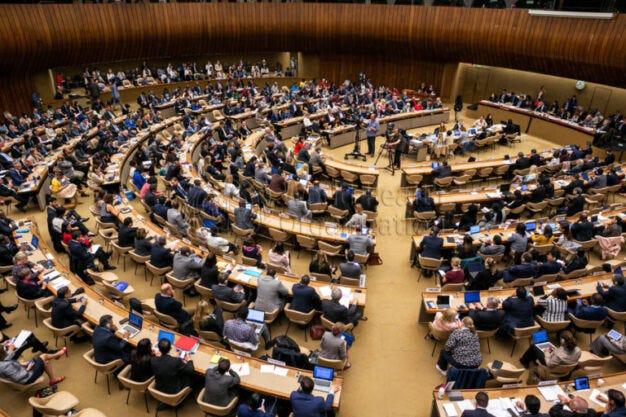
World Health Assembly, Geneva, Switzerland
The ambit of the overwhelmingly privately funded WHO, contained in its extensive constitution, can be interpreted as overly broad and sweeping, and thus, unknown to non-participants, has always posed a potential threat to individual health and national sovereignty.
The WHO’s constitution states in Chapter 2 – Functions – Article 2: In order to achieve its objective, the functions of the Organization shall be: (v) generally to take all necessary action to attain the objective of the Organization. However Article 21 of the WHO’s constitution is specific about making (non-binding) regulations, limiting the WHO to just five areas.
Proposed amendments to the new pandemic treaty include a dangerous clause that would change the WHO’s role from a UN agency that shares recommendations, to a rogue agency whose elitist and secretive attempts at legislation are binding and mandatory on member states, violating fundamental human rights and freedoms. However, health freedom advocates agree that WHO has no actual authority in the law.
In effect therefore, with both IHR amendments and the proposed new treaty, the WHO is acting ultra vires in its Big Pharma driven power grab, in collusion with naïve or compromised member state delegates. Ultra vires is defined in the law as: acting beyond the scope or in excess of legal power or authority. Ultra vires acts of impunity by the WHO could accelerate a mass defund and exit of the agency.
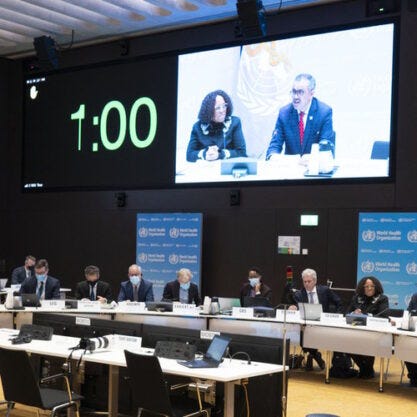
WHO’s negotiating body on a proposed pandemic treaty
Health is no longer just health, as it is defined in the WHO’s constitution. Through Covid-19, and other controversially declared pandemics, health is now a multi-billion dollar health security industry. With it, creeps in the tyranny of secrecy, surveillance, vaccine certificates, forced quarantines, and the undemocratic censorship of free speech. Given the absence of public participation, the WHO is a strategic spear for oligarchs and corporations, and given international resistance to its power grab, it may become desperate and argue or push for sanctions.
Reported in 2021: “In 2021, German Health Minister Jens Spahn called for sanctions against countries that hide information about future outbreaks. Citing the World Trade Organization’s power to sanction countries for non-compliance, Spahn said “there must be something that follows” if countries fail to live up to commitments under a new pandemic treaty that the World Health Assembly will take up in November.”
Further, it is entirely under reported that controversial “World Health Organization Director-General Tedros Adhanom Ghebreyesus also urged countries to consider the idea as they take up the treaty, a legally binding tool. The treaty should “have all the incentives, or the carrots” to encourage transparency, Tedros said, appearing at a press conference with Spahn in Berlin. “But maybe exploring the sanctions may be important,” he added.”
Also reported in 2021: “Speaking at the WHA in June, Mike Ryan, WHO Health Emergencies Programme Executive Director, also spoke out in favour of the treaty, despite the fact that WHO technical staff have historically avoided taking positions on controversial policy choices before member states. “My personal view is that we need a political treaty that makes the highest-level commitment to the principles of global health security — and then we can get on with building the blocks on this foundation.”
I engaged renowned international law expert Professor Francis Boyle about the possibility of sanctions via the WHO. He had no doubt “They will pursue sanctions against countries that do not comply with their orders, coming from Geneva. Both economic and political sanctions. However, they will only have the power to pursue sanctions if we accept their authority. We cannot. We must exit the WHO.”
With far less public scrutiny currently than the WHO, the United Nations is also seeking exponential new powers and stronger “global governance” mechanisms to deal with what they define as international emergencies. In March 2023, the UN released a policy brief , astonishingly titled “To Think and Act for Future Generations – Our Common Agenda. Strengthening the International Response to Complex Global Shocks – An Emergency Platform”
These all encompassing areas of expanded UN power include:
- climate or environmental events;
- environmental degradation;
- pandemics;
- accidental or deliberate release of biological agents;
- disruptions in the flow of goods, people, or finance;
- disruptions in cyberspace or “global digital connectivity;”
- a major event in “outer space;”
- and “unforeseen risks (‘black swan’ events)
There are several types of sanctions imposed through the United Nations:
- Economic sanctions – typically a ban on trade, possibly limited to certain sectors such as armaments, or with certain exceptions (such as food and medicine)
- Diplomatic sanctions – the reduction or removal of diplomatic ties, such as embassies.
- Military sanctions – military intervention
- Sport sanctions – preventing one country’s people and teams from competing in international events.
- Sanctions on the environment – since the declaration of the United Nations Conference on the Human Environment, international environmental protection efforts have been increased gradually.
- Economic sanctions are distinguished from trade sanctions, which are applied for purely economic reasons, and typically take the form of tariffs or similar measures.
It is plausible that the UN’s controllers realise that the world is pushing back against the WHO’s overreach, or find it irrelevant to real health. Given that sovereign nations will choose to exit the WHO, the UN decided to launch plan B and ascribe to itself even greater powers. Technically, there is no legislation to exit the United Nations within the UN Charter. Again, this is a critical issue of national sovereignty.
The United Nations Children’s Fund or UNICEF’s 2020 Annual Report highlights USD 717 million in donations from the private sector, which is 21 percent of income overall. Lucrative corporate partnerships include Unilever, Louis Vuitton, and Microsoft, while foundation partners include Bill and Melinda Gates Foundation and Mastercard Foundation. It also prides relationships with the World Economic Forum and the International Chamber of Commerce. National committees fundraise from individual donors and corporations at the national level, to support UNICEF globally. The UN’s programmes therefore are heavily dependant on private funding. Funding crowns influence.
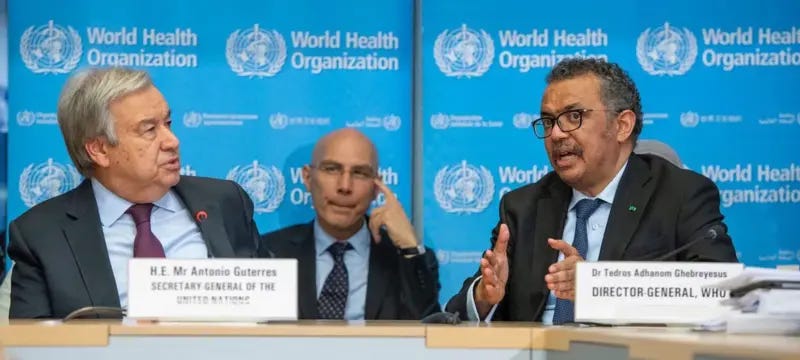
UN secretary general Antonio Guterres with WHO director general Adhanom Tedros Ghebreyesus
The WHO is an agency of the United Nations.
- In 2015, on punishing member states who violate the IHR, as reported: “United Nations health officials said they want to impose sanctions on countries that do not comply with public health regulations meant to avoid the spread of dangerous epidemics, such as the Ebola outbreak that killed more than 9,000 people and ravaged domestic health care systems in West Africa last year. World Health Organization Director Margaret Chan said she is investigating ways to reprimand countries that disobey the International Health Regulations (IHR) — a set of rules adopted in 2005 and mandate that countries set up epidemiological surveillance systems, fund local health care infrastructure and restrict international trade and travel to affected regions deemed unsafe to the public, among other provisions. Chan is on a panel set up by U.N. Secretary General Ban Ki-moon, who instructed the group to think of ways to hold countries accountable for how they manage public health crises and punish those who violate the IHR.”
- In 2022, according to commentators in a policy article: “In order to enforce compliance, some commentators have recommended concluding the treaty at the United Nations level. However, we fear that it has been already decided with the INB (mandated by WHASS) that a treaty will be developed under the roof of WHO. They added: “To move on with the treaty, WHO therefore needs to be empowered — financially, and politically. If international pandemic response is enhanced, compliance is enhanced. In case of a declared health emergency, resources need to flow to countries in which the emergency is occurring, triggering response elements such as financing and technical support. These are especially relevant for LMICs, and could be used to encourage and enhance the timely sharing of information by states, reassuring them that they will not be subject to arbitrary trade and travel sanctions for reporting, but instead be provided with the necessary financial and technical resources they require to effectively respond to the outbreak. High-income settings may not be motivated by financial resources in the same way as their low-income counterparts. An adaptable incentive regime is therefore needed, with sanctions such as public reprimands, economic sanctions, or denial of benefits.”
* Tweet CHD Africa if you agree that sanctions are possible and must be opposed internationally. Use the #StopSanctions
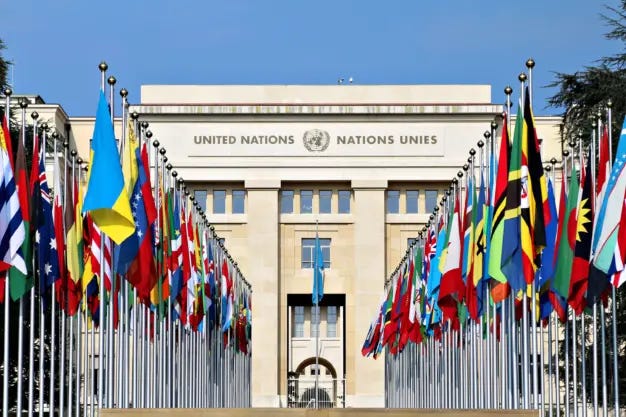
United Nations headquarters in Geneva, Switzerland
In 2000, Kofi Annan, former Secretary General of the UN said: “However, just as we recognize the importance of sanctions as a way of compelling compliance with the will of the international community, we also recognize that sanctions remain a blunt instrument, which hurt large numbers of people who are not their primary targets. Further, sanctions need refining if they are to be seen as more than a fig leaf in the future. Hence, the recent emphasis on targeted sanctions which prevent the travel, or freeze the foreign bank accounts, of individuals or classes of individuals – the so-called ‘smart sanctions’.”
Do sanctions work? “UN targeted sanctions, which are packages of sanctions imposed by the UN Security Council, have been successful in leading to intended policy change only 10% of the times, and limited the policies they intended to change in 28% of cases, but led to a reduced life expectancy in the targeted countries by 1.2–1.4 years. Economic sanctions have also been criticised for the potential collateral damage to third states they can cause. For this reason, some authors suggest that economic sanctions should be banned, as they are having detrimental effects on health and nutrition of civilians.”
Countries themselves can and do impose dangerous sanctions. A 2022 UN security council meeting on sanctions recorded: “Unilateral sanctions, which are sanctions imposed by (groups of) states and not by the UN Security Council, are particularly controversial. Unilateral sanctions have also been criticised for being disproportionately imposed on low-income and middle-income countries by wealthier countries, for example, by the Kenyan representative in a Security Council debate on sanctions on 7 February 2022: ‘The frequency and reach of unilateral sanctions have led to a growing view that they are the weapons of the strong against the vulnerable or weak’.”
- The Universal Declaration of Human Rights, in its first article, states that ‘all human beings are |…| equal in dignity and rights’, which includes the right to health. Article 25 specifies that ‘everyone has the right to |…| health and well-being |…| including medical care’.
- In the UN Convention on the Rights of the Child, article 24 states that ‘state parties recognize the right of the child to |…| the highest attainable standard of health and to facilities for the treatment of illness and rehabilitation of health. State parties shall strive to ensure that no child is deprived of his or her right of access to such health care services’.
- General Comment No.14 of the UN Committee on Economic, Social and Cultural Rights (CESCR) on the right to the highest attainable standard of health, the right to health is a fundamental human right which is necessary for all other human rights to exist and be exercised.
- “The use of sanctions designed to hurt a country’s healthcare sector is clearly incompatible with respecting citizens’ right to health. Accordingly, the general comment No. 14 of the CESCR calls on states to refrain ‘at all times’ from sanctions on medicines and medical equipment. However, sanctions on other healthcare products and, in fact, other non-healthcare products may as well interfere with the right to health, and, thus, need to be subject to scrutiny.”
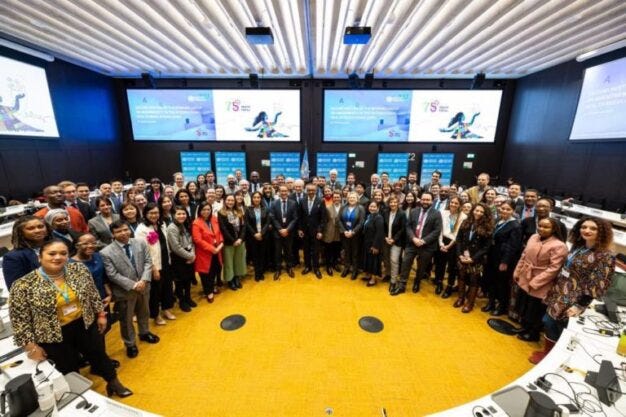
WHO’s World Health Assembly 75
South African Precious Matsoso, co-chair of the International Negotiating Body (INB), formed to negotiate the terms of the proposed pandemic treaty or accord, admitted openly that punitive measures have not been shown to work “anywhere” in the world. However, she said, there must be accountability measures while recognizing countries’ sovereignty. “We have to recognize that they’re sovereign, and they keep on reminding us that they are sovereign states.” It is positive to note that more states do recognise the real threat to sovereignty.
Not all states are considered equal. Smaller countries are at a distinct disadvantage in participating, negotiating and making decisions at the hierarchical WHO. Significantly, Matsoso was transparent about failures in equal participation. “A number of smaller delegations have always expressed concerns about organizations of multiple meetings, where they have to travel from afar, and not even having the capacity to participate in the negotiations,” Matsoso said. “And they have repeatedly requested that you must avoid parallel sessions.” To little avail.
Given the rapidly growing distrust in the WHO, its historical failures and harms, Covid-19 failures and harms, and the fact that it cannot maintain independence because it is a largely privately funded entity; it is plausible that the WHO and/or the UN will move to impose or influence sanctions via the World Trade Organisation, ahead of Agenda 2030. This act of aggression weaponises the WHO and/or the UN against countries that influential funders and unethical stakeholders have an interest in destabilising for power and resource control.
This sinister strategy has disturbing implications for democracy, peace, and prosperity around the world. Freedom faces an existential risk through unelected bureaucratic entities. Nations can and must protect their sovereignty by defunding and exiting WHO, and, by critically assessing the true nature, value, and risks of continued membership in the 78 year old United Nations. Not to do so, means ignoring the risks of UN peacekeepers, who are known to commit crimes with impunity, being deployed in your country to enforce UN and WHO dictates.
Shabnam Palesa Mohamed is executive director and chapter coordinator for Children’s Health Defense Africa. She is an activist, journalist, lawyer, and mediator, with over 20 years of experience in human rights work. To share information, Twitter: @ShabnamPalesaMo
Follow CHD Africa on 6 social platforms for news, action alerts, and updates:
– Telegram: t.me/CHDafrica
– Twitter: https://twitter.com/CHD_Africa
– Instagram: https://www.instagram.com/af.childrenshealthdefense/
– Facebook: https://www.facebook.com/CHDafricachapter
– Rumble: https://rumble.com/user/ChildrensHealthDefenseAfrica
– Tiktok: https://www.tiktok.com/@chdafrica?is_from_webapp=1…
After five months of strained ties, US admits Chinese balloon did not collect information
Global Times | June 30, 2023
After repeated hyping of the so-called Chinese spy balloon incident for nearly five months, the Pentagon on Thursday admitted the airship did not collect any information, not to mention send any data back to China. This is an objective result that should be welcomed, but it came too late, as the incident has damaged mutual trust, totally changed the environment for communication between China and the US, and caused the two sides to miss a better time to restore relations, Chinese experts said.
Analysis of debris collected from a Chinese balloon drifting into the sky over the US and shot down by the latter in February showed that “it did not collect [any information] while it was transiting the US or over flying the US” despite that it “had intelligence collection capabilities,” Pentagon spokesperson Brigadier General Pat Ryder told media on Thursday.
A Chinese balloon spent a week in February flying over the US and Canada before it was shot down by a fighter jet off the Atlantic coast, on orders from President Joe Biden. Although Chinese authorities reiterated that the balloon was a civilian weather balloon, some US media and hawkish politicians continued to hype it as a spy balloon, underscoring the increasing tensions between the world’s two largest economies.
In response, Chinese Foreign Ministry spokesperson Mao Ning said at a press conference on Friday that China has reiterated on many occasions that the Chinese civilian airship drifting into the sky over the US was an unintended, unexpected and isolated event caused by force majeure. Calling the airship a “spy balloon” and claiming it is used to collect intelligence is total slandering and smearing, Mao stressed.
Citing some anonymous officials, a Wall Street Journal report on Thursday claimed that the balloon was found to be carrying some American-made equipment helping it to collect photos, videos and other information. Ryder did not confirm the report on Thursday when he announced the result of the Pentagon’s analysis.
The Pentagon’s brief announcement on Thursday showed that the US, or at least the US’ defense department, is trying to close the chapter on the incident as it must have realized that the facts are slapping them in the face, Lü Xiang, a research fellow at the Chinese Academy of Social Sciences, told the Global Times on Friday.
“We should welcome the move, but I have to say that it is far from enough. The US hyping damaged the basic mutual trust between China and the US and set a bad precedent in dealing with a foreign country’s civilian facility by using the military to shoot down the balloon. They should express regret for the decision,” Lü said.
The balloon incident fundamentally changed the atmosphere between the two countries. Blinken postponed a reported visit to Beijing. This led to a delay in the progress of China-US interactions of about five months for no good reason, which is very unfavorable given the already high tension between the two countries, Lü noted.
Secretary of State Antony Blinken was said to have been planning a diplomatic trip to China before the balloon incident, but reportedly postponed the plan soon after it occurred. The trip was rescheduled and Blinken visited Beijing in June.
However, the US Department of Defense’s Defense Security Cooperation Agency on Thursday approved new arms sales to Taiwan worth $440 million. The arms package is to include 30mm ammunition, spare parts for wheeled vehicles and other items, according to media reports. This is the 10th arms-sales package to Taiwan made under US President Joe Biden.
China urges the US to abide by the one-China principle and the provisions of the three China-US joint communiqués, stop selling weapons to Taiwan island, stop creating factors that lead to tensions in the Taiwan Straits and stop damaging the peace and stability in the region, Mao Ning said in response to the deal at the Friday press conference.
The US is building Taiwan island into a powder keg and ammunition depot. This is not “protecting” or “defending” the island but damaging and ruining it, the Taiwan Affairs Office of China’s State Council said Friday, slamming the deal.
Earlier this week, a US bipartisan congressional delegation led by House Armed Services Committee Chairman Mike Rogers landed in Taiwan for a three-day visit.
We must face the fact that US diplomacy will continue to show a character of being two-faced, as it views China as a main strategic opponent and will not change its strategy of containing China before it regains an absolute advantage over China, Lü said.
The Chinese central government must have become aware of this and is making adjustments in its strategy in the Taiwan Straits and the South China Sea to maintain China’s practical control of the regions amid the US’ provocation, Lü pointed out, citing China’s firm actions in the Taiwan Straits since last year including large-scale military drills and the flying of fighter jets across the so-called median line of the Taiwan Straits, which the Chinese mainland had declared a non-existent concept.
Some experts expect more windows of opportunity in China-US relations to open after US Treasury Secretary Janet Yellen was reported to be planning a trip to China in early July, but they also warned that the window will not be open for long, so Washington needs to make sincere moves rather than create new trouble.
When asked is there still a window of opportunity to repair China-US ties before US elections, former Chinese Ambassador to the US Cui Tiankai told the Global Times on Thursday that it’s never too late if there is political will. “China has shown its political commitment to improving relations.”
Featured Video

Max Blumenthal: ‘Israel First’ in Iran War Sparks MAGA Civil War
or go to
Aletho News Archives – Video-Images
From the Archives
Wartime internment camps in Australia
National Archives of Australia
World War I
During World War I, for security reasons the Australian Government pursued a comprehensive internment policy against enemy aliens living in Australia.
Initially only those born in countries at war with Australia were classed as enemy aliens, but later this was expanded to include people of enemy nations who were naturalised British subjects, Australian-born descendants of migrants born in enemy nations and others who were thought to pose a threat to Australia’s security.
Australia interned almost 7,000 people during World War I, of whom about 4,500 were enemy aliens and British nationals of German ancestry already resident in Australia.
Records of World War I internment camps
World War II
During World War II, Australian authorities established internment camps for three reasons – to prevent residents from assisting Australia’s enemies, to appease public opinion and to house overseas internees sent to Australia for the duration of the war.
Unlike World War I, the initial aim of internment during the later conflict was to identify and intern those who posed a particular threat to the safety or defence of the country. As the war progressed, however, this policy changed and Japanese residents were interned en masse. In the later years of the war, Germans and Italians were also interned on the basis of nationality, particularly those living in the north of Australia. In all, just over 20 per cent of all Italians resident in Australia were interned. … continue
Blog Roll
 Aletho News
- Diplomats slam US negotiators’ performance in Iran talks
- Trump Refuses Exit Ramp, War with Iran will Continue
- Trump Says US Naval Blockade in Strait of Hormuz Will Begin Shortly
- US, Iran end 21-hour talks without agreement
- US IRAN TALKS: Who Are the Crazy Ones Here? /Lt Col Daniel Davis
- Talks with the US end without a deal over excessive US demands: Iran
- Feeling Better, Getting Worse: How Psychiatric Drugs Create the Illusion They Cure
- ‘Nobody Told Me’: Former Mental Health Patient Calls Out Dangerous Side Effects of Psychiatric Drugs
- Dr. Abu-Sitta: Beirut ‘felt like a day in Shifa Hospital’
- Iran Has Won the War, It Will Be Up to the US to Secure the Peace: Mohammad Marandi
- If Americans Knew
- US-Iran ceasefire negotiations make zero progress – Daily Update
- Pro-Israel ‘Thinktanks’ and Individuals who Influence U.S. Foreign Policy
- Mearsheimer reveals how Israel dictates US policies on Iran, Gaza – video
- After killing 350+, Israel still has a “score to settle” with Lebanon before ceasefire – Daily Update
- Military aid to Israel emerges as the latest political litmus test for Democrats
- The only Palestinian children’s rights organization closes following years-long Israeli campaign against it
- ‘I Can’t Forget the Smell’: Lebanese Reel After Israel Kills Over 300 in Single Day
- DNC Shoots Down Resolutions Calling Out AIPAC and Limiting Arms to Israel
- TCN: Is Israel Blackmailing President Trump?
- Israel killed at least 303 Lebanese yesterday – who were they? Daily Update
- No Tricks Zone
- German Expert: Heat Dome Led To Record Temps In Western USA…Warmer In 1934, 1936
- New Study: No Linear Warming Or Glacier Retreat Along Northern Antarctic Peninsula Since 1980s
- An Inconvenient Tree: Uncovered In Alps… Europe Much Warmer Than Today 6000 Years Ago
- New Study Reports A 60% Slowdown In Greenland’s Ice Loss Rate In The Last Decade
- Low Intensity Tornado Wrecks Major Solar Farm, Creating A Potential Toxic Dump
- New Study Finds Warming Saves Lives…Cold Temperatures 12 Times More Deadly Than Excess Heat
- German Science Blog Accuses PIK Climate Institute Of Hallucinating Climate Tipping Points
- Devastating Assessment Of Comirnaty Vaccine By Former Senior Pfizer Europe Toxicologist
- New Study: CO2 Is ‘Effectively Negligible’ As An Explanatory Climate Change Factor Since 2000
- Former Pfizer Toxicologist Dr. Helmut Sterz Tells Bundestag Hearing Pfizer Vaccine Should Have Never Been Approved
 Aletho News