NATO ‘s Great New Idea: ‘Let’s Start A War With China!’
By Ron Paul | May 8, 2023
NATO’s post-Cold War history is that of an organization far past its “sell-by” date. Desperate for a mission after the end of the Warsaw Pact, NATO in the late 1990s decided that it would become the muscle behind the militarization of “human rights” under the Clinton Administration.
Gone was the “threat of global communism” which was used to justify NATO’s 40-year run, so NATO re-imagined itself as a band of armed Atlanticist superheroes. Wherever there was an “injustice” (as defined by Washington’s neocons), NATO was ready with guns and bombs.
The US military-industrial complex could not have been happier. All the Beltway think tanks they lavishly fund finally hit on a sure winner to keep the money pipeline flowing. It was always about money, not security.
The test run for NATO as human rights superheroes was Yugoslavia in 1999. To everybody but NATO and its neocon handlers in DC and many European capitals, it was a horrific, unjustified disaster. Seventy-eight days of bombing a country that did not threaten NATO left many hundreds of civilians dead, the infrastructure destroyed, and a legacy of uranium-tipped ammunition to poison the landscape for generations to come.
Just last week tennis legend Novak Djokovic recalled what it felt like to flee his grandfather’s home in the middle of the night as NATO bombs fell and destroyed it. What a horror!
Then NATO got behind the overthrow of the Gaddafi government in Libya. The corporate press regurgitated the neocon lies that bombing the country, killing its people, and overthrowing its government would solve all of Libya’s human rights problems. As could be predicted, NATO bombs did not solve Libya’s problems but made everything worse. Chaos, civil war, terrorism, slave markets, crushing poverty – no wonder Hillary Clinton, Obama, and the neocons don’t want to talk about Libya these days.
After a series of failures longer than we have space for here, DC-controlled NATO in 2014 decided to go all-in and target Russia itself for “regime change.” First step was overthrowing the democratically elected Ukrainian government, which Victoria Nuland and the rest of the neocons took care of. Next was the eight years of massive NATO military assistance to Ukraine’s coup government with the intent of fighting Russia. Finally, it was the 2022 rejection of Russia’s request to negotiate a European security agreement that would prevent NATO armies circling its border.
Despite the mainstream media and US government propaganda, NATO has been about as successful in Ukraine as it was in Libya. Hundreds of billions of dollars have been flushed away, with massive corruption documented by journalists like Seymour Hersh and others.
The only difference this time is that NATO’s target – Russia – has nuclear weapons and views this proxy war as vital to its very existence.
So now despite its legacy of failure, NATO has decided to start a conflict with China, perhaps to take attention off its disaster in Ukraine. Last week NATO announced that it will open its first-ever Asia office in Japan. What next, NATO membership for Taiwan? Will Taiwan willingly serve as NATO’s newest “Ukraine” – sacrificing itself to China in the name of blundering NATO’s seemingly endless appetite for conflict?
We can only hope that America will elect a president in 2024 who will finally end NATO’s deadly world tour.
Copyright © 2023 by RonPaul Institute.
China won’t forget NATO’s ‘barbaric’ actions in Yugoslavia
RT | May 8, 2023
Beijing has neither forgotten nor forgiven the May 1999 bombing of its embassy in Belgrade, Chinese Foreign Ministry spokesman Wang Wenbin told reporters on Monday. Wang condemned the US-led bloc for creating conflict while posing as a defensive alliance, urging it to “seriously reflect” on its crimes.
Wang noted that May 7 was the anniversary of the embassy attack, in which three Chinese journalists were killed and 20 diplomatic staff members were injured. “The Chinese people will never forget what they sacrificed to uphold the truth, fairness and justice. Nor will we ever forget this barbaric atrocity committed by US-led NATO,” he told reporters.
While claiming to be a regional defense bloc, NATO has “repeatedly lit the fuse and brought conflicts to places all over the world,” Wang noted, “from Bosnia and Herzegovina to Kosovo, from Iraq to Afghanistan, and from Libya to Syria.”
Having participated in wars that have killed hundreds of thousands and displaced tens of millions, NATO is now “making forays eastward into the Asia-Pacific, instigating bloc confrontation and undermining peace and stability in the region,” the spokesman added. “The US-led NATO needs to seriously reflect on the crimes they’ve committed, abandon the outdated Cold War mentality, stop inciting tensions in the region, and stop sowing division and instability.”
The embassy strike happened six weeks into the NATO air war against Yugoslavia, waged on behalf of ethnic Albanian separatists in Kosovo. Five bombs struck the compound, killing Shao Yunhuan, Xu Xinghu and his wife Zhu Ying. Beijing condemned the bombing as a “barbaric act.”
The US claimed it had struck the embassy by accident, using an “old map” of the Serbian capital. The real target, Washington said, had been the Yugoslav government agency for military procurement, which was almost 500 meters (1,640 feet) away. The strike was carried out by a B-2 stealth bomber, using JDAM bombs that are accurate to within 14 meters (46 feet) of the target. It was the first and only mission during the 78-day campaign that had been planned by the CIA, the agency’s director George Tenet later testified before the US Congress. One CIA agent was reportedly fired and six were reprimanded over the incident.
US President Bill Clinton offered a public apology. Washington later paid a compensation of $28 million to the Chinese government and $4.5 million to the families of the victims.
The NATO-backed war crimes tribunal for the former Yugoslavia cited this, as well as the CIA disciplinary measures, among the reasons for not opening an investigation into the bombing, much less pressing charges.
EU plans to punish China for trade with Russia – FT
RT | May 8, 2023
The European Union is seeking to tighten its economic screws on Russia by sanctioning Chinese companies that conduct trade with Moscow, the Financial Times reported on Sunday.
Seven Chinese businesses have been named in a new package of restrictions that the EU member states will discuss this week, the report says, citing a copy of the sanctions list seen by the paper.
According to the FT, the list includes two mainland Chinese companies, 3HC Semiconductors and King-Pai Technology, and five from Hong Kong, including Sinno Electronics, Sigma Technology, Asia Pacific Links, Tordan Industry, and Alpha Trading Investments.
To take effect, the new sanctions need to be unanimously approved by all 27 EU member states.
The businesses have reportedly been accused of selling equipment that could be used by Moscow in weapons manufacturing. Some of these companies have already been placed under sanctions by the US.
The European Commission believes it is “appropriate” to target certain entities “in third countries involved in the circumvention of trade restrictions” against Russia, the FT quoted the sanctions proposal as saying.
Until now, the FT noted, the EU has avoided targeting China, saying there was no evidence that Beijing was directly providing weapons to Moscow.
The EU has so far imposed 10 rounds of economic sanctions against Russia over its military operation in Ukraine.
The EU’s chief diplomat, Josep Borrell, admitted last month that the bloc had nearly exhausted its options for punitive measures against Moscow.
Since then, it has been reported that EU lawmakers are considering targeting third countries that re-export goods to Russia, thus helping Moscow to circumvent trade restrictions.
China is insisting on a diplomatic solution to the Ukraine conflict, and proposed a 12-point peace plan in February, calling for the security concerns of each side to be addressed. Josep Borrell dismissed Beijing’s proposals last week as “wishful thinking” and insisted that any peace plan must be based on Kiev’s demands.
Syria’s return to Arab League is a big deal
BY M. K. BHADRAKUMAR | INDIAN PUNCHLINE | MAY 8, 2023
When a mere subplot overnight assumes habitation and a name, it becomes more fascinating than the main plot itself. Syria’s return to the Arab League after its decade-long exclusion can be regarded as a sub-plot of the China-brokered rapprochement between Saudi Arabia and Iran. But then, China and Iran are not per se party to the process.
Syria’s return to the Arab League is seen as an Arab initiative, but it is quintessentially a project Riyadh steered through in close consultation and coordination with Damascus, ignoring some murmur by a clutch of Arab States and patently in defiance of Washington’s trenchant opposition.
Against the backdrop of the epochal struggle for a new world order characterised by multipolarity and resistance to Western hegemony, Russia and China quietly encouraged Riyadh to move in such a direction.
A riveting thing about the decision taken by the foreign ministers of the seven Arab League nations at the meeting in Cairo on Sunday is its sweet timing. For, this is the 80th anniversary of the establishment of the Ba’ath Party in Damascus in 1943, which espoused an ideology of Arab nationalist and anti-imperialist interests that have lately re-appeared in the geopolitics of West Asia.
Syria has a tradition of strategic autonomy. Through the past decade, it was preoccupied with fighting off the US-sponsored regime change project, with help from Russia and Iran. As it turns the corner and is stabilising, Syria’s strategic autonomy will be increasingly in evidence. This is one thing.
However, the strategic relations with Russia and Iran will continue to remain special and there should be no misconceptions on that score. But Syria is capable of ingenuity and diplomatic acumen to create space for itself to manoeuvre, as geopolitics takes a back seat and Assad prioritises stabilisation and reconstruction of the economy, which requires regional cooperation.
The recent visit by Iran’s president Ebrahim Raisi to Syria testifies to Tehran’s “soft diplomacy,” exuding pragmatism that on the one hand made it clear that despite the recent rapprochement between Damascus and Arab countries, Syrian-Iranian ties are still strong and even highlighted Syria’s role in the resistance to Israel — with Raisi holding a meeting in Damascus with senior Palestinian officials, including leaders of Hamas and Islamic Jihad — while on the other hand, the negotiations with the Syrian leadership was largely about economic cooperation.
Raisi said Iran is ready to take an active part in the post-war reconstruction of Syria. Iran faces competition from Gulf countries that have deep pockets. Meanwhile, the warming of relations between Syria and Turkey is also on the agenda, which is sure to lead to increased trade and spur investment flow.
To put matters in perspective, Iran’s exports to Syria currently amount to a paltry sum of $243 million. However, since the beginning of the conflict in Syria, Iran has been a key sponsor of the Syrian authorities. In January 2013, Tehran opened the first credit line of $1 billion for Damascus, which was under international sanctions, thanks to which the government was able to pay for imported food. This was followed by a loan of $3.6 billion for the purchase of petroleum products. The third loan of $1 billion was extended in 2015. Tehran also allocated funds to Damascus to pay salaries to civil servants, which helped preserve state institutions. In 2012, a free trade agreement began to operate between the countries. Iran is also spending billions to finance Shiite militias in Syria and supply them with weapons. Naturally, Tehran would like to recoup some of these investments.
Syria is assessing, rightly so, that normalisation with the Arab neighbours and Turkey will be a game changer. But, while everyone is talking about Syria’s “readmission to the Arab family” as a concession, Damascus reacted to the Arab League decision in a measured way.
The Syrian Foreign Ministry statement said on Sunday, “Syria has been following the positive trends and interactions that are currently taking place in the Arab region, and believes that these benefit all Arab countries and favour the stability, security and well-being of their peoples.
“Syria has received with interest the decision issued by the meeting of the Council of the League of Arab States.” The statement went on to stress the importance of dialogue and joint action to confront the challenges facing the Arab countries. It recalled that Syria is a founding member of the Arab League and always had a strong position in favour of strengthening joint Arab action.
Most important, the statement concluded by reaffirming that the next stage requires “an effective and constructive Arab approach on the bilateral and collective levels on the basis of dialogue, mutual respect, and the common interests of the Arab nation.”
From all appearance, the Arab League statement itself was a “consensus statement” drafted with great sensitivity by Saudi Arabia.
In an interview with Al-Mayadeen, Raisi said prior to his departure for Damascus that “Syria has always been on the axis of resistance… We unequivocally support all fronts of the axis of resistance, and my visit to Syria is within the framework of this support, and we are working to strengthen the resistance front, and we will not hesitate in this.” In fact, Raisi’s arrival in Syria coincided with increased Israeli attacks by Israel on Iranian military facilities, including on Aleppo airport.
Without doubt, Iran remains Syria’s main ally and Iranian influence in Damascus is still strong. Iran views Syria as its strategic territory through which Tehran can establish ties with Lebanon and confront Israel.
What works to Syria’s advantage here is that the Saudi-Iranian detente is based on a common view in Riyadh and Tehran that they have to coexist in one form or another, since their enmity and regional rivalry turned out to be a “lose-lose” proposition that didn’t improve their regional standing. Suffice to say, their national interest resulting from their rapprochement overrides past rivalries. Syria will be a testing ground where each other’s true intentions as well as conduct will come under close scrutiny.
The good part is that the Saudis have concluded that President Assad is firmly in the saddle, having weathered the most devastating war since World War 2, and mending relations with Damascus can be a “win-win” for Riyadh.
That said, Syria is a strategic hinge where Riyadh will need to balance its strategic ties with the US and its tacit ties with Israel. But then, Saudi Arabia’s new strategic calculus also includes China and Russia. When it comes to Syria, Russia is an anchor sheet for Assad, while China has been all along on the right side of history.
This geopolitical setting has driven Biden Administration into frenzy, NSA Jake Sullivan rushed to Saudi Arabia holding the hands of his Indian and Emirati counterparts for company! Wisdom lies in Washington using Saudis (and Emiratis and Indians) to open a line to Damascus. However, Assad will set the very same non-negotiable condition to Washington for normalisation that he insisted with Turkey — vacation of US occupation. Beyond that lies, of course, Israel’s annexation of Golan Heights.
Kuwait to join Shanghai regional bloc as ‘dialogue partner’
MEMO | May 6, 2023
Kuwait signed a memorandum of understanding on Saturday to join the Shanghai Cooperation Organization (SCO), a powerful regional bloc led by China and Russia, Anadolu reports.
The document was inked on the sidelines of a meeting of the SCO foreign ministers on May 4-5 in Panaji city, India, the state news agency KUNA reported.
“Kuwait’s joining of SCO as a dialogue partner is the first step towards joining the organization as a full member in the future,” said Kuwaiti Ambassador to India Jassim Al-Najem.
He added that the accession of some Gulf Cooperation Council (GCC) countries as dialogue partners to the SCO “confirms the growing importance of the organization.”
On March 29, Saudi Arabia agreed to join the SCO as a dialogue partner in preparation for full membership.
The SCO was founded in June 2001 by China, Russia, and the Central Asian states of Uzbekistan, Kazakhstan, Kyrgyzstan and Tajikistan.
The Eurasian political, economic, and security alliance is recognized as the world’s largest regional organization, with eight members, four observer states and several dialogue partners, including Turkiye.
Pakistan and India became full members in 2017.
Iran, an SCO observer state since June 2005, had its permanent membership approved in September 2021 and signed a memorandum of commitment a year later for its full accession.
What the China Literature Gets Wrong
By Joseph Solis-Mullen | The Libertarian Institute | May 1, 2023
For more than a decade it’s become expected for books peddling the “China threat” to pop up as best sellers. From Martin Jacques’ When China Rules the World (2009) to Michael Pillsbury’s The Hundred-Year Marathon (2015), the best response has been to just shrug and move on. Talk in serious policy circles and major media were still primarily focused on Beijing’s integration into the “liberal world order” as a “responsible stakeholder,” and of the gains in trade made (and still to be made) in exchange between the United States and China.
The transformation of China from global partner to enemy number one seemed to happen, in Hemingway’s words, gradually, then suddenly. Indeed, despite Donald Trump’s early bellicosity when it came to China, the corporate press didn’t immediately play along with the China threat narrative. Rather, they proclaimed the folly of his trade war and seemed to revel in reporting the losses it was inflicting on American farmers, whose exports to China had been interrupted as a result of retaliatory tariffs.
But in the background the slow, ominous drip of the China threat narrative continued with Graham Allison’s Destined For War (2017). Then, in quick succession, Stealth War: How China Took Over While America’s Elite Slept (2019) by Robert Spalding, Deceiving the Sky: Inside Communist China’s Drive for Global Supremacy (2019) by Bill Gertz, Unrestricted Warfare: China’s Master Plan to Destroy America (2020) by Qiao Liang, Has China Won? (2020) by Kishore Mahbubani, The Long Game: China’s Strategy to Displace American Order (2021) by Rush Doshi, The World According to China (2021) by Elizabeth Economy, War Without Rules: China’s Playbook for Global Domination (2022) by Robert Spalding, No Limits; the Inside Story of China’s War with the West (2022) by Andrew Small, and Red Carpet: Hollywood, China, and the Global Battle for Cultural Supremacy (2022) by Erich Schwartzel.
It was as though even before the COVID pandemic—which exacerbated already strained relations between the United States and China—the movement was underway to translate for the public the policies pursued through multiple U.S. administrations aimed at containing China. It suddenly became normal to pick up one of the so-called “papers of record,” corporate media giants like The Wall Street Journal, The New York Times, or Washinton Post and encounter a headline about China presented as ominous or threatening. Indeed, by the time Hal Brands and Michael Beckley’s Danger Zone: The Coming Conflict With China (2022) hit bookshelves last August, entire opinion pages of the major papers sounded like talking points from the 2017 U.S. National Security Strategy (NSS), the 2018 U.S. National Defense Strategy (NDS), or the 2018 special report from the U.S. Trade Representative (USTR) which all painted China as a direct threat to vital U.S. interests, and one that needed to be vigorously countered and contained militarily, geopolitically, economically, ideologically, and technologically.
While many of the books mentioned above are written in the breathless, alarmed manner of their earliest forerunner, the eponymous China Threat (2000) by Bill Gertz, there have been some notable exceptions which have sought and obtained some measure of balance even when they could not completely escape the China threat paradigm. Kevin Rudd’s The Avoidable War (2022) and James Fok’s Financial Cold War (2021) both do a reasonable job presenting the facts, perspectives of both Washington and Beijing on key issues, and have as their aim deescalating the growing crisis that is the present state and trajectory of U.S.-China relations.
Tellingly, outright dissenters, those that questioned any part of the ascendent China narrative, were few. Red Flags: Why Xi’s China Is In Jeopardy (2018) by George Magnus and Thomas Orlik’s China: The Bubble That Never Pops (2020) both deserve credit for seeing through to the true mess that is China’s economy. Though their critiques of the China threat narrative are incomplete, and scarcely touch on the demographic, environmental, and geostrategic mountains confronting Beijing, China’s economy is central to everything else (the one-party CCP dictatorship included) and an expansion of their critiques is all one needs to cast the prospect of a future “Chinese Century” into serious doubt.
And it is here that a point needs to be clearly parsed. There is a significant difference between China ruling the world in a manner like the United States has for the past three decades, and Beijing enjoying preponderance in its immediate environs and proportional heft for its relative weight where its interests are concerned around the globe. For while it is increasingly unlikely that China’s economy will ever surpass that of the United States—either in total or per capita output—or that it will ever have the military reach enjoyed by Washington, Beijing has grown powerful enough relatively that it can assert and more or less get what it wants in its immediate environs. Trivial, obvious, or realistic though that may seem to the objective observer, to Washington this fact constitutes the whole of the China threat. The existence of an independent China (or Russia, for that matter) is a threat to Washington’s accustomed ability to do more or less whatever it wants wherever it wants. However, the existence of an independent China is already a fact and continued refusal on the part of Washington to accept it will cause more than theoretical problems.
I did not imagine or intend, when I started graduate school several years ago, that any serious amount of my time would be spent reading Chinese history, learning Mandarin, or studying the specifics of the Maoist interpretation of the Marxist dialectic. As a political scientist, economist, and historian with an interest in the emergence of different political and economic structures in Europe from the fourteenth to the nineteenth century, my initial diversion into Sino-American relations, both past and present, came as something of an annoyance.
Writing at the Mises Institute, I’ve done my best to push back against this fake China threat narrative. It’s become clear, however, that a more comprehensive case needs to be made against the ludicrous idea that China is on the cusp of taking over the world. Alas, public fear has been continually stoked and the China threat narrative is worse than ever—hence, The (fake) China Threat (and its very real danger) has taken on book-length form and will be published by the Libertarian Institute in 2023. In the meantime, I will do my bi-weekly best to pour cold water on whatever the latest hawkish nonsense from DC towards China happens to be, as well as inform and contextualize for readers what is going on in China and the wider Indo-Pacific. While I cannot promise readers will always like what I have to say, with no conflicts of interest to declare they can at least be rest assured that I have no reason whatsoever to lie to them—which is (tragically) more than can be said for practically anyone anywhere else.
Joseph Solis-Mullen is a political scientist with degrees from Spring Arbor University and the University of Illinois, and is currently a graduate student in the economics department at the University of Missouri. An independent researcher and journalist, his work can be found at the Ludwig Von Mises Institute, Eurasian Review, Libertarian Institute, Journal of the American Revolution, Antiwar.com, and the Journal of Libertarian Studies. You can contact him through his website http://www.jsmwritings.com or find him on Twitter @solis_mullen
The US Is Rounding Up Allies Ahead Of A Possible War With China
BY ANDREW KORYBKO | MAY 1, 2023
The US is shaping the Asia-Pacific in preparation of a conventional conflict with China, to which end it unveiled the AUKUS alliance in late 2021. This platform is intended to form the core of a NATO-like military structure for containing the People’s Republic, and it’ll replace whatever related role American policymakers initially envisaged the Quad playing. This makes AUKUS extremely dangerous, especially as other regional countries tacitly expand their cooperation with its American leader.
South Korea’s recent decision to let US nuclear-armed submarines dock at its ports for the first time in decades, which was made during President Yoon’s trip to DC last week, signals its interest in de facto integrating into this anti-Chinese bloc. Nearby Japan can already be regarded as an informal member of that alliance after Prime Minister Kishida reaffirmed his country’s commitment to the US’ regional goals in January and implied that it’ll rapidly remilitarize in the coming future in order to contain China.
Taken together and paired with the recent Japanese-Korean rapprochement, it can therefore be concluded that the US has strengthened its alliance network in Northeast Asia in order to facilitate the region’s unofficial integration into AUKUS+. At the same time, it’s also doing something similar with the Philippines in Southeast Asia, whose president visits the US this week. He’s expected to also de facto integrate his country into AUKUS+ too exactly as his South Korean counterpart just did.
The Philippines’ northernmost core island of Luzon is much closer to Taiwan than the Japanese Home Islands are, thus making it an ideal staging post for any American military intervention in that Chinese province. Although President Marcos just denied that his country intends to facilitate anyone’s regional military plans, it was recently revealed that the four new bases that he agreed to let America use are located on that island, thus casting serious doubts on the sincerity of his claim.
Three other recent developments bode ill for peace in this part of Asia. CNN published a lengthy analysis in mid-April arguing that the US should maximally stockpile weapons in Taiwan in order to help its ally’s forces survive in the event that China blockades the island prior to launching a special operation there. Curiously, such resupply challenges were then confirmed a few days later during an anti-Chinese congressional committee’s wargame of precisely that scenario.
The second development concerned top EU diplomat Borrell’s suggestion that the bloc’s navies patrol the Taiwan Strait. This came just several weeks after NATO Secretary-General Stoltenberg declared that “We are now stepping up our cooperation with our partners in the Indo-Pacific: Japan, South Korea, New Zealand and Australia.” The indisputable trend is that the US’ European partners are poised to play a larger military role in the region, including a provocative one if they end up patrolling the Taiwan Strait.
And lastly, it was reported last weekend that US special forces carried out their first-ever drills simulating what they’d do if their country went to war with China over Taiwan, thus removing any so-called “strategic ambiguity” about how Washington would respond to that scenario. It can no longer claim any pretense to neutrality after literally preparing its most highly trained forces for infiltrating into Taiwan to kill whatever Chinese forces might eventually enter that island.
These three developments prove that the US is rounding up allies in both the Asia-Pacific and Europe ahead of a possible war with China, but there are two important players that either won’t participate in this plot or have yet to decide, with these being India and Indonesia respectively. The influential Council on Foreign Relations’ official magazine just published a piece about why India won’t get involved, while Indonesia is being pressured to allow American and Australian forces to transit through its territory.
Even without those two, the US’ emerging anti-Chinese containment coalition is still very formidable and represents its success in getting a multitude of countries to converge around AUKUS. South Korea will serve as an intelligence and missile outpost, Japan’s Ryukyu Islands and the Philippines’ Luzon are complementary staging points for facilitating a US intervention in Taiwan, and NATO will provide back-end support all across the region as well as possibly provoke China by patrolling the Taiwan Strait.
Amidst the solidification of the Asia-Pacific’s NATO-like military structure, the US and its allies will likely fill Taiwan to the brim with weapons exactly as CNN suggested and an anti-Chinese congressional committee curiously confirmed should be a top priority just a couple days later. These interconnected trends represent extremely pressing challenges for China’s objective national security interests, which are being threatened ever more by the day as it holds off on launching a special operation in Taiwan.
There are justifiable reasons for China’s stance, especially since its leadership would truly prefer to peacefully reunify with their country’s wayward region and thus want to completely exhaust all related possibilities before resorting to military means. This moral approach is predicated on their reluctance to be the first to initiate what would be a fratricidal conflict, which is commendable, but it comes at the expense of military interests in the event that a war over that island is inevitable.
No one knows whether it is or not, but the US is doing its utmost to be in the best position possible should that scenario unfold, which thus complicates China’s own position in that event. If the US feels that it’s obtained a decisive edge over China through the crystallization of AUKUS+ and upon maximally stockpiling weapons in Taiwan, then it might even seek to provoke a conflict that wargamers convinced themselves Beijing would lose, which is a frightening scenario that can’t be ruled out.
The U.S. Proxy War Against Russia & China Is Increasingly Seen Globally As A Disaster Made By American And NATO Lies
Strategic Culture Foundation | April 28, 2023
It has become patently obvious to the world that the conflict in Ukraine is a dirty and desperate geopolitical confrontation, despite massive Western media efforts to portray it as something else more noble – the usual charade of chivalry and virtue to disguise naked Western imperialism.
The death and destruction in Ukraine is nothing but a proxy war by the United States and its NATO partners to defeat Russia in a strategic gambit. But the unspoken objective does not end with Russia. The U.S. and its Western imperialist lackeys are driven to push for confrontation with China too.
As if taking on Russia is not reckless enough! The Western powers want to double down on their warmongering with China. This is all because the underlying impetus is for Washington and its Western minions to promote U.S.-led dominance of the global order. Russia and China are the main obstacles to that path of would-be dominance, and hence we see this manic drive for aggression stemming from Washington, the executive power of the Western order.
It should be obvious that while the U.S.-led NATO axis has stoked the war in Ukraine to calamitous heights, this same axis is wantonly inciting tensions with China. This observation alone should be enough to condemn the criminality of Western powers.
This week saw the NATO powers deliver depleted uranium weapons to the Kiev regime, while the United States announced that it would be docking submarine nuclear warheads in South Korea, a move that infuriated China which pointed out that Washington was violating decades-old commitments to denuclearize the Korean Peninsula. Of course, such perverse provocation is par for the course as far as Washington is concerned. It is done deliberately in a conscious effort to exacerbate tensions and escalate militarism. Peace and security are anathemas to the U.S. (and its minions) whose whole ideological raison d’être is to aggravate war to gratify corporate capitalist addiction – a system that is increasingly bankrupt and dysfunctional, and hence the insane desperation for craving “war-fixes”.
In a scathing speech to the United Nations Security Council this week, Russian Foreign Minister Sergei Lavrov asserted that the conflict in Ukraine cannot be properly resolved without an understanding of the geopolitical context. In other words, the war in the former Soviet republic which erupted last February has bigger causes than what the Western powers and their compliant news media would try to pretend otherwise.
Defense of Ukraine? Defense of democracy? Defense of international law? Defense of national sovereignty? These are some of the laughable claims made by Washington and its allies. One only has to consider the decades of total trashing of the UN Charter and democratic principles by the United States and its rogue partners in their pursuit of criminal wars to realize that their virtue-signaling over Ukraine is a vile joke.
Lavrov’s address to the Security Council was a stunning rebuke of the hypocrisy and criminality of the United States, Britain, France, Germany and other NATO powers, as well as the European Union. His speech was akin to the scene in the classic old movie The Wizard of Oz when the curtain was pulled back on the buffoonish villain for all to see. Any objective observer would agree with the Russian foreign minister’s excoriating survey of modern history and why the war in Ukraine has tragically manifested. Lamentably, if we fail to understand history and the real causes of conflicts, then we are condemned to repeat the horrors.
Ironically, Western leaders have at times revealed the bigger geopolitical agenda with their own misspoken arrogant words. U.S. President Joe Biden had previously blurted out a call for regime change in Moscow while his senior aides, Secretary of State Antony Blinken and Pentagon chief Lloyd Austin, have succumbed to the intoxication of their narcissism and hubris by saying that the purpose of the war in Ukraine is the “defeat of Russia”.
Other NATO senior figures, such as the stupid, conceited Polish leaders and their Baltic buddies, have also come out and stated that the war’s ulterior agenda is to vanquish Russia. The fascist skeletons of their Nazi-collusion past have resurrected their deathly rattles, uncontrollably.
As Lavrov’s address to the Security Council intimates, the systematic violation of the UN Charter by the United States and its Western partners is a deplorable continuation of the Nazi fascism and imperialist barbarism that was supposed to have been defeated in World War Two. The culmination of the constant, unbridled Western imperialist criminality and its state terrorism is the current war in Ukraine and the growing aggression toward China over Taiwan as a pretext.
In all of this, woefully, the Western public has been flagrantly lied to by their governments and media as to the real nature of the war in Ukraine. American and European citizens have been bilked for hundreds of billions of dollars to prop up a Nazi regime in Kiev whose function is to act as a NATO spear-tip against Russia, and ultimately China when the NATO powers feel they are done with Ukraine. (The latter is a futile ambition, as is becoming increasingly evident.)
Journalists and antiwar activists in the West who highlight the malfeasance over Ukraine are either sacked, vilified, censored, or sanctioned into poverty, or even imprisoned.
Nevertheless, the Western public and the rest of the world are increasingly becoming aware of the odious charade. By definition, charades are inevitably untenable.
The Global South – the majority of the 193 nations at the UN – has had it with Western capitalist hegemony and its outrageous neocolonialist privileges. The incremental dumping of the U.S. dollar as an international reserve currency for trade is a testament to the historic shift towards a multipolar order in defiance of Western unipolar elitism. The nations of Africa, Latin America and Asia understand that the U.S.-led NATO war in Ukraine is a desperate last-ditch bid to preserve an imperialist global order which should have been eradicated after World War Two with the establishment of the United Nations, but which, regrettably, was not. Because the root cause of imperialism is the AngloAmerican-led Western capitalist order. The end of World War Two, as with World War One, was but a pause in the historical killing machine.
It is now increasingly evident in the light of leaked documents from the Pentagon that the war in Ukraine is a disaster. The Kiev regime is facing defeat at the hands of superior Russian forces even though that regime has been flooded with weapons by the United States and NATO. Great expectations of a Ukrainian victory that were widely predicted by Western leaders and media have been shown to be empty, contemptible lies.
The side-show of this war is a gargantuan racket. Western arms companies have raked in unprecedented profits, while the NATO-backed cabal in Kiev has skimmed off hundreds of millions of dollars. This is the same Kiev regime that is burning down Orthodox Christian churches, exterminating the Russian language, lionizing World War Two Nazi criminals, and locking up any critical opposition and media.
But the main takeaway is the lies that the United States and Western lackeys, including the entire media industry, have been telling about the proxy war in Ukraine. This war is an imperialist adventure that has been financially ruinous, has destroyed Ukraine, and is driving a dangerous all-out war with Russia and China that could turn into a nuclear armageddon.
We should not be surprised by such blatant lying and deception. President Joe Biden and his administration have been telling barefaced lies to conceal the corruption oozing out of Biden’s own family. Biden and his son Hunter have exploited Ukraine since the CIA-backed coup in Kiev in 2014 for personal enrichment. The president has even reportedly got his senior aides to do his bidding to censor intelligence agencies and media from revealing to the public the corruption at the heart of his family. (Risibly, the truth is smeared as Russian or Chinese disinformation!)
The lies that Biden and his administration tell about personal corruption are indelibly coupled with the lies told about the proxy war in Ukraine.
It is increasingly clear that the American public, the European public, and the rest of the world have been duped in multiple ways. The phony war in Ukraine is exposing the deep, stinking well of corruption in this White House. There will be hell to pay.
Meeting of the Defense Ministers of the Shanghai Cooperation Organization in Delhi
By Gilbert Doctorow | April 28, 2023
One quite important event today in global politics is unlikely to receive coverage in The New York Times, The Financial Times, the BBC or Euronews. I have in mind the meeting in Delhi of the defense ministers of the Shanghai Cooperation Organization.
The SCO is one of the two principal bodies that bring together the nations that are today challengers to the US-dominated world order. The other such body is BRICS.
Whereas BRICS is primarily an economic fraternity with focus on commercial relations among its members, meaning a platform of Soft Power, the SCO is primarily a Hard Power fraternity focusing on the security of its member states. It is also more limited geographically, concentrated on Eurasia. Its founding members were China, Russia, Kazakhstan, Kyrgyzstan and Tajikistan. Today it also includes Uzbekistan, India and Pakistan. Among the states accorded “observer” status are Afghanistan, Mongolia and Iran. And at its edges as “dialogue partners” are Armenia, Azerbaijan, Cambodia, Egypt, Nepal, Qatar, Saudi Arabia, Sri Lanka and Turkey.
There were a couple of outstanding and newsworthy developments at the SCO gathering in India today. One was the speech delivered by Russian Defense Minister Sergei Shoigu. Several minutes from this speech were carried on Russian news channels and what we heard was Shoigu declaring that from the start of the Special Military Operation in Ukraine the Collective West was throwing all of its military assets against Russia.
The other noteworthy development was the side meeting of Shoigu and his Chinese counterpart Li Shangfu. They were shown on television walking side by side to that meeting. Russian news tells us that Li used their meeting to extend an invitation to Shoigu to visit him in Beijing, and that Shoigu accepted.
The impact on the other SCO member states, observers and dialogue partners of these close and fast developing relations between the Russian and Chinese defense ministries cannot be overstated. Today they were all direct witnesses of this fact. Among other things, this spells the end of opportunities for Central Asian states to play Russia off against China in obtaining favors, as Western media believed they were doing. It completely vitiates all efforts by U.S. Secretary of State Blinken over the past several months to pressure these same Central Asian countries into loosening or breaking ties with Moscow. These states are now all caught between a rock and a hard place.
The drama of the Russian-Chinese entente also will bear on the future conduct of India and Pakistan. Here, too, the options for playing games or fence sitting are fast disappearing. For their part, Iran and Saudi Arabia will surely be among the countries taking great comfort in the bloc forming between the states they rely on to pursue a foreign policy independent of diktat from Washington.
©Gilbert Doctorow, 2023
Ukraine will have to accept Chinese mediation when spring offensive fails
By Ahmed Adel | April 28, 2023
In a phone call with Volodymyr Zelensky on April 26, Chinese President Xi Jinping identified negotiations as the only way to resolve the conflict in Ukraine, something that the Ukrainian president has been resistant to.
“Dialogue and negotiation is the only possible method,” Chinese media quoted Xi as saying in his first known conversation with Zelensky since the Russian special military operation began. The Chinese president also stressed that Beijing “will persistently seek peace and synergistically promote negotiations.”
For his part, Zelensky, who for many months has expressed interest in speaking with Xi, said he had “a long and meaningful phone call” with the Chinese president that lasted for an hour. “We discussed a full range of topical issues of bilateral relations. Particular attention was paid to the ways of possible cooperation to establish a just and sustainable peace for Ukraine.”
“There can be no peace at the expense of territorial compromises,” he added, suggesting that perhaps Xi is wasting his time.
None-the-less, after the conversation with Xi, the Ukrainian president signed a decree which appointed former Minister of Strategic Industry Pavel Ryabikin as Ambassador of Ukraine to the People’s Republic of China. This insinuates that the comments from the Chinese leader did not spoil relations between the two countries.
The long absence of a Ukrainian ambassador to China does demonstrate the traditional attitude that Kiev had towards the Asian giant. Now, despite relations improving, Kiev is giving provocative ultimatums on conditions for peace talks when Beijing is searching for peace.
It is recalled that Xi made a state visit to Russia in March and met President Vladimir Putin. During the visit, Xi and Putin affirmed their alignment across many issues, such as dealing with American provocations.
In addition, the Xi-Zelensky call comes only days after the Chinese Ambassador in Paris sparked controversy by suggesting that the Baltic states had no status under international law following the collapse of the Soviet Union in 1991, something which authorities in Kiev could have interpreted as also being aimed against them. This was ultimately rejected by Beijing though, with authorities saying that the ambassador’s comments were his own personal opinion and not official policy.
Beijing announced that China’s Special Representative for Eurasian Affairs, former Chinese Ambassador to Russia Li Hui, will lead a special delegation on crisis settlement in Ukraine. The establishment of a special Chinese delegation to resolve the crisis in Ukraine is a very important step, particularly because Li Hui is an experienced diplomat who has served as China’s ambassador to Russia for many years. On the other hand, people should not harbour any illusions as Washington will likely prevent Kiev from achieving peace with Moscow under Chinese stewardship.
For her part, Russian Foreign Ministry spokeswoman Maria Zakharova said that Moscow had taken notice of Beijing’s will to enable negotiations with Ukraine following the phone call between Zelensky and his Chinese counterpart.
“We note the readiness of the Chinese side to make efforts to establish the negotiation process,” Zakharova said during a press conference on April 26. She noted that negotiations under current conditions are unlikely and highlighted that Kiev is the one rejecting initiatives by Moscow.
Despite these difficult conditions, China started positioning itself as a peacemaker in the conflict in early 2023 after releasing a proposal for a discussion-based solution to the war. However, the proposal has been completely rejected by Kiev and their Western backers as it included no provision for Russia to withdraw its troops.
Xi also received criticism from the West for attempting to position himself as a mediator whilst visiting Moscow but not having spoken with Zelensky at that point. At the same time, when considering the timing of the call between the two leaders, it suggests that Xi believes there is a possibility for progress, even if Zelensky is attaching stringent demands.
With China successfully reconciling Iran and Saudi Arabia, the country’s decisionmakers also feel confident that they can tackle an even bigger challenge considering Russia and Ukraine are in direct conflict, unlike the two Middle Eastern countries.
Because Ukraine believes it can prevail against Russia on the battlefield and in the spring offensive, there should be no expectations for peace negotiations to begin soon. Evidently though, Beijing said that they are going to take concrete steps in the direction of mediation, a major step in China demonstrating that it is a Great Power with global influence. Once Ukraine’s spring offensive fails, Kiev will have no choice but to reach out to Beijing to help mediate a peace agreement.
Ahmed Adel is a Cairo-based geopolitics and political economy researcher.
Russia cannot lose its UNSC seat despite Western and Ukrainian attempts
By Ahmed Adel | April 27, 2023
The US has a strong ambition to add its allies to the United Nations Security Council to weaken Russia’s influence across the world, or if this fails, to render the organisation useless, akin to the old League of Nations. However, even more dangerous than the US seeking more allies in the UNSC are the initiatives to abolish Russia’s right of veto and take away its status as a permanent member. Kiev raises this suggestion at almost every session of the UN General Assembly.
In this sense, new challenges are being created, especially as UN Secretary General António Guterres stated that the majority of UN member states see the need for reforming the UNSC. Such suggestions must be treated with suspicion though as the US wants to take advantage and weaken not only Russian influence, but also Chinese.
Guterres and the US are clearly trying to push their closest allies, such as Germany, Australia, and Japan, where unsurprisingly American military bases are located, into the UNSC. There are also other countries, such as Turkey, which regularly raise the issue of UNSC reform and complain that the fate of humanity should not depend on five countries – China, France, Russia, the UK, and the US.
However, Turkey’s suggestion is problematic as the UNSC would be inundated with permanent membership requests from dozens of middle powers who have equal or greater power than Turkey, such as Egypt, Iran, and Saudi Arabia. Realistically, at this current junction, an expanded permanent UNSC could only include Brazil and India, the former because it is the most important country in Latin America and the latter because it is on a rapid path towards Great Power status.
None-the-less, Moscow, just like Washington, is in favour of reforming the UNSC, but with significantly different views. While the US and its allies are pushing reforms as a possible way to limit Russian influence, Moscow believes that the Security Council should to be expanded, but to achieve a more equitable world and to not empower Western aggression.
Russian Foreign Minister Sergey Lavrov explained that the composition of the UNSC should be strengthened by Asian, African, and Latin American countries, which are not represented in the UNSC, with the exception of China in regards to Asia. Therefore, in Moscow’s view, the UNSC should not be expanded only so that the West and its closest allies, such as Japan, can get additional seats. Moscow wants to balance the UNSC because the West has three of five permanent seats despite comprising only a minority of humanity.
It is clear that Lavrov has strategically put the West in a difficult position because if they veto the expansion initiative, it will lead to a backlash from countries like India which believe they have earned a right to a permanent seat in the UNSC. At the same time, Lavrov and his Chinese counterpart must be cautious on expansion so that the UNSC does not transform into a political branch of NATO.
The UN Charter does not provide for a reform procedure, and this especially applies to the UNSC, which is the most important body of the organisation. By recklessly expanding the body, the contradictions and conflicts of interest, which already hinder the UNSC in its current format, would elevate.
Therefore, in the current geopolitical situation, it will be very difficult to reform the UNSC in such a way as to objectively consider the interests of all participants in the process. A permanent UNSC membership is a privilege and not something to lightly contemplate expanding upon.
There is also no legal basis to exclude Russia from the UNSC, limit its status and deprive it of veto rights. The entire architecture of the UN was originally built on the fact that the five great powers, the winners of the Second World War, assumed the role of guarding the global world order. The founding states cannot exclude each other because if one or two pillars are thrown out, the UN would collapse.
If Russia was somehow excluded, it would mark the destruction of the entire system based on international law, on the UN Charter, and would call into question the existence of the UN itself. Russia, however, is a permanent member of the Security Council and has veto power. This practically means that Russia, if the Charter is applied, can only be expelled if it does not exercise its veto power. Therefore, it is impossible to deprive Russia of that right, despite constant Ukrainian attempts.
Hypothetically, there are two scenarios in which Russia could lose its seat in the UNSC – first, if it excludes itself and second, if the UN ceases to exist as an organisation. It is recalled that the Soviet Union was foolishly excluded from the League of Nations, the forerunner of the UN, but that organisation ceased to exist. The same fate would befall the UN if Russia was expelled.
Ahmed Adel is a Cairo-based geopolitics and political economy researcher.
Featured Video
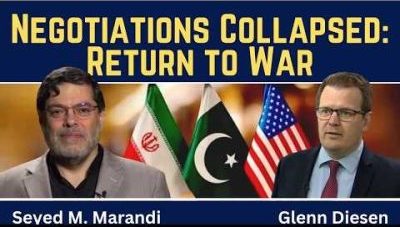
Seyed M. Marandi: Negotiations Collapsed – Return to War
or go to
Aletho News Archives – Video-Images
From the Archives
Wartime internment camps in Australia
National Archives of Australia
World War I
During World War I, for security reasons the Australian Government pursued a comprehensive internment policy against enemy aliens living in Australia.
Initially only those born in countries at war with Australia were classed as enemy aliens, but later this was expanded to include people of enemy nations who were naturalised British subjects, Australian-born descendants of migrants born in enemy nations and others who were thought to pose a threat to Australia’s security.
Australia interned almost 7,000 people during World War I, of whom about 4,500 were enemy aliens and British nationals of German ancestry already resident in Australia.
Records of World War I internment camps
World War II
During World War II, Australian authorities established internment camps for three reasons – to prevent residents from assisting Australia’s enemies, to appease public opinion and to house overseas internees sent to Australia for the duration of the war.
Unlike World War I, the initial aim of internment during the later conflict was to identify and intern those who posed a particular threat to the safety or defence of the country. As the war progressed, however, this policy changed and Japanese residents were interned en masse. In the later years of the war, Germans and Italians were also interned on the basis of nationality, particularly those living in the north of Australia. In all, just over 20 per cent of all Italians resident in Australia were interned. … continue
Blog Roll
 Aletho News
- Seyed M. Marandi: Negotiations Collapsed – Return to War
- Tomorrow’s naval blockade showdown
- ‘Israel’ attacks civilians to hide its embarrassing military failures & out of pure sadism
- Any Foreign Military Vessel Approaching Hormuz Under Any Pretext ‘Will Be Dealt With Severely’: IRGC
- Diplomats slam US negotiators’ performance in Iran talks
- Trump Refuses Exit Ramp, War with Iran will Continue
- Trump Says US Naval Blockade in Strait of Hormuz Will Begin Shortly
- US, Iran end 21-hour talks without agreement
- US IRAN TALKS: Who Are the Crazy Ones Here? /Lt Col Daniel Davis
- Talks with the US end without a deal over excessive US demands: Iran
- If Americans Knew
- US-Iran ceasefire negotiations make zero progress – Daily Update
- Pro-Israel ‘Thinktanks’ and Individuals who Influence U.S. Foreign Policy
- Mearsheimer reveals how Israel dictates US policies on Iran, Gaza – video
- After killing 350+, Israel still has a “score to settle” with Lebanon before ceasefire – Daily Update
- Military aid to Israel emerges as the latest political litmus test for Democrats
- The only Palestinian children’s rights organization closes following years-long Israeli campaign against it
- ‘I Can’t Forget the Smell’: Lebanese Reel After Israel Kills Over 300 in Single Day
- DNC Shoots Down Resolutions Calling Out AIPAC and Limiting Arms to Israel
- TCN: Is Israel Blackmailing President Trump?
- Israel killed at least 303 Lebanese yesterday – who were they? Daily Update
- No Tricks Zone
- German Expert: Heat Dome Led To Record Temps In Western USA…Warmer In 1934, 1936
- New Study: No Linear Warming Or Glacier Retreat Along Northern Antarctic Peninsula Since 1980s
- An Inconvenient Tree: Uncovered In Alps… Europe Much Warmer Than Today 6000 Years Ago
- New Study Reports A 60% Slowdown In Greenland’s Ice Loss Rate In The Last Decade
- Low Intensity Tornado Wrecks Major Solar Farm, Creating A Potential Toxic Dump
- New Study Finds Warming Saves Lives…Cold Temperatures 12 Times More Deadly Than Excess Heat
- German Science Blog Accuses PIK Climate Institute Of Hallucinating Climate Tipping Points
- Devastating Assessment Of Comirnaty Vaccine By Former Senior Pfizer Europe Toxicologist
- New Study: CO2 Is ‘Effectively Negligible’ As An Explanatory Climate Change Factor Since 2000
- Former Pfizer Toxicologist Dr. Helmut Sterz Tells Bundestag Hearing Pfizer Vaccine Should Have Never Been Approved
 Aletho News