AUKUS deal ‘worst in history’ – former Australian PM
RT | March 15, 2023
Former Australian Prime Minister Paul Keating has fired a broadside against the current government for its endorsement of the AUKUS security bloc and the purchase of American submarines. It doesn’t help protect the country and drags it into the US attempt to preserve its hegemony by containing China, he has argued.
Keating, who chaired the Australian government in the 1990s, reiterated his negative view of the purchase of Virginia-class nuclear-powered boats in a lengthy rebuke this week. He branded it the “worst international decision” by an Australian Labor government since conscription in World War I. Speaking to journalists from the National Press Club of Australia on Wednesday to make the case for his position, he added “it must be the worst deal in all history.”
Prime Minister Anthony Albanese formally confirmed the acquisition on Monday during a visit to California, where he and British Prime Minister Rishi Sunak were hosted at a naval base by US President Joe Biden. The plan was first announced in 2021, with Keating blasting the then-Conservative government in Canberra.
Figures in the British government were “looking around for suckers,” the famously acerbic Aussie politician said of the prelude to the announcement two years ago. “And they found – whoo! – here is a bunch of accommodating people in Australia.” The Albanese cabinet was just as eager to push the deal forward, he added.
The Australian Royal Navy is buying up to five attack submarines from the US and possibly building three more with the UK’s help. The deal is estimated to cost 360 billion Australian dollars ($240bn).
With that investment, Australia could have 40 to 50 domestically-built Collins-class diesel-electric submarines instead, Keating suggested.
A larger fleet would be far better at protecting Australia from a possible invasion, which would require an “armada of troops ships” reaching its coast, he believes. Meanwhile, the nuclear subs would be sent to the Chinese coast to potentially take part in a US-Chinese conflict, the former prime minister suggested.
“It’s a strange way to defend Australia to have your submarines sunk on the Chinese continental shelf chasing Chinese submarines,” Keating mused.
“We are part of a [US] containment policy against China,” he added. “It’s about one matter only: the maintenance of US strategic hegemony in Southeast Asia.”
The politician dismissed as “rubbish” the idea that China poses a military threat to Australia in the first place and shamed national journalists peddling it.
Pakistan’s Fascist Post-Modern Coup Regime Risks Replicating The East Pakistan Tragedy
By Andrew Korybko | March 15, 2023
The fascist authorities who were installed in Pakistan following last April’s US-orchestrated but superficially “democratic” post-modern coup against former Prime Minister Imran Khan risk replicating the East Pakistan tragedy if they don’t immediately stop shooting at their own people. The ousted leader’s supporters are rallying around his residence to prevent the local police from serving him an arrest warrant on a trumped-up graft charge that was concocted against him as “lawfare”.
Instead of reconsidering the wisdom of clashing with unarmed and purely peaceful civilians, the fascist authorities ordered their goons to assault them all with tear gas, rubber bullets, and reportedly even live ammunition that was shot into the air according to some accounts. This de facto declaration of war by the fascist post-modern coup regime on its own people could dangerously place the country’s political-security trajectory on the irreversible path towards civil war.
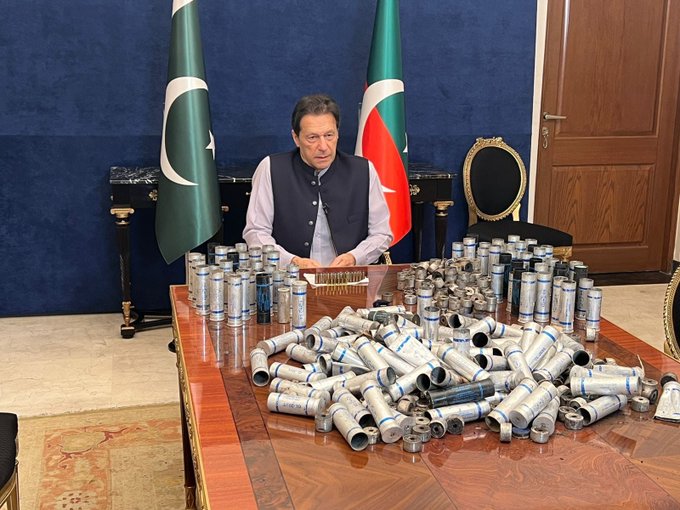
Former Prime Minister Khan warned as much in a tweet on Wednesday that he shared alongside a photo of himself sitting down in front of a pile of tear gas canisters that were shot at his home the other day. He wrote that “My house has been under heavy attack since yesterday afternoon. Latest attack by Rangers, pitting the largest pol party against the army. This is what PDM and the enemies of Pakistan want. No lessons learnt from the East Pakistan tragedy.”
The military-intelligence establishment must urgently rescind their de facto declaration of war on the Pakistani people, do whatever’s required behind the scenes to have the fascist post-modern coup’s leading figures resign as the first step towards national reconciliation, and then hold early elections. It’s only through this three-step process that the worst-case scenario of replicating the East Pakistan tragedy can potentially be avoided since anything less than that makes this more likely by the hour.
One of the most populous countries in the world is being pushed towards civil conflict by those conspirators who illegally usurped power with the US’ help last April and subsequently crashed the economy. This factual framing of Pakistan’s latest political-security dynamics proves that the increasingly violent clashes provoked by the fascist post-modern coup regime against its own people could lead to a global crisis in the event that they soon spiral even further out of control.
If the military-intelligence establishment continues waging war on the Pakistani people, then their victims should consider publicly calling on their iron brothers in China to urgently rein them in as a last resort to avert the worst-case scenario that former Prime Minister Khan just warned about. China’s diplomatic miracle in brokering the Iranian–Saudi rapprochement last week proves that it has the political capabilities to peacefully resolve the Pakistani Crisis if the people request for it to do so.
After all, the People’s Republic also stands to geostrategically lose if that neighboring nation descends into civil war. The China-Pakistan Economic Corridor (CPEC), which is the flagship project of Beijing’s Belt & Road Initiative (BRI) that’s aimed at creating a Community of Common Destiny for Mankind, would practically become inoperable should that happen. Not only could that block off China’s shortcut to the Indian Ocean, but it would deal an immense blow to its soft power and BRI’s reputation as well.
Without intending to come off as “conspiratorial”, observers can’t preclude the possibility that the fascist post-modern coup regime’s US backers encouraged them to provoke a civil war partially for the purpose of advancing America’s anti-Chinese “containment” strategy via unconventional means. At the very least, its military-intelligence establishment wouldn’t so publicly violate its people’s human rights and possibly even countenance war crimes against them without the US’ advance approval.
This means that the latest escalation of the nearly year-long Pakistani Crisis is connected to the US just like its origin is, thus extending credence to the preceding concerns that the events which Washington set into motion last April are actually part of its larger Hybrid War on China. This South Asian state was knocked out of the geostrategic game at the most sensitive moment in the global systemic transition shortly after this process accelerated following the start of Russia’s special operation.
That outcome hasn’t just proven disastrous for the Pakistani people who’ve suffered as a result of the crippling economic crisis that followed, but it also unexpectedly offset a key pillar of China’s grand strategy related to its reliance on CPEC as a non-US-controlled shortcut to the Indian Ocean. Furthermore, both the political and especially economic dimensions of the US-provoked Pakistani Crisis also raised serious doubts about CPEC’s future as well as that of BRI more broadly.
Nobody can therefore deny that the US’ regime change in Pakistan last year had very serious consequences for China that are becoming worse by the hour as that country’s fascist post-modern regime risks pushing it into civil war after de facto declaring war on its own people. China might already be working behind the scenes to try and de-escalate the latest and thus far most dangerous phase of this nearly year-long crisis on its borders, but it would still help a lot if Pakistanis publicly requested this.
That’s because this could compel China into taking urgent action behind close doors if it hasn’t already done so, not to mention creating the optics of Pakistan’s US-backed fascist post-modern coup regime literally shooting at Chinese-friendly peaceful protesters, which would force China to get involved. No other party apart from the US has the influence to peacefully resolve this crisis, and seeing as how Washington’s interests are perversely advanced by exacerbating it, the onus thus falls on Beijing.
Practically speaking, China has a credible chance of brokering peace and thus averting another Pakistani Civil War, but this best-case scenario can only happen if the fascist post-modern coup regime has the political will to save their country from this US-engineered collapse. If they do, then China can simply propose the previously suggested three-step peace plan related to immediately ceasing fire against unarmed peaceful protesters, creating a caretake government, and holding early elections.
The coup regime might agree to this in exchange for a Chinese bailout that could replace the IMF’s continually delayed one that’s full of strings and has thus far been withheld by that body’s US leader for the purpose of keeping its proxies in check in case they consider “defecting”. That last-mentioned observation is precisely what China would be tempting them to do, basically “defect” from the US in exchange for much-needed aid and thus averting the seemingly impending civil war.
The latest and thus far most dangerous phase of the nearly year-long Pakistani Crisis is rife with unpredictability since everything is moving so rapidly right now so it’s difficult to predict what might come next. In any case, it would greatly help the cause of peace and preventing a replication of the East Pakistani tragedy that former Prime Minister Khan just warned about if his unarmed peaceful protesters publicly called on China to diplomatically intervene and prevent this from becoming a global crisis.
Let’s compare China’s ‘agents’ in Canada to Israel’s
By Yves Engler | March 11, 2023
What would happen if the media and intelligence agencies applied the same standard used regarding China to the Israel lobby?
In the Globe and Mail Andrew Coyne has written two columns in recent days arguing that the discussion over Chinese interference should focus on “domestic accomplices”. “What we need a public inquiry to look into is domestic complicity in foreign interference”, noted the regular CBC commentator.
In a similar vein Justin Trudeau responded to criticism regarding purported Chinese interference by noting, “We know that Chinese Canadian parliamentarians, and Chinese Canadians in general, are greater targets for interference by China than others.” The prime minister added, “We know the same goes for Iranian Canadians, who are more subject to interference from the Iranian government. Russian speakers in Canada are more vulnerable to Russian misinformation and disinformation.”
Why ignore how Israel and its Canadian lobby use Jewish MPs and Jewish organizations as their agents?
The leading Israel advocate in parliament, Anthony Housefather chairs the Canada-Israel Interparliamentary Group. That group was previously led by another Jewish Liberal MP, Michael Leavitt, who resigned to head Israel lobby group Friends of Simon Wiesenthal Center. Housefather and Leavitt have repeatedly met Israeli officials in Canada.
As part of the media frenzy about Chinese interference, there has been significant discussion about Trudeau attending a 2016 Liberal Party fundraiser at the Toronto home of Chinese Business Chamber of Canada chair Benson Wong. Among the attendees was Chinese Canadian billionaire Zhang Bin who is alleged to have donated to the Trudeau Foundation/University of Montréal at the request of a Chinese government official.
But Trudeau has far more extensive ties to pro-Israel funders. Since 2013 the chief fundraiser for the Trudeau Liberals has been Stephen Bronfman, scion of an arch Israeli nationalist family. Bronfman has millions invested in Israeli technology companies and over the years the Bronfman clan has secured arms for Israeli forces and supported its military in other ways. Bronfman openly linked his fundraising for Trudeau to Israel. In 2013 the Globe and Mail reported:
“Justin Trudeau is banking on multimillionaire Stephen Bronfman to turn around the Liberal Party’s financial fortunes in order to take on the formidable Conservative fundraising machine…. Mr. Bronfman helped raise $2-million for Mr. Trudeau’s leadership campaign. Mr. Bronfman is hoping to win back the Jewish community, whose fundraising dollars have been going more and more to the Tories because of the party’s pro-Israel stand. ‘We’ll work hard on that,’ said Mr. Bronfman, adding that ‘Stephen Harper has never been to Israel and I took Justin there five years ago and he was referring at the end of the trip to Israel as ‘we.’ So I thought that was pretty good.’”
In 2016 Trudeau attended a fundraiser at the Toronto home of now deceased billionaire apartheid supporters Honey and Barry Sherman. The event raised funds for the party and York Centre Liberal party candidate Michael Levitt. In 2018 CBC reported on multimillionaire Mitch Garber attending one of Bronfman’s fundraisers with Trudeau. On Federation CJA Montréal’s website Garber’s profile boasts that his “eldest son Dylan just completed his service as a lone soldier serving in an elite Cyber Defense Intelligence Unit of the IDF in Israel.”
A thorough investigation of pro-Israel Liberal fundraising would uncover a litany of other examples. And they’ve had far greater success. While the Trudeau government has banned Chinese firms, arrested a prominent Chinese capitalist and targeted that country militarily, they’ve been strikingly deferential to Israel. The Trudeau government has expanded the Canada-Israel free trade agreement, organized a pizza party for Canadians fighting in the Israeli military, voted against over 60 UN resolutions upholding Palestinian rights, sued to block proper labels on wines from illegal settlements and created a special envoy to deflect criticism of Israeli abuses. During a 2018 visit to Israel former foreign affairs minister Freeland announced that should Canada win a seat on the United Nations Security Council it would act as an “asset for Israel” on the Council.
Part of the Chinese interference story is about funding University of Montréal and University of Toronto initiatives tied to China. But Jewish Zionist donors have set up far more initiatives, including numerous Israel and Israel-infused Jewish studies programs.
Having fought to establish Israel and with major investments in Israel, David Azrieli spent $5 million to establish Israel studies and $1 million on Jewish studies at Concordia University. At the University of Toronto more than $10 million was donated to establish the Anne Tanenbaum Centre for Jewish Studies and the Andrea and Charles Bronfman Chair in Israeli Studies. Millions of dollars more have been donated to launch similar initiatives at other universities.
On many occasions pro-Israel donors have leveraged donations to block academic appointments or suppress discussion of Palestinian rights. The hundreds of millions of dollars donated by Israel supporters (Schwartz/Reissman, Peter Munk, Seymour Schulich, etc.) partly explains why over a dozen Canadian university presidents recently traveled with apartheid lobby group, the Centre for Israel and Jewish Affairs, to Israel despite opposition from significant segments of their institutions.
Much more influential than the ‘China lobby’, the Israel lobby has largely been ignored in recent discussion about the need for an inquiry into foreign interference. But any serious foreign agent registry ought to include the apartheid state’s domestic accomplices.
The hidden security clauses of the Iran-Saudi deal
By Hasan Illaik | The Cradle | March 12, 2023
Under Chinese auspices, on 10 March in Beijing, longtime regional competitors Iran and Saudi Arabia reached an agreement to restore diplomatic relations, after a break of seven years.
In its most optimistic reading, the deal can be seen as a historic strategic agreement, reflecting major changes underway in West Asia and the world. At worst, it can be characterized as an “armistice agreement” between two important rivals, that will provide a valuable space for direct, regular communications.
The Sino-Saudi-Iranian joint statement on Friday carried strong implications beyond the announcement of the restoration of diplomatic relations between Tehran and Riyadh, severed since 2016.
The statement is very clear:
- The embassies of Saudi Arabia and the Islamic Republic Iran will reopen in less than two months.
- Respect for the sovereignty of States.
- Activating the security cooperation agreement between Saudi Arabia and Iran signed in 2001.
- Activating the cooperation agreement in the economic, trade, investment, technology, science, culture, sports and youth sectors signed between the parties in 1998.
- Urging the three countries to exert all efforts to promote regional and international peace and security.
At first glance, the first four clauses suggest that the Chinese-brokered deal is essentially a mending of diplomatic relations between the two longtime adversaries. But in fact, the fifth clause is far from the standard text inserted into joint statements between states.
It appears to establish a new reference for conflicts in West Asia, in which China plays the role of “peacemaker” — in partnership with Iran and Saudi Arabia — in which Beijing assumes a role in various regional conflicts or influences the relevant parties.
Sources familiar with the negotiations have revealed to The Cradle that Chinese President Xi Jinping did not merely coat-tail a deal already underway between Tehran and Riyadh. Xi has, in fact, personally paved the way for this agreement to materialize. The Chinese head of state delved deep into its details since his visit to Saudi Arabia in December 2022, and then later, during Iranian President Ebrahim Raisi’s visit to Beijing in mid-February 2023.
More than one round of negotiations was held under Chinese auspices, during which the Iranians and Saudis finalized details negotiated between them in Iraq and Oman, during earlier rounds of talks.
It was by no means a given that the two sides would arrive at an agreement in their last round of discussions (6-10 March, 2023). But the Chinese representative managed to overcome all obstacles between the two delegations, after which the parties obtained approval from their respective leaderships to announce the deal on Friday.
China as regional guarantor
In the past couple of days, much has been written about the strategic implications of a Chinese-brokered Saudi-Iranian agreement and its impact on China’s global role vis-à-vis the United States. The Persian Gulf is a strategic region for both powers, and the main source of China’s energy supply. It is likely why Beijing intervened to stem tensions between its two strategic allies. It is also something Washington, long viewed as the region’s “security guarantor,” could never have achieved.
Undoubtedly, much will be said about Saudi Crown Prince Mohammed bin Salman’s (MbS) “strategic adventurism” and his exploitation of global changes to offset the decline of US regional influence. The rise of a multipolar, post-American order allows traditional US allies some space to explore their international options away from Washington, and in service of their immediate national interests.
Saudi Arabia’s current interests are related to the ambitious political, economic, financial, and cultural targets that MbS has set out for his country, and are based on two pillars:
- Diversifying regional and global partnerships in order to adapt to global systemic changes that will help realize Riyadh’s grand plans.
- Establishing security and political stability to allow Saudi Arabia to implement its major projects, especially those outlines in MbS’ “Vision 2030,” through which Riyadh envisions itself transforming into a regional incubator for finance, business, media, and the entertainment industry – similar to the role played by the UAE in decades past, or by Beirut before the Lebanese civil war in 1975.
In short, regional and domestic security and stability are vital for Riyadh to be able to implement its strategic goals. As such, confidential clauses were inserted into the Beijing Agreement to assure Iran and Saudi Arabia that their security imperatives would be met. Some of these details were provided to The Cradle, courtesy of a source involved in the negotiations:
- Both Saudi Arabia and the Islamic Republic of Iran undertake not to engage in any activity that destabilizes either state, at the security, military or media levels.
- Saudi Arabia pledges not to fund media outlets that seek to destabilize Iran, such as Iran International.
- Saudi Arabia pledges not to fund organizations designated as terrorists by Iran, such as the People’s Mojahedin Organization (MEK), Kurdish groups based in Iraq, or militants operating out of Pakistan.
- Iran pledges to ensure that its allied organizations do not violate Saudi territory from inside Iraqi territory. During negotiations, there were discussions about the targeting of Aramco facilities in Saudi Arabia in September 2019, and Iran’s guarantee that an allied organization would not carry out a similar strike from Iraqi lands.
- Saudi Arabia and Iran will seek to exert all possible efforts to resolve conflicts in the region, particularly the conflict in Yemen, in order to secure a political solution that secures lasting peace in that country.
According to sources involved in the Beijing negotiations, no details on Yemen’s conflict were agreed upon as there has already been significant progress achieved in direct talks between Riyadh and Yemen’s Ansarallah resistance movement in January. These have led to major understandings between the two warring states, which the US and UAE have furiously sought to undermine in order to prevent a resolution of the Yemen war.
In Beijing however, the Iranian and Saudis agreed to help advance the decisions already reached between Riyadh and Sanaa, and build upon these to end the seven-year war.
Hence, although the Beijing statement primarily addresses issues related to diplomatic rapprochement, Iranian-Saudi understandings appear to have been brokered mainly around security imperatives. Supporters of each side will likely claim their country fared better in the agreement, but a deeper look shows a healthy balance in the deal terms, with each party receiving assurances that the other will not tamper with its security.
While Iran has never declared a desire to undermine Saudi Arabia’s security, some of its regional allies have made no secret of their intentions in this regard. In addition, MbS has publicly declared his intention to take the fight inside Iran, which Saudi intelligence services have been doing in recent years, specifically by supporting and financing armed dissident and separatist organizations that Iran classifies as terrorist groups.
The security priorities of this agreement should have been easy to spot in Beijing last week. After all, the deal was struck between the National Security Councils of Saudi Arabia and Iran, and included the participation of intelligence services from both countries. Present in the Iranian delegation were officers from Iran’s Ministry of Intelligence and from the intelligence arms of the Islamic Revolutionary Guard Corps (IRGC).
On a slightly separate note related to regional security — but not part of the Beijing Agreement — sources involved in negotiations confirmed to The Cradle that, during talks, the Saudi delegation stressed Riyadh’s commitment to the 2002 Arab peace initiative; refusing normalization with Tel Aviv before the establishment of an independent Palestinian state, with Jerusalem as its capital.
What is perhaps most remarkable, and illustrates the determination by the parties to strike a deal without the influence of spoilers, is that Iranian and Saudi intelligence delegations met in the Chinese capital for five days without Israeli intel being aware of the fact. It is perhaps yet another testament that China — unlike the US — understands how to get a deal done in these shifting times.
China steps up, a new era has dawned in world politics
BY M. K. BHADRAKUMAR | INDIAN PUNCHLINE | MARCH 11, 2023
The agreement announced on Friday in Beijing regarding the normalisation of diplomatic relations between Saudi Arabia and Iran and the reopening of their embassies is a historic event. It goes way beyond an issue of Saudi-Iranian relations. China’s mediation signifies that we are witnessing a profound shift of the tectonic plates in the geopolitics of the 21st century.
The joint statement issued on Friday in Beijing begins by saying that the Saudi-Iranian agreement was reached “in response to the noble initiative of President Xi Jinping.” The dramatic beginning goes on to state that Saudi Arabia and Iran have expressed their “appreciation and gratitude” to Xi Jinping and the Chinese government “for hosting and sponsoring the talks, and the efforts it placed towards its success.”
The joint communique also mentioned Iraq and Oman for fostering the Saudi-Iranian dialogue during 2021-2022. But the salience is that the United States, which has been traditionally the dominant power in West Asian politics for close to eight decades, is nowhere in the picture.
Yet, this is about the reconciliation between the two biggest regional powers in the Persian Gulf region. The US retrenchment denotes a colossal breakdown of American diplomacy. It will remain a black mark in President Biden’s foreign policy legacy.
But Biden must take the blame for it. Such a cataclysmic failure is largely to be traced to his fervour to impose his neoconservative dogmas as an adjunct of America’s military might and Biden’s own frequent insistence that the fate of humankind hinges on the outcome of a cosmic struggle between democracy and autocracy.
China has shown that Biden’s hyperbole is delusional and it grates against realities. If Biden’s moralistic, ill-considered rhetoric alienated Saudi Arabia, his attempts to suppress Iran met with stubborn resistance from Tehran. And, in the final analysis, Biden literally drove both Riyadh and Tehran to search for countervailing forces that would help them to push back his oppressive, overbearing attitude.
The US’ humiliating exclusion from the centre stage of West Asian politics constitutes a “Suez moment” for the superpower, comparable to the crisis experienced by the UK in 1956, which obliged the British to sense that their imperial project had reached a dead end and the old way of doing things—whipping weaker nations into line as ostensible obligations of global leadership —was no longer going to work and would only lead to disastrous reckoning.
The stunning part here is the sheer brain power and intellectual resources and ‘soft power’ that China has brought into play to outwit the US. The US has at least 30 military bases in West Asia — five in Saudi Arabia alone — but it has lost the mantle of leadership. Come to think of it, Saudi Arabia, Iran and China made their landmark announcement on the very same day Xi Jinping got elected for a third term as president.
What we are seeing is a new China under the leadership of Xi Jinping trotting over the high knoll. Yet, it is adopting a self-effacing posture claiming no laurels for itself. There is no sign of the ‘Middle Kingdom syndrome,’ which the US propagandists had warned against.
On the contrary, for the world audience — especially countries like India or Vietnam, Turkey, Brazil or South Africa — China has presented a salutary example of how a democratised multipolar world can work in future — how it is possible to anchor big power diplomacy on consensual, conciliatory politics, trade and interdependence and advance a ‘win-win’ outcome.
Implicit in this is another huge message here: China as a factor of global balance and stability. It is not only Asia-Pacific and West Asia who are watching. The audience also includes Africa and Latin America — in fact, the entire non-Western world that forms the big majority of world community who are known as the Global South.
What the pandemic and the Ukraine crisis have brought to the surface is the latent geopolitical reality that the Global South rejects the policies of neo-mercantalism pursued by the West in the garb of ‘liberal internationalism.’
The West is pursuing a hierarchical international order. None other than the EU foreign policy chief Josep Borrell blurted this out in an unguarded moment recently with a touch of racist overtone when he said from a public platform that ‘Europe Is a garden. The rest of the world Is a jungle, and the jungle could Invade the garden.’
Tomorrow, China could as well be challenging the US hegemony over the Western Hemisphere. The recent paper by the Chinese Foreign Ministry titled ‘US Hegemony and Its Perils’ tells us that Beijing will no longer be on the defensive.
Meanwhile, a realignment of forces on the world stage is taking place with China and Russia on one side and the US on the other. Doesn’t it convey a big message that on the very eve of the historic announcement in Beijing on Friday, the Saudi Arabian foreign minister Prince Faisal bin Farhan Al Saud landed suddenly in Moscow on a ‘working visit’ and went into a huddle with Foreign Minister Sergey Lavrov who was visibly delighted? (here, here and here )
Of course, we will never know what role Moscow would have played behind the scenes in coordination with Beijing to build bridges between Riyadh and Tehran. All we know is that Russia and China actively coordinate their foreign policy moves. Interestingly, on March 6, President Putin had a telephone conversation with Iran’s President Ebrahim Raisi.
Audacity of hope
To be sure, the geopolitics of West Asia will never be the same again. Realistically, the first sparrow of spring has appeared but the ice was melted for only three or four rods from the shore. Nonetheless, the sun’s rays give hope, signalling warmer days to come.
Conceivably, Riyadh won’t have any truck further with the diabolical plots hatched in Washington and Tel Aviv to resuscitate an anti-Iran alliance in West Asia. Nor is it in the realms of possibility that Saudi Arabia will be party to any US-Israeli attacks on Iran.
This badly isolates Israel in the region and renders the US toothless. In substantive terms, it scatters the Biden administration’s feverish efforts lately to cajole Riyadh to join Abraham Accords.
However, significantly, a commentary in Global Times noted somewhat audaciously that the Saudi-Iranian deal “set a positive example for other regional hotspot issues, such as the easing and settlement of the Israeli-Palestinian conflict. And in the future, China could play an important role in building a bridge for countries to solve long-standing thorny issues in the Middle East just as what it did this time.”
Indeed, the joint communique issued in Beijing says, “The three countries [Saudi Arabia, Iran and China] expressed their keenness to exert all efforts towards enhancing regional and international peace and security.” Can China pull a rabit out of the hat? Time will tell.
For the present, though, the Saudi-Iranian rapprochement will certainly have positive fallouts on the efforts toward a negotiated settlement in Yemen and Syria as well as on the political instability in Lebanon.
Besides, the joint communique emphasises that Saudi Arabia and Iran intend to revive the 1998 General Agreement for Cooperation in the Fields of Economy, Trade, Investment, Technology, Science, Culture, Sports, and Youth. All in all, the Biden administration’s maximum pressure strategy toward Iran has crashed and the West’s sanctions against Iran are being rendered ineffectual. The US’ policy options on Iran have shrunk. Put differently, Iran gains strategic depth to negotiate with the US.
The cutting edge of the US sanctions lies in the restrictions on Iran’s oil trade and access to western banks. It is entirely conceivable that a backlash is about to begin as Russia, Iran and Saudi Arabia — three top oil/gas producing countries start accelerating their search for payment mechanisms bypassing the American dollar.
China is already discussing such an arrangement with Saudi Arabia and Iran. China-Russia trade and economic transactions no longer use American dollar for payments. It is well understood that any significant erosion in the status of the dollar as ‘world currency’ will not only spell doom for the American economy but will cripple the US’ capacity to wage ‘forever wars’ abroad and impose its global hegemony.
The bottom line is that the reconciliation between Saudi Arabia and Iran is also a precursor to their induction as BRICS members in a near future. To be sure, there is a Russian-Chinese understanding already on this score. The BRICS membership for Saudi Arabia and Iran will radically reset the power dynamic in the international system.
World welcomes Iran-Saudi detente as Israel feels ‘fatal blow’ to coalition building
Press TV – March 10, 2023
Various countries have welcomed the restoration of diplomatic relations between Iran and Saudi Arabia, while the regime in Tel Aviv seems to view the development as a “fatal blow” to its regional coalition building against the Islamic Republic.
After several days of intensive negotiations hosted by China, Iran and Saudi Arabia finally clinched a deal on Friday to restore diplomatic relations and re-open embassies, seven years after ties were severed over several issues.
The important development soon became a hot topic in regional as well as international media and reactions from other countries began to pour in.
“The return to normal relations between the Islamic Republic of Iran and Saudi Arabia provides great capacities to both countries, the region, and the Muslim world,” Iranian Foreign Minister Hossein Amir-Abdollahian, who is set to soon meet with his Saudi counterpart to make the necessary arrangements, wrote in a post on his Twitter account.
“The good neighborliness policy, as the key axis of the Iranian administration’s foreign policy, is strongly moving in the right direction and the diplomatic apparatus is actively behind the preparation of more regional steps,” he said.
Riyadh eyeing continuation of dialogue
Saudi National Security Adviser Musaid Al Aiban, who negotiated the agreement with his Iranian counterpart Ali Shamkhani, said that Riyadh “welcomes the initiative of His Excellency President Xi Jinping, based on the Kingdom’s consistent and continuous approach since its establishment in adhering to the principles of good neighborliness.”
He said Saudi Arabia takes “everything that would enhance security and stability in the region and the world,” while “adopting the principle of dialogue and diplomacy to resolve differences.”
“While we value what we have reached, we hope that we will continue to continue the constructive dialogue, in accordance with the pillars and foundations included in the agreement, expressing our appreciation for the People’s Republic of China’s continued positive role in this regard.”
China’s Top Diplomat Wang Yi praised the agreement as “a victory for dialogue, a victory for peace, offering major good news at a time of much turbulence in the world.”
China will continue to play a constructive role in handling hotspot issues in the world and demonstrate its responsibility as a major nation, Wang said. “The world is not just limited to the Ukraine issue.”
Nasrallah: Agreement could lead to new horizons
Addressing a local event on Friday, the secretary general of Lebanon’s Hezbollah resistance movement Sayyed Hassan Nasrallah said the agreement will be “to the benefit” of the region.
“The rapprochement of Iran and Saudi Arabia proceeds in its normal path and can open new horizons for the region and Lebanon,” he said.
The Iranian foreign minister also held separate phone conversations with his Omani, Iraqi, and Qatari counterparts who embraced the resumption of ties.
Turkey and the United Arab Emirates also welcomed the new development in separate statements.
In the first reaction, the United States claimed that it embraces “de-escalation” in West Asia.
“Generally speaking, we welcome any efforts to help end the war in Yemen and de-escalate tensions in the Middle East region. De-escalation and diplomacy together with deterrence are key pillars of the policy President Biden outlined during his visit to the region last year,” a White House National Security Council spokesperson told Reuters.
Ansarullah hails move against foreign interference
Mohammed Abdulsalam, the Yemeni Ansarullah resistance movement’s chief negotiator, said the region is in need of resumption of “normal ties” between its countries.
“The region needs the resumption of normal ties between its countries for the Islamic nation to reclaim its lost security as a result of foreign, especially American-Zionist, interferences,” he tweeted.
Foreign interference, he said, has taken advantage of differences in the region and used Iranophobia to wage aggression on Yemen.
‘Dangerous development for Israel’
Meanwhile, the Israeli regime did not seem to take the development so well. Former Israeli Prime Minister Naftali Bennett called the agreement a “political victory” for Iran and a “serious and dangerous development for Israel.”
“This delivers a fatal blow to efforts to build a regional coalition against Iran,” he said.
Former Prime Minister Yair Lapid also described the reconciliation deal as a dangerous development that strips Israel of its regional defensive wall. “The agreement between Saudi Arabia and Iran reflects the complete and dangerous failure of the Israeli government’s foreign policy,” Lapid said.
Benny Gantz, former minister of military affairs, also reacted to the rapprochement, stating that it was a cause for concern.
CNN admits America trying to use Ukraine conflict to ‘isolate’ China
By Drago Bosnic | March 10, 2023
It’s certainly no secret that the United States has been trying to foment yet another conflict in the immediate vicinity of its geopolitical adversaries. This is particularly true in regards to Russia and China, the only near-peer rivals capable of not only resisting, but also challenging Washington DC’s disastrous hegemony. It is precisely this that makes both superpowers prime targets for encirclement and destabilization, with the end goal being either their complete dismantlement or, at the very least, weakening to a point where they would be forced to accept US dominance without much (or any) opposition. To accomplish this, the belligerent thalassocracy has been using everything at its disposal, from false narratives disseminated by the massive mainstream propaganda machine to more “hard power” schemes such as weapons deliveries and (in)direct military involvement.
Most observers have always seen the connection between Russia and China or, more specifically, between their interests in Ukraine and Taiwan, respectively. These legitimate interests (primarily relating to, but not limited to security) have been targeted by the US and its numerous vassals. Both Moscow and Beijing are perfectly aware of this and are working towards building closer ties, especially on a strategic level, to counter escalating US aggression while maintaining their respective foreign policy frameworks, which aren’t always 100% convergent in every aspect. However, this does not impede their growing cooperation in any way, as can only be expected from truly sovereign nations. This is causing a tremendous amount of frustration in Washington DC, prompting it to mobilize its propaganda machine to try and tarnish the (Eur)Asian giants’ reputation.
A recent piece published by the infamous CNN perfectly illustrates the thinking behind US attempts to use the aforementioned crises against both Russia and China. Authored by Brad Lendon and titled “Ukraine war has made it easier for US to isolate China in the Pacific”, the analysis is an admission of sorts that Washington DC is pushing both conflicts.
Expectedly, the author claims that China is supposedly “backing” Russia just by virtue of Beijing’s continued refusal to join the political West’s siege of Moscow. Lendon claims that this perceived support has pushed Japan to double military spending and acquire long-range weapons from the US, while entirely ignoring the enormous pressure Tokyo has been exposed to in the last 12 months to “up the ante” and commit more of its increasingly depleted resources to the “defense of shared values”.
And while the author praised the new Japanese $320 billion remilitarization program, he harshly criticized China’s own regular military activities as “destabilizing”. This is just further proof that the incessant hypocrisy and double standards are the mainstays of US foreign policy. Lendon claims that “China’s actions are pushing the Asia-Pacific allies closer than ever before”, openly admitting that the Ukraine conflict is “very useful” for Washington DC in this regard. He then quoted the Chinese Premier Li Keqiang as saying: “The [Chinese] armed forces should intensify military training and preparedness across the board, develop new military strategic guidance, devote greater energy to training under combat conditions and make well-coordinated efforts to strengthen military work in all directions and domains.”
The CNN insists that the outgoing Chinese premier stated this as part of a government work report. Either way, the US is surprisingly open about its plans, with the recently revealed National Security Strategy (NSS) envisioning a greater strategic role for America’s numerous satellite states. While Donald Trump’s approach was more isolationist and focused on economic warfare, the Biden administration is showing much more belligerence, as well as a tendency to relegate portions of its power projection to allies and vassals such as the UK, Australia, Japan, etc. Somewhat surprisingly, Lendon claims that South Korea is now also joining the fray.
“Peace and stability in the Taiwan Strait is essential for peace and stability on the Korean Peninsula and it’s indispensable for security and prosperity of the region as a whole,” South Korean Foreign Minister Park Jin told CNN recently.
This is somewhat uncommon for Seoul, which has previously been careful not to antagonize Beijing, with which it has extensive economic cooperation. If CNN’s claims are true, this would signal a dramatic strategic shift in the Asia-Pacific, further splitting the region along geopolitical fault lines and eroding decades of essentially unlimited economic cooperation. Perhaps this might be exactly what the US wants, as per CNN itself, but it might also backfire into yet another spectacular US foreign policy failure. Lendon insists that South Korea is worried about Pyongyang and that this is the main reason it is further integrating with the US-brokered anti-Chinese coalition.
However, it could be argued that it is precisely this action by Seoul that could escalate tensions between the North and the South, particularly if the latter further antagonizes and alienates Beijing, which has been playing quite a constructive role in defusing tensions in the Korean peninsula. The destabilization could also be exacerbated by South Korea repeatedly floating the idea of potentially acquiring its own nuclear weapons, a course of action the US has not shown any opposition to while still insisting the North should disarm. Needless to say, Pyongyang is not only refusing to comply with such a suicidal request, but is even expanding its strategic capabilities, much to the chagrin of Washington.
In conclusion, Lendon laments that the Ukrainian crisis “has not been helpful in one key American partnership in the Indo-Pacific, the informal Quad alliance linking the US, Japan, Australia and India”, as New Delhi, “unlike the other three members”, has not condemned Russia’s counteroffensive against NATO aggression in Europe. “When the US, Australia, and Japan tried to condemn Russia through a joint statement, India refused…
India claimed that the Quad only tackles Indo-Pacific challenges, and since Russia isn’t in the region, this topic cannot be broached,” the piece quoted Derek Grossman, a senior defense analyst at the infamous RAND Corporation. However, he added that “the split in the Quad doesn’t really distract from its focus, as the Quad is all about how to deal with China”, essentially admitting that America is still trying to compartmentalize its geopolitical approach in the region.
Drago Bosnic is an independent geopolitical and military analyst.
The Cold War Racket Is Back
By Jacob G. Hornberger | FFF | March 7, 2023
Chinese leader Xi Jinping has issued a direct critique against the U.S. government’s policy of containment when it comes to China. According to an article in the Wall Street Journal, the critique is unusual in that it comes directly from China’s leader rather than indirectly through governmental spokespersons.
The Journal article quotes Shirley Martey Hargis, fellow at the Washington think tank Atlantic Council, who suggests that Xi might just be shifting the blame for economic problems in China. “It’s either take the blame or shift it,” she said.
Notwithstanding China’s economic problems, however, the fact is that Xi is right. There is no denying that U.S. national-security establishment, led by the Pentagon and the CIA, have been pursuing a Cold War policy of containment against China, with the aim of renewing its old Cold War racket.
Of course, as the Russians will attest, the Pentagon and the CIA have been doing the same with them — doing everything they can to gin up their old Cold War racket against Russia, just as they are doing against China.
Take a look at this map. You might be shocked, or maybe not. It displays the number of U.S. military bases near China. Tom Orsag, a freelance leftist journalist, points out that “China is effectively encircled by US bases all across the Pacific.” Orsag adds, “The U.S. is the biggest bully in the Pacific, with rings of military bases blocking and threatening China.”
Now, take a look at this map. It depicts the number of Chinese military bases near the United States. Number? Zero! In fact, according to an article at Eurasia Times entitled “Over 750 Military Bases Across 80 Countries: How US Military Overshadows China In Projecting Power Overseas,” China has the grand total of one foreign military base — in Djibouti, which is more than 7,000 miles away from the United States.
Take a look at this map. It shows the number of U.S. military bases near both Russia and China.
Now, take a look at this map again. It shows the number of Russian military bases near the United States. Number? Zero!
Let’s just imagine that the situation was reversed. Let’s assume that the United States had no military bases overseas whatsoever and had a non-empire, non-interventionist foreign policy. And let’s imagine that the United States was encircled by the same number of Russian and Chinese military bases that the Pentagon and the CIA have encircling Russia and China.
What do you think would be the reaction of U.S. officials? My hunch is that they would be going ballistic and directly objecting to China’s and Russia’s policy of encircling and containing the United States, just as Russia and China are currently objecting to U.S. encirclement and containment of their countries.
Are China and Russia justified in their concern over the Pentagon’s encirclement of their nations? Martin Luther King, whose birthday U.S. officials honor each year with a federal holiday, pointed out that the United States was the greatest purveyor of violence in the world. And that was before the U.S. invasions and wars of aggression against Afghanistan and Iraq! Given such, why wouldn’t China and Russia be concerned about being encircled and contained by the Pentagon and the CIA?
The Wall Street Journal article cited above quotes Jessica Chen Weiss, a Cornell University professor and former State Department advisor, saying in response to the escalating tensions between China and the U.S., “The current tit-for-tat spiral serves no one.”
Is Weiss really that innocent and naive? Serves no one? Are you kidding me? It serves the entire U.S. national-security establishment, including its army of “defense” contractors who eat out our substance by feeding voraciously at the public trough. The current tit-for-tat gives the U.S. national-security establishment its old — and extremely lucrative — Cold War racket back.
China warns of ‘critical juncture’ in Ukraine conflict
RT | March 7, 2023
The conflict in Ukraine will spin of control if a peace process does not start soon, Chinese Foreign Minister Qin Gang has said.
The fighting between Russia and Ukraine has reached a “critical juncture,” Qin stated during his annual press conference in Beijing on Tuesday.
“There will either be cessation of hostilities, restoration of peace and a move towards political settlement, or fuel will be added to the fire, the crisis will expand, and the situation will get out of control,” he warned.
The diplomat pointed out that now is the time for “calmness, sanity and dialogue,” insisting that talks “should start as soon as possible.”
“The legitimate security concerns of all parties should be respected” during the negotiations, as this is the only way to achieve long-term peace and stability in Europe, he said.
Qin also expressed regret that previous attempts to launch a peace process to end the conflict had been “repeatedly undermined.”
“There is an ‘invisible hand’ pushing the conflict towards escalation and trying to use the Ukrainian crisis to serve a certain geopolitical agenda,” he said.
Moscow has repeatedly said the conflict in Ukraine is a “proxy war” waged against Russia by the US and its NATO allies, which provide Kiev with weapons, funds and intelligence.
Last week, Russian Foreign Minister Sergey Lavrov reiterated that Moscow was ready to consider peace proposals “that are made out of sincere desire to find a political solution” to the crisis. However, Lavrov pointed out that there haven’t been any such serious peace offers coming from either Kiev or its Western backers since last March. On the contrary, “Ukraine is being persuaded to continue the fighting,” he said.
During his press conference, Qin also spoke about the significance of relations between Russia and China. Over the past year, Beijing resisted Western pressure to condemn and sanction Moscow, while consistently calling for a peaceful resolution of the crisis.
“The more turbulent the world is, the more steadily the Chinese-Russian relations should move forward,” the Chinese FM said.
Cooperation between Beijing and Moscow will “provide impetus for multipolarization of the world and democracy in international relations; global strategic balance and stability will be assured through it,” he stated.
The United States Is in Conflict with Countries for Doing Things We Know They’re Not Doing
By Ted Snider | The Libertarian Institute | March 6, 2023
China, Balloons, and Spying
On February 4, the U.S. military shot down a Chinese balloon they claim was a surveillance device spying on U.S. territory. The unprecedented “kinetic action against an airborne object… within United States or American airspace” was followed by three more objects being shot down by the U.S. and Canada over their airspace.
The conflict that followed derailed potential and necessary Sino-American diplomacy. But Washington knows three crucial things: the surveillance balloon was not intentionally sent over American airspace, the next three objects were not even spying, and even if they had been spying, China would only be doing what the U.S. does every day. There was never a need for the conflict.
Biden has admitted that the three later objects that were shot down “were most likely research balloons, not spy craft.” The U.S. “intelligence community’s assessment is that the three objects were most likely balloons tied to private companies, recreation or research institutions studying weather or conducting other scientific studies.”
As for the balloon the United States still believes was a spy balloon, they knew all along that China had not deliberately sent it over American airspace. Far from being taken by surprise, as they portrayed, “U.S. military and intelligence agencies had been tracking it for nearly a week, watching as it lifted off from its home base on Hainan Island near China’s south coast.”
And they knew the intended destination was never the United States. Officials “are now examining the possibility that China didn’t intend to penetrate the American heartland with their airborne surveillance device.” The U.S. monitored the flight path that was taking it to Guam when “strong winds… appear to have pushed the balloon south into the continental United States.”
The U.S. initiated a potentially dangerous conflict with a country for doing something they knew the country wasn’t doing.
And even if China did send a spy balloon over the United States, the government knows that they do that to China every day. Three times a day actually! Retired Ambassador Chas Freeman, who accompanied Nixon to China in 1972, told me that the U.S. “mount[s] about three reconnaissance missions a day by air or sea along China’s borders, staying just outside the 12-mile limit but alarming the Chinese, who routinely intercept our flights and protest our perceived provocations.”
The U.S. has, not balloons, but satellites that spy on China. NBC’s Robert Windrem calls Washington’s “appetite for China’s secrets” “insatiable” and says that “spying on the People’s Republic of China has been one of the National Security Agency’s top priorities since it was established in 1952.”
But they have balloons too. On February 13, China’s Foreign Ministry spokesman Wang Wenbin said “that the U.S. had flown high-altitude balloons through its airspace more than 10 times since the start of 2022.” He went on to say that “U.S. balloons regularly flew through other countries’ airspace without permission.”
And in February 2022, Politico revealed that the Pentagon is working on “high-altitude inflatables” that would fly “at between 60,000 and 90,000 feet [and] would be added to the Pentagon’s extensive surveillance network…” The Pentagon, which has spent millions on the project, hopes the balloons “may help track and deter hypersonic weapons being developed by China and Russia.”
Cuba and Sponsoring Terrorism
On October 3, 2022, Colombian President Gustavo Petro asked U.S. Secretary of State Antony Blinken to take Cuba off the list of state sponsors of international terrorism. At a press conference the same day, Blinken defended the Cuban listing, insisting that “When it comes to Cuba and when it comes to the state sponsor of terrorism designation, we have clear laws, clear criteria, clear requirements.” Petro disagreed, responding that “what has happened with Cuba is an injustice.”
Mexican President Andrés Manuel López Obrador agrees. In December, he said that the world must “unite and defend the independence and sovereignty of Cuba, and never, ever treat it as a ‘terrorist’ country, or put its profoundly humane people and government on a blacklist of supposed ‘terrorists.’”
The United States agrees. Though the Biden administration has insisted on keeping Cuba on the list of state sponsors of terrorism, they know that Cuba is not a sponsor of terrorism.
William LeoGrande, Professor of Government at American University and a specialist in U.S. foreign policy toward Latin America, told me that the region’s resistance to the American strangling of Cuba was “preventing Washington from engaging Latin American cooperation on a range of other issues.” Deputy National Security Adviser Ben Rhodes said U.S. policy on Cuba had become “an albatross” around the neck of the U.S., crippling their policy in the hemisphere.
So, President Obama ordered a review of the designation. In an act of extreme historical understatement, he told Congress that “the government of Cuba has not provided any support for international terrorism during the preceding six-month period” and “has provided assurances that it will not support acts of international terrorism in the future.” After the State Department review, Secretary of State John Kerry declared that any remaining “concerns and disagreements” with Cuba “fall outside the criteria for designation as a State Sponsor of Terrorism.” The State Department issued an “assessment that Cuba meets the criteria established by Congress for rescission.” The U.S. intelligence community came to the same decision.
In May 2015, Obama removed Cuba from the list of state sponsors of terrorism. Cuba’s Foreign Ministry announced that “The government of Cuba recognizes the just decision made by the President of the United States to remove Cuba” from the list, adding that “it never deserved to belong” on the list in the first place.
Cuba was placed on the list in 1982 in an act of hypocrisy and exceptionalism. President Reagan locked Cuba in the list for arming revolutionary left wing movements in Latin America, meanwhile Reagan was arming their right wing opponents. Reagan declared that supporting those groups was “self-defense” and waged secret proxy wars and armed and supported counter-revolutionary forces in El Salvador and Nicaragua. LeoGrande has said that the U.S. backed counter-revolutionary forces “guilty of far worse terrorist attacks against civilians” than the Cuban backed revolutionary forces.
Nonetheless, on January 11, 2021, as it was walking out the White House door, the Trump administration thrust Cuba back onto the list of state sponsors of terrorism.
Biden promised, while campaigning for the presidency, that he would “promptly reverse the failed Trump policies that have inflicted harm on the Cuban people and done nothing to advance democracy and human rights.” Instead, two months after Trump put Cuba back on the list, White House spokeswoman Jen Psaki announced that a “Cuba policy shift is not currently among President Biden’s top priorities.”
Cuba remains on the state sponsor of terrorism list even though Washington knows Havana is not a state sponsor of terrorism. The Obama administration liberated them from the list, knowing that “the government of Cuba has not provided any support for international terrorism.” The Trump administration locked them back in the list, knowing the same, and the Biden administration has no immediate plans to reverse it.
Iran and Nuclear Bombs
The pattern is the same with Iran. The Obama administration signs the JCPOA nuclear agreement with Iran, paving the way to end the conflict, the Trump administration illegally pulls out of the deal, renewing the conflict, and Joe Biden continues Trump’s failed policies instead of returning to Obama’s promising policies.
The Biden administration knows that the Trump era policy they are keeping alive is a mistake. Blinken called the Trump administration’s “decision to pull out of the agreement” a “disastrous mistake.” Biden, while campaigning, said that Trump “recklessly tossed away a policy that was working to keep America safe and replaced it with one that has worsened the threat.” He promised to “offer Tehran a credible path back to diplomacy.” He hasn’t.
Instead, the State Department has said that the negotiations with Iran are “not our focus right now.” Robert Malley, the top U.S. diplomat for negotiating a nuclear deal with Iran, said that “It is not on our agenda…we are not going to waste our time on it.”
So, Iran continues to be the recipient of American sanctions, threats, assassinations, and sabotage: all while the United States knows Iran is not building a nuclear bomb.
The 2007 and 2011 U.S. National Intelligence Estimates both concluded with “high confidence” that Iran was not building a bomb. But you don’t have to go back that far to find American admissions that they are continuing the conflict with Iran for doing things they know Iran is not doing.
The 2022 U.S. Department of Defense Nuclear Posture Review makes the stunning admission that Iran is not building a nuclear weapon nor has it even made a decision to pursue a nuclear weapon. The Nuclear Posture Review makes that admission, not once, but twice, and it is repeated again in the National Defense Strategy in which it is included.
The Nuclear Posture Review says that “Iran does not currently pose a nuclear threat but continues to develop capabilities that would enable it to produce a nuclear weapon should it make the decision to do so.” It then lays out the truth about Iran in the greatest clarity: “Iran does not today possess a nuclear weapon and we currently believe it is not pursuing one.”
That was true four months ago, when the Nuclear Posture Review was released, and it remains true today. On February 25, CIA Director William Burns said that “[t]o the best of our knowledge, we don’t believe that the supreme leader in Iran has yet made a decision to resume the weaponization program.”
As with its Cuba policy, the United States continues to engage in conflict with Iran for doing something they know Iran is not doing. In the case of Iran, that escalating, self-defeating policy is potentially very dangerous.
In all three cases—China, Cuba and Iran–the United States has engaged in hostile, and sometimes dangerous, conflict with countries for doing what Washington knew all along they weren’t doing.
Russia to maintain high oil output – JPMorgan
RT | March 5, 2023
Russian oil drillers can maintain high production despite numerous rounds of Western sanctions, JPMorgan projected this week, according to Reuters.
The Wall Street bank pointed to growing demand for crude oil from China and India which is expected to increase collectively by 1 million barrels per day (mbd) this year.
“We believe Russia will be able to maintain its oil production at pre-war levels of 10.8 mbd but will have difficulties getting back to peak pre-Covid volumes of 11.3 mbd,” JPMorgan reportedly stated.
The US bank suggested that Moscow could struggle to reroute part of its oil product exports away from the EU, following the bloc’s embargo on imports of Russian fuels. Seaborne oil product shipments from Russia are set to decline by around 300,000 barrels per day to “lows last seen in May 2022,” it projected.
Meanwhile, business daily Kommersant reported this week, citing industry sources, that Russian oil output in February reached pre-sanctions levels for the first time, and may exceed the February 2022 figure.
According to Kpler, Russian crude oil and petroleum product exports also held strong last month, with energy producers managing to ship 7.32 million barrels per day of crude oil and oil products.
While the EU and G7 nations have introduced price caps and restrictions on Russian fuel imports, China, India, Türkiye, and some other countries have boosted purchases from Moscow. Last month, Russia unveiled plans to curb oil production in March by 500,000 barrels a day, or about 5%, in retaliation to Western sanctions.
Featured Video

ARE PATIENTS BEING PROPERLY INFORMED ABOUT OZEMPIC?
or go to
Aletho News Archives – Video-Images
New Book
Breast Cancer: Before You Consent
A new Unbekoming paperback
Lies are Unbekoming | September 18, 2026
Peter Gøtzsche reviewed every randomised mammography screening trial ever conducted for the Cochrane Collaboration. Cochrane’s headline is that, assuming a 15% mortality reduction, one woman in 2000 avoids dying of breast cancer over ten years. Ten are overdiagnosed and treated. Two hundred experience false alarms.
But that headline assumes the reduction. When Gøtzsche looked only at the trials with adequate randomisation — the higher-quality ones — the reduction disappeared. No effect on breast cancer mortality. No effect on all-cause mortality.
This is the Cochrane finding, published in the establishment’s own database of systematic reviews.
No woman being asked to consent to a mammogram this week knows it.
That is why the new Unbekoming paperback exists. … continue
Blog Roll
 Aletho News
- The Truth About the Trump Shootings with Ken Silva
- ARE PATIENTS BEING PROPERLY INFORMED ABOUT OZEMPIC?
- US lawmaker blocks $2.8 billion weapons sale to Israel: Report
- Yemeni army claims responsibility for strikes on sensitive sites in Saudi capital, Aramco facilities in Yanbu
- Iran Judiciary issues indictments against 159 US, Israeli officials for assassination of Leader, commanders
- Turkiye revokes Iranian bank license under US sanctions campaign
- US-Denmark Agreement on Greenland Is ‘PR Stunt’ Ahead of Midterms
- Araghchi: Military intervention cannot create security; coercion cannot bring peace
- Fraud Squared
- Breast Cancer: Before You Consent
- If Americans Knew
- Inside Gaza’s death trap of collapsing, bombed-out buildings
- The everyday items Israel bans from Gaza every day
- Inside the siege, the ruined buildings of Gaza – Daily Update
- Debunking The Claim That Macklemore Has A “History Of Antisemitism”
- CPJ demands release of arrested Palestinian-US journalist near Bethlehem
- Robert Kraft: The Billionaire Friend of Netanyahu Pulling The Strings Behind the Macklemore/Ed Sheeran Blow Up
- Columbia Administered Fund Gives Big Money to Pro-Israel Groups
- Deportation Case of Palestinian Activist Salah Sarsour Tests First Amendment
- ‘We Will Not Forget’: Palestinians Mark 44 Years since Sabra and Shatila
- Why do we let Zionists decide what we can and can’t say?
- No Tricks Zone
- 2025 Nature Paper Claiming Worsening Global Drought Gets RETRACTED …Heavily Flawed
- New Study: ‘Global Drought Shows No Detectable Recent Acceleration Under Climate Warming’
- Economic Masterminds: German Socialists Suggest Taxing Productivity Gains Stemming From Using AI
- The South China Sea Has Not Been Cooperating With The Climate Change Narrative
- Energy Crisis: Germany Enters Heating Season With Historically Low Gas Reserve Fill Levels
- New Study: The Antarctic Ice Sheet Gained Mass From 2020-2024 Due To Staggering Snow And Ice Accumulation
- Study: Ocean Heating Rates From Thousands Of Years Ago ‘Dwarf’ Modern Ocean Heating Rates
- Climate Extremists Target, Attack Large-Scale Power Grid Infrastructure In Germany!
- New Study: Antarctic Ice Melt Has Contributed Less Than 1 Centimeter To Sea Level Rise In The Last 30 Years
- Fear Of Debate: Alarmist German Climate Scientist Calls On Mainstream Media To Discredit Skeptic Voices
 Aletho News