Sanction failures piling up
Free West Media | February 11, 2023
Western sanctions were supposed to “ruin” Russia not only economically, but also technologically – according to the well-known announcement by German Foreign Minister Annalena Baerbock.
The ban on supplying electronics was intended to paralyze the Russian armaments industry. But Western war planners appear to have gotten even the most basic facts wrong. As is now apparent, an “isolated” Russia has managed to circumvent US-imposed sanctions in the technology sector. What’s more, Russia is importing even more microchips and semiconductors than before the war.
Among other things, the US and the EU banned the supply of microchips and semiconductors to Russia, depriving them of “70 percent” of their imports. The most important companies in the sector, such as Intel, AMD, the Taiwanese chip giant TSMC and Nexperia from the Netherlands, stopped doing business in Russia almost overnight.
At the end of March, US President Biden confidently announced that Russia would no longer be “able to rebuild those devastating weapon systems” and was on its way back “to the 19th century” as a result of the Russian operation in Ukraine, while US Commerce Secretary Gina Raimondo stated: “We have reports from Ukrainians that when they find Russian military equipment on the ground, it’s filled with semiconductors that they took out of dishwashers and refrigerators”.
Raimondo spoke at a Senate hearing in May last year, noting that she had recently met with Ukraine’s prime minister. “Our approach was to deny Russia technology — technology that would cripple their ability to continue a military operation. And that is exactly what we are doing.”
And in September, the President of the EU Commission, Ursula von der Leyen, defiantly announced that Russia’s industry was in ruins. “The Russian military is taking chips from dishwashers and refrigerators to repair their military equipment because they are running out of semiconductors. Russian industry is in tatters,” she claimed in a speech in the European Parliament.
Total Western failure to predict outcomes
But the Russian armed forces never had to do that during the war, as is now evident. Referring to an official report, the weekly German newspaper Zeit reported that Western sanctions in no way reduced Russian imports of electronic components – on the contrary: Russia imported even more processors and semiconductors in 2022 than before the war. Overall, imports in this segment have increased from 1.8 billion euros to 2.45 billion euros.
Beyond that, Russian imports fell by just 16 percent on a yearly basis. This was also confirmed by US economist and sanctions advocate Matthew Klein. According to his calculations, Russian imports in November were only 15 percent below the monthly average for 2021. At the beginning of 2022, shortly after the Russian operation started, Western “experts” had expected a slump of at least 30 to 40 percent.
The fact that Russia was able to circumvent the sanctions is due to countries like China, Turkey or the United Arab Emirates, which quickly filled the gaps left by Western corporations. They also act as a location for Russian intermediaries who obtain Western technology from letterbox companies.
At the same time, Russians have been manufacturing their own goods to fill the gaps that have arisen as a result of sanctions and the withdrawal of western corporations.
IMF expects Russia’s economy to grow
Until recently the West doubted that Russia’s economy would survive under sanctions, but the International Monetary Fund (IMF) is now sounding more optimistic than even the Russian government. Known for its gloomy forecasts, The IMF has predicted that Russia’s GDP will expand this year.
By far the most important trading partner for Russia is China. Overall, imports from China rose by 13 percent in 2022. Many Western companies such as Apple or Ikea had supplied the Russian market before they withdrew. This decision to leave could be compensated for.
China’s companies now deliver the majority of new cars and smartphones, computers, but also heavy equipment such as construction machinery and trucks. In fact, exports of trucks from China more than tripled in 2022 while imports of construction equipment have doubled.
Most importantly from a Russian point of view, however, are the imports of microchips. Together with Hong Kong, China shipped $900 million worth of semiconductors to its neighbour in 2022, more than double than the figure for 2021.
Former Acting US Defense Secretary: ‘Cut Military Spending’ by Half, Stop Hyping China Threat
By Wyatt Reed – Sputnik – 10.02.2023
As the Biden administration prepares to request congressional approval of the largest military budget in US history, Trump’s final pick for Pentagon chief has urged a “40-50%” reduction in spending on the armed forces, saying the Defense Department is “too big and bloated and wasteful.”
Former acting Secretary of Defense Chris Miller has raised eyebrows by calling out the “military-industrial complex” by name, as well as urging policymakers to “dramatically” cut the Pentagon’s budget and to stop demonizing China.
“We have created an entire enterprise that focuses economically on creating crisis to justify outrageously high defense spending,” Miller lamented in an interview with CBS.
With the military-industrial complex having become a “hydra-headed monster” and with “virtually no brakes on the American war machine,” Miller told CBS that “you have to starve the beast to make people come out of their cubby holes and start thinking creatively.”
The former acting defense secretary has also condemned the frequent saber rattling that’s come to dominate popular American political discourse regarding the alleged military threat which US leaders claim emanates from China.
Miller argued that “by constantly harping on the fact that the Chinese are the greatest threat to America and what not,” Washington’s political class is giving China’s leadership the “opportunity” to “have an enemy that they can focus their people’s anger and attention on.”
 In his new memoir, “Soldier Secretary,” Miller calls to cut Defense Department spending by 40% to 50% so that it would be closer to pre-9/11 spending levels, given that the US is “no longer waging wars in Afghanistan and Iraq.”
Much of his frustration with the course of the US military appeared to stem from the double standards he says have been exposed in the wake of disastrous and bloody US invasions in the Middle East.
“The more I thought, the more I was horrified,” Miller writes. “We invaded a sovereign nation, killed and maimed a lot of Iraqis, and lost some of the greatest American patriots to ever live — all for a goddamned lie.”
What “really bothers me,” Miller said in an interview with The Hill this week, is how “our young soldiers see the hypocrisy” in the system.
“If they end up being late for work, they get in a lot of trouble,” he noted, adding that if a soldier were to “mess up a piece of paperwork for a supply request, there’s a possibility they can be kicked out of the service.”
And on the other side of the equation, “there’s the people who lose wars and end up advancing on to other positions of power and wealth,” Miller stated. “And that’s what really bugs me.”
It’s a theme the former acting secretary of defense returns to frequently in his new book.
“The recognition that so many sacrifices were ultimately made in the service of a lie, as in Iraq, or to further a delusion, as in the neoconservatives’ utopian fantasy of a democratic Middle East… It still makes my blood boil, and it probably will until the day I die,” he writes.
But despite the raw emotions on display in the memoir, Miller doesn’t express much optimism that lawmakers in Washington will heed his call for a more reasonable Pentagon budget.
“There’s no incentive to reduce military spending,” he told the Hill. “I think there’s whispers, but [we need] someone with the courage and experience to get in there and force it.”
China Demands US “Explain Itself to the World” Over Nord Stream Attack Story
By Paul Joseph Watson | Summit News | February 10, 2023
China has demanded that the United States “explain itself to the world” if the revelations in Seymour Hersh’s story about US intel being responsible for destroying the Nord Stream gas pipelines are true.
The Pulitzer Prize-winning investigative journalist published an article this week in which he asserted that the pipelines were destroyed by the US as part of a covert operation.
According to Hersh’s sources, the explosives were planted in June 2022 by US Navy divers under the guise of the BALTOPS 22 NATO exercise and were detonated three months later with a remote signal sent by a sonar buoy.
One source told Hersh that the plotters knew the covert operation was an “act of war,” with some in the CIA and State Department warning, “Don’t do this. It’s stupid and will be a political nightmare if it comes out.”
Now Beijing is demanding that the White House address the issue, seemingly unimpressed with the Biden administration’s rather weak response to merely label the story “false”.
Earlier today, Chinese Foreign Ministry spokeswoman Mao Ning asserted that Washington would have to bear responsibility if the report is confirmed as accurate.
“If the conclusions of the investigation are true, then the US behavior is unacceptable,” the diplomat told reporters, adding that the US would need to “explain itself to the world community.”
The Kremlin also responded to the report by demanding a fresh international investigation into the attack, which was preceded by both Joe Biden and Victoria Nuland asserting that the pipelines would be taken out if Russia invaded Ukraine.
Kremlin Press Secretary Dmitry Peskov said Hersh’s article showed “the need for an open international investigation into this unprecedented attack on this critical infrastructure.”
“It’s a very important piece, which… must provoke the acceleration of the international probe. But we, on the contrary, witness attempts to silently wind down such international investigation,” he added.
Meanwhile, in Germany, the Alternative for Germany (AfD) party is also calling for a full inquiry.
“The Pulitzer Prize winner’s suspicions must be investigated,” wrote co-chairman of the AfD parliamentary group, Tino Chrupalla.
“Has NATO’s leading power carried out an attack on our country’s vital critical infrastructure in European waters? Then one would have to question whether the alliance guarantees security in Europe or rather endangers it. The consequence would be the withdrawal of all U.S. troops.”
Absurd US propaganda claims China has more ICBMs than America
By Drago Bosnic | February 8, 2023
Mere days after the United States pompously announced that it has soundly defeated an adrift weather balloon, another absurdity has taken the headlines in the mainstream media. Apparently, China somehow managed to overtake America in the number of ICBM (intercontinental ballistic missile) launchers. This was reported by the Wall Street Journal on February 7, citing the Senate and House Armed Services Committees. According to WSJ, the commander of the US Strategic Command, which oversees America’s nuclear forces, notified the US Congress about the supposed Chinese advantage.
“The number of land-based fixed and mobile ICBM launchers in China exceeds the number of ICBM launchers in the United States,” the commander stated.
The author of the WSJ article himself admitted that the US is currently modernizing its entire nuclear triad (land, sea and air-launched nuclear weapons) and that “it has a much larger nuclear force than China”. The Strategic Command also notified US lawmakers that America still has more land-based ICBMs than China, as well as several times more thermonuclear warheads mounted on those missiles. Worse yet, the report doesn’t even include SLBMs (submarine-launched ballistic missiles) and strategic bombers that make the US dominance even more pronounced.
But US officials and experts are claiming that “many of China’s land-based launchers still consist of empty silos”, meaning that Beijing “potentially has more launch options”. The lawmakers cited these launchers as “a portent of the scale of China’s longer-range ambitions and are urging the US to expand its own nuclear forces to counter the Russian and Chinese forces”. According to Mike Rogers, chairman of the House Armed Services Committee, “China is rapidly approaching parity with the United States”.
“We cannot allow that to happen. The time for us to adjust our force posture and increase capabilities to meet this threat is now,” Rogers stated.
He then criticized America’s compliance with the New START (Strategic Arms Reduction Treaty), claiming this is “inhibiting the US from building up its arsenal to deter Russia and China”. And while China isn’t included in the treaty (set to expire in 2026), Russia is, meaning that Moscow is also “inhibited” by it, making the assertion all the more illogical. On the other hand, many US experts are now claiming that it’s in the US interest to preserve treaty limits with Russia and to also attempt to draw Beijing into it, while still continuing with constant modernization of America’s nuclear arsenal.
Rose Gottemoeller, a US arms control expert who took part in negotiating the New START, stated: “It’s in our national interest to keep the Russians under the New START limits. We need to complete our nuclear modernization according to plan, not pile on new requirements.”
The WSJ report posits that the US is now trying to deal with Russia and China by using a mix of arms control treaties and upgraded nuclear forces. The Pentagon’s 2022 Nuclear Posture Review identified both superpowers as strategic rivals, stating that “by the 2030s the United States will, for the first time in its history, face two major nuclear powers as strategic competitors and potential adversaries.”
However, while claiming that it wants to preserve the New START, the troubled Biden administration seems to be working towards eliminating it. Just last week, the US accused Russia of violating the treaty by refusing to allow on-site inspections, although the US itself is doing the same, meaning Moscow is simply responding in kind. Such actions indicate that Washington DC might be trying to sabotage the New START because it’s frustrated that China isn’t included in it.
The Pentagon claims that Beijing will increase its current arsenal of 400 warheads to 1,500 by 2035. At present, China’s nuclear arsenal includes an unspecified number of mobile ICBM launchers, while the US military claims that the Asian giant also operates approximately 20 liquid-fueled, silo-based ICBMs, but that it’s also building three ICBM silo fields intended to house approximately 300 modern solid-fueled missiles. For comparison, the US fields 5,428 warheads, with at least 400 land-based ICBMs. In other words, the current American nuclear arsenal is over 13 times larger than China’s, while its land-based ICBMs outnumber Beijing’s by more than 20 times.
US experts are often debating what China plans to do with the aforementioned silos it’s now allegedly building. Some claim that, while Beijing currently doesn’t have enough nuclear-tipped ICBMs to fill all silos, it might leave some empty or install conventionally armed missiles. Still, the sheer magnitude of the mental gymnastics used by the US political establishment to present itself as the “party in jeopardy” in this case is ludicrous for anyone familiar with the size of America’s nuclear arsenal. Even with the assertion that China will have 1,500 nuclear weapons in 2035, including 400 land-based ICBMs, the US would still have a 3:1 advantage, making the accusations against Beijing a moot point.
Drago Bosnic is an independent geopolitical and military analyst.
Spycraft or Not, Shootdown of Chinese Weather Balloon Using 5th-Gen Jet Looks ‘Silly’
By Ilya Tsukanov – Sputnik – 05.02.2023
A US jet destroyed a Chinese weather balloon off the coast of South Carolina on Saturday, with US officials saying the balloon had engaged in espionage as it flew over US airspace over the past several days. Beijing insists the dirigible was just a meteorological research balloon that drifted off course.
It’s unclear whether the Chinese weather balloon downed over the Atlantic was an intelligence-gathering vessel, but the incident has certainly given Washington the pretext it needs to feed anti-China hysteria amid tectonic shifts being witnessed in the global geopolitical and economic order, former Department of Defense analyst-turned anti-war whistleblower and activist Karen Kwiatkowski has told Sputnik.
“The only reason to shoot down the balloon after it had completely transversed the continental US would be to confirm exactly what the balloon was carrying before it got out of the 200 nautical mile exclusion zone. If we do hear about any analysis from the Pentagon later, this could be used to inform or propagandize the Biden administration’s actions or inaction,” Kwiatkowski explained.
“If the balloon constituted a legitimate threat, and apparently this is not the first time such balloons have drifted this way, then the Biden administration obviously failed to react in defense of the US. More likely they knew it wasn’t a threat but as it was observed by civilian Americans on the ground, it technically became a UFO, they didn’t know what to do, and eventually acted in a way that could be explained, albeit weakly,” she said.
“The Chinese response may have been to chuckle, or it helped inform the Chinese government as to the air defense capabilities of the US, or both. Obviously, if it is determined that [the US] belatedly shot down a weather balloon with a 5th generation fighter jet with a standoff air-to-air Sidewinder missile, it feeds into the global narrative of the US military as an offensively-oriented warmonger, and kind of silly,” Kwiatkowski stressed.
Either way, Washington’s overreaction (or untimely underreaction, as the case may be) will be sure to inform Beijing’s perceptions of US air defense capabilities, as well as perceptions of the US leadership in general, according to the retired officer.
“From a Chinese perspective, the whole event was handled weakly, and I think reveals leadership vacuums and US confusion, and these conditions will inform Chinese relations with the US, and their long-term strategy in dealing with Washington. I don’t see how DC can be treated seriously by the Chinese government, notwithstanding the large, offensive-oriented US military and the US policy for nuclear first strike, Kwiatkowski said.
Conceding that “any airborne object can and probably does collect data,” and that “all countries do this, whether they admit it or not,” Kwiatkowski believes that the longer the Pentagon waits to produce evidence of the balloon’s malicious nature, the more likely it will be that it really was just a harmless weather balloon, as the Chinese say it was. However “if the surveillance equipment on this balloon is found to be interesting, we can be sure this will be used to whip up Chinese war narratives,” she said.
PR Stunt?
Kwiatkowski emphasized that as a critic of the Biden administration, she would actually be “gratified” to learn that the spy balloon drama was just a PR stunt on the part of the White House, since this would at least “indicate some strategic unity and a well-defined set of military and diplomatic objectives vis-à-vis China in the coming years.”
Instead, she said, this administration has so far only demonstrated its propensity to bicker, and faces a massive trust deficit with the public due to difficulty communicating “honestly and clearly” with the American people.
“Officials in the Biden administration are not only bickering amongst themselves over the Ukraine tar-baby, they are not trusted by anyone, and will not be until Blinken and Victoria Nuland and others are removed from their posts,” Kwiatkowski stressed.
Ominous Omen
There is also a more ominous aspect of the balloon story, related to the growing push by Washington to prepare Americans for a possible direct conflict with China, according to the observer.
“The US government-controlled media has hyped [the spy balloon story] because it feeds into an overall fear narrative that the government wishes to stoke, given a loss of popular interest in continuing to subsidize and extend the war in Ukraine, and to help feed anti-Chinese hysteria among the people. Just last week, [US General Mike] Minihan… publicly proclaimed that the US would be in a hot war with China by 2025. The story [about the balloon] fits with that kind of propagandizing. More than a military war with China is really the impending economic and government problems with the rest of the world’s oil consumers and producers moving decisively off the petrodollar system. If US government debt cannot be supported on the back of its formerly dominant dollar, that government must collapse or go completely autocratic to survive. Meanwhile, global gold and energy and actual productive capabilities are entirely outside of US control or influence, or will soon be. When empires collapse, they seek war, and they propagandize and threaten war,” Kwiatkowski explained.
Did Someone Forget What Century They’re In?
Commenting on the balloon incident and Pentagon chief Lloyd Austin’s remarks about the Chinese dirigible being used to monitor American military facilities, Russian military observer Oleg Glazunov told Sputnik that it seemed like Washington had forgotten what century they’re in as far as intelligence-collecting methods go.
“When was the last time you heard of reconnaissance by balloon? This was over 50-60 years ago. Moreover, there is a Chinese diaspora in the United States of over 2 million people, with their position so strong in some cities that the FBI can’t do anything. What balloon are we talking about?” he said.
For his part, former CIA station chief Philip Giraldi, executive director of the Council for the National Interest, a US-based non-partisan non-profit, pointed out that “there is no established law regarding satellites or other flying objects passing through someone’s airspace as a violation of sovereignty or international agreements if that object is well beyond the atmosphere, as this balloon was. Satellites cross most nations in the world at a high altitude and many of them are, in fact, spying, but Washington has not begun shooting down those that transit the United States.”
Giraldi echoed Kwiatkowski’s sentiments that the balloon hysteria supports the Biden administration’s push to portray China as a future “adversary” or even “enemy” of the United States. However, he doesn’t expect China to react to the “provocation” through escalation, “as its leadership is more sensible than what we are forced to suffer with here in the United States.”
“I believe that the relationship between Beijing and Washington will continue to be difficult, with most of the problems coming from the political posturing engaged in by a clueless White House,” the observer concluded.
Ex-Pentagon Analyst Doubts China Would Risk Sending Surveillance Balloon Over US
Sputnik – 04.02.2023
WASHINGTON – A former US defense official told Sputnik it is hard to imagine why China would risk sending an uncontrollable balloon with high-end surveillance equipment over the United States.
The Pentagon on Friday said it detected another Chinese surveillance balloon – this one transiting Latin America, which comes a day after the US identified the first one over Montana.
Beijing said the balloon over the US is a civilian airship intended for scientific research, however, Secretary of State Antony Blinken scrapped a high profile visit to China over the incident.
“It is hard to imagine why the Chinese would risk sending military-grade surveillance equipment in a vulnerable, uncontrollable balloon that cannot even be directed to a specific target,” former Pentagon analyst Chuck Spinney said. “These high altitude balloons basically go with the wind-flows.”
US constitutional historian and political commentator Dan Lazare said the US response has been a gross overreaction. Canceling an important diplomatic trip over something as trivial as this is absurd, he added.
China’s foreign ministry on Friday said the airship deviated far from its planned course and regrets the unintended entry into US airspace due to force majeure.
Scholtz failed to secure support for Ukraine on his tour of South America
By Ahmed Adel | February 2, 2023
German Chancellor Olaf Scholz’s trip to Argentina, Brazil and Chile was with the aim of involving them in the Ukraine conflict and to create a regional counterweight to China’s growing influence. These are similar actions already made by the US in South America and one that we can also expect from other European powers.
Scholz’s visit is an attempt to restore influence in a region that has been empowered by China and Russia to forge an independent path that is not under the umbrella of the “Monroe Doctrine.” It is not a coincidence that the German Chancellor visited the region just days after the Summit of the Community of Latin American and Caribbean States (CELAC), at which member states sought to strengthen regional integration in the context of Western powers attempting to prevent Latin America from strengthening relations with Russia and China.
Behind Scholz’s visit was the fact that China has become very close to Latin America. Therefore, it is in Berlin’s interest to note this competition between the Great Powers in South America and follow the trends that are emerging in the region rather than just behave as Washington’s representative.
It cannot be overlooked that South America, especially Chile, has large lithium reserves. Scholz’s visit is a form of US and European effort to effectively make the Chilean economy work in their own interest, as was the case when the US installed Augusto Pinochet as dictator in 1973.
The West’s imperial attitude of previous centuries remains the same, but, now with China’s thirst for resources, South American countries are finding a way out from the grasp of US hegemony. It is reminded, for example, that Chile’s main copper export partner today is China and not the US.
Both Washington and Berlin want major Latin American countries, like Chile, to ratify commercial, diplomatic, and political relations with the West so that they are not absorbed into China’s sphere of influence. This is an endeavour that will take many years to undergo because China is already entrenched in the region, something that is problematic for Germany as they need immediate solutions to the self-imposed energy crisis caused by sanctions on Russia.
Germany’s own self-destructive policies made it show an interest in a region that it never traditionally did. If the war in Ukraine was not occurring, it is more than likely that Berlin would not be in a hurry to forge new relationships for alternative energy sources. The issue is that Germany wants to impose its own liberal ideology over Latin America as a condition for trade, which means a cut in trade and relations with China and Russia.
South America is not only an important source of resources, but is a major region that refuses to cut trade and diplomatic relations with Russia. Whatever anticipation or expectation Scholz had on his trip were quickly dashed as he did not find the response he was expecting from his Latin American counterparts. The positions of the leaders of Argentina, Brazil and Chile reflects the fact that these governments know how to distinguish economic cooperation from political dependence.
Involving Latin America in the Ukraine conflict is something that will face widespread rejection. For example, although new Brazilian President Luiz Inacio Lula da Silva “emphatically deplored Russia’s violation of Ukraine’s territorial integrity and annexation of parts of its territory as flagrant violations of international law” in a joint statement released with Scholtz on January 30, his government’s policies towards Russia have not deviated far from his predecessor Jair Bolsonaro.
However, Lula also confirmed that Brazil would not provide ammunition to Ukraine for German-made Gepard anti-aircraft guns, as reportedly requested by Berlin, and insinuated that Ukraine was not seeking peace. Effectively, Lula is happy to pay lip service to the West but will not take any concrete action in matters related to the war in Ukraine.
In the same light, Argentina and Chile’s leaders also ended any German hope that they might lend support for Ukraine despite the fact that they were happy to condemn Russia’s military operation as an “invasion”. On his Latin America tour, Scholz wanted to demonstrate that international unity against Russia extends beyond the Western World, but only managed to secure some statements that are unlikely to damage relations with Moscow.
For his part, Lula said Brazil will work with other countries to help achieve peace in Ukraine as his country has not taken sides – something objectively true despite some damning rhetoric. In fact, likely to the annoyance of the German Chancellor, Lula said that China has an important role to play in peace talks, which he said he will discuss on a planned visit to Beijing in March.
It can be said that although Scholz’s trip can serve as a foundation for German-South American relations, his main goals – to secure support for Ukraine and to make advances in the resource industry only found limited success. Although he secured some rhetoric against Russia, he could not secure any material support for Ukraine. At the same time, although Germany has pitched its entry into the resource market, there is no guarantee that it will come to fruition or even challenge China’s dominance in the region.
Ahmed Adel is a Cairo-based geopolitics and political economy researcher.
New Asian contracts to double Russian gas project’s revenue – Reuters
RT | January 26, 2023
The Sakhalin-2 liquefied natural gas (LNG) project is expected to generate twice as much revenue in 2023 compared to its earnings before the Ukraine-related sanctions rained down on Russia’s energy sector, Reuters reported on Thursday, citing industry analysts.
The boost is attributed to long-term contracts with clients from the Asian region, along with higher global energy prices.
Renewed deals with Asian buyers are expected to secure demand for up to 6.5 million tons of the super-chilled fuel annually from Sakhalin 2, according to calculations by the agency and contractual volume data provided by the GIIGNL international group of LNG importers.
The contracts could earn up to $4.5 billion in revenue for Sakhalin 2 shareholders, which include state-run energy giant Gazprom and Japanese companies Mitsubishi and Mitsui, according to Masanori Odaka, a senior analyst on Rystad Energy’s gas and LNG team.
The enterprise is expected to generate another $7.45 billion in 2023 if production remains in line with 2022, while its sales on the spot market are retained at 4.9 million tons, Alexei Kokin, chief analyst at Russia’s Otkritie brokerage, told Reuters.
On Thursday, Sakhalin Energy, the operator of the project, said it produced 11.5 million tons of LNG and some 3.7 million tons of its Sakhalin blend crude oil at the Sakhalin-2 facilities in 2022, exceeding its production plan. That is 10% more than the project produced in the previous year.
The company had managed to continue production despite “a period of unprecedented pressure from external factors on production and economic activity,” according to Andrey Oleinikov, Sakhalin Energy’s managing director.
According to the company’s statement, LNG and oil shipments in 2022 were delivered to the buyers on time in full compliance with the terms of Stock Purchase Agreement, while its production remained on schedule. The major markets for exports are Japan, China, South Korea and Indonesia, Sakhalin Energy said.
Goodbye empire? US sanctions are failing in the face of multipolarity
By Felix Livshitz | RT | January 25, 2023
Foreign Affairs, a highly influential US magazine – effectively a US empire house journal – has published an article detailing how sanctions are quickly losing their efficiency as a weapon in Washington’s global arsenal.
Published by the Council on Foreign Relations NGO, Foreign Affairs provides space for officials within the US military industrial complex to communicate with one another on matters they believe to be of the utmost significance. Therefore, it is important to pay attention when the magazine makes major pronouncements on any issue.
It recently published an appraisal of US sanctions – the conclusion being that they are increasingly ineffective, have prompted Beijing and Moscow to create alternative global financial structures to insulate themselves and others from punitive actions, and that Washington and its acolytes will no longer be able to force countries to do their bidding, let alone destroy dissenting states, through such measures in the very near future.
The article begins by noting that “sanctions have long been the US’ favored diplomatic weapon,” which “fill the void between empty diplomatic declarations and deadly military interventions.” Despite this, it predicts “the golden days of US sanctions may soon be over.”
These “golden days” were the immediate post-Cold War era, when Washington was “still an unrivaled economic power,” and therefore could at the press of a button cripple each and every overseas economy, in theory. This was due to “primacy of the US dollar and the reach of US oversight of global financial channels.”
As international trade was overwhelmingly conducted using dollars, Washington could stop any country from exporting or importing any and all goods it wished, whenever it liked. Even then, Foreign Affairs recalls, US leaders themselves worried if sanctions were applied too liberally. In 1998, then-President Bill Clinton claimed his government was “in danger of looking like we want to sanction everybody who disagrees with us.”
The Foreign Affairs article says Clinton’s fears were “overblown,” but this is precisely what came to pass. Governments, and the countries they represented, have been sanctioned for pursuing the wrong policies, refusing to be overthrown in US-backed coups and military interventions and showing any degree of independence in their domestic or foreign dealings whatsoever. In the process, millions have died, and even more lives have been ruined for no good reason.
This approach has backfired, and badly. In response, states “have begun to harden their economies against such measures.” For example, after the US cut off Iran from the SWIFT global banking system, many other countries took note. Restricting China’s access to numerous technologies as part of the new Cold War has also served to place both Washington’s allies and adversaries alike “on notice their access to crucial technology could be severed.”
Beijing and Moscow lead the way in the push to create “financial innovations that diminish US advantage,” creating a raft of “currency swap agreements, alternatives to SWIFT, and digital currencies” that serve as “preemptive measures” against any “potential penalties” down the line.
Currency swaps, which connect central banks directly to each other and eliminate the need for trades between them to be dollar-backed, have been eagerly embraced by China. It has signed deals of this kind with more than 60 countries across the world, thereby enabling its companies “to circumvent US financial channels when they want to.”
In 2020, Beijing settled more than half its annual trade with Moscow in currencies other than the dollar, making the majority of these transactions totally immune to US sanctions, and that figure has only risen ever since. In March that year also, the China and Russia-led Shanghai Cooperation Organization officially prioritized development of payments in the local currencies of its members.
Beijing and Moscow are also, Foreign Affairs reports, “busily preparing their own alternatives” to various Western-dominated international systems. Their alternative to SWIFT, the Cross-Border Interbank Payment System, isn’t yet a match in terms of transaction volume, but that’s not the point. It prevents them, and any state or organization enrolled in the framework – 1,300 banks in over 100 countries already – from being unable to make international financial transactions, should they be cut out of SWIFT.
Similarly, China is expanding the reach of the digital renminbi, the currency issued by Beijing central bank, at home and overseas. More than 300 million of its citizens already use it, and a billion are forecast to by 2030. The currency is completely sanctions-proof as the US has no ability to prevent its use, and Beijing has encouraged several countries to pay for its exports exclusively using it – “other such deals will probably follow,” Foreign Affairs predicts.
The American empire’s obsessive reliance on sanctions has now created a Catch-22 situation, by the magazine’s reckoning. The already hostile relations between the USA, China and Russia mean Moscow and Beijing are pushing ahead with this revolutionary effort no matter what. If “things get worse,” they’ll simply “double down on their sanctions-proofing efforts,” taking more and more countries with them.
“These innovations are increasingly giving countries the ability to conduct transactions through sanctions-proof channels. This trend appears irreversible,” the article bitterly concludes. “All this means that within a decade, US unilateral sanctions may have little bite.”
It is all these developments, along with Moscow’s economic pivot eastwards after the 2014 Ukraine coup, and move towards self-sufficiency in energy and food and in other vital resources, which account for the embarrassing failure of US-led sanctions against Russia.
Western leaders, academics, journalists, pundits and economists promised when these sanctions were imposed that they would soon lead to Russia’s total political, economic and military collapse. They have not, demonstrating that elites in Europe and North America do not understand the global economy they claim to rule. They should get to grips with the new reality they inhabit in short order, though – for a multipolar world has begun to emerge in 2022, and it is here to stay.
How rapidly US elites are reckoning with the radically different reality in which they are now forced to operate is ironically underlined by how quickly the author of the Foreign Affairs article, Agathe Demarais, seems to have completely changed her tune on the subject of sanctions. On 1 December, less than a month earlier, she authored a piece for Foreign Policy – another US empire in-house journal – that offered a radically different take on the matter.
Boldly declaring “sanctions on Russia are working” in the headline, Demarais dismissed suggestions punitive Western measures were intended to “force Putin to back down and pull out of Ukraine,” or to provoke “regime change” in Moscow, or to prompt “a Venezuela-style collapse of the Russian economy,” despite the fact every single one of these outcomes was explicitly cited as a motivating factor behind the sanctions by Western officials, pundits, and journalists at the time.
Instead, she argued, sanctions were effective in the quest to “send a message to the Kremlin” that “Europe and the United States are standing with Ukraine.”
Whether or not Kiev will be thrown under a bus by its Western backers in due course, and the anti-Russian measures will endure after the war is over, seems to not matter so much, though – for, as Demarais was herself forced to acknowledge less than four weeks later, the effectiveness of sanctions is rapidly diminishing. The speed of this about-face could well be an indication of how irresistibly the multipolar world is coming to be.
Lavrov: US Crossing Red Lines by Threatening Other Countries Not to Work With Russia
By Petr Beryshnikov – Sputnik – 23.01.2023
Russian Foreign Minister Sergey Lavrov arrived in this year’s BRICS host state, South Africa, on Monday morning to discuss bilateral relations as well as coopeation within the BRICS.
Western countries, namely the US and the UK, are crossing all red lines by exerting pressure on the states that cooperate with Russia, said Russian Foreign Minister Sergey Lavrov at a joint press conference with his South African counterpart Naledi Pandor after their meeting in Pretoria on Monday.
“[The US] is publicly saying that those who cooperate with Russia will regret it,” he said, anwsering to Sputnik’s question at the press conference. “Through threats and pressure, the US, and the British too, are crossing all red lines.”
Lavrov stressed that the West undermines the democratic principles in terms of international relations, noting that the US, as well as the EU appeal to democracy only when it suits their interests.
Answering the reporters’ questions, the minister also drew attention to the issues concerning the export of Russian grain and fertilizers in the context of the world food crisis and anti-Russian sanctions. He noted that although such exports are not prohibited by the Western sanctions, the latter create logistical, financial and freightage problems. Lavrov stressed that Russia is ready for international cooperation to overcome these issues – among others, noted by UN Secretary-General Antonio Guterres – but the West does not seem to be willing to participate.
“As for Russian fertilizers, grain, no efforts by the UN helped the European Union and the United States remove obstacles to our exports,” he said.
He also noted that only 20,000 of 280 thousand tonnes of fertilizers, which Russia agreed to provide to the poorest states for free, left the European ports.
“It’s been about half a year since President Putin drew the attention of the world community to this initiative. During this time, out of 280,000 tons, only 20,000 tons were sent from the Netherlands to Malawi – well, […] such an agreement was reached three months ago, and the cargo itself was transported only very recently,” he underlined.
According to Lavrov, less than 10% of grain exported under the so-called Black Sea grain deal goes to the poorest countries, with almost a half being directed to the EU and roughly the same amount to prosperous developing countries.
The Black Sea Grain Initiative, aslo known as the “grain deal”, refers to an agreement between Russia and Ukraine with the participation of Turkey and the UN. The goal of the initiative is to help tackling the world food crisis by allowing grain exports from the Black Sea ports, which were initially blocked during the conflict in Ukraine.
Talking about the food crisis, the minister also responded to claims made by the US Treasury Secretary Janet Yellen, who said that Russia’s special military operation in Ukraine and “weaponization of food has exacerbated food insecurity and caused untold suffering”.
According to Lavrov, it is “hard to comment” on Yellen’s statements, which he called a “slogan” and cited UN data indicating that the world food crisis started before the special military operation in Ukraine and was caused by “uncontrolled emission of money” in the West as well as “politicized and uncompromising transition to so-called green economy”.
Yellen had made her statements during her January African tour, which is widely seen as part of “Biden’s big push” into Africa in an effort to counter Chinese and Russian influence on the continent.
Talking about the West’s pressure on African countries, Lavrov also touched the matter of western criticism of the Russia-China-South Africa naval drills scheduled to take place in February.
“As for naval exercises, I think there is nothing even to comment on. Three sovereign countries conduct exercises without violating any norms of international law. I don’t understand how they can cause a ‘mixed’ reaction,” Lavrov told reporters, adding: “US colleagues believe that only they can conduct exercises around the world. Now they are actively engaged in naval exercises within the framework of the Indo-Pacific strategies around China, in the South China Sea, in the Taiwan Strait, and this does not cause any mixed reaction from anyone,” the diplomat noted.
Thandi Modise, South Africa’s minister of defense, earlier said that Russia could be Africa’s key partner in terms of military cooperation. She also recently stated that the US, in its turn, “threatens Africa, not just South Africa, of having anything that is even smelling of Russia”.
In her turn, South Africa’s foreign minister stressed the importance of the exercises for her state, saying that South Africa’s military conducts drills “as part of agreements with many countries worldwide”. Naledi Pandor said that in contrast to the current criticism of the three-lateral exercises, “no-one asked questions” when South Africa took part in drills with the US or France.
“These are all part of exercises we undertake […] to be able to respond to a range of situations, including disaster management, which our military often plays a role in addressing. So, I just think it’s important that we regard all countries as sovereign nations and not stop doing so when it suits us,” she underlined.
According to Lavrov, Russia is actively developing military cooperation with its BRICS partners such as China, South Africa and India, noting that this cooperation is “nothing new”. He said that the exercises are “transparent” and called for the western states to respect their foreign counterparts.
“If you respect other countries, let them pick their sides,” the minister said, concluding: “We simply advocate for each country to have its own rights in the international system, as stipulated by the UN Charter.”
On Monday, Russia Foreign Minister Sergey Lavrov arrived in South Africa, which became the first destination for him during his African tour.
In summer 2022, Sergey Lavrov conducted a major African tour, visiting the Republic of the Congo, Uganda, Ethiopia and Egypt. In September 2022, he also held talks with South African Foreign Minister Naledi Pandor on the sidelines of the United Nations General Assembly.
Russia and the South African Republic established their bilateral diplomatic relations in 1992. Being two key nations of the BRICS group, which also encompasses Brazil, India and China, Moscow and Pretoria promoted their bilateral relations to the level of the comprehensive strategic partnership in 2013.
South Africa is Russia’s key partner in scientific and educational spheres and one of the key trade partners on the African continent along with Egypt and Algeria. The two sides have also been actively promoting relations in the military dimension as well as in other fields. Moscow and Pretoria share common views on the core principles of the world order, coordinating their positions and actions by means of regular bilateral diplomatic dialogue, at the United Nations, as well as within such formats as BRICS and G20.
The country’s president, Cyril Ramaphosa, first visited Russia in 2019, when he participated in the first Russia-Africa summit held in Sochi. Pretoria is also expected to participate in the second Russia-Africa summit which will be held in Saint Petersburg in July.
A Taiwan bloodbath might suit US decision-makers just fine
Wargames point to heavy losses in a conflict with China, but that’s unlikely to discourage America’s war advocates
By Tony Cox | RT | January 21, 2023
Most sane human beings would shudder to think about the carnage that would result from a US-China war over Taiwan. For the warmongers and military-industrial-complex profiteers in Washington, the bloody prospects are something to contemplate and calculate with a mixture of anticipation and opportunism.
No matter how they run the various scripts, the computers and the human analysts spit out findings that ought to be sobering for policy makers and generals alike. Consider, for example, this month’s wargaming report by the Center for Strategic and International Studies (CSIS), a US think tank that considers its mission to be defining the “future of national security.”
CSIS studied 24 different scenarios for a US-China conflict following a Chinese invasion of Taiwan. The gist of its findings was that the invasion would fail, but at an enormous cost to all parties involved. The US and Japan would lose dozens of warships, including two American aircraft carriers, hundreds of planes and thousands of troops. Taiwan would be left in ruins, “without electricity and basic services.” The think tank sees the dust clearing with Beijing’s vaunted naval forces “in shambles,” hundreds of ships and aircraft lost, and tens of thousands of Chinese troops either dead or captured.
I would argue that the outcome would be worse for the US and its allies (more on that later), but even if we accept a Washington-centric, rose-colored view of the conflict for discussion’s sake, it would seem like the sort of catastrophe that would terrify leaders on all sides – and spur them to ease tensions in the region. However, the scary thing is that if we consider Washington’s tactics past and present, America’s real decision-makers might actually be encouraged and emboldened by the CSIS’s projections.
When there’s money to be made and more power to be secured, Washington’s rulers have no qualms about getting thousands – or even millions – of people killed or maimed. That’s especially true of the smaller allies that they vow to support. From the South Vietnamese to the Iraqi and Syrian Kurds to the Afghans who sided with the West against the Taliban, many a little brother can testify to how big brother emboldened him to fight, pledging to have his back, only to throw him under the bus when it came time to skedaddle.
As former South Vietnamese president Nguyen Van Thieu put it after being betrayed by the US, “It is so easy to be an enemy of the United States, but so difficult to be a friend.”
The CSIS report paints a grim picture of the heavy losses that Japan and especially Taiwan would suffer. But from a US perspective, the allies’ devastation would be a small price to pay for feeding the American war machine.
We’re seeing the same thing play out today in Ukraine, where US politicians have spoken openly of what a great deal it is for the Pentagon to help kill Russian forces without putting any of its own troops in harm’s way. Washington helped lay the groundwork for the conflict by pushing for the expansion of NATO up to Russia’s borders and helping to overthrow the elected government of Ukraine in 2014. Having achieved their desired proxy war, US leaders are trying to prolong it to weaken Russia’s military and generate more profits.
This isn’t altogether good news for the people who have to actually fight this bloody conflict. Big brother is happy to keep it going to the last Ukrainian. Little brother – the Ukrainian forces, for whom the US and its allies profess to care so deeply – just gets to die. Ukrainian Defense Minister Aleksey Reznikov admitted in a January 5 TV interview that Kiev’s forces are “shedding their blood” for NATO, which probably didn’t give much satisfaction to the troops whose bodies littered the streets in Soledar when Russian forces captured the strategic city a week later.
That doesn’t mean Washington is terribly reluctant to get its own forces killed. In fact, their deaths can sometimes be useful enough in advancing an agenda. In the early days of World War II, then-president Franklin D. Roosevelt faced strong public opposition to joining the fight. A Gallup poll in May 1940 showed that 93% of Americans opposed entering the war with troops. One week after Japanese forces attacked Pearl Harbor in December 1941, 91% said they agreed with the president’s decision to declare war on Germany and Japan.
Some historians argue that this catalyzing event, Roosevelt’s “day that will live in infamy,” didn’t happen by accident. In their view, which is considered a conspiracy theory by most other historians, Roosevelt’s administration sought to provoke Japan into attacking the US and to ensure that losses would be severe enough to make even isolationist Americans beg for war.
One of the leading advocates of this view, the late Robert Stinnett, author of ‘Day of Deceit’, described an October 1940 memo from the Office of Naval Intelligence (ONI) that detailed how the US would push Tokyo’s back against the wall. The plan included giving all possible aid to the Chinese national government led by Chiang Kai-shek; making arrangements with British and Dutch forces for use of their bases in Southeast Asia; deploying US destroyers and submarines to the Orient; keeping the main strength of the US naval fleet in Hawaii; insisting that the Dutch refuse all Japanese demands for economic concessions, especially oil; and embargoing all trade with Japan, in cooperation with the UK.
The memo was never publicly adopted, but Stinnett writes that Roosevelt and his cabinet saw and approved it (though the “presidential routing logs” he cites as evidence are not provided).
Unbeknownst to the Japanese, Stinnett and other supporters of the ‘Pearl Harbor advance-knowledge theory’ claim, the US broke their communications codes, so their hand was exposed as Washington’s policies pushed Emperor Hirohito’s empire closer and closer to an overt act of war against America. Ironically, the ONI memo’s author, Lieutenant Commander Arthur McCollum, oversaw the routing of communications intelligence to Roosevelt during the run-up to the Pearl Harbor attack.
According to Stinnett, key intelligence was withheld from the top US commanders in Hawaii, US Navy Admiral Husband Kimmel and US Army Lieutenant General Walter Short, even as the movements of Admiral Isoroku Yamamoto’s attack fleet were being monitored in the northern Pacific. When the bombs started dropping on a sleepy Sunday morning, US forces in Hawaii were caught off guard.
The attack killed 2,403 Americans, including 68 civilians, and destroyed or damaged 19 US Navy ships and hundreds of aircraft, but Roosevelt had his way. Congress voted the next day to declare war on Japan, which meant the US was essentially at war, too, with Tokyo’s ally, Nazi Germany. Adolf Hitler made it official three days later, declaring war on the US on December 11. And with US industry ramping up to build new warships, aircraft and other weaponry, the Great Depression was finally over.
While Stinnett and others like him are dubbed revisionists, and their claims are widely refuted citing questionable sourcing and factual errors, it’s not difficult to understand how US warmongers can salivate over a horrific and devastating event on the scale of Pearl Harbor.
Consider the Project for the New American Century (PNAC), a foreign policy think tank whose founding statement in 1997 was signed by such political heavyweights as Dick Cheney and Donald Rumsfeld. John Bolton, the future national security advisor, was among its directors. In a report written in September 2000, PNAC wrote that in order to create “tomorrow’s dominant force,” the necessary transformation of America’s military would take a long time, “absent some catastrophic and catalyzing event – like a new Pearl Harbor.”
One year later, by which time Cheney had become vice president and Rumsfeld was secretary of defense, America had its new Pearl Harbor: the September 11 terrorist attacks on Washington and the Pentagon. Even the casualty total was similar, with 2,977 victims killed.
Aided by a sudden outbreak of bipartisanship in Congress, President George W. Bush’s administration leaped into action, firing up the war machine and trampling civil liberties in the name of national security. The US also followed through with a regime-change war in Iraq, as contemplated in the PNAC document.
The CSIS report, titled ‘The First Battle of the Next War’, predicts that 3,200 US troops would be killed in a Taiwan Strait conflict with China in just three weeks, while thousands more would be wounded. And after decades of operating with dominant firepower, the US Navy and Air Force would be staggered by the losses they’d suffer against China’s powerful forces.
It’s easy to imagine how war profiteers would see opportunity in such a situation. Just replacing the lost weaponry would be a bonanza for defense contractors. The aircraft carriers alone would cost more than $13 billion each. But it wouldn’t stop there.
For years, some US lawmakers have complained that even as Washington spends more on defense than the nine next-biggest military budgets combined, the Pentagon isn’t working aggressively enough to expand its forces and develop new weaponry to counter China’s rise. Imagine the spending binge that would ensue with the US military reeling from a fierce battle with Beijing.
The CSIS also predicts that the Chinese Communist Party would be destabilized by a failed invasion of Taiwan – surely an encouraging prospect for US policy makers. However, the study seems to overlook how catastrophically wrong the war could go for the US and its allies. Just as Washington has shrugged off escalation risks in its Ukrainian proxy war with Moscow, the CSIS suggests that a battle over Taiwan could be contained to that region and finished relatively quickly.
China is a nuclear-armed superpower that has grown weary of Washington’s unipolar worldview. Its leaders think in terms of centuries, not two- or four-year election cycles, and they likely wouldn’t consider losing an option in Taiwan. Through trade sanctions alone, China could wreak havoc on the US. Beijing also has allies and nuclear weapons. What if nuclear-armed North Korea saw this as a good time to attack Japan or South Korea? Wars tend to be full of surprises and unforeseen consequences.
Unfortunately, with so much to potentially be gained, US decision-makers appear to be recklessly provoking China. Washington wouldn’t publicly proclaim a policy of trying to instigate war with Beijing, just as it didn’t announce a plan to trigger a Japanese attack. However, we need only watch US actions to guess at its intentions.
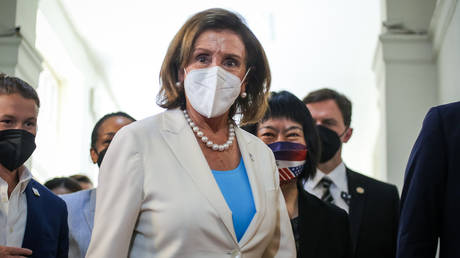
For instance, was there some legitimate benefit contemplated when 82-year-old congressional leader Nancy Pelosi disregarded China’s warnings and visited Taiwan last August? Did she bring the countries closer to war or further from it? The result was China’s decision to dramatically increase drills in the Taiwan Strait and sever military and climate ties with the US.
The same questions might be asked about Washington’s “freedom-of-navigation” exercises in the region, such as when the US Navy sent warships through the Taiwan Strait earlier this month. Do such actions create more risk of conflict or less? What was the point? On the latter question, a US Navy spokeswoman said, “The United States military flies, sails and operates anywhere international law allows.”
When the US was doing the same sort of thing in 1940-41, the provocations near or within Japanese waters were called “pop-up cruises.” Roosevelt advocated the tactic, saying, “I just want them to keep popping up here and here and keep the Japs guessing.” Kimmel, who later became a scapegoat for the Pearl Harbor attack, was among the critics of the pop-up strategy, saying, “It is ill-advised and will result in war if we make this move.”
Like the sailors, soldiers and civilians whose lives were ended or shredded that day, Kimmel paid a price for the US war-instigation policy when he lost his command. But the heavy losses were a price worth paying, at somebody else’s cost, for the war planners in Washington.
Tony Cox is a US journalist who has written or edited for Bloomberg and several major daily newspapers.
Featured Video

ARE PATIENTS BEING PROPERLY INFORMED ABOUT OZEMPIC?
or go to
Aletho News Archives – Video-Images
New Book
Breast Cancer: Before You Consent
A new Unbekoming paperback
Lies are Unbekoming | September 18, 2026
Peter Gøtzsche reviewed every randomised mammography screening trial ever conducted for the Cochrane Collaboration. Cochrane’s headline is that, assuming a 15% mortality reduction, one woman in 2000 avoids dying of breast cancer over ten years. Ten are overdiagnosed and treated. Two hundred experience false alarms.
But that headline assumes the reduction. When Gøtzsche looked only at the trials with adequate randomisation — the higher-quality ones — the reduction disappeared. No effect on breast cancer mortality. No effect on all-cause mortality.
This is the Cochrane finding, published in the establishment’s own database of systematic reviews.
No woman being asked to consent to a mammogram this week knows it.
That is why the new Unbekoming paperback exists. … continue
Blog Roll
 Aletho News
- The Truth About the Trump Shootings with Ken Silva
- ARE PATIENTS BEING PROPERLY INFORMED ABOUT OZEMPIC?
- US lawmaker blocks $2.8 billion weapons sale to Israel: Report
- Yemeni army claims responsibility for strikes on sensitive sites in Saudi capital, Aramco facilities in Yanbu
- Iran Judiciary issues indictments against 159 US, Israeli officials for assassination of Leader, commanders
- Turkiye revokes Iranian bank license under US sanctions campaign
- US-Denmark Agreement on Greenland Is ‘PR Stunt’ Ahead of Midterms
- Araghchi: Military intervention cannot create security; coercion cannot bring peace
- Fraud Squared
- Breast Cancer: Before You Consent
- If Americans Knew
- Inside Gaza’s death trap of collapsing, bombed-out buildings
- The everyday items Israel bans from Gaza every day
- Inside the siege, the ruined buildings of Gaza – Daily Update
- Debunking The Claim That Macklemore Has A “History Of Antisemitism”
- CPJ demands release of arrested Palestinian-US journalist near Bethlehem
- Robert Kraft: The Billionaire Friend of Netanyahu Pulling The Strings Behind the Macklemore/Ed Sheeran Blow Up
- Columbia Administered Fund Gives Big Money to Pro-Israel Groups
- Deportation Case of Palestinian Activist Salah Sarsour Tests First Amendment
- ‘We Will Not Forget’: Palestinians Mark 44 Years since Sabra and Shatila
- Why do we let Zionists decide what we can and can’t say?
- No Tricks Zone
- 2025 Nature Paper Claiming Worsening Global Drought Gets RETRACTED …Heavily Flawed
- New Study: ‘Global Drought Shows No Detectable Recent Acceleration Under Climate Warming’
- Economic Masterminds: German Socialists Suggest Taxing Productivity Gains Stemming From Using AI
- The South China Sea Has Not Been Cooperating With The Climate Change Narrative
- Energy Crisis: Germany Enters Heating Season With Historically Low Gas Reserve Fill Levels
- New Study: The Antarctic Ice Sheet Gained Mass From 2020-2024 Due To Staggering Snow And Ice Accumulation
- Study: Ocean Heating Rates From Thousands Of Years Ago ‘Dwarf’ Modern Ocean Heating Rates
- Climate Extremists Target, Attack Large-Scale Power Grid Infrastructure In Germany!
- New Study: Antarctic Ice Melt Has Contributed Less Than 1 Centimeter To Sea Level Rise In The Last 30 Years
- Fear Of Debate: Alarmist German Climate Scientist Calls On Mainstream Media To Discredit Skeptic Voices
 Aletho News