‘Globalization Has Died and Davos 2023 Was Its Funeral Ceremony’
Sputnik – 21.01.2023
The World Economic Forum’s annual meeting took place in Davos on January 16-20, 2023. International observers sat down with Sputnik to formulate the main message of the gathering in a nutshell.
“This year’s forum featured the new state of the world: divided, resentful, and grim,” Gal Luft, director of the Washington-based Institute for the Analysis of Global Security, told Sputnik. “Davos has become the dressing room of the West and is more divorced than ever from the rest. It no longer represents the real concerns of most of the world’s population. Its obsession with climate change, social justice, gender and other forms of wokeness has made it a laughing stock and target of disdain for most of the world.”
The World Economic Forum (WEF), an international non-governmental and lobbying organization, was founded in January 1971 by German economist Klaus Schwab. Initially the entity was called “European Management Forum”; it changed its name to the World Economic Forum in 1987.
Bringing together business executives, thought leaders, and prominent politicians, the forum sought to become a global platform to spearhead the ideas of globalization and solve pressing economic and political dilemmas. However, some Western commentators observed that the forum quickly morphed into a technocratic globalist elitist club which sought to dictate rules for the rest of the world.
“Globalization was based on the premise of broad acceptance of global institutions, norms and rules, as well as reasonably free flow of goods, money and information,” Luft said. “Each one of those has been compromised over the past few years, first with the US-China decoupling and second with the war in Europe. Instead, we have global bifurcation into two camps – the collective West plus honorary members and all the others – and the emergence of new institutions, alliances, financial instruments, trade blocs and priority sets.”
“There is no return to the post-WWII system. In addition, we are seeing massive repudiation of some of the institutions and individuals who have been most associated with globalization: the media, Davos, entertainment industry etc. De-globalization can also be seen along cultural fault lines. Western ideas, ethics, and ‘values’ are rejected by billions who see them as dangerous and destabilizing,” the US scholar continued.
Russia’s Independence Doesn’t Fit in Davosian ‘Ideal World’
The necessity to “defeat” Russia became a leitmotif of the gathering, with German Chancellor Olaf Scholz declaring that to end the ongoing conflict in Ukraine, the Russian special operation “must fail.” The chancellor called for stepping up military aid for Ukraine, but fell short of confirming that Berlin would send its Leopard 2 main battle tanks to Kiev, something that the Ukrainian regime, Poland, Finland, and the UK are urging him to do.
For his part, Harvard Professor Kenneth Rogoff, former chief economist at the International Monetary Fund (IMF), urged the West not only to step up anti-Russia sanctions, but to create conditions for “regime change” inside Russia.
“The forum in Davos is a congress of adherents of globalism,” Konstantin Babkin, president of the Rosagromash Association and co-chair of Moscow Economic Forum (MEF), told Sputnik. “These people would like to see a unified world where global corporations rule, dominating even the official state structures. What is happening in Ukraine contradicts their ideas of an ideal world. Many multinational corporations had to leave Russia. So, [Russia] has fallen out of the control of these Western corporations. This contradicts their ideas about the ideal state of affairs.”
While the Davos participants insisted that it is necessary to support Ukraine and to make sure that Russia obeys the rules established by the West, it appears that many countries have tired of this bellicose rhetoric, according to Babkin.
‘Biodiversity’ in Economy & Politics Instead of Global Unification
The Western-centric globalized world order is falling apart at the seams, with other countries adopting a non-aligned status and implementing their own scenarios of development in terms of their financial policies, foreign trade, and tax policies, according to Babkin. The Russian scholar argues that re-industrialization and strengthening of national economies could ensure the world’s stability and diversity of models.
“It would be nice to have different models, different states, different peoples, different cultures,” the Russian scholar said, drawing parallels with natural biodiversity. “[There will be] Iranian model, Indian model, Chinese model, Western model, and rejection of globalism. I think this is a good thing, and Russia needs to develop its own economy. I can also advise Iran, and China, and other large states, and state associations (…) I think the world that Davos is promoting is so unstable.”
Remarkably, major developing nations, including Russia and China, “have shunned the forum and inspired others to do the same,” said Luft, calling these countries a “resistance bloc.”
“In the years to come, with the inevitable departure of Klaus Schwab from the scene, the forum will lose its relevancy and will become just another exclusive overpriced Swiss club with entry ticket of $250,000,” Luft said. “It has already become a symbol of elitism and arrogance, representing the garden as opposed to the jungle, to use Josep Borrell’s terminology, and a platform to advance Western priorities.”
Babkin echoed Luft by saying that even though the Davos forum is likely to continue bringing together Western executives and politicians, it has ceased being a truly international platform and will never become what some call “the world’s government.”
“Globalization the way we know it has died and Davos 2023 was its funeral ceremony,” Luft concluded.
US-China unlikely to find breakthrough during Blinken’s upcoming visit to Beijing
By Ahmed Adel | January 18, 2023
US Secretary of State Antony Blinken will try to prevent China from deepening its cooperation with Russia during his visit to Beijing. Although it will not succeed, Blinken hopes that perhaps other topics could de-escalate the trade war and lessen tensions over the Taiwan issue, and in this way, also incentivise Beijing’s move away from Moscow.
Politico reported that Blinken will visit China on February 5-6, where he will meet with his Chinese counterpart Qin Gang. This meeting was later confirmed by the Chinese Ministry of Foreign Affairs.
It does raise the question why Blinken is seemingly desperate to meet with the Chinese foreign minister in Beijing. The US Secretary of State will likely try to divide Russia and China by raising the issue of Ukraine. Specifically, the US envoy may condemn the growing partnership between Moscow and Beijing, as it has done many times before, but offer incentives to move the Asian country away from Russia.
None-the-less, it is unlikely to work since China’s position is very firm and fully sympathises with Russia’s concerns about NATO’s encroachment and encirclement.
It is also speculated that during Blinken’s visit, the Americans would try to tactically reduce the extent of the trade war launched by former US president Donald Trump. Although the US are in public denial about it, policymakers in Washington are undoubtedly frustrated that the trade war against China and sanctions on Russia have failed to weaken them. In fact, this two-pronged American economic aggression has instead deepened trade ties and cooperation between the #2 (Russia) and #3 (Chinese) ranked military powers.
The visit will also relate to Taiwan. The US wants to find out if there is any possibility of a compromise or move following the victory of the staunchly “anti-China” Republicans in November’s midterm elections. They are even stepping up their military aid program to Taiwan and preparing for a visit by new House Speaker Kevin McCarthy. The visit is expected to take place in February or March.
Perhaps the Biden administration, along with Blinken, are trying to soften the future actions of the Republican-held House of Representatives. The problem for Washington is that the Chinese do not distinguish between Congress and the Office of the President. For Beijing – both offices are considered the official position of the US, even if it is contradictory.
It cannot be overlooked that Blinken’s visit will come before Chinese President Xi Jinping’s visit to Moscow in March. For this reason, it is expected that the Secretary of State will try to conduct exploratory activities to find out what will happen when the Russian and Chinese leaders meet.
Chinese Foreign Ministry Spokesperson Wang Wenbin said on January 17 that Beijing hopes for the US to adopt a correct perception, stick to dialogue rather than confrontation, and pursue win-win results rather than a zero-sum game.
“It is hoped that the US can work with China to fully deliver on the important common understandings reached between the two heads of state, and bring China-US relations back to the track of sound and steady growth,” Wang stressed.
Politico said in a report that Blinken’s “much-anticipated” trip to Beijing is a follow-up to the meeting Chinese President Xi Jinping had with his US counterpart Joe Biden in Indonesia in November 2022. At the time, Biden pledged to “maintain open lines of communication” with China despite worsening bilateral tensions.
According to Politico, some US observers, like former deputy assistant secretary of state Susan Shirk, believe that the visit will test China’s “moderate” foreign and domestic policies to satisfy the US. However, such a notion is ridiculous and unhelpful in recovering bilateral ties as it once again signals to China to compromise on its values and instead adhere to Western liberalism.
In fact, it is the US who is more desperate to repair relations with China, especially considering their own economic problems. The problem Washington has is that it does not want to compromise on the tensions it has created for itself.
“The Biden administration needs to bring back economic confidence, so what the US needs to do at the moment is to make full use of engagement with China to fix the damaged supply chains and save its own economy which is certainly in trouble. For instance, they should cancel the restrictions and sanctions that target China’s development but in fact harm the US economy as well,” The Global Times reported.
As mentioned though, despite the US needing to overcome this impasse, it is also stubborn and uncompromising in its endeavour to limit Chinese influence and preserve a unipolar world system. Biden has described China as the US’ only long-term competitor for global leadership and is orientating US foreign policy around this challenge, even whilst simultaneously attempting to contain Russia.
Although Blinken’s trip will also be the first by a top US official to China since Washington accused the country of perpetrating genocide against the Muslim Uyghurs, a charge rejected by Beijing, there is unlikely to be a major breakthrough during Blinken’s meetings with Chinese officials.
Ahmed Adel is a Cairo-based geopolitics and political economy researcher.
China urges Israel to stop ‘incitement’ to avoid escalation
MEMO | January 16, 2023
China’s Minister of Foreign Affairs, Qin Gang, urged Israel on Sunday to stop its “incitement” in order to avoid escalation with the Palestinians, news agencies have reported.
In a joint press conference with his Egyptian counterpart Sameh Shoukry in Cairo, the Chinese minister called on Israel to “stop incitements and provocations, and to refrain from taking uniliteral actions that could worsen the situation.”
Referring to the recent provocative incursion at Al-Aqsa Mosque by Israel’s far-right Minister of National Security, Itamar Ben-Gvir, Qin Gang reiterated the importance of “maintaining the status quo” in Jerusalem.
He also reiterated China’s longstanding position on resolving the Israeli-Palestinian conflict based on the “the two-state-solution and the land-for-peace principle.” The international community, he added, should find a “just” solution for the Palestinian people through a return to the negotiation table and resumption of the peace process.
Will Japan and India become permanent members of the UN Security Council?
By Petr Konovalov – New Eastern Outlook – 14.01.2023
On December 12, 2022 in London, during a meeting of the British Foreign, Commonwealth and Development Office, its head, James Cleverly, said that he was in favor of expanding the number of permanent members of the UN Security Council (UNSC) by including Japan, India, Brazil and Germany.
The British diplomat believes that the current world order allows a much larger number of people to live much better than before, but today it needs some changes. According to Cleverly, the UK is interested in reflecting the needs of as many countries as possible in the UN. He also noted that the inclusion of Japan, Brazil, India and Germany would allow London to expand interaction with these countries and thus accelerate the growth of global prosperity.
The British Secretary of State for Foreign, Commonwealth and Development Affairs said that the established system of international relations, which was approved as a result of the victory of the Allies after the Second World War, is allegedly outdated due to the fact that since 1950 the volume of world trade has increased by about 40 times, which has led to a radical change in the balance of power in the world. Furthermore, he emphasized that demographic changes had also made their own adjustments to the modern world order.
The rhetoric of the British leadership is quite logical. The UK no longer represents the military and economic power that it used to be during the second half of the previous century. London is aware that it needs allies to support it internationally. The countries listed by James Cleverly, which, in his opinion, should become permanent members of the UN Security Council, maintain close relations with the US and the UK and are highly likely to pursue a common policy with London and Washington on many issues.
In accordance with the norms of international law, the UN Charter can be revised only with the unanimous consent of all the permanent members of the UN Security Council. France, which is a permanent member of the UN Security Council and is loyal to the policy pursued by Washington and London, will support the proposal of the UK, however, Russia and China, who are also permanent members of the UN Security Council, may not approve its expansion, as this may upset their geopolitical plans.
Russia welcomes the inclusion of India and Brazil in the list of permanent members of the UN Security Council. The Russian Federation has fairly warm relations with these states, and it is unlikely that Moscow will have any international disputes with them in the foreseeable future. Back in 2010, Russian President Vladimir Putin, who was serving as Prime Minister of the Russian Federation that year, during a meeting with Indian diplomats, said that India should be included in the list of permanent members of the UN Security Council. Subsequently, the Russian president has always adhered to this rhetoric. As for Russian-Brazilian relations, they have always been at a high level, and Lula da Silva, elected for the third time as President of Brazil in October 2022, is known for his pro-Russian views. During the previous presidency of Lula da Silva, the international organization BRICS was created (in 2006), which includes Brazil, Russia, India, China and South Africa. Consequently, the Russian Federation is likely to approve the inclusion of Brazil in the list of permanent members of the UN Security Council.
However, the Kremlin has a negative stance when it comes to the inclusion of Germany and Japan in the list of permanent members of the UN Security Council, since these states are pursuing an unfriendly policy towards Russia, and Tokyo completely casts doubt on the territorial integrity of the Russian Federation, claiming control over the Kuril Islands.
It should be noted that the inclusion of Germany, Brazil, Japan and India in the list of permanent members of the UN Security Council is not beneficial for China either, since these states maintain good relations with the United States and will adhere to a pro-American position in numerous international disputes.
Germany and Brazil are in close economic relations with London and Washington and therefore, with a high degree of probability, they will act in the interests of the US and the UK if they become permanent members of the UN Security Council. Of course, China will prevent such a development of events.
In China, the memory of Japan’s war crimes against the Chinese population during the Second World War is still fresh. Beijing also disapproves of Tokyo’s pro-American policy and is wary of the impressive number of US military installations in Japan.
Relations between Beijing and New Delhi are also at a fairly low level. India and China are competing for influence in places like Bangladesh and Sri Lanka. The Chinese authorities do not want the strengthening of Indian international influence and will do everything in their power to prevent India from being included in the list of permanent members of the UN Security Council.
It is important to emphasize that skirmishes have periodically occurred between Indian and Chinese border guards over the past 45 years. As recently as December 9, 2022, another conflict broke out between the military of China and India along the Indian line of actual control in the Tawang district in the west of the Indian state of Arunachal Pradesh in an area of the disputed territory. As a result of the collision, the military personnel of the two countries were slightly injured.
Despite the rationality of the idea of expanding the list of permanent members of the UN Security Council, Russia and China are unlikely to take such a step. Russia will not vote for granting this privilege to Germany and Japan, which today openly support the Ukrainian army participating in hostilities against the Russian Armed Forces. In turn, China is not interested in increasing the clout in the international arena of Tokyo and New Delhi, which are on cool terms with Beijing. Also, China will not give an opportunity to Germany and Brazil to become permanent members of the UN Security Council since both countries sympathize with the policies of the states of the Western bloc. As noted above, without the unanimous consent of all the permanent members of the UN Security Council, changes in the norms of international law are impossible.
The West is pursuing its own interests and engaging in geopolitical confrontation with China through the Quadrilateral Security Dialogue (QUAD), which includes Australia, the US, Japan and India. Within the framework of this organization, annual military exercises of the participating countries are held.
On May 24, 2022, a QUAD summit was held in Tokyo, the main agenda of which, according to Australian Prime Minister Anthony Albanese, was to discuss how to counter the growth of China’s influence in East and Southeast Asia.
As it stands now, there will be no expansion in the number of countries that are permanent members of the UN Security Council any time soon, since this comes into conflict with the plans of several current permanent members of the UN Security Council. However, the absence of Japan and India in the UN Security Council is offset by their participation in the QUAD, as well as their close cooperation with the United States in the field of defense.
From Unipolar World to Multipolarity: Why US Attempts to Intimidate Africa Won’t Work
By Ekaterina Blinova – Samizdat – 12.01.2023
South Africa has criticized Washington over its pressure campaign on African nations for maintaining relations with Russia. Defense and Military Veterans Minister Thandi Modise was quoted as saying that the US threatens African nations over “anything that is even smelling of Russia.”
South African Defense and Military Veterans Minister Thandi Modise’s criticism was sparked by reports concerning a delivery of “unidentified” cargo to the Simon’s Town naval base in December 2022 by an alleged Russia-flagged merchant ship.
In November, when the US learned that the vessel in question was headed toward South Africa, the US Embassy alerted Pretoria that the ship had been subject to Washington’s sanctions since May 2022. In accordance with US laws, Washington can impose restrictions on any entity, person or country that provides services to a sanctioned vessel.
The US press said that the embassy received no response from the South African government, adding that the alleged sanctioned freighter was accepted at the nation’s port in December.
Addressing the issue earlier this week, Defense and Military Veterans Minister Thandi Modise told US media that “whatever contents this vessel was getting were ordered long before COVID,” and lambasted Washington over the unjustified pressure the latter has imposed on African states maintaining ties with Moscow.
Since the beginning of Russia’s special military to demilitarize and de-Nazify Ukraine in February 2022, the US has been trying to isolate Moscow and disrupt its cooperation with the Global South.
Earlier, on April 27, 2022, the US House of Representatives passed the HR 7311 Countering Malign Russian Activities in Africa Act with a bipartisan 419-9 majority. The legislation was aimed at sanctioning African nations over cooperating with Moscow. It was later referred to the Committee on Foreign Relations by the US Senate and appears to be on hold.
Washington’s Tools of Coercion
“One of the leverages is fear of sanctions,” Eguegu Ovigwe, a policy analyst specializing in geopolitics and African affairs at Development Reimagined, told Sputnik. “I think HR 7311 – that is the act where the US secretary of state developed strategies which were submitted to Congress, an implementation plan, of course, to counter the so-called malign influence of Russian activities in African countries. So that really gives a legislative backing or legislative framework to potential sanctions that the African countries may come under if they continue to have a relationship with Russia that the US doesn’t like.”
Washington’s hypocrisy is obvious, according to Ovigwe: on the one hand, the US asserted to African nations that it wouldn’t force developing countries to choose between Russia and China or the United States; on the other hand, US House lawmakers almost unanimously passed legislation aimed at punishing Africans for maintaining ties with Moscow.
“[I]t is not the place of the United States to dictate what supposedly sovereign countries should do,” stressed the analyst. “This is the extraterritorialization of US law. So, if the US passes a law, that’s for the US; it has nothing to do with bilateral relations between two other countries.”
In addition to sanctions, the US could cut African nations off its global economic programs, according to Ovigwe. For instance, the Bill Clinton era’s African Growth and Opportunity Act (AGOA) provides duty-free treatment for goods of designated sub-Saharan African countries (SSAs). Earlier this month, Burkina Faso, a desert landlocked African country located in the Sahel, was officially removed from the program by the US for not meeting the initiative’s requirements. Last year, the Biden administration also terminated the AGOA program for Ethiopia, Mali, and Guinea over what it called “unconstitutional change in governments” and “the gross violations of internationally recognized human rights.”
Washington may also reduce or nullify foreign direct investment (FDI) to some African countries to twist their arm into halting relations with Moscow, Ovigwe continued.
Still, the scholar does not think that removal from AGOA or lack of US investments could spell doom for the continent. The crux of the matter is that there are enough global players interested in Africa’s growing market and rich natural reserves who are willing to fill Washington’s shoes, according to him.
Africa’s Alternatives & Opportunities
Africa has far more promising development projects than the AGOA: in May 2019, the African Union (AU) kicked off the African Continental Free Trade Area (AfCFTA), which looks to create a single continental market with a population of about 1.3 billion. It could become by far the world’s largest free trade area, bringing together the 55 countries of the African Union (AU) and eight (8) Regional Economic Communities (RECs).
“I don’t think many countries will be losing sleep, fearing that they’re going to be kicked out of AGOA, with the wealth of opportunities which may present themselves,” Ovigwe noted.
Remarkably, the US rushed to embrace the AU’s project in December 2022, with the White House saying that the initiative “present[s] an extraordinary opportunity for the US to invest in Africa’s future.”
The US has long been lagging behind the EU and China in terms of trade with the continent. While the US trade with Africa reached $83.6 billion in 2021, it pales in comparison with the EU’s €288 billion ($306 billion) and China’s $254 billion in the same year.
When it comes to FDIs, China, a US major geopolitical competitor, is currently investing heavily in Africa, noted Mikatekiso Kubayi, researcher at the Institute for Global Dialogue associated with UNISA and research fellow at the Institute for Pan African Thought and Conversation.
“China continues to be the leading source of FDIs in Africa and has a pipeline of projects, particularly in infrastructure,” Kubayi told Sputnik. “Africa’s relations with China continue to deepen. This relationship can yield great benefits to both parties in joint research and development, manufacturing in Africa, and an African market that is expected to reach 2.5 billion in population by 2050. African wealth in minerals such as rare earths and others are all thoroughly purposefully explored for practical action and development.”
Multipolarity is Answer to Intimidation
Washington’s unipolar approach creates an uneven playing field for developing countries as the US is still communicating with the Global South from a position of force, according to the observers. In contrast, the multipolar vision ensures equality and fair conditions for all players.
“The recent G20 summit reiterated the importance of multilateralism and the United Nations in its declaration,” Mikatekiso Kubayi underscored. “BRICS – which China and Russia are members of – emphasized the need to deepen and improve the practical experience of multilateralism with the United Nations at its center. The changing geopolitical landscape is changing precisely because of the realization that it does not benefit the majority of the world.”
The US attempts to coerce Africa into submission, including through anti-Russia legislation targeting the continent, “do not seem to generate confidence and positivity,” Kubayi warned.
Meanwhile, unlike the Group of Seven (G7) which appears to be a closed club of Western industrialized nations plus Japan, BRICS has the potential to grow and develop by adding new members, according to Ovigwe. Previously, Argentina, Iran, and Saudi Arabia signaled their interest in becoming BRICS members.
“You have emerging multilateral platforms like BRICS, for instance, that have so much momentum, and seem to be more open to emerging powers, more focused on issues that are really important to the majority of the world,” Ovigwe stressed. “One of the trends we might see going forward is countries tilting more towards these new and emerging multilateral platforms because they want it to be accessible to them. G7 is not going to be expanded – it has already contracted from G8 to G7.”
The scholar added that he hopes the global system moves towards more new, open, and more dynamic platforms like BRICS.
A multipolar world is taking shape, offering new alternatives and opportunities to developing states and thwarting attempts to intimidate global players by sanctions and use of force, according to the observers.
Britain and Japan to sign defense pact
UK and Japanese troops will be deployed on each other’s territory, as Tokyo deepens its alignment with NATO powers
RT | January 11, 2023
UK Prime Minister Rishi Sunak and his Japanese counterpart, Fumio Kishida, will sign a major defense agreement on Wednesday, Sunak’s office has announced. With Britain and its NATO allies focused on opposing both Russia and China, Japan is deepening its cooperation with the Western military machine.
The ‘Reciprocal Access Agreement’ will allow both countries to deploy troops on each other’s soil, and to hold “larger and more complex” joint military exercises, according to a statement from Downing Street.
While Japan already hosts around 50,000 US troops, Wednesday’s signing will make the UK the first European nation to have a reciprocal access deal with Japan. Australia has had such an agreement with Japan since 2007, although this pact became non-binding when it was renewed in October.
The signing comes a month after Japan, the UK, and Italy announced that they would team up to develop a sixth-generation fighter jet, merging separate national jet programs.
These developments mark a significant step by Japan away from its post-WWII constitution, which commits the country to a pacifist foreign policy and mandates that its military be a strictly defensive and peacekeeping force.
However, Japan joined the renewed Quadrilateral Security Dialogue – a loose military alliance with the US, India, and Australia explicitly aimed at countering China in the “Indo-Pacific” region – in 2017, and in December announced a doubling of its military budget, citing missile “missile threats” from China and North Korea.
Tokyo also joined the West in sanctioning Russia over the conflict in Ukraine, and plans on stationing supersonic missiles near Russia’s northeastern islands. Moscow considers this plan to pose “a serious challenge” to its security.
Sunak and Kishida are set to discuss both Ukraine and China on Wednesday, with the British prime minister’s office stating that they would talk about “the need to maintain our collective support” for Kiev and strengthen its military.
Top USMC commander in Japan says Pentagon preparing for war with China
By Drago Bosnic | January 11, 2023
The United States is now publicly discussing the “containment” of China with its Asia-Pacific vassals. On January 8, the Financial Times reported that the supreme US Marine Corps commander for Japan gave very direct statements regarding Pentagon’s China strategy. Lieutenant General James Bierman thinks there are “numerous parallels” between Ukraine and Taiwan and admits the US is preparing what he dubbed “a counter-China theater” by strengthening coordination with its regional satellite states.
“The US and Japanese armed forces are rapidly integrating their command structure and scaling up combined operations as Washington DC and its Asian allies prepare for a possible conflict with China such as a war over Taiwan, according to the top Marine Corps general in Japan,” the FT report states.
Japan has indeed become more active, as its new government decided to abandon the economy-focused policies Tokyo practiced since WWII ended. The historic shift doesn’t only include (re)militarization, but also an increasing rivalry with three regional powers – China, North Korea and Russia. Apart from a break with its military neutrality, as Tokyo is massively increasing its defense budget, USMC Lieutenant General Bierman confirmed that Japan is exponentially expanding its role in joint military operations with America.
In what can only be described as a complete break with even a semblance of diplomatic etiquette, the US general spoke in a very direct and rough manner, particularly in regards to the ongoing arming of Taiwan, claiming this serves “to prepare” the island similarly to how the Kiev regime has been since 2014. His exact statement was as follows:
“Why have we achieved the level of success we’ve achieved in Ukraine? A big part of that has been because after Russian aggression in 2014 and 2015, we earnestly got after preparing for future conflict: training for the Ukrainians, pre-positioning of supplies, identification of sites from which we could operate support, sustain operations. We call that setting the theatre. And we are setting the theatre in Japan, in the Philippines, in other locations.”
The interview is scandalous, to say the least, as it can hardly be considered anything else but an attempt to provoke China. This is further reinforced by the US general’s explicit comparison of Taiwan and Ukraine, which is a textbook example of how the political West generates conflicts that then turn into open warfare. Bierman’s position as the commander of the Third Marine Expeditionary Force and USMC Forces Japan makes these statements all the more disturbing and alarming, especially to Beijing, which has been making strides to improve relations with the US.
As the general casually admitted the political West spent years preparing the Kiev regime for war with Russia (while feigning “efforts for a peaceful resolution“), his comments about Taiwan are quite revealing and will surely be taken very seriously in China. Even the FT, one of the flagships of Western mainstream media, admits that Bierman’s statements are an “unusually frank” comparison with Ukraine. To make matters worse, he didn’t stop there, but made several more controversial “frank comments”. The FT claims the general’s further statements were as follows:
“When you talk about the complexity, the size of some of the operations they would have to conduct, let’s say [in] an invasion of Taiwan, there will be indications and warnings, and there are specific aspects to that in terms of geography and time, which allow us to posture and be most prepared… …You gain a leverage point, a base of operations, which allows you to have a tremendous head start in different operational plans. As we square off with the Chinese adversary, who is going to own the starting pistol and is going to have the ability potentially to initiate hostilities… …we can identify decisive key terrain that must be held, secured, defended, leveraged.”
The aforementioned preparations also include the Philippines. Manila reportedly plans to allow US forces to double their prepositioned weapons and logistics in the island country. In addition to five Filipino bases, the Pentagon will gain access to five more, all of which will be part of the “China containment effort”. Bierman also “cautioned” the US regional vassals “not to overestimate the Chinese military”, claiming that “the PLA should not be fearfully seen as being 10 feet tall”.
It’s quite clear the general couldn’t have possibly acted on his own when giving such statements, indicating that the Pentagon refuses to deescalate the ever-growing tensions in the increasingly contested Asia-Pacific region. If Washington DC continues with these aggressive Sinophobic policies, Beijing is extremely unlikely to stand idle. China’s aim is a peaceful settlement with Taipei and this isn’t just its official position, but a clearly defined goal. Beijing has consistently been working to achieve this through diplomatic and economic means. For decades, it invested heavily in improving ties with the island, offering unparalleled autonomy.
On the other hand, America has been “discouraging” Taipei from signing any deals with China. This has prompted Beijing to further invest in its military might. Although China’s primary focus is economic development, it also had to make plans for strategically important contingencies such as further arming of Taiwan, to say nothing of the US-backed independence movement which has gained traction in recent decades. Although it hasn’t given up on a diplomatic solution, as it’s still investing in a “soft power” approach towards its breakaway island province, China still needs to mitigate the disastrous effects of the significant US regional influence.
Drago Bosnic is an independent geopolitical and military analyst.
China invests millions in oil production in Afghanistan
Free West Media | January 9, 2023
While Western governments are trying to ignore or isolate the Taliban regime, which was able to take power in Afghanistan in August 2021, an Afghan-Chinese deal worth millions was concluded. China wants to develop an extensive oil field in Afghanistan. The Afghan mining minister and Chinese representatives signed a corresponding agreement in Kabul.
Accordingly, oil deposits are to be developed in three northern provinces in the Amu Darya Basin. The Chinese company CAPEIC plans to invest 150 million US dollars as a first move. The joint project aims to create around 3,000 jobs. The Taliban government will initially receive a 20 percent share of the profits. It is the largest planned economic project since they came to power.
Afghanistan has large deposits of raw materials that have hardly been tapped in the past four decades due to the ongoing military conflict. According to estimates, the total value could amount to one trillion dollars (around 940 billion euros) and more.
So far, however, the infrastructure such as roads, rails and sufficient power capacity has been missing to exploit the deposits on a large scale.
Afghanistan’s landlocked location and rugged landscape make mining and export difficult. However, the cooperation project with the Chinese should give Afghanistan access to the Chinese Silk Road transport network, which is intended to promote economic integration between China and the rest of the Eurasian-African landmass.
China’s normalization overtures rejected as US opts for another Taiwan escalation
By Drago Bosnic | January 9, 2023
For decades, many geopolitical experts have been claiming the United States is in constant need of geopolitical adversaries. The view was challenged by those claiming that all the US wants is the spread of “peace, prosperity, democracy, freedom, human rights,” etc. And yet, the belligerent thalassocracy is consistent in its rejection of mutually beneficial relations with other global powers.
USSR/Russia essentially dismantled its own superpower status in an attempt to establish normal ties with the political West and focus almost exclusively on economic cooperation and integration. The political West responded with an unrelenting eastward expansion and effective destabilization and encirclement of Russia’s core regions in the west of the country. Despite Moscow’s patience, the results of this are now seen in Ukraine, where the Eurasian giant is forced to fight the same ultra-radicals it had to fight eight decades ago.
A somewhat similar scenario seems to be playing out in the increasingly contested Asia-Pacific geopolitical theater, where the US and (most of) its regional vassals are taking aim at China. Despite Beijing’s attempts at rapprochement with Washington DC and its numerous satellites, this seems to be futile. The belligerent thalassocracy keeps insisting on not just meddling in China’s internal affairs, but is also engaging in repeated violations of Beijing’s sovereignty and territorial integrity. This is especially true concerning the South China Sea, as well as the Asian giant’s breakaway island province of Taiwan, which is being pushed ever closer to an armed conflict with (mainland) China. Beijing is certainly capable of winning if the ongoing dispute ever turns hot, but it’s still trying to avoid such a scenario.
In line with its attempts at detente with the US, the last major (geo)political move China made at the end of 2022 was the appointment of a new foreign minister. On December 30, its ambassador to the US, Qin Gang, was appointed as the Foreign Minister of China, taking the diplomatic helm from Wang Yi. Major Western media outlets noted that the move could indicate Beijing’s “softening” stance toward America. Indeed, this could be considered one of the biggest recent developments out of Beijing and it could have impacted the future of US-China relations, as Qin Gang tried his best to keep ties between the two superpowers as friendly as possible during his relatively short, seventeen months-long tenure in Washington DC.
In the first days of January, the new Chinese FM grabbed the headlines of Western media by posting tweets that he’s “deeply impressed” by the American people, while pledging to push US-China ties towards a more positive relationship. “I want to pay sincere thanks to the people of the United States for the strong support and assistance given to me and the Chinese Embassy during this period,” Qin tweeted on January 2, adding: “I have been deeply impressed by so many hard-working, friendly and talented American people that I met,” further saying he had “made many friends across the US.” He promised to “support the growth of China-US relations” in his capacity as the new Chinese FM.
And yet, China’s overtures have been shunned by the US. On January 4, barely two days after Gang’s words, the Office of the US Trade Representative (USTR) announced it will be sending a delegation to Taipei this week for additional trade talks with the government of the breakaway island province. Washington DC and Taipei held formal trade talks last year and agreed to have more such meetings after the first round was held in New York in November. Although there are no official relations between the US and Taiwan, as even Washington DC officially considers the island as part of China, the American delegation is led by Terry McCartin, the assistant US trade representative for China affairs.
This means the move is carried out by President Biden’s Executive Office, giving the effort a formal diplomatic status, usually reserved for state-level contacts, which is highly unlikely to be appreciated in Beijing. In addition, the USTR stated that the meetings would be attended by officials from several other US government agencies. According to The South China Morning Post, Yang Jen-ni, Taipei’s deputy trade representative, will lead the Taiwanese delegations, which will also include officials from other departments. This clearly implies that the meeting will include more than just trade talks, further antagonizing China and its attempts at rapprochement.
Beijing views high-level contacts between Washington DC and Taipei as a direct violation of the One-China policy, to which, as previously mentioned, the US still officially adheres. This also includes trade talks, which have been almost exclusively aimed against China in recent years. Beijing views the trade talks as another US attempt to hurt China’s standing in the Asia-Pacific region. The USTR has dubbed the trade talks the US-Taiwan Initiative on 21st-Century Trade and said that “they are intended to develop concrete ways to deepen the economic and trade relationship.”
A major point of the talks is Taiwan’s position as the world’s largest producer of advanced semiconductors. The US is aiming to push Taiwan-based companies to move facilities to America, while sanctioning China’s microchip industry, marking a hostile shift in US trade policy toward the Asian giant. Additionally, speaking of hostility, on January 5, only a day after the controversial trade talks were announced, Washington DC further insulted Beijing by ordering the US Navy 7th Fleet’s Arleigh Burke-class guided-missile destroyer USS Chung-Hoon to pass through the Taiwan Strait as part of “its commitment to a free and open Indo-Pacific.” This was the latest sign that the US is clearly rejecting China’s peace initiatives.
Drago Bosnic is an independent geopolitical and military analyst.
The High Cost Of Blowing Up The World: Ukraine & The 2023 NDAA
By Matthew Ehret | Zero Hedge | January 2, 2022
Will Americans wake up to the reality that they’ve been walking on the wrong side of history for too long or has the point of no-return been crossed?
Bipartisan insanity was on display again this week as the U.S. congress responded to Biden’s requested $37 billion in additional aid to Ukraine by giving him $45 billion bringing the total U.S. support to its Davos-managed disposable ward up to $111 billion.
The aid was part of an overall omnibus spending bill passed by both houses of Congress was a gargantuan $1.7 trillion and included $858 billion in defense spending which far exceeds any sum ever spent by a U.S. government in history.
Of that $858 billion, $817 billion is allocated directly to the U.S. Department of Defense while the remaining $29 billion will be allocated to national security programs within the department of energy.
Continuing to Weaponize Taiwan
2023 NDAA Funds will be used to “strengthen” Taiwan in the Pacific with $12 billion authorized to assist Taiwan in purchasing weapons from the U.S. military industrial complex (with the $12 billion in ‘loans’ needing to be paid back over the course of the next five years of course). Of this fund, $100 million will be given directly to contractors to fill up a “contingency stockpile” to be used by Taiwan “in case of any future conflict”.
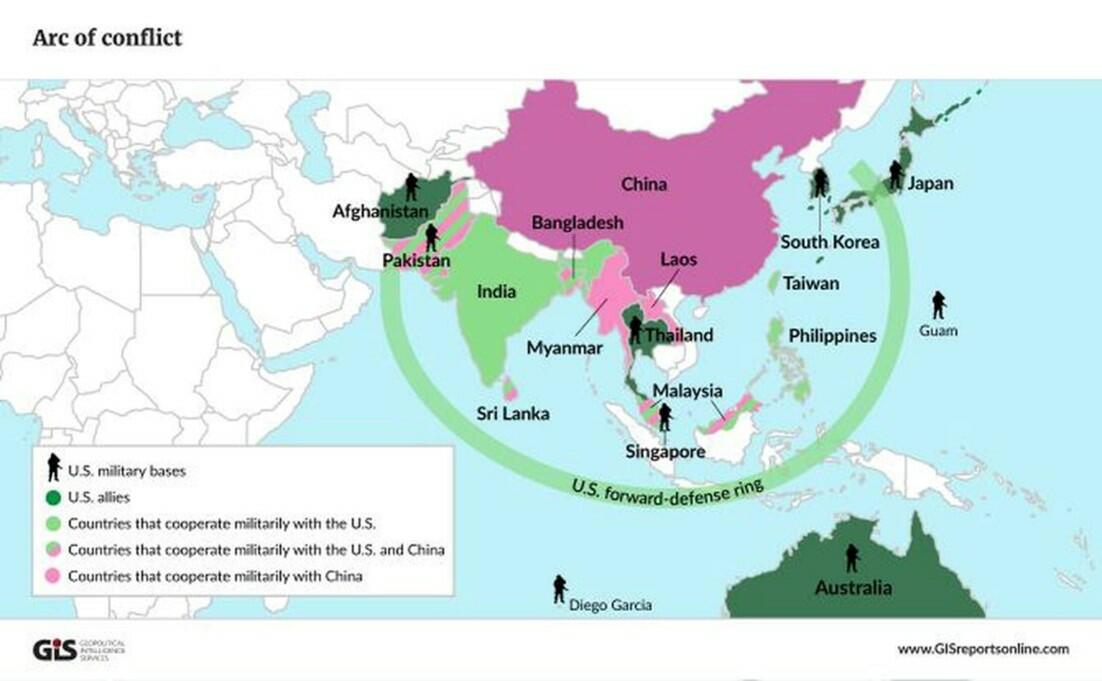
Additionally Taiwan will be invited to participate in the next U.S.-led Rim of the Pacific Military Exercise in 2024 and thus greater “Pacific NATO” strategy encircling mainland China. This exercise and broader Pacific NATO (aka Quad) anti-China arsenal of puppet colonies will be boosted by an additional $11.5 billion will be allocated to the Pacific Deterrence Initiative ‘to counter malign Chinese influence in the Pacific’.
Just as Ukraine has suffered U.S.-directed color revolutions in 2004 and 2014, so too has Taiwan been strung through a similar NED-funded ‘Sunflower Revolution’ regime change in 2014 which saw the Kuomintang Party taken out of power just as final stages of an economic integration agreement with mainland China were being finalized.
Billions have been tagged to purchase Lockheed Martin Corp’s (LMT.N) F-35 fighter jets and ships made by General Dynamics but beyond airforce, one of the biggest and most dangerous boosts in spending this year has been absorbed by a fixation on ‘space warfare’. $5.3 billion will be directed towards ‘space force’ and the ongoing effort to militarize space as a new dimension in war making in the 21st century (which was $333 million more than originally requested by military officials at space force’).
The recent U.S.-Canada-Australia joint ‘space warfare’ drills in order to prepare for an oncoming war over Europe took place at the start of December 2022 at the Schriever Space Force Base in Colorado- which [eliminates] the residues of any positive memory of ‘space diplomacy’ once seen under JFK’s leadership, the 1976 Apollo-Soyuz cooperation program or even the better aspects of President Trump’s Artemis Accord.
The 2000 RAD Origins of NDAA 2023’s Dark Age Doctrine
It would be a lie to say that this program for human extermination originated in 2022, or even under the previous presidencies of Trump or Obama.
If one wishes to grasp the germ seed of today’s policy doctrine, it would be necessary to revisit the Project for a New American Century Think Tank’s September 2000 Rebuilding America’s Defenses report where the end of history cultists then taking the helm of government stated:
“RAD” envisions a future in which the United States is in complete control of land, sea, air, space and cyberspace of planet Earth. It finds objectionable the limitations imposed by the ABM treaty and urges a newer rendition of Reagan’s ‘Star Wars’ defense shield program.
On top of calling for the USA’s exit from the ABM Treaty (which was promptly done in the wake of 911), the authors of RAD outline in clear detail the rationale behind the growth of the rise of a need for a new branch of the military known as space force. The authors stated that the USA must gain:
“CONTROL THE NEW ‘INTERNATIONAL COMMONS’ OF SPACE AND ‘CYBERSPACE,’ and pave the way for the creation of a new military service – U.S. Space Forces – with the mission of space control.”
Outlining the doctrine of ‘Full Spectrum Dominance’ the PNAC report outlined on page 51:
Global Missile Defenses — “A network against limited strikes, capable of protecting the United States, its allies and forward-deployed forces, must be constructed. This must be a layered system of land, sea, air and space-based components”.
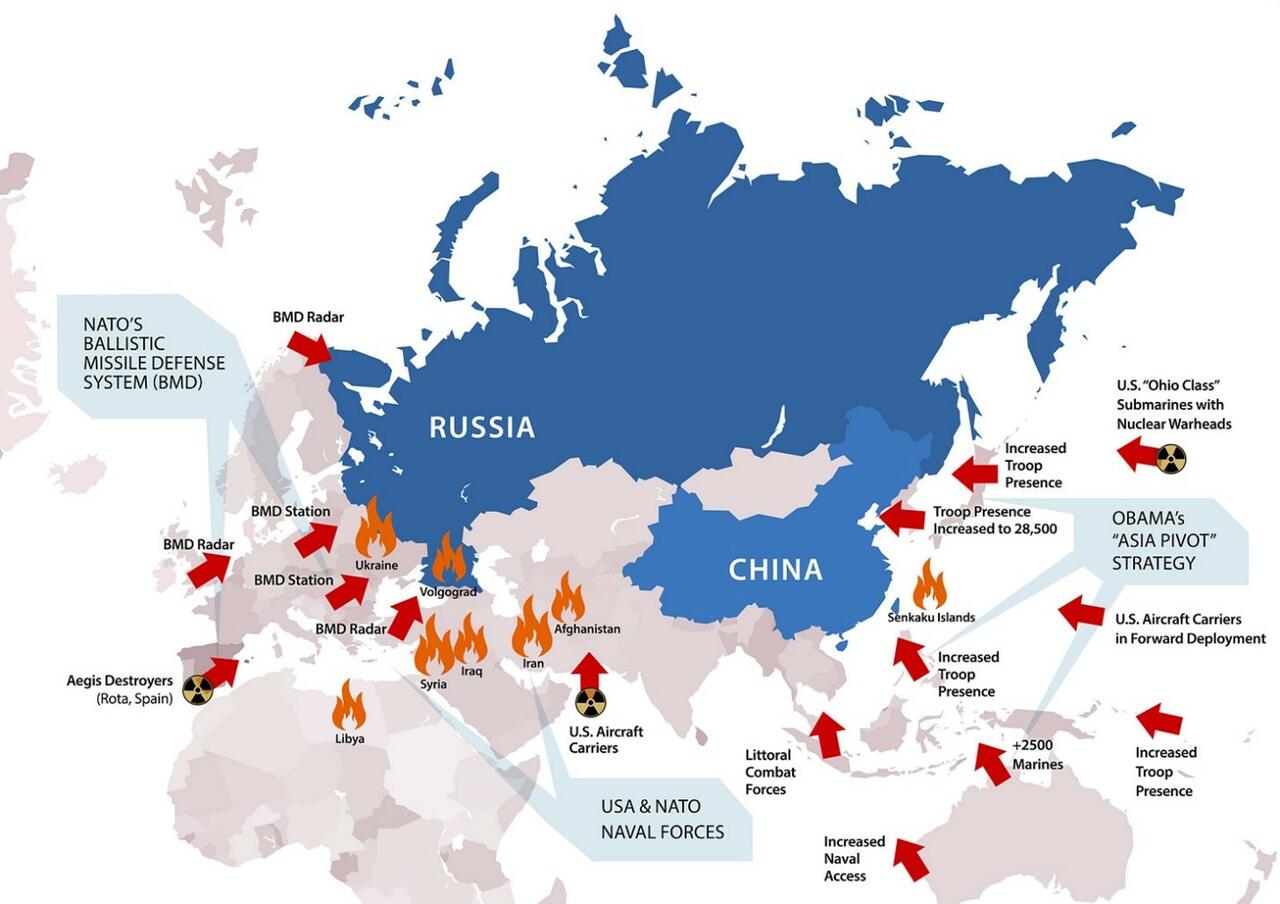
Looking towards the need to expand and modernize nuclear forces due to the possible danger of China, Russia, Iran, North Korea and Iraq, the RAD authors stated:
“Today’s strategic calculus encompasses more factors than just the balance of terror between the United States and Russia. U.S. nuclear force planning and related arms control policies must take account of a larger set of variables than in the past, including the growing number of small nuclear arsenals – from North Korea to Pakistan to, perhaps soon, Iran and Iraq – and a modernized and expanded Chinese nuclear force.”
Possibly one of the most dangerous and revealing aspects of RAD, was found on page 60, where the authors outline a program that soon grew into obscene proportions in the wake of the 2001 Anthrax attacks which justified the later passage of Cheney’s 2004 Bioshield Act as well as the growth of the 320+ international biolabs run by the pentagon. Describing the conversion of bioweapons from the realm of terror to “a politically useful tool”, the authors state:
“Although it may take several decades for the process of transformation to unfold, in time, the art of warfare on air, land, and sea will be vastly different than it is today, and ‘combat’ likely will take place in new dimensions: in space, ‘cyber-space,’ and perhaps the world of microbes… Space itself will become a theater of war, as nations gain access to space capabilities and come to rely on them; further, the distinction between military and commercial space systems – combatants and non-combatants – will become blurred. Information systems will become an important focus of attack, particularly for U.S. enemies seeking to short-circuit sophisticated American forces. And advanced forms of biological warfare that can target specific genotypes may transform biological warfare from the realm of terror to a politically useful tool”
Back to Ukraine
How will the $45 billion Ukraine money burning project be used? That’s not so easy to say exactly?
What we do know is that $22.9 billion will go towards what Kiev will be expected to use to buy more weapons from private U.S.-based defense contractors and much of the rest will be enjoyed by NGOs and Non Profits which will more often than not be run by figures closely tied to those same creatures in the Washington swamp who voted for these bills.
These uncomfortable facts were outlined repeatedly by the oft-slandered republican Senator Marjorie Taylor Greene whose multiple attempts to create some form of oversight and auditing of the handouts to Ukraine have been met with absurd levels of resistance since the special operation was launched in February. Even when such operations as the FTX crypto exchange (a major partner to Kiev and the World Economic Forum) was discovered to be simply a money laundering outfit infusing vast sums into the coffers of the DNC that were tied to Ukrainian operations, hardly a single western Mockingbird press outlet made a peep.
As the Pentagon Papers and Hunter Biden Laptop reminded us, not only has Ukraine been run by a coterie of money laundering grifting politicians enjoying endless skimming of foreign aid (Pandora Papers revealed that Zelensky and his billionaire handler Igor Kolomoskoi were both tied to offshore shell companies representing hundreds of millions of dollars of stolen loot), but also energy firms like Burisima which have been caught extracting revenue from the Ukrainian people the way silk worm farmers extract silk.
And what happens if you find yourself among that precious minority of republican or independent voices of resistance to this new plunge into world war? Just ask Representative Matt Gaetz who has been called out alongside other patriots such as Jim Jordan and Lauren Boebert for not applauding Zelensky’s pathetic speech in Congress this week. For the crime of keeping their hands from slapping in lock step with the rest of the congressional herd, NBC analysts like Michael Beschloss have attempted to stir up a McCarthyite witchhunt asking why these representatives refused to clap, asking:
“I’d like to know why that was for two reasons- Number one: You’re a public servant, we’re allowed to know those things. You’re supposed to tell us if you’re serving in Congress what the reason was. Do you love Putin, or are you just opposed to democracy, or is there something else?”
The fact that these figures even dared ask where graft was going probably touched a nerve too close to home with the Pentagon itself failing its fifth consecutive audit in November 2022 with over 65% of its assets and expenditures unaccounted for. That’s right, the government ‘lost track’ of $2 trillion in 2022.
Will enough Americans wake up to the reality that they have been walking on the wrong side of history for far too long or has the point of no-return already been crossed?
Chinese Media Says Washington ‘in No Position’ to Lecture Beijing How to Deal With Moscow
By Oleg Burunov – Samizdat – 01.01.2023
On Saturday, Chinese President Xi Jinping underscored that relations between Moscow and Beijing may “find new opportunities for growth” in 2023.
A Chinese media outlet has reported that the US is “in no position” to point the finger at China and lecture Beijing on “how to deal with its relations” with Moscow.
“Compared with the US’ alliance system, the China-Russia relationship, which is based on non-alliance, non-confrontation and non-targeting of any third party, not only conforms to the interests of both sides, but also can be more conductive in addressing global challenges,” the report said.
The solid ties between Beijing and Moscow “can help the world advance toward multipolarity, and prevent the international community from slipping into unilateralism.”
Even before the beginning of the ongoing Russian special operation in Ukraine on February 24, Washington “had been wary of close ties” between Russia and China.
“As the US has classified the two countries as its main competitors, or even potential foes, Washington is worried that the deepening cooperation between China and Russia will impact its global leadership and hegemony, and affect its containment effect against the two countries.”
The news outlet also quoted Yang Jin, an associate research fellow at the Institute of Russian, Eastern European and Central Asian Studies at the Chinese Academy of Social Sciences, as saying that the US “worries that mounting China-Russia cooperation in areas covering the economy and trade will significantly reduce the effect of sanctions imposed by the US and the West on Russia.”
The comments come after a US State Department spokesperson said on Friday that “those that side with Moscow in this unjust war will inevitably find themselves on the wrong side of history,” an apparent reference to the ongoing Russian special operation in Ukraine.
“Beijing claims to be neutral, but its behavior makes clear that it is still investing in close ties to Russia,” the spokesperson said, adding that Washington was “monitoring Beijing’s activity closely.”
The statement followed a virtual meeting between Russian President Vladimir Putin and Chinese counterpart Xi Jinping, during which the two, in particular, praised bilateral economic ties.
Putin stressed that “despite the unfavorable external conditions, illegitimate restrictions and direct intimidation by some countries of the West, Russia and China managed to secure record growth rates of mutual trade.” According to him, “by the end of the year, it will increase by 25%. Under such a dynamic, we will be able to reach the $200 billion target mark set by us for 2024 ahead of schedule.”
Xi, for his part, emphasized that China is ready to build up strategic cooperation with Russia in the interests of world stability against the backdrop of a difficult international situation. The Chinese president added that Beijing highly appreciates the fact that Russia is not refusing to resolve the Ukrainian crisis through negotiations.
In a separate development this week, Xi sent a New Year telegram to Putin, expressing a willingness to maintain close contacts with him in 2023.
“I am ready […] to lead our countries to the deepening of comprehensive strategic cooperation and practical collaboration in various fields for the benefit of the peoples of the two countries,” the telegram reads.
Featured Video

ARE PATIENTS BEING PROPERLY INFORMED ABOUT OZEMPIC?
or go to
Aletho News Archives – Video-Images
From the Archives
Trans ‘milk’ as good as the real thing – NHS
RT | February 18, 2024
The drug-induced nipple secretions of trans women are as good as mothers’ breast milk for babies, the University of Sussex Hospitals NHS Trust claimed in a letter to campaigners made public in a report by British think tank the Policy Exchange on Sunday.
The healthcare trust’s medical director, Rachel James, argued that the off-label prescription drug cocktail men transitioning to female take in order to produce milk was “similar to the natural hormones which encourage lactation to develop when the baby is newly born.”
“The evidence which is available demonstrates that the milk is comparable to that produced following the birth of a baby,” James wrote in the letter, sent to Children of Transitioners last August.
Biological men who wish to lactate must first take hormones to grow milk glands and then take high doses of either domperidone or metoclopramide to stimulate milk production. Neither drug is approved for this use, though they are occasionally prescribed off-label to biological women who have trouble lactating.
However, domperidone’s own manufacturer, Janssen, warns patients the drug “may cause unwanted side effects affecting the heart in a breastfed baby” and “should be used during breastfeeding only if your physician considers this clearly necessary.” … continue
Blog Roll
 Aletho News
- The Truth About the Trump Shootings with Ken Silva
- ARE PATIENTS BEING PROPERLY INFORMED ABOUT OZEMPIC?
- US lawmaker blocks $2.8 billion weapons sale to Israel: Report
- Yemeni army claims responsibility for strikes on sensitive sites in Saudi capital, Aramco facilities in Yanbu
- Iran Judiciary issues indictments against 159 US, Israeli officials for assassination of Leader, commanders
- Turkiye revokes Iranian bank license under US sanctions campaign
- US-Denmark Agreement on Greenland Is ‘PR Stunt’ Ahead of Midterms
- Araghchi: Military intervention cannot create security; coercion cannot bring peace
- Fraud Squared
- Breast Cancer: Before You Consent
- If Americans Knew
- Inside Gaza’s death trap of collapsing, bombed-out buildings
- The everyday items Israel bans from Gaza every day
- Inside the siege, the ruined buildings of Gaza – Daily Update
- Debunking The Claim That Macklemore Has A “History Of Antisemitism”
- CPJ demands release of arrested Palestinian-US journalist near Bethlehem
- Robert Kraft: The Billionaire Friend of Netanyahu Pulling The Strings Behind the Macklemore/Ed Sheeran Blow Up
- Columbia Administered Fund Gives Big Money to Pro-Israel Groups
- Deportation Case of Palestinian Activist Salah Sarsour Tests First Amendment
- ‘We Will Not Forget’: Palestinians Mark 44 Years since Sabra and Shatila
- Why do we let Zionists decide what we can and can’t say?
- No Tricks Zone
- 2025 Nature Paper Claiming Worsening Global Drought Gets RETRACTED …Heavily Flawed
- New Study: ‘Global Drought Shows No Detectable Recent Acceleration Under Climate Warming’
- Economic Masterminds: German Socialists Suggest Taxing Productivity Gains Stemming From Using AI
- The South China Sea Has Not Been Cooperating With The Climate Change Narrative
- Energy Crisis: Germany Enters Heating Season With Historically Low Gas Reserve Fill Levels
- New Study: The Antarctic Ice Sheet Gained Mass From 2020-2024 Due To Staggering Snow And Ice Accumulation
- Study: Ocean Heating Rates From Thousands Of Years Ago ‘Dwarf’ Modern Ocean Heating Rates
- Climate Extremists Target, Attack Large-Scale Power Grid Infrastructure In Germany!
- New Study: Antarctic Ice Melt Has Contributed Less Than 1 Centimeter To Sea Level Rise In The Last 30 Years
- Fear Of Debate: Alarmist German Climate Scientist Calls On Mainstream Media To Discredit Skeptic Voices
 Aletho News