China Conducts Military Maneuvers Near Guam, Okinawa
By Kyle Anzalone and Will Porter | The Libertarian Institute | December 30, 2022
The Chinese aircraft carrier Liaoning has sailed near the Japanese island of Okinawa and the US territory of Guam over the past two weeks. The naval operations came at the end of a year which saw several military escalations between Washington and Beijing.
Tokyo reported that the Liaoning and at least four other large warships operated in waters near Okinawa, adding that the ships remained about 150 miles offshore for several days. While in the area, the Chinese carrier conducted over 200 takeoff and landing drills.
On Thursday, Japanese officials confirmed that, after sailing away from Japan, the flotilla then traveled near the US territory of Guam. According to the Global Times, a Chinese newspaper closely linked with the country’s ruling Communist Party, the operation ”showed that the Chinese carrier is ready to defend the country against potential US attacks launched from there.”
The relationship between Washington and Beijing has continued to deteriorate in 2022, perhaps best exemplified by House Speaker Nancy Pelosi’s trip to Taiwan last summer and a massive round of Chinese military drills launched near the island in retaliation.
President Joe Biden has further fueled tensions by repeatedly asserting that US forces would come to Taiwan’s defense in the event of a Chinese invasion. However, Taiwan is not recognized as a sovereign nation under US law, which instead endorses Beijing’s claim to the island and calls for a position of ”strategic ambiguity” towards Taipei.
While a number of past US administrations have refrained from openly saying whether Washington would intervene against China on Taiwan’s behalf, Biden has increasingly eroded that position, prompting senior White House officials to walk back his statements on multiple occasions. Proponents of strategic ambiguity contend that the policy acts as a deterrent against any future attack by Beijing, and stops short of emboldening Taipei to take aggressive actions of its own.
Biden recently met with Chinese President Xi on the sidelines of the G20 summit. While the goal was to seek to resolve various outstanding issues between the two powers, both countries continue to conduct provocative military exercises.
Tokyo – which is part a three-way security pact with Washington and Seoul created to confront Beijing – has also escalated regional tensions by announcing an end to its post-WWII defense-oriented military and plans to become the world’s third-highest weapons spender over the next five years. Moreover, the United States has worked to persuade its allies in the North Atlantic Treaty Organization to take part in its operations in Chinese-claimed waters, while Canada recently announced plans to conduct more military transits through the disputed Taiwan Strait.
Beijing has significantly deepened its security and diplomatic ties with Moscow this year, with the two allies striking a ”no limits strategic partnership” in the days before Russia’s invasion of Ukraine in late February. The Asian superpowers have conducted joint drills in the waters and skies around both Japan and Taiwan in recent weeks, having just wrapped up naval exercises in the East China Sea on Tuesday. Another round of wargames on December 14 saw Chinese warships cross multiple Japanese straits as Russian fighters and bombers flew near Japanese airspace over the Sea of Japan.
Underscoring the rising hostilities, earlier this week the Pentagon released a video, captured on December 21, showing a Chinese fighter that approached an American spy plane over the South China Sea, accusing the pilot of performing an ”unsafe maneuver” that risked a collision.
Lavrov’s interview with the Great Game programme, December 28, 2022
Russian Ministry of Foreign Affairs | December 28, 2022
Question: Several years ago, I spoke with former US Secretary of State Henry Kissinger. At that time I had just returned from Moscow and told him that if the US and NATO policy of ignoring Russia’s concerns – with a satisfying smack on the head – continued, Russia would have to use force. Kissinger said if we did this, we would suffer big damage and all of NATO would unite against us.
He was right – the collective West united in response to the special military operation and has shown even greater solidity than many expected. Russia stands proudly and confidently; Moscow does not look like a city that has wavered or that doubts its correctness and strength.
What do you think about the possibility of military escalation, on the one hand, and serious talks next year, on the other?
Sergey Lavrov: You are right that the collective West has closed ranks. But this was not because every country in the alliance felt it wanted to. They were rallied, by the United States, primarily. Their mentality of domination has not been moderated in any sense.
A couple of weeks ago, I noted a statement by a Stanford professor to the effect that the US needed to be a global policeman to save the world. Not only NATO but also the EU, as an association that only recently claimed strategic autonomy, has fully conformed to the West’s uniform policy. Centres for coordinating actions by NATO and the EU are being set up, neutral states (Finland and Sweden) are being included. A mobility programme began to be introduced long before that. It provides for using transport and other infrastructure in non-NATO countries for moving NATO’s equipment eastward, closer to our borders.
Recently, some in the Great Game discussed the global changes taking place in the EU and Europe as a whole, and a shift in the centre of gravity in favour of Europe, primarily Poland, the Baltic states. the Czech Republic and Slovakia. Europe’s grandees are lost in this situation. Four years ago, President of France Emmanuel Macron spoke about the need for Europe to rely on its own forces and to have its own army. A strategic compass was created as a step to strategic autonomy. He talked about NATO being braindead, in expressing his disappointment with the processes imposed from overseas. Now this talk is over. Mr Macron said at one time, it would be necessary to create a system of security in Europe with consideration for the interests of all countries, including Russia. But he was quickly rebuked by the junior members of the alliance. Everyone sees this as the normal course of events.
As for how Russia was perceived throughout these years, including the time you met with Mr Kissinger, our Western colleagues used to say that “Russia needs to know its place.” They said this with pleasure. This is an accurate observation. This “pleasure” was felt practically in the years after the USSR. First, they patted us on the shoulder in the direct and figurative sense of the word. They believed we were in the “the golden billion’s” pocket and were becoming part of the Western globalisation system. Now it is called a system of rules that must underlie the world order. We were seen as an ordinary junior partner that had the resources needed by the West and to which the West would transfer technology while preserving its position in its own coordinate system. The tune is set by the Western leaders, primarily the US and its closest allies in Europe, that have straightened their shoulders and think they have the right to dictate how Europe is developed.
A recent article by Henry Kissinger was widely commented on. We took note of his evaluations and forecasts, including the options for a final settlement. Surprisingly, no one paid attention to the line that said, “As the world’s leaders strive to end a war in which two nuclear powers contest a conventionally armed country.” It’s probably a Freudian slip, but Henry Kissinger is a wise person and never says anything for nothing.
But this is a candid statement about who is fighting against whom. We are at war with the collective West led by the United States which is a nuclear power. This war was declared years ago after the coup in Ukraine which was orchestrated by the United States and supported by the EU, and after no one planned to act on the Minsk agreements (as we now know for sure). Angela Merkel confirmed this.
Several years prior to her stepping down as chancellor, in a conversation with President Vladimir Putin, when he, for the umpteenth time, reminded her what was written in black and white about the importance of resolving special status-related issues in a direct dialogue between Kiev, Donetsk and Lugansk, Merkel said that this was a case of “constructive ambiguity.” Allegedly, Russia was overseeing things in Donbass, so it was supposed to sort things out with Kiev as well. This was not an epiphany or an attempt to jump on the Russophobic “train” that was picking up speed. It was a deeply rooted stance.
Experts from the Presidential Executive Office and the Foreign Ministry drafted an approved text of agreements that confirmed the principled provisions of the Minsk agreements for the Normandy Four summit held in Paris in December 2019. A ceasefire and the disengagement of forces along the entire line of contact was the number one provision. This was agreed upon by everyone.
When the four leaders sat down at a table in the Elysee Palace and the parties took their seats along the perimeter, President of Ukraine Zelensky said that he would not act on or sign a document on disengaging forces along the entire line of contact. The most he was willing to do was pick three pilot sites and try to see if disengagement would work there. We had our suspicions right away, but we chose to clarify the reason behind the metamorphosis occurring on the way from the consensus achieved by the experts and the destruction of this consensus at the heads of state level. The Americans sent a signal that if Zelensky were to disengage forces along the entire line of contact, the Russians would never give Donbass back.
Question: Do you know for a fact that he received this kind of advice or instruction from the United States?
Sergey Lavrov: I’m not sure about the name of the person who conveyed that. But they told him what I just said: if he disengaged the forces, he would drastically reduce his chances of taking these territories back. They wanted to take them back through military force for one, and only one, reason. They were unwilling to fulfil the Minsk agreements in part concerning the terms and conditions for restoring Ukraine’s territorial integrity which were quite straightforward: the Russian language, their own local police (like the state police in the United States), and central authorities holding mandatory consultations when appointing judges and prosecutors, as well as special economic relations with neighbouring Russian regions.
The Republika Srpska in Bosnia and Herzegovina has that. This is also included in an agreement on the creation of a Community of Serb Municipalities in Kosovo reached by Pristina and Belgrade in 2013 with lots of ceremony and EU mediation. Almost the same rights were granted to the Serbs in northern Bosnia and Herzegovina, the same as in the Minsk agreements for the Russians living on the territories in question.
Zelensky refused to restore Ukraine’s territorial integrity which he could do by providing to a portion of the people the rights enshrined in numerous international conventions and the constitution which still spells out the obligation of the state to ensure the rights of ethnic minorities, and the Russians are mentioned separately. Plan B has been in existence since 2019 in Paris. From time to time, certain Ukrainian leaders have let it out that the Minsk agreements were not in their interest and said military force must be used to take it back.
The Ukrainian tragedy goes back quite a while. They are now trying to cancel the portion of it that clarifies what is going on now and many other things as well. Russian culture in Ukraine has been cancelled for many years now. Laws to this end were adopted back when President Poroshenko was in office and continue to be pumped out under President Zelensky. A couple of years ago, they approved a law on the Ukrainian language as the state language. This caused alarm even at the CoE Venice Commission, the European Union, and the OSCE. But the most these venerable institutions could do at the time was tell the Ukrainians they could keep the law, but should update the applicable legislation on ethnic minorities.
A few weeks ago, the Verkhovna Rada adopted the law on ethnic minorities in the second reading. This is Ukrainian lawmaking at its best. It says that the state guarantees the rights of all minorities to the extent defined in the applicable legislation. The new law on ethnic minorities includes everything that was restricted before that (education, media and culture) as the basis for the rights that the Kiev regime is willing to grant to ethnic minorities. The Romanian leadership is in uproar. They are now talking vociferously about the need for consultations and that no one asked them what they thought. The attitude towards the Hungarians and the way Kiev treats the Hungarian minority is well known. Needless to say, Russians are treated even worse than the Hungarians.
Forgive me for digressing before taking your question. The issue is about approving or not approving the neo-colonial international order, which President Vladimir Putin spoke about. The West is covering it in a shroud of respect for its rules-based order. When this term came into use, I asked my Western colleagues (we were still talking back then) to give us a list of these rules. No wonder no one has ever given us any reference material that would show the specific rules or the code of conduct. The answer is simple. These rules mean that everyone must do as the United States says.
Remark: These rules have been put forward by the West but they were never approved by the UN.
Sergey Lavrov: They have never been approved by anyone. No one has seen them. When they first introduced this into the international discourse, we immediately raised our concern and tried to engage them in rational discussion. However, they were unwilling to do anything of the sort.
These rules were best expressed in a statement made by a professor from Stanford University, who said that the United States had to be the global policeman to save the world. In many of America’s doctrinal documents, Russia is referred to as an immediate threat. That not because we are going to attack anyone somehow but because we have challenged this world order. China is next in line. It poses the most formidable and systemic long-term challenge, and it is the only country capable of surpassing the United States in almost all areas. In terms of nuclear weapons stockpiles and the development of nuclear capabilities, Beijing will soon be on a par with Moscow and Washington.
You can look for the answer to the question about the possibility of escalation in various statements and analyses by political scientists. The Russian authorities have not voiced an intention to take an escalation-based approach. We are committed to ensuring that the special military operation’s objectives are achieved. As President Vladimir Putin said, our indisputable priority is the four new regions of the Russian Federation. An end must be put to the threat of Nazification they have been exposed to for many years. We need to ensure security for all people living there, and their rights must be respected.
Another very important objective is to ensure that no threats to our security are created or remain on the Ukrainian territory. Now they say that the West did not try to urge Ukraine to engage in military action against Russia, however, I regard oppressing Russian-speaking people in Ukraine to be genuine aggression.
Question: I would like to clarify one issue. When you talk about the four regions, do you refer to their administrative borders or the part of their territory, as of today, that Russia has brought under its control?
Sergey Lavrov: No, I am talking about the borders of these regions as part of the Russian Federation, in keeping with our country’s Constitution. It is an obvious thing.
Question: Do you mean that Russia needs to liberate these regions?
Sergey Lavrov: Of course. It is required by the public vote held in each of the four regions. This happened long ago in the Donetsk and Lugansk people’s republics, while in the Zaporozhye and Kherson regions it was in autumn 2022.
Question: What you expect to achieve by the end of the negotiating process, or the recognition of this fact by Ukraine – are these prerequisites for launching the talks?
Sergey Lavrov: President of Russia Vladimir Putin has said many times that we never reject any proposal to achieve diplomatic agreements. The terms on which we agree to discuss them are well known. The fact that four territories belong to the Russian Federation is an indispensable condition for talks. But this is not all that must be discussed.
The second large block of problems, in addition to the destinies of the people who do not want to live under the current regime with its open Nazi and racist views is the security of the Russian Federation that has been subjected to numerous threats created on Ukrainian territory. Now some people are saying that this is not at all the case, that these exercises in Ukraine, including in the Black Sea, were “military cooperation for peaceful purposes.” The territory of Ukraine was actively developed. There were plans (we are aware of these as well) to establish a naval base in the Sea of Azov. You know that at that time this was a sea of two states. The construction of an Anglo-Saxon naval base would have radically changed the security situation. In the same way, there were plans to create a military base in then Ukrainian Crimea before the coup and the referendum in order to neutralise our capabilities in the Black Sea.
We do not launch spontaneous, offensive or striking operations unlike Ukraine. As a rule, Ukraine does this regardless of its losses. Its main goal is to produce a media effect there and then. The West would have continued to endlessly extoll its current leaders as representatives of genuine democracy. Vladimir Zelensky would be portrayed as a hero of the times, and he should have everything he wants for this reason. Yet, his requests are sometimes rejected. There are smart people in the West, who understand that these people and this regime should not be given some categories of arms.
“Anonymous specialists from the Pentagon have said more than once that they don’t have the right to prohibit Zelensky from striking the territories that are internationally recognised as part of Ukraine, including Crimea. There is some anonymous but credible evidence that American specialists were directly involved in modernising multiple launch rocket systems to extend their range to 1,000 kilometres. Nobody hides the fact that information from military and civil satellites belonging to US owners are actively used in real time for adjusting fire. US specialists are directly involved in targeting. We asked the Americans through the channels our Embassy still has, whether a decision to transfer a Patriot battery means the presence of US experts, considering the expertise needed to use it. We were given a lengthy explanation that this was not planned because the US didn’t want to and would not fight against Russia directly. It will take several months to prepare the Patriots for action, until the Ukrainian military master this technology. But there are dozens and maybe even hundreds of American military personnel there, and they were in Ukraine even before the coup. CIA employees occupied at least one floor in the Ukraine Security Service building. Now they have a big military attaché office. Obviously, military experts are not just visiting the Defence Ministry of Ukraine. They are giving direct consultative services (and probably doing more than that). There is also a group of specialists that (as the Pentagon explained in the US Congress) have controlled how American weapons were being used for months now. So, when some members of Congress tried to demand the creation of a special mechanism for this purpose, the Pentagon reassured them that they were monitoring all this. This is a rather interesting situation. There are many facts indicating that Western weapons are surfacing in Europe (maybe now in other regions as well). I asked my staff to make an open source compilation to show our interlocutors what is being swept under the rug at this point.
We are in no hurry. President of Russia Vladimir Putin talked about this. We would like to finish, as soon as possible, the war the West was preparing for and eventually unleashed against us through Ukraine. Our priority is the lives of the soldiers and civilians that remain in the zone of hostilities. We are patient people. We will defend our compatriots, citizens and lands that belonged to Russia for centuries, proceeding from these priorities.
Question: You quite rightly said that the West is waging a war against us through Ukraine and not only. The West and the United States hypocritically claim (since they are not officially sending their troops to openly fight against Russia on Ukrainian territory) that they are not a party to this conflict. Therefore, without fear of a third world war, including a nuclear one, they can send Ukraine any type of weapons, provide them with intelligence and advise on the battlefield. We can see that both the number and quality of weapons the West provides to Ukraine is growing. The West is overcoming its own taboos established several months ago.
What is Russia doing and what will it do in 2023 to convince the West to abandon this dangerous logic and stop this trend?
Sergey Lavrov: I believe that we must continue our policy outlined by Russian President Vladimir Putin on the ground to strengthen our capabilities, both technologically and from the viewpoint of military personnel who, after the partial mobilisation, have undergone serious training. A significant part of them is already there but most are not on the frontline where professionals, contract soldiers are fighting. A significant part of them is in reserve.
We will continue to strengthen our deployment. This decision was made in September 2022. The commander of the joint force was appointed. We are engaged in actions that will allow us to operate much more effectively in these territories in the very near future. I have no doubts about this.
We also pay attention to what you said – pumping Ukraine with large quantities of advanced Western weapons. I follow the discussion in our society, and on your programme, and in other political circles and formats.
Retired military professionals say that the supply of Western weapons needs to be cut off. I mean railways, bridges and tunnels. I believe this issue cannot be ignored by professionals. They have been paying attention to it for quite some time. They are responsible for taking professional decisions on the methods of obstructing and, ideally, blocking these supplies. One such method has been used and is still being used, which is inflicting damage on infrastructure, including energy infrastructure that enables the supply of these weapons. I believe there are also other plans for achieving the same objective.
We have scarce opportunities for talking to the West now. There is no particular desire to do this when you read statements by foreign ministers, prime ministers or presidents about the need to address the issue of security of Europe to protect it against Russia. They used to say “without Russia” and now they say “against Russia.” The idea of French President Emmanuel Macron to create a European political community boils down, roughly speaking, to the OSCE without Russia and Belarus. This was proposed by a man who a bit later said it was important to stay open to opportunities for building security institutions with Russia. Yet, the European political community will be gaining in strength. They have scheduled a regular summit for spring and are trying to drag all our neighbours, except Belarus, into it.
Considering this, we have no particular desire to talk to the West. When a concrete situation emerges where the West openly commits unlawful actions, then we ask questions. According to recent reports, Greece plans to transfer its S-300 missile systems to Ukraine. We asked our ambassador to contact the Greek Foreign Ministry and Defence Ministry and remind them that the systems in question had been transferred to Greece. You might remember that they had to be delivered to Cyprus but the West did all it could to not allow this to happen, given the insularity of Cyprus and it not being a NATO member. As a result, a compromise was reached that suited everyone. Greece bought this system. Under the contract for this deal, Greece may not transfer missiles to anyone without our approval. We reminded the Greeks about this. They said they remembered their obligations. We are closely following things like this, all the more so as the same provision prohibiting the transfer of our weapons to anyone applies to the majority of weapons in Eastern Europe – the member countries of the former Warsaw Treaty – where they were produced under licence. We need to be on our guard. Many unlawful actions are being committed under the slogan “Let’s Save Ukraine,” because “Ukraine Is Europe” and “Europe Is Ukraine.”
Question: Is the United States mistaken in thinking that it is safe, need not worry about any escalation or a direct armed clash with Russia and can render any and all military assistance to Ukraine until it enters a direct war against Russia?
Sergey Lavrov: President of Russia Vladimir Putin spoke about this at the recent expanded meeting of the Defence Ministry Board. He formulated our position as the Supreme Commander-in-Chief (I won’t add anything to it) on the new systems of our Navy, which have been put into operation now.
Question: Dimitri Simes started our conversation by saying that the West has closed ranks. I think the outgoing year has revealed an even more important trend. This is the formation of a global majority – the countries of the East and South, which do not accept Western hegemony and refused to side with the West against Russia. I perceive this year as the moment of truth in relations with the West and with non-West. Will our turn to the global majority be a strategic rather than opportunistic trend in Russian foreign policy that will be preserved and strengthened in 2023? What will Russia do in 2023 to promote its ties to the global majority and its role in world affairs?
Sergey Lavrov: I agree with those analysts reviewing the outgoing year who note that the discord between the West that claims hegemony and control over compliance with “its rules” everywhere, on the one hand, and the global majority, on the other, is an objective phenomenon. It was brewing and would have come to the surface eventually. We could no longer tolerate how Russians were being humiliated in Ukraine and how threats to our security were created there. We launched the special military operation that served as a catalyst and sharply accelerated this process.
It seems to me that after sanctions imposed on Russia following the coup against it and after the Crimean referendum, the majority of non-Western states had already realised that the system they were in with other countries was unreliable. This is a system of international currency, finance, globalisation, logistics chains, insurance for international shipments, freight rates and technological products that are produced by a handful of states. This applies to the same conductors on which the Americans are now trying to impose a veto. They have sanctioned Chinese companies that produce conductors in an obvious bid to slow down the development of the PRC. Everything happened much faster.
Many countries had to make a choice then and there. It was probably difficult, considering how deeply they were intertwined in the globalisation system. It was created by the Americans and discredited by them because Washington proved to be an unreliable curator and operator of this system.
Yes, we have heard the Chinese authorities saying that they are against hegemony and for building a fair world order, and the Indian authorities saying that they will be guided by the interests of India and that it is useless trying to convince them to abandon their national interests in favour of American geopolitical interests. Türkiye and Algeria, as well as Venezuela, Cuba, Nicaragua, Mexico, Argentina and Brazil have not joined the sanctions either. The emergence of a new world order will certainly gain momentum and is already gaining momentum. It will objectively be a whole historical era.
I noticed that somebody said during one of your shows that globalisation is giving way to regionalisation, and that there will be several large blocks formed around regional leaders. These blocks will create the instruments and mechanisms that replace globalisation instruments and mechanisms that are being abused by those who created them. The debate focused on whether the United States was aware of that process. Somebody said that it was and that the Americans would like to accelerate the regionalisation of the global economy and international relations in general. However, China, which is also aware of the importance of regionalisation and is not against regionalisation as such, is creating its own instruments and structures but would like this process to take as much time as possible.
I thought that it was an interesting opinion. It should be carefully analysed. If the Americans really wanted to accelerate regionalisation, they would have wanted to agree on the terms as much as possible and as soon as possible. The sooner you negotiate and come to certain terms, the better the chance that you will preserve the instruments you have been using globally.
There is no doubt that the process is underway. And the choice is not between the global majority and the West; we will choose those who are reliable partners and honour agreements, who hold a promise when it comes to long-term projects and will not only look for short-term benefits.
I discussed this with my American colleagues back when we had channels for a regular dialogue. Many officials in the US administration admitted at the beginning of the pandemic that democracy as it is understood in the West has its limitations and that there are certain advantages in the system which the Americans describe as autocracy. Ultimately, autocracy is a centralised state with a strong vertical system of power, which can quickly take decisions that are implemented throughout the national territory. If we compare how different countries dealt with Covid-19, we will see that there are advantages in both systems. Our Chinese comrades have ultimately admitted that their decision to completely close off the country was not entirely correct, because it prevented the development of herd immunity. They are working now to rectify their mistake. However, the United States had the largest number of Covid cases by far.
I discussed the matter with former US Secretary of State Condoleezza Rice. I asked if presidential and parliamentary election campaigns, held every two years, interfered with governing their vast, great and diverse country, even though it is a melting pot that turns all its citizens into Americans. She said that they did. They have a cumbersome system, but this is their problem, and they know how to address it. However, this has also become a problem for the rest of the world, because the Americans need to invent an external problem, threat or goal for every election campaign. Given the US weight on the international stage, global processes become hostage to and are strongly influenced by the Americans’ discussions of domestic issues and political infighting. Autocratic states, as defined by the United States, with a centralised system of government at least have the advantage of a more predictable horizon, like in China. One can argue if it does or does not comply with the principles of democracy, but who said that American democracy is the best form of government?
Winston Churchill could have been right, in part, when he said that “democracy is the worst form of Government except for all those other forms that have been tried from time to time.” The world is changing, and we can still see something new invented in this domain.
Question: They ascribe another interesting statement to Winston Churchill, who reportedly said: “The best argument against democracy is a five-minute conversation with the average voter.” I would like to say that anyone who wants to comprehend how wrong US democracy is should talk to an average member of the US Congress, and much will become clear.
Several days ago, you said that, according to the US media, including The New York Times, some people in the Biden administration are seriously thinking about launching a pre-emptive strike against the top Russian leadership. I called Washington and spoke with two people in the US administration on condition of anonymity.
Sergey Lavrov: I also quoted an anonymous source.
Question: They said that they could not vouch for all officials of the large US administration, but that, of course, there are no plans to hit the top Russian leadership, and that there can be no such plans. Do you believe, on the basis of what you know, that someone with real authority in Washington is planning a strike against the Russian leadership?
And my second question. US Secretary of State Antony Blinken and National Security Adviser Jake Sullivan have repeatedly said that Washington is warning Russia that it should not go down a certain road because this would cause the most serious repercussions. Would you like to use this opportunity and to tell the US administration what would happen if someone tried to conduct such a strike?
Sergey Lavrov: I quoted an anonymous source, but, unlike you, I don’t know him (you know your anonymous sources). I know that they called him a high-ranking source.
Question: Did The New York Times advertise him?
Sergey Lavrov: Yes.
Question: Does this mean that The New York Times took him seriously?
Sergey Lavrov: We are used to thinking that it is serious journalism. Although there are more and more indications that this is not always so, we, nevertheless, stick to this concept. I would like to deliberately exaggerate this anonymous leak because this source (he or she or it, using the current politically correct language) said that such a threat had been voiced and that, in principle, the Kremlin should not feel safe. The source said something along these lines. There was nothing specifically about Vladimir Putin, but everything was clear. I decided to deliberately emphasise this statement, made against the backdrop of constantly chattering talking heads who can obviously do nothing else but talk, but they aren’t very good at thinking. Alexey Danilov from Kiev, for example …
Question: National Security and Defence Council Secretary Alexey Danilov.
Sergey Lavrov: Yes, he is a great expert on foreign affairs. There is also Mikhail Podolyak …
Question: An adviser to the Head of the Office of the President of Ukraine.
Sergey Lavrov: Every day, they say that they will take back Crimea, and that the Kremlin should know that they will reach it and drop their bombs there.
The US administration did not respond in any way to a similar but slightly less vulgar statement by an anonymous source in Washington. Journalists did not ask White House Press Secretary Karine Jean-Pierre what they think about this at a briefing. When they asked about Crimea, an anonymous Pentagon source said that they could not forbid the Ukrainians from using their armed forces against a territory they consider to be part of Ukraine. This highlights a serious change in their position.
In April 2014, after the coup and the referendum in Crimea (I have already talked about it, it is not a secret), we gathered in Geneva ‒ US Secretary of State John Kerry, myself, EU’s leading diplomat Catherine Ashton and Andrey Deshchitsa, who acted as a foreign policy curator for the putschists. We sat down and discussed a one-page document that included, as the main statement, support of Ukraine’s federalisation and the start of the process involving all Ukrainian regions. It was a completely natural development for the EU delegate and John Kerry. The paper was still there later; however, it did not gain any status either. Concurrently, John Kerry and I had lengthy bilateral conversations. During one of them, he said that they were well aware of the fact that Crimeans’ choice was sincere and there was no doubt about it. And yet, that choice had to be formalised, through another referendum, with invited representatives from the OSCE, the UN and others. The first referendum had been conducted in haste. I explained to him that the rush was due to the fact that the putschists had thrown their “friendship trains” at Crimea, with armed militants, the Right Sector and other neo-Nazi ultra-radical groups that stormed the Supreme Council of Crimea. The local population did not want to wait for another aggressive provocation.
US President Joe Biden keeps saying that Ukraine must win in order to prevent the third world war. He said something to that effect only recently. I don’t understand this kind of reasoning because first, he says they will not directly confront Russia otherwise it will trigger world war three and later, he adds that Ukraine must win to prevent the world war. We don’t have a dialogue channel. Chairman of the Joint Chiefs of Staff Mark Milley occasionally calls Chief of the General Staff of the Russian Armed Forces Valery Gerasimov. US Secretary of Defence Lloyd Austin has spoken to our Defence Minister Sergey Shoigu maybe a couple of times. That is all good and helpful. But it comes down to us having to be careful.
Question: Back when Hillary Clinton was US Secretary of State, she formulated the underlying principle of American diplomacy, which remains in effect to this day – the United States “can walk and chew gum at the same time.” In this case, if applied to US-Russian relations, it means the United States is containing Russia, providing all-out support to Ukraine and trying to help Ukraine “defeat Russia on the battlefield,” while at the same time it wants to discuss with Russia issues that are of interest to them. Now they are interested in talking with Russia about the resumption of START-3 inspections at nuclear facilities. The United States argues that we are both nuclear superpowers and the inspections are essential for strategic stability. In my opinion, this is very hypocritical. I see the main threat to strategic stability in the hybrid war that the United States is waging against us, not in inspections or a lack thereof. In any case, do you think we need this? True, it is one of the opportunities for dialogue with the United States; but in the context the United States is proposing, should we agree?
Sergey Lavrov: When I was young, I was perfectly comfortable walking and chewing gum at the same time. This is an American metaphor. But we use other idioms, including “the cat would eat fish but not wet her feet.”
You are absolutely right. They are interested in the resumption of inspections. Naturally, we are analysing the situation. According to our assessment, they need this to be able to know what to expect “just in case” – for all the mantras about nuclear war being unacceptable, and we are still one hundred percent committed to this. We recently reaffirmed our commitment in a special statement. I am referring to the Russia-initiated statements by the five nuclear states that there could be no winners in a nuclear war and no such war should ever be started. In June 2021, at Russia’s initiative, presidents Joe Biden and Vladimir Putin at the summit updated and reaffirmed the statements signed by Ronald Reagan and Mikhail Gorbachev in the late 1980s.
They want to do these inspections. They send signals to us; we receive calls from representatives of the National Security Council who want to resume everything. We quote the treaty to them – exactly in the vein of your assessment that stability is not ensured by inspections. The preamble to this treaty says that the Russian Federation and the United States, will be working “to forge a new strategic relationship based on mutual trust, openness, predictability, and cooperation.” All of the above has been derailed by the United States. They have as good as labelled Russia an enemy. There is no trust, and they say so directly to us.
In the preamble, the parties also recognise the existence of the interrelationship between strategic offensive arms and strategic defensive arms. And that was the farthest the Americans were willing to go to signal their understanding of our concerns about their missile defence plans, plans to create a global missile defence system. Well in any case, this interrelationship is enshrined in the treaty. Even in the previous period, before the current events, we highlighted that connection during consultations on the treaty’s implementation. The treaty further adds that this interrelationship will become more important as strategic nuclear arms are reduced. They said, it is just the preamble. We pointed out that after ratifying the treaty, our State Duma issued a statement that the treaty could not have been ratified unless it mentioned the close inseparable interrelationship between offensive and defensive strategic arms. This is not “just a preamble” to something unimportant; it is a legal fact. Of course, they are violating this obligation. A global missile defence system is being built along the perimeter of Russian and Chinese borders. All this “not to worry, it’s all against Iran and North Korea” talk is a thing of the past. Nobody remembers this anymore. It is openly declared that the anti-missile systems are there to “deter” Russia and China.
In this situation, if the only important part they see in this treaty is “you let us come and see,” this is not too fair. From a technical point of view, the sanctions have seriously hampered our ability to carry out cross inspections. Even if Russia is (hypothetically) given permission for aircraft to fly across all the countries on the way to Geneva, the members of the delegation and the crews, as we have found, will have problems paying for their hotel, food, and refuelling of the aircraft. None of this can be guaranteed. “Let’s just resume the inspections, and then we will solve things as we go.” The technical side is treated like a minor, even immaterial issue.
A strategically important issue is that they have undermined all the foundations this treaty relied on. Despite that, as we spelled this all out to our American colleagues, we said that we were fully committed to our obligations under the treaty as long as they could be implemented on an equal footing: we will provide them with the information as required by the treaty in a timely and complete manner and will send appropriate notices.
Question: Continuing the theme of real threats to strategic stability, Joe Biden said Ukraine must win on the battlefield to prevent a third world war. What do you think the US will do when Ukraine loses on the battlefield? This seems inevitable to me. They have convinced themselves that this war is not only (and not so much) for Ukraine, but for American leadership, for the notorious “rules-based international order,” that is for American hegemony. What will they do when Ukraine loses?
Sergey Lavrov: Your question has cornered me. I usually try to think before I say something. Even so, I let things slip sometimes, I confess. When a person says such things, they probably have something up their sleeve; if they really mean what they say, that is.
There is increasing talk on the need to start negotiating. But then Russia is accused of refusing, while President Vladimir Putin has repeatedly stated that there have been no serious proposals.
The Istanbul episode clearly showed that Ukraine was immediately scolded then: “Too early. You haven’t yet exhausted Russia to the point the United States would deem acceptable.” Now they don’t even blink when saying Kiev is “ready” to talk and Russia isn’t, amid Kiev’s declarations that Ukraine will never sit down at the negotiating table until they have their “native Ukrainian-Crimean” land and others back, until Russia “capitulates,” and pays “reparations.” Only then will we be accepted into some new “party.” After a tribunal, naturally. And in February 2023, they will put together some new ranks. It will be interesting to see.
Most processes have long been taken outside the UN framework. The French and the Germans have created some new platforms on international humanitarian law. Then they created an EU-led Alliance for Multilateralism. When asked why they couldn’t do this at the UN, a format as multilateral as possible, they said the old members were retrogrades, while they were progressive multilateralists.
Joe Biden later convened the Summit for Democracy, assuming the right to decide which democracy is more democratic. The criterion for being a democracy in the American interpretation is not just being loyal to the United States, but to the US Democratic Party. Linguistically understandable. Then came the European Political Community forum. The US recently hosted a US-Africa Summit. Unlike us, (Russia invited every African country to the first such summit and to the second one in mid-2023), the Americans themselves decided what Africa was, as a geographical concept. Six or seven countries were left out, because the governments were not “legitimate” enough, i.e., not appointed through elections. At the same time, the Ukrainian government came to power as a result of a bloody coup.
Question: As someone who has just arrived from Washington, I can argue with you. If the Biden administration decided that a country is not part of Africa, then it isn’t, full stop. You are challenging the basic premise. If someone has made a decision that a certain country is not part of Africa, why does Moscow object?
Sergey Lavrov: I’d like to finish the list of their bizarre manipulations with the possibility of creating another security forum excluding Russia. Vladimir Zelensky has put forward a 10-point plan, and Dmitry Kuleba is already appointing supervisors from the Western camp for each of the ten points. They will start handing out instructions soon.
Question: Let’s get back to Henry Kissinger. Many years ago he wrote that leaders rarely lie to each other. Things are different in public diplomacy, where telling the truth and nothing but the truth in dealings with the counterparty is not something that diplomats are expected to do. When leaders talk to each other, though, they don’t usually lie to each other, because they know they will have to deal with each other again and minimal trust is a bedrock principle of diplomacy.
Now, it appears that we have arrived at a point where trust is nonexistent, and Washington and Brussels are bragging about the fact that there is no trust in relations with Russia and cannot be any. Things that were discussed during talks with the President or with you are made public. They say warnings were issued during the Georgia crisis of 2008 to the effect that it was necessary to get Mikheil Saakashvili “out of the way.” Remarks are being ascribed to President Putin and you which (as it turned out later) you never made.
I have a question for you: how are you supposed to deal with your former US colleagues in these circumstances? For better or worse, the United States remains a great power, and you have to deal with them in order to maintain token public dialogues and a confidential dialogue that is still ongoing. What do you wish for in this regard? Not a rhetorical wish, but a serious wish to policymakers in Washington, so that a serious dialogue could start in the new year?
Sergey Lavrov: We are not going to make any wishes with regard to the dialogue. They are well aware of the fact that it was not us who broke off the dialogue. We are not going to ask them to resume it. That’s not who we are. We respond only to sensible offers when we receive an offer to meet.
There were several informal proposals during this period. Each time we agreed to meet. One of them materialised when Director of the Central Intelligence Agency William Burns met with Head of the Foreign Intelligence Service Sergey Naryshkin in Ankara. The meeting was supposed to be confidential, but every piece of information under discussion was leaked to the public domain. Few things are kept secret these days, although we always try to keep up our end of the deal. More attempts were made to set up a meeting which also included references to Washington-issued instructions. We never said no. But eventually these attempts tapered off.
My wish is for them to be a little more democratic, not in the way they understand it, but in the way it is understood in the international arena. When we are talking about democratising international relations, we are not talking about some supernatural or breakthrough approaches. We are talking about the importance of having these relations rely on the UN Charter, according to which the UN is based on the sovereign equality of states. There’s no need for anything other than that. All we need to do is act in line with this commitment, which the United States (in conjunction with Russia) wrote with its own hands in this fundamental document. Otherwise, they feel entitled (I cited these examples and everyone is aware of them) to suddenly decide that the security of the United States has deteriorated abruptly or seriously depends on what is going on in Yugoslavia; or, someone suddenly begins to suspect Saddam Hussein of doing some kind of research in the field of WMD; or Muammar Gaddafi is all of a sudden not “good” enough or maybe knows too much about funding a presidential campaign in France in a given year. That is all they need to get going. An expeditionary force is then sent to a country lying 10,000 miles away from the United States. They levelled Libya. Now they are trying to put it back together again. Just like the Americans insisted at some point that Sudan must be divided into two parts. Then they started complaining that neither part is listening to them. Now, they demand that sanctions should be imposed against Sudan and South Sudan and are, in fact, imposing them.
Hundreds of thousands of people were killed in Iraq and cities were razed to the ground. No weapons were found. Tony Blair in his memoirs said that they made a mistake, but it can happen to anyone. All of that was done to the countries located on the other side of the ocean. I’m not even talking about the reasons the Americans came up with for intervening the Dominican Republic or Grenada. President Reagan was talking about a threat to the lives of US citizens. Just a threat. There were thousands of Americans there. They invade countries, topple governments, etc.
In our case with the Russians and the Russian-speaking people in Ukraine, their rights, language, education, media and culture were trampled on under the law. Then, there was the coup. The putschists then said that the Russian language must be banned and outlawed, and Russians should be driven out of Crimea. We went ahead and signed the Minsk agreements, which covered a small portion of the territories that are now under dispute. Not a single law was adopted in Ukraine under President Poroshenko or President Zelensky without the United States providing strong advice. Nothing would have happened if the West, primarily the United States, had complied with these overall simple agreements. There would have been no putsch or the coup if the Germans, French and Poles, who acted as guarantors of the deal signed by President Yanukovych and the opposition, had insisted on the putschists ending this mayhem and following up on the agreement. There would have been elections there five to six months down the road and the opposition would have won. Things were clear. Why did they have to do it? I have only one answer to that question. If this were the case, the theory put forward by Zbigniew Brzezinski would have come under revision and risk. Then, provided that the existing agreements were fulfilled, and everything remained within the 1991 borders, this would have created an environment for Russia and Ukraine to maintain good relations (it’s a fantasy, but I think it’s not far from the truth).
What they did instead was put Russophobes in place, break the deal with President Yanukovych and start doing what they keep doing now, namely, legitimising the Nazi theory and promoting Nazi practices via battalions into everyday life.
When US Congress was approving the US military budget, as it does every year, they imposed a ban on any kind of help, including military and financial, to Azov. Each time, the Pentagon objects to this and pushes for having this ban removed from the US budget. This speaks volumes.
Question: What is your forecast for the next year? I am not asking you to fantasise, it is not what a minister should do. Just what you can share in terms of your own expectations.
Sergey Lavrov: We must always be realistic. I am not a pessimist, although they say that a pessimist is simply a well-informed optimist. As for the glass, whether it is half full or half empty – it is also important which liquid is there.
My expectations are realistic. I am confident that with our resilience, patience and sense of purpose, we will defend the noble goals that are crucially important for our people and our country. We will do it consistently, while remaining ready for an equal dialogue and agreements that will ensure a truly equitable and indivisible security in Europe.
This includes respect for Russia’s interests. It is not something we have made up and now demand to be implemented. It is what all Western leaders put their names to in Istanbul in 1999 and in Astana in 2010, and also in the Russia-NATO Council documents. What they told us was untrue, to put it diplomatically.
China-Russia relations ‘strong as monolith’: Chinese FM
Press TV – December 25, 2022
Chinese Foreign Minister Wang Yi has praised Sino-Russia relations, saying ties between the two countries are “strong as a monolith” and do not change under the influence of the unstable international circumstances.
Wang made the remarks via video at a conference on Chinese diplomacy in the capital Beijing on Sunday.
“Relations maintained between China and Russia are firm as a monolith. They are not susceptible to interference and provocations; major changes in the state of affairs do not hurt them,” he said.
The top Chinese diplomat said both countries are proactively promoting bilateral cooperation, addressing mutual strategic interests and resting on mutual confidence. He said cooperation between the two sides is not antagonistic and is not aimed against any third party, adding that Beijing and Moscow “firmly speak out against hegemony and against a new Cold War.”
Elsewhere in his remarks, Wang defended China’s “impartial” position on the ongoing war in Ukraine, signaling that Beijing would deepen ties with Moscow in the coming year. “With regard to the Ukraine crisis, we have consistently upheld the fundamental principles of objectivity and impartiality, without favoring one side or the other, or adding fuel to the fire, still less seeking selfish gains from the situation,” Wang said, according to an official text of his remarks.
China would “deepen strategic mutual trust and mutually beneficial cooperation” with Russia, he said, pointing that warships from the two countries held joint naval drills in the East China Sea last week. He also said trade turnover between China and Russia is moving to the level of $200 billion per year, adding that major investment projects are under way.
Wang further blamed the United States for the deterioration in relations between the world’s two largest economies, saying that Beijing has “firmly rejected” Washington’s “erroneous China policy.”
Last week, Wang urged the US to abandon the “old routine of unilateral bullying” and stop suppressing China’s development, during a phone call with his American counterpart Antony Blinken.
The latest remarks by the top Chinese diplomat underscored deep tensions that have marked relations between the world’s two largest economies despite direct and indirect channels of communication.
China’s refusal to condemn the offensive against Ukraine and join others in imposing sanctions on Russia has also further frayed ties.
Russia launched the “special military operation” in Ukraine on February 24. Since the onset of the war, the United States and its European allies have unleashed a wide array of unprecedented sanctions against Russia and poured numerous batches of advanced weapons in Ukraine to assist its military fend off the Russian troops, despite repeated warnings by the Kremlin that such measures will only prolong the war.
Russia Rules Out Possibility of Supplying Oil at Forced Prices Set by West
Samizdat – 25.12.2022
MOSCOW – Russia will look for new markets and logistics even at higher costs so as not to supply oil at prices set by the West, Finance Minister Anton Siluanov said on Sunday.
“We will not supply oil by contracts, which will indicate price limits offered by Western countries. This is out of the question. Russian President Vladimir Putin stated that Russia will not supply oil under agreements that specify price caps,” Siluanov stated.
The minister also said that Russia will look for new consumers as the demand for oil is expected to increase.
“We will look for new markets, we will look for new logistics, and perhaps it will be more expensive,” Siluanov specified.
Earlier this month, the G7 nations (including the EU, associated with the club) and Australia capped Russian oil exports at $60 per barrel, citing the special military operation in Ukraine. Moscow lambasted the price cap, saying it was a brazen attempt to manipulate “the basic principles of free markets.” Russia warned it wouldn’t sell oil to those countries that adopt the price restriction, while Deputy Prime Minister Alexander Novak noted that the country stands ready to reduce oil production as a response to the cap.
China calls US a ‘direct threat’ to the world
RT | December 25, 2022
Washington intentionally hypes up the “China threat” as an exuse to boost its military spending in an effort to maintain its global dominance, the Chinese Defense Ministry said in a statement on Saturday, after President Joe Biden signed the 2023 US National Defense Authorization Act into law.
“Facts have proved more than once that the US is the direct threat to the international order and the culprit of the regional turbulence,” said the ministry’s spokesman, Colonel Tan Kefei.
The statement went on to claim that in pursuit of its selfish interests, the US on multiple occasions “either waged wars against other countries or created conflicts, causing massive casualties and displacement of innocent civilians.”
The $858-billion US military spending program for fiscal year 2023, which authorized $10 billion in security assistance and fast-tracked weapons procurement for Taiwan, is yet another in a series of provocative moves that “seriously jeopardize the peace and stability in Taiwan Straits and increase the risk of China-US military confrontation.”
The Chinese People’s Liberation Army further vowed to “resolutely safeguard national reunification and territorial integrity of the country,” warning that Washington has no other choice but to “respect China’s core interests and major concerns.”
The island of Taiwan has been self-governed since 1949, but never officially declared independence from Beijing, with China viewing it as part of its territory. Tensions between Beijing and Taipei have been high since the visit of US House speaker Nancy Pelosi to Taiwan in August.
Washington must drop its “old trick of unilateral bullying” that it hands out to Beijing, Chinese Foreign Minister Wang Yi told US Secretary of State Antony Blinken in a phone call earlier this week. “It has not worked with China in the past, nor will it work in the future.”
A German-China-Russia triangle on Ukraine
BY M. K. BHADRAKUMAR | INDIAN PUNCHLINE | DECEMBER 24, 2022
The US Secretary of State Antony Blinken probably thought that in his self-appointed role as the world’s policeman, it was his prerogative to check out what is going on between Germany, China and Russia that he wasn’t privy to. Certainly, Blinken’s call to Chinese State Councilor and Foreign Minister Wang Yi on Friday turned out to be a fiasco.
Most certainly, his intention was to gather details on two high-level exchanges that Chinese President Xi Jinping had on successive days last week — with German President Frank-Walter Steinmeier and the Chairman of the United Russia Party and former Russian President Dmitry Medvedev respectively.
Blinken made an intelligent guess that Steinmeier’s phone call to Xi on Tuesday and Medvedev’s surprise visit to Beijing and his meeting with Xi on Wednesday might not have been coincidental. Medvedev’s mission would have been to transmit some highly sensitive message from Putin to Xi Jinping. Only last week, reports said Moscow and Beijing were working on a meeting between Putin and Xi Jinping later this month.
Steinmeier is an experienced diplomat who held the post of foreign minister from 2005 to 2009 and again from 2013 to 2017, as well as of Vice Chancellor of Germany from 2007 to 2009 — and all of it during the period Angela Merkel was the German chancellor (2005- 2021). Merkel left a legacy of surge in Germany’s relations with both Russia and China.
Steinmeier is a senior politician belonging to the Social Democratic Party — same as present chancellor Olaf Scholz. It is certain that Steinmeier’s call with Xi was in consultation with Scholz. This is one thing.
Most importantly, Steinmeier had played a seminal role in negotiating the two Minsk Agreements (2014 and 2015), which provided for a package of measures to stop the fighting in Donbass in the downstream of the US-sponsored coup in Kiev.
When the Minsk agreements began unravelling by 2016, Steinmeier stepped in with an ingenious idea that later came to be known as the Steinmeier Formula spelling out the sequencing of events spelt out in the agreements.
Specifically, the Steinmeier formula called for elections to be held in the separatist-held territories of Donbass under Ukrainian legislation and the supervision of the OSCE. It proposed that if the OSCE judged the balloting to be free and fair, then a special self-governing status for the territories would be initiated.
Of course, all that is history today. Merkel “confessed” recently in an interview with Zeit newspaper that in reality, the Minsk agreement was a western attempt to buy “invaluable time” for Kiev to rearm itself.
Given this complex backdrop, Blinken would have sensed something was amiss when Steinmeier had a call with Xi Jinping out of the blue, and Medvedev made a sudden appearance in Beijing the next day and was received by the Chinese president. Notably, Beijing’s readouts were rather upbeat on China’s relationship with Germany and Russia.
Xi Jinping put forward a three-point proposal to Steinmeier on the development of China-Germany relations and stated that “China and Germany have always been partners of dialogue, development, and cooperation as well as partners for addressing global challenges.”
Similarly, in the meeting with Medvedev, he underscored that “China is ready to work with Russia to constantly push forward China-Russia relations in the new era and make global governance more just and equitable.”
Both readouts mentioned Ukraine as a topic of discussion, with Xi stressing that “China stays committed to promoting peace talks” (to Steinmeier) and “actively promoted peace talks” (to Medvedev).
But Blinken went about his mission clumsily by bringing to the fore the contentious US-China issues, especially “the current COVID-19 situation” in China and “the importance of transparency for the international community.” It comes as no surprise that Wang Yi gave a stern lecturing to Blinken not to “engage in dialogue and containment at the same time”, or to “talk cooperation, but stab China simultaneously”.
Wang Yi said, “This is not reasonable competition, but irrational suppression. It is not meant to properly manage disputes, but to intensify conflicts. In fact, it is still the old practice of unilateral bullying. This did not work for China in the past, nor will it work in the future.”
Specifically, on Ukraine, Wang Yi said, “China has always stood on the side of peace, of the purposes of the UN Charter, and of the international society to promote peace and talks. China will continue to play a constructive role in resolving the crisis in China’s own way.” From the US state department readout, Blinken failed to engage Wang Yi in a meaningful conversation on Ukraine.
Indeed, Germany’s recent overtures to Beijing in quick succession — Chancellor Olaf Scholz’s high-profile visit to China last month with a delegation of top German CEOs and Steinmeier’s phone call last week — have not gone down well in the Beltway.
The Biden Administration expects Germany to coordinate with Washington first instead of taking own initiatives toward China. (Interestingly, Xi Jinping underscored the importance of Germany preserving its strategic autonomy.)
The current pro-American foreign minister of Germany Annalena Baerbock distanced herself from Chancellor Scholz’s China visit. Evidently, Steinmeier’s phone call to Xi confirms that Scholz is moving according to a plan to pursue a path of constructive engagement with China, as Merkel did, no matter the state of play in the US’ tense relationship with China.
That said, discussing peacemaking in Ukraine with China is a daring move on the part of the German leadership at the present juncture when the Biden Administration is deeply engaged in a proxy war with Russia and has every intention to support Ukraine “for as long as it takes.”
But there is another side to it. Germany has been internalising its anger and humiliation during the past several months. Germany cannot but feel that it has been played in the countdown to the Ukraine conflict — something particularly galling for a country that is genuinely Atlanticist in its foreign-policy orientation.
German ministers have expressed displeasure publicly that American oil companies are brazenly exploiting the ensuing energy crisis to make windfall profits by selling gas at three to four times the domestic price in the US. Germany also fears that Biden Administration’s Inflation Reduction Act building on foundational climate and clean energy investments may lead to the migration of German industry to America.
The unkindest cut of all has been the destruction of the Nord Stream gas pipeline. Germany must be having a fairly good idea as to the forces that were behind that terrorist act, but it cannot even call them out and must suppress its sense of humiliation and indignation. The destruction of the Nord Stream pipelines makes a revival of German-Russian relationship an extremely tortuous affair. For any nation with a proud history, it is a bit too much to accept being pushed around like a pawn.
Scholz and Steinmeier are seasoned politicians and would know when to dig in and hunker down. In any case, China is a crucially important partner for Germany’s economic recovery. Germany can ill afford to let the US destroy its partnership with China also, and reduce it to a vassal state.
When it comes to the Ukraine war, Germany becomes a frontline state but it is Washington that determines the western tactic and strategy. Germany estimates that China is uniquely placed to be a peacemaker in Ukraine. The signs are that Beijing is warming up to that idea too.
All Rights Reserved © 2022 Indian Punchline
HAS NATO’S STRATEGY TO BLEED RUSSIA BACKFIRED?
By Larry Johnson | Son Of The New American Revolution | December 23,2022
My short answer to the question — Yes! I received an interesting response to my request for opinions on what constitutes the “Endgame” in Ukraine from a man named Matt. Here is his analysis:
The end game is to diminish/weaken Russia. The US has determined they cannot fight and win a war against both China and Russia. The US and it’s allies have sought to pick off the weaker of the two. The longer the US bleeds out Russia, via Ukraine, the better. Not all NATO (think Germany) were onboard with the plan. Hence, NATO starts talks with Ukraine about joining. Such talk provoked a response from Russia. Blowing up Nordstream forced Germany fully on board. The US/NATO will fight Russia to the last Ukrainian. NATO weakens Russia; US clears the decks to more capably deal with China; arms manufacturers make money, and politicians skim money here and there. The way the conflict is currently postured, this can go on for some time, all of which benefits US/NATO. Last thought, the EU will need to take laboring oar on rebuild. Current projections are $1 trillion and rising. EU will need to issue bonds. Interest rates currently too high. Plus, you get into problems between the rich northern countries, and poorer southern countries ((PIGS)). The US won’t publicly announce they win by weakening Russia, by taking away a Chinese ally, and saddling Europe with a generation of debt, but that seems to be happening. What do you think?
My response — “Matt, Thank you for taking the time to write something thoughtful. I think the facts on the ground contradict you. For example, the US economy is in recession with the added whammy of inflation. Russia’s economy is growing not shrinking. It is the United States that cannot supply Ukraine with an adequate supply of artillery rounds and HIMMARs. Russia by contrast is not running out of weapons/missiles. It continues to fire and hit targets in Ukraine. It is the US that is bleeding out.
Why do you believe that the US is so strong militarily? We no longer meet recruiting goals and the military leadership is more worried about proper pronouns rather than a competent military.”
I think Matt is correctly observed that the original plan of the United States and NATO was to “bleed out” Russia. The phrase, “bleed out,” refers to an arterial wound that cannot be staunched. A person with such a wound will die within four minutes if the bleeding is not stopped. Only one little problem — Russia ain’t bleeding; it is NATO and the United States that are hemorrhaging.
The Wall Street Journal published a news item this week making this very point, Europe Is Rushing Arms to Ukraine but Running Out of Ammo:
Europe, home to some of the world’s largest weapons manufacturers, is struggling to produce enough ammunition for Ukraine and for itself, jeopardizing NATO’s defense capacity and its support for Kyiv, officials and industry leaders say.
A lack of production capacity, a dearth of specialized workers, supply-chain bottlenecks, high costs of financing and even environmental regulations are putting a brake on efforts to increase output, presenting the West and Ukraine with a fresh challenge for next year.
The United States and its European allies have been deceived by their use of military force over the last 30 years. They have never had to fight a peer nation with the capability to produce all of its own military equipment that is on par with what the West relies on. They have deployed their military forces against ill-equipped, poorly trained armies that lacked air power and effective artillery and tank forces. The United States and NATO were lulled into a state of complacency.
Compounding the problem was the decision of the West to shift much of its manufacturing capability to foreign countries. American can no longer do what it did in the wake of Japan’s attack on Pearl Harbor in December 1941, when the United States switched its massive industrial base into manufacturing tanks, planes, ammunition, battleships and air craft carriers. Modern day America specializes in producing grotesquely expensive, unreliable weapons that take months and years to appear on a battlefield.
This also is an intelligence failure. It appears the CIA bought into the nonsense that Russia had a small, weak economy and would crumbled in the face of Western sanctions. A real analyst would have raised the fact that sanctions, historically, have been ineffective in forcing regime change. Cuba and Iran are primary examples. It looks like the CIA donned its cheerleading uniform, complete with Blue and Yellow pom poms, and parroted the lie that Russia could not produce the rockets, artillery shells and precision missiles to support a long war. We are ten months into Russia’s “Special Military Operation” and they continue to shred Ukraine’s troops and infrastructure like a lethal Energizer Bunny — those pesky Rooskies keep going and going.
We enter the New Year under a dark and dangerous cloud. The failure of the United States and NATO to stop Russia may lead the Western alliance to act with more desperation and recklessness. Russia, for its part, admitted as much this week and is taking steps to bulk up its forces in the event this escalates into a World War. I continue to pray for peace, but there are no Western leaders embracing that approach. They are pinning their hopes on getting rid of Vladimir Putin without taking a moment to consider that Putin’s replacement would likely be more nationalistic and less inclined to negotiate. We are living in an historic, epochal moment that likely signifies the beginning of the end of American dominance in world affairs.
Japan’s $320 billion militarization plan wastes precious resources amid rapid societal decline
By Drago Bosnic | December 20, 2022
In the aftermath of the Second World War, Japan went through a process of thorough demilitarization. The country’s militaristic ideology, the effects of which were disastrous for the entire Asia Pacific region during WWII, was also dismantled by American occupation forces. The changes were codified in the new Japanese constitution which effectively banned the country from possessing a fully fledged military.
This changed to a certain degree during the zenith of the (First) Cold War when the Japan Self-Defense Forces (JSDF) essentially became the country’s military, although its role was limited to effectively being a footnote within the larger context of US-led “Free World” security policies. This approach lasted up until recently, when Tokyo decided to start a massive rearmament program aimed at turning Japan into a major military power.
On December 16, the Japanese government announced a $320 billion program that would make it possible for the JSDF to launch standoff strikes against China and other regional adversaries (presumably North Korea). Reportedly, the plan also involves the expansion of Japanese military power to include the ability to maintain a sustained front against advanced opponents. Speculation about the program started in late November when Tokyo hinted it could soon equip its submarines with long range missiles. According to a report by the Naval News, the Japanese Defense Ministry announced it was in the process of extending the range of its Type 12 surface-to-ship missiles deployed by the Ground Self-Defense Force (JGSDF) from the current 200 km to a maximum of 1,200 km.
A Reuters report claims the new military plan would take approximately five years to complete and would also make Japan the world’s third largest military spender, right after the United States and China. The program would also focus on logistics as it would include the stockpiling of spare parts and various types of munitions, expanding transport capacity, as well as the development of cyber warfare capabilities.
The deal is also set to benefit the Japanese military industry, as companies such as the Mitsubishi Heavy Industries are expected to be at the helm of the development efforts for long-range missiles that are set to constitute the backbone of the country’s new military power projection in the Asia-Pacific region. The company is currently involved in a project to develop Japan’s next generation fighter jet. The effort, which also includes corporate giants such as the BAE Systems and Leonardo SPA, is a joint venture between Japan, the UK and Italy. So far, the project received at least $5.6 billion in funding.
Foreign companies, particularly those from the US, are also expected to benefit from Japan’s (re)militarization efforts.
Additionally, Tokyo says it plans to arm its ships with the latest iteration of the “Tomahawk” cruise missile (most likely referring to the new Block V) made by the Raytheon Technologies. According to Reuters, other weapons set to be acquired as part of the new five year program will very likely include interceptor missiles for ballistic targets (apparently including the troubled ship-borne “Aegis” and its land-based “Aegis Ashore” version), attack and ISR (intelligence, surveillance, reconnaissance) drones, satellite communications equipment, F-35 fighter jets, helicopters, submarines, warships and heavy-lift transport jets.
Prime Minister Fumio Kishida recently stated that “Japan is at a turning point in history,” adding that “the ramp-up in its military was my answer to the various security challenges that we face.” According to Reuters, Kishida’s government is allegedly concerned that “Russia has set a precedent that will encourage China to attack Taiwan, threatening nearby Japanese islands, disrupting supplies of advanced semiconductors and putting a potential stranglehold on sea lanes that supply Middle East oil.” Needless to say, the claim that Russia set a precedent is quite bemusing, especially when considering the countless examples of the massive scope of US aggression against the world.
Expectedly, the program will be closely coordinated with the US, as shown in a separate national security document in which Tokyo pledged to maintain close security ties with Washington DC and its other vassals. The US itself was quick to show public support for the program. US Ambassador to Japan Rahm Emanuel stated that “the Prime Minister is making a clear, unambiguous strategic statement about Japan’s role as a security provider in the Indo-Pacific.”
In addition, the cooperation is apparently also set to include China’s breakaway island province of Taiwan. During a meeting with Japan-Taiwan Exchange Association Chairman Mitsuo Ohashi on Friday, the incumbent head of the government in Taipei Tsai Ing-wen stated she expected greater defence cooperation with Japan. “We look forward to Taiwan and Japan continuing to create new cooperation achievements in various fields such as national defence and security, the economy, trade, and industrial transformation,” Reuters claims the presidential office cited Tsai as saying.
The plan is expected to double Japan’s military expenditures to around 2% of the country’s GDP over a period of five years. The previous 1% limit was self-imposed in 1976, nearly 50 years ago. This is also set to increase the share of military expenditures to around 10% of all public spending. To secure funding for the program, the current Japanese government announced tax hikes, which can only further exacerbate the country’s woes, including the disastrous demographic situation which is set to get even worse in the coming years.
With nearly 1,400,000 deaths and approximately 840,000 births per year, Japan is highly unlikely to get out of its current demographic “black hole”. And yet, instead of focusing on preventing further societal decline, the Japanese government is still blindly following the suicidal US diktat by investing precious remaining resources into a military project which is bound to fail from the start, as China’s unrelenting rise will dwarf anything its opponents could hope to accomplish.
Drago Bosnic is an independent geopolitical and military analyst.
The Other Lab in Wuhan: The German-Chinese “Laboratory for Virus Research”
By Robert Kogon | Brownstone Institute | December 19, 2022
The “lab-leak” theory is enjoying a strong revival at the moment, thanks in part to Elon Musk having obliquely endorsed it in a Tweet while clearly point the finger at Anthony Fauci: “As for Fauci, he lied to Congress and funded gain-of-function research that killed millions of people.”
This despite the fact that an article in Science appeared to have already put the theory to rest over a year ago by showing that the initial cluster of Covid-19 cases in Wuhan was located on the opposite (left) bank of the Yangtze River from the Wuhan Institute of Virology, which is commonly supposed to be the pandemic’s epicenter according to the “lab-leak” theory.
But unbeknownst to most observers, there was in fact another infectious diseases lab in Wuhan, the German-Chinese Joint Laboratory of Infection and Immunity, and it is located on the same side of the river in the cluster.
The below map from the Science article makes the distance of the cluster from the two campuses of the Wuhan Institute of Virology clear – although the article itself coyly refrains from referring to the Institute.
Instead, the article shows that even if many of the earliest known cases of Covid-19 in Wuhan did not have any “epidemiologic link” to the famous Huanan wet market, the great majority of them were clustered in the vicinity of the market. This suggests – as per the quasi-official account – that the epidemic started in the market by way of animal-to-human (zoonotic) transmission and then spread to the surrounding area via “community transmission.”
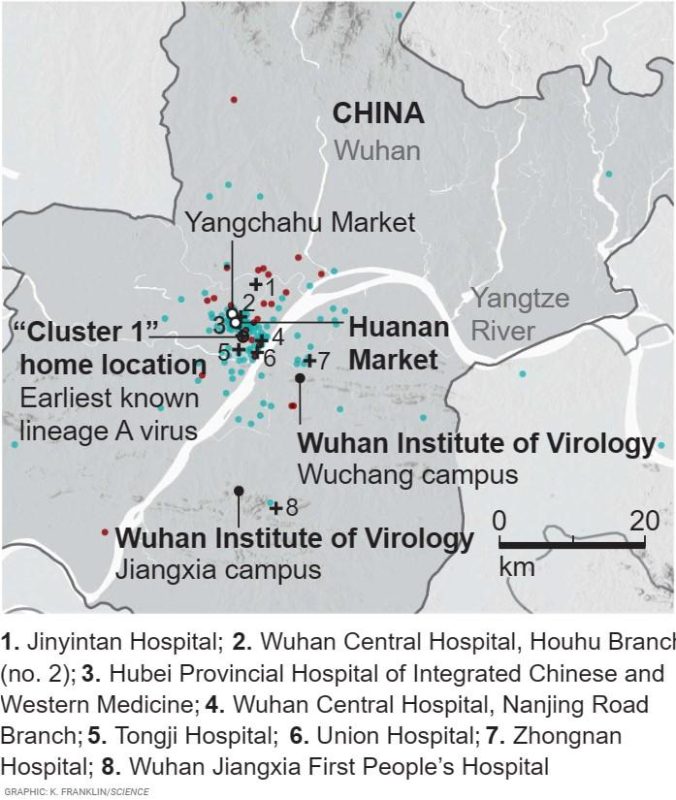
Ergo, the “lab-leak” theory is dead.
Except that there is also an infectious diseases lab in the area of the cluster: the aforementioned German-Chinese Joint Laboratory of Infection and Immunity at Union Hospital, Tongji Medical College. The laboratory is a joint project of Union Hospital, Tongji Medical College and the University Hospital of Essen in Germany. Prof. Ulf Dittmar, chair of the virology department in Essen, has also referred to the joint laboratory as the “Essen-Wuhan Laboratory for Virus Research.”
(See interview here [in German]. It should be noted that in the cited interview, conducted in January 2020, Dittmar downplays the dangerousness of the novel Coronavirus and warns against “hysterical” reactions.)
Helpfully, the map from the Science article also indicates the locations of the Chinese host institutions of the joint laboratory: the Union and Tongji hospitals. Per the legend, they are indicated by crosses 5 and 6: right next to the home location of what the article identifies as “cluster 1,” an elderly husband and wife who represent “the earliest known case cluster and the only cluster admitted by 26 December. They had no known connection to Huanan Market.” (Red dots on the map indicate cases with a known connection to the market; blue dots those that have no known connection.) The Tongji Hospital is the closest to “cluster 1.”
Astonishingly, in early September 2019, only three months before the allegedly initial outbreak of Covid-19 just a stone’s throw from Tongji Hospital in Wuhan, then German Chancellor Angela Merkel paid a visit to none other than…Tongji Hospital in Wuhan. The hospital is also known as the German-Chinese Friendship Hospital.
A photo of Chancellor Merkel being welcomed by nurses at the hospital reception can be seen here. The accompanying article in the German newspaper Die Süddeutsche Zeitung notes another highly intriguing fact: the Essen University Hospital is not the only German teaching hospital with which Tongji has a “close partnership.”
It also has a partnership with the Charité Hospital in Berlin of Germany’s “state virologist” Christian Drosten! Drosten is the chair of the virology department at the Charité.
Now, it was none other than Christian Drosten who in mid-January 2020 – just a couple of weeks after the initial outbreak of Covid-19 just a stone’s throw from Tongji Hospital – devised the notoriously oversensitive PCR test that would become the “gold standard” for detecting the virus. Since Drosten’s PCR would also and especially be used to test people with no symptoms of the illness, it thus paved the way for the outbreak to obtain pandemic status.
Before the PCR test was adopted by the WHO, Drosten’s paper on it would be rushed through the peer-review process of the EU-funded journal Eurosurveillance in record time: going from submission to acceptance in anywhere from three-and-a-half hours to 27-and-a-half hours per the calculations of Simon Goddek.
According to accompanying tweets and Gettr posts in German, a photo that circulated on the two platforms earlier this year is supposed to show Drosten at a Tongji Medical College (or perhaps joint Tongji-Charité?) event. “What a coincidence,” some of the posts note ironically. (Here, for instance.) Many of the posts link a Charité webpage. But the link does not contain or no longer contains any such photo. It merely leads to generic information on a Charité-Tongji exchange program, thus leaving the source of the photo unclear.
Christian Drosten at Tongji Medical College event?
A Google search result from the Tongji website (see below) tantalizingly notes that a “Sino-German Disaster Medicine Institute, Charité University in Germay [sic.] and Tongji Hospital was officially opened in Tongji Hospital, Wuhan, China.” But the indexed Tongji news article is not available nor is it cached, and the URL is not archived by the Wayback Machine either. Could this be the event at which Drosten is pictured? Perhaps Drosten could clarify.

In any case, thanks to a FOIA request, we know that Drosten participated in February 2020 email exchanges with Anthony Fauci and other international scientists about the possibility of a lab leak and that he was in fact, in contrast to other participants, particularly irritated about the hypothesis. Several of the others – including, n.b., Anthony Fauci – are clearly willing to entertain the possibility of a lab leak, and Jeremy Farrar of the Wellcome Trust even says that he is split 50:50 between lab leak and natural origin and that Edward Holmes of the University of Sydney is even 60:40 lab leak.
The doubts and open-mindedness of the other participants elicits an obviously pissy response from Drosten. “Can someone help me with one question,” he asks, “didn’t we congregate to challenge a certain theory, and if we could, drop it? …Are we working on debunking our own conspiracy theory?”
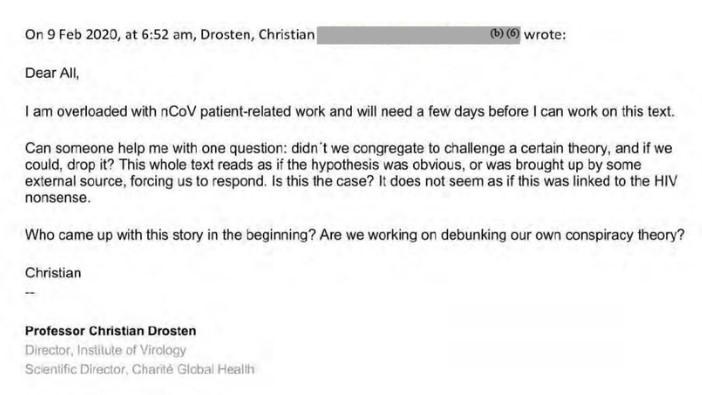
As the journalist Milosz Matuschek has pointed out in an article for the Swiss weekly Die Weltwoche, the FOIA release could prove to be a problem for Christian Drosten. For in a sworn statement to a German court, Drosten has insisted that he
had no interest in steering the suspicion about the origin of the SARS-CoV-2 virus in a certain direction. In particular, I had and I have no personal interest in ruling out the so-called laboratory thesis as origin of the virus. If there were indications for the correctness of the laboratory thesis, I would vigorously defend it in the scientific and public discussion.
Prosecute/Drosten?
Robert Kogon is a pen name for a widely-published financial journalist, a translator, and researcher working in Europe. Follow him at Twitter here. He writes at edv1694.substack.com.
Xi Jinping ends landmark KSA visit by calling on Arab states to embrace multipolar world
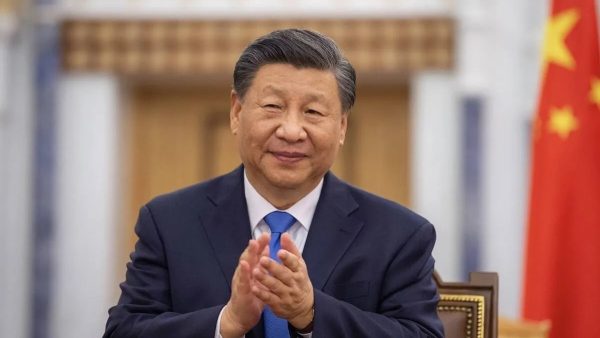
The Cradle | December 10, 2022
Chinese President Xi Jinping left Saudi Arabia early on 10 December following a three-day visit that saw him attend three different summits with leaders from across West Asia and Africa.
On Friday night, Xi headed the first China-Arab States Summit, which saw a large majority of Arab League heads of state attend in a bid to strengthen bilateral ties with the Asian giant.
“As strategic partners, China and Arab states should … foster a closer China-Arab community with a shared future, so as to deliver greater benefits to their peoples and advance the cause of human progress,” the Chinese president said during his keynote speech.
Xi also called on Arab states to remain “independent and defend their common interests,” adding that China “supports Arab states in independently exploring development paths suited to their national conditions and holding their future firmly in their own hands.”
“China is ready to deepen strategic mutual trust with Arab states, and firmly support each other in safeguarding sovereignty, territorial integrity and national dignity,” Xi said, noting that the two sides should “jointly uphold the principle of non-interference in other countries’ internal affairs, practice true multilateralism, and defend the legitimate rights and interests of developing countries.”
The Chinese leader also urged leaders from West Asia and Africa to embrace “synergy between their development strategies, and promote high-quality [cooperation in the Belt and Road Initiative].”
Launched nine years ago, the Belt and Road Initiative (BRI) is considered the crown jewel of Xi’s long-term foreign policy agenda. The stated aim of the mega-infrastructure project is to bring capital and infrastructure to Global South countries while dramatically strengthening connectivity for commerce, finance, and culture.
The BRI also aims to secure markets for Chinese companies, stable supplies of inputs for Chinese factories, and productive outlets for China’s large foreign exchange holdings. Close to 150 nations across the globe have signed on to participate in the BRI.
For the first half of 2022, Saudi Arabia was the biggest recipient of China’s finance and investment spending in the BRI.
Ahead of the China-Arab Summit on Friday, the Chinese president met with leaders from the Gulf Cooperation Council (GCC). During this summit, he urged the oil and gas giants to conduct energy sales in the Chinese yuan, potentially divorcing the US dollar from bilateral transactions.
He also vowed to import more oil and natural gas from Gulf Arab states while not interfering in their affairs, a departure from Washington’s long-standing policy of interference and domination.
Xi later took the opportunity to express China’s support for the end of the Israeli occupation of Palestine, and voiced frustration over the “historical injustice” suffered by Palestinians.
“It is not possible to continue the historical injustice suffered by the Palestinians,” the Chinese president said on Friday.
He went on to call on the international community to grant Palestine “full membership in the United Nations” and said Beijing “supports the two-state solution and the establishment of a Palestinian state on the 1967 borders, with East Jerusalem as its capital.”
Beijing’s emergence as a major superpower since the turn of the century has proven to be critically important for Arab states, prompting them to diversify their strategic objectives and balance themselves away from a decades-long Western dependency.
Featured Video

ARE PATIENTS BEING PROPERLY INFORMED ABOUT OZEMPIC?
or go to
Aletho News Archives – Video-Images
From the Archives
Trans ‘milk’ as good as the real thing – NHS
RT | February 18, 2024
The drug-induced nipple secretions of trans women are as good as mothers’ breast milk for babies, the University of Sussex Hospitals NHS Trust claimed in a letter to campaigners made public in a report by British think tank the Policy Exchange on Sunday.
The healthcare trust’s medical director, Rachel James, argued that the off-label prescription drug cocktail men transitioning to female take in order to produce milk was “similar to the natural hormones which encourage lactation to develop when the baby is newly born.”
“The evidence which is available demonstrates that the milk is comparable to that produced following the birth of a baby,” James wrote in the letter, sent to Children of Transitioners last August.
Biological men who wish to lactate must first take hormones to grow milk glands and then take high doses of either domperidone or metoclopramide to stimulate milk production. Neither drug is approved for this use, though they are occasionally prescribed off-label to biological women who have trouble lactating.
However, domperidone’s own manufacturer, Janssen, warns patients the drug “may cause unwanted side effects affecting the heart in a breastfed baby” and “should be used during breastfeeding only if your physician considers this clearly necessary.” … continue
Blog Roll
 Aletho News
- 2025 Nature Paper Claiming Worsening Global Drought Gets RETRACTED …Heavily Flawed
- Your Milk Is Not the Problem
- The Truth About the Trump Shootings with Ken Silva
- ARE PATIENTS BEING PROPERLY INFORMED ABOUT OZEMPIC?
- US lawmaker blocks $2.8 billion weapons sale to Israel: Report
- Yemeni army claims responsibility for strikes on sensitive sites in Saudi capital, Aramco facilities in Yanbu
- Iran Judiciary issues indictments against 159 US, Israeli officials for assassination of Leader, commanders
- Turkiye revokes Iranian bank license under US sanctions campaign
- US-Denmark Agreement on Greenland Is ‘PR Stunt’ Ahead of Midterms
- Araghchi: Military intervention cannot create security; coercion cannot bring peace
- If Americans Knew
- Inside Gaza’s death trap of collapsing, bombed-out buildings
- The everyday items Israel bans from Gaza every day
- Inside the siege, the ruined buildings of Gaza – Daily Update
- Debunking The Claim That Macklemore Has A “History Of Antisemitism”
- CPJ demands release of arrested Palestinian-US journalist near Bethlehem
- Robert Kraft: The Billionaire Friend of Netanyahu Pulling The Strings Behind the Macklemore/Ed Sheeran Blow Up
- Columbia Administered Fund Gives Big Money to Pro-Israel Groups
- Deportation Case of Palestinian Activist Salah Sarsour Tests First Amendment
- ‘We Will Not Forget’: Palestinians Mark 44 Years since Sabra and Shatila
- Why do we let Zionists decide what we can and can’t say?
- No Tricks Zone
- 2025 Nature Paper Claiming Worsening Global Drought Gets RETRACTED …Heavily Flawed
- New Study: ‘Global Drought Shows No Detectable Recent Acceleration Under Climate Warming’
- Economic Masterminds: German Socialists Suggest Taxing Productivity Gains Stemming From Using AI
- The South China Sea Has Not Been Cooperating With The Climate Change Narrative
- Energy Crisis: Germany Enters Heating Season With Historically Low Gas Reserve Fill Levels
- New Study: The Antarctic Ice Sheet Gained Mass From 2020-2024 Due To Staggering Snow And Ice Accumulation
- Study: Ocean Heating Rates From Thousands Of Years Ago ‘Dwarf’ Modern Ocean Heating Rates
- Climate Extremists Target, Attack Large-Scale Power Grid Infrastructure In Germany!
- New Study: Antarctic Ice Melt Has Contributed Less Than 1 Centimeter To Sea Level Rise In The Last 30 Years
- Fear Of Debate: Alarmist German Climate Scientist Calls On Mainstream Media To Discredit Skeptic Voices
 Aletho News