Moscow: US to Spend $11 Billion on Cyberattacks Against ‘Unwanted’ Governments

© AP Photo / Department of Defense, Cherie Cullen
Samizdat – 10.12.2022
MOSCOW – Washington plans to spend around $11 billion next year on carrying out cyberattacks with the aim of controlling unfriendly governments, Russian Deputy Foreign Minister Oleg Syromolotov said in an interview with Sputnik.
“Western countries want to use information and its carriers – big data and software tools for their transmission – to subjugate unwanted governments through cyberattacks,” Syromolotov said, adding that the “Pentagon’s budget alone for these purposes in 2023 will be more than $11 billion.”
The deputy foreign minister pointed out that, according to the new doctrinal documents released in October, the administration of US President Joe Biden has “declared the whole world and the global information space to be its sphere of interest.”
On October 12, the Biden administration released the 2022 National Security Strategy that characterized China as being the most consequential geopolitical challenge for the United States. According to the document, Beijing is Washington’s sole rival allegedly seeking to increase its economic, diplomatic and military capacity to change the international order.
Syromolotov’s comments come in the wake of the earlier statement by the Russian Embassy in the United States that blasted Washington’s sanctions against Moscow as an attempt to exert pressure on governments that are “inconvenient” for the US.
The Russian diplomatic mission said that Washington is attempting to force “other countries to adjust their foreign policy,” disguising these attempts as efforts to defend human rights.
The Pentagon released its National Defense Strategy (NDS) in October, stating that China remains the top competitor of the United States and warning that Beijing-Moscow collaboration might threaten US interests. The document also characterizes Russia as an acute and more immediate threat to US interests and values than China, which is characterized as a “pacing challenge.”
On Friday, the US Treasury Department announced that the United States was sanctioning over 40 individuals and entities from nine different countries, including Russia, Iran, North Korea, and China, for alleged links to corruption and human rights abuses.
US defense bill authorizes more Ukraine and Taiwan aid
RT | December 7, 2022
US lawmakers have reached a compromise on the National Defense Authorization Act, agreeing to approve $45 billion more in overall military spending in 2023 than President Joe Biden had requested, as well as multiple provisions for new “security assistance” to Ukraine and increased cooperation with Taiwan.
The House and Senate Armed Services Committees released their final draft of the NDAA on Tuesday night following lengthy negotiations, seeking to bring it up for a vote in the House by the end of the week. The massive spending bill would devote a total of $858 billion for next year’s defense budget, with lawmakers arguing the increase compared to 2022 is needed due to soaring inflation and costly arms shipments to Kiev.
In addition to setting out basic yearly funding for the Defense Department and the Department of Energy, which manages America’s nuclear arsenal, the latest NDAA would approve another $800 million for the Ukraine Security Assistance Initiative – $500 million more than President Biden’s initial request.
Since February, the Biden administration has approved more than $19 billion in direct military aid for Kiev from the Pentagon’s stockpiles, and the bill seeks additional funding to boost production and replenish the US military’s dwindling stocks.
US officials also agreed to require periodic reports from the Pentagon in the “short and medium term” on US arms sent to Ukraine, after several Republican lawmakers raised concerns that American weapons were not being properly tracked on reaching the country’s chaotic battlefield.
The new spending bill also authorizes the Taiwan Enhanced Resilience Act, which is designed to “increase security cooperation” with the island and would allocate up to $10 billion for that purpose over the next five years. The latter provision is likely to trigger condemnation from Beijing, which considers Taiwan part of its sovereign territory and has repeatedly urged Washington to halt all direct dealings with Taipei.
Another project targeting China, the US Pacific Deterrence Initiative, will receive another $11.5 billion in new investments under the current draft legislation. The Pentagon has noted the initiative aims to confront the supposed “multi-domain threat” posed by Beijing and expand the US military footprint in the Indo-Pacific region.
Considered ‘must-pass’ legislation due to its increasingly wide scope, versions of the NDAA have been approved by US lawmakers every year since 1961. The measure is also frequently described as a “legislative vehicle,” as Republicans and Democrats usually seek to include a range of issues unrelated to defense in each year’s spending bill.
Xi’s visit and the future of the Middle East
By Ramzy Baroud | MEMO | December 7, 2022
The problem with most Western media’s political analyses is that they generally tend to be short-sighted and focused mostly on variables that are of direct interest to Western governments.
These types of analyses are now being applied to understanding official Arab attitudes towards Russia, China, global politics and conflicts.
As Chinese President Xi Jinping prepares to lead a large delegation to meet with Arab leaders in Saudi Arabia on 9 December, Western media conveys a sense of dread.
The Chinese leader’s visit “comes against the backdrop” of the Biden Administration’s “strained ties with both Beijing and Riyadh” over differences, supposedly concerning “human rights and Russia’s invasion of Ukraine,” Reuters reported.
The same line of reasoning was parroted, with little questioning, by many other major Western media sources, falsely suggesting that ‘human rights’, along with other righteous reasons, are the main priority of the US and Western foreign policy agenda.
And, since these analyses are often shaped by Western interests, they tend to be selective in reading the larger context. If one is to rely exclusively or heavily on the Western understanding of the massive geopolitical changes around the world, one is sure to be misled. Western media wants us to believe that the strong political stances taken by Arab countries – neutrality in the case of war, growing closeness to China and Russia, lowering oil output, etc – are done solely to ‘send a message‘ to Washington, or to punish the West for intervening in Arab affairs.
Seen through a wider lens, however, these assumptions are either half-truths or entirely fabricated. For example, the OPEC+ decision to lower oil output on 5 October was the only reasonable strategy to apply when the global market’s demand for energy is low. Additionally, Arab neutrality is an equally reasonable approach considering that Washington and its Western allies are not the only global forces that matter to the Arabs. It is equally untrue that the Middle East’s growing affinity with Asia is borne out of recent dramatic events, but a process that began nearly two decades ago, specifically a year following the US invasion of Iraq.
In 2004, China and the Arab League established the China-Arab States Cooperation Forum.
CASCF officially represented the Chinese government and all 22 members of the Arab League, eventually serving as the main coordination platform between China and the Arabs. This has given China the advantage of investing in a collective strategy to develop trade, economic and political ties with the entirety of the Arab world. On the other hand, Arabs, too, had the leverage of negotiating major economic deals with China that could potentially benefit multiple Arab states simultaneously.
An extremely important caveat is that CASCF was predicated in what is known as the “Five Principles of Peaceful Coexistence.” Based on the Westphalian norms of state sovereignty, the five principles seem to be founded on an entirely different paradigm of foreign relations, compared to the West’s approach to the Middle East and the Global South, in general, extending from the colonial periods to the neo-colonialism of post-World War II: mutual respect for “territorial integrity and sovereignty”, “non-aggression”, “non-interference”, and so on.
Chinese-Arab relations continue to follow this model to this day, with very little deviation. This validates the claim that collective Arab political attitudes towards China and Xi’s visit to the Middle East are hardly an outcome of any sudden shift of policies resulting from the Russia-Ukraine war of recent months.
This is not to suggest that Arab and Chinese relations with the US and the West had no impact on the nature of the speed of Chinese-Arab ties. Indeed, the Chinese model of ‘peaceful coexistence’ seems to challenge the henceforth modus operandi at work in the Middle East.
In 2021, China announced projects to build a thousand schools in Iraq, a piece of news that occupied substantial space in Arab media coverage. The same can be said about China’s growing economic – not just trade – influence in Arab countries.
China’s lucrative Belt and Road Initiative, announced in 2013, fits seamlessly into the political infrastructure of Arab-Chinese ties, which were built in previous years. According to the Asharq Al-Awsat newspaper, Riyadh was the largest recipient of Chinese investments within the BRI during the first half of 2022.
Starting in March, Saudi Arabia agreed in principle to sell its oil to China using the Chinese Yuan instead of the US dollar. When implemented, this decision will have irreversible repercussions on the global market but also on the future status of the dollar.
Assuming that such mammoth changes in global geopolitics were an outcome of the immediate need for the Arabs to ‘send a message’ will continue to impair the West’s ability to truly appreciate that the changes underway, not only in the Middle East but worldwide, are part of permanent shifts to the world’s political map. The sooner the West achieves this realisation, the better.
Considering all of this, it would be unfair – in fact, misguided – to suggest that large political entities like China and Arab countries combined are shaping their foreign policy agendas, thus staking their futures, on knee-jerk political reactions to the attitude of a single American President or administration.
Beijing Rips ‘US’s Old Trick of Hyping China Threat’ as DoD Projects Four-Fold Jump in Chinese Nukes
By Ilya Tsukanov – Samizdat – 06.12.2022
China’s Defense Ministry has ripped Washington over a Pentagon report claiming the People’s Republic plans to ramp up its nuclear weapons stockpile to 1,500 warheads by 2035 and to make modifications to its nuclear doctrine.
“It should be emphasized that China firmly pursues a nuclear strategy of self-defense, adheres to the nuclear policy of no first use of nuclear weapons at any time and under any circumstances, and keeps nuclear capabilities at the minimum level required for national security,” Defense Ministry spokesman Tan Kefei said in a written press statement Tuesday.
Accusing Washington of engaging in baseless “speculation” about Beijing’s nuclear deterrent, Tan urged the US to “deeply review and reflect on its own nuclear policy” before “pointing fingers” at China.
“With the largest nuclear arsenal in the world, the US continues to upgrade its nuclear triad, vigorously seeks to develop or forward-deploy non-strategic nuclear weapons, lowers the threshold for using nuclear weapons, and conducts nuclear proliferation through the AUKUS trilateral security partnership, increasingly becoming the source of nuclear conflicts,” the spokesman said.
Tan added that as far as the Pentagon’s 2022 China report as a whole is concerned, it constitutes an example of “the US’s old trick to hype up the so-called ‘Chinese military threat’.” China is “strongly dissatisfied with and firmly opposed to the US’s move, and has lodged solemn representations with the US,” the spokesman said.
The US Department of Defense’s new report on China, released on November 29, characterizes the People’s Republic as “the only competitor with the intent and, increasingly, the capacity to reshape” the US-dominated world order. The report cites Chinese efforts to “modernize, diversify, and expand its nuclear forces,” and expects Beijing to increase the size of its nuclear arsenal from about 400 nukes now to “about 1,500 warheads by its 2035 timeline.”
The document further accuses China of planning to make modifications to its nuclear posture to account for more and better weapons systems, and suggests that the PRC “probably seeks lower yield nuclear warhead capabilities to provide proportional response options that its high-yield warheads cannot deliver.” Finally, the Pentagon paper expresses concerns about China’s “launch on warning posture,” which allows for nuclear missiles to be launched before an enemy first strike detonates.
How Much of a Threat Do China’s Nukes Pose to the US?
Estimates on the size of China’s nuclear stockpile range from 350-400 total warheads. Even if the PRC went ahead and more than quadrupled its total nuclear stockpile, as the Pentagon report claims, Beijing’s 1,500 nukes would still be just a fraction of the 5,550 warhead stockpile held by the United States. Amid recent US efforts to peg China into strategic arms limitation talks with Russia, Beijing has indicated that it would be “happy” to join such discussions if the nuclear superpowers first reduced their stockpiles to China’s level.
Notwithstanding China’s economic and technological might and growing geopolitical and strategic weight in the world, its nuclear deterrent remains extremely modest compared to the US. For example, while the US Navy operates a fleet of 14 Ohio-class ballistic missile submarines, each carrying up to 336 nuclear bombs – enough to obliterate the whole of China, the People’s Liberation Army Navy has six Type 094 missile subs, each carrying between one and seven warheads (for a total capacity of 12-84 warheads per sub).
China and India remain the only two nuclear weapons states with a no first use policy. The US’s nuclear doctrine, on the other hand, allows the president not only use nukes preemptively, but even against “non-nuclear weapons states.” At the same time that it has accused China of “probably” seeking low-yield nukes, the Pentagon has developed the W76-2 – a nuclear warhead with an explosive yield of about five kilotons (i.e. about a third of the power of the US nuclear bomb which leveled the Japanese city of Hiroshima in 1945). Nuclear arms experts have expressed concerns that such low-yield nuclear weapons pose a threat to global strategic stability by lowering the threshold for nuclear war.
Necessary Illusions – Even the narrative of the EU as a geo-strategic player has now burst
By Alastair Crooke | Strategic Culture Foundation | December 5, 2022
Something odd is afoot in Europe. Britain recently has been ‘regime washed’, with a strongly pro-EU Finance Minister (Hunt) paving the passage to an election-free premiership by ‘globalist’ Rishi Sunak. Why so? Well, to impose swingeing cuts to public services, to normalise immigration running at 500,000 per annum and to raise taxes to the highest levels since the 1940s. And to open channels about a new relationship deal with Brussels.
A British Tory Party is content to do that? Slash social support and hike taxes into an already existent worldwide recession? On the face of it, it doesn’t seem to make sense. Shades of Greece 2008? Greek austerity for Britain — are we missing something? Is this setting the scene for the Remainer Establishment to point to an economy in crisis (blamed on Brexit failure), and to say there is no alternative (TINA) but a return to the EU in some form, (British ‘cap in hand’, and with head bowed)?
Simply put, forces behind the scenes seem to want the UK to resume its former role as US plenipotentiary inside Brussels — pushing the US primacy agenda (as Europe sinks into self-doubt).
Likewise odd — and significant – was that on 15 September, former German Chancellor Schroeder entered unannounced into Scholtz’s office where only the Chancellor, and Vice-Chancellor, Robert Habeck, were present. Schroeder slapped down a long-term gas supply proposal by Gazprom on the desk, directly under Scholtz’s eyes.
The Chancellor and his predecessor held each other’s gaze for a minute – without a word passing. Then Schroeder reached out, took back the unread document, turned his back and exited the office. Nothing was said.
On 26 September (11 days later), the Nordstream pipeline was sabotaged. Surprise (yes, or no)?
Many unanswered questions. The upshot: No gas for Germany. One Nordstream train (2B) however, survived the sabotage and remains pressurised and functional. Yet still no gas arrives in Germany (other than high price liquified gas). There are presently no EU sanctions on gas from Russia. Landing the Nordstream gas requires only a Regulatory go-ahead.
So then: Europe is to have austerity, loss of competitiveness, price and tax hikes? Yes — yet Scholtz did not even glance at the gas offer.
The Green Party of Habeck and Baerbock (and the EU Commission) is in close alignment with those in the Biden team insisting to maintain US hegemony, at all costs. This Euro-coalition is explicitly and viscerally malefic towards Russia; and in contrast, is as viscerally indulgent towards Ukraine.
The big picture? German Foreign Minister Baerbock in a speech in New York on 2 August 2022 sketched out a vision of a world dominated by the US and Germany. In 1989, George Bush famously had offered Germany a “partnership in leadership”, Baerbock claimed. “Now the moment has come when we have to create it: A joint partnership in leadership”. A German bid for explicit EU primacy, snaring US support. (The Anglos will not like that!)
Ensuring no backsliding on Russia sanctions and continuing EU financial support for the Ukraine war is a clear ‘Red Line’ for precisely those in the Biden team likely to be attentive to Baerbock’s Atlanticist bid — and who understand that Ukraine is the spider at the centre of a web. The Greens explicitly are playing this.
Why? Because Ukraine is still the global ‘pivot’: Geopolitics; geo-economics; commodity and energy supply chains — all revolve around where this Ukraine pivot finally settles. A Russian success in Ukraine would bring a new political bloc and monetary system into being, through its allies in the BRICS+, the Shanghai Cooperation Organization and the Eurasian Economic Union.
Is this European austerity binge then just about the German Green Party nailing down EU Russophobia? Or are Washington and its Atlanticist allies now prepping for something more? Prepping for China to get the ‘Russia treatment’ from Europe?
Earlier this week at Mansion House, PM Sunak changed gear. He ‘hat-tipped’ to Washington with the promise to stand by Ukraine ‘as long as it takes’, yet his primary foreign policy focus was firmly on China. The old ‘golden’ era of Sino-British relations ‘is over’: “The authoritarian regime [of China] poses a systemic challenge to our values and interests”, he said — citing the suppression of anti-zero-COVID protests and the arrest and beating of a BBC journalist on Sunday.
Over in the EU — belatedly panicking over unfolding widespread de-industrialisation — President Macron has been signalling that the EU might take a more hard-line China stance, though only were the US were to back-down on the subsidies in the Inflation Reduction Act, which entice EU companies to up-anchor, and sail off to America.
Yet, Macron’s ‘play’ is likely to meet a dead end, or at best, a cosmetic gesture — for the Act has already been legislated in the US. And the Brussels political class unsurprisingly already is waving the white flag: Europe has lost Russian energy and now stands to lose China’s tech, finance and market. It’s a ‘triple whammy’ — when taken together with European de-industrialisation.
There you have it — austerity is always the first tool in the US toolbox for exerting political pressure on US proxies: Washington is prepping the EU ruling élites to sever from China as fundamentally Europe has already done from Russia. Europe’s largest economies already are taking a harder line on Beijing. Washington will squeeze the UK and EU ‘til the pips squeak to get full compliance on a China cut-off.
The protests in China over Covid regulations could not have arrived at a more serendipitous time from the US’ ‘China hawks’ perspective: Washington whipped the EU into full propaganda mode on Iranian ‘demonstrations’ — and now the China protests offer the opportunity for Washington to go full court on China demonisation:
The ‘line’ used against Russia (Putin makes mistake after mistake; the system bumbles; the Russian economy is precariously perched on a knife edge and popular disaffection is soaring) – will be ‘cut and pasted’ to Xi and China.
Only, the inevitable EU moral lecturing will antagonise China even further: Hopes to keep a trade foothold in China will vanish, and effectively it will be China ‘washing its hands’ of Europe, rather than vice versa. European leaders have this blind spot — quite some Chinese may deplore the Covid lockdown practice, yet still will remain deeply Chinese and nationalist in sentiment. They will hate EU lecturing: ‘European values speak only for themselves — we have our own’.
Obviously, Europe has dug itself into a deep hole. Its adversaries grow bitter at EU moralising. But what exactly is going on?
Well, firstly, the EU is hugely over-invested in its Ukraine narrative. It seems incapable of reading the direction of travel that events in the war zone are taking. Or, if it does read it correctly (of which there is little sign), it appears incapable of being able to affect a course correction.
Recall that the war at the outset was never seen by Washington as likely ‘being decisive’. The military aspect was viewed as an adjunct — a pressure multiplier — to the political crisis in Moscow that sanctions were expected to unleash. The early concept was that financial war represented the front line — and the military conflict, the secondary front of attack.
It was only with the unexpected shock of sanctions not achieving ‘shock and awe’ in Moscow that priority switched from the financial to the military arena. The reason the ‘military’ was not firstly seen as ‘front-line’ was because Russia clearly had the potential for escalatory dominance (a factor which is now so evident).
So, here we are: The West has been humiliated in the financial war, and unless something changes (ie. dramatic escalation by the US) – it will lose militarily too — with the distinct possibility that Ukraine at some point, simply implodes as a state.
The actual situation on the battlefield today is almost completely at odds with the narrative. Yet, so heavily has the EU invested in its Ukraine narrative that it just doubles-down, rather than draw back, to re-assess the true situation.
And so doing — by doubling-down narratively, (standing by Ukraine ‘for as long as it takes’) — the strategic content to the ‘Ukraine’ pivot rotates 180 degrees: Rump ‘Ukraine’ will not be ‘Russia’s Afghan quagmire’. Rather, its’ rump is morphing into Europe’s long-term financial and military ‘quagmire’.
‘As long as it takes’ gives the conflict an indeterminate horizon — yet leaves Russia in control of the timetable. And ‘as long as it takes’ implies ever more exposure to NATO blind spots. The rest-of-world intelligence services will have observed NATO’s air defence and military-industrial lacunae. The pivot will show who is the true ‘paper tiger’.
‘As long as it takes’ — has the EU thought this through?
If Brussels imagines too, that such dogged adherence to narrative will impress the rest-of-the-world and bind these other states closer to the EU ‘ideal’, they will be wrong. Already there is a wide hostility to the notion that Europe’s ‘values’ or squabbles have any wider pertinence, beyond Europe’s borders. ‘Others’ will see the inflexibility as some bizarre compulsion by Europe to self-suicide – at the very moment that the end of ‘everything bubble’ already threatens a major downturn.
Why would Europe double-down on its ‘Ukraine’ project, at the expense of losing its standing abroad?
Perhaps, because the EU political class fears even more losing its domestic narrative. It needs to distract from that — it is a tactic called ‘survival’.
The EU, as with NATO, was always a US political project for the subjugation of Europe. It still is that.
Yet, the meta-EU narrative — for internal EU purposes — posits something diametrically different: that Europe is a strategic player; a political power in its own right; a market colossus, a monopsony with the power to impose its will over whomsoever trades with it.
Simply put, the EU narrative is that it has meaningful political agency. But Washington has just demonstrated it has none. It has trashed that narrative. So, Europe is destined to become an economic backwater. It has ‘lost’ Russia — and soon China. And is finding it has lost its standing in the world, too.
Again, the actual situation on the geo-political ‘battlefield’ is almost completely at odds with the EU narrative of itself as a geo-strategic player.
Its ‘friend’, the Biden Administration, is gone — whilst powerful enemies elsewhere accumulate. The EU political class never had a good grasp of its limitations — it was ‘heresy’ even to suggest there were limitations to EU power. Consequently, the EU has hugely overinvested in this narrative of its agency too.
Hanging EU flags from every official building will not cast a fig leaf over the nakedness, nor hide the disconnect between the Brussels ‘bubble’ and its deprecated European proletariat. French politicians now openly ask what can save Europe from complete vassalage. Good question. What does one do when a hyper-inflated power narrative bursts, at the same time as a financialised one?
Canada Plans to Increase Traffic of Warships Through Taiwan Strait: Foreign Minister
Samizdat – 05.12.2022
Canada intends to send more warships to pass through the Taiwan Strait to demonstrate that the waters claimed by China are international, Canadian Foreign Minister Melanie Joly said on Monday.
“We will continue to enforce the international rules-based order when it comes to the Taiwan Strait. And that’s why also we had a frigate going through the Taiwan Strait this summer, along with the Americans, [and] we’re looking to have more frigates going through it,” Joly said in an interview with Financial Times.
According to the minister, Canada will increase the number of frigates stationed in the Indo-Pacific region to three, as well as deploy an additional number of diplomats and military attaches. In total, 400 million Canadian dollars ($298 million) will be invested in the region’s security.
Chinese officials repeatedly told their US counterparts that Beijing did not recognize the strait between the east coast of the mainland and Taiwan as international waters. In addition, Canada recently unveiled its Indo-Pacific Strategy, which called Beijing an “increasingly disruptive global power.”
Official relations between Beijing and Taipei broke down in 1949 after the Kuomintang forces led by Chiang Kai-shek defeated by the Chinese Communist Party in the civil war moved to Taiwan. Business and informal contacts between the island and China resumed in the late 1980s. Since the early 1990s, the two sides maintain contacts through nongovernmental organizations.
US chip war hurts Taiwan
By Uriel Araujo | December 5, 2022
While the United States’ European allies are now fighting aggressive American subsidies (a crisis that risks dividing the political West), Taiwan, another US ally, also faces Washington’s protectionism. This fits into the US pattern of hurting close allies in many different ways.
Biden and Apple’s CEO Tim Cook are visiting Arizona on December 6 to launch the $12 billion American plant of chip giant TSMC – it is the company’s first advanced chip in the US. The US $52 billion chip subsidy bill (passed in July) has been described as vital to the construction of the TSMC plant in Arizona. This will basically transfer Taiwan’s productivity and its most advanced technology to the US and such news has not been well received in Taiwan.
Journalist Zhang Zhouxiang has described this new development as TSMC draining itself. According to him, Taiwan is moving “high-end jobs” away, which hurts the Taiwanese economy.
Semiconductors play a key role in cybersecurity and military applications. Since the pandemic, there has been a shortage of chips (semiconductors) and earlier this year the US Commerce Secretary Gina Raimondo described this situation as a “national security” issue.
Regarding chips, national interests and national security concerns are thus often intertwined. The British government has basically imposed a semiconductor blockade on China, by having taken actions to retrospectively block the sale of Newport Wafer Fab (one of the country’s largest semiconductors plants) to Nexperia, a Dutch company owned by China’s Wingtech. Just days before, the German government had blocked the sale of Elmos Semiconductor’s factory to Silex, a Swedish subsidiary of China’s Sai Microelectronics. In both Germany and Britain concerns about security and economic as well as technological sovereignty have been voiced. There are also concerns about the possible outflow of technical know-how.
Likewise, as part of the ongoing New Cold War, the US government, in early October, banned Chinese companies from purchasing (without a license) both chip-making equipment and advanced chips. Singapore’s foreign minister Vivian Balakrishnan went so far as to describe the American ban as “all but a declaration of a technology war”. Former US Treasury secretary Lawrence Summers has also described the American chip restrictions as a “de facto declaration of economic war” (against China), and added that it is a “disproportionate response”.
Chipmaking has been a new front in American-Chinese tensions, and now, with the aforementioned German and British decision, tensions are also escalating in Europe. Such European decisions are also the result of Washington’s pressure, according to Xiaomeng Lu, director of geo‑technology at Eurasia Group.
In February, amid the escalation of tensions between Beijing and Washington over Taiwan, I wrote on how Taiwan stands between the two superpowers in their technological competition. Amid the ongoing chip race, many different countries have introduced incentives to foster the semiconductors’ industry. Taiwan is the planet’s largest chip manufacturer and is also the center of Chinese-US tensions today. This is the ironic context of TSMC’s Arizona move.
It is increasingly difficult today to insulate industries from geopolitical disputes. Beijing aspires to become a tech superpower, something which American political elites will not tolerate. Although the Chinese semiconductor industry has been growing quite quickly, it still remains behind the cutting edge in chips, largely due to American efforts to block Chinese endeavors to acquire the necessary equipment and know-how.
However, the American economic war on Beijing in fact endangers the global microchip industry itself and increases the risk of butterfly effects, China being a key part of the globalized world. Moreover, while the US never had an intensive economic relationship with its Soviet rival during the old Cold War, China today remains the United States’ third largest market for exports. In addition, as historian and foreign-policy analyst Max Boot has remarked, a single factory in China, Foxconn, is reported to produce about half the world’s iPhones, for example. This being so, according to Boot, while Washington does not want to see any Western technology being “transferred” to the Chinese military, it can’t, on the other hand, endanger supply chains for chips and other vital parts.
Moreover, the so-called American “chip war” and its export curbs can in fact bring record losses for Taiwanese, Japanese and South Korean makers (all of these nations being US allies).
Washington’s aggressive subsidies and protectionism have arguably stopped the country from rejoining the Trans-Pacific Partnership (a trade agreement among 12 Asia-Pacific nations). Its Inflation Reduction Act in turn has alienated important allies such as Germany and France – the very states Washington counts on in its plans to counter China.
Harvard professor William Overholt has stated that today the US “wants everybody to join economic alliances” with them, while not giving anything in return. Meanwhile, ironically, Communist-Party ruled China, according to him, has promoted freer trade and investment around the world.
With the Belt and Road Initiative, among others, geoeconomics has been the very core of Beijing’s geostrategic approaches. Washington, in turn, has been dangerously weaponizing its economic and financial policies to “counter” China and Russia, also hurting close allies in the process. The irony is that the more the US employs economic leverage to aggressively coerce other states, the greater the incentive to come up with alternatives against Washington.
To sum it up, currently, the US is overextended and overburdened, trying to simultaneously encircle and contain both Moscow and Beijing. Its aggressive protectionism in turn has been enraging and alienating important allies, such as the EU and Taiwan. All of this signals the decline of the American superpower and of the US-led global order.
Hiding in Plain Sight
The lab origin of SARS-CoV-2 was published in 2015
By John Leake | Courageous Discourse | December 3, 2022
One of the most striking features of the corrupt pandemic response is that its innumerable elements of fraud, deception, malfeasance, unconstitutionality, and negligent homicide are NOT concealed. Because these criminal elements are not reported by the mainstream media, they remain unknown to most people. Like pebbles tossed onto a recently mown lawn, they are not immediately visible, but would be to anyone who looks a little closer.
This is not actual concealment; it’s just a matter of not drawing attention to something. Nevertheless, such systematic omissions result in ignorance for those accustomed to obtaining their information from the mainstream media. This ignorance is reinforced by the consumption of daily mainstream news, which diminishes awareness of any particular story that develops over a period of time.
A stunning form of this deception by omission is when public officials, scientists, and the media pretend not to notice extremely harmful and even criminal conduct that is detectable for anyone who bothers to look. Public officials and news reporters have no excuse for not looking because it’s their job to look. Their omissions are analogous to a police investigator choosing not to look at a video surveillance recording of a bank that has just been robbed by a man not wearing a mask. Those who have committed dangerous and even criminal acts are, in this way, allowed to hide in plain sight
A striking example is the histrionic debate over whether NIH grant recipients conducted Gain-of-Function research on bat coronaviruses. The pinnacle of such theater were the jousting matches between Senator Rand Paul and Dr. Anthony Fauci at Senate Health Committee hearings, at which Dr. Fauci vehemently insisted his agency did NOT fund Gain-of-Function research on bat coronaviruses. Apart from Senator Paul, few in the Senate, and few if any in the mainstream media, questioned Dr. Fauci’s assertions.
And yet, to see that the NIH was, in fact, funding Gain-of-Function research of bat coronaviruses, one need only to read the 2015 paper titled A SARS-like cluster of circulating bat coronaviruses shows potential for human emergence by Veneet Menachery, Zhengli-Li Shi, Ralph Baric, et al. This study plainly states that the authors conducted Gain-of-Function research on bat coronaviruses in order to make them infectious to primary human airway epithelial cells.
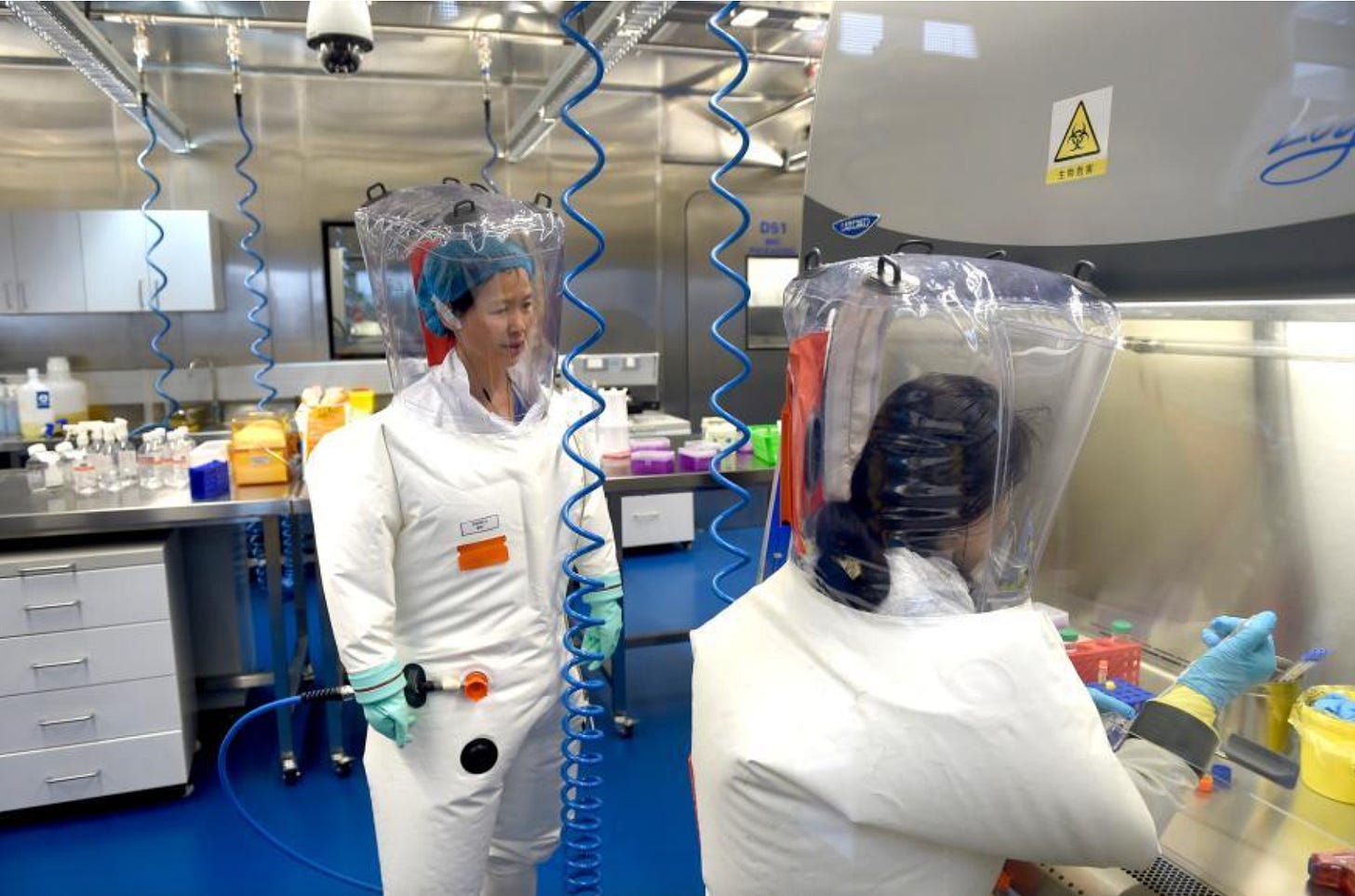
Dr. Zhengli-Li Shi, AKA “Bat Woman” and collaborator with Dr. Ralph Baric
Towards the end of the paper, the reader comes to the following section:
Biosafety and Biosecurity
Reported studies were initiated after the University of North Carolina Institutional Biosafety Committee approved the experimental protocol (Project Title: Generating infectious clones of bat SARS-like CoVs; Lab Safety Plan ID: 20145741; Schedule G ID: 12279). These studies were initiated before the US Government Deliberative Process Research Funding Pause on Selected Gain-of-Function Research Involving Influenza, MERS and SARS Viruses (http://www.phe.gov/s3/dualuse/Documents/gain-of-function.pdf). This paper has been reviewed by the funding agency, the NIH. Continuation of these studies was requested, and this has been approved by the NIH.
Note that the reason for pausing Gain-of-Function research was the determination that its risks outweighed its potential benefit. The legalistic assertion that this particular Gain-of-Function research was authorized to continue flies in the face of the risk assessment. Such research was, in 2014, deemed to be too dangerous for mankind, and in fact (as we now know) it was too dangerous. That Professor Baric’s research was approved before this negative risk assessment was made is immaterial.
The 2015 paper and other documents show that Ralph Baric and his Chinese colleague, Zhengli-Li Shi, were indeed engineering SARS-like bat coronaviruses in a lab at the Wuhan Institute of Virology in order to make them highly infectious to humans. Today we learn that Dr. Andrew Huff, former EcoHealth Alliance vice president and scientist, has just published a book titled The Truth about Wuhan: How I Uncovered the Biggest Lie in History.
We welcome Dr. Huff’s report, though we suspect that he won’t reveal anything we don’t already know.
US exaggerating ‘China threat’ to justify nuclear build-up – Beijing
RT | November 30, 2022
The US is hyping up a supposed “Chinese threat” as an excuse to expand its nuclear arsenal and maintain its military hegemony, Chinese Foreign Ministry spokesman Zhao Lijian said on Wednesday, calling it a “go-to tactic of the US.”
China’s nuclear policy remains consistent and clear, the spokesman explained, noting that Beijing was sticking to its no-first-use policy in regard to nuclear weapons and has limited the development of its strategic arsenal to the minimum level required by national security. “We are never part of any form of an arms race,” he pointed out, stating that China does not pose a threat or challenge to other countries, with which it hopes to be a development partner.
Meanwhile, the US has the largest nuclear arsenal in the world and openly devises first-strike deterrence policies against particular countries, Zhao noted.
“What the US should do is to seriously reflect on its nuclear policy, abandon the Cold-War mentality and hegemonic logic,” the spokesman said. He called on Washington to “stop disrupting global strategic stability,” and cut down its nuclear arsenal in order to “create conditions for attaining the ultimate goal of complete and thorough nuclear disarmament.”
Zhao’s comments come after the US Defense Department published on Tuesday the so-called 2022 China Military Power Report, which describes Beijing as “the most consequential and systemic challenge to our national security and to a free and open international system.” The report also suggests that China could step up the modernization of its nuclear forces in the next decade and produce about 1,500 tactical warheads by 2035.
Last month, the US also released its 2022 National Security Strategy, in which China was labeled as “the most consequential geopolitical challenge,” noting that Beijing had the intent to reshape the international order and possessed “the economic, diplomatic, military, and technological power to do it.”
Beijing responded by accusing Washington of being driven by “the logic of domination” and deliberately “misrepresenting” China’s foreign and defense policies.
British Media Minister Shows Double Standards on Free Speech in China and UK
Samizdat – 29.11.2022
The British government’s draft Online Safety Bill has previously come under fire from free speech campaigners and MPs — including current culture and media minister Michelle Donelan — for demanding social media sites censor posts which do not break any law.
The UK’s media minister has demanded Beijing grant British journalists freedom of speech — while suppressing it at home.
But her department is also spearheading new legislation to censor social media posts even if they do not break any laws against threats or incitement.
Speaking on a radio programme on Tuesday morning, Digital, Culture, Media and Sport Secretary Michelle Donelan said it was “absolutely shocking” that a reporter for British state media was arrested while covering protests against COVID-related restrictions in Shanghai.
“We believe in press freedom and the media to be able to report all over the globe,” Donelan said.
Chinese Foreign Ministry spokesperson Zhao Lijian accused the British media of “playing the victim” after it claimed cameraman Edward Lawrence was “beaten and kicked” by police.
Zhao urged foreign journalists not to engage in activities “unrelated to their role” — implying they were taking part in the protests rather than reporting them impartially.
The new draft of the Online Safety Bill, which Donelan’s department is pushing through Parliament, would force social media moderators to delete users’ posts if they have “reasonable grounds to infer” their content could cause “serious distress” to some individuals.
The previous version drafted under Donelan’s predecessor Nadine Dorries was criticised by MPs and free speech advocates for attempting to ban comments it dubbed “legal but harmful”.
Donelan herself said at the time that wording would create “a quasi-legal category between illegal and legal.”
A government factsheet published in May said the bill would only mandate censoring social media posts if some harm was “intended”, without a reasonable excuse or the defence of public interest — theoretically protecting satirical cartoons and statements of political opinion.
Ironically, Dorries was herself reportedly banned from a private WhatsApp group for Conservative Party MPs in December 2021 for defending then-Prime Minister Boris Johnson from her colleagues’ criticism.
New York Times Decides Lockdowns are Actually Draconian and Economically Destructive when China Does Them
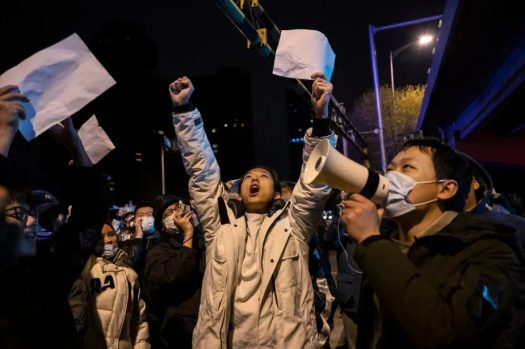
“Right-wing conspiracy theorists with ties to anti-Xi opposition elements spread baseless rumours, deny science, and endanger lives” – strangely not how the NYT chose to caption this image.
eugyppius: a plague chronicle | November 28, 2022
Three years ago, Zero Covid was the aspiration of public health bureaucrats and politicians across the West. Charlatan techbros like Tomas Pueyo appeared on national television to demand nationwide house arrest; leaders like Angela Merkel surrounded themselves with virus-eradicationist modellers and imposed unprecedented months-long closures upon their countries. When protests inevitably broke out, they were violently suppressed; the protesters were slandered as conspiracy theorists and fascists.
The New York Times played a leading role in this long and excruciating charade. In April 2020, they reported that “an informal coalition of influential conservative leaders and groups, some with close connections to the [Trump] White House” was responsible for “quietly working to nurture protests and apply … pressure to overturn state and local orders intended to stop the spread of the coronavirus.” In March 2021, they ran an obnoxious opinion piece about What Happened When Germany’s Far-Riught Party Railed Against Lockdowns, which called the German protesters “an amorphous mix of conspiracy theorists, shady organizations and outraged citizens” and appeared to accuse the right-populist party Alternativ für Deutschland of opportunism for joining their ranks.
What a difference a few years have made.
China Protests Break Out as Covid Cases Surge and Lockdowns Persist is a lead headline in today’s New York Times : “Strict Covid restrictions are hurting the country’s economy and angering members of the public, who are taking to the streets,” we read in the article that follows. Western anti-lockdown protesters are fascists and conspiracy theorists; Chinese anti-lockdown protesters, on the other hand, are ordinary people protesting their oppression:
“Lift the lockdown,” the protesters screamed in a city in China’s far west. On the other side of the country, in Shanghai, demonstrators held up sheets of blank white paper, turning them into an implicit but powerful sign of defiance. One protester, who was later detained by the police, was carrying only flowers.
Over the weekend, protests against China’s strict Covid restrictions ricocheted across the country in a rare case of nationwide civil unrest. There had been signs of dissent, but the new wave of anger may pose a bigger challenge for the government.
Some demonstrators went so far as to call for the Communist Party and its leader, Xi Jinping, to step down. Many were fed up with Mr. Xi, who in October secured a precedent-defying third term as the party’s general secretary, and his “zero-Covid” policy, which continues to disrupt everyday life, hurt livelihoods and isolate the country.
Western lockdowns were necessary to save lives. Chinese lockdowns are the repressive tactic of an undemocratic regime.
The Chinese government on Monday blamed “forces with ulterior motives” for linking a deadly fire in the western Xinjiang region to strict Covid measures, a key driver as the protests spread across the country.
In much the same way, the New York Times blamed shadowy political actors with ties to Trump for anti-lockdown protests in 2020.
Outside China, the rest of the world has adapted to the virus and is near normalcy. Take soccer’s premier event, the World Cup. Thousands of people from across the globe have assembled in Qatar and are cheering on their teams, shoulder-to-shoulder, without masks, in packed stadiums.
China’s approach won praise during the beginning of the pandemic, and there is no doubt it has saved lives. But now that approach looks increasingly outdated. Almost three years after the coronavirus emerged, the contrast between China and the rest of the world couldn’t be starker.
Emphasis mine, because it’s probably the most amazing line in the whole piece. Here we have America’s foremost propaganda outlet, trying desperately to accuse China of unjust dictatorial repression, for the crime of implementing in a more organised and coherent way the very same Zero Covid policies that Times journalists spent nearly two years supporting. What’s actually wrong with the harsh Chinese lockdowns? Well, say the Times, because they can’t say anything else, they’ve become unfashionable.
The Times have also suddenly discovered that lockdowns are bad for the economy. “China’s economy has been hurt by the restrictions,” which have “hammered business both large and small,” they report. Major companies are seeking to escape the effects of closures by “expand[ing] production outside China”, all while “reduced foot traffic” hurts businesses in “the main streets of towns and cities.” That’s bad when it happens in China, but Germany or Canada it’s totally worth it.
On the one hand, we should be probably be happy about the implicit repudiation of lockdowns that articles like this represent, and the strong signal they send that none of our opinion makers wants to return to them. Some of you will have your own more detailed theories about why this is, but my broad view, is that mass containment adheres to the same trajectory everywhere: 1) There is the initial lockdown followed by a seasonally-induced collapse in cases, which encourages among policymakers to an illusion of control. 2) When infections inevitably surge the second time, they try to play the lockdown card again and again, always with less success. 3) Finally, in the face of growing protests and destruction, the policies are abandoned and everything reopens. The only difference between China and the West, is that a few years intervened before the first and the second of these steps.
On the other hand, the increasingly open hypocrisy and manipulation of the press are reaching terrifying levels I’d never imagined before, and I think this is very bad.
Featured Video

ARE PATIENTS BEING PROPERLY INFORMED ABOUT OZEMPIC?
or go to
Aletho News Archives – Video-Images
From the Archives
Trans ‘milk’ as good as the real thing – NHS
RT | February 18, 2024
The drug-induced nipple secretions of trans women are as good as mothers’ breast milk for babies, the University of Sussex Hospitals NHS Trust claimed in a letter to campaigners made public in a report by British think tank the Policy Exchange on Sunday.
The healthcare trust’s medical director, Rachel James, argued that the off-label prescription drug cocktail men transitioning to female take in order to produce milk was “similar to the natural hormones which encourage lactation to develop when the baby is newly born.”
“The evidence which is available demonstrates that the milk is comparable to that produced following the birth of a baby,” James wrote in the letter, sent to Children of Transitioners last August.
Biological men who wish to lactate must first take hormones to grow milk glands and then take high doses of either domperidone or metoclopramide to stimulate milk production. Neither drug is approved for this use, though they are occasionally prescribed off-label to biological women who have trouble lactating.
However, domperidone’s own manufacturer, Janssen, warns patients the drug “may cause unwanted side effects affecting the heart in a breastfed baby” and “should be used during breastfeeding only if your physician considers this clearly necessary.” … continue
Blog Roll
 Aletho News
- 2025 Nature Paper Claiming Worsening Global Drought Gets RETRACTED …Heavily Flawed
- Your Milk Is Not the Problem
- The Truth About the Trump Shootings with Ken Silva
- ARE PATIENTS BEING PROPERLY INFORMED ABOUT OZEMPIC?
- US lawmaker blocks $2.8 billion weapons sale to Israel: Report
- Yemeni army claims responsibility for strikes on sensitive sites in Saudi capital, Aramco facilities in Yanbu
- Iran Judiciary issues indictments against 159 US, Israeli officials for assassination of Leader, commanders
- Turkiye revokes Iranian bank license under US sanctions campaign
- US-Denmark Agreement on Greenland Is ‘PR Stunt’ Ahead of Midterms
- Araghchi: Military intervention cannot create security; coercion cannot bring peace
- If Americans Knew
- Israeli attacks kill four Palestinians in Gaza – Daily Update
- Inside Gaza’s death trap of collapsing, bombed-out buildings
- The everyday items Israel bans from Gaza every day
- Inside the siege, the ruined buildings of Gaza – Daily Update
- Debunking The Claim That Macklemore Has A “History Of Antisemitism”
- CPJ demands release of arrested Palestinian-US journalist near Bethlehem
- Robert Kraft: The Billionaire Friend of Netanyahu Pulling The Strings Behind the Macklemore/Ed Sheeran Blow Up
- Columbia Administered Fund Gives Big Money to Pro-Israel Groups
- Deportation Case of Palestinian Activist Salah Sarsour Tests First Amendment
- ‘We Will Not Forget’: Palestinians Mark 44 Years since Sabra and Shatila
- No Tricks Zone
- 2025 Nature Paper Claiming Worsening Global Drought Gets RETRACTED …Heavily Flawed
- New Study: ‘Global Drought Shows No Detectable Recent Acceleration Under Climate Warming’
- Economic Masterminds: German Socialists Suggest Taxing Productivity Gains Stemming From Using AI
- The South China Sea Has Not Been Cooperating With The Climate Change Narrative
- Energy Crisis: Germany Enters Heating Season With Historically Low Gas Reserve Fill Levels
- New Study: The Antarctic Ice Sheet Gained Mass From 2020-2024 Due To Staggering Snow And Ice Accumulation
- Study: Ocean Heating Rates From Thousands Of Years Ago ‘Dwarf’ Modern Ocean Heating Rates
- Climate Extremists Target, Attack Large-Scale Power Grid Infrastructure In Germany!
- New Study: Antarctic Ice Melt Has Contributed Less Than 1 Centimeter To Sea Level Rise In The Last 30 Years
- Fear Of Debate: Alarmist German Climate Scientist Calls On Mainstream Media To Discredit Skeptic Voices
 Aletho News