US-Turkiye brinkmanship won’t reach a point of no return
Conflict between Ankara and Washington over Syria will likely see the two drift apart, with Turkiye aligning more closely with Eurasian powers.
By MK Bhadrakumar | The Cradle | November 28, 2022
The series of airstrikes against Kurdish militants in northern Syria by Turkish jets in the past week come amid heightened concerns over Ankara’s threat to launch a ground operation. Such actions are not without precedent, yet have thus far achieved little in terms of eradicating the security challenges posed by US-backed Kurdish fighters.
Turkiye is today addressing an existential challenge to its national security and sovereignty, stemming from the United States’ quasi-alliance with Kurdish groups in Syria over the past decade – with whom Ankara has been battling for far longer.
However, this issue is playing out within a much broader regional backdrop today. Russia now has a permanent presence in Syria and is itself locked in an existential struggle with the US in Ukraine and the Black Sea. Iran-US tensions are also acute and President Joe Biden has openly called for the overthrow of the Iranian government.
Opposing the US occupation of Syria
Suffice to say, the Syrian government, which has demanded the removal of illegal US troops from one-third of its territory for years, enjoys a congruence of interests with Turkiye like never before, particularly in opposing the American military presence in Syria.
For the US, on the other hand, continued occupation of Syria is crucial in geopolitical terms, given that country’s geography on the northern tier of the West Asian region which borders Iran and the Caucasus to the north and east, Turkiye and the Black Sea to the north, Israel to the south, and the Eastern Mediterranean to the west.
All of that would have a great bearing on the outcome of the epochal struggle for the control of the Eurasian landmass – the Heartland and the Geographical Pivot of history as Sir Halford J. Mackinder once described it in evocative terms – by Washington and NATO to counter Russia’s resurgence and China’s rise.
China’s involvement in the Astana process
A curious detail at this point assumes larger-than-life significance in the period ahead: Beijing is messaging its interest in joining the Astana process on Syria. Moscow’s presidential envoy for Syria, Alexander Lavrentiev, stated recently that Russia is convinced that China’s involvement as an observer in the Astana format would be valuable.
Interestingly, Lavrentiev was speaking after the 19th international meeting on Syria in the Astana format with his counterparts from Turkiye and Iran on November 15.
“We believe that China’s participation in the Astana format would be very useful. Of course, we proposed this option. The Iranians agreed with this, while the Turkish side is considering it and has taken a pause before making a decision,” he explained.
Lavrentiev noted that Beijing could provide “some assistance as part of the Syrian settlement, improve the lives of Syrian citizens, and in reconstruction.”
The Chinese Foreign Ministry promptly responded to the Russian invitation, confirming that Beijing “attaches great importance to this format and is ready to work with all its participants to restore peace and stability in Syria.”
Lavrentiev didn’t miss the opportunity to taunt Washington, saying: “Of course, I believe that if the Americans returned to the Astana format, that would also be very useful. If two countries like the United States and China were present as observers in the Astana format, that would be a very good step, a good signal for the international community, and in general in the direction of the Syrian settlement.”
However, there is no question of the Biden Administration working with Russia, Turkiye, Iran, and China on a Syrian settlement at the present time. Reports keep appearing that the US has been transferring ISIS fighters from Syria to Ukraine to fight Russian forces, and to Afghanistan to stir up the pot in Central Asia.
The Astana troika are in unison, demanding the departure of US occupation forces from Syria. Moscow knows fully well too that the US hopes to work toward shuttering Russian bases in Syria.
Turkiye’s pursuit of the US’s Kurdish allies
In fact, the aerial operations in Syria that Ankara ordered last Sunday followed a terrorist strike in Istanbul a week ago by Kurdish separatists, killing at least six people and injuring more than 80 others. President Recep Tayyip Erdogan has said the air strikes were “just the beginning” and that his Armed Forces “will topple the terrorists by land at the most convenient time.”
Turkish security agencies have nabbed the bomber – a Syrian woman named Ahlam Albashir who was allegedly trained by the US military. White House Press Secretary Karine Jean-Pierre hurriedly issued a statement to calm that storm: “The United States strongly condemns the act of violence that took place today in Istanbul, Turkiye.”
But Turkiye’s Interior Minister Suleyman Soylu reacted caustically to the American missive, saying that Washington’s condolence message was like “a killer being the first to show up at a crime scene.”
Conceivably, with Erdogan facing a crucial election in the coming months, the Biden Administration is pulling out all the stops to prevent the ruling AKP party from winning another mandate to rule Turkiye.
The Turkish “swing state” is crucial for US plans
The US feels exasperated with Erdogan for pushing ahead with independent foreign policies that could see Turkiye joining the BRICS and Shanghai Cooperation Organization (SCO), and deepening his strategic ties with Russia and China – and most important, steadily mark distance from Washington and NATO’s containment strategies against Russia and China.
Turkiye has become a critically important “swing state” at this stage in the post-cold war era. Erdogan’s effort to bolster the country’s strategic autonomy lethally undermines the western strategy to impose its global hegemony.
While Erdogan keep’s Washington guessing about his next move, his airstrikes in northern Syria hit targets very close to US bases there. The Pentagon has warned that the strikes threaten the safety of American military personnel. The Pentagon statement represents the strongest condemnation by the US of its NATO ally in recent times.
Russian diplomacy forestalls Syria ground incursion
Unsurprisingly, Russia is acting as a moderating influence on Turkiye. Lavrentyev said last Wednesday that Moscow has tried to convince Ankara to “refrain from conducting full-scale ground operations” inside Syria. The Russian interest lies in encouraging Erdogan to engage with Syrian President Bashar al-Assad and pool their efforts to curb the activities of Kurdish terrorists.
Indeed, the probability is low that Erdogan will order ground incursions into Syria. This also seems to be the assessment of local Kurdish groups.
US-backed Syrian Democratic Forces (SDF) Commander Mazloum Kobane Abdi, who is the Pentagon’s key interlocutor in northern Syria, has been quoted as saying that while he has received intelligence that Turkiye has alerted its local proxies to prepare for a ground offensive, the Biden administration could still convince Erdogan to back off.
That said, Erdogan can make things difficult for the US and eventually even force the evacuation of its estimated 900 military troops, shutting down the Pentagon’s lucrative oil smuggling operation in Syria and abandoning its training camps for ex-ISIS fighters in northern and eastern Syria.
But the US is unlikely to take matters to a point of no return. A retrenchment in Syria at the present juncture will weaken the US regional strategies, not only in West Asia, but also in the adjoining Black Sea region and the Caucasus, in the southern periphery of the Eurasian landmass.
From Erdogan’s perspective too, it is not in his interest to burn bridges with the west. A bridge in disrepair remains a bridge nonetheless, which would have its selective uses for Erdogan in the times of multipolarity that lie ahead.
Rishi Sunak’s hawkish antagonization of Beijing has not gone unnoticed
By Timur Fomenko | RT | November 23, 2022
Since the conclusion of China’s 20th Communist Party Congress, Xi Jinping has been on a diplomatic blitzkrieg. He’s met with leaders from countries all over the world, including the German chancellor, the French president and even US President Joe Biden himself. He’s keeping up the momentum as New Zealand’s Prime Minister Jacinda Ardern has received an invitation to visit Beijing. China believes that diplomacy is critical to prevent the US from isolating it.
But one important country has thus far been left on the sidelines – the United Kingdom. A meeting between Xi Jinping and British Prime Minister Rishi Sunak, scheduled at the UK’s request during the recent G20 summit, was cancelled. It came just as Sunak, at least superficially, softened his rhetoric on Beijing and sought to re-engage, after having portrayed himself as an ultra-hawk during the leadership contest at home. He even scrapped Liz Truss’s designation of Beijing as a “security threat” to his country.
But that hasn’t saved him from Beijing’s wrath. China is getting tough on Britain, in a similar way to how it did on Scott Morrison’s Australia. While the impasse with Canberra ended with the election of Antony Albanese as Prime Minister, who is more pragmatic in handling China ties, Beijing now sees London as the one playing the role of the “insufferable poodle” of the US, and will likely deliberately block engagement until it changes course.
Out of all allies of the United States, China is especially wary of what is known as “The Anglosphere” or the “Five Eyes” – That is Australia, Canada, New Zealand (although not these days) and the United Kingdom. These Anglophone countries, direct products of the British Empire, are the states which are most invested in American hegemony and closest to the United States in terms of ideology and worldview. While Continental European nations may to varying degrees differentiate themselves from the US, the Anglosphere nations are “true believers” in the US cause.
Hence, when the US invaded Iraq, it was the UK and Australia who answered the call, just to cite one instance. China therefore naturally sees members of the Five Eyes with geopolitical suspicion. Additionally, Beijing does not see them as truly “sovereign” countries or as equals to itself, but rather as US vassals. However, it has to balance this with the reality that all of these countries are critical economic and trade partners, due to their accumulated wealth and market influence. In which case, China’s geopolitical objective is not to treat these countries as adversaries, but to use a very explicit “carrot and stick” mode of diplomacy whereby it punishes them for “bad behaviour” in following the US too closely on the one hand, but rewards them for deeper bilateral engagement on the other.
And there is no more explicit example of this ongoing right now than the contrast between China deepening its engagement with New Zealand and shutting out the United Kingdom. When Beijing deems that a leader of an Anglosphere state, such as Scott Morrison of Australia, or Rishi Sunak of the UK, is too deeply following the United States, then there is absolutely no point in engaging them because the fundamental decisions are being made in Washington and not their respective capitals. The metric of right-wing populism, when these respective leaders are actively demonizing China for domestic political gain, is also a ‘naughty step’ offense. Only the US has the political privilege and power to be able to demonize Beijing, but still get engagement with it, hence why America is able to provoke China and never receive the reactions which smaller nations get from China.
This is how Beijing tries to “dilute” American power. The US itself is never confronted, but those who follow Washington too closely are. And on this, China has caught Sunak off guard. Beijing tolerated the government of Boris Johnson because he described himself as a “Sinophile” determined to improve ties with China. Sunak, however, used antagonism of China for partisan gain. The Prime Minister has since moderated his rhetoric and spoken about “keeping ties open,” believing that his spree of anti-China hyperbole, as well as a recent Ministerial visit to Taiwan, would simply be brushed off and that Beijing would welcome him with open arms. He was wrong, and Beijing is now showing that when it is not about the US, engagement with China is conditional on “good behaviour.”
China also recognizes the UK economy is weak, and as loath as London is to admit it, the UK needs ties with China. Inflation is surging, industrial unrest is picking up, chancellor Jeremy Hunt says the country is already in a state of recession. In which case, Beijing is exploiting these vulnerabilities and, similar to Australia, it will place a number of “demands” on Britain which will become pre-requisites to normalization again, which usually involve respecting Beijing’s position on Taiwan and not following the US agenda.
However, whether this works is another story. In the case of Australia, Scott Morrison’s government did not change course, and it simply became the case that China had to wait him out before re-engaging with his successor. That could very much be the case here too. Britain has ultimately made the choice to follow the US on China, even when those policies prove to be blatantly self-defeating, as is the case with the Newport Wafer Fab. Nonetheless, if Sunak is trying to be pragmatic, this should be a reality check for him.
Xi to visit Saudi Arabia as Prince Salman seeks BRICS membership
By Ahmed Adel | November 23, 2022
The upcoming visit of Chinese leader Xi Jinping to Saudi Arabia, scheduled for December and prepared for a year, shows that the Gulf kingdom has sidelined American interests for its own and taken the first step towards de-dollarization. According to Saudi Foreign Minister Adel al-Jubeir, strengthening trade ties and regional security will be prioritised during Xi’s upcoming visit to Saudi Arabia.
Jubeir emphasized that meetings between Chinese and Saudi leaders are “natural” and recalled that China is Saudi Arabia’s largest trade partner. Sources familiar with the organisation of Xi’s visit confirmed that it has been prepared for a year and that the Chinese leader will arrive in the second half of December to attend the China-Gulf Summit.
Xi’s visit to Saudi Arabia is a continuation of a wider process stimulated by BRICS and the Shanghai Cooperation Organization (SCO), in which China and Russia are key countries. BRICS and the SCO are increasingly attractive organisations for many countries as a framework in which development and cooperation is possible without blackmail and pressure.
Saudi Arabia has fundamentally changed its policy from one of complete submission to the interests of the US to now putting its own national interests first. This does not mean that the Saudis will break relations with the US, but it is a huge difference when the country puts its own interests first compared to when it is subordinated to the interests of Washington.
Riyadh pursues much better and closer cooperation with China as it is a continuation of the process in becoming an independent state and not subservient to Washington. In these processes, by the nature of things, since they are complementary economies, avoiding the dollar as a means of payment is a completely logical plan as it removes the risk of great damage if American sanctions are ever imposed.
On the one hand, BRICS, independently of Saudi Arabia, is operationally working to create a concept that would reduce the importance and influence of the dollar in the world economy. More precisely, such an achievement would reduce the influence of the dollar, which is effectively the basis of US foreign policy.
It is also for this reason that Saudi Arabia is positioning itself as a potential new member of the BRICS bloc.
Within that, a whole series of countries in bilateral cooperation, which is now expected from China and Saudi Arabia, agree on payments in domestic currencies as the first step in the process of de-dollarizing the world economy. It is also for this reason why the visit of Xi to Saudi Arabia follows from everything that has already happened and should not be considered a surprise.
However, it is too early to say whether China will overtake the US as Saudi Arabia’s main partner, even despite the fiasco that was President Joe Biden’s visit to the Gulf kingdom. This is especially the case because Saudi Arabia has based its defence on American weapons and has immense financial ties with the US.
There will definitely be more significant Sino-Saudi cooperation and the Arab kingdom itself will attempt to detach from the dollar. However, the truth is that de-dollarization is a process that will take many years. None-the-less, the Saudi reduction in cooperation with the US will inevitably occur.
It is recalled that South African President Cyril Ramposa said during his visit to Riyadh in October that Crown Prince Mohammed bin Salman expressed Saudi Arabia’s desire to join BRICS. Discussions on the expansion of the BRICS bloc are scheduled to take place in South Africa when it takes over the presidency in 2023.
Saudi Arabia’s separation from the West has only accelerated under the Biden presidency. Biden described Saudi Arabia as a pariah state due to Prince Salman’s alleged involvement in the murder of Jamal Khashoggi, a Washington Post journalist. However, the US President changed his outlook and rhetoric towards the Arab country after coming to power.
As BRICS represents more than 40 percent of the global population and nearly a quarter of the world’s GDP, with the group set to have bolstered global influence if it expands, Saudi Arabia is interested in gaining further independence by joining the bloc. Joining the bloc also means closer relations with China, something that Saudi Arabia is now pursuing despite Western criticism.
Ahmed Adel is a Cairo-based geopolitics and political economy researcher.
A Very Different Global State of Affairs Takes Hold
By Alastair Crooke | Strategic Culture Foundation | November 21, 2022
How the world appears all depends on whether your gaze is firmly focussed on the hub of the wheel, or alternatively, were you to watch the wheel’s rotation around the hub – and the bearing it follows – you would see the world differently.
Looked at from a DC-centric perspective, all is still: Nothing (as it were), is moving geo-politically. Was there an election in the U.S.? Well, certainly there is no longer an ‘Election Day’ event as the new mechanics of ballots vs in-person voting, commencing up to 50 days earlier, and ploughing on, weeks after, has become far removed from the old notion of having ‘an election’, and an aggregate macro outcome.
From this ‘centric’ viewpoint, the Midterms change nothing – stasis.
So many of Biden’s policies were already in stone anyway – and beyond the ability of any Congress to change in the short run.
New legislation, if there were any, could be vetoed. And should the election ‘month’ end with the House controlled by Republicans and the Senate controlled by Democrats, there might not be any legislation at all, because of partisanship and an inability to compromise.
More to the point, Biden anyway can rule for the next 2 years through Executive Order and bureaucratic inertia – and not need the Congress at all. In other words, the composition of Congress may not matter that much.
But now, turn your gaze to the rotation around the ‘hub’, and what do you see? The rim spinning wildly. It seizes more and more traction on the ground and has clear directionality.
The biggest pivot around the hub? Well probably, President Xi of China travelling to Riyadh to meet Mohammad bin Salman (MbS). The wheel rim here digs deep for a firm grip on bedrock, as Saudi Arabia makes its pivot toward the BRICS. Xi likely is going to Riyadh to seal the details of Saudi’s accession to the BRICS and the terms of China’s future ‘Oil Accord’ with Saudi Arabia. And that may be the beginning to the end to the petrodollar system – as whatever is agreed in terms of the Chinese mode of payment for oil will mesh with Russo-Chinese plans eventually to move Eurasia onto a new trading currency (far away from the dollar).
Saudi Arabia gravitating BRICS-wards means other Gulf and Mid East – states such as Egypt – leaning BRICS-wards also.
Another pivot: The Turkish Interior Minister Süleyman Soylu said after this week’s explosion in Istanbul: “We do not accept the condolence message of the U.S. Embassy. We understand the message that was given to us, we received the message that was given to us”. Soylu then dismissed the U.S. condolence as akin to “a killer being first to show up at a crime scene”.
Let’s be clear: The minister just told the U.S. to go sc**w itself. This unleashing of raw anger comes just as Turkey has agreed to join with Russia to establish a new gas hub in Turkey and is participating with Russia in a massive oil and gas investment and co-operation deal with Iran. Turkey too, is veering BRICS-wards.
And, as Turkey veers away from one ‘hub’, much of the Turkic sphere will take Turkey’s lead.
These two events – from Xi’s meeting with MbS’ thumbing his nose at the U.S., to Turkey’s fury at the terrorism in Istanbul – clearly dovetail together to mark a strategic Middle East pivot – both in terms of energy and monetary frameworks, towards the unfolding Eurasian free trade sphere.
Then comes the news from last Thursday: Iran says that it has developed a high-precision hypersonic missile. General Hajizadeh said the Iranian hypersonic ballistic missile can reach more than five times the speed of sound and, as such, it will be able to breach all present systems of anti-missile defence.
Simply put: Iran essentially already is a nuclear threshold state (but not a nuclear weapons state). The remarkable technical achievement of producing a hypersonic high-precision missile (which still eludes the U.S.), is a paradigm-changer.
Strategic nukes make no sense in a highly mix-populated, small Middle East – and now, there is no need for Iran to move towards becoming a weapons state. So, what would be the point to a complicated containment strategy (i.e. the JCPOA), oriented towards hindering an outcome that has become overtaken by new technology? A hypersonic ballistic missile capacity makes tactical nukes redundant. And hypersonic missiles are more effective; more easily deployed.
The problem for the U.S. and Israel is that Iran has done it – it has leaped beyond the JCPOA containment cage.
On top of that, a few days earlier, Iran also announced that it had launched a ballistic missile, carrying a satellite into space. If so, Iran now has ballistic missiles capable of reaching, not only Israel, but Europe too. Furthermore, Iran is reported to soon receive 60 SU-35 aircraft, as just one part to its rapidly evolving relationship with Russia, sealed last week with Nikolai Patrushev (Russia’s Security Council Secretary) in Tehran.
Again, to be clear, Russia has just acquired a highly potent kinetic force multiplier; access to Iran’s sanctions-busting rolodex of contacts and strategies, and a full partner to Moscow’s big play of Eurasia becoming a commodities super-oligopoly.
Simply put, as Iran enlists as a force multiplier to the Russia-China axis, so too will Iraq, Syria, Hizbullah and the Houthis slip along a somewhat similar trajectory.
Whilst the European ‘security architecture’ remains still frozen in a tight NATO, anti-Russian grip, West Asia’s security architecture is dissolving away from the old U.S. and Israeli-led hard polarisation of a Sunni sphere vs Shi’i Iran (i.e. the so-called Abraham Accords), and is re-forming around a new security architecture being shaped by Russia and China.
This makes sense. Turkey prizes its Turkic civilisational heritage. Iran clearly is a civilisational state, and MbS plainly wants his kingdom to be widely accepted as one, too (and not as just a U.S. dependency). The point of the SCO format is that it is ‘pro-autonomy’ and is opposed to any singularity of ideology. In fact, by being civilisational in concept, it becomes anti-ideological and opposed to tight binary (with us, or against us) alliances. Membership does not require endorsement of each other partner’s particular policies, provided they do not impinge on others’ sovereignty.
In effect, the whole of West Asia – to one degree or another – is being lifted up into this evolving Eurasian economic and security paradigm.
And, simply said, since Africa is already enlisted into the China camp, the African component to MENA is trending strongly Eurasia-wards, as well. The Global South’s affiliation too, largely can be taken for granted.
Where does this leave the old ‘hub’? It has Europe fully in its control. For now, yes…
However research published by France’s École de Guerre Economique suggests that whilst Europe has, since WW2, “lived in a state of the unspoken” in respect to its full-spectrum dependency on Washington, as Russia sanctions take their catastrophic effect on Europe, “a very different state of affairs takes hold”. Consequently, politicians, and the public alike, struggle to identify “who truly is their enemy”.
Well, the collective view, based on interviews with French intelligence experts (i.e. the French Deep State) is very clear: 97% percent consider the U.S. to be the foreign power that “most threatens” the “economic interests” of France. And they see it as a problem that must be resolved.
Of course, the U.S. will not easily let Europe go. Nonetheless, if parts of the Establishment can speak thus, then something is moving and afoot, beneath the surface. The report underlines naturally that the EU might have a trade surplus of 150 billion euros with the U.S., but the latter would never willingly allow this to translate into ‘strategic autonomy’. And any gain in autonomy is achieved against the constant backdrop of – and more than offset by – “strong geopolitical and military pressure” from the U.S. at all times.
Could the Nord Stream sabotage have been the straw that broke the camel’s back? In part, it was a trigger, but Europe hides its diverse old hatreds and long-nursed vindictiveness under ‘a Brussels lid of easy money’. But this pertains only so long as the EU remains a glorified ATM – states insert their debit-cards and withdraw cash. The concealed animosities are repressed, and monetarily lubricated into quiescence.
The ATM however, is in trouble (economic contraction, de-industrialisation and austerity cometh!); and as the ATM withdrawals’ window winnows down, so too the lid holding down the old animosities and tribal feelings will not hold for long. Indeed, the demons are rising – and are readily visible even now.
And finally, will the Washington ‘hub’ hold? Does it retain the resources to manage so many stress-test events – financial, systemic and political – all arriving synchronistically? We must wait to see.
In retrospect, the ‘Hub’ is not ‘on the move’. It has moved already. It is just that so many are stuck seeing an ‘empty space’ that once was occupied by something past, but which somehow still somehow lingers on, in visual memory, as a ‘shade’ of its earlier solidity.
South Korea asks for Russia and China’s help

South Korea’s nuclear envoy Kim Gunn
RT | November 21, 2022
South Korea has turned to Russia and China for help in shutting down rival North Korea’s missile testing program, arguing that Pyongyang is threatening peace and stability across Northeast Asia and beyond.
Nuclear envoy Kim Gunn held a telephone call on Monday morning with the Russian and Chinese ambassadors to Seoul, Andrey Kulik and Xing Haiming, asking for “active cooperation” in persuading Pyongyang to refrain from “further provocations” and return to dialogue, the South Korean Foreign Ministry said in a statement. Kim argued that North Korea’s launch of an intercontinental ballistic missile (ICBM) on Friday violated UN Security Council resolutions and marked yet another dangerous saber-rattling incident from President Kim Jong-un’s regime.
Seoul made its appeal for help as its envoys prepared to lobby the UN Security Council for action at an emergency meeting on Monday in response to North Korea’s latest ICBM test. The South Korean diplomat “emphasized the need for the international community, including the United States, to unite and promptly take decisive countermeasures,” the ministry said.
As permanent members of the Security Council, Russia and China have the power to veto any resolutions that would punish North Korea for its strategic weapons tests. Russia has called in the past for de-escalation on the Korean Peninsula by both sides, meaning Pyongyang would halt nuclear-related tests and the US and South Korea would suspend their joint military exercises in the region. US officials have called that idea “insulting.”
Kulik warned last year that only diplomacy would bring peace to the peninsula. “We are convinced that step-by-step activities based on the principles of equality and a gradual and synchronized approach will make it possible to ensure the denuclearization of the Korean Peninsula and lay the foundation for a solid system of peace and security here,” the ambassador told TASS in an interview last December.
UN secretary-general Antonio Guterres issued a statement on Friday condemning North Korea for its latest ICBM launch. North Korean Foreign Minister Choe Son-hui responded on Monday by calling Guterres a “puppet of the US.” She defended North Korea’s weapons tests as a “legitimate and just exercise of the right to self-defense,” saying they came in response to “provocative nuclear war rehearsals” by the US and its allies.
Kamala Harris moves to counter China’s territorial claims
RT | November 20, 2022
US Vice President Kamala Harris has traveled to the Philippines for a visit designed to demonstrate Washington’s support for Manila and other Southeast Asian allies in their territorial disputes with China.
Harris arrived on Sunday evening to a red-carpet welcome in Manila after attending the Asia-Pacific Economic Forum in Thailand. She’s scheduled to meet with President Ferdinand Marcos Jr. on Monday for talks on strengthening security and economic ties, then fly on Tuesday to the Palawan island chain, which lies adjacent to disputed waters of the South China Sea.
Harris will become the highest-ranking US official to ever visit Palawan. Her trip marks the latest effort by President Joe Biden’s administration to push back against Beijing’s territorial claims in the Spratly region, where China has dredged the seafloor to create artificial islands featuring airstrips and missile launchers.
Parts of the Spratlys are claimed by the Philippines, Taiwan, Vietnam, Malaysia, and Brunei. Washington has also sought to enforce freedom of navigation in the South China Sea, which is home to an estimated $5 trillion worth of annual shipping traffic, as well as rich oil and natural gas deposits.
“This visit demonstrates the Biden-Harris administration’s commitment to stand with our Philippine ally in upholding the rules-based international maritime order in the South China Sea, supporting maritime livelihoods, and countering illegal, unregulated, and unreported fishing,” a senior White House official told reporters in previewing the VP’s trip last week. “The message is that you can count on the United States. We are, we are a friend and a partner.”
Asked what message the administration intended to send to Beijing, the unidentified official said, “China can take the message it wants. The message to the region is that the United States is a member of the Indo-Pacific, we are engaged, we’re committed to the security of our allies in the region.”
Philippine Ambassador to Washington Jose Manuel Romualdez agreed, telling the Associated Press : “The message they’re trying to impart to the Chinese is that ‘we support our allies like the Philippines on these disputed islands.’ This visit is a significant step in showing how serious the United States views this situation now.”
Beijing has claimed sovereignty over the Spratly Islands and surrounding waters as falling within its “nine-dash line.” During a visit to Southeast Asia last year, Harris accused China of “coercion” and “intimidation.”
Harris’ visit to Palawan could instigate China into boosting Spratly Island defences
By Ahmed Adel | November 18, 2022
The US is preparing for Vice President Kamala Harris to visit the Palawan Islands in the Philippines, located near the disputed areas in the South China Sea. Her visit to the archipelago is part of Washington’s wider strategy of containing China but will likely trigger Beijing to respond, which could include the strengthening of Chinese defences in the Spratly Islands.
A senior US official said that Vice President Kamala Harris will visit the Palawan Islands to show Washington’s “commitment to stand with our Philippine ally in upholding the rules-based international maritime order in the South China Sea, supporting maritime livelihoods, and countering illegal, unregulated, and unreported fishing.”
Harris’ visit to Palawan is scheduled for November 22. With this visit, she will become the highest-ranking US official to visit the chain of islands adjacent to the Spratly islands, parts of which are also claimed by Brunei, Malaysia, the Philippines, Taiwan and Vietnam.
The Vice President is also expected during her visit to inspect the Antonio Bautista Air Force Base. One of the base’s facilities is under construction as part of a military cooperation agreement between the US and the Philippines. The Philippine military command is located at the air base and is responsible for overseeing security and patrolling in the Palawan archipelago.
By Harris visiting this geographically sensitive area, the US is drawing international attention to the South China Sea issue and shows support for the Philippines, a Philippines which until recent times was fostering closer relations with China.
After a face-to-face meeting in Bali between Chinese leader Xi Jinping and US President Joe Biden, which was aimed at de-escalating tensions, Harris’ trip could backfire efforts already made. Coupled with Pelosi’s visit to Taiwan, Harris’ visit is undoubtedly a demonstration of the trend in US policy to contain China.
It is possible that Harris’ visit is also part of the US response to the security agreement between China and the Solomon Islands. The Americans are increasing their presence in the region and may be signalling to China to give up its ambitions. Beijing will not capitulate to such a demand and could in fact respond by deploying more modern weapons on the Spratly Islands.
Since the beginning of this year, the Philippines has had to deal with many problems. The conflict in Ukraine has caused energy and food prices to sharply rise. In addition, the Philippines is struggling to cope with the consequences of the pandemic. Therefore, renewed tensions with China in the South China Sea may not be something the Filipinos want to deal with at the moment, but it could serve as a unifying factor across the country.
In addition, at his meeting with Xi Jinping, Biden said that he has no intention of containing China. At the same time, a US visit to Palawan gives clear intentions and is an action louder than any words Biden can sprout.
The recent meetings in Phnom Penh between Chinese Premier Li Keqiang and ASEAN partners, as well as the results of the ASEAN summit, show progress in finding a consensus on the South China Sea issue. All parties expressed their wish to ensure stability in the region to resolve the South China Sea issue without interference from outside parties. This positive dynamic in diplomacy lessens the reasons for regional states to oppose China, something which Washington opposes.
If the parties make real progress in negotiating the disputed issues in the South China Sea, then Washington will not be able to leverage this issue to pressure China and unite regional states. If a compromise is reached on a bilateral or multilateral basis that satisfies all involved parties to the dispute, this lessens US influence in the region.
It is no coincidence that Washington is hurrying to strengthen its military ties with its allies in the region and is supporting this process in every way possible. Manila announced on November 15 that Washington would spend $66.5 million to upgrade three military bases in the country. Accordingly, training facilities and warehouses will be built at the bases as noted in the 2014 security cooperation agreement.
As Reuters noted, the US and Philippines have a 70-year-old Mutual Defence Treaty and their respective militaries participate in dozens of joint training exercises each year, ranging from live fire and amphibious assaults to humanitarian missions and counter-terrorism drills. In this way, the US is leveraging its military as a source of influence in the Philippines, but for decision makers in Manila, the path of diplomacy is preferred, even if Harris will attempt to suggest otherwise during her visit to Palawan.
Ahmed Adel is a Cairo-based geopolitics and political economy researcher.
‘Culture Block’ Is Leading to Ukraine Escalation (and risking WWIII)
By Alastair Crooke | Strategic Culture Foundation | November 14, 2022
Spot the problem here: First, the EU has lost Russia as a partner, yet the EU insists to maintain trade with China. Two, China, though, must bend to our EU ‘rules’ on how it configures its economy. Thirdly, China too, must accept to be ‘castigated’ by the likes of Olaf Scholtz and Charles Michel for ‘not having put an end to Russia’s illegal war in Ukraine’. Fourth, we, the EU, anyway do not intend to depend on you. And fifth, clean up your human rights abuses!
Wow! Well, the initial reaction might be a spell back at the Academy on the art of diplomatic discourse, as being one idea. Nonetheless, the sheer number of non-sequiturs to this stance is startling. Firstly, the rest of the world is not greatly interested in EU leaders’ woke thought-code (the Chinese simply cancelled EU Chief Michel’s proposed speech to a gathering in Beijing). Europe has lost Russia; It will likely lose China. And probably, it will find itself excluded from the colossus, free-trade area unfolding in Eurasia – as the blocs differentiate into separate trading spheres.
Where does this leave that bruited EU ambition to be a global player? … Perhaps the EU’s thought-code culture might be the problem to its ambitions.
You (the EU) have not thought this through: You are now a dependent appendage of the U.S. economy – a prop to maintaining America’s exalted spot in the global system – at a time when its predatory economic model of money-printing at zero interest has been holed by an iceberg (known as accelerating inflation). American industry needs a captive market in a world that is fast seceding into two separate spheres. You have ‘elected’ to fill that role.
Containing China is America’s explicit goal. And that means blocking the European continent from moving closer to Asia to form the world’s biggest free trade zone. Washington had to stop that (i.e. sabotage Nord Stream) in order to preserve Europe as a captive market, and what remains of dollar ‘privilege’.
As an American dependency, Europe is perceived as having conceded not only economic, but political agency too. Simply put, the EU has lost its cheap-energy business model with the ‘I stand with Ukraine’ woke thought and speech codes, and now finds that it is impotent politically. Why would ‘others’ deal with the courtiers, when they can go directly to the ‘Command’ in Washington?
Furthermore, the culture block the EU adopts prevents it from bringing the Ukraine war to a political end. Rather, what it does is bake-in escalation.
Here is the problem: You bought into liberal America’s notion of a coercive process of induced government dysfunctionality – that is to stay, the state of mass psychosis that any weaponised dysfunctional state of society can produce. And it’s been a success (on its own narrow terms).
The bigger message is that ‘induced dysfunctionality’ marching in lockstep, and using culture block tactics to suppress any dissenting opinions, can and does produce a society that can be ruled over (made compliant through unpleasantness and applied pain) – without having to govern (i.e. make things actually work).
And induced compliance has proved its use for implementing all sorts of other ideological schemes that the public would otherwise never accept.
Weaponised dysfunctionality was trialled during the recent pandemic. The public was persuaded to accept systemic degradation of the economy. Western leaders regularly have expressed a pleasant surprise at the degree of public compliance achieved during the lockdowns. Of course, it was only made possible by ‘woke mobs’ on social platforms impugning the motives of anyone questioning ‘the Science’, the scale of emergency, or the long-lasting toxic effects on the real economy. Cultural roadblock was imposed.
The same process is evident today: The EU is in (another) ‘emergency’ because it made a strategic misjudgement over its Russia sanctions. The political class thought the effects of EU sanctions on Russia offered a ‘slam dunk’ outcome: Russia would fold in weeks, and all would return to how it was before. Energy would flow freely to the EU again; things would go back to ‘normal’.
Instead, Europe faces economic melt-down from astronomic fuel costs.
Yet, some leaders in Europe – zealots for the Green Transition – quietly embrace this sanctions ‘failure’ and the resulting economic mayhem caused by spiking energy prices – weaponising it as a strategic asset to accelerate Green Transition. European authorities actively encourage this pathological approach, believing that the pain incurred will force compliance on their societies to embrace de-industrialisation, accept carbon footprint monitoring and the Green Transition; and too, to bear prospective monumental Transition costs.
Yellen explicitly celebrated the financial pain (dysfunctionality) precisely as serving to accelerate ‘The Transition’ (like it or not) – even were that to push the citizen out of employment, and to the cusp of society.
Here then, is the problem: Some in the EU political class may hope for an intensification of the war on Russia, seeing in it all sorts of benefits – in extending centralised control over member-states and facilitating new means of printing money (mutualised debt instruments) ostensibly to fund Ukraine.
Sure – but there are fears for societal breakdown in Europe too. The problem? The EU cannot bring Ukraine to a deal.
The point is that the EU has framed the Ukraine conflict in absolute victim-vein terms, in line with woke cultural tropes: A revanchist Russian leader, dreaming of former empire, illegally, and without provocation has invaded and seized territory from its neighbour, whilst committing heinous war crimes in so doing. The perpetrator must face a humiliating defeat – otherwise, if he gets an inch, he will take a mile. And the global order will be ‘toast’.
The ‘online mob’ has been steered, through ‘influencers’, to insist that U.S. Realist Camp’s support for a negotiated settlement is tantamount to taking Russia’s side: rushing to denounce all voices – from Bill Burns’ (then U.S. ambassador and now CIA chief) celebrated 2008 telegram ‘Niet means Niet’ warning that any NATO takeover of Ukraine means war; to Prof Mearsheimer, Kissinger, or Elon Musk – as dangerous ‘Putin apologists’. Musk now faces a security probe.
The logic is stark: This shrinks the Overton window to only those advocating the total defeat of Russia and an end to Putin’s ‘regime’ – even if it risks WWIII. It is the ‘slash and burn’ stance, favoured by the U.S. and allied EU neo-cons.
So, we have Washington saying it has no interests, per se, in Ukraine – beyond supporting Kiev in recovering its territory. The Biden Administration says it is guided by the wishes of the Ukrainian people.
Do you still not see the problem to which this logic takes us? It is a Potemkin Village position. All façade and nothing ‘behind’ or around it. The conflict in Ukraine is not itself ‘a unique thing’, but a ‘thing’ of two leaves. At one level, Ukraine is a ‘state’ among surrounding states; and at another level, it is itself an actor. A ‘player in events’ – an owner indeed, of a certain history.
What the Potemkin ‘approach’ does is to artificially free-up some sort of abstract ‘clearing in the wood’ amidst the density of trees, in which the visible thing – Ukraine – is to be positioned, and set before the western spectator public, stripped naked of surrounding context; stripped of history and of the fact of itself being a conscient player in an extended drama.
The Realists have been culture blocked. Their motives impugned.
The title to this play – ‘America has no fundamental interests in Ukraine, and is but an innocent, called up upon the stage by an act of brutal villainy’ – is an obvious fraud. As is the corollary that the EU must therefore support the ‘war’ as Ukraine is victim.
Plainly said, the U.S. is pursuing a bi-partisan geopolitical strategy to quash China’s meteoric rise and preserve America’s dominant role in the world order. Can there be any doubt about that? No, none. For two decades U.S. foreign policy has centred around its ‘pivot to Asia’.
Washington’s real interests in Ukraine thus must be understood not as a war of values – as the EU has it – but rather as a cruise-missile launched at China, not Russia. In gist, the ‘high road’ to collapsing Beijing is perceived in DC to pass through a weakened Moscow. The NATO response to Ukraine is intended as ‘a letter’ to China, concerning Taiwan. And the comprehensive sanctions on Russia are a missive to the rest of the world to not trifle with America’s absolute primacy.
But if this latter context is absolutely ‘off the table’, through culture block and the only agenda item being the sham Potemkin Village construct, then what is there to talk about?
The matter then must inexorably be settled by events – not talk. Who has the potential for escalatory dominance? Russia has many – and various – options. Ukraine has only one. Pushing more troops at the contact line and suffering heavy losses. What does the West have: WWIII?
Can you see now why your peace efforts have come to naught? Actually, President Xi explained the situation courteously, yet pointedly, to Chancellor Scholtz during the latter’s day trip to Beijing: Having lectured Scholz on the evanescent quality of Trust in any political relationship (a quality that Xi said should be nurtured), he emphasised the need for Europe to avoid an ideological approach to relations.
Rough Translation: You (Scholz) have destroyed your relationship with Russia; you have pursued a bloc-orientated ideological policy, and this has been to your disadvantage. Do not think you can do the same with China.
(Or with the rest of the world, Xi might well have added).
Russia strategises with Iran for the long haul in Ukraine

Ali Shamkhani (L), representative of Supreme Leader and Secretary of Supreme National Security Council, met Nikolai Patrushev, Secretary of Russia’s Security Council, Tehran, Nov. 9, 2022
BY M. K. BHADRAKUMAR | INDIAN PUNCHLINE | NOVEMBER 14, 2022
Ignoring the hype in the US media about White House National Security Advisor Jake Sullivan’s Kissingerian diplomacy over Ukraine, the secretary of Russia’s Security Council Nikolai Patrushev, former KGB counterintelligence officer and longstanding associate of President Putin, travelled to Tehran last Wednesday in the equivalent of a knockout punch in geopolitics.
Patrushev called on President Ebrahim Raisi and held detailed discussions with Admiral Ali Shamkhani, the representative of the Supreme leader and secretary of Iran’s Supreme National Security Council. The visit marks a defining moment in the Russia-Iran partnership and plants a signpost on the trajectory of the war in Ukraine.
The Iranian state media quoted Raisi as saying, “The development of the extent and expansion of the scale of war [in Ukraine] causes concern for all countries.” That said, Raisi also remarked that Tehran and Moscow are upgrading relations to a “strategic” level, which is “the most decisive response to the policy of sanctions and destabilisation by the United States and its allies.”
The US State Department reacted swiftly on the very next day with spokesman Ned Price warning that “This is a deepening alliance that the entire world should view as a profound threat… this is a relationship that would have implications, could have implications beyond any single country.” Price said Washington will work with allies to counter Russian-Iranian military ties.
Patrushev’s talks in Tehran touched on highly sensitive issues that prompted President Vladimir Putin to follow up with Raisi on Saturday. The Kremlin readout said the two leaders “discussed a number of current issues on the bilateral agenda with an emphasis on the continued building up of interaction in politics, trade and the economy, including transport and logistics. They agreed to step up contacts between respective Russian and Iranian agencies.”
In this connection, Patrushev’s exceptionally strong support for Iran over the current disturbances in that country must be understood properly. Patrushev stated: “We note the key role of Western secret services in organising mass riots in Iran and the subsequent spread of disinformation about the situation in the country via Persian-language Western media existing under their control. We see this as overt interference in the internal affairs of a sovereign state.”
Russian security agencies share information with Iranian counterparts on hostile activities of western intelligence agencies. Notably, Patrushev sidestepped Iran’s suspicions regarding involvement of Saudi Arabia. Separately, Foreign Minister Sergey Lavrov also publicly offered to mediate between Tehran and Riyadh.
All this is driving Washington insane. On the one hand, it is not getting anywhere, including at President Biden’s level, to raise the spectre of Iran threat and rally the Arab regimes of the Persian Gulf all over again.
Most recently, Washington resorted to theatrics following up an unsubstantiated report by Wall Street Journal about an imminent Iranian attack on Saudi Arabia in the coming days. The US forces in the West Asian region increased their alert level and Washington vowed to be ready for any eventuality. But, curiously, Riyadh was unmoved and showed no interest in the US offer of protection to ward off threat from Iran.
Clearly, the Saudi-Iranian normalisation process, which has been front-loaded with sensitive exchanges on their mutual security concerns, has gained traction neither side gets provoked into knee-jerk reaction.
This paradigm shift works to Russia’s advantage. Alongside its highly strategic oil alliance with Saudi Arabia, Russia is now deepening its strategic partnership with Iran.
The panic in spokesman Price’s remarks suggests that Washington has inferred that the cooperation between the security and defence agencies of Russia and Iran is set to intensify.
What alarms Washington most is that Tehran is adopting a joint strategy with Moscow to go on the offensive and defeat the weaponisation of sanctions by the collective West. Despite decades of sanctions, Iran has built up a world class defence industry on its own steam that will put countries like India or Israel to shame.
Shamkhani underscored the creation of “joint and synergistic institutions to deal with sanctions and the activation of the capacity of international institutions against sanctions and sanctioning countries.” Patrushev concurred by recalling the earlier agreements between the national security agencies of the two countries to chart out the roadmap for strategic cooperation, especially in regard of countering western economic and technological sanctions.
Shamkhani added that Tehran regards the expansion of bilateral and regional cooperation with Russia in the economic field as one of its strategic priorities in the conditions of US sanctions, which both countries are facing. Patrushev responded, “The most important goal of mine and my delegation in traveling to Tehran is to exchange opinions to speed up the implementation of joint projects along with providing dynamic mechanisms to start new activities in the economic, commercial, energy and technology fields.”
Patrushev noted, “Creating synergy in transit capacities, especially the rapid completion of the North-South corridor, is an effective step to improve the quality of bilateral and international economic and commercial cooperation.”
Patrushev and Shamkhani discussed a joint plan by Russia and Iran “to establish a friendship group of defenders of the United Nations Charter” comprising countries that bear the brunt of illegal western sanctions.
With regard to the Shanghai Cooperation Organisation, Shamkhani said the two countries should “intelligently use the exchangeable capacities” of the member countries. He said the danger of terrorism and extremism continues to threaten the security of the region and stressed the need to increase regional and international cooperation.
Patrushev’s visit to Tehran was scheduled in the run-up to the conference on Afghanistan being hosted by Moscow on November 16. Iran and Russia have common concerns over Afghanistan. They are concerned over the western attempts to (re)fuel the civil war in Afghanistan.
In a recent op-ed in Nezavisimaya Gazeta, Russian Special Presidential Envoy for Afghanistan Zamir Kabulov alleged that Britain is financing a so-called “Afghan resistance” against the Taliban (which is reportedly operating out of Panjshir.) Kabulov wrote that the US is baiting two Central Asian states by offering them helicopters and aircraft in lieu of cooperation in covert activities against the Taliban.
Kabulov made a sensational disclosure that the US is blackmailing the Taliban leaders by threatening them with a drone attack unless they broke off contacts with Russia and China. He said, specifically, that the US and Britain are demanding that Kabul should refrain from restricting the activities of Afghanistan-based Uyghur terrorists.
Interestingly, Moscow is exploring the creation of a compact group of five regional states who are stakeholders in Afghanistan’s stabilisation and could work together. Kabulov mentioned Iran, Pakistan, India and China as Russia’s partners.
Iran is a “force multiplier” for Russia in a way no other country — except China, perhaps — can be in the present difficult conditions of sanctions. Patrushev’s visit to Tehran at the present juncture, on the day after the midterms in the US, can only mean that the Kremlin has seen through the Biden administration’s dissimulation of peacemaking in Ukraine to actually derail the momentum of the Russian mobilisation and creation of new defence lines in the Kherson-Zaporozhya-Donbass direction.
Indeed, it is no secret that the Americans are literally scratching the bottom of the barrel to deliver weapons to Ukraine as their inventory is drying up and several months or a few years are needed to replenish depleted stocks. (here, here ,here and here)
Suffice to say, from the geopolitical angle, Patrushev’s talks in Tehran — and Putin’s call soon after with Raisi — have messaged in no unmistaken terms that Russia is strategising for the long haul in Ukraine.
Research: Countries That Sought ‘Zero-COVID’ Lockdowns Have The Least Immunity
Kevin Frayer/Getty Images
By Steve Watson | Summit News | November 4, 2022
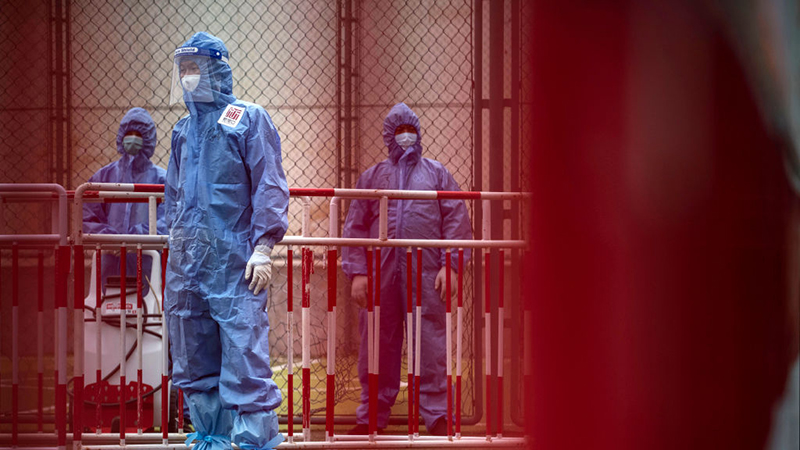
New research has revealed the countries that implemented the harshest lockdowns as part of ‘zero-COVID’ policies now have the least immunity from the virus itself.
The analysis by The Institute of Health Metrics and Evaluation (IHME) at the University of Washington’s School of Medicine estimates that China, which still has multiple lockdowns in place, has the lowest level of immunity to COVID-19 on the planet.
Other nations that didn’t institute harsh lockdowns, including Russia, Singapore and Brazil are thought to have the highest immunity levels, according to the research.
The research estimates immunity rates according to infection numbers, vaccination rates and how much time has passed in the interim.
The analysis posits that as of the end of October 2022, just 17.2% of the Chinese population have immunity from the virus, while Russia on the other hand is estimated to have an immunity rating of 74.5% with everyone in the country having contracted the virus.
While Singapore’s immunity rating is thought to be around 70%, and Brazil’s 68%, Japan, another country that put into place harsh restrictions is believed to have just 38.9% immunity.
The U.S. is believed to have 60.5% immunity at this time, according to the analysis.
Ironically, given the IHME’s COVID model being used to laud strict restrictions, the analysis again highlights the futility of lockdowns in preventing the spread of the virus in the longterm.
Johns Hopkins University previously concluded that lockdowns have had a much more detrimental impact on society than they have produced any benefit, with researchers urging that they “are ill-founded and should be rejected as a pandemic policy instrument.”
A Centers for Disease Control and Prevention report released last month highlighted how a record number of children in the U.S. are now being hospitalised with common colds due to weakened immune systems.
The CDC data is consistent with research by scientists at Yale who warned that it is not normal to see children with combinations of seven common viruses, including adenovirus, rhinovirus, respiratory syncytial virus (RSV), human metapneumovirus, influenza and parainfluenza, as well as COVID-19.
As we previously highlighted, there has also been a global outbreak of hepatitis cases in children, with the media asserting the cause is “unknown.”
Biden administration officials have continuously pushed for children to keep wearing masks in schools, and there are still hordes of hypochondriacs forcing their children to do so, despite COVID posing virtually no risk to the health of children in normal circumstances.
The European Medicines Agency’s (EMA), Europe’s equivalent of the FDA, has also warned that relying on endless rounds of booster shots to fight COVID-19 could end up causing “immune response” problems.
Scholz’s China trip raises hackles
BY M. K. BHADRAKUMAR | INDIAN PUNCHLINE | NOVEMBER 5, 2022
German diplomacy presented a riveting sight of “counterpoint” with Foreign Minister Annalena Baerbock hosting her G7 partners in Münster on November 3-4 even as Chancellor Olaf Sholz was deplaning from Berlin on a one-day visit to Beijing.
The photo-op showed the US Secretary of State Antony Blinken flanking Baerbock at the main table with Under-secretary of State Victoria Nuland — best known as the master of ceremonies at the 2014 “Maidan” coup in Kiev in 2014 — peering from behind.
Germany is catching up with photo journalism. Seriously, the photo couldn’t have arrested more meaningfully for the world audience the split personality of German diplomacy as the present coalition government pulls in different directions.
Quintessentially, Baerbock has highlighted her discontent with Scholz’s China visit by assembling around her the like-minded G7 counterparts. Even by norms of coalition politics, this is an excessive gesture. When a country’s top leader is on a visit abroad, a display of dissonance undercuts the diplomacy.
Equally, Baerbock’s G7 counterparts chose not to wait for Scholz’s return home. Apparently, they have a closed mind and the tidings of Scholz’s discussions in Beijing will not change that.
First thing on Monday, Scholz should ask for Baerbeck’s resignation. Better still, the latter should submit her resignation. But neither is going to happen.
In the run-up to Scholz’s China visit, he faced withering criticism for undertaking such a mission to Beijing with a business delegation of powerful German CEOs. Clearly, the Biden Administration looked to Baerbock and the influential “Atlanticist” circles embedded within Germany’s political economy to lead the charge.
Has Scholz bitten more than he could chew? The answer depends on a counter question: Is Scholz eyeing a legacy in the great tradition of his predecessors in the Social Democratic Party, Willy Brandt (1969-1974), Helmut Schmidt (1974-1982)?
Those two titanic figures took path-breaking initiatives toward the former Soviet Union and China respectively during defining moments in modern history, defying the shackles of Atlanticism that curbed Germany’s strategic autonomy and consigned that country as a subaltern in the US-led alliance system.
The cardinal difference today is that Brandt (who navigated Ostpolitik ignoring the furious American protestations over the first-ever gas pipeline connecting Soviet gas fields with Germany) and Schmidt (who seized the moment to cash in on US-China normalisation) — and Chancellor Gerhard Schroeder (1998-2005) too, who expanded and deepened expansion of business relations with Russia and struck an unprecedented working relationship with the Kremlin leadership, much to Washington’s irritation — were assertive leaders.
Put differently, it all depends on Germany’s collective will to break the NATO glass ceiling, which Lord Ismay, the Alliance’s first secretary-general, had succinctly captured as intended to “to keep the Soviet Union out, the Americans in, and the Germans down.” Currently, the interplay of three factors impact German politics.
First, the Indo-Pacific strategy. Make no mistake, the proxy war in Ukraine is a dress rehearsal for the inevitable confrontation between the US and China over Taiwan issue. In both cases involving the strategic global balance, the stakes are exceedingly high for the US’ global hegemony and the multipolarity in the world order.
Germany has a pivotal role in this epochal struggle, not only by virtue of occupying the highly volatile ground in the middle of Europe that also carries remains of history, but being the economic powerhouse in the continent at the threshold of becoming a superpower.
The angst in Washington is self-evident that Scholz’s China visit may weaken the US’ geopolitical design to repeat the impressive feat of western unity over Ukraine if tensions boil over in Asia-Pacific and China is forced to act.
Of course, no analogy is complete as China is unlikely to opt for a 9-month old, incremental special military operation by Russia to “grind” the Taiwanese military and destroy the Ukrainian state. It’ll be world war from day one.
The analogy is complete, though, when it comes to the sanctions from hell that the Biden Administration will impose on China and the brigandry of confiscation of China’s “frozen assets” (exceeding a trillion dollars at the very least) ensues, apart from paralysing China’s supply chains.
Suffice to say, “doing a Ukraine” on China holds the key to the perpetuation of US global hegemony, as China’s financial assets get appropriated to refuel America’s ailing economy and dollar’s status as world currency and neo-mercantalism and control of capital movement, etc. remain intact.
Second, one big diplomatic victory of the Biden Administration so far has been in transatlantic politics where it succeeded in consolidating its dominance over Europe by pitchforking to the centerstage the Russia question. The European countries’ Manichean fears of an historic resurgence of Russian power were stirred up.
Few expected a Russian resurgence so soon after President Vladimir Putin’s famous speech at the Munich Security Conference in February 2007.
The western narrative at that time was that Russia simply lacked the capacity to regenerate as a global power, as Russia’s military’s modernisation was unfeasible. Arguably, Chancellor Angela Merkel’s entire diplomacy toward Russia (2005-2021) was pinned on that facile narrative.
Thus, when Putin announced most unexpectedly at a meeting of the Defence Ministry Board in Moscow on 24th December 2019 that Russia has become world leader in hypersonic weaponry and that “not a single country possesses hypersonic weapons, let alone continental-range hypersonic weapons,” the West heard it with undisguised horror.
The Biden team cashed in on the profound disquiet in the European capitals to rally them and drum up “western unity” over Ukraine. But a hairline crack is now appearing over Scholz’s visit to Berlin. Blinken rushed in to push Scholz back into the fold.
Third, following the above, a fundamental contradiction has appeared today as the West’s “sanctions from hell” against Russia boomeranged on Europeans, pushing them into recession. Germany has been hit very hard, staring at the spectre of the collapse of entire sectors of its industry, consequent unemployment and social and political turmoil.
The German industrial miracle was predicated on the availability of cheap, unlimited, assured supply of energy from Russia and the disruption is creating havoc. On top of it, the sabotage of Nord Stream pipelines rules out a revival of the energy nexus between Germany and Russia (which German public opinion favours.)
To be sure, with all the data available from the sea bed in the Baltic Sea, Schulz must be well aware of the geopolitical consequences of what the US has done to Germany. But he is not in a position to create a ruckus and instead opted to internalise the sense of bitterness, especially as Germany is in a humiliating position of having to buy frightfully expensive LNG from American companies to replace Russian gas.
The only option left to Germany is to reach out to China in a desperate search to revive its economy. Incidentally, Scholz’s mission primarily aimed at the relocation of production units of BASF, the German multinational chemical company and the largest chemical producer in the world, to China.
It is highly improbable, though, that Washington will allow Scholz a free hand. Fortuitously for Washington, Scholz’s coalition partners — Greens and FDU — are unvarnished atlanticists and are willing to play the American game, too.
Brandt or Schroeder would have fought back, but Scholz is not a street fighter, although he senses the US’ grand design to transform Germany as an appendage of the American economy and integrate it into a single supply chain. Simply put, Washington expects Germany to be an indispensable cog in the wheel of the collective West.
Meanwhile, Washington holds a strong hand, as Germany’s corporate sector is also a divided house with many companies who are well-placed to benefit from the economic model shift that Washington is promoting, showing reluctance to support Scholz — albeit a corporatist chancellor himself.
The US is adept at leveraging such situations. Reportedly, some of Germany’s high-tech companies did not accept Scholz’s invitation to accompany him to Beijing, including the CEOs of Mercedes-Benz, Bosch, Continental, Infineon, SAP, and Thyssen Krupp.
UN Security Council votes against probe into US biolabs
Samizdat – November 3, 2022
The UN Security Council has rejected Russia’s call for an international investigation into claims that the US used laboratories in Ukraine to develop biological weapons.
While China backed Russia’s proposal, the US, Britain, and France voted against it, and the ten rotating council members abstained.
Russia insists that the US and Ukraine have been violating the 1972 international convention that bans the development, production, and stockpiling of biological weapons. According to Moscow, several laboratories in Ukraine were working on a secret “military-biological” program, which involved studies and the stockpiling of samples of anthrax, cholera, and other infectious diseases.
Washington and Kiev both deny developing biological weapons. Ukrainian President Vladimir Zelensky said in March that the laboratories were conducting “ordinary scientific research.”
During the vote in the Security Council on Wednesday, US envoy, Linda Thomas-Greenfield, argued that the Russian proposal for a probe is “based on disinformation, dishonesty, bad faith, and a total lack of respect for this body.”
Thomas-Greenfield reiterated that the activities under the Pentagon’s Cooperative Threat Reduction (CTR) program in Ukraine and other former Soviet states “are not for military purposes.”
The US Mission to International Organizations in Geneva, Switzerland said in April that the CTR’s goal in Ukraine was to help the country “consolidate and secure pathogens and to continue to ensure Ukraine can detect and report disease outbreaks before they pose security or stability threats.”
Dmitry Polyansky, Russia’s deputy envoy to the UN, meanwhile, said he was “deeply disappointed” by the vote. He said “the Western countries are simply afraid” of an international investigation into the issue.
Featured Video

ARE PATIENTS BEING PROPERLY INFORMED ABOUT OZEMPIC?
or go to
Aletho News Archives – Video-Images
From the Archives
Trans ‘milk’ as good as the real thing – NHS
RT | February 18, 2024
The drug-induced nipple secretions of trans women are as good as mothers’ breast milk for babies, the University of Sussex Hospitals NHS Trust claimed in a letter to campaigners made public in a report by British think tank the Policy Exchange on Sunday.
The healthcare trust’s medical director, Rachel James, argued that the off-label prescription drug cocktail men transitioning to female take in order to produce milk was “similar to the natural hormones which encourage lactation to develop when the baby is newly born.”
“The evidence which is available demonstrates that the milk is comparable to that produced following the birth of a baby,” James wrote in the letter, sent to Children of Transitioners last August.
Biological men who wish to lactate must first take hormones to grow milk glands and then take high doses of either domperidone or metoclopramide to stimulate milk production. Neither drug is approved for this use, though they are occasionally prescribed off-label to biological women who have trouble lactating.
However, domperidone’s own manufacturer, Janssen, warns patients the drug “may cause unwanted side effects affecting the heart in a breastfed baby” and “should be used during breastfeeding only if your physician considers this clearly necessary.” … continue
Blog Roll
 Aletho News
- 2025 Nature Paper Claiming Worsening Global Drought Gets RETRACTED …Heavily Flawed
- Your Milk Is Not the Problem
- The Truth About the Trump Shootings with Ken Silva
- ARE PATIENTS BEING PROPERLY INFORMED ABOUT OZEMPIC?
- US lawmaker blocks $2.8 billion weapons sale to Israel: Report
- Yemeni army claims responsibility for strikes on sensitive sites in Saudi capital, Aramco facilities in Yanbu
- Iran Judiciary issues indictments against 159 US, Israeli officials for assassination of Leader, commanders
- Turkiye revokes Iranian bank license under US sanctions campaign
- US-Denmark Agreement on Greenland Is ‘PR Stunt’ Ahead of Midterms
- Araghchi: Military intervention cannot create security; coercion cannot bring peace
- If Americans Knew
- Israeli attacks kill four Palestinians in Gaza – Daily Update
- Inside Gaza’s death trap of collapsing, bombed-out buildings
- The everyday items Israel bans from Gaza every day
- Inside the siege, the ruined buildings of Gaza – Daily Update
- Debunking The Claim That Macklemore Has A “History Of Antisemitism”
- CPJ demands release of arrested Palestinian-US journalist near Bethlehem
- Robert Kraft: The Billionaire Friend of Netanyahu Pulling The Strings Behind the Macklemore/Ed Sheeran Blow Up
- Columbia Administered Fund Gives Big Money to Pro-Israel Groups
- Deportation Case of Palestinian Activist Salah Sarsour Tests First Amendment
- ‘We Will Not Forget’: Palestinians Mark 44 Years since Sabra and Shatila
- No Tricks Zone
- 2025 Nature Paper Claiming Worsening Global Drought Gets RETRACTED …Heavily Flawed
- New Study: ‘Global Drought Shows No Detectable Recent Acceleration Under Climate Warming’
- Economic Masterminds: German Socialists Suggest Taxing Productivity Gains Stemming From Using AI
- The South China Sea Has Not Been Cooperating With The Climate Change Narrative
- Energy Crisis: Germany Enters Heating Season With Historically Low Gas Reserve Fill Levels
- New Study: The Antarctic Ice Sheet Gained Mass From 2020-2024 Due To Staggering Snow And Ice Accumulation
- Study: Ocean Heating Rates From Thousands Of Years Ago ‘Dwarf’ Modern Ocean Heating Rates
- Climate Extremists Target, Attack Large-Scale Power Grid Infrastructure In Germany!
- New Study: Antarctic Ice Melt Has Contributed Less Than 1 Centimeter To Sea Level Rise In The Last 30 Years
- Fear Of Debate: Alarmist German Climate Scientist Calls On Mainstream Media To Discredit Skeptic Voices
 Aletho News