My First Day as CIA Director
By Ray McGovern | Consortium News | February 22, 2018
Now that I have been nominated again – this time by author Paul Craig Roberts – to be CIA director, I am preparing to hit the ground running.
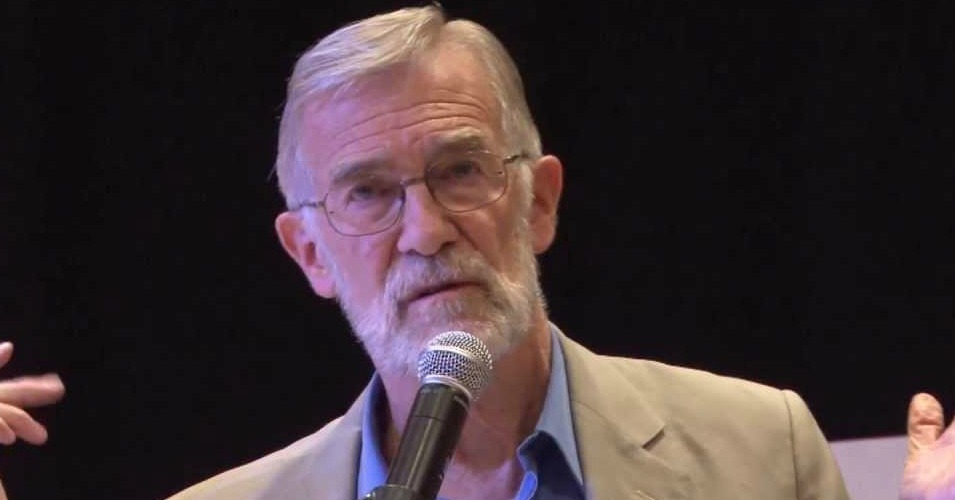
Ray McGovern
Last time my name was offered in nomination for the position – by The Nation publisher Katrina vanden Heuvel – I did not hold my breath waiting for a call from the White House. Her nomination came in the afterglow of my fortuitous, four-minute debate with then-Defense Secretary Donald Rumsfeld, when I confronted him on his lies about the attack on Iraq, on May 4, 2006 on national TV. Since it was abundantly clear that Rumsfeld and I would not get along, I felt confident I had royally disqualified myself.
This time around, on the off-chance I do get the nod, I have taken the time to prepare the agenda for my first few days as CIA director. Here’s how Day One looks so far:
Get former National Security Agency Technical Director William Binney back to CIA to join me and the “handpicked” CIA analysts who, with other “handpicked” analysts (as described by former National Intelligence Director James Clapper on May 8, 2017) from the FBI and NSA, prepared the so-called Intelligence Community Assessment (ICA) of Jan. 6, 2017. That evidence-impoverished assessment argued the case that Russian President Vladimir Putin ordered his minions “to help President-elect Trump’s election chances when possible by discrediting Secretary Clinton.”
When my predecessor, CIA Director Mike Pompeo invited Binney to his office on Oct. 24, 2017 to discuss cyber-attacks, he told Pompeo that he had been fed a pack of lies on “Russian hacking” and that he could prove it. Why Pompeo left that hanging is puzzling, but I believe this is the kind of low-hanging fruit we should pick pronto.
The low-calorie Jan. 6 ICA was clumsily cobbled together:
“We assess with high confidence that Russian military intelligence … used the Guccifer 2.0 persona and DCLeaks.com to release US victim data obtained in cyber operations publicly and in exclusives to media outlets and relayed material to WikiLeaks.”
Binney and other highly experienced NSA alumni, as well as other members of Veteran Intelligence Professionals for Sanity (VIPS), drawing on their intimate familiarity with how the technical systems and hacking work, have been saying for a year and a half that this CIA/FBI/NSA conclusion is a red herring, so to speak. Last summer, the results of forensic investigation enabled VIPS to apply the principles of physics and the known capacity of the internet to confirm that conclusion.
Oddly, the FBI chose not to do forensics on the so-called “Russian hack” of the Democratic National Committee computers and, by all appearances, neither did the drafters of the ICA.
Again, Binney says that the main conclusions he and his VIPS colleagues reached are based largely on principles of physics – simple ones like fluid dynamics. I want to hear what that’s all about, how that applies to the “Russian hack,” and hear what my own CIA analysts have to say about that.
I will have Binney’s clearances updated to remove any unnecessary barriers to a no-holds-barred discussion at a highly classified level. After which I shall have a transcript prepared, sanitized to protect sources and methods, and promptly released to the media.
Like Sisyphus Up the Media Mountain
At that point things are bound to get very interesting. Far too few people realize that they get a very warped view on such issues from the New York Times. And, no doubt, it would take some time, for the Times and other outlets to get used to some candor from the CIA, instead of the far more common tendentious leaks. In any event, we will try to speak truth to the media – as well as to power.
I happen to share the view of the handful of my predecessor directors who believed we have an important secondary obligation to do what we possibly can to inform/educate the public as well as the rest of the government – especially on such volatile and contentious issues like “Russian hacking.”
What troubles me greatly is that the NYT and other mainstream print and TV media seem to be bloated with the thin gruel-cum-Kool Aid they have been slurping at our CIA trough for a year and a half; and then treating the meager fare consumed as some sort of holy sacrament. That goes in spades for media handling of the celebrated ICA of Jan. 6, 2017 cobbled together by those “handpicked” analysts from CIA, FBI, and NSA. It is, in all candor, an embarrassment to the profession of intelligence analysis and yet, for political reasons, it has attained the status of Holy Writ.
The Paper of (Dubious) Record
I recall the banner headline spanning the top of the entire front page of the NYT on Jan. 7, 2017: “Putin Led Scheme to Aid Trump, Report Says;” and the electronic version headed “Putin Led a Complex Cyberattack Scheme to Aid Trump, Report Finds.” I said to myself sarcastically, “Well there you go! That’s exactly what Mrs. Clinton – not to mention the NY Times, the Washington Post and The Establishment – have been saying for many months.”
Buried in that same edition of the Times was a short paragraph by Scott Shane: “What is missing from the public report is what many Americans most eagerly anticipated: hard evidence to back up the agencies’ claims that the Russian government engineered the election attack. That is a significant omission.”
Omission? No hard evidence? No problem. The publication of the Jan. 6, 2017 assessment got the ball rolling. And Democrats like Adam Schiff (D-Calif.) ranking member of the House Intelligence Committee, were kicking the ball hard down the streets of Washington. On Jan. 25, 2017, I had a chance to confront Schiff personally about the lack of evidence — something that even Obama had acknowledged just before slipping out the door. I think our two-minute conversation speaks volumes.
Now I absolutely look forward to dealing with Adam Schiff from my new position as CIA director. I will ask him to show me the evidence of “Russian hacking” that he said he could not show me on Jan. 25, 2017 – on the chance his evidence includes more than reports from the New York Times.
Sources
Intelligence analysts put great weight, of course, on sources. The authors of the lede, banner-headlined NYT article of Jan. 7, 2017 were Michael D. Shear and David E. Sanger; Sanger has had a particularly checkered career, while always landing on his feet. Despite his record of parroting CIA handouts (or perhaps partly because of it), Sanger is now the NYT’s chief Washington correspondent.
Those whose memories go back more than 15 years may recall his promoting weapons of mass destruction in Iraq as flat fact. In a July 29, 2002 article co-written with Them Shanker, for example, Iraq’s (non-existent) “weapons of mass destruction” appear no fewer than seven times as flat fact.
More instructive still, in May 2005, when first-hand documentary evidence from the now-famous “Downing Street Memorandum” showed that President George W. Bush had decided by early summer 2002 to attack Iraq, the NYT ignored it for six weeks until David Sanger rose to the occasion with a tortured report claiming just the opposite. The title given his article of June 13 2005 was “Prewar British Memo Says War Decision Wasn’t Made.”
Against this peculiar reporting record, I was not inclined to take at face value the Jan. 7, 2017 report he co-authored with Michael D. Shear – “Putin Led a Complex Cyberattack Scheme to Aid Trump, Report Finds.”
Nor am I inclined to take seriously former National Intelligence Director James Clapper’s stated views on the proclivity of Russians to be, well, just really bad people — like it’s in their genes. I plan to avail myself of the opportunity to discover whether intelligence analysts who labored under his “aegis” were infected by his quaint view of the Russians.
I shall ask any of the “handpicked” analysts who specialize in analysis of Russia (and, hopefully, there are at least a few): Do you share Clapper’s view, as he explained it to NBC’s Meet the Press on May 30, 2017, that Russians are “typically, almost genetically driven to co-opt, penetrate, gain favor, whatever”? I truly do not know what to expect by way of reply.
End of Day One
In sum, my priority for Day One is to hear both sides of the story regarding “Russian hacking” with all cards on the table. All cards. That means no questions are out of order, including what, if any, role the “Steele dossier” may have played in the preparation of the Jan. 6, 2017 assessment.
I may decide to seek some independent, disinterested technical input, as well. But it should not take me very long to figure out which of the two interpretations of alleged “Russian hacking” is more straight-up fact-based and unbiased. That done, in the following days I shall brief both the Chair, Devin Nunes (R-Calif.) and ranking member Schiff of the House Intelligence Committee, as well as the Chair and ranking member of its counterpart in the Senate. I will then personally brief the NYT’s David Sanger and follow closely what he and his masters decide to do with the facts I present.
On the chance that the Times and other media might decide to play it straight, and that the “straight” diverges from the prevailing, Clapperesque narrative of Russian perfidy, the various mainstream outlets will face a formidable problem of their own making. Mark Twain put it this way: “It is easier to fool people than it is to convince them they have been fooled.”
And that will probably be enough for Day One.
Ray McGovern works with Tell the Word, a publishing arm of the ecumenical Church of the Savior in inner-city Washington. He served 30 years as an U.S. Army Intelligence and CIA analyst, and in retirement co-founded Veteran Intelligence Professionals for Sanity (VIPS).
Bear scare! Why the US Democrats desperately need a Russian bogeyman
By Robert Bridge | RT | February 20, 2018
Even before Donald Trump set foot in the White House, loveless liberals were busy pushing the narrative that Russia meddled in the elections. But could this claim be – just maybe – a dastardly ploy to hide some unsavory truths?
Pass the popcorn, the theater of the political absurd known as ‘Russiagate’ continues playing to disappointed audiences without so much as an intermission. And with the latest episode featuring an indictment against 13 Russian nationals without rhyme or reason, perhaps it’s a good time to pause and reflect on the question the mainstream media conspicuously ignores: was the real meddlesome actor in the 2016 presidential election not the perennial bogeyman known as ‘Putin’s Russia’, but the Democratic Party itself?
Indeed, some highly questionable moves on the part of the Democrats before, during and after the elections go far in exonerating the Russian fall guy from any and all charges. You be the judge.
The FISA fail
In a memo declassified by the White House and released to great fanfare by the House Intelligence Committee on February 2, it was alleged that on October 21, 2016, the FBI and the Department of Justice (DOJ) – armed with the notorious Trump dossier – secured a Foreign Intelligence Surveillance Act (FISA) warrant to conduct surveillance on Carter Page, a Trump campaign adviser.
But something looks rotten in Denmark. As it turned out, the explosive Trump dossier, compiled by former MI6 spy Christopher Steele, was bought and paid for by the Democratic National Committee (DNC) and the Clinton campaign. In other words, this represents – at the very least – a very big conflict of interest.
At the same time, in the their application for the FISA warrant, the FBI and DOJ “cited extensively” a Yahoo News article by one Michael Isikoff, which discusses Page’s July 2016 trip to Moscow.
As it turned out, however, there were serious problems with that article. As the Nunes memo states, Isikoff’s article “does not corroborate the Steele dossier because it is derived from information leaked by Steele himself…”
Indeed, Steele admitted that he met with Yahoo News “at the direction of Fusion GPS,” the firm that organized the dossier, in September 2016. Meanwhile, the mainstream media has largely played down these glaring violations of FISA protocol, as it continues to heap scorn on Russia.
“Putin’s KGB-inspired maneuvering of the United States via Donald Trump and the Republican Congress has all the earmarks of a carefully planned, professionally executed war game in which Trump, congressional Republicans and some in right wing media are his comrades,”wrote Cheri Jacobus in USA Today.
The specter of the Russian bogeyman is truly the gift that keeps giving.
Clinton’s email scandal
In March 2015, the news broke that Hillary Clinton, while serving as secretary of state, had used her home computer while handling classified government documents. An assortment of experts and politicians accused Clinton of violating State Department protocol.
On July 5, 2016, following an investigation, FBI Director James Comey said Clinton had been “extremely careless” in handling her email correspondences. He added that “no reasonable prosecutor would bring such a case.”
That statement did little to calm the critics, however, as Clinton was haunted by the ghosts of emails past right up to the eve of the elections.
On October 28, 2016, the FBI said it was reopening its investigation into Clinton’s private email server after messages were discovered on the computer of top aide Huma Abedin’s husband, Anthony Weiner, who was then embroiled in a sexting scandal. Comey announced just before the elections that nothing had changed in the Clinton case, which had been closed four months earlier without criminal charges.
However, the email saga refuses to go away as the DOJ once again reopened its investigation into Clinton’s email server in January.
To this day, Hillary Clinton has been able to divert attention away from the very serious charge of handling classified government emails over her private server thanks to a giant smokescreen known as Russia, the bogeyman that conveniently explains every transgression and setback by the Democratic Party.
Operation Sink Sanders
In July 2016, the DNC suffered a broadside after WikiLeaks released a batch of emails purporting to show that Debbie Wasserman Schultz, the chairwoman of the body, was actively conspiring against the campaign of Senator Bernie Sanders. Naturally, this news had a way of upsetting those donors who contributed funds to the Sanders campaign. Wasserman Schultz resigned in disgrace following the revelations.
Despite there being a deliberate effort to undermine the Sanders campaign, that disturbing news was sidelined by the conspiracy theory that a Russian army of apparatchiks hacked the DNC computers, turning over the information to Julian Assange. To this day, no evidence has been provided to support that claim.
Meanwhile, Wasserman Schultz was eventually cleared of rigging the Democratic primary in favor of Hillary Clinton, while Russia continues to suffer from mainstream media mudslinging.
Clinton cheated in debates
One of the most shocking revelations to come from the leaked/hacked DNC emails was the claim that Donna Brazile, interim chairperson of the DNC who once worked at CNN, used her inside connections to feed Hillary Clinton the questions to several of her public debates against Donald Trump.
Following the DNC debacle, Brazile hoped to cash in on the scandal by publishing a tell-all book entitled, ‘Hacks: The Inside Story of the Break-ins and Breakdowns that Put Donald Trump in the White House.’
In one particularly candid part, Brazile said she was secretly concerned about Clinton’s health as Election Day drew closer. This comment did not sit well with Brazile’s former colleagues. Clinton’s staffers published an open letter in response to the book, saying, “It is particularly troubling and puzzling that she would seemingly buy into false Russian-fueled propaganda, spread by both the Russians and our opponent, about our candidate’s health.”
Once again, Russia was used and abused as the convenient 11-time-zone Band-Aid that can cover any political wound, whatever the size. What is the most surprising about this tactic is that anybody still falls for it.
Regime change
Given Hillary Clinton’s past track record for advocating on behalf of military adventures, most memorably in Iraq and Libya, the tall tale of Trump-Russia collusion appears to have been a desperate effort on the part of the establishment to get their candidate into office and the military industrial complex into another war.
According to the Center for Public Integrity’s review of Federal Election Commission data, over a 14-month period (January 2015 through February 2016), Clinton and Sanders jointly received at least $765,049 from employees of major defense contractors – more than twice the $357,775 sum received by the Republican Party presidential candidates.
To prove the liberal media’s (and by extension, the establishment’s) apparent desire for military conflict, consider how it lavished praise on Trump after he attacked Syria’s Shayrat Airbase on April 7, 2017, America’s first unilateral military act aimed at the Syrian government forces (not the terrorists).
CNN analyst Fareed Zakaria waxed poetically, “I think Donald Trump became president of the United States,” he said dreamily. “I think this was actually a big moment.” On MSNBC, Nicholas Kristof, a regular Trump critic, said the Republican leader “did the right thing.” Elliott Abrams could barely contain his newfound enthusiasm for Trump: “… the Trump administration can truly be said to have started only now. The president has been chief executive since January 20, but this week he acted also as Commander in Chief. And more: He finally accepted the role of Leader of the Free World.”
Judging by such comments, had Trump continued bombing Syria, and thereby pacifying the hawks in Washington, there is a very good chance that Russiagate would have been quietly swept under the media’s carpet.
Impeach Trump
It would be difficult to name another US president who has suffered the slings and arrows of media scorn more than Donald J. Trump. And he’s only been in office for just over one year. Indeed, no sooner had his Inauguration finished there were already calls for him to be impeached. In fact, the subject has become so popular among the Democrats that there is even a special Wikipedia page dedicated to the relentless campaign.
Although the clamor to impeach the Republican leader has subsided of late, when the idea does raise its head, the empty claim that Russia influenced the elections ranks high among the reasons.
Clinton Foundation ‘pay to play’
Another reason why the Democrats would need to push the anti-Russia narrative is to protect the Clinton family from allegations that they personally profited from donations to the Clinton Foundation.
In January 2017, it was reported that the FBI opened an investigation into whether the Clinton Foundation accepted donations in exchange for political favors while Hillary Clinton served as secretary of state in the Obama administration, the Los Angeles Time reported, citing two anonymous sources.
“Critics have accused the Clinton family of using the foundation to enrich themselves and give donors special access to the State Department when Hillary Clinton was its head,” the article said.
The LA Times said that the Democrats have rejected the claims, saying that “Trump is trying to steer attention away from investigations examining…Russian attempts to influence the 2016 election.”
Nunes Memo, Part 2
If anybody thought the Trump administration would just release the Nunes memo and drop it, think again. In fact, Trump’s legal team backs the idea of a second special counsel to investigate the FBI and Justice Department
White House Deputy Press Secretary Raj Shah told reporters on Air Force One Monday that Trump’s attorneys have given the green light to starting the process of appointing a second special counsel to investigate the FBI and Justice Department’s behavior during the 2016 presidential campaign, according to a report by Axios.
In other words, expect a lot more anti-Russia outbursts from the Democrats in the days and weeks to come.
Read more:
Nunes: FBI and DOJ Perps Could Be Put on Trial
By Ray McGovern | Consortium News | February 19, 2018
Throwing down the gauntlet on alleged abuse of the Foreign Intelligence Surveillance Act (FISA) by the Department of Justice and the FBI, House Intelligence Committee Chair Devin Nunes (R-Calif.) stated that there could be legal consequences for officials who may have misled the FISA court. “If they need to be put on trial, we will put them on trial,” he said. “The reason Congress exists is to oversee these agencies that we created.”

Devin Nunes interview with Sharyl Attkisson
Nunes took this highly unusual, no-holds-barred stance during an interview with Emmy-award winning investigative journalist Sharyl Attkisson, which aired on Sunday.
Attkisson said she had invited both Nunes and House Intelligence Committee Ranking Member Adam Schiff (D-Calif.) but that only Nunes agreed. She asked him about Schiff’s charge that Nunes’ goal was “to put the FBI and DOJ on trial.” What followed was very atypical bluntness — candor normally considered quite unacceptable in polite circles of the Washington Establishment.
Rather than play the diplomat and disavow what Schiff contended was Nunes’ goal, Nunes said, in effect, let the chips fall where they may. He unapologetically averred that, yes, a criminal trial might well be the outcome. “DOJ and FBI are not above the law,” he stated emphatically. “If they are committing abuse before a secret court getting warrants on American citizens, you’re darn right that we’re going to put them on trial.”
Die Is Cast
The stakes are very high. Current and former senior officials — and not only from DOJ and FBI, but from other agencies like the CIA and NSA, whom documents and testimony show were involved in providing faulty information to justify a FISA warrant to monitor former Trump campaign official Carter Page — may suddenly find themselves in considerable legal jeopardy. Like, felony territory.
This was not supposed to happen. Mrs. Clinton was a shoo-in, remember? Back when the FISA surveillance warrant of Page was obtained, just weeks before the November 2016 election, there seemed to be no need to hide tracks, because, even if these extracurricular activities were discovered, the perps would have looked forward to award certificates rather than legal problems under a Trump presidency.
Thus, the knives will be coming out. Mostly because the mainstream media will make a major effort – together with Schiff-mates in the Democratic Party – to marginalize Nunes, those who find themselves in jeopardy can be expected to push back strongly.
If past is precedent, they will be confident that, with their powerful allies within the FBI/DOJ/CIA “Deep State” they will be able to counter Nunes and show him and the other congressional investigation committee chairs, where the power lies. The conventional wisdom is that Nunes and the others have bit off far more than they can chew. And the odds do not favor folks, including oversight committee chairs, who buck the system.
Staying Power
On the other hand, the presumptive perps have not run into a chairman like Nunes in four decades, since Congressmen Lucien Nedzi (D-Mich.), Otis Pike (D-NY), and Sen. Frank Church (D-Idaho) ran tough, explosive hearings on the abuses of a previous generation deep state, including massive domestic spying revealed by quintessential investigative reporter Seymour Hersh in December 1974. (Actually, this is largely why the congressional intelligence oversight committees were later established, and why the FISA law was passed in 1978.)
At this point, one is tempted to say plus ça change, plus c’est la même chose – or the more things change, the more they stay the same – but that would be only half correct in this context. Yes, scoundrels will always take liberties with the law to spy on others. But the huge difference today is that mainstream media have no room for those who uncover government crimes and abuse. And this will be a major impediment to efforts by Nunes and other committee chairs to inform the public.
One glaring sign of the media’s unwillingness to displease corporate masters and Official Washington is the harsh reality that Hersh’s most recent explosive investigations, using his large array of government sources to explore front-burner issues, have not been able to find a home in any English-speaking newspaper or journal. In a sense, this provides what might be called a “confidence-building” factor, giving some assurance to deep-state perps that they will be able to ride this out, and that congressional committee chairs will once again learn to know their (subservient) place.
Much will depend on whether top DOJ and FBI officials can bring themselves to reverse course and give priority to the oath they took to support and defend the Constitution of the United States against all enemies foreign and domestic. This should not be too much to hope for, but it will require uncommon courage in facing up honestly to the major misdeeds appear to have occurred — and letting the chips fall where they may. Besides, it would be the right thing to do.
Nunes is projecting calm confidence that once he and Trey Gowdey (R-Tenn.), chair of the House Oversight Committee, release documentary evidence showing what their investigations have turned up, it will be hard for DOJ and FBI officials to dissimulate.
In Other News …
In the interview with Attkisson, Nunes covered a number of other significant issues:
- The committee is closing down its investigation into possible collusion between Moscow and the Trump campaign; no evidence of collusion was found.
- The apparently widespread practice of “unmasking” the identities of Americans under surveillance. On this point, Nunes said, “In the last administration they were unmasking hundreds, and hundreds, and hundreds of Americans’ names. They were unmasking for what I would say, for lack of a better definition, were for political purposes.”
- Asked about Schiff’s criticism that Nunes behaved improperly on what he called the “midnight run to the White House,” Nunes responded that the stories were untrue. “Well, most of the time I ignore political nonsense in this town,” he said. “What I will say is that all of those stories were totally fake from the beginning.”
Not since Watergate has there been so high a degree of political tension here in Washington but the stakes for our Republic are even higher this time. Assuming abuse of FISA court procedures is documented and those responsible for playing fast and loose with the required justification for legal warrants are not held to account, the division of powers enshrined in the Constitution will be in peril.
A denouement of some kind can be expected in the coming months. Stay tuned.
Ray McGovern works with Tell the Word, a publishing arm of the ecumenical Church of the Savior in inner-city Washington. He was a CIA analyst for 27 years and is co-founder of Veteran Intelligence Professionals for Sanity (VIPS).
The US-UK Deep State Empire Strikes Back: ‘It’s Russia! Russia! Russia!’
By James George JATRAS | Strategic Culture Foundation | 18.02.2018
There’s no defense like a good offense.
For weeks the unfolding story in Washington has been how a cabal of conspirators in the heart of the American federal law enforcement and intelligence apparat colluded to ensure the election of Hillary Clinton and, when that failed, to undermine the nascent presidency of Donald Trump. Agencies tainted by this corruption include not only the FBI and the Department of Justice (DOJ) but the Obama White House, the State Department, the NSA, and the CIA, plus their British sister organizations MI6 and GCHQ, possibly along with the British Foreign Office (with the involvement of former British ambassador to Russia Andrew Wood) and even Number 10 Downing Street.
Those implicated form a regular rogue’s gallery of the Deep State: Peter Strzok (formerly Chief of the FBI’s Counterespionage Section, then Deputy Assistant Director of the Counterintelligence Division; busy bee Strzok is implicated not only in exonerating Hillary from her email server crimes but initiating the Russiagate investigation in the first place, securing a FISA warrant using the dodgy “Steele Dossier,” and nailing erstwhile National Security Adviser General Mike Flynn on a bogus charge of “lying to the FBI”); Lisa Page (Strzok’s paramour and a DOJ lawyer formerly assigned to the all-star Democrat lineup on the Robert Mueller Russigate inquisition); former FBI Director James Comey, former Associate Deputy Attorney General Bruce Ohr, former Deputy FBI Director Andrew McCabe, and – let’s not forget – current Deputy Attorney General Rod Rosenstein, himself implicated by having signed at least one of the dubious FISA warrant requests. Finally, there’s reason to believe that former CIA Director John O. Brennan may have been the mastermind behind the whole operation.
Not to be overlooked is the possible implication of a pack of former Democratic administration officials, including former Attorney General Loretta Lynch, former National Security Adviser Susan Rice, and President Barack Obama himself, who according to text communications between Strzok and Page “wants to know everything we’re doing.” Also involved is the DNC, the Clinton campaign, and Clinton operatives Sidney Blumenthal and Cody Shearer – rendering the ignorance of Hillary herself totally implausible.
On the British side we have “former” (suuure . . . ) MI6 spook Christopher Steele, diplomat Wood, former GCHQ chief Robert Hannigan (who resigned a year ago under mysterious circumstances), and whoever they answered to in the Prime Minister’s office.
The growing sense of panic was palpable. Oh my – this is a curtain that just cannot be allowed to be pulled back!
What to do, what to do . . .
Ah, here’s the ticket – come out swinging against the main enemy. That’s not even Donald Trump. It’s Russia and Vladimir Putin. Russia! Russia! Russia!
Hence the unveiling of an indictment against 13 Russian citizens and three companies for alleged meddling in U.S. elections and various ancillary crimes.
For the sake of discussion, let’s assume all the allegations in the indictment are true, however unlikely that is to be the case. (While that would be the American legal rule for a complaint in a civil case, this is a criminal indictment, where there is supposedly a presumption of innocence. Rosenstein even mentioned that in his press conference, pretending not to notice that that presumption doesn’t apply to Russian Untermenschen – certainly not to Olympic athletes and really not to Russians at all, who are presumed guilty on “genetic” grounds.)
Based on the public announcement of the indictment by Rosenstein – who is effectively the Attorney General in place of the pro forma holder of that office, Jeff Sessions (R-Recused) – and on an initial examination of the indictment, and we can already draw a few conclusions:
- Finally, “collusion” is dead! If Mueller and the anti-constitutional cabal had any hint that anyone on the Trump team cooperated with those indicted, they would have included it. They didn’t. That means that after months and months of “investigation” – or really, setting “perjury traps” and trying to nail people on unrelated accusations, like Paul Manafort’s alleged circumvention of lobbying and financial reporting laws – and wasting however many millions of dollars, Mueller and his merry band got nothing. Zip. Zilch. Bupkes. Nada. The fake charge that Trump colluded with the Russians is exposed as the fraud it always was.
- And yet, “collusion” still lives! But while there is no actual allegation (much less evidence) that any American, much less anyone on the Trump team, “colluded” with the indicted Russians, the indictment makes it clear that Moscow sought to support Trump and disparage Hillary. Thus, Trump is guilty of being favored by Russia even if there was no actual cooperation. It’s a kind of zombie walking dead collusion, collusion by intent (of someone else) absent actual collusion. Its purpose in the indictment is to discredit Trump as a Russian puppet, albeit an unwitting one. The indictment says the Russian desperados supported Bernie Sanders and Jill Stein too – so they’re also Putin’s dupes.
- Any and every Russian equals Putin. Incredibly, nothing in the indictment points to any connection of those indicted to the Russian government! This is on a par with the hysteria over social media placements by “Russian interests” on account of which hysterical Senators demanded that tech giants impose content controls, or dimwit CIA agents getting bilked out of $100,000 by a Russian scam artist in Berlin in exchange for – well, pretty much nothing. (The CIA denies it, which leads one to suspect it is true.) Paragraph 95 of the indictment points to what amounted to a click-bait scam to fleece American merchants and social media sites from between $25 and $50 per post for promotional content. Paragraph 88 refers to “self-enrichment” as one motive of the alleged operation. That makes a lot more sense than the bone-headed claim in the indictment that the Russian goal was to “sow discord in the U.S. political system” by posting content on “divisive U.S. political and social issues.” What! Americans disagree about stuff? The Russians are setting us against each other! In announcing the indictment, Rosenstein said the Russians wanted to “promote discord in the United States and undermine public confidence in democracy. We must not allow them to succeed.” (He wagged his finger with resolve at that point.) It evidently doesn’t occur to Rosenstein that he and his pals have undermined public confidence in our institutions by perverting them for political ends.
- Demonizing dissent. Those indicted allegedly sought to attract Americans’ attention to their diabolical machinations through appeal to hot-button issues (immigration, Black Lives Matter, religion, etc.) and popular hashtags (#Trump2016, #TrumpTrain, #MAGA, #Hillary4Prison). Have you taken a stand on divisive issues, Dear Reader? Have you used any of these hashtags? Are you reading this commentary? You too might be an unwitting Russian stooge! Vladimir Putin is inside your head! Hopefully DOJ will set up a hotline where patriotic citizens influenced without their knowledge can now report themselves, now that they’ve been alerted. Are you a thought criminal, comrade?
- An amateurish, penny-ante scheme with no results – compared to what the U.S. does. At worst, even if all the allegations in the indictment are true – a big “if” – it would still amount to the kind of garden-variety kicking each other under the table that a lot of countries routinely engage in. As described in the indictment this gargantuan Russian scheme was (as reported by Politico) an “expensive [sic] effort that cost millions of dollars and employed as many as hundreds of people.” Millions of dollars! Hundreds of people! How did the American republic manage to survive the onslaught? Rosenstein was keen to point out for the umpteenth time that nothing the Russians are alleged to have done (never mind what they actually might have done, which is far less) had any impact on the election. That stands in sharp contrast to the lavishly funded, multifaceted, global political influence and meddling operations the U.S. conducts in nations around the world under the guise of “democracy promotion.” The National Endowment for Democracy (NED), along with its Democratic and Republican sub-organizations, can be considered the flagship of a community of ostensibly private but government-funded or subsidized organizations that provides the soft compliment to American hard military power. The various governmental, quasi-governmental, and nongovernmental components of this network – sometimes called the “Demintern” in analogy to the Comintern, an organization comparable in global ambition if differing in ideology and methods – are also coordinated internationally at the official level through the less-well-known “Community of Democracies.” It is often difficult to know where the “official” entities (CIA, NATO, the State Department, Pentagon, USAID) divide from ostensibly nongovernmental but tax dollar-supported groups (NED, Freedom House, Radio Free Europe/Radio Liberty) and privately funded organizations that cooperate with them towards common goals (especially the Open Society organizations funded by billionaire George Soros). Among the specialties of this network are often successful “color revolutions” targeting leaders and governments disfavored by Washington for regime change – a far cry from the pathetic Russian operation alleged in the indictment.
- “Mitt Romney was right.” Already many of Trump’s supporters are not only crowing with satisfaction that the indictment proves there was no collusion but refocusing their gaze from the domestic culprits within the FBI, DOJ, etc., to a bogus foreign threat. “This whole saga just brings back the 2012 election, and the fact that Mitt Romney was right” for “suggesting that Russia is our greatest geopolitical foe,” is the new GOP meme. To the extent that Russiagate was less about Trump than ensuring that enmity with Russia will be permanent and will continue to deepen, this latest Mueller indictment is a smashing success already.
The Mueller indictment against the Russians is a well-timed effort to distract Americans’ attention from the real collusion rotting the core of our public life by shifting attention to a foreign enemy. Many of the people behind it are the very officials who are themselves complicit in the rot. But the sad fact is that it will probably work.
Ex-CIA operative says US has long meddled in elections, but it’s OK since they are ‘god cops’
RT | February 18, 2018
In an article published in the New York Times on Saturday, former CIA officers and several researchers, who have been studying covert US intelligence operations for years, say that the while methods allegedly used by Russians to meddle into the US elections might slightly differ from the old school CIA operations overseas, there is nothing in the allegations against Russians that Americans haven’t done themselves.
“If you ask an intelligence officer, did the Russians break the rules or do something bizarre, the answer is no, not at all,” retired CIA veteran Steven Hall told NYT’s Scott Shane.
Hall, who left his job as CIA Chief of Russian Operations in 2015 after 30 years of service, noted that the US has never shunned attempting to meddle in other countries’ elections.
Saying that the CIA had “absolutely” engaged in such operations in the past, Hall added that he hopes “we keep doing it.”
Thirteen Russian nationals and three entities were indicted on Friday as part of the special FBI counsel Robert Mueller’s lingering probe into alleged Russian interference in the 2016 US presidential elections, and collusion between Moscow and US President Donald Trump’s campaign. As proof to support either of the two allegations is still scant, the Russians listed in the indictment were accused of waging “information warfare against the United States of America,” including by sowing discord on social media with “divisive” posts on Facebook and Twitter.
While the social media boom is a recent phenomenon, the US intelligence has a long record of weaponizing information, albeit in a more conventional form, Loch Johnson, a scholar at the University of Georgia, who has been investigating the CIA since the 1970s, told the Times.
“We’ve used posters, pamphlets, mailers, banners — you name it. We’ve planted false information in foreign newspapers. We’ve used what the British call ‘King George’s cavalry’: suitcases of cash,” Johnson said, recounting that in the late 1980s he was told by CIA operatives that they used to plant reports that fit the US agenda or bluntly fake news in foreign newspapers by the dozen. The number of such daily “insertions” ran in as many as 70 to 80 publications, he recounted.
But when the US does it, it’s for the greater good, the scholar and the CIA officers claim.
Likening the American operations to what Russia is accused of, “is like saying cops and bad guys are the same because they both have guns — the motivation matters,” Hall said. Because, just like the bloody wars the US is waging around the world, it is being done for the sake of democracy.
Contrary to the supposed Russian onslaught on the American democracy, which, according to Deputy Attorney General Rod Rosenstein, did not affect the outcome of the presidential elections, some US meddling did lead to actual changes of power across Latin America, Eastern Europe and the Middle East.
According to a survey by Researcher Dov Levin of Carnegie Mellon University’s Institute for Politics and Strategy, the US meddled in elections at least 81 times from 1946 to 2000, including in Yugoslavia in the 2000 against Slobodan Milosevic.
The number, however, does not include the military coups orchestrated by the US, or regime changes as a result of the US interventions, some of which had precious little to do with democracy, such as the rise of Chilean dictator Augusto Pinochet after the violent overthrow of President Salvador Allende in 1973. With the collapse of the Soviet Union and the end of the Cold War, the US did not give up on its interventionist policy. The most recent examples include the US-led NATO intervention in Libya that brought down strongman Muammar Gaddafi, but failed to deliver a semblance of democracy. The war-ravaged country is being torn between three different power centers seven years after the military incursion.
The US role in the coup in Ukraine, which paved way for bloodshed in the country’s east, has been widely reported. Last year, former US Vice President Joe Biden admitted in his memoir that he demanded former Ukrainian President Viktor Yanukovich resign in 2014, telling him that his “time was over.”
Biden also boasted that he played a part in the firing of a Ukrainian prosecutor during a meeting with Ukrainian President Petro Poroshenko and former Ukrainian Prime Minister Arseny Yatsenyuk in March 2016.
Read more:
US ‘Stumbled Into Torture,’ Says NYT Reporter
By Adam Johnson | FAIR | February 15, 2018
As part of a promotion for the upcoming “Look, Evil Russians!” film Red Sparrow (hyping Hollywood films is apparently a thing reporters do now), New York Times national security reporter Scott Shane (2/14/18) wrote a synergistic Cold War 2.0 essay about the CIA’s alleged attempt to recruit him. It included a rather jarring—if not risible—paragraph summarizing Shane’s years of reporting:
All these years later, I assume my name appears in multiple files at the CIA, the National Security Agency and perhaps other corners of the sprawling security bureaucracy, with gripes and comments related to my coverage of how America stumbled into torture; how drone strikes went wrong; espionage cases; WikiLeaks cables; Snowden documents; Russian hackers and the Shadow Brokers; and probably stories I’ve forgotten.
Two clauses stand out for their confident attribution of benevolent motives to US foreign policy. First, there’s the idea that “America stumbled into torture,” rather than planned, plotted and spent over 15 years carrying out a policy of torture. This pretends that the US’s massive global torture regime—which involved drownings, beatings, sleep deprivation and sexual humiliation, among other techniques, along with “extraordinary rendition” to allied countries for less refined torture methods–was something other than a deliberate policy initiative.
As FAIR (6/22/17) noted last year, corporate media routinely assert that the US “stumbles,” “slips” or is “dragged into” war and other forms of organized violence, rather than planning deliberate acts of aggression. For reporters in foreign policy circles, the US only does immoral things on accident—unlike Official Bad Countries, which do them for calculated gain when they aren’t motivated by sheer malice.
The second clause, claiming that “drone strikes went wrong,” is a passive way of suggesting that civilian deaths are an unforeseen accident rather than a predictable consequence baked into the cake of the US’s permawar on terror. The US doesn’t murder civilians, it simply launches missiles at unknown and faceless brown people in Yemen and Afghanistan, and sometimes the missiles “go wrong.” While Shane has certainly reported on these respective crimes (as he proudly notes), he has done so in a similar, limited fashion that treats them as unfortunate mishaps, rather than intentional features of a violent empire.
For an essay that is more or less Shane patting himself on the back for holding power to account instead of becoming a spook, his instinct to assume noble intentions on the part of these spooks is a telling indication of the broader ethos of corporate media’s national security reporting: Criticism is welcome around the margins, so long as motives are never challenged.
Lifting of US Propaganda Ban Gives New Meaning to Old Song
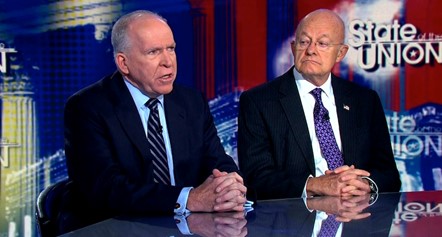
Former Director of National Intelligence James Clapper and former CIA Director John Brennan discuss allegations of Russian influence in presidential elections (CNN Screenshot)
By Whitney Webb – Mint Press News – February 12, 2018
Though its ostensible purpose is to fund the US military over a one year period, the National Defense Authorization Act, better known as the NDAA, has had numerous provisions tucked into it over the years that have targeted American civil liberties. The most well-known of these include allowing the government to wiretap American citizens without a warrant and, even more disturbingly, indefinitely imprison an American citizen without charge in the name of “national security.”
One of the lesser-known provisions that have snuck their way into the NDAA over the years was a small piece of legislation tacked onto the NDAA for fiscal year 2013, signed into law in that same year by then-President Barack Obama. Named “The Smith-Mundt Modernization Act of 2012,” it completely lifted the long-existing ban on the domestic dissemination of US government-produced propaganda.
For decades, the US government had been allowed to produce and disseminate propaganda abroad in order to drum up support for its foreign wars but had been banned from distributing it domestically after the passage of the Smith-Mundt Act of 1948. However, the Modernization Act’s co-authors, Reps. Mac Thornberry (R-TX) and Adam Smith (D-WA, no relation to the Smith of the 1948 act), asserted that removing the domestic ban was necessary in order to combat “al-Qaeda’s and other violent extremists’ influence among populations.”
Thornberry stated that removing the ban was necessary because it had tied “the hands of America’s diplomatic officials, military, and others, by inhibiting our ability to effectively communicate in a credible way.” Yet, given that Thornberry is one of the greatest beneficiaries of weapon manufacturers’ campaign contributions, the real intent — to skeptics at least — seemed more likely related to an effort to ramp up domestic support for US military adventurism abroad following the disastrous invasions of Iraq and Libya.
Five years later, the effects of the lifting of the ban have turned what was once covert manipulation of the media by the government into a transparent “revolving door” between the media and the government. Robbie Martin — documentary filmmaker and media analyst whose documentary series, “A Very Heavy Agenda,” explores the relationships between neoconservative think tanks and media — told MintPress, that this revolving door “has never been more clear than it is right now” as a result of the ban’s absence.
In the age of legal, weaponized propaganda directed at the American people, false narratives have become so commonplace in the mainstream and even alternative media that these falsehoods have essentially become normalized, leading to the era of “fake news” and “alternative facts.”
Those who create such news, regardless of the damage it causes or the demonstrably false nature of its claims, face little to no accountability, as long as those lies are of service to US interests. Meanwhile, media outlets that provide dissenting perspectives are being silenced at an alarming rate.
The effects of lifting the ban examined
Since 2013, newsrooms across the country, of both the mainstream and “alternative” variety, have been notably skewed towards the official government narrative, with few outside a handful of independently-funded media outlets bothering to question those narratives’ veracity. While this has long been a reality for the Western media (see John Pilger’s 2011 documentary “The War You Don’t See”), the use of government-approved narratives and sources from government-funded groups have become much more overt than in years past.
From Syria to Ukraine, US-backed coups and US-driven conflicts have been painted as locally driven movements that desperately need US support in order to “help” the citizens of those countries — even though that “help” has led to the near destruction of those countries and, in the case of Ukraine, an attempted genocide. In these cases, many of the sources were organizations funded directly by the US government or allied governments, such as the White Helmets and Aleppo Media Centre (largely funded by the US and U.K. governments) in the case of Syria, and pro-Kiev journalists with Nazi ties (including Bogdan Boutkevitch, who called for the “extermination” of Ukrainians of Russian descent on live TV) in the case of Ukraine, among other examples. Such glaring conflicts of interests are, however, rarely — if ever — disclosed when referenced in these reports.
More recently, North Korea has been painted as presenting an imminent threat to the United States. Recent reports on this “threat” have been based on classified intelligence reports that claim that North Korea can produce a new nuclear bomb every six or seven weeks, including a recent article from the New York Times. However, those same reports have admitted that this claim is purely speculative, as it is “impossible to verify until experts get beyond the limited access to North Korean facilities that ended years ago.” In other words, the article was based entirely on unverified claims from the US intelligence community that were treated as compelling.
As Martin told MintPress, many of these government-friendly narratives first began at US-funded media organizations overseen by the Broadcasting Board of Governors (BBG) — an extension of the US state department.
Martin noted that US-funded media, like Voice of America (VOA) and Radio Free Europe (RFE), were among the first to use a State Department-influenced narrative aimed at “inflaming hostilities with Russia before it soaked into mainstream reporting.” Of course, now, this narrative — with its origins in the US State Department and US intelligence community — has come to dominate headlines in the corporate media and even some “alternative” media outlets in the wake of the 2016 US election.
This is no coincidence. As Martin noted, “after the ban was lifted, things changed drastically here in the United States,” resulting in what was tantamount to a “propaganda media coup” where the State Department, and other government agencies that had earlier shaped the narrative at the BBG, used their influence on mainstream media outlets to shape those narratives as well.
A key example of this, as Martin pointed out, was the influence of the new think-tank “The Alliance for Securing Democracy,” whose advisory council and staff are loaded with neocons, such as the National Review’s Bill Kristol, and former US intelligence and State Department officials like former CIA Director Michael Morell. The Alliance for Securing Democracy’s Russia-focused offshoot, “Hamilton 68,” is frequently cited by media outlets — mainstream and alternative — as an impartial, reliable tracker of Russian “meddling” efforts on social media.
Martin remarked that he had “never seen a think tank before have such a great influence over the media so quickly,” noting that it “would have been hard to see [such influence on reporters] without the lifting of the ban,” especially given the fact that media organizations that cite Hamilton 68 do not mention its ties to former government officials and neoconservatives.
In addition, using VOA or other BBG-funded media has become much more common than it was prior to the ban, an indication that state-crafted information originally intended for a foreign audience is now being used domestically. Martin noted that this has become particularly common at some “pseudo-alternative” media organizations — i.e., formerly independent media outlets that now enjoy corporate funding. Among these, Martin made the case that VICE News stands out.
After the propaganda ban was lifted, Martin noticed that VICE’s citations of BBG sources “spiked.” He continued:
One of the things I immediately noticed was that they [VICE news ] were so quick to call out other countries’ media outlets, but yet — in every instance I looked up of them citing BBG sources — they never mentioned where the funding came from or what it was and they would very briefly mention it [information from BBG sources] like these were any other media outlets.”
He added that, in many of these cases, journalists at VICE were unaware that references to VOA or other BBG sources appeared in their articles. This was an indication that “there is some editorial staff [at VICE News ] that is putting this in from the top down.”
Furthermore, Martin noted that, soon after the ban was lifted, “VICE’s coverage mirrored the type of coverage that BBG was doing across the world in general,” which in Martin’s view indicated “there was definitely some coordination between the State Department and VICE.” This coordination was also intimated by BBG’s overwhelmingly positive opinion of VICE in their auditing reports, in which the BBG “seemed more excited about VICE than any other media outlet” — especially since VICE was able to use BBG organizations as sources while maintaining its reputation as a “rebel” media outlet.
Martin notes that these troubling trends have been greatly enabled by the lifting of the ban. He opined that the ban was likely lifted “in case someone’s cover [in spreading government propaganda disguised as journalism] was blown,” in which case “it wouldn’t be seen as illegal.” He continued:
For example, if a CIA agent at the Washington Post is directly piping in US government propaganda or a reporter is working the US government to pipe in propaganda, it wouldn’t be seen as a violation of the law. Even though it could have happened before the ban, it’s under more legal protection now.
Under normal circumstances, failing to disclose conflicts of interests of key sources and failing to question government narratives would be considered acts of journalistic malpractice. However, in the age of legal propaganda, this dereliction matters much less. Propaganda is not intended to be factual or impartial — it is intended to serve a specific purpose, namely influencing public opinion in a way that serves US government interests. As Karl Rove, the former advisor and deputy chief of staff to George W. Bush, once said, the US “is an empire now, and when we act, we create our own reality.” This “reality” is defined not by facts but by its service to empire.
Meanwhile, counter-narratives, however fact-based they may be, are simultaneously derided as conspiracy theories or “fake news,” especially if they question or go against government narratives.
The revolving door
Another major consequence of the ban being lifted goes a step further than merely influencing narratives. In recent years, there has been the growing trend of hiring former government officials, including former US intelligence directors and other psyops veterans, in positions once reserved for journalists. In their new capacity as talking heads on mainstream media reports, they repeat the stance of the US intelligence community to millions of Americans, with their statements and views unchallenged.
For instance, last year, CNN hired former Director of National Intelligence James Clapper. Clapper, a key architect of RussiaGate, has committed perjury by lying to Congress and more recently lied about the Trump campaign being wiretapped through a FISA request. He has also made racist, Russophobic comments on national television. Now, however, he is an expert analyst for “the most trusted name in news.” CNN last year also hired Michael Hayden, who is a former Director of both the CIA and the NSA, and former Principal Deputy Director of National Intelligence.
CNN isn’t alone. NBC/MSNBC recently hired former CIA director John Brennan — another key architect of RussiaGate and the man who greenlighted (and lied about) CIA spying on Congress — as a contributor and “senior national security and intelligence analyst.” NBC also employs Jeremy Bash, former CIA and DoD Chief of Staff, as a national security analyst, as well as reporter Ken Dilanian, who is known for his “collaborative relationship” with the CIA.
This “revolving door” doesn’t stop there. After the BBG was restructured by the 2016 NDAA, the “board” for which the organization was named was dissolved, making BBG’s CEO — a presidential appointee — all powerful. BBG’s current CEO is John Lansing, who – prior to taking the top post at the BBG – was the President and Chief Executive Officer of the Cable & Telecommunications Association for Marketing (CTAM), a marketing association comprised of 90 of the top US and Canadian cable companies and television programmers. Lansing’s connection to US cable news companies is just one example of how this revolving door opens both ways.
Media-government coordination out of the shadows
Such collusion between mainstream media and the US government is hardly new. It has only become more overt since the Smith-Mundt ban was lifted.
For instance, the CIA, through Operation Mockingbird, started recruiting mainstream journalists and media outlets as far back as the 1960s in order to covertly influence the American public by disguising propaganda as news. The CIA even worked with top journalism schools to change their curricula in order to produce a new generation of journalists that would better suit the US government’s interests. Yet the CIA effort to manipulate the media was born out of the longstanding view in government that influencing the American public through propaganda was not only useful, but necessary.
Indeed, Edward Bernays, the father of public relations, who also worked closely with the government in the creation and dissemination of propaganda, once wrote:
The conscious and intelligent manipulation of the organized habits and opinions of the masses is an important element in democratic society. Those who manipulate this unseen mechanism of society constitute an invisible government which is the true ruling power of our country.
While this was once an “invisible” phenomenon, it is quickly becoming more obvious. Now, Silicon Valley oligarchs with ties to the US government have bought mainstream and pseudo-alternative media outlets and former CIA directors are given prominent analyst positions on cable news programs. The goal is to manufacture support at home for the US’ numerous conflicts around the world, which are only likely to grow as the Pentagon takes aim at “competing states” like Russia and China in an increasingly desperate protection of American hegemony.
With the propaganda ban now a relic, the once-covert propaganda machine long used to justify war after war is now operating out in the open and out of control.
Featured Video
Seyed M. Marandi: Negotiations Collapsed – Return to War
or go to
Aletho News Archives – Video-Images
From the Archives
Wartime internment camps in Australia
National Archives of Australia
World War I
During World War I, for security reasons the Australian Government pursued a comprehensive internment policy against enemy aliens living in Australia.
Initially only those born in countries at war with Australia were classed as enemy aliens, but later this was expanded to include people of enemy nations who were naturalised British subjects, Australian-born descendants of migrants born in enemy nations and others who were thought to pose a threat to Australia’s security.
Australia interned almost 7,000 people during World War I, of whom about 4,500 were enemy aliens and British nationals of German ancestry already resident in Australia.
Records of World War I internment camps
World War II
During World War II, Australian authorities established internment camps for three reasons – to prevent residents from assisting Australia’s enemies, to appease public opinion and to house overseas internees sent to Australia for the duration of the war.
Unlike World War I, the initial aim of internment during the later conflict was to identify and intern those who posed a particular threat to the safety or defence of the country. As the war progressed, however, this policy changed and Japanese residents were interned en masse. In the later years of the war, Germans and Italians were also interned on the basis of nationality, particularly those living in the north of Australia. In all, just over 20 per cent of all Italians resident in Australia were interned. … continue
Blog Roll
 Aletho News
- Seyed M. Marandi: Negotiations Collapsed – Return to War
- Tomorrow’s naval blockade showdown
- ‘Israel’ attacks civilians to hide its embarrassing military failures & out of pure sadism
- Any Foreign Military Vessel Approaching Hormuz Under Any Pretext ‘Will Be Dealt With Severely’: IRGC
- Diplomats slam US negotiators’ performance in Iran talks
- Trump Refuses Exit Ramp, War with Iran will Continue
- Trump Says US Naval Blockade in Strait of Hormuz Will Begin Shortly
- US, Iran end 21-hour talks without agreement
- US IRAN TALKS: Who Are the Crazy Ones Here? /Lt Col Daniel Davis
- Talks with the US end without a deal over excessive US demands: Iran
- If Americans Knew
- US-Iran ceasefire negotiations make zero progress – Daily Update
- Pro-Israel ‘Thinktanks’ and Individuals who Influence U.S. Foreign Policy
- Mearsheimer reveals how Israel dictates US policies on Iran, Gaza – video
- After killing 350+, Israel still has a “score to settle” with Lebanon before ceasefire – Daily Update
- Military aid to Israel emerges as the latest political litmus test for Democrats
- The only Palestinian children’s rights organization closes following years-long Israeli campaign against it
- ‘I Can’t Forget the Smell’: Lebanese Reel After Israel Kills Over 300 in Single Day
- DNC Shoots Down Resolutions Calling Out AIPAC and Limiting Arms to Israel
- TCN: Is Israel Blackmailing President Trump?
- Israel killed at least 303 Lebanese yesterday – who were they? Daily Update
- No Tricks Zone
- Cave Discovery Reveals Today’s Desert Climates Were Recently Far Warmer, Wetter, Teeming With Life
- German Expert: Heat Dome Led To Record Temps In Western USA…Warmer In 1934, 1936
- New Study: No Linear Warming Or Glacier Retreat Along Northern Antarctic Peninsula Since 1980s
- An Inconvenient Tree: Uncovered In Alps… Europe Much Warmer Than Today 6000 Years Ago
- New Study Reports A 60% Slowdown In Greenland’s Ice Loss Rate In The Last Decade
- Low Intensity Tornado Wrecks Major Solar Farm, Creating A Potential Toxic Dump
- New Study Finds Warming Saves Lives…Cold Temperatures 12 Times More Deadly Than Excess Heat
- German Science Blog Accuses PIK Climate Institute Of Hallucinating Climate Tipping Points
- Devastating Assessment Of Comirnaty Vaccine By Former Senior Pfizer Europe Toxicologist
- New Study: CO2 Is ‘Effectively Negligible’ As An Explanatory Climate Change Factor Since 2000
 Aletho News