Shambolic Doings in Washington
Will we survive the next 90 days?

By Philip Giraldi • Unz Review • April 25, 2017
There remains one good thing to say about Donald Trump: he is not Hillary. The boneheaded cruise missile attack in Syria would have occurred even earlier under President Rodham Clinton and there would undoubtedly be no-fly and safe zones already in place. Oh, and Ukraine and Georgia would be negotiating their entries into NATO to make sure that old Vlad Putin would be put on notice and understand that the days of namby-pamby jaw-jaw-jaw that characterized the Obama Administration are now ancient history.
Apart from that, I can only observe dumbstruck how yet again a candidate promising peace and dialogue could be flipped so quickly. Or maybe he never believed in anything he said, which is perhaps more to the point. Be that as it may, we now, after only ninety days in office, have a neo-neocon foreign policy and the folks clustered around their water coolers in the Washington think tanks are again smiling. And as the ruinous Syrian civil war continues thanks to American intervention, there are probably plenty of high fives within Israel’s Benjamin Netanyahu government. Bibi again rules the roost.
The Israelis are no doubt particularly delighted to hear Donald Trump’s latest factually exempt voyage into the outer reaches of the galaxy regarding Iran. Or perhaps The Donald is only having continuing digestive problems dealing with “most beautiful piece of chocolate cake that you’ve ever seen” when dining with mortified Chinese leader Xi Jinping while simultaneously launching cruise missiles intended to send a message to Beijing’s ally Russia. It is inevitably Iran’s turn for vilification, so Trump, while conceding that the Iranians have been compliant with the nuclear weapons agreement they signed, also felt compelled to add that they continue to be a threat and have not entered into the “spirit” of the pact. Apparently the spirit codicil was somehow left out of the final draft, an interpretation that will no doubt surprise the other signatories consisting of Russia, China and the European Union.
To make its point that Tehran is somehow a cheater, the White House has ordered a 90 day review of Iran policy which will empower hardliners in that country in upcoming elections as well as nut cases like Senators John McCain and Lindsey Graham on this side of the Atlantic. Iranian opposition groups like the terrorist Mujaheddin e Khalq (MEK) are already rising to the challenge by floating phony intelligence while Graham is currently advocating a preemptive attack on North Korea, conceding that it would be catastrophic for every country in the region while noting smugly that the carnage and destruction would not reach the United States. Too bad that Pyongyang’s fury cannot be directed straight to Graham’s house in South Carolina.
Graham is reportedly a good dancer and multitasker who can pivot back to Iran effortlessly as soon as Pyongyang is reduced to rubble, so those who want to deal with Iran sooner rather than later should not despair. As things continue to go south nearly everywhere, tension in the Middle East will no doubt lead to a rapidly deteriorating situation in the Persian Gulf that will require yet another ham-handed show of strength by the United States of Amnesia. There will be a war against Iran.
There have been a couple of other interesting stories circulating recently, all demonstrating that when Benjamin Franklin observed that we Americans had created a republic, “if we can keep it,” he was being particularly prescient. Robert Parry has observed that all the fuss about Russiagate is misleading as the only country that interferes with the political process in the U.S. persistently and successfully while also doing terrible damage to our national security is Israel. He wonders when we will have Congress convening investigative commissions to look into Israel-gate but then answers his own question by observing that it will never happen given who controls what in the United States. “No one dares suggest a probe of Israel-gate,” he concludes, but it is interesting and also encouraging to note that some Americans are actually starting to figure things out.
One of the curious things relating to the Russiagate scandal is the issue of who in the U.S. intelligence community leaked highly classified information to the media, a question which somehow seems to have disappeared from whatever final reckoning might be forthcoming. The issue is particularly relevant at the moment because there are reports that the Justice Department is pulling together a case against WikiLeaks founder Julian Assange as part of a possible attempt to remove him forcibly from his refuge in Britain and try him for constituting what CIA Director Mike Pompeo describes as a “hostile intelligence service helped by Russia.” It all suggests that low hanging fruit is fair game while some “official” leakers at high levels are somehow being protected.
To cite another example of Justice Department hypocrisy, three current and four former U.S. officials leaked to Reuters last week’s story about a Russian think tank having created a plan to subvert the U.S. election. If that is so, their identities might be discernible or surmised. Why aren’t they in jail? Or is it that many in government now believe that Russia is fair game and are prepared to look the other way?
It is significant that the recent House Intelligence Committee hearing on Russiagate, featuring FBI Director James Comey and NSA Director Mike Rogers, provided very little new information even as it confirmed troubling revelations that had already surfaced regarding the corruption of the nation’s security services. Given that former Central Intelligence Agency (CIA) head John Brennan and former Director of National Intelligence (DNI) chief James Clapper have been most frequently cited as the Obama administration’s possible bag men in arranging for the generation, collection, dissemination, and leaking of information disparaging to Trump, why weren’t they also being questioned?
The latest focus on Brennan, an Obama/Clinton loyalist who might safely be regarded as the most likely candidate seeking to discredit Team Trump and reap the benefits from Hillary, explores some suspicions about what actually took place last year and how it might have been arranged. The story broke in The Guardian on April 13th, headlined “British spies were first to spot Trump team’s links with Russia.” The article rehashes much old information, but, relying on a “source close to UK intelligence,” it describes how Britain’s NSA equivalent GCHQ obtained information late in 2015 relating to suspect “interactions” between Trump associates and the Russian intelligence. GCHQ reportedly routinely passed the information on to its U.S. liaison counterparts, and continued to do so over the next six months. The information was supplemented by similar reporting from a number of European intelligence services as well as the remaining “Five Eyes”: Canada, Australia and New Zealand.
According to the Guardian source and reporters, who are clearly hostile to Trump, the collection was not directed or targeted but was rather part of random interception of Russian communications. This may or may not be true but it serves as a useful cover story if someone was up to something naughty. And it also makes one wonder about the highly incriminating British intelligence sourced “dossier” on Trump and his associates, which The Guardian strangely does not mention, that appeared in January. Another apparent Guardian source called GCHQ the “principal whistleblower” in sharing the information that led to the opening of an FBI investigation in July 2016, a suggestion that the British role was not exactly passive.
The article goes on to describe how John Brennan, then CIA Chief, was personally the recipient of the material passed hand-to-hand at “director level” because of its sensitivity. So the Guardian article is essentially saying that the information was both routine and extremely sensitive, which would seem to be contradictory. Brennan was reportedly then the driving force behind launching a “major inter-agency investigation” and he briefed selected members of Congress regarding what he had obtained. Shortly thereafter leaks began appearing in the British press followed subsequently by revelations in the media in the U.S.
An October request to the Foreign Intelligence Surveillance Act (FISA) court reportedly was initiated after particularly damaging information was received from Estonia concerning Trump associate Carter Page and also regarding allegations that a Russian bank was funneling money into the Trump campaign. This led to an investigation of Page and the tapping into servers in Trump Tower, where the presidential campaign offices were located. Estonia, it should be noted, was particularly concerned about Trump comments on de-emphasizing NATO and strongly supported a Hillary victory so it is fair to speculate that the intelligence provided might have been cherry picked to make a particular case, but The Guardian fails to make that obvious point.
It is interesting to note how for the first time, in this media account, Brennan surfaces as the central player in the investigation of Team Trump. And it is perhaps not out of line to suggest that the European reporting of information on Trump associates was not exactly due to random collection of information, as The Guardian seeks to demonstrate. It could just as easily have been arranged at the “director level” by Brennan and his counterparts to disrupt the Trump campaign and enhance the electability of Hillary Clinton, which would have directly benefited Brennan and his inner circle as well as the Europeans, all of whom feared a Trump victory. Intelligence can be skewed, “fixed around a policy” or even fabricated and can say whatever one wants it to say so it is fair to suggest that the role of a politically committed John Brennan remains to be explored much more fully.
It is now being reported that Brennan will be summoned to give testimony at a closed House Intelligence Committee meeting on May 2nd. Hopefully his comments will be somehow leaked to the media plus those of James Clapper, who is also scheduled to appear. Nevertheless, one imagines that, as was the case in Comey’s first appearance, both former officials will spend most of their time refusing to confirm or deny anything.
The active participation of Brennan in the background to the 2016 electoral campaign is unprecedented and it is also suggestive of what America’s national security agencies have become, basically creatures of the White House. It is hard to escape the conclusion that Benjamin Franklin would undoubtedly deplore the fact that we have failed to keep the republic that the Founding Fathers bequeathed to us. That would be bad enough, but we are slipping into a pattern of foreign wars based on tissues of lies and deceptions by the very people who are in place to protect us, quite possibly exemplified by unscrupulous and ambitious ladder climbers like John Brennan, who was also the architect of Obama’s assassination policy. If we go to war because of suspected lack of “spirit” in our adversaries or merely because someone in the White House had a piece of chocolate cake and wanted something to talk about over his cup of espresso then we are doomed as a nation.
CIA and FBI admit that Wikileaks Vault 7 NOT done by Russia, but inside job
By Alex Christoforou | The Duran | April 20, 2017
In the never ending narrative as to who is telling the truth, the various US intelligence agencies or Wikileaks, it appears that Wikileaks is the honest actor… indirectly confirmed by US intelligence agencies.
With the release of Vault 7, WikiLeaks was careful to note that the treasure trove of CIA information came to them from former contractors who worked for US intelligence.
Zerohedge reports that once again “WikiLeaks’ facts were facts and CIA/FBI facts were fake.”
Having exclaimed that WikiLeaks is “a non-state hostile intelligence service often abetted by state actors like Russia,” laying the blame for every embarrassing leak at Moscow’s footsteps, the FBI and CIA have admitted that they are searching for an “insider” (not a Russian) who exposed thousands of top-secret documents that described CIA tools used to penetrate smartphones, smart televisions and computer systems.
CBS News reports that a manhunt is underway for a traitor inside the CIA…
Sources familiar with the investigation say it is looking for an insider — either a CIA employee or contractor — who had physical access to the material. The agency has not said publicly when the material was taken or how it was stolen.
Much of the material was classified and stored in a highly secure section of the intelligence agency, but sources say hundreds of people would have had access to the material. Investigators are going through those names.
The trove was published in March by the anti-secrecy organization WikiLeaks.
This is yet another big dent in the “Russia hacker” narrative peddled out by the liberal left nearly 8 months ago.
US ‘politicians, bureaucrats & academics’ caught in Turkey’s failed coup attempt probe
RT | April 16, 2017
Turkey has launched an investigation to examine whether 17 prominent Americans could have links to the FETO movement of an exiled US-based cleric, Fethullah Gulen, which Ankara blames for last summer’s failed coup attempt.
The Chief Public Prosecutor’s Office launched the probe into 17 individuals including US politicians, bureaucrats, and academics after a number of Turkish attorneys filed a criminal complaint against these persons, local media report.
Former CIA Director John O. Brennan, New York Senator Chuck Schumer, US attorney for the Southern District of New York Preet Bharara, and Office of Foreign Assets Control (OFAC) President David Cohen are among the suspects, Anadolu reports.
Other American residents caught in the probe include Henri Barkey, Director of the Middle East Program at Wilson Center former CIA figure Graham E. Fuller, and President of the Turkic American Alliance (TAA) Faruk Taban.
Schumer, for instance, is being suspected of receiving millions of dollars from Gulen’s movement and representing his organizational interests in the US.
Fuller, a former vice chairman of the National Intelligence Council at the CIA, allegedly was a sponsor for Gulen when he applied for a US residence permit.
The individuals are being accused of conspiracy to overthrow the Turkish government and are suspected to have links with FETO. Alleged evidence of their involvement with the Gulen movement has been submitted to the prosecutors, Turkish media report.
Gulen leads the popular Islamic transnational religious and social movement called Hizmet, believed to be funding numerous businesses, think tanks, private schools, and publishing houses around the world. Turkish President Recep Tayyip Erdogan has accused the prominent cleric and his group of masterminding the failed coup in Turkey on July 15, 2015.
Gulen, once an Erdogan ally, is now living in self-imposed exile in Pennsylvania. Ankara has repeatedly demanded his extradition to investigate his alleged participation in the coup attempt, as well as that of Hizmet, known as FETO in Turkey, and considered a terrorist organization by Ankara. The 74-year-old has denied any involvement in the failed coup plot.
Suspected Gulen followers, known as Gulenists, allegedly infiltrated all layers of Turkish society and have been persecuted and hunted down in Turkey in a massive crackdown on Erdogan’s opposition which followed the events in July 2016.
More than 100,000 people were fired from their jobs and around 30,000 detained, including teachers, journalists, security personnel and army officers.
WaPo Urges Aggression and Regime Change in Syria
By Stephen Lendman | April 9, 2017
The neocon Washington Post is a virtual CIA house organ. Its reporting and opinions reflect Langley’s diabolical agenda.
Extremist Robert Kagan co-founded the Project for the New American Century (PNAC) – now called the Foreign Policy Institute (FPI), its sinister agenda unchanged, promoting endless wars of aggression for unchallenged US global dominance.
In a WaPo opinion piece, he called for more aggression on Syria as part of US “military strategy to rebalance the situation in (the country) in America’s favor.”
He urged establishing a no-fly zone, grounding Syria’s air force, arming anti-government terrorists more than already, and ousting Assad – a virtual declaration of war on Russia if these policies are instituted.
Kagan: “The United States’ commitment to such a course will have to be clear enough to deter the Russians from attempting to disrupt it.”
“This in turn will require moving sufficient military assets to the region so that neither Russia nor Iran will be tempted to escalate the conflict to a crisis, and to be sure that American forces will be ready if they do.”
His worldview reflects madness. He urged escalated war on Syria to show Moscow, Beijing, Tehran and Pyongyang “that the days of American passivity are over.”
He called Trump’s Friday aggression “a critical first step,” an “opening salvo in a broader campaign” to oust Assad and reassert “US power and influence in the Middle East and throughout the world.”
“A single missile strike” only matters if followed by escalated war, he maintains.
He lied claiming “thousands of Russian forces operate throughout Syria, not (against ISIS), against the civilian population and the US-backed moderate opposition.”
“… Russia has increasingly supplanted the United States as a major power broker in the region.”
Fact: All anti-government forces are US-supported terrorists. No moderates exist.
Fact: Limited numbers of Russian personnel are in Syria, mostly related to its anti-terrorist military operations – greatly helping, not harming civilians.
Fact: America and Israel remain the dominant regional powers. Russia has cooperative relations with various Middle East nations.
Kagan is part of Washington’s lunatic fringe. His wife, Victoria Nuland, orchestrated regime change in Ukraine, replacing democratic governance with illegitimate Nazi putschists.
WaPo editors called Trump’s aggression “right as a matter of morality.”
They urged him to assert US leadership forcefully – wanting greater aggression than already.
Stephen Lendman can be reached at lendmanstephen@sbcglobal.net. His new book is titled Flashpoint in Ukraine: How the US Drive for Hegemony Risks WW III.
Media Promote Baseless Assertions By Government Officials Of Russian Interference As Facts
By Matt Peppe | Just the Facts | April 9, 2017
The headline of a New York Times article published April 6, “C.I.A. Had Evidence of Russian Effort to Help Trump Earlier Than Believed,” misleadingly implies not only that there was an effort by the Russian government to help Donald Trump win the American presidential election but that it is a settled fact that the CIA was in possession of hard evidence to that effect. The text of the piece does nothing to substantiate either claim. There is not one mention in the 33 paragraphs that follow about the purported evidence. As has been true for months, no evidence of any actual Russian actions is presented – only unfounded assertions that such evidence exists. But the allegations have been repeated over and over so many times over the course of so many months that they have become established fact, as saying something often enough apparently makes it true.
Eric Lichtblau, the reporter whose byline appears on the piece, received a Pulitzer Prize for his reporting on illegal and unconstitutional warrantless surveillance of Americans inside the United States by intelligence agencies during the George W. Bush administration. One would expect a journalist with such a history to be extra skeptical of government sources, but that is not the case. Lichtblau appears not to have done any due diligence at all. The article does little more than transcribe anonymous rumors, turning the New York Times into a conduit for intelligence officials to disseminate their narrative to the public.
The Times’ reports on Bush’s illegal spying campaign, first released in December 2005, are often presented as an example of the mainstream media practicing its intended role as the Fourth Estate in American society by acting in the public interest to hold government accountable for overreach and abuse. In reality, the warrantless spying story fits perfectly within the propaganda model of media developed by Noam Chomsky and Edward Herman. The propaganda model recognizes that media organizations will – with varying degrees of frequency – produce critical coverage of government actions. But their criticisms are framed as examples of rogue actors or misguided policies that are part of a political system that is fundamentally benevolent, despite mistakes and abuses that represent exceptions to the rule.
This overarching worldview is evidenced by Lichtblau’s deference to the fact-free rumors spread by anonymous intelligence officials. Having reported first hand about the CIA’s flagrant disregard for the constitution, Lichtblau would logically be expected to reflexively question the motives of Agency officials when they feed him information off the record. Instead, he takes for granted that they are being honest.
“The briefings indicate that intelligence officials had evidence of Russia’s intentions to help Mr. Trump much earlier in the presidential campaign than previously thought,” Lichtblau writes.
This logical fallacy assumes that if members of the CIA told something to Congress, then it must be true. Alternatively, the briefings could indicate that intelligence officials stirred up wild fantasies about foreign interference in the elections as a way of themselves intervening in the election much earlier in the campaign than previously thought.
A journalist wouldn’t take his sources at face value unless he internalized the belief that they had benevolent motives and were only interested in ensuring the public learned the truth. It doesn’t even occur to him that they might have their own agenda, and were manipulating him by leaking information selectively to advance that agenda. Naturally, these are the motives of foreign intelligence agents – like the Russians – but not ours. Because U.S. intelligence agents are different, naturally; they have only noble motives.
This type of thinking requires a special penchant for ignoring and apologizing for the CIA’s long history of misdeeds, from playing an indispensable role in overthrowing the elected governments of Guatemala, Iran and Chile; to meddling in the elections of more than 30 sovereign nations; organizing and operating death squads and torture chambers in South Vietnam; creating and sponsoring a terrorist army led by former security officials from the ousted military dictatorship in Nicaragua, looking the other way as the terrorists obtained funding for weapons by flooding the streets of Los Angeles and other American cities with crack cocaine.
Even leaving aside the CIA’s history from more than a few decades ago, during the last 15 years alone the CIA has carried out illegal programs of kidnapping, torture and assassination. The CIA even went as far as hacking into the computers of Senate investigators – who nominally oversee them – while they were investigating the crimes. This was widely reported and even acknowledged by the Agency themselves.
When describing Trump’s assertion that he was wiretapped by Obama, Lichtblau notes that Trump made the claim “with no evidence.” One has to wonder why, then, he chooses to report completely unsubstantiated assertions from the CIA without qualifying them with the same caveat.
One could speculate that the CIA, in the absence of any real evidence of any Russian activities relating to the U.S. election, is using Lichtblau and the Times to launder their unfounded rumors. Instead of producing evidence, officials merely assert (off the record, of course, without explanation of why they refuse to attach their names to their assertions) that they have evidence. The press accepts these claims at face value without questioning their veracity, and gives them credibility by printing them as if there could be no doubt they are true.
In this way, intelligence officials are able to create a narrative stamped by the paper of record as historical fact based on nothing more than their own word. When government officials can shape the political discourse by substituting their own alternate reality for objective facts, there is no way a democracy can function. The media serve merely as an extension of government while simultaneously providing the facade of independence and oversight.
The picture that corporate media paints of the world would indeed be much different if journalists demonstrated the same skepticism toward their own government that they do without fail towards official enemies. And it would be much more difficult for the government to carry out their perilous game of demonizing foreign adversaries and leading the public towards a reckless, needless and possibly apocalyptic military confrontation based on grievances that have been manufactured out of whole cloth.
Where Was CIA’s Pompeo on Syria?
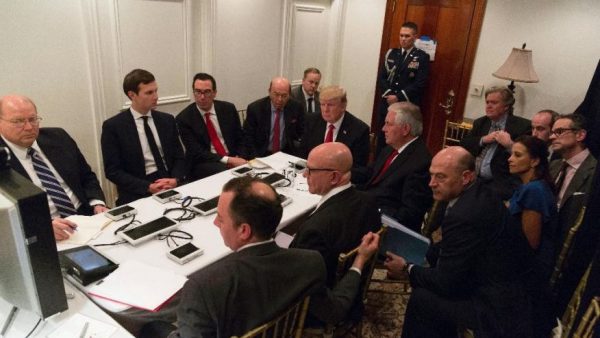
President Trump meeting with his advisers at his estate in Mar-a-Lago on April 6, 2017
By Robert Parry | Consortium News | April 8, 2017
There is a dark mystery behind the White House-released photo showing President Trump and more than a dozen advisers meeting at his estate in Mar-a-Lago after his decision to strike Syria with Tomahawk missiles: Where is CIA Director Mike Pompeo and other top intelligence officials?
Before the photo was released on Friday, a source told me that Pompeo had personally briefed Trump on April 6 about the CIA’s belief that Syrian President Bashar al-Assad was likely not responsible for the lethal poison-gas incident in northern Syria two days earlier — and thus Pompeo was excluded from the larger meeting as Trump reached a contrary decision.
At the time, I found the information dubious since Trump, Secretary of State Rex Tillerson and other senior U.S. officials were declaring quite confidently that Assad was at fault. Given that apparent confidence, I assumed that Pompeo and the CIA must have signed off on the conclusion of Assad’s guilt even though I knew that some U.S. intelligence analysts had contrary opinions, that they viewed the incident as either an accidental release of chemicals or an intentional ploy by Al Qaeda rebels to sucker the U.S. into attacking Syria.
As strange as the Trump administration has been in its early months, it was hard for me to believe that Trump would have listened to the CIA’s views and then shooed the director away from the larger meeting before launching a military strike against a country not threatening America.
After the strike against Syria by 59 Tomahawk missiles, which Syrian officials said killed seven people including four children, Trump gave a speech to the American people declaring flatly:
“On Tuesday, Syrian dictator Bashar al-Assad launched a horrible chemical weapons attack on innocent civilians. Using a deadly nerve agent, Assad choked out the lives of helpless men, women, and children. It was a slow and brutal death for so many. Even beautiful babies were cruelly murdered in this very barbaric attack. No child of God should ever suffer such horror.”
As much as Trump stood to benefit politically by acting aggressively in attacking Syria — and thus winning praise even from his harshest critics — the idea that he would ignore the views of the U.S. intelligence community on an issue of war or peace was something that I found hard to believe.
So, I put aside what I had heard from the source about the discordant Pompeo-Trump meeting as the sort of tidbit that may come from someone who lacks first-hand knowledge and doesn’t get all the details right.
After all, in almost every similar situation that I had covered over decades, the CIA Director or the Director of National Intelligence has played a prominent role in decisions that depend heavily on the intelligence community’s assessments and actions.
For instance, in the famous photo of President Obama and his team waiting out the results of the 2011 raid to kill Al Qaeda leader Osama bin Laden, CIA Director Leon Panetta is the one on the conference screen that everyone is looking at.
Even when the U.S. government is presenting false information, such as Secretary of State Colin Powell’s 2003 speech laying out the bogus evidence of Iraq hiding WMDs, CIA Director George Tenet was seated behind Powell to lend credibility to the falsehoods.
At the Table
But in the photo of Trump and his advisers, no one from the intelligence community is in the frame. You see Trump, Secretary of State Tillerson, National Security Adviser H.R. McMaster, White House chief of staff Reince Priebus, strategic adviser Steve Bannon, son-in-law Jared Kushner and a variety of other officials, including some economic advisers who were at Mar-a-Lago in Florida for the meeting with Chinese President Xi Jinping.
However, you don’t see Pompeo or Director of National Intelligence Dan Coats or any other intelligence official. Even The New York Times noted the oddity in its Saturday editions, writing: “If there were C.I.A. and other intelligence briefers around, … they are not in the picture.”
That made me wonder whether perhaps my original source did know something. The claim was that CIA Director Pompeo had briefed Trump personally on the analysts’ assessment that Assad’s forces were not responsible, but – then with Pompeo sidelined – Trump conveyed his own version of the intelligence to his senior staff.
In other words, the other officials didn’t get the direct word from Pompeo but rather received a second-hand account from the President, the source said. Did Trump choose to rely on the smug certainty from the TV shows and the mainstream news media that Assad was guilty, rather than the contrary view of U.S. intelligence analysts?
After the attack, Secretary of State Tillerson, who is not an institutional intelligence official and has little experience with the subtleties of intelligence, was the one to claim that the U.S. intelligence community assessed with a “high degree of confidence” that the Syrian government had dropped a poison gas bomb on civilians in Idlib province.
While Tillerson’s comment meshed with Official Washington’s hastily formed groupthink of Assad’s guilt, it is hard to believe that CIA analysts would have settled on such a firm conclusion so quickly, especially given the remote location of the incident and the fact that the initial information was coming from pro-rebel (or Al Qaeda) sources.
Thus, a serious question arises whether President Trump did receive that “high degree of confidence” assessment from the intelligence community or whether he shunted Pompeo aside to eliminate an obstacle to his desire to launch the April 6 rocket attack.
If so, such a dangerous deception more than anything else we’ve seen in the first two-plus months of the Trump administration would be grounds for impeachment – ignoring the opinion of the U.S. intelligence community so the President could carry out a politically popular (albeit illegal) missile strike that killed Syrians.
Investigative reporter Robert Parry broke many of the Iran-Contra stories for The Associated Press and Newsweek in the 1980s.
Idlib chemical attack: A sign no change of policy is on the horizon
By Kit | OffGuardian | April 5, 2017
The alleged chemical attack, reported yesterday, is the latest in a series of atrocities notionally carried out by the Syrian government (“The Regime”, in the partisan parlance of the press). There has not been time, as yet, to fully examine and analyse all the evidence – the claims and counter claims, the photographs and videos – but it would be a massive mistake to view it in a vacuum.
First, the situation on the ground needs to be considered. The Syrian government – with assistance from Iran and the Russian Air Force, have been making steady progress for months. Aleppo has fallen. Palmyra was retaken. The rebels are losing. So cui bono? What good does dropping chemical weapons on children do Assad, at this point? It is both strategically pointless, and a crushing blow to his international image. It would serve no purpose, unless he’s a comic-book style villain intent on being cruel for cruelty’s sake – and they don’t exist outside of cinema or the American press. Conversely, it would make all the sense in the world for cornered zealots and mercs to try to disrupt the upcoming talks (from which they are excluded).
Second, the timing. Much like a previous “chemical attack” (and subsequent BBC Panorama documentary) came on the eve of a commons vote on military intervention in Syria, this attack comes at a key moment. In two days there is a meeting in Brussels on the Syria peace process, and the future of the country. This attack will allow Western leaders – especially the European voices, increasingly separate from the US on this issue – to ride an artificial high-horse into those proceedings. Deals can be scuppered and progress refused in the wake of such “atrocities”.
Third, we have seen this all before. There was the chemical attack in Ghouta, initially pinned on the government (and still unquestioningly attributed to them in the MSM), that was revealed to be carried out by rebels. there was also the aforementioned napalm/chemical attack on a school – thoroughly debunked by Robert Stuart. We have seen the same girl rescued three different times by the White Helmets, and seen people in Egypt arrested for faking footage of bombings. The “last hospital in Aleppo” was knocked down everyday for a month, and the last doctors slaughtered bi-weekly. There is no reason, as yet, to think this is not just more of the same.
This is in fine tradition of media manipulation – from filming people on the outside of a fence and pretending they’re inside, to moving bodies for a better photograph, to deliberately removing an image’s context, and lying about it. Events are ignored, twisted, exaggerated and outright fabricated in order to push an agenda. Accordance with reality is immaterial to the process, and coincidental when it occurs.
Real or not, false flag or not – No one can deny convenience of the timing. Given the conflict the UK/EU find themselves in with the new US administration re: Syria. During the campaign Trump, unlike Clinton, totally refused to countenance the idea of no-fly zones or any kind of American/NATO backed military action against Syria and their Russian/Iranian allies. The last few weeks have seen even a softening of America’s “Assad must go” mantra. Rex Tillerson, speaking in Turkey last week, said:
I think the… longer term status of president Assad will be decided by the Syrian people,”
And the American ambassador to the UN added:
You pick and choose your battles and when we’re looking at this, it’s about changing up priorities and our priority is no longer to sit there and focus on getting Assad out.”
Though she did later clarify these remarks, after being named-and-shamed in the media.
John McCain called Tillerson’s words “one of the more unusual statements I have ever heard”, stating it would be ridiculous to let Syrians decide the fate of Syrian government (probably because they would choose wrong).
The press, of course, have not referenced any of this. They continue to cite the partisan White Helmets and completely discredited “Syrian observatory for Human Rights” as if they are reliable sources. They continue to assert gossip and rumor as if it were fact. They continue to lie, but give themselves just enough room to manoeuvre should their lies be exposed.
The Guardian view on…, one of the Guardian’s anonymous editorials (that definitely don’t come straight from GCHQ, you cynics), is a classic example. The headline reads:
The Guardian view on Syria: Assad knows he acts with impunity
A sharp, hard-edged, statement of absolute certitude… and the only sentence of conviction in the whole piece. The rest is littered with uncertain, selective language. Weasel-words and guesses. I have added the emphasis:
Tuesday’s attack in rebel-held Idlib province has forced a reaction: it is one of the worst suspected chemical attacks in the six-year war
the symptoms suggest the use of a nerve agent, probably sarin
ascertaining the agents used, by whom, is always difficult – particularly given the problems experts will face in accessing the site.
The suspicion is that Tuesday’s strike, like another suspected sarin attack which killed 93 people in eastern Hama in December,
Some have already drawn a link between what seems to be the use of a more deadly agent and the US shift on Syria
That’s an awful lot of “seems” and “suspecteds” to cram into 700 words. It’s a suspected attack, that seems like it might be similar to other suspected attacks, which might have happened. As of right now, it appears, we don’t who attacked, how they attacked, what they attacked with or – indeed – if anyone attacked anything at all.
Nevertheless, the nameless and completely non-partisan and objective author reassures us that:
Nonetheless, the evidence so far points in one direction,
… he just neglects to mention exactly what that evidence is, or tell us where we can find it.
Just hours later we are treated to a longer variation on the exact-same theme, this time the author doesn’t feel ashamed to put his name to it… he probably should be. But years of writing about the Guardian teaches you that Jonathan Freedland is never ashamed of putting his name to anything.
Let’s not even condemn these attacks any more – because our condemnations ring so hollow.
… he says, before condemning the attacks – at interminable length and in trite manipulative language. That these condemnations “ring hollow” might be the only honest words in the article. The level of selective blindness, historical dishonesty, and flat-out hypocrisy is astounding. Even for him,
Assad has himself broken international law, indeed broken a set of precious, century-old conventions and agreements that ban chemical weapons.
… he says, as if a) It was a proven fact and b) It was the only example. No mention of American use of depleted Uranium, Agent Orange or napalm is made. No mention of Israeli White Phosphorus or of the cluster bombs we used in Iraq, and sold to Saudi Arabia to be used on Yemeni civilians. The use of any and all of those substances is illegal under International law. America and Israel cannot be charged with a breach of The Geneva Convention, of course, because they have never ratified protocols I and II, outlawing the targeting of civilians and infrastructure and banning certain weapons.
We are all too aware of the costs of action. But the dead of Khan Sheikhoun force us to make another calculation. They force us to see that inaction too can exact a terrible price.
This could be a straight copy-and-paste job from his many articles on Libya. He made the same arguments back then, and must take partial responsibility for post-apocalyptic wasteland that he (and his colleagues in the media) helped to create. Libya is destroyed, he knows this, and if he could excuse or downplay his role in that destruction… he would do so. To ignore it, and employ the same reasoning to encourage the same fate to yet another Middle-Eastern country, displays a callousness and vanity that belies is saccharine concern for “values”.
However, no amount of faux-moral agonising and dishonesty will ever trump this:
For more than a decade, we have rightly weighed the grave consequences of the 2003 invasion of Iraq, counting the toll in human suffering.
The tone mirrors the same tone ever-taken by members of the Western press when it comes to Iraq. “Our consciences are agony”, they scream at us. As if Iraq was all a tragic accident, fuelled by the fervor of our best intentions and naivety of our governments. They will never address the truth of it – that it was a cynical and brutal war of conquest, cheered on a by braying, controlled media, with more regard for their appearance of virtue, and their bank balances, than any idea of objective truth.
Now, the lame self-flagellation is one thing, but that it should appear alongside this:
Assad’s impunity is, at this very moment, being noted and filed away by the world’s most brutal regimes: the precedent is being set. This is what you can get away with.
… is quite another. The world is VERY aware “what you can get away with” in international law…and it’s not 70 dead in what “seems” like a gas attack. What you can “get away with” is walling up millions of people in a giant ghetto, and cutting off their water and power supply. It’s dropping carcinogens on villages, that give babies tumors 50 years later. It’s illegal sanctions that kill 500,000 children but are “worth it”.
“what you can get away with”, as the author so po-facedly admits, is the invasion of Iraq. An illegal war, a million dead, an ancient seat of civilisation reduced to a glass crater. Was anyone fired? Did anyone resign in disgrace? Has anyone faced charges in the Hague. No, the perpetrators walk free. They collect paychecks from the boards of the most powerful companies in the world, and are given column inches in the Guardian when ever they want them.
In terms of making an actual argument, he hits the exact same talking points as The Guardian view, uses the exact same phrases… and produces the exact same amount of evidence:
… we almost certainly know who did it. Every sign points to the regime of Bashar al-Assad.
He doesn’t say what these “signs” are. Or link to where we can see them.
We know that the poison spread after warplanes dropped bombs
We “know” no such thing. That’s just what the White Helmets said. The White Helmets are paid by the governments of several countries… including the US and UK. They are completely discredited as a source. But this article isn’t about making an evidence-based case, it is about harnessing created public outrage in order to further a specific political agenda.
So, what is the agenda? Well, it won’t be full-blown war in Syria. Number 10 was very quick to – shall we say – shoot-down that idea. It won’t be any kind of overt NATO or American backed intervention… if the PTB had wanted that, they would have pushed harder for a Clinton victory. And Freedland’s reference to Anne-Marie Slaughter’s suggestion is laughable:
Anne-Marie Slaughter, formerly of the Obama administration, suggests a single strike that would crater, say, a runway used by Assad’s warplanes – not an invasion, not a full-scale military operation, but some way of punishing Syria for what it has done.
No, the agenda being pushed here is two-fold, firstly an attack on the UN and its apparent impotence, and secondly a pre-emptive defense of the status quo.
To deal with the first point, the article launches a sidelong attack on the UN Security Council, most specifically the veto power:
In February, the UN security council considered imposing sanctions over the use of chemical weapons. Russia vetoed it, of course: it would never want to stay the hand of its murderous chum. But China vetoed it too.
This is not new material for the Guardian, they have been attacking the UN veto for years now – as have other liberal papers and news outlets. You don’t need to be a genius to understand the drive to undermine the only regulatory body that can put a hold on neo-liberal imperialism. But for the UNSC, Iraq would have been so much easier and Syria would have been levelled by now.
The second point is more subtle. For years the CIA et al have been seeking to remove Assad from government, most openly through supplying arms and money to the “moderate opposition” in order to wage a proxy war. Trump’s election, and his public undermining of the intelligence agencies, poses a threat to this on-going plan.
Now that this chemical attack has happened, of course, Trump’s administration can be condemned for being “soft”. Now, we can call on Trump and his cabinet to “act”… and when they refuse to change their policy, rightfully fearful of a conflict with Russia, they will be further derided and undermined in the press as “Russian agents” who are “easy on tyrants”.
All the while, the covert operations carried out by American and European alphabet agencies all over Syria will continue.
When the State Dept., the CIA and all their co-members of America’s (totally imaginary) “deep state” completely disregard the orders of their Commander-in-Chief, and continue to pursue their own agenda – continue to supply arms and funding to their mercenaries and proxies – they will be applauded in the press for their “bravery” and “resolution”.
We will be encouraged to be “thankful” that the mechanics of democracy and freedom cannot be impeded by the election of an autocratic buffoon. We will be told, with a bright smile, that our choice of leadership means literally nothing as it pertains to foreign policy.
It will be thrown in our faces that our elected officials have no real power, and we will be told to applaud the death of democracy… in the name of freedom.
Featured Video
Seyed M. Marandi: Toward Total War in the Middle East
or go to
Aletho News Archives – Video-Images
From the Archives
The Geopolitics behind the War in Yemen (I)
By Mahdi Darius NAZEMROAYA | Strategic Culture Foundation | 30.03.2015
The United States and the Kingdom of Saudi Arabia became very uneasy when the Yemenese or Yemenite movement of the Houthi or Ansarallah (meaning the supporters of God in Arabic) gained control of Yemen’s capital, Sanaa/Sana, in September 2014. The US-supported Yemenite President Abd-Rabbuh Manṣour Al-Hadi was humiliatingly forced to share power with the Houthis and the coalition of northern Yemenese tribes that had helped them enter Sana. Al-Hadi declared that negotiations for a Yemeni national unity government would take place and his allies the US and Saudi Arabia tried to use a new national dialogue and mediated talks to co-opt and pacify the Houthis.
The truth has been turned on its head about the war in Yemen. The war and ousting of President Abd-Rabbuh Manṣour Al-Hadi in Yemen are not the results of «Houthi coup» in Yemen. It is the opposite. Al-Hadi was ousted, because with Saudi and US support he tried to backtrack on the power sharing agreements he had made and return Yemen to authoritarian rule. The ousting of President Al-Hadi by the Houthis and their political allies was an unexpected reaction to the takeover Al-Hadi was planning with Washington and the House of Saudi. … continue
Blog Roll
 Aletho News
- Israeli lobby seeks to bind US fate to ‘Israel’: Araghchi
- Pakistan-Iran talks secure LNG shipment to Islamabad through Hormuz
- Black Sea grain crisis puts global wheat supplies under pressure
- IRGC air defenses destroy another US MQ-1 drone over Strait of Hormuz
- Imran Khan’s entire immediate family detained in Pakistan ahead of mass protest demanding his release
- EU nation detains former presidential frontrunner
- Leaked: Britain’s Sham Conviction Of Hashim Thaci
- Seyed M. Marandi: U.S. Strike Imminent – Toward Total War in the Middle East
- Russia Voted Under Fire. Washington Is Loading the Tankers.
- 12 Things Your Oncologist Was Trained Not to Tell You
- If Americans Knew
- Israeli Attacks in Gaza Kill at Least Seven Palestinians Over Three Days, including Woman and Child
- Trump’s militarization of Washington DC as he pursues Israel’s war against Iran
- Why Israel Fears This Searing New Documentary
- Huckabee aide solicited cash gifts from Israelis
- This isn’t sci-fi, AI is already killing people
- ‘The Most Brutal Thing’: Investigation Reveals Execution of Elderly Woman in Rafah
- Inside Israel’s ‘soft’ ethnic cleansing plan for Gaza through the eyes of its victims
- New online database tracks pro-Israel political donations in the United States
- Israeli president pardons soldier convicted for killing wounded Palestinian
- Singer Ed Sheeran says his ‘heart broken’ by Gaza devastation, addresses Macklemore controversy
- No Tricks Zone
- 2025 Nature Paper Claiming Worsening Global Drought Gets RETRACTED …Heavily Flawed
- New Study: ‘Global Drought Shows No Detectable Recent Acceleration Under Climate Warming’
- Economic Masterminds: German Socialists Suggest Taxing Productivity Gains Stemming From Using AI
- The South China Sea Has Not Been Cooperating With The Climate Change Narrative
- Energy Crisis: Germany Enters Heating Season With Historically Low Gas Reserve Fill Levels
- New Study: The Antarctic Ice Sheet Gained Mass From 2020-2024 Due To Staggering Snow And Ice Accumulation
- Study: Ocean Heating Rates From Thousands Of Years Ago ‘Dwarf’ Modern Ocean Heating Rates
- Climate Extremists Target, Attack Large-Scale Power Grid Infrastructure In Germany!
- New Study: Antarctic Ice Melt Has Contributed Less Than 1 Centimeter To Sea Level Rise In The Last 30 Years
- Fear Of Debate: Alarmist German Climate Scientist Calls On Mainstream Media To Discredit Skeptic Voices
 Aletho News