The Beatification of Barack Obama
By Kit | OffGuardian | January 15, 2017
As the eight-year term of America’s first black President draws to a close, the media are already in the process of myth-making. There’s room for an honest autopsy of a man who promised a new kind of world, and delivered merely warmed-over soundbites and a few fake tears.
“With Barack Obama’s exit the US is losing a saint.” writes Simon Jenkins in the Guardian, whilst Ann Perkins praises his “grace, decency and defence of democracy”. Lola Okolosie rhapsodises on his legacy of “warmth, love, resilience”.
Already the storyline is set – Obama was a good man, who tried to do great things, but was undone by a Republican senate, and his own “sharp intelligence”.
These people, as much as anybody, reflect the cognitive dissonance of the modern press. “Liberals”, to use their own tortured self-descriptor, now assign the roles of good guy and bad guy based purely on aesthetics, convenience and fuel for their vanity. Actions and consequences are immaterial.
For the sake of balance, here is a list of Saint Obama’s unique achievements:
- Obama is the first President in American history to be at war for every single day of an 8 year presidency.
- Obama has carried out 10x more drone strikes than Bush ever did. Every Tuesday a military aide presents Obama with a “kill list”, and the “decent, gracious” Obama picks a few names off a list…and kills them. And their families. And their neighbours. These illegal acts of state-sanctioned murder have killed hundreds of civilians in 5 different countries in 2016 alone. The only reason that number isn’t higher, is that the Obama administration re-classified all males over 18 as combatants, regardless of occupation.
- After declaring he wanted to build a “nuclear free world”, Obama committed to spending $1 TRILLION dollars on rebuilding America’s nuclear weapons.
- Under Obama, the NSA et al. were able to spy on, essentially, the whole world. When this was revealed, not a single intelligence officer or government official was prosecuted. Instead…
- Obama’s administration declared a “war on whistleblowers”, enacting new laws and initiating what they call the “Insider Threat Program”. Manning was prosecuted, Snowden sent into exile and Assange was set-up, discredited and (they hoped) extradited. It has never been more dangerous to be a government whistle-blower, than under Barack Obama
- In terms of foreign policy, despite his press-created and non-sensical reputation as a non-interventionist, American Special Forces are currently operating in over 70% of the world’s 138 countries. The great lie is that, where Bush was a warmonger, Obama has sought to avoid conflict. The truth is that Obama, in the grand tradition of the CIA and American Imperial power, has simply turned all America’s wars into covert wars.
- Before Obama came into office, Libya was the richest and most developed nation in Africa. It is now a hell-hole. Destroyed by war, hollowed-out by corruption. The “liberal” press allow him to agonise over this as his “greatest mistake”, and then gently pardon him for his good intentions. The truth is that Libya was not a mistake, or a misjudgment, or an unforeseen consequence. Libya is exactly what America wanted it to become. A failed state where everything is for sale, a base to pour illegal CIA weapons south into Africa and east into the ME. When war is your economy, chaos is good for business. When secrecy is your weapon, anarchy is ammunition. Libya went according to plan. A brutal plan that killed 100,000s and destroyed the lives of millions more. Libya, like Iraq, is a neocon success story. Syria on the other hand…
- Syria, probably the word that will follow Obama out of office as “Iraq” did his predecessor, is a total failure. Both of stated intent and covert goals. Where the press will mourn Obama’s “indecisive nature” and wish he’d “used his big stick”, the real story is one of evil incompetence, so great that it would be almost comical… if it hadn’t destroyed an ancient seat of civilisation and killed 100,000s of people. Syria (along with Libya, Iraq, Somalia, Iran and Sudan) was on the list of the 7 countries America intended to destroy, famously “leaked” by General Wesley Clark. After the fall of Libya, Syria was (essentially) surrounded by American military on all sides. Iraq, Israel, Turkey and America operating out of Libya could pour “freedom fighters” into Syria to bring down “the regime”. When that didn’t work they deployed the trusty “WMD” method, to demand “humanitarian intervention”… the Russians saw that off. Then “ISIS” was created by the CIA, as al-Qaida were before them, and their manufactured barbarism was used as a pretext for invasion. The Russians, again, saw to it that this would not happen.
- Perhaps in the hope of distracting Russia from the ME, or perhaps merely as a short-sighted punitive measure, the Obama administration’s next foreign policy target was Ukraine. Victoria Nuland’s own voice proves how much that “color revolution” was an American creation. Ukraine is broke, even more broke than it was, its people starve and freeze through the winter. The new “democratic government” has shelled 10,000 people to death in the East of the country…. using American weapons.
- In Yemen, the poorest country in the ME is being bombed to shreds by the richest…. again, using American (and British) weapons. Obama’s “defense of democracy” doesn’t extend to criticising, or even discussing, the abhorrent Human Rights record of America’s Saudi Arabian allies, and in an act of brazen hypocrisy, even supported their chairing of the Human Rights Council of the UN.
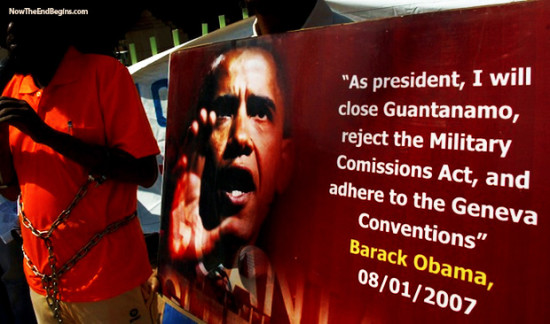
This is the world Saint Obama has created. Guantanamo is still open, and terrorist “suspects” are still held there without trial or charge (they are probably still tortured). Other “suspects” can be simply declared guilty, and unilaterally executed… anywhere in the world. The NSA and CIA are illegally monitoring the communications of half the world. If any other leader in the world claimed even 1% of this power, they would be decried as “autocratic”, and their country denounced as a “pariah state”.
The Middle-East is ablaze from Libya to Afghanistan, and from Yemen to Turkey. Relations with Russia are as precarious as at any time since WWII, thanks to America’s efforts to break Russia economically and shatter their global influence. There is no sign that America intends to back-down (see the recent red-scare style hysteria in the American press). Likewise America has positioned itself to have a massive conflict with China in the South China Sea. Obama is, in terms of influence, nothing more than a used-car salesman. His job is not to create policy, but to sell neocon ideas to the general public, but his lack of agency cannot excuse his lack of vision or morals. Under Obama’s notional leadership the world has moved to the very brink of self-immolation in the name of protecting American hegemony. Domestically America still crumbles.
He had a nice smile, and a good turn of phrase. He was witty, and cool, and looked good in a suit… but that doesn’t mean he wasn’t just more of the same. He could say the right things, and sound like he meant them, but he was still a monster. As he moves out to pasture, the press will try to spit-shine Obama’s tarnished halo, to try to convince us that he was a good man at heart and that, as politicians go, we can’t do any better.
But yes, we can.
Dossiers, Make Believe and Fantasy
The CIA, Trump and Unverified News
By Binoy Kampmark | Dissident Voice | January 13, 2017
London — Morning breakfast news on the BBC’s Radio Four on Friday was a delightful affair filled with discussions on Russia (when do we not talk about that busy, stirring Bear these days?), Donald Trump, dossiers and the intelligence fraternity. Did it even matter that various sources have been unverified, subject matter lumped together in cumbersome conversations on fake news, sexual frolics and the like?
Discussants on the Beeb who kept listeners company over coffee included former, recently confessed spook Frederick Forsyth, for years the go-to creator of the spy narrative, and the official intelligence historian Sir Christopher Andrew.
For Forsyth, the allegations outlined by former British spy Christopher Steele that Trump found himself in prancing company with Russian hookers, dubious real estate deals targeted as bribes and a treasonous coordination with the Russian intelligence services to defeat Hillary Clinton, beggared belief. Trump was hardly that much of a buffoon, surely.
On Wednesday night, the US director of national intelligence, James R. Clapper Jr., issued a statement in the aftermath of a conversation with Trump on the Steele dossier, suggesting that the agencies had “not made any judgment that the information in this document is reliable.” Naturally, despite any claims about authenticity, the report had been circulated within the deepest recesses of spook central. Clapper would never want to deny his own officials the pleasure of that smut.
The New York Times conceded that much of the story remained “out of reach – most critically the basis question of how much, if anything, in the dossier is true.” You would think that this point was most salient, rendering any other discussion empty and flatulent.
Nonetheless, the paper would go on to assert that it was “possible to piece together a rough narrative of what led to the current crisis, including lingering questions about the ties binding Mr. Trump and his team to Russia.”
With the US presidential inauguration fast approaching, the press jackals have been swarming. The tid bits offered by the Steele report are themselves shrouded, stemming from September 2015 when an anti-Trump Republican donor (naturally, we do not know the name) commissioned Fusion GPS, a Washington-based research firm stacked by former journalists turned information hit-men, to do some digging. The mission was simple: find as much debilitating dirt as possible and sink the Trump ship.
Steele, considered at one point one of Britain’s foremost Russian experts within MI6, was considered ideal for the job of funneling information to Glenn Simpson at Fusion GPS. The themes of those memos were stock standard: the old compromising (kompromat) material, with sex being central; and the hacking of the Democratic National Committee with discussion by Trump officials with Russian entities.
Trump has not done himself any favours, preferring to throw meagre carrion at the press corps, and hope that it miraculously dissipates. His polemical advisors would have been best served to tell him to shut it. News is not interesting. Allegations have become the gold dust of political debate.
This latest battle of spite and indignation reveals that internally, there is a war between claims and institutions within the United States. The intelligence community finds itself unsheathing its weapons. Trump has duly responded.
The point being missed here is the possibility that the servants of the elected commander-in-chief may actually be subverting the Republic, for all Trump’s sullen, and childish authoritarianism. Sources garnered from the very foundry of deception have assumed an aura of reliability. The argument about fake news has been turned inside out.
While care should be taken in packaging the entire US intelligence community into a neat box of anti-Trump enthusiasts, a good number of former officials were very keen that Hillary Clinton take over the reins in the White House. Views were expressed throughout the election cycle: Trump had to be defeated at all costs.
Once it became clear that Trump was gaining electoral momentum at nerve racking pace, it was important to side with the Clinton electoral team on a revived Cold War mantra: the Russians were doing terrible things, with Trump operating in the shadow of Russian President Vladimir Putin.
For former CIA and NSA director under George W. Bush, Gen. Michael Hayden, Trump was “the useful fool, some naïf, manipulated by Moscow, secretly held in contempt, but whose blind support is happily accepted and exploited.”
Former CIA Director Michael J. Morell also took a step that can only be regarded as singular and institutionally troubling: coming out from the shadows to pick his preferred candidate while denigrating another.
In August, he bored readers with his resume in an opinion piece for the New York Times. (“In my 40 years of voting, I have pulled the lever for candidates of both parties.”) He expressed a solemn view that Trump was “not only unqualified for the job, but he may well pose a threat to our national security.” Russia’s Putin “had recruited Mr. Trump as an unwitting agent of the Russian Federation.”
The Fourth Estate used to be the solemn interrogating power of the parliamentary galleries. Being unelected, it was given, as an accident of history, a certain influence. Like all power, it can be misdirected, even ill-informed. The questioners can become vessels and conduits.
Over time, that same estate has withered, becoming a faint echo of investigation and fact checking. Even in notionally democratic states, it can be co-opted. As Glenn Greenwald has argued, the most useful tool of the deep state has been the US media, “much of which reflexively reveres, serves, believes, and sides with hidden intelligence officials.”
Leakers are punished; facts are not cross-checked. The hack now floats in an ether of speculation, fed by the unverifiable, and pampered by the intelligence official. The battles now seemingly are not over narratives of veracity but narratives of invention. Power, it would seem, to the creative in this new Republic of trouble that is the United States.
Binoy Kampmark was a Commonwealth Scholar at Selwyn College, Cambridge. He lectures at RMIT University, Melbourne and can be reached at: bkampmark@gmail.com.
Pulling a J. Edgar Hoover on Trump
By Robert Parry | Consortium News | January 12, 2017
The decision by the U.S. intelligence community to include in an official report some unverified and salacious accusations against President-elect Donald Trump resembles a tactic out of FBI Director J. Edgar Hoover’s playbook on government-style blackmail: I have some very derogatory information about you that I’d sure hate to see end up in the press.
In this case, as leaders of the U.S. intelligence community were pressing Trump to accept their assessment that the Russian government had tried to bolster Trump’s campaign by stealing and leaking actual emails harmful to Hillary Clinton’s campaign, Trump was confronted with this classified “appendix” describing claims about him cavorting with prostitutes in a Moscow hotel room.
Supposedly, Director of National Intelligence James Clapper and CIA Director John Brennan included the unproven allegations in the report under the rationale that the Russian government might have videotaped Trump’s misbehavior and thus could use it to blackmail him. But the U.S. intelligence community also had reasons to want to threaten Trump who has been critical of its performance and who has expressed doubts about its analysis of the Russian “hacking.”
After the briefing last Friday, Trump and his incoming administration did shift their position, accepting the intelligence community’s assessment that the Russian government hacked the emails of the Democratic National Committee and Clinton’s campaign chief John Podesta. But I’m told Trump saw no evidence that Russia then leaked the material to WikiLeaks and has avoided making that concession.
Still, Trump’s change in tone was noted by the mainstream media and was treated as an admission that he was abandoning his earlier skepticism. In other words, he was finally getting onboard the intelligence community’s Russia-did-it bandwagon. Now, however, we know that Trump simultaneously had been confronted with the possibility that the unproven stories about him engaging in unorthodox sex acts with prostitutes could be released, embarrassing him barely a week before his inauguration.
The classified report, with the explosive appendix, was also given to President Obama and the so-called “Gang of Eight,” bipartisan senior members of Congress responsible for oversight of the intelligence community, which increased chances that the Trump accusations would be leaked to the press, which indeed did happen.
Circulating Rumors
The stories about Russian intelligence supposedly filming Trump in a high-end Moscow hotel with prostitutes have been circulating around Washington for months. I was briefed about them by a Hillary Clinton associate who was clearly hopeful that the accusations would be released before the election and thus further damage Trump’s chances. But the alleged video never seemed to surface and the claims had all the earmarks of a campaign dirty trick.
However, now the tales of illicit frolic have been elevated to another level. They have been inserted into an official U.S. intelligence report, the details of which were leaked first to CNN and then to other mainstream U.S. news media outlets.
Trump has denounced the story as “fake news” and it is certainly true that the juicy details – reportedly assembled by a former British MI-6 spy named Christopher Steele – have yet to check out. But the placement of the rumors in a U.S. government document gave the mainstream media an excuse to publicize the material.
It’s also allowed the media to again trot out the Russian word “compromat” as if the Russians invented the game of assembling derogatory information about someone and then using it to discredit or blackmail the person.
In American history, legendary FBI Director J. Edgar Hoover was infamous for using his agency to develop negative information on a political figure and then letting the person know that the FBI had the dirt and certainly would not want it to become public – if only the person would do what the FBI wanted, whether that was to reappoint Hoover to another term or to boost the FBI’s budget or – in the infamous case of civil rights leader Martin Luther King – perhaps to commit suicide.
However, in this case, it is not even known whether the Russians have any dirt on Trump. It could just be rumors concocted in the middle of a hard-fought campaign, first among Republicans battling Trump for the nomination (this opposition research was reportedly initiated by backers of Sen. Marco Rubio in the GOP race) before being picked up by Clinton supporters for use in the general election.
Still, perhaps the more troubling issue is whether the U.S. intelligence community has entered a new phase of politicization in which its leadership feels that it has the responsibility to weed out “unfit” contenders for the presidency. During the general election campaign, a well-placed intelligence source told me that the intelligence community disdained both Clinton and Trump and hoped to discredit both of them with the hope that a more “acceptable” person could move into the White House for the next four years.
Hurting Both Candidates
Though I was skeptical of that information, it did turn out that FBI Director James Comey, one of the top officials in the intelligence community, badly damaged Clinton’s campaign by deeming her handling of her emails as Secretary of State “extremely careless” but deciding not to prosecute her – and then in the last week of the campaign briefly reopening and then re-closing the investigation.
Then, after the election, President Obama’s CIA began leaking allegations that Russian President Vladimir Putin had orchestrated the hacking of Democratic emails and provided them to WikiLeaks to reveal how the DNC undermined Sen. Bernie Sanders’s campaign and what Clinton had told Wall Street bigwigs in paid speeches that she had sought to keep secret from the American people.
The intelligence community’s assessment set the stage for what could have been a revolt by the Electoral College in which enough Trump delegates could have refused to vote for him to send the election into the House of Representatives, where the states would choose the President from one of the top three vote-getters in the Electoral College. The third-place finisher turned out to be former Secretary of State Colin Powell who got four votes from Clinton delegates in Washington State. But the Electoral College ploy failed when Trump’s delegates proved overwhelmingly faithful to the GOP candidate.
Now, we are seeing what looks like a new phase in this “stop (or damage) Trump” strategy, the inclusion of anti-Trump dirt in an official intelligence report that was then leaked to the major media.
Whether this move was meant to soften up Trump or whether the intelligence community genuinely thought that the accusations might be true and deserved inclusion in a report on alleged Russian interference in U.S. politics or whether it was some combination of the two, we are witnessing a historic moment when the U.S. intelligence community has deployed its extraordinary powers within the domain of U.S. politics. J. Edgar Hoover would be proud.
Investigative reporter Robert Parry broke many of the Iran-Contra stories for The Associated Press and Newsweek in the 1980s.
Of Wizards and Washington and the Dreary, Unrelenting Reality of American Politics
A raw and sometimes darkly comic survey of America’s treacherous political terrain
By John Chuckman | Aletho News | January 12, 2017
The books about The Wizard of Oz were written as satire on American politics, but Hollywood, in its inimitable way, turned them into a song-and-dance picture for children. Still, one scene in the film has a sense of the author’s intent. That scene is when Dorothy, in Emerald City, approaches a closet-like structure, which, as it happens, is the Wizard’s control booth for sounds and smoke and lights, his special effects for intimidating visitors and impressing them with non-existent power.
The entrance curtain happens to be open, so Dorothy sees a modest man busily pulling levers and pushing buttons and speaking into a microphone which alters his voice into a great booming one, echoing like a great organ in a cathedral. When the man realizes that he is being watched, he makes a last effort and booms out words along the lines of “Pay no attention to the man in the booth.” Of course, the jig is up, and we all understand there is no wizard.
 What better allegory for events in Washington today could there be? We have booming noises and smoke and glaring lights, and it all comes from a rather sad little – little in the sense of failed – man with about two weeks left to sit at his big desk and pretend that he is a great and powerful wizard. Except, when you are President, as this man is, you can never be observed in your control booth and you have your stunts and booming claims seconded by a chorus of flacks, hangers-on, and political appointees, presumably lending a semblance of authenticity and substance.
What the controversy engendered by “the Russians did it” has achieved is almost the opposite to what was intended. Dubious claims and pretend evidence have caused lights to shine brightly over what is a blanketing fabric of dishonesty in America’s establishment. The fabric covers everything from foreign affairs and the military to the details of domestic affairs. It is immense, complex, and carefully constructed covering, and those who created it have very little tolerance for any of it being scrutinized under spotlights. Achieving this scrutiny may be regarded as Obama’s final act of failure.
Whether it is “the Russians hacked the DNC” or “America has been bombing ISIS in Syria” or “the Russians threaten Eastern Europe” or “the Russians committed atrocities in Aleppo” or “Russia shot down Flight MH-17,” the same tiresome actors making the same unsupported claims have for eight years expected that just their inflated job titles should intimidate us into believing them. Proof? Who needs that? Would I lie to you about such matters? Once you start something foolish as Obama has done, and it is widely understood as being foolish, you only weaken your authority over all the other less-obviously dubious claims you have been making. The fabric of lies becomes weakened, and that is one of Obama’s small, but unintended, achievements now.
Even as I write these words, the first big wave of the Obama-Clinton unsupported claims, unsupported, that is, except by hack appointees like James Clapper, is receding. The world quickly reached a verdict of “nonsense.” But a second wave now laps up with an equally unsupported claim that the Russians have a compromising dossier on Donald Trump, an attempt to plant the idea that Russia will have direct influence over Trump’s policies. This malicious effort at “poisoning the well” for a political successor, brings to mind the time, some years back, when the ugliest of clutch of Israeli settlers, those who swaggered around Gaza behind barbed wire enclosed-compounds, full of attitude and always toting light machine guns while under the malevolent guard of Israeli soldiers, decided to leave their hopeless situation. They quite literally poisoned the water wells they had used before strutting away. I cannot imagine a much shabbier act. But here is Obama and his appointees doing much the same thing, effectively hacking away at what little democracy America has left out of sheer maliciousness.
I don’t mean to say that such gross lying began with Obama. The wizard’s control booth for smoke and lights and thundering sounds was not invented by him. There was nothing but eight years of lies from the weird triumvirate presidency of Cheney-Rumsfeld-Bush and from the corrupt and often-inept Clinton government. Lies are what big countries or organizations do when their activities will not stand up to public scrutiny. When countries secretly play dirty tricks, when they kill, and when they apply mafia-like pressure on allies and international organizations to do as they are told, they simply lie about all of it, always. Such activity has characterized America for a very long time. How can it be otherwise when you try to control the planet?
It’s just that eight years ago, we had some reason to believe Obama would be different, at least a little different, but he is not. He is just as shabby, murderous, and deceitful as his immediate predecessors, sometimes even more so. He has been at war somewhere every single day of his eight years. He has bombed seven countries. In his last year alone, he is said to have dropped over 26,000 bombs. Literally hundreds of thousands have died at the hands of the Peace Prize winner with the big boyish smile. I’ve often asked myself what it is that motivates Obama, and I don’t know. Sometimes he seems to fit the well-known pattern of the charming, smiling psychopath who secretly likes to kill.
Sometimes he just seems weak and, yes, cowardly, someone who has allowed the brass and big suits around those conference tables to run roughshod over him, leaving him with nothing but the pretense of authority. This could explain what is a remarkable sense of arrogance observed at times when he is around outsiders as a kind of psychological reflex to his living in his job under constant bullying. After all, Bush’s whole presidency was a pretense: he pretended to be president, and Cheney and Rumsfeld – the precise quality of men who, had they lived in 1930s’ Germany would have been seen happily “working towards the Führer” as they used to say – deferentially allowed him to do so as they ran everything. Bush was the first president to prove America doesn’t even need a president except to sign documents, much like the formal requirement for a witness’s signature on a legal document.
We know, too, that Bush was as close to a moron as ever held the office, because we watched his insipid face and listened to his inability to articulate a clear sentence for eight years. Sometimes, we do see glimmers of something similar from Obama, statements and behaviors that would not be expected from someone of forceful intelligence – the unsupported Russian hacking accusations being one, but also such matters as his foolish public dismissal of Russia, the only country which can literally obliterate the United States, as a great power – only with Obama we don’t see Bush’s Alfred E. Neuman look, we see a serious, stiff mien and a tone and posture of arrogance. A well-practiced cover-up behavior for inadequacies?
I don’t know, and it really does not matter. He has been a terrible president in every important respect, but he maintains a fair number of supporters who I guess are impressed with the big boyish smile, although that is seen far less often now, the baritone voice, and perhaps the sheer, unprecedented fact of a black man standing in his position. There’s no accounting for taste or popularity, as we see in every corner of contemporary celebrity culture, and American politics absolutely has an important element of celebrity culture, just as it loves to use celebrities as endorsements. Think of the last days of Hillary Clinton’s tired campaign when she had, yes, Beyoncé and Jay Z appearing in Ohio. It is hard to imagine what political or economic or social information that pair of pop celebrities had to offer voters, and it was reported by some that they were quietly paid millions for some minutes of effort to help swing the state with razzle-dazzle. After all, this was the Hillary Campaign, a glorious travelling circus that is estimated to have burned through $1.2 billion.
Many do expect something different from Trump, and we can hope their expectations are well-founded. His entire path to the presidency does show some unorthodox attitudes and methods – unorthodox, that is, by the claustrophobic standards and practices of that center of world empire, Washington, not unorthodox in some wider sense – and they show a very tough and driven man. It is simply a fact that anyone missing the last quality cannot function effectively as President in 21st-century America. The general environment in Washington, without the least exaggeration, may be compared to the proverbial snake pit or to scenes from the last days of Roman Empire.
That is why, for example, Bernie Sanders is such a hopeless hope. The man conducted an impressive crusade, displaying considerable skills, yet he just folded in the end, leaving his enthusiastic followers in limbo and giving up to Hillary Clinton who represented almost everything he opposed and who stood before him as someone who had just clearly cheated him out of the nomination through a whole range of cheats, ploys and gimmicks. Yet, he just accepted her and even did some campaigning for her.
Such a personality offers zero promise in face-to-faces with Pentagon generals, CIA Big Suits, mega-corporation presidents, and some foreign leaders who are closer to Mafiosi than politicians. What do you expect out of a little place like Vermont? It’s lovely. I’ve spent time there. But it resembles a great deal something from a backlot set for “Lassie Come Home” or “Anne of Green Gables.” I know, I know, Bernie originally came from hard-bitten New York, but the operative word there is “came.” Whatever his reasons for seeking bucolic, low-stress bliss, they do not make him material for presiding over Washington’s Chamber of Horrors.
Many Americans themselves, including both liberals and conservatives, are well aware of the dishonesty of their government, if only in a vague sense, but they know the task of doing anything about it is just too overwhelming and difficult to consider. After all, peasants on a 17th century estate hardly dared dream of changing the “natural order” in which they lived. And ordinary Americans work extremely hard to raise their families, and a great many of them do not work at all. They do not command great resources for all the costs and activities of a crusade. The general human condition in Western countries has not changed quite so much as some like to imagine over a few centuries of enlightenment and progress. A huge number of Americans count only for brief moments when their ballots are sought with sound-bites and vacuous ads. Afterwards, the establishment goes on just as before, ignoring them and getting back to the business of lying.
The papers people read – and, thanks to the spreading, corrosive effects of American imperialism, I include other Western countries, not just the United States – and the broadcasts to which they listen are uniform in discouraging any truly fresh way of looking at things and in suppressing the hope that arrangements can be much different. They universally avoid telling the truth where government prefers that they don’t. The idea of independent and principled journalism is something you only find in brochures for journalism schools or in Hollywood films.
The two major American political parties – together forming a duopoly of political power little different in overall its effect from the kind of monopoly power American authorities like to disparage in other, “less free” places – certainly do not provide much room for fresh voices or new initiatives. Over long periods, they can actually be quite stifling, much like high officials in a church concerning accepted truth and doctrine. The parties are totally dominated by money – money that can only come in the volumes required for marketing, advertising, polls, make-up artists, wardrobe consultants, facilities of every kind, publicity, and travel expenses from extremely wealthy people and special interests who are not the least interested in any significant change to a very cozy and comfortable situation.
The dominance of the Clintons in the Democratic Party through their money connections has been an arrangement to defend the status quo. It was a clever construction. The Clintons got to be center stage, play-acting as liberals and agents of change, in exchange for the kind of money which absolutely guaranteed that they never for a moment could forgot that they were just playing parts, not really doing anything of consequence. Bill Clinton’s record as President is interchangeable, remarkably so, with what might have been expected from a traditional Republican. Hillary’s record as Secretary of State made her promise for the future, if anything, far more extreme in the same direction, and especially when it came to serving special interests and waging bloody war. The woman wore $11,000 Armani suits regularly and commanded $300,000 a pop plus expenses and comforts (right down to a standard demand for a certain bottled water to be supplied) for a long series of tedious speeches on America’s military given to investment bankers, and she made private jokes about people dying, as we know she said of Julian Assange, “Couldn’t we just drone him or something?” Or there was her appalling joke about the murder of Muammar Gaddafi in Libya, a man who had been a good leader to his people, “We came, we saw, he died! Ha, ha, ha!”
The Democratic Party, given its distant past, especially the now all-but-forgotten legacy of Franklin Roosevelt, is the one from which an outsider viewing America, with no close knowledge of it, might reasonably have expected to find some prospect for change. But that seems a naïve hope if you understand who are the interests keeping the wheels of the organization turning.
The Democratic Party has become completely an establishment party, and one that literally morphed into the War Party along the way. Today, it offers a menu of the lightest possible offerings of social interest – the political equivalent of a platter of Ladies’ Tearoom sandwiches and dainties served by waiters in white gloves – just to differentiate itself from the Republicans and to make Americans of any degree of genuine liberal sentiment feel a little more comfortable. Since there aren’t a great number of the latter left in America by all appearances, the offerings can indeed be extremely modest.
Of course, these menu offerings consist of suggestions, attitudes, and slogans, not hard proposals for change, real change, in anything. The Democrats’ recent history of political behavior much resembles what mega-corporations do when they stick an image of a pink bow on their product packaging for a while and run a few, likely tax-deductible, ads promising purchasers that they will be helping in the fight against breast cancer by buying the brand. Imagine a package of Marlboros with a pink bow printed on it, and you get the picture.
Nothing better represents this modern Democratic leitmotif than Hillary Clinton’s long record of sound-bite concerns on many topics accompanied by a record of no actual effort spent on doing anything beyond getting elected. She started her last campaign saying every woman who is a rape victim deserved to be believed – something surely many young women and sympathetic men found re-assuring – yet she herself had dismissed privately, out-of-hand, for years a platoon of women pointing to her own predatory husband with the same charge.
Again, her displeasure with the Electoral College – echoed recently after her defeat – was first declared back in 2000, when George Bush won with a popular minority, but there is no record of her doing any work towards amending that outdated and anti-democratic provision of the Constitution, as during her eight years as a Senator. No, that would be a huge task to undertake, and political rewards are greater for sound-bites than they are for actual slogging hard work on anything most people do not even understand. Captains on the bridge with their gold braid and brass buttons on immaculate uniforms get noticed, not the sweating engineers actually running the ship down in the boiler room.
Make no mistake, the Democrats are bedrock establishment today, a party defending mostly backward views of the world and of American society. They are nothing more than the political Coke to the Republican’s Pepsi, or vice versa. And all the endorsements and advertising in the world do not change the reality of two sugary, dyed, fizzy drinks, indistinguishable in taste to many. Eight years of Obama – a man whose first campaign saw him sometimes wearing sandals and eschewing a totemic, imperialistic American flag pin on his lapel and intoning to cheering crowds, “Yes, we can” – proved that beyond all doubt.
Political figures like Ralph Nader or Bernie Sanders or Jill Stein are pretty close to irrelevant in the steaming boiler room of real American politics. Ideas are virtually never an issue in American elections. Neither is improving government’s service to citizens, from education to healthcare. Neither is the proper financing and budgeting of government. Neither is a reduction to insane military and security spending. How can it be otherwise in this “pounding fist” of an imperial society? All such American politicians tend to remind one of some naïve political science professor lecturing a rapt first-year audience of undergraduates excited about being out of high school and entering “the real world.”
This is the center of a world empire. It maintains a gigantic military which virtually never stops fighting wars, none of them having anything to do with defense. It has created an intelligence monstrosity which makes old outfits like the Stazi seem almost quaint, and it spies on everyone. Indeed, it maintains seventeen national security establishments, as though you can never have too much of a good thing. And some of these guys, too, are engaged full-time in forms of covert war, from fomenting trouble in other lands and interfering in elections to overthrowing governments.
Barack Obama is not one of those marginal American politicians, having gained the leadership of one of the two great parties, and yet in eight years he changed almost nothing worth changing. Whether the plight of whistleblowers in America or the third-world conditions prevailing in American cities where many of his fellow black people survive in squalor. He did nothing to reform a financial system that gave the world a collapse from which it still has not recovered. He did virtually nothing about the nation’s rotting schools or rotting infrastructure. He whined about guns but never acted in a serious way on the huge problem of police who shoot people dead on the nation’s streets, more than 1,100 of them last year alone
Yet he signed, time after time, record legislation for squandering money on the military and Big Intelligence. Under his command, the Pentagon literally burned pallet-load shipments of cash on bad programs such as the failed F-35 fighter, a new super-aircraft carrier that doesn’t work, a new type of littoral combat ship that doesn’t work, and a new Zumwalt-class destroyer that has proven an embarrassment. And there are the hugely expensive and highly intrusive NSA Supercomputer Data Centers. This is not a record of which to be proud, and it is about as far from liberal or progressive as you can go.
And, of course, this “liberal,” as so many insist still on calling him, ended by killing more people than any dictator or demagogue of this generation on earth you care to name, several hundred thousand of them in his eight years. And he found new ways to kill, too, as by creating the world’s first industrial-scale extrajudicial killing operation. Here he signs off on “kill lists,” placed in his Oval Office in-box, to murder people he has never seen, people who enjoy no legal rights or protections. His signed orders are carried out by uniformed thugs working at computer screens in secure basements where they proceed to play computer games with real live humans as their targets, again killing or maiming people they have never seen.
If you ever have wondered where all the enabling workers came from in places like Stalin’s Gulag or Hitler’s concentration camps, well, here is your answer. American itself produces platoons of such people. You could find them working at Guantanamo and in the far-flung string of secret torture facilities the CIA ran for years, and you could find them in places like Fallujah or Samarra or Abu Ghraib, at the CIA’s basement game arcade killing centers, and even all over the streets of America dressed as police who shoot unarmed people every day, sometimes in the back.
Obama has told more lies than anyone could possibly count while conducting so much killing and destruction, and he has done so unblinkingly. If you have ever noticed, government officials doing shameful and illegal things do tend to lie about what it is they are doing. And when Obama wasn’t telling lies, he made secrecy and lack of transparency hallmarks of his administration. He is said to feel very harshly towards whistle-blowers and leakers. He ends his grubby term of office with baseless, self-serving public accusations comparable in every way to those of Senator Joe McCarthy of the early 1950s.
McCarthy, a Republican, was also someone the establishment quietly supported for a time. He served their purposes, until he started weaving dangerously on the road, much like a drunken driver. He departed from the accepted script and began hurling accusations everywhere, and not just accusations about “commies” in the State Department, a place the establishment of the time hated. He came to relish accusing some targets of being sexual perverts, and he attacked new target after new target, threatening the ability of government even to function. For those who don’t know, J. Edgar Hoover, perpetual director of the FBI and an early supporter of McCarthy, was gay and a cross-dresser in private.
Of course, the establishment doesn’t have to worry about the embarrassing excesses of Obama and pompous appointees like James Clapper, as they finally did about those of McCarthy, because this pair of vicious clowns faithfully did just as they were supposed to do, and they are now headed for the exit doors. But they do have to worry about Trump, a man who already has expressed intelligent skepticism over the offerings of Big Intelligence as well as intelligent skepticism about the shameful and immense waste of the Pentagon. Importantly, he has asked why the entire Mideast is on fire and why Russia should be viewed as an enemy. And that is why the likes of Obama and Clapper have taken on a last-minute, rearguard destructive operation on behalf of those fearful of change.
It is certain that Joseph McCarthy’s rise to power could not have happened without important silent support, and his fall, after pretty much disgracing himself, allowed members of the establishment to congratulate themselves in public over protecting America from such demagoguery. All of this, from beginning to end, was complete hypocrisy, the very kind of hypocrisy we have screaming at us today from Washington. A similar claque of powerful people today congratulates themselves on efforts to interfere with the proper and peaceful transition of power to a man they’ve arbitrarily labelled a demagogue.
America’s mainline press has supported the claque by painting Trump as a dangerous demagogue, and I think it is largely over their resentment for his literally hi-jacking a very tired, almost worn-out, Republican Party – which resembled a becalmed antique sailing ship going nowhere – and promising to power it off in new directions. Of course, those loyal to the Clinton-Obama War Party greedily join in the accusations against Trump, seemingly completely innocent or even unaware of behavior ranging from insider plots to steal Hillary’s nomination from a contender to killing a third of a million people in Syria and who knows how many in Libya.
Also, they literally hate the prospect that the War Party, which they have faithfully supported for years, may be crumbling. And, who knows, even the possible further prospect of its demise after recent events revealed it to the public as a mafia-like operation with little respect for democratic process or principles of any kind? Stranger things in politics have happened, and political parties are no more guaranteed eternal life than the crowds at American revival meetings who raise their arms in child-like fantasy towards some huckster-preacher banging the Bible at the podium.
You must always remember, America’s press, which loves to congratulate itself regularly on its journalistic principles, is a mature and in some ways declining industry which is owned, through consolidations, by a very small number of corporate interests who completely support the Neocon Wars and a highly aggressive American foreign policy which puts American corporate interests first, everywhere, and reduces foreign governments, such as those in Europe or Japan, to American satrapies. The dominant views of America’s establishment are not enlightened, not democratic, not open-minded. They are “me-first” and keep competitors abroad under your thumb.
The subject of the Neocon Wars raises the related issue of the Israel Lobby’s influence in American politics. These destructive wars and an associated hyper-aggressive American foreign policy reflect this influence. The term “Neocon” refers to a coterie of influential people in Washington over the last fifteen years or so, people who have openly advocated for a highly aggressive policy of asserting American global dominance, always including a subsidiary aim, expressed with the euphemism, “the birth of a new Middle East.” Eliminating any independent-mindedness in the countries of the Mideast and assuring Israel’s complete imperialistic dominance over the region are the primary goals of the wars and interventions which have cost about two million lives and immense destruction over the Bush-Obama era. The extent of much of this holocaust is allowed to remain hidden from the public by our obliging corporate press, and efforts at explaining the causes has been a great throbbing engine for the production of lies.
But what is the long-term sense of assuring total dominance by eight million people, many of them immigrants, over hundreds of millions of others with centuries of history in the region? Eight million people who have no relationship or common history or culture and views with the great masses over which they are to dominate? An essentially European, urban people who share only a religion – and many of them not even that since Israel has a high proportion of non-believers – with the ancient Hebrews who once lived there? Even that number of eight million is deceptive since it includes over a million Arabs who are accidentally, and not with full equality, technical citizens of Israel.
These terrible Neocon Wars are, in addition, largely responsible for two devastating developments in our time. The first is huge movements of terrified refugees into Europe, millions of them, causing immense difficulties and putting great stress on the very foundations of the EU.
The second is the phenomenon we call international terror, which in fact is a side effect of the Neocon Wars. A huge amount of weaponry has been scattered around in the region by supporters of the American policy. Then, large numbers of mercenaries and rootless, violent people have been deliberately recruited, paid, and supplied to assist in carrying out America’s policy, as in Libya and Syria. Finally, there are large numbers of angry young men now who seek revenge for what has been done to their homes and families. It is a witches’ brew our press deliberately confuses by calling it international terror while constantly promoting the idea of Arabs and Muslims being undependable, unstable, and backward people, a concept welcomed and supported by the residents of the American crusader fortress we call Israel. The entire effort has been a guaranteed formula for instability and human misery.
In reality, what we call international terror is largely the “blowback” of American policies which themselves amount to state terror. Israel, of course, finds comfort in headlines in the West about “international terror” since the fear of that notion helps Americans and Europeans feel a bit more bonded to the fears Israel has always felt in its position as a colony planted by violence in an alien region. Many Israelis undoubtedly feel about their millions of neighbors much the way the Old South’s planters used to feel about the large number of inhabitants in the slave quarters as they went to bed each night with pistols and daggers kept under their pillows. Fear of rebellion was constant and worked like a poisonous substance in the Old South society, even though there was only one rebellion, a small one too, that ever happened. That endless unease explains why Old South society was well known for its inclination to violence, as in the infamous “code of the Old South.” Doesn’t Israel have much the same reputation?
America’s assistance and policies keep a garrison state not only going but growing, growing through the regular seizure of their neighbors’ property, a terrible practice which successive American governments fear addressing. Why? I think the Israel Lobby’s extremely well-organized efforts in American politics explain that. Support Israel, almost unconditionally, and you will receive large campaign donations and positive press coverage (remembering, it is a much-consolidated American press owned by quite a small number of companies). Criticize Israel and your opponents will get the donations and you will get negative press coverage. This has been an on-going pattern since the days when Harry Truman first agreed to recognize Israel, against his private best judgment, at a time when he felt vulnerable because his own re-election was quite uncertain.
While in the short term this massive bloodshed and destruction may be reassuring for Israel, having pretty much everything around it flattened, over the long term I do not see how this can be anything but destabilizing.
Destabilizing just as is the $38 billion, ten-year military-assistance agreement Obama just extended to Israel, a country perfectly able to pay for its own defense. This amount vastly exceeds what the United States gives any other country, even far larger ones in far greater economic need. The amount represents an increase of more than a quarter over the previous decade’s assistance agreement. And Obama gave it without a single condition imposed on Israel at a time when Israel’s government is constantly violating laws, rights, and international norms and agreements. I can’t think of any other place on earth where it is regarded as just fine suddenly to march out and seize someone else’s farms or homes. You cannot build a sound future society for yourself that way, quite apart from the injustice and misery inflicted on others.
Yet, the press often gives the impression that Obama is no friend to Israel. It is well-known that Obama and Netanyahu personally dislike each other intensely, and Netanyahu has gone out of his way to demean or embarrass Obama several times. So, does the immense size of this military-assistance agreement reflect the influence of the Israel Lobby? I think it does, and it all points again to Obama’s total inability in office to fight for anything worth fighting for, such as conditions at least placed on a criminal government being handed a vast fortune, something approaching $500 each year for each citizen of Israel, almost a national basic personal income, if you will, supplied by America.
It is often asserted that the term “Israel Lobby” indicates prejudice, but saying that is just a form of reverse-prejudice, another version of the worn-threadbare accusation that if you criticize Israel, you are, ipso-facto, anti-Semitic. Indeed, this false idea has become as common as rain, and Israel has made considerable diplomatic efforts through the years, with some success, in Europe and in North America to have criticism of Israel criminalized in one fashion or another.
Two distinguished American scholars – John Mearsheimer of the University of Chicago and Stephen Walt of Harvard University’s Kennedy School of Government – wrote a serious book on the subject of the Israel Lobby, establishing the fact and of its existence beyond question. Others, too, have contributed to understanding the phenomenon.
And we also see, from time to time, events which bring the reality forcefully home. Israeli diplomats in London were just caught on video discussing bringing down British MPs regarded as unfriendly to Israel. Well, talk about direct interference in the internal affairs and elections of others! Newt Gingrich, when last running for his party’s presidential nomination, went around making speeches about how there really was no such thing as a Palestinian after receiving the best part of $20 million dollars in campaign donations from a very wealthy and avid supporter of Israel. Freshmen American Congressmen after an election are routinely “offered” – I put that in quotes because it is not an offer to be declined without political consequences – paid holidays to Israel for indoctrination. Recently, the New York Times confirmed the discovery that all of its stories concerning Israel are routinely passed by the official Israeli Censor before being published. Hillary’s most massive contributors over the years are members in good standing of the Lobby.
One of the most predictable and bordering-on-absurd regular happenings in Washington around this subject is Senator Lindsey Graham suddenly leaping to his feet at any mention of Israel which has even a hint of less-than-fulsome praise or at any proposal to give a less-than-lordly hand-out and going into paroxysms. I’ve asked myself why that would be. Why should Senator Graham, who represents Baptists in South Carolina, choose the role of political pit bull on guard for Israel? Why should he care so intensely and constantly about Israel? Well, I spent a short time reading about him and looking at photos, and I couldn’t help being struck by the distinct possibility of Senator Graham’s being gay.
Of course, there’s absolutely nothing wrong with being gay, unless you happen to represent South Carolina, surely one of the more backward and least tolerant states in the Union. My guess, and it is only a guess, is that Senator Graham was caught, years ago, in a “honey trap” by Mossad, and he has been given to understand that compromising photos exist. Today, he is a tireless defender of all things Israeli. It is hard to explain such sustained motivation otherwise. Exactly the same kind of thing happened to the FBI’s J. Edgar Hoover early in his career. The Mafia is said to have had compromising photos of him and a male lover, and that old bull dog-faced lawman eventually became notorious for not pursuing the Mafia, allowing it decades of comfortable growth after the repeal of Prohibition.
He always chased instead almost non-existent Communists, keeping the Communist party of America’s ranks packed with undercover FBI Agents and its coffers filled with their expensed donations so that it kept the appearance of something formidable when it wasn’t and served to justify constant FBI budget increases. It might be called the “self-fulfilling prophecy” approach to spying, much like the CIA’s approach to its annual Soviet estimates during the Cold War. The estimates were always wildly inflated, and the CIA always got the budget increases it sought. Security service empires have a way of growing exponentially regardless of the threat level. They share with the military the almost magical ability to be always discovering dire new needs for their services.
The whole set of matters concerning Israel forms a huge indigestible mass at the very center of American politics. Clearly, it is better in every way to halt the Neocon wars. Clearly, also, it is better to force Israel to make peace and define its still undefined borders by accepting the status quo of 1967. Clearly, it is better to have a stable, peaceful region with good long-term relations with the United states. But, these things are easier said than done, and precisely because of the Israel Lobby which always defends Israel, even when it pursues destructive policies and goals, as it so frequently does.
A lot of people hope Trump will halt the stupid wars, and a lot of people, recognizing his political history of being an upstart without a lifetime’s obligations to the usual political crowd, think he may be in a good position to do something important in the Mideast. There is ambiguity here though, owing to some references about moving America’s embassy to Jerusalem from Tel Aviv, a non-starter for peace, if ever there was one, but the references are also quite possibly a deal-maker lure, for there can be little doubt that Jerusalem will be the capital of both Israel and Palestine in the end.
At least, ending the wars is the sine qua non of anything to be called progress. It is also part of a needed de-escalation in America’s current hyper-aggressive global posture. If you want a better domestic economy, there are few better places to start than paring back the unbelievable waste of great masses of ships and planes and tanks rumbling around everywhere and creating nothing of economic value. Nothing is more wasteful and destructive than maintaining such a military establishment. No one better knows how to waste money than the military with its every movement of a truck or plane costing immensely more than the same act in the civilian economy and none of the movements producing any worthwhile good or service. And the nonsense of keeping Europe and Russia as near-enemies rather than flourishing economic partners only impoverishes everyone.
But it is not sound economic thinking or a sensible approach to world affairs which has governed America’s use of its military for years. It is indulgent, uncaring pride, the arrogance of a wealthy establishment which does what it does simply because it can. It is a formidable barrier against progress which is not going to just fade away. And Trump’s political base, while clearly excluding Neocons, does include the belly-over-the-belt types who, perhaps unthinkingly, like to see Old Glory waving everywhere. So, there is a big set of difficulties for him to work through, and it is not at all clear how he can do so.
The establishment’s waste and arrogance and paying-no-attention to ordinary people really are what motivated a lot of Americans to vote for Trump, especially when the other choice was the very embodiment of those arrogant qualities, annoyingly and patronizingly taking a moment, here and there, to nibble a piece of fried chicken with the folks in some obscure diner. Good photo-op. Americans very much feel they have a national government which behaves more as an occupying power than as a legitimate institution to serve them. And the fact that it spends so much time and money and credibility on trying to control the planet does have a tendency to influence its resources and its very attitudes at home. After all, they are occupied with earth-shattering matters abroad, and you, well, you just don’t count in the scheme of things.
But politics never provides complete change, as some naïve political thinkers like to believe. America remains a huge imperial power essentially run by wealthy people for the interests of wealthy people, and that is not going to change any time soon, but that does not preclude some changes in the way things have been conducted because not all wealthy people see their interests as being identical, and wealthy people making decisions do sometimes make very bad ones. Never mind how the Pentagon and CIA, under Obama and Bush, have stomped their heels into the necks of countless thousands of innocents and wrecked whole societies, just look on the home front at the shabby way corporate giants can behave.
We have Amazon’s Jeff Bezos buying the Washington Post and turning it into a more complete propaganda factory than ever, publishing, for example, a scurrilous, libelous list of Internet sites said to be under Russian influence, a list obtained from an “anonymous source” which almost certainly just happen to reside in Langley, Virginia. We have Facebook’s shuffling, t-shirted multi-billionaire appointing himself American Guru of Truth and Fakery in the News. This from the founder of one of the most fake-filled sites on the Internet, notorious previously for fake reader “likes” which affect advertising rates, but, more importantly, an outfit which ceaselessly censors and spies on its users, sucking information from them like a Dyson whirlwind vacuum cleaner to sell to marketers and send along to the security services. Recently, when I use my Google bookmark link for Russia’s Sputnik (formerly, RIA Novosti, The Voice of Russia ), an informative and entertaining site I have checked for years, Google frequently inserts a warning page telling me that it is dangerous to proceed, a page which includes a button marked “Back to Safety,” as though I were approaching a phishing or pornographic site. This from the company that started years ago with a motto, “Do no harm,” but, of course, today Google is a vest-pocket affiliate of CIA, an outfit which does almost nothing but harm. And look at the way Microsoft introduced Windows 10, including violations of fundamental conventions on the Internet such as a pop-up “install” box whose “dismiss command” did precisely the opposite when the “x” was selected, or the way another giant, Apple, has treated some of its customers, including things like “bricking” their costly phones if any effort is made to change or repair anything.
It is simply about the arrogance of power, a phrase the late Senator Fulbright wrote years ago to describe America’s murderous and pointless crusade in Vietnam.
Politics can shake-up a few institutions which need shaking-up, expose a few rotten actors and send them packing, turn around a few dangerous policy paths, and it can grant the people at large a sense of some new possibilities. Sometimes, and this may be one of those times. But the fanatical wing of Trump supporters, especially those on the “alt-right” are almost certain to be disappointed when he does not re-create America the way “accepting Christ” is supposed to re-create a sinner.
Trump seems a man of enough independent-mindedness and independent wealth and seasoned toughness of personality to withstand the assaults he will face from the establishment in Washington. Actually, I shouldn’t say “will” because he is facing waves of them before he even takes the oath, and he is doing admirably well at handling them. There is a claque of very rich and influential people who are not going to disappear into the woodwork despite losing control now. However, he is himself a rich man with a rich man’s interests, and he is not likely to lose his sense of direction in a wave of patriotic fervor which some Americans confuse with religion. He will have done as much as any candidate could if he ends the killing and the mindless interference in the affairs of others and creates some programs which bring jobs to large numbers of now-hopeless Americans. He actually does have a chance at genuine political greatness, but I would not bet the farm on it.
What I Learned From the Intelligence Report on “Russian Hacking”
corbettreport | January 10, 2017
The propaganda surrounding the “Russia hacked the election” meme is, quite frankly, beneath the intelligence of The Corbett Report community. But this hodgepodge of evidence-free assertions is still driving the 24/7 fake news cycle, so today James rolls up his sleeve and shows the latest propaganda for what it is.
SHOW NOTES AND MP4: https://www.corbettreport.com/?p=21334
America’s Russian Dybbuk
By Gerald Sussman | CounterPunch | January 11, 2017
From ancient Hebrew folklore, the dybbuk is a demonic spirit that inhabits a person’s body and soul in order to get what it wants. American foreign policy is endlessly driven to search and destroy imaginary demons: Noriega, Milosevic, Saddam, Ho, Tojo, Nasser, Gaddafi, Lumumba, Castro, Osama, Yanukovych, and a host of others in its hit parade. Obama wouldn’t be fulfilling his duty as warmonger-in-chief if he didn’t submit at least one new person to the pantheon of evil nogoodniks. He found his dybbuk in Vladimir Putin.
Apparently, the Democrats and their partners within the Republican cabal, particularly McCain and Graham, believe that Mr. Putin qualifies as an evil spirit, a super dybbuk, who controls the destiny of American politics – and even the Vermont electrical grid. Anyone who questions this is simply possessed, which obviously includes the soon-to-be White House zombie, Mr. Trump. Playing on the old Western trope of the untamed Russian Bear, Obama has titled the Putin conspiracy Grizzly Steppe. In his last remaining days in office, the American president is hoping to create dramatic memorabilia, such as his expulsion of 35 Russian diplomats just before Christmas, to fill what would otherwise be a rather vacant Obama Library.
Unfortunately for the Cold Warriors, the Kremlin dybbuk responded by simply laughing it off as not worth responding in kind. Focused on his legacy obsession, Obama’s sour grapes is not only about his limited achievements and his party shamelessly losing the election to a crude, narcissistic, and inexperienced child-like politician but also about his loss of face in the Middle East conflict, where the Russians are scoring military and diplomatic points left and right. It’s also about Obama’s last ditch efforts to dispossess Trump of any legitimate power, employing well-tested Cold War propaganda tactics to try to break up any Republican policy consensus.
What is the basis on which liberals insist on depicting the Russians in such dark conspiratorial terms? First, the Cold Warriors assert that Russia is an aggressor, citing its alleged “invasion” of South Ossetia in 2008. On December 26, 2016, Dan Lamothe, a Washington Post national security reporter, and formerly an embedded journalist in Afghanistan, told viewers on C-Span that Russia is an imperialist state. His evidence? He claims that Russia “invaded” Georgia in 2008. Even the New York Times, a reliable echo chamber of the State Department, had to admit on November 6, 2008 that its earlier report (August 8, 2008) that Russia initiated the conflict in that autonomous region was false. There has since been a broad understanding among informed reporters, though not Mr. Lamothe, that it was the president of Georgia, Mikheil Saakashvili, who attacked South Ossetia and the Russian peacekeepers who were stationed there to prevent Georgian attacks on nearby Russian towns. Russia chased out the invaders and left South Ossetia with its autonomous status intact.
The leading German weekly, Der Spiegel, reported at the time that, according to the EU investigative mission head, Heidi Tagliavini, “It was Georgia which triggered off the war when it attacked [the South Ossetian capital] Tskhinvali.” Following the Georgian invasion, the pro-US Saakashvili increasingly came under internal criticism for corruption and authoritarianism and fled Georgia in 2013 while under criminal investigation. With the backing of Ukraine’s president, Petro (“Porky”) Poroshenko, Saakashvili briefly served as a failed governor of Odessa. Meanwhile, Georgia has stripped him of his citizenship.
The second broadly cited “evidence” of Putin’s imperialist behavior is the allegation that Russia “invaded” Crimea in 2014. This is another distortion, stripped of historical context, that typically ignores the referendum that Crimea held to separate from Ukraine and rejoin Russia, of which it had been a part for hundreds of years before Khrushchev gifted it to a Ukraine that was then part of the USSR. The circumstances of that secession vote was that it occurred in the aftermath of the US-supported coup earlier in the year that illegally and unconstitutionally deposed Viktor Yanukovych from the presidency and forced him to flee for his life. This began a series of reprisals by the coup regime against the ethnic Russian population, pushed by its neo-Nazi faction – reminiscent of the Bandera fascist movement in World War II that assisted the German military in the murder of millions of Ukraine’s Russians, Jews, Gypsies, and Poles. The March 2014 irredentist vote in favor of reunification with Russia won with overwhelming 97% support, with an 83% turnout. The Obama administration and its legions in the mainstream media, which condemned the “annexation” of Crimea, failed to explain how it was significantly different from the Kosovo secession that the US supported following the massive US and NATO bombardment of Serbia that ended its control over the province. Selective perception indeed.
The Cold Warriors didn’t stop there in outing the dybbuk. The clever demon, they insist, acted as chief opposition researcher for the Trump campaign. Everyone from Hillary Clinton’s campaign manager, Robby Mook, to Obama and Clinton herself, along with their pet media pundits and their yes men (and women) in the CIA, backed the claim that “Russian state actors,” working under orders from no less than the dybbuk himself, hacked Democratic National Committee and Clinton campaign chairman John Podesta emails in order to elect Donald Trump. Putin’s response was that if America’s elections could be so easily manipulated, it must be a banana republic. The Russian hacking story originated with “research” done by a group of private consulting firms attached to the Democratic Party. To date, neither the CIA nor the Obama administration has revealed any real evidence of Russian state involvement in the alleged hacking, nor have the mainstream media. The media’s lapse in not insisting on evidential confirmation raises the question of who are the real hacks?
The MSM won’t let go of the hacking story. Here is a sample of their headlines:
+ New York Times– Spy Agency Consensus Grows that Russia Hacked D.N.C.
+ New York Times – S. Says Russia Directed Hacks to Influence Elections
+ ABC News – Obama Orders Review into Russian Hacking of 2016 Election
+ SLATE – The Latest Evidence that Russia was Behind the DNC Hack.
+ CNN – US Sees More signs Russia Feeding Emails to WikiLeaks
+ NBC News – Why Experts Are Sure Russia Hacked the DNC Emails
+ Washington Post – Russian Government Hackers Penetrated DNC, Stole Opposition Research on Trump
+ Time – 2016 Election: Russian Hackers ‘Could Fake Evidence of Electoral Fraud,’ say US Officials
+ Washington Post – Russian Operation Hacked a Vermont Utility
On the last story, the Post later printed a brief retraction that first appeared within the reprinted original story itself, as if it were maybe a retraction and maybe not. MSM fake news is the new normal. Evgeny Morozov has written: “Democracy may or may not be drowning in fake news, but it’s definitely drowning in elite hypocrisy.”
What happened to the contents of the leaked emails? One of the significant revelations is that Clinton knew while secretary of state (she said so in one of her emails) that the Saudis and Qataris were funding ISIS, and yet she subsequently took millions from them for her personal foundation, which is an extraordinary act of corruption that would be tolerated in few countries that purport to be democratic. She also diverted millions of dollars she raised, supposedly for the benefit of Democratic state parties, to her own campaign. The leaks also showed that the DNC had sabotaged the Bernie Sanders campaign and were planning to further undermine his candidacy by labeling him an “atheist.” The Democrats and the MSM managed to bury these issues with a kill the messenger tactic and blocked the possibility of a serious party house cleaning. Blame the dybbuk.
One of the few politicians unwilling to join the anti-Putin chorus is Donald Trump, making him a prime target of the corporate mainstream media, which have abandoned all pretense of respect for the “canons of journalism.” The exaggerated efforts at depicting Trump as a puppet of Putin (the former “diplomat” Madeleine Albright used the term “useful idiot”) are laughable. But despite lacking any credible evidence, the thesis that Russia conspired to get Trump elected finds almost no resistance in the MSM or in academia. More recently, the press and later the official US intelligence report has launched a jeremiad against the Russian media, particularly RT (Russia Today) for its dissemination of “fake news” (confession: I’ve appeared on its English language TV news reports as a commentator multiple times), aimed at undermining the legitimacy of the democratic system in America. Hillary Clinton made much of the fact that Trump gave an interview on RT, but she neglected to point out that the program was hosted by long-time liberal and talk show pillar of CNN, Larry King. She also made the extremely graceless and undiplomatic comparison of Putin to Hitler, an insult not only to the Russian president but to the memory of the 27 million Russians who died in the ultimate defeat of Naziism.
The implication of these attacks is that Donald Trump is a fifth columnist president. On the other hand, Benjamin Netanyahu (another dybbuk), who openly campaigned for Mitt Romney in 2012 and met with both party candidates on the eve of the final 2016 presidential debate, is off the MSM hook on foreign political interference. And the patriotism of Republicans who brought the apartheider to speak in Congress without the benefit of a White House invitation is also not questioned. Moreover, as the Guardian’s Owen Jones notes, Americans should know something about election meddling “because they’ve been doing it for years.” Among America’s many clients, the Russian autocrat Boris Yeltsin was a beneficiary of US election intervention in the 1990s (with Bill Clinton’s strong support), funding him and supplying a team of American election consultants to get him elected, by hook and by crook, in 1996. Russia’s current prime minister, Dmitry Medvedev, at the time a close associate of Yeltsin, admitted that the election outcome was rigged against the real winner, Communist Party leader, Gennady Zyuganov.
All of this renewed Cold War anti-Russia hysteria can be seen to have core purposes. Most conspicuous is the devastating defeat of the Democratic Party in the 2016 elections, losing the White House and failing to take either the House or Senate, but also leaving Republicans fully in charge of 33 state legislatures and, over the past 4 election cycles, net gains of some 1,000 legislative seats, which makes Obama’s legacy look pretty shabby. The Democrats, from Obama on down, have refused to radically rethink their party’s institutional character and instead put failed leader Nancy Pelosi back in charge of the House minority and the Wall Street favorite, Charles Schumer, as head of the Senate Democrats. Strategically, American neocons, including the Clintons, see Russia as obstructing US global ambitions and demand nothing less than Russian obedience to Pax Americana. Third, the mainstream corporate media, especially the Washington Post, owned by the viscerally anti-Trump tycoon, Jeff Bezos, have hitched their wagons to an aggressive US foreign policy and the patronage of global Fortune 500 companies, including the petroleum and defense industries.
Before demanding a Trump exorcism of the dybbuk’s influence, one needs to ask, with a view to recent history, whether Russia is the aggressor that the establishment is making it out to be. Are Russian forces lined up along the US border, north and south, the way NATO is poised for direct intervention with bases across Russia’s “near abroad”? Which country has a history of arming the most repressive, jihadi-supporting states in the Middle East (Saudi Arabia, Bahrain, Qatar), military dictatorships across Latin America and Asia, apartheid in South Africa and Israel, and regime change across eastern Europe? Which country has starved Cuba of basic necessities for 56 years out of revenge for instituting a socialist government that has won the support of nearly all of Latin America? According to William Blum, since 1945 “the US has attempted to overthrow more than fifty governments, most of which were democratically elected, and grossly interfered in democratic elections in at least thirty countries.”
Are the CIA claims about the Russian takeover of the American election to be believed, the same CIA that lied about WMDs in Iraq (Obama’s intelligence chief, James Clapper, being one of the fabricators of this, among his many official lies) and that country’s import of aluminum tubes for making nuclear centrifuges, Saddam’s involvement in 9/11 and his support for terrorism, Iraq’s alleged purchase of yellowcake uranium powder from Niger, the black site detention and torture chambers set up around the world for kidnapped Arabs and other alleged “terrorists,” Abu Ghraib, and a much longer list of lies and cover-ups serving US imperialism over its 70-year history? Why would political elites and the MSM assume, without seeing a shred of evidence, that the “Company” is telling the truth about the Russia “threat”?
The answer lies in the real objectives of US foreign policy, which are really quite obvious. The new Cold War serves US hegemonic interests in the Middle East, including the elimination of Assad, and in NATO-fortified eastern Europe, and its efforts to neuter Russia as an independent state. Its motives, however, are cloaked, as they always have been, in fake news about Russia, about Syria, and every other state that has pursued either non-alignment or active resistance to US domination. What the naïve believed to be an “information society” has actually matured into a propaganda society, adapting to the informational mode of production to create new platforms and techniques of public perception management. The latest effort in this direction is the Obama administration’s creation of the Orwellian-sounding Global Engagement Center, housed in the State Department, yet another propaganda apparatus (remember Rumsfeld’s bizarre-sounding “Office of Strategic Influence”?) designed to offset the real news in the world media that are critical of US militarist and regime change policies, including RT and Press TV.
Cyber security specialist John McAfee has publicly disputed the Russian hacking claims, arguing that anyone who leaves fingerprints on a hack that tracks him/her as “Russian” isn’t Russian: “if it looks like the Russians did it, then I can guarantee you it was not the Russians.” It should be plain enough that the real hack job is the one that the Democrats, including Obama, used against the Russians to refocus the story away from the party’s and Hillary Clinton’s foreign policy, election manipulations, and self-aggrandizing personal politics.
What the US government should be concerned about is the global perception, based on 2014 Gallup polling, that the United States is regarded as the greatest threat to world peace. The only way this perception will be altered is when the US disembarks from its unipolarism, imperialism, warmongering ambitions and dybbuk-hunting excuses for its foreign and domestic failures as a supposed democratic state. We can only hope that the highly unpredictable Trump tweetocracy keeps the warmongers in their harbors and steers the US in a less aggressive pattern of international behavior that avoids demonizing world leaders who challenge US global hegemony.
Gerald Sussman is a Professor in the Toulan School of Urban Studies and Planning at Portland State University. He is the author of Branding Democracy: US Regime Change in Post-Soviet Eastern Europe.
When the blood is a lie
By BlackCatte | Off Guardian | January 11, 2107

If we told you this child was covered in blood would you dare to tell us we were lying?
On December 26 the UK Independent revealed that five people had been arrested in Egypt for faking footage of civilian suffering in east Aleppo. The Indy commented:
Five people in Port Said allegedly making fake videos purporting to show the wreckage of air strikes in the Syrian city of Aleppo have been arrested, the Egyptian Interior Ministry has said.
The videographer, his assistants and the parents of two children who appear in the footage were detained after police managed to trail the would-be camera crew to a building site awaiting demolition, a statement on Monday said.
The team reportedly admitted they had planned to distribute their work on social media, pretending it showed scenes of the injured and destruction in Aleppo, the embattled northern Syrian city which has just fallen back under government control after four years of fighting between the regime and Sunni rebels.
The footage in question was widely discussed in non-western outlets. According to Sputnik :
According to the Ministry, the police witnessed the shooting process, which was taking place near the vestiges of a building destroyed as illegal under the decision of the local authorities. A girl standing in a white dress covered in “blood” that later proved to be paint drew attention of a police officer driving by. The girl held a teddy bear covered in the same “blood” and had her arm “bandaged”.
The images are indeed excruciatingly amateurish. The “blood” is too clearly paint. The teddy bear is mawkish overkill. The location too clearly a building site or something similar.

It couldn’t fool us for a moment. Could it?
But more on that later.
Fakery is, of course, a very zeitgeisty issue, because “fake news” has been discovered by the corporate media. The EU is very worried about it apparently. Germany is so concerned it’s setting up a “specialist centre” to combat all the untrue things being said by people like us.
That’s a “specialist centre” you understand – not (and we have to make this very clear) a Ministry of Enlightenment & Propaganda, or anything at all resembling anything Goebbels may have created back in the bad old days. Goebbels was just doing propaganda. Merkel is doing truth. Big diff there.
Curious that the state and corporate media’s new dread of fake news doesn’t extend to self-policing or questioning the news feeds issued by their own patrons is it not?
No, of course it isn’t. And anyone who is surprised has really not been paying attention. Endless promo reels of official-narrative-endorsement is now a majority of mass media output, and not just on news outlets but in movies and fiction. Since Obama took office and the “Left” stopped even pretending to offer a reality check, an entirely fake recent history has been created, and a degree of estrangement from truth exists within the heart of our media and intelligentsia not seen since the days of Stalinism. The entirety of the class that traditionally offers limited critique of the power structure is now subsumed in a cultist and delusional thinking that makes them the slaves and endorsers of that power structure.
Meryl Streep’s speech at the Golden Globes embodies this institutional malaise perfectly. Listen to it and despair. In her rictus-smiling circle the war criminals Obama and Clinton are angels of peace and progress, the foreign wars and dronings aren’t happening, the murders and brutalisation aren’t happening, the dangerous persecution of Russia and concomitant risk of nuclear war isn’t happening, the fragmentation of American society through poverty isn’t happening. In her circle only Trump is happening; the single threat to the Progressive Utopia they believe they are inhabiting.
The Hollywood and media elites really believe this and view those of us who don’t as dangerous heretics who need to be controlled. Screaming “fake news” at any fact they can’t bear to believe is just Donald Sutherland pointing and howling in the closing shot of Invasion of the Body Snatchers.
In recent weeks the sense of desperate fantasy is increasing exponentially as this cultist belief system is colliding more and more forcibly with the evidence for its own falseness. The “news” is now little more than a roll-out of sketchy dreamscapes, so poorly developed and internally inconsistent they collapse at the slightest interrogation only to be replaced by more of the same. Official “reality” is becoming no more than a thin mesh of words designed to remain cohesive for the lifetime of a hashtag.
The solution to the crumbling of their credibility is to up the pace. Just keep the rollout fast and furious so your audience has no time to question or adjust. Look over here… sad pictures of sad people in some place of strategic importance to neocon interests. Look over there … horrifying images of the latest “terror attack!” Look this way… nasty people being mean to nice people. That’s dreadful, right? Share it. Deplore it. Be shocked. Be upset. Look at the pain. Look at the blood. LOOK AT THE BLOOD!
When the entire fabric of our official reality is based on lies… why should we assume the blood is always true?
Let’s take another look at this picture:
Suppose instead of being presented to us as a proven and clumsy fake this image had been in the Indy or on our Facebook feed as a genuine example of child-suffering? How would that red paint look then? And even if we felt a tinge of doubt about that, how many of us would have the courage/crassness to see this on FB and comment “nah – that’s not blood, kid’s just an actor”?
And how would we react to anyone who did have that courage/crassness?
I wonder how many times a day we unwittingly or inattentively endorse some sort of fakery? If the image presented to us appeals to our sense of justice or just seems too heartbreaking to question we’ll probably look no further, share it, add an outraged comment and pass it on. We’ve just been manipulated and won’t even know.
In a fake narrative fake blood might be better than real blood because it can appear wherever you want it to and be wiped away without consequence when its fifteen minutes are over. Disasters and death that can be manufactured in a make-up trailer might be a better option than the real thing, with no inconvenient victims hating and suing you.
Can we assume every image of a bleeding and dusty child is the real deal simply because the Indy didn’t tell us otherwise? And if we refuse to volunteer that act of faith, what do we do?
The Hitler Diaries Mark II – or I Hope They Changed the Mattress
By Craig Murray | January 11, 2016
UPDATE Michael Cohen has now stated he has never been to Prague in his life. If that is true the extremely weak credibility of the entire forgery collapses in total. What is more, contrary to the claims of the Guardian and Washington Post that the material is “unverifiable”, the veracity of it could be tested extremely easily by the most basic journalism, ie asking Mr Cohen who has produced his passport. The editors of the Washington Post and the Guardian are guilty of pushing as blazing front page news the most blatant forgery to serve their own political ends, without carrying out the absolutely basic journalistic checks which would easily prove the forgery. Those editors must resign.
The mainstream media’s extreme enthusiasm for the Hitler Diaries shows their rush to embrace any forgery if it is big and astonishing enough. For the Guardian to lead with such an obvious forgery as the Trump “commercial intelligence reports” is the final evidence of the demise of that newspaper’s journalistic values.
I suspect that we are supposed to “conclude” falsely that the reports were written by Mark Allen at BP. Here are a short list of six impossible things we are asked to believe before breakfast:
1) Vladimir Putin had a five year (later stated as eight year) plan to run Donald Trump as a “Manchurian candidate” for President and Trump was an active and knowing partner in Putin’s scheme.
2) Hillary Clinton is so stupid and unaware that she held compromising conversations over telephone lines whilst in Russia itself.
3) Trump’s lawyer/adviser Mr Cohen was so stupid he held meetings in Prague with the hacker/groups themselves in person to arrange payment, along with senior officials of the Russian security services. The NSA, CIA and FBI are so incompetent they did not monitor this meeting, and somehow the NSA failed to pick up on the electronic and telephone communications involved in organising it. Therefore Mr Cohen was never questioned over this alleged and improbable serious criminal activity.
4) A private company had minute by minute intelligence on the Manchurian Candidate scheme and all the indictable illegal activity that was going on, which the CIA/NSA/GCHQ/MI6 did not have, despite their specific tasking and enormous technical, staff and financial resources amounting between them to over 150,000 staff and the availability of hundreds of billons of dollars to do nothing but this.
5) A private western company is able to run a state level intelligence operation in Russia for years, continually interviewing senior security sources and people personally close to Putin, without being caught by the Russian security services – despite the fact the latter are brilliant enough to install a Manchurian candidate as President of the USA. This private western company can for example secretly interview staff in top Moscow hotels – which they themselves say are Russian security service controlled – without the staff being too scared to speak to them or ending up dead. They can continually pump Putin’s friends for information and get it.
6) Donald Trump’s real interest is his vast financial commitment in China, and he has little investment in Russia, according to the reports. Yet he spent the entire election campaign advocating closer ties with Russia and demonising and antagonising China.
As forgeries go, this is really not in the least convincing. I might add I do not include the golden showers among the impossible aspects. I have no idea if it is true and neither do I care. Given Trump’s wealth and history, I think we can say with confidence that he has indulged whatever his sexual preferences might be all over the world and not just in Russia. It seems most improbable he would succumb to blackmail over it and not brazen it out. I suppose it could be taken as the sole example of trickledown theory actually working.
Featured Video
Seyed M. Marandi: Toward Total War in the Middle East
or go to
Aletho News Archives – Video-Images
From the Archives
The Geopolitics behind the War in Yemen (I)
By Mahdi Darius NAZEMROAYA | Strategic Culture Foundation | 30.03.2015
The United States and the Kingdom of Saudi Arabia became very uneasy when the Yemenese or Yemenite movement of the Houthi or Ansarallah (meaning the supporters of God in Arabic) gained control of Yemen’s capital, Sanaa/Sana, in September 2014. The US-supported Yemenite President Abd-Rabbuh Manṣour Al-Hadi was humiliatingly forced to share power with the Houthis and the coalition of northern Yemenese tribes that had helped them enter Sana. Al-Hadi declared that negotiations for a Yemeni national unity government would take place and his allies the US and Saudi Arabia tried to use a new national dialogue and mediated talks to co-opt and pacify the Houthis.
The truth has been turned on its head about the war in Yemen. The war and ousting of President Abd-Rabbuh Manṣour Al-Hadi in Yemen are not the results of «Houthi coup» in Yemen. It is the opposite. Al-Hadi was ousted, because with Saudi and US support he tried to backtrack on the power sharing agreements he had made and return Yemen to authoritarian rule. The ousting of President Al-Hadi by the Houthis and their political allies was an unexpected reaction to the takeover Al-Hadi was planning with Washington and the House of Saudi. … continue
Blog Roll
 Aletho News
- HE SAVED LIVES. NOW HE FACES PRISON.
- Israeli lobby seeks to bind US fate to ‘Israel’: Araghchi
- Pakistan-Iran talks secure LNG shipment to Islamabad through Hormuz
- Black Sea grain crisis puts global wheat supplies under pressure
- IRGC air defenses destroy another US MQ-1 drone over Strait of Hormuz
- Imran Khan’s entire immediate family detained in Pakistan ahead of mass protest demanding his release
- EU nation detains former presidential frontrunner
- Leaked: Britain’s Sham Conviction Of Hashim Thaci
- Seyed M. Marandi: U.S. Strike Imminent – Toward Total War in the Middle East
- Russia Voted Under Fire. Washington Is Loading the Tankers.
- If Americans Knew
- Israeli Attacks in Gaza Kill at Least Seven Palestinians Over Three Days, including Woman and Child
- Trump’s militarization of Washington DC as he pursues Israel’s war against Iran
- Why Israel Fears This Searing New Documentary
- Huckabee aide solicited cash gifts from Israelis
- This isn’t sci-fi, AI is already killing people
- ‘The Most Brutal Thing’: Investigation Reveals Execution of Elderly Woman in Rafah
- Inside Israel’s ‘soft’ ethnic cleansing plan for Gaza through the eyes of its victims
- New online database tracks pro-Israel political donations in the United States
- Israeli president pardons soldier convicted for killing wounded Palestinian
- Singer Ed Sheeran says his ‘heart broken’ by Gaza devastation, addresses Macklemore controversy
- No Tricks Zone
- 2025 Nature Paper Claiming Worsening Global Drought Gets RETRACTED …Heavily Flawed
- New Study: ‘Global Drought Shows No Detectable Recent Acceleration Under Climate Warming’
- Economic Masterminds: German Socialists Suggest Taxing Productivity Gains Stemming From Using AI
- The South China Sea Has Not Been Cooperating With The Climate Change Narrative
- Energy Crisis: Germany Enters Heating Season With Historically Low Gas Reserve Fill Levels
- New Study: The Antarctic Ice Sheet Gained Mass From 2020-2024 Due To Staggering Snow And Ice Accumulation
- Study: Ocean Heating Rates From Thousands Of Years Ago ‘Dwarf’ Modern Ocean Heating Rates
- Climate Extremists Target, Attack Large-Scale Power Grid Infrastructure In Germany!
- New Study: Antarctic Ice Melt Has Contributed Less Than 1 Centimeter To Sea Level Rise In The Last 30 Years
- Fear Of Debate: Alarmist German Climate Scientist Calls On Mainstream Media To Discredit Skeptic Voices
 Aletho News