CISA Shake-Up: Democrats Fight to Restore Government Control Over Online Speech

By Didi Rankovic | Reclaim The Net | February 18, 2025
Senator Alex Padilla (D-CA) and Representative Joe Morelle (D-NY) are once again championing censorship under the guise of election security, objecting to the Trump administration’s decision to sideline several officials within the Cybersecurity and Infrastructure Security Agency (CISA). These lawmakers, both strong advocates for government intervention in online discourse, are alarmed that employees who previously played a role in monitoring and flagging speech for suppression have been placed on administrative leave.
Padilla, the Ranking Member of the Senate Committee on Rules and Administration, and Morelle, the Ranking Member of the Committee on House Administration, are demanding explanations from senior CISA officials, asserting that the removal of these employees threatens election security. However, their concerns conveniently ignore the broader issue — CISA’s troubling involvement in suppressing free speech under the pretext of combating so-called “misinformation.”
In a formal letter, the lawmakers stated, “Election-related mis- and disinformation from domestic and foreign actors continues to threaten the strength and integrity of our democracy by weakening trust in our elections and promoting falsehoods about election officials that have resulted in threats against them and their families.” This rhetoric is a familiar justification for empowering government agencies to police online speech, often silencing dissenting voices and alternative perspectives in the process.
We obtained a copy of the letter for you here.
The removals at CISA are part of a course correction to ensure that federal agencies are not overstepping their bounds in surveilling and controlling public discourse. The Trump administration’s actions follow other moves aimed at restoring balance, such as dismantling an FBI task force that engaged in similar activities and removing Federal Election Commission (FEC) Chair Ellen Weintraub. Senator Padilla has responded by rallying fellow Democrats to demand the reinstatement of such figures, further exposing their commitment to government-controlled narratives.
Padilla and Morelle also question how CISA determined which employees to place on leave, suggesting that even those who had moved away from overt censorship operations remain essential to their agenda. They also bemoan CISA’s absence from recent election security conferences — gatherings that often serve as echo chambers for expanding government control over online speech.
The lawmakers’ letter demands a range of responses from CISA, seeking details on employee removals, directives from the Department of Homeland Security, and ongoing election security efforts. However, their real aim appears to be ensuring that CISA remains a stronghold for pro-censorship policies.
They have set a deadline of February 28, 2025, for CISA to respond, pushing for continued interference in election-related discourse. As they stated in their letter, “Regardless of party affiliation, all Americans deserve and expect free and fair elections.” Ironically, their persistent advocacy for government-regulated speech only undermines that very principle.
A New Year’s Resolution: Let’s Get the United States Out of the Censorship Business
By Jonathan Turley | December 31, 2024
On this New Year’s Eve, billions of people will gather with friends to ring in 2025 with the hope of a better year to come. For the first time in many years, free-speech advocates have a reason to celebrate.
With 2024, we will say goodbye to one of the most reviled offices in the Biden Administration: The Global Engagement Center. I discuss the Center in my recent book, The Indispensable Right: Free Speech in an Age of Rage as one of the most active components in the massive censorship system funded by the Biden Administration. The demise of the GEC is a good start. However, like weight loss resolutions, it will take much more of a commitment if we are going to restore free speech in the United States. It is time to make the ultimate resolution to rip out the censorship root and stem from our government.
This month, the Biden Administration fought to keep the GEC funded, but Republicans refused to include it in the continuing resolution for the budget. However, even with the closure of this one office, Biden will leave behind the most comprehensive censorship system in the history of the United States.
Over the last three years, many of us have detailed a comprehensive system of grants to academic and third party organizations to create blacklists or to pressure advertisers to withdraw support for targeted sites. The subjects for censorship ranged from election fraud to social justice to climate change.
I testified at the first hearing by the special committee investigating the censorship system funded or coordinated by the Biden Administration. It is an unprecedented alliance of corporate, government, and academic groups against free speech in the United States. The Biden Administration established the most anti-free speech record since the Adams Administration.
House investigations showed the critical role played by government officials in “switchboarding,” or channeling demands for removal or bans in social media. Officials evaded the limits of the First Amendment by using these groups as surrogates for censorship.
Even with the elimination of the GEC, other offices remain in various agencies, including the Cybersecurity and Infrastructure Security Agency (CISA) in the Department of Homeland Security, which emerged as one of the critical control centers in this system.
CISA head Jen Easterly declared that her agency’s mandate over critical infrastructure would be extended to include “our cognitive infrastructure.” That includes not just “disinformation” and “misinformation,” but combating “malinformation” – described as information “based on fact, but used out of context to mislead, harm, or manipulate.”
These groups form a censorship consortium where the suppression of speech attracts millions in federal dollars. Election Integrity Partnership (EIP) was created in association with Stanford University “at the request of DHS/CISA.”
EIP supplied a “centralized reporting system” to process what were known as “Jira tickets” targeting unacceptable views. It would include not only politicians but commentators and pundits as well as the satirical site The Babylon Bee.
Stanford’s Virality Project pushed to censor even true facts since “true stories … could fuel hesitancy” over taking the vaccine or other measures. Emails show government officials stressing that they could not be seen as “openly endors[ing]” censorship while other groups sought to minimize public scrutiny of their work.
For example, one article featured the work of Kate Starbird, director and co-founder of the University of Washington Center for an Informed Public. In one communication, Starbird cautioned against giving examples of disinformation to keep them from being used by critics, adding “since everything is politicized and disinformation inherently political, every example is bait.”
Likewise, University of Michigan’s James Park is shown pitching that school’s WiseDex First Pitch program, promising that “our misinformation service helps policy makers at platforms who want to . . . push responsibility for difficult judgments to someone outside the company . . . by externalizing the difficult responsibility of censorship.”
The system has layers of interconnected grants and systems. For example, the EIP worked with the Global Engagement Center that contracted with the Atlantic Council in censorship efforts.
The censorship system included scoring groups through a grant from the National Endowment for Democracy (NED) to the British-based Global Disinformation Index (GDI). The index targeted ten conservative and libertarian sites as the most dangerous sources of disinformation, including sites like Reason which publishes conservative legal analysis. Conversely, some of the most liberal sites were ranked as the most trustworthy for advertisers.
The system is still in place, but on December 23, 2024, the GEC closed its doors. That is something to celebrate but not something to take as great comfort. This is a redundant and overlapping system created precisely to allow for such attrition.
Years ago, some of us wrote about the creation of the infamous Disinformation Governance Board at Homeland Security under its so-called “Disinformation Nanny,” Nina Jankowicz. When the Biden administration caved to public outcry and disbanded the Board, many celebrated. However, as I previously testified, the Biden Administration never told the public about a far larger censorship effort in other agencies, including an estimated 80 FBI agents secretly targeting citizens and groups for disinformation.
The system has functioned like a multiheaded hydra where cutting off one head only allows two more to grow back. These censors will not simply walk away and become dentists or bartenders. They have a skill set for censorship and this is now a profitable industry supporting scores of people who now market themselves as “disinformation specialists.”
Shutting down the GEC will eliminate a $61 million budget and 120 employees. However, these employees will find ample opportunities not just in other agencies but in academia and state agencies. There are also pro-censorship sites like BlueSky, which are becoming safe spaces for liberals who do not want to be “triggered” by opposing views . (Notably, BlueSky hired a former Twitter employee who was fired after Musk cleaned out at what is now X).
They are not going anywhere unless the Trump Administration and the Congress makes free speech a priority in eliminating each of these funding sources.
As I wrote in the book, we need to get the United States out of the censorship business by passing a law barring any federal funds for the use of censorship, including grants to academic and NGO groups.
Rooting out this censorship system will require a comprehensive effort by the new Trump Administration. So here is a resolution that I hope many in the Trump Administration will share: let’s get the United States out of the censorship business in 2025.
“Shutting Down CISA” Senator Rand Paul’s Crusade Against Online Censorship
By Didi Rankovic | Reclaim The Net | November 19, 2024
Senator Paul Rand, who is about to take over as chair of the US Senate Committee on Homeland Security and Governmental Affairs, has spoken in favor of shutting down the Cybersecurity and Infrastructure Security Agency (CISA).
CISA, a part of the Department of Homeland Security (DHS), was established in 2018 to do just what its name says – but has in the meanwhile become weaponized to suppress free speech, opponents believe, citing a number of programs where CISA was involved in monitoring and flagging online posts for removal.
Senator Paul refers to the agency’s behavior – which he says included the ability to censor content and thus influence what information is available to people – as “intrusions into the First Amendment.”
“The First Amendment is important, that’s why we listed it as the First Amendment. I’d like to, at the very least, eliminate their ability to censor content online,” Paul said in a post on X.
The senator was referencing his previous statements made for Politico, when he revealed he is in favor of shuttering CISA completely, while at the same time conceding that this is “unlikely” to happen – but also promising there will be hearings, as the incoming committee starts probing this government entity “working” with social media.
According to Politico, Democrats in Congress would react “fiercely” against any attempt not only to dismantle but also to limit CISA’s powers.
CISA representatives, like senior adviser Ron Eckstein, continue to claim that the agency is merely doing its job, without ever overstepping the mandate and engaging in censorship. Quite the contrary, Eckstein told the press – according to him, CISA is in fact protecting Americans’ “freedom of speech, civil rights, civil liberties, and privacy.”
Taking into account what has come to light regarding CISA’s activities over the past four years in particular, that is an extraordinary claim, and one Senator Paul clearly disagrees with.
Even though established under President Trump’s first administration, CISA assumed an active role around the highly contentious 2020 election, allegedly to suppress those voicing their concerns online about the legitimacy of the vote.
CISA and legacy media supporting the policies the agency is executing – or has been until now – describe this as “countering domestic disinformation,” and suggest that CISA is these days more focused on fighting back adversaries from abroad.
Government and Private Groups Still Unite to Target Election “Misinformation”
By Didi Rankovic | Reclaim The Net | August 27, 2024
The Cybersecurity and Infrastructure Security Agency (CISA) – a part of the US Department of Homeland Security (DHS) – has been enlisting private entities to help achieve one of its goals.
According to CISA, it would be to combat election misinformation and secure “election infrastructure” – while according to critics, it is to continue with the mission of censoring lawful speech “disfavored” by the current authorities seeking to remain where they are after November – by hook or crook.
CISA doesn’t feel the need to hide this activity that has been taking place since 2018 through a program called the Election Infrastructure Subsector Coordinating Council (SCC). It is here that US government entities – federal, state, and local – meet private groups (“partners” as CISA calls them).
We obtained the latest document for you here.
What’s coordinated here, according to the agency, and as was reported by The Federalist, is the reduction of “cyber, physical, and operational security risks to election infrastructure.” The coordination is done to the point where government and private sector have adopted “a unified approach.”
Information sharing ahead of the presidential election is also happening as SCC works with the Government Coordinating Council (GCC).
According to CISA, this collaboration is now “unprecedented” while what is referred to as “private sector owners and operators” sit, as part of SCC, in meetings with the FBI and election officials.
But CISA has other partners – the Election Integrity Project (EIP), formed months before the 2020 election, which has been blasted by the House Judiciary Committee as a tool for the government to bypass the First Amendment and censor speech.
The CISA site has a document, “Mis-, Dis-, and Malinformation: Planning and Incident Response Guide for Election Officials,” put together by CISA/GCC Joint Mis/Disinformation Working Group.
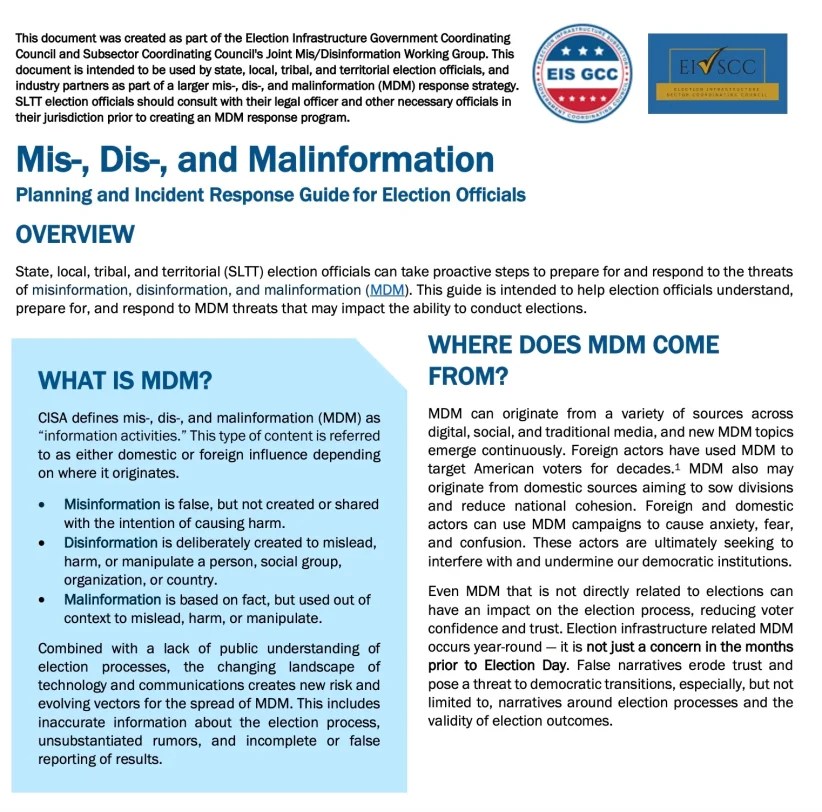
In it, CISA “defines” what each of its targets is supposed to be, and ends up doing what all “misinformation warriors” do – offer subjective and broad descriptions susceptible to interpretation, instead of clear definitions.
For example, “malinformation” is said to be information “based on fact, but used out of context to mislead, harm, or manipulate.”
The document mentions “delegitimization of election results” as one form of mis, dis, and mal information.
It’s unclear if CISA has both 2016 and 2020 elections in mind – or only one – but this is how the activity is described: “Narratives or content that delegitimizes election results or sows distrust in the integrity of the process based on false or misleading claims.”
The Closing of the Internet Mind
The definition of online freedom has been depressingly constricted over the last thirty years
By Aaron Kheriaty, Debbie Lerman, Andrew Lowenthal, and Jeffrey Tucker | The American Mind | May 22, 2024
You have surely heard that your search results on Google (with 92 percent share of the search market) reflect not your curiosities and needs but someone or something else’s views on what you need to know. That’s hardly a secret.
And on Facebook, you are likely inundated by links to official sources to correct any errors you might carry in your head, as well as links to corrections to posts as made by any number of fact-checking organizations.
You have likely also heard of YouTube videos being taken down, apps deleted from stores, and accounts being canceled across a variety of platforms.
You might have even adjusted your behavior in light of all of this. It is part of the new culture of Internet engagement. The line you cannot cross is invisible. You are like a dog with an electric shock collar. You have to figure it out on your own, which means exercising caution when you post, pulling back on hard claims that might shock, paying attention to media culture to discern what is sayable and what is not, and generally trying to avoid controversy as best you can in order to earn the privilege of not being canceled.
Despite all the revelations regarding the Censorship Industrial Complex, and the wide involvement of government in these efforts, plus the resulting lawsuits that claim that this is all censorship, the walls are clearly closing in further by the day.
Users are growing accustomed to it, for fear of losing their accounts. For example, YouTube (which feeds 55 percent of all video content online) allows three strikes before your account is deleted permanently. One strike is devastating and two existential. You are frozen in place and forced to relinquish everything–including your ability to earn a living if your content is monetized–if you make one or two wrong moves.
No one needs to censor you at that point. You censor yourself.
It was not always this way. It was not even supposed to be this way.
It’s possible to trace the dramatic change from the past to present by following the trajectory of various Declarations that have been issued over the years. The tone was set at the dawn of the World Wide Web in 1996 by digital guru, Grateful Dead lyricist, and Harvard University fellow John Perry Barlow, who died in 2018.
Barlow’s Declaration of the Independence of Cyberspace, somewhat ironically written in Davos, Switzerland, is still hosted by the Electronic Frontier Foundation that he founded. The manifesto waxes lyrical about the liberatory, open future of internet freedom:
Governments of the Industrial World, you weary giants of flesh and steel, I come from Cyberspace, the new home of Mind. On behalf of the future, I ask you of the past to leave us alone. You are not welcome among us. You have no sovereignty where we gather.
We have no elected government, nor are we likely to have one, so I address you with no greater authority than that with which liberty itself always speaks. I declare the global social space we are building to be naturally independent of the tyrannies you seek to impose on us. You have no moral right to rule us nor do you possess any methods of enforcement we have true reason to fear.
Governments derive their just powers from the consent of the governed. You have neither solicited nor received ours. We did not invite you. You do not know us, nor do you know our world. Cyberspace does not lie within your borders. Do not think that you can build it, as though it were a public construction project. You cannot. It is an act of nature and it grows itself through our collective actions.
And so on it went with a heady, expansive vision–tinged perhaps with a dash of sixties utopian anarchism–that shaped the ethos which drove the building of the Internet in the early days. It appeared to a whole generation of coders and content providers that a new world of freedom had been born that would shepherd in a new era of freedom more generally, with growing knowledge, human rights, creative freedom, and borderless connection of everyone to literature, facts, and truth emerging organically from a crowd-sourced process of engagement.
Nearly a decade and a half later, by 2012, that idea was fully embraced by the main architects of the emergent app economy and the explosion of smartphone use across the world. The result was the Declaration of Internet Freedom that went live in July of 2012 and garnered a great deal of press attention at the time. Signed by the EFF, Amnesty International, Reporters Without Borders, and other liberty-focused organizations, it read:
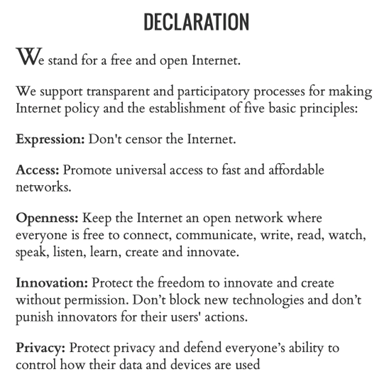
To be sure, it was not quite as sweeping and visionary as the Barlow original but maintained the essence, putting free expression as the first principle with the lapidary phrase: “Don’t censor the Internet.” It might have stopped there, but given the existing threats coming from growing industrial cartels and the stored-data marketplace, it also pushed openness, innovation, and privacy as first principles.
Again, this outlook defined an era and elicited broad agreement. “Information freedom supports the peace and security that provides a foundation for global progress,” said Hillary Clinton in an endorsement of the freedom principle in 2010. The 2012 Declaration was neither right-wing nor left-wing. It encapsulated the core of what it meant to favor freedom on the Internet, exactly as the title suggests.
If you go to the site internetdeclaration.org now, your browser will not reveal any of its contents. The secure certificate is dead. If you bypass the warning, you will find yourself forbidden from accessing any of the contents. The tour through Archive.org shows that the last living presentation of the site was February 2018.
This occurred three years after Donald Trump publicly advocated that “in some places” we have to talk about “closing up the Internet.” He got his wish, but it came after him personally following his election in 2016. The very free speech about which he made fun turned out to be rather important to him and his cause.
Two years into the Trump presidency, precisely as the censorship industry started coalescing into full operation, the site of the Declaration site broke down and eventually disappeared.
Fast forward a decade from the writing of the Internet Declaration of Freedom. The year is 2022 and we had been through a rough two years of account takedowns, particularly against those who doubted the wisdom of lockdowns or vaccine mandates. The White House revealed on April 22, 2022 a Declaration for the Future of the Internet. It comes complete with a parchment-style presentation and a large capital letter in old-fashioned script. The word “freedom” is removed from the title and added only as a part of the word salad that follows in the text.
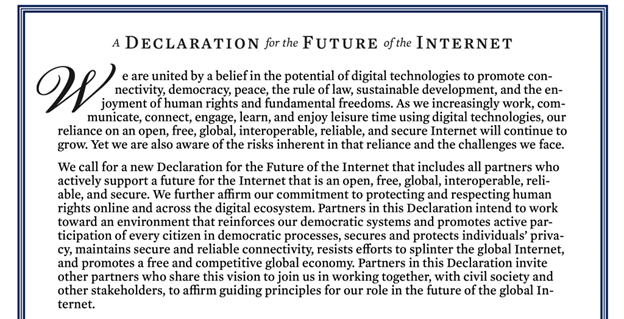
Signed by 60 nations, the new Declaration was released to great fanfare, including a White House press release. The signatory nations were all NATO-aligned while excluding others. The signatories are: Albania, Andorra, Argentina, Australia, Austria, Belgium, Bulgaria, Cabo Verde, Canada, Colombia, Costa Rica, Croatia, Cyprus, Czech Republic, Denmark, Dominican Republic, Estonia, the European Commission, Finland, France, Georgia, Germany, Greece, Hungary, Iceland, Ireland, Israel, Italy, Jamaica, Japan, Kenya, Kosovo, Latvia, Lithuania, Luxembourg, Maldives, Malta, Marshall Islands, Micronesia, Moldova, Montenegro, Netherlands, New Zealand, Niger, North Macedonia, Palau, Peru, Poland, Portugal, Romania, Serbia, Slovakia, Slovenia, Spain, Sweden, Taiwan, Trinidad and Tobago, the United Kingdom, Ukraine, and Uruguay.
The core of the new declaration is very clear and represents a good encapsulation of the essence of the structures that govern content today: “The Internet should operate as a single, decentralized network of networks – with global reach and governed through the multistakeholder approach, whereby governments and relevant authorities partner with academics, civil society, the private sector, technical community and others.”
The term “stakeholder” (as in “stakeholder capitalism”) became popular in the nineties as distinct from “shareholder” meaning a partial owner. A stakeholder is not an owner or even a consumer but a party or institution with a strong interest in the outcome of the decision-making by the owners, whose rights might need to be overridden in the broader interests of everyone. In this way, the term came to describe an amorphous group of influential third parties that deserve a say in the management of institutions and systems. A “multistakeholder” approach is how civil society is brought inside the tent, with financing and seeming influence, and told that they matter as an incentive to woke-wash their outlooks and operations.
Using that linguistic fulcrum, part of the goal of the new Declaration is explicitly political: “Refrain from using the Internet to undermine the electoral infrastructure, elections and political processes, including through covert information manipulation campaigns.” From this admonition we can conclude that the new Internet is structured to discourage “manipulation campaigns” and even goes so far as to “foster greater social and digital inclusion within society, bolster resilience to disinformation and misinformation, and increase participation in democratic processes.”
Following the latest in censorship language, every form of top-down blockage and suppression is now justified in the name of fostering inclusion (that is, “DEI,” as in Diversity [three mentions], Equity [two mentions], and Inclusion [five mentions]) and stopping dis- and mis-information, language identical to that invoked by the Cybersecurity Infrastructure Security Agency (CISA) and the rest of the industrial complex that operates to stop information spread.
This agency was created in the waning days of the Obama administration and approved by Congress in 2018, supposedly to protect our digital infrastructure against cyberattacks from computer viruses and nefarious foreign actors. But less than one year into its existence, CISA decided that our election infrastructure was part of our critical infrastructure (thereby asserting Federal control over elections, which are typically handled by the states). Furthermore, part of protecting our election infrastructure included protecting what CISA director Jen Easterly called our “cognitive infrastructure.”
Easterly, who formerly worked at Tailored Access Operations, a top secret cyber warfare unit at the National Security Agency, coined the queen of all Orwellian euphemisms: “cognitive infrastructure,” which refers to the thoughts inside your head. This is precisely what the government’s counter-disinformation apparatus, headed by people like Easterly, are attempting to control. True to this stated aim, CISA pivoted by 2020 to become the nerve center of the government’s censorship apparatus–the agency through which all government and “stakeholder” censorship demands are funneled to social media companies.
Now consider what we’ve learned about Wikipedia, which is owned by Wikimedia, the former CEO of which was Katherine Maher, now slated to be the head CEO of National Public Radio. She has been a consistent and public defender of censorship, even suggesting that the First Amendment is “the number one challenge.”
The co-founder of Wikipedia, Joseph Sanger, has said he suspects that she turned Wikipedia into an intelligence-operated platform. “We know that there is a lot of backchannel communication,” he said in an interview. “I think it has to be the case that the Wikimedia Foundation now, probably governments, probably the CIA, have accounts that they control, in which they actually exert their influence. And it’s fantastic, in a bad way, that she actually comes out against the system for being ‘free and open.’ When she says that she’s worked with government to shut down what they consider ‘misinformation,’ that, in itself, means that it’s no longer free and open.”
What happened to Wikipedia, which all search engines privilege among all results, has befallen nearly every prominent venue on the Internet. The Elon Musk takeover of Twitter has proven to be aberrant and highly costly in terms of advertising dollars, and hence elicits vast opposition from the venues that are on the other side. That his renamed platform X even exists at all seems to run contrary to every wish of the controlled and controlling establishment today.
We have traveled a very long way from the vision of John Perry Barlow in 1996, who imagined a cyberworld in which governments were not involved to one in which governments and their “multi stakeholder partners” are in charge of “a rules-based global digital economy.” In the course of this complete reversal, the Declaration of Internet Freedom became the Declaration for the Future of the Internet, with the word freedom consigned to little more than a passing reference.
The transition from one to the other was–like bankruptcy–gradual at first and then all at once. We’ve traveled rather quickly from “you [governments and corporate interests] are not welcome among us” to a “single, decentralized network of networks” managed by “governments and relevant authorities” including “academics, civil society, the private sector, technical community and others” to create a “rules-based digital economy.”
And that is the core of the Great Reset affecting the main tool by which today’s information channels have been colonized by the corporatist complex.
CISA Was Behind the Attempt to Control Your Thoughts, Speech, and Life
Brownstone Institute | June 30, 2023
Keeping up with the corruption of the Covid regime feels like drinking from a firehose. The volume of the fraud, the pace of new discoveries, and the breadth of the operations are overwhelming. This makes it imperative for groups like Brownstone Institute to digest the onslaught of information and communicate salient themes and dispositive facts, particularly given the dereliction of mainstream media.
On Monday, the House Judiciary Committee released a report on how the Cybersecurity and Infrastructure Security Agency (CISA) “colluded with Big Tech and ‘disinformation’ partners to censor Americans,” adding to the informational firehose we work to imbibe.
The 36-page report raises three familiar issues: first, government actors worked with third parties to overturn the First Amendment; second, censors prioritized political narratives over truthfulness; and third, an unaccountable bureaucracy hijacked American society.
- CISA’s Collusion to Overturn the First Amendment
The House Report reveals that CISA, a branch of the Department of Homeland Security, worked with social media platforms to censor posts it considered dis-, mis-, or malinformation. Brian Scully, the head of CISA’s censorship team, conceded that this process, known as “switchboarding,” would “trigger content moderation.”
Additionally, CISA funded the nonprofit EI-ISAC in 2020 to bolster its censorship operations. EI-ISAC worked to report and track “misinformation across all channels and platforms.” In launching the nonprofit, the government boasted that it “leverage[d] DHS CISA’s relationship with social media organizations to ensure priority treatment of misinformation reports.”
The switchboard programs directly contradict sworn testimony from CISA Director Jen Easterly. “We don’t censor anything… we don’t flag anything to social media organizations at all,” Esterly told Congress in March. “We don’t do any censorship.” Her statement was more than a lie; it omitted the institutionalization of the practice she denied. The agency’s initiatives relied on a collusive apparatus of private-public partnerships designed to suppress unapproved information.
This should sound familiar.
Alex Berenson gained access to thousands of Twitter communications that uncovered concrete evidence that government actors – including White House Covid Advisor Andy Slavitt – worked to censor him for criticizing Biden’s Covid policies.
White House Director of Digital Strategy Rob Flaherty privately lobbied social media groups to remove a video of Tucker Carlson reporting the link between Johnson & Johnson’s vaccine and blood clots.
Facebook worked with the CDC to censor posts related to the Covid “lab-leak” hypothesis. Company employees later met with the Department of Health and Human Services to de-platform the “disinformation dozen,” a group including Robert F. Kennedy, Jr.
These were not cherry-picked examples – they were part of an institutional collusion to strip Americans of their First Amendment rights. Journalists Michael Shellenberger and Matt Taibbi exposed the “Censorship Industrial Complex,” a collection of the world’s most powerful government agencies, NGOs, and private corporations that worked together to silence dissent.
The Supreme Court has held that it is “axiomatic” that the government cannot “induce, encourage, or promote private persons to accomplish what it is constitutionally forbidden to accomplish.” Yet, CISA has joined the disturbing tendency of public-private partnerships designed to impede Americans’ right to information and freedom of speech.
- Political Operatives
Second, these programs were not idealistic attempts to promote the truth; they were calculated programs designed to quash inconvenient but truthful narratives.
The report outlines how CISA censored “malinformation – truthful information that, according to the government, may carry the potential to mislead.” Journalist Lee Fang later wrote that the malinformation campaign “highlights not only the broad authority that the federal government has to shape the political content available to the public, but also the toolkit that it relies upon to limit scrutiny in the regulation of speech.”
In this system, uncensored information has a tacit government approval, amounting to a system of widespread propaganda.
“State and local election officials used the CISA-funded EI-ISAC in an effort to silence criticism and political dissent,” the report notes. “For example, in August 2022, a Loudon County, Virginia, government official reported a Tweet featuring an unedited video of a county official ‘because it was posted as part of a larger campaign to discredit the word of’ that official. The Loudon County official’s remark that the account she flagged ‘is connected to Parents Against Critical Race Theory’ reveals that her ‘misinformation report’ was nothing more than a politically motivated censorship attempt.”
The officials supporting the operation remained unrepentant in their aim to advance political agendas. Dr. Kate Starbird, a member of CISA’s “Misinformation & Disinformation” subcommittee, lamented that many Americans seem to “accept malinformation as ‘speech’ and within democratic norms.”
Of course, the program explicitly violated the Constitution. The First Amendment does not discriminate based on the veracity of a statement. “Some false statements are inevitable if there is to be an open and vigorous expression of views in public and private conversation,” the Supreme Court’s controlling opinion held in United States v. Alvarez. But CISA – led by zealots like Dr. Starbird – appointed themselves the arbiters of truth and worked with the most powerful information companies in the world to purge dissent.
This was part of a larger political campaign.
Hunter Biden’s laptop, natural immunity, the lab-leak theory, and side effects of the vaccine were all censored at the government’s behest. The truth of the reports were not at issue; instead, they presented inconvenient narratives for Washington’s political class, who then used the Orwellian label of “malinformation” to lend cover to eviscerating the First Amendment.
- The Terror of the Administrative State
Third, the report exposes the increasing power of the administrative state. Federal bureaucrats rely on anonymity and unaccountability. Private industry employees could never oversee a disaster like the Covid response and maintain their jobs. It’d be like if BP’s head of safety for the Gulf of Mexico received a promotion after the oil spill.
But unelected officilals like CISA officials enjoy ever-increasing power over Americans’ lives without having to answer for their calamities. Suzanne Spaulding, a member of the Misinformation & Disinformation Subcommittee, warned that it was “only a matter of time before someone realizes we exist and starts asking about our work.”
Spaulding’s comment reflects the power that CISA wields and the benefit it derives from its lack of public exposure. Most Americans have never heard of CISA despite its overwhelming influence over lockdowns.
In March 2020, CISA divided the American workforce into categories of “essential” and “nonessential.” Within hours, California became the first state to issue a “stay at home” edict. This began a previously unimaginable assault on Americans’ civil liberties.
The House Report indicates that CISA was a central actor in censoring criticism of the Covid regime in the ensuing months and years. The agency is representative of the cabal of censorial and unaccountable officials engaged in public-private partnerships designed to keep us in the dark.
Billionaire Biden Donor Bankrolled 2020 Election Social Media Censorship Effort
BY LEE FANG | JUNE 8, 2023
The Department of Homeland Security’s controversial social media censorship effort during the 2020 election was propped up by a partisan billionaire.
Newly obtained documents, acquired through a public records request, confirm that Pierre Omidyar, the billionaire founder of eBay, financed a specialized portal maintained by the Center for Internet Security (CIS). This portal was used to facilitate the swift removal of predominantly conservative messages on Twitter and Facebook during the previous presidential election.
Omidyar, previously identified as one of the largest donors to campaign groups supporting Joe Biden’s presidential bid, donated $45 million to the “Sixteen Thirty Fund” in 2020. This dark money group mobilized Democratic voters and financed pro-Biden Super PACs. However, Omidyar’s direct involvement in the DHS partnership, which is now facing increased scrutiny, remained undisclosed until now.
The funding provided by Omidyar to CIS was used to establish a Misinformation Reporting Portal (MiRP). A team from CIS continuously monitored this portal 24/7 from September 28 to November 6, 2020, as revealed in a post-election report, “Election Infrastructure Misinformation Reporting.” The Democracy Fund, Omidyar’s foundation, supported the creation of the MiRP through a direct grant, according to the report.
The misinformation reporting portal served to rapidly identify and remove instances of alleged misinformation. CIS’s report acknowledged that the flagged content ranged from “intentional misinformation to honest mistakes.” Of the content reported by CIS, 61% “resulted in positive action,” which the group defined as content takedowns or labeling.
This MiRP system was used by a coalition of liberal-leaning research groups and overseen by the Cybersecurity and Infrastructure Agency (CISA), a sub-agency of the DHS that has led the government’s push to censor social media. Despite government backing for the project, the effort was partisan – the Democratic National Committee was part of the consortium, but not the Republican National Committee, indicating a partisan bias.
“In addition to sharing all reports with CISA, some reports were shared with the Federal Bureau of Investigation,” the CIS report noted. The effort focused on “election narratives” deemed conspiratorial or inaccurate.
Tax records appear to confirm the Omidyar funding. The Democracy Fund’s 990 disclosure shows that it donated $130,000 to CIS in 2020. The grant, however, is listed as support for “election security best practices,” a vague description that belied the true function of the MiRP portal.
CIS did not respond to a request for comment. The Omidyar Network discussed this inquiry with me but stopped responding before publication.
Evidence of this MiRP system first emerged in emails I obtained from a visit to Twitter’s San Francisco headquarters in December. In an email thread dated October 1, 2020, Twitter attorney Stacia Cardille mentioned receiving outreach from DHS, forwarding a censorship demand from CISA, CIS official Aaron Wilson, and a representative from the Election Integrity Partnership, a coalition monitoring misinformation.
The alleged misinformation mentioned in the October 1 thread revolved around conservative warnings regarding potential risks associated with mail-in voting—a concern voiced by partisans from both sides. Twitter, however, took action against conservative accounts but did not similarly act against Democrats who warned against mail-in ballots, as I’ve previously reported. For instance, former D.N.C. chairman Howard Dean tweeted during the election: “Do not vote by mail. Ok to vote now early and drop your ballot off in person at the proper office. Too late to trust trumps postmaster thug.”
The Dean tweet was noted by Twitter’s content moderation team but no action was taken, while similar messages warning against mail-in voting from conservative accounts were censored.
The CIS report provides a comprehensive explanation of the public-private apparatus employed to influence content on social media. In doing so, the report also debunks recent myths. In April, MSNBC host Mehdi Hasan made a false claim that journalist Matt Taibbi deliberately misrepresented his case under oath during his congressional testimony on CISA’s role in shaping social media decisions. Hasan suggested that Taibbi had willfully conflated CISA with CIS during his testimony. This claim led Representative Stacey Plaskett (D-V.I) to accuse Taibbi of perjury in a letter.
The CIS report I obtained contradicts Hasan and Plaskett, clarifying that “CIS and CISA worked together to ensure the reports were sent to the social media platform within an hour of their receipt.” CIS also played a pivotal role in triaging the material while maintaining the government partnership with disinformation research think tanks.
In essence, CIS and CISA worked in close collaboration to exert pressure on platforms like Twitter, aiming to remove conservative political expression deemed untrustworthy. The project was a public-private venture, overseen by government agencies, and supported by a system financed entirely by a Democratic donor.
The report makes recommendations for future elections. It notes that misinformation reporting may require dedicated government funding, with a “transition to the operational side of CIS” under the CISA umbrella, as well as better operational support from social media platforms.
The CIS report is part of a batch of documents recently received from Kate Starbird, an advisory board member of CISA at the University of Washington, via a records request. As I reported on Tuesday, the Justice Department intervened last year to impede the release of records from Starbird’s team. Starbird has also accused journalists seeking these records of “harassment,” likening it to a cyber attack.
Nevertheless, these inquiries are part of a broader public examination of government-backed censorship. As previously reported, Starbird’s advisory panel advocated for an expanded role for CISA, calling for an extension of its monitoring to include various platforms such as social media, mainstream media, cable news, hyper-partisan media, talk radio, and other online resources.
To support their argument for such a broad mandate, CISA advisors highlighted the detrimental effects of alleged misinformation on key democratic institutions like the courts, as well as other sectors such as the financial system and public health measures, suggesting that virtually any major public interest concern may be used as justification for broad censorship.
DHS is sued for censorship records on meetings with Big Tech
By Didi Rankovic | Reclaim The Net | April 6, 2023
Judicial Watch has decided to sue the US Department of Homeland Security (DHS) after the federal agency failed to respond to a Freedom of Information Act (FOIA) request for records related to meetings with Big Tech representatives where censorship was allegedly discussed.
The lawsuit, filed in the US District Court for the District of Columbia, seeks to force the DHS to disclose documents detailing how its Cybersecurity and Information Security Agency (CISA) worked with companies behind social media platforms in order to censor speech.
We obtained a copy of the complaint for you here.
The initial FOIA request dates back to December of last year, and the advocacy group said that it wanted to gain access to records and communications of CISA Director Jen Easterly, a former CISA director, Christopher Krebs, former CISA Senior Cybersecurity Advisor Matt Masterson, and CISA Senior Cybersecurity Advisor Brian Scully.
These documents concern meetings that CISA either hosted or facilitated with Meta and Facebook, Twitter, Wikimedia Foundation, Pinterest, and Microsoft’s LinkedIn on the topic of “election security.”
Furthermore, Judicial Watch wanted information about several other meetings, including those with DHS Office of Intelligence and Analysis, FBI, US Secret Service, NSA, and the Office of the Director for National Intelligence employees, related to the previously mentioned meetings, and those with Election Infrastructure Subsector Government Coordinating Council.
The Judicial Watch press release refers to the Twitter Files where journalist Matt Taibbi on several occasions mentions CISA’s involvement in censorship activities, and cites these and the dates when the contacts or communication occurred.
The group also refers to Twitter Files revelations regarding the FBI’s role in censorship decisions, notably the pressure it exerted on the site to act in this way, and Taibbi’s testimony before Congress about the collusion between the Biden administration – including the Democratic National Committee and federal, state, and local law enforcement – and Big Tech, with the goal of suppressing legitimate information.
Judicial Watch President Tom Fitton described all this, and more that is mentioned in the statement, as “an unholy conspiracy in the Biden administration to censor Americans in collusion with Big Tech.”
As for the lawsuit, Fitton said it “shows the censorship abuse is furthered by unlawful secrecy and cover-ups.”
U.S. Government Has Been Planning to ‘Lockdown and Wait for a Vaccine’ Since 2007
BY WILL JONES | THE DAILY SCEPTIC | DECEMBER 13, 2022
More and more evidence is coming to light that the ‘lockdown and wait for a vaccine’ strategy unleashed in 2020 was being cooked up inside the U.S. Government for decades before COVID-19 appeared and gave too many people an excuse to put the dreadful plan into action.
Recently the role of CISA (Cybersecurity and Infrastructure Security Agency) in producing key lockdown guidance for America in March 2020 came to light.
Now, a pandemic plan from 2007 produced by the National Infrastructure Advisory Council (NIAC) and currently hosted on the CISA website has emerged.
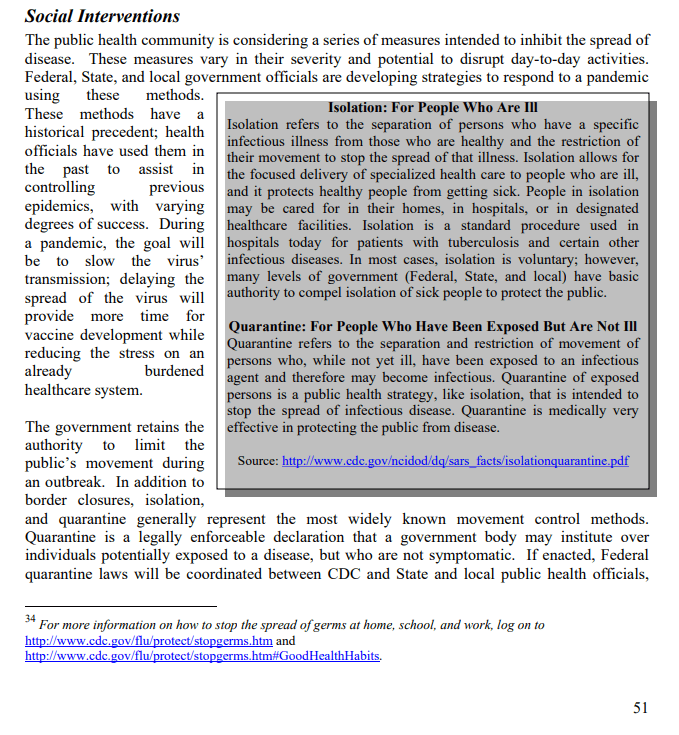
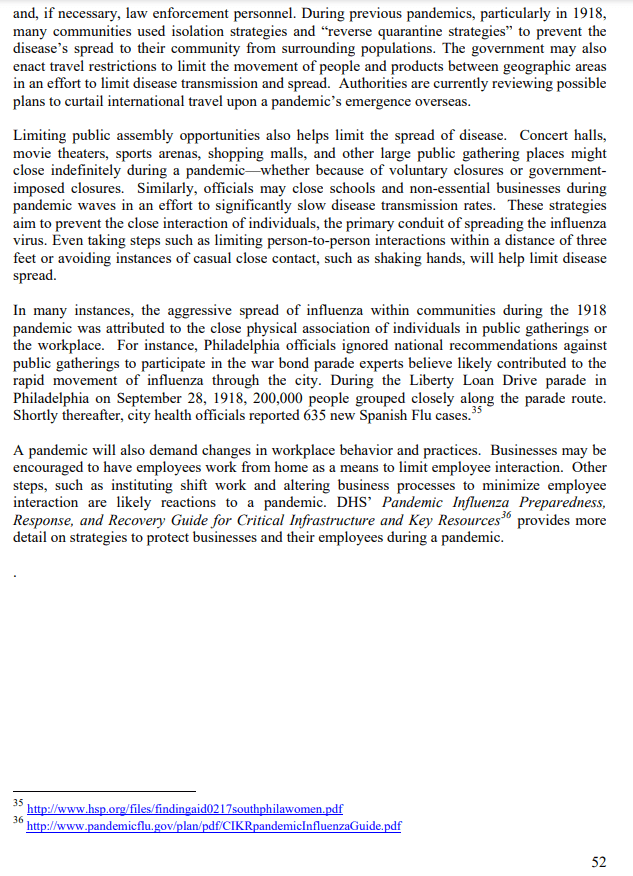
The plan contains the original list of pandemic ‘essential businesses’ that was used by CISA in 2020 to lock down America. The 2007 plan (which was itself based on a Department of Homeland Security plan from the previous year) clearly states the intention to ban large gatherings “indefinitely”, close schools and non-essential businesses, institute work-from-home, and quarantine exposed and not just sick individuals. The aim is simple and clear: to slow the spread to wait for a vaccine.
During a pandemic, the goal will be to slow the virus’ transmission; delaying the spread of the virus will provide more time for vaccine development while reducing the stress on an already burdened healthcare system.
Here’s the relevant section of the 2007 NIAC plan in full.
2006 and 2007 were a turning point in U.S. biodefence planning. Prior to 2006, such planning had been focused on biological attacks, but after that point major mission creep set in and the new draconian ideas were applied wholesale to general pandemic planning. This controversial switch in focus so riled leading U.S. disease expert D.A. Henderson, who had been involved with the project up to that point, that he issued his famous riposte objecting in the strongest terms to the new ideas. He and his fellow dissenters wrote, presciently:
Experience has shown that communities faced with epidemics or other adverse events respond best and with the least anxiety when the normal social functioning of the community is least disrupted. Strong political and public health leadership to provide reassurance and to ensure that needed medical care services are provided are critical elements. If either is seen to be less than optimal, a manageable epidemic could move toward catastrophe.
I’m told by someone who was involved with the programme in the early days that the original biodefence planning in 2002-2003 assumed a targeted biological weapons attack with smallpox as the viral case and anthrax as the bacterial case – both considered worst case scenarios. It was recognised that the old smallpox vaccine was too risky to try to use on a wider population to protect them if such an attack occurred, thus the effort for a new vaccine. But very quickly, within a year or two (not least due to the SARS outbreak in 2003), there was a massive expansion of the original mission and suddenly every infectious agent, whether dangerous or not, was cast into the web of biodefence.
Outside the U.S. there was more resistance to this kind of totalitarian nonsense. However, even the 2019 World Health Organisation pandemic guidance bears many of its marks. While this guidance commendably did not recommend “in any circumstances” contact tracing, border closures, entry and exit screening and quarantine of exposed individuals, it did make conditional recommendations for use of face masks by the public, school and workplace closures and “avoiding crowding” i.e., social distancing.
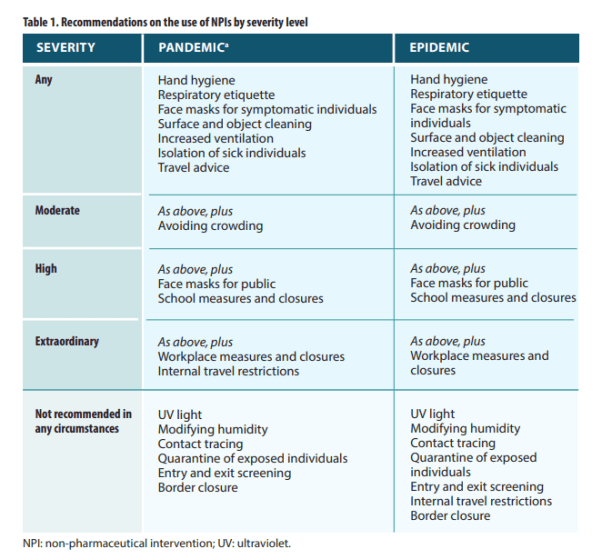
The purpose was also the same: to ‘flatten the curve’ to wait for a vaccine, as illustrated in the diagram below. The WHO guidance states: “NPIs are often the most accessible interventions, because of the time it takes to make specific vaccines available”; “specific vaccines may not be available for the first six months”; NPIs are “used to delay the peak of the epidemic… allowing time for vaccines to be distributed”.
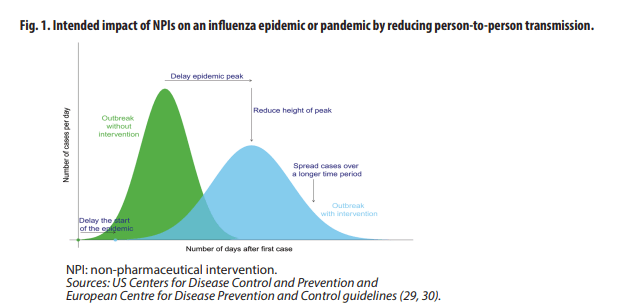
These untested ideas, which the WHO’s own guidance rightly admitted had no good quality evidence to support them, have now become a terrible orthodoxy for global pandemic response. This is despite them utterly failing to achieve any of their goals – a point that no one who backs them seems to have noticed.
Somehow, the world must learn the right lessons from this debacle. Yet it keeps threatening to learn all the wrong ones.
Did Federal Censors Swing the 2020 Election?

By Jim Bovard | The Libertarian Institute | November 14, 2022
Did the Russiagate conspiracy entitle the federal government to censor Americans forever? Did federal shenanigans swing the 2020 election? A new report reveals how a new federal agency and federal grantees exploited a 2016 scam to launch the greatest covert censorship campaign in U.S. history.
In 2016, top FBI officials and the Obama administration fueled a conspiracy that the Trump presidential campaign was colluding with the Russian government. Numerous false FBI claims spurred a massive wiretapping operation approved by the Foreign Intelligence Surveillance Court. The allegations led to the appointment of Special Counsel Robert Mueller, who spent two years investigating before admitting that there was nothing to prosecute for his primary charge. But by that point, Trump had been irredeemably tainted and the Democrats had exploited the controversy to capture control of the U.S. House of Representatives in 2018.
Thanks to Russiagate, Congress created a new federal agency in 2018—the Cybersecurity Infrastructure Security Agency (CISA) in the Department of Homeland Security (DHS). CISA was purportedly intended to fight foreign threats to election security and U.S. infrastructure. But the agency quickly shifted its target to American citizens. As a report last week from the Foundation for Freedom Online (FFO) revealed, “Any U.S. citizen posting what DHS considered misinformation’ online was suddenly conducting a cyber attack against US critical infrastructure.”
CISA and DHS realized that they could not directly muzzle Americans so they colluded with a number of federal grantees who comprised the Election Integrity Project, a coalition formed in mid-2020. The result was “censorship by proxy,” as law professor Jonathan Turley observed, bludgeoning social media companies into submission. The DHS-spurred crackdown in 2020 resulted in the suppression of “22 million tweets labeled ‘misinformation’ on Twitter” and “hundreds of millions of individual Facebook posts, YouTube videos, TikToks, and tweets impacted” thanks to changes that would not have occurred without “‘huge regulatory pressure’ from government,” FFO reported.
Once the government claims a prerogative to censor “misinformation,” the definition of misinformation mushrooms to serve political purposes. The Election Integrity Partnership bragged about how social media posts were targeted that were merely purportedly guilty of offenses such as “exaggerate issue,” “misleading stats” and “out of context.” Many of those alleged factual infractions were piddling compared to the sweeping falsehoods continually uncorked by presidential candidates Trump and Biden.
Prior to the 2020 election, “the censorship focus was always and consistently foremost targeted at speech casting doubt on mail-in ballots,” FFO reported. Democrats exploited the COVID-19 pandemic to push through electoral changes that opened the floodgates to unverified mail-in ballots. Some states like Michigan sent absentee ballots to all voters, violating the Election Clause of the Constitution (which specifies that state legislatures make the rules for federal elections).
Election regimes that scrutinized mail-in ballots routinely had a high rejection rate. New York City relied on mail-in ballots for a June 2020 primary that the New York Daily News derided as a “dumpster fire.” Up to 20% of ballots “were declared invalid before even being opened, based on mistakes with their exterior envelopes,” The Washington Post noted, thanks largely to missing postmarks or signatures. Trump claimed that the shift to mail-in ballots could result in “the most corrupt vote in our nation’s history.”
But federal string-pulling minimized controversies. FFO noted, “Pre-censoring U.S. citizen debate about mail-in ballots five months before an election has the impact of devastating the ability of concerned citizens to pressure their state representatives to take legal action on changing voting procedures.” Rather than the traditional scrutiny for mail-in ballots, many locales defaulted to accepting practically any piece of paper with a mark. Mail-in ballots determined the outcome of the 2020 election. Trump received more votes on Election Day but 43,000 mail-in ballots in three states sealed Biden’s victory—a minuscule portion of the tens of millions of mail-in votes he received.
In a July 28, 2020 article for the American Institute for Economic Research, I warned that the controversies over mail-in ballots could lead to “the death of political legitimacy…Deep State federal agencies are a Godzilla that have established their prerogative to undermine if not overturn election results.”
Until I read the new FFO report, I did not realize that “the biggest category for [2020] censorship was ‘delegitimization’… defined to mean any speech that ‘casts doubt’ on any kind of election process, outcome or integrity issues [which] made all conservative and populist criticism of the administration of the election pre-banned at the narrative level, five months in advance of Election Day.” Damn, no wonder that article of mine got so little traction on Twitter and Facebook! “Delegitimization” resulted in “72% of its censorship tickets and targeted over 99% of the posts throttled by narrative during the 2020 election.”
The entire process looks like a Monty Python parody of democracy. As Mike Benz, the former State Department official who heads FFO, observed, “The same obscure DHS subagency tasked with election security also gained the power to censor any questions about election security.”
How much impact did federal censorship and suppression have on the most recent elections? The Election Integrity Project browbeat tech companies to accept “that social media posts about the 2022 elections be censorable under a low bar of simply ‘misleading,’” according to FFO. For the midterm elections, “the Election Integrity Project is tightly monitoring and working to censor ‘discussions surrounding the delays in counting ballots’ being ‘framed as fraud,’” FFO reported. Damned convenient considering the debacle in Arizona—which was foreseen if not foreordained. In a Washington speech just before the election, President Biden told listeners that “in some cases we won’t know the winner…until a few days after the election. It takes time to count all legitimate ballots in a legal and orderly manner.” Biden stressed that citizens must be “patient. That’s how this is supposed to work.”
But it never consistently worked that way before in American history. Arizona’s voting machines dismally failed on Election Day and Democrats are vehemently resisting a hand recount of all ballots.
The real goal is to control Americans’ minds—and not just on Election Day. Jen Easterly, the NSA honcho who Biden chose to run CISA, declared that “the most critical infrastructure is our cognitive infrastructure, so building that resilience to misinformation and disinformation… is incredibly important.” And the most important cognitive “fix” is to train Americans to never doubt Uncle Sam. In a March 2022 meeting with top Twitter executives, FBI official Laura Dehmlow “warned that the threat of subversive information on social media could undermine support for the U.S. government,” The Intercept recently reported. The FBI has 80 agents on a task force to curb “subversive data utilized to drive a wedge between the populace and the government.”
“Disinformation” is often simply the lag time between the pronouncement and the debunking of government falsehoods. If the feds can censor most if not almost all of their online critics, their cons become almost irrefutable. Perhaps that is the only way that many federal policies can retain any shard of legitimacy. As Mike Benz warns, “DHS is carrying out an official state policy that if public trust is not earned, it must be installed.” That is a recipe for the death of democracy.
Jim Bovard is the author of Public Policy Hooligan (2012), Attention Deficit Democracy (2006), Lost Rights: The Destruction of American Liberty (1994), and 7 other books. He is a member of the USA Today Board of Contributors and has also written for the New York Times, Wall Street Journal, Playboy, Washington Post, and other publications. His articles have been publicly denounced by the chief of the FBI, the Postmaster General, the Secretary of HUD, and the heads of the DEA, FEMA, and EEOC and numerous federal agencies.
Fauci forced to testify on social media censorship
Samizdat | October 22, 2022
The White House’s chief medical advisor, Anthony Fauci, and other senior officials are set to be deposed under oath as part of a lawsuit claiming the government worked alongside social media platforms to create a “massive censorship enterprise” throughout the Covid-19 outbreak.
In a Friday ruling, Judge Terry Doughty granted a joint request from the attorneys general of Missouri and Louisiana to compel several current and former officials to testify in the suit, among them Fauci, ex-White House press secretary Jen Psaki, Director of White House Digital Strategy Rob Flaherty, Surgeon General Vivek Murthy and two high-level figures from the FBI and Department of Homeland Security (DHS).
“After finding documentation of a collusive relationship between the [Joe] Biden administration and social media companies to censor free speech, we immediately filed a motion to get these officials under oath,” Missouri AG Eric Schmitt said in a statement. “It is high time we shine a light on this censorship enterprise and force these officials to come clean to the American people, and this ruling will allow us to do just that. We’ll keep pressing for the truth.”
While the defense insisted that senior officials can only be called to testify about their actions in office under “extraordinary circumstances,” Judge Doughty said the personnel in question met that standard. He added that the two GOP-led states “have proven that Dr. Fauci has personal knowledge about the issue concerning censorship across social media as it related to Covid-19,” ordering him to cooperate with a deposition.
Requests to depose the other officials were granted on similar grounds, as the judge concluded all either held direct meetings with social media firms about the purported censorship, or had close knowledge of those discussions.
Jen Easterly, who heads up the DHS’s Cybersecurity and Infrastructure Security Agency (CISA) was also ordered to testify. She played a “central role” in “flagging misinformation to social-media companies for censorship,” the plaintiffs argued, describing the cyber agency the “nerve center” of “the federal government’s efforts to censor social media users.” The same official was said to be involved in the DHS’ now-defunct ‘Disinformation Governance Board’ – dubbed the ‘Ministry of Truth’ by critics – which would have created a new mechanism to facilitate cooperation between the White House and social media sites.
Initially filed last May by Schmitt and Louisiana Attorney General Jeff Landry, the lawsuit claims the federal government encouraged online platforms to censor, delete or ban certain speech about the pandemic, including discussion of the “lab leak theory of Covid-19’s origin,” as well as questions about the effectiveness of face masks, vaccines or lockdown policies, among other issues. The two AGs have largely relied on documents obtained through subpoenas of YouTube, Twitter and Facebook’s parent firm Meta, which detail regular communications between the government and social media sites.
The White House, as well as the eight officials ordered to testify, have yet to comment on Friday’s ruling. The depositions must take place within 30 days of the order, though it remains unclear whether the defense intends to appeal the decision.
FBI and CISA tell people to flag “misinformation” to social media platforms
By Cindy Harper | Reclaim The Net | October 8, 2022
The FBI and Cybersecurity and Infrastructure Security Agency (CISA) have put out a warning about foreign actors pushing 2022 midterm election “misinformation,” encouraging people to flag “disinformation” to social media platforms.
“If appropriate, make use of in-platform tools offered by social media companies for reporting elections related disinformation,” the report, released by CISA reads.
We obtained a copy of the report for you here.
The FBI has warned about election-related disinformation being promoted by operatives for the Chinese and Russian governments ahead of the midterm elections in November.
The disinformation involves amplifying conversations that Americans are already having on social media, not creating new content, an official from the FBI’s Foreign Influence Task Force told the press.
The FBI is currently being sued for withholding records of communications with Facebook about the Hunter Biden laptop story during the last presidential election.
In an appearance on Joe Rogan’s podcast in August, Meta CEO Mark Zuckerberg said that before the 2020 election, the FBI warned Facebook about Russian propaganda.
“The background here is that the FBI came to us – some folks on our team – and was like, ‘Hey, just so you know, you should be on high alert. We thought there was a lot of Russian propaganda in the 2016 election, we have it on notice that basically there’s about to be some kind of dump that’s similar to that,’” he said.
The FBI did not explicitly mention the laptop story but Facebook thought the story fit the pattern that the federal agency described and decided to limit the reach of the story.
The Russian influence operations are, according to the report, more substantial compared to China. However, China has been accused of “Russian-style influence activities” by leveraging the political divisions in the US. The FBI official noted that Facebook recently deleted accounts allegedly created by Chinese operatives that shared memes mocking Senator Marco Rubio (R-FL) and President Joe Biden.
An official from the FBI’s Cyber Division said no hacking campaigns are targeting the midterms. However, the bureau is “concerned that malicious actors could seek to spread or amplify false or exaggerated claims of compromises to election infrastructure. The official added that “It’s important for all Americans to understand that claims of cyber compromises will not prevent them from being able to vote.”
Featured Video

Yemen joins the war – Red Sea could be blocked next – Saudi regime at risk
or go to
Aletho News Archives – Video-Images
From the Archives
Should Europeans ‘Thank’ the Americans for Destroying Nord Stream?
By Robert Bridge | Strategic Culture Foundation | September 29, 2022
With an investigation continuing into the destruction of the Nord Stream gas pipeline that provided energy supplies to Europe from Russia, there appears to be just one prime suspect, and that should surprise nobody.
Following the sabotage of the Nord Stream 1 and 2 gas pipelines, former Polish Foreign Minister Radoslaw Sikorski already seemed to know the identity of the perpetrator when he tweeted out: “Thank you, USA.”
At first glance, it seemed that Sikorski was speaking sarcastically, berating Washington for carrying out an attack that will have severe repercussions for the people of Europe. After all, how could anyone see any good coming from the termination of Europe’s primary source of gas reserves with winter just around the corner? It was Sikorski’s homeland of Poland, after all, that urged its citizens to collect firewood in the face of dwindling gas reserves.
In fact, the Polish diplomat was speaking one-hundred percent literally… continue
Blog Roll
 Aletho News
- Bring The Troops Back. End This War Now!
- Can we please stop calling Israel the ‘only democracy in the Middle East’ now?
- US should start removing its troops for Germany, proposes AfD co-leader Chrupalla
- Iran Red Crescent: 600 educational centers attacked in US-Israeli ‘war crimes’
- Russian Oil Tanker Arrives in Cuba Amid U.S. Blockade
- America Racing to Strategic Defeat in Iran: Lt Col Daniel Davis
- FTC Warns Visa, Mastercard, PayPal, Stripe Over Political Debanking
- Russian tanker approaches Cuba despite US oil blockade
- Marandi: Yemen joins the war – Red Sea could be blocked next – Saudi regime at risk
- Pro-Palestinian French member of European Parliament denied entry to Canada
- If Americans Knew
- Israeli police block Catholic cardinal from entering Church of the Holy Sepulchre on Palm Sunday
- Israel is assassinating journalists again, more than any other nation, anywhere, ever – Not a ceasefire Day 170
- Over 300 US service members wounded, majority have brain injuries – Not a ceasefire Day 169
- Researchers at Human Rights Watch Resign Over Blocked Report on Palestinian Refugee Return
- Jewish Groups Are Backing a War Americans Don’t Want
- Eric Fingerhut Thinks He’s the President of the Jews
- Top Jewish Philanthropists, Rabbis Urge Israeli President to Take Action Against ‘Jewish Extremists’
- Don’t Be Fooled. Zionist Leaders Have Always Wanted to Control Southern Lebanon
- Israel’s widespread use of torture is a core element of its genocide against the Palestinian people
- In Israel’s War on Iran, Many Middle East US Bases Rendered “All But Uninhabitable”
- No Tricks Zone
- New Study Finds Warming Saves Lives…Cold Temperatures 12 Times More Deadly Than Excess Heat
- German Science Blog Accuses PIK Climate Institute Of Hallucinating Climate Tipping Points
- Devastating Assessment Of Comirnaty Vaccine By Former Senior Pfizer Europe Toxicologist
- New Study: CO2 Is ‘Effectively Negligible’ As An Explanatory Climate Change Factor Since 2000
- Former Pfizer Toxicologist Dr. Helmut Sterz Tells Bundestag Hearing Pfizer Vaccine Should Have Never Been Approved
- Energy Expert: Germany’s Nuclear Phaseout Was A “500 Billion Euro Mistake”
- New Research: South Australia’s Mid-Holocene Sea Surface Temperatures Were 4°C Warmer Than Today
- Storing Green Energy To Last Germany 10 Days Would Require A 60-Million Tonne Battery
- New Studies: UK Sea Levels Were 4 Meters Higher Than Today During The Mid-Holocene
- Destructive Green New Deal: German Energy And Metal Group Warns Of Drastic Crisis
 Aletho News