State propaganda on NPR’s “Morning Edition”
By Justin Doolittle | Crimethink | June 12, 2013
On Wednesday’s episode of “Morning Edition” on NPR, a segment was devoted to exploring the extreme violence that has engulfed Honduras in recent years. Indeed, if measured by per capita murder rate, Honduras is now the most dangerous in the country in the world. There are many reasons why Honduran civil society has broken down like this, but let’s suspend that discussion for the moment in order to focus on one particular aspect of this story on NPR that was quite revealing.
At one point in the segment, Carrie Kahn, the NPR correspondent reporting from Honduras, said the following:
Last year, the U.S. Congress held up funding to Honduras over concerns of alleged human rights abuses and corruption, particularly in the Honduran police force. Part of the funds are still on hold.
This is an astonishing statement for someone who purports to be a journalist. Unless Ms. Kahn has psychic powers, she cannot know why the U.S. Congress held up funding to Honduras. She can only know why Congress said it was holding up funding to Honduras. There is often a profound difference between why politicians say they are implementing policy X and why they are actually doing it. As you might have heard, politicians are occasionally dishonest and insincere, and their decisions are informed by a number of factors that have nothing to do with their personal beliefs. For a journalist, someone who is supposed to adversarially cover politicians and express skepticism at everything they say, this kind of blind faith is inexcusable.
The problem, though, is that Ms. Kahn’s statement is actually quite a bit worse than that. Even if she had said, “the U.S. Congress held up funding to Honduras over what it claimed were concerns of alleged human rights abuses and corruption,” instead of just mindlessly repeating what the government claimed, that would still be wildly insufficient for any journalist who takes her profession even the slightest bit seriously. Why? Because the United States government provably does not base its decisions on allocating foreign aid on “concerns about human rights and corruption.” For decades, the U.S. has provided aid to some of the most repressive and corrupt governments on Earth. Going down the list would be trivial, but, for the sake of comparison, let’s stay relatively close by and just look at Colombia. The U.S. government ships hundreds of millions of dollars to the Colombian government every year; in FY 2012, $443 million was provided, making Colombia the leading recipient of U.S. aid in the hemisphere.
In a strange twist, though, Colombia is also widely considered to be the most repressive violator of human rights in the hemisphere, and corruption there is rampant. This is quite a conundrum. Ms. Kahn tells us that the U.S. withheld aid from Honduras “over concerns of alleged human rights abuses and corruption.” But the U.S. evidently has no such “concerns” in Colombia and continues to send hundreds of millions of dollars in annual aid. One is almost tempted to conclude that the U.S. government makes these decisions based not on noble and selfless “concerns” about human rights and corruption, but, rather, on what it perceives to be U.S. interests.
Ms. Kahn must know that the government claim she dutifully parroted is transparently fraudulent and, in fact, downright comical. She cannot be a working journalist and not know this. Presumably, she follows the news, she is knowledgeable regarding basic facts about U.S. aid, and she knows that the U.S. has always cheerfully sent aid to brutal regimes around the world. She’s not a wide-eyed poly-sci 101 student who is shocked to find out that U.S. government decisions are not invariably and solely based on considerations of Good and Evil. Ms. Kahn is a highly educated reporter, and she obviously does know these things, but the culture of obedience and submissiveness in American journalism is so profound that she probably doesn’t even consciously realize that she’s serving state power instead of doing journalism. The U.S. government told her that aid is being withheld to Honduras because of concerns about human rights and corruption, therefore aid is being withheld to Honduras because of concerns about human rights and corruption. That’s that. Then she goes on NPR, unquestioningly repeats government claims, and she’s done her job. We would call this “propaganda” if it happened in the Soviet Union, but it’s called “journalism” when it happens here.
Venezuela arrests Colombian paramilitaries plotting instability
Xinhua | June 10, 2013
CARACAS — Venezuelan authorities have detained two groups of Colombian paramilitary members allegedly plotting against Venezuela’s government, Venezuela’s Minister of the Interior, Justice and Peace Miguel Rodriguez Torres said Monday.
“These two groups that were captured in our territory belong to two well-known Colombian paramilitary gangs. In fact, one of the groups belongs to ‘El Chepe Barrera’s’ gang, one of the most wanted criminals in Colombia,” Rodriguez said at a press conference in Caracas.
The first group, which included six people, was captured in Venezuela’s southwest Tachira state, along the border with Colombia, and their arms were confiscated.
The second three-member group of paramilitaries, who also carried arms, were captured in Guanare in western Portugesa state.
They were also carrying a black box, such as the ones used to record flight information and aeronautical data, and a box with aviation tools, “which are being analyzed by experts to determine what type of airplane we’re talking about,” said Rodriguez.
After questioning, it became clear both groups were linked and headed to Caracas, Rodriguez said.
“They planned to travel to the capital of the country to accomplish a mission that would be assigned them once they were in Caracas,” said Rodriguez.
Rodriguez said the detained revealed the existence of a third armed group, “with weapons for sharpshooters” and other long-range arms, which may already be in Caracas as part of a plot to destabilize the country.
“All of this may be part of a plan that is being orchestrated from Colombia against the life of our president (Nicolas Maduro) and against the stability of the Bolivarian government,” Rodriguez said.
Venezuelan opposition groups may be involved in the plots, said the minister, adding the country’s intelligence units are on alert to capture the third paramilitary group.
Following the announcement, Maduro congratulated the Bolivarian Intelligence Service (Sebin) via Twitter and blamed the opposition for the presence in Venezuela of the paramilitary groups.
“I congratulate Sebin for its work in defense of the peace; these violent groups are the armed wing that carries out the plan of the fascist right,” said Maduro, adding that neighboring Colombia is being used to conspire against Venezuela.
Related article
NATO Intends to Explode Latin American Unity, Leaders Warn
Prensa Latina | June 3, 2013
Managua – The supposed initiative to incorporate Colombia in a military group like the North Atlantic Treaty Organization (NATO) is an attack on Latin American and Caribbean unity, the governments of Nicaragua and Venezuela denounced today.
The statements by Presidents Daniel Ortega and Nicolas Maduro occurred on Sunday night during a massive event at Revolution Square in the capital, marking the visit of the South American leader.
“When the region seeks more unity through the Community of Latin American and Caribbean States (CELAC), it is worrying that initiatives are presented to try to divide and weaken the process”, noted Ortega.
“It is inadmissible and I want to believe that this is not actually happening, I find it hard to believe that President Juan Manuel Santos expressed his decision to join NATO,” highlighted the leader.
“Strength does not lie in filling our countries with foreign military bases, or joining organizations whose focus is bombing, murdering and destroying; that is NATO’s tradition and it has a “keep-on-doing-it” policy, noted the president.
“CELAC has commitments and if anyone breaks them, there will always be other leaders that rectify mistakes and strengthen unity of our peoples”, underlined Ortega.
Maduro warned that Colombia’s attempt contradicts the doctrine and the international law on which regional unity is based. “They want to put dynamite in the heart of the achievements of the unity of Latin America, the Caribbean and South America”, the leader pointed out.
Bolivia Calls UNASUR Summit to Discuss Colombia’s Inclusion in NATO
Prensa Latina | June 3, 2013
La Paz – The president of Bolivia, Evo Morales, described Colombia”s decision to join NATO as a threat to the region and called an extraordinary meeting of the Security Council of UNASUR.
During a ceremony in the southern city of Potosi, he considered that the decision of President Juan Manuel Santos to join the North Atlantic Treaty Organization (NATO) is a violation of the peace treaties signed by the Union of South American Nations (UNASUR) and involves a dangerous possibility of military intervention to the nations of Latin America and the Caribbean.
“We can not allow NATO to intervene Latin America. Having NATO is a threat to our continent, to Latin America and the Caribbean,” he said.
The president asked the General Secretariat of UNASUR to complete the formalities for the Security Council to convene an emergency meeting to take a joint position of rejecting the Atlantic Pact arrival to the region through Colombia.
He believed that the presence of that organization of military powers seeks to destabilize and undermine leftist governments in Latin America, primarily Venezuela, Ecuador, Nicaragua and Bolivia itself.
Colombia: Piedad Córdoba Ratifies Intention to Run for President
Prensa Latina | June 1, 2013
 La Paz – While visiting this capital, Colombian ex senator Piedad Córdoba expressed her intention to run for president in the next elections in her country, according to press reports.
Cordoba visited the cities of Sucre and La Paz to film the next chapters of the program “Causa Justa” (Just Cause) to be broadcast by Telesur television network, and took the opportunity to ratify her position to become the first woman to be at the helm of Colombia.
According to the newspaper Cambio, Córdoba also extolled the transformations undergone by the Bolivian capital in the past few years: “you can really see progress in Bolivia, the big changes and improvements in La Paz!”, she said.
Cordoba, 58, has worked systematically for the rights of women, ethnic minorities and human rights in her country, besides being involved, in 2007, in efforts to reach an agreement between the Revolutionary Armed Forces of Colombia-People’s Army (FARC-EP) guerrillas and the then government of President Alvaro Uribe.
Since 2011, in the wake of her dismissal as senator by the Attorney General’s Office of Colombia, she started to work with Telesur in the Causa Justa program, which highlights conflicts hitting the region, as told by political, social and cultural figures, notes Cambio newspaper.
She is in Bolivia “for a second season of the program in order to film a documentary on discrimination, bilingual education and the indigenous presence of President Evo Morales,” added the source.
Related articles
- Colombia: FARC and Government Reach Agreement on Land Reform
- Colombia: extrajudicial executions killing still ongoing according to report
- Latest FARC Proposal for Peace Process in Colombia
- Colombia: President Santos Announces ‘Profound Changes’
- Colombia: Drummond Contractor Convicted in Unionists’ Deaths
- Imperialism and Violence in Colombia
Colombia: FARC and Government Reach Agreement on Land Reform

Revolutionary Armed Forces of Colombia (FARC), resting in the countryside. (Photo: Phoenix Diaz)
By Avery Kelly | The Argentina Independent | May 27, 2013
Representatives from the Revolutionary Armed Forces of Colombia (FARC) and the Colombian government announced yesterday that they have signed a keynote agreement on land reform.
The accord is a big step forward for the on-going peace negotiations in Havana, Cuba between the rebel group and the government of President Juan Manuel Santos, as land reform is the first of six main issues on the agenda for discussion.
The agreement comes after nearly six months of talks on the subject.
A press release ratified by both parties stated that the accord facilitates the “start of radical transformations of the rural and agrarian reality of Colombia with fairness and democracy”.
President Santos applauded yesterday’s accord, commenting on Twitter that the land reform measure is a breakthrough for the peace talks and a “fundamental step in Havana towards a full agreement that will put an end to half a century of conflict”.
Iván Márquez, chief negotiator of the FARC, explained: “This historical recognition is felt by the rural and impoverished communities and is a flag in the wind in our hands … at the negotiation table.”
However, Márquez added that some of the points of the accord must be discussed again before negotiations end. He commented, “nothing is agreed upon until everything has been agreed upon”, referring to discussions still to come on other polemic topics in the peace talks expected to finish by August.
Land reform has been a fundamental issue for both the government and the FARC even before the peace talks began. Land disputes were one of the primary issues that the Marxist-leaning rebel group took on as early as 1964.
Now that the land reform issue has been decided, government and FARC negotiators will move discussions to the political participation of the rebel forces, the fight against drug trafficking, and an end to the conflict more generally with respect to victim compensation.
Colombia: extrajudicial executions killing still ongoing according to report
By George Nelson | The Argentina Independent | May 24, 2013
The Centre for Popular Research and Education (Cinep) in Bogotá has reported that during 2012 there were 11 separate cases of extrajudicial executions in Colombia, suggesting that executions known as ‘false positives’ are still ongoing. A further eight cases of arbitrary detention have also been reported, amassing a total of 52 victims.
The false positives scandal refers to the Colombian military’s alleged sanctioned practice of killing civilians and then dressing them up in guerrilla fatigues in order to present them as combat kills. Reports show that the executions usually target farmers, social activists, and political opponents.
The scandal is part of continuous armed conflict between Colombia’s government and the FARC and ELN, both guerilla forces. In May last year the International Federation of Human Rights (FIDH) alleged that over 3,000 civilians had been killed between 2002 and 2008 as a result of the conflict.
Cinep also claim that the general state of human rights in Colombia is poor with members of the paramilitary “the greatest violators” responsible for 565 cases, followed by the police with 268. Giraldo Serna, of Cinep, said, “Threats, tortures, disappearances, deaths, and social cleansing are still implemented in Colombia.”
The government denied ‘false positives’ are still occurring but Cinep believes the problem is far greater than people think. “Those who justify the false positives don’t realise they are damaging the prestige of the police force,” said Cinep spokesman Alejandro Angulo.
Nicaragua and Russia Make Cocaine Bust in Caribbean
Latin America Herald Tribune | April 13, 2013
MANAGUA – Nicaraguan naval forces and Russian drug enforcement agents seized 100 packages of cocaine on the high seas, state media reported, citing military spokesmen.
The seizure was made 30 nautical miles from Quitasueño key in the Caribbean waters administered by Colombia for 84 years until an International Court of Justice ruling on Nov. 19, 2012, restored sovereignty over the area to Nicaragua, armed forces spokesman Col. Orlando Palacios said.
The cocaine was being smuggled in a two-engine boat and arrests were made, Palacios said, without specifying how many suspects were detained.
Nicaragua’s Caribbean region provides a natural smuggling corridor for drug traffickers moving narcotics from Colombia into the United States.
The Nicaraguan armed forces seized 6,870 kilos of cocaine, arrested 143 people and confiscated 52 boats in 2012, the government said.
Nicaragua and Russia signed an agreement to fight drug trafficking.
Russian officials placed the cornerstone for an anti-drug training center in Managua in March.
Related article
- Nicaragua, Russia Break Up Drug-Trafficking Ring (rferl.org)
Latest FARC Proposal for Peace Process in Colombia
Nazih Richani | Cuadernos Colombianos | March 19, 2013
White smoke is rising in Havana, Cuba where the negotiators of the Juan Manuel Santos and the insurgents of the Armed Revolutionary Forces of Colombia (FARC) have been negotiating since early last year. The two sides have almost agreed on the most important issue on the agenda: the agrarian question. I said almost because of the FARC’s insistence on the expansion of Peasant Zones.
So far, the FARC has clearly demonstrated its commitment to a peaceful compromise provided that the state commits to find a solution of the enduring institutional legacies of Spanish colonialism: the encomienda, which was succeeded by the hacienda system, which in turn gave grounds to the emergence of latifundios (large land ownership)—all of which were sustained by the mita (tribute) system in which the indigenous population were forced to sell their labor of 15 or more days per year to the latifundistas and to the mine owners. The mita system was supplanted by sharecropping which remained an important form of labor exploitation well into the 20th century.
In Colombia, the outcome of these institutions was one of the most skewed land distributions in Latin America, alongside Brazil and Guatemala, where large landowners retained significant political power. The Colombian recalcitrant large landowning elite hindered two previous attempts (1936 and 1968) of land reforms that would have allowed the creation of economies of scale fomenting capitalist development based on large-scale agribusiness and industry. The process was derailed and the peasantry paid the heavy price on top of centuries of exploitation, dispossession, and brutal oppression.
The last attempt at land reform coincided with the emergence of the narcotraffickers in the 1970s through the marijuana “Golden of Santa Marta,” which created the first bonanza of narco-dollars, most of which being invested in land and real estate. This was followed by the second and more significant influx of billions of dollars in the 1980s, 1990s, and 2000s, which was invested in land put to use through cattle ranching. This boosted the landed elite ranks, furthering the concentration of land ownership from 0.80 to 0.85 (where zero is perfect equality and the value 1 indicates that all properties are owned by one person). According to the Geographic Institute Agustín Codazzi (Igag), this translates into a mere 1.62% of landowners owning 43% of the lands.
More important, the emergence of the narcobourgeoisie faction gave a boost to the landowning elite, allowing them to reassert their political and economic power. The narcobourgeoisie invested heavily in land due to the relative ease in using property as a money-laundering scheme, which conflicted with the interests of the peasants and the rebels. This in turn created a class affinity between the narco-bourgeoisie and the traditional landed oligarchy.
The inequitable distribution of land and power cemented class interests and allowed the narcobourgeoisie the economic capacity to build private armies capable of safeguarding the class interests of the entire landed elite. This may explain their success in exercising influence and political power in an economy where the agrarian sector contributes to only (a diminishing) 7% of the GDP, while the service sector contributes 55% and manufacturing 38%.
This is the paradox that Colombia presents to insurgents, academia, and policy makers. It is an interesting case in which pre-capitalist modes of production, as the ones mentioned above, were embedded in new modes and relations of production only to become entangled with a contingency such as narcotrafficking. To this paradox add that Colombia is today the fourth largest economy in Latin America, after Brazil, Mexico, and Argentina.
The FARC, for example, acknowledging the contradictions and mutations of the country’s economic history— colonial and post-colonial—that produced it as a rebel movement, is bringing into the forefront the expansion of “Peasant Zones” to safeguard the peasant economy. The idea is not new. The creation of Peasant Zones was promulgated in Law 160 of 1994, but was never seriously pursued or implemented by the state. Since the introduction of this Law, only 830,000 hectares were redistributed and benefited only 75,000 people. This was while millions of subsistence peasants were exposed to violence, increasing dispossession, and aggressive encroachments of large landowners, narcobourgeoisie, speculators, bio-fuels industries, multinational mining corporations, and oil companies.
The FARC is calling for the expansion of the protection of “Peasant Zones” to include 9,5 million hectares and provide these peasant communities autonomy similar to the ones that the 1991 constitution granted the Afro-Colombian and indigenous groups. This sparked the ire of the reactionary faction of the landed elite, led by the cattle ranchers and political conservatives such as the Minister of Agriculture a descendant of the Antioquia dominant class and coffee elite. Statistics are showing that the peasant economy is more efficient and productive than the so-called capitalist large-scale farming.
Currently the small-scale peasant economy produces more than 60% of the country’s food needs which are cultivated in only 4.9 million hectares. If the peasant zones were to expand on the magnitude suggested by FARC, Colombia will not only secure its food supply, but it will generate enough surpluses improving the standards of livelihood of almost 35% of its population and create a multiplying effect on the overall economy. This may lay down solid foundations for a durable peace and a sustainable development. This is a proposal that merits serious attention.
Friday March 22, two thousand peasants are gathered for their third national meeting in San Vicente del Caguan to push forward the initiative to expand the Peasant Zones. This meeting represents the historical affinity and organic links between the peasantry and the FARC.
Nazih Richani is the Director of Latin American studies at Kean University.
Colombia: President Santos Announces ‘Profound Changes’
By Kari Paul | The Argentina Independent | March 14, 2013
Colombian President Juan Manuel Santos announced yesterday that he will initiate “an agenda of transformation” in the 16 months he has left in office.
This announcement comes as Santos continues peace negotiations with Revolutionary Armed Forces of Colombia (FARC). Congress announced last week that a resolution will be made with the armed revolutionary group by August.
“Our vision is of a just, modern, and safe Colombia,” Santos said, according to El Tiempo.
He added that disarming FARC is not enough and that the system must change in order to avoid similar situations in the future.
“Some people continue to be stuck in the past, selling us a vision of a Colombia condemned to another 50 years of violence, paralysed by fear and without the capacity to imagine anything more than what it has always been,” he said. “However we, the large majority, believe in our future.”
Officials and Santos finalised this new “comprehensive government strategy” in a meeting Monday.
Beginning today, union directors and business owners will begin meeting to design and begin this project that Santos called “an emergency plan for growth and productivity.”
Beyond lowering rates of violence in the country, the president announced goals of a more “modern Colombia,” including plans to build 317 kilometres of highways this year.
Santos added that he is “committed… to making it so that Colombia can say ‘we have peace’ before leaving the government.”
Colombia: FARC Reiterates Call for Ceasefire During Peace Talks
By Marc Rogers | The Argentina Independent | February 2013
The leader of the Revolutionary Armed Forces of Colombia (FARC)’s negotiating team, Iván Márquez, underscored the group’s willingness to agree to a bilateral ceasefire with government forces while historic peace talks between the two continue.
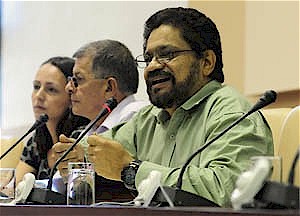 At the start of the fifth round of peace talks in Havana, Cuba, Márquez praised the proposal for a ceasefire written by Colombian politician and former cabinet minister Álvaro Leyva in a column for the El Nuevo Siglo newspaper.
Leyva called for a bilateral truce with international verification and oversight.
“For us a ceasefire requires a huge effort,” said Márquez, “but we know it is an important step to demonstrate a will for peace on both sides.”
FARC declared a unilateral ceasefire for two months after peace talks began in November last year, but did not extend the measure after the government refused to reciprocate. Even as peace talks continued, there has been an upsurge in violence since that ceasefire ended on 20th January, with seven Colombian soldiers killed in the latest incident.
The government has so far refused to accept a ceasefire agreement, over concerns that it would allow the guerilla group to re-arm and consolidate its position.
Colombia: Drummond Contractor Convicted in Unionists’ Deaths
Weekly News Update on the Americas | February 11, 2013
On Jan. 25 Colombian judge William Andrés Castiblanco sentenced Jaime Blanco, a former contractor for the Alabama-based Drummond Co. Inc. coal company, to 37 years and 11 months in prison for masterminding the March 2001 murders of two union leaders in the northern department of Cesar. The court found that Blanco, who supplied food services for Drummond’s La Loma mine, had arranged with rightwing paramilitaries, including one known as “Tolemaida,” for the killing of Valmore Locarno and Víctor Hugo Orcasita, leaders of the mine’s union. Blanco’s assistant, Jairo Charris, was convicted in 2009 in the same murder plot and was sentenced to 30 years.
Judge Castiblanco also sent trial records to Colombian prosecutors so that they could investigate other people possibly connected to the crimes: Drummond’s president, Garry Drummond; two company directors, Augusto Valencia and Jean Adkins; Alfredo Araújo Castro, Drummond’s public relations director for Cesar; and former Colombian legislator Jorge Castro Pacheco, who was convicted in 2010 of maintaining ties to paramilitary organizations. In addition, the judge supported a request by the victims’ relatives to ask the Supreme Court to investigate former assistant prosecutor Edgardo Maya for allegedly failing to act to protect unionists in Cesar; Maya is Jaime Blanco’s half-brother.
Drummond management has long been suspected of involvement of the murders of Locarno and Orcasita and of another La Loma unionist, Gustavo Soler, who was killed later in 2001. The US-based International Labor Rights Fund (ILRF) and the United Steelworkers (USW) union filed a civil suit against Drummond in March 2002 under the 1789 Alien Tort Statute in federal court in Birmingham, Alabama, where the company is based. The Birmingham jury found the company not liable in 2007, but ILRF executive director Terry Collingsworth announced plans to appeal [see Update #911]. In an April 2011 interview Blanco told the Associated Press wire service that Drummond senior managers ordered the murders of Locarno and Orcasita and that if he was convicted, they would be able to “wash their hands” of the case. (El Tiempo (Bogotá) 2/5/13; Miami Herald 2/6/13 from AP)
Related article
- Mine contractor jailed for trade unionists’ murders (morningstaronline.co.uk)
Featured Video

Rewriting the risk? Inside the government’s vaccine safety messaging
or go to
Aletho News Archives – Video-Images
Book Review
“Davos Can Really Replace the UN”
Inside the book that maps the architecture behind global governance — from the Epstein files to the Pact for the Future
Lies are Unbekoming | April 1, 2026
On June 13, 2019, the United Nations and the World Economic Forum signed a partnership deal to “accelerate the implementation of the 2030 Agenda for Sustainable Development.” That same evening, WEF president Börge Brende — Norway’s former Foreign Minister — had dinner with Jeffrey Epstein at Epstein’s Manhattan townhouse. The Epstein files, released January 2026, contain an exchange between the two from the previous year. Epstein to Brende: “Davos can really replace the UN. C21, cyber, crypto . genetics… intl coordination.” Brende back to Epstein: “Exactly — we need a new global architecture. World Economic Forum (Davos) is uniquely positioned — public private.”
The next day, the UN General Assembly adopted the framework for restructuring global governance.
That sequence — the partnership signing, the Epstein dinner, the candid admission about replacing the UN with a public-private architecture, and then the formal adoption — opens Jacob Nordangård’s The Digital World Brain. Pages two and three. Footnoted to the UN resolution number, the Epstein files, and the General Assembly record.
I keep coming back to it because it captures what this book does that almost nothing else in the independent research space manages. I’ve followed Jacob’s work for years now and interviewed him about his research. Each book peels back another layer of the same institutional architecture, and each time I think he’s reached the limit of what can be documented, the next one goes further. Nordangård doesn’t speculate. He doesn’t editorialize much. He lays institutional actions next to each other in chronological order and lets the pattern announce itself. … continue
Blog Roll
 Aletho News
- The End of NATO
- 37 days of war on Iran cost US staggering $42bln, tracker shows
- Baghdad tells Asian refiners, traders to begin loading Iraqi crude amid Iranian exemption
- Under fire, Moscow and Tehran close ranks
- Iran, US receive Pakistan-mediated plan for ceasefire then final deal
- Iran submits demands for end to war as mediators scramble ahead of Trump deadline
- Iran Threatens Retaliatory Strike on Stargate AI Project in UAE
- US sent ‘a lot’ of arms to Iranian protesters – Trump
- Barak Ravid Launders Deception To Allow Trump To Back Off Of His Power Plant Threat – Again
- REWRITING THE RISK? INSIDE THE GOVERNMENT’S VACCINE SAFETY MESSAGING
- If Americans Knew
- Trump poised to “blow everything up” (ie. commit war crimes) in Iran – Daily Update
- In Iran, Israel-US take aim at “reason, research, and freedom of thought” – Daily Update
- US loses planes over Iran, Israel downgrades Lebanon war goals – Daily Update
- Israel Is Blocking Palestinians from Easter at Church Where Jesus Resurrected
- Plot to assassinate Palestinian activist follows harassment campaign promoted by Zionist groups and elected officials
- Prominent New York synagogue hosts presentation on why U.S. Jews should support the ethnic cleansing of Gaza
- Tapper vs. Piker: Is the CNN Anchor Auditioning for David Ellison?
- Shouldn’t Democrats Be Able to Condemn Genocide?
- Israel-US kill negotiators, destroy civilian structures, but Iran’s military capabilities still largely intact – Daily Update
- ‘War crime’: Global condemnation as Israeli ministers celebrate death penalty law targeting Palestinian prisoners
- No Tricks Zone
- An Inconvenient Tree: Uncovered In Alps… Europe Much Warmer Than Today 6000 Years Ago
- New Study Reports A 60% Slowdown In Greenland’s Ice Loss Rate In The Last Decade
- Low Intensity Tornado Wrecks Major Solar Farm, Creating A Potential Toxic Dump
- New Study Finds Warming Saves Lives…Cold Temperatures 12 Times More Deadly Than Excess Heat
- German Science Blog Accuses PIK Climate Institute Of Hallucinating Climate Tipping Points
- Devastating Assessment Of Comirnaty Vaccine By Former Senior Pfizer Europe Toxicologist
- New Study: CO2 Is ‘Effectively Negligible’ As An Explanatory Climate Change Factor Since 2000
- Former Pfizer Toxicologist Dr. Helmut Sterz Tells Bundestag Hearing Pfizer Vaccine Should Have Never Been Approved
- Energy Expert: Germany’s Nuclear Phaseout Was A “500 Billion Euro Mistake”
- New Research: South Australia’s Mid-Holocene Sea Surface Temperatures Were 4°C Warmer Than Today
 Aletho News