Violence and Terror: The Ukrainian and Colombian Road to Empire Building
By James Petras | The People’s Voice | March 19, 2014
Introduction
The two paths to 21st century empire-building-via-proxies are illustrated through the violent seizure of power in the Ukraine by a US-backed junta and the electoral gains of the US-backed Colombian war lord, Alvaro Uribe. We will describe the ‘mechanics’ of US intervention in the domestic politics of these two countries and their profound external effects – that is how they enhance imperial power on a continent-wide basis.
Political Intervention and Proxy Regimes: Ukraine
The conversion of the Ukraine into a US-EU vassal state has been a prolonged process which involved large scale, long term financing, indoctrination and recruitment of cadres, organization and training of politicos and street fighters and, above all, a capacity to combine direct action with electoral politics.
Seizing power is a high stakes game for empire: (1) Ukraine, in the hands of clients, provides a NATO with a military springboard into the heart of the Russian Federation; (2) Ukraine’s industrial and agricultural resources provide a source of enormous wealth for Western investors and (3) Ukraine is a strategic region for penetrating the Caucuses and beyond.
Washington invested over $5 billion dollars in client-building, mostly in ‘Western Ukraine’, especially in and around Kiev, focusing on ‘civil society groups’ and malleable political parties and leaders. By 2004, the initial US political ‘investment’ in regime change culminated in the so-called ‘Orange Revolution’ which installed a short-lived pro-US-EU regime. This, however, quickly degenerated amidst major corruption scandals, mismanagement and oligarchical pillage of the national treasury and public resources leading to the conviction of the former-Vice President and the demise of the regime. New elections produced a new regime, which attempted to secure ties with both the EU and Russia via economic agreements, while retaining many of the odious features (gross endemic corruption) of the previous regime. The US and EU, having lost thru democratic elections, relaunched their ‘direct action organizations’ with a new radical agenda. Neo-fascists seized power and established a dictatorial junta through violent demonstrations, vandalism, armed assaults and mob action. The composition of the new post-coup junta reflected two sides of the US-backed political organizations: (1) neo-liberal politicos for managing economic policy and forging closer ties with NATO, (2) and neo-fascists/violent nationalists to impose order by force and fist, and crush pro-Russian Crimean ‘autonomists’ and ethnic Russians and other minorities, especially in the industrialized south and east.
Whatever else may ensue, the coup and the resultant junta is fully subordinated to and dependent on the will of Washington: claims of Ukrainian ‘independence’ notwithstanding. The junta proceeded to purge the elected and appointed government officials affiliated with the political parties of the previous democratic regime and to persecute its supporters. Their purpose is to ensure that subsequent managed elections will provide a pretense of legitimacy, and elections will be limited to two sets of imperial clients: the neo-liberals, (self-styled “moderates”) and the neo-fascists dubbed as “nationalists”.
Ukraine’s road to imperialist power via a collaborator regime illustrates the various instruments of empire building: (1) the use of imperial state funds, channeled through NGOs, to political front groups and the build-up of a ‘mass base’ in civil society; (2) the financing of mass direct action leading to a coup (‘regime change’); (3) the imposition of neo-liberal policies by the client regime; (4) imperial financing of the re-organization and regroupment of mass direct action groups after the demise of the first client regime; (5) the transition from protest to violent direct action as the major backdrop to the extremist sectors (neo-fascists) organizing the seizure of power and purge of the opposition; (6) organizing an ‘international media campaign’ to prop up the new junta while demonizing domestic and international opposition (Russia) and (7) political power centralized in the hands of the junta, convoking “managed elections” limited to the victory of one or the other pro-imperial pro-junta candidates.
In summary, empire-builders operate on several/levels: violent and electoral; social and political; and with selected incumbents and rivals committed to one strategic aim: the seizure of state power and the conversion of the ruling elite into willing vassals of empire.
Columbia’s Deathsquad Democracy: Centerpiece of the Imperial Advance in Latin America
In the face of a continent-wide decline of US influence in Latin America, Colombia stands out as a constant bulwark of US imperial interests: (1) Colombia signed a free trade agreement with the US; (2) provided seven military bases and invited thousands of US counter-insurgency operatives; and (3) collaborated in building large-scale paramilitary death squads prepared for cross border raids against Washington’s arch enemy Venezuela.
Colombia’s ruling oligarchy and military have been able to resist the wave of massive democratic, national and popular social upheavals and electoral victories that gave rise to the post-neo-liberal states in Brazil, Argentina, Venezuela, Ecuador, Bolivia, Paraguay and Uruguay.
While Latin America has moved toward ‘regional organizations’ excluding the US, Colombia strengthened its ties to the US through bilateral agreements. While Latin America reduced its dependence on US markets, Colombia expanded its commercial ties. While Latin America reduced their military ties to the Pentagon, Colombia tightened them. While Latin America moved toward greater social inclusion by increasing taxes on foreign multinational corporations, Colombia lowered corporate taxes. While Latin America expanded land settlements for its landless rural populations, Colombia displaced over 4 million peasants as part of the US-designed ‘scorched earth’ counter-insurgency policy.
Colombia’s “exceptional” unwavering submission to US imperial interests is rooted in several large-scale, long-term programs developed in Washington. In 2000, President ‘Bill’ Clinton committed the US to a $6 billion dollar counter-insurgency program (Plan Colombia) which greatly increased the brutal repressive capacity of the Colombian elite to confront the popular grass roots movements of peasants and workers. Along with arms and training, US Special Forces and ideologues entered Colombia to develop military and paramilitary terror operations – aimed primarily at penetrating and decimating political opposition and civil society social movements and assassinating activists and leaders. The US-backed Alvaro Uribe, notorious narco-trafficker and the very personification of a ruthless imperial vassal, became president over a ‘Death-Squad Democracy’.
President Uribe further militarized Colombian society, savaged civil society movements and crushed any possibility of a popular democratic revival, such as were occurring throughout the rest of Latin America. Thousands of activists, trade unionists, human rights workers and peasants were murdered, tortured and jailed.
The ‘Colombian System’ combined the systematic use of para-militarism (death squads) to smash local and regional trade union and peasant opposition and the technification and massification of the military (over 300,000 soldiers) in fighting the popular insurgency and ‘emptying the countryside’ of rebel sympathizers. Large-scale multi-billion dollar drug trafficking and money laundering formed the ‘financial glue’ to cement a tight relationship among oligarchs, politicos, bankers and US counter-insurgency advisers – creating a terrifying high-tech police state bordering Venezuela, Ecuador and Brazil – countries with substantial popular mass movements.
The same state terror machinery, which decimated the pro-democracy social movements, has protected, promoted and participated in ‘stage-managed elections’, the hallmark of Colombia as a “death squad democracy”.
Elections are held under a vast overlapping network of military bases, where death squads and drug traffickers occupied towns and villages intimidating, terrorizing and ‘corrupting’ the electorate. The only ‘safe’ protest in this repressive atmosphere has been voter abstention. Electoral outcomes are pre-ordained: oligarchs never lose in death squad democracies, they are the empire’s most trusted vassals.
The cumulative effects of the decade and a half-long bloody purge of Colombian civil society by Presidents Uribe and his successor, Santos, have been to eliminate any consequential electoral opposition. Washington has achieved its ideal: a stable vassal state; a large-scale and obedient military; an oligarchy tied to US corporate elites; and a tightly-controlled ‘electoral’ system that never permits the election of a genuine opponent.
The March 2014 Colombian elections brilliantly illustrate the success of US strategic intervention in collaboration with the oligarchy: The vast majority of the electorate, over two-thirds, abstained, demonstrating the absence of any real legitimacy among the eligible voters. Among those who ‘voted’, ten percent submitted ‘spoiled’ or blank ballots. Voter abstention and ballot-spoilage was especially high in the rural regions and working class areas which had been subject to state terror.
Given the intense state repression, the mass of voters decided that no authentic pro-democracy party would have any chance and so refused to legitimize the process. The 30% who actually voted were largely urban middle and upper class Colombians and residents in some rural areas completely controlled by narco-terrorists and the military where ‘voting’ may have been ‘compulsory’. Of a total of 32 million eligible voters in Colombia, 18 million abstained and another 2.3 million submitted spoiled ballots. The two dominant oligarchical coalitions led by President Santos and ex-President Uribe received only 2.2 million and 2.05 million votes respectively, a fraction of the number who abstained (14 million). In this widely scorned electoral farce, the center-left and left parties made a miserable showing. Colombia’s electoral system puts a propaganda veneer on a dangerous, highly-militarized vassal state primed to play a strategic role in US plans to “reconquer” Latin America.
Two decades of systematic terror, financed by a six-billion dollar militarization program, has guaranteed that Washington will not encounter any substantial opposition in the legislature or presidential palace in Bogota. This is the ‘acrid, gunpowder-tinged smell of success’ for US policymakers: violence is the midwife of the vassal state. Colombia has been turned into the springboard for developing a US-centered trade bloc and a military alliance to undermine Venezuela’s Bolivarian regional alliances, such as ALBA and Petro Caribe as well as Venezuela’s national security. Bogota will try to influence neighboring right and center-left regimes pushing them to embrace of the US Empire against Venezuela.
Conclusion
Large-scale, long-term subversion and organization in Ukraine and Colombia, as well as the funding of paramilitary and civil society organizations (NGO) has enabled Washington to: (1) construct strategic allies, (2) build ties to oligarchs, malleable politicians and paramilitary thugs and (3) apply political terrorism for their seizure of state power. The imperial planners have thus created “model states” – devoid of consequential opponents and ‘open’ to sham elections among rival vassal politicians.
Coups and juntas, orchestrated by longstanding political proxies, and highly militarized states run by ‘Death Squad Executives’ are all legitimized by electoral systems designed to expand and strengthen imperial power.
By rendering democratic processes and peaceful popular reforms impossible and by overthrowing independent, democratically elected governments, Washington is making wars and violent upheavals inevitable.
-###-
James Petras is a Bartle Professor (Emeritus) of Sociology at Binghamton University, New York. He is the author of 64 books published in 29 languages, and over 560 articles in professional journals, including the American Sociological Review, British Journal of Sociology, Social Research, Journal of Contemporary Asia, and Journal of Peasant Studies.

When Protests and Violence Are Important to the U.S. Media
By Nate Singham | CEPR Americas Blog | February 28, 2014
In light of the recent political demonstrations that have swept the country, Venezuela has received considerable attention from both the US State Department and mainstream media. In recent days, President Obama, U.S. Secretary of State John Kerry and several others have issued numerous statements regarding the protests. In the US major media, The New York Times has published articles nearly every day since the protests began. Extensive reporting can also be found in the Wall Street Journal, USA Today and The Washington Post.
It is worth comparing the extent of this coverage to protests of similar importance next door to Venezuela. In August of last year, Colombian farmers launched large-scale demonstrations in opposition to Colombian trade policies that are strongly supported by the U.S. government.
Unlike the protests in Venezuela, the Colombian protests received very little coverage from mainstream media, as CEPR pointed out at the time. The graph below compares the amount of coverage, in total number of articles published, given by four of the United States’ most influential newspapers to the protests and violence in Colombia and Venezuela. The difference ranges from more than two times to 14 times as many articles devoted to the Venezuelan protests as compared with Colombia, despite the fact that the period covered for Colombia is twice as long.
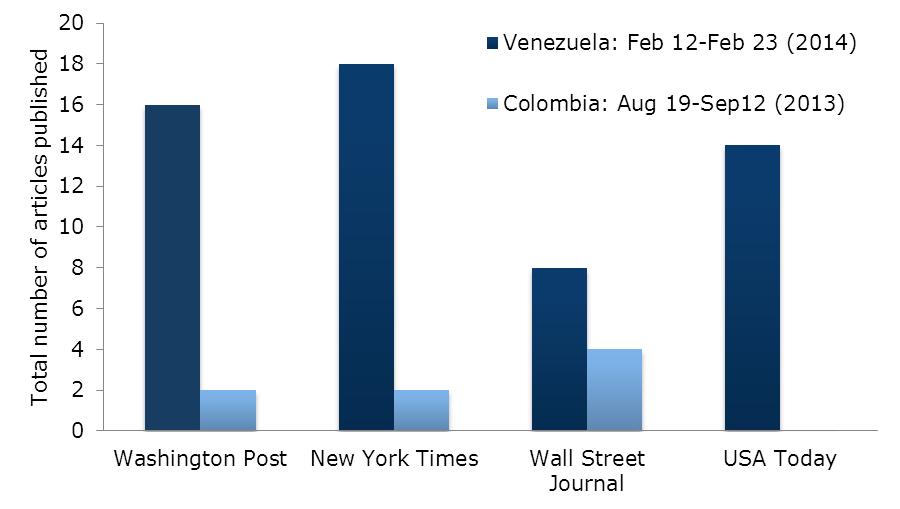
This is especially remarkable if we consider the high levels of repression carried out by the Colombian police and military in response to these protests. The International Office for Human Rights Action in Colombia described the violence as “unprovoked” and “indiscriminate” and attributes all of the violence to state forces.
The incidence of deaths in both Colombia and Venezuela[i], so far, is only slightly higher in Venezuela, with 13 deaths versus 12 deaths in Colombia.[ii] Yet there was very little coverage, and almost no criticism of the Colombian government as compared to the harsh attacks on the Venezuelan government in the U.S. media.
As mentioned earlier, US Secretary of State John Kerry and President Obama made public statements regarding the protests in Venezuela. Both demanded that students arrested in Venezuela be released, without regard as to whether any had been arrested for allegedly committing crimes such as arson and assault. There were no such statements from U.S. officials regarding the hundreds arrested in Colombia.
It is possible that both the huge differences in the amount of media coverage, and the responses to these two sets of protests by both the media and U.S. government officials has to do with the protesters and their aims, and the respective governments. The Colombian farmers were protesting against policies strongly supported by the U.S. government; they were also protesting against a government that the U.S. sees as a strategic ally, home to U.S. military bases and receiving billions of dollars in U.S. aid. The Venezuelan protesters are demanding the ouster of a government that the U.S. government has [spent] millions of dollars trying to get rid of, including U.S. support for the 2002 military coup against the government.
[i] The total amount of deaths reflects data from the most recent figures from Venezuela Transparencia, as of Monday, February 24 2014.
[ii] It is important to note that so far only six of the 13 deaths in Venezuela are confirmed to be opposition protesters.
Violence and Vulnerability in Buenaventura, the Dark Side of Development
By Margaret Boehme | Red Hot Burning Peace | February 24, 2014
From the tenth-floor balcony of our hotel in Buenaventura, we sit with community leader Miguel Duarte and watch as the sunset over the Pacific Ocean streaks the sky with peach and mauve before fading to a shroud of lavender-gray and darkness. Below us, teenage girls chase a soccer ball. A few hundred yards away, a patch of the island is covered with tree tops like the heads of broccoli. “Take a photo of that island,” says Duarte, pointing at the tree line. “There are thousands of dead bodies buried on it.”
“We need a commission from the Attorney General’s office to count the bodies,” he continues. “The island is controlled by paramilitaries.”
The violence in Buenaventura is staggering, yet reliable statistics are hard to attain: official documentation is lacking and it’s left to community leaders, like 18-year-old Jesús, to try to compile the data independently. At our meeting, he pulls out his notebook and begins reading off his handwritten list of victims from a recent massacre. He gets to the end of his list, glances up, and says, “Children were cut up and heads were found in barrios Santa Monica and Campo Alegro. Last night Alberto’s cousin was killed in a confrontation. That one made the newspaper.”
According to a report issued in January 2014, the city sees two-to-three murders and three-to-six forced disappearances daily. In November 2013 alone, fighting between different armed groups displaced 2,500 families in Buenaventura.
“We’re convinced of one thing,” says Duarte. “This pressure is so that people leave.”
On the heels of shoot-outs in waterfront neighborhoods, city officials arrive and ask residents if they’re ready to sign documents in which they agree to vacate the zone. On February 5 and 6, local security forces staged an elaborately orchestrated tsunami drill for neighborhoods near the port, with armed men blocking off streets and redirecting traffic into the night. According to Colombian Process of Black Communities (PCN), the exercise was yet another effort to brainwash Buenaventura’s Bajamar residents into believing that it’s not safe to live in the area and that they should be ready to evacuate at a moment’s notice.
Many point out that Buenaventura is dangerous for people who live in neighborhoods slated for commercial development but that, paradoxically, these same areas are safe for tourists. Below our hotel, a seafood fusion-sushi bar does slow business just yards from a neighborhood where armed groups recently did battle.
It’s Friday night in this commerce town, and clubs cater to weekend carousers with pockets full of pesos. Against a backdrop of giraffe-like cranes, half-built high-rises sprouting rebar, and a balmy breeze dispersing salsa beats, Duarte explains that 15 or 20 years ago, people began to talk about megaprojects in the region: port expansion, a cargo terminal, a tourist boardwalk, and an international airport in nearby Cali. Those conversations coincided with the beginning of the market liberalization process, as the port changed from public to private ownership.
Over the past 15 years, as the armed conflict arrived to nearby rural areas, many residents fled their farming communities at the outskirts of Buenaventura and settled in ocean-front neighborhoods near the city center, joining communities of Afro-Colombians who had arrived generations ago. In 2005, the FARC and Colombian military battled in Buenaventura. In 2006, paramilitaries entered the urban zone to protect businesses and terrorize the local population.
The first interurban displacement in Buenaventura—in which people fled from one neighborhood to another within the city—was in 2009. Today, ground zero for violent displacement coincides perfectly with zones marked for port expansion, a coal warehouse, a massive container storage area, and a tourist promenade. The violence, PCN states, is “part of the war strategy to control territory and clean out the zone to bring in projects.”
Residents in vulnerable neighborhoods are not opposed to the city’s economic growth, per se. But many feel that projects should benefit all people in the area, not bring prosperity to few while forcing misery on most.
That’s what Remedios’ husband, Eduardo believed. Their home in Caucana, about 45 minutes from the port, is along the road being widened to facilitate port expansion and accompanying projects in order to make Buenaventura competitive for Free Trade Agreement projects.
The old road is narrow, windy, and unpaved, meaning that it currently takes a truck seven or eight hours to make the trip from Buenaventura to Bugalagrande, a town along the Pan-American Highway. The new road will reduce the journey to about an hour.
Eduardo opposed the road expansion through their community because small children play there, and the project was contaminating their air and bad for people’s health. Remedios said, “He’d been looking to strengthen the community. He didn’t want to leave people in misery.” He’d been advocating for the community’s right to Free Prior and Informed Consent for new projects on their land guaranteed under Law 70, or the “Law of Black Communities.”
One morning Eduardo got a call that warned him he’d be killed if he ran in upcoming community council elections. For months he lived under the dark cloud of death threats, and on February 23, 2013, he was murdered. A year later, despite the efforts of his wife and other community members to seek justice, the government has made no progress in the investigation of his death.
“It has left me desperate, my kids too. They’re struggling at school. They don’t remember their vowels, just sleep, play, fight, scream….My children want to know why their father was murdered. They’re small, thinking bad thoughts, seeking vengeance. I’m asking for help because I don’t want my kids to become bad people.”
While we are in Buenaventura, a death threat is circulated, naming as military targets indigenous groups, campesinos, Marcha Patriotica members, protestors who block roads, and “guerilla-defending” NGOs—the name often used by paramilitaries to refer to NGOs that work on human rights issues.
Back on the tenth-floor balcony, a man whose community is surrounded by illegal armed groups looks out over the port, past the island of dead bodies, to the green lights blinking at the edge of the bay. He says, “If we don’t act quickly in Buenaventura, there will be more deaths.”
Margaret Boehme is a member of the Witness for Peace Colombia team based in Bogotá.
Related article

Colombia: Who Is Really In Charge?
By John I. Laun | Colombia Support Network | February 18, 2014
In the last several days a number of stunning disclosures have surfaced concerning the role of the Colombia military. First, the Colombian news magazine Semana revealed that military intelligence had conducted wire-tapping and surveillance for an operation called Andromeda from a listening post set up in a site disguised as a small restaurant named “Buggly Hacker” located in Galerias, a Bogota commercial district. Among the phone calls tapped and overheard it appears there may have been calls of members of the Colombian Government’s delegation involved in peace talks with the FARC guerrillas, whose delegation’s conversations may likewise have been tapped and overheard. When news broke of this activity, President Juan Manuel Santos declared publicly that these wiretaps (chuzadas, as they are referred to in Colombia) were illegal and had to be investigated at once. The President said publicly that he did not authorize and knew nothing about this activity. But the next day, President Santos declared that the chuzadas had been done legally!
Two things are very clear. First, that the President of Colombia is not aware of what a significant part of his government is doing, and that’s all right with him. And second, that the military are (quite literally) calling the shots in Colombia. It appears obvious that Mr. Santos changed his opinion overnight on the legality of the secret wire-tapping activity by military intelligence because military officers told him he could not call the activity illegal. In other words, they’re in ultimate control of the government in Colombia!
How could Mr. Santos determine that this activity was legal? There are laws which have provided great leeway to military intelligence. But they certainly do not extend to overhearing conversations between Colombian Government representatives and FARC representatives meeting in Havana supposedly aimed at arriving at a broad peace agreement through which the guerrilla war would be ended. Who would speak freely his or her ideas on what a peace agreement should consist of—a necessary part of peace conversations if they are to be productive— if he or she knew a third party was overhearing what was being said? No one. Particularly if the party overhearing the conversations is the Colombian military, which has a long record of abusive conduct, and even has a representative at the peace talks, General Mora. The chuzadas are a serious impediment to frank and open dialogue between the Colombian Government and the FARC. One suspects that former President Alvaro Uribe Velez is likely the recipient of the information gained from the chuzadas, as he utilizes his close relationship with military officers to obtain information with which to undercut the peace talks, which he has publicly opposed. He earlier obtained the coordinates for movement of two FARC leaders as they came out of their bases to go to Havana—secret information he could only have gotten through a leak from a military or governmental source. Of course, President Santos has not moved seriously to investigate this leak. Why? Because he is not in control of the Colombian government.
This has been made clear by events in the last couple of days. Semana, much to their credit, has carried out and now published the results of an extensive investigation of corruption in the Colombian military. The investigation found military officers discussing how to skim off funds for their personal benefit from monies received by the military, the likely source of which was the United States Government. One of the persons involved in the recorded conversations is the current Commander of the Colombian Armed Forces, General Leonardo Barrero. Another article reported how supposedly disgraced General Rito Alejo del Rio, confined to a military installation in Bogota for his support of illegal paramilitary forces during his time as Commander of the Seventeenth Brigade in Carepa, near Apartado, essentially commands the installation, freely making supposedly-prohibited cell phone calls. And other military personnel who misbehaved had been involved in the “false positives” scandal in which military officers ordered the kidnapping of young men, had them killed, and then falsely presented them as guerrillas killed in combat.
The reports by Semana show an astonishing level of corruption in the Colombian military. President Santos has promised an investigation of these activities, of which he says he had no knowledge. Again, we see Mr. Santos as being out of the loop, heading a government he does not control. The conclusion is inescapable that the military controls the government and Mr. Santos is an uninformed bystander. He seems to believe that his job is to hob-nob with representatives of multinational corporations, as he did on a recent visit to Spain, inviting them to invest in Colombia and remove its valuable mineral resources for a pittance. The Colombian people deserve much better than this!
There is another aspect of the military’s current “dance of the millions” which is very troubling. The funds that are being stolen by military personnel are almost certainly provided by the United States government (i.e., U.S. taxpayers) as a part of the bloated budget of funds the U. S. government provides to the Colombian military. An obvious question is: Did the U.S. government personnel, such as the country’s military attache and Ambassador in Colombia, know what has been going on? And, if not, why not? This scandal calls for a full review of the U.S. aid program to Colombia and an immediate freezing of any funds in the aid pipeline. We in the human rights community have long known of the pervasive corruption in the Colombian military, though we did not know of the brazen theft of funds which Semana uncovered. It is high time that President Obama, Secretary of State Kerry and Secretary of Defense Hagel give their undivided attention to the Colombia situation. And the members of Congress should insist upon a thorough investigation, dismissal of those government personnel who overlooked these very serious problems, and prosecution of those who may have collaborated with the Colombian military to their own advantage.
Rights concerns in Colombia over leaked recording
Press TV – February 18, 2014
Human rights concerns have risen again in Colombia after an online recording of a military chief revealed his solidarity with a colonel jailed for alleged extrajudicial killings.
In the recording, published by leading news magazine Semana on Sunday, Colombia armed forces chief General Leonardo Barrero is heard telling colonel Robinson Gonzalez del Rio that prosecutors’ investigations into the extrajudicial killings is a “bunch of crap.”
The army chief also suggests that Gonzalez, who is facing criminal charges over the killing of two men in 2007, mount a counterattack to discredit prosecutors.
According to local reports, deputy joint chief General Javier Rey, resigned on Monday following the revelation by Semana’s weekend report. Barrero is also reported to have expressed regret over his remarks in the audio recording.
Colombian President Juan Manuel Santos said the serious allegations made in the Semana report need to be investigated. The government, however, said it was taking no immediate action against Barrero as he was not directly accused of corruption.
An earlier scandal on extrajudicial killings by Colombia military dubbed the “false positives scandal” broke in 2008.
According to media reports, hundreds of innocent civilians were slain and presented as guerrillas killed in battle by the country’s army in an effort to inflate body counts and receive promotions or other benefits.
Earlier this month, Semana reported that a military spy ring had eavesdropped for 15 months on emails and text messages of government negotiators involved in peace talks with leftist rebels.
How the Washington Post Distorts Colombia
What Dana Priest Left Out
By JACK L. LAUN | CounterPunch | January 2, 2014
On December 21, 2013 the Washington Post published an article titled “Covert action in Colombia” by reporter Dana Priest. Ms. Priest is a veteran reporter who has over the course of her career produced significant reports on important topics. However, in her report on the role of the United States government in supporting the Colombian state’s war on the FARC guerrillas she has overlooked or ignored some very basic aspects of this relationship.
The most significant of these is that she ignores the nature and history of the paramilitary forces’ activities and the link of these to the United States government. As Father Javier Giraldo, S.J., correctly observed years ago, the paramilitaries in Colombia are a strategy of the Colombian state. Furthermore, this strategy was suggested to the Colombian government by a United States military mission to Colombia in February 1962, in response to fear of the spread of influence of the Castro Revolution in Cuba. The mission was led by Lieutenant General William Yarborough, the Commander of the U.S. Army Special Warfare Center. A Wikipedia entry cites a secret report to the Joint Chiefs of Staff quoting Yarborough as recommending “development of a civilian and military structure…to pressure for reforms known to be needed, perform counter-agent and counter-propaganda functions and as necessary execute paramilitary, sabotage and/or terrorist activities against known Communist proponents. It should be backed by the United States.” (See this citation and more information at Wikipedia.org/wiki/William_P_Yarborough.) The basic idea behind the reliance upon paramilitaries has been to keep the Colombian military from being involved directly in the Colombian government’s dirty war against the guerrillas and rural noncombatants and thus avoid having “dirty hands”. As Father Giraldo observed back in 1996, “Paramilitarism becomes, then, the keystone of a strategy of “Dirty War”, where the “dirty” actions cannot be attributed to persons on behalf of the State because they have been delegated, passed along or projected upon confused bodies of armed civilians.” (Colombia: The Genocidal Democracy, Common Courage Press, 1996, p. 81). There are many examples of the paramilitary death squad actions. One of these was a terrible slaughter by machetes and chainsaws of an estimated 30 civilians in the town of Mapiripan in Meta Department on July 15-20, 1997, in which paramilitary forces under the command of Carlos Castano in northern Colombia were allowed to travel by airplane with Colombian military acquiescence to reach their target community in southeast Colombia. A second example of the vicious attacks of paramilitary forces upon civilians was the slaughter on February 21, 2005 of 8 persons of the Peace Community of San Jose de Apartado in Antioquia Department, including a founder and leader of that Community, Luis Eduardo Guerra. The latter massacre was carried out with the assistance of Colombian Army soldiers from the Seventeenth and Eleventh Brigades.
While Ms. Priest approvingly suggests that Colombia “with its vibrant economy and swanky Bogota social scene” is far removed from Afghanistan, she fails to recognize that most of Bogota’s nearly 8 million residents are very poor, while a great majority of the country’s rural residents are impoverished. To be accurate in her portrayal of present-day Colombia, Ms. Priest should recognize and acknowledge that the distribution of land among Colombia’s population is the second worst in South America, after Paraguay, and the 11th worst in the world. (Oxfam Research Reports, “Divide and Purchase: How land ownership is being concentrated in Colombia”, 2013, p.7. See http://www.oxfam.org.) In rural areas paramilitary forces, supposedly demobilized in a sham proceeding during Alvaro Uribe’s Presidency, continue to threaten and murder campesinos (small-scale farmers) and force them and their families off their lands, so they can be taken over by large landowners or multinational corporations with mining and petroleum plans encouraged by the government of President Juan Manuel Santos. Paramilitary activity also continues to account for murders of labor union leaders and organizers, more of whom are killed in Colombia year after year than in any other country in the world.
It is also disappointing that Ms. Priest makes no mention of the fact that there are some 6 million internally-displaced persons in Colombia, more than any other country in the world. In his December 27-29 article in Counterpunch, titled “Mythmaking in the Washington Post: Washington’s Real Aims in Colombia”, Nick Alexandrov correctly calls attention to Ms. Priest’s failure to take into account these displaced persons. And he also properly focuses criticism upon Ms. Priest’s failure correctly to acknowledge one of the most important links of the United State to Colombia and one of the most damaging: the drug trade and the effects of coca crop spraying (fumigation) upon Colombia’s rural population. Here again the responsibility of the United States government is clear and direct. As Mr. Alexandrov points out, tens of thousands of Colombia’s campesinos have been decimated economically as their legal food crops are destroyed through fumigation under direct control of the United States government. As a Colombia Support Network delegation was told by U. S. Embassy personnel while Anne Patterson was Ambassador there, the crop-spraying campaign using Round-Up Ultra has been controlled from the Embassy itself. Indeed, mayors of towns in Putumayo Department (province) told us they are not informed in advance and have no control over when fumigation of farm fields in their municipalities occurs.
Furthermore, the assertion that the FARC are principally responsible for Colombia’s production of illicit drugs is questionable. Right-wing paramilitaries, protected by the Colombian Army and linked to many Colombian political figures, have been involved in the drug trade for decades, and continue to benefit from this trade, as do their benefactors in the private sector, such as owners of large cattle ranches, merchants, and banana plantation owners. And the United States government has supported and even idealized one of the persons most responsible for corruption of the political process in Colombia, Alvaro Uribe Velez. Before his election as President in 2002, Alvaro Uribe had been identified by the United States government as linked to drug-trafficking. As Virginia Vallejo, a Colombian television journalist and sometime love interest of Pablo Escobar, suggested to me in a telephone conversation and mentioned in her book, Amando a Pablo, Odiando a Escobar (Random House Mondadori, September 2007), Alvaro Uribe was favored by Escobar. He allegedly approved the opening of drug-transit airstrips as Director of Civil Aeronautics. Later, as Governor of Antioquia Department, Uribe promoted the formation of so-called “self-defense” forces, which morphed into cut-throat, illegal paramilitaries who ravaged the countryside. His cousin Mario Uribe, with whom he has been particularly close, was convicted of corrupt actions and spent time in prison, while his brother Santiago Uribe Velez is about to be prosecuted for organizing and training illegal paramilitary forces on a Uribe family ranch. When Alvaro Uribe ran for re-election in 2004, his agents bribed Congresswoman Yidis Medina to get her to change her vote in committee so that Uribe could be re-elected (not permitted at that time by the Colombian Constitution). Yidis Medina went to prison for having received the bribe, but neither Alvaro Uribe nor his staff members who offered the bribe have been convicted and sentenced for the offenses they committed.
What was the reaction of the United States government to President Uribe’s alleged promotion of illegal activities? He was awarded the Presidential Medal of Freedom by President George W. Bush, the highest honor a President can convey upon any person! (For a detailed account of Alvaro Uribe’s purported misdeeds, see the Master’s thesis of Francisco Simon Conejos at the University of Valencia, Spain, of December 2012, titled, in English translation, “Crimes Against Humanity in Colombia: Elements to Implicate Ex-President Alvaro Uribe Velez before Universal Justice and the International Criminal Court”.)
No analysis of the United States’ role in Colombia can properly ignore the relationships and responsibilities outlined above. But even beyond these points if one is to consider whether the United States’ actions toward and in Colombia have been beneficial for that country and its people, one must look at the effect of the United States government’s support for corporate interests of companies from this country and their actions in Colombia. The policies of Presidents Clinton, Bush and Obama in the past two decades have advanced the agendas of mining and petroleum companies— such as Exxon Mobil, Occidental Petroleum, and Drummond— and food companies— such as Chiquita Banana and, most recently, Cargill— while these companies’ activities in rural Colombia have caused environmental damage, massive displacement of residents of these areas and destruction of the campesino economy. One wishes that Ms. Priest had treated the Colombian context much more broadly to provide a much more complete and honest view of how United States government actions and policies have affected the population of this important country, with Latin America’s third largest population (after Brazil and Mexico).
John I. Laun is president of the Colombia Support Network.
Washington’s Real Aims in Colombia
Mythmaking in the Washington Post
By Nick Alexandov | CounterPunch | December 27, 2013
Last Sunday’s Washington Post carried a front-page article by Dana Priest, in which she revealed “a CIA covert action program that has helped Colombian forces kill at least two dozen rebel leaders.” Thanks to “a multibillion-dollar black budget”—“not a part of the public $9 billion package of mostly U.S. military aid called Plan Colombia”—as well as “substantial eavesdropping help from the National Security Agency,” the initiative has been successful, in Priest’s assessment, decimating the Revolutionary Armed Forces of Colombia (FARC) guerrillas, as the country’s “vibrant economy” and “swanky Bogota social scene” flourish.
The lengthy piece offers a smorgasbord of propagandistic assertions, pertaining both to Washington’s Colombia policies, and to its foreign conduct in general. For a sampling of the latter, consider one of the core assumptions underlying Priest’s report—namely, that our noble leaders despise drugs. The FARC’s “links with the narcotics trade” and “drug trafficking” motivated U.S. officials to destroy their organization, we’re supposed to believe. True, CIA informants in Burma (1950s), Laos (1970s), and Afghanistan (1980s) exploited their Agency ties “to become major drug lords, expanding local opium production and shipping heroin to international markets, the United States included,” Alfred W. McCoy’s research demonstrates. True, a few decades ago the Office of the United States Trade Representative joined “with the Departments of Commerce and State as well as leaders in Congress” for the purpose of “promoting tobacco use abroad,” the New York Times reported in 1988, quoting health official Judith L. Mackay, who described the resulting “tobacco epidemic” devastating the Philippines, Malaysia, and other countries: “smoking-related illnesses, like cancer and heart disease” had surpassed “communicable diseases as the leading cause of death in parts of Asia.” True, the DEA shut down its Honduran office in June 1983, apparently because agent Thomas Zepeda was too scrupulous, amassing evidence implicating top-level military officials in drug smuggling—an inconvenient finding, given Honduras’ crucial role in Washington’s anti-Sandinista assault, underway at the time.
But these events are not part of History, as the subject has been constructed in U.S. schools. It’s common to read, every year or so, an article in one of the major papers lamenting the fact that “American students are less proficient in their nation’s history than in any other subject,” as Sam Dillon wrote in a 2011 piece for the Times. The charge is no doubt true, as far as it goes: Dillon explained that only a “few high school seniors” tested were “able to identify China as the North Korean ally that fought American troops during the Korean War,” for example. But the accusation is usually leveled to highlight schools’ inadequacies, with little examination of the roles these institutions are meant to serve. And the indictments are hardly novel: in 1915, a Times story on New York City’s public schools complained their graduates “can not spell simple words,” were incapable of finding “cities and States” on a map, and so on. That piece explicitly critiqued graduates’ abilities to function as disciplined wage-earners, and so was more honest than the majority of today’s education coverage. The simple fact is “that the public schools are social institutions dedicated not to meeting the self-perceived needs of their students [e.g., by providing an understanding of how the world works] but to preserving social peace and prosperity within the context of private property and the governmental structures that safeguard it,” David Nasaw concludes in his fascinating history of the subject. Private schools, to be sure, are similar in essential respects. And one result of this schooling is that well-educated journalists can repeat myths about U.S. foreign policy, as their well-educated readers nod in blind assent.
The notion that U.S. officials have a coherent counterdrug policy is, again, one of these myths. In addition to the historical examples of U.S. support for drug traffickers cited above, we can note that the slur “narco-guerrilla,” which Washington uses to imply that the FARC is somehow unique for its involvement in the narcotics trade, ought to be at least supplemented by—if not abandoned in favor of—“narco-paramilitary.” Commentators tend to discuss the paramilitaries and the Colombian state separately, presupposing the former are “rogue” entities—another myth—when it would be better to view them, with Human Rights Watch, as the Colombian Army’s unofficial “Sixth Division,” acting in close conformity with governmental aims. Paramilitary leader Carlos Castaño admitted in March 2000 that some 70% of the armed groups’ funding came from drug trafficking, and U.S. intelligence agencies took no issue with his estimate—and “have consistently reported over a number of years that the paramilitaries are far more heavily involved than the FARC in drug cultivation, refinement and transshipment to the U.S.,” International Security specialist Doug Stokes emphasizes.
When these substances enter our country, they become a key pretext for the skyrocketing incarceration rate, which has more people imprisoned for drug offenses today than were incarcerated for all offenses in 1980, criminologist Randall Shelden has pointed out, with rates of arrest and sentencing durations especially severe for blacks. “Every criminal prohibition has that same touch to it, doesn’t it?” legal historian Charles Whitebread once asked. “It is enacted by US,” he stressed, “and it always regulates the conduct of THEM”—“you know, them criminals, them crazy people, them young people, them minority group members,” he added sardonically. Reviewing the history of marijuana prohibition, Whitebread noted that, at the Marihuana Tax Act hearings in 1937, two men spoke regarding the drug’s medical effects. One was Dr. William C. Woodward, Chief Counsel to the American Medical Association, who explained his organization had found “no evidence that marihuana is a dangerous drug.” “Doctor,” a Congressman complained, “if you can’t say something good about what we are trying to do, why don’t you go home?” The second was a Temple University pharmacologist, “who claimed that he had injected the active ingredient in marihuana into the brains of 300 dogs, and two of those dogs had died.” When one Congressman asked him whether he had experimented on dogs because of some similarity they bore to humans, the pharmacologist professed ignorance: “I wouldn’t know, I am not a dog psychologist.”
That was the extent of the medical basis for outlawing marijuana in the U.S., as threadbare as the anti-drug pretexts of Washington’s Colombia policies. Nearly four years after Plan Colombia’s 1999 announcement, for example, the U.S. General Accounting Office reported that “the Departments of State and Defense [had] still not developed estimates of future program costs, defined their future roles in Colombia, identified a proposed end state, or determined how they plan[ned] to achieve it.” But while efforts to reduce coca cultivation and cocaine production were poorly articulated—and failed consistently—other endeavors met with great success. For example, aerial fumigation displaced some 17,000 people from the Putumayo Department, where the FARC had a major presence, in 2001 alone. The fumigation effectively converted the land from a means of subsistence into a profit source: journalist Garry Leech pointed out that, from 2003-2004, there was “a slew of new contracts signed between multinational companies and the Colombian government,” and the events in Putumayo and elsewhere suggest that Colombia’s herbicide-spraying campaign was never really aimed at illicit crops, typically described as the main target. It seems that if the point were to eradicate, say, coca, the solution would be relatively simple: let coca growers harvest something else. But Plan Colombia has consistently devoted only minimal funding for alternative development schemes, indicating the peasants’ sin isn’t growing coca, but living as subsistence farmers. That kind of activity is an inappropriate use of the land in an oil-rich region, where there are profits to be made.
A Guatemalan peasant made a similar point to author-activist Kevin Danaher, when he visited her country in 1984—shortly after School of the Americas alumnus Ríos Montt had completed his genocidal tear through the countryside. The woman, Danaher writes, “told us that soldiers had come to her home one night and hacked her husband to death, right in front of her and her three children;” the man “was a subversive,” in the military’s eyes, “because he was helping other peasants learn how to raise rabbits as a source of food and money.” Danaher struggled to understand the connection between this effort at self-sufficiency, and the brutal end its advocate met. “Look,” the widow explained, “the plantations down along the coast that grow export crops are owned by generals and rich men who control the government. A big part of their profit comes from the fact that we peasants are so poor we are forced to migrate to the plantations each year and work for miserable wages in order to survive.” Were she and other Guatemalan peasants to become self-reliant, they “would never work on the plantations again”—an indication of the severe threat rabbit-raising posed.
This woman’s remarks indicated who Washington’s real enemy was in Guatemala, and throughout the world. The U.S. government was not opposed merely to “Communists,” real or imagined, during the Cold War, and in Colombia its policies have helped ruin—or end—the lives of millions of destitute individuals beyond the FARC’s top officials. Of course, Sunday’s Post article ignores this fact, portraying the struggle as one between the U.S. government and its Colombian allies on one side, and aggressive guerrillas on the other. But we can expect little else from this mythmaker of record.
CIA secret program helped Colombia kill FARC leaders: Report
Press TV – December 22, 2013
US intelligence agencies have secretly helped the Colombian government kill at least two dozen leaders of the Revolutionary Armed Forces of Colombia (FARC), a report says.
On Saturday, the Washington Post published the report revealing that both the Central Intelligence Agency (CIA) and the National Security Agency (NSA) provided the Colombian government with technology to terminate the rebel leaders.
The report was based on interviews with more than 30 former and current American and Colombian officials, who spoke on condition of anonymity since the program is classified and ongoing, the newspaper said.
According to the report, Washington provided Colombia with Global Positioning System (GPS) equipment that can be used to transform regular munitions into so-called smart bombs.
These explosives can accurately pinpoint specific targets, even if the objects are located in dense jungles.
In addition, the NSA provided “substantial eavesdropping help” to the Colombian government, the report stated.
In one of its operations, Colombian forces killed top FARC commander, Raul Reyes, in March 2008, while he was in a FARC-operated jungle camp in neighboring Ecuador. The newspaper reported that a US-made smart bomb was used in the killing.
Colombian President Juan Manuel Santos commented on the report, telling the newspaper that the CIA has been “of help, providing Colombian forces with “better training and knowledge.” The CIA, however, did not want to give any comments regarding the revelations.
The report also revealed that the multibillion-dollar program was secretly funded on top of the nine billion dollars in aid that the US has openly provided to Colombia, mostly in military assistance. The covert program was authorized by President George W. Bush and has continued under President Barack Obama.
The Colombian government and FARC have been holding peace negotiations since November last year in Cuba.
The two sides have agreed upon the matter of land reform and rural development, while four others issues still remain unsolved, including FARC’s participation in politics.
FARC is Latin America’s oldest insurgent group and has been fighting the government since 1964.
Bogota estimates that 600,000 people have been killed and more than 4.5 million others have been displaced due to the fighting.
FARC Insists on Need to Eliminate Factors Leading to State Terrorism
Prensa Latina | October 7, 2013
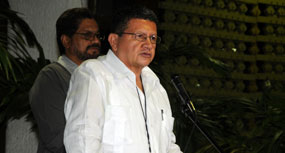 Havana – The Revolutionary Armed Forces of Colombia – People”s Army (FARC-EP) insisted today on the need to reach an agreement and implement mechanisms to eliminate those factors that enable State terrorism, thus avoiding a post-conflict ”dirty war”.
Jesús Santrich, member of the guerrilla delegation, referred to the elimination of the National Security Doctrine, the conception of the internal enemy and paramilitarism, in a communique issued today here in Havana.
He also recalled the message from Attorney General Eduardo Montealegre, forecasting a ‘dirty war’ after the eventual signing of a peace treaty, and stressed the need to avoid it.
He added that this will be one of the greatest challenges for the Colombian State.
Santrich said that a peace agreement for Colombia cannot be reached without effective political guarantees and respect for human rights of all.
The FARC-EP insisted on the request to create a Commission to revise and clarify the history of the Colombian conflict, in order to analyze the circumstances of the current war.
Desperate To Sew Up TPP Negotiations At Any Cost, Politicians Agree All Future Meetings Will Be Completely Secret
By Glyn Moody | Techdirt | September 3, 2013
We’ve been reporting for several years about the extraordinary levels of secrecy surrounding the TPP negotiations, where little information was released about what was going on, and there were few opportunities for representatives of civic and other groups to meet with negotiators to present their point of view. More recently, there have been some indications that this lack of transparency is fuelling increasing discontent among some of the participating nations.
In order to get the trade deal sewn up by the end of this year, and before resistance spreads further, the negotiators have decided to hold ‘inter-sessional’ meetings for the remaining unresolved areas. But as this article from Scoop explains, these won’t be like routine TPP meetings, with their routinely unhelpful levels of opacity:
Detective work indicates that informal ‘inter-sessional’ meetings on six chapters are scheduled within the next four weeks — all in North America.
‘ “Inter-sessional” is a misnomer’, says Professor Kelsey, ‘because they are not planning any more formal sessions. There will be no access for the media or stakeholders to these smaller meetings.’
‘Past inter-sessionals have been shrouded in secrecy to ensure we can’t find out what’s happening and we don’t have access to those negotiators who see value in talking with us.’
‘The last three years of the TPPA have been widely condemned for their lack of transparency. The process is now going further underground’.
That is, rather than opening up TPP in response to widening criticisms, its negotiators will now be meeting in complete secret, presumably until they emerge with some kind of a deal, however bad. Since no information will be released about those gatherings behind closed doors, and there will be no opportunities to convey concerns to the participants, the public in whose name all these talks are taking place will have no way of knowing what is going on or of offering its views. It’s the ultimate in arrogant, “we know best” negotiations where citizens are expected to accept what is given, no discussion allowed.
The last time this approach was used on this scale was for ACTA, which was ultimately rejected, largely because the European public took to the streets to express its outrage at the contempt being shown towards it by the negotiators. Interestingly, in Colombia people are already taking to the streets to protest against the effects of free trade agreements with the US, Europe and Canada, at least in part. Do the governments participating in the now-secret TPP negotiations really want to risk the same happening in their own countries?
Related articles
Colombia farmers’ uprising puts the spotlight on seeds
Against the grain | September 4, 2013
On 19 August, Colombian farmers’ organisations initiated a massive nationwide strike. They blocked roads, dumped milk on cars and basically stopped producing food for the cities. The problem? Farmers are being driven out of existence by the government’s policies.
The state provides almost no support for the small-scale farming sector.1 Instead, it embraces a social and economic model that serves the interests of a wealthy elite minority. Recent free trade agreements (FTAs) signed with the US and the EU are undercutting Colombian producers, who can’t compete with subsidised imports.2 The Colombian government has been actively promoting land grabbing by large corporations, many of them foreign (Monica Semillas from Brazil, Merhav from Israel, Cargill from the US), to promote export-oriented agribusiness at the expense of family farming oriented towards food sovereignty.
But the farming sector needs real support, especially in the form of access to land and lower costs of production, protestors argue. Otherwise, Colombian potato and coffee farmers, dairy and meat producers, not to mention small fishers, will not be able to keep up. They are being evicted and exterminated.
With their backs against the wall, a movement of mobilisation began in one part of the country in June and grew into a coordinated national action for August. The farmers’ strike was soon supported by other sectors: oil industry workers, miners, truckers, health sector professionals and others. On 29 August, ten days into the strike, more than 20,000 students joined the movement and shut down the capital city, Bogotá.
The response of the government was chaotic and contradictory. Police forces violently repressed and injured a lot of protestors, not to mention journalists. More than 250 people were arrested, including high-level union leader Hubert Jesús Ballesteros Gomez, mostly on trumped up charges.
A number of people on both sides lost their lives. At one moment the government recognised the farmers’ grievances as valid and offered some concessions. In another it claimed that the movement was infiltrated by the FARC. President Santos even went on TV and claimed that “the agrarian strike does not exist”. The following day, he was filmed from a helicopter, inspecting the skirmishes and tear gas which filled the streets of Bogotá.
The mobilisation has been extremely successful in opening up space for discussion, conscientisation, solidarity and resistance in Colombia. Students, for instance, were keen to support the farmers and back their demands. They rallied loudly against GMOs and for food sovereignty. But they also wanted to put forward their own demands for free public education, nudging the mobilisation beyond agrarian concerncs into a broader wave of social pressure to change current Colombian policies.
Law 970
Seeds emerged as one highly visible issue. Under the FTA signed with Washington, as well as that signed with Brussels, Bogotá is required to provide legal monopoly rights over seeds sold by US and European corporations as an incentive for them to invest in Colombia. Farmers who are caught selling farm-saved seeds of such varieties, or simply indigenous seeds which have not been formally registered, could face fines or even jail time.3 As is the case in many other countries throughout the world, this criminalisation of farmers’ and indigenous people’s rights to save, exchange and sell seeds puts the country’s biodiversity and cultural heritage at risk.
While it’s true that the Colombian government has been moving in this direction for many years, and agreeing to such policies as part of its membership in the Andean Community or the World Trade Organisation, many people point out that it is only since the signing of the US and EU FTAs that the government has begun seriously implementing them.
In 2011, the Colombian government authorities stormed the warehouses and trucks of rice farmers in Campoalegre, in the province of Huila, and violently destroyed 70 tonnes of rice that it said were not processed as per the law. This militarised intervention to destroy farmers’ seeds shocked many, and inspired one young Chilean activist, Victoria Solano, to make a film about it. The film is called “9.70” because that is the number of the law adopted in 2010 that articulates the state’s right to destroy farmers’ seeds if they don’t comply.4
Today, thanks to the force, tenacity and justness of the farmers’ protest, people from all walks of life in Colombia are discussing that film, as can be seen in the mass media, social networks and the streets, and asking why the government is pursuing such senseless policies.
Support the movement
There is no question that Colombian farmers can feed the country very well, in a way that provides jobs, dignity and a healthy environment. But the government is too firmly attached to an economic model that caters to crony interests and holds no place for small-scale family farming. We should all support the popular agrarian struggle in Colombia to turn that model around. It’s not too late.
As one small concrete action, the documentary film “9.70” — which you can watch online in Spanish at http://youtu.be/kZWAqS-El_g — is seeking funds to produce a version with English subtitles so that more people around the world can understand what the Colombians farmers are facing and support them to defeat such policies. The smallest contribution helps. Please go to http://idea.me/proyectos/9162/documental970 to participate. The deadline is 10 September!
As another meaningful action, the Latin American Coordination of La Via Campesina are seeking international solidarity initiatives to support the strike. Please go to http://goo.gl/9u6RXJ to learn more. Again, time is of the essence!
Beyond Colombia, the battle over similar seeds legislation is raging right now at very high political levels, and across the countryside, in Chile and Argentina as well. One concern is that some of the more aggressive elements adopted by the government of Colombia could infiltrate other Latin American countries as well. The need to scrap these laws is truly urgent indeed!
Going further:
- “La historia detrás del 970“, Semana, Bogotá, 24 August 2013
- Grupo Semillas, “Colombia: Las leyes que privatizan y controlan el uso de las semillas, criminalizan las semillas criollas“, Bogotá, 26 August 2013
- Julia Duranti, “A struggle for survival in Colombia’s countryside“, 30 August 2013
Visit the bilaterals.org website for more coverage (in English, French and Spanish) of the general agrarian strike and the fight over Law 970
For more information about the struggles around the seed laws in Colombia, please contact Grupo Semillas (“Seeds Group”) at semillas@semillas.org.co or visit their website http://semillas.org.co/
To learn more about the political battle currently taking place in Chile, please get in touch with Anamuri, the National Association of Rural and Indigenous Women, at secretariag@anamuri.cl
For information about what is happening in Argentina, please contact Diego Montón at the Latin American Coordination of La Vía Campesina, at secretaria.cloc.vc@gmail.com.
Notes
1 Almost one-third of the Colombian population lives in the countryside and nearly 60% of those in the rural areas live, to some extent, in hunger. See Paro Nacional Agrario y Popular, Pliego de peticiones.
2 The effects are just starting, but they are real. US agricultural exports to Colombia shot up 62% in the first year of the agreement, while Colombian farm exports to the US went down 15%. (See USTR, and Portafolio)
3 To be registered and certified, seeds need to meet criteria of genetic uniformity and stability, to suit agroindustrial processes. This excludes, by definition, peasant seeds — or criollo varieties, as they are called in Colombia — which tend to be diverse, adaptive and dynamic. Under the current rules in Colombia, if a farmer wants to plant criollo seeds, s/he has to get authorisation from the government, can only do it once, can only do it on five hectares or less and must consume the entire harvest at home (cannot sell it on the market).
4 See the film’s Facebook page and on Twitter look up #NoMas970. In the three years of Law 970 so far (2010-2012), the government rejected or destroyed nearly 4,000 tonnes of seeds.
Featured Video
“Historic Russia”: The Land Putin Will Not Give Back
or go to
Aletho News Archives – Video-Images
Book Review
Why the War on Conspiracy Theories Is Bad Public Policy
By Kevin Barrett • Unz Review • February 1, 2019
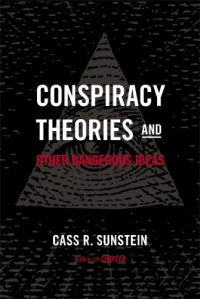 A Review of Conspiracy Theories and Other Dangerous Ideas by Cass Sunstein (based on an earlier paper co-authored with Adrian Vermeule); In Defense of Troublemakers: The Power of Dissent in Life and Business by Charlan Nemeth; and Conspiracy Theories and the People Who Believe Them, edited by Joseph E. Uscinski
On January 25 2018 YouTube unleashed the latest salvo in the war on conspiracy theories, saying “we’ll begin reducing recommendations of borderline content and content that could misinform users in harmful ways—such as videos promoting a phony miracle cure for a serious illness, claiming the earth is flat, or making blatantly false claims about historic events like 9/11.”
At first glance that sounds reasonable. Nobody wants YouTube or anyone else to recommend bad information. And almost everyone agrees that phony miracle cures, flat earthism, and blatantly false claims about 9/11 and other historical events are undesirable.
But if we stop and seriously consider those words, we notice a couple of problems. First, the word “recommend” is not just misleading but mendacious. YouTube obviously doesn’t really recommend anything. When it says it does, it is lying. … continue
Blog Roll
 Aletho News
- BRITAIN’S WARNING: PREPARE FOR WAR
- “Historic Russia”: The Land Putin Will Not Give Back
- How the Cambridge Analytica scandal still haunts Mark Zuckerberg
- The Ongoing Cancellation Campaign Against a Dissenting Academic in Norway
- Yemen and ‘the Houthis’: Challenging Sami Hamdi’s Narrative
- No, Christians did not invent Zionism
- AIPAC-led lobbying network opens branches in Cypriot, Greek parliaments
- Araghchi blasts ‘parasitic’ alliance as US taxpayers pay for Israel’s war on Iran
- Easy fix for Europe’s chaos? Stop fueling war against Russia
- Putin’s key remarks on peace talks and Europe’s ‘schizophrenia’
- If Americans Knew
- An error has occurred; the feed is probably down. Try again later.
- No Tricks Zone
- Two New Studies Find Thwaites Glacier Melt Cannot Be Driven By Human Activity Or A Warming Ocean
- E-Cars Reduce CO2 Emissions By Only 41% Compared To Internal Combustion Engine Vehicles
- Predictions Made By Renowned Climate Professor Over Past Decades Have Been Proven To Be Poor
- New Study Suggests Large Regions Of The Pacific Ocean Have Been Cooling For The Last 80 Years
- Germany’s Green Energy Debacle: High Energy Costs Force Kahla Porzellan to Close After 182 Years!
- New Study: 50 Years Of The Most Aggressive ‘Net Zero’ Policies Can Only Affect The Global Climate By 0.03°C
- US September “Heat” Was No Record…Many Records Set Decades Ago
- Latest European Green Energy Debacle; Portugal’s Largest Flagship Solar Park Insolvent!
- Green Energy Debacle: German Expert Professor Fritz Vahrenholt Warns Of Severe Economic And Social Consequences
- Two More Paleo Reconstructions Affirm Meters-Higher Sea Levels Across Ireland, Brazil 7000-6000 Years Ago

