What We Are Not Allowed to Say
By Christine E. Black | OffGuardian | December 3, 2023
Censorship imperils cultures and civilization. When governments and elites prohibit speaking or writing without threats, shaming, or epithets meant to shut down discussion, free thinking dies. People also die.
A censorship industrial complex grew around Covid hysteria, which began as a war on a virus. New full-blown wars, with guns, bombs, tanks, and planes, and thousands dead now explode around us as free speech is lost in wars’ rubble, and propaganda buries truths.
With money and massive influence, private for-profit industries like pharmaceutical companies, capture US agencies, such as the Food and Drug Administration and the Centers for Disease Control, that then bolster industry profits rather than protect public health. Similarly, captured politicians help corporations profit from wars, as Marine Corp Brigadier General Smedley Butler notes in his book, War is a Racket and as Dwight D. Eisenhower warned against in his 1961 Farewell Address. Corporate and government elites get rich from wars based on lies, such as wars in Iraq and Afghanistan – and they sit rich now in retirement.
What truths might we uncover, sifting through wars’ rubble? Children and young people didn’t need Covid shots as they were at little risk from serious illness from Covid, and some countries stopped recommending them. Yet, vaccines are a main source of revenue for pediatricians. A “pandemic of the unvaccinated” never happened though entertainers, highly paid media figures, and politicians viciously maligned those who waited or declined a Covid shot.
Most people contracted Covid anyway, whether they got multiple shots or not. Shots did not prevent transmission. Thousands of Covid vaccine-injured people have been bullied into silence and rendered invisible. These are all statements we have been forbidden from making in the last few years; those who dare utter them faced rancor or ridicule or worse.
Don’t talk about Covid shots, school and business closings, or the many beloved businesses and churches that closed for good because of bureaucratic mandates.
Don’t talk about vaccine injuries or deaths or children’s learning losses or epidemics of addictions; don’t talk about child and teen suicides.
Don’t talk about Robert F. Kennedy Jr’s astute observations that Haiti and Nigeria had the some of the least restrictive Covid policies on earth, had about a one percent Covid vaccine rate, and have had some of the lowest Covid death rates in the world, observations noted in his book, Letter to Liberals.
Don’t talk about how Covid shots may cause Covid, or how Pfizer’s own product literature states that Covid is one of the side effects of the shot. When we talk about these topics, listeners often stiffen and bristle, their eyes may go blank as they dismiss us with pity or contempt before we even complete a spoken paragraph. Now, new disasters and traumas affect the world, and many insist we not talk about them to avoid snarling and insults or worse.
Violence and war exploded in the Middle East recently, and more unutterable statements come to mind. For instance, criticizing the policies of the Israeli government does not equal anti-Semitism. Great Britain, the same colonial power that colonized and divided the African continent and other countries like poker chips among winners, made The Balfour Declaration in 1917 that declared a “home for the Jews” in Palestine, where Palestinians already lived.
Was this presumptuous and elitist for the British to declare?
Is a single, open, and democratic state in Israel with equal rights for all the best solution to the conflicts and violence, as Israeli American writer, activist, and Israeli Defense Force veteran Miko Peled has stated? Peled is the son of an Israeli general and grandson of one of the signers of the Israeli Declaration of Independence. His father was an Israeli war hero turned peace maker. He changed his thinking on Israel; so did Miko Peled. Peled writes his story in his book, The General’s Son and shares his views in talks and interviews, such as this one on the Katie Halper program.
In spite of how propaganda bombards us, we may note as Miko Peled does, that Palestinians are not simply evil barbarians, beheading babies and raping women. Islam is not a religion of fanatics and terrorists, in Palestine, or anywhere else, as the media often portrays it. It is one of the world’s major religions. The word, Islam, means “submission to the will of God.” The Arabic word, “salaam” which means peace, is part of the common greeting among Muslims all over the world.
Spreading peace is a requirement of the faith. Similarly, sharing God’s peace is expected among Christians and Jews.
Christians have been criticized for their views on Israel. An older and much more well-read peace activist friend shared with me that some evangelical Christians who support Israel, stand with Israel, do so because they believe Israel is the final launching pad for the Rapture when Christians will be zapped up to Heaven, and Jewish people will be too if they convert to Christianity. Jewish people who do not will perish.
What do Jewish people think of this scenario? What if they do not want to “accept Jesus,” but simply wish to remain Jewish? It is confusing. Plenty of the world’s worst violence has been committed and continues in the name of or under the cover of religion.
Statements we are not supposed to make call us to make them now. Statements I make above could be wrong. Many may disagree with them. However, censorship kills with its shaming epithets meant to shut down discussion and thought, like the labels “anti-Semitic” or “conspiracy theorist,” “science denier” or “anti-Vaxxer.”
Censorship imperils us when we are forbidden to speak without threats and insults, such as when we were told, “You don’t care if others die of Covid” if we decided not to wear a mask or to move about freely in 2020 and 2021. Similarly, we were told, “You deserve to be excluded from society if you decline a vaccine” even when some of us had natural immunity or didn’t think we needed it. Even worse, some of us were told, “You deserve to die – or lose your job or friends or education — if you don’t comply.”
Many said such horrible things in the last few years.
Slogans and advertising language often replace free speech and obliterate open thought, as they did during the Covid period, as they do during all wars. Should we be wary of sloganeering and pre-packaged language like “wiped off the map,” “Israel’s 9-11,” “rid the world of evil,” “mushroom cloud,” “weapons of mass destruction,” “pandemic of the unvaccinated,” – sloganeering that stops empathy and reflection, closes debate, and whips populations into war frenzies? Should we question slogans and manipulative phrases?
What questions might we ask about slogans like Israel’s “right to exist”? What does that mean? After a suicide bomber killed his niece in Israel years ago, Miko Peled asked questions. He joined dialogue groups of Israelis and Palestinians and changed his thinking.
US military veteran suicides have been at epidemic levels after soldiers returned from multiple deployments in disastrous wars in Iraq and Afghanistan, ignited by sloganeering after 9-11 and the launch of the so-called “war on terror,” which was to “rid the world of evil.” How might those veterans react now, hearing this same kind of language about “Israel’s 9-11”? This past week, I learned of another veteran who committed suicide.
Can we keep our minds opened, our hearts softened to alternative perspectives? During Covid lockdowns, rigid thinking and censorship caused the US to harm its own children relentlessly as their suicides, addictions, developmental delays, learning losses, and despair increased. Children around the world starved, were abused, exploited, and enslaved because of lockdown policies we were forbidden to question. Has an entire generation of young people been harmed?
Free societies do not ban statements and opinions. Free societies permit questions and debate. Statements above may be phrased as questions as well. For instance, do Covid shots work? Have they worked to stop transmission and illness and death? Was discussion of early Covid treatment suppressed, as Dr. Peter McCollough noted early in lockdowns? Are Covid vaccine-injured people silenced? Where may we find their stories?
Should western cultures have shut down in 2020 in an attempt to avoid a single pathogen? By what authority did bureaucrats suspend the US Constitution in 2020 and forbid assembly, speech, protest, group worship, and community gatherings? What were the harms? Who benefitted from lockdowns and Covid shots and how? How much money changed hands? Who wrote the checks and who got paid?
Why are Palestinians fighting? How do we end the violence and build peace? Should the US fund violence in Israel the ways it does? What has life been like in Gaza and the West Bank of Palestine for the last few decades? Could lockdowns have made life there worse?
Israel has been criticized as one of the most repressive countries in the world for Covid restrictions and Covid shot mandates. Protesting Covid policies is a privilege Palestinians in Gaza would not have had. They have lacked basic medicines, clean water, and schools free of bombings for years.
Was the Balfour Declaration a good idea? Conservative Jewish Rabbi Yisroel Dovid Weiss, speaking at a Let the Quran Speak conference, supports Palestinians and criticizes leaders of the state of Israel on religious grounds.
Documentary films like Occupation 101 and Peace, Propaganda, and the Promised Land provoked my thinking when I helped organize public showings of them while working with peace groups. We led discussions of these films along with War Made Easy, a film based on Norman Solomon’s book by the same name, and The Ground Truth, a film about the horrific effects on the eight-ten percent of the population, sent on multiple deployments to fights those wars.
In the last few years, the same US government that sent military members to fight and die in catastrophic wars forced Covid shots on them until refusers struck down the unlawful mandates.
Stories from outsiders and whistleblowers may teach us, stories from former insiders in the military, in industry, in governments. Soldiers sent to fight disastrous wars may have lost limbs or memory or cognitive function from IEDs. They learned and changed and spoke – what we were not allowed to say.
Describing this latest violence as “Israel’s 9-11” is especially dangerous as we recall the unfathomable destruction and carnage that such language unleashed on the world more than twenty years ago with the launch of the so-called “war on terror”.
What did we learn? Outsiders and independent thinkers — who have said what was forbidden — have often changed history. From the so-called “war on terror,” the war on a virus, the current war in Israel and Palestine, perhaps they will now.
Christine E. Black‘s poetry has been published in Antietam Review, 13th Moon, American Journal of Poetry, New Millennium Writings, Nimrod International, Red Rock Review, The Virginia Journal of Education, Friends Journal, The Veteran, Sojourners Magazine, Iris Magazine, English Journal, Amethyst Review, St. Katherine Review, Dappled Things and other publications.
Citizen Inquiry Report Blasts Canadian Government Response to COVID
‘We Cannot Allow This to Happen to Our Children and Grandchildren’
By John-Michael Dumais | The Defender | December 1, 2023
After months of hearings in nearly every province, Canada’s National Citizens Inquiry (NCI) on Tuesday released its final 643-page report on the country’s COVID-19 response, addressing the societal impacts of lockdowns, school closures, mask and vaccine mandates and other measures.
The report, compiled by four independent commissioners, included nearly 5,000 additional pages of testimony from hundreds of people who experienced adverse vaccine reactions, destruction of their livelihoods and education, diminished mental health, damaged reputations, professional discipline and/or censorship, according to True North.
The report contained over 80 pages of recommendations for lawmakers, public institutions and citizens, and called for the establishment of a National Crisis Oversight Council that would serve as an “independent, multidisciplinary body tasked with monitoring, policing and investigating government actions during crises,” including pandemics.
In an online press conference announcing the report, NCI commissioners and others discussed the division and suffering the pandemic measures caused, the failure of institutions to serve citizens and the overreach of government authority that violated rights and freedoms.
They emphasized the importance of unity, open dialogue, accountability and active democratic participation to heal as a nation.
In his opening comments, NCI Commissioner Ken Drysdale, an expert in forensic engineering and investigations, said, “Our lips may be bloodied, and we may be shamed. But we cannot turn away from the horrors of the past three years. We cannot allow this to happen to our children and grandchildren.”
Commissioner Bernard Massie, Ph.D., author of 138 peer-reviewed papers and owner of 12 patents, said, “One of the greatest dangers to democracy is the tyranny of the majority that has forgotten the primordial importance of truth and liberty grounded in the individual responsibility that cannot and should not be outsourced to the administrative state.”
NCI administrator Ches Crosbie, former leader of the Progressive Conservative Party of Newfoundland and Labrador, called out Health Canada for approving the COVID-19 vaccines without determining they were safe and effective.
“The expression ‘safe and effective’ is a marketing slogan and a deceptive one,” Crosbie said, adding, “Beyond dispute is that [the] vaccines are adulterated … by the presence of foreign DNA fragments and a sequence from a monkey virus called SV40, suspected of causing cancer.”
Denis Rancourt, Ph.D., co-director of CORRELATION Research in the Public Interest in Canada, told The Defender the NCI report “is a masterful in-depth examination of the COVID response in Canada and the world.”
“Through hundreds of testimonies and thousands of exhibits, the picture that emerges could not be more clear,” he said, adding:
“The entire COVID campaign — from CIA–military planning, to initial Wuhan false flag, to the WHO [World Health Organization] declaration of a ‘pandemic,’ to medical institutional responses, to general lockdowns and impositions on personal behavior, to unprecedented censorship and media alignment, to mandatory vaccination accompanied by dismissals from workplaces, to delicensing medical and legal professionals, to completely biased court rulings, to covering up vaccine harm and deaths, to egregious isolation and mistreatment of vulnerable populations, to shredding of constitutional protections, to criminalizing dissent and demonstrations, to locking away political prisoners, and on and on, in a total blanket of actual totalitarianism in Canada and many countries — has been an outright unjustified vicious assault against people, freedom and democracy.”
A citizen-organized, citizen-run, citizen-funded initiative
The NCI — “funded and staffed by volunteers who believe in a better Canada,” said Crosbie — was established in response to the government’s actions during the COVID-19 pandemic and because “no Canadian government has shown an appetite for a fulsome review of the measures implemented,” according to the report.
Hearings took place over 24 days between March and May in eight cities, from British Columbia to Nova Scotia. More than 300 sworn testimonies from both experts and citizens were collected.
NCI heard expert testimony from doctors, scientists, lawyers, economists, teachers, psychologists, morticians, risk management analysts and experts in public policy, emergency management, occupational health and safety, aviation safety, pharmacy, policing and journalism, according to True North.
Among the 147 experts testifying were Rancourt, known for his analysis of all-cause mortality during the pandemic; Dr. Peter McCullough; Dr. Jay Bhattacharya; Dr. Jessica Rose; Dr. Didier Raoult, the French doctor who promoted early treatment with hydroxychloroquine at the beginning of the pandemic; Dr. Sabine Hazan; Michel Chossudovsky of Global Research ; Catherine Austin Fitts; James Corbett; Dr. William Makis; Dr. Charles Hoffe; Edward Dowd; J. Jay Couey, Ph.D., staff scientist for Children’s Health Defense; Jeffrey Tucker of the Brownstone Institute; Steve Kirsch, founder of the Vaccine Safety Research Foundation; and Dr. Jordan Peterson.
The commissioners invited testimony from representatives of all provincial/territorial and federal levels of government across Canada — including “sixty-three members of government, regulators, and authorities” — but none accepted or testified.
However, NCI was able to obtain records of government positions from court proceedings, policy statements, press conferences and other evidence of their actions, and incorporate these into their hearings and findings.
NCI considered testimony on pharmaceutical interventions (use of drugs, vaccines and other treatments) and non-pharmaceutical interventions (masking, lockdowns, closures of public facilities and quarantines), and analyzed their impacts in the following categories:
- Social — including restricted public meetings, movement and ability to interact and meet with other people.
- Civil — the abridgment of rights and freedoms, the imposition of restrictions and forced mandates, assessed at the personal, institutional and organizational levels.
- Economic — the shutdown of businesses and the characterization of “nonessential” businesses, restrictions to employment and overall impacts.
- Health — forced medical procedures, lack of access to patients due to mandates, doctors treating virtually; injuries resulting from forced medical procedures and isolation.
“These testimonies provide irrefutable evidence that an unprecedented assault has been waged against the citizens of Canada. Not since World War II has the nation experienced such a devastating attack on its people,” Drysdale told True North.
Commissioner Janice Kaikkonen, an educator and public policy researcher, said at the press conference that her experience with NCI had been “quite the journey,” and that “the picture being painted was much deeper, all more devastating and divisive, and the response from our public institutions on every Canadian far more destructive” than she expected.
Kaikkonen said society still needs to address “the impact on … children of being isolated from their friends and their social networks and their structures being taken from them.”
“The juncture Canadians face in moving forward must include exposing the forces that willingly subscribed to destroying our beloved country from the inside out,” she said.
Breakdown of legal system
NCI heard extensive evidence that Canadian courts failed to uphold the rule of law during the pandemic, leading to “a breakdown in confidence and an erosion of trust in a Canadian legal system,” according to the report.
None of the legal experts who testified or consulted with NCI reported success in any court across the country against the measures or mandates.
Similar to the U.S., the Canadian system of government is comprised of executive, legislative and judicial branches. However, during the pandemic, “much of the rule-making power in Canada coalesced into the executive, which resulted in unelected public health offices across the country ruling as petty tyrants, without accountability or oversight,” the report stated.
The report attributed this in part to the “overgrowth of the administrative state,” resulting in “Canadian courts … pay[ing] more and more deference to the powers of unelected administrative bodies,” leading to “a perfect storm” where unelected officials who are “not subject to oversight through an election” have “powers over Canadians” that are “largely unchallengeable in court.”
The most obvious example of administrative overreach — enforced by professional bodies that regulate various health professions — was the public health orders, the report stated, which “subvert[ed] rights on the premise of ‘protecting the greater good.’”
Commissioner Heather DiGregorio, senior partner in an Alberta law firm, said during Tuesday’s press conference that her position as a lawyer made her pay particular attention to the testimony about the Canadian legal system, the Canadian Constitution and the Charter of Rights and Freedoms.
“By guaranteeing that the government cannot tread on my neighbor’s rights, we guarantee our own,” she said. “This is never more important than when things are difficult in times of fear and uncertainty.”
The evidence gathered from the NCI hearings “all points one way: to a significant breakdown of Canadian institutions,” DiGregorio said.
She cited such undesirable pandemic outcomes: “The division of our society. Neighbors pitted against neighbors. Families torn apart. Individuals suffering grievous injuries that their own doctors won’t acknowledge. Feelings of isolation. Depression. Suicides. Pain and grief.”
“Canadians have been left with a feeling that there is no person to protect them from government overreach,” the report stated. “This is worrisome evidence of a breakdown of the rule of law.”
Despite the grievous lapses in the legal system during the pandemic, DeGregorio said, “Seeing the strength of ordinary Canadians, even in the darkest times of their lives, gave me renewed hope.”
Proposals, outlook going forward
In addition to the establishment of a National Crisis Oversight Council — which the report said should include enforceable subpoena powers — the NCI report called for a full judicial investigation of the COVID-19 vaccination authorization process in Canada, leaving open the possibility of criminal liability under existing Canadian law.
It also called for an in-depth review of how Canadian courts handled all pandemic-related cases to “rebuild public confidence in the justice system.”
Citing the need to ensure “proper checks and balances,” the report recommended examining and reforming the extent of executive authority during emergencies and establishing laws that require administrative bodies “to demonstrate their expertise and rationale for decisions, particularly when those decisions infringe on individual rights.”
Regarding healthcare, the report called for establishing a clear framework for oversight of public health authorities’ decision-making processes during emergencies, and an “independent, multidisciplinary inquiry into the governance of professional colleges, especially those governing medical professionals,” to ensure transparency, accountability and adherence to the Charter of Rights and Freedoms.
During the press conference, DiGregorio called for “accountability for the actions of others,” but said we also need to “look at our own actions and take accountability for the part that each of us have played.”
Kaikkonen called for “Each and every one of us saying we’ve had enough, this is not going to happen again, and we’re going to stand with people who say no, who have that strength,” and with “people who are being shamed publicly or abused or trodden over.”
Voicing his hopes for the report, Drysdale said, “In the end, it is not the report itself that wields the power of transformation. … It remains just a tool, lying dormant on a shelf … until thousands or millions of people choose to wield that tool.”
Massie said it’s going to take time before things change, but that “it’s not going to take the majority of people to wake up to make a difference. … You just need a critical mass of people … to move [on the] political front, provincial, federal, [and in] court.”
Rancourt told The Defender :
“Canadians may have produced the most comprehensive report, which is an historic landmark. Now, will there be accountability? To what degree, and what form will it take?
“Every citizen’s awakening is one unit of the needed accounting, and this report has been a process that catalyzed more awareness.”
John-Michael Dumais is a news editor for The Defender. He has been a writer and community organizer on a variety of issues, including the death penalty, war, health freedom and all things related to the COVID-19 pandemic.
This article was originally published by The Defender — Children’s Health Defense’s News & Views Website under Creative Commons license CC BY-NC-ND 4.0. Please consider subscribing to The Defender or donating to Children’s Health Defense.
Sometimes they really are out to get you
Gatito Bueno – bad cattitude – November 27, 2023
Well that sure does maybe explain why so much of this felt like a milspec psyop…
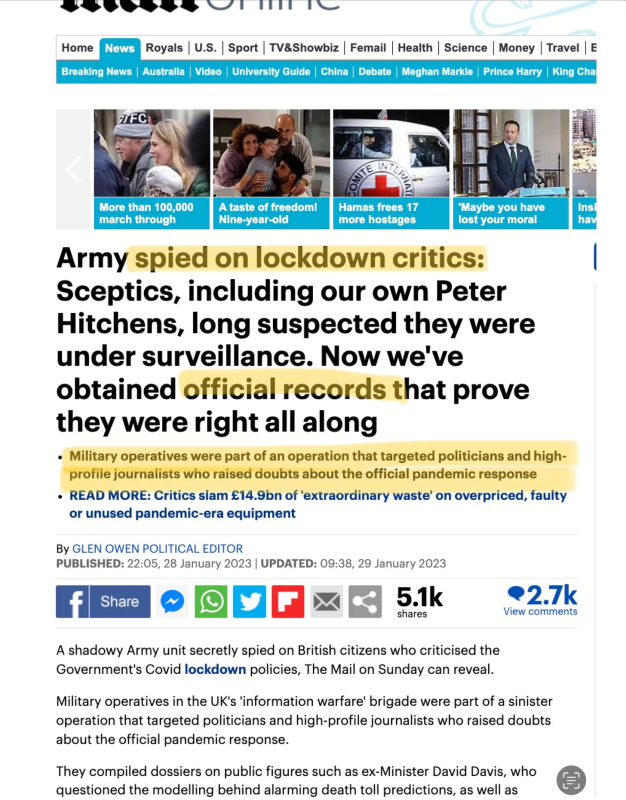
Jeez, can you imagine if they did something like this in the US?
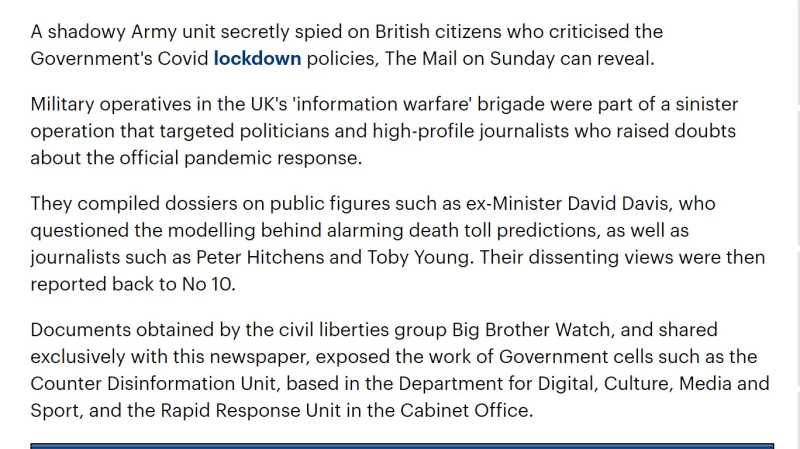
Because this sure seems like waging info-war on your own people…
Yikes.
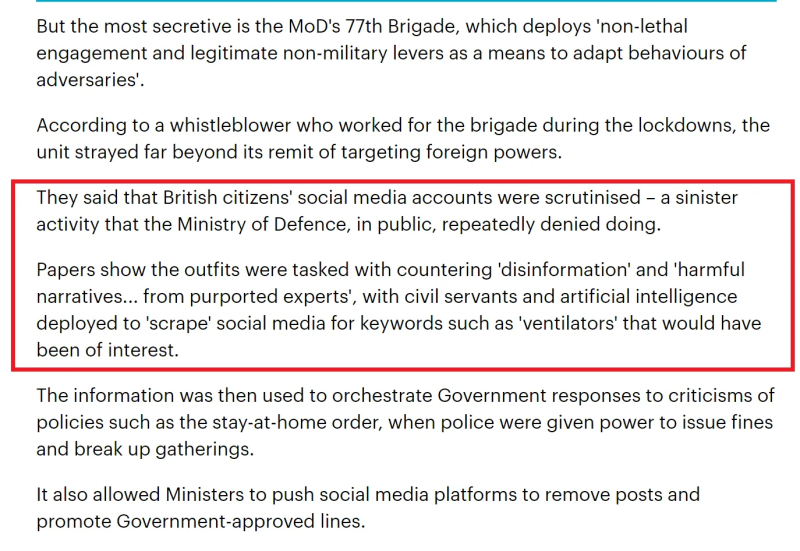
‘If We Get Away With It, It’s Legal’: Documents Reveal New Details on U.S. Government’s ‘Censorship-Industrial Complex’
By Michael Nevradakis, Ph.D. | The Defender | November 29, 2023
Government agencies, private-sector firms, academia and nonprofits were collaborating to combat alleged “misinformation” and “disinformation” as far back as 2017, according to new documents released Tuesday.
The “CTIL Files” — which refer to the Cyber Threat Intelligence League, or CTI League, a key player in the so-called “Censorship-Industrial Complex” — are based on documents received from an unnamed but “highly credible” whistleblower, according to investigative journalists Michael Shellenberger, Alex Gutentag and Matt Taibbi, who released the files.
The new documents rival or exceed the “Twitter Files” and “Facebook Files” in “scale and importance,” according to the journalists, two of whom — Shellenberger and Taibbi — were instrumental in releasing many of the “Twitter Files” that first called attention to the “Censorship-Industrial Complex.”
A comprehensive picture of the birth of the ‘anti-disinformation’ sector
The documents, which the journalists detailed on Substack, center around the activities of the CTI League, which “officially began as the volunteer project of data scientists and defense and intelligence veterans but whose tactics over time appear to have been absorbed into multiple official projects, including those of the Department of Homeland Security (DHS).”
According to the journalists, the CTI League documents “offer the missing link … to key questions not addressed in the Twitter Files and Facebook Files” and “offer a comprehensive picture of the birth of the ‘anti-disinformation’ sector.”
“The whistleblower’s documents describe everything from the genesis of modern digital censorship programs to the role of the military and intelligence agencies, partnerships with civil society organizations and commercial media, and the use of sock puppet accounts and other offensive techniques,” the journalists wrote.
Documents in the “CTIL Files” show members of the CTI League, DHS officials and key figures from social media companies “all working closely together in the censorship process.”
This “public-private model” laid the groundwork for “anti-misinformation” and “anti-disinformation” campaigns launched by the U.S. and U.K. governments in 2020 and 2021, the journalists wrote, including attempts to circumvent First Amendment protections against government censorship of speech in the U.S.
Such tactics included “masking censorship within cybersecurity institutions and counter-disinformation agendas; a heavy focus on stopping disfavored narratives, not just wrong facts; and pressuring social media platforms to take down information or take other actions to prevent content from going viral,” they added.
The CTI League went still further though, the journalists wrote, engaging “in offensive operations to influence public opinion, discussing ways to promote ‘counter-messaging,’ co-opt hashtags, dilute disfavored messaging, create sock puppet accounts, and infiltrate private invite-only groups.”
Such censorship lies at the heart of Missouri et al. v. Biden et al., a First Amendment censorship case where injunctions were issued against several federal agencies and government officials, barring them from communicating with social media companies regarding user content. The injunctions are now under review by the U.S. Supreme Court.
Former British intelligence analyst charged with creating counter-disinformation project
The journalists wrote that while previous releases of the “Twitter Files” and “Facebook Files” revealed “overwhelming evidence of government-sponsored censorship,” they had not revealed “where the idea for such mass censorship came from.”
The whistleblower alleged that a key figure in the CTI League, “a ‘former’ British intelligence analyst, was ‘in the room’ at the Obama White House in 2017 when she received the instructions to create a counter-disinformation project to stop a ‘repeat of 2016.’”
By 2019, this analyst, Sara-Jayne “SJ” Terp, had “developed the sweeping censorship framework,” leading a team of U.S. and U.K. “military and intelligence contractors” who “co-led CTIL.” Previously, in 2018, Terp attended a 10-day military exercise organized by the U.S. Army Special Operations Command, according to the journalists.
It was there that Terp met Pablo Breuer, a former U.S. Navy commander, who became a key figure in the CTI League. According to Wired, the two realized that misinformation “could be treated … as a cybersecurity problem.” This led to the development of CogSec, which soon housed the “MisinfoSec Working Group.”
“Terp’s plan, which she shared in presentations to information security and cybersecurity groups in 2019, was to create ‘Misinfosec communities’ that would include government,” the journalists wrote.
By spring 2020, it appears Terp achieved this plan, as the CTI League partnered with the Cybersecurity and Infrastructure Security Agency (CISA), which has been implicated in prior releases of the “Twitter Files” for its role in the “Censorship-Industrial Complex.”
The MisinfoSec Working Group included Renee DiResta, a former CIA operative who worked for the Election Integrity Partnership (EIP) — later renamed the Virality Project (VP). This group “created a censorship, influence, and anti-disinformation strategy called Adversarial Misinformation and Influence Tactics and Techniques (AMITT).”
According to the journalists, AMITT adapted “a cybersecurity framework developed by MITRE, a major defense and intelligence contractor that has an annual budget of $1 to $2 billion in government funding.” MITRE is a backer of the Vaccination Credential Initiative and the SMART Health Card — a digital “vaccine passport.”
Terp used AMITT to develop the DISARM framework, which the World Health Organization (WHO) applied in “countering anti-vaccination campaigns across Europe.”
The same framework “has been formally adopted by the European Union and the United States as part of a ‘common standard for exchanging structured threat information on Foreign Information Manipulation and Interference’” according to the journalists.
‘Can we get a troll on their bums?’
According to the journalists, MisinfoSec’s motivation for counter-misinformation was the “twin political earthquakes of 2016: Brexit and the election of Trump.”
“There’s something off kilter with our information landscape,” Terp and other CTI League members wrote, according to documents.
“The usual useful idiots and fifth columnists — now augmented by automated bots, cyborgs and human trolls — are busily engineering public opinion, stoking up outrage, sowing doubt and chipping away at trust in our institutions. And now it’s our brains that are being hacked,” they added.
In spring 2020, the CTI League set its sights on COVID-19-related narratives, targeting users who engaged in messaging that ran contrary to official policy.
“CTIL began tracking and reporting disfavored content on social media, such as anti-lockdown narratives like ‘all jobs are essential,’ ‘we won’t stay home,’ and ‘open America now,’” the journalists wrote.
“CTIL created a law enforcement channel for reporting content as part of these efforts. The organization also did research on individuals posting anti-lockdown hashtags … and kept a spreadsheet with details from their Twitter bios. The group also discussed requesting ‘takedowns’ and reporting website domains to registrars,” they added.
Regarding the “we won’t stay home” narrative, internal documents revealed by the whistleblower showed that CTI League members wrote, “Do we have enough to ask for the groups and/or accounts to be taken down or at a minimum reported and checked?” and “Can we get all troll on their bums if not?”
They also called posters circulating online promoting anti-lockdown posters “disinformation artifacts,” saying, “We should have seen this one coming” and asking “can we stop the spread, do we have enough evidence to stop superspreaders, and are there other things we can do (are there countermessagers we can ping etc).”
During CTI League brainstorming sessions to develop strategies for “counter-messaging for things like encouraging people to wear masks,” statements such as “Repetition is truth” were uttered by CTI League staff, the journalists noted.
The CTI League also sought to go “beyond simply urging Twitter to slap a warning label on Tweets, or to put individuals on blacklists.”
According to the journalists, “The AMITT framework calls for discrediting individuals as a necessary prerequisite of demanding censorship against them” and “trying to get banks to cut off financial services to individuals who organize rallies or events.”
As part of these efforts, even truthful information was targeted. In a 2019 podcast on “Disinformation, Cognitive Security, and Influence,” Terp admitted, “Most information is actually true … but set in the wrong context.”
“You’re not trying to get people to believe lies most of the time,” she said. “Most of the time, you’re trying to change their belief sets. And in fact, really deeper than that, you’re trying to change, to shift their internal narratives … the set of stories that are your baseline for your culture.”
Previous “Twitter Files” releases have revealed that true information was targeted for censorship by the U.S. government and social media platforms like Twitter if the information contradicted official policy regarding COVID-19 vaccines and restrictions.
‘Cognitive security’ a euphemism for censorship
In the same podcast, according to the journalists, Terp said, “Cognitive security is the thing you want to have. You want to protect that cognitive layer. It basically, it’s about pollution. Misinformation, disinformation is a form of pollution across the Internet.”
The journalists wrote, “A key component of Terp’s work through CTIL, MisinfoSec, and AMITT was to insert the concept of ‘cognitive security’ into the fields of cybersecurity and information security.”
Such “cognitive security” was seen as being threatened by the erosion of the mass media’s control on information and influence over public opinion.
Documents revealed by the whistleblower included a MisinfoSec report stating “For a long time, the ability to reach mass audiences belonged to the nation-state (e.g. in the USA via broadcast licensing through ABC, CBS and NBC).”
“Now, however, control of informational instruments has been allowed to devolve to large technology companies who have been blissfully complacent and complicit in facilitating access to the public for information operators at a fraction of what it would have cost them by other means,” the report said.
The same report also called for a form of “pre-bunking,” to “preemptively inoculate a vulnerable population against messaging,” suggesting that DHS-funded Information Sharing and Analysis Centers could be used to promote such pre-bunking.
‘If we get away with it, it’s legal’
Public-private partnerships were specifically sought out in an attempt to circumvent First Amendment free speech protections in the U.S., the documents revealed, even while Bloomberg, The Washington Post and Wired wrote glowing articles portraying the CTI League as a mere group of “volunteer” cybersecurity experts.
Yet, according to the journalists, “In just one month, from mid-March to mid-April [2020], the supposedly all-volunteer CTIL had grown to ‘1,400 vetted members in 76 countries’” and had “helped to take down 2,833 cybercriminal assets on the internet” including some which impersonated government organizations, the United Nations and WHO.
On the same 2019 podcast, according to the journalists, Breuer explained how the CTI League was getting around the First Amendment, by working to get “nontraditional partners into one room,” including “maybe somebody from one of the social media companies, maybe a few special forces operators, and some folks from Department of Homeland Security.”
Together, they would “talk in a non-attribution, open environment in an unclassified way so that we can collaborate better, more freely and really start to change the way that we address some of these issues,” Breuer said.
Breuer even likened these tactics to those employed by the Chinese government, saying “If you talk to the average Chinese citizen, they absolutely believe that the Great Firewall of China is not there for censorship. They believe that it’s there because the Chinese Communist Party wants to protect the citizenry and they absolutely believe that’s a good thing.”
“If the US government tried to sell that narrative, we would absolutely lose our minds and say, ‘No, no, this is a violation of our First Amendment rights.’ So, the in-group and out-group messaging have to be often different,” he said.
The whistleblower told the journalists that CTI League leaders did not discuss their potential violation of the First Amendment.
“The ethos was that if we get away with it, it’s legal, and there were no First Amendment concerns because we have a ‘public-private partnership’ — that’s the word they used to disguise those concerns. ‘Private people can do things public servants can’t do, and public servants can provide the leadership and coordination,’” the whistleblower said.
According to the journalists, the authors of the MisinfoSec report also “advocated for police, military, and intelligence involvement in censorship, across Five Eyes nations, and even suggested that Interpol should be involved.”
The CTI League documents also suggest that the organization was involved in a form of domestic spying, with one document noting that while censorship activities abroad are “typically” performed by “the CIA and NSA and the Department of Defense,” such efforts “against Americans” necessitate the use of private partners because the government lacks the “legal authority” to do so.
According to the whistleblower, CTI League members also went to great lengths to conceal their activities, with a CTI League handbook recommending the use of burner phones, online pseudonyms and the generation of fake AI faces. One document advised, “Lock your s**t down … your spy disguise.”
One suggested list of questions to be posed to prospective CTI League members proposed asking whether those individuals had ever “worked with influence operations (e.g. disinformation, hate speech, other digital harms etc) previously” and whether those efforts included “active measures” and “psyops” (psychological operations).
Indeed, according to the documents, several CTI League members had worked for the military or intelligence agencies, while according to the whistleblower, “roughly 12-20 active people involved in CTIL worked at the FBI or CISA” — even, for a time, displaying their agency seals alongside their names on the CTI League’s internal Slack channel.
Terp, for instance, previously designed machine learning algorithms and unmanned vehicle systems for the U.K.’s Ministry of Defence.
According to the whistleblower, the CTI League sought “to become part of the federal government.”
Shellenberger, Taibbi to testify before Congress this week
According to the journalists, the FBI declined to comment, while CISA, Terp and other CTI League figures did not respond to requests for comment.
However, one CTI League member, Bonnie Smalley, did respond to the journalists’ request. She wrote, verbatim, “all i can comment on is that i joined cti league which is unaffiliated with any govt orgs because i wanted to combat the inject bleach nonsense online during covid. … i can assure you that we had nothing to do with the govt though.”
“CTIL appears to have generated publicity about itself in the Spring and Fall of 2020 for the same reason EIP did: to claim later that its work was all out in the open and that anybody who suggested it was secretive was engaging in a conspiracy theory,” the journalists wrote.
“But as internal messages have revealed, much of what EIP did was secret, as well as partisan, and demanding of censorship by social media platforms, contrary to its claims,” they said, adding that “EIP and VP, ostensibly, ended, but CTIL is apparently still active, based on the LinkedIn pages of its members.”
The journalists said the documents will be presented to Congressional investigators and made public, while protecting the identity of the whistleblower.
Shellenberger and Taibbi will testify at Thursday’s hearing of the U.S. House of Representatives’ Select Subcommittee on the Weaponization of the Federal Government. They previously testified before the same committee in March.
On Tuesday, Taibbi appeared in a live YouTube webcast presenting some of the key revelations from the first release of the “CTIL Files.”
Michael Nevradakis, Ph.D., based in Athens, Greece, is a senior reporter for The Defender and part of the rotation of hosts for CHD.TV’s “Good Morning CHD.”
This article was originally published by The Defender — Children’s Health Defense’s News & Views Website under Creative Commons license CC BY-NC-ND 4.0. Please consider subscribing to The Defender or donating to Children’s Health Defense.
Meet The “Medically Kidnapped” Teenager Who Brought A Tyrannical Healthcare System To Its Knees
The story of Maya Kowalski and how it might help Covid treatment victims
BY JJ STARKY | NOVEMBER 19, 2023
Days ago, a Floridian jury ruled in favour of the surviving family members of a wife and mother who took her own life after her daughter, Maya, was “medically kidnapped” for nearly 90 days.
The six-person jury in Sarasota County unanimously determined Johns Hopkins All Children’s Hospital in St. Petersburg was liable for the incidents leading up to the January 2017 death of Beata Kowalski, 43.
They also ruled that the hospital should pay the Kowalski family well over $210 million for the losses they endured, which included punitive damages.
The Kowalski’s story is one of torment, heartache, and anguish.
In fact, it is the sort of story that would make the most limp-wristed of us metamorphose into an angry cage fighter that looks like they’ve snorted a cubic tonne of cocaine before stepping into the octagon. You want blood after hearing it.
Netflix made a near two-hour documentary on their case, ‘Taking Care of Maya’, which I highly recommend watching.
To recap the bare bones, in 2015, 10-year-Maya began experiencing some nasty symptoms. These included breathing problems, headaches, blurred vision, skin lesions, lower limb dystonia, and debilitating chronic pain. And they would come on arbitrarily. So her parents, Jack and Beata, naturally sought medical advice.
But it was to no avail. They saw dozens of medical experts and they still didn’t know what was wrong with their daughter. That was until they visited one Dr. Anthony Kirkpatrick in September 2015, who diagnosed Maya with advanced complex regional pain syndrome (CRPS).
CRPS is a form of amplified musculoskeletal pain syndrome in which pain from a physical interaction outlasts the expected recovery time. For example, a gentle touch can mimic a slap – a flick, a punch.
Fortunately for Jack and Beata, Dr Kirkpatrick encountered the syndrome before in past patients. He had a treatment protocol in mind using ketamine, but – and herein lies the beginning of the problem – it was not conventional or well-known. Nor was the prescribed treatment available in Florida, where the Kowalski family lived.
Low doses of ketamine kept proving ineffective and so the family travelled to Mexico so Maya could undergo a ketamine coma, fearing her symptoms would worsen and become fatal. Thankfully, the procedure was successful. Her symptoms dissipated.
Except, one random night in October 2016, they returned – with vengeance. Her father rushes her to the local hospital, Johns Hopkins All Children’s, admits her, and tries to explain the rare syndrome to the staff. But they were mystified. They hadn’t come across the condition and even became suspicious of its existence. Beata told the hospital staff what treatment was required, but as soon as they learnt of the amount of Ketamine she had been taking, it was too late.
The next thing they know, a child abuse paediatrician, Dr Sally Smith, turns up unidentified to Maya’s bedside for an assessment. Within ten minutes, Smith concludes Beata has been abusing Maya, and that CRPS is not present. A nurse then informs Jack that his daughter is now in state custody and orders him to leave. Maya has been diagnosed with Munchausen syndrome by proxy, the fancy phrase for “medical child abuse”.
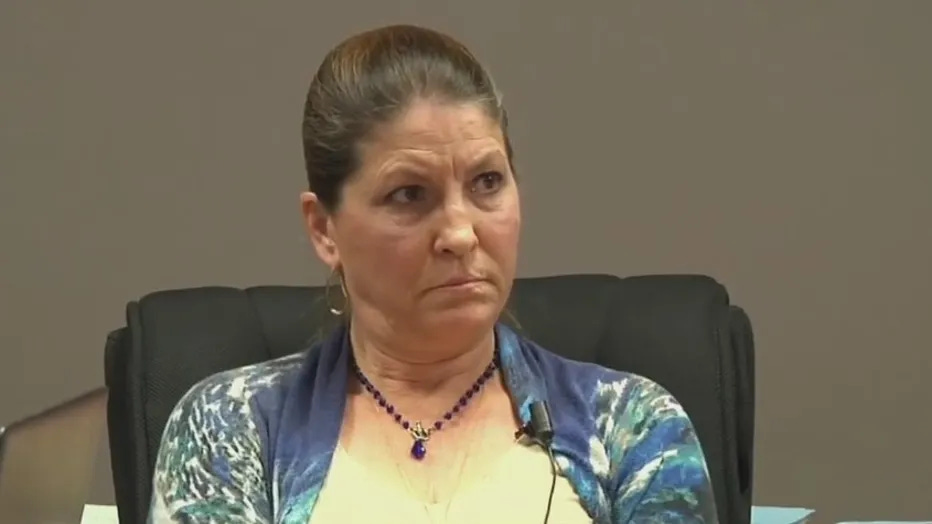
Sally Smith
What transpires over the next 3 months is nothing short of parental hell. Maya was still separated from her family. Her father was allowed to see her now and again because he adopted the role of pacifier, but her mother, Beata, who’d actively argued with hospital staff, was not.
Beata descended into a pit of depression. During rare scheduled calls with Maya, she discovered her symptoms were deteriorating and that the hospital had changed her treatment without her consent. Allegations also surfaced that a contracted social worker had stripped her daughter down to a sports bra against her will in order to take pictures of her body. This, again, occurred without Beata and Jack’s consent.
The same social worker, Catherine Bedy, Maya accused of telling her she was “going to go into a foster home”, her mother “was in a mental institution”, and she was “going to end up adopting” her.
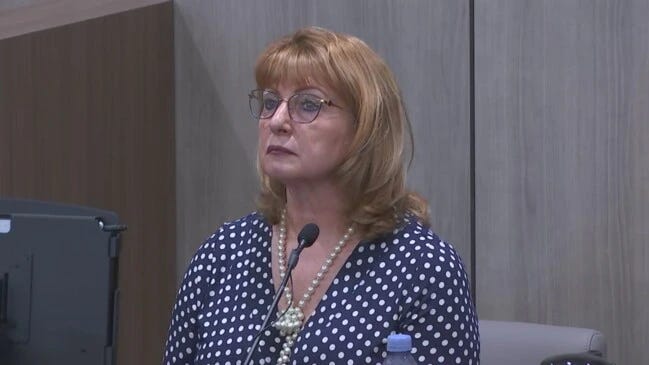
Catherine Bedy
On January 8, 2017, after 87 days without her daughter, believing she is the primary reason for Maya’s separation, Beata commits suicide. She hangs herself in the garage at home while Jack and her son Kyle attend a party. Jack didn’t discover her body until her brother had read Beata’s suicide note and rushed over to the home. When Jack woke up to Beata’s brother’s piercing screams, he knew his wife had taken her own life.
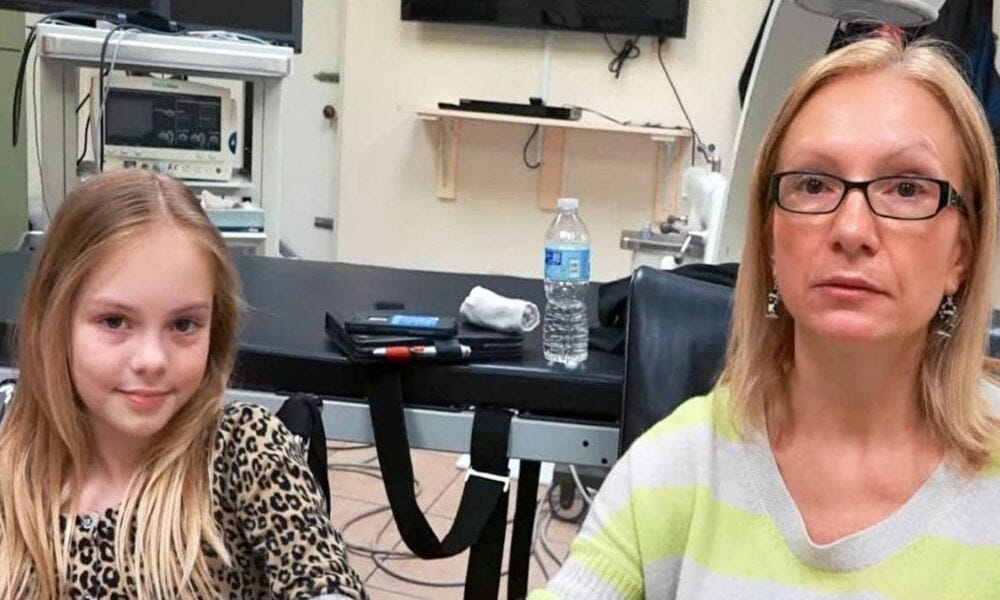
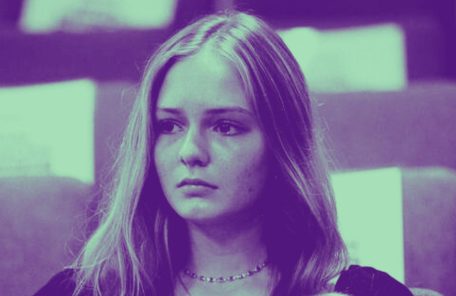
10-year-old Maya with her mother, Beata
In the fallout of Maya’s medical kidnapping, the Kowalski’s lawyer, Debra Salisbury, discovered Dr Smith works for the Suncoast Center, which provides child welfare services to Pinellas County. Salisbury also finds out that children in Pinellas County, where the hospital is based, are almost two and a half times as likely to be removed from their families when compared to the Florida average. Suspicions arise Suncoast has incentivised its employees to misdiagnose children so their customer base could increase.
Retrospective analysis of Maya’s diagnosis would support this theory. After Beata’s suicide, Dr Kirkpatrick, the doctor who initially prescribed the Ketamine, testifies that he informed Dr Smith of Maya’s rare condition and offered to send her all the documented evidence to support his prescription when she contacted him to file her original report. The only thing is, she didn’t include any details of their discussion in that report. The medical expertise of the doctor who’d provided the most materially effective treatment was totally excluded.
Weeks later, local investigative reporter Daphne Chen hears of Beata’s passing. Like any good journalist seeking truth, she refuses to accept the “official story” – “official narrative” connotations intended – and digs in. In January 2019, when her fingertip presses publish on a write up about the Kowlaski’s, something unexpected occurs. Calls start flying in.
Chen becomes inundated with calls and emails from local parents, alleging the misdiagnosis of Munchausen syndrome by proxy. Instances where parents called 911 because their child was experiencing a life-threatening emergency – seizures, breathing difficulty, excess vomiting – were resulting in the same outcome. After their child underwent a series of tests and scans, hospital staff would question parents over the injuries and symptoms and issue a case review. And curiously, the one thing they all had in common – you guessed it – was an assessment from Dr. Smith. Post-Smith assessment, these parents found themselves legally segregated from their child, with some being arrested. They did what the system told them to do, sought help, but were instead, punished.
Upon further investigation, Salisbury, the Kowalski’s lawyer, found that the root cause was less to do with a rogue clinician than it was a deep fault in the system. In the 1970s, child protective services in the U.S. diagnosed child abuse via excess corporeal punishment. We’re talking overt physical abuse – beatings, cigarette burns, etc. But overtime, they redefined the criteria. Fast forward to the 2020s, parents with children suffering from rare conditions that consult with over 3 or 4 doctors can find themselves accused of “doctor-shopping”, exposing a child to unnecessary medical procedures and thus, being guilty of medical child abuse.
In a recent interview with The Epoch Times, investigative journalist Stellar Paul explained how similar circumstances led to the mistreatment of hospitalised Covid patients. Like Maya, these patients were attacked by a system that continually found itself departing from traditional medical ethics and toward a form of blanket-style healthcare. In turn, personalised treatment and attention were subverted. The medical complex treated them en masse, rather than as individuals with unique health needs.
Take the story of Ray Lamar, who, when hospitalised with Covid, specifically requested he not receive certain treatments. He even wrote on his inner forearm, “no vent. (ventilator) no Remdesivir”. So what did his “carers” do? They gave him Remdesivir, without informing him of dangers, without receiving his consent. He later died.
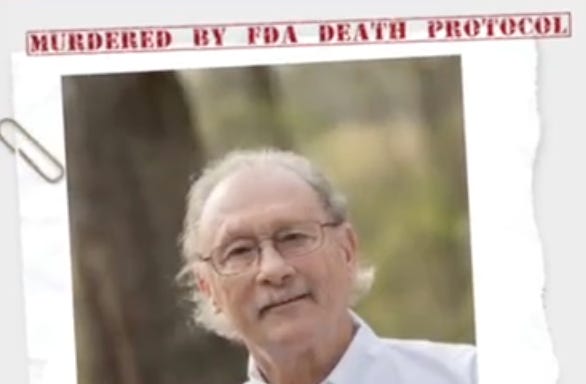
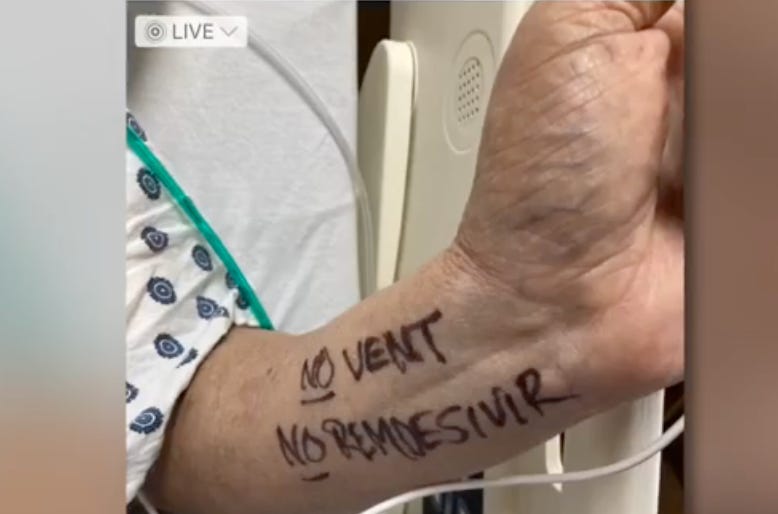
Then, there is Christine Johnson. Christine’s daughter was a nurse, so she was aware of Remdesivir’s questionable benefit-to-risk ratio and the detrimental impact it could have on her kidneys. She also said she didn’t want the drug. So hospital staff gave it to her while she slept. She also died.
These stories go on and on.
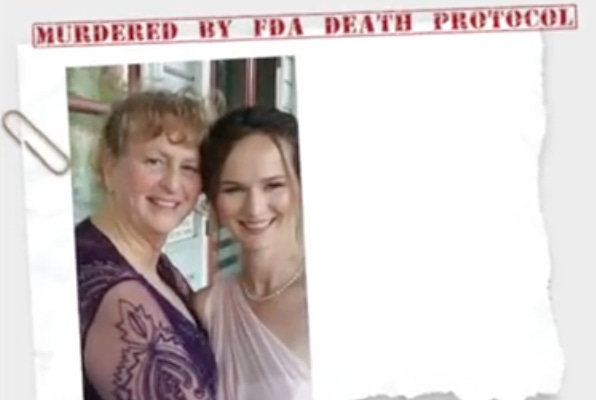
Why did hospitals treat patients in this way? Well, again, as Stellar explains, it is because, whether by policy or practice, external forces adulterated the structure of the system. For Ray and Christine, it was the 2020 Coronavirus Aid, Relief, and Economic Security Act (CARES) and the Public Readiness and Emergency Preparedeness Act (PREP). One financially incentivised the use of dangerous treatments while the other legally shielded hospitals that administered them. For Maya, it was the empowerment of Dr Sally Smith and the dilution of the definition of “child abuse”.
The court proceedings for the Kowalski’s were not straightforward. There were various lengthy delays, and they wondered if they would ever see justice. To give you an idea of how vicious the hospital’s lawyers were, when Maya missed just one hearing, they combed through her social media and presented photos to the jury of her attending her homecoming. This, they argued, was proof that Maya could live a “normal teenager’s life”. Talk about vipers.

However, thanks to Beata’s meticulous note-taking of events without which the family’s lawyer said prosecution would have not been possible, the Kowlaski family successfully sued the hospital on multiple claims of false imprisonment, battery, intentional infliction of emotional distress, medical negligence, negligent infliction of emotional distress, negligent training of doctors and healthcare providers, and fraud.
There are numerous parallels we could draw from Maya’s story and 2020 Covid treatment victims but if there is one overarching precedent set, it is how the mutated structure of the medical complex has facilitated anti-healthcare. And it is one that could help dozens upon dozens of Covid treatment victims currently fighting their battles in court as well as other victims of the misdiagnosis of medical child abuse.
Perhaps the saddest realisation after researching this case is that had Beata not taken her own life, it is unlikely we would have heard about Maya’s ordeal. May she rest in peace.
Elon Musk’s Comments On Mechanical Ventilation Betrayed A Stunning Amount of Ignorance – Part 1
BY PIERRE KORY, MD, MPA | NOVEMBER 15, 2023
Recently, Elon Musk was interviewed by Joe Rogan where he shared that, early in Covid, he had access to front-line data in China and “talked to doctors from Wuhan,” implying that if we had known what he knew, our use of mechanical ventilation would have been different. That is almost certainly true but he then went on to make several inaccurate statements which I think further fuel widespread misunderstanding and overestimation of the actual negative impacts of mechanical ventilation use during Covid in the U.S.
Now, I find it shocking that I might be putting myself in a position to defend the U.S. Covid response as that would be an outrageous endeavor, however, I take issue with his subsequent statements on mechanical ventilation use as they were almost completely wrong (almost).
I hate misinformation (inaccurate /false information) about Covid and I believe Elon trafficked in the same. I do not believe he did so out of willful, malevolent intent as that would be disinformation (what the now corporate controlled U.S. government regime does to us). His comments were instead borne of a stunning amount of ignorance regarding the real risks of mechanical ventilation and exactly how mechanical ventilation was misused (and not misused) both in China and in the U.S. during that first wave. So, here is my attempt to “set the record straight.”
ELON: “We had 20,000 employees in China and during the first wave we had nobody die and nobody get ill.”
This is both interesting and unsurprising and almost certainly accurate. It brings back harsh memories of all the fear porn that was being blasted out by the world’s media with cherry-picked images of scenes from the hardest hit areas like Wuhan, Lombardy, New York, Seattle etc. They did this while the vast majority of urban areas in the country and around the world did not experience such tidal waves of people in acute respiratory failure.
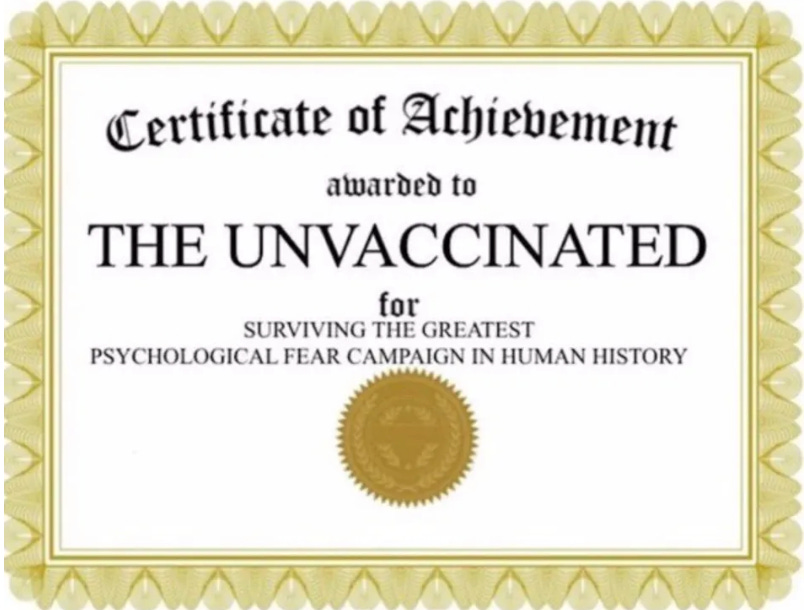
Although news media trying to get as many eyeballs glued to their shows is not new (i.e. “if it bleeds it leads”) in early Covid, it soon became apparent to many (in my world at least) that they also did so to instill widespread fear to increase compliance with what were soon to be draconian violations of civil liberty, bodily autonomy, informed consent, and free speech. Those violations were deemed necessary in their plight to coerce the entire U.S. population to be vaccinated. This is probably a good time to re-read the anonymous poem I posted last year titled “Message to the Unvaccinated.” Link here:
However, on this point of instilling the greatest amount of fear possible, a recent post by A Midwestern Doctor quoted Scott Atlas, a completely sane member of the White House’s insane Coronavirus Task Force:
As often happened, Fauci spoke up to support Dr. Birx’s concerns, saying people need to be warned even more strongly about the dangers of the virus spreading, about wearing masks and distancing. He claimed Americans didn’t think the virus was serious, and that was the reason cases spread. I was honestly surprised. I thought people were already panic-stricken. Normal life had virtually ceased to exist, even eliminating serious medical care or last visits with dying family. Meanwhile the media were on-message 24/7, instructing the public about masks and social distancing; there were signs and announcements demanding masks and diagrams about distancing everywhere; healthy young people were outside riding bicycles or driving their cars alone, wearing masks. Indeed, surveys showed that most adults perceived grossly exaggerated risks, particularly but not only younger people; and yes, a high percentage were obeying the edicts, distancing and wearing masks, according to virtually every published survey.
I challenged him to clarify his point, because I couldn’t believe my ears. “So you think people aren’t frightened enough?”
He [Fauci] said, “Yes, they need to be more afraid.”
To me, this was another moment of Kafkaesque absurdity. I replied, “I totally disagree. People are paralyzed with fear. Fear is one of the main problems at this point.” Inside, I was also shocked at his thought process, as such an influential face of the pandemic. Instilling fear in the public is absolutely counter to what a leader in public health should do. To me, it is frankly immoral, although I kept that to myself.”
Note: Fauci also fear-mongered for his own benefit throughout the AIDS crisis (which amongst other things created significant stigmatization towards the gay community as Fauci asserted without evidence that HIV might be transmitted without physical contact).
ELON: I called doctors in Wuhan and asked “what are some of the biggest mistakes you made in the first wave” and they said “we put far too many people on mechanical ventilators.”
My motivation for writing this post is to try to correct (but not completely refute) the now widespread, strong belief that it was the “ventilators” that killed people and that if we did not use mechanical ventilators, many lives would have been saved. Or, similarly, “if they hadn’t put my (wife/mother/father etc) on a ventilator, they would be alive today.”
I largely and strongly disagree with the latter assessment (but not completely). The reason for my disagreement is that, based on my experiences running Covid ICU’s at the University of Wisconsin in Madison, Beth Israel Medical Center in New York City, Greenville Memorial Hospital in South Carolina, St. Lukes Medical Center in Milwaukee, and Aspirus Wausau in Central Wisconsin, it wasn’t the vents that killed people. It was the lack of effective treatments being adopted.
Initially, it was the lack of any treatment (i.e. “supportive care only” approaches, particularly at UW) that led to widespread death after what was often weeks on a ventilator and later it morphed into sub-optimal, insufficiently aggressive, sometimes harmful, monolithic treatments like Remdesivir and a modest dose of corticosteroids instead of a broad, multi-component, safe, synergistic combination of therapies such as the MATH+ protocol that FLCCC members were using and recommending for hospital patients (forgive me for I am biased). However, Elon then said the following regarding mechanical ventilation:
“This is what is exactly damaging the lungs it is not Covid. The treatment, the cure is worse than the disease.”
“People yelled at me saying I am not a doctor but I said yeah but I do make spaceships with life support systems, what do you do?”
Well, Elon, although I don’t build spaceships, I actually used and taught mechanical ventilation to keep people alive for a living and did so throughout most of Covid. Further, mechanical ventilation was a deep interest if not passion of mine for almost 20 years prior.
The act of of sedating and paralyzing someone to place an endotracheal tube through their vocal cords and into their trachea is called “intubation” and is required to transition someone to support by an invasive mechanical ventilator. What I witnessed in the first wave (but not later waves) was doctors favoring “early intubation/mechanical ventilation” out of fear that the patient would suddenly crash (intubating a “crashing” patient is a higher risk procedure). And yes, another subtle, but not overt motivation, very early on, was to “protect” staff from exhaled breath due to fear of heated high flow nasal cannulas (this is an intermediate support device often used to avoid intubation) – more on this issue/aspect in Part 3 which is already available here).
Now, although it is true that each extra day on a ventilator can worsen prognosis, the harms are much more from prolonged, poorly responsive illness requiring prolonged sedation and immobility which then cause confusion/delirium and disuse atrophy of the muscles. So for him to say it is the ventilators which damage the lungs more than Covid is completely off – know that patients with neurological injuries affecting respiration can be kept alive safely on ventilators for weeks to months to years to decades without significant “damage” accumulating to the lungs.
Admittedly, the situation of someone with a lung injury is different in that inappropriate ventilator settings can certainly further damage the lungs, but with modern ventilator techniques such as low tidal volumes, daily spontaneous breathing trials, use of appropriate positive-end expiratory pressure, highly responsive inhalation triggers etc, the harms of mechanical ventilation to the lungs are generally minimal.
To wit, I have successfully extubated thousands of patients in my career despite devastating injuries to their lungs requiring prolonged periods on the ventilator, even in situations where the ventilator was particularly difficult to set in order to achieve the holy grail of mechanical ventilation, that of “patient-ventilator synchrony.” All I am saying is that his comment on the harms of mechanical ventilation was grossly overstated to an un-credible degree. He then went further:
“The treatment is worse than the disease.”
Ugh. Mechanical ventilation is not and has never been a treatment, it is simply a means to support a patient’s breathing to keep them alive while you administer therapies (more on this below) to reverse the underlying insult or infection that landed them on the ventilator in the first place – no-one, and I mean no-one in medicine has ever viewed the ventilator as a treatment or cure for anything.
However, the initial practice of “early intubation” caused unmanageable and chaotic situations in many hospitals by increasing demand for ICU rooms and ventilators, but I will argue below that this situation was almost completely fueled by the lack of effective treatments being adopted.
This is a key distinction, i.e the harm of ineffectively or not treating the disease far, far outweighed the harms of intubating too early. Further, “early” intubations largely occurred during the first wave, and as physicians became more familiar with the disease they began to defer intubation to much more advanced degrees of respiratory failure and hypoxemia (obviously there were exceptions to this, but, as I mentioned above, I travelled and worked fairly widely, and in each center I found that the ICU docs quickly learned to defer intubation to as late as possible in Covid induced hypoxemic respiratory failure. This issue is what I will explore in further detail in Part 2.
I instead maintain that the absurdly high death rates in many hospitals in the U.S and across the world in the early waves of Covid was due to an over-reliance on “supportive care only” approaches (i.e. limiting interventions to just supplemental oxygen, fluids, nutrition, fever suppressants, mechanical ventilation). Rarely were effective treatments targeting the underlying pathophysiology being offerred at most academic medical centers based on the widespread belief that patients were dying of a viral pneumonia and that no effective anti-viral therapies existed.
What was not being sufficiently taught or disseminated at that time is that Covid-19 disease had multiple phases, i.e. an early “viral replicative phase” marked by typical viral syndrome symptoms such as cough, fever, congestion, sore throat, fatigue etc with a minority of those patients then going on to develop the later “hyper-inflammatory phase” involving the lungs. The FLCCC tried very hard to alert “the system” to the fact that early studies found no live, culturable virus in patient secretions beyond Day 6 (cue the folks who state there is no virus and/or they don’t exist. To those, all I can offer is this excellent post addressing the issue by A Midwestern Doctor).
Thus, after about Day 6, a minority of Covid-19 patients began to develop morphed a hyper-inflammatory, pulmonary phase due largely to activated macrophages (an immune cell) as well as micro-clumping or clotting of blood cells and proteins. In this latter phase, anti-inflammatory or immunosuppressive therapies combined with anti-coagulants were required (this is why the FLCCC recommended corticosteroids and blood thinners in hospital patients from the outset and were observing excellent results with early use).
To wit, my first paper on Covid (and the one I am most proud of) was initially drafted in April of 2020. I argued then that Covid-19 pulmonary disease was not a viral pneumonia but instead an “organizing pneumonia” (a form of lung injury with many causes (viruses are only one of them) but whose mainstay of therapy is corticosteroids).
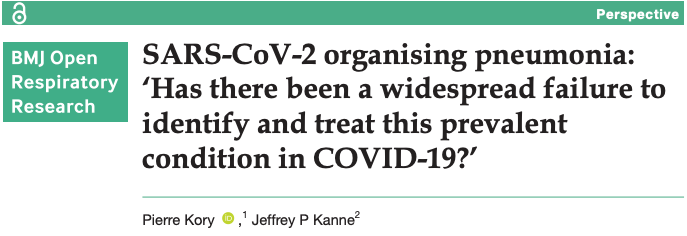
From the abstract:
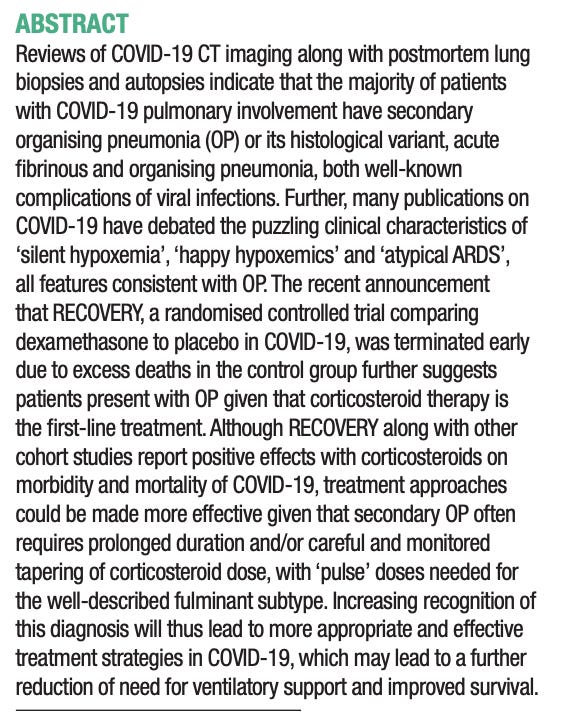
I arrived at that hypothesis after a couple of weeks of being mystified by the repeated presentations of Covid patients with what was called at the time, “happy hypoxia”, i.e. the state of requiring high amounts of supplemental oxygen yet without exhibiting a significant increase in the work of breathing.
I knew I had seen “happy hypoxia” on a couple of occasions in my career but could not remember what was wrong with those patients until one morning during a shower before an ICU shift in New York City it hit me – “these patients remind me of patients with organizing pneumonia!” As soon as I got to work, before my shift, I called Dr. Jeff Kanne at the University of Wisconsin, one of the top chest radiologists in the world and an expert on organizing pneumonia.
“Jeff, what would you say if I told you that I think that all of these Covid patients are suffering from organizing pneumonia?” I asked. His answer? “Of course they are. We wrote this up in March in the journal Radiology after an expert panel that I chaired completed our review of all the CT scans from Wuhan.” They had actually written in their expert report that “the most common reported CT findings in Covid-19 patients are typical of an organizing pneumonia pattern of lung injury.”
“Clinicians don’t read radiology journals,” I shouted into the phone. “We need to publish this in a clinical medical journal! Like NOW!” We quickly agreed that we would write it up together.
I went home after my ICU shift and started working furiously. The paper included radiographic, pathologic, and clinical evidence to try to prove that the pulmonary phase of Covid-19 was an organizing pneumonia and that the first line of therapy for this condition was (wait for it)… corticosteroids.
Note that my paper above was not published until September 2020 due to 5 journals rejecting it, with one journal rejecting it because a peer-reviewer said “this cannot be published until a randomized controlled trial of corticosteroids is conducted.” Welcome to my life.
The problem we in the FLCCC had with getting the world to use corticosteroids in the hospital phase were many and will be explored in Part 2 (already available).
Mayo Clinic is Sued For Suspending Doctor Over Online Posts on Covid and Transgenderism
By Ben Squires | Reclaim The Net | November 15, 2023
Dr. Michael Joyner, backed by the Academic Freedom Alliance (AFA), has initiated a lawsuit against the Mayo Clinic College, including its president and board chair. The suit arises from disciplinary actions taken against Joyner following his public comments on topics within his field of expertise. Specifically, the controversy revolves around statements he made to the New York Times about gender differences in athletic performance and to CNN regarding the use of convalescent plasma in COVID-19 treatment. The Mayo Clinic’s response, which involved suspension, salary review implications, and strict media interview oversight, is at the heart of this legal challenge.
We obtained a copy of the complaint for you here.
Lucas Morel, chair of the AFA’s academic committee, emphasized the lawsuit’s significance, asserting that “academic freedom is a key guarantor of scientific integrity.”
Morel expects the case to establish a precedent for the freedom of scientists and academics to express their professional opinions without undue influence from financial or political interests. The AFA, which previously supported Joyner during his disciplinary hearings, is now financing this lawsuit, highlighting the organization’s commitment to protecting academic freedom.
Joyner’s legal action, filed with the State of Minnesota’s Third Judicial District, seeks compensation for the damages incurred from the disciplinary measures. These included a week-long unpaid suspension, denial of salary increase, and a potential termination threat, all of which have reportedly harmed Joyner’s finances and professional reputation. The lawsuit, handled by Allen Harris Law, was filed after allowing the defendants to review and respond, which they declined.
What does the WHO say about its power to enforce the Pandemic Treaty (and International Health Regulations)?
By MERYL NASS | NOVEMBER 12, 2023
Many people have insisted that the WHO could not make the US do anything. Let me remind those people that the US government under Biden is instrumental in pushing forward the WHO proposals, and so it will comply. Here is what the WHO says:

What is meant by a ‘convention, agreement or other international instrument’?
Conventions, framework agreements and treaties are all examples of international instruments, which are legal agreements made between countries that are binding.
Why did WHO’s Member States decide to create an accord for pandemic preparedness and response?
In light of the impact of the COVID-19 pandemic, WHO’s 194 Member States established a process to draft and negotiate a new convention, agreement, or other international instrument (referred to in the rest of this FAQ, generally, as an “accord”) on pandemic preparedness and response. This was driven by the need to ensure communities, governments, and all sectors of society – within countries and globally – are better prepared and protected, in order to prevent and respond to future pandemics. The great loss of human life, disruption to households and societies at large, and impact on development are among the factors cited by governments to support the need for lasting action to prevent a repeat of such crises.
[Ho ho ho—Nass]
At the heart of the proposed accord is the need to ensure equity in both access to the tools needed to prevent pandemics (including technologies like vaccines, personal protective equipment, information and expertise) and access to health care for all people.
[If this were true, why do the treaty and amendments only discuss health “coverage” which means health insurance, rather than health care? The WHO knows the difference, but only demands “coverage”—a sop to the insurance industry.
Furthermore, the WHO demands censorship of information not in agreement with the WHO’s narratives, not free sharing of information—so much for information equity—and its so-called expertise was used to overdose hospitalized patients with HCQ without informed consent, when these unfortunates were enrolled in the WHO’s “SOLIDARITY” trial. Its expertise led to demanding that nations stop the use of HCQ and ivermectin for COVID and administer more shots. Who needs this expertise? —Nass]
Who else is involved in the process for the accord?
Besides WHO Member States, the process for developing a possible new accord is providing extensive opportunities for engagement with relevant stakeholders, including other United Nations system bodies, and a wide range of other non-State actors in official relations with the WHO, to ensure robust and inclusive participation in the proceedings of the Intergovernmental Negotiating Body. Furthermore, WHO is seeking complementary inputs through public hearings with stakeholders including: international organizations; civil society; the private sector; philanthropic organizations; scientific, medical, public policy and academic institutions and other entities with relevant knowledge, experience and/or expertise.
[In other words, Bill Gates, who was the largest funder of the WHO the year Trump defunded the organization, gets the lion’s share of input, while we peons get none. Trump then turned around and funded Gate’s’ charity GAVI with the money, and GAVI turned around and gave it back to the WHO. That was our money, by the way.—Nass]
—There is more of this nonsense on this webpage, but you can go look it up yourself if you have the stomach for it.—Meryl
CPSO Pronounces Judgment Over Dr Trozzi
But the shots are still toxic, Pfizer committed fraud, everyone has been assaulted, and we must act now to save lives.
Dr Mark Trozzi | November 6, 2023
Health Canada recognizes that Pfizer committed fraud. The shots turn out to be even worse than I thought. They contain large quantities of DNA, and multiple genetic sequences including a very dangerous SV40 promoter sequence which promotes permanent genetic modification, disease, and cancer. Sadly, innocent people are uninformed and lining up for injections that they would never agree to if they knew what was in them and what it can do to them.
Here is my ten minute video to update you, with a focus on current priorities and strategies. Crisis is a combination of danger and opportunity. The SV40 revelation marks severe danger, but it is also an opportunity to finally set things right. This video includes genuinely kind and honest advice for the CPSO administrators and staff; and a small request for you to please share your judgement of me as a doctor with the CPSO.
Please Share Your Judgment of Dr Trozzi with the CPSO here:
- CPSO Compliment a physician https://www.cpso.on.ca/en/Public/Public-Information/Compliment-a-physician
- or by email direct to feedback@cpso.on.ca

CPSO v. Trozzi – Case Update – November 1, 2023
COLLEGE DENIES DR. TROZZI’S RIGHT TO FREEDOM OF EXPRESSION
We are the Administrative State and You are Not
The Ontario Physicians and Surgeons Discipline Tribunal has ruled that Dr. Mark Trozzi is guilty of professional misconduct and dishonourable conduct and is incompetent in the practice of medicine for questioning the government’s Covid-19 narrative. He was also found guilty of professional misconduct and was deemed incompetent for writing medical exemptions for Covid-19 injections in support of a patient’s right to refuse coerced medical treatment under Ontario’s Health Care Consent Act and section 7 of the Canadian Charter of Rights and Freedoms.
In 2021, the College of Physicians and Surgeons of Ontario established three Covid-19 restrictions through website statements — doctors were forbidden from: (i) making any statements that discourage anyone from following Covid-19 public policies and recommendations; (ii) prescribing alternative Health Canada approved medications for the treatment of Covid-19; and (iii) writing medical exemptions for Covid-19 injections, unless a patient had suffered a severe allergic reaction or developed myocarditis after a first shot. Based on the restrictions relating to freedom of expression and medical exemptions, the College issued investigation orders against Dr. Trozzi in 2021.
This eventually led to a five-day hearing in July of 2023 during which the College Tribunal focused its prosecution on Dr. Trozzi’s daily newsletter at drtrozzi.org, where he had supposedly caused harm by spreading “misinformation” about Covid-19 science. The College was particularly concerned with Dr. Trozzi’s view that neither Big Pharma nor Health Canada had done the due diligence required to prove the Covid-19 injections were safe and effective. The Tribunal concluded that his views were inflammatory, unprofessional and worthy of censure. On November 10th, the Tribunal will hold a penalty hearing to determine whether to revoke the licence of the 25-year ER veteran and former university professor.
Trozzi’s lawyer, Michael Alexander, commented: “The Tribunal wrote up the prosecution’s position on almost every issue. The one saving grace was the College’s acknowledgement that the right to free expression includes the right to make statements that may be wrong or mistaken. However, that position is difficult to reconcile with the Tribunal’s view that Dr. Trozzi can be punished for spreading misinformation.“
He added: “The Tribunal did not address our argument that the College lacked the authority to investigate and prosecute Dr. Trozzi since its Covid-19 restrictions were merely recommendations rather than binding rules or regulations, even though we cited the Ontario Divisional Court and the Ontario Court of Appeal in support of our position.”
Further, he stated: “The Tribunal totally ignored our cross-examination of the College’s expert witnesses, which makes the entire decision a complete travesty. On cross, the College’s main expert witness on Covid science, Dr. Andrew Gardam, admitted that he had never responded to the 41-page expert report provided by Dr. Trozzi in which he rebutted Gardam’s own 8-page expert report with 29 scientific citations. As a result, in closing submissions, we argued that Dr. Trozzi was unrefuted on Covid science; yet, the Tribunal made no mention of this fact.”
Finally, he added: “The Tribunal also paid no attention to the fact that the Supreme Court recognized an expansive right to freedom of expression as an inherent feature of parliamentary government as early as 1939, which gives the right a higher status than it enjoys under the Charter. In matters of law, we will appeal the decision to the Divisional Court on the standard of correctness.”
For media inquiries, please contact Michael Alexander by cell at 416-318-4512 and by e-mail at malexanderjd@protonmail.com.
Please support the fight to restore ethical medicine and the rule of law in Ontario and Canada.
Please sign this petition to defend my license to practice medicine in Ontario and ultimately restore Canadians’ access to many honest doctors who have been persecuted for resisting the unethical and unscientific covid agenda.
Reports about Dr Trozzi and the CPSO from others:
- Life site News: Dr. Mark Trozzi may lose medical license for defying COVID narrative
- Epoch Times Tribunal Finds Ontario Doctor Critical of COVID Measures Committed Professional Misconduct
- Derek Sloan Funding the Fight: Dr. Trozzi Latest Update – May Lose Licence Next Week
- Denis Rancourt, “In Canada, Dr Mark Trozzi has opposed the toxic death-causing vaccine in every way he can, so the CPSO @cpso has decided that he is incompetent! ( And “disgraceful, dishonourable or unprofessional”)”
Here’s a history to be proud of, and “accused” of:
- To follow Dr Trozzi’s public covid truth mission beginning January 2021 and right up until the present start here
- Or to begin with the most recent and work your way back start here
DNA Contamination/ SV40 promoter sequence/ Pfizer’s Fraud/ Health Canada
- Dr Trozzi Alert | There’s DNA in the RNA Shots. Lots! April 2023
- World Council For Health Urgent Panel of Global Experts Confirm Dangerous Criminal Undeclared DNA In Pfizer And Moderna Covid-19 “Vaccines”
- Epoch Times regarding plasmid DNA contamination and Health Canada
Cancer:
Canadian doctor sounds alarm over ‘turbo cancers’ in young people due to COVID jabs. ‘I’ve never seen anything like this,’ said Dr. William Makis regarding ‘stage four’ cancers presenting in young people and uncharacteristically aggressive leukemias.
Outcomes after Early Treatment with Hydroxychloroquine and Azithromycin: An Analysis of 30,423 COVID-19 patients
By Peter A. McCullough, MD, MPH | Courageous Discourse | November 6, 2023
We perform prospective, randomized, double-blind, placebo-controlled trials to test drugs, vaccines, devices, and other products for safety and efficacy. Randomization is important since it handles: 1) selection bias, 2) all known and unknown confounders. Despite the hundreds of billions of dollars spent during the pandemic, we did not have an investment in large, multidrug prospective, randomized, placebo controlled trials or comparative studies to test the best drug regimens.
In the end, what patients care about is how they feel, function, and survive. When it came to COVID-19, whether randomized or not, if patients survived if they were in the optimally treated group. The only way to assess how a high-risk population fared in the pandemic is to report on a large sample of patients sick with COVID-19 with a large number of the outcome of of interest—death.
Brouqui et al reported from a French database of 30,423 COVID-19 patients of whom 535 succumbed to the illness. In great detail, the investigators report mortality according to ambulatory treatment received, hospitalization, and the course over the following six weeks.
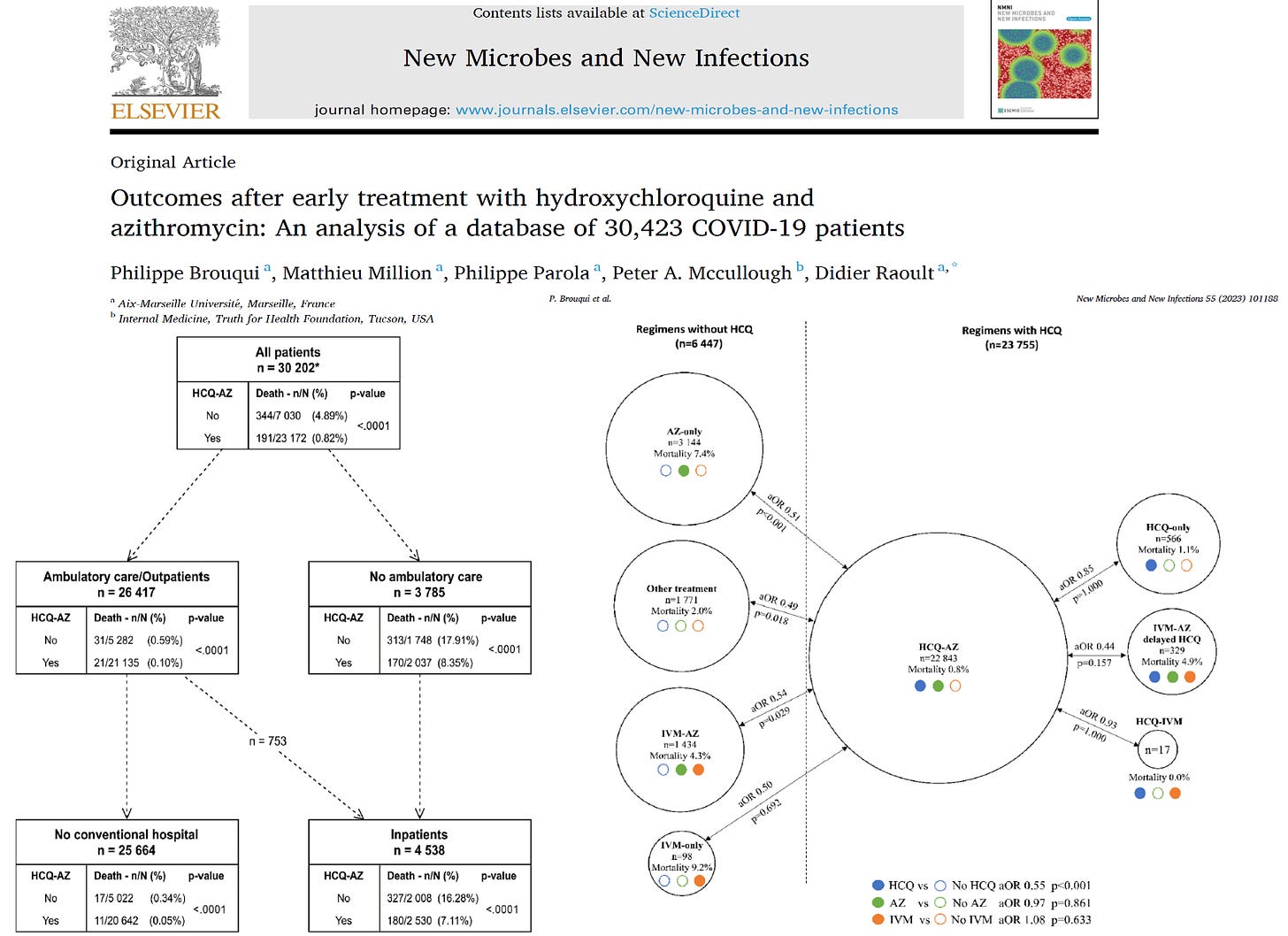
Featured Video
Trita Parsi: Israel Set a Trap for Total War in the Region
or go to
Aletho News Archives – Video-Images
From the Archive
Zionism’s Violent Legacy
By Donald Neff | Washington Report On Middle East Affairs | January 1996
On January 4, 1948, Jewish terrorists drove a truck loaded with explosives into the center of the all Arab city of Jaffa and detonated it, killing 26 and wounding around 100 Palestinian men, women and children.[1] The attack was the work of the Irgun Zvai Leumi – the “National Military Organization,” also known by the Hebrew letters Etzel – the largest Jewish terrorist group in Palestine. The Irgun was headed by Revisionist Zionist Menachem Begin and had been killing and maiming Arabs, Britons and even Jews for the previous ten years in its efforts to establish a Jewish state.
This terror campaign meant that at the core of Revisionist Zionism there existed a philosophical embrace of violence. … continue
Blog Roll
 Aletho News
- Trita Parsi: Israel Set a Trap for Total War in the Region
- Trump’s Iran war is on an Israeli leash
- Saudi oil boss issues global supply warning
- Riyadh Says Its Oil System Is Intact. The Numbers Say Otherwise.
- Trump and Netanyahu Want to “Finish the Job” on Iran
- US ‘one-sided dictation’ not Iran’s beliefs makes rational talks impossible: Baghaei
- Iran’s Next Strike May Not Explode. It Could Shut You Down /Col Doug Macgregor
- Iran: US political targets legitimate if assassinations return
- Iraq shuts key border crossing with Iran under US pressure: Report
- Undersea Internet cables could be targeted in retaliation for attacks on Iran: IRGC deputy chief
- If Americans Knew
- The Israel Lobby’s Changing Fortunes
- AIPAC has become such a political liability that it’s shifting to a more “nimble” approach to buying politicians
- At least 160 Israeli settler attacks in 2 weeks
- Will Gaza’s Ancient Christian Community Disappear Forever?
- Israel’s vision of regional security rests on keeping Arab states weak
- Heidi Levine recounts how Palestinian youths helped save her in settler attack
- DAILY UPDATE: Latest essential news on Palestine, Israel, & region
- Trump’s Intensifying Sabotage of the ICC, for Israel’s Sake
- Israeli military detain US and UK volunteers in West Bank including Democratic NY politician Brad Lander
- Americans at National Conservatism Conference held in Israel this year criticize Israel
- No Tricks Zone
- E-Cars Reduce CO2 Emissions By Only 41% Compared To Internal Combustion Engine Vehicles
- Predictions Made By Renowned Climate Professor Over Past Decades Have Been Proven To Be Poor
- New Study Suggests Large Regions Of The Pacific Ocean Have Been Cooling For The Last 80 Years
- Germany’s Green Energy Debacle: High Energy Costs Force Kahla Porzellan to Close After 182 Years!
- New Study: 50 Years Of The Most Aggressive ‘Net Zero’ Policies Can Only Affect The Global Climate By 0.03°C
- US September “Heat” Was No Record…Many Records Set Decades Ago
- Latest European Green Energy Debacle; Portugal’s Largest Flagship Solar Park Insolvent!
- Green Energy Debacle: German Expert Professor Fritz Vahrenholt Warns Of Severe Economic And Social Consequences
- Two More Paleo Reconstructions Affirm Meters-Higher Sea Levels Across Ireland, Brazil 7000-6000 Years Ago
- New Study: Earth And Venus Surface Warmth Largely Explained By Convection And Lapse Rate, Not CO2 Or Radiation

