USAID linked to pharma testing on Ukrainians – Russian MOD
RT | December 12, 2025
The US Agency for International Development (USAID) could have been involved in testing pharmaceutical drugs on Ukrainians, a senior Russian military official said on Friday. The agency was officially closed by the administration of US President Donald Trump this summer.
According to Major General Aleksey Rtishchev, the head of Russia’s Nuclear, Biological and Chemical Protection Troops, US officials have acknowledged defense-related work at biological laboratories in Ukraine.
He named, among others, former National Security Council spokesman John Kirby, former senior State Department official Victoria Nuland, and Health Secretary Robert F. Kennedy Jr.
Rtishchev noted that Cornell University organic chemistry professor Dave Collum told American journalist Tucker Carlson in an interview in August that pharmaceutical drugs had been tested on the Ukrainian population in 38 laboratories.
“To ensure secrecy, the customers behind such research are not military agencies but civilian agencies and non-governmental organizations. One such organization is the US Agency for International Development (USAID), which was dismantled by a decision of US President Donald Trump,” Rtishchev said.
According to the major general, USAID also provided funding for Event 201, a pandemic simulation exercise that focused on how to respond to a coronavirus outbreak. “I would like to note that these exercises were held in October 2019… shortly before the start of the Covid-19 pandemic,” he said.
Russia’s claims that USAID was involved in unlawful activity were reinforced, Rtishchev added, by comments made by billionaire Elon Musk, who previously headed a US government efficiency agency and has called USAID a “criminal organization.”
Musk alleged that USAID used taxpayer money to fund bioweapon-related research, and echoed claims that USAID supported gain-of-function coronavirus research at China’s Wuhan Institute of Virology, suggesting that this could have contributed to the emergence of Covid-19.
Russia has raised concerns in the past about Pentagon-backed biological laboratories in Ukraine and other countries near its borders, suggesting that they are involved in bioweapons research.
How the Covid Inquiry Protected the Establishment
By Trish Dennis | Brownstone Institute | November 28, 2025
After four years, hundreds of witnesses, and nearly £200 million in costs, the UK Covid Inquiry has reached the one conclusion many expected: a carefully footnoted act of self-exoneration. It assiduously avoids asking the only question that truly matters: were lockdowns ever justified, did they even work, and at what overall cost to society?
The Inquiry outlines failure in the abstract but never in the human. It catalogues errors, weak decision-making structures, muddled communications, and damaged trust, but only permits examination of those failings that do not disturb the central orthodoxy.
It repeats the familiar refrain of “Too little, too late,” yet anyone paying attention knows the opposite was true. It was too much, too soon, and with no concern for the collateral damage. The government liked to speak of an “abundance of caution,” but no such caution was exercised to prevent catastrophic societal harm. There was no attempt to undertake even a basic assessment of proportionality or foreseeable impact.
Even those who approached the Inquiry with modest expectations have been startled by how far it fell below them. As former Leader of the UK House of Commons, Jacob Rees-Mogg recently observed, “I never had very high hopes for the Covid Inquiry… but I didn’t think it would be this bad.” Nearly £192 million has already been spent, largely enriching lawyers and consultants, to produce 17 recommendations that amount, in his words, to “statements of the obvious or utter banality.”
Two of those recommendations relate to Northern Ireland: one proposing the appointment of a Chief Medical Officer, the other an amendment to the ministerial code to “ensure confidentiality.” Neither insight required hundreds of witnesses or years of hearings. Another recommendation, that devolved administrations should have a seat at COBRA, reveals, he argues, “a naiveté of the judiciary that doesn’t understand how this country is governed.”
Rees-Mogg’s wider criticism goes to the heart of the Inquiry’s failures, as it confuses activity with accountability. Its hundreds of pages record bureaucratic process while ignoring substance. The same modeling errors that drove early panic are recycled without reflection; the Swedish experience is dismissed, and the Great Barrington Declaration receives a single passing mention, as if it were an eccentric sideshow. The report’s underlying message never wavers: lockdowns were right, dissent was wrong, and next time the government should act faster and with fewer restraints.
He also highlights its constitutional incoherence. It laments the lack of “democratic oversight,” yet condemns political hesitation as weakness. It complains that ministers acted too slowly, while elsewhere chastising them for bowing to public pressure. The result, he says, is “schizophrenic in its approach to accountability.” Behind the legal polish lies an authoritarian instinct, the belief that bureaucrats and scientists know best, and that ordinary citizens cannot be trusted with their own judgment.
The conclusions could have been drafted before the first witness entered the room:
- Lockdowns were necessary.
- Modelling was solid.
- Critics misunderstood.
- The establishment acted wisely.
It is the kind of verdict that only the British establishment could deliver about the British establishment.
The Inquiry treats the question of whether lockdowns worked as if the very question were indecent. It leans heavily on modeling to claim that thousands of deaths could have been avoided with earlier restrictions, modeling that is now widely recognised as inflated, brittle, and detached from real-world outcomes. It repeats that easing restrictions happened “despite high risk,” yet fails to note that infection curves were already bending before the first lockdown began.
Here Baroness Hallett makes her headline claim that “23,000 lives could have been saved” if lockdowns had been imposed earlier. That number does not come from a broad evidence base, but from a single modelling paper written by the same scientist who, days later, broke lockdown to visit his mistress because he did not believe his own advice or modeling figures. Treating Neil Ferguson’s paper as gospel truth is not fact-finding. It is narrative protection.
Even Dominic Cummings, Boris Johnson’s most influential adviser in early 2020, has accused the Inquiry of constructing what he calls a “fake history.” In a detailed post on X, he claimed it suppressed key evidence, ignored junior staff who were present at pivotal meetings, and omitted internal discussions about a proposed “chickenpox-party” infection strategy. He argued that the Inquiry avoided witnesses whose evidence would contradict its preferred story, and he dismissed the “23,000 lives” figure as politically spun rather than empirically credible. Whatever one thinks of Cummings, these are serious allegations from the heart of government, and the Inquiry shows little interest in addressing them.
It quietly concedes that surveillance was limited, urgency lacking, and spread poorly understood. These admissions undermine the very certainty with which it endorses lockdowns. Yet instead of re-examining its assumptions, the Inquiry sidesteps them. To avoid reconsidering lockdowns is to avoid the very heart of the matter, and that is exactly what it does.
During 2020 and 2021, fear was deployed and amplified to secure compliance. Masks were maintained “as a reminder.” Official documents advised that face coverings could serve not only as source control but as a “visible signal” and “reminder of COVID-19 risks,” a behavioural cue of constant danger.
The harms of lockdown are too numerous for a single list, but they include:
- an explosion in mental health and anxiety disorders, especially in children and young adults
- a surge in cancers, heart disease, and deaths of despair
- developmental regressions in children
- the collapse of small businesses and family livelihoods
- profound social atomisation and damage to relationships
- the erosion of trust in public institutions
The Inquiry brushes over these truths. Its recommendations focus on “impact assessments for vulnerable groups” and “clearer communication of rules,” bureaucratic language utterly inadequate to address the scale of the damage.
It also avoids the economic reckoning. Pandemic policy added 20 percent of GDP to the national debt in just two years, a cost already passed to children not yet old enough to read. That debt will impoverish their lives and shorten life expectancy, since wealth and longevity are closely linked.
Whenever Sweden is mentioned, a predictable chorus appears to explain away its success: better healthcare, smaller households, lower population density. Yet it is also true that Sweden resisted panic, trusted its citizens, kept schools open, and achieved outcomes better than or comparable to ours. The Inquiry refers vaguely to “international differences” but avoids the one comparison that most threatens its narrative. If Sweden shows that a lighter-touch approach could work, the entire moral architecture of Britain’s pandemic response collapses, and that is a question the Inquiry dares not ask.
The establishment will never conclude that the establishment failed, so the Inquiry performs a delicate dance:
- Coordination was poor, but no one is responsible.
- Communications were confusing, but the policies were sound.
- Governance was weak, but the decisions were right.
- Inequalities worsened, but that tells us nothing about strategy.
It acknowledges everything except the possibility that the strategy itself was wrong. Its logic is circular: lockdowns worked because the Inquiry says they worked; modeling was reliable because those who relied on it insist it was; fear was justified because it was used; Sweden must be dismissed because it challenges the story.
At times, reading the report feels like wandering into the Humpty Dumpty chapter of Through the Looking-Glass, where words mean whatever authority decides they mean. Evidence becomes “established” because the establishment declares it so.
A serious, intellectually honest Inquiry would have asked:
- Did lockdowns save more lives than they harmed?
- Why was worst-case modeling treated as fact?
- Why were dissenting voices sidelined?
- How did fear become a tool of governance?
- Why did children bear so much of the cost?
- Why was Sweden’s success dismissed?
- How will future generations bear the debt?
- How can trust in institutions be rebuilt?
Instead, the Inquiry offers administrative tweaks, clearer rules, broader committees, and better coordination that studiously avoid the moral and scientific questions. An Inquiry that evades its central task is not an inquiry at all, but an act of institutional self-preservation.
Perhaps we should not be surprised. Institutions rarely indict themselves. But the cost of this evasion will be paid for decades, not by those who designed the strategy, but by those who must live with its consequences: higher debt, diminished trust, educational loss, social fracture, and a political culture that has learned all the wrong lessons.
The Covid Inquiry calls itself a search for truth, but the British establishment will never allow something as inconvenient as truth to interfere with its instinct for self-preservation.
Trish Dennis is a lawyer, writer, and mother of five based in Northern Ireland. Her work explores how lockdowns, institutional failures, and social divides during Covid reshaped her worldview, faith, and understanding of freedom. On her Substack, Trish writes to record the real costs of pandemic policies, honour the courage of those who spoke out, and search for meaning in a changed world. You can find her at trishdennis.substack.com.
The Global Purge Of Independent Leaders (2020-2022)
A chronological overview of leadership changes and the policy pivots that followed
Health And Truth and Mark Stronge | October 28, 2025
From early 2020 onward, a repeating script unfolded: a head of state voiced skepticism of lockdowns, PCR testing, or experimental mRNA vaccines; international agencies scolded them; chaos or “illness” struck; and within weeks new officials delivered full compliance and suddenly unlocked frozen aid money. The alignment was worldwide—different cultures, same choreography.
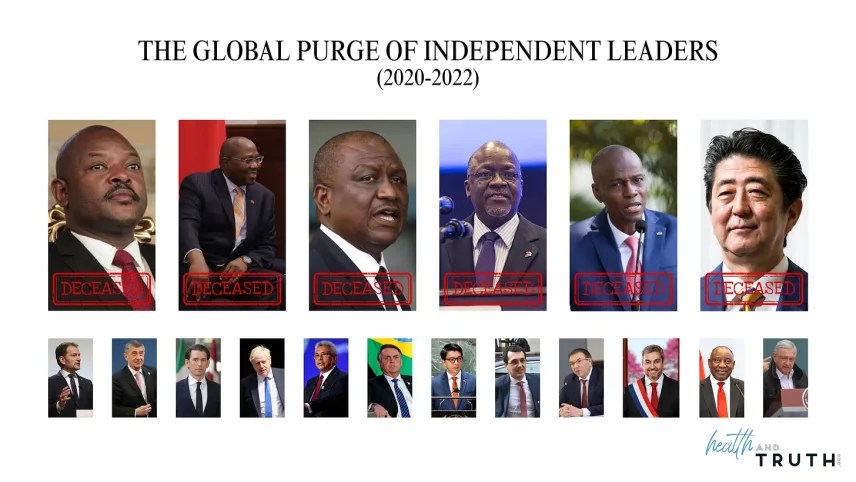
1. Burundi – Pierre Nkurunziza
In Burundi, President Pierre Nkurunziza expelled the World Health Organization from his country in May 2020, saying foreign interference was undermining national sovereignty. He kept the nation open while neighboring states imposed severe restrictions. Merely two weeks after that decision he was dead, officially of a “heart attack,” though associates described him as being in vibrant health. His successor, Évariste Ndayishimiye, reversed course immediately, reopened WHO offices, and signed new vaccine and funding arrangements that brought Burundi back into the international fold.
- Backdrop: In spring 2020 the government halted WHO field work, accusing it of interfering with domestic affairs. Burundi rejected external pandemic restrictions and held public gatherings normally.
- Event: Nkurunziza died suddenly 8 June 2020 while still in office; official cause – cardiac arrest.
- Immediate shift: Successor Évariste Ndayishimiye re‑opened WHO offices, declared COVID‑19 a “national priority,” invited vaccine partnerships, and received roughly $24 million in rapid IMF assistance.
- Result: Burundi signed onto COVAX distribution in 2021 after having been one of the continent’s last hold‑outs.
2. Eswatini – Ambrose Dlamini
In Eswatini (formerly Swaziland), Prime Minister Ambrose Dlamini resisted extreme lockdown policies, insisting that starving citizens to stop a virus was immoral. In December 2020 he was taken to South Africa “for observation” and declared dead soon afterward. The royal government that replaced him moved quickly to impose strict curfews, accept COVAX vaccines, and collect foreign emergency aid.
- Backdrop: The businessman‑turned‑PM favoured balanced restrictions, warning that closing trade would worsen poverty.
- Event: Tested positive for SARS‑CoV‑2, transferred to South Africa, and died 13 Dec 2020.
- Aftermath: King Mswati III and his cabinet adopted curfews, mandatory masking, and joined regional COVAX planning.
- Economic follow‑up: The African Development Bank confirmed a $10 million grant under the COVID‑19 Response Support Programme in early 2021.
3. Ivory Coast – Hamed Bakayoko
A similar disappearance occurred in Ivory Coast. Hamed Bakayoko, the charismatic prime minister, had publicly encouraged herbal treatments and questioned the accuracy of PCR diagnostics. In March 2021 he died in Germany of “cancer,” barely eight months after his predecessor suffered a similar fate. His passing removed the last voice questioning WHO dependence. President Alassane Ouattara’s administration proceeded to import AstraZeneca doses through COVAX, and by summer the country was being praised for its “responsible leadership.”
- Backdrop: The popular Prime Minister promoted herbal remedies and localized treatment efforts while maintaining open borders for trade.
- Event: Died 3 Mar 2021 in Germany where he was under cancer treatment; preceded by the death of previous PM Amadou Gon Coulibaly eight months earlier.
- Aftermath: President Alassane Ouattara named Patrick Achi acting PM; by May, 504 000 AstraZeneca doses had been deployed through COVAX.
- Funding: World Bank approved $300 million for emergency health and education programmes that quarter.
4. Tanzania – John Magufuli
The next to fall was Tanzania’s John Magufuli, Africa’s most outspoken skeptic of mass testing and vaccines. He mocked the system by demonstrating that fruit and goats tested positive for COVID. After vanishing from public view in March 2021, the vice‑president announced that he had died of heart failure. His replacement, Samia Suluhu Hassan, promptly reversed every one of his policies, accepted a $600 million IMF “emergency” loan, reopened the gates to foreign pharmaceutical programs, and declared a massive vaccination drive before year’s end.
- Backdrop: Highly skeptical of PCR testing accuracy and mass vaccination; prioritized economic continuity.
- Event: Absent from view in March 2021 for two weeks; Vice President Samia Suluhu Hassan announced his death 17 March (heart failure).
- Aftermath: New administration reinstated public health briefings, reopened WHO cooperation, applied for IMF Rapid Credit Facility ($600 million approved Sept 2021).
- Policy transformation: Vaccine programmes, mask campaigns, and international data reporting began within ninety days.
5. Haiti – Jovenel Moïse
Then came Haiti, where Jovenel Moïse had rejected donated vaccine shipments, explaining that the country faced deeper issues of water and poverty. On July 7 2021, he was executed in his home by an armed team whose origins remain murky. Within three weeks, Haiti received half a million Moderna doses from COVAX and enjoyed renewed flows of Inter‑American Development Bank and USAID funding. The national policy flipped overnight.
- Backdrop: Refused early COVAX vaccine delivery, arguing sanitation and nutrition were greater priorities.
- Event: Assassinated 7 Jul 2021 by a commando team; political motives still contested.
- Aftermath: First COVAX shipment of 500 000 Moderna doses landed 14 July 2021.
- Financial context: Inter‑American Development Bank and USAID re‑released more than $60 million in suspended grants under the “COVID‑19 Recovery Program.”
6. Japan – Shinzo Abe → Yoshihide Suga → Fumio Kishida
In Japan, Prime Minister Shinzo Abe avoided harsh lockdowns and refused to make vaccination compulsory. In August 2020 he resigned citing chronic illness, a convenient exit for global interests irritated by Japan’s autonomy. His successor Yoshihide Suga approved emergency authorization for the Pfizer vaccine within weeks, and after political struggles Fumio Kishida continued the same line, expanding booster programs and digital health passes. When Abe, now a private citizen and public skeptic of global centralization, was assassinated in July 2022, the last independent conservative bastion in Japan’s establishment disappeared. The current government invested ¥4.5 trillion—about $40 billion—in mRNA infrastructure partnerships with Western firms.
- Backdrop: Abe resisted extreme lockdowns and mandatory passes; preferred voluntary distancing.
- Resignation: Aug 2020 due to chronic illness; Suga took over and immediately authorized Pfizer vaccine imports (Feb 2021).
- Transition: Kishida succeeded Suga Oct 2021 after election; expanded booster campaigns and health‑pass apps.
- Abe’s assassination: 8 Jul 2022 in Nara; investigation officially attributed to a personal grudge.
- Post‑event: Japan pledged ¥4.5 trillion (≈ $40 billion) in bio‑innovation investment partly for mRNA research.
7. Slovakia – Igor Matovič
Slovakia followed the pattern in March 2021 when Igor Matovič, who had attempted to purchase Russia’s Sputnik V vaccine outside the European Union’s centralized supply, was forced out after furious criticism from Brussels. His successor Eduard Heger rejoined the EU’s procurement framework and in return unlocked €6.3 billion in recovery funds.
- Backdrop: Purchased Sputnik V without EU approval to widen supply options.
- Event: Coalition crisis culminated March 2021 in his resignation.
- Aftermath: New PM Eduard Heger froze Sputnik imports, conformed to EU purchasing pool, and unlocked €6.3 billion EU Recovery Funds.
8. Czech Republic – Andrej Babiš
Nearby, the Czech Republic saw Prime Minister Andrej Babiš lose power at the end of 2021 after refusing to maintain endless pandemic states of emergency. His replacement Petr Fiala implemented vaccine passports and mass‑testing decrees soon afterward, bringing the nation into perfect accord with EU directives.
- Backdrop: Initially resisted heavy lockdowns, favored voluntary vaccination.
- Event: Lost October 2021 election amid strong pro‑mandate media push.
- Aftermath: Petr Fiala government mandated digital health passes (“Tečka” app) and extended state‑support contracts with Pfizer/Moderna.
9. Austria – Sebastian Kurz
Austria lost Sebastian Kurz the same year. Once a rising star who had questioned perpetual lockdowns, Kurz resigned under the weight of a corruption scandal in October 2021. Within days his successor announced Europe’s first universal vaccine mandate and qualified the country for €4.5 billion in European Stability Mechanism funding.
- Backdrop: Pushed for reopening and questioned perpetual emergency powers.
- Event: October 2021 resignation after prosecution alleged misuse of party funds.
- Aftermath: Successor Alexander Schallenberg announced universal vaccination January 2022; European Stability Mechanism distributed ≈ €4.5 billion in recovery funding.
10. United Kingdom – Boris Johnson
In the United Kingdom, Boris Johnson’s government had ended restrictions in mid‑2021 and refused to make vaccine passports a permanent condition of daily life. The press then exploded with “Partygate” scandals over gatherings during lockdown. Johnson resigned in 2022, replaced by Rishi Sunak, who restored Britain to full WHO cooperation and financed a £2 billion digital‑health‑ID system intended to prevent “misinformation.”
- Backdrop: Repealed many restrictions July 2021 (“Freedom Day”), angering zero‑COVID advocates.
- Event: Forced resignation mid‑2022 after “Partygate.”
- Aftermath: Rishi Sunak government supported the WHO pandemic‑treaty process and invested £2 billion in NHS digital ID infrastructure through Palantir‑backed data platforms. Within weeks of taking office, Downing Street announced negotiations with Moderna to establish a permanent mRNA‑manufacturing base — a 10‑year “strategic partnership” followed with construction of a mRNA vaccine research, development, and manufacturing centre in Harwell Science Park (Oxfordshire), projected to produce up to 250 million doses a year in a future outbreak. This collaboration was framed as part of the UK’s “100‑Day Mission” to deliver vaccines within 100 days of identifying a new pathogen; the mission itself originated from G7 and G20 pandemic‑preparedness pledges.
11. Sri Lanka – Gotabaya Rajapaksa
Half a world away in Sri Lanka, President Gotabaya Rajapaksa argued that global supply sabotage and debt were worse problems than COVID. By mid‑2022 coordinated protests and economic chaos forced him to flee abroad. Within weeks, the IMF approved a $3 billion bailout that required health‑security reforms and the adoption of digital‑surveillance frameworks under WHO supervision.
- Backdrop: Advocated reopening, claimed economic sabotage larger threat than virus.
- Event: Mass protests July 2022 amid fuel and food shortages.
- Aftermath: New interim government signed a $3 billion IMF agreement mandating fiscal reform and health‑security modernization.
12. Brazil – Jair Bolsonaro
Brazil completed the second‑wave phase of this storyline. President Jair Bolsonaro ridiculed mask mandates, called lockdowns a luxury for the rich, and questioned vaccine safety. After two furious years of constant hostility from media conglomerates and international NGOs, he lost the 2022 election. Lula da Silva took office, rejoined WHO initiatives, and secured a $1.2 billion World Bank “preparedness” loan.
- Backdrop: Dismissed lockdowns as “hysteria,” resisted vaccine coercion.
- Event: Lost 2022 election to Lula da Silva after two years of hostile media coverage.
- Aftermath: Brazil re‑entered WHO initiatives, COVAX procurement, and secured World Bank Preparedness Loan ($1.2 billion).
13. Madagascar – Andry Rajoelina
Along the African coast to Madagascar, President Andry Rajoelina had introduced his own herbal remedy, COVID‑Organics, and rejected Western pharmacology. In 2021 an attempted coup shook the island, and under global pressure Rajoelina signed new agreements restoring WHO cooperation that same year so donor funding could return.
- Backdrop: Promoted herbal tonic “COVID‑Organics” (artemisia‑based), claiming national self‑reliance.
- Event: July 2021 coup attempt; several senior officers arrested.
- Aftermath: Rajoelina accepted WHO cooperation and external medical aid later that year, restoring aid flows suspended in 2020.
14. Romania – Vlad Voiculescu Minister of Health
Appointed in December 2020 under Prime Minister Florin Cîțu, Voiculescu quickly became one of Eastern Europe’s most outspoken advocates for data transparency within the vaccine‑procurement process.
He questioned:
- why the European Commission’s contracts with Pfizer/BioNTech and Moderna were heavily redacted;
- the procedure for reporting adverse events and hospital bed usage;
- and financial allocation for Romania’s “Green Certificate” system.
In April 2021, Voiculescu alleged irregularities in the way national statistics on Covid mortality were reported (he said hospital figures were being “massaged” to fit EU targets).
Within 48 hours, Prime Minister Cîțu dismissed him (14 April 2021). That dismissal fractured the ruling coalition and was widely interpreted as pressure from Brussels and Bucharest business lobbies to restore “credibility” with EU health authorities.
- Backdrop: In 2021 Romanian minister objected to secrecy of EU vaccine contracts.
- Event: Dismissal and cabinet reshuffle.
- Aftermath:
- Florin Cîțu — Prime Minister (National Liberal Party), an economist trained in the US and a former banker, had emphasized cooperation with the European Commission’s Recovery Facility.
- Immediately after Voiculescu’s removal, Cîțu approved the formal implementation of the EU Digital COVID Certificate
- He signed Romania’s Recovery and Resilience Facility plan for €29 billion (approved September 2021).
- Cîțu later lost internal party support and was replaced by Nicolae Ciucă (2021 December).
- Raed Arafat — Secretary of State, Chief of the Department for Emergency Situations, a longtime figure in Romanian health management (specialist of Palestinian background), spearheaded the nationwide lockdown operations.
- He became polarizing — praised for emergency coordination but criticized for advocating strict curfews and mandatory digital passes.
- Through his influence, Romania aligned with EU Civil Protection Mechanisms and WHO technical advisories.
- Government enforced EU Digital COVID Certificates.
- Brussels released tranches of Recovery and Resilience Facility funds (€29 billion total plan).
- Florin Cîțu — Prime Minister (National Liberal Party), an economist trained in the US and a former banker, had emphasized cooperation with the European Commission’s Recovery Facility.
15. Bulgaria – Kostadin Angov
Appointed during the closing months of Prime Minister Boyko Borisov’s third administration, acting Health Minister Kostadin Angov (2020 – 2021) faced severe criticism from Brussels for Bulgaria’s slow vaccine rollout and limited transparency regarding distribution data. Angov and Borisov’s cabinet were accused of delaying orders through the EU’s joint procurement scheme, preferring to wait for additional safety results before committing to large Pfizer/Moderna contracts.
By late March 2021, Bulgaria had one of the lowest vaccination rates in the European Union and was publicly rebuked by the European Commission for “failure to utilize allocated supply quotas.”
Backdrop: By early 2021, Bulgaria’s center‑right government under Boyko Borisov had lost support amid apparent corruption scandals unrelated to health policy but amplified by public anger over uneven lockdown enforcement and vaccine delays. Multiple cabinet ministers, including acting Health Minister Angov, were called before parliamentary committees to justify the government’s refusal to impose stricter green‑pass rules or to publish full statistics on vaccine deliveries.
Event: In April 2021, Borisov’s GERB party failed to form a coalition following a general election; the president appointed Stefan Yanev as caretaker prime minister, and Stoycho Katsarov — a former deputy minister and health‑reform activist — assumed the health portfolio. Katsarov announced immediate compliance with EU digital pass protocols and promised rapid adoption of the COVID Certificates system, stating that “communication with Brussels must be restored through transparency and vaccination.”
Aftermath: Within three months of the caretaker cabinet’s installation, Bulgaria joined the EU Digital Green Certificate scheme (July 2021), issued its own national app, and implemented tightened entry controls for public venues. The European Commission then approved Bulgaria’s €6 billion Recovery and Resilience Facility allocation (approved December 2021) after earlier postponements linked to “governance deficiencies.”
Katsarov and Yanev argued the shift was strictly technocratic, yet domestic media framed it as the price of unlocking EU funds frozen under Borisov. Moreover, WHO country officers held joint press briefings in Sofia throughout autumn 2021, publicly graduating Bulgaria from a “non‑compliant” to a “fully aligned EU‑health partner.” Later that year a second caretaker cabinet retained the same policies to preserve continued Brussels cooperation.
Government Outcome: By the end of 2021 Bulgaria had moved from partial defiance to complete compliance with EU and WHO health requirements. The turnover of Borisov’s administration and replacement with technocratic caretaker officials effectively cleared the way for release of European recovery funds for health‑system modernization and digital infrastructure projects.
Summary of Sequence
- Initial reluctance to join EU vaccine mandates and delays in accepting digital certificate standards.
- Electoral defeat of incumbent government after months of European pressure and domestic unrest.
- Caretaker administration’s rapid embrace of EU and WHO frameworks.
- Approval of €6 billion in Recovery Funds and re‑establishment of good standing with Brussels.
16. Paraguay – Mario Abdo Benítez
Paraguay’s experience exemplifies how smaller Latin American economies were forced to align pandemic policies with international credit conditions. President Mario Abdo Benítez’s government initially emphasized economic stability over draconian lockdowns, warning that strict restrictions would devastate informal workers who make up more than 60% of the labour market. However, as domestic protests intensified and foreign creditors tightened lending conditions, the administration conceded to the IMF’s stipulations that pandemic‑response financing be tied to specific “public‑health governance commitments.” Once those commitments were accepted, loan disbursements resumed, showing how financial contingency mechanisms coerced health‑policy conformity.
- Backdrop: Through 2020 and early 2021 Paraguay maintained one of South America’s least restrictive lockdown regimes. The government was reluctant to mandate vaccinations or fully close borders with Brazil and Argentina.
- Event: In March 2021 mass protests erupted in Asunción over shortages of medical supplies and alleged corruption in procurement; opposition parties launched a failed impeachment attempt against President Abdo Benítez.
- Aftermath: To restore credit stability, the finance ministry agreed to conditions attached to an IMF Rapid Financing Instrument (≈ $274 million) earmarked for health expenditure auditing and expansion of surveillance systems. By late 2021 Paraguay was fully aligned with WHO and Pan American Health Organization recommendations.
- Outcome: Government stability was restored after external financing resumed, but policy autonomy remained limited by credit conditionality.
17. South Africa – Cyril Ramaphosa
South Africa began as a reluctant participant in strict global pandemic protocols. President Cyril Ramaphosa voiced concerns that extended lockdowns could fuel unrest and economic collapse, and he pushed for Africa‑wide vaccine intellectual‑property waivers rather than Western purchases. Nevertheless, as international ratings agencies threatened downgrades and IMF/World Bank assistance was made contingent on “strengthened public‑health governance,” South Africa shifted its course, introducing some of the continent’s strictest workplace vaccine rules.
- Backdrop: From early 2020 to mid‑2021 Ramaphosa’s cabinet clashed with business unions and community organizations over the cost of lockdowns versus public‑health benefit. Debt pressures soared following a 10% GDP contraction in 2020.
- Event: The National Treasury secured a $4.3 billion IMF loan (July 2020) and a World Bank loan of $750 million (Jan 2022) containing performance benchmarks for pandemic containment and “human capital protection”.
- Aftermath: By December 2021 South Africa announced mandatory vaccination for public‑sector employees and participation in the WHO vaccine passport initiative. Foreign aid disbursement and sovereign bond ratings stabilized only after these steps.
- Outcome: Policy alignment improved credit access but deepened domestic inequality and led to significant civil‑liberty litigation and ongoing parliamentary inquiries into procurement transparency.
18. Mexico – Andrés Manuel López Obrador
Mexico under Andrés Manuel López Obrador (AMLO) presented one of the last major cases of gradual capitulation to WHO and multilateral financial pressures. Initially AMLO resisted mandatory lockdowns and booster campaigns, insisting that national public‑health policy should focus on nutrition and poverty reduction. However, a combination of supply‑chain disruption, dollar liquidity concerns, and lobbying from international philanthropic networks (CEPI, GAVI, and the Gates Foundation) eventually pushed Mexico toward full policy compliance by 2022.
- Backdrop: Throughout 2020 Mexico’s Health Secretary Jorge Alcocer and Under‑secretary Hugo López‑Gatell advocated moderate restrictions and non‑coercive vaccine rollout. The country’s mortality surged during mid‑2021, provoking foreign and domestic pressure for a policy shift.
- Event: Facing threat of credit downgrades, the Finance Ministry began talks with the World Bank and IMF for infrastructure loans linked to public‑health reform. In December 2021 Mexico signed a joint memorandum of understanding with WHO and CEPI for “bio‑pharmaceutical collaboration and vaccine development capacity”.
- Aftermath: Through 2022 Mexico aligned its vaccine certification systems with the COVAX framework and expanded digital health records for the Ministry of Health, unlocking up to $1 billion in World Bank Covid‑response financing.
- Outcome: By 2023 Mexico was publicly touted by WHO offices as a “model for integrated pandemic response,” demonstrating how international credit leverage transformed a once‑independent policy line into strict adherence with global health‑security standards.
Summary of Observable Trends
- Chronology: Deaths of Nkurunziza, Dlamini, Bakayoko, Magufuli, and Moïse opened the sequence (Jun 2020 – Jul 2021). Political collapses in Europe, Asia, and the Americas followed through 2022.
- Policy effect: Every successor endorsed WHO recommendations and entered international funding arrangements that had been unavailable under predecessors.
- Financial trigger: Aid packages—IMF Rapid Credit, World Bank preparedness loans, EU Recovery mechanisms—were routinely disbursed within 30–90 days of the leadership change.
Key Takeaway
From 2020 to 2022, the result was unmistakable: national autonomy collapsed beneath a synchronized agenda linking public‑health compliance to economic salvation. Countries that resisted early, especially in Africa, suffered the hardest blows—five sitting leaders dead in one year. More powerful nations experienced subtler coups through scandal, protest, or economic blackmail, all producing the same end state.
What emerged from these parallel crises was not medical harmony but political homogenization. Each successor declared a “renewed partnership with science,” welcomed new funding from the IMF, World Bank, or GAVI, and ushered in digital‑compliance systems that now define post‑pandemic governance.
By the end of 2022 nearly every government on Earth—rich or poor, democratic or autocratic—had been brought into alignment. Differing flags, languages, and histories no longer prevented one shared choreography: resistance punished, obedience financed, and sovereignty quietly exchanged for a coordinated global script.
- IMF Press Release – Rapid Credit Facility for Burundi (June 2020).
- Reuters / AP Report – Death of Eswatini Prime Minister (Dec 2020).
- African Development Bank – COVID‑19 Response Support Programme (2021).
- World Bank – Ivory Coast Emergency Support Project (2021).
- IMF Press Release No. 21/210 – Tanzania RFI (Sept 2021).
- Associated Press – “President of Haiti Assassinated at Home” (July 2021).
- IDB Official Statement on Haiti Relief Funding (2021).
- Japan Cabinet Office – Resignation of PM Abe (Aug 2020).
- Nikkei Asia – “Japan Invests in mRNA Manufacturing” (2022).
- 1European Commission – Next Generation EU Fund Allocation to Slovakia (2021).
- Czech News Agency – Election Results and Policy Changes (2021).
- Austrian Prosecution Service – Kurz Investigation Report (2021).
- EU Council Press Release – Austria ESM Allocation (2022).
- UK Parliamentary Record – Digital Health Infrastructure Funding (2022).
- IMF Staff Report – Sri Lanka Extended Fund Facility (March 2023).
- World Bank – Brazil Pandemic Preparedness Loan (2022).
- WHO Madagascar Country Office – Cooperation Agreement (2021).
- European Commission – Romania RRF Approval (2021).
- European Commission – Bulgaria RRF Approval (2021).
- IMF Country Report – Paraguay Pandemic Financing (2021).
- IMF Country Report – South Africa Fiscal Support Arrangements (2021).
- WHO / CEPI Press Release – Mexico Cooperation Agreement (2022).
- IMF Country Report – Paraguay Rapid Financing Instrument 2021.
- BBC News Latin America – “Protests Rock Paraguay Over Pandemic Supplies,” March 2021.
- Finance Ministry of Paraguay – Press Release on IMF Commitments April 2021.
- South African Reserve Bank Annual Report 2021.
- IMF Press Release No. 20/315 – South Africa Loan Approval; World Bank Loan Press Brief 2022.
- Reuters – “South Africa Adopts Mandatory Public‑Sector Vaccination Policy,” December 2021.
- El Universal – “López‑Gatell Sabemos que no habrá vacunación obligatoria,” 2020.
- WHO / CEPI – Memorandum on Mexico Vaccine Collaboration, December 2021.
- World Bank – “Mexico COVID‑19 Emergency Response Project,” 2022.
Spain’s COVID restrictions declared unconstitutional, over 90k fines struck down
By Andreas Wailzer | LifeSiteNews | October 10, 2025
More than 90,000 COVID fines have been overturned so far after the Spanish constitutional court declared the draconian 2020 COVID measures unconstitutional.
As Spanish news outlet The Objective reported, 92,278 fines have been annulled as of September 3, 2025, following the declaration of certain provisions of the 2020 state of emergency decree, which was in effect during the first COVID-19 lockdown, as unconstitutional.
However, these penalties only represent the first wave of fines set to be annulled, with many more expected to follow. During the strict lockdown under the state of alarm in 2020, more than 1 million penalties were imposed nationwide, and an estimated 1.3 million people were fined for violating the prohibitive restrictions.
In its ruling, the Constitutional Court determined that certain sections of Article 7 of Royal Decree 463/2020, which pertains to the general prohibition on movement, implied an unjustified suspension of the fundamental right to freedom of movement, rather than merely a limitation. This suspension exceeded the power of the declared state of alarm, the court found. The court determined that such a severe restriction could only have been implemented under a stricter state of emergency, which requires more rigorous parliamentary proceedings.
This ruling now retroactively applies to all penalties issued during the 2020 lockdown, putting a significant burden on the administrative state. The Objective reports that “enforcement has been slow and uneven depending on each territory,” showing that the refunds could take months or years.
The Objective reiterates that the 92,278 cases revoked to date “are just the tip of the iceberg of a regulatory crisis” stemming from the draconian lockdown policies imposed by the Spanish government in 2020.
The Nature of hypocrisy: pharma-funded journals smearing independent voices
Nature alleges that I endanger public health, but it is the journal — steeped in pharma money — that ought to be looking inward.
By Maryanne Demasi, PhD | October 1, 2025
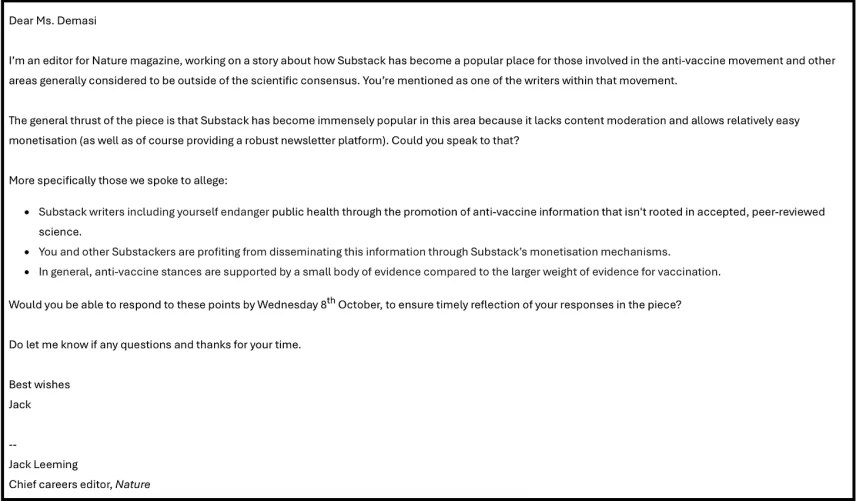
When an editor from Nature emailed me this week, it wasn’t a neutral request for comment. It was a prelude to a hit piece — filled with defamatory accusations and framed around a predetermined narrative.
According to the email, I was being lumped into an “anti-vaccine movement,” accused of “endangering public health,” and “profiting from disseminating misinformation.”
No evidence was provided. No articles were cited. No definition of “anti-vaccine” was offered. No complainants were named. Just blanket accusations intended as a character assassination.
Conflict of interest at the heart of Nature
And who is casting these stones?
Nature — a journal that publishes vaccine research while pocketing revenue from pharmaceutical advertising and sponsored content.
To then assign an editor to target independent journalists who scrutinise that very industry is a glaring conflict of interest.
A medical journal acting as both mouthpiece and judge of what counts as “misinformation” is like a tobacco company funding lung health studies while attacking anyone who questions them.
The hypocrisy is staggering.
On its own website, Nature boasts of partnerships with Johnson & Johnson, Merck, AstraZeneca and other vaccine companies, dressing them up as “pioneering collaborations” to “support science.” It even publishes paid advertising features.

Meanwhile, I’ve never taken a cent from the drug industry. My work is sustained by readers who choose to support independent journalism.
Yet Nature accuses me of “profiting” — as if being funded by the public is more corrupting than raking in thousands, if not millions, from the very companies you’re supposed to scrutinise.
To test how deep the rot runs, I’ve requested that Nature disclose its advertising revenue for the past decade, broken down by pharmaceutical corporations, government agencies, and NGOs.
I will publish those figures if and when they are provided.
Loaded language
Nature’s email branded me part of an “anti-vaccine movement.” But what does that actually mean?
Is questioning regulatory capture “anti-vaccine”?
Is demanding the timely publication of safety signals “anti-vaccine”?
Is exposing the failures of the vaccine injury compensation scheme “anti-vaccine”?
Is pointing out the poor oversight of vaccine trials “anti-vaccine”?
By that logic, critics of arsenic in drinking water would be “anti-arsenic,” and anyone calling for safer driving would be “anti-car.” The absurdity is obvious, yet the label is useful to silence debate.
And the email’s language was revealing.
Phrases like “scientific consensus” and “peer-reviewed science” are waved around like trump cards, but in practice they are red flags — appeals to authority rather than evidence.
‘Consensus’ can be manufactured. And ‘peer review’ is no shield against corruption when journals themselves are compromised.
I have documented journal–pharma ties, the retraction of inconvenient studies, and the use of pharma-funded “fact checks” masquerading as science to discredit politically uncomfortable findings.
So when an editor of Nature hides behind these clichés instead of addressing the evidence I present, it tells you everything. This isn’t about protecting science, it’s about protecting a narrative.
And I’m clearly not the only target.
Dr Robert Malone — also a Substack publisher and now a member of the CDC’s Advisory Committee on Immunisation Practice — received the same media request from Nature.
The journal’s smear campaign extends even to those who now sit on America’s top vaccine advisory body.
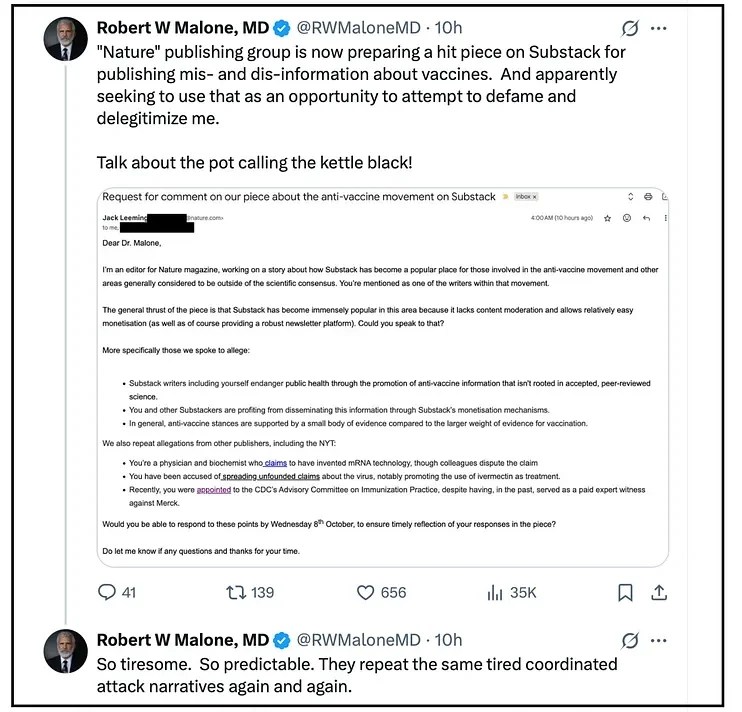
Nature insists that “anti-vaccine stances are supported by a small body of evidence compared to the larger weight of evidence for vaccination.”
But that’s probably because journals act as gatekeepers, blocking challenges to orthodoxy and shutting out novel viewpoints. Studies that raise concerns are rejected, buried or retracted, while industry-friendly findings sail through unopposed.
It isn’t the science that’s lacking — it’s the willingness of journals to let inconvenient results see the light of day. The house of cards is collapsing, and that is why the attacks on dissent are more aggressive than ever.
And those attacks often come from self-proclaimed experts who are themselves conflicted, embedded in institutions sustained by the teat of industry, and unwilling to disclose their own conflicts.
Pot calling the kettle black: the Proximal Origin scandal
Notably, while Nature postures as a guardian against “misinformation,” it bears responsibility for one of the pandemic’s most notorious scandals.
In March 2020, Nature Medicine — part of the Nature portfolio — published “The proximal origin of SARS-CoV-2,” which declared the virus could not have been engineered in a lab.
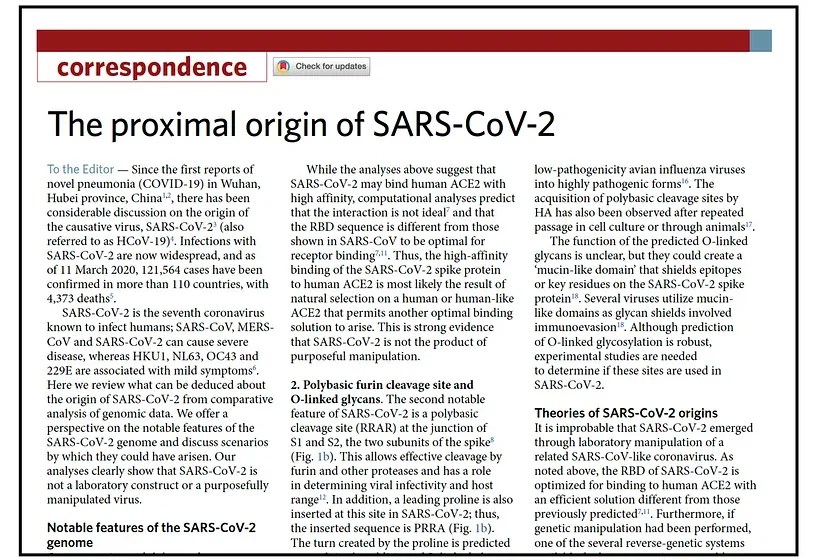
The paper was splashed across headlines and weaponised to dismiss the lab-leak theory as a “conspiracy.”
But private emails and Slack chats told another story. The authors harboured serious doubts and admitted a lab origin could not be ruled out.
Hundreds of scientists now call the paper a ‘political tract’ dressed up as science, and thousands have petitioned for its retraction. Yet Nature Medicine refuses, brushing it aside as a “point of view” piece.
If that isn’t misinformation, then what is?
Even the White House has distanced itself. Its website now acknowledges that the Proximal Origin paper was used to suppress debate, and alleges the authors were nudged by Dr Fauci to push the “preferred” zoonotic origin narrative.
Time for accountability
Make no mistake, this is ‘the system’ at work.
Powerful journals with financial ties to industry unleashing hatchet men to smear independent journalists and scientists, rather than engaging with evidence.
I won’t play along. My job is to hold institutions accountable, not to curry their favour. If Nature wants to brand that “misinformation,” so be it. History shows that today’s heresy is often tomorrow’s truth.
This goes to the heart of the corruption of medical publishing — a system Robert F. Kennedy Jr has repeatedly warned about, and one that now demands scrutiny at the highest levels.
With Dr Jay Bhattacharya at the helm of the National Institutes of Health, there is finally an opportunity to investigate the conflicts of interest, selective censorship, and financial entanglements that journals like Nature have normalised.
When those who profit from pharma partnerships claim the authority to police what lies “outside the scientific consensus,” public trust in science collapses.
And that collapse is not the fault of independent journalists asking hard questions. It is the fault of journals that serve industry interests over science.
New Book: Covid Through Our Eyes
Review by Maryanne Demasi, PhD | September 28, 2025
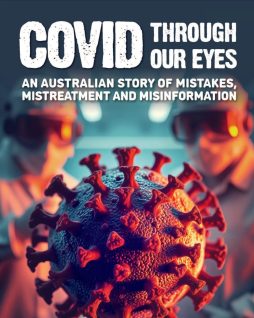 When Covid hit, governments, health agencies and the media marched in lockstep. Their united front was sold as “consensus.”
In reality, it was compliance by coercion. Dissenters were punished, questions suppressed, and the public was fed slogans instead of science.
Covid Through Our Eyes tears away that façade.
This collection of essays—written by doctors, scientists, lawyers, journalists, economists and ordinary Australians whose lives were upended—restores the voices silenced during the pandemic.
Each chapter forms part of a collective testimony. And in a final act of principle, not a cent of the book’s sales goes to the authors; all proceeds support Australia’s vaccine injury class action.
A chorus of voices
Editors Robert Clancy, an immunologist, and Melissa McCann, a physician, have gathered an extraordinary range of perspectives.
Among them, British oncologist Angus Dalgleish describes patients relapsing into aggressive cancers after years in remission. He argues that repeated boosters and chronic spike protein exposure created a “pro-cancer milieu.”
Vaccinologist Nikolai Petrovsky recounts how his homegrown vaccine, built on decades of expertise, was cast aside in favour of untested mRNA technology.
Statistician Andrew Madry lays out devastating evidence of excess mortality and the government’s refusal to investigate the causes.
Other contributors highlight phenomena dismissed at the time: immune system imprinting, shifts in antibody subclasses, and persistence of mRNA in the body.
Regulatory expert Philip Altman details how the Therapeutic Goods Administration ignored clear safety signals, choosing convenience over caution.
Lawyers and doctors tell of their battles in the courts and on the streets against vaccine mandates—small victories, bitter defeats, and governments that seemed more determined to silence critics than to defend their policies with evidence.
Clancy himself turns a sharp eye on Australia. Once a nation of independent scientists—from Burnet to Fenner, with pandemic plans crafted at the Commonwealth Serum Laboratories—by 2020 it had surrendered to bureaucracy.
He argues that recovery depends on restoring the doctor–patient relationship and returning vaccine development to proven antigen platforms, not experimental technologies rushed to market.
The media that failed
My own chapter in the book examines how mainstream media collapsed.
Newsrooms abandoned their adversarial role and parroted government lines. Contradictory evidence was buried. Scientists who asked questions were branded fringe. Patients who reported harm were cast as public health risks.
The press did not simply fail; it became an enforcer. That betrayal corroded trust, and the damage persists today.
Stories of loss
The most haunting chapters are personal.
Antonio DeRose, left in a wheelchair after transverse myelitis, describes doctors who refused to acknowledge the cause.
Queenslander Caitlin Gotze died six weeks after her second Pfizer dose, with her myocarditis misdiagnosed as asthma.
Actor and writer Katie Lees collapsed from clotting linked to AstraZeneca; her death was reduced to a single line on a regulator’s website.
These are stories of grief, stark reminders of what happens when agencies, designed to protect, instead deny responsibility.
This book matters
Covid may have slipped from the headlines, but its consequences have not.
Excess deaths remain unexplained. Injured families still fight for recognition. Trust has been squandered. And this nation has yet to hold a Royal Commission into Covid.
Covid Through Our Eyes is essential reading for anyone who wants to understand what really happened to Australians—a nation of people once known for their laid-back spirit, now grappling with a legacy of coercion and injury.
Buy it, read it, and judge for yourself.
Google admits Biden regime pressured content removal, promises to restore banned YouTube accounts
By Dan Frieth | Reclaim The Net | September 23, 2025
After years of denying bias, Google now concedes that it gave in to pressure from the Biden White House to remove content that did not breach its own rules.
The admission comes alongside a promise to restore access to YouTube accounts permanently removed for political speech related to COVID-19 and elections, topics where government officials had applied behind-the-scenes pressure to control the narrative.
This move follows sustained scrutiny from the House Judiciary Committee, which Reclaim The Net covered extensively, led by Chairman Jim Jordan (R-OH), who issued a subpoena and spearheaded an investigation that revealed the extent of government influence on content moderation decisions at Google.
In a letter from its legal representative, Google confirmed that it faced pressure from the federal government to suppress lawful speech.
We obtained a copy of the letter for you here.
Google revealed that it had been contacted multiple times by top federal officials regarding content on its platforms, even when that content did not break any rules.
The company stated that “Senior Biden Administration officials, including White House officials, conducted repeated and sustained outreach to Alphabet and pressed the Company regarding certain user-generated content related to the COVID-19 pandemic that did not violate its policies.”
According to the company, this outreach took place in a broader political climate that made it difficult to operate independently.
Google noted that “The political environment during the pandemic created significant pressure on platforms, including YouTube, to address content that some deemed harmful.”
While describing the situation, Google made clear its disapproval of such efforts, stating bluntly that “This pressure was – and remains – unacceptable and wrong.”
In response to this period of politicized enforcement, the company said it is now taking steps to reverse prior censorship decisions.
As part of that process, Google confirmed that “Reflecting the Company’s commitment to free expression, YouTube will provide an opportunity for all creators to rejoin the platform if the company terminated their channels for repeated violations of COVID-19 and elections integrity policies that are no longer in effect.”
The letter also clarified YouTube’s approach to content moderation, explicitly rejecting the use of outside arbiters. “YouTube does not use third-party fact checkers to determine whether content should be removed or labeled,” the company said.
Acknowledging the role of political diversity on its platform, Google stated that “YouTube values conservative voices on its platform. These creators have extensive reach and play an important role in civic discourse.”
The company concluded with a broader statement rejecting government interference in lawful online speech, saying that “The federal government should not play a role in pressuring private companies to take action on lawful speech.”
The revelations echo findings in the Murthy v. Missouri case, where lower courts found that federal agencies had taken on a role similar to an “Orwellian ‘Ministry of Truth.’” While the Supreme Court dismissed the case on procedural grounds, the core issues around government pressure on speech remain unresolved.
The investigation into Google is part of a broader probe into how tech firms handled information related to the 2020 election, COVID-19, and high-profile political topics such as Hunter Biden’s laptop. The committee’s findings show a pattern of censorship aligned with political objectives.
THE “661 TRIALS” LIE: WHAT AARON SIRI REVEALED IN CONGRESS
The HighWire with Del Bigtree | September 11, 2025
Del sits down with ICAN’s lead attorney, Aaron Siri, Esq., for a hard-hitting conversation following his explosive Senate testimony. Siri takes aim at the false narrative of “661 placebo-controlled vaccine trials,” dismantling it point by point. He also exposes the buried Henry Ford study featured in the upcoming documentary “An Inconvenient Study,” and opens up about his powerful new book, “Vaccines. Amen.” Together, they make the case for why true transparency in vaccine science can no longer be delayed.
While America panics, Europe quietly recalibrates Covid-19 vaccine policy
Maryanne Demasi, PhD | September 3, 2025
As of 1 September, Sweden no longer recommends Covid-19 vaccination for children unless an individual medical assessment finds they are at increased risk of severe disease.
Even then, it is only available with a doctor’s prescription.
Adults are eligible for a single dose only if they are 75 and older, or belong to defined risk groups.
It is a strikingly cautious policy — yet in Sweden, there is no sense of crisis. Public health officials describe it as a proportionate step, aligned with the evidence.
By contrast, in the United States, the temperature has been rising over the narrowing of Covid-19 vaccine policy. The medical establishment has long been hostile toward Health Secretary Robert Kennedy Jr, but in recent weeks the attacks have escalated.
This week in the New York Times, nine former directors of the Centers for Disease Control and Prevention (CDC) warned that his decisions mean “children risk losing access to lifesaving vaccines.”
On ABC TV, outgoing CDC official Dr Demetre Daskalakis intensified the rhetoric, claiming he “only sees harm coming” for America’s children. The language was deliberately alarming and intended to signal an emerging catastrophe.
Dr Demetre Daskalakis, former director, CDC National Center for Immunization & Respiratory Diseases.
In reality, though, the policies under review in the US look more like a belated effort to bring American practice closer to what Europe has already done.
The CDC’s own data illustrate why recalibration makes sense.
Figures show that the risk of children dying from Covid-19 equates to roughly 1 in 810,000 per year (0.000123%) — an infinitesimally low risk.
It’s even lower for children without underlying conditions, closer to 1 in 1.75 million (0.000057%).
Despite these tiny mortality figures, Daskalakis warned that half of infants hospitalised for Covid-19 last season had “no underlying conditions.”
But that claim paints a distorted picture.
A Covid-19 hospitalisation is defined as “a positive SARS-CoV-2 test ≤14 days before admission or during hospitalisation,” meaning any child treated for a broken arm or routine surgery but testing positive, is still counted as a Covid case.
When researchers examined hospital charts more closely, they found roughly 30% of paediatric Covid-19 admissions were ‘incidental’ – in other words, they were hospitalised with Covid, not for Covid.
CDC’s adult data showed a similar pattern.
Other countries ahead of the curve
Across Europe and beyond, other nations are moving in the same direction as Sweden.
The United Kingdom has also tightened eligibility as it heads into autumn, limiting Covid boosters to people over 75, nursing-home residents, and those with weakened immune systems.
Its guidance notes that “in the current era of high population immunity to Covid-19, additional Covid-19 doses provide very limited, if any, protection against infection and any subsequent onward transmission of infection.”
These are targeted, risk-based policies aligned to measurable benefits.
Australia, too, has shifted. In May, the Department of Health quietly updated its immunisation handbook to state that healthy children and adolescents under 18 without medical conditions no longer need the Covid-19 vaccine.
There was no press conference, no ministerial statement, no media blitz. And most notably, no outrage from the medical establishment.
Taken together, these changes show nations with advanced health systems are adjusting policies in response to the evidence.
Unlike in the US, no one accuses countries like Sweden, Britain, or Australia of ‘sacrificing children’ by narrowing access to Covid-19 vaccines.
Hepatitis B on the radar
On September 18-19, the CDC’s Advisory Committee on Immunization Practices (ACIP) will meet to vote on various issues, including the current hepatitis B schedule.
Daskalakis warned that at its upcoming meeting, ACIP might “try to change the birth dose,” arguing that public health only gets “one bite of that apple” to vaccinate newborns against hepatitis B.
But several advanced European programs already do not give a universal day-one dose.
Instead, they target it to babies of mothers who test positive for hepatitis B, since most are screened in hospital, and begin routine doses later in infancy.
Denmark follows this approach. It is mainstream policy, endorsed by national health authorities, and no one suggests Danish babies are being left unprotected.
Scrutiny, not sabotage
The criticism of ACIP has been fierce.
Current members are branded as “dangerous” or anti-vaccine when their real offense is pressing for increased scrutiny and asking difficult questions. That is what an advisory committee is meant to do.
Kennedy is accused of sabotaging access to vaccines, but his approach is simply a call for the ‘gold standard’ science that Americans were promised by this administration.
As FDA Commissioner Marty Makary said this week, the CDC is a “broken” agency. That is why proportional policies and humility matter.
The way forward is not to alarm Americans with talk of bans or lost access to vaccines. It is to deliver risk-based, evidence-driven recommendations, as peer nations already do, and to be candid about uncertainty.
That is how public health begins to rebuild trust…the trust Kennedy says he now hopes to restore.
COVID Vaccines ‘Unleashed Profound Harm’ New Peer-Reviewed Paper Says
By Michael Nevradakis, Ph.D. | The Defender | August 29, 2025
A new peer-reviewed study suggests that the SARS-CoV-2 virus responsible for COVID-19 shows signs of “deliberate engineering” and that these features, including the spike protein also found in the mRNA COVID-19 vaccines, are responsible for widespread health harms globally.
The study, authored by 11 scientific and legal experts, was published in the fall edition of the Journal of American Physicians and Surgeons.
The authors argue that the man-made features of SARS-CoV-2 and the mRNA COVID-19 vaccines are likely the outcome of controversial gain-of-function research, in violation of the United Nations’ Biological Weapons Convention.
Gain-of-function research, which increases the transmissibility or virulence of viruses, is frequently used in vaccine development.
According to the paper, the spread of COVID-19 — followed by the rollout of mRNA vaccines — resulted in unprecedented health harms, ranging from “autoimmune diseases and cardiovascular catastrophes to pregnancy complications and aggressive cancers.”
“Far from benign, these vaccines have unleashed profound harm, disrupting nearly every system of the human body and contributing to unprecedented levels of morbidity and mortality,” the paper states.
Dr. Andrew Zywiec, principal physician at Zywiec & Porter, is the paper’s lead author. He said the paper reveals a “pattern of harm too consistent, too pervasive to be dismissed as chance.” He added:
“The systemic toxicity unleashed by these interventions, manifesting as autoimmune diseases, cardiovascular devastation, aggressive cancers, and catastrophic reproductive harms, represents not merely a public health failure but a profound betrayal of trust.”
Joseph Sansone, Ph.D., a psychotherapist who filed a lawsuit to prohibit mRNA vaccines in Florida, said the paper is “extremely significant” as it is “the first peer-reviewed journal article stating that both COVID and the COVID injections violate the Biological Weapons Convention and that both COVID-19 and the COVID injections are biological weapons.”
SARS-CoV-2 virus ‘indicative of laboratory manipulation’
According to the paper, the SARS-CoV-2 virus “displays multiple genomic features indicative of laboratory manipulation,” including its furin cleavage site, which “enhances infectivity” and which is “absent in SARS-like viruses found in nature.”
Several other features of the SARS-CoV-2 virus “enhance immunological evasion and aerosol transmissibility,” making the virus “unusually durable … and five times more stable in air” than other respiratory viruses.
“These combined traits, along with the virus’s mutation patterns, are strong evidence that SARS-CoV-2 could not have evolved naturally,” the paper states.
The paper cites two peer-reviewed journal articles by military scientists stating that SARS-CoV-2 contained “evidence of manipulation” that makes the virus an “attractive pathogen” due to its features, which resemble those of a biological weapon.
These manipulations “represent a violation of the Biological Weapons Convention,” the paper argues.
Enacted in 1975, the convention “effectively prohibits the development, production, acquisition, transfer, stockpiling and use of biological and toxin weapons.” Nearly 200 countries have signed it.
Paper accuses Fauci of deliberately concealing SARS-CoV-2 origins
According to the paper, gain-of-function research involves “viral manipulation techniques” that can lead to the development of pathogens that are banned under the convention.
Yet, the U.S. government — particularly the National Institute of Allergy and Infectious Diseases, led by Dr. Anthony Fauci until 2022 — has long been involved in gain-of-function research, “including a long-standing collaboration between U.S.-funded institutions and the Wuhan Institute of Virology” in China.
Proponents of the “lab-leak theory” of the origins of SARS-CoV-2 argue that gain-of-function research at the Wuhan laboratory and a subsequent leak led to the global outbreak of COVID-19, which was covered up.
In April, the Trump administration launched a new version of the government’s official COVID-19 website, presenting evidence that COVID-19 emerged due to a leak at the Wuhan lab. The CIA, FBI, U.S. Department of Energy, U.S. Congress and several foreign intelligence agencies have endorsed this theory.
The paper refers to Project DEFUSE, a proposal the EcoHealth Alliance and Wuhan scientists submitted to the U.S. Defense Advanced Research Projects Agency in 2018. Although the proposal was rejected, it described the creation of coronaviruses with features that enhanced their infectivity, including the furin cleavage site.
EcoHealth Alliance and its former president, Peter Daszak, Ph.D., collaborated with Wuhan researchers. Last year, the U.S. Department of Health and Human Services (HHS) suspended all funding for EcoHealth Alliance after finding the organization had failed to properly monitor risky coronavirus experiments.
The paper states that Fauci and the U.S. Intelligence Community never disclosed the existence of the research. Instead, “they obfuscated what is, in fact, proof of intent to produce a virus much like the one that caused the COVID-19 pandemic.”
The paper cites a Feb. 1, 2020, teleconference with Fauci and key virologists, including several of the co-authors of the now-infamous “The proximal origin of SARS-CoV-2” paper. The paper, which promoted the natural origin of COVID-19, was published in Nature Medicine in March 2020.
Although several of the co-authors of “Proximal Origin” expressed doubts that SARS-CoV-2 developed naturally, Fauci “aimed to suppress” such concerns during the Feb. 1, 2020, call.
“Proximal Origin” became one of the most-cited papers of 2020 and has been accessed over 6 million times. In 2023, The Nation reported that over 2,000 media outlets cited the paper.
The U.S. government, the scientific community and the media subsequently used “Proximal Origin” to promote the “zoonotic” — or natural origin — theory of the origin of SARS-CoV-2 and to discredit proponents of the “lab-leak theory.”
“The deliberate concealment of critical genomic features delayed public awareness and pandemic mitigation efforts, potentially allowing wider spread and more deaths,” the paper states.
In May, President Donald Trump issued an executive order that paused gain-of-function research in the U.S. for 120 days while a new regulatory framework is developed. It also ended U.S. funding for such research in some countries.
Spike protein poses ‘potential for irreversible harm’
According to the paper’s authors, the development of SARS-CoV-2 — and the COVID-19 features that contain similar gain-of-function properties — resulted in significant harm to global public health.
The paper references statistics from the Defense Medical Epidemiology Database which show a significantly increased incidence of myocarditis (151.4%), pulmonary embolism (43.6%), ovarian dysfunction (34.9%), hypertensive disease (22.9%), Guillain-Barré syndrome (14.9%), esophageal cancer (12.5%) and breast cancer (7%) in 2021, the year the COVID-19 vaccines were rolled out globally.
Additional U.S. military data cited in the paper show “persistent elevations” in myocarditis, digestive organ cancer, brain cancer and other injuries between 2022 and 2025.
Reproductive harms also significantly increased following the rollout of the COVID-19 vaccines, the paper argues. It cites data from sources including the U.S. government-run Vaccine Adverse Event Reporting System (VAERS), Pfizer’s 2021 post-marketing surveillance report and its Phase 2/3 clinical trial data for its COVID-19 shot, showing increased miscarriages, stillbirths and neonatal deaths.
The paper cites the spike protein in the mRNA COVID-19 vaccines as one of the likely factors for the increased incidence of cancers and other health conditions in recent years.
“Prolonged protein expression, exemplified by S1 spike protein detection more than 700 days post-COVID vaccination, underscores the potential for irreversible harm,” the paper states.
The paper argues that suppression of “proven or promising treatments” such as hydroxychloroquine in favor of universal COVID-19 vaccine mandates — and the policy decision to implement mass vaccination during the pandemic — further exacerbated global public health and had “damaging effects on public trust.”
Growing calls to suspend mRNA vaccines
The paper was published just as the U.S. Food and Drug Administration ended its broad authorization of COVID-19 vaccines earlier this week, restricting the shots to people at higher risk for severe illness.
Earlier this month, HHS announced it canceled nearly $500 million in contracts and grants for the development of mRNA vaccines.
A growing number of scientists have called for the suspension or withdrawal of mRNA vaccines. The paper’s authors said their findings strengthen these calls. They stated:
“The surge in autoimmune diseases, aggressive cancers, pregnancy losses, cardiovascular fatalities, societal fragmentation, and the looming risks of advanced mRNA platforms demand an immediate halt to mRNA vaccine and biologic use, comprehensive investigations into the motives behind this unprecedented violation of public trust, and robust measures to restore safe therapeutics and ethical public health practices.”
Dr. Irene Mavrakakis, one of the paper’s co-authors and a clinical assistant professor in the Department of Surgery at the Philadelphia College of Osteopathic Medicine, said the paper supports calls for “complete recall of all COVID-19 vaccines and biologics and a moratorium on all mRNA biologics.”
Mavrakakis also called for the “criminal prosecution of decision-makers who were criminally negligent and failed in their duties.” She said vaccine manufacturers should be stripped of the immunity they enjoy under the National Childhood Vaccine Injury Act of 1986 and the Public Readiness and Emergency Preparedness Act (PREP Act) of 2005.
Karl Jablonowski, Ph.D., senior research scientist at Children’s Health Defense, agreed. He said gain-of-function research “will always have its cheerleaders,” but humanity faces “extreme risk and inevitably pays a heavy price for that research.”
“Labs can and do leak,” he said. “One singular event at the Wuhan Institute of Virology in late 2019 caused innumerable suffering and death. Until we can construct a leak-proof lab, we shouldn’t be assembling world-ravaging viruses in them.”
This article was originally published by The Defender — Children’s Health Defense’s News & Views Website under Creative Commons license CC BY-NC-ND 4.0. Please consider subscribing to The Defender or donating to Children’s Health Defense.
How the American Academy of Pediatrics Betrayed Children Everywhere
By Clayton J. Baker, MD | Brownstone Institute | August 25, 2025
The prime directive of Western medicine, its golden rule, is expressed by the Latin maxim primum non nocere – first, do no harm. Unfortunately, the Covid era taught us that from the patient’s point of view, a better motto for our times might be caveat emptor – let the buyer beware.
Every medical student is taught that, first and foremost, they should not cause harm to their patients, and every doctor is familiar with this maxim. It is echoed in the Hippocratic Oath, and it forms the basis for the four pillars of medical ethics: autonomy, beneficence, nonmaleficence, and justice.
This rule, and the core tenets of medical ethics that it underpins, were all abandoned during the Covid era. They were replaced with a brutal, inhumane, and unethical martial-law-as-public-health approach to medicine. The results were unconstitutional lockdowns, prolonged school closures, suppression of early treatment, mandated vaccinations, and silencing of dissenting views. These abuses were justified by constant propaganda and lies from public health authorities, the medical establishment, the mainstream media, and medical professional associations.
Enter the American Academy of Pediatrics.
The American Academy of Pediatrics (AAP) is the largest professional association for pediatricians in the United States. Nearly one hundred years old, the AAP’s motto is “Dedicated to the Health of All Children.” But as with so much of the medical establishment, the Covid era revealed that the AAP has abandoned its stated mission, and in the process, it has betrayed children everywhere.
During the Covid era, no group was harmed more – or more unnecessarily – than children, who lost multiple years of education, socialization, and normal growth and development. Many millions of kids also received the fraudulently tested, toxic, experimental mRNA-based injections that were coercively imposed upon the population at large. Countless children have been harmed or killed by these products, with myocarditis being only the most universally acknowledged of the many toxicities associated with the shots.
Adding insult to injury, it was known from the beginning of the pandemic that the gain-of-function-produced SARS-CoV-2 virus affected children very mildly, rarely causing severe illness, and almost never killing them. Even at the height of the pandemic, an article in the preeminent journal Nature described pediatric Covid deaths as “incredibly rare.” A very large population-based Korean study from 2023 found the case-fatality rate in children from Covid to be well under 1 death in every 100,000 cases.
If no segment of the population was harmed more egregiously than children during the Covid era, few medical organizations betrayed their patient population more thoroughly than the American Academy of Pediatrics.
While the AAP has for many years taken questionable stances on a variety of issues, including the ever-enlarging pediatric vaccine schedule, “gender reassignment,” and others, at one early point during Covid, the AAP did attempt to advocate appropriately in the interest of children. It didn’t last long, however, and a review of this incident shows how the AAP, like so many other medical professional organizations, effectively sold its soul during Covid.
Summer 2020: The AAP Changes Its Tune on In-School Learning
From mid-March 2020, when the Covid lockdowns began, until the end of that school year in June, most American schoolchildren had been kept completely out of school. On July 9, 2020, the AAP released a statement arguing forcefully for the return of American schoolchildren back:
The AAP strongly advocates that all policy considerations for the coming school year should start with a goal of having students physically present in school. The importance of in-person learning is well-documented, and there is already evidence of the negative impacts on children because of school closures in the spring of 2020.
The July AAP statement went on to say that school closure “places children and adolescents at considerable risk of morbidity and, in some cases, mortality.” It went even further to state that:
… the preponderance of evidence indicates that children and adolescents are less likely to be symptomatic and less likely to have severe disease resulting from SARS-CoV-2 infection. In addition, children may be less likely to become infected and to spread infection.
All of these claims the AAP made in July 2020 were known to be true to those who did the proper research (as the AAP apparently had done), and they have been repeatedly and definitively confirmed in the following years.
I was acutely aware of that July 9, 2020, AAP statement. I used it as an important resource in my own advocacy during the summer of 2020 to try to get schools reopened for full-time learning in New York State by the fall. The July AAP document was a well-researched, well-constructed, and well-argued advocacy tool that supported all children’s best interests.
So far, so good. Very soon thereafter, however, the AAP shamefully succumbed to pressure from public health officials, teachers’ unions, and others pushing for continued school closures. By August 19, 2020, with school reopening imminent, the AAP suddenly “revised” their recommendations. The AAP dramatically changed its tune, stating that they would go along with whatever measures public health officials decreed:
… many schools where the virus is widespread will need to adopt virtual lessons and [AAP] is calling for more federal funding to support both models.
“This is on us – the adults – to be doing all the things public health experts are recommending to reduce the spread of the virus,” said AAP President Sara “Sally” H. Goza, M.D., FAAP.
In an act of cowardice and dereliction of duty, the AAP surrendered. It abandoned the strong and sound advocacy for normalizing children’s education contained in its July document. As a physician actively following the issues of the day surrounding Covid and publicly fighting for school reopening, I can testify that nothing changed regarding our knowledge of the virus that justified the AAP’s abdication of its responsibility to children. In fact, multiple foreign countries had already returned children to school without ill effect. The AAP’s capitulation significantly undermined school reopening efforts, especially in Blue states.
The AAP’s sudden and craven volte-face regarding in-school learning was just one of many disgraceful acts committed by medical associations during the Covid era, and it acted to the severe harm of schoolchildren across the nation. Millions of American schoolchildren continued to languish in “remote” or “hybrid” learning for the entire 2020-2021 school year. Many thousands simply dropped out of school, never to return.
In retrospect, the AAP cannot claim that they “didn’t know” enough to push for school reopening. Their July 2020 document proves they knew the correct course of action – before caving in to the establishment’s false narrative, and then subsequently devolving into just one more shameless shill organization, pushing for the mass inoculation of children with the toxic Covid mRNA injections.
Why would the AAP have done such a thing?
Money, for one thing. And plenty of it.
The AAP’s Federal Funding Windfall During Covid
As the Covid vaccine push intensified, the AAP became one of the trusted legacy medical associations that was handsomely rewarded to “push vaccines and combat ‘Misinformation’.” By 2023, the year for which data is most available, the AAP was absolutely raking it in.
As journalist Michael Nevradakis explains:
AAP… received $34,974,759 in government grants during the 2023 fiscal year, according to the organization’s most recent tax disclosure. The grants are itemized in the AAP’s single audit report for 2023-2024. Documents show some of the money was used to advance childhood vaccination in the U.S. and abroad, target medical “misinformation” and “disinformation” online, [and] develop a Regional Pediatric Pandemic Network.
In summary: in July 2020, the AAP ever-so-briefly and correctly sided with the lockdown dissenters, in service of its self-proclaimed motto to serve “the health of all children.” But by mid-August, the AAP switched sides and subsequently got a massive payout to do so. In fiscal 2023 alone, the AAP was receiving $35 million of tax money, much of it directly tied to pushing the Covid mRNA shots in children and to silence dissenters, whom it knew were telling the truth.
Unfortunately, this is unsurprising. Years before Covid, the AAP had already morphed into a highly compromised organization, straying far from its stated goal of being “dedicated to the health of all children.”
The Dinosaurs Sell Themselves to Survive
The business model for the old establishment medical professional organizations, like the AAP, is a dinosaur. The value of paid membership to these organizations has disappeared over the years, causing income from membership fees to fall. Individual paid subscriptions to their flagship journals have nosedived as well. Their financial survival increasingly relies upon Big Pharma largesse and, as we saw above for the AAP during Covid, government payouts.
In return for Big Pharma and government money, these professional organizations function less and less as champions for their professional members and their patients. They become mouthpieces for government initiatives and advertisers for Pharma. If you’ll pardon the mixed metaphor, they have become a strange species of dinosaur-prostitutes.
The AAP in particular is deeply tied to and heavily subsidized by Big Pharma, especially in the area of vaccine promotion.
Starting with the 1986 National Childhood Vaccine Injury Act (NCVIA), which effectively eliminated tort liability for vaccine manufacturers, the CDC pediatric vaccine schedule has ballooned from 7 vaccines in 1985 to 23 vaccines (and over 70 total doses!) in 2024. Since then, the AAP has largely been in the vaccine promotion business.
In accordance with the CDC vaccine schedules, the Federal government purchases huge quantities of the recommended vaccines from pharmaceutical companies. The shots are promoted to the public and to physicians through well-paid organizations like the AAP, and administered by pediatricians, many of whom receive payment – essentially kickbacks – to do so. Every step of the way, palms are greased.
As a result, American children have become what Dr. Meryl Nass calls “a delivery system to transfer taxpayer funds to big pharmaceutical companies, via your child or grandchild’s arm.”
As HHS Secretary Kennedy recently noted, the AAP posts on its own website its financial indebtedness to its corporate “donors.” Lo and behold, the four top vaccine manufacturers for the products on the pediatric vaccine schedule – Merck, Pfizer, Moderna, and Sanofi – stand at the top of the AAP’s corporate “donor” list. (The total amounts of the payouts the AAP receives are not disclosed.)
The AAP, originally created a century ago to advocate for pediatricians and their patients, has devolved into an advertiser and lobbyist for the corporate interests that fund their operations. So much for “dedicated to the health of all children.”
The AAP Goes All-In Against Reform
Fast forward to the present. The second Trump Administration and its reconstituted Department of Health and Human Services (HHS) under Secretary Robert F. Kennedy, Jr., are attempting to implement much-needed reforms to the corrupt and thoroughly captured Federal regulatory systems for healthcare.
HHS has begun to review and revise the Centers for Disease Control and Prevention’s recommended vaccine schedules, including the pediatric schedule. As mentioned above, since the passage of the NCVIA, which provided broad legal immunity to vaccine manufacturers, the pediatric schedule has exploded, from 7 recommended shots in 1986 to an incredible 23 in 2024. For over 3 decades, the AAP has agreed with the recommendations of the CDC with regard to the recommended pediatric vaccines, without argument.
Absolutely no cumulative safety testing for this bloated schedule has ever been performed, and products based on the highly controversial mRNA platform, including annual recommended shots for Covid, have recently been added to the schedule. The CDC pediatric schedule is much larger than those of most other developed countries, many of which boast significantly better pediatric (and general population) health than the United States.
Kennedy’s HHS replaced the members of the Advisory Committee on Immunization Practices (ACIP) that reviews vaccines for the schedules, due to documented conflicts of interest that many prior members were found to have.
In May 2025, Kennedy’s HHS announced changes to the Covid-19 vaccination recommendations for children. The changes are in fact modest. Regarding the Covid shots, CDC currently recommends “shared clinical decision-making” between parents and providers for healthy children ages 6 months to 17 years.
How has the American Academy of Pediatrics responded? With actions so blatantly pro-Pharma, and so spitefully anti-parent, anti-patient, and anti-child, that their August 2020 betrayal of schoolchildren seems like, well, child’s play in comparison.
On July 28, 2025, in its flagship journal Pediatrics, the AAP released a policy statement calling for a nationwide end to all religious and other nonmedical exemptions for all mandated vaccinations for children, announcing “The AAP advocates for the elimination of nonmedical exemptions from immunizations as contrary to optimal individual and public health.”
Note that the AAP calls for a blanket ban. It makes no distinction between different vaccines, different educational settings, or different reasons for seeking exemptions. According to the AAP, all mandated vaccines are equally essential to both “individual and public health.” All nonmedical exemptions are totally invalid.
The lead author of the policy statement, one Dr. Jesse Hackell, told MedpageToday that
“We recognize that excluding a child from public education does have problems, and yet, we reach the conclusion that, on balance, assuring the safety of the school and daycare environment outweighs that risk because there are other educational opportunities available.”
What an appalling shift in the AAP’s attitude toward in-school learning. What happened to their July 2020 stance, when barring kids from school “places children and adolescents at considerable risk of morbidity and, in some cases, mortality?”
The AAP’s message to parents and children is crystal clear. They don’t give a damn about your beliefs, your personal autonomy, your Constitutional rights, or even your well-being. You want to go to school? Shut up, line up, and take the shots we tell you to take. Every last one of them. On August 19, 2025, the AAP released its own pediatric vaccination schedule, which is at variance with the Kennedy HHS’s current schedule. The AAP’s website states:
“The biggest difference between the AAP and CDC schedules is around COVID-19 vaccination. The CDC no longer recommends routine vaccination for healthy children, although children can get vaccinated after a conversation with their doctor. In contrast, the AAP recommends all young children ages 6-23 months get vaccinated.”
It is telling that after decades of placid agreement with the CDC as the pediatric vaccine schedule continually expanded, the AAP has decided to take the drastic step of releasing its own childhood vaccination schedule, at variance with the CDC’s, over the issue of “shared decision-making.” Apparently, only slavish adherence to mandatory vaccination suffices for the AAP.
This is the AAP’s stance, despite rapidly declining uptake of the Covid shots in the population, the miniscule risk of Covid to children, and the mountains of evidence building that demonstrate the toxicity of these shots. In addition to myocarditis, peer-reviewed studies are demonstrating numerous autoimmune and immune system toxicities in children receiving these shots. Michael Nevradakis lists some of these:
According to a peer-reviewed study published in Pediatric Rheumatology in May, children and adolescents who received at least one Covid-19 vaccine had a 23% higher risk of developing autoimmune disease compared to unvaccinated children.
A study published in the journal Immunity, Inflammation and Disease in April found that young adults who received a Pfizer Covid-19 vaccine showed elevated spike protein production a year or more after vaccination — significantly longer than the spike protein was expected to remain in the body.Children ages 5-11 who received two doses of Pfizer’s Covid-19 vaccine had heightened levels of a type of antibody suggestive of an altered immune system response one year after vaccination, according to a peer-reviewed study published last year in the Pediatric Infectious Disease Journal.
Regarding the Covid injections and the CDC vaccine schedule in general, the AAP holds a weak hand, and yet their leadership is going all-in anyway. The AAP’s insistence on annual Covid shots for children is absurd at best, and murderous at worst. As public relations, it appears arrogant, mercenary, and utterly tone deaf. Morally and ethically, it is indefensible.
The Betrayal Is Complete
The leadership at the American Academy of Pediatrics has apparently decided that they would rather torch any residual credibility on the altar of vaccinology than acknowledge any past or present mistakes, or suffer the pain of needed reform. In so doing, with their arrogant and grossly irresponsible attitude to the safety of children, they demonstrate that primum non nocere is not in their vocabulary, and that their motto “dedicated to the health of children” is, quite frankly, a lie.
Such destructive (and self-destructive) actions reveal the AAP’s near-total dependency on the vaccine industry, and its desperation to perpetuate that gravy train at any cost. The American Academy of Pediatrics has sold its soul. Sooner or later, the devil will come to collect.
The AAP’s deep betrayal of its stated core purpose is hardly unique. The AAP is just the poster child for the corruption and corporate capture that have consumed other legacy medical professional associations (the American Medical Association and the American College of Gynecology come to mind).
The Federal Government must stop all funding to medical professional organizations like the AAP. This was always bound to corrupt them, and hard experience has demonstrated that it has. Furthermore, these organizations should be prohibited from accepting Pharma largesse, or at the very least be required to publicly disclose all income from such sources.
Perhaps some of these organizations will choose to reform. Public admission of past wrongdoing, complete divestiture of all Pharma support, and eliminating government subsidy would be the essential, bare-minimum steps to re-establishing independence and credibility.
More likely, the dinosaurs will be replaced by a species of smaller, independent, and uncompromised organizations that incorporate safeguards against the corruption that destroyed their predecessors.
Any legacy medical professional organizations that do not thoroughly and sincerely reform do not deserve the support of physicians, credibility in the eyes of the public, or trust of patients. May they go the way of the dinosaur.
C.J. Baker, M.D., 2025 Brownstone Fellow, is an internal medicine physician with a quarter century in clinical practice. He has held numerous academic medical appointments, and his work has appeared in many journals, including the Journal of the American Medical Association and the New England Journal of Medicine. From 2012 to 2018 he was Clinical Associate Professor of Medical Humanities and Bioethics at the University of Rochester.
Featured Video

Iran’s Next Strike May Not Explode. It Could Shut You Down
or go to
Aletho News Archives – Video-Images
From the Archive
Zionism’s Violent Legacy
By Donald Neff | Washington Report On Middle East Affairs | January 1996
On January 4, 1948, Jewish terrorists drove a truck loaded with explosives into the center of the all Arab city of Jaffa and detonated it, killing 26 and wounding around 100 Palestinian men, women and children.[1] The attack was the work of the Irgun Zvai Leumi – the “National Military Organization,” also known by the Hebrew letters Etzel – the largest Jewish terrorist group in Palestine. The Irgun was headed by Revisionist Zionist Menachem Begin and had been killing and maiming Arabs, Britons and even Jews for the previous ten years in its efforts to establish a Jewish state.
This terror campaign meant that at the core of Revisionist Zionism there existed a philosophical embrace of violence. … continue
Blog Roll
 Aletho News
- Trump’s Iran war is on an Israeli leash
- Saudi oil boss issues global supply warning
- Riyadh Says Its Oil System Is Intact. The Numbers Say Otherwise.
- Trump and Netanyahu Want to “Finish the Job” on Iran
- US ‘one-sided dictation’ not Iran’s beliefs makes rational talks impossible: Baghaei
- Iran’s Next Strike May Not Explode. It Could Shut You Down /Col Doug Macgregor
- Iran: US political targets legitimate if assassinations return
- Iraq shuts key border crossing with Iran under US pressure: Report
- Undersea Internet cables could be targeted in retaliation for attacks on Iran: IRGC deputy chief
- EU sending ‘biased’ observers to interfere in Serbian election – president
- If Americans Knew
- The Israel Lobby’s Changing Fortunes
- AIPAC has become such a political liability that it’s shifting to a more “nimble” approach to buying politicians
- At least 160 Israeli settler attacks in 2 weeks
- Will Gaza’s Ancient Christian Community Disappear Forever?
- Israel’s vision of regional security rests on keeping Arab states weak
- Heidi Levine recounts how Palestinian youths helped save her in settler attack
- DAILY UPDATE: Latest essential news on Palestine, Israel, & region
- Trump’s Intensifying Sabotage of the ICC, for Israel’s Sake
- Israeli military detain US and UK volunteers in West Bank including Democratic NY politician Brad Lander
- Americans at National Conservatism Conference held in Israel this year criticize Israel
- No Tricks Zone
- E-Cars Reduce CO2 Emissions By Only 41% Compared To Internal Combustion Engine Vehicles
- Predictions Made By Renowned Climate Professor Over Past Decades Have Been Proven To Be Poor
- New Study Suggests Large Regions Of The Pacific Ocean Have Been Cooling For The Last 80 Years
- Germany’s Green Energy Debacle: High Energy Costs Force Kahla Porzellan to Close After 182 Years!
- New Study: 50 Years Of The Most Aggressive ‘Net Zero’ Policies Can Only Affect The Global Climate By 0.03°C
- US September “Heat” Was No Record…Many Records Set Decades Ago
- Latest European Green Energy Debacle; Portugal’s Largest Flagship Solar Park Insolvent!
- Green Energy Debacle: German Expert Professor Fritz Vahrenholt Warns Of Severe Economic And Social Consequences
- Two More Paleo Reconstructions Affirm Meters-Higher Sea Levels Across Ireland, Brazil 7000-6000 Years Ago
- New Study: Earth And Venus Surface Warmth Largely Explained By Convection And Lapse Rate, Not CO2 Or Radiation

