Russia backs Argentina’s call to curb Western dominance
Press TV – July 13, 2014
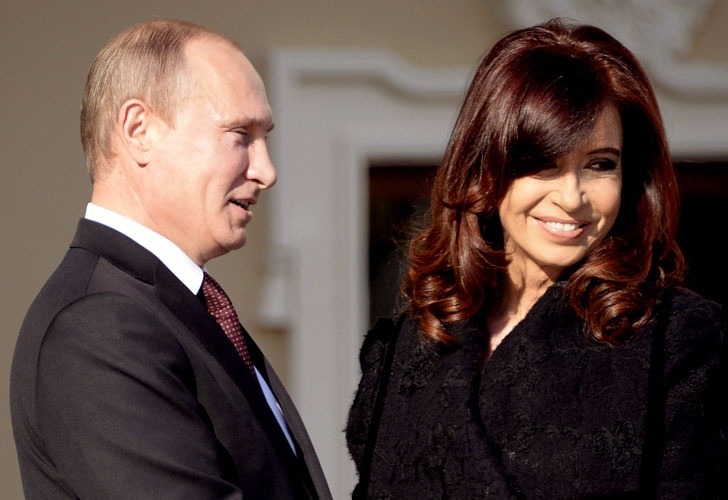
Russian President Vladimir Putin has endorsed a call by his Argentinean counterpart Cristina Fernandez de Kirchner to curb Western dominance in international politics.
Putin gave his support during a meeting with Kirchner in the Argentinean capital, Buenos Aires, on Saturday.
The Russian leader also said Moscow and Buenos Aires share a close view on international relations.
During the meeting, Kirchner emphasized that global institutions must be overhauled and made more multilateral, adding, “We firmly believe in multipolarity, in multilateralism, in a world where countries don’t have a double standard.”
In addition, the two leaders discussed military cooperation and oversaw their delegations signing a series of bilateral deals, including one on nuclear energy.
Putin’s visit to Argentina is part of his six-day tour of Latin America aimed at boosting trade and ties in the region, according to Russian state media.
The Russian leader’s trip will next take him to Brazil, where he is scheduled to attend the gathering of the economic alliance, BRICS (Brazil, Russia, India, China and South Africa), in Brazil on July 15 and 16.
Putin’s Latin American tour began on July 11 in Cuba, where he met with President Raul Castro and his brother, Fidel Castro. During his stay in the capital, Havana, Putin signed a law writing off 90 percent of Cuba’s USD 35-billion Soviet-era debt.
Following his visit to Cuba, Putin made a surprise visit to Nicaragua, where he held talks with President Daniel Ortega.
Cuba: US Fine Against BNP Paribas is Outrageous
Prensa Latina | July 3, 2014
Havana – The Cuban Ministry of Foreign Affairs (MINREX) denounced the U.S.-imposed fine against the French bank BNP Paribas as an outrage against state sovereignty and the rules of free trade and international law.
A MINREX statement warns that with this new fine, the government of President Barack Obama has gone further than all his predecessors, accumulating penalties that exceed $11 billion USD against scores of entities, applied under many different sanctions regimes.
According to the statement, the U.S. Departments of Treasury and Justice and the state of New York imposed a record fine on June 30 of $8.97 billion USD against the French bank BNP Paribas, for disobeying Washington’s unilateral sanctions regimes against many countries.
In the specific case of Cuba, this bank institution is accused, according to U.S. Attorney General Eric Holder, of having processed thousands of transactions with the island’s entities, totaling more than $1.7 billion USD.
This fine, the largest imposed in history by the U.S. government for violations of its blockade on Cuba and current sanctions against third countries, violates the rules of International Law, and is described as an extraterritorial and illegal application of U.S. legislation against a foreign entity.
MINREX said that as a Free Trade Agreement between the United States and the European Union is being negotiated, it might be asked whether this is how the U.S. government intends to continue treating its allies.
BNP Paribas joins a long list of U.S. and foreign financial, trade, economic and other entities that have been the object of punitive measures, in the context of the worsening of the blockade and, especially, the financial persecution of Cuba.
Once again, the U.S. government has ignored the overwhelming international rejection of this criminal and failed policy against our nation, the Ministry said, qualifying the fine as an outrage against state sovereignty, and the rules of free trade and international law.
BNP Paribas near record $9bn settlement for violating US sanctions
RT | June 23, 2014
France’s biggest bank has reportedly agreed an $8-9 billion settlement with US prosecutors over hiding $30 billion in money transfers to countries on the US sanctions blacklist. The fine against BNP Paribas could be a record for this type of violation.
In the proposed settlement, BNP Paribas will plead guilty to criminal charges in early July, The Wall Street Journal reports, citing a source close to the matter. After admitting violating the International Economic Powers Act, the bank will temporarily be banned from doing deals in US dollars. France has warned this could have a negative effect on the stability of the euro zone.
The US Department of Justice is negotiating with BNP Paribas over the infractions, and the penalty could be the biggest of its kind. French President Francois Hollande said the fines are ‘unfair’ and ‘disproportionate’.
In 2012, the US fined HSBC $1.9 billion over similar US sanctions violations, and Credit Suisse pled guilty to concealing sanctions data and paid $2.6 billion in fines.
After examining over $100 billion of transactions, US authorities found that $30 billion were illegally conducted with Iran, Cuba, and Sudan as they are countries sanctioned by the US.
The infraction will force the company to reshuffle its US-based management, according to several sources. The Wall Street Journal reports 30 bank employees have already left, or will soon exit, the company.
First set at $3 billion, the penalty later was rumored to have reached $16 billion before the latest $8-9 billion figure. The largest fine on record for a bank is the $13 billion JPMorgan Chase & Co paid out for pre-crisis mortgage frauds. BNP Paribas has only set aside over $1 billion to pay out any potential fines, and a fine between $8-9 billion could nearly wipe out the company’s entire pre-tax earnings of $11.2 billion.
The US, Cuba and Terrorism
By Robert Fantina | CounterPunch | May 2, 2014
The United States State Department, in its infinite wisdom, has once again designated Cuba as a state sponsor of terrorism. The newest Country Report on Terrorism, issued on April 30, 2014, includes Cuba in a list of nations that “repeatedly provided support for acts of international terrorism”. The island country in the Caribbean has been so designated since 1982.One reads about the U.S. calling any other nation a ‘sponsor of terrorism’ in shocked disbelief. That the U.S., the greatest purveyor of terrorism on the planet, has the audacity to accuse any other nation of sponsoring terrorism is beyond all credibility.
Just since the beginning of the new millennium, the U.S. has unleashed horrific terrorism on the people of Iraq and Afghanistan, resulting in the deaths of at least hundreds of thousands of men, women and children, and the displacement of millions, and is currently sending drones to Yemen and other nations, ostensibly to kill ‘terrorists’, but resulting in the deaths of thousands of innocent people. Is this not terrorism?
And what of the U.S.’s continued and unwavering financial support of Israeli terrorism against the Palestinians? Not only does the U.S. finance that apartheid regime, it blocks any attempt by the international community to put a halt to it.
So 1982 is the year that the U.S. first decided that Cuba was a state sponsor of terrorism. This, despite U.S. antagonism toward that country since 1959, when the repressive and widely hated, U.S.-supported regime of Fulgencio Batista was overthrown by a popular resistance movement, led by the young leftist, Fidel Castro. At that time, the U.S. controlled 80% of Cuban utilities, 90% of its mines and cattle ranches, and nearly all of its oil refineries. No wonder Mr. Castro has incurred the wrath of the U.S. since then: when the American bottom line is threatened, no efforts are too great to protect it.
And what has the U.S., that shining beacon of peace, freedom and democracy, been doing on the world stage since 1982, when it first singled out Cuba as a terrorist state? It has either invaded, or covertly or overtly worked for the overthrow of the governments of the following countries, sometimes on multiple occasions, and sometimes constantly:
Cuba
Nicaragua
Angola
Philippines
Iraq
Iran
Venezuela
Palestine
Afghanistan
Somalia
Haiti
If one were to go back just to the middle of the twentieth century, these countries could be added to the list:
Syria
Guatemala
Tibet
Indonesia
Democratic Republic of the Congo
South Vietnam
Brazil
Ghana
Chile
Turkey
Poland
Korea
El Salvador
Grenada
And what of ‘enhanced interrogation techniques’, including waterboarding, which the United Nations and every civilized country in the world, except for the U.S., condemns? By any but U.S. standards, these are acts of terrorism.
And while we’re talking about Cuba, let’s not forget Guantanamo, the U.S.’s, Cuban-based torture chamber. And the U.S. policy of ‘extraordinary rendition’, the practice of kidnapping suspected terrorists and sending them to foreign countries where prohibitions against torture don’t exist, can only be seen as terrorism.
So while the U.S. wages war, tortures political prisoners, holds prisoners for years without any concept of due process, destabilizes democratically-elected governments which displease it, and finances governments with long records of the most shocking human rights abuses, it actually has the nerve to accuse another country of supporting terrorism.
The Cuban response to this designation is milder than one might expect. A statement from that country’s foreign ministry said that Cuba “… energetically rejects the manipulation of a matter as sensitive as international terrorism by turning it into an instrument of policy against Cuba and it demands that our country be definitively excluded from this spurious, unilateral and arbitrary list.”
So what are the specific reasons the U.S. has for continuing to designate Cuba a sponsor of terrorism? It hardly matters, considering the U.S.’s own ongoing, horrific terrorist activities around the globe, but let’s note them anyway.
* Past support for the Basque separatist group ETA (Euskadi Ta Askatasuna ( Basque Homeland and Freedom), and
* Support for Colombia’s FARC (Fuerzas Armadas Revolucionarias de Colombia (Revolutionary Armed Forces of Colombia) rebels.
Yet the report concedes that Cuban ties to ETA ‘have become more distant’, and it points out that Cuba is hosting talks between the Colombian government and the FARC in Havana.
There are, of course, opposing views for why the U.S. actually has so designated Cuba:
Said Mauricio Claver-Carone, of the U.S.-Cuba Democracy PAC, an influential lobby group in Washington: Cuba “fails to meet the statutory criteria for being removed” (whatever that is).
Alana Tummino, director of policy at the Americas Society/Council for the Americas in New York, had a different view: “Sadly, unless the State Department has more evidence than it’s providing, it appears that political motivations have once again driven this determination.”
Can there be any doubt that political motivations are, in fact, behind the U.S.’s continuation of a policy that makes no logical sense? For nearly sixty years, the U.S. has embargoed, boycotted, sanctioned, blockaded and invaded Cuba, all because of ongoing resentment against the takeover by the government by Cubans from the Americans. The electoral vote in Florida is usually vital in presidential elections, and the importance of the Cuban-American voting bloc, although diminishing, is still worth courting. So such considerations as human rights, justice and statesmanship have no role in policy-making, when the goal is always re-election.
One looks in vain for any substantive change to U.S. policy towards Cuba.
Robert Fantina’s latest book is Empire, Racism and Genocide: a History of US Foreign Policy (Red Dill Press).
US-run ‘Cuban Twitter’ categorized ‘political tendencies’ of users – report
RT | May 1, 2014
Contractors working for the United States who ran the so-called ‘Cuban Twitter’ social media project categorized user responses to overtly political messages for “receptiveness” and “political tendencies,” among other details, according to a new report.
The US State Department’s Agency for the International Development (USAID) employed contractors to foster political unrest – while avoiding Cuba’s internet restrictions – through the subscription-based text-messaging service ZunZuneo, AP reported earlier this month.
Documents obtained by AP said ZunZuneo was designed to start with fairly benign messaging. Once it was more widespread among the Cuban population, it would introduce political content that would attempt to inspire Cubans to “renegotiate the balance of power between the state and society.”
Despite the State Department’s assertions that the program was not used to influence political leanings, AP reported Wednesday that cell phone users were categorized in databases as being “pro-revolution,” “apolitical,” or “anti-revolutionary.”
One young contractor working on the project was Paula Cambronero, whose first job out of college was working on how Cubans interacted with ZunZuneo messages carefully – and quietly – sent from Spanish phone numbers. The contractor asked Cambronero to communicate with staff over encrypted channels, and emails were sent from a domain name “not publicly linked” to the contractor.
Her employer – not named by AP – told her that she would be dealing with a “considerable amount of sensitive information that must be safeguarded to protect critical operations of the Project.” USAID even established a dummy company in the Cayman Islands to cover any money trail associated with ZunZuneo.
Cambronero’s responsibility was to build a database of unsuspecting Cuban cell phone users that responded to ZunZuneo messages, using classifications like gender, age, location, “receptiveness,” and “political tendencies.” She would analyze how users reacted to overtly political messages written by a hired Cuban satirist that poked at the nation’s leaders.
Cambronero did not respond to AP’s request for comment. The State Department had no comment to AP on Wednesday.
On Tuesday, USAID spokesman Matthew Herrick told AP that the agency had reviewed the project and offered congressional investigators the selection of messages sent to Cubans.
Herrick claimed the 249 different messages focused on sports, technology, world news, and trivia, and that the messages “were consistent with the objective of creating a platform for Cubans to speak freely among themselves.”
The political messages crafted by the satirist were sent “under a grant that pre-dated the ZunZuneo project,” Herrick said.
Yet documents reviewed by AP show that USAID considered the grant a “test phase” of the network that would become ZunZuneo.
Overall, Cambronero collected more than 700 responses to text messages, analyzing them by two variables: the level of interest in the received messages and the political content of a response.
She found that 68 percent of responses exhibited mild interest in the ZunZuneo texts. Many responses – 210 total – wanted to know who was sending the anonymous message.
“Explain your point better because I don’t understand and remember that if you haven’t done anything you shouldn’t fear anything, at least tell me your name if you’re not a coward,” said one respondent.
Others asked for help in obtaining birth certificates of Spanish ancestors, a prerequisite for acquiring a Spanish passport to leave Cuba.
Only 59 responses were analyzed for political content. Cambronero found 10 that did have “political character,” AP reported, “of which two were counter-revolutionary.”
In her notes, Cambronero recommended that “messages with a humorous connotation should not contain a strong political tendency, so as not to create animosity in the recipients.”
Upon the ZunZuneo revelations, the Obama administration quickly came under attack and promptly denounced allegations that it covertly plotted to disrupt Cuban politics.
Condemnation of the program continues to emerge. In Costa Rica, where ZunZuneo was reportedly developed by American officials, the nation’s foreign minister Enrique Castillo said last week that not only does he think it was “inappropriate” for the US to use his country to conduct the project, but that he previously warned officials not to involve his Central American country in the endeavor due to fears it would strain Costa Rica’s own relationship with Cuba.
“I think it’s inappropriate to use an embassy in Costa Rica for this type of operation that harms a third country,” Castillo told the AP. “We’re not filing a complaint. The point is that embassies accredited in Costa Rica don’t have to submit their plans or programs for the Costa Rican government’s approval.”
Costa Rica’s minister of communications, Carlos Roverssi, said Wednesday that it will fall on the country’s recently elected government to deal with the matter from here on out.
“It seems to me that the issue is now public and the next government should follow up on the issue, without a doubt,” he said.
The US State Department has begun a review of the program, saying it would be “troubling” if ZunZuneo involved political messaging.
USAID Subversion in Latin America Not Limited to Cuba
By Dan Beeton | CEPR Americas Blog | April 4, 2014
A new investigation by the Associated Press into a U.S. Agency for International Development (USAID) project to create a Twitter-style social media network in Cuba has received a lot of attention this week, with the news trending on the actual Twitter for much of the day yesterday when the story broke, and eliciting comment from various members of Congress and other policy makers. The “ZunZuneo” project, which AP reports was “aimed at undermining Cuba’s communist government,” was overseen by USAID’s Office of Transition Initiatives (OTI). AP describes OTI as “a division that was created after the fall of the Soviet Union to promote U.S. interests in quickly changing political environments — without the usual red tape.” Its efforts to undermine the Cuban government are not unusual, however, considering the organization’s track record in other countries in the region.
As CEPR Co-Director Mark Weisbrot described in an interview with radio station KPFA’s “Letters and Politics” yesterday, USAID and OTI in particular have engaged in various efforts to undermine the democratically-elected governments of Venezuela, Bolivia, and Haiti, among others, and such “open societies” could be more likely to be impacted by such activities than Cuba. Declassified U.S. government documents show that USAID’s OTI in Venezuela played a central role in funding and working with groups and individuals following the short-lived 2002 coup d’etat against Hugo Chávez. A key contractor for USAID/OTI in that effort has been Development Alternatives, Inc. (DAI).
More recent State Department cables made public by Wikileaks reveal that USAID/OTI subversion in Venezuela extended into the Obama administration era (until 2010, when funded for OTI in Venezuela appears to have ended), and DAI continued to play an important role. A State Department cable from November 2006 explains the U.S. embassy’s strategy in Venezuela and how USAID/OTI “activities support [the] strategy”:
(S) In August of 2004, Ambassador outlined the country team’s 5 point strategy to guide embassy activities in Venezuela for the period 2004) 2006 (specifically, from the referendum to the 2006 presidential elections). The strategy’s focus is: 1) Strengthening Democratic Institutions, 2) Penetrating Chavez’ Political Base, 3) Dividing Chavismo, 4) Protecting Vital US business, and 5) Isolating Chavez internationally.
Among the ways in which USAID/OTI have supported the strategy is through the funding and training of protest groups. This August 2009 cable cites the head of USAID/OTI contractor DAI’s Venezuela office Eduardo Fernandez as saying, during 2009 protests, that all the protest organizers are DAI grantees:
¶5. (S) Fernandez told DCM Caulfield that he believed the [the Scientific, Penal and Criminal Investigations Corps’] dual objective is to obtain information regarding DAI’s grantees and to cut off their funding. Fernandez said that “the streets are hot,” referring to growing protests against Chavez’s efforts to consolidate power, and “all these people (organizing the protests) are our grantees.” Fernandez has been leading non-partisan training and grant programs since 2004 for DAI in Venezuela.”
The November 2006 cable describes an example of USAID/OTI partners in Venezuela “shut[ting] down [a] city”:
11. (S) CECAVID: This project supported an NGO working with women in the informal sectors of Barquisimeto, the 5th largest city in Venezuela. The training helped them negotiate with city government to provide better working conditions. After initially agreeing to the women’s conditions, the city government reneged and the women shut down the city for 2 days forcing the mayor to return to the bargaining table. This project is now being replicated in another area of Venezuela.
The implications for the current situation in Venezuela are obvious, unless we are to assume that such activities have ended despite the tens of millions of dollars in USAID funds designated for Venezuela, some of it going through organizations such as Freedom House, and the International Republican Institute, some of which also funded groups involved in the 2002 coup (which prominent IRI staff publicly applauded at the time).
The same November 2006 cable notes that one OTI program goal is to bolster international support for the opposition:
…DAI has brought dozens of international leaders to Venezuela, university professors, NGO members, and political leaders to participate in workshops and seminars, who then return to their countries with a better understanding of the Venezuelan reality and as stronger advocates for the Venezuelan opposition.
Many of the thousands of cables originating from the U.S. embassy in Caracas that have been made available by Wikileaks describe regular communication and coordination with prominent opposition leaders and groups. One particular favorite has been the NGO Súmate and its leader Maria Corina Machado, who has made headlines over the past two months for her role in the protest movement. The cables show that Machado historically has taken more extreme positions than some other opposition leaders, and the embassy has at least privately questioned Súmate’s strategy of discrediting Venezuela’s electoral system which in turn has contributed to opposition defeats at the polls (most notably in 2005 when an opposition boycott led to complete Chavista domination of the National Assembly). The current protests are no different; Machado and Leopoldo López launched “La Salida” campaign at the end of January with its stated goal of forcing president Nicolás Maduro from office, and vowing to “create chaos in the streets.”
USAID support for destabilization is no secret to the targeted governments. In September 2008, in the midst of a violent, racist and pro-secessionist campaign against the democratically-elected government of Evo Morales in Bolivia, Morales expelled the U.S. Ambassador, and Venezuela followed suit “in solidarity.” Bolivia would later end all USAID involvement in Bolivia after the agency refused to disclose whom it was funding in the country (Freedom of Information Act requests had been independently filed but were not answered). The U.S. embassy in Bolivia had previously been caught asking Peace Corps volunteers and Fulbright scholars in the country to engage in espionage.
Commenting on the failed USAID/OTI ZunZuneo program in Cuba, House Oversight and Government Reform Chairman Jason Chaffetz (R-UT) commented that, “That is not what USAID should be doing[.] USAID is flying the American flag and should be recognized around the globe as an honest broker of doing good. If they start participating in covert, subversive activities, the credibility of the United States is diminished.”
But USAID’s track record of engaging in subversive activities is a long one, and U.S. credibility as an “honest broker” was lost many years ago.
Related article

USAID Caught Using Tweets to Try and Overthrow a Government
The Hummingbird Tweet: An Espionage Tale

By Alfredo Lopez | This Can’t Be Happening | April 3, 2014
For two years, starting in 2010, the United States Agency for International Development ran a social networking service — similar to Twitter — for the Cuban people. Its long-term objective was to foment popular revolt against the government and destabilize the country.
They called it “ZunZuneo” (Cuban slang for a hummingbird’s “tweet”) and launched it under absolute secrecy about who was really running it. “There will be absolutely no mention of United States government involvement,” according to a 2010 memo from one of the companies supposedly running the service. “This is absolutely crucial for the long-term success of the service and to ensure the success of the mission.”
The “mission” was to reach a critical mass of Cuban users by offering tweets on sports, entertainment and light news over the service and signing recipients up through word of mouth — you call a phone number and your phone is hooked up. With that critical mass in place, the tweets would start getting more political: inspiring Cuban citizens to organize “smart mobs” — mass gatherings called at a moment’s notice to spark a kind of a “Cuban Spring” or, as one USAID document put it, “renegotiate the balance of power between the state and society.”
At one point there were 40,000 Cubans getting ZunZuneo tweets but the project was abandoned in 2012 when the initial funding ran out and the people who own the real Twitter refused to take it on.
The story, an investigative report by the Associated Press, is probably not surprising to most people in this country. After the NSA revelations, what could possibly surprise us? And besides, it would not be the first time that USAID was found doing the nefarious work of the CIA at undermining governments. But it is an embarrassing revelation about how our government is using the Internet and about how “hot” the Cold War remains.
There are also some serious legal issues.
One of the main organizers of the project — Joe McSpedon of the USAID — met with officials from a variety of fronting “sponsor companies” to launch the project in 2009-2010.
From the start, the program’s objective was clear: to de-stablize the government of Cuba, and destabilizing governments is something the United States is proficient at. There are few areas of the world whose history doesn’t include an attempt, often successful, by United States to overthrow a government. In fact, in Venezuela, Ukraine and various parts of Africa, South America and the “Middle East”, such efforts are currently ongoing. In most of these cases, the propaganda-preparing and deceit-dispensing USAID plays a central role.
But some U.S. Congressional officials seemed to think this went further. Vermont Democrat Senator Patrick Leahy, who chairs the Appropriations Committee’s State Department and Foreign Operations Subcommittee, called the program “dumb, dumb, dumb” today on MSNBC. He denied knowing anything of the program but said that, if he had, “I would have said, ‘What in heaven’s name are you thinking?’”
White House Press Secretary Jay Carney insisted that the government was only thinking of improving Cuban’s lives and had done everything “by the law”.
But that’s questionable. The program’s initial recruitment drive was based on a list of a half million Cuban cellphone users apparently stolen from Cuba’s most prominent cellphone company. An employee of that company apparently gave up the information to USAID. Those are stolen phone numbers and also involved an invasion of privacy, which is illegal under any law.
The USAID staffers also set up a series of “front” companies in Spain, Mexico and possibly other countries, to act as the new service’s sponsors. The service, with those companies displaying phony ads and messages on its website, then texted the half million stolen numbers with an offer to join up. That goes way beyond “false advertising” and is absolutely illegal in most countries, including the United States.
Finally, there is the intent of the program (the real reason that USAID wanted to hide its role). You can insult other leaders and even threaten them under international law, but you can not, ever, intervene to overthrow another country’s government. That the United States does this all the time only means that it’s breaking the law all the time.
The exposure of the Zunzuneo story is likely to lead to a new look at the role of USAID in other parts of the world where there are seemingly “popular” risings against elected governments, such as Ukraine and Venezuela.
The truth is that this Zunzuneo program actually addressed a real need, or at least took advantage of one. Cuban communications officials have been reluctant to open Internet access to the country. Then there are the problems of a still developing infrastructure (electricity and phone wires are still in scarce supply). Plus there is the lack of home computers, which only exacerbates the problem. With cell phones now available to many Cubans, the thirst for an information source over the Internet is increasingly being felt.
Which is one good reason many other Latin American leaders, some of them friends of Cuba, are advising the Cuban government to make connectivity a priority in their country. Without an on-line connection to the rest of the world, exploitative criminals like those at the USAID can make their moves.
Related articles
- ‘Cease illegal activity against Cuba’: Havana slams Washington for ‘Twitter’ program (rt.com)
- US Secretly Created ‘Cuban Twitter’ To Stir Unrest (mintpressnews.com)
‘US funded social network to incite unrest in Cuba’
Press TV – April 3, 2014
A new investigation reveals that the US government has secretly funded a social media network program to instigate political unrest in Cuba.
The administration of US President Barack Obama has been secretly financing the project, dubbed “Cuban Twitter,” for more than two years to undermine the Caribbean country’s government, according to an investigation by the Associated Press.
The program has reportedly been able to evade Cuba’s Internet restrictions by creating a text-messaging service that could be used to organize political rallies.
The service drew in tens of thousands of subscribers who were unaware of Washington’s scheme. The investigation showed that the US Agency for International Development (USAID) has gone to extensive lengths to conceal its involvement in the program.
It also added that USAID set up front-companies overseas and routed money through a Cayman Islands bank to hide the funding it supplied to support the Cuban Twitter project.
Havana and Washington have been at odds since the Cuban revolution, led by Fidel Castro, toppled Fulgencio Batista’s regime in 1959. The US started imposing measures on the same year and placed an official embargo against Cuba in 1962.
Speaking at the United Nations General Assembly in 2012, Cuba’s Foreign Minister Bruno Rodriguez Parrilla said that after the 2008 US presidential election, Obama had promised a new beginning with Cuba but “the reality of the last four years has been characterized by a persistent tightening of the economic, commercial, and financial blockade.”
Related articles
Slavery, Cotton and Imperialism
By W.T. Whitney, Jr. | CounterPunch | March 25, 2014
“Cuba is already ours. I feel it in my finger’s ends.”
– James Buchanan, 1849
Historian Walter Johnson’s highly recommended book, “River of Dark Dreams,” centers on cotton production and slave ownership in the Mississippi River Valley prior to the U.S. Civil War. Planters, it seems, believed their fate was linked to imperatives imposed through an internationalized system of sales, manufacture, and re-supply. Johnson’s spirited, enthralling narrative casts slave ownership and cotton growing as precarious undertakings. Planters on the edge of disaster strategized and improvised in order to retain both land and slaves.
Their intransigence vis-à-vis northern compatriots derived, Johnson suggests, from immersion in a labyrinth-like alternative universe that set conditions for their economic survival. Planters were alienated enough from pretensions of their own government to seek deliverance through privatized military interventions in countries seen as hospitable to plantations and slavery.
Johnson focuses on actualities and people’s lives rather than on well-trodden slavery-era themes like abolitionism, or northern industrialization, or states rights . Social and economic history in his hands tells of ledger books; cotton “pickability;” slaves starving, stolen, rebelling, and running away; search dogs; slave babies dying, slave prices, soil fertility, droughts, sandbars, and Haiti. Steamboats feature prominently, along with their explosions, gamblers, races, high-pressure engines, and dining room etiquette. They were technological marvels of their era and absolutely crucial for marketing cotton.
During the period under study, Valley cotton production increased fortyfold, the slave population, 17 times. “The greatest economic boom in the history of the United States” was in progress. Cotton was “the largest single sector of the global economy.” Planters were part of “a network of material connections that stretched from Mississippi and Louisiana to  Manhattan and Lowell to Manchester and Liverpool.” Indeed, the “rate of exploitation of slaves in a field in Mississippi … was keyed to the exchange in Liverpool (port of entry for 85 percent of U.S. planters’ cotton) and the labor of mill hands in Manchester.”
In New York southern cotton was re-sold, re-graded, and re-loaded onto other ships for the Atlantic crossing. That city consumed 40 percent of all income generated through cotton sales. Cotton made up two thirds of all U.S. exports. Yet only 10 percent of U.S. imports ended up in cotton-producing states. Southern manufacturers lacked essential equipment manufactured abroad. Cotton producers endured shortages of imported plantations supplies.
Johnson characterizes “the conceptual reach of the global economy in the first half of the nineteenth century” as “lashes into labor into bales into dollars into pounds sterling.” Cotton moved from plantations, to factors in New Orleans, to bankers and shippers in New York, to bankers, buyers, and manufacturers in England, all on a flood of promissory notes, loans, credit, and deductions.
Planters’ wealth took the form of slaves and land. Although land served as collateral for loans, “without slaves, land itself was worthless.” In effect, planters “buy Negroes to plant cotton and raise cotton to buy Negroes.” Facing hard times, slaveholders as a class could not simply transfer their investment from one form of capital to another… Their capital would not simply rust or lie fallow. It would starve. It would steal. It would revolt.”
Influential trade representatives and publicists determined upon a “spatial fix.” They envisioned the Mississippi River as conduit to southern venues favorable to cotton production and other investment possibilities. “In order to survive, slaveholders had to expand,” the author points out: “Proslavery globalism increasingly took the form of imperialist military action.”
“[F]or many in the Mississippi Valley … the most important issue in the early 1850s was Cuba.” Pursing annexation, former Spanish soldier Narciso López in 1851 invaded the island with troops drawn from “the margins of the cotton economy.” Slaveholders had donated supplies. The expedition failed, and López’ execution in Havana attracted 20,000 spectators. Former Mississippi governor and co-conspirator John Quitman raised 1000 men in 1855 for another invasion, which never materialized.
Johnson reviews the career also of slaveholder proxy William Walker whose small army in 1855 subdued Nicaraguan defenders and set him up as the country’s president. Mississippi Valley supporters provided supplies, arms, troops, and ample publicity.
Were slave-owners capitalist? Johnson rejects the notion of slavery as an “archaic” pre-capitalist mode of exploitation. He settles on “a materialist and historical analysis [that] begins from the premise that there was no nineteenth century capitalism without slavery.” […]
Johnson documents early stirrings of U.S. imperialism. The take among many leftists is that capitalism by its very nature entails recurring crises in accumulation. They assume too that for solutions capitalists look to overseas extension of their operations, even to war making. Thus slave owner longings for exploitative possibilities in the Caribbean and in Central America fueled military adventurism. “River of Dark Dreams” serves in this regard to have documented the beginnings of a U.S. turn toward a global fix for close-to-home economic incongruities. – Full review
W.T. Whitney Jr. is a retired pediatrician and political journalist living in Maine.
Featured Video
Meet The Ellisons: Zionists, Technocrats, Moguls
or go to
Aletho News Archives – Video-Images
Frlom the Archives
Who Rules America?
The Power Elite in the Time of Trump
By James Petras | Axis of Logic | September 6, 2017
Introduction
In the last few months, several competing political, economic and military sectors – linked to distinct ideological and ethnic groups – have clearly emerged at the centers of power.
We can identify some of the key competing and interlocking directorates of the power elite:
- Free marketers, with the ubiquitous presence of the ‘Israel First’ crowd.
- National capitalists, linked to rightwing ideologues.
- Generals, linked to the national security and the Pentagon apparatus, as well as defense industry.
- Business elites, linked to global capital.
This essay attempts to define the power wielders and evaluate their range of power and its impact. … continue
Blog Roll
 Aletho News
- Iran Does Not Consider Israel Party to Talks to Need Mediators With It – Ambassador
- Macron’s aircraft carrier and warplanes to the Persian Gulf is a dangerous vanity project
- Meet The Ellisons: Zionists, Technocrats, Moguls
- US failures in Iran reveal Russia is key to South Korea’s strategic security
- ‘All ports in Persian Gulf will be legitimate targets if Iranian ports are attacked’
- 40 Years of Endless War, Data Point by Data Point
- Department of War Using Palantir AI to Pick Targets in Iran
- American bases do not protect – they attack the peoples of the Persian Gulf
- ‘We’ve Obliterated Their Missiles’
- Syrian president vows ‘absolute support’ to disarm Hezbollah
- If Americans Knew
- Israeli strategic plans to “remake the Middle East” from the 1950s and since
- Honoring Gaza’s women who refused to let the world look away
- 97% of victims of war on Iran are Iranian, 98% of victims in war on Gaza are Gazans – Not a ceasefire Day 152
- Early Iran strikes cost $5.6 billion in munitions, Pentagon estimates
- Israel Decided the War, But Trump’s America Fights and Pays the Bill
- Conscientious Objector Group: Phone ‘Ringing Off Hook’ As Huge Mobilization Underway
- U.S. support for Israel continues to plummet, despite media’s best efforts
- Threats and missiles fly, death tolls soar in Iran, Lebanon, Gaza – Not a ceasefire Day 151
- Lebanon: Israel’s White Phosphorous Use Risks Civilian Harm
- Corporate Media Go All Out To Support The US-Israeli War On Iran
- No Tricks Zone
- Destructive Green New Deal: German Energy And Metal Group Warns Of Drastic Crisis
- New Study Documents A 20-Year Pause In Arctic Sea Ice Decline – Driven By Internal Variability
- Wake-up Call: Survey Shows Majority Of Germans Now Favor Postponing Climate Targets!
- Televised! Leading German Political Candidate Tells Schoolchildren CO2 Makes Sun Hotter!
- New Study: A Century Warming Of 1.1°C Is ‘Commonplace’ And ‘Not Unusual’ During This Interglacial
- New Study: ‘Internal Noise’ And Volcanic Forcing Can Trigger 10-15°C Warming Within Decades
- Glaciers Worldwide Are Suddendly Surging, Experts Blame Warming!
- Surprising Discovery: Sahara Is Greening…Billions Of Trees Where Once Thought To Be Barren
- New Research Reaffirms Clouds, Aerosols, And Surface Solar Radiation Are ‘Driving The Climate System’
- Germany: Electric Car Catches Fire At Charging Station, Sets Off Local “Inferno”, Widespread Damage
 Aletho News