Documents Describe US “Transition Plans” for Cuba
Secrecy, politics at heart of Cuba project
Along the Malecon | January 17, 2013
U.S. officials stressed the importance of secrecy during a 2008 meeting with a Maryland contractor that had been chosen to carry out a new democracy project in Cuba, according to a confidential memo (download 8-page document).
The project wasn’t considered classified, however, because the U.S. Agency for International Development wanted to create the illusion of transparency.
Development Alternatives Inc., of Bethesda, Md., won the USAID contract on Aug. 14, 2008, and quickly hired Alan Gross, who was later arrested in Cuba while working on the project.
DAI – not USAID, as some websites have reported – wrote the confidential memo to summarize what was said during a private Aug. 26, 2008, meeting with top USAID officials.
During the meeting, DAI learned that the U.S. government had “five to seven different transition plans” for Cuba. DAI would “not be asked to write a new one.”
Instead, the contractor would carry out a daring plan to set up satellite Internet connections under the nose of Cuban state security agents.
USAID promised to protect the identities of contractors and their associates in and out of Cuba. “The program is not pressing (and will not press) them to disclose networks,” said the memo, which DAI filed in federal court on Jan. 15 as part of its reply to a $60 million lawsuit filed by the Gross family in November 2012 (See Spanish-language translation of this post here, h/t Letras Afiladas).
The memo stressed the unusual nature of the Cuba program:
The project was not classified because USAID wanted to send the message that this is a transparent process. Also, a classified project imposes significant security, documentation burdens and delays on all its stakeholders.
USAID wanted no delays and was eager to move ahead. The memo said:
This Administration expects immediate results from this program, definitely before mid-January.
That deadline likely had something to do with the departure of George W. Bush, a strong supporter of USAID’s programs in Cuba, and the arrival of Barack Obama, who was sworn in on Jan. 20, 2009.
The DAI memo summed up a top USAID official’s view of the political undercurrents:
- This project has received and will continue to warrant intense political scrutiny and pressure for results and fiscal integrity.
- Target populations for grants are those NGO reaching out to pro-democracy and human rights change agents and those Cubans with a different vision for their country.
- USAID is not telling Cubans how or why they need a democratic transition, but rather, the Agency wants to provide the technology and means for communicating the spark which could benefit the population.
- This project will be difficult to implement because an ‘ossified’ Cuban government prevents change, and because most government resources go to its police and control machinery.
- The Cuba program attracts significant attention and scrutiny by US Congress, where some support and others question existing activities.
- There is, of course, skepticism on this project, influential political and civic leaders have the perception that this program is paying too much for work that could be significantly less expensive through other contract or award options.
The challenge, the memo said, would be finding “creativity to implement this project in the face of opposition from the Cuban State…while protecting the security of participants and change agents.”
The project was entitled “Cuba Democracy and Contingency Planning Program,” or CDCPP. The memo gave explicit instructions on how the initiative should be described if any lawmakers should ask about it.
Explanation to the Hill regarding CDCPP: to empower pro-democracy, pro-human rights and those looking for alternative visions for the island. The program seeks to expand the reach of their ideas and activities, to build and fortify networks and their capacity to act, and to increase the flow of communication to and around the island.
That vague description gave no clues to the project’s clandestine nature, but the DAI memo was clear:
CDCPP is not an analytical project; it’s an operational activity. USAID approval is needed for everything. We cannot freelance.
The memo said USAID picked DAI in part because of its international reach.
USAID would like to tap into the global network of contacts that DAI has in terms of democracy promotion…
Planes flying in to Cuba from Europe, Central America and the Caribbean look “less conspicuous.”
Grant limits to non-U.S. NGOs “have no funding ceiling,” the memo added. But:
Cuban security apparatus is very strong so non-US NGOs should be vetted.
The DAI memo spelled out what the contractor should say in response to any inquiries from the public or the media:
Yes, we have been awarded CDCPP and we are working with USAID on discussions, but the project is not fully operational yet. Please refer other questions to (redacted) of USAID.
The memo said USAID stressed:
Nothing anywhere.
DAI said that meant:
We must not post anything on our website or issue a press release on the awarded contract.
DAI wound up picking Gross to handle “new media” – the satellite Internet connections – described as the “most sensitive component in a very sensitive project.”
And during four trips to Cuba, Gross established three Internet connections – one in Havana, two outside the capital.
DAI paid him $258,274. He requested more money to continue the project and was promised $332,334, which would have brought his subcontract total to $590,608, an October 2009 memo shows (download 6-page document).
In late November 2009, Gross returned to Cuba a fifth time. Cuban authorities arrested him on Dec. 3, 2009, and accused him of crimes against the socialist state.
DAI said it paid Gross “the full amount owed under the Subcontract for completed deliverables.”
That evidently means Gross would have been entitled to just $65,132.80. That would bring his total payments to $323,406.80, not the full $590,608 he could have collected if he were not arrested.
Gross called his effort “Para La Isla” – For The Island. According to a proposal (download 13-page document) he wrote after his first four trips to Cuba:
Efforts to date under the Para-La-Isla (PLI) Pilot have been focused on establishing and operationalizing 3 sites on the Island through which target group members now have greater access to information than they had previously.
Activities in support of these efforts included the selection, configuration, logistics and training on the use of specific information and communication technologies (ICTs). Primary objectives of the Pilot dealt with the efficacy of the technologies deployed and the contractor’s demonstration that these technologies work.
In the Sept. 17, 2009, memo, Gross proposed six eight additional trips to Cuba that his company would carry out from Nov. 1, 2009, to Oct. 31, 2010.
The memo stated:
Activities initially developed under this pilot at the first site in the capital city have been replicated and expanded to two other target group member communities in the provinces. These activities can be expanded to other identified target groups.
That likely means that Gross and DAI had envisioned taking the program beyond the Jewish community where Gross installed his first Internet connection.
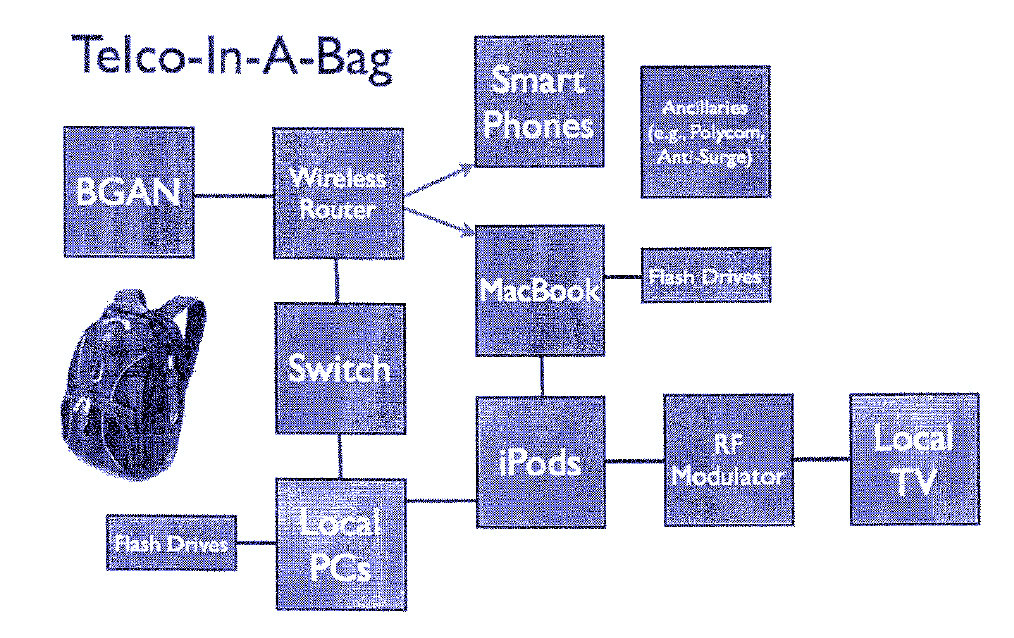
Gross had supplied his Cuban collaborators with Broadband Global Area Network equipment, BGAN for short. The equipment, which fits into a backpack, can be used to establish a broadband Internet connection from anywhere in the world. Users can also make phone calls, send e-mail messages and set up a WiFi network.
During follow-up visits, Gross wanted to learn how Cubans were using the BGAN equipment, increase the number of users at each site and boost security so they wouldn’t be caught.
He considered it “highly probable” that state security agents would detect the satellite connections in the provinces. He wrote:
Radio Frequency activity in the Capitol City is more difficult to monitor than in the provinces because of an already existing level of RF congestion (e.g., from government, commercial sites, embassies, etc.). Therefore, monitoring and detection in the use of ICTs is less likely to occur in the Capitol City. Conversely and because there is little RF congestion in the provinces, monitoring and detection of ICT devices is highly probable.
Even limited use of BGANs and wireless networks will be monitored and detected because Island government technicians routinely “sniff” neighborhoods with their handheld devices in search of ham-radio and satellite dishes. While wireless computer networks (intranet) are not likely to cause any problem if detected, discovery of BGAN usage for Internet access would be catastrophic.
Gross planned to install special SIM cards in the three BGAN systems that would disable their GPS tracking feature and make them more difficult to detect. He wrote:
In order to improve and supplement security tactics and protocols already in place, the contractor will use an alternative SIM card, called “discreet” SIM card, that will increase the level of technical security with each of the 3 BGANs deployed. Discreet SIM cards impede the ability to track or detect specific aspects of non-terrestrial transmitted signals, regarding location and IP identification of transmission. This is accomplished by:
- Masking the IP address of the BGAN, in case some entity is able to “hack” into the transmission at either end, and
- Masking the signal so that its GPS location cannot be pinpointed within 400 km.
During the last three of the six trips that Gross planned, he had hoped to supply “up to an additional three prospective new target group sites” with what he described as “Telco-in-a-Bag.” He wrote:
Beneficiaries will utilize this equipment to support activities that are consistent with CDP program. A standard configuration will include:
- Hardware and software (e.g., computers, modems)
- Content sharing devices (e.g. iPods, flash drives, smartphones)
- Activation and Service (BGAN and mobile)
- Installation
- Training on the use of this equipment will be similar to the first 3 sites (excluding training on Ruckus Wireless equipment)
- Local Technical Support to be provided by local contractor staff for trouble-shooting, technical assistance, maintenance, etc.
- Accessories
- Schematic
Gross said each ‘Telco-In-A-Bag” would include:
- Unlocked SmartPhones
- Sim Card
- 2GB miniSD Expansion Memory Card
- iPod 120 GB
- Composite AV Cable for use with iPod & TV
- RF Modulator for TVs, Coaxial Cable
- BGAN satellite modem (1 T&T, 2 Nera)
- Discreet BGAN Sim card
- Wireless Router
- Switch
- MacBook
- Backpack
- Surge Protector (3-outlet) & Adapters
- Polycom Communicator for Notebook
- WD External Hard Drive, 500 GB
- USB Memory Stick (4 GB Flash Drive)”
The memo said that Gross and DAI would reach “an amicable agreement on how to resolve or settle” any differences if forces beyond their control prevented the project’s completion.
But there was no amicable agreement after Gross was arrested and Gross and his wife, Judy, sued DAI and USAID.
On Jan. 15, DAI asked a federal judge to throw out the lawsuit. Lawyers for DAI wrote (download 57-page document):
The Cuban government, reprehensibly, has sought to manipulate its detention of Mr. Gross to strengthen its hand in dealings with the United States. This has included seeking to exchange Mr. Gross’s release for the U.S. Government’s release of five Cuban spies. As Congresswoman Ileana Ros-Lehtinen observed, “[t]he Cuban dictatorship is clearly using Mr. Gross to strengthen its grip on power and gain leverage with the United States.”
Against this backdrop, Plaintiffs have filed the present tort suit seeking monetary damages from the Defendants. The fundamental premise of the Complaint is that Plaintiffs may bring tort claims against the Defendants based on the tragic harm that has befallen Mr. Gross.
This premise is wrong. Plaintiffs’ allegations are inextricably intertwined with Federal laws and policies that bar Plaintiffs’ claims, and also fail to state a claim on which the Court can grant relief. Plaintiffs’ claims must be dismissed for eight distinct reasons, any one of which would justify dismissal.
The DAI lawyers – Steven J. Weber, Sarah M. Graves and Matthew J. Gaziano – also said that the company did not have duty to protect Gross. They said he was an independent contractor who should have done more to avoid arrest.
They wrote:
…the Subcontract explicitly states “[t]he Subcontractor shall take all reasonable precautions to prevent damage, injury, or loss to all persons performing services hereunder, the Work, all materials and equipment utilized therein, and all other property at the site of the Work and adjacent thereto.” § 7.3. Thus, § 410 is inapplicable on its face, and the general rule restricting liability to independent contractor employees should prevail.
In sum, DAI had no duty to protect Mr. Gross from the type of injury he suffered, and no exception to this rule is applicable given his admitted status as an employee of an independent contractor. Whether his injury was foreseeable is a factual question that does not change this analysis.
The Cuban government – not DAI – are ultimately to blame for any harm done to Gross and his wife, the contractor’s lawyers said.
DAI deeply regrets that Mr. and Mrs. Gross have suffered harm due to the actions of the Cuban government while Mr. Gross was undertaking activities in Cuba to further the U.S.Government’s foreign policy. For the reasons stated above, however, the Complaint against DAI must be dismissed in its entirety and with prejudice.
Related articles
- Alan Gross and his descent into hell
- Cuba responds to unsubstantiated U.S. claims regarding the Alan Gross case
- Cuba and the Jewish Lobby
- Ecuador: Government Announces End of Cooperation with USAID

Why Is Cuba’s Health Care System the Best Model for Poor Countries?
By Don Fitz – Black Agenda Report – 12/12/2012

Furious though it may be, the current debate over health care in the US is largely irrelevant to charting a path for poor countries of Africa, Latin America, Asia and the Pacific Islands. That is because the US squanders perhaps 10 to 20 times what is needed for a good, affordable medical system. The waste is far more than 30% overhead by private insurance companies. It includes an enormous amount of over-treatment, making the poor sicker by refusing them treatment, creation of illnesses, exposure to contagion through over-hospitalization, and disease-focused instead of prevention-focused research. [1]
Poor countries simply cannot afford such a health system. Well over 100 countries are looking to the example of Cuba, which has the same 78-year life expectancy of the US while spending 4% per person annually of what the US does. [2]
The most revolutionary idea of the Cuban system is doctors living in the neighborhoods they serve. A doctor-nurse team is part of the community and know their patients well because they live at (or near) the consultorio (doctors’ office) where they work. Consultorios are backed up by policlínicos which provide services during off-hours and offer a wide variety of specialists. Policlínicos coordinate community health delivery and link nationally designed health initiatives with their local implementation.
Cubans call their system medicina general integral (MGI, comprehensive general medicine). Its programs focus on preventing people from getting diseases rather than curing them after they are sick
This has made Cuba extremely effective in control of everyday health issues. Having doctors’ offices in every neighborhood has brought the Cuban infant mortality rate below that of the US and less than half that of US Blacks. [3] Cuba has a record unmatched in dealing with chronic and infectious diseases with amazingly limited resources. These include (with date eradicated): polio (1962), malaria (1967), neonatal tetanus (1972), diphtheria (1979), congenital rubella syndrome (1989), post-mumps meningitis (1989), measles (1993), rubella (1995), and TB meningitis (1997). [4]
The MGI integration of neighborhood doctors’ offices with area clinics and a national hospital system also means the country responds well to emergencies. It has the ability to evacuate entire cities during a hurricane largely because consultorio staff know everyone in their neighborhood and who to call for help getting disabled residents out of harms way. At the same time New York City (roughly the same population as Cuba) had 43,000 cases of AIDS, Cuba had 200 AIDS patients. [5] More recent emergencies such as outbreaks of dengue fever are quickly followed by national mobilizations. [6]
Perhaps the most amazing aspect of Cuban medicine is that, despite its being a poor country itself, Cuba has sent over 124,000 health care professionals to provide care to 154 countries. [7] In addition to providing preventive medicine Cuba sends response teams following emergencies (such as earthquakes and hurricanes) and has over 20,000 students from other countries studying to be doctors at its Latin American School of Medicine in Havana (ELAM, Escuela Latinoamericana de Medicina). [8]
In a recent Monthly Review article, I gave in-depth descriptions of ELAM students participating in Cuban medical efforts in Haiti, Ghana and Peru. [9] What follows are 10 generalizations from Cuba’s extensive experience in developing medical science and sharing its approach with poor countries throughout the world. The concepts form the basis of the New Global Medicine and summarize what many authors have observed in dozens of articles and books.
First, it is not necessary to focus on expensive technology as the initial approach to medical care. Cuban doctors use machines that are available, but they have an amazing ability to treat disaster victims with field surgery. They are very aware that most lives are saved through preventive medicine such as nutrition and hygiene and that traditional cultures have their own healing wisdom. This is in direct contrast to Western medicine, especially as is dominant in the US, which uses costly diagnostic and treatment techniques as the first approach and is contemptuous of natural and alternative approaches.
Second, doctors must be part of the communities where they are working. This could mean living in the same neighborhood as a Peruvian consultorio. It could mean living in a Venezuelan community that is much more violent than a Cuban one. Or it could mean living in emergency tents adjacent to where victims are housed as Cuban medical brigades did after the 2010 earthquake in Haiti. Or staying in a village guesthouse in Ghana. Cuban-trained doctors know their patients by knowing their patients’ communities. This differs sharply from US doctors, who receive zero training on how to assess homes of their patients.
Third, the MGI model outlines relationships between people that go beyond a set of facts. Instead of memorizing mountains of information unlikely to be used in community health, which US students must do to pass medical board exams, Cuban students learn what is necessary to relate to people in consultorios, polyclínicos, field hospitals and remote villages. Far from being nuisance courses, studies in how people are bio-psycho-social beings are critical for the everyday practice of Cuban medicine.
Fourth, the MGI model is not static but is evolving and unique for each community. Western medicine searches for the correct pill for a given disease. In its rigid approach, a major reason for research is to discover a new pill after “side effects” of the first pill surface. Since traditional medicine is based on the culture where it has existed for centuries, the MGI model avoids the futility of seeking to impose a Western mindset on other societies.
Fifth, it is necessary to adapt medical aid to the political climate of the host country. This means using whatever resources the host government is able and willing to offer and living with restrictions. Those hosting a Cuban medical brigade may be friendly as in Venezuela and Ghana, hostile as is the Brazilian Medical Association, become increasingly hostile as occurred after the 2009 coup in Honduras, or change from hostile to friendly as occurred in Peru with the 2011 election of Ollanta Humala. This is quite different from US medical aide which, like its food aide, is part of an overall effort to dominate the receiving country and push it into adopting a Western model.
Sixth, the MGI model creates the basis for dramatic health effects. Preventive community health training, a desire to understand traditional healers, the ability to respond quickly to emergencies, and an appreciation of political limitations give Cuban medical teams astounding success. During the first 18 months of Cuba’s work in Honduras following Hurricane Mitch, infant mortality dropped from 80.3 to 30.9 per 1000 live births. When Cuban health professionals intervened in Gambia, malaria decreased from 600,000 cases in 2002 to 200,000 two years later. And Cuban/Venezuelan collaboration resulted in 1.5 million vision corrections by 2009. Kirk and Erisman conclude that “almost 2 million people throughout the world … owe their very lives to the availability of Cuban medical services.” [7]
Seventh, the New Global Medicine can become reality only if medical staff put healing above personal wealth. In Cuba, being a doctor, nurse or support staff and going on a mission to another country is one of the most fulfilling activities a person can do. The program continues to find an increasing number of volunteers despite the low salaries that Cuban health professionals earn. There is definitely a minority of US doctors who focus their practice in low income communities which have the greatest need. But there is no political leadership which makes a concerted effort to get physicians to do anything other than follow the money.
Eighth, dedication to the New Global Medicine is now being transferred to the next generation. When students at Cuban schools learn to be doctors, dentists or nurses their instructors tell them of their own participation in health brigades in Angola, Peru, Haiti, Honduras and dozens of other countries. Venezuela has already developed its own approach of MIC (medicina integral communitaria, comprehensive community medicine) which builds upon but is distinct from Cuban MGI. [10] Many ELAM students who work in Ghana as the Yaa Asantewaa Brigade are from the US. They learn approaches of traditional healers so they can compliment Ghanaian techniques with Cuban medical knowledge.
Ninth, the Cuban model is remaking medicine across the globe. Though best-known for its successes in Latin America, Africa and the Caribbean, Cuba has also provided assistance in Asia and the Pacific Islands. Cuba provided relief to the Ukraine after the 1986 Chernobyl meltdown, Sri Lanka following the 2004 tsunami, and Pakistan after its 2005 earthquake. Many of the countries hosting Cuban medical brigades are eager for them to help redesign their own health care systems. Rather than attempting to make expensive Western techniques available to everyone, the Cuban MGI model helps re-conceptualize how healing systems can meet the needs of a country’s poor.
Tenth, the new global medicine is a microcosm of how a few thousand revolutionaries can change the world. They do not need vast riches, expensive technology, or a massive increase in personal possessions to improve the quality of people’s lives. If dedicated to helping people while learning from those they help, they can prefigure a new world by carefully utilizing the resources in front of them. […]
Discussions of global health in the West typically bemoan the indisputable fact that poor countries still suffer from chronic and infectious diseases that rich countries have controlled for decades. International health organizations wring their hands over the high infant mortality rates and lack of resources to cope with natural disasters in much of the world. [3]
But they ignore the one health system that actually functions in a poor country, providing health care to all of its citizens as well as millions of others around the world. The conspiracy of silence surrounding the resounding success of Cuba’s health system proves the absolute unconcern by those who piously claim to be the most concerned.
How should progressives respond to this feigned ignorance of a meaningful solution to global health problems? A rational response must begin with spreading the word of Cuba’s New Global Medicine through every source of alternative media available. The message needs to be: Good health care is not more expensive — revolutionary medicine is far more cost effective than corporate controlled medicine.
Notes
1. Fitz, D. (December 9, 2010). Eight reasons US healthcare costs 96% more
than Cuba’s—With the same results.
http://www.alternet.org/health/149090/eight_reasons_us_healthcare_costs_96%25_more_than_cuba%27s–with_the_same_results
2. Dresang, L.T., Brebick, L., Murray, D., Shallue, A. & Sullivan-Vedder, L. (July-August, 2005). Family medicine in Cuba: Community-Oriented Primary Care and Complementary and Alternative Medicine, Journal of the American Board of Family Medicine 18 no. 4: 297-303.
3. Cooper, R.S., Kennelly, J.F. & Orduñez-Garcia, P. (2006). Health in Cuba, International Journal of Epidemiology, 35: 817–824.
4. Pérez, J. (May 15, 2012). Gender and HIV Prevention. Slide presentation at the Pedro Kouri Institute of Topical Medicine, Havana, Cuba.
5. Whiteford, L.M. & Branch, L.G. (2008). Primary Health Care in Cuba: The Other Revolution. Lanham: Rowman & Littlefield Publishers, Inc.
6. Fitz, D. (February 14, 2012). Med School Classes Cancelled in Havana.
http://blackagendareport.com/content/med-school-classes-cancelled-havana
7. Kirk, J.M. & Erisman, M.H. (2009). Cuban Medical Internationalism: Origins, Evolution and Goals. New York: Palgrave Macmillan.
8. Fitz, D. (March, 2011). The Latin American School of Medicine Today: ELAM. Monthly Review 62 no. 10: 50–62.
9. Fitz, D. (September, 2012). Cuba: The New Global Medicine. Monthly Review 64 no. 4: 37–46.
10. Brouwer, S. (2011). Revolutionary Doctors: How Venezuela and Cuba are Changing the World’s Conceptualization of Health Care. New York, Monthly Review Press.
Don Fitz can be contacted via fitzdon@aol.com
Related articles
- 80 percent of Cuban AIDS patients since 1986 alive (vancouverdesi.com)
Cuba responds to unsubstantiated U.S. claims regarding the Alan Gross case
Press statement from Josefina Vial Ferreiro, U.S. director at the Cuban Ministry of Foreign Affairs
THE last few days have seen an intensification of statements and false reports from the U.S. government related to the case of U.S. citizen Alan Gross, particularly related to the alleged deterioration of his health.
Once again, the U.S. government is lying to the public, by affirming that Mr. Gross is suffering from cancer and is not receiving adequate medical attention.
These lies have not stopped, not even after his family and U.S. authorities were given the results of the biopsy of a lesion on Mr. Gross’ back, which leave no doubt that he does not have cancer.
From the very first day, a team of Cuban doctors of international repute have systematically attended to Mr. Gross. This team has the results of a biopsy and other examinations which demonstrate that Mr. Gross is not suffering from cancer or any other illness representing a threat to his life. The U.S. has no evidence to demonstrate the contrary. If these distortions persist, we shall be obliged to divulge further evidence.
The U.S. government is also lying about Mr. Gross’ prison conditions, his schedule of telephone calls and visits.
The U.S. government is continuing to lie as to the causes which led to Mr. Gross’ detention, with the sole purpose of evading his direct responsibility for his situation and that of his family.
The U.S. government has never addressed the case of Alan Gross seriously and has only reiterated the unsustainable position that it has nothing to negotiate with Cuba in order to find a solution. At the same time, it insists on demanding from Cuba a unilateral decision which does not consider our humanitarian concerns related to the case of the Five. This is not realistic. I reiterate today Cuba’s disposition to immediately establish a dialogue on the issue of Gross.
On the basis of these fabrications and curiously coinciding with the anniversary of Mr. Gross’ detention, the U.S. government has pressured the UN Human Rights Council Working Group on Arbitrary Detention to force a decision declaring Mr. Gross’ detention arbitrary. Today, we denounce these acts of pressure, which led to a violation of the customary procedures and timing of the Group’s work.
Yesterday, December 4, the government of Cuba received the opinion of this group describing Alan Gross’ detention as arbitrary.
Today, we are circulating via the MINREX website Cuba’s response to the United Nations Group, which demonstrates that the detention of Mr. Gross cannot in any way be described as arbitrary.
Alan Gross was detained, tried and sentenced with all guarantees and rights of due legal process and in fulfillment of principles related to judicial independence. Mr. Gross violated Cuban laws by committing acts that constitute serious crimes, acts which are severely punished in most countries, including the U.S.
The United States does not permit any other government to ignore its regulations and clandestinely send individuals to its territory, with government funding from this other government, to establish illegal and covert communications systems, without undertaking any kind of procedure or registration, far less so when the objective is to destabilize the existing order.
Mr. Gross has received decorous and humane treatment since he was arrested.
The United Working Group is the same body which, in May 2005, declared arbitrary the detention of the five Cuban anti-terrorists, taking into consideration that they were held in solitary confinement for 17 months, did not have due access to lawyers and the evidence related to the case, as well as the existing climate of predisposition and prejudice which contributed to the Five being presented as guilty from the outset, given the absence of objectivity and impartiality.
The government of Cuba once again invites the U.S. government to serious talks on these issues in order to achieve a humanitarian solution acceptable to both sides.
International Press Center
Havana, December 5, 2012.
Democrats and U.S. Labor Delusional About Latin America
Diatribes and Curious Silences
By ALBERTO C. RUIZ | CounterPunch | September 4, 2012
The Democrats just put out their platform on Latin America, and it demonstrates only the loosest connection to reality. Thus, while praising the “vibrant democracies in countries from Mexico to Brazil and Costa Rica to Chile,” as well as “historic peaceful transfers of power in places like El Salvador and Uruguay,” the Democrats continue to point to Cuba and Venezuela as outliers in the region in which the Democrats plan “to press for more transparent and accountable governance” and for “greater freedom.” Of course, it is their Platform’s deafening silence on critical developments in the region which says the most about their position vis a vis the Region.
Not surprising, the Democrats say nothing about the recent coups in Honduras and Paraguay (both taking place during Obama’s first term) which unseated popular and progressive governments. They also say nothing about the fact that President Obama, against the tide of the other democratic countries in Latin America, quickly recognized the coup governments in both of these countries. Also omitted from the platform is any discussion of the horrendous human rights situation in post-coup Honduras where journalists, human rights advocates and labor leaders have been threatened, harassed and even killed at alarming rates.
As Reporters Without Borders (RWR) explained on August 16, 25 journalists have been murdered in Honduras since the 2009 coup, making Honduras the journalist murder capital of the world. In this same story, RWR mentions Honduras in the same breath as Mexico (a country the Democrats hold out as one of the “vibrant democracies” in the region) when speaking of the oppression of journalists and social activists, as well as the general climate of violence which plagues both countries. As RWR stated, “Like their Mexican colleagues, Honduran journalists – along with human rights workers, civil society representatives, lawyers and academics who provide information – will not break free of the spiral of violent crime and censorship until the way the police and judicial apparatus functions is completely overhauled.” And indeed, according to the Committee to Protect Journalists, 38 journalists have been killed in Mexico since 1992, and it has been confirmed in 27 of these cases that the journalists were killed precisely because they were journalists. Meanwhile, in Mexico, over 40,000 individuals have been killed due to the U.S.-sponsored drug war – hardly a laudable figure.
Of course, in the case of Honduras, and Paraguay as well, things are going fine for U.S. interests post-coup, with Honduras maintaining the U.S. military base which President Manuel Zelaya, overthrown in the coup, had threatened to close. Similarly, in Paraguay, one of the first acts of the new coup government was agreeing to open a new U.S. military base – a base opposed by Porfirio Lobos, the President (and former liberation Bishop) overthrown in the coup. The other act of the new coup government in Paraguay was its agreement to allow Rio Tinto to open a new mine in that country, again in contravention of the deposed President’s position. The Democrats simply do not speak of either Honduras or Paraguay in their Platform.
Instead, the Democrats mostly focus on their alleged desire to bring freedom to Cuba, saying nothing about the strides already made by Cuba itself where, according to a January 27, 2012 story in the Financial Times, entitled, “Freedom comes slowly to Cuba,” “there are currently no prisoners of conscience.” This is to be contrasted with Colombia, the chief U.S. ally in the region, which houses around 10,000 political prisoners and prisoners of conscience. The Democrats, shy about such unpleasant facts, simply say nothing about Colombia – this despite the fact that Colombia just announced historic peace talks with the guerillas which have been engaged in a 50-year insurgency in that country. Apparently, this does not deserve a mention amongst the Democrats’ anti-Cuba diatribe.
Meanwhile, the Democrats also single out Venezuela as a country which it is hoping to free from its alleged chains. What the Democrats fail to note is that Venezuela already has a popular, democratically President in Hugo Chavez who is making life better for the vast majority of Venezuelans, and who appears poised to receive the majority of the votes of the Venezuelan people in the upcoming October elections as a consequence. Thus, according to Oxfam, “Venezuela certainly seems to be getting something right on inequality. According to the highly reputable UN Economic Commission for Latin America and the Caribbean, it now has the most equal distribution of income in the region, and has improved rapidly since 1990.” Again, contrast this with the U.S.’s chief ally Colombia and with Mexico, the two countries with the worst problems of inequality in the region. As the Council on Hemispheric Affairs noted earlier this year, “both Colombia and Mexico suffer from some of the world’s most unequal distributions of wealth. In 1995, Colombia was ranked the fifth most unequal country (of those with available statistics), with a Gini coefficient of 0.57, while Mexico was ranked the eighth worst with a Gini coefficient of 0.52. Between 2006 and 2010, Colombia’s inequality ranked 0.58, while Mexico’s coefficient was 0.52, qualifying them as two of the lowest ranked countries in the world.” The Democrats, uninterested in such trivialities as social equality, simply ignore such inconvenient data.
For its part, U.S. labor, as represented (albeit very poorly) by the AFL-CIO’s Solidarity Center, continue to march in step with the U.S. government and the Democrats in their imperial delusions about the Region. Thus, while for some time simply hiding the fact that it has been working in Venezuela at all, the Solidarity Center, in response to pressure about this issue, has recently admitted on its website that it has been continuously working in Venezuela these past 13 years – i.e., to and through the coup in 2002 which the Solidarity Center aided and abetted by funneling monies from the National Endowment for Democracy (NED) to the anti-Chavez CTV union which was a major player in the coup.
Stinging from the just criticism over this, the Solidarity Center now claims — reminiscent of George W. Bush who fancied himself a “uniter” as opposed to a “divider” – claims that it is in Venezuela to unite the divided labor movement. Thus, the Solidarity Center states: “[g]iven the political fragmentation and divisions between unions in Venezuela, Solidarity Center activities work to help unions from all political tendencies overcome their divisions in order to jointly advocate for and defend policies for increased protection of fundamental rights at the workplace and industry levels. The Solidarity Center currently supports efforts to unite unions from diverse political orientations (including chavista and non-chavista, left and center) to promote fundamental labor rights in the face of anti-labor actions that threaten both pro-government unions and traditionally independent unions.” In its statement, the Solidarity Center says nothing about the progressive labor law which President Chavez just recently signed into law without any help from U.S. labor. This law, among other things, outlaws outsourcing and subcontracting, shortens the work week, increases minimum vacation time, increases maternity leave and requires employers to provide retirement benefits.
The Solidarity Center statement about Venezuela is laden with irony as well as hubris. The U.S. labor movement is itself greatly fragmented, with two competing houses of labor (the AFL-CIO and Change to Win) as well as divisions even within these two confederations. That the Solidarity Center would presume to be able to unite any union movement outside its borders is laughable. Indeed, only imagine the reception from the labor movement in this country if China’s labor confederation purported to intervene in the U.S. to help unite the labor movement here. Aside from wondering how exactly the Chinese unionists planned to do this, many would wonder about the ends to which such unity, once miraculously created, would be applied. And, one must wonder the very same about this in regard to the Solidarity Center’s role in Venezuela. First of all, the so-called “chavista” unions want nothing to do with the Solidarity Center, funded as it is by the NED and U.S.-AID, especially after the 2002 coup. Again, they would have to question what the Solidarity Center, which just received a massive grant of $3 million for its work in Venezuela and Colombia, would want to “unify” the Venezuelan union movement to do. The question appears to answer itself, and it is not a pretty one.
A modest proposal for the AFL-CIO and its Solidarity Center is to focus on uniting the labor movement at home in the U.S. to challenge the power that capital has on our political system; pressing for better U.S. labor law (on this score it could learn a lot from Venezuela and its labor movement); abandoning its labor paternalism (if not imperialism) and leaving it to the Venezuelans to unite their own labor movement. Similarly, the Democrats, instead of worrying about ostensibly bringing U.S.-style democracy (more like social inequality and militarism) to other countries in the Region, should spend more time trying to make this country less beholden to corporate and monied interests, and thereby more democratic in the process. But again, this is not what the Democrats are about. What the AFL-CIO is about, aside from blindly supporting the Democrats, is anyone’s guess.
Alberto C. Ruiz is a long-time labor and peace activist.
Related articles
Media & Opposition: False Perceptions of Venezuela’s Democracy
By Rachael Boothroyd | Correo del Orinoco International | May 25th 2012
Earlier this week Al Jazeera English published an article by Nikolas Kozloff, a former academic turned author who now spends his time writing satire and lambasting the Venezuelan government while hiding behind his Oxford PhD as a veil of objectivity. The focus of Kozloff’s latest article was the Cuban-Venezuelan “Barrio Adentro” initiative, a social mission which provides free healthcare to Venezuela’s poor, and free, community based training for Venezuelan medical students.
Despite the program being one of the government’s most popular, and the fact that it is often cited as an exemplary case of Cuban internationalism and solidarity, in his article Kozloff instead decides to detail the alleged “harrowing” conditions that Cuban doctors are subjected to while treating patients in Venezuela.
According to Kozloff’s article, Cuban medical personnel are overworked, obliged to treat 60- 70 patients a day, constantly spied on, and used by the Venezuelan state for political purposes. The sources of Kozloff’s outlandish statements are none other than leaked documents from the US embassy in Caracas, which, the cables reveal, has been aiding dissident Cuban doctors to apply to the US government for “humanitarian parole” so that they might be transferred to Miami as “asylum seekers”.
According to the documents, 73 Cuban medical personnel were transferred to Miami by 2009. Despite the fact that over 80,000 Cubans have worked in the mission, with 30,000 Cuban medical personnel currently working in Venezuela, Kozloff finds that these 73 Cubans are representative enough of the whole Barrio Adentro mission for him to conclude that the program is “fraying at the edges” in the run-up to this year’s elections.
But questionable e-mails written by staunchly anti-Cuban US diplomats might not be the best sources for judging the merits of a social program which has, by all accounts, dramatically increased Venezuelans’ standards of living. So much so, that despite the vast amounts of propaganda against the healthcare program, the opposition’s candidate, Henrique Capriles Radonski, has been forced to pledge that he will maintain it should he by some miracle win the elections this year.
Kozloff’s selective analysis of the state of the Barrio Adentro program is typical of most “political commentaries” covering the Venezuelan elections in the international press, which are currently contributing to a distorted understanding of Venezuela’s political reality in the run up to the October elections.
Opposition Out of Touch
While most commentators either stress Capriles’ youth (he’s 39) and his energetic campaign, or apparent “indecision” on the part of Venezuelan voters, the reality on the ground is quite different in Venezuela. The opposition have faced defeat after defeat for the past two months.
Not only do nearly all polls in Venezuela give Chavez a 20-30% lead over his opponent, but the Capriles campaign has also made several tactical mistakes. In a move that alienated working class voters in May, Capriles announced that he did not attend the country’s International Workers’ Day march because he was an “employer” and not an employee. His campaign has also been responsible for the persecution and assault of several community media journalists, harking back to the days of repression under previous governments.
In the international arena, in a subtle snub against the Venezuelan opposition coalition, Colombian President Juan Manuel Santos stated in an interview that Chavez represented “stability” for the continent that was both essential for regional unity and beneficial for Colombia. Meanwhile US ally and former Colombian president Alvaro Uribe’s vocal support for Capriles has backfired, only serving to reinforce the perception of Capriles as the candidate of US imperialism amongst the Venezuelan public. Just this week, Capriles’ US advisor, Peter Greenberg, also admitted that Chavez’s lead over Capriles was “irreversible”.
These concerns are also being echoed by conservatives inside the country with even rightwing journalists such as Rafael Poleo mourning Capriles’ “hopeless” election campaign and members of the opposition coalition demanding that the campaign be restructured. “Capriles could be out anywhere today, but the rest of the country does not know about it… (his) strategy is not working, his candidacy is not growing, and Chavez’s illness has hyper-personalized electoral debate. People are only talking about Chavez”, explained Oscar Schemel, President of the Hinterlaces polling company.
Throughout this election campaign the opposition’s most serious failure is to have misunderstood the extent to which new mechanisms of participatory democracy have grown in Venezuela. The concept of democracy has taken on new meaning and the working class and organized communities are currently at the helm of an unprecedented experiment with radical new forms of democratic participation. Citizens’ democratic participation is now channelled through communal councils, communes, socialist workers’ councils and cooperatives, which extend the democratic process into their everyday lives and allow them to transform their own socio-cultural surroundings. Venezuelan democracy is no longer reducible to national elections every 6 years, rather it is something constructed every single day.
Following an unsuccessful 12-year battle against Chavez waged on its own terrain, the opposition is now attempting to compete on the Revolution’s terrain and the results are perhaps even less rewarding. The opposition has totally failed to understand just how Venezuela’s political terrain is constantly shifting and continuously being propelled forwards by the country’s new grassroots democratic format.
Just like Kozloff, the Venezuelan opposition continues to look at Venezuela from a distance. Their sources are US diplomats, US political advisors or the Venezuelan elite. From this perspective, Barrio Adentro is merely a political strategy. For Kozloff, it is merely the product of a transient deal with Cuba which can be rolled back should another government take power. For Capriles it is a program he must pledge to maintain in order to have any chance of winning votes.
But for many Venezuelans Barrio Adentro is more than a political strategy and more than a program, it is a social process which has become an integral part of their everyday lives, which has brought dignity, value and identity, and shaped their communities and changed their educational possibilities. These are changes that can’t be perceived from the upper class district of Altamira in Caracas, and much less from a newsroom in New York.
Related articles
- Germany Asks European Union to Step Up Support for Venezuela’s Opposition (alethonews.wordpress.com)
- Venezuelan Opposition Promises “Renewal” for Venezuela-Israel Relations (alethonews.wordpress.com)
- Why Do Venezuelan Women Vote for Chavez? (alethonews.wordpress.com)
- Capriles and Chavez Neck and Neck, and Pigs Might Fly, or Conduct a Poll (alethonews.wordpress.com)
- Immigration to Venezuela Double that of Emigration (alethonews.wordpress.com)
Somnambulant in Cartagena
By ROBERT SANDELS | CounterPunch | April 27, 2012
“I watched Obama closely at the famous ‘summit gathering.’ Fatigue sometimes overcame him, he involuntarily closed his eyes and occasionally slept with his eyes open.”
– Fidel Castro [1]
The Sixth Summit of the Americas, held April 14 and 15 in Cartagena de Indias, Colombia was supposed to be about what President Barak Obama wanted to talk about; instead it was about everything he didn’t want to hear.
The theme of the summit was “Connecting the Americas: Partners for Prosperity,” but what most of the 33 leaders present wanted to discuss with Obama was decriminalizing drugs, supporting Argentina’s claim to sovereignty over the Islas Malvinas (Falkland Islands) and an end to US exclusion of Cuba from the summits.
Having no good answers on these and other matters Obama shut down, — if Fidel observed correctly — put his mouth on auto pilot, recited the words to the anthem about free trade, national security, and prosperity for all and then refused to sign the final declaration.
The US agenda of prosperity through promotion of market capitalism, asymmetric free trade agreements, privatizations, unfettered flow of capital, and excessive protection of intellectual property rights is currently out of favor in most of the region.
Free trade of the kind pedaled by Bill Clinton and George W. Bush is no longer a regional issue. In a sense, all of these summits have been pointless if one recalls their main purpose. When Clinton convened the first one in Miami in 1994, it was not to address the forever problems of the region but to follow up on the successful negotiation of a dubious free-trade agreement with Mexico (NAFTA) by extending US commercial and financial penetration into the rest of the region under a Free Trade Area of the Americas (FTAA). That drive was stopped cold at Mar del Plata, Argentina during the 2005 summit.
Led by Brazil, – the largest regional economy and the “B” in the BRICS — many leaders in Cartagena saw Obama’s free trade and monetary obsessions as his way to help resolve US economic problems but not theirs. The cheap-dollar strategy may help US exports, job growth and narrow its trade deficit but those gains are seen as other people’s losses.
Meanwhile, the Federal Reserve makes nearly interest-free dollars available to financial institutions that then can engage in the lucrative carry trade – moving cheap dollars to places like Brazil where, perforce, interest rates are higher.
Brazil’s President Dilma Rouseff has complained to Obama’s face that the Fed’s actions have caused a “monetary tsunami” and are driving up Brazil’s currency. [2] The central bank has tried to reduce upward pressure on the Brazilian real through capital controls and dollar purchases, a situation that seems at odds with Obama’s “partnership for prosperity.”
Cuba: the Phantom of the Summit
Most or all the delegates (except Obama and his faithful Canadian companion Stephen Harper) wanted an end to the US policy of excluding Cuba from the summits and to the 50-year old blockade of the island. The Bolivarian Alliance for the Peoples of Our America (ALBA), which includes Bolivia, Cuba, Ecuador and Venezuela, had already formally demanded that Cuba be invited to Cartagena. Ecuador’s President Evo Morales reported that it was not just ALBA but Rouseff and other leaders in the Caribbean and South America who were saying, “there will not be another summit without Cuba.” [3]
In his speech opening the Cartagena summit, host President Juan Manuel Santos said that another summit without Cuba was ”unacceptable.” [4]
Of all the speeches and rumors of speeches in this hermetically sealed summit perhaps Santos’ remarks were the most striking. Here was a conservative president of one of the few loyal US allies left in Latin America, the recipient of billions in US aid to fight a proxy war on Colombia’s coca leaves under Clinton’s 1999 Plan Colombia, one of the few countries to sign a free trade pact with the United States and host to US troops on seven Colombian military bases telling Obama that his views on Cuba were based on an “outmoded ideology.” It was a “cold war anachronism,” he said. [5]
The Cuba issue could not have taken Obama by surprise. What did he expect after it was pounded into him when the previous summit foundered on the issue? At the 2009 summit in Port of Spain, Trinidad and Tobago, his colleagues wanted to talk about readmitting Cuba to the OAS. The summit ended with no agreement on the final declaration, which only the host government signed, but there was consensus that Cuba could re-apply for admission. That is not going to happen because Cuba does not want to rejoin the OAS and even if it did, Obama could impose the majority-crushing one-country veto arguing that Cuba isn’t democratic.
The constant harping about the lack of democracy in Cuba seems especially odd considering that the US government has never paid attention to the annual lopsided vote in the UN condemning the blockade. And in this very summit there was little exercise of majority rule when the United States and Canada blocked agreement on a final declaration because it contained inconvenient resolutions.
Obama, in office only a few weeks when he went to Port of Spain in April 2009, was well regarded in the region. He talked about cooperation and admitted that mistakes were made by his predecessors. He was generally praised for dropping Bush’s harsh restrictions on Cuban-American travel to Cuba. He has tried to live on those meager crumbs ever since, pretending that by reverting to the travel rules in play under Clinton he was “easing” Cuba policy when in reality the policy has remained the destruction of the Cuban revolution.
Soon after Port of Spain, however, Obama supported the June 2009 Honduran coup that followed the arrest and defenestration of President Jose Manuel Zelaya — who of course was democratically elected. Then as now Obama never tired of calling upon Cuban President Raul Castro to hold elections, without which, the island could never attend a Summit of the Americas.
Honduran President Porfirio Lobo, the direct beneficiary of that coup, attended the summit.
The lesson of Port of Spain was that John F. Kennedy’s 1962 expulsion of Cuba from the OAS was now reversed. The lesson of Cartagena was that there wouldn’t be any more of these summits without Cuba.
Who said summits are pointless?
A war on the war on drugs
Latin American leaders of all political hues have been murmuring recently about legalization or decriminalization of drugs. Guatemala’s President Otto Perez Molina is probably the furthest to the right in that group, which includes ex-presidents Cesar Gaviria of Colombia, and Ernesto Zedillo and Vicente Fox of Mexico and current Mexican President Felipe Calderon, who, against a background of some 50,000 deaths in his militarized war on drugs, has lately suggested the idea should be on the table.
Appearing slightly flexible on the issue, Obama told Univision News, “I don’t mind a debate around issues like decriminalization,” but added, “I personally don’t agree that’s a solution to the problem.” [6]
Whether or not there was a debate on drugs during the closed-door sessions, Vice President Joe Biden had already made the rounds in Mexico and Central America to promise there would be no legalization while Obama was in office.
And, as if to drive the point home, the summit had barely closed when General Douglas Fraser, chief of the US Southern Command, (Was there a democratic vote among the peoples of the region to include themselves in a US military zone?) made it clear that what Obama doesn’t like, the United States doesn’t like. The general called for greater cooperation from the region on planning for the naval side of the war on drugs. It seems that Operation Hammer, which will cover the Caribbean coast of Central America and the Pacific coast of South America, is about to begin and he wants “the naval forces of all the region” to get with the plan. [7]
If Obama’s views on legalization were not clearly spelled out in Cartagena, they are in his 2012 National Drug Control Strategy, which “rejects the false choice between an enforcement-centric ‘war on drugs’ and the extreme notion of drug legalization.” [8]
His 2012 budget to pay for that strategy authorizes $15.1 billion for traditional enforcement methods and $10.1 billion for prevention and treatment. The Marijuana News and Information blog notes that the percentage for enforcement is the same or higher than what Bush proposed spending. [9]
While hinting at flexibility on the drug issue, Obama announced at the summit that the United States was increasing funds for the foreign war on drugs led by “our Central American friends” and pledged more than $130 million dollars for it in 2012. [10]
As for the Malvinas, President Cristina Fernandez de Kirchner argued for inclusion in the final declaration of Argentina’s claims of sovereignty.
Pressed to declare himself, Obama pleaded neutrality. That’s a “no.”
There was a certain airy dismissiveness about Obamas demeanor at the summit. He danced away from the serious issues and, apparently forgetting he was the U.S. president, said, “I’m not somebody who brings to the table here a lot of baggage from the past, and I want to look at these issues in a new and fresh way.” [11]
That was a curious, even astonishing statement by a man who has willingly shouldered a good deal of imperial baggage. Of course the baggage is his to dump or carry: 54 years of it since Dwight Eisenhower tried to block Fidel from taking power, 51 years of it since the Bay of Pigs, 50 years of it since JFK got Cuba kicked out of the OAS and now nearly four years of Obama continuing the blockade, instituting his own cyber warfare against Cuba and continuing to pay Cubans to act as agents of US policy inside the island.
What baggage has he not made his own?
The other summit
Obama’s election-year intransigence on the issues at Cartagena has badly damaged and probably sunk the Americas summitry and with it maybe even the OAS. The best thing for Obama is to let the summits die and blame it on Fidel and Raul Castro (also on Santos, Rouseff, Morales, Rafael Correa, among many others).
Waiting to take its place is the Community of Latin American and Caribbean States (CELAC), inaugurated in Caracas last December as an OAS without the United States and Canada.
Behind it is ALBA, which held its own, little noticed meeting in Caracas just before the Cartagena summit. It was the summit that most of the Cartagena delegates most likely would have preferred. Its final declaration supported Argentina on the Malvinas, condemned the blockade of Cuba and called the exclusion of Cuba from the Americas summits “unacceptable.” [12]
“Perhaps,” wrote Fidel, “CELAC will become what it should be, a hemispheric political organization without the United States and Canada. The decadent and unsustainable empire has earned the right to rest in peace.” [13]
Robert Sandels is a writer for Cuba-L and CounterPunch.
Notes.
[1] Fidel Castro, Reflexiones, Granma, 04/17/12,
http://www.granma.cu/espanol/reflexiones/17abril-reflexiones.html.
[2[Reuters, 04/14/12,
<http://www.vancouversun.com/news/Scandal+mars+Obama+wooing+Latin+America+wi
th+video/6473757/story.html>.
[3] ALBA-TCP website, http://www.alianzabolivariana.org/modules.php?
name=News&file=article&sid=8495.
[4] La Jornada (Mexico), 04/14/12,
http://www.lajornadajalisco.com.mx/2012/04/14/inaceptable-una-nueva-cumbre-s
in-cuba-santos/.
[5] Ibid.
[6] Interview, Univision News, 04/14/12,
http://univisionnews.tumblr.com/post/21081359245/obama-dont-mind-debating-le
galization-of-drugs.
[7] United States Southern Command website, 04/18/12,
http://www.southcom.mil/newsroom/Pages/Western-Hemisphere-Defense,
-Security-Leaders-Gather-to-Discuss-Transnational-Organized-Crime-in-Central
-America.aspx.
[8] White House,
http://www.whitehouse.gov/ondcp/2012-national-drug-control-strategy.
[9] Marijuana News and Information, 04/20/12,
http://www.theweedblog.com/obamas-2012-drug-strategy-is-a-reminder-the-feds-
are-addicted-to-the-drug-war/.
[10] Xinhua, 04/14/12,
http://news.xinhuanet.com/english/world/2012-04/15/c_131527076.htm.
[11] Washington Post, 04/15/12,
http://www.washingtonpost.com/world/the_americas/obama-concludes-summit-of-t
he-americas-on-the-defensive-about-inviting-cuba/2012/04/15/gIQAVrgAKT_story
.html.
[12] Granma Internacional, 04/18/12,
http://www.granma.cu/ingles/cuba-i/18abr-17gobierno.html.
[13] Fidel Castro, Reflexiones, Granma Internacional, 04/17/12,
http://www.granma.cu/espanol/reflexiones/17abril-reflexiones.html.
Featured Video
Meet The Ellisons: Zionists, Technocrats, Moguls
or go to
Aletho News Archives – Video-Images
Frlom the Archives
Who Rules America?
The Power Elite in the Time of Trump
By James Petras | Axis of Logic | September 6, 2017
Introduction
In the last few months, several competing political, economic and military sectors – linked to distinct ideological and ethnic groups – have clearly emerged at the centers of power.
We can identify some of the key competing and interlocking directorates of the power elite:
- Free marketers, with the ubiquitous presence of the ‘Israel First’ crowd.
- National capitalists, linked to rightwing ideologues.
- Generals, linked to the national security and the Pentagon apparatus, as well as defense industry.
- Business elites, linked to global capital.
This essay attempts to define the power wielders and evaluate their range of power and its impact. … continue
Blog Roll
 Aletho News
- US-Israeli war of aggression on Iran meant to reshape region: Omani FM
- Iran Does Not Consider Israel Party to Talks to Need Mediators With It – Ambassador
- Macron’s aircraft carrier and warplanes to the Persian Gulf is a dangerous vanity project
- Meet The Ellisons: Zionists, Technocrats, Moguls
- US failures in Iran reveal Russia is key to South Korea’s strategic security
- ‘All ports in Persian Gulf will be legitimate targets if Iranian ports are attacked’
- 40 Years of Endless War, Data Point by Data Point
- Department of War Using Palantir AI to Pick Targets in Iran
- American bases do not protect – they attack the peoples of the Persian Gulf
- ‘We’ve Obliterated Their Missiles’
- If Americans Knew
- How to end the war on Iran that costs US taxpayers $1M per minute – Not a ceasefire Day 153
- Israeli strategic plans to “remake the Middle East” from the 1950s and since
- Honoring Gaza’s women who refused to let the world look away
- 97% of victims of war on Iran are Iranian, 98% of victims in war on Gaza are Gazans – Not a ceasefire Day 152
- Early Iran strikes cost $5.6 billion in munitions, Pentagon estimates
- Israel Decided the War, But Trump’s America Fights and Pays the Bill
- Conscientious Objector Group: Phone ‘Ringing Off Hook’ As Huge Mobilization Underway
- U.S. support for Israel continues to plummet, despite media’s best efforts
- Threats and missiles fly, death tolls soar in Iran, Lebanon, Gaza – Not a ceasefire Day 151
- Lebanon: Israel’s White Phosphorous Use Risks Civilian Harm
- No Tricks Zone
- Destructive Green New Deal: German Energy And Metal Group Warns Of Drastic Crisis
- New Study Documents A 20-Year Pause In Arctic Sea Ice Decline – Driven By Internal Variability
- Wake-up Call: Survey Shows Majority Of Germans Now Favor Postponing Climate Targets!
- Televised! Leading German Political Candidate Tells Schoolchildren CO2 Makes Sun Hotter!
- New Study: A Century Warming Of 1.1°C Is ‘Commonplace’ And ‘Not Unusual’ During This Interglacial
- New Study: ‘Internal Noise’ And Volcanic Forcing Can Trigger 10-15°C Warming Within Decades
- Glaciers Worldwide Are Suddendly Surging, Experts Blame Warming!
- Surprising Discovery: Sahara Is Greening…Billions Of Trees Where Once Thought To Be Barren
- New Research Reaffirms Clouds, Aerosols, And Surface Solar Radiation Are ‘Driving The Climate System’
- Germany: Electric Car Catches Fire At Charging Station, Sets Off Local “Inferno”, Widespread Damage
 Aletho News