Brazilian lawmakers call for police protection of Glenn Greenwald and his partner
RT | September 4, 2013
Lawmakers in Brazil have asked that American journalist Glenn Greenwald and his partner David Miranda receive protection from federal police, due to the importance of their testimony regarding an ongoing investigation of US spying practices.
On Tuesday, the Brazilian Senate began an official investigation into allegations that the National Security Agency (NSA) had been surveilling the country and even intercepted personal emails sent by President Dilma Rousseff.
Greenwald first broke the news of allegations that the NSA had been tapping Brazil’s communications several weeks ago, but a Sunday report aired on Globo TV made more pointed accusations that the Brazilian head of state had been targeted.
The American journalist’s reports of alleged NSA spying operations on South America – based on leaks provided by former NSA contractor Edward Snowden – have been making headlines in Brazil, based in large part on Greenwald’s column with O Globo newspaper.
Sunday’s revelations seemed to be a direct result of the extended detention of Miranda at London’s Heathrow Airport in mid-August. Miranda, a Brazilian national who lives in Rio de Janeiro with Greenwald, was held by officers for nine hours. His electronic equipment was confiscated by authorities. Believing the incident was an attempt at intimidation, Greenwald then indicated that his reporting on Snowden’s leaks would only pick up pace.
In a separate incident in July, Greenwald told media that he believed his home had been broken into and a laptop stolen after he contacted Miranda telling him to expect emailed NSA documents.
The fresh allegations of NSA spying have brought into question president Rousseff’s scheduled state visit to the US in October. Brazil has officially requested an explanation on the new reports by the end of the week, saying that Rousseff’s decision on whether or not to visit Washington will be based on that response.
According to AP, Government security spokesman Eduardo Sanchez confirmed on Tuesday that Brazil’s foreign ministry had contacted the US and requested an “in-depth investigation into the matter.”
During its first meeting on the NSA scandal, Brazil’s Parliamentary Inquiry Commission approved an application for police protection of Greenwald and Miranda.
A member of the committee, Senator Pedro Taques, decried allegations of spying on the country’s leadership.
“There’s been an attempt, not only against our national laws that involve the immunity and safety of our head of state, but other people as well,” he told reporters.
The new report provided by Greenwald also alleges that the NSA targeted Mexican President Enrique Pena Nieto, monitoring his communications prior to the country’s July 2012 election.
Related articles
- Report: NSA targeted Brazil, Mexico leaders (alethonews.wordpress.com)
- Brazil to probe telecom companies implicated in NSA spying (rt.com)
Report: NSA targeted Brazil, Mexico leaders
By Ian Swanson – The Hill – 09/02/13
The NSA monitored communications of the leaders of Brazil and Mexico, Guardian journalist Glenn Greenwald said in an interview on Brazilian television, according to the Associated Press.
The revelations come days before President Obama is to travel to Russia for a meeting of the G20.
Greenwald told the Brazilian television program “Fantastico” that he has a document indicating Mexican President Enrique Pena Nieto’s emails were being read. The document is dated from June 2012, a month before Nieto was elected.
National Security Agency leaker Edward Snowden has leaked thousands of documents related to the U.S. surveillance programs to Greenwald.
The document from June 2012 shows who Nieto was considering for appointments to key government posts, according to the AP report.
While Greenwald said that document shows “specific intercepted messages” in the case of Nieto, the tracking of Brazilian President Dilma Rousseff was done through a program known as DNI Presenter that allows the NSA to open and read emails and online chats, the AP report said.
It said the U.S. targeting mapped out the aides with whom Rousseff communicated and tracked patterns of how those aides communicated with one another.
The NSA programs seem likely to come up in some of Obama’s meetings at the G20 in St. Petersburg. Brazil and Mexico are both members of the G20, and Snowden has been granted asylum by Russia.
Related articles
- NSA spied on Brazil, Mexico presidents – Greenwald (rt.com)
- Greenwald claims up to 20,000 Snowden documents are in his possession (alethonews.wordpress.com)
- Brazil may reject US fighter jet deal over NSA spying scandal (alethonews.wordpress.com)
- Greenwald Testifies to Brazilian Senate about NSA Espionage Targeting Brazil and Latin America (alethonews.wordpress.com)
Brazil: Senate Approves Law to Fund Public Services with Oil Revenue
By Kahina Boudarène | The Argentina Independent | August 15, 2013
The law to fund public services with oil revenue, headed by Brazil president Dilma Rousseff, was ratified yesterday by the Senate, two weeks after its approval by the lower house.
“We listened to the streets voices,” declared Renan Calheiros, leader of the Senate, referring to the massive social movements that started several weeks ago all around the country.
The senate has approved the move to use 75% of crude oil revenue to finance education and the other 25% to bankroll the health sector.
The law affects all oil contracts that fall within the “declaration of commerciality”, which was signed on 3rd December 2012.
At first, Rousseff wanted to direct 100% of the revenue to education. The measure was part of a pact announced last June to establish “ways to fight effectively against corruption”.
The pact contains four key points: a national mobility plan privileging public transports; 100% of the oil revenue to education sector; bringing thousands of foreign doctors to the country; and meeting with leaders from peaceful demonstrations, youth organisations, trade unions, workers movements and popular organisations.
Brazilians protest costly visit by Pope
Press TV – July 27, 2013
Brazilians have taken to the streets of the two megacities of Rio de Janeiro and Sao Paulo to protest the costly week-long visit of Pope Francis to the country.
On Friday, hundreds of demonstrators faced off with 1.5 million Catholic pilgrims in Rio’s Copacabana beach, where visiting Pope was wrapping up a massive ceremony marking World Youth Day.
Protestors were closely monitored by security personnel in scores of vehicles, including an armored vehicle equipped with a water cannon.
Meanwhile, in Sao Paolo, over 300 protesters ransacked five banks and set fire to garbage bins and blocked traffic late on Friday as a show of solidarity with demonstrators in Rio de Janeiro.
On Monday, a similar demonstration was held near the Rio state governor’s palace following a meeting there between the Pope and Brazil’s President Dilma Rousseff.
The demonstrations come just weeks after the country experienced a series of massive protests against government corruption, lagging public services, and the cost of the 2014 World Cup and 2016 Olympics.
The protesters argued that the government should spend public funds on health, education, and other public services rather than on costly international events.
Brazil: US spying response insufficient
Press TV – July 16, 2013
Brazil says Washington has insufficiently responded to Brasilia’s request for an explanation over US spying programs, recently revealed by US intelligence whistleblower Edward Snowden.
Foreign Minister Antonio Patriota said Monday that some clarifications have been made however Brazilia views them as insufficient.
Patriota also reported that there had basically been nothing new since he appeared before Congress last week, saying he was awaiting a formal response from Washington.
Since the disclosure, the Brazilian government has set up a technical group, including representatives of the ministries of justice, defense, foreign affairs, science and technology as well as security experts, to investigate into the spying revelations.
On July 7, Brazilian newspaper O Globo published a report based on documents leaked by Snowden, showing the US National Security Agency has targeted most Latin American countries in their spying programs.
According to the report, Brazil along with Colombia, Venezuela and Mexico were among those of highest priority for the U.S. intelligence agency in Latin America.
In addition, the newspaper revealed that Washington also kept a base in Brasilia to intercept foreign satellite communications.
President Dilma Rousseff responded to the revelations that if the reports prove true, they would constitute a “violation of sovereignty and human rights.”
On July 12 during a summit, Presidents of Brazil, Bolivia, Argentina, Uruguay, and Venezuela together condemned the US for spying in the region.
Meanwhile, Latin American nations, Venezuela, Nicaragua and Bolivia have all offered asylum to Snowden, who is holed up at Moscow’s Sheremetyevo International Airport since June 23, when he landed in Russia from Hong Kong.
Related articles
- PressTV: Latin America united against US over espionage (jhaines6.wordpress.com)
- NSA Spying on Latin American Countries Included Targeting of Trade Secrets (alethonews.wordpress.com)
- Brazil expresses deep concerns over US spying activities (alethonews.wordpress.com)
Spain apologizes for role in Morales jet ban
Press TV – July 16, 2013
Spain has apologized to Bolivia for its parts in the recent incident, in which Bolivian President Evo Morales’ plane was forbidden to fly over some European countries on the rumors that US intelligence whistleblower Edward Snowden was onboard.
Ambassador Angel Vazquez delivered on Monday the official apology to the Bolivian Foreign Ministry in La Paz.
Varquez gave a statement acknowledging an “apology for the obstacle and the hardships caused to the president.”
France, Spain, Portugal and Italy all refused to allow Morales’ plane, which was flying home on July 2 from Moscow, to cross their airspace.
The presidential plane was forced to land in Vienna, Austria where it was searched by authorities on false rumors that US intelligence leaker Edward Snowden was on board.
The Bolivian Foreign Ministry accused the Europeans of bowing to US pressure when it banned Morales’ plane.
After the incident, Morales revealed that Spain’s ambassador to Austria had tried to conduct a search of the aircraft.
“We recognize publicly that perhaps the procedures used in the Vienna airport by our representative were not the most effective,” said Vaszquez.
“We regret this fact … the procedure was not appropriate and bothered the president (Morales), putting him in a difficult situation.”
The incident also caused strong condemnation from several countries in Latin American, including Brazilian President Dilma Rousseff, who called it a “provocation” that concerned” all of Latin America.”
Meanwhile, Venezuela, Nicaragua and Bolivia have all offered asylum to Snowden, who is holed up at Moscow’s Sheremetyevo International Airport since June 23, when he landed in Russia from Hong Kong.
NSA Spying on Latin American Countries Included Targeting of Trade Secrets
By Noel Brinkerhoff | AllGov | July 11, 2013
The United States has been accused of spying on numerous countries in Latin America in an effort to collect intelligence on trade secrets and military capabilities.
Using information provided by former National Security Agency (NSA) contractor Edward Snowden, a Brazilian newspaper, O Globo, published a story that said the U.S. spy agency has gathered data on telephone calls and emails from Brazil, Colombia, Mexico, Venezuela and others.
The account indicated that the NSA had collected military and security data on countries including Venezuela, while also carrying out surveillance operations to acquire trade secrets from within the oil industry in Venezuela and the energy sector in Mexico.
O Globo also published a story over the weekend saying Brazil was a major target of the NSA’s global spying on telecommunications, which involved the cooperation of American and Brazilian companies (which were not named).
It was additionally reported that the CIA and NSA jointly operated monitoring stations to gain foreign satellite data in 65 countries, including five in Latin America.
In response to the accusations, the U.S. ambassador to Brazil, Thomas Shannon, reportedly denied that Washington has been conducting surveillance operations on Brazilian communications.
News of the alleged spying upset many in Brazil and other Latin countries, which have a history of military governments—often supported by the United States—that spied on their own people.
Brazilian President Dilma Rousseff, who was jailed and tortured in the 1970s under the ruling junta, said her government would raise concerns with the U.N. Commission on Human Rights.
“Brazil’s position on this issue is very clear and very firm,” Rousseff told the media. “We do not agree at all with interference of this kind, not just in Brazil but in any other country.”
To Learn More:
U.S. Spy Spread Through Latin America (by Glenn Greenwald, and Kaz and Roberto Jose’ Casado; O Globo)
Capitals 4 Countries Also Housed the Office of the NSA and CIA (by Kaz and Roberto Jose’ Casado; O Globo)
U.S. and Britain Eavesdropped on World Leaders at 2009 Summits (by Noel Brinkerhoff, AllGov)
US NSA Spied on Venezuela When President Chavez Died, Documents Reveal (alethonews.wordpress.com)
Brazil: Rousseff Offers Protesters a Plebiscite
Weekly News Update on the Americas | July 1, 2013
On June 24 Brazilian president Dilma Rousseff began a week of meetings with various groups—youths, unionists, campesinos, political party leaders, state governors, congressional leaders and Supreme Court members—in response to the massive protests that broke out in the middle of the month [see Update #1181]. Rousseff initially proposed a plebiscite on holding a constituent assembly to reform the Constitution, but she quickly dropped the idea. Instead, she proposed a plebiscite that would allow voters to choose from various options in three areas: public financing of political campaigns, methods of electing legislators and voting by party list. The vote would be held by October.
In a note published on June 28, former president Luiz Inácio Lula da Silva (2003-2011) supported Rousseff’s proposal, which he said “has the merit of breaking the impasse on this decisive question, which for decades has entered and left the national agenda without accomplishing significant changes.” Rousseff and Lula are both members of the center-left Workers Party (PT). The opposition parties oppose the plan, which some analysts think could open the way to the sort of political transformation that center-left presidents have carried out in other Latin American countries. In the opposition’s counter-proposal, the National Congress would develop a reform plan and the government would then hold a referendum allowing voters to accept or reject the entire project. (El País (Madrid) 6/28/13 from correspondent; La Jornada (Mexico) 6/29/13 from AFP, DPA, Notimex)
For its own part, the National Congress responded to the protests with legislation, much of which had been stalled for months. On June 26 the legislators voted down a constitutional amendment that would have limited federal prosecutors’ authority to investigate crimes; many protesters considered the amendment an effort by politicians to stymie corruption investigations. In addition, the Senate passed a bill making corruption a crime as serious as murder or rape; the Chamber of Deputies is expected to pass it later. The Chamber passed a bill allocating 75% of revenues from oil production to education programs and the remaining 25% to healthcare.
Meanwhile, the protests continued, although on a smaller scale than the week before. On June 26 some 50,000 people demonstrated in Brazil’s third largest city, Belo Horizonte in the eastern state of Minas Gerais, while Brazil’s soccer team was playing the Uruguayan team; the allocation of funds to international sports competitions rather than education and health has been a major grievance in the demonstrations. Hooded youths threw rocks at the police, who used tear gas to keep the protesters 3 km away from the city’s Mineirão stadium. According to the authorities a young man was seriously injured and at least 24 people were arrested; looting was reported, along with two fires and damage to dozens of stores. In Brasilia, protesters kicked soccer balls towards the police line at the Congress building. (La Jornada 6/27/13 from Reuters, AFP, DPA, Xinhua)
One of the main triggers of the mass protests was a series of small demonstrations early in June by the Free Pass Movement (MPL), a São Paulo-based organization fighting an increase in transit fares. MPL was the first group scheduled to meet with Rousseff on June 24. Before the meeting, they issued an open letter to the president saying they were surprised by the invitation since “social movements in Brazil always suffered repression and criminalization…. We hope that this meeting will mark a change of position by the federal government that will extend to other social struggles: to the indigenous peoples, who, like the Kaiowá-Guaraní and the Munduruku, have suffered various attacks from large landowners and the public power; to the communities affected by evictions; to the homeless; to the landless; and to the mothers whose children were murdered by the police in the peripheral neighborhoods.” (Adital (Brazil) 6/24/13)
Related article
- Brazil protesters give Rousseff tenuous truce (thestate.com)
‘Vitoria!’ Mass protests force Brazil congress to reject ‘bill of discontent’
RT | June 26, 2013
Brazil’s legislative body has thrown out a proposed constitutional amendment, which was a key grievance of protesters across the country. The government is also planning to introduce a range of political reforms to appease demonstrators.
In what in being seen as a victory for people power, the measure was defeated on Tuesday by Congress by 430 votes to nine; with the Rio Times saying the protests were “largely fueled by social media and citizen journalists.”
The amendment, known as PEC 37, would have limited the power of state prosecutors to investigate crimes.
The protesters had argued that PEC 37 might have opened the way to more corruption; a problem which is endemic in Brazil.
Brazil ranks 69 out of 174 countries on the 2012 Transparency International index, a score that indicates significant problems with corruption.
The defeat of PEC 37 will keep public prosecutors at the forefront of the fight against corruption. If the amendment had become law, it would have granted power to carry out criminal investigations exclusively to the police.
Critics to the bill argued that it would have prevented prosecutors from conducting fair, impartial and effective criminal investigations, particularly into organized crime and corruption, in which the police themselves have been embroiled. In December last year 63 police officers were arrested after a yearlong bribery investigation.
The police in Brazil are amongst the most corrupt in the world and have been mired in recent years in a number of corruption scandals.
Congress also voted Tuesday to funnel all revenue and royalties from newly-discovered oil fields off the Brazilian coast into education and health.
The new fields are among the largest finds in recent years and, once fully operational, are expected to produce tens of billions of barrels of oil; although they are located deep on the ocean floor and extracting the oil will require expensive new technology and carries huge risks.
Protestors also voiced their anger at other issues, which they say the government is mishandling, including soaring levels of corruption, poor public services and the huge cost of staging the 2014 World Cup and 2016 Summer Olympics, both to be held in Brazil.
The government, though, has promised a range of initiatives, which they say will combat corruption and improve public services.
A referendum proposing political reform is meant to address campaign financing and political representation, and the government says a vote may take place as soon as September 7.
A controversial plan to bring in foreign doctors to reverse a shortfall in the country is being pushed through despite the objections of Brazilian medical practitioners and an increase in public transport fares in many cities has also been scrapped. The President of the Senate, Renan Calheiros, has even proposed free transport for students.
Yet it is still unclear whether or not these hasty political concessions are having an impact. Protests are due to continue in the city of Belo Horizonte Wednesday, with tens of thousands of people expected to take part.
In a security nightmare for police, the demonstration will take place at the same time as the semifinal of the Confederation Cup between Brazil and Uruguay. One protest group has said it plans to protest outside the national team’s hotel.
Last Saturday there were violent clashes in Belo Horizonte during another protest and President Rousseff has warned against a repeat of violence.
Brazil sees largest protests in decades as unrest hits second week
RT | June 17, 2013
Mass protests continued throughout Brazil on Monday, with hundreds of thousands of demonstrators converging in Sao Paulo, Rio de Janeiro, Belo Horizonte, the capital of Brasilia and other cities.
Protests initially began last week following a government announcement of an increase in public transportation costs, which brought out students and young workers and led to more than 250 arrests.
According to reports by Brazilian media such as Jornal do Dia, the initially peaceful demonstrations last week became heated, and led to clashes with Brazil’s riot police that left at least 100 injured in the major cities of Brasilia, Sao Paulo, Rio de Janeiro and Belo Horizonte.
Though the protests initially began following the announcement of bus fare increases, they have evolved to include a wide range of groups that have grown dissatisfied over everything from government corruption and income inequality, as well as to outrage over the police’s harsh response to protesters last week.
In a sign that public dissatisfaction was still simmering, soccer fans booed president Dilma Rousseff on Monday during the opening of a two-week tournament at a stadium in the capital Brasilia. The heckling only intensified when the president of the global soccer body, FIFA, reprimanded the crowed for failing to show the president “respect.”
Though Rousseff was able to ride on her predecessor’s popularity, Brazil’s economic growth has slowed considerably since she took over from Luiz Inacio Lula da Silva, who is widely credited with lifting 40 million Brazilians out of poverty. Brazil’s economy has posted its worst two-year performance in over a decade, and inflation rose to 6.5 per cent in May.
At least 20,000 Brazilians were expected to demonstrate in Sao Paulo on Monday, with organizers placing the figure closer to 30,000.
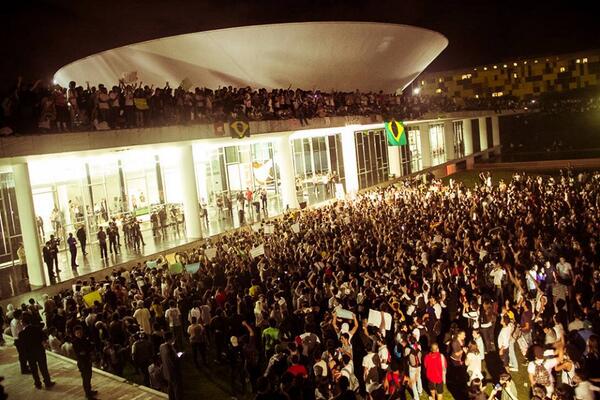
Protesters climb atop the capitol building in Brazil. #ChangeBrazil pic.twitter.com/Tb6CblQ5T0
Related articles
China seeks free trade deal with Mercosur
Press TV – June 26, 2012
Chinese Premier Wen Jiabao says China is interested in sealing a free trade agreement with the South American regional trade bloc Mercosur.
“We share ample common interests and we have great potential,” Wen said in Buenos Aires on Monday, while standing next to Argentine President Cristina Fernandez de Kirchner in a videoconference that included the presidents of Brazil and Uruguay, AP reported.
In the videoconference, Brazilian President Dilma Rousseff said strengthening relations between Chian and Mercosur could become a “strategy to keep the crisis contagion from reaching our markets and provoking unwanted consequences in employment and income that would hurt economic growth.”
In a meeting with the Argentine president, the Chinese premier signed deals on nuclear energy and the export of Argentine agricultural products.
Fernandez called the expansion of ties between China and Mercosur “a historic opportunity to add value to our raw materials and create jobs.”
The Mercosur bloc also includes Paraguay, which does not have diplomatic relations with Beijing because it recognizes Taiwan, which China, Mercosur’s second-biggest trade partner, considers a renegade province.
Related articles
- Paraguay faces expulsion from Mercosur/Unasur, economic isolation (alethonews.wordpress.com)
- Mercosur Bars New Paraguay Leader from Summit (voanews.com)
Paraguay faces expulsion from Mercosur/Unasur, economic isolation
MercoPress | June 23, 2012
President Cristina Fernández assured on Friday night that “Argentina does not condone the coup in Paraguay” and anticipated that “appropriate measures” will be taken at next week’s Mercosur Summit, scheduled to take place in Mendoza.
The Argentine leader also said that Unasur expressed a unanimous voice regarding the impeachment process that removed President Fernando Lugo from office on Friday.
Brazilian president Dilma Rousseff also suggested that Paraguay could be expulsed from Mercosur and Unasur since the two organizations have clauses in support of democratic rules and governance.
Speaking at a press conference before addressing the UN Rio+20 summit Rousseff said there “are anticipated sanctions for those who do not comply with the principles that characterize democracy” but admitted Paraguay was going through “a complicated situation”.
When a country violates the democratic clause the sanction is “non participation in multilateral bodies; that is expulsion from Mercosur and Unasur”.
Ecuadorean president Rafael Correa anticipated that his government “will not recognize any other Paraguayan president but Fernando Lugo”, and independently of the decisions from Lugo and Unasur “Ecuador will not recognize the new president”, Federico Franco, named by Congress.
“We are not going to remain idle to the advance of these type of issues in our region because what happened in Paraguay is absolutely illegitimate” and recalled the democratic clause from Unasur which enables the regional block to act when against the rupture of democratic order in any member country.
“What has happened in Paraguay is a big farce disguised as legality but it is totally unacceptable that the decision to oust a president was taken in 24 hours ignoring his right to due process and defence”, added Correa.
Venezuelan Foreign minister Nicolas Maduro said in Asuncion that a meeting of Unasur heads of state will take place soon to decide on the Paraguayan case, which he described as “absolutely shameful”.
Maduro is in Paraguay as one of the Unasur Foreign ministers’ delegation sent to try and mediate in the political crisis.
Unasur ministers cautioned that if due process was not respected “this would mean the rupture of cooperation of Unasur, Mercosur and Celac with Paraguay” which involves among other things cutting of subsidized fuel, limiting communications and commercial dealings.
Unasur Secretary General Ali Rodriguez said in a release that country members “will assess how it can be possible to continue cooperation with Paraguay in the framework of South American integration”, if the impeachment process ignores due process and the right to defence.
“The foreign ministers mission reaffirms its total solidarity with the Paraguayan people and its support for constitutional president Fernando Lugo”, underlined Ali Rodrigues.
Venezuela’s Maduro said that “we came (to Paraguay) with the best of willingness and open minds to help but disappointingly we were not listened by those making the decision”.
“There is an evident breaking down of constitutional order” pointed out Maduro who added the delegation arrived in Asunción “to support Paraguayan democracy, the Paraguayan people and the constitutional president Fernando Lugo”.
Maduro claims lawmakers listened in “silence and with indifference” to the Unasur request for respect to due process in the impeachment of the head of state.
~
See also:
Brazilian embargo could impact 60% of Paraguay’s exports
Related articles
- Rousseff suggests expulsion of Paraguay’s Mercosur and Unasur (ireport.cnn.com)
- Paraguayan Senate impeaches leftist president, causing international uproar (weeklyintercept.blogspot.com)
Featured Video
Now everyone is dumping US government bonds
or go to
Aletho News Archives – Video-Images
From the Archives
Experts Warned For Years That A War With Iran Would Happen This Way
By Caitlin Johnstone | April 3, 2026
… It’s so wild how we keep seeing reports that Iran’s retaliation caught the US off guard. For all the years I’ve been paying attention to this issue I’ve been reading experts and analysts saying if the US attacks Iran, Iran can close the Strait of Hormuz and strike US bases and the energy infrastructure of US allies in the region.
A few examples:
A 2006 Oxford Research Group paper titled “Iran: Consequences of a War” warned that Iran has numerous options at its disposal in the event of a US attack, and that the “most significant of these would be any possible retaliatory Iranian action to affect the transport of oil and liquefied natural gas through the Straits of Hormuz,” adding that stopping Iran from doing this “would be difficult if not impossible to achieve, leading to a fear of attack which alone would have a formidable impact on oil markets.”
A 2007 Cato Institute paper titled “The Iraq War and Iranian Power” warns that “Iran possesses the largest ballistic-missile inventory in the Persian Gulf — missiles which can reach Israel, Saudi Arabia and US military bases in Iraq,” and that “experts argue Iran could also use the ’oil weapon’: blocking the 34km-wide Strait of Hormuz and conducting submarine and anti-ship missile attacks against ports and oil facilities in Saudi Arabia, Kuwait and other Gulf Cooperation Council states.”
A 2012 NPR article titled “Can Iran Close The World’s Most Important Oil Route?” features then-chairman of the Joint Chiefs of Staff acknowledging that Iran absolutely can block the Strait of Hormuz, saying Tehran has “invested in capabilities” which specifically enable them to do so.
A paper from the Columbia Center on Global Energy Policy and the Center for a New American Security titled “IN DIRE STRAITS? IMPLICATIONS OF US-IRAN TENSIONS FOR THE GLOBAL OIL MARKET” warns of a potential scenario “that includes damage to Gulf oil infrastructure and a temporary closure of the Strait of Hormuz.”
These weren’t a bunch of keffiyeh-wearing peaceniks making these assessments, they were deeply entrenched swamp monsters entirely loyal to the US empire. They opposed war with Iran not because it would be an evil act of unforgivable mass murder, but because it would be bad for the imperial power structure. … Full article
Blog Roll
 Aletho News
- US dismantling international law in its war against Iran while claiming ‘false’ victory: Legal scholar
- One martyr, 5 injuries in US attack on Iraqi border crossing with Iran
- ‘This war is Israel’s war’: World facing ‘security breakdown’, says Qalibaf
- IRGC decries attack on US embassy in Riyadh, says executed by ‘Israel’
- Iran blasts EU hypocrisy as EU invokes international law over Hormuz
- There is no military solution to Strait of Hormuz
- NATO’s structural collapse – the outcome of deviation from reality
- Poll finds world views China better than US
- One Of America’s Leading Neo-Cons Has Turned Against The Iran War And Israel
- Attack in the Bosphorus exposes NATO weaknesses and tensions among allies
- If Americans Knew
- US loses planes over Iran, Israel downgrades Lebanon war goals – Daily Update
- Israel Is Blocking Palestinians from Easter at Church Where Jesus Resurrected
- Plot to assassinate Palestinian activist follows harassment campaign promoted by Zionist groups and elected officials
- Prominent New York synagogue hosts presentation on why U.S. Jews should support the ethnic cleansing of Gaza
- Tapper vs. Piker: Is the CNN Anchor Auditioning for David Ellison?
- Shouldn’t Democrats Be Able to Condemn Genocide?
- Israel-US kill negotiators, destroy civilian structures, but Iran’s military capabilities still largely intact – Daily Update
- ‘War crime’: Global condemnation as Israeli ministers celebrate death penalty law targeting Palestinian prisoners
- 7 Ways Israel Is Turning Lebanon Into Gaza
- World’s Leading Football Bodies Under Fire Over Israel Policies
- No Tricks Zone
- Low Intensity Tornado Wrecks Major Solar Farm, Creating A Potential Toxic Dump
- New Study Finds Warming Saves Lives…Cold Temperatures 12 Times More Deadly Than Excess Heat
- German Science Blog Accuses PIK Climate Institute Of Hallucinating Climate Tipping Points
- Devastating Assessment Of Comirnaty Vaccine By Former Senior Pfizer Europe Toxicologist
- New Study: CO2 Is ‘Effectively Negligible’ As An Explanatory Climate Change Factor Since 2000
- Former Pfizer Toxicologist Dr. Helmut Sterz Tells Bundestag Hearing Pfizer Vaccine Should Have Never Been Approved
- Energy Expert: Germany’s Nuclear Phaseout Was A “500 Billion Euro Mistake”
- New Research: South Australia’s Mid-Holocene Sea Surface Temperatures Were 4°C Warmer Than Today
- Storing Green Energy To Last Germany 10 Days Would Require A 60-Million Tonne Battery
- New Studies: UK Sea Levels Were 4 Meters Higher Than Today During The Mid-Holocene
 Aletho News