Ballots or Bullets: Democracy and World Power
By James Petras | October 31, 2014
The principal reason why Washington engages in military wars, sanctions and clandestine operations to secure power abroad is because its chosen clients cannot, and do not, win free and open elections.
A brief survey of recent election outcomes testify to the electoral unattractiveness of Washington-backed clients. The majority of democratic electorates rejects candidates and parties which back the US global agenda: neo-liberal economic policies; a highly militarized foreign policy; Israeli colonization and annexation of Palestine; the concentration of wealth in the financial sector; the military escalation against China and Russia. While the US policy attempts to re-impose the pillage and dominance of the 1990s via recycled client regimes the democratic electorates want to move on toward less bellicose, more inclusive governments, which restore labor and welfare rights.
The US seeks to impose the unipolar world, of the Bush Sr. and Clinton era, failing to recognize the vast changes in the world economy, including the rise of China and Russia as world powers, the emergence of the BRIC and other regional organizations and above all the growth of popular democratic consciousness.
Failing to convince electorates by reason or manipulation, Washington has opted to intervene by force, and to finance organizations to subvert the democratic electoral process. The frequent resort to bullets and economic coercion when ballots fail to produce the “appropriate outcome” testifies to the profoundly reactionary nature of US foreign policy. Reactionary in the double sense of ends and means.
Pragmatically, the imperial centered socio-economic policies deepen inequalities and depress living standards. The means to achieve power, the instruments of policy, include wars, intervention, covert operations, are more akin to extremists, quasi-fascist, far right regimes.
Free Elections and the Rejection of US Clients
US-backed electoral parties and candidates have suffered defeats throughout most of the world, despite generous financial backing and international mass media propaganda campaigns. What is striking about the negative voting outcomes is the fact that the vast majority of adversaries are neither anti-capitalist nor ‘socialist’. What is equally striking is that all of the US clients are rightist or far-rightist parties and leaders. In other words, the polarization is usually between center-left and rightist parties; the choice is between reform or reaction, between an independent or satellite foreign policy.
Washington and Latin America: Masters of Defeats
Over the past decade, Washington has backed losing neo-liberal candidates throughout Latin America and then sought to subvert the democratic outcome.
Bolivia
Since 2005, Evo Morales, the center left leader favoring social reforms and an independent foreign policy, has won three Presidential elections against Washington backed rightist parties, each time by a greater margin. In 2008, he ousted the US ambassador for intervening, expelled the Drug Enforcement Agency (DEA) in 2008, USAID in 2013 and the Military Mission after foiling an aborted coup in Santa Cruz.
Venezuela
The United Socialist Party of Venezuela (PSUV) and its predecessor have won every Presidential and Congressional election (over a dozen) except one over the past 15 years despite US multi-million dollar funding of neo-liberal opposition parties. Unable to defeat the Chavez-led radical-reform government, Washington backed a violent coup (2002), a boss’s lockout (2002/3), and decades long paramilitary attacks of pro-democracy leaders and activists.
Ecuador
The US has opposed the center-left government of President Correa for ousting it from the military base in Manta, renegotiating and repudiating some of its foreign debt and backing regional pacts which exclude the US. As a result Washington backed an abortive police led coup in 2010 that was quickly defeated.
Honduras
During democratically elected President Manual Zelaya’s tenure in office, a center-left President, Honduras sought to pursue closer relations with Venezuela in order to receive greater economic aid and to shed its reputation as a US dominated “banana republic”. Washington, unable to defeat him at the ballot box, responded by supporting a military coup (2009) which ousted Zelaya and returned Honduras to the US fold. Since the coup Honduras has experienced more killings of popular leaders-200- than any country in Latin America.
Brazil
The center-left Workers Party has won four straight elections against US backed neo-liberal candidates beginning in 2002 and continuing through the 2014 elections. The US propaganda machine, including NSA’s spying on President Rousseff and the strategic state petrol company, Petrobras, and the international financial press went all out to discredit the reformist center-left government. To no avail! The voters preferred an ‘inclusive’ social liberal regime pursuing an independent foreign policy to an opposition embedded in the discredited socially regressive neo-liberal politics of the Cardoso regime (1994-2002). In the run-up to the 2014 elections Brazilian and US financial speculators attempted to strike fear in the electorate by betting against the currency (real) and driving the stock market into a precipitous fall.
To no avail. Rousseff won with 52% of the vote.
Argentina
In Argentina a massive popular revolt overthrew the US backed neo-liberal regime of De la Rua in 2001. Subsequently, the electorate elected the center-left Kirchner government over the rightist, US backed Menem candidacy in 2003. Kirchner pursued a reformist agenda imposing a moratorium on the debt and combining high economic growth with large scale social expenditures and an independent foreign policy. US opposition escalated with the election of his wife Cristina Fernandez. Financial elites, Wall Street, the US judiciary and Treasury intervened to destabilize the government, after failing to defeat Fernandez’s re-election. Extra-parliamentary financial pressures were matched by political and economic support for rightist politicians in preparation for the 2015 elections.
Earlier, in 1976, the US backed the military coup and political terror that led to the murder of 30,000 activists and militants. In 2014 the US backed a “financial coup” as a federal judge sided with vulture funds, sowing financial terror in international markets against a democratically elected government.
Paraguay
President Fernando Lugo was a moderate former Bishop who pursued a watered-down center-left agenda. Nevertheless, he raised issues that conflicted with Washington’s extremist agenda, including Paraguay’s membership in regional organizations that excluded the US (MERCOSUR). He appealed to the landless rural workers and he retained ties to other Latin American center-left regimes. He was deposed by Congress in 2012 in a highly dubious ‘institutional coup’, quickly supported by the White House and replaced by a straight-line neo-liberal, Federico Franco with tight links to Washington and hostile to Venezuela.
Globalizing US Threats to Democracy
US subversion of democracy when center-left political formations compete for power is not confined to Latin America – it has gone ‘global’.
Ukraine
The most egregious example is the Ukraine, where the US spent over $6 billion in over a decade and a half. Washington financed, organized, and promoted pro NATO shock troops to seize power against an elected regime (Viktor Yanukovych) which tried to balance ties between the West and Russia. In February 2014, an armed uprising and mob action led to the overthrow of the elected government and the imposition of a puppet regime totally beholden to the US. The violent putschists met resistance from a large swathe of pro-democracy activists in the Eastern region. The Kiev junta led by oligarch Petro Poroshenko dispatched air and ground troops to repress the popular resistance with the unanimous backing of the US and EU. When the rightist regime in Kiev moved to impose its rule over the Crimea and to break its military base treaty with Russia, the Crimean citizens voted, by a large margin (85%), to separate and merge with Russia.
In both the Ukraine and Crimea, US policy was directed toward imposing by force, the subordination of democracy to NATO’s drive to encircle Russia and undermine its democratically elected government.
Russia
Following the election of Vladimir Putin to the Presidency, the US organized and financed a large number of opposition “think tanks”, and NGO’s, to destabilize the government. Large scale demonstrations by well-funded NGO’s were given wide play by all the Western mass media.
Failing to secure an electoral majority and after suffering electoral defeats in the executive and legislative elections, Washington and the EU, using the pretext of Russian “intervention” in the Ukraine, launched a full scale economic war on Russia. Economic sanctions were enforced in the hopes of provoking economic collapse and a popular upheaval. Nothing of the sort occurred. Putin has gained greater popularity and stature in Russia and consolidated its ties with China and the other BRIC countries.
In sum, in the Ukraine, Crimea and Russia, facing independent elected governments, Washington resorted to a mob uprising, military encirclement and an escalation of economic sanctions.
Iran
Iran has periodic elections in which pro and anti-western parties compete. Iran has drawn the wrath of Washington because of its support for Palestinian liberation from the Israeli yoke; its opposition to the Gulf absolutist states; and its ties to Syria, Lebanon (Hezbollah) and post- Saddam Hussain Iraq. As a result, the US has imposed economic sanctions to cripple its economy and finances and has funded pro-Western neo-liberal opposition NGO’s and political factions. Unable to defeat the Islamist power elite electorally, it chooses to destabilize via sanctions in order to disrupt its economy and assassinations of scientists and cyber warfare.
Egypt
Washington backed the Hosni Mubarak dictatorship for over three decades. Following the popular uprising in 2011, which overthrew the regime, Washington retained and strengthened its ties to the Mubarak police, military and intelligence apparatus. While promoting an alliance between the military and the newly elected President Mohammed Morsi, Washington funded NGO’s, who acted to subvert the government through mass demonstrations. The military, under the leadership of US client General Abdel Fattah el-Sisi, seized power, outlawed the Moslem Brotherhood and abolished democratic freedoms.
Washington quickly renewed military and economic aid to the Sisi dictatorship and strengthened its ties with the authoritarian regime. In line with US and Israeli policy, General Sisi tightened the blockade of Gaza, allied with Saudi Arabia and the Gulf despots, strengthened its ties with the IMF and implemented a regressive neo-liberal program by eliminating fuel and food subsidies and lowering taxes on big business.
The US backed coup and restoration of dictatorship was the only way Washington could secure a loyal client relationship in North Africa.
Libya
The US and NATO and Gulf allies launched a war (2011) against the independent, nationalist Libyan government, as the only way to oust the popular, welfare government of Colonel Gaddafi. Unable to defeat him via internal subversion, unable to destabilize the economy, Washington and its NATO partners launched hundreds of bombing missions accompanied by arms transfers to local Islamic satraps, tribal, clans and other violent authoritarian groups. The subsequent ‘electoral process’ lacking the most basic political guarantees, fraught by corruption, violence and chaos, led to several competing power centers. Washington’s decision to undermine democratic procedures led to a violent Hobbesian world, replacing a popular welfare regime with chaos and terrorism.
Palestine
Washington has pursued a policy of backing Israeli seizures and colonization of Palestinian territory, savage bombings and the mass destruction of Gaza. Israel, determined to destroy the democratically elected Hamas government, has received unconditional US backing. The Israeli colonial regime has imposed racist, armed colonies throughout the West Bank, financed by the US government, private investors and US Zionist donors. Faced with the choice between a democratically elected nationalist regime, Hamas, and a brutal militarist regime, Israel, US policymakers have never failed to back Israel in its quest to destroy the Palestinian mini-state.
Lebanon
The US, along with Saudi Arabia and Israel, has opposed the freely elected Hezbollah led coalition government formed in 2011. The US backed the Israeli invasion in 2006, which was defeated by the Hezbollah militias. Washington backed the right wing Hariri-led coalition (2008 – 2011) which was marginalized in 2011. It sought to destabilize the society by backing Sunni extremists especially in Northern Lebanon. Lacking popular electoral support to convert Lebanon into a US client state, Washington relies on Israeli military incursions and Syrian based terrorists to destabilize Lebanon’s democratically elected government.
Syria
Syria’s Bashar Assad regime has been the target of US, EU, Saudi and Israeli enmity because of its support for Palestine, its ties with Iraq, Iran, Russia and Hezbollah. Its opposition to the Gulf despotism and its refusal to become a US client state (like Jordan and Egypt) has been another source of NATO hostility. Under pressure from its internal democratic opposition and its external allies, Russia and Iran , the Bashar Assad regime convoked a conference of non-violent opposition parties, leaders and groups to find an electoral solution to the ongoing conflict. Washington and its NATO allies rejected a democratic electoral road to reconciliation. They and their Turkish and Gulf allies financed and armed thousands of Islamic extremists who invaded the country. Over a million refugees and 200,000 dead Syrians were a direct result of Washington’s decision to pursue “regime change” via armed conflict.
China
China has become the world’s largest economy. It has become a leading investment and trading country in the world. It has replaced the US and the EU in Asian, African and Latin American markets. Faced with peaceful economic competition and offers of mutually beneficial free trade agreements, Washington has chosen to pursue a policy of military encirclement, internal destabilization and Pan Pacific integration agreements that exclude China. The US has expanded military deployments and bases in Japan, Australia and the Philippines. It has heightened naval and air force surveillance just beyond China’s limits. It has fanned rival maritime claims of China’s neighbors, encroaching on vital Chinese waterways.
The US has supported violent Uighur separatists, Tibetan terrorists and protests in Hong Kong in order to fragment and discredit China’s rule over its sovereign territory. Fomenting separation via violent means results in harsh repression, which in turn can alienate a domestic constituency and provide grist for the Western media mills. The key to the US countering China’s economic ascent is political: fomenting domestic divisions and weakening central authority. The democratization which Chinese citizens favor has little resonance with US financed ‘democracy’ charades in Hong Kong or separatist violence in the provinces.
Washington’s effort to exclude China from major trade and investment agreements in Asia and elsewhere has been a laughable failure. The principle US “partners”, Japan and Australia are heavily dependent on the Chinese market. Washington’s (free trade) allies in Latin America, namely Colombia, Peru, Chile and Mexico are eager to increase trade with China. India and Russia are signing off on multi-billion dollar trade and investment deals with China! Washington’s policy of economic exclusion miscarried in the first month!
In sum, Washington’s decision to pursue confrontation over conciliation and partnership; military encirclement over co-operation; exclusion over inclusion, goes counter to a democratic foreign policy designed to promote democracy in China and elsewhere. An authoritarian choice in pursuit of unachievable Asian supremacy is not a virtue; it is a sign of weakness and decay.
Conclusion
In our global survey of US policy toward democracy, center-left governments and free elections we find overwhelming evidence of systematic US hostility and opposition. The political essence of the “war on terrorism” is Washington’s world-wide long-term pernicious assault on independent governments, especially center-left democratic regimes engaged in serious efforts to reduce poverty and inequality.
Washington’s methods of choice range from financing rightist political parties via USAID and NGO’s, to supporting violent military coups; from backing street mobs engaged in destabilization campaigns to air and ground invasions. Washington’s animus to democratic processes is not confined to any region, religious, ethnic or racial group. The US has bombed black Africans in Libya; organized coups in Latin America against Indians and Christians in Bolivia; supported wars against Muslims in Iraq, Palestine and Syria; financed neo-fascist “battalions”and armed assaults against Orthodox Christians in the Eastern Ukraine; denounced atheists in China and Russia.
Washington subsidizes and backs elections only when neo-liberal client regimes win. It consistently destabilizes center-left governments which oppose US imperial policies.
None of the targets of US aggression are strictly speaking anti-capitalist. Bolivia, Ecuador, Brazil, Argentina are capitalist regimes which attempt to regulate tax and reduce disparities of wealth via moderate welfare reforms.
Throughout the world, Washington always supports extremist political groups engaged in violent and unconstitutional activity that have victimized democratic leaders and supporters. The coup regime in Honduras has murdered hundreds of rank and file democratic activists, farm workers,and poor peasants.
The US armed Islamic jihadist and ex-pat allies in Libya have fallen out with their NATO mentors and are at war among themselves, engaging in mutual bloodletting.
Throughout the Middle East, South Asia, North Africa, Central America and the Caucuses wherever US intervention has taken place, extreme right-wing groups have served, at least for a time, as Washington and Brussels’ principal allies.
Pro EU-NATO allies in the Ukraine include a strong contingent of neo-Nazis, paramilitary thugs and “mainstream” military forces given to bombing civilian neighborhoods with cluster bombs.
In Venezuela, Washington bankrolls terrorist paramilitary forces and political extremists who murdered a socialist congressional leader and dozens of leftists.
In Mexico the US has advised, financed and backed rightist regimes whose military, paramilitary and nacro-terrorist forces recently murdered and burned alive 43 teachers’ college students, and are deeply implicated in the killing of 100,000 “other” Mexicans, in less than a decade.
Over the past eleven years the US has pumped over $6 billion dollars in military aid to Colombia, funding its seven military bases and several thousand special operations forces and doubling the size of the Colombian military. As a result thousands of civil society and human rights activists, journalists, trade union leaders and peasants, have been murdered. Over 3 million small land-holders have been dispossessed.
The mass media cover up the US option for right wing extremism by describing ruling mass murderers as “center-right regimes” or as“moderates”: linguistic perversions and grotesque euphemisms are as bizarre as the barbarous activities, perpetrated by the White House.
In the drive for world power, no crime is left undone; no democracy that opposes it is tolerated. Countries as small and marginal as Honduras or Somalia or as great and powerful as Russia and China cannot escape the wrath and covert destabilization efforts of the White House.
The quest for world domination is driven by the subjective belief in the “triumph of the will”. Global supremacy depends entirely on force and violence: ravaging country after country, from carpet bombing of Yugoslavia, Iraq, Afghanistan and Libya to proxy wars in Somalia, Yemen, Ukraine to mass killings in Colombia, Mexico and Syria.
Yet there are limits to the spread of the “killing fields”. Democratic processes are defended by robust citizens’ movements in Venezuela, Ecuador and Bolivia. The spread of imperial backed terrorist seizures of power are stymied by emergence of global powers, China in in the Far East and Russia in Crimea and eastern Ukraine have taken bold steps to limit US imperial expansion.
In the United Nations, the President of the United States and his delegate Samantha Powers rant and rave, in a fit of pure insanity, against Russia as “the greatest world terrorist state” for resisting military encirclement and the violent annexation of the Ukraine.
Extremism, authoritarianism and political insanity know no frontiers. The massive growth of the secret political police, the National Security Agency, the shredding of constitutional guarantees, the conversion of electoral processes into elite controlled multi-billion dollar charades, the growing impunity of police involved in civilian murders, speaks to an emerging totalitarian police – state inside the US as a counterpart to the violent pursuit of world power.
Citizens’ movements, consequential center-left parties and governments, organized workers, in Latin America, Asia and Europe have demonstrated that authoritarian extremist proxies of Washington can be defeated. That disastrous neo-liberal policies can be reverted. That welfare states, reductions in poverty, unemployment and inequalities can be legislated despite imperial efforts to the contrary.
The vast majority of the Americans, here and now, are strongly opposed to Wall Street, big business and the financial sector. The Presidency and the Congress are despised by three quarters of the American public. Overseas wars are rejected. The US public, for its own reasons and interests, shares with the pro-democracy movement’s world-wide, a common enmity toward Washington’s quest for world power. Here and now in the United States of America we must learn and build our own powerful democratic political instruments.
We must, through the force of reason, contain and defeat “the reason of force”: the political insanity that informs Washington’s ‘will to power’. We must degrade the empire to rebuild the republic. We must turn from intervening against democracy abroad to building a democratic welfare republic at home.
Ecuador Investing in Strategic Sectors
teleSUR | October 22, 2014
For the state general budget plan for 2015 it has been announced that strategic sectors will be the largest investment at 35%. The principal areas of focus will be strengthening electric and hydraulic resources as well as hydrocarbons and increasing social investment.
This investment is intended to provide a financial base upon which the state will focus on other projects, on sectors such as education and technology, to support a future economy which will move away from extractivism.
In an interview with TeleSUR English, Latin American School of Social Sciences (FLACSO) specialist Patricio Trujillo said, “Investment in strategic sectors first creates an infrastructure that is sufficiently self-sustainable so that the second phase can be based on human talent. If we do not have infrastructure it is very difficult to better this human talent, to improve for example investigation.”
Other sectors include production at 22%, social development at 16%, Security at 7% and the rest at 6%. The sector of human talent, expected to receive greater investment in the future a critical base of the Citizen’s Revolution, will receive 14 percent investment at USD $1.19 billion, which will be directed towards basic and higher education as well as culture.
On strategic sectors, President Rafael Correa said that investment will be focused in the Ministries of Electricity and Water. He said, “This investment is just in two ministries. We are beginning with an investment of 3 billion dollars.”
Much of this investment will be directed towards creating the necessary infrastructure for the functioning of hydroelectric dam projects by the end of 2016, with the possibility of exporting energy to neighboring Colombia and Peru.
“For example, with eight hydroelectric dams, by 2016 we will have saved an enormous amount of resources. So this puts pressure on the budget, and the country. This is of course because we are trying to accomplish this in 2, 3 years what was not done in 50. There is spending, spending, spending now but afterwards, we are going to see the fruits of these efforts,” said Correa.
Heightened investment in strategic sectors is aimed at ensuring national sovereignty over energy and natural resources, and at an eventual surplus for internal consumption, allowing for export and greater revenue for investment in other areas.
Ecuador Slams Human Rights Abuse Claims
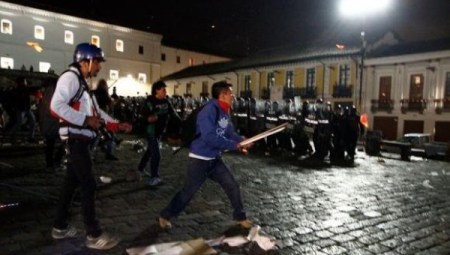
Opposition protesters took sticks and other objects to attack policemen (Photo: ANDES).
teleSUR | October 22, 2014
The Ecuadorian government hit back on Tuesday against a report claiming it repressed protestors during a recent demonstrations.
The Ecuadorian government is challenging a lawyer cited in the report to prove his allegations.
It was responding to accusations made by U.S. based organization Human Rights Watch (HRW).
Interior Minister Jose Serrano announced during a televised interview that the government will sue the lawyer who told HRW that students and protesters detained on September 17 and 18 were tortured by the police.
“This lawyer had the audacity and cynicism to say that the police had tortured them … this individual will have to prove what he said … is effectively true,” Serrano said.
The Interior Minister also clarified that those apprehended were caught on video attacking policemen. All of them confessed to the charges against them.
President Rafael Correa had warned ahead of the September 17 protest that the opposition would try to use similar tactics to those used by the Venezuelan opposition, seeking to generate violent incidents which would then generate controversy and international reactions.
On September 17, opposition activists and government sympathizers both organized mobilizations which were located very close to one another. To avoid a small violent group from reaching the government sympathizers, a group of policemen blocked streets which connected both sites.
Opposition activists attacked the police to try to break into the pro-government rally, with arrests following.
“We had announced ahead (of the protests) that there were groups amongst the protesters which would use vandalism and violent strategies,” Serrano reminded.
According to the official, the International Red Cross was called days before the protests to guarantee that, if any detention was made, the organisation was present in the detention center.
“Mr. Vivanco (Jose Miguel Vivanco, HRW chief for Latin America) will have to show the whole world who is financing him, where are they getting their resources from, and why does he have this particular aversion against Latin America’s progressive governments,” Serrano said.
HRW is increasingly being held account by intellectuals and experts in the United States and the world due to its close relationship with the U.S. State Department.
Journalist Keane Bhatt has previously documented several cases in which HRW members have become senior U.S. State Department officials, in what Bhatt calls a “revolving door policy”.
Nobel Peace Prize Laureates Adolfo Perez Esquivel and Mairead Maguire together with former U.N. Assistant Secretary General Hans von Sponeck and over 100 scholars wrote a letter in May requesting Human Rights Watch to change its policy so as to avoid links with the U.S. State Department.
Correa Denounces US Plans to Intervene in Latin America
teleSUR | September 28, 2014
Ecuador’s President Rafael Correa criticized on Saturday a new U.S. government plan to intervene and weaken Latin American governments.
Correa said that Obama’s intention to create six innovation centers for educating new “leaders” in Latin America, Sub-Saharan Africa, Middle East, and Asia, was clearly intended to interfere with Latin American countries.
“What they want is to intervene in Venezuela, Bolivia, Ecuador, because they say we attack freedom of speech; but go and see for yourselves who are the owners of media in United States,” said Correa.
On Tuesday President Barrack Obama said that his government will support civil society in countries where freedom of speech and association are threatened by the governments.
“We’re creating new innovation centers to empower civil society groups around the world,” said Obama during his speech in a plenary session of the Clinton Open Initiative. “Oppressive governments are sharing worst practices to weaken civil society. We’re going to help you share the best practices to stay strong and vibrant.”
President Correa hit back “This is part of the conservative restoration: the insolent announcement of intervention in other countries.” He added “Let us live in peace and respect the sovereignty of our countries.”
Correa also responded that he will propose the creation of an innovation center in the United States to teach the country “something about human rights,” so they might learn about true democracy and freedom of speech, revoke the death penalty and end the blockade on Cuba.
Correa has accused opposition movements in the country of trying to destabilize his government.
U.S. Senators Urge Ecuador to Restore Relations with Israel
teleSUR | August 27, 2014
Ecuador will continue supporting Palestine despite U.S. pressure to restore diplomatic relations with Israel.
The successful campaign “Ecuador with Palestine” organized by civil society and the Ministry of Foreign Affairs resulted in 20 tons of medical supplies and other crucial donations that will be delivered to Gaza next week.
The end of the campaign on August 25 coincided with a letter sent by U.S. Senators Marco Rubio, Bob Menendez, Mark Kirk and James Risch, urging the governments of Ecuador, Brazil, El Salvador, Peru and Chile to restore diplomatic relations with Israel.
The letter read, “Your actions send a troubling message to the United States about your government’s commitment to long-lasting peace between Israel and the Palestine Liberation Organization.”
In early August President Rafael Correa canceled a trip to Israel scheduled for the second half of this year. This decision was made in the midst of the “Operation Protective Edge,” which saw a ceasefire begin Tuesday after leaving more than 2,200 Palestinians dead.
The government of Ecuador recalled its ambassador in Tel Aviv and has opened an embassy in Ramallah.
Reacting to the letter sent by the senators, Foreign Minister Ricard Patiño said, “These men should give advice in their own house, they are not going to give the Ecuadorian government advice, worse is this type of advice of a political nature.”
“We are going to keep developing other agreements to enter in strong bilateral relations,” said Palestinian Ambassador in Ecuador Hani Remawi, “We have a lot to give Ecuador, and Ecuador also has more, much, much more to offer Palestine.” … Full article
Chile, El Salvador, Peru Recall Israel Envoys in Protest of Gaza Offensive
Al-Manar | July 30, 2014
Chile, El Salvador and Peru have announced they are recalling their ambassadors in Tel Aviv in consultation to protest the Israeli assault on the besieged strip of Gaza.
The moves come on the heels of Brazil and Ecuador, who announced last week that they were recalling their envoys.
“Given the escalation of Israeli military operations in Gaza, the Government of Chile, in coordination with others in our region, has decided to call in consultation Santiago Ambassador of Chile in Tel Aviv, Jorge Montero,” the Chilean foreign ministry in Santiago said in a statement.
“Chile notes with great concern and dismay that such military operations, which at this stage of development are subject to a collective punishment against the Palestinian civilian population in Gaza do not respect fundamental rules of international humanitarian law.”
The Chilean foreign ministry emphasized the more than 1,000 Palestinians killed, including women and children during Operation Protective Edge, which continued for a 22nd day on Tuesday. The statement also noted Israel’s attacks “on schools and hospitals.”
“The scale and intensity of Israeli operations in Gaza violate the principle of proportionality in the use of force, an essential requirement to justify self-defense,” the statement added, referring to rocket fire by the resistance movements in the coastal territory.
El Salvador Ambassador in the Zionist entity Susana Edith Gun was also recalled for “urgent consultations” on Tuesday. The Foreign Ministry of the Central American country said that El Salvador President Sanchez Ceren gave these instructions “over serious escalation of violence and Israel’s bombings in the northern part of the Gaza Strip.”
A similar statement was also published by the Peruvian Foreign Ministry, condemning Israel’s operation in Gaza.
Venezuela and Bolivia that cut their ties with Tel Aviv over Israel’s 2009 war on Gaza have also strongly condemned Israel’s actions.
Brazil, Chile, Argentina, Costa Rica, Cuba, Mexico and Venezuela were among the 29 countries that voted in favor of a probe by the UN Human Rights Council into Israel’s war crimes in Gaza.
Hamas commends withdrawal of Ecuadorian ambassador from Tel-Aviv
MEMO | July 19, 2014
The Palestinian Islamic movement Hamas hailed on Friday the Ecuadorian decision to withdraw his country’s ambassador to Tel-Aviv in protest against Israeli aggression on Gaza.
Speaking to the Palestinian newspaper Al-Resalah, Hamas spokesman Fawzi Barhoum said: “This is a very advanced position, to which the countries in the region have not arrived at.”
Barhoum described the withdrawal of the ambassador as a “courageous” decision.
Ecuador’s Foreign Minister Ricardo Patino said the Ecuadorian government condemned the Israeli invasion on the Gaza Strip.
“We condemn the Israeli military incursion into Palestinian territory, we require cessation of operations and indiscriminate attacks against civilians,” Patino said.
Barhoum also called for the UN Security Council to pass a resolution to lift the eight-year siege on Gaza and stop Israeli aggression on Gaza, which has continued for 13 days.
Ecuador announced Thursday that it was calling in its ambassador to Israel, according to La Informacion and El Universo.
Ecuador does not recognize Ukraine’s ‘illegitimate’ govt – Correa
RT | March 30, 2014
Ecuador has said it will not deal with the coup-appointed government in Kiev and has called for fair elections. President Rafael Correa declared he would only negotiate with a “legitimate government” that represents the will of the Ukrainian people.
In his weekly address to the Ecuadorian people, Correa explained why Ecuador had abstained from the UN General Assembly vote Thursday that passed a resolution condemning Crimea’s union with Russia.
“We will not fall for a farce, we will only deal with a legitimate government,” said Correa, adding that Ecuador does not recognize the current government that is the product of a coup d’état. To win the support of Ecuador, Ukraine should hold democratic elections and establish a legitimate government chosen by the Ukrainian people, Correa said.
Moscow has also decried the coup-appointed government that came to power in Kiev at the end of February following weeks of bloody protests in the Ukrainian capital’s Independence Square.
“The current government is the product of devious machinations, to put to it mildly, clearly supported by hypocritical rhetoric from the West,” Correa said.
On Crimea’s decision to become a part of Russia and break from Ukraine, he said the region was “historically Russian,” but the Crimean referendum “does not change the constitution.”
With this in mind, Correa explained that Ecuador could not accept the stance of the Ukrainian government – which he described as an extension of the United States – or Moscow’s position until Crimea’s status had been clarified.
Ecuador, along with 58 other nations, abstained from a UN General Assembly vote Thursday that condemned Crimea’s referendum to join Russia as “illegal.” The resolution was supported by 100 nations, while 11 opposed it.
Armenia, Belarus, Bolivia, Cuba, North Korea, Nicaragua, Sudan, Syria, Venezuela and Zimbabwe all voted against the resolution.
Unlike UN Security Council resolutions, a General Assembly resolution is not legally binding.
Russia condemned the UN assembly vote as “confrontational” and undermining the referendum and the right to self-determination of the Crimean people. The initiative for Crimea to reunite with Russia came from the Crimean people themselves, not from Moscow, said Russian Ambassador to the UN Vitaly Churkin.
Russia also previously vetoed a Security Council resolution that said the Crimean referendum to join Russia would have “no validity” in an emergency session held the day before Crimea headed to the polls.
On March 16, an overwhelming majority of Crimean residents voted in favor of joining the Russian Federation, in the wake of bloody protests in Kiev that ousted Ukrainian President Viktor Yanukovich.

Ecuadorian Fugitives Gave Large Sums of Money to US Politicians
Prensa Latina | March 13, 2014
Washington – Ecuadorian bankers Roberto and William Isaias, current fugitives, donated large sums of money to campaigns of U.S. politicians, the press revealed today.
Reports underline that the Federal Bureau of Investigation (FBI) is investigating cases that involve Congressional Republican Senator Marco Rubio, Democrat Robert Menendez and Republican Representative Ileana Ros-Lehtinen, among other politicians.
New York’s NBC network says the FBI suspects that Menendez, through phone calls and recommendation letters to the Department of State and other bodies, helped the Ecuadorian brothers establish themselves in the U.S. in exchange for donations to his reelection campaign.
Journalist and blogger Alberto Padilla claims he can confirm that, since they arrived to live in Miami, the Isaias have financed an active lobbying campaign against the Rafael Correa administration in Ecuador and have also aided senators, in exchange for being allowed to remain in the United States.
The Isaias were sentenced in absentia to eight years of imprisonment on April 11, 2012 by the National Court of Justice after a judicial process that lasted 13 years and in which 54 judges participated.
In the Ros-Lehtinen case, the Daily Beast website assured that she recently received money from the former bankers in exchange for help.
The Isaias had donated at least $23,700 USD to Ros-Lehtinen during the 2010, 2012 and 2014 electoral cycles, according to federal contribution campaign registers.
The Isaias also contributed to the campaign funds of Florida’s Senator Bill Nelson, and Congresswoman and also President of the National Democrat Committee Debbie Wasserman-Schultz and Representative Joe Garcia.
Related article

Ecuador leaves inter-American defense treaty
Press TV – February 5, 2014
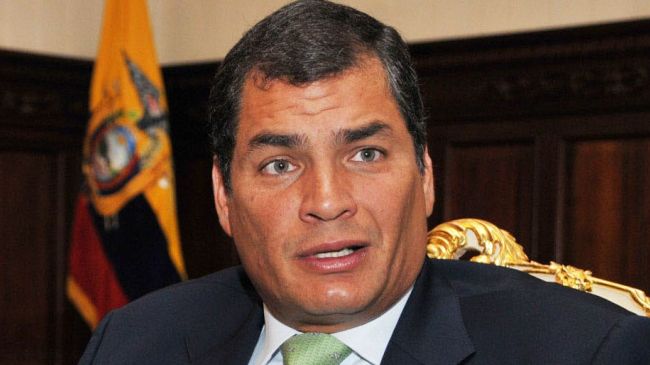 Ecuador has announced its withdrawal from the Inter-American Treaty of Reciprocal Assistance, a hemispheric agreement of mutual defense signed in 1947.
On Wednesday, Ecuador Foreign Ministry said President Rafael Correa pulled the country out of the US-led security arrangement on the grounds it is outdated, AFP reported.
The Foreign Ministry said Correa signed a decree on Tuesday, ratifying a decision earlier this month by the National Assembly to withdraw from the treaty.
“Ecuador renounces in all its articles the Inter-American Treaty of Reciprocal Assistance,” the ministry said.
The treaty, commonly known as the Rio Treaty, stipulates that an armed attack against any of the member states is to be considered an attack against all of them.
Ecuador ratified the treaty in 1950.
The move is the latest in a shift away from US-led security arrangements in the region by Ecuador and other leftist Latin American allies.
At the end of an annual meeting of the Organization of American States (OAS) in Bolivia in 2012, the foreign ministers of Bolivia, Venezuela and Nicaragua announced their decision to pull out of the treaty, saying the regional defense treaty is a US initiative and membership is not beneficial to them.
Federal Probe Into Senator Menendez Widens To Include Help To Fugitive Bankers
By DSWright | FireDogLake | January 24, 2014
Already under investigation for trying to help a contributor who may have been defrauding Medicare, New Jersey Senator Bob Menendez is reportedly facing another federal criminal probe this time focusing on his relationship with two fugitive bankers from Ecuador.
William and Roberto Isaias were sentenced in abstentia for embezzling millions from Filanbanco, a bank they ran that collapsed in Ecuador. The United States has so far refused to hand them over to Ecuador despite an Interpol international arrest warrant and recommendations from officials within the State Department to return the convicted bankers back to Ecuador.
In 2005, U.S. Ambassador to Ecuador Kristie Kenney wrote a cable to the State Department saying the Isaias brothers absconded “with $100 million” and “used their ill-gotten wealth to buy safe passage from Ecuador.”…
“The fact that the Isaias brothers continue to live a life of luxury in the U.S. while their account holders are suffering in Ecuador has been a constant concern between the U.S. And Ecuador since their flight,” said Linda Jewell, a former U.S. Ambassador to Ecuador.
Enter Senator Bob Menendez who has allegedly been advocating on the brothers’ behalf. Menendez is said to have used the power of his office to assist the Isaias brothers writing letters to the State Department and Department of Homeland Security.
While Senator Menendez was writing letters the Isaias family was giving money to his campaign and the Democratic Party.
Federal election records show relatives of the Isaias brothers who are residents donated more than $10,000 to the senator’s 2012 campaign. And records show that the family of Roberto Isaias also donated at least $100,000 to the Democratic party in 2012.
If a connection between the donations and the letters can be established Senator Menendez might once again have to face ethics charges if not criminal charges.
Menendez previously paid $58,000 to a campaign contributor as reimbursement for two round trips he took to the Dominican Republic on the contributor’s private jet. The contributor was Dr. Salomen Melgen whom Menendez had assisted in dealing with allegations of improperly billing Medicare. Melgen had contributed $33,000 to Senator Menendez and traveled with him throughout the Caribbean for “political fundraisiers.”
~~~
Backgound:
Ecuador to urge US military withdrawal
Press TV – January 23, 2014
Ecuador’s President Rafael Correa has announced plans to call for the withdrawal of some US military officers from the South American country.
 Speaking at the Carondelet presidential Palace in the Ecuadorian capital Quito on Wednesday, Correa said his government will ask Washington to withdraw “nearly 50 military personnel” assigned to the US embassy in the Latin American country.
He described the number of American military personnel in Ecuador as “inconceivable,” saying, “Unfortunately, these people have been so infiltrated in all the sectors that what is scandalous appeared normal.”
Correa also noted that Quito was “already taking measures” to address the outsized presence of the US forces.
The remarks came after revelations concerning the presence of four US military personnel in an Ecuadoran military helicopter that came under fire in October last year near the border with Colombia.
“They (the US troops) flew in the helicopters of the air force, of the army. It was normal for foreign soldiers to be flying with our soldiers in frontier areas,” he said.
Meanwhile, the US embassy said it has not received any request from the Ecuadorian government yet.
In 2009, Quito refused to renew an agreement with Washington on counter-narcotics operations after accusing it of financing opposition groups.
Related articles


Featured Video

Meet The Ellisons: Zionists, Technocrats, Moguls
or go to
Aletho News Archives – Video-Images
Frlom the Archives
Who Rules America?
The Power Elite in the Time of Trump
By James Petras | Axis of Logic | September 6, 2017
Introduction
In the last few months, several competing political, economic and military sectors – linked to distinct ideological and ethnic groups – have clearly emerged at the centers of power.
We can identify some of the key competing and interlocking directorates of the power elite:
- Free marketers, with the ubiquitous presence of the ‘Israel First’ crowd.
- National capitalists, linked to rightwing ideologues.
- Generals, linked to the national security and the Pentagon apparatus, as well as defense industry.
- Business elites, linked to global capital.
This essay attempts to define the power wielders and evaluate their range of power and its impact. … continue
Blog Roll
 Aletho News
- Iran Does Not Consider Israel Party to Talks to Need Mediators With It – Ambassador
- Macron’s aircraft carrier and warplanes to the Persian Gulf is a dangerous vanity project
- Meet The Ellisons: Zionists, Technocrats, Moguls
- US failures in Iran reveal Russia is key to South Korea’s strategic security
- ‘All ports in Persian Gulf will be legitimate targets if Iranian ports are attacked’
- 40 Years of Endless War, Data Point by Data Point
- Department of War Using Palantir AI to Pick Targets in Iran
- American bases do not protect – they attack the peoples of the Persian Gulf
- ‘We’ve Obliterated Their Missiles’
- Syrian president vows ‘absolute support’ to disarm Hezbollah
- If Americans Knew
- Israeli strategic plans to “remake the Middle East” from the 1950s and since
- Honoring Gaza’s women who refused to let the world look away
- 97% of victims of war on Iran are Iranian, 98% of victims in war on Gaza are Gazans – Not a ceasefire Day 152
- Early Iran strikes cost $5.6 billion in munitions, Pentagon estimates
- Israel Decided the War, But Trump’s America Fights and Pays the Bill
- Conscientious Objector Group: Phone ‘Ringing Off Hook’ As Huge Mobilization Underway
- U.S. support for Israel continues to plummet, despite media’s best efforts
- Threats and missiles fly, death tolls soar in Iran, Lebanon, Gaza – Not a ceasefire Day 151
- Lebanon: Israel’s White Phosphorous Use Risks Civilian Harm
- Corporate Media Go All Out To Support The US-Israeli War On Iran
- No Tricks Zone
- Destructive Green New Deal: German Energy And Metal Group Warns Of Drastic Crisis
- New Study Documents A 20-Year Pause In Arctic Sea Ice Decline – Driven By Internal Variability
- Wake-up Call: Survey Shows Majority Of Germans Now Favor Postponing Climate Targets!
- Televised! Leading German Political Candidate Tells Schoolchildren CO2 Makes Sun Hotter!
- New Study: A Century Warming Of 1.1°C Is ‘Commonplace’ And ‘Not Unusual’ During This Interglacial
- New Study: ‘Internal Noise’ And Volcanic Forcing Can Trigger 10-15°C Warming Within Decades
- Glaciers Worldwide Are Suddendly Surging, Experts Blame Warming!
- Surprising Discovery: Sahara Is Greening…Billions Of Trees Where Once Thought To Be Barren
- New Research Reaffirms Clouds, Aerosols, And Surface Solar Radiation Are ‘Driving The Climate System’
- Germany: Electric Car Catches Fire At Charging Station, Sets Off Local “Inferno”, Widespread Damage
 Aletho News