UK boosts 2015 arms sales to Egypt after sinking 2013 deals
Press TV – August 1, 2015
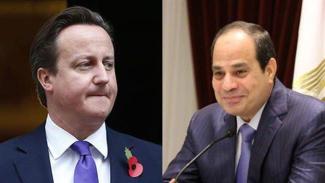
Britain has reportedly re-boosted weapon sales to the Egyptian government in 2015 following a reduction in sales put in place after the military ouster of former president Mohamed Morsi.
The US-based Newsweek magazine reported Friday that official figures released by the UK government indicated that London approved military sales licenses to Egypt for “components of military combat vehicles” worth $76.3 million in the first quarter of 2015.
According to the report, the figures point to a 3,000-percent annual increase in the value of military sales to Egypt by British weapon exporters. It added that in the first quarter of 2014 military deals between the two states stood at $2.4 million in value.
It further noted that some arms export licenses were cancelled by Britain in 2013 following a military coup against Morsi by then army chief and current President Abdel-Fattah el-Sisi.
In June, the Egyptian president received an official invitation from British Prime Minister David Cameron to pay a visit to London.
A number of British human rights organizations have censured the expanding military ties between London and Cairo.
“The UK should be condemning the appalling human rights abuses that are taking place in Egypt,” said CAAT researcher Andrew Smith.
“However, these increasing arms sales, and the forthcoming visit, suggest that the government wants to strengthen its ties [with Cairo],” he added.
Obama’s Egypt Policy Breeds Terrorism
By Jonathan Marshall | Consortium News | July 29, 2015
Like a stopped clock, even rabid neoconservatives can be right once in a while. A good case in point is a recent open letter to Secretary of State John Kerry, signed by such neocon luminaries as Robert Kagan, Elliott Abrams, Reuel Gerecht and Ellen Bork, calling on the Obama administration to “press the Government of Egypt to end its campaign of indiscriminate repression in order to advance a more effective strategy for countering violent extremism.”
The Obama administration, which helped blow up Libya and Syria in the name of human rights, has resumed arms shipments to the military regime of Abdel Fattah al-Sisi, which seized power from a democratically elected government in 2013. Washington’s double standard not only undercuts U.S. credibility internationally, it also jeopardizes important security interests in the region.
As the letter from the “Bipartisan Working Group on Egypt” rightly warns, “State violence — several thousand killed during street demonstrations, tens of thousands of political prisoners, hundreds of documented cases of torture or forced disappearance, sexual assault of detainees or family members, reported collective punishment of Sinai communities possibly with weapons provided through U.S. military aid — is creating more incentives for Egyptians to join militant groups.”
The letter adds, “By carrying out a campaign of repression and human rights abuses that is unprecedented in the country’s modern history, and by closing off all avenues of peaceful expression of dissent through politics, civil society, or media, Al-Sisi is stoking the very fires he says he wants to extinguish.”
Just three days before the group sent its letter to Kerry, Human Rights Watch reported that Egyptian security forces, operating with “nearly absolute impunity,” have killed hundreds of dissidents in recent months, detained more than 40,000 suspects, and “forcibly disappeared” dozens of people. University students in particular have been targeted for mystery disappearances and killings.
The government has also jailed some 18 journalists for publishing reports that conflict with government-approved messages. Its massacre of roughly 1,000 protesters in Cairo in August 2013 ranks as one of the worst single-day atrocities in the region.
Government repression is growing more, not less, severe with time. President al-Sisi recently issued an executive decree giving himself the power to fire officials at independent state institutions. The government is also fast-tracking legislation to further crack down on press freedoms, including, for example, heavy fines for contradicting official statements on terrorist attacks. Human rights organizations have termed it “a blatant violation of the constitution.” The executive director of the Arabic Network for Human Rights Information said the proposed law “turns journalists into mere conveyors of the state’s official data.”
Yet the tepid response of Kerry’s State Department is to endorse Egypt’s “fight against terrorism,” while expressing the “hope” that the final version of Egypt’s new counterterrorism law will respect “individual rights.” The New York Times rightly called the statement “laughable.”
It is, however, fully in keeping with the Obama administration’s “see-no-evil” policy toward Egypt of late. During a visit to Cairo last year, Kerry praised al-Sisi for expressing “‘a very strong sense of his commitment to human rights.” Then, in December, the United States delivered 10 Apache helicopters to support Egypt’s counterterrorism efforts. Finally, this March, the Obama administration lifted its partial freeze on military aid to Egypt, enacted in October 2013 to encourage movement toward free and fair elections in the country.
When Egypt started buying arms from France and negotiating with Russia, the administration suddenly decided that resuming its full $1.3 billion in annual military aid was “in U.S. national security interests.” That finding came despite the administration’s admission this June that “the overall trajectory for rights and democracy has been negative,” including “arbitrary and unlawful killings” and repressive new laws and executive initiatives that “undermine prospects for democratic governance.”
One factor in the administration’s calculus is its concern over rising numbers of Islamist terrorist attacks within Egypt. They include numerous guerrilla operations by the Egyptian affiliate of the Islamic State (Wilayat Sinai) and, more worrisome, the devastating car bombing of the Italian consulate in downtown Cairo this month. A campaign of urban terrorism could devastate the country’s economy and turn Egypt into a much greater crisis than Syria.
But as numerous human rights activists warn, Egyptian repression has become the most effective recruiting tool for anti-government extremists. The Muslim Brotherhood’s longstanding doctrine of peaceful political change has lost credibility with young activists, who refuse to submit passively to arrest and torture at the hands of state security forces.
Reflecting pressure from within its ranks, the powerful Islamic movement declared in late January, “We are at the beginning of a new phase where we summon our strength and evoke the meaning of jihad. . . [We] prepare ourselves, our wives, our sons and daughters, and whoever follows our path for relentless jihad where we ask for martyrdom.”
As one student of Egypt’s Islamists notes, “the matter has yet to be settled. Given the Brotherhood’s long history of non-violence, many members don’t find it easy to accept it now even in response to the Sisi regime’s clampdown. But the fear of losing ground is occupying the minds of Brotherhood leaders. The way many Brotherhood leaders are framing this is that if there is a war between society and the state, and if the society has taken a stance, the Muslim Brotherhood should not hinder society’s fight for freedom.”
Last year, Robert Kagan became one of the first neoconservatives to break with conservatives in Congress, the American Israel Public Affairs Committee and the Netanyahu regime to warn about prospects for “a new Egyptian jihadist movement brought into existence by the military’s crackdown.”
“To Israel, which has never supported democracy anywhere in the Middle East except Israel, the presence of a brutal military dictatorship bent on the extermination of Islamism is not only tolerable but desirable,” Kagan wrote. But “In Egypt, U.S. interests and Israel’s perceptions of its own interests sharply diverge. If one believes that any hope for moderation in the Arab world requires finding moderate voices not only among secularists but also among Islamists, America’s current strategy in Egypt is producing the opposite result.”
Kagan’s pithy observations remain as true today as they were then. The advice that he and others in the Working Group on Egypt sent to Kerry last week—urging him to stop whitewashing Egypt’s regime and instead to pressure it to meet international human rights commitments and promote national reconciliation —is not simply humane but the wisest possible strategic counsel.
UN lists 3,200 children arrested in Egypt since 2013 coup
MEMO – July 25, 2015
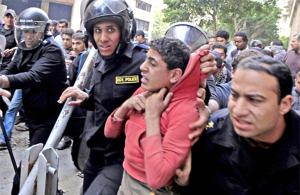 The UN Working Group on Arbitrary Detention has said in a report that the arbitrary detention of minors by the Egyptian regime is “systematic and widespread.” Rassd.com published the findings of the report on Friday.
According to the working group, 3,200 children have been arrested since the end of June 2013, when the military carried out a coup against the first ever freely-elected Egyptian President, Mohamed Morsi. The UN claims that minors have been tortured inside state detention centres. Around 800 are still in prison, it reports, 200 of whom are in the Central Security Camp in Banha, north of Cairo.
“These minors are subject to ill treatment, including physical torture and sexual violence,” the report points out. “They are prevented from having any visits.”
The working group called on the Egyptian authorities to release all of the detained minors and compensate them proportionally for the harm they have suffered.
The report was produced following a complaint to the UN Working Group by Al-Karama, a Geneva-based, independent human rights organisation.
Hassan Nasrallah: Israel is terrorism in essence, and the source of all terrorism in the region
~
Speech of the Secretary General of Hezbollah, Sayed Hassan Nasrallah, on the occasion of International Al-Quds Day (Jerusalem), July 10, 2015.
Transcript:
[…] Israel announces its satisfaction with the civil wars ravaging the entire region, and works through its secret services and in different ways to extend these wars. And unfortunately, many countries have been affected by this disaster, and we see what is now being prepared against Algeria, with unfortunately, once again, a sectarian appearance.
At present, I have no detailed information, I do not claim to be a specialist in this matter, but every time that there were problems in some regions, the media spoke of ethnic differences, or ethnic considerations, namely between Arabs and Amazigh (Berber). But I have seen, in recent days, some foreign (Western) channels broadcast in Arabic [BBC Arabic, France 24, etc.] speak of fights between Malikis and Ibadits. That is to say that the West wants to present this as a denominational and sectarian conflict.
This is what (the West) is implementing in the whole of the region.
During this conference (of the Israeli High Command), the impudence of Israelis went as far as calling for an Arab-Israeli alliance to confront terrorism. Conceive of it: Israel calling for an Arab-Israeli alliance to confront terrorism! And what is terrorism for them? Iran and the Resistance movements. Now, so that the imposture not be too blatant, they put Daech (the Islamic State) with us. But of course they did not include the Al-Nusra Front, or Al-Qaeda or other movements like Ansar Bayt al-Maqdis, or Boko Haram or… or… or…
So this hypocrite Israel claims it shows solidarity with Egypt in the Sinai, and it incites the conflict between Egypt and the Gaza Strip, especially with the Hamas movement. In Syria, Israel presents itself as the protector of the Druze, while it fully supports the Al-Nusra Front and armed takfiri groups that threaten all Syrians, not just the Druze. This is pure hypocrisy. This is hypocrisy and deception.
But regardless of the details, Israel that is the mother of terrorism, the source of terrorism, the terrorist country, the entity that was founded by a terrorist organisation, and, to use philosophical concepts, the only state whose very essence is terrorism, whose nature is terrorism, that Israel presents itself as fighting against terrorism? Do you see what times we are in? The Israel that just a year ago, led the most merciless war and perpetrated the most heinous crimes, war crimes and crimes against humanity in Gaza, so that the reports of international institutions that, at all times, exonerated Israel, have failed, this time, to conceal the truth: the number of women and children killed by Israel, the number of houses destroyed, all the blood of Gaza civilians that was spilt. And after that, it dares to present itself as a civilised country, and claims to be part of a project or an Axis fighting against terrorism. Of course, this is the pinnacle of impudence.
And we must be careful not to mislead ourselves, because unfortunately there are people who may sometimes, because of the impact of terrorism on them, say “What do I care, about Israel? My priority, is this terrorism that is attacking me!” For the existing takfiri terrorism today is among the major adversities faced by our (Muslim) Community. Because (these terrorists) do not fight on a political basis, or for a political project, but on the basis of religious affiliation, or current of thought, or sectarian affiliation. And all the killings that are currently taking place throughout the region are committed on this basis, and not on a political basis or for a political struggle.
Well, the last point that shows that Israel is our enemy, who does it consider to be a threat? Who according to him is a threat? There is only one direction, only one country which represents a threat for Israel: after what happened in Syria, this country (Syria) was removed from the list of threats. All that remains is Iran. The Islamic Republic of Iran. That is why we have seen, during the (Israeli) conference of Herzliya, before, and after, that the spirit of Israel is completely obsessed and captured by Iran, by the Islamic Republic: by its nuclear program, the development of its ballistic capacity, its economy, its democracy, the support of its people for its leaders, the health of its leaders and the health of the country… For everything related to Iran, one can see Israel secure its full attention and work on it, both inside and outside of Iran, and at all international forums. The only target for Israel is the Islamic Republic of Iran, and with it, the Resistance movements.
As for Israel, despite all our consideration and our respect for the Resistance movements and for ourselves (there is no harm if we manifest our respect for ourselves!), the Resistance movements have not reached the stage where they are, from Israel’s point of view, an existential danger. It is not shameful to say the truth, and that is the truth. Yes, the Resistance movements now represent a strategic danger, but they have not reached the point of representing an existential threat (to Israel). Today, on the whole of the face of the Earth, the only state, the only entity, the only thing that is considered by Israel as an existential danger to them is the Islamic Republic of Iran. These are undeniable truths. If someone claims things are different, may he come (and expose his analysis to us).
And this is why Israel incites the entire world against Iran: the United States, Congress… Netanyahu is ready to ruin his relations with the White House by urging Congress against Iran… Israel incites the Arabs (against Iran)… And many of these Arab regimes already have, by nature, such calculations, such a mentality, such a vision (hostile to Iran). This is the reality.
Question: does this not represent, today (I raise this point), if we calm somewhat, as Arabs, as Muslims, as Palestinians, as peoples of the region, if someone relaxes a bit and calmly reflects, away from the bullets, the suffering, the screaming, the problems and the Arab channels, and wonders seriously: Why? Why Israel… In all the Arab and Islamic world, worldwide, with its billion and a half Muslims, its states, its armies, its peoples… Israel fears no one, cares about no one, does not pay attention to anyone except Iran. Why Iran? Should we not pose this question on the occasion of the International Day of Al-Quds (Jerusalem)? Why this total hostility against Iran on the part of the Zionists? Why do we see nothing of this sensitivity, this preoccupation, this anxiety, this fear, this precaution, for example on the part of Israel with regard to Saudi Arabia? Or in respect to any other Arab regime? So that no one say that today, Sayed (Nasrallah) was bitter against Saudi Arabia. No, it is a logical and natural question: why?
Today, at this very moment, the Arab countries and the Arab armies buy billions of dollars of aircraft, missiles, artillery, anti-tank weapons, long-range missiles… Israel does not care in the least because there is a certainty, a confidence, a guarantee, not just a written commitment: they have absolute confidence and certainty in this official Arab mentality, and these official Arab regimes, to the point of having no need for guarantees or written commitments. And experience is the best proof: for 67 years, what for example have the Arabs done, most of them? In short, because Israel knows with certainty that the official Arab regimes have sold them Palestine, Al-Quds (Jerusalem) and the Palestinian people. And the proof is what has happened for 67 years and to this day.
Well, this year, they paid a visit to Gaza: have Gazan homes been rebuilt? What is the situation of the wounded of Gaza? Where is the blockade of Gaza? How are the people of Gaza? If a small portion of the billions of dollars being spent on the war against Yemen, the war against Syria, the war against Iraq and the repression of the populations, was spent on Gaza, would we not today have Gaza in a more acceptable situation? Are they not part of Palestine? Are they not part of the (Islamic) Community? And forgive me for expressing myself again like this, but today we are forced to speak in these terms, are they not a part of the Sunni community? Are they not Muslims, who fast and pray? Why are they abandoned? Because there is an official Arab decision to sell Palestine (to Israel). Palestine has no existence (for them). And the Palestinians are subjected to torture and live in ruins because of it.
And because Israel also knows that the takfiri project, which is sponsored by some Arab countries, does not care about Palestine and Al-Quds (Jerusalem), and that its battle is on other fields, and that this takfiri project completely serves Israeli interests and destroyed for them, without them making any effort, Syria and Iraq, it participated in the destruction of Yemen and spreads sectarian and ethnic conflicts among all Muslims and Christians, tearing apart our (Islamic) Community, and tearing through the national and social fabric in each of our countries, and freely (for Israel).
Who then still carries the flag (of the Palestinian cause)? I do not say this to praise Iran, but to come to a stance. I request a stance to be taken. The one who continues to carry the flag, to face the enemy and refuse to recognise the very existence of this entity, even though the negotiations and the agreement on the nuclear issue should be stopped because of this, whether the current discussions in Vienna that last longer than expected or the ones to come. You will remember that Netanyahu asked that the agreement include the recognition of the existence of Israel by Iran. And I tell you: if the entire nuclear dossier should be closed and Iran be given everything it wanted on the nuclear issue, including what she did not even dare to dream, if the condition was (only) the acknowledgment by Iran of Israel’s existence, the Islamic Republic of Iran, the Republic of Imam Khomeini, under the leadership of His Eminence Imam Khamenei, through his government, the Chamber of Deputies and his people, would never accept such a clause, as Iran would leave its religion by doing so. They know that this is Iran.
And because Iran continues to face the enemy, it is Iran who support the Axis of Resistance, its states, its peoples and its countries, politically, morally, materially, financially, in terms of arms, on the roof and in full sunlight (in plain sight). And this is something that nobody dares to do, or, so as not to exaggerate, that many are afraid to do. Despite the severe sanctions that Iran suffered for over 30 years, and the threat of permanent war and bombing of its facilities. Because Iran is such a threat to Israel, and for the project of American domination over the region, military wars have been fought against it in the past, and media wars, political, psychological and economic wars are conducted against it, wars involving the instruments and allies of the United States in the region, who constituted by their acts the best support for Israel for decades.
On this International Day of Al-Quds (Jerusalem), allow me to speak frankly with Muslims, Christians, Arabs, Palestinians, with the Resistance movements, and whoever supports and sustains the Palestinian cause: you cannot be with Palestine but by being alongside the Islamic Republic of Iran. And if you’re the enemies of the Islamic Republic of Iran, then you are the enemies of Palestine and Al-Quds (Jerusalem). Why is this? These are not empty slogans. Because the only hope remaining after God the Exalted and Most High, to recover Palestine and Al-Quds (Jerusalem), is this Islamic Republic, its help and support to the people and the Resistance movements in the region, and primarily to the Palestinian people. As long as the world is divided into poles, military camps and positions, we must be clear and straightforward: if we want to be serious and sincere, if we leave aside the partisanship, if we want to be logical, this is the logical vision: this enemy (Israel) unanimously recognises what I say, there is no one in Israel that says anything else about the Islamic Republic of Iran.
As for attempts to escape this historic and decisive stance on the pretext of the “Persian project”… There is no “Persian project”! It is deception to keep people away from a genuine and sincere ally of the Arabs and Muslims and all peoples of the region, namely Iran. Everything concerning a Safavid project is nothing but empty words, exhumed from ancient history. Everything about evoking an ostensible Shiite crescent (is futile)… And besides, Iran is now accused in Yemen, but the (alleged) crescent would be distorted by such a movement. The crescent was to be Iran-Iraq-Syria-Lebanon: how would the crescent reach Yemen? Who are they trying to fool? These are just lies concocted by the corrupt official Arab mentality which has abandoned Palestine and Al-Quds (Jerusalem), and if anyone approaches to lend a helping hand to Palestine and Al-Quds, they will present them as an enemy, as evidenced by the fact that the Shah (of Iran) was not their enemy when he was an ally of Israel [although he was also Shiite]. But now they want to present Iran as an enemy. How to achieve this? Pretend that there is a Shiite crescent, they want to spread Shiism, it is a Persian project, it is a Safavi project, etc. These are absurd and empty statements.
[…]
Translated from Arabic by Sayed Hasan
Translated from French by Jenny Bright
Egypt president to change law to permit speedy executions
Reprieve | June 30, 2015
Egypt’s President, General Abdel-Fattah al Sisi, has said he wants to change the law to allow for quicker executions in the country.
In remarks at the funeral of Egypt’s Attorney-General Hisham Barakat, who died after a car bomb attack on Monday, Sisi is reported to have said: “The arm of justice is chained by the law. We’re not going to wait for this. We’re going to amend the law to allow us to implement justice as soon as possible”. He added: “If there is a death sentence, a death sentence shall be enforced.”
The decision to expedite executions for those sentenced to death raises fears for scores of people arrested in the military’s 2013 breakup of protests. Many face possible death sentences in mass trials that fail to meet international standards; including juveniles such as Irish teenager Ibrahim Halawa, who is being tried as an adult alongside 493 other people. Ibrahim, a student from Dublin, was 17 and visiting family in Cairo when he was arrested in August 2013. Now 19, he has reported torture and mistreatment throughout his two years of pre-trial detention.
Commenting, Maya Foa, the head of Reprieve’s death penalty team, said: “In Egypt we’ve already seen scores of innocent people – including juveniles such as Ibrahim Halawa – arrested for the mere ‘crime’ of being at or near a protest. Thousands still face torture, ‘mass trials’, and the threat of hanging. It is sickening that President Sisi now wants to dismantle what little checks remain to prevent wrongful executions. This wave of repression has done nothing to restore law and order in Egypt – Sisi must urgently change course, before any more lives are lost.”
Families of detained journalists commence sit-in at syndicate
By Mostafa Mohie* | Mada Masr | June 28, 2015
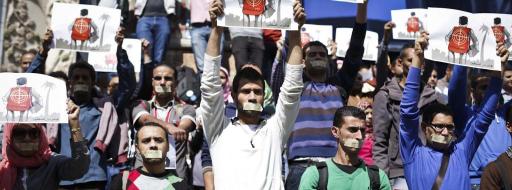
The families of detained journalist Mohamed Saber al-Battawy and photojournalist Mahmoud Abou Zeid, known as Shawkan, started a sit-in on Sunday at the Journalists Syndicate until the release of their relatives.
Battawy’s wife, Rofaida al-Safty, told Mada Masr, “We don’t know why my husband has been detained, we and his lawyers haven’t seen him yet, despite the fact that he has been prosecuted and received a 15-day detention order pending investigation.”
Safty explained that on June 17 at dawn, “a masked force broke into the house and confiscated personal documents, books and Battawy’s hard drive.” Safty wasn’t home when this happened, but Battawy’s father was with him and recounted the details to her.
When Battawy’s father asked about where his son would be taken, he was told “Toukh Police Station,” but Safty didn’t find him there or at any other station within Qalyubiya Governorate, and his arrest was denied by those she asked.
“We called around, notified the syndicate, as well as state-owned Akhbar al-Youm media oulet, and filed a complaint with the general prosecutor and interior minister. We even called the human rights division within the ministry, who asked us to call again, but when we did, their phone was off, Safty recounted.
The Journalists Syndicate filed a complaint with the prosecutor on Monday last week, demanding the disclosure of Battawy’s place of detention and the charges brought against him. The syndicate added in a statement released on the same day that it had communicated with the interior ministry, but received no adequate answer.
On Tuesday, the state-owned Middle East News Agency published an article quoting security sources saying Battawy is in Tora prison and has been accused of “being a member of an illegal group.” Battawy’s defense team headed to the prosecution to verify this information, but no accusations were listed.
Safty reportedly awaits her husband’s transfer to the prosecution again next Wednesday.
As for Shawkan’s family, his mother said he was arrested in August 2013 while covering the Rabea sit-in, along with two foreign photographers who were later released. Shawkan was taken to Cairo Stadium and then transferred to the prosecution, who charged him with murder, attempted murder, being part of an armed group, assaulting security forces, and the possession of a firearm, she added.
Shawkan hasn’t been released or transferred to court and has been detained for 22 months.
Ahmed Abdel Naby, Shawkan’s lawyers, previously told Mada Masr, “There is no evidence against Shawkan and upon arrest he was only carrying a camera. We have submitted all the necessary documents, stating that the photojournalist was working when he was arrested, in addition to the testimony of both his foreign colleagues before their release, but obviously all this is insufficient for his acquittal.”
Abdel Naby said Shawkan was beaten at Cairo Stadium and was then taken to Abu Zaabal Prison, then finally to Tora Prison. Shawkan’s health condition has deteriorated in detention as he has Hepatitis C.
A letter from Shawkan to Yehia al-Qalash, head of the Journalists Syndicate, was published a couple of days ago saying, “All that matters now is the release of all journalists, so that they don’t die a slow death like me. I am afraid that my colleagues will end up like me … thin, pale, with dark circles under the eyes, a heart with an irregular pace and a featureless face that has lost all hope that one day I will be free and will be able to hug my mother again.”
Shawkan added, “I have explained how I die each day, so that you know the suffering of my colleagues in detention. Therefore, I do not ask for my release, but theirs, and I hope that one day they will be free, whether I am alive inside prison or dead.”
Qalash met with Shawkan’s family upon their arrival at the syndicate on Sunday and told reporters he is communicating with the presidency concerning Shawkan’s case.
The Association for Freedom of Thought and Expression (AFTE) issued a report on Saturday on the violations of freedom of the press during the first half of 2015. According to the report, 18 journalists were arrested, 14 others were illegally detained, 34 were physically assaulted, eight were verbally abused, and 85 were prohibited from future coverage. AFTE reported one case in which a media institution was raided. AFTE added that five journalists were detained for more than 500 days and five others for more than 100 days.
The Committee to Protect Journalists (CPJ) issued a statement on June 25 saying that Egyptian authorities jailed 18 journalists in 2015 — the highest number of detentions since 1990.
CPJ sent a “delegation to Egypt in February, where it met with the general prosecutor and the minister of transitional justice, who said that no journalists have been detained because of their work. However, the committee stated that Sisi’s government used national security as a way to control human rights and freedom of the press.”
The report added, “The Egyptian government is randomly accusing journalists and activists of being members of a banned group. The majority of detained journalists have been accused of being Muslim Brotherhood affiliated.
* Translated by Mada Masr
269 die in Egypt jails after Morsi ouster: Rights body
Press TV – June 27, 2015
A Cairo-based rights group has revealed that as many as 269 people have lost their lives in Egyptian custody since the 2013 ouster of Mohamed Morsi, the country’s first democratically-elected president.
The Egyptian Commission for Rights and Freedoms (ECRF) disclosed the data in a report issued on Friday to mark the United Nations International Day in Support of Victims of Torture.
The group said 130 of the fatalities, which comprised 68 political detainees and 62 criminal defendants, had occurred under Egypt’s military-appointed interim President Adly Mansour, who was trusted with the country’s leadership after Morsi’s overthrow from July 3, 2013, to early June 2014.
The report also noted that among the deaths, 143 had occurred due to systematic medical negligence and 32 others as a result of torture practices.
The ECRF also documented 139 deaths in Egyptian prisons and detention facilities since President Abdel-Fattah el-Sisi ascended to power last year.
Morsi, affiliated with Egypt’s Muslim Brotherhood movement, was elected as the country’s president in 2012 but was ousted only a year later in a military coup led by the then army chief, Sisi.
Sisi, who had also served as military chief under former dictator Hosni Mubarak, later campaigned for and won the country’s presidency in controversial elections in June 2014.
The Sisi administration has been cracking down on any opposition since Morsi was ousted, banning the Muslim Brotherhood movement.
Thousands of the supporters of Morsi and the Muslim Brotherhood movement have also been jailed, with many of them, including Morsi, receiving death penalties in mass trials.
Egypt to burn all books by Brotherhood scholars
MEMO | June 23, 2015
The head of the religious sector at Egypt’s Ministry of Endowments, Mohamed Abdel Razek, has announced that the ministry will burn all books and exegeses written by Muslim Brotherhood scholars.
In a press statement released on Monday, Abdel-Razek said that his ministry plans to burn the “poisonous books” written by Sheikh Hassan Al-Banna, Yusuf Al-Qaradawi, Sayyid Qutb and other Brotherhood leaders, as well as books written by other Islamist groups.
The Minister of Endowments Mohammad Mukhtar Juma on Saturday issued a decision to examine and conduct an inventory of the books at religious and public libraries across the country so as to “cleanse” them of books considered to contradict the tolerant nature of Islam.
Egypt builds trench along Gaza border
Ma’an – June 22, 2015
CAIRO – The Egyptian military has constructed a trench along the border of Rafah to prevent smugglers from operating in the area, the army said.
The trench is 20 meters deep and 10 meters wide and is located two kilometers from the border with Gaza outside of Rafah city.
The new infrastructure — part of a larger buffer zone being constructed in the area — is intended to prevent smugglers from driving their vehicles to the opening of tunnels along the border.
A military official said that the army plans to expand the trench and install watchtowers along its length.
Work on the buffer zone on the Egyptian side began in February 2014, but was at the time slated to extend only about 300 meters in urban areas and 500 meters in rural areas.
After a bombing killed more than 30 Egyptian soldiers in the Sinai in October 2014, however, the military stepped up a campaign to build the buffer zone amid accusations of Hamas support for the group that carried out the attack.
Hamas, which denies Egyptian accusations, has suffered poor relations with the Egyptian government ever since the democratically-elected Muslim Brotherhood, with whom they were closely allied, was thrown out of power in July 2013.
Deteriorating relations between Egypt and Hamas come at a high price to Gaza’s 1.8 million residents for whom the smuggling tunnels have served as a lifeline to the outside world since Israel imposed a crippling siege on the coastal enclave in 2007.
Egypt blocks Geneva-bound Yemen plane from entering airspace
Press TV – June 15, 2015
The plane carrying the representatives of Yemen’s political factions, including those of the Houthi Ansarullah movement, to attend the UN-brokered talks in the Swiss city of Geneva has not arrived in its destination yet due to Egypt’s refusal to allow them to enter its airspace.
The delegation left the Yemeni capital, Sana’a, on Sunday afternoon, but was forced to have a long stop in Djibouti.
Sources close to Ansarullah delegation currently in Djibuti said that Saudi Arabia seeks to manipulate the talks in Geneva as Riyadh creates obstacles to the presence of Yemeni negotiators in the meeting.
Egyptian authorities have reportedly not allowed the plane to cross the country’s airspace due to the Saudi pressure.
According to reports, two other Houthi representatives were also expected to arrive in Geneva from Oman.
The negotiations aimed at ending the deadly conflict in the Arab country were supposed to start in Geneva early on Monday with Yemeni political factions and former regime officials in attendance.
UN Secretary-General Ban Ki-moon, who will also be present in the talks, is expected to meet with representatives of Yemen’s fugitive former president, Abd Rabbuh Mansur Hadi prior to holding talks with the Ansarullah delegation.
UN spokesman Ahmad Fawzi on Sunday called on all parties involved in Yemen’s conflict to observe a renewed “humanitarian pause” due to Saudi Arabia’s incessant airstrikes on the impoverished country.
Sources have confirmed Hadi will attend the meeting.
The talks brokered by UN special envoy for Yemen Ismail Ould Cheikh Ahmed aim to secure a ceasefire, and accelerate the delivery of humanitarian aid to the war-racked Yemeni people.
The UN envoy said that the talks will be the beginning of “preliminary inclusive consultations” to find a solution to the conflict that has claimed more than 2,500 lives and triggered a “catastrophic” humanitarian crisis.
In a statement issued early July, the UN urged all Yemeni parties “to engage in these consultations in good faith and without preconditions in the interest of all Yemeni people.”
However, the meeting, which was initially scheduled for May 28, was delayed after Hadi refused to attend the negotiations.
The Un-brokered peace talks come as Saudi Arabia continues its military aggression against the Yemeni people.
Riyadh launched a military campaign against its impoverished neighbor on March 26 – without a UN mandate- in an attempt to undermine the Houthi revolutionaries and restore power to Hadi, who is a staunch ally of Saudi Arabia.
Featured Video
BRITAIN’S WARNING: PREPARE FOR WAR
or go to
Aletho News Archives – Video-Images
From the Archives
British weapons and personnel doing much of the killing in Yemen
Press TV – June 18, 2019
A detailed report published by the Guardian newspaper has shown how Britain is massively contributing to Saudi Arabia’s devastating war on Yemen as it suggests that London is not only supplying the bombs that fall on Yemenis, but it provides the personnel and expertise that keep the war going.
The comprehensive report by Arron Merat published on Tuesday showed that Britain was doing much of the killing in Yemen as the country continues to provide Saudi Arabia with everything it needs to turn its southern impoverished neighbor into a graveyard.
“Every day Yemen is hit by British bombs – dropped by British planes that are flown by British-trained pilots and maintained and prepared inside Saudi Arabia by thousands of British contractors,” said Merat in the report. … continue
Blog Roll
 Aletho News
- Elijah Magnier: Yemen’s Strikes Are Shattering Saudi Arabia’s Long-Term Strategy
- Pentagon designates Chinese cultural centers national security threat
- Israel Demolishes Home Of Lebanese Journalist Whose Viral Film Exposed Pager Attack
- Record Oil, Empty Tanks: The UAE’s Miracle Recovery
- Burnham tackles Britain’s poverty with aggression in Yemen
- Peace in Ukraine: the easy way – or the hard way
- Trump & the Rrrrussians
- US taxpayer money laundered back through Ukraine – Musk
- Before COVID, an NIH lab chief proposed making a SARS-like bat virus more infectious
- Gates, Bourla on Trial in Netherlands Accused of ‘Great Reset’ Scheme at Vaccine Injury Hearing
- If Americans Knew
- An error has occurred; the feed is probably down. Try again later.
- No Tricks Zone
- Sudden Stratospheric Warming, Powerful El Niño Combination May Lead To Extreme Europe Cold, Energy Crisis!
- Two New Studies Find Thwaites Glacier Melt Cannot Be Driven By Human Activity Or A Warming Ocean
- E-Cars Reduce CO2 Emissions By Only 41% Compared To Internal Combustion Engine Vehicles
- Predictions Made By Renowned Climate Professor Over Past Decades Have Been Proven To Be Poor
- New Study Suggests Large Regions Of The Pacific Ocean Have Been Cooling For The Last 80 Years
- Germany’s Green Energy Debacle: High Energy Costs Force Kahla Porzellan to Close After 182 Years!
- New Study: 50 Years Of The Most Aggressive ‘Net Zero’ Policies Can Only Affect The Global Climate By 0.03°C
- US September “Heat” Was No Record…Many Records Set Decades Ago
- Latest European Green Energy Debacle; Portugal’s Largest Flagship Solar Park Insolvent!
- Green Energy Debacle: German Expert Professor Fritz Vahrenholt Warns Of Severe Economic And Social Consequences

