Peres praises the ‘Egyptian war’ against Hamas
MEMO | January 6, 2014
Israeli President Shimon Peres has praised what he describes as “the war” being waged by the Egyptian authorities against the Islamic resistance movement Hamas.
Peres also celebrated, in statements during a meeting held on 5 January with foreign ministry representatives, the incitement campaigns being waged by some of the Egyptian authorities against the Palestinian resistance factions, particularly Hamas.
In the same context, Peres noted, “We may be in isolation, but we are not alone”, adding that: “the Arabs wanted to uproot Israel during its establishment; however, they have become convinced that Israel is not the problem, and they are utterly aware that terrorism is their first enemy.”
Last week, Egypt’s Interior Minister Mohammad Ibrahim claimed that Hamas had provided military training in the Gaza Strip for members of the Egyptian Muslim Brotherhood, which the Egyptian authorities have now designated a terrorist organisation.
Former Mossad Chief Meir Dagan also praised Egypt’s campaign against Hamas ever since the military coup that deposed the former Egyptian president, Mohamed Morsi. He remarked that: “We don’t need to destroy Hamas, as Egypt is playing that role already.”
Attending the Majdi Forum in Kfar Saba, Dagan explained: “Israel has no interest in destroying Hamas, and the reason is the important efforts made by Egypt to dwarf Hamas’s power. And I also see a similar effort exerted by the Gulf countries. The State of Israel is not involved in these efforts.”

Let’s Not Forget The Neocons Who Cheered The Egyptian Military Into Power
By Chris Rossini | Ron Paul Institute | December 28, 2013
Earlier this year, the Egyptian military overthrew the democratically elected Mohammed Morsi. Much has happened since the initial violent crackdown on Morsi’s supporters. The Muslim Brotherhood, which has been around some 80 years, has been labeled a “terrorist organization” by the Egyptian government, and now even bloggers who speak out against the military are being jailed.
Plenty of neocons cheered the military coup from the sidelines when it occurred. With all of their flap about the US “bringing democracy to the world,” this apparently was a case where a coup was necessary.
Now that 6 months has passed, and the Egyptian military continues to flex its iron fist, let’s not forget the neocons who cheered them into power:
John Bolton on July 3: “we needed the military to stop the Muslim Brotherhood, and I think this coup was the right thing.”
Jonathan Tobin on Aug. 8: “There is more to democracy than voting, and any solution that risks giving Morsi another chance to consolidate power would be a disaster for Egypt and the United States. Washington must be prepared to stick with the military no matter what happens in the streets of Cairo.”
Michael Rubin on Aug. 16: “So long as the Muslim Brotherhood seeks to turn back the clock, impose its hateful and intolerant ideology upon Egyptians of all religiosities and religions, and refuses to abide by the pathway to transitional elections, and so long as it continues to fight in the streets, then it should suffer the consequences of its actions. And if those consequences result in exponentially higher Brotherhood casualties than army casualties, then so be it. That is the truest path to peace.”
Peter Wehner on Aug. 20: “So from the perspective of American national security and morality, having the Muslim Brotherhood in power is considerably worse than having the Egyptian military in power.”
Remember the rule: If the winner of a foreign election is someone that the U.S. government approves of: “Democracy = Good”. However, if the U.S. government does not approve of the winner: “Roll in the tanks!”
PFLP: Hamas should not abandon their ideology
Ma’an – 30/12/2013
GAZA CITY – Hamas are a vital component of the Palestinian nationalist struggle and should not abandon their ideology, the Popular Front for the Liberation of Palestine said Monday.
The statement from the leftist group was in response to a recent call by the PLO for Hamas to dissociate itself from the Muslim Brotherhood.
“We are not calling on Hamas or other forces to abandon their ideological roots, but we ask everyone to give priority to the interests of the Palestinian people when they build relations with the surrounding Arab and Islamic world,” the PFLP said.
On Saturday, Jamal Muheisin, a Fatah representative in the PLO executive committee, said Hamas should detach itself from the Brotherhood, warning of political, economic, and security consequences if Hamas remained “subordinate” to “this banned terrorist group.”
A representative of the Arab Liberation Front said that Hamas has always prioritized the Muslim Brotherhood’s interests over the interests of the Palestinian people, while Ahmad Majdalani of the Palestinian Popular Struggle Front said Hamas was viewed as a terrorist organization by many countries including the United States due to its affiliation with the Brotherhood.
PFLP official Rabah Muhanna was one of many faction leaders who also called upon Hamas to sever relations with the Muslim Brotherhood.
Gaza government spokeswoman Isra Almodallal told Ma’an last week that while Hamas and the Muslim Brotherhood may share ideology, they should not be seen as one and the same movement.
“We are in completely different circumstances,” Almodallal said. “We don’t want people to think Hamas is the same as the Muslim Brotherhood.”
“We don’t want Egypt to punish us the way the Muslim Brotherhood is punished in Egypt.”
Almodallal added that Hamas agreed that “at this particular time” it is best to remain neutral in the affairs of other Arab countries.
Related article
- PLO Urges Hamas To Sever Ties With Muslim Brotherhood (eurasiareview.com)
Senate panel approves aid to military governments
Press TV – December 19, 2013
The US Senate Foreign Relations Committee has approved a bill facilitating the provision of aid to countries ruled by post-coup military governments.
The bill would require the US government to determine when a democratically-elected government has been removed by force, Foreign Policy reported on Wednesday.
The Senate Committee passed the Egypt Assistance Reform Act by a 16-1 vote on Wednesday and the key supporters of the bill, Senators Robert Menendez (D-N.J.) and Bob Corker (R-Tenn.), say the congressional legislation would authorize the US administration to maintain ties with strategically important countries like Egypt even after military forces overthrow a democratically-elected government.
“This legislation reaffirms the enduring U.S. commitment to our partnership with the Egyptian government by authorizing continued assistance and endorsing the importance of ongoing cooperation,” said Menendez, the chairman of the Committee.
On July 3, Egypt’s powerful military ousted former Egyptian President Mohammad Morsi who was the country’s first democratically-elected head of state.
The administration of US President Barack Obama refused to call the military-led ouster of Morsi a coup because such acknowledgement would trigger an automatic congressional ban on the US aid to the Egyptian military.
Section 7008 of the Foreign Operations Appropriations Law prohibits aid to countries run by post-coup military governments.
Nevertheless, if the new bill makes it into law, the US government would not find itself in the same situation in the future because it is tasked with making a coup determination.
The bill, which was drafted in consultation with the White House, was criticized by Senator Rand Paul (R-KY) who said, “Instead of holding the Egyptians accountable, this bill will make it easier for the US to send tanks and F-16 fighter jets to a country that suffers endemic violence against political opponents and religious minorities.”
Mursi to stand trial on terrorism charges
Al-Akhbar | December 18, 2013
Egypt’s public prosecutor ordered deposed President Mohammed Mursi and 34 other Islamists to stand trial on charges including conspiring with foreign organizations to commit terrorist acts in Egypt and divulging military secrets to a foreign state.
In a statement, the prosecutor said that Mursi’s Muslim Brotherhood had committed acts of violence and terrorism in Egypt and prepared a “terrorist plan.”
The charge sheet called it “the biggest case of conspiracy in the history of Egypt”. It accused the Brotherhood of carrying out attacks on security forces in North Sinai after he was deposed on July 3.
It said the Brotherhood had hatched a plan dating back to 2005 that would send “elements” to the Gaza Strip for military training.
The trial appears to stem from an investigation into prison breaks during a 2011 uprising against strongman Hosni Mubarak, when Mursi and other Islamist prisoners escaped.
Prosecutors have alleged the jailbreaks were carried out by Palestinian and Lebanese groups, who had members imprisoned under Mubarak.
Mursi is already standing trial for inciting violence during protests outside the presidential palace a year ago when he was still in office. He was ousted in July by the army following mass protests against his rule.
The Egyptian authorities have launched a fierce crackdown on the Muslim Brotherhood since Mursi was removed from power, killing hundreds of his supporters during protests and arresting thousands more.
(Reuters, AFP, Al-Akhbar)
Related articles
Number recently displaced by flooding in Gaza tops 10,000
Ma’an | December 15, 2013
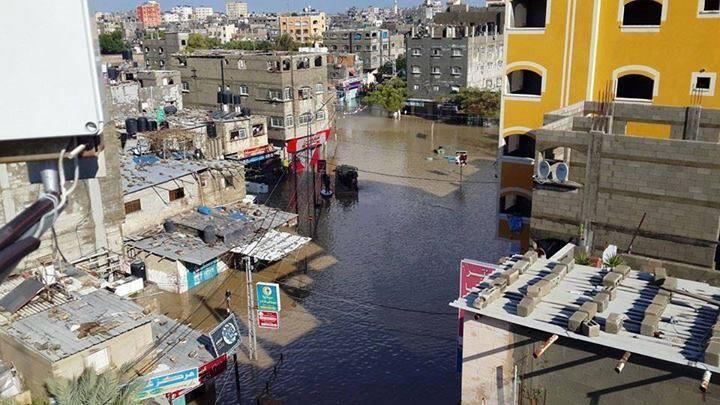
BETHLEHEM – Approximately 10,000 people have been forced to flee their homes due to widespread flooding in the Gaza Strip, according to a report released Saturday evening by the United Nations Office for the Coordination of Humanitarian Affairs.
The numbers of displaced dwarf earlier estimates, as they take into account both the thousands who have sought refuge in Gaza shelters as well as those who have sought refuge elsewhere.
Previous estimates released by the Gaza government had measured only those who had sought refuge in official shelters, who at their peak reached above 5,000 but were estimated at around 2,234 on Sunday.
In a comprehensive report on winter storm Alexa’s effects on the Palestinian Territories, OCHA reported that as of Saturday at 9 p.m., 10,000 Gazans had been evacuated from their homes and had gone to either shelters or relatives’ houses.
The areas most devastated by the storm are “North Gaza and Gaza City where over 1,500 houses suffered damage due to water entering houses, damaging furniture and electricity networks.”
An infant died and 100 were injured in storm-related incidents throughout Gaza, the report said. Gaza government officials said on Sunday that two individuals had died, but did not mention any case involving an infant.
Schools throughout Palestine have been closed since Thursday, and according to OCHA 17 schools in Gaza have been converted into shelters, while five other schools have been rendered unusable due to flooding.
The report also discussed the effects of the storm, in conjunction with the Israeli occupation, on herding communities in the West Bank.
“Several herding communities had their structures demolished (by the Israeli authorities) one day before the storm hit, prompting the UN Humanitarian Coordinator to call again for a halt to demolitions due to their humanitarian impact,” the report said.
Additionally, “approximately 30 families living in ten Bedouin communities in the northern Jordan Valley require emergency assistance.”
Meanwhile, the report said farmers across Palestine have been hit with livestock and crop losses, further weighing on levels of food insecurity throughout the territories.
“In the West Bank, preliminary reports of damages to the livestock sector are emerging from Hebron, Bethlehem and Salfit. Bedouin and herding communities seem to be the most affected. Herders are expected to face increasing livestock fatalities and morbidity in the coming weeks.”
In Gaza, over 10 percent of the coastal enclave’s greenhouses and field crops were destroyed or damaged by winter storm Alexa, in addition to 50 animal pens, the report said.
“120,000 chicks and 200 heads of livestock died as a result of the weather.”
The Gaza Strip is currently under a state of emergency due to severe weather conditions caused by a historic storm front moving south across the Levant.
UNRWA spokesperson Chris Gunness said on Saturday that large regions of the Gaza Strip were a “disaster area” and called on the international community to lift the Israeli blockade in order to allow recovery efforts to proceed.
“Any normal community would struggle to recover from this disaster. But a community that has been subjected to one of the longest blockades in human history, whose public health system has been destroyed and where the risk of disease was already rife, must be freed from these man made constraints to deal with the impact of a natural calamity such as this,” he said in a statement sent to Ma’an.
Fuel shortages have caused daily life in the Gaza Strip to grind slowly to a halt since early November, cutting off access to basic necessities for Gaza residents.
Until Sunday, the Gaza Strip had been without a functioning power plant since the beginning of November, when the plant ran out of diesel fuel as a result of the tightening of a seven-year-long blockade imposed on the territory by Israel with Egyptian support.
The power station began operating Sunday after receiving a delivery of diesel that was purchased from Israel by the Palestinian Authority using funds donated by Qatar.
The plant was only reopened in 2012 after it was targeted by an Israeli airstrike in the 2006 assault on the Strip. The power plant generates around 30 percent of the Gaza Strip’s electricity supply, while the rest comes from Israel and Egypt.
Until July of this year, the tunnels to Egypt provided a vital lifeline for the territory amidst the otherwise crippling Israeli blockade. The blockade has been in place since 2006, and it has limited imports and exports and led to a major economic decline and wide-reaching humanitarian crisis.
In 2011 and 2012, however, the situation improved, as the tunnels to Egypt witnessed a brisk trade following the Egyptian Revolution.
Gaza Strip energy officials have blamed Egypt for destroying numerous tunnels linking the Gaza Strip and Egypt in recent months. They also blamed the Fatah-led Palestinian Authority for charging taxes on fuel too high for Hamas authorities to afford.
Related article
“Judges for Egypt” to boycott constitution referendum
MEMO | December 15, 2013
The President of Egypt’s Court of Appeals, Judge Mohamed Awad, has said that he will not participate in the judicial supervision of the referendum on the new constitution. He claims that the document lacks credibility.
Awad, who is also the General Coordinator of Judges for Egypt, said in a statement, “The proposed constitution allows the military to act as masters of the Egyptian people, legitimises military coups and eliminates Egypt’s Islamic identity to establish a secular state.”
The document, he added, denies the Egyptian people their rights to be the source of power in the country. “The proposed constitution is illegal because it has been issued by an illegal commission that did not represent the Egyptian people,” insisted Awad. “The referendum will take place under military rule, which has been renowned for electoral fraud since the 1952 coup.”
Related article
Comparing Current Draft of Egypt’s 2013 Neo-liberal Constitution to that of the Publicly Approved Constitution of 2012
By Scott Creighton | American Everyman | December 7, 2013
In order to show various so-called “alternative” and “anti-globalist” activists what the real cause of the State Department sponsored coup in Egypt back in July of this year was all about, I have put together just a few comparisons of the publicly approved Egyptian constitution of 2012 and their respective counterparts in the new draft constitution being put together by the illegal junta run by their new dictator, al Sisi.
As many of the fake alternative journalists have often raged against the “Islamist” nature of the previous constitution without ever linking their readers to the document so they could read it and judge it for themselves, I resolve to provide links to both the translated Egyptian Constitution of 2012 and the current draft version written by the technocrats and advisers on behalf of Big Global Business and the financial elites.
Here is a link to the publicly approved Egyptian Constitution of 2012
What I have done is taken a few articles and simply listed them side by side for you to view. I have created 4 PDFs of this which I will link to below and 4 JPEGS so you can view them without having to download the other files. The PDFs are obviously easier to read, but I will do my best with the pics. I sincerely hope that you will take the time to read both the original 2012 version as well as the new neo-liberal one.
If you wish to know why I spent so much time working on this when the story of the illegal coup in Egypt is all but over, remember this…
They are currently working on producing a climate in this country which will provide them the needed pretext to begin rewriting our constitution. It’s not that far off folks. Heard some “progressives” on NPR chatting about that very thing just yesterday.
You want to see how they (the Chicago School of Economics technocrats) remake constitutions? The Egyptian model should serve as a fine example of what we can expect to see very soon.
Here are the PDF versions:
- 2012 to 2013 Layout1 (1)
- 2012 to 2013 Layout1 (2) (1)
- 2012 to 2013 Layout1 (3) (1)
- 2012 to 2013 Layout1 (4) (1)
And here are the photos (JPEGs)


The new constitution institutionalizes entry points for various global multinational corporations and financial institutions, setting as a priority the notions of the creation of a financial environment which will encourage hot money speculation and foreign investment. It’s all about “sustainable development” and protecting the “economic services” industry (i.e. financial institutions)
Notice that the new constitution states that the natural resources “belong to the people” but make no mention of their right to the profits of those resources they own. The 2012 constitution did.
The 2012 constitution said the property of the state is not to be disposed of while the neo-liberal 2013 draft says it can be under law.
The slickness of the legalese is notable as well. Notice how the new constitution, rather than guaranteeing the people various rights like the 2012 constitution does, instead they “aim” or “commit” to these ideals as if they were goals they promise to attempt to fulfill. Legally speaking, big difference.
I only scratched the surface with this comparison. Others have pointed out that the 2013 draft empowers the elements in Egypt that sided with the Obama administration during the coup like the judiciary, the military and the police.
Some have pointed out that the new constitution allows for military detentions of civilians, which it does.
Given the nature of the current dictatorship in Egypt (the way they are outlawing political parties like the Apartheid government did to the ANC based on the arbitrary ruling that they are a “terrorist organization”, the way they are arresting peaceful protesters if they don’t just shoot them dead in the streets) it’s quite remarkable that anyone who claims to be opposed to our imperialist interventions across the globe could possibly still imagine that this illegal coup has any form of legitimacy whatsoever. I hope that this simple comparison will make it clearer what is happening in Egypt and more importantly, why it happened.
Related article
- Army Powers Expanded in Egyptian Draft Constitution (mascareignas.blogspot.com)
Egypt’s constitution to grant immunity to military
Press TV – November 30, 2013
Egypt’s constitution-drafting committee has agreed to an article that grants immunity to the Supreme Council of the Armed Forces (SCAF).
According to a draft published in Egypt’s state media on Thursday, the new constitution would grant more powers to the SCAF and could ban Islamic parties completely.
The 50-member assembly is scheduled to finish the draft of the constitution this week. The constitution will then be put to a referendum in December.
Earlier this month, it was revealed that General Abdel Fattah el-Sisi, the army chief and minister of defense, had been seeking immunity for the military council for a period of five to ten years.
It has also been leaked that he asked for a media campaign to lobby for a specific clause to be included in the constitution. The clause would allow Sisi to retain his post as defense minister in the event he loses in the presidential election.
The military representatives of the committee also called for the constitution to allow the military to name the defense minister during the next two presidential terms. The move has been widely criticized by legal experts, who say this would give the military more power than the president.
Egypt has been experiencing unrelenting violence since July 3, when the army ousted President Mohamed Morsi’s government, suspended the constitution, and dissolved the parliament. It also appointed the head of the Supreme Constitutional Court, Adly Mahmoud Mansour, as the new interim president.
The government of Mansour has launched a bloody crackdown on Morsi supporters and arrested more than 2,000 Muslim Brotherhood members, including the party’s leader, Mohamed Badie, who was detained on August 20.
About 1,000 people were killed in a week of violence between Morsi supporters and security forces after police dispersed their protest camps in a deadly operation on August 14. The massacre sparked international condemnation and prompted world bodies to call for an independent investigation into the violence.
The Plot Thickens: Gaza is Flooded with Sewage and Conspiracies
By Ramzy Baroud | Palestine Chronicle | November 27, 2013
The latest punishment of Gaza may seem like another familiar plot to humiliate the strip to the satisfaction of Israel, Mahmoud Abbas’s Palestinian Authority, and the military-controlled Egyptian government. But something far more sinister is brewing.
This time, the collective punishment of Gaza arrives in the form of raw sewage that is flooding many neighborhoods across the impoverished and energy-chocked region of 360 km2 (139 sq mi) and 1.8 million inhabitants. Even before the latest crisis resulting from a severe shortage of electricity and diesel fuel that is usually smuggled through Egypt, Gaza was rendered gradually uninhabitable. A comprehensive UN report last year said that if no urgent action were taken, Gaza would be ‘unlivable’ by 2020. Since the report was issued in August 2012, the situation has grown much worse.
Over the years, especially since the tightening by Israel of the Gaza siege in 2007, the world has become accustomed to two realities: the ongoing multiparty scheme to weaken and defeat Hamas in Gaza, and Gaza’s astonishing ability to withstand the inhumane punishment of an ongoing siege, blockade and war.
Two infamous wars illustrate this idea: The first is Israel’s 22-day war of 2008-9 (killing over 1,400 Palestinians and wounding over 5,500 more) and the second is its more recent war of Nov 2012 – eight days of fighting that killed 167 Palestinians and six Israelis. In the second war, Egypt’s first democratically-elected president Mohammed Morsi was still in power. For the first time in many years, Egypt sided with Palestinians. Because of this and stiff Palestinian resistance in Gaza, the strip miraculously prevailed. Gaza celebrated its victory, and Israel remained somewhat at bay – while of course, mostly failing to honor its side of the Cairo-brokered agreement of easing Gaza’s economic hardship.
In relative terms, things seemed to be looking up for Gaza. The Rafah border crossing between Gaza and Egypt was largely opened, and both Egypt and the Hamas governments were in constant discussions regarding finding a sustainable economic solution to Gaza’s many woes. But the ousting by General Abdel Fatah al-Sisi of President Morsi on July 3 changed all of that. The Egyptian military cracked down with vengeance by shutting down the border crossing and destroying 90-95 percent of all tunnels, which served as Gaza’s main lifeline and allowed it to withstand the Israeli siege.
Hopes were shattered quickly, and Gaza’s situation worsened like never before. Naturally, Cairo found in Ramallah a willing ally who never ceased colluding with Israel in order to ensure that their Hamas rivals were punished, along with the population of the strip.
Citing Gaza officials, the New York Times reported on Nov 21 that 13 sewerage stations in the Gaza Strip have either overflowed or are close to overflowing, and 3.5 million cubic feet of raw sewage find their way to the Mediterranean Sea on a daily basis. “The sanitation department may soon no longer be able to pump drinking water to Gaza homes,” it reported.
Farid Ashour, the Director of sanitation at the Gaza Coastal Municipalities Water Utilities, told the Times that the situation is ‘disastrous’. “We haven’t faced a situation as dangerous as this time,” he said. But the situation doesn’t have to be as dangerous or disastrous as it currently is. It has in fact been engineered to be that way.
Gaza’s only power plant has been a top priority target for Israeli warplanes for years. In 2006 it was destroyed in an Israeli airstrike, to be opened a year later, only to be destroyed again. And although it was barely at full capacity when it operated last, it continued to supply Gaza with 30 percent of its electricity needs of 400 megawatts. 120 megawatts came through Israel, and nearly 30 megawatts came through Egypt. The total fell short from Gaza’s basic needs, but somehow Gaza subsisted. Following the ousting of Morsi and the Egyptian military crackdown, the shortage now stands at 65 percent of the total.
In an interview with the UN humanitarian news agency, IRIN, James W. Rawley, the humanitarian coordinator for the Occupied Palestinian Territory, depicted a disturbing scene in which the impact of the crisis has reached “all essential services, including hospitals, clinics, sewage and water pumping stations.”
Israelis on the other hand, have been doing just fine since the last military encounter with Hamas. “The past year was a great one,” the Economist quoted the commander of Israel’s division that ‘watches’ Gaza, Brigadier Michael Edelstein. Due to the massive drop in the number of rockets fired from Gaza in retaliation to Israeli attacks and continued siege (50 rockets this year, compared to 1,500 last year), “children in Israel’s border towns can sleep in their beds, not in shelters, and no longer go to school in armored buses,” according to the Economist on Nov 16.
“But Israel’s reciprocal promise to help revive Gaza’s economy has not been kept,” it reported. Israel has done everything it its power to keep Gaza in a crisis mode, from denying the strip solar panels so that they may generate their own electricity to blocking Gaza exports. “In the meantime, Gaza is rotting away.”
Desperate to find immediate remedies, Gaza Prime Minister Ismail Haniyeh issued new calls to Mahmoud Abbas for a unity government. “Let’s have one government, one parliament and one president,” Haniyeh said in a recent speech, as quoted by Reuters. A Fatah spokesman, Ahmed Assaf, dismissed the call for it “included nothing new.” Meanwhile, the PA decided to end its subsidy on any fuel shipped to Gaza via Israel, increasing the price to $1.62 per liter from 79 cents. According to Ihab Bessisso of the PA, the decision to rescind Gaza’s tax exemption on fuel was taken because sending cheap fuel to Gaza “was unfair to West Bank residents,” according to the Times.
But fairness has little to with it. Reports by the Economist, Al Monitor and other media speak of Egyptian efforts to reintroduce Gaza’s former security chief and Fatah leader Mohammed Dahlan to speed-up the anticipated collapse of the Hamas government. Al Monitor reported on Nov 21 that Dahlan, a notorious Fatah commander who was defeated by Hamas in 2007 because of, among other reasons, his close ties with Israeli intelligence, had met with General al-Sisi in Cairo. Evidently, the purpose is to oust Hamas in the Gaza Strip. But the question is how? Some “suggest that a Palestinian brigade mustered in al-Arish could march on Gaza and, with Egyptian support, defeat the broad array of Hamas forces created in the last decade.”
With Morsi’s Muslim Brotherhood out of the picture, at least for now, Gaza is more vulnerable than ever. Some of Abbas’s supporters and certainly Dahlan’s may believe that the moment to defeat their brethren in Gaza is now.
– Ramzy Baroud (www.ramzybaroud.net) is a media consultant, an internationally-syndicated columnist and the editor of PalestineChronicle.com. His latest book is: My Father was A Freedom Fighter: Gaza’s Untold Story (Pluto Press).
Egypt’s coup leaders call for end to subsidies on basic goods
MEMO | November 23, 2013
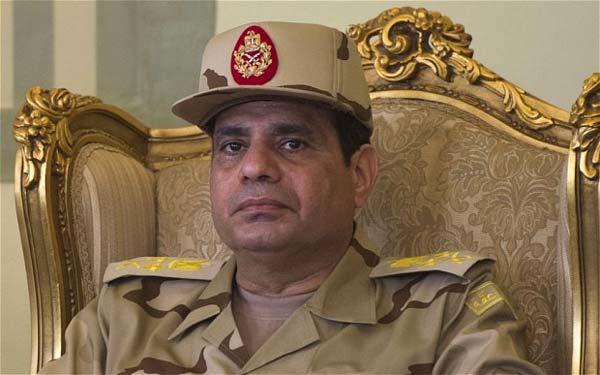 In a new leaked audio tape, the Egyptian coup leader Gen. Abdul-Fattah al-Sisi has called for an end to subsidies on bread and energy in Egypt, as well as a 50 per cent reduction of public sector salaries.
Gen. Al-Sisi described the measure as “austerity” and pointed to examples in various countries expressing his admiration for them.
In the audio which was broadcast by Al-Jazeera Mubashir Misr on Friday 22 November, he said: “A gas container is sold to citizens for 62 to 67 Egyptian pounds, (restaurants pay much more). This means that a lot of money is being unintentionally wasted in the country.”
He said: “It is impossible to pay 107 billion Egyptian pounds to subsidise energy and 17 billion for bread.”
Al-Sisi continued: “What I would like to say, regardless if it is appropriate to raise prices or not is that when former President Sadat attempted to solve Egypt’s problems in 1977, he decided that every citizen had to pay the prime costs for the goods they bought.”
Citing other examples, Gen Al Sisi said: “I would like to tell you that Germany reduced 50 per cent of the salaries for its austerity plan, and people accepted that measure.” However, he did not give any details about when and how Germany carried out this measure.
He further pointed to the cases of South Africa and Sudan. In the latter case he said, “When South Sudan seceded from the north and became independent, it cut salaries by 50 per cent. People said nothing.”
Then he concluded: “I do not care about the decisions. I would like to say that the situation requires from all of us, Egyptians, if we love our country, to take measures regarding the issue of the prices and goods’ subsidies.”
Related article
- In interview, Egypt army chief Sisi toys with idea of presidential candidacy (uprootedpalestinians.wordpress.com)
Featured Video

Racist Seinfeld Dances for Joy as Bibi Unveils His New Map
or go to
Aletho News Archives – Video-Images
TV Drama Review
Japanese drama projects Japan’s wartime atrocities onto Chinese characters

Global Times | October 25, 2026
By portraying Chinese characters as perpetrators of ruthless violence while casting Japanese Self-Defense Forces (SDF) intelligence operatives as defenders, the season 2 of the Japanese drama Vivant has recently drawn criticism from Chinese netizens, who argue that its depiction turns historical reality on its head while ignoring Japan’s wartime atrocities.
The TBS drama series – a spy suspense story in which an alleged unofficial intelligence unit of the SDF operates across the globe — has attracted a passionate fanbase. Its currently airing season 2 opened with a household rating of 18.8 percent, the highest for a TV drama this year, according toa commentary article by Japanese media Toyo Keizai.
What draws attention is the portrayal of the enemies in the series, the article noted. Scenes in which the Chinese organization subjects kidnapped members of the SDF unit to brutal torture are repeated with unrelenting intensity.
It is rare for Japanese TV dramas to explicitly portray a real-life country as the enemy, the article noted.
Japanese Prime Minister Sanae Takaichi also made a reference to the drama, saying that she has been recording Vivant and hopes to binge-watch it over the year-end and New Year holidays, according to Japanese media outlets.
China’s CCTV News report on Sunday revealed that the drama features scenes in which Chinese personnel cut off the fingers of and stab Japanese intelligence operatives in the abdomen. Such acts bear striking similarities to the torture inflicted on Chinese nationals by invading Japanese troops during the World War II.
The drama distorts the truth by attributing these atrocities to modern Chinese characters. Beneath the surface, it subtly glorifies Japan’s cross-border overseas operations, blurs the functional boundaries of the SDF and implicitly promotes an expansionist narrative, per CCTV News. … continue
Blog Roll
 Aletho News
- Iran FM Araghchi: “Hormuz Will No Longer Be the Same”
- EU facing trillion-euro debt hole while seeking more cash for Kiev
- How US, Europe, Persian Gulf states exhausted missile stockpiles, splurged billions to defend Israel
- Up in arms… Koreans reject U.S. empire’s plan to make South Korea the next Ukraine
- Iran, Turkey, Pakistan, Saudi Arabia could advance region-led security framework in Tehran: FM spox
- Netizens condemn Japanese drama for projecting Japan’s wartime atrocities onto Chinese characters
- Racist Seinfeld Dances for Joy as Bibi Unveils His New Map
- A West Bank War for Netanyahu’s Election Campaign, Could It Backfire?
- Yemen denounces European Parliament’s ‘hypocritical’ push to blacklist Ansarullah
- Qalibaf: UAE’s UN bid aims to ‘clear the runway’ for ‘Greater Israel’, whitewash genocide
- If Americans Knew
- An error has occurred; the feed is probably down. Try again later.
- No Tricks Zone
- Sudden Stratospheric Warming, Powerful El Niño Combination May Lead To Extreme Europe Cold, Energy Crisis!
- Two New Studies Find Thwaites Glacier Melt Cannot Be Driven By Human Activity Or A Warming Ocean
- E-Cars Reduce CO2 Emissions By Only 41% Compared To Internal Combustion Engine Vehicles
- Predictions Made By Renowned Climate Professor Over Past Decades Have Been Proven To Be Poor
- New Study Suggests Large Regions Of The Pacific Ocean Have Been Cooling For The Last 80 Years
- Germany’s Green Energy Debacle: High Energy Costs Force Kahla Porzellan to Close After 182 Years!
- New Study: 50 Years Of The Most Aggressive ‘Net Zero’ Policies Can Only Affect The Global Climate By 0.03°C
- US September “Heat” Was No Record…Many Records Set Decades Ago
- Latest European Green Energy Debacle; Portugal’s Largest Flagship Solar Park Insolvent!
- Green Energy Debacle: German Expert Professor Fritz Vahrenholt Warns Of Severe Economic And Social Consequences

