Let’s divide the European Union
By Dr Jiří Weigl | The Reference Frame | July 22, 2021
Last week’s publication of the European Commission’s plan for a green “great leap” in the holy struggle to save the climate has definitively confirmed that the gulf of opinion, ideas, and interests between the EU’s West and its post-communist East has reached an insurmountable dimension.
The EU West, which controls Brussels and all European structures, has completely succumbed to the phantasmagorical progressivist ideology and is not willing to discuss it at all, but on the contrary wants to impose it by force on everyone, regardless of their views. We are in danger of something strongly reminiscent of the [fatal 1620 Battle of] White Mountain and the subsequent 1627-1628 Verneuerte Landesordnung [Restored Land Order, a new constitutional document] which was octroied [by Ferdinand II i.e. circumventing the legislative assembly of the estates], i.e. intolerant foreign domination, ideological monopoly enforced from the position of strength, persecution of those who disagree, de-nationalisation, and disenfranchisement.
This is not an exaggeration. Progressivist anti-humanist pseudo-salvation of the planet cannot do without such actions and suppression of dissent by force.
Hypothetically, the following possible responses are offered:
Submission and relying on somehow surviving again. That may no longer work in today’s world.
Fight within the EU. An unrealistic scenario, because there is no chance of convincing Brussels and the West of the need to change the current policy.
To respect the balance of power and agree with the other dissatisfied parties to divide the whole, whose direction is not to our liking, while preserving the maximum of the positive from the common past.
To come forward individually, which in the current constellation is not a realistic project for which we have the strength.
We have to respect that our Western European partners, disgusted by their current excess of wealth, see a meaningful future only in poverty, sacrifice, and renunciation for the sake of the planet. Let us respect that they want to renounce consumerism, flying, and personal transport, meat-eating, child-bearing, and other pleasures of life. Let us accept that polyamory and marriage for all will take the place of family for them. Let us give our Western friends the pleasures of doing good deeds in opening their borders and caring for all who head to them from the world for an easier life. Let us allow them to live in a multicultural, Islamized society with free choice of gender and total equality for every conceivable minority, protected by the surveillance of inquisitorial political correctness. Let us allow them to have their own experience of the restriction of civil rights and liberties and the only ideology allowed.
However, let us firmly demand that they respect that we – Czechs, Hungarians, Poles, Slovaks, and other Central and Eastern Europeans – do not want to live in such a society, that we did not enter the EU with such goals and they were not outlined to us at the time. We have our own experiences of totalitarianism and social utopias and we do not want to repeat them. We want to live in our own way and not under someone else’s dictates.
Let us try to avoid the imminent conflict and destruction of European cooperation rationally – let us divide today’s EU with respect for one another and preserve the maximum of the good that unites us. Only in this way will we be able to overcome today’s tensions that threaten to destroy the entire current shaky European construct. We Czechs and Slovaks may have something important to say about this. By taking a similar step, we avoided the serious threats after the fall of communism.
As we know, it was not beneficial for anyone to stay on the Titanic after the collision with the iceberg. The European Commission itself put such an iceberg in the EU’s path. Let us try to get off a ship that we cannot stop at any cost if we care about the future of our children. The planet will survive.
Spanish Officials to Hire Foreign Snitch Squads to Report on Illegal House Parties
By Paul Joseph Watson | Summit News | August 3, 2021
Under the justification of stopping the spread of COVID-19, officials on the Spanish island of Ibiza are planning to hire teams of snitch squads made up of foreigners who will report illegal house parties to the authorities.
Yes, really.
Organizers of illegal parties face gigantic fines of up to €600,000 euros, but that apparently hasn’t deterred some people from risking financial ruin after local authorities once again shut down nightclubs and imposed a ban on mixed household gatherings from 1am to 6am.
Local official Mariano Juan appealed for “outside help” after explaining that it was hard for police to infiltrate the parties because officers were known to locals.
He added that authorities are working with a private company to hire “foreigners between 30 and 40 years old” who can infiltrate the parties and then report back to police.
In other words, the government is hiring private snitch squads to grass people up for having fun in their own homes.
“The idea has… been heavily criticised by the Socialist party, which leads the regional administration covering Ibiza,” reports the Guardian. “A spokesperson, Vicent Torres, called on the island’s officials to put forth “serious proposals that have legal backing” rather than “acting irresponsibly by launching ideas that we cannot agree to.”
Draconian efforts to enforce coronavirus rules are still underway despite a recent ruling by Spain’s top court which concluded that the country’s lockdown was unconstitutional.
Spain’s lockdown was characterized by innumerable dystopian facets that confirmed it as one of the most brutal in Europe.
During the first six weeks of the lockdown, stay at home measures were so strict that Spaniards weren’t even allowed to go outside to exercise or walk their dogs.
In one case, police were called after a neighbor spotted two brothers playing soccer in their own back yard.
For many months during hot weather, wearing masks in every outdoor setting, even on beaches, was compulsory and authorities briefly told citizens that wearing masks while swimming in the sea was mandatory.
People were also issued fines of €2,000 euros for “disrespecting” a police officer during lockdown.
Numerous instances of police beating people for not wearing masks also emerged, while protesters at one point freed a woman from police arrest while cops were trying to handcuff her for not wearing a face covering.
20,595 Dead 1.9 million injured (50% serious) reported in EU’s database of adverse reactions for COVID shots
By Brian Shilhavy | Health Impact News | August 2, 2021
The European Union database of suspected drug reaction reports is EudraVigilance, and they are now reporting 20,595 fatalities, and 1,960,607 injuries, following COVID-19 injections.
A Health Impact News subscriber from Europe reminded us that this database maintained at EudraVigilance is only for countries in Europe who are part of the European Union (EU), which comprises 27 countries.
The total number of countries in Europe is much higher, almost twice as many, numbering around 50. (There are some differences of opinion as to which countries are technically part of Europe.)
So as high as these numbers are, they do NOT reflect all of Europe. The actual number in Europe who are reported dead or injured due to COVID-19 shots would be much higher than what we are reporting here.
The EudraVigilance database reports that through July 31, 2021 there are 20,595 deaths and 1,960,607 injuries reported following injections of four experimental COVID-19 shots:
- COVID-19 MRNA VACCINE MODERNA (CX-024414)
- COVID-19 MRNA VACCINE PFIZER-BIONTECH
- COVID-19 VACCINE ASTRAZENECA (CHADOX1 NCOV-19)
- COVID-19 VACCINE JANSSEN (AD26.COV2.S)
From the total of injuries recorded, half of them (968,870) are serious injuries.
“Seriousness provides information on the suspected undesirable effect; it can be classified as ‘serious’ if it corresponds to a medical occurrence that results in death, is life-threatening, requires inpatient hospitalisation, results in another medically important condition, or prolongation of existing hospitalisation, results in persistent or significant disability or incapacity, or is a congenital anomaly/birth defect.”
A Health Impact News subscriber in Europe ran the reports for each of the four COVID-19 shots we are including here. This subscriber has volunteered to do this, and it is a lot of work to tabulate each reaction with injuries and fatalities, since there is no place on the EudraVigilance system we have found that tabulates all the results.
Since we have started publishing this, others from Europe have also calculated the numbers and confirmed the totals.*
Here is the summary data through July 31, 2021.
Total reactions for the experimental mRNA vaccineTozinameran (code BNT162b2,Comirnaty) from BioNTech/ Pfizer: 9,868 deaths and 767,225 injuries to 31/07/2021
- 21,004 Blood and lymphatic system disorders incl. 126 deaths
- 19,717 Cardiac disorders incl. 1,489 deaths
- 177 Congenital, familial and genetic disorders incl. 14 deaths
- 9,913 Ear and labyrinth disorders incl. 8 deaths
- 471 Endocrine disorders incl. 3 deaths
- 11,693 Eye disorders incl. 21 deaths
- 69,612 Gastrointestinal disorders incl. 431 deaths
- 205,214 General disorders and administration site conditions incl. 2,832 deaths
- 779 Hepatobiliary disorders incl. 46 deaths
- 8,405 Immune system disorders incl. 53 deaths
- 24,114 Infections and infestations incl. 941 deaths
- 9,314 Injury, poisoning and procedural complications incl. 146 deaths
- 19,170 Investigations incl. 323 deaths
- 5,675 Metabolism and nutrition disorders incl. 178 deaths
- 104,915 Musculoskeletal and connective tissue disorders incl. 122 deaths
- 528 Neoplasms benign, malignant and unspecified (incl cysts and polyps) incl. 43 deaths
- 137,631 Nervous system disorders incl. 1,081 deaths
- 719 Pregnancy, puerperium and perinatal conditions incl. 24 deaths
- 140 Product issues incl. 1 death
- 13,659 Psychiatric disorders incl. 130 deaths
- 2,481 Renal and urinary disorders incl. 157 deaths
- 8,028 Reproductive system and breast disorders incl. 2 deaths
- 33,642 Respiratory, thoracic and mediastinal disorders incl. 1,168 deaths
- 36,970 Skin and subcutaneous tissue disorders incl. 87 deaths
- 1,289 Social circumstances incl. 13 deaths
- 564 Surgical and medical procedures incl. 25 deaths
- 21,401 Vascular disorders incl. 404 deaths
Total reactions for the experimental mRNA vaccine mRNA-1273(CX-024414) from Moderna: 5,460 deaths and 212,474 injuries to 31/07/2021
- 3,901 Blood and lymphatic system disorders incl. 49 deaths
- 6,139 Cardiac disorders incl. 599 deaths
- 86 Congenital, familial and genetic disorders incl. 3 deaths
- 2,699 Ear and labyrinth disorders
- 165 Endocrine disorders incl. 1 death
- 3,330 Eye disorders incl. 13 deaths
- 18,562 Gastrointestinal disorders incl. 200 deaths
- 57,313 General disorders and administration site conditions incl. 2,188 deaths
- 345 Hepatobiliary disorders incl. 20 deaths
- 1,803 Immune system disorders incl. 9 deaths
- 6,151 Infections and infestations incl. 332 deaths
- 4,652 Injury, poisoning and procedural complications incl. 102 deaths
- 4,289 Investigations incl. 103 deaths
- 2,105 Metabolism and nutrition disorders incl. 125 deaths
- 26,743 Musculoskeletal and connective tissue disorders incl. 107 deaths
- 252 Neoplasms benign, malignant and unspecified (incl cysts and polyps) incl. 27 deaths
- 38,118 Nervous system disorders incl. 552 deaths
- 432 Pregnancy, puerperium and perinatal conditions incl. 5 deaths
- 46 Product issues
- 4,224 Psychiatric disorders incl. 90 deaths
- 1,306 Renal and urinary disorders incl. 85 deaths
- 1,526 Reproductive system and breast disorders incl. 2 deaths
- 9,377 Respiratory, thoracic and mediastinal disorders incl. 521 deaths
- 11,300 Skin and subcutaneous tissue disorders incl. 45 deaths
- 925 Social circumstances incl. 20 deaths
- 700 Surgical and medical procedures incl. 55 deaths
- 5,985 Vascular disorders incl. 207 deaths
Total reactions for the experimental vaccine AZD1222/VAXZEVRIA (CHADOX1 NCOV-19) from Oxford/ AstraZeneca: 4,534 deaths and 923,749 injuries to 31/07/2021
- 10,912 Blood and lymphatic system disorders incl. 184 deaths
- 15,131 Cardiac disorders incl. 523 deaths
- 132 Congenital familial and genetic disorders incl. 3 deaths
- 10,643 Ear and labyrinth disorders
- 415 Endocrine disorders incl. 3 deaths
- 16,108 Eye disorders incl. 18 deaths
- 91,912 Gastrointestinal disorders incl. 229 deaths
- 244,487 General disorders and administration site conditions incl. 1,128 deaths
- 729 Hepatobiliary disorders incl. 41 deaths
- 3,663 Immune system disorders incl. 18 deaths
- 22,077 Infections and infestations incl. 284 deaths
- 10,114 Injury poisoning and procedural complications incl. 119 deaths
- 20,068 Investigations incl. 105 deaths
- 11,087 Metabolism and nutrition disorders incl. 62 deaths
- 140,986 Musculoskeletal and connective tissue disorders incl. 63 deaths
- 446 Neoplasms benign malignant and unspecified (incl cysts and polyps) incl. 13 deaths
- 194,032 Nervous system disorders incl. 727 deaths
- 363 Pregnancy puerperium and perinatal conditions incl. 8 deaths
- 135 Product issues incl. 1 death
- 17,296 Psychiatric disorders incl. 39 deaths
- 3,324 Renal and urinary disorders incl. 40 deaths
- 11,369 Reproductive system and breast disorders
- 31,980 Respiratory thoracic and mediastinal disorders incl. 534 deaths
- 42,437 Skin and subcutaneous tissue disorders incl. 30 deaths
- 1,093 Social circumstances incl. 7 deaths
- 971 Surgical and medical procedures incl. 19 deaths
- 21,839 Vascular disorders incl. 336 deaths
Total reactions for the experimental COVID-19 vaccine JANSSEN (AD26.COV2.S) from Johnson & Johnson: 733 deaths and 57,159 injuries to 31/07/2021
- 531 Blood and lymphatic system disorders incl. 23 deaths
- 867 Cardiac disorders incl. 92 deaths
- 21 Congenital, familial and genetic disorders
- 346 Ear and labyrinth disorders
- 24 Endocrine disorders incl. 1 death
- 705 Eye disorders incl. 3 deaths
- 5,449 Gastrointestinal disorders incl. 27 deaths
- 15,097 General disorders and administration site conditions incl. 177 deaths
- 78 Hepatobiliary disorders incl. 7 deaths
- 231 Immune system disorders incl. 5 deaths
- 915 Infections and infestations incl. 21 deaths
- 529 Injury, poisoning and procedural complications incl. 11 deaths
- 2,936 Investigations incl. 51 deaths
- 305 Metabolism and nutrition disorders incl. 12 deaths
- 9,614 Musculoskeletal and connective tissue disorders incl. 18 deaths
- 24 Neoplasms benign, malignant and unspecified (incl cysts and polyps) incl. 2 deaths
- 12,240 Nervous system disorders incl. 90 deaths
- 17 Pregnancy, puerperium and perinatal conditions incl. 1 death
- 17 Product issues
- 659 Psychiatric disorders incl. 8 deaths
- 207 Renal and urinary disorders incl. 9 deaths
- 354 Reproductive system and breast disorders incl. 2 deaths
- 1,878 Respiratory, thoracic and mediastinal disorders incl. 57 deaths
- 1,602 Skin and subcutaneous tissue disorders incl. 2 deaths
- 143 Social circumstances incl. 3 deaths
- 468 Surgical and medical procedures incl. 30 deaths
- 1,902 Vascular disorders incl. 81 deaths
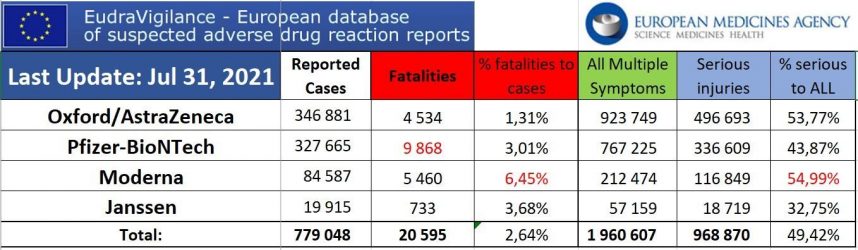
*These totals are estimates based on reports submitted to EudraVigilance. Totals may be much higher based on percentage of adverse reactions that are reported. Some of these reports may also be reported to the individual country’s adverse reaction databases, such as the U.S. VAERS database and the UK Yellow Card system. The fatalities are grouped by symptoms, and some fatalities may have resulted from multiple symptoms.
Russia rejects Dutch court ruling to hand $5 BILLION of taxpayers’ cash to ex-oligarchs over collapse of Yukos
RT | July 29, 2021
Officials in Moscow have vowed to vigorously appeal a judicial ruling in an international arbitration court that would bind Russia to hand over billions of dollars to the former shareholders of the collapsed Yukos energy giant.
The office of the country’s Prosecutor General said on Thursday that it does not acknowledge the validity of the decision, by the International Arbitration Court in The Hague. Authorities said that Russia would “appeal the decision without fail,” questioning both the basis of the judges’ jurisdiction and the claims themselves.
Earlier that day, representatives of the shareholders who lost cash when the former oil and gas conglomerate collapsed claimed victory in legal proceedings that handed them a total of $5 billion in compensation. A separate claim, for a total of $57 billion, is currently being heard by the Supreme Court of the Netherlands.
The ex-shareholders say that the Russian government “expropriated” the assets of Yukos when the firm was bankrupted by a multi-billion dollar tax bill. The private company had been formed after a controversial auction of state assets following the fall of the Soviet Union, and quickly became one of the world’s most valuable companies despite investors picking it up for a fraction of its worth.
The founder of the energy empire, Mikhail Khodorkovsky, later served time in prison on fraud charges, which he claims were a response to his political activity. However, the London-based businessman asserts he has no direct interests in the lawsuit, and the case has been brought by other financiers including influential businessman Leonid Nevzlin.
Russia has insisted that the judgements are “politically motivated,” and in December the country’s Justice Minister, Konstantin Chuychenko, told journalists that the case was part of a “legal war that has been declared on Russia.” He added that “Russia must adequately defend itself and, sometimes, even attack back.”
Moscow denies the charges and says that foreign courts have not considered that national laws around fraud and other wrongdoing might have been broken. However, in December, the Constitutional Court, one of Russia’s highest judicial authorities, ruled that Russia could refuse to pay any settlement imposed by Dutch judges. The basis for the arbitration is the terms of the Energy Charter Treaty, which Moscow signed but never ratified.
In their adjudication, the judges found that while the country’s government of the day began the process of signing up to the pact in 1994, they did not have the authority to make national laws inferior to international agreements, or to “challenge the competence” of Russian courts. Therefore, the jurists conclude, adhering to the Dutch court’s demands would be “unconstitutional.”
There have, however, been a number of attempts to confiscate Russian state assets in case the country refuses to honor any eventual settlement. To date, though, these have ultimately been rapidly overturned by courts. The case is expected to be settled by the Netherlands’ highest court later this year.
Belgium investigates possible manslaughter following deadly floods that killed over 40
RT | July 29, 2021
An investigation into fatal floods has been launched in Belgium’s Wallonia region, the worst hit by the disaster earlier this month. Prosecutors are looking into “involuntary homicide by lack of foresight or precaution.”
An investigative judge has been appointed to identify possible officials who allegedly may be responsible for manslaughter during this month’s deadly floods, a public prosecutor’s office in the city of Liege announced on Wednesday. A prosecutor has already taken note of various public positions relating to the chain of events preceding the floods, adding that those in charge might be responsible for the “lack of foresight or precaution,” according to local media.
The inquiry relates to the severe floods that hit the region in the south of Belgium on July 14. The province of Liege suffered the worst, and 41 deaths have been confirmed in Wallonia in total, with at least two more persons still missing, local media reported this week, citing regional government. At least 202 of 262 municipalities in Wallonia can claim support from the disaster fund, region’s prime minister Elio Di Rupo announced at a press conference earlier this week, saying that “this shows the scale of the disaster.”
Locals have also called for an independent investigation. Residents and businesses in the town of Chaudfontaine in the Liege province have joined forces in a “People against flows” collective, planning to file a complaint against the state, according to local media. They suspect that the mishandling of dams in the region could have possibly led to the disaster, while also blaming officials’ negligence in terms of evacuation orders. At least some damage could have possibly been prevented by lowering water levels at a major dam following bad weather forecasts, specialists have suggested.
The flooding in Belgium has damaged infrastructure, leaving thousands without power and drinking water. In neighboring Germany, dozens were killed in the massive flooding, and the disaster has also hit Switzerland and Austria. Germany’s Chancellor Angela Merkel has said her country will continue to “oppose” the destructive forces of nature, while calling for a tougher climate protection policies.
Vaccinated To Have More Freedoms In Germany
By Richie Allen | July 26, 2021
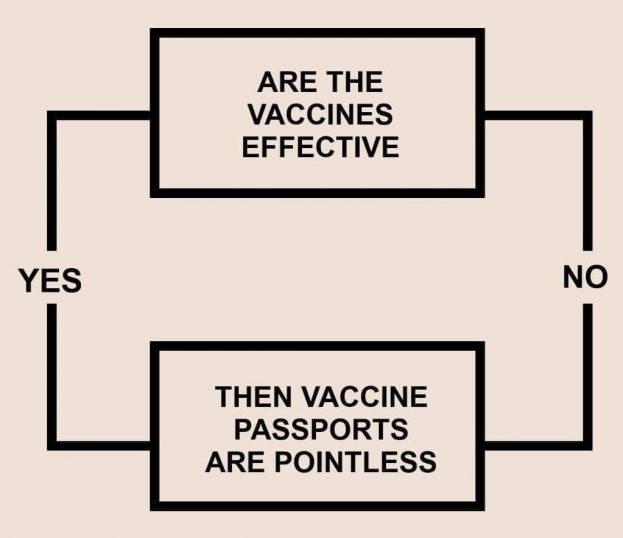
Speaking to Bild newspaper yesterday, Chancellor Angela Merkel’s chief of staff said that the vaccinated “will definitely have more freedoms.” Helge Braun said that if cases continue to rise in Germany, the unvaccinated would be barred from pubs, restaurants theatres and stadiums.
The chief of staff who is also a medical doctor told Bild :
“If we have a high rate of infection despite our testing procedures then the unvaccinated will have to reduce their contacts. Those who have been vaccinated will definitely have more freedom than those who have not been vaccinated.”
Braun went on to say that the unvaccinated wouldn’t even be allowed to take a covid test to gain entry to venues. When asked why, she replied: “The risk to everyone else is too high.”
As to the legality of introducing such discriminatory measures Braun said that, “the state has a duty to protect the health of its citizens.”
Neighbouring France has introduced Covid passes as a condition of entry to restaurants, café’s and supermarkets. From late September, anyone wanting to go to a nightclub or a concert in the UK, will have to prove that they’ve been double jabbed.
The UK government is also expected to say that anyone attending sports venues in the Autumn will also need to prove that they have been jabbed.
And from today, Irish citizens wishing to drink or dine inside a pub or restaurant, must show that they have been jabbed or that they recently produced a negative covid test.
Lockstep anyone?
Why the EU’s Carbon Border Tax will Fail to Stop Carbon Leakage
By Eric Worrall | Watts Up With That? | July 20, 2021
The EU is once again attempting to impose a carbon tax on all imports, to stop “carbon leakage”, the loss of manufacturing or other businesses relocating to lower cost countries. But a few simple economic calculations demonstrate why the EU’s plan will not stop the ongoing haemorrhage of business activity.
Carbon Border Adjustment Mechanism: Questions and Answers
Why is the Commission proposing a Carbon Border Adjustment Mechanism?
The EU is at the forefront of international efforts to fight climate change. The European Green Deal sets out a clear path towards realising the EU’s ambitious target of a 55% reduction in carbon emissions compared to 1990 levels by 2030, and to become a climate-neutral continent by 2050.
The July 2021 package in support of the EU’s climate targets is an integral part of our strategy to achieve this, and will further seal the EU’s reputation as a global climate leader. As part of these efforts, the Carbon Border Adjustment Mechanism (CBAM) is a climate measure that should prevent the risk of carbon leakage and support the EU’s increased ambition on climate mitigation, while ensuring WTO compatibility.
Climate change is a global problem that needs global solutions. As we raise our own climate ambition and less stringent environmental and climate policies prevail in non-EU countries, there is a strong risk of so-called ‘carbon leakage’ – i.e. companies based in the EU could move carbon-intensive production abroad to take advantage of lax standards, or EU products could be replaced by more carbon-intensive imports. Such carbon leakage can shift emissions outside of Europe and therefore seriously undermine EU and global climate efforts. The CBAM will equalise the price of carbon between domestic products and imports and ensure that the EU’s climate objectives are not undermined by production relocating to countries with less ambitious policies.
…
Read more: https://ec.europa.eu/commission/presscorner/detail/en/qanda_21_3661
Why does this tax put an EU producer at a disadvantage?

EU Border Tax – No Sale
Simple – selling to another EU entity is price competitive, so far, but selling outside the EU is impossibly expensive, because you are competing with other sellers who don’t pay EU carbon taxes. An exporter outside the EU has an advantage over a manufacturer inside the EU, even if they have to pay a carbon border adjustment.
What about if the EU tries to level the playing field for EU based exporters, and applies a tax credit to exports? This opens the door to massive global carbon carousel fraud.

EU Carbon Tax Carousel Fraud
Either the EU destroys their own exporters, in an attempt to protect their domestic industry, or they have a big firefight on their hands, trying to contain carbon carousel fraud, which will only get worse any time they try to ratchet up their carbon price.
What about the effect of carbon pricing on businesses inside the EU carbon tax zone?

Classic supply and demand graph, showing the impact on quantity of a tax driven rise in price per unit.
In this case quantity is assumed to be a proxy for economic activity.
Ever visited a shopping centre, and wondered why all the interesting shops are slowly replaced by clothes shops or other high turnover businesses? The reason is all those interesting shops are not profitable enough to pay the rent, and over time they are replaced by simpler, less interesting businesses – safe, boring, profitable, but still a contraction in the diversity of life choices available to consumers.
Pretty much the same thing would happen to domestic high carbon businesses afflicted by EU carbon pricing.
The EU at least in principle likely hopes that revenue from the carbon tax will drop to zero, as people discover low carbon or zero carbon alternatives to the high carbon goods they currently use such as alumina, or simply learn to live without.
But this is a huge gamble. The only reason for carbon leakage in the first place is because the carbon intensive goods targeted by the EU are difficult to replace with low carbon alternatives, and difficult to live without.
If a carbon intensive good is irreplaceable, continued dependency on that high carbon good will be an ongoing anchor dragging on the European economy.
Of course you could make an argument that the benefits the people of the EU receive from reduced CO2 emissions outweigh the costs, that one day our descendants will thank us for giving them the opportunity to experience cold weather. But this does not help consumers and businesses today.
In conclusion, the EU carbon border adjustment will do nothing to prevent carbon leakage. The EU does not control enough of the global economy to make it more than an inconvenience for multinationals. The only people the EU border carbon adjustment will hurt are people living in the EU, who will see their choices and opportunities contract.
Spain’s Top Court Rules That Lockdown Was Unconstitutional
By Paul Joseph Watson | Summit News | July 14, 2021
Spain’s top court has ruled that the country’s national COVID-19 lockdown was unconstitutional following a lawsuit filed by the populist Vox party.
“While leaving intact most of the state of emergency’s terms, the court said that the key articles ordering the population off the streets except for shorts trips for shopping and unavoidable commutes for work and other official business were unconstitutional,” reports the Associated Press.
“According to TVE, the ruling said that the limitations on movement violated citizens´ basic rights and therefore the state of emergency was insufficient to give them constitutional backing. The six magistrates said that a state of exception, which does allow the government to suspend basic rights, would have been necessary.”
During the first six weeks of the lockdown, stay at home measures were so strict that Spaniards weren’t even allowed to go outside to exercise or walk their dogs.
In one case, police were called after a neighbor spotted two brothers playing soccer in their own back yard.
As we previously highlighted, Spain’s lockdown laws were so draconian that at one point authorities briefly told citizens that wearing masks while swimming in the sea was mandatory.
For many months during hot weather, wearing masks in every outdoor setting, even on beaches, was compulsory.
People were also issued fines of €2,000 euros for “disrespecting” a police officer during lockdown.
Numerous instances of police beating people for not wearing masks also emerged, while protesters at one point freed a woman from police arrest while cops were trying to handcuff her for not wearing a face covering.
Early on during the first lockdown, police helicopters fitted with loudspeakers were also used to aggressively order beachgoers to go home.
The Spanish government many now face multiple lawsuits as a result of the lockdown being declared unlawful.
Fit for 55 — EU Green Deal and the Industrial Collapse of Europe
By F. William Engdahl – New Eastern Outlook – 12.07.2021
One of the rare honest statements by Bill Gates was his remark in early 2021 that if you think covid measures are bad, wait until the measures for global warming. The European Union is in the process of imposing, top-down, the most draconian measures to date, that will effectively destroy modern industry across the face of the 27 states of the European Union. Under cute names such as “Fit for 55” and European Green Deal, measures are being finalized in Brussels by unelected technocrats that will cause the worst industrial unemployment and economic collapse since the crisis of the 1930s. Industries such as automobile or transport, power generation and steel are on the chopping block, all for an unproven hypothesis called manmade global warming.
While most EU citizens have been distracted by endless restrictions over a flu-like pandemic called covid19, the technocrats at the EU Commission in Brussels have been preparing a program of planned dis-integration of the EU industrial economy. The convenient aspect of an unelected supranational group far away in Brussels or Strasbourg is that they are not accountable to any real voters. They even have a name for it: Democratic Deficit. If the measures about to be finalized by the EU Commission under German President Ursula von der Leyen and Vice President for Global Warming Dutch technocrat Frans Timmermans, are enacted, here is a hint of what will happen.
“Fit for 55”
On July 14, the EU Commission presents its “Fit for 55” green agenda. While the title sounds more like an ad for a middle-ager health studio, it will be the most draconian and destructive de-industrialization program ever imposed outside of war.
Fit for 55 will be the central framework of new laws and rules from Brussels to reduce CO2 emissions dramatically, using schemes such as carbon taxes, emission caps and cap and trade schemes.
In April 2021 the EU Commission announced a new EU climate target: Emissions to be reduced by 55 percent by 2030 compared to 1990, up from the 40 percent as previously agreed. Hence the cute name “Fit for 55.” But the industry and workforce of the EU states will be anything but fit if the plan is advanced. Simply said, it is technocratic fascism being imposed without public debate on some 455 million EU citizens.
This Fit for 55 is the first time in the world that a group of countries, the EU, officially imposes an agenda to force an absurd “Zero” CO2 by 2050 and 55% less CO2 by 2030. EU Green Deal czar, Commissioner Frans Timmermans said in May, “We will strengthen the EU Emissions Trading System, update the Energy Taxation Directive, and propose new CO2 standards for cars, new energy efficiency standards for buildings, new targets for renewables, and new ways of supporting clean fuels and infrastructure for clean transport.” In reality it will destroy the transport industry, steel, cement as well as coal and gas fuel electric generation.
Here are major parts of the sinister Fit For 55.
Cars and Trucks
A major target of the EU Green Deal will be measures that will force internal combustion engine vehicles– gasoline or diesel cars and trucks—to adhere to such punitive CO2 emission limits that they will be forced off the roads by 2030 if not sooner. The plan will change the current target of a 37.5% reduction in vehicle CO2 emissions by 2030 to a rumored zero emissions by 2035.
On July 7 a coalition of trade unions, transport industry companies and suppliers including the European Trade Union Confederation and the European Automobile Manufacturers Association, wrote an urgent appeal to EU Green Czar Frans Timmermans. They stated, “… we want to see industrial transformation and innovation in Europe, rather than de-industrialisation and social disruption.” The letter pointed out that the EU has no plans for a so-called “Just Transition” for the EU auto industry including no new skills training for displaced workers: “Currently, there is no such framework for the 16 million workers in our mobility eco-system, and notably Europe’s automotive sector which is a powerhouse of industrial employment.”
This is no minor issue as the transition from internal combustion engine cars and trucks to E-autos will mean a huge unprecedented disruption to the present auto supplier chains. The letter points out that EU-wide, the auto sector has 8.5% of all European manufacturing jobs and in 2019 produced nearly 10% of GDP in Germany alone, along with 40% of the country’s research and development spending. The EU today makes up more than 50% of the world’s exports of auto products. They point out that the transition to zero CO2 vehicles will mean a loss of at least 2.4 million skilled, high-wage jobs across the EU. Entire regions will become depressed. The letter points out that Brussels has yet to even map the consequences for the auto sector of the Green Deal.
In April German EU Commission President Ursula von der Leyen indicated Fit for 55 could extend a draconian carbon emissions trading scheme (ETS) from beyond power plants or industry to cover road transport and buildings in a “polluter pays” add on. The tie to the ETS will automatically force financial penalties on drivers or home owners beyond the present carbon taxes despite a very limited impact of some 3% on emissions. This, on top of tighter auto emission standards, will deal a killer blow to consumers and industry. When the French government imposed such a carbon tax in 2018 it triggered the Yellow Vests national protests and forced Paris to withdraw it.
Steel
The drastic EU plan contains new provisions that will mean drastic change for the energy-intensive EU steel and cement industries. Steel is the second biggest industry in the world after oil and gas. Currently the EU is the second largest producer of steel in the world after China. Its output is over 177 million tons of steel a year, or 11% of global output. But the Timmermans plan will introduce new measures that ostensibly penalize steel imports from “dirty” producers, but that in fact will make EU steel less competitive globally. Leaks of the EU plan indicate that they plan to eliminate current free ETS pollution permits for energy-intensive industries such as steel or cement. That will deal a devastating blow to both essential industries. They call it the Carbon Border Adjustment Mechanism. As the Center for European Policy Network points out, EU steel exporters will “not receive any compensation for the discontinuation of the free allocation. As a result, they suffer considerable competitive disadvantages compared to their competitors from third countries.“
Coal Carbon Taxes
The EU’s new 55% climate target for 2030 implies a near-complete coal phase-out by 2030 in the whole EU. This will hit Germany, far the largest EU coal power user. The German government, already with the world’s most expensive electric power owing to the Merkel Energiewende transition to unreliable solar and wind that will see the last nuclear power plant closed in 2022, has just recently dropped its plan to phase out coal by 2038. It will phase out far earlier, but for obvious political reasons in an election year, has not revealed its new “zero coal” date.
The absurdity of believing the EU, especially Germany, will be able to achieve zero coal by 2030, replacing not even with natural gas, but rather unreliable solar and wind, is already clear. On January 1, 2021 as part of the Government mandate on coal power reduction, 11 coal-fired power plants with a total capacity of 4.7 GW were shut down. That phase out lasted eight days as several of the coal power plants had to be reconnected to the grid to avoid blackouts due to a prolonged low-wind period. The shut coal plants were ordered to operate on reserve status at the cost of the consumers. The Berlin government commission that drafted the coal phase-out plan included no power industry representatives nor any power grid experts.
With the new element of the destructive EU Commission Fit for 55 plan, the heart of European industry, Germany, is pre-programmed not only for severe industrial unemployment in steel, cement and auto sectors. It is also pre-programmed for power blackouts such as that that devastated Texas in early 2021 when wind mills froze. In 2022 in Germany, as noted, the last nuclear plant along with other coal power will be closed, removing 3% of the power. An added 6,000 wind turbines also will exit due to age, for a total cut of 7%. Yet planned addition of new wind and solar doesn’t come close to replace that, so that by 2022 Germany could have a shortfall of between 10% and 15% in capacity on the generation side.
WEF Great Reset and EU Green Deal
The hard thing for ordinary sane citizens to grasp with this EU Fit for 55 and the Davos Great Reset or the related UN Agenda 2030 globally, is that it is all a deliberate technocratic plan for dis-integration of the economy, using the fraudulent excuse of an unproven global warming danger that claims– based on dodgy computer models that ignore influence of our sun on Earth climate cycles– that we will see catastrophe by 2030 if the world does not slash harmless and life-essential CO2 emissions.
The ever-active Davos World Economic Forum as part of its Great Reset is also playing a significant role in shaping the EU Commission’s Europe Green Deal. In January 2020, the World Economic Forum at its Annual Meeting in Davos brought together leaders from industry and business with Executive Vice-President Frans Timmermans to explore how to catalyze the European Green Deal. The July 14 unveiling by Brussels is the result. The WEF supports the CEO Action Group for the European Green Deal to get major corporations behind the Brussels dystopian plan.
F. William Engdahl is strategic risk consultant and lecturer, he holds a degree in politics from Princeton University.
Alternative for Germany Party Leader Wants Exit From EU, More Cooperation With Moscow
By Ilya Tsukanov – Sputnik – 12.07.2021
The popularity of the nationalist Alternative for Germany (Alternative fur Deutschland – AfD) party shot up dramatically from a state of virtual obscurity in the mid-2010s as Germans struggled to deal with the migrant crisis of 2015-2016, with the party winning 94 seats and becoming the third largest party in the Bundestag in the 2017 elections.
Germany has no choice but to leave the European Union and to create a “new European space” in which Russia will also have a place, AfD parliamentary group co-chair Tino Chrupalla has said.
“Germany should exit today’s European Union, which simply cannot be reformed, and establish a new European economic and interest group,” Chrupalla said in an interview with Welt published on Sunday.
The politician lamented that Germany’s post-World War 2 national identity and culture had been heavily influenced by the “psychological warfare of the Allies, especially the Americans,” which he compared to the Nazis. As an example of such malign influence, the politician cited Washington’s strategy of trying to torpedo the Nord Stream 2 gas pipeline project between Germany and Russia, suggesting that the US was pursuing “strategic interests” via a “deliberate strategy of disinformation and the manipulation of public opinion” in Germany.
Chrupalla went into greater detail on his party’s vision of a new association of European nations to replace the EU in an op-ed in the Junge Freiheit newspaper, rejecting the concept of an EU “superstate” in favour of a ‘Europe of fatherlands’. The EU, he suggested, had failed utterly in tackling several major emergencies, including the euro crisis, and the migrant and coronavirus crises.
The politician also clarified that instead of the concept of a UK-style ‘Gexit’, AfD’s policy was to support ‘Neustart’, or ‘Reset’ – a “common reset for Europe” which includes an invitation for all AfD’s European sister parties “to join us.”
On the prospect of improved ties with Moscow, Chrupalla emphasized in his op-ed that “a good relationship with Russia is not negotiable,” and that Russia is “an integral part” of Europe economically, politically and culturally.
The politician accused EU elites of “sticking to old Cold War thought patterns” about Russia, and noted that while “communism in Eastern Europe has long been defeated, European opinion leaders were importing new Western ideologies from the US ‘New Left’,” such as identity politics and its promotion of positive discrimination, resulting in social unrest which he stressed “must be overcome.”
“With Russia, a large European state and an important trade partner has been excluded from the European Union. Furthermore, at the insistence of our US partners, we are constantly imposing new trade sanctions on the Russians for new reasons,” Chrupalla wrote.
According to the politician, these restrictions ultimately come back and hit the German economy and medium-sized businesses, causing them to lose out as Russia replaces its imports from Germany with new trade ties with Asia. “Trade between Germany and Russia fell by 25 percent between 2013 and 2019, and in Saxony by 70 percent. It cannot go on like this!” Chrupalla argued.
Ultimately, the politician suggested that both countries would benefit if sanctions are lifted and new ones are ruled out. “Russia is also an integral part of Europe culturally and politically, and Germany always does well when it has good relations with Russia,” Chrupalla stressed.
Chrupalla’s views on foreign policy aren’t representative of the AfD as a whole, with party co-chair Jorg Meuthen recently suggesting that a German exit from the EU is a “poorly thought out idea.” The party is also traditionally in favour of close ties to the US and Israel, and of keeping Germany a member of NATO. Since its emergence as a major political force in the Bundestag following the 2017 elections, the party has experienced an intense internal debate regarding these and other policies.
Germans will go to the polls on 26 September for general elections to the Bundestag and multiple state parliaments. Longtime German Chancellor Angela Merkel is set to retire after the elections. A recent INSA/YouGov poll indicated that Merkel’s Christian Democratic Union/Christian Social Union alliance enjoys a plurality of 28 percent support at the moment, with the Social Democratic Party and the Greens second with 17 percent support each. 12 percent of respondents said they plan to support the Free Democratic Party, 11 percent said they would vote for the AfD, and 8 percent said they plan to give their vote to the democratic socialist Die Linke. Like the AfD, Die Linke supports an improvement in Germany’s relations with Russia. The party also has a firm policy of opposition to NATO and proposes to replace the alliance with a new collective security system for Europe with Russia as a member. Despite their ideological differences, AfD and Die Linke occasionally cooperate on certain issues.
Featured Video

AIDS Inc. by Gary Null (2007)
or go to
Aletho News Archives – Video-Images
From the Archives
Clash of Civilization, Iran Part II
By Jamal Kanj – Intifada-Palestine.com – January 14, 2011
Israel’s survival kit is: perpetuate conflict, insecurity to rationalize collective hate and finally playing victim.
Devoid of conflict, Israel implodes internally; without hate, Zionism loses its justification; and playing eternal victim to continue blackmailing the West. Absence of this holy trinity, Israel ceases to exist.
From its inception, the house of Zion has mastered exploiting adversarial powers to advance Israel’s cause. For instance, their influence over the Democratic Party in the US began with President Truman’s bid for 2nd term election in 1948.
Responding to strong opposition from Secretary of State General George Marshall and Department experts urging against recognition of Israel, President Truman replied: “I’m sorry gentlemen but I have to answer to hundreds of thousands [Jewish voters] who are anxious for the success of Zionism. I do not have hundreds of thousands of [voting] Arabs among my constituents”
Zionists influence over liberal American politics was matched with the doctrinal school of Conservative theoreticians aligning the Republican Party’s platform with Israel’s objectives. The Neoconservative Zionists, coined Zioncons, invented the “Clash of Civilization” concept to fight Israel’s wars. … continue
Blog Roll
 Aletho News
- 12 Things Your Psychiatrist Was Trained Not to Tell You
- From Unipolar Universalism to Multipolar Civilizational Distinctiveness
- RSF military group defects, joins Sudanese army: State media
- Ireland goalkeeper refuses to play ‘Israel’ as squad weighs boycott
- China pushes back against US on Cuba, Iran
- Ukrainian Soldiers, Potential Mercenaries: Have Gun, Will Travel!
- Burnham’s UN debut… A masterclass in British disinformation
- Iran flights continue despite US aviation sanctions
- Global Tipping Points Lead the World Into a State of Entropy
- The day-after at the White House: USA and Xi Jinping
- If Americans Knew
- Israel forces Gazans to live in constant peril – Daily Update
- Deconstructing Netanyahu’s pants-on-fire UN rant – Daily Update
- Trump betrayed voters with his campaign lies and prioritized a foreign country once he took office
- Netanyahu calls Israel’s war in Gaza ‘opposite of genocide’ in UN speech to near-empty hall
- Settler Kidnappings: Torture, Sexual Abuse and Terrorisation of Palestinian Abductees as Israel Deepens Annexation of West Bank
- Gaza winter nears as 162,000 tents become unusable, raising fears of humanitarian crisis
- Netanyahu says, “It’s the opposite of genocide”; UN says Gaza economy is world’s ‘most severe crisis on record’ – Daily Update
- Israel’s US-Backed Assault on Gaza Has Created the ‘World’s Most Severe Economic Crisis on Record’: UN
- ‘Protecting U.S. Citizens’… From Israel
- ‘This is where I live now, the back of a truck’: a day in the life of a grandmother in Gaza
- No Tricks Zone
- New Study: Earth And Venus Surface Warmth Largely Explained By Convection And Lapse Rate, Not CO2 Or Radiation
- 2025 Nature Paper Claiming Worsening Global Drought Gets RETRACTED …Heavily Flawed
- New Study: ‘Global Drought Shows No Detectable Recent Acceleration Under Climate Warming’
- Economic Masterminds: German Socialists Suggest Taxing Productivity Gains Stemming From Using AI
- The South China Sea Has Not Been Cooperating With The Climate Change Narrative
- Energy Crisis: Germany Enters Heating Season With Historically Low Gas Reserve Fill Levels
- New Study: The Antarctic Ice Sheet Gained Mass From 2020-2024 Due To Staggering Snow And Ice Accumulation
- Study: Ocean Heating Rates From Thousands Of Years Ago ‘Dwarf’ Modern Ocean Heating Rates
- Climate Extremists Target, Attack Large-Scale Power Grid Infrastructure In Germany!
- New Study: Antarctic Ice Melt Has Contributed Less Than 1 Centimeter To Sea Level Rise In The Last 30 Years

