Putin: Kiev would rather play the ‘victim’ than work for peace
Reunification with Donbass now nearly a lost cause
RT | July 12, 2021
Russian President Vladimir Putin has blasted Ukraine’s apparent lack of interest in striking a deal to resolve the bloody civil war in the east of the country, saying that Kiev politicians are using it to score political points.
In a lengthy article published on the Kremlin’s website on Monday, Russian President Vladimir Putin said that much of modern Ukraine had been formed out of his country’s historical territories, and at Moscow’s expense. Arguing that the two nations shared deep historical and cultural roots, he said that modern conflicts were derived from the fact that Ukraine was “the brainchild of the Soviet era” and effectively an experiment by “Bolsheviks” who drew its borders.
However, Putin said, the implications of ongoing disputes within the Eastern European nation were catastrophic. “According to the UN High Commissioner for Human Rights, the total number of victims associated with the conflict in Donbass has exceeded 13,000 people,” he said. “Among them are elderly people and children. Terrible, irreparable losses.”
“Russia did everything to stop fratricide,” he went on, arguing that Moscow sees no other way out of the bitter dispute than for Kiev to honor the Minsk Agreements that were intended to provide a roadmap to ending the conflict. However, he said, talks with Ukrainian officials have fallen flat because “they prefer to exploit the image of a ‘victim of external aggression’ and trade in Russophobia.”
Insisting that Kiev is using the conflict to its advantage in dealing with the West, Putin also claimed that “they arrange bloody provocations in the Donbass” and, “in a word, are trying to attract the attention of their external patrons and masters by any means necessary.”
“I am more and more convinced that Kiev simply does not need Donbass,” the president went on. “Why? Because, firstly, the inhabitants of these regions will never accept the rule they are trying to impose by force, blockades and threats.” In addition, he said, the Minsk protocols could be readily implemented but, in his words, “contradict the whole logic of the anti-Russia project” and would undermine “the constant cultivation of the image of an internal and external enemy.”
Fighting between Kiev’s forces and those loyal to the two breakaway self-proclaimed Donbass Republics has escalated in recent months, with a number of civilian casualties reported. A tense standoff between Ukrainian forces and Russian soldiers across the frontier sparked concerns of an all-out conflict earlier this year, until Moscow announced that its units would be redeployed and that readiness exercises had been concluded.
Last month, Putin said that he saw little point in meeting with his Ukrainian counterpart, Volodymyr Zelensky, to discuss the situation in the east of Ukraine given, he alleged, that much of the country’s policies were imposed from abroad.
“Why should I meet Zelensky?” the Russian leader asked. “If he has given up his country to full external control, the key issues about life in Ukraine are resolved not in Kiev but in Washington, and, to some extent, in Berlin and Paris. What then would we talk about?”
‘They Make Unsubstantiated Accusations’: Venezuela Calls UN Report Fallacious
Orinoco Tribune | July 6, 2021
In a communiqué, the Bolivarian Republic of Venezuela rejected the fallacious content and highlighted the biased nature of a report published about the country’s situation by the Office of the United Nations High Commissioner for Human Rights, Michelle Bachelet, on July 1, 2021.
This report is the result of a Resolution promoted by a small group of governments with serious domestic human rights violations, that conspired to satisfy the policy of “regime”-change promoted by the US against Venezuela.
Despite the attacks, Venezuela is distinguished by its harmonious constitutional system that guarantees and defends human rights. The state provides a protective shield for its people against the barbarous criminal blockade imposed and directed from Washington and the European Union, that constitutes a serious crime against humanity.
It is especially worrying that this report is based on information provided by individuals with unknown motivations, and has not been duly verified with the authorities of Venezuela, despite the extensive facilities that the Venezuelan Government has provided for the performance of the OHCHR functions within the country.
On this occasion, based on a handful of alleged complaints of human rights violations, unverified accusations are made against the Venezuelan institutions, further manipulating the false narrative constructed to artificially supplement the file currently before the International Criminal Court, with the political objective of destabilizing the democratic institutions of Venezuela.
In addition to this, the report omits mention of the 26 visits made to detention centers and headquarters of intelligence agencies during which the Office of the High Commissioner has been able to interview hundreds of prisoners, according to its own guidelines of operation. In the Office’s conclusions, delivered to the State, the people interviewed confirmed that their personal integrity was respected during their incarceration.
Venezuela has asked the Office of the High Commissioner to share information with the national authorities on the alleged cases referred to in the report, in order to carry out rigorous investigations and determine their veracity and, if applicable, the corresponding responsibilities, in full consistency with its policy of absolute respect for human rights. Similarly, the Office of the High Commissioner has been invited to accompany the investigation processes developed by local authorities.
The Bolivarian Republic of Venezuela, in order to continue intensifying due cooperation with this office, ratifies its willingness to maintain channels of communication and dialogue with the Office of the United Nations High Commissioner for Human Rights, on the basis of strict adherence to the principles of objectivity, impartiality, non-politicization, respect for sovereignty, commitment to constructive dialogue, and—as required by international law—free from geopolitical agendas at the service of hegemonic powers.
Global Vaccine Passports Have Arrived Courtesy of Google, EU
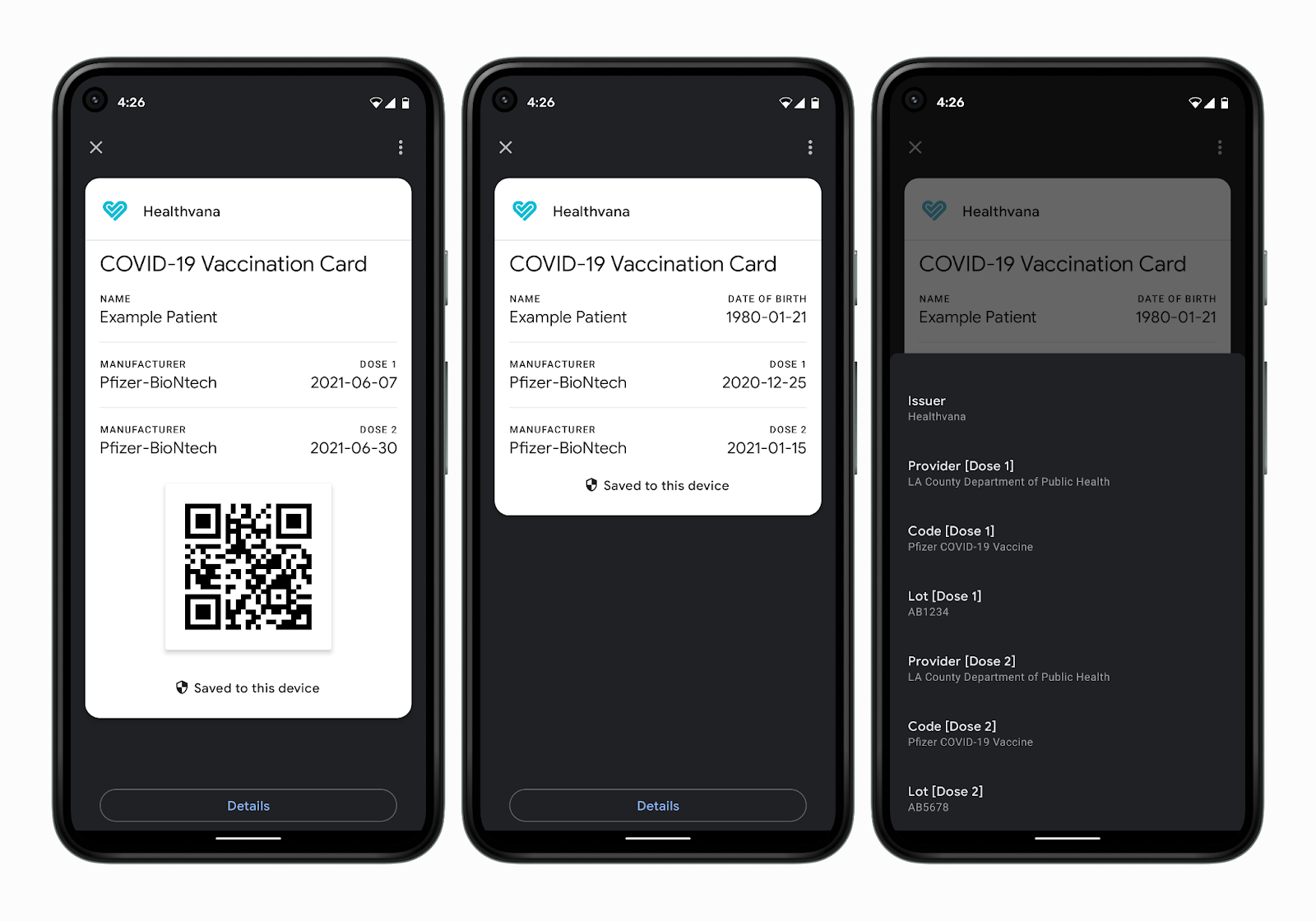
Image Credits: Google
Privacy To Go | July 8, 2021
On June 30th, 2021, the Google Developers blog announced the launch of vaccine passports in Android through its Passes API.
Less than 24 hours later, the European Union, long mired in a sea of national standards for digital jab records, rolled out its EU-wide vaccine passport.
Two completely different vaccine passport schemes unveiled on the same day, encompassing the whole of the Western world? What are the odds!
Exceedingly low, of course. This level of coordination belies yet another blitz in the ongoing rollout of a global, technofeudal control grid. The EU has arguably been at the forefront of this rollout – its standardized digital jab certificate is little more than an aggregator for the draconian technology now operating at the Nation-State level.
Adoption of this unified standard is already approaching 100% of EU Member States. Doublethink rhetoric of restoring the Schengen Area’s “freedom of movement” abounds, even as additional barriers to travel are erected.
In this sense, Google and the US are playing catch-up. While de facto vaccine passports have been implemented sparingly in places like New York, California, and Hawaii, an ever-expanding number of States have banned the notion outright.
Yet herein lies the insidiousness of the public-private partnership model: Technocrats can use governments where it suits them, corporations where it does not, and an increasingly bizarre fusion of the two where necessary. Even the propaganda rollout surrounding jab passports is bifurcated by this model, with the EU using official government bulletins while Google syndicates the news via trendy tech blogs.
And though many States in the US have passed legislation or executive action to curb the implementation of vaccine passports, Google could care less.
Google Passes: Vaccine passports for all, regulation be damned
Like the contact tracing API before it, political resistance alone is proving ineffective against the technological implements of the Great Reset. Even the staunchest State level opponents to this agenda have done nothing to halt the hyperactive Bluetooth surveillance grid running on Android and iOS devices – on the contrary, many have used taxpayer money to help finance its data harvesting operations.
Similar political action against digital vaccine passports will not halt Google’s rollout via the Passes API, either.
In fact, Google’s selection of the Passes API to implement vaccine records is telling in its own right, given the information it already stores: Boarding passes for airlines. Travel tickets. Event tickets.
While legislative action in States like Florida may allow you to attend a Miami Dolphins game with your biological privacy intact, the same may not be said for travel. The battle over Federalization of airline travel was lost on November 19th, 2001 with the creation of the Transportation Security Administration, whose influence has been expanding ever since – the latest privacy affront being the REAL ID Act, which mandates highly insecure RFID technology for interstate air travel.
Even more dangerous are biometric companies with government contracts, like CLEAR, whose terminals are already widely used at TSA PreCheck terminals and event centers.
Google Passes and other digitized jab certificates are simply a competing product. One that is already in the pocket of 85% of Americans alone, with similar adoption levels in Europe.
Products marketed for “convenience” like TSA PreCheck biometrics will, over time, become mandatory – the REAL ID Act itself is a perfect example of this Fabian creep. Passed all the way back in 2005, its full implementation has been pushed back multiple times due to individual State holdouts, most recently until 2023.
But these delays are immaterial – the framework’s existence is all that matters, as despite not being enforced, privacy-violating RFID technologies are now the norm for US driver’s licenses. Jab certificates like Google Passes will be no different. Once in place, they will be utilized – if not immediately, then in the future.
Not only can the Passes API integrate with third-party pharmaceutical companies to track jab history, it is also capable of storing results from dubious PCR tests. This level of biodigital convergence sets an unsettling precedent, as Silicon Valley’s expectation is that your medical history will now be in your pocket at all times, integrated with their servers, and subject to whatever authority may ask for it.
Passes is not an isolated product, either – it’s a development suite within the broader Google Pay SDK.
There are technical reasons why Google may have chosen to use the Pay SDK as opposed to a health-focused API like Google Fit – QR code generation, limited use passes, and encrypted keyrings are already present in the Passes API. However, despite Google Pay’s scant consumer use at present, the long-term intent is crystal clear: Access to financial services and medical records will be intertwined.
In Closing
The post-2020 era has pushed humanity to the precipice of a longstanding dream of our would-be comptrollers. Whether it is Newt Gingrich’s Age of Transitions or the late Zbignew Brzezinski’s Between Two Ages, the kind of biodigital convergence represented by digitized medical passports has been at the forefront of the Technocratic agenda for decades.
As Silicon Valley attempts to bridge the “last mile” of mandated biometric surveillance, resistance to these aims on an individual level remain multivariate – ditch your smartphone, or at least utilize a privacy-respecting alternative that is incompatible with Google or iOS services. Starve the business of travel and entertainment industries that would see us become serfs in exchange for bread and circuses.
If you’re in the EU, use paper records instead of digital equivalents, or better yet, refuse to comply at all.
Educate well-meaning policymakers to the threats represented by the pseudo-private sector and impress upon them that the dangers of State surveillance are rapidly being outpaced by Terms and Conditions mandated by smartphone companies.
Neofeudal Technocracy is desperately trying to extract humanity’s consent to these draconian efforts before the next phase of the so-called Great Reset.
Don’t let them.
America & some of its so-called ‘democratic’ allies have turned ‘liberal-totalitarian’: Russia’s top spy
By Jonny Tickle | RT | June 24, 2021
The US and some other Western nations held up as “models of liberal democracy” are rapidly turning into totalitarian regimes reminiscent of the Soviet Union, the head of Russia’s Foreign Intelligence Service has claimed.
Speaking on Thursday at the Moscow Conference on International Security, Sergey Naryshkin claimed that there are “almost all signs of a totalitarian dictatorship” in some Western countries, including a “monopoly on the media,” the “police nature of the state,” and the “irremovability of oligarchic elites.”
“It is astonishing to see how the West is trying to divide our diverse world into two completely artificial camps – a supposedly democratic one and a supposedly authoritarian one,” Naryshkin said, noting Russia, China, and Iran have been placed into the second camp, along with NATO ally Turkey and, on some issues, EU member state Poland.
“The US and other so-called models of liberal democracy seem not to notice that they themselves are rapidly turning into a liberal-totalitarian regime,” the chief spook said.
According to Naryshkin, the West’s imposition of ideological attitudes is somewhat reminiscent of the history of the late Soviet Union, in that it doesn’t even believe the values it tries to project abroad.
However, the head spy pointed to the US-Russia summit in Switzerland earlier this month as a potential turning point, noting that he hopes the West will be able to use “the spirit of Geneva to try to build a safer and fairer world.”
Naryshkin’s belief that the West is attempting to split the world into ‘democratic’ and ‘authoritarian’ echoes a statement made by Defense Minister Sergey Shoygu at the same conference on Wednesday.
“Today, a new trend is coming to the fore,” Shoygu said. “The formation of global coalitions, the division of the world into ‘friends’ and ‘strangers.’”
EU Database of Adverse Drug Reactions for COVID-19 Shots, June 19, 2021
By Brian Shilhavy | Health Impact News | June 21, 2021
The European database of suspected drug reaction reports is EudraVigilance, which also tracks reports of injuries and deaths following the experimental COVID-19 “vaccines.”
A subscriber from Europe recently emailed us and reminded us that this database maintained at EudraVigilance is only for countries in Europe who are part of the European Union (EU), which comprises 27 countries.
The total number of countries in Europe is much higher, almost twice as many, numbering around 50, although there are some differences of opinions as to which countries are technically part of Europe.
So as high as these numbers are, they do NOT reflect all of Europe. The actual number in Europe who are reported dead or injured due to COVID-19 shots would be much higher than what we are reporting here.
The EudraVigilance database reports that through June 19, 2021 there are 15,472 deaths and 1,509,266 injuries reported following injections of four experimental COVID-19 shots:
- COVID-19 MRNA VACCINE MODERNA (CX-024414)
- COVID-19 MRNA VACCINE PFIZER-BIONTECH
- COVID-19 VACCINE ASTRAZENECA (CHADOX1 NCOV-19)
- COVID-19 VACCINE JANSSEN (AD26.COV2.S)
From the total of injuries recorded, half of them (753,657) are serious injuries.
“Seriousness provides information on the suspected undesirable effect; it can be classified as ‘serious’ if it corresponds to a medical occurrence that results in death, is life-threatening, requires inpatient hospitalisation, results in another medically important condition, or prolongation of existing hospitalisation, results in persistent or significant disability or incapacity, or is a congenital anomaly/birth defect.”
A Health Impact News subscriber in Europe ran the reports for each of the four COVID-19 shots we are including here. This subscriber has volunteered to do this, and it is a lot of work to tabulate each reaction with injuries and fatalities, since there is no place on the EudraVigilance system we have found that tabulates all the results.
Since we have started publishing this, others from Europe have also calculated the numbers and confirmed the totals.*
Here is the summary data through June 19, 2021.
Total reactions for the experimental mRNA vaccineTozinameran (code BNT162b2,Comirnaty) from BioNTech/ Pfizer: 7,420 deaths and 560,256 injuries to 19/06/2021
- 16,133 Blood and lymphatic system disorders incl. 81 deaths
- 12,637 Cardiac disorders incl. 964 deaths
- 101 Congenital, familial and genetic disorders incl. 6 deaths
- 7000 Ear and labyrinth disorders incl. 4 deaths
- 265 Endocrine disorders incl. 1 death
- 8,122 Eye disorders incl. 17 deaths
- 51,030 Gastrointestinal disorders incl. 348 deaths
- 155,486 General disorders and administration site conditions incl. 2,290 deaths
- 468 Hepatobiliary disorders incl. 31 deaths
- 6,110 Immune system disorders incl. 32 deaths
- 17,549 Infections and infestations incl. 762 deaths
- 6,275 Injury, poisoning and procedural complications incl. 104 deaths
- 13,249 Investigations incl. 285 deaths
- 4,162 Metabolism and nutrition disorders incl. 139 deaths
- 79,125 Musculoskeletal and connective tissue disorders incl. 88 deaths
- 325 Neoplasms benign, malignant and unspecified (incl cysts and polyps) incl. 23 deaths
- 100,895 Nervous system disorders incl. 780 deaths
- 384 Pregnancy, puerperium and perinatal conditions incl. 10 deaths
- 107 Product issues
- 9,928 Psychiatric disorders incl. 105 deaths
- 1,765 Renal and urinary disorders incl. 115 deaths
- 2,696 Reproductive system and breast disorders incl. 3 deaths
- 23,689 Respiratory, thoracic and mediastinal disorders incl. 848 deaths
- 26,641 Skin and subcutaneous tissue disorders incl. 66 deaths
- 846 Social circumstances incl. 10 deaths
- 281 Surgical and medical procedures incl. 19 deaths
- 14,987 Vascular disorders incl. 289 deaths
Total reactions for the experimental mRNA vaccine mRNA-1273(CX-024414) from Moderna: 4,147 deaths and 122,643 injuries to 19/06/2021
- 2,239 Blood and lymphatic system disorders incl. 29 deaths
- 3,315 Cardiac disorders incl. 446 deaths
- 39 Congenital, familial and genetic disorders incl. 3 deaths
- 1,454 Ear and labyrinth disorders
- 82 Endocrine disorders incl. 1 death
- 1,883 Eye disorders incl. 7 deaths
- 10,655 Gastrointestinal disorders incl. 142 deaths
- 33,936 General disorders and administration site conditions incl. 1,759 deaths
- 209 Hepatobiliary disorders incl. 11 deaths
- 1,117 Immune system disorders incl. 5 deaths
- 3,835 Infections and infestations incl. 234 deaths
- 2,480 Injury, poisoning and procedural complications incl. 77 deaths
- 2,670 Investigations incl. 89 deaths
- 1,297 Metabolism and nutrition disorders incl. 85 deaths
- 15,131 Musculoskeletal and connective tissue disorders incl. 77 deaths
- 128 Neoplasms benign, malignant and unspecified (incl cysts and polyps) incl. 15 deaths
- 21,684 Nervous system disorders incl. 424 deaths
- 255 Pregnancy, puerperium and perinatal conditions incl. 2 death
- 20 Product issues
- 2,437 Psychiatric disorders incl. 69 deaths
- 807 Renal and urinary disorders incl. 52 deaths
- 459 Reproductive system and breast disorders incl. 1 death
- 5,640 Respiratory, thoracic and mediastinal disorders incl. 399 deaths
- 6,538 Skin and subcutaneous tissue disorders incl. 28 deaths
- 504 Social circumstances incl. 13 deaths
- 397 Surgical and medical procedures incl. 38 deaths
- 3,432 Vascular disorders incl. 141 deaths
Total reactions for the experimental vaccine AZD1222/VAXZEVRIA (CHADOX1 NCOV-19) from Oxford/ AstraZeneca: 3,364 deaths and 793,036 injuries to 19/06/2021
- 9,136 Blood and lymphatic system disorders incl. 132 deaths
- 12,135 Cardiac disorders incl. 396 deaths
- 95 Congenital, familial and genetic disorders incl. 2 deaths
- 8,797 Ear and labyrinth disorders
- 309 Endocrine disorders incl. 2 deaths
- 13,459 Eye disorders incl. 12 deaths
- 81,806 Gastrointestinal disorders incl. 161 deaths
- 212,663 General disorders and administration site conditions incl. 891 deaths
- 525 Hepatobiliary disorders incl. 25 deaths
- 3,085 Immune system disorders incl. 11 deaths
- 17,791 Infections and infestations incl. 217 deaths
- 7,854 Injury, poisoning and procedural complications incl. 77 deaths
- 16,731 Investigations incl. 79 deaths
- 9,765 Metabolism and nutrition disorders incl. 50 deaths
- 123,637 Musculoskeletal and connective tissue disorders incl. 45 deaths
- 332 Neoplasms benign, malignant and unspecified (incl cysts and polyps) incl. 8 deaths
- 169,286 Nervous system disorders incl. 532 deaths
- 223 Pregnancy, puerperium and perinatal conditions incl. 4 deaths
- 103 Product issues
- 14,931 Psychiatric disorders incl. 27 deaths
- 2,809 Renal and urinary disorders incl. 29 deaths
- 5,967 Reproductive system and breast disorders
- 26,631 Respiratory, thoracic and mediastinal disorders incl. 387 deaths
- 36,457 Skin and subcutaneous tissue disorders incl. 22 deaths
- 772 Social circumstances incl. 4 deaths
- 671 Surgical and medical procedures incl. 16 deaths
- 17,066 Vascular disorders incl. 235 deaths
Total reactions for the experimental COVID-19 vaccine JANSSEN (AD26.COV2.S) from Johnson & Johnson: 541 deaths and 33, 331 injuries to 19/06/2021
- 306 Blood and lymphatic system disorders incl. 16 deaths
- 496 Cardiac disorders incl. 56 deaths
- 14 Congenital, familial and genetic disorders
- 177 Ear and labyrinth disorders
- 8 Endocrine disorders incl. 1 death
- 383 Eye disorders incl. 3 deaths
- 3,086 Gastrointestinal disorders incl. 23 deaths
- 8,761 General disorders and administration site conditions incl. 137 deaths
- 52 Hepatobiliary disorders incl. 4 deaths
- 85 Immune system disorders
- 392 Infections and infestations incl. 13 deaths
- 320 Injury, poisoning and procedural complications incl. 8 deaths
- 2,003 Investigations incl. 37 deaths
- 184 Metabolism and nutrition disorders incl. 10 deaths
- 5,718 Musculoskeletal and connective tissue disorders incl. 17 deaths
- 16 Neoplasms benign, malignant and unspecified (incl cysts and polyps)
- 7,093 Nervous system disorders incl. 68 deaths
- 9 Pregnancy, puerperium and perinatal conditions incl. 1 death
- 9 Product issues
- 355 Psychiatric disorders incl. 5 deaths
- 119 Renal and urinary disorders incl. 8 deaths
- 114 Reproductive system and breast disorders
- 1,130 Respiratory, thoracic and mediastinal disorders incl. 43 deaths
- 804 Skin and subcutaneous tissue disorders incl. 2 deaths
- 72 Social circumstances incl. 3 deaths
- 336 Surgical and medical procedures incl. 26 deaths
- 1,289 Vascular disorders incl. 60 deaths
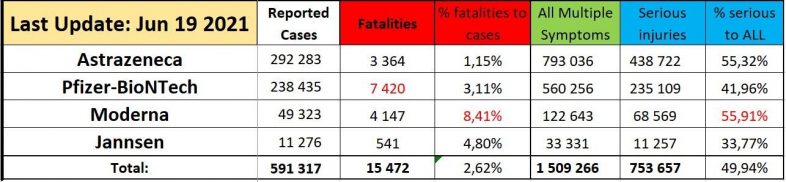
*These totals are estimates based on reports submitted to EudraVigilance. Totals may be much higher based on percentage of adverse reactions that are reported. Some of these reports may also be reported to the individual country’s adverse reaction databases, such as the U.S. VAERS database, and the UK Yellow Card system. The fatalities are grouped by symptoms, and some fatalities may have resulted from multiple symptoms.
The New Irish Soviet: State Bans Seniors from Traveling Until They’ve Had ‘Second Dose’ of AstraZeneca Jab
21st Century Wire | June 15, 2021
Since the crisis began in March 2020, there has been a distinct air of medical fascism which has gradually permeated Irish political rhetoric and policy – which has left many conscientious residents shocked.
This dark state of affairs appears to be coming to a head now, as technocrats in Dublin push the totalitarian envelope even further.
Suddenly, after 15 months of running an open-ended crisis narrative, the great and good are now saying, “Now is certainly not the time to be taking risks on travel,” as the government and media operatives begin ramping-up Project Fear once again.
As usual, the state has singled-out the most vulnerable target demographic upon which to leverage its power, and to mete out some of the most outlandish policies ever seen in the western world over the last 150 years, including policies that would even have been beyond the pale for Stalin’s Soviet Union.
Incredibly, after the Irish government pushed some 400,000 of its older citizens to inject the highly controversial, unlicensed experimental gene-based AstraZeneca jab, the government is now banning them from leaving the country – until they have received their second dose.
Irish Independent reports…
More than 400,000 people who are waiting for a second dose of the AstraZeneca Covid-19 vaccine have been told they cannot travel abroad.
The “vaccine bonus” for those who are a month on from their first AstraZeneca jab does not involve foreign travel, the updated advice from the HSE has warned.
People in their 60s, and a significant number of those with underlying conditions, have been left waiting for a second dose of the vaccine, which will take at least eight weeks, but may be even longer for many.
They can avail of the vaccine “bonus”, with one dose after 28 days, allowing certain limited meeting up with others indoors, but “this does not include foreign travel”.
By definition, this can be classed medical fascism – where state and corporations have codified policy in order to coerce and effectively enforce an experimental medical procedure. On paper, this is in direct violation of the Nuremberg Codes which have been recognised for decades as de facto international law. Moreover, citizens are being denied informed consent, which is also a violation of both Irish and European law and contravenes the human rights charter.
This is an incredibly dangerous move by the state, and while it may be done under the now acceptable auspices of fear and general hysteria – it has still been done with no actual scientific evidence to justify it – only often repeated conjecture and increasingly vague claims used to further underpin the ever-evolving self-licking ice cream cone which is the seemingly never-ending “variant” scare.
Intelligent, sober people can now see that the variant scare has been contrived to justify the government’s omnipresent threat of more lockdowns, restrictions and border closures, and above all: to force vaccine compliance.
Meanwhile, technocrats in Brussels are using these artificial travel obstacles created by member states in order to create an artificial demand for a new Vaccine Passport (or ‘COVID credentials’) regime, which they have recently rebranded as a “Digital Wallet” due to pushback against its previous vaccine “Green Pass”:
The EU Digital Certificate, paving the way for travel within the bloc, is due to be operational here from July 19.
The HSE does not specify the same travel restriction for people who received one dose of the other vaccines.
Moreover, government ministers continue to make assertive claims about the alleged “effectiveness” of these unlicensed experimental injections against the newly branded “variants” which are now being deceptively sold to the public as ‘deadly mutations’ of the previously touted ‘novel’ coronavirus:
Public Health England has previously found that one dose of vaccine gives just 33pc protection against the more infectious Delta variant that originated in India.
It said yesterday that two doses of the Pfizer vaccine give 96pc protection while the AstraZeneca gives 92pc.
It comes amid concern at the inevitable rise in the Delta variant, with around 140 cases detected here so far. Another 242 cases of coronavirus were diagnosed yesterday.
How the UK government could make any such claims about the level of “protection” any COVID vaccine actually provides against the alleged ‘variants’ may be more a feat of political science and propaganda than actual clinical science, because the source of these sweeping claims emanates from the pharmaceutical manufacturers themselves. Does anyone seriously doubt by now that these private interests have captured European governments’ regulatory and political institutions?
Still, Irish ‘science’ experts appear to be confused as to how to play the new variant-vaccine narrative. Luke O’Neill, professor of biochemistry at Trinity College, spoke with the Irish Independent, claims to know how the rebranded ‘Delta variant’ virus behaves, while at the same time admitting that, ‘there doesn’t seem to be a huge amount it around’. He then defers to the UK experts and their own spurious Delta claims, whilst advising hapless Irish citizens who have had one dose of the experimental AstraZeneca injection to ‘take care’. By now, this contortionist feat of ‘public health’ gymnastics has become commonplace:
“We know from the UK that one shot of AstraZeneca is not giving the same level of protection from the Delta variant as two shots, so I would think those who have had one shot of AstraZeneca will have to take some precautions until they’ve had their second shot,” he said.
“We’re lucky in that there doesn’t seem to be a huge amount of the Delta variant around, at least currently. The goal has to be to get the second shot into the vulnerable people – including the over-60s – as quickly as possible.”
Of course there is no mention by any government officials about the fact that this problematic AstraZeneca jab has already been halted in multiple countries (and it hasn’t been allowed to be released in the United States either) due to confirmed risks of maiming or death due to fatal blood clotting – a fact now accepted by experts worldwide. This is now accepted as a clear and present danger for any members of the public taking part in this unprecedented human experiment.
In Europe, health officials have stated that countries should also avoid giving the AstraZeneca vaccines to people over 60, as said by the head of the EU drug regulator’s COVID-19 task force on Sunday. But for some strange reason, no Irish politician or mainstream media outlets want to talk about this serious problem.
All of this comes amid the backdrop of British PM Boris Johnson announcing the delaying of an end to the UK government’s indefinite ‘state of emergency’ and lingering lockdown policies. The government claims this is because of fears of the alleged Indian Variant (recently rebranded to ‘Delta Variant’), while claiming that somehow COVID-19 “cases” (not actual clinical cases, but PCR and lateral flow ‘positive’ tests) are now at a three-month high. Britain was scheduled to lift all remaining restrictions on June 21st, but now says that it needs more time to vaccinate more of its population – as extremist voices in political and media circles continue to blame these alleged new ‘outbreaks’ of COVID-19 on ‘the unvaccinated.’
Based purely on its words and polices, Ireland’s ruling Fine Gael-Fianna Fail regime (from the onset, ‘opposition’ party Sinn Fein has also supported these same draconian policies) now finds itself as the vanguard of a new European Soviet.
Needless to say, this level of medical tyranny and mass-hysteria is unprecedented.
The real question remains: will the public at large and conscientious members of the press and government, come to their senses and wake up before the damage to democracy and freedom becomes irreparable?
Poland wants to end political censorship online
Poland is one of the few countries pushing to support free speech on monopoly platforms
By Dan Frieth | Reclaim the Net | June 10, 2021
According to Poland’s Prime Minister Mateusz Morawiecki, Big Tech corporations have amassed so much power that they control politics, and the solution is for governments around the world to introduce laws limiting that power.
Polish legislators are working on a bill that would make it illegal for online platforms to censor content that does not break Poland’s laws.
“Today, who sets these rules is really the master of destiny for society and for nation-states,” Morawiecki said in a recent interview with Newsweek. “So today, platforms and communication networks and intellectual property are even more important than the land and the buildings and the technology assembly lines and all the materials that go into creating these digital realms.”
The PM argued for a new approach focused on protecting the power of governments, as well as the well-being of society, accounting for the way the internet and social media has transformed the social, political, and economic environment.
“These dynamics do not make it easier to grasp the elements of the moving parts of the complicated interdependent economic jigsaw puzzle that is our modern age,” Morawiecki said.
“And this is why it is so much more difficult to understand who sets the rules today, because it is no longer the governments that can have this competence over the setting of the rules.
“Huge international corporations in the area of the digital world, in particular, are setting the rules very often that are suitable for themselves, which may not always be a social good.
“This is another form of dominance over the rest of the sectors they operate in, but it may also create dominance over other areas of the lives of citizens in a society.
“And this is why states should now be very active in eliminating censorship and eliminating monopolistic powers of those companies, as well. And this is one of the reasons we started to work on this anti-censorship regulation.”
Morawiecki and members of his political party PiS (Law and Justice Party) are pushing for the introduction of a new legislation to push back against Big Tech. They recently proposed a bill that would allow the government to fine social media companies for censoring legal speech in Poland. Additionally, the legislation would allow social media users in Poland to appeal censorship they deem unfair to the Free Speech Council, which will be formed when the bill passes. A social media platform found guilty of removing legal speech could be fined as much as $13.35 million.
In February, Hungary’s Justice Minister Judit Varga said she was working on a new law to “regulate the domestic operations of large tech companies.” She argued that mainstream online platforms “limit the visibility of Christian, conservative, rightwing opinions,” adding that the “power groups behind global tech giants” are so powerful that they can influence national elections.
In February, Poland’s Justice Minister Sebastian Kaleta echoed the conservative Hungarian government’s sentiments, saying the Polish government was focusing on protecting conservatives.
“We see that anonymous social media moderators often censor opinions which do not violate the law but are just criticism of leftists’ agenda,” he told the Financial Times. “This creates important risks of infringing freedom of speech.”
Morawiecki added that the new legislation is being discussed in parliament, and the government is not only looking at domestic legislation but also discussing it with the European Commission (the legislative arm of the European Union).
“We are in discussion with the European Commission in two aspects of this area. One is vis-à-vis the freedom of speech and eliminating the censorship issue,” said the Polish PM.
“The other one is in taxing companies where they do business—so not letting them go to tax havens like Luxembourg or Cyprus or Switzerland, and not paying taxes at all or very little taxes paid in these other tax haven countries, because I think that Big Tech companies minimizing their tax burden this way is not sustainable for our economies.”
EU: Growing online censorship of presumed “violent extremism” of all ideological varieties
StateWatch | June 7, 2021
EU police agency Europol recently undertook its first ever “Referral Action Day against right-wing terrorist online propaganda,” in which officers trawled the internet to file complaints about material that may contravene platforms’ terms of service.
The “Action Day” followed recommendations made by the Council of the EU and was part of a growing move towards EU and national bodies removing “violent extremist” material from the internet.
However, as “violent extremism” is a term for which – unlike terrorism – there is no legal definition, it has an expansive scope that puts much in the eye of the beholder.
Indeed, the Portuguese Council Presidency states (in document 8372/21) that the current EU threat assessment takes into account “all forms of extremism that could lead to a terrorist threat or to violence.”
Alongside “Islamism/Jihadism”, it is taken to include both the far-right (or “violent right-wing extremism”, VRWE) and “violent left-wing and anarchist extremism” (VLWAE), both of which encompass a broad sweep of ideologies and activities.
A specific recommendation stemming from the threat assessment was for Europol to use Joint Action Days to target “violent right-wing extremist and terrorist online content.”
However, this is likely to precede action against other ideologies – the document also suggests that: “Where appropriate, consideration should also be given to other forms of violent extremism, such as left-wing.”
This is not the end of it. A separate note from the Presidency (7896/21) considers that:
“Taking into consideration the latest assessments provided to the TWP [Terrorism Working Party], the growing polarization in society, whether based on ideological extremisms or not, seems to be a trend worldwide that may fuel violent extremism. It is also assessed that mainly, but not exclusively, due to the economic consequences of the COVID-19 pandemic, a new breeding ground for radicalisation has the potential to emerge.”
And:
“Mainly as a consequence of the ongoing COVID-19 pandemic, today’s ideological extremism in the EU is no longer restricted to the “classic” VRWE, VLWE or jihadist extremism. Some recent antisystem COVID-19 denier movements have obvious potential for violence; inspired by conspiracy theories, they challenge governments and restrictive measures put in place, by inciting civil disobedience and unrest. Although extremely difficult to label, they need to be addressed since they pose security challenges to EU Member States.”
Thus:
“Bearing in mind this new reality, it is critical to understand the depth of today’s online threats and the extent to which extremists are using the internet. Therefore, an adequate balance between the improvement of operational capacity and the necessary security requirements on PCVE online activities should be met.”
Documentation
- NOTE from: Presidency to: Delegations: EU Threat Assessment in the field of counterterrorism: recommendations (Council document 8372/21, LIMITE, 3 May 2021, pdf) and a previous version: 7171/21 (pdf)
- NOTE from: Presidency to: Terrorism Working Party (TWP): Countering violent extremism (CVE) in its ideological orientations and dimensions, including online (Council document 7896/21, LIMITE, 23 April 2021, pdf)
- Europol press release, 1st Referral Action Day Against Right-Wing Terrorist Online Propaganda, 28 May 2021 (pdf)
Further reading
Partners Don’t Use Blackmail: Top German Lawmaker Slams US Attempts to Block Nord Stream 2
By Tim Korso – Sputnik – 13.05.2021
Washington has been strongly opposed to the Nord Stream 2, a joint project by Russia’s Gazprom and European energy giants, trying to stop its construction with sanctions. The European beneficiaries of the project have condemned the US meddling in the bloc’s economic and energy affairs.
The Nord Stream 2 pipeline is an economic project beneficial to German interests and thus must be completed in the shortest term possible, parliamentary co-leader of the German party The Left, Dietmar Bartsch has stated. The lawmaker, who is expected to fight for the chancellor’s seat in this year’s election, added that the US must not create obstacles for the project’s completion.
“Washington must not make decisions for Germany and Europe regarding their energy security. Partners do not resort to blackmail and threats in their relations”, Bartsch stressed.
The US has repeatedly objected to the plans of European countries to complete and certify the Nord Stream 2 pipeline, which was designed to deliver up to 55 million cubic metres of Russian natural gas per year. Washington claims the pipeline undermines European energy security, making it dependent upon Moscow, and suggests buying American or Israeli LNG instead. The White House also expressed concern that Nord Stream 2 will deprive Ukraine of lucrative contracts on the transit of Russian gas through its territory. The latter has been disrupted by Kiev multiple times in the past.
EU powers, especially Germany, have defended the project, insisting that the continent’s energy supplies are sufficiently diversified. German politicians and lawmakers regularly denounce the sanctions Washington has put in place in order to force European countries to abandon the pipeline. Russia, for its part, has assured the West that gas transit through Ukraine will continue as long as it remains economically viable.
The Nord Stream 2 is now in the final stages of construction despite the US countermeasures. Around 5% of the pipe remains to be built according to statements by the operating company. The question, however, remains whether any European entity will agree to certify the pipeline once it’s complete to allow it to turn on the taps, as they would risk falling under American sanctions by doing so.
Halt Vaccine Passports! It’s illegal, medical apartheid
By Dr Mike Yeadon | OffGuardian | May 7, 2021
It is very important that people understand what is happening here. The intention is to introduce vaccine passports everywhere. But this is a disguise. It’s a world’s first digital common-format, globally-interoperable ID system with an editable health flag (vaccinated Y or N).
It makes no one safer. If you’re vaccinated, you’re protected & are not made safer by knowing others immune status.
As in Israel, you will be compelled to present a valid VaxPass in order to access defined facilities or access services. No VaxPass, you’re denied.
This system only needs 50%+ of the adult population to start up because of its huge, coercive power on the unvaccinated.
It’s illegal, medical apartheid.
If they succeed, it won’t help you to refuse. They’ll move on, leaving that minority behind.
A VaxPass System like this will give to those controlling the database & it’s algorithms TOTALITARIAN TYRANNY over us all.
The ONLY way to stop this biosecurity nightmare is to NOT GET VACCINATED FOR NON-MEDICAL REASONS!!!
I fear that, if our adversaries gain this absolute control, they will use it to harm the population. There’s no limit to the evil which will flow from this strategic goal.
DO NOT ALLOW THIS SYSTEM TO START UP, because it’s unstoppable afterwards.
One example: your VaxPass pings, instructing you to attend for your 3rd or 4th or 5th booster or variant vaccine. If you don’t, your VaxPass will expire & you’ll become an out-person, unable to access your own life.
How much choice do you have?
It’s none. You are controlled. Forever.
PLEASE share this widely, on every platform you use.
Thank you,
Dr Mike Yeadon
Featured Video

AIDS Inc. by Gary Null (2007)
or go to
Aletho News Archives – Video-Images
From the Archives
Clash of Civilization, Iran Part II
By Jamal Kanj – Intifada-Palestine.com – January 14, 2011
Israel’s survival kit is: perpetuate conflict, insecurity to rationalize collective hate and finally playing victim.
Devoid of conflict, Israel implodes internally; without hate, Zionism loses its justification; and playing eternal victim to continue blackmailing the West. Absence of this holy trinity, Israel ceases to exist.
From its inception, the house of Zion has mastered exploiting adversarial powers to advance Israel’s cause. For instance, their influence over the Democratic Party in the US began with President Truman’s bid for 2nd term election in 1948.
Responding to strong opposition from Secretary of State General George Marshall and Department experts urging against recognition of Israel, President Truman replied: “I’m sorry gentlemen but I have to answer to hundreds of thousands [Jewish voters] who are anxious for the success of Zionism. I do not have hundreds of thousands of [voting] Arabs among my constituents”
Zionists influence over liberal American politics was matched with the doctrinal school of Conservative theoreticians aligning the Republican Party’s platform with Israel’s objectives. The Neoconservative Zionists, coined Zioncons, invented the “Clash of Civilization” concept to fight Israel’s wars. … continue
Blog Roll
 Aletho News
- 12 Things Your Psychiatrist Was Trained Not to Tell You
- From Unipolar Universalism to Multipolar Civilizational Distinctiveness
- RSF military group defects, joins Sudanese army: State media
- Ireland goalkeeper refuses to play ‘Israel’ as squad weighs boycott
- China pushes back against US on Cuba, Iran
- Ukrainian Soldiers, Potential Mercenaries: Have Gun, Will Travel!
- Burnham’s UN debut… A masterclass in British disinformation
- Iran flights continue despite US aviation sanctions
- Global Tipping Points Lead the World Into a State of Entropy
- The day-after at the White House: USA and Xi Jinping
- If Americans Knew
- Israel forces Gazans to live in constant peril – Daily Update
- Deconstructing Netanyahu’s pants-on-fire UN rant – Daily Update
- Trump betrayed voters with his campaign lies and prioritized a foreign country once he took office
- Netanyahu calls Israel’s war in Gaza ‘opposite of genocide’ in UN speech to near-empty hall
- Settler Kidnappings: Torture, Sexual Abuse and Terrorisation of Palestinian Abductees as Israel Deepens Annexation of West Bank
- Gaza winter nears as 162,000 tents become unusable, raising fears of humanitarian crisis
- Netanyahu says, “It’s the opposite of genocide”; UN says Gaza economy is world’s ‘most severe crisis on record’ – Daily Update
- Israel’s US-Backed Assault on Gaza Has Created the ‘World’s Most Severe Economic Crisis on Record’: UN
- ‘Protecting U.S. Citizens’… From Israel
- ‘This is where I live now, the back of a truck’: a day in the life of a grandmother in Gaza
- No Tricks Zone
- New Study: Earth And Venus Surface Warmth Largely Explained By Convection And Lapse Rate, Not CO2 Or Radiation
- 2025 Nature Paper Claiming Worsening Global Drought Gets RETRACTED …Heavily Flawed
- New Study: ‘Global Drought Shows No Detectable Recent Acceleration Under Climate Warming’
- Economic Masterminds: German Socialists Suggest Taxing Productivity Gains Stemming From Using AI
- The South China Sea Has Not Been Cooperating With The Climate Change Narrative
- Energy Crisis: Germany Enters Heating Season With Historically Low Gas Reserve Fill Levels
- New Study: The Antarctic Ice Sheet Gained Mass From 2020-2024 Due To Staggering Snow And Ice Accumulation
- Study: Ocean Heating Rates From Thousands Of Years Ago ‘Dwarf’ Modern Ocean Heating Rates
- Climate Extremists Target, Attack Large-Scale Power Grid Infrastructure In Germany!
- New Study: Antarctic Ice Melt Has Contributed Less Than 1 Centimeter To Sea Level Rise In The Last 30 Years

