Europe’s heavy industry unlikely to survive Net Zero
GWPF – 30/04/21
It is becoming ever more evident that much of Europe’s heavy industry is unlikely to survive the EU’s unilateral Net Zero policy.
The EU’s carbon price reached a new record high of 45 euros ($54) a tonne on Tuesday.
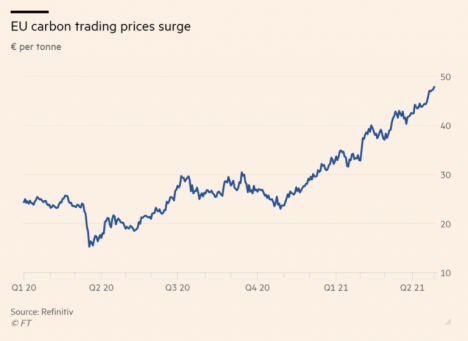
As the carbon price is expected to increase much further in the next few years, European industrial groups are desperately calling for the introduction of a carbon border tax, hoping that it will save them from international competitors that are able to produce much cheaper.
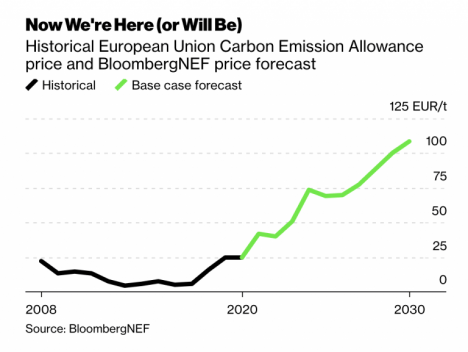
Even higher carbon prices are coming. BloombergNEF expects carbon prices to hit 100 euros by 2030.
They warn that rising energy and carbon costs will force energy-intensive manufacturing to shut down and relocate to countries with less stringent CO2 targets if the EU does not introduce protectionist carbon protection.
It is rather doubtful, however, whether the EU can afford to introduce a carbon border tax, knowing full well that China, India and much of the rest of the emerging and developing world would simply retaliate in return, threatening to tax European products out of Asian and African markets altogether.
European and American politicians should be reminded that we have been warning for years about this inevitable outcome of unilateral climate policies.
There is no scientific foundation to the concept of Vaccine Passports: Doctors for Covid Ethics
By Oliver May • THE DAILY EXPOSE • April 29, 2021
Doctors for Covid Ethics, a group of doctors across Europe and North America, say studies on Covid-19’s closest-related virus to infect humans, SARS, revealed that those who had acquired natural immunity in 2003 remain protected even now. They also maintain that, even before the onset of vaccination campaigns, most people had become immune to Covid-19, either through infection with the virus itself, often without symptoms or with only mild, uncharacteristic ones, or due to cross-immunity conferred by other, naturally occurring coronaviruses.
But under an Article of Law Decree just published by the European Union, its proposed Digital Green Pass will have validity for just six months. Once this expires the holder would need to be re-vaccinated or have had Covid in the last six months or take a test every 48 hours in order to regain their freedoms.
Doctors for Covid Ethics argue there is no rational case for such a pass, which is currently being used in Israel and proposed in the UK, adding that immunity from infection is likely to be durable and unaffected by variants.
Doctors for Covid Ethics said: “There is no scientific foundation to the concept of vaccine passports and no rational case at all for vaccine passports. To set a six-month cut-off is bizarre and arbitrary. Examining the time course of antibodies in blood samples is not a valid approach to the question of, ‘how long does immunity last?’.
“This is because antibodies aren’t the most important host defence mechanism in immunity to viruses. That’s considered to be T-cell memory (cytotoxic as well as ‘helper’ lymphocytes) and B-memory (antibody producing) cells. Antibodies naturally fall over time if you’re no longer constantly rechallenged with the infective pathogen. As community prevalence falls away, this re-exposure to the virus also diminishes.
“When durability of immunity to the closest known virus, SARS, was studied, those who had acquired immunity naturally, through infection in 2003, all retained immunity 17 years later. There is speculation that ‘variants’ of SARS-CoV-2 might ‘break through’ the immunity gained through natural infection or vaccination. There is absolutely no evidence for this at all.
“In fact, there is very strong evidence to the contrary – that no variant is sufficiently different from the original virus that it’s even possible for ‘immune escape’ to occur. Several groups of immunologists have shown convincingly that people immune to one variant have T-cells which recognise all the other variants tested. This isn’t a surprise, for no variant differs from the original sequence by more than 0.3 per cent.
“In fact, those who had retained immunity to SARS also possessed cross-immunity to SARS-CoV-2. These two viruses differ by approximately 20 per cent. Obviously, if our immune systems easily recognise two viruses which share 80 per cent similarity, it follows that differences of 0.3 per cent are completely irrelevant, from an immunological perspective.”
The group went on to add that focusing on antibodies in the context of vaccination against SARS-CoV-2 is “flawed” and so coercing people into so-called booster vaccines in order to regain their freedoms withdrawn by Governments is wholly inappropriate.
“The whole concept of antibody-based immunity against an air-borne pathogen is flawed because the antibodies are on the wrong side of the wall and cannot intercept viral entry into the respiratory tract epithelium,” added the group.
“Secreted IgA antibodies play no significant role either: selective IgA deficiency does not enhance susceptibility towards coronavirus infections.”
The group also highlights that vaccine companies have been exempt from legal liability for vaccine-induced harm, adding that, for the vast majority of people, SARS-CoV-2 is a non-lethal, typically mild to moderately severe illness. They said: “The overwhelming majority of people are not at risk from COVID-19 and do not require vaccination for their own protection.
“The vaccines have been touted as a means to prevent asymptomatic infection and, by extension, asymptomatic transmission. However, “asymptomatic transmission” is an artefact of invalid and unreliable PCR test procedures and interpretations, leading to high false-positive rates. Evidence indicates that PCR-positive, asymptomatic people are healthy false-positives, not carriers. A comprehensive study of 9,899,828 people in China found that asymptomatic individuals testing positive for COVID-19 never infected others.
“In contrast, the papers cited by the Centre for Disease Control to justify claims of asymptomatic transmission are based on hypothetical models, not empirical studies; they present assumptions and estimates rather than evidence. Preventing asymptomatic infection is not a viable rationale for promoting vaccination of the general population.”
They have written to MEP’s, putting them on notice that liability for adverse reactions to the vaccines will fall on them, should they vote for the Digital Green Pass, which was debated on Wednesday.
And last week, Doctors for Covid Ethics wrote their third letter to the European Medicines Agency, warning executive director Emer Cooke that cerebral venous sinus thrombosis (CVST) dominates the list of adverse reactions from the vaccines and is not as rare as the EMA suggests.
Europe can’t soft-pedal a sanitary techno-dictatorship while claiming to protect people from abuse by AI
By Rachel Marsden | RT | April 23, 2021
Europe can’t soft-pedal a sanitary techno-dictatorship while claiming to protect people from abuse by AI. Pick a lane, hypocrites.
The EU is proposing to regulate AI and facial recognition in the interest of privacy, while pushing ahead with an intrusive scheme that would strongarm citizens into disclosing private medical data through digital certificates.
This week, when logging into the French government’s TousAntiCovid smartphone application – a one-stop shop for everything Covid-19 related, including the latest statistics, news and self-certification forms to be out and about after the 7pm curfew – French citizens discovered a new feature had been quietly added: “My wallet: Your test certificates will be available here,” it reads.
The addition is detailed in the app as an “experiment in progress, only on some flights to Corsica” via Air France and Air Corsica – both of which are controlled in part by the French government through a 29% stake in Air France-KLM, making the state the company’s single largest shareholder.
“To digitize your test certificates and always have them at hand, it’s simple: once the result of your test is available, you will receive a text message with a link and instructions to follow,” according to the new feature. A button below the message can be clicked to activate the user’s camera and scan the QR code of a Covid-19 PCR test.
In an interview earlier this month with CBS News, French President Emmanuel Macron said that “we are building a European certificate to facilitate the travels after these restrictions between the different European countries with testing and vaccination. And the idea indeed is altogether to offer that to the American citizen when they decided to vaccinate or with a PCR test being negative.”
The royal ‘we’ is a reference to the European Union, which has also claimed to be working on a bloc-wide certificate. Hypocritical EU officials also introduced a proposal this week to regulate facial recognition and other artificial intelligence, lest any such technology risk violating personal privacy – kind of like the EU is working on doing with its scheme to have people disclose private medical information to anyone demanding it, under the guise of sanitary nanny statism.
The beta test that has just creeped up on the French government’s anti-Covid app for use on the airline it controls is a little toe dipped into the water of a potentially massive, privacy-breaching tsunami.
At what point do people start to rebel, to send the government the message that state intrusion into the most intimate aspects of their personal life – in this case their medical history – has gone too far? When the government asks for vaccination and antibody certificates to be uploaded? When it expands the program beyond use by Air France to other airlines? When it goes beyond air travel to everyday venues? When a hacker breaches the system and accesses sensitive information? When health insurers start demanding QR codes to Covid-19 related testing in order to reassess the cost of people’s premiums?
French people are known for taking to the streets at the slightest provocation. The now defunct Yellow Vest movement, a casualty of Covid-19 era mass gathering bans, initially ignited over a mere gas tax increase. The creeping sanitary authoritarianism evidenced by the recent Covid app update isn’t as alarming to people as a gas tax because it’s being soft-pedalled, introduced too incrementally to provoke a backlash. No one really cares right now if you need a negative PCR test scanned into your phone to board a plane to Corsica, except the relatively few people going there. And that’s not enough to raise a ruckus.
But the government is deliberately calling it an ‘experiment in progress’ for a reason. It obviously isn’t going to end there. Macron said as much to CBS News. He’s also creating a false dichotomy. Macron is suggesting that the certificates – which he has previously said would be optional (unless you want to leave the house, I guess) – would allow the virus to be controlled, while lifting domestic restrictions and allowing international tourism to resume. The alternative is to be forced to maintain restrictions.
But look, the restrictions will end when we, the people, say they will. And far too many citizens have yet to wake up to that fact.
The insecurity of governments regarding their capacity to contend with a virus, or terrorism, or any other perceived threat, isn’t our personal problem. And it certainly shouldn’t be a reason to invade people’s private lives without a court ordered warrant.
Demanding that everyone provide a Covid test as proof of sanitary ‘innocence’ is radically dystopian. If people want to be vaccinated, that’s their choice. If they don’t, then that’s their choice, too. They may choose to take their chances on catching Covid, and developing natural immunity.
The schizophrenic EU and its member states, like France, which constantly claim that personal privacy is a non-negotiable core value, need to pick a lane. Is Europe going to be a technology-enabled sanitary dictatorship? Or are you going to protect us from creeping fascism? Pick one. Because you can’t have both.
Rachel Marsden is a columnist, political strategist and host of an independently produced French-language program that airs on Sputnik France. Her website can be found at rachelmarsden.com
Kremlin Reveals Details About Putin-Biden Phone Call
By Ilya Tsukanov – Sputnik – 14.04.2021
Russian President Vladimir Putin and his US counterpart Joe Biden held a telephone conversation on Tuesday. According to the White House account of the discussion, issues raised included strategic stability, Russia’s alleged ‘cyber intrusions’ and election meddling, and America’s “unwavering commitment” to Ukraine. A summit meeting was proposed.
Tuesday’s phone call between Presidents Putin and Biden was “businesslike” and of considerable duration, Kremlin spokesman Dmitry Peskov indicated.
Speaking to reporters on Wednesday, Peskov said the two men had agreed that the possibility of their meeting would be discussed through diplomatic channels. Moscow, he said, is only now starting to receive information about organisational and other aspects related to a possible summit.
“Before now there was simply a dearth of information about how it would take place, in what order, who would speak, who would chair it, what the outcome is expected to be, whether a final document would be issued, etc. We are just starting to get answers to all these questions; we are still studying them,” the presidential spokesman said. He added that it was “too early” to discuss the proposed meeting’s possible place and time.
Earlier Wednesday, Finnish media reported that Finland had offered to facilitate the meeting of the Russian and US presidents, and that Austria and Iceland had similarly offered their diplomatic services.
Commenting on the escalation of Russia-US tensions surrounding Ukraine, Peskov stressed that a de-escalation of the situation in the civil war-torn Eastern European nation would only be possible if the Ukrainian army indicated that it wouldn’t engage in any provocative behaviour.
“We consider the ‘expression of any concerns’ from any side, including the United States, in connection with the movements of Russia’s armed forces inside Russia, to be groundless. On the territory of Ukraine, de-escalation can only occur if the Ukrainian armed forces reject provocative actions,” he said.
Earlier, the White House readout of Tuesday’s telephone conversation between Putin and Biden said that the US president had “voiced” Washington’s “concerns over the sudden Russian military buildup in occupied Crimea and on Ukraine’s borders, and called on Russia to de-escalate tensions”.
Recent weeks have seen a major deterioration of the security situation in eastern Ukraine, with officials from the breakaway Donbass republics accusing Kiev of preparing for a new military offensive. Moscow has urged both sides to stick to the terms of the Minsk ceasefire. Washington, its NATO allies and Kiev have instead accused Russia of “aggression”.
In his remarks Wednesday, Peskov also indicated that he would not comment on whether the Russian side would ask Biden to apologise over last month’s remarks, in which he agreed with a journalist’s characterisation of the Russian president as a “killer” and threatened to make him “pay a price” over alleged meddling in America’s elections.
“I will leave this issue without comment,” the spokesman said.
Finally, asked to comment on whether Alexei Navalny, the Russian opposition vlogger whom the US and its allies accused Moscow of poisoning, was brought up in the Putin-Biden telephone talks, Peskov said his name was not mentioned.
The United States and the European Union slapped Russia with new sanctions last month over the Navalny case. The opposition vlogger and anti-corruption activist collapsed on a domestic flight in Siberia last August, and was rushed for emergency treatment in the Siberian city of Omsk. At the request of his family, he was then transferred out of the country for further treatment at a hospital in Germany. German authorities then claimed that doctors had found traces of a deadly nerve agent in his system, going on to accuse the Kremlin of poisoning him. Moscow denied the allegations, saying no toxic substances had been found in his system at the time of his treatment in Russia. Washington sought to use the Navalny situation to poison Russian-European relations, and called on Western European nations to cancel construction of the Nord Stream 2 gas pipeline. Navalny returned to Russia in January and was jailed over multiple breaches of his probation in a 2014 fraud case.
Mandatory vaccines are ‘necessary in democratic society,’ don’t infringe human rights, EU court rules
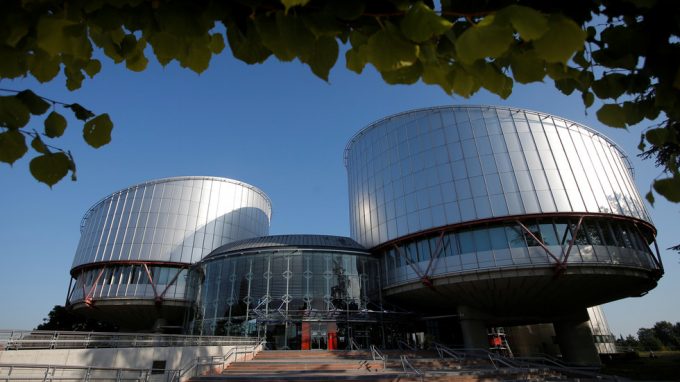
European Court of Human Rights, in Strasbourg, France. (FILE PHOTO) © Reuters / Vincent Kessler
RT | April 8, 2021
Making children get jabs for common diseases is ‘necessary in democratic society’ and is in their best interests, the European Court for Human Rights (ECHR) ruled on Thursday in a landmark decision against anti-vaxxers.
It’s the first time the ECHR has ruled on mandatory vaccinations for children against common diseases. While the case dealt with the Czech Republic’s laws that require schoolchildren to have jabs against diseases like whooping cough, tetanus and measles, it has implications when it comes to compulsory Covid jabs.
Nicolas Hervieu, a legal expert specializing in the ECHR, said the ruling reinforces the possibility of compulsory vaccination under the current coronavirus pandemic conditions.
A panel of judges ruled 16-1 that the Czech health policy that prevented unvaccinated children from attending nurseries or schools was consistent with “the best interests” of children.
“The… measures could be regarded as being ‘necessary in a democratic society,” the court ruled.
“The objective has to be that every child is protected against serious diseases, through vaccination or by virtue of herd immunity.”
The judges dismissed the appeal brought by six Czech nationals who were fined for failing to comply with mandatory vaccination rules or whose children were denied admission to nursery school for the same reason. The parents had claimed that the mandatory jab rules violated their human rights.
“The objective had to be to protect every child against serious diseases,” the court ruled.
It said that the need for compulsory vaccination in the Czech Republic represented the national authorities’ answer to the pressing social need to protect individual and public health against diseases and “to guard against any downward trend in the rate of vaccination among children.”
The court said that while mandatory vaccinations raised sensitive issues, the value of social solidarity to protect the health of all members of society, particularly those who were especially vulnerable, required everyone to assume a minimum risk by having jabs.
There was no immediate reaction from the six who appealed the case to the ECHR.
Russian senator slams Europe’s silence on Donbass attack as green light to Kiev
Press TV – April 5, 2021
Deputy speaker of Russia’s upper house Federation Council has slammed European silence over a recent attack by Ukrainian forces on a Russian-speaking eastern area as a green light for a renewed military operation in the pro-independence region.
Kiev will interpret Europe’s silent position “as carte blanche for a military operation in Donbass and restoring territorial integrity by force,” said Konstantin Kosachev on Sunday, reacting to a joint statement by German and French foreign ministers on the Donbass attack, Russia’s official TASS news agency reported.
Top French diplomat Jean-Yves Le Drian and his German counterpart, Heiko Maas, have expressed concerns over the deteriorating situation on the contact line in Donbass but then voiced support for Kiev’s sovereignty and territorial integrity. The joint statement issued on Sunday further said the two countries were carefully monitoring the situation, particularly Russian troop movements in the region, while urging restraint and abrupt defusing of tensions.
The Russian senator, however, reminded the two European diplomats that a child was killed by a Ukrainian drone strike on Saturday in the self-proclaimed Donetsk People’s Republic (DPR).
“Yesterday, for the first time since July 2020 a Ukrainian shelling of the DPR was conducted and a six-year-old child died, but there is no word about this” in the European statement, Kosachev said. Instead, he noted, the West accused Russia of troop movements.
“Russia says there must be no force, but only a direct dialogue between the conflicting states. The statement of the two ministers does not include this, and in this sense, it has no added value and only adds fuel to the flame of the conflict,” he added.
The development came as Moscow on Sunday urged the European Union to demand an explanation from Kiev following the drone attack on Donbass, amid an escalation of armed clashes between the pro-Russian forces and Ukrainian troops in the restive region.
Russian State Duma Speaker Vyacheslav Volodin also called on the Parliamentary Assemblies of the Council of Europe (PACE) and the Organization for Security and Cooperation in Europe (OSCE PA) to demand an explanation from Kiev about the incident.
Also on Sunday, Ukrainian President Vladimir Zelensky enforced sanctions against Russian humanitarian cooperation agency, Volga Dnepr Co as well as 77 more companies.
Reacting to the news, Volodin said, “We will discuss with the Russian foreign ministry’s and the agency’s senior officials measures that are to be taken in this situation in order not to leave our compatriots and Ukrainian nationals who want to preserve relations with Russia without support.”
Ukraine’s sanctions are an “example of defiance of international law and common sense,” Volodin wrote on his Telegram channel, adding, “Ukraine is seeking to mock its patrons as much as it can. Sanctions against a state institution – Rossotrudnichestvo, with its mission of developing international humanitarian cooperation – constitute an unprecedented case.”
Meanwhile, the EU vowed its “unwavering” support for the Western-backed Ukrainian government on Sunday, with its foreign policy chief, Josep Borrell, voicing major worries about what he called Russian troop movements.
“Following with severe concern the Russian military activity surrounding Ukraine,” Borrell wrote online after a phone call with Ukrainian Foreign Minister Dmytro Kuleba. “Unwavering EU support for Ukraine’s sovereignty and territorial integrity.”
Borrell said he would hold further talks on the issue with Kiev’s top diplomat and foreign ministers from the EU’s 27 nations at a meeting later this month.
Other Western leaders, including US President Joe Biden, have also stated that they are standing by Ukraine, which has blamed Russia for amassing thousands of troops on its northern and eastern borders.
While Moscow has not denied the troop movements amid the increasing military activities near its borders by the US-led NATO alliance, it has insisted that the move was “not threatening anyone.”
Donbass has been the scene of a conflict between Ukrainian troops and pro-Russian forces since 2014. It has so far claimed more than 13,000 lives, according to the UN.
The armed confrontations began when a wave of protests in Ukraine overthrew a democratically-elected pro-Russia government and replaced it with a pro-West administration. The majority in those areas refused to endorse the new administration.
That new government then began a crackdown on the mainly ethnic Russians in the east, who in turn took up arms and turned the two regions of Donetsk and Lugansk — collectively known as the Donbass — into self-proclaimed republics.
[“Sustainable”] Uranium Prices Poised To Rally
Oilprice.com | April 3, 2021
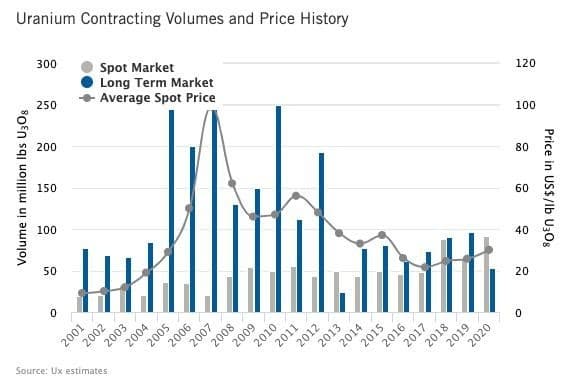
The uranium market is emerging from years in the doldrums as the overhang from the nuclear disaster in Japan is cleared and global demand picks up steam.
The spot price for U3O8 moved above $30 per pound for the first time this year as uranium producers and mine developers hoover up above-ground inventories and reactor construction continues apace.
Two new research notes from BMO Capital Markets and Morgan Stanley say today’s price marks a floor and predict a rally in prices over the next few years to the ~$50 level by 2024.
The stars seem to be aligning for a new phase of nuclear energy investment with the US, China and Europe bolstering the bull case for the fuel this month.
Although nuclear energy was not mentioned explicitly in the $2 trillion Biden infrastructure proposal released today, its federally mandated “energy efficiency and clean electricity standard” is hardly achievable without it.
Source: Cameco
Over the weekend leaked documents showed a panel of experts advising the EU is set to designate nuclear as a sustainable source of electricity which opens the door for new investment under the continent’s ambitious green energy program.
China’s 14th five-year plan released a fortnight ago also buoyed the uranium market with Beijing planning to up the country’s nuclear energy capacity by 46% – from 48GW in 2020 to 70GW by 2025.
There are several factors working in uranium’s favour, not least the fact that annual uranium demand is now above the level that existed before the 2011 Fukushima disaster when Japan shut off all its reactors:
- Uranium miners, developers and investment funds like Yellow Cake (13m lbs inventory build up so far) are buying material on the spot market bringing to more normal levels government and utility inventories built up over the last decade
- Major mines are idled including Cameco’s Cigar Lake (due to covid-19) which accounts for 18m lbs or 13% of annual mine supply. The world’s largest uranium operation McArthur River was suspended in July 2018 taking 25m lbs off the market
- Permanent closures so far this year include Rio Tinto’s Ranger operation in Australia (3m lbs) and Niger’s Cominak mine (2.6m lbs) which had been in operation since 1978. Rio is exiting the market entirely following the sale of Rössing Uranium in Namibia
- Like Cameco, top producer Kazatomprom, which mined 15% less material last year due to covid restrictions has committed to below capacity production (–20% for the state-owned Kazakh miner) for the foreseeable future
- Price reporting agency and research company UxC estimates that utilities’ uncovered requirements would balloon to some 500m lbs by 2026 and 1.4 billion lbs by 2035
- Roughly 390m lbs are already locked up in the long term market while 815m lbs have been consumed in reactors over the last five years, according to UxC
- There are 444 nuclear reactors in operation worldwide and another 50 under construction – 2 new connections to the grid and one construction start so far in 2021
- Much cheaper and safer, small modular nuclear power reactors which can readily slot into brownfield sites like decommissioned coal-fired plants (or even underground or underwater) are expected to become a significant source of additional demand.
There are caveats to this rosy scenario, however.
Morgan Stanley warns that “the opacity of the inventory situation remains a key uncertainty to price – see for example palladium, which needed almost 7 years of deficit before the price really took off.”
BMO says given the still high levels of inventories “acute shortages and price squeezes are extremely unlikely, both for this year and the foreseeable future,” adding that “there is no obvious need for new mine supply in the near future.”
Stoltenberg Comes Clean on China ‘Opportunity’ for NATO
By Finian Cunningham | Strategic Culture Foundation | March 28, 2021
In an unguarded moment, NATO’s secretary-general Jens Stoltenberg let the cat out of the bag when he described the rise of China as both a challenge and “an opportunity”. What he was admitting unintentionally is that a confrontational policy toward China gives the military alliance some badly needed new purpose.
Stoltenberg was giving an exclusive interview to Deutsche Welle to mark the first ministerial NATO summit attended by the Biden administration. The two-day summit held on March 23-24 at NATO headquarters in Brussels involved in-person participation of U.S. secretary of state Antony Blinken as well as other foreign ministers of the 30-nation military alliance.
The NATO meeting comes as the United States and its European allies are ramping up a coordinated policy of sanctions against China and Russia over alleged human rights issues. This week saw an unprecedented coordination by the U.S., Canada, Britain and the European Union in implementing new sanctions against Beijing and Moscow. It is no coincidence that this provocative development comes after high-profile international meetings, both in-person and via videoconferencing, by the Biden administration calling for allies to adopt a more adversarial and unified position toward China and Russia.
The Biden administration has changed tack from the predecessor Trump “America First” policy to vigorously advocate for a “revitalized” transatlantic relationship. Washington views a more unified U.S.-Europe axis as a more effective strategic way to challenge China and Russia. And NATO is providing a renewed coordinating vehicle.
But in seeking unity, the Biden administration is by necessity having to push a much more aggressive policy toward China and Russia, portraying them as greater threats. This means the American military alliance takes on greater responsibility for spearheading Washington’s policy. A NATO joint statement this week affirmed the alliance’s unity in the face of Russian “aggression”. Moscow slammed the statement, saying that Russia threatened no nation, and that NATO was trying to justify its existence.
Senior Russian lawmaker Leonid Slutsky said that NATO’s claims about being a defensive alliance are a “blatant lie”, pointing to wars and interventions it has launched in former Yugoslavia, Afghanistan, Iraq, Libya and Syria.
America’s top diplomat Antony Blinken this week claimed that China’s rise and Russia’s attempts to destabilize the West were “threats” that required NATO to come together. Blinken added disingenuously that the U.S. won’t force its allies into making an “us or them choice” with China. That’s exactly what the U.S. is doing.
Jens Stoltenberg and other European leaders have been swooning over the “new chapter” in transatlantic relations under the Biden administration. After four years of dealing with vulgar-mouth Donald Trump and his relentless hectoring over military budgets, some European leaders are sighing with relief at Biden’s seemingly dulcet assurances that “America is back”.
Of course people like Stoltenberg, a former Norwegian prime minister who has been the civilian head of NATO since 2014, are reliant on pushing a stronger alliance for their comfy livelihoods and no doubt for future sinecures at corporate-funded think-tanks. Stoltenberg is constantly striving to find a new vision and mission for NATO, an organization founded over 70 years ago at the start of the Cold War, and which has been expanding ever since despite the official end of the Cold War three decades ago. The buzz phrase he uses is to make the alliance “future-proof” – that is to find a permanent pretext for the U.S.-led military organization to continue its existence regardless of real-world security needs.
In his interview with Deutsche Welle this week, Stoltenberg commented on the rise of China. He said, inferring something menacing: “China is coming closer to us, investing in our critical infrastructure.”
Well maybe that’s because China is the world’s biggest trading partner with the European Union and a major foreign direct investor in European nations which have become bankrupt from decades of neoliberal capitalism and austerity.
Stoltenberg went on: “There’s no way we can avoid addressing the security consequences for our regional alliance of the rise of China and the shift in the global balance of power.”
And then the usually cautious, wooden Stoltenberg let it slip: China, he said, provided “a unique opportunity to open a new chapter in the relationship between North America — the United States — and Europe.”
Voila! So the real strategic value of China being presented as a “threat” or an “adversary” is to give a new purpose to the U.S.-led NATO bloc which subordinates Europe to Washington’s geopolitical objective of hegemony. The emphasis here is on China “being presented as a threat” and not what the real relationship actually is, that is, one of a vital economic partner. (Same for Russia and its vast energy partnership with Europe.)
The United States in pursuit of global dominance by its corporations and its capitalist order must, by definition, thwart a multipolar global political economy which the rise of China and Russia embody.
The fiendish political problem, however, is that Washington and its European surrogates cannot justify such a stance based on the normal and natural relations that exist. For in doing that, they would be seen as obnoxious, unwarranted aggressors. It is imperative therefore to conflate China and Russia as “security threats” to the presumed Western “rules-based order”.
Never mind that the Western “rules-based order” has seen NATO powers trashing rules and order by invading countries all around the world, waging criminal wars and subversions, killing millions of people and unleashing terrorism and other security threats stemming from collapsing nations and mass migration.
Forget about China, or Russia, being an alleged threat. They are in actual fact an “opportunity” for NATO and U.S. imperialism, which the alliance ultimately serves, to find an excuse for their criminal existence and conduct. Just ask the secretary-general Jens Stoltenberg (who, as the jokes goes, is more secretary than he is general).
US/EU Russia Bashing
By Stephen Lendman | March 26, 2021
On Wednesday after talks with interventionist Blinken, EU foreign policy chief Borrell said the following:
“We agreed to coordinate our efforts in addressing Russia’s confrontational behavior (sic) and encourage Russia to abandon this path (sic).”
No Russian “confrontational behavior” exists — how the US-dominated West operates, not Moscow.
A hostile joint statement by Blinken and Borrell said the following:
They’re “determin(ed) to further address, in a coordinated manner, Russia’s challenging behavior (sic), including its ongoing aggression against Ukraine and Georgia (sic); hybrid threats, such as disinformation (sic); interference in electoral processes (sic); malicious cyber activities (sic; and military posturing (sic).
All of the above reflect US/EU war on Russia by other means — for its freedom from Western control, unrelated to alleged threats that don’t exist.
The above misinformation, disinformation, fake news, and bald-faced Big Lies also aim to distract attention from US-led Western war on humanity internally against their own people and abroad against nations free from their control.
Blinken and Borrell continued their war of words on Russia as follows:
They “decided to coordinate their response to the shrinking space in Russia for independent political voices (sic), civil society (sic), media freedom (sic), and the dwindling respect for human rights and the rule of law (sic).
All of the above reflect how the hostile to peace and stability US and EU operate.
Russia pursues higher standards, according to the rule of law — what the US-dominated West long ago abandoned.
If global war 3.0 is launched, it’ll be made-in-the-USA, a major threat to humanity that could happen by willful design.
The US-dominated West poses an unparalleled threat to everyone everywhere.
On all things related to Russia, China, and other nations free from its control, Borrell operates as a US imperial tool, bending to its will.
Along with the Biden regime, he threatened more illegal EU sanctions on Russia.
In response to hostile US/EU actions, head of Russia’s Delegation to the Vienna Negotiations on Military Security and Arms Control Konstantin Gavrilov said the following:
US-dominated NATO can’t “have its cake and eat it too.”
The alliance must choose between cooperative dialogue with Russia or confrontation, adding:
“It is obvious to us that it is impossible to build trust in the military field when the North Atlantic Alliance goes ahead with its activity and builds up presence along Russia’s borders.”
“In these conditions, collective persuasions to support the ‘package’ of proposals put forward by 34 OSCE member states to modernize the VD (Vienna Document 2011) are futile and will have no effect.”
Separately, head of Russia’s UN Human Rights Council in Geneva delegation Dmitry Vorobyov slammed the UNHRC’s resolution on Syria.
As US-led aggression enters its 11th year — resolution unattainable because its hardline belligerents reject restoration of peace and stability to the war-torn country — Russia called the UNHRC resolution “utterly biased, based on unproven stories and false thinking, distorts reality and can be characterized as blatantly politicized.”
Syria’s representative in Geneva Hussam al-Din Ala, said that states sponsoring terrorism, occupying parts of the country and impose unilateral measures that rise to the level of crimes against humanity, have no political or moral legitimacy to submit resolutions about the human rights status in Syria, adding:
US imperial partner Britain, “the main sponsor of the (UNHRC) resolution… fabricat(ed) allegations and circulat(ed) political and media campaigns against the Syrian government (in support of the pro-Western) commission of Inquiry on Syria whose reports” falsely blame its ruling authorities for US-led aggression.
US pressure, bullying, threats and bribes got 27 of 47 UNHRC member states to support what demanded opposition.
“Russia, Armenia, Bolivia, China, Cuba and Venezuela resolutely denounced it, 14 countries abstained.
The Biden regime upped the stakes further in Syria by sending a convoy of around 80 trucks carrying weapons, humvee armored vehicles and supplies to the country’s northeast.
Jihadists armed with Western weapons accompanied what was sent to continue endless US-led aggression on Syria and its people.
Much the same is ongoing in Afghanistan, Yemen, and intermittently in Iraq — part of endless US war on humanity.
Blinken’s Pièce de Théâtre Failed; Its Script Was Passé
By Alastair Crooke | Strategic Culture Foundation | March 26, 2021
A Global Times editorial assessed that the China-U.S. Anchorage talks would come to be seen as “a landmark in history”. For the first time, U.S. hegemony was treated disdainfully; for the first time, the U.S. ‘right’ to claim its values – its ‘style’ of democracy – as universally applicable, was publicly and flatly contradicted. Even the posture of ‘speaking from strength’ was dismissed, and the U.S.’ pressure of an alliance ‘bloc’ system ‘despised’. All spoken with an air of impunity (you need us, more than we need you). Strong stuff; no wonder Blinken looked shell-shocked.
Yet, this was not ‘it’. Anchorage was, in practice, a play of several acts. Well before ‘Opening Night’, a supportive cast was being mobilised as chorus to the play’s anticipated moment of climax: The Quad (U.S., Japan, Australia, and India) were warmed up; NATO activated, and the Europeans co-opted.
Even before the audience could take their seats, a small early drama was enacted in Moscow. It set in place the scenery to the climactic Act that was expected at Anchorage. The EU High Representative who had travelled purposively to read the ‘Riot Act’ to Moscow for its treatment of demonstrators, and of Alexei Navalny himself, was completely nonplussed to find the tables entirely turned – it was the EU that was led to the Moscow dock, chastised for criminalising Catalonian leaders as seditionists, and presented with videos of European police heavy-handedness in dealing with demonstrators. The first crack to the mould appeared.
FM Lavrov later made it unmistakably clear that Moscow was more than a little browned-off with Europe. The EU, he said, had “destroyed” Russia’s ability to have relations with Brussels: “There are no relations with the EU as an organization. The entire infrastructure of these relations has been destroyed by unilateral decisions made from Brussels”.
As the day approached for the main theatrical ‘piece’, even before the curtain rose, one actor (playing Uncle Sam), strolled the forestage to ‘warm up’ the audience with a recitation of the villainy perpetuated by the anti-hero (China). That was the mood-setter – the crux to the pièce de théâtre. A rolled document was in his hand, but not shown to the audience. It was just possible to glimpse its title: The Longer Telegram.
Aahh! The audience took the hint; it made the connection – The Longer Telegram was a ‘play’ on an earlier 1946 work by George Kanaan, excoriating the USSR, and warning that Russia must never be allowed to side with China. The Longer Telegram however, identified China as chief villain, and assailed President Xi and the CCP precisely as fault-lines who should be reviled, and if possible, wedged and broken apart. Though the conclusion to both Telegrams at least remained unchanged: Russia and China must never be allowed to join forces with each other.
What made this work so tantalising was that no one knew who wrote it – his/her identity was concealed by the Atlantic Council. “The author of this work has requested to remain anonymous, and the Atlantic Council has honoured this for reasons we consider legitimate but that will remain confidential. The Council has not taken such a measure before, but it made the decision to do so given the extraordinary significance of the author’s insights and recommendations as the United States confronts the signature geopolitical challenge of the era” [i.e. China – does the phrasing sound familiar?].
Almost certainly, it was thought, a member of the Biden Administration was the author. But might it have been Blinken himself? No one knows, but The Longer Telegram was read in Beijing too.
So, as the night arrived, and the curtain started to rise, the actor-narrator prepared the seated audience for the key dénouement saying that the anticipated clash with the anti-hero Yang, would be a “once-off” climactic duel, rather than the ‘start of something’, adding that the prospective duel also would be opportunity for an “airing of grievances” about China’s terrible behaviour.
But, when it came to the main scene, it all went wrong. Blinken, having duly read out the prepared ‘grievances’ indictment, found that the anti-hero, Yang Jiechi, instead of being chastened and reproved, hit back. (He had read the Theatre promo, and was prepared). It was a disaster. The End of Act. The mould was broken. An editor at the U.S. Spectator surmises: “The United States, said Yang, in one of the most dismissive diplomatic rejoinders I have ever heard, does not have the ‘qualifications’ to address China ‘from a position of strength’. F, my dear Blinken, you”.
Then we come to a further scene, where the play’s two anti-heroes turn out not to be ‘anti-heroes’, but brothers-in-arms. It turns out that the Russian anti-hero’s patron had been earlier impugned as a soulless ‘killer’. Lavrov and Li seal a pact in Beijing after the talks. And China warns any regional actor who sides with Uncle Sam – against either of the brothers-in-arms – ‘would not succeed in standing alone’ against either brother, but to face them jointly would be unimaginable. “Anyone putting their faith in the U.S. would be disappointed. The U.S. is weakening”.
The mould is in pieces – and Russia and China have come together.
Last Act opens (a thunderstorm is heard in the background): The ‘Bloc’ strikes: The U.S., Canada, the UK and EU act in a co-ordinated strike on the ‘brothers’, for infringing Muslin human rights in Xinjiang Province (a fiercely contested claim). Within minutes of the EU sanctions being imposed on party officials in Xinjiang, Beijing retaliates with sanctions on European parliamentarians, the EU Council political and security committee, scholars and the human rights sub-committee. (It is the EU’s turn to be shell-shocked now).
Dismissing the EU’s move “as based on nothing but lies and disinformation”, a spokesman for the Chinese Foreign Ministry said, “the Chinese side urges the EU side to reflect on itself, face squarely the severity of its mistake and redress it. It must stop lecturing others on human rights and interfering in their internal affairs. It must end the hypocritical practice of double standards and stop going further down the wrong path. Otherwise, China will resolutely make further reactions”. Ouch … another convention lies shattered.
The U.S. and EU are unused to being treated with disdain; and their sanctions ignored and brushed aside, with a curt ‘China doesn’t care for your pressures’. Even more perplexing to the EU’s unremittingly mercantilist mindset, China is evidently reconciled to losing the January Investment Pact (CAI) signed with the EU, but not ratified by parliament, and now almost certainly lost to both parties. And Moscow too, seems not to care that Nordstream 2 might also be at greater risk now. EU leaders will be disturbed that its’ ‘400 million market’ may not be the ‘ace’ which it imagined it to be.
The EU faces a dilemma: It had been crying out for a return to so-called ‘multilateralism.’ It got it – the Bloc sanctioning of Xinjiang officials, Putin impugned, and Russia sanctioned, and paradoxically, the EU is now sanctioned itself – its foreign relations with the great powers of Eurasia lie mired in the mud. It faces economic losses in respect to the China Investment Pact, and in trade with Russia.
The scene then changes one final time: It has Brussels’ NATO HQ as its backdrop now. The actor-narrator steps again onto the theatre forestage to say that whilst a collective response to China’s coercive behaviour “which threatens our collective security and prosperity” was indeed the thrust of our script, the latter “doesn’t mean countries can’t work with China, where possible. The United States will. We can’t afford not to … The United States won’t force our allies into an ‘us-or-them’ choice with China”.
The Bloc cannot hold – the crystal snapped, emitting a sharp crack. The theatre play was all about re-legitimising (a ritual, one-off re-enactment) of the American myth of its innate moral quality for holding leadership of the world, and its right to mobilise allies against those (here the tone is of a man – Blinken – shocked at what he is about to say) that don’t share our values: “They actually try and undermine the international rules-based order”.
The curtain is down. The script didn’t gel. The play is critiqued and it revealed paradoxically, that the ‘the myth’ that it precisely intended to re-validate, in a post-Trump, ritual exorcism, is indeed date-expired – it is passé. It is a very different world, four years on.
We Are All Europeans Now
By Tom Luongo | Gold Goats ‘N Guns | March 4, 2021
The U.S. ceased to be any kind of representative government in 2020.
And that’s just the way the totalitarians in Europe want it.
The moment the Supreme Court abdicated its responsibility to even recognize Texas’ complaint against Pennsylvania was the moment the veneer of Constitutional authority in D.C. was removed.
With the Court cowed into political subservience and the presidency and the legislature secured there is nothing left of any Constitutional ‘checks and balances’ in D.C.
Now that the Democrat-controlled House is done embarrassing themselves with a sham impeachment of Donald Trump they can get serious about consolidating power such that they never relinquish it.
It’s called H.R. 1 and, in the words of John Fund, “It is the worst piece of legislation I have even seen in my 40 years reporting from Washington.”
I’m not going into the details of it here, Fund does a fine job of outlining them, along with Zerohedge. And whether this abortion of a bill passes through a filibuster in the Senate is irrelevant.
What is relevant is that this bill is a laundry list of changes to the electoral system of the U.S. to ensure single party rule for what’s left of the lifespan of the United States as a 50 entity compact among equals.
Oh, I’m sorry, that isn’t correct because not one of the current members of the Supreme Court believes that’s what the U.S. is anymore, a compact of equals.
If any of them did they would have argued for Texas’ right to sue Pennsylvania for its election law changes and heard the case under the court’s original jurisdiction.
Even if they’d thrown the case out on its merit that would have been somewhat acceptable, but to refuse to hear it was an insult to anyone with a passing acquaintance with the Constitution.
What Speaker Nancy Pelosi has done with this bill is to make manifest for the world to see that D.C. is ruled and operated by a mafia. And that mafia works for its own betterment, not those it rules over.
That’s been the very clear message since the election. Because election outcomes not controlled by the D.C. mafia are verboten.
Especially now that the plan to tear down and ‘Build Back Better’ the global economy is in process. Nothing as tawdry and plebian as democracy and civilian input can be tolerated when such plans are afoot.
Americans are just now getting the memo that Europeans got repeatedly over the past two generations. The words of former European Commission President Jean-Claude Juncker echo through the corridors of the fabulously ugly EU headquarters in Brussels.
“There can be no democratic choice against the European treaties.”
So it was in November and so it will be in 2022 and 2024. If we learned anything from 2020 it is that nothing is off the table in the pursuit of legitimizing a naked grab for power.
The pols in D.C. can tell themselves that Trump was a delusional crackpot all they want. They can have their quislings in the media repeat that lie endlessly in the hope someone would actually believe it. They can issue endless dire warnings about domestic terrorism from those who know in their hearts their voice was stolen from them.
They can convince those too cowardly or naïve to admit the truth of what happened, but they cannot ignore the consequences of their actions.
Ruling through force is a self-negation of the legitimacy of the rule itself. Forcing people to accept your vision of the future literally invalidates the vision. Because if your ideas had any merit you wouldn’t have to force people to abide by them.
This is why the European Union is set up the way it is. There is no power vested in the democratic part of the Union. The EU parliament has no real power, only advisory power.
The real power lies with the unelected EU Commission and the leadership of the European Central Bank. Their decisions are rubber-stamped by the European Court of Justice whose name is, at best, a sick joke.
We have a president taking office under sincere doubts about the election. Steadfast refusals by those who support him to even entertain the idea that there was anything at all wrong with the election results.
If that’s the case, why do we even need these changes? If Pelosi and company won this election fair and square (which they didn’t) then what’s the rush to put forth H.R. 1 in the first place?
I ask these questions knowing full well that H.R.1 will never pass a Senate where the filibuster was recently defended by the controlled opposition known colloquially as the GOP.
But Pelosi’s anchor baby of a bill isn’t intended to pass in its current form. It’s meant to begin the obligatory Straussian Two Step every bad idea in D.C. goes through.
Repeat after me: Thesis-Antithesis-Synthesis.
This bill is the Thesis. The GOP will filibuster for the Antithesis and they will eventually agree on something that looks like a compromise but will be fundamentally worse.
If you ever wondered why we get such abysmal legislation on just about every issue, you now know the mechanism.
And it further doesn’t matter that states are passing election law changes to harden their elections against what happened last fall. Eventually D.C. will mandate this is how Federal elections are handled.
And if any state doesn’t comport with these changes there will be asymmetric punishments handed out by withholding funding.
This is the same thing that Hungary fought tooth and nail to stop in the COVID relief agreement in the EU, to keep separate national sovereignty and national laws and funding.
The point, ultimately, is that the Biden administration and the Democrats are moving very quickly to remake this country in Europe’s autocratic image.
Because the Straussian Two Step is too inefficient for The Davos Crowd. The European way is a so much more efficient form of control.
They have to do so through different means, with different language, “protecting voter disenfranchisement,” but the end result is exactly the same — a central government that issues edicts that the vassal states must comply with ignoring the desires or voices of the people it rules over.
A few weeks ago I asked you, “What happens after The Churn?“ What happens when the rules of the game of survival change so rapidly that we have no framework left to make sense of the world we live in.
H.R. 1 represents one of those post-Churn building blocks of a world we will soon barely recognize. The worst part is so many will cheer for it rather than return to the chaos of the old world.
Featured Video
New positive ivermectin evidence
or go to
Aletho News Archives – Video-Images
From the Archives
Fanatical Followers of the Covid Regime: A Jim Jones-Style Cult?
By Professor Roger Watson and Dr. Niall McCrae | The Daily Sceptic | November 15, 2021
As scholars at leading British universities over recent decades, we witnessed the replacement of critical thinking and debate by narrative: facts are discrimination and scientific method is imperialism; truth, instead, is derived from ‘progressive’ values. This educational trend may be a major contributory factor to the ease in which society has been inculcated to the Covid ‘new normal’ of masking, testing, and repeated doses of vaccines for a disease of similar risk to severe influenza.
One doesn’t need much critical reasoning to observe the flawed logic of some vaccination enthusiasts, such as people who respond to experiencing any side effects, however debilitating, by saying “at least I know it’s working”, or, after contracting the disease despite their promised inoculation (over 90% effective, according to initial drug company claims), “I’d have been worse off without the jab.” … continue
Blog Roll
 Aletho News
- Najaf airport to reopen to Iranian flights within 24 hours: Ambassador
- From ‘How Will This End For Iran’ to ‘When America Walks Away’: A tale of two Economist covers
- Tehran blasts ‘baseless’ speculation linking Iran to alleged bomb plot at UK air base
- The Rise And… Rise Of ‘Color Revolutions’
- The Coming GOP Bloodbath?
- Arctic Scare Stories Melt Away
- Wrong, Euronews: Climate Change Has Not Created a Food, Energy, and Economic “Meta-Crisis”
- New positive ivermectin evidence
- Met Office Caught Fabricating Daily Temperature Record Claims
- Merck Virologists Admitted to Falsely Certifying Vaccine Efficacy
- If Americans Knew
- Netanyahu Asked UAE Leader to Deny Report on Oct. 7 Warning in Secret Visit, Sources Say
- CNN Chief Int’l Correspondent Clarissa Ward on Journalists in Gaza
- Democratic Party Consultants Surround Troy Jackson with Pro-Israel Donors
- Christian Leader Responds To Netanyahu’s Claims Regarding Palestinian Christians
- In Gaza, ‘Whoever Survives the Bombing Won’t Survive the Rubble’
- Israel kills more Palestinians, amid push to resettle Gaza – Daily Update
- Israel forces Gazans to live in constant peril – Daily Update
- Deconstructing Netanyahu’s pants-on-fire UN rant – Daily Update
- Trump betrayed voters with his campaign lies and prioritized a foreign country once he took office
- Netanyahu calls Israel’s war in Gaza ‘opposite of genocide’ in UN speech to near-empty hall
- No Tricks Zone
- New Study: Earth And Venus Surface Warmth Largely Explained By Convection And Lapse Rate, Not CO2 Or Radiation
- 2025 Nature Paper Claiming Worsening Global Drought Gets RETRACTED …Heavily Flawed
- New Study: ‘Global Drought Shows No Detectable Recent Acceleration Under Climate Warming’
- Economic Masterminds: German Socialists Suggest Taxing Productivity Gains Stemming From Using AI
- The South China Sea Has Not Been Cooperating With The Climate Change Narrative
- Energy Crisis: Germany Enters Heating Season With Historically Low Gas Reserve Fill Levels
- New Study: The Antarctic Ice Sheet Gained Mass From 2020-2024 Due To Staggering Snow And Ice Accumulation
- Study: Ocean Heating Rates From Thousands Of Years Ago ‘Dwarf’ Modern Ocean Heating Rates
- Climate Extremists Target, Attack Large-Scale Power Grid Infrastructure In Germany!
- New Study: Antarctic Ice Melt Has Contributed Less Than 1 Centimeter To Sea Level Rise In The Last 30 Years

