Macron said Covid-19 jabs would be optional… so a Europe-wide vaccine passport should be a reason to leave the EU
By Rachel Marsden | RT | March 5, 2021
It’s unacceptable that the EU is pushing big brother authoritarianism on its member states via vaccine passports. French President Emmanuel Macron should stay true to his word and take a stand against this nanny statism.
After all, Macron couldn’t have been more clear when he said in a national address last November that Covid-19 vaccines would not be mandatory. And that’s exactly as it should be.
No one should have the right to dictate what substances you inject into your body – and especially not the state. The rights of the collective end where the rights of the individual begin, and that’s precisely with one’s own physical being. If someone is worried about catching Covid-19, then they have every right to get vaccinated in the interests of self-protection, but no one should have any ability to impose it on anyone else.
Given the debate over the duration of any Covid-19 antibodies, it’s unclear exactly how often people are going to have to pump any vaccine into their body. Will it be every few months? Once a year?
Nor is it clear exactly how the virus will mutate in future, or how fast Covid-19 could become just another banal seasonal virus floating around out there. For those who are in good health, with no pre-existing medical issues, they may consider the injection of a vaccine to be worse than contending with the virus itself. And they should have every right to make that choice.
Yet we’re now being told that the European Commission will table a vaccine passport concept this month, effectively suppressing individual choice over inoculation. It would be required for travel within the European Union or to avoid quarantine upon arrival.
Some countries have already adapted the concept for use on their own territory in the form of a ‘green pass’ required for access to venues such as gyms, theaters, concert venues, movie theaters, and restaurants. The idea seems to have initially taken hold in Israel, where people have to flash a digital pass showing proof of vaccination everywhere they go in order to have any semblance of a normal life.
Now everywhere from Paris to New York, authorities are considering the idea of people having to show that they’ve taken either the vaccine or, alternatively, proof that they’ve had a giant Q-Tip shoved up their nose within the last three days, and have tested negative for Covid.
Any such banalization of Covid PCR testing as a prerequisite for daily living means that every few days, people would have to line up at a testing facility – possibly for hours, given how relatively few PCR testing facilities exist in some countries – all just to prove that they don’t carry this particular virus. The idea is absolutely absurd. Because what about the next virus that overwhelms hospitals, as French newspaper titles suggested already occurred here in France in 2018, in 2017, in 2016 and in 2015? In fact, it seems like there’s barely a flu season that goes by during which French hospitals aren’t overwhelmed.
And yet, the flu shot has always been optional. Every year here in France and in North America, there’s a massive annual push for everyone to run out and get the seasonal flu shot regardless of personal circumstance or susceptibility. The notion of sacrificing domain over one’s own body – which is about the only thing that we ultimately control in our time on this planet – under the pretext of the greater collective has long been the propaganda imposed on society annually for years, even as some doctors privately advise patients who aren’t at risk not to bother with it.
Once freedom is taken away, it’s rarely ever restored – particularly if the populace has grown resigned, complacent, or indifferent. Covid-19 vaccine passports or territorial green passes could very well lead to more impositions that hijack personal autonomy. Because what exactly is stopping any creeping authoritarianism once states accept that they can force individuals into a system whereby everyday life is impossible unless they jump the hoops and tick the boxes dictated by the state?
Covid-19 is just one virus. But what about next year’s flu? Is that going to be added to the vaccine passport, as well, given that every year it seems to overwhelm hospitals? It’s just too tempting for governments not to throw more bricks onto a foundation like a passport or pass that they’ve already created and that citizens have already accepted, lest they find themselves effectively banned from everything that they used to take for granted in their daily life.
In the extreme, such access passes could slide toward something like China’s digital social credit system, introduced in 2014, that pegs everyday access to things like travel and public sector employment to points earned or lost in relation to professional and personal interactions, court records, financial and physical health.
If the European Commission insists on Covid vaccination passes, then it’s up to Macron to keep his promise to voters and safeguard individual French citizens’ right of personal autonomy. Even if that means pulling France out of the European Union.
Rachel Marsden is a columnist, political strategist and host of an independently produced French-language program that airs on Sputnik France. Her website can be found at rachelmarsden.com
Western Powers Can Save Iran Nuclear Deal – By Honoring It
Strategic Culture Foundation | February 26, 2021
The international signatories to the nuclear accord with Iran have now a three-month window to salvage that landmark deal. The onus is on the United States to return to the Joint Comprehension Plan of Action (JCPOA) – as the accord is formally titled. Washington must do this unconditionally, beginning with lifting its economic sanctions from Iran. The European states have a duty to advocate Washington to meet its obligations. And all of the Western powers have a duty to honor a treaty which bears their signatures. Castigating Iran for alleged breaches is a cowardly distraction from the real problem.
This week Iran averted a further serious breakdown in the JCPOA after negotiating an interim inspection compromise with the United Nations’ International Atomic Energy Agency (IAEA). Iran has suspended so-called short-notice inspections at nuclear and military sites for three months, but will continue recording video footage at the sites which it will then provide to the IAEA for monitoring and verification purposes as required under the JCPOA. If, however, the United States does not cancel its sanctions on Iran by this period then the surveillance videos will be destroyed, and one can assume that the JCPOA will be finally doomed.
Let’s recap on how we arrived at this impasse. The JCPOA was signed in July 2015 by the United States, Britain, France, Germany (the E3), Russia, China and Iran. It was subsequently ratified by the UN Security Council. The accord took several years of painstaking negotiations to complete and was widely seen as a landmark in diplomacy and an important achievement towards improving peace and security in the Middle East – Israel’s continued possession of nuclear weapons notwithstanding.
In exchange for Iran taking the unprecedented step of severely curtailing its civilian nuclear program (a program it is entitled to pursue as a signatory of the 1970 Nuclear non-Proliferation Treaty), the other international powers were mandated to cancel a raft of Western and UN sanctions imposed on Iran.
Then Donald Trump got elected as US president in 2016 and set about sabotaging the JCPOA which he disparaged as the “worst deal ever”. Trump walked the US away from the accord unilaterally in May 2018 and promptly re-imposed crippling sanctions on Iran. This was part of a “maximum pressure” policy of aggression towards Iran by the Trump administration which was rationalized by citing baseless allegations that the Iranians were secretly building nuclear weapons and conducting malign operations in the region.
Not only that but the Trump administration threatened all other signatories to the JCPOA with extraterritorial “secondary sanctions” if they continued doing business with Iran. Russia and China have ignored those American threats, but lamentably the European Union has feebly caved in to Washington’s demands. Billions of euro-worth of investment and trade deals with Iran were scrapped by the Europeans in deference to Washington’s bullying diktat. In effect, as far as relations between Iran and the Western powers are concerned the JCPOA has delivered nothing of benefit to the Iranian people despite Tehran’s erstwhile full compliance with the accord.
The combination of the United States unilaterally abrogating an international treaty, and the Europeans complying with unlawful punitive measures against Iran, then resulted in Tehran taking subsequent steps to gradually wind down – but not revoking – its commitments to the JCPOA. Those steps include surpassing limits on enrichment of uranium and stockpiles of the enriched nuclear material. Iran is within its right to carry out these “remedial actions” under the provisions of the JCPOA if other signatories do not meet their obligations. And the US and EU have clearly not met their obligations.
The latest suspension by Iran of inspections from the IAEA must be seen in the wider context of responding to the Western powers reneging on the implementation of an international treaty to which they are signatories.
Newly inaugurated President Joe Biden has stated his intention to return the United States to the JCPOA. Biden has also dismissed the “maximum pressure” policy of his predecessor as a failure.
However, the Biden administration is insisting that it is Iran which must first return to full compliance with the nuclear accord.
It is somewhat disconcerting that the European trio of Britain, France and Germany issued a joint statement this week censoring Iran for halting inspections from the IAEA. The E3 urged Iran to resume “full compliance” of the JCPOA.
The Europeans would have more credibility and authority if they showed some backbone in censoring the United States for its egregious failure to honor the nuclear accord. The Europeans say little if nothing when it comes to holding the US to account. It is the Europeans who have aided and abetted Washington in its backsliding and abuse of sanctions.
Russia and China have, however, rightly kept the focus on the priority thing to do, which is for the US to return immediately and unconditionally to abiding by the JCPOA, including lifting all sanctions from Iran.
At a time of global pandemic and particular hardship for Iran it is morally imperative for the United States to end its unlawful and barbaric sanctions regime. The only way to build trust is for the Biden administration to reverse the violations. If the United States does not take the morally and legally honorable steps then the suspicion of an ulterior agenda will be fatal for resolving the impasse. The Biden team talks about “lengthening and strengthening” the accord. It sounds suspiciously like Washington is trying to extricate further concessions from Iran beyond the concessions that it had originally agreed to when the JCPOA was signed in 2015. Is the Biden administration pandering to its regional allies Israel and Saudi Arabia who are implacably opposed to the accord? Biden and his Secretary of State Antony Blinken have both stated publicly that this US administration will consult closely with Israel on all regional policies.
It is being reported that Europe is trying to facilitate “informal” talks between Iran and the United States. There should be no need for such cloak and dagger shenanigans. The Western powers can salvage the nuclear deal in a much more straightforward way – by honoring it.
After ban on Russian TV news Latvia now will criminalize watching ‘illegal’ cross border channels
RT | February 18, 2021
Tens of thousands of Russian-speaking Latvians will be turning down the volume and listening out for neighborhood snoopers after a new law came into force that will see viewers of unlicensed satellite TV fined just for tuning in.
Earlier this month, local media reported that the Seimas, the Baltic nation’s parliament, had adopted a bill in its final reading that will criminalize people for watching unauthorized broadcasts.
The networks that will be affected are said to include dozens of Russian television channels for which signals can be picked up from across the border. More than one in three Latvians speaks Russian at home, but dozens of broadcasters showing programs in the language have had their licenses revoked and been banned from the country’s airwaves since earlier this month.
Ivars Abolins, the chairman of Latvia’s National Council for Electronic Media (NEPLP), issued a statement backing the ban. “We have protected, are protecting, and will protect our information space,” he said. Regulators claim that talk show guests on the Russian-speaking channels have incited hatred and called for war in Europe.
The Russian Embassy in Riga issued a stern protest in response. In a post to its Facebook page it said that the policy was “in the best traditions of dictatorship.”
Riga’s move has likely been inspired by the fact that “Harmony,” the country’s main opposition party, is led by Russian speakers and has close links to the leftist Russian grouping, “Fair Russia.” Harmony won 23 of the 100 seats in the Seimas in the 2018 election.
“Violation of free speech? That’s just the start of it,” it added. “Apparently, in a free market environment, Latvian television channels cannot compete, even in the information space of their own country.”
However, under the old rules, while the channels themselves were prohibited, plucky viewers intent on getting a fix of their favorite shows in their native language did not fall foul of the law. Now though, consumers themselves are likely to face financial penalties if they are caught watching illicit programming. Lawmakers note that 62,000 households tuned into illegal satellite broadcasts in 2018, the most recent year for which figures were given.
The Reporters Without Borders NGO issued a warning last summer after a number of Baltic nations moved to ban several separate RT channels. The free speech watchdog said that “While it is legitimate to defend and promote independent and reliable news reporting,” it “regards these closures as a misuse of the EU sanctions policy.”
“Rather than banning media outlets on loose grounds and on a flimsy legal basis,” it argued, “countries can require all media to guarantee editorial independence and can then impose legitimate sanctions, subject to judicial control, when it is established that media outlets have not complied with their obligations.”
Ukraine has also recently come under fire from both Russian and European politicians for its decision to block and ban a series of Russian-language outlets, run and produced by Russian-speaking Ukrainians from within the country. One in three Ukrainians speaks Russian at home as a first language, but Kiev has claimed the channels amount to pro-Kremlin propaganda.
Atlantic Council urges Biden to enforce regime change in Belarus
By Paul Antonopoulos | February 18, 2021
A recent online meeting hosted by the Atlantic Council think tank discussed ways to force regime change in Belarus. The think tank detailed a plan with the aim of removing Aleksander Lukashenko, the current president of Belarus, from power by utilizing sanctions and other methods of pressure.
The Washington-based Atlantic Council is affiliated with NATO and receives funding from international billionaires like Adrienne Arsht, global companies like Goldman Sachs, Facebook and Google, as well as the Rockefeller Foundation and the JPMorgan Chase Foundation. These are only a few examples of their extensive funding. Some of the most powerful and influential figures in the world participate in the operations of the think tank, as well as a representative of Svetlana Tikhanovskaya, Belarus’ main opposition figure.
Objectives of the virtual meeting, entitled “Biden and Belarus: A strategy for the new administration,” includes organizing Washington’s control over the Belarussian opposition movement. In addition, they suggest a new position for a senior organizer to administer and maintain sanctions against Minsk, and appoint a senior official to administer assistance to the opposition. Their agenda also emphasized recognizing Tikhanovskaya’s position as the true leader of Belarus and delegitimizing Lukashenko by relocating the newly appointed U.S. ambassador to the Belarussian capital of Minsk, Julie Fisher, to the Lithuanian capital of Vilnius.
The Atlantic Council also suggested that U.S. Congressional funding for Radio Free Europe/Radio Liberty must be doubled from its current $117.4 million. The think tank also called for the U.S. to offer more advice to Belarussian opposition leaders. John Herbst, a former U.S. ambassador to Ukraine, suggested in the virtual meeting that Belarussian opposition leaders should reduce public expressions about their aspirations for Minsk to be involved in Western security councils like NATO and economic structures like the European Union so that they do not provoke any response from Moscow.
Economist Anders Åslund, who is a senior fellow at the Atlantic Council’s Eurasia Center, also suggested that sanctions should be applied to companies in Russia and not Belarus. He argued that if sanctions hit Belarus, Minsk would be more dependent on Moscow. He also advised the Biden administration to sanction hundreds of Belarussian officials, saying that the aim of the sanctions is to put enough pressure on Belarus so that Lukashenko has no choice but to relinquish power. Åslund emphasized that this is really a group of regime change sanctions. In addition, the think tank suggested that the U.S. should increase its funding of the Belarussian opposition from $60 million to $200 million, saying that this amount came from Belarussian activists themselves.
As Åslund himself says, these measures exist entirely to force regime change against a sovereign nation. The mission of the Atlantic Council is to encourage and embolden the U.S. to control the Belarussian opposition movement with the aim of overthrowing Lukashenko. At the same time, the think tank claims that it respects Belarus’ sovereignty. However, it is evident that the think tank does not respect the sovereignty or self-determination of the Belarussian people and simply wants the Biden administration to install a lackey into power to continue Washington’s campaign of pressure against Russia.
If the Biden administration adopts the recommendations made by the Atlantic Council, this would not only cause significant tensions and further divisions in Belarus, but would also increase tensions between Washington and Moscow, which are already extremely strained.
The Atlantic Council promotes Western hegemony and a U.S.-led unipolar world order. The think tank is ranked seventh in the category of “2020 Top Think Tanks in the United States,” and tenth globally. Along with funding from the world’s richest people and most powerful corporations, the Atlantic Council wields great influence in not only NATO, but also various U.S. power structures like the White House and the Pentagon. For this reason, there is every chance that at some point during Biden’s presidential mandate that he will engage in a significant campaign of pressure against Belarus with the ultimate aim of further isolating Russia in Eastern Europe.
As the Atlantic Council attempts to maintain a U.S.-led unipolar order, Russia is one of its main targets because the Eurasian country inhibits American dominance over large areas of the Caucasus, Central Asia and Eastern Europe. Because Belarus is the sole friendly state in Eastern Europe towards Russia, Lukashenko’s removal from power will open the path for Russia to be completely isolated in the region. Biden also champions a U.S.-led unipolar order, and because of this there is every chance that at some point in the future he will enact the Atlantic Council’s program against Belarus to target Russia.
Paul Antonopoulos is an independent geopolitical analyst.
Hundreds of Scientists Write To Biden To Stop Dirty Biomass Industry

By Paul Homewood | Not A Lot Of People Know That | February 11, 2021
I have been covering the scandal of burning forests for power, only made possible by obscene subsidies and EU rules that class it as “zero carbon”.
I am pleased to see that several hundred scientists have now written to Biden, von der Leyen and others, objecting to the practice on scientific rather than environmental grounds.
Their basic argument is that the new biomass industry is not sustained by offcuttings, as claimed, but by wholly new harvesting. As I have been arguing, it could take decades for the carbon dioxide released from burning to be offset by regrowth. And that assumes that these forests will be replaced, an unlikely scenario.
In the meantime of course, more trees will be chopped down for burning, leaving a permanent “carbon debt”. As they point out, burning wood for power is far more carbon intensive than coal or gas, as it has a lower energy content.
Worse still, more than half of the wood is lost in harvesting and processing, long before it reaches the power station, adding carbon dioxide to the atmosphere without even replacing fossil fuels. (They might also have mentioned the emissions resulting from processing and shipping).
And if that’s not bad enough, there are concerns that palm oil will be used in biomass plants. As we know, carbon dense tropical forests have been cleared already for palm oil plantations. Demand for more palm oil will be a catastrophic consequence of biomass policy.
Unfortunately biomass is now big business, not only in Europe but also in the US and Japan. Companies like Drax will fight tooth and nail to protect their generous subsidies.
Meanwhile governments will continue to turn a blind eye to this dirty industry, as without it they would find it impossible to achieve their climate targets.
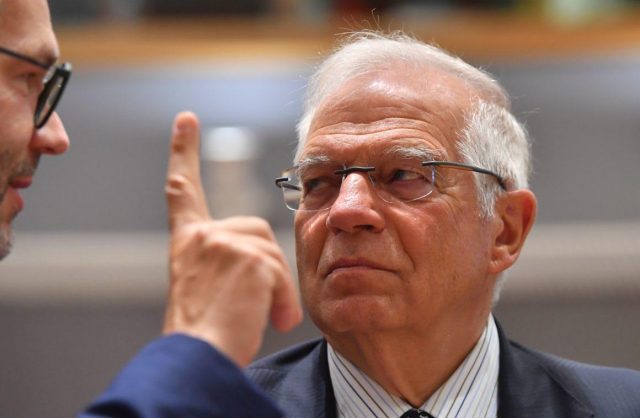
For Josep Borrell, Russia will remain a ‘mystery inside an enigma’
By Johanna Ross | February 9, 2021
It’s been a quotation cited repeatedly to describe the difficulties faced by western policy-makers towards Russia. Winston Churchill famously said the country was ‘a riddle wrapped in a mystery inside an enigma’. Back in 1939, when he broadcast this speech, just as Britain had declared war on Germany, Churchill said that he thought he had the ‘key’ to unlocking the secret of Russian foreign policy and that was, he said, ‘Russian national interest’.
I assume that Josep Borrell, the EU’s high representative for foreign affairs and security policy, who visited Moscow last Friday, is familiar with this quotation. And it seems that for him, Russia has remained something of a mystery. For upon his return to Brussels, after what his European colleagues have termed a ‘humiliating’ trip (they are now demanding his resignation), Borrell wrote a blog post outlining what was essentially his complete failure to engage with his Russian counterpart. “My meeting with Minister Lavrov highlighted that Europe and Russia are drifting apart”, he wrote in a piece published on Sunday evening. “It seems that Russia is progressively disconnecting itself from Europe.”
What is surprising for the Russians, is the absolute inability of these European policy-makers to read and comprehend the Russian position. Western diplomats in this regard seem to be diplomatically autistic. And far from taking tips from Russian political analysts and think-tanks, they turn to the same pseudo ‘Russia-experts’ and western academics, the majority of whom churn out age-old anti-Russian rhetoric like a broken record. As Professor Stephen Cohen once told me:
‘The idea that we have to fight Russian disinformation is now very profitable in the US; everybody will give you money. And if you don’t have a particularly big brain, it’s a good way to pretend you’re an intellectual and get paid for it.’
As a consequence, we are sadly no further in unravelling the ‘mystery inside the enigma’.
Churchill was close to the truth when he said that ‘Russian national interest’ was a key factor in understanding Russia – but that’s hardly a secret. Every country acts according to its national interest. What is lacking, particularly at the moment from western policy makers, is the ability to treat Russia according to how they themselves expect to be treated. Like a naughty schoolboy, Russia and its leader are constantly being lectured on how to behave. The problem is, the ‘adults’ – in this case the West – are guilty of the same offences that Russia is being accused of. As Vladimir Putin noted during his speech at the Munich security conference in 2007:
‘Incidentally, Russia – we – are constantly being taught about democracy. But for some reason those who teach us do not want to learn themselves.’
Unfortunately, nothing has changed, and the hypocrisy still stinks.
Borrell’s visit is also a classic example of Europeans saying one thing to Russia’s face and another behind its back. For the statements Borrell made after his return to Brussels, as Russian Foreign spokesperson Maria Zakharova remarked on Monday, do not correspond with comments he made when in Moscow. Zakharova expressed surprise at the diplomat’s negative summary of the trip and suggested that his colleagues had influenced him on arrival. But I would add that it is a regular occurrence that western politicians are two-faced when it comes to dialogue with Russia, and that they often place less emphasis on the value of verbal agreements. Take for example the promise of US Secretary of State James Baker to Soviet leader Mikhail Gorbachev back in the 1980s that NATO would not expand eastward. For the Russians that assurance meant something, as it is frequently quoted by them to this day; for the Americans it clearly didn’t. Since then NATO has proceeded to encircle Russia to the east.
The reality is that Russia is not going to be dictated to on human rights and freedoms when they are currently being curtailed in the West. It’s not going to be told that opposition protesters are being mal-treated when demonstrators in the US and Europe are regularly manhandled by police. It’s not going to be bullied into releasing Alexei Navalny – a politician with a criminal conviction – when the US and Europe have their own political prisoners, the most famous being Julian Assange. And it’s not going to be harassed about press freedoms when the majority of the western mainstream corporate media play the role of government mouthpieces. Russia is a sovereign nation and won’t be told what to do.
For Borrell et al. this is a problem. Therefore a stalemate has been reached in EU-Russian relations. Borrell seems resigned to the fact that there will be little improvement in relations in the near future. This is unfortunate, because it is not something that Russia has wanted. Even as recently as last month, when speaking at the Davos Economic Forum, Vladimir Putin said that Europe and Russia were ‘practically one civilisation’. And yet there is a fundamental difference in mentality which proves impossible to overcome.
It is in Europe’s and the West’s interest, however, to try better to engage with Russia on a level playing field, without taking the moral high ground. Global security and stability are at stake. In addition, Europe currently depends on Russian gas, and will likely always be reliant to some degree on Russia’s vast expanse of natural resources. As renowned academic Andrei Tsygankov has aptly summarised in his book ‘Russia’s Foreign Policy’:
‘Russia is sufficiently big and powerful, and that limits Western ability to influence its developments. Vast territory, enormous natural resources and military capabilities, and a significant political and diplomatic weight in the world have allowed and will continue to allow Russians considerable room for foreign policy maneuvering. It is hard to believe that the West will ever possess enough power to fully determine the shape and direction of Russia’s developments.’
If only Josep Borrell had read this book before he went to Moscow…
Johanna Ross is a journalist based in Edinburgh, Scotland.
Denmark to pioneer digital vaccine passports
RT | February 3, 2021
Denmark’s government has said digital vaccine passports will be used “in three, four months” to restart life in the country. And by the end of February, Danes can check their status online and print off their vaccination certs.
Speaking in Copenhagen on Wednesday, Finance Minister Morten Bodskov said Danish companies needed to get back on track to kickstart the nation’s economy – and a digital vaccine passport was a key part of that.
“It will be the extra passport that you will be able to have on your mobile phone that documents that you have been vaccinated,” Bodskov said. “We can be among the first in the world to have it and can show it to the rest of the world.”
The government plans to work with business bodies like the Confederation of Danish Industries, which represents Denmark’s major companies, and the Danish Chamber of Commerce to get the new system into place.
Bodskov said society needed to “move on” once people had been vaccinated.
“It’s about finding the right technological solution so that we can get opportunities in cultural life and Danish society, and so that those who have to travel, for example on business, will also have a chance to do so,” he said.
The finance minister stressed, however, that other requirements such as social distancing and mask wearing would not be replaced by the digital passports.
Similar digital passport schemes are being planned to help travelers avoid quarantine imposed to help prevent the spread of Covid-19. The European Commission is looking at issuing vaccination certificates while Belgium, Cyprus, Greece and Spain have expressed interest in similar passport plans. On Tuesday, Estonia said it would permit travelers arriving into the country who showed proof of vaccination to avoid its quarantine requirements.
The World Health Organization (WHO) said in January it was opposed “for the time being” to the introduction of certificates of vaccine passports as there were “too many fundamental unknowns” about the effectiveness of jabs.
Opponents say vaccine passports endanger the rights of Europeans by dividing people into categories based on health status, denying access to public services to the non-vaccinated and opening the door to health tracking that violates individuals’ privacy rights.
Russia’s Ombudswoman Gets Requests to Protect Baltnews, Sputnik Latvia Reporters
Sputnik – 28.01.2021
Russian Human Rights Commissioner Tatyana Moskalkova has received requests from journalists who work with Baltnews and Sputnik Latvia media outlets, asking to protect their rights to freedom of speech, Moskalkova’s office told Sputnik on Thursday, adding that work on the requests is already underway.
“There are such [requests]. We are already working on them”, the office said.
In December, several Russian-speaking journalists working in Latvia, including those who wrote articles for the Baltnews and Sputnik Latvia outlets, have been accused of violating EU sanctions.
Their apartments were searched, with them being put under the condition to not leave the country. Sputnik Latvia and Baltnews are part of the Rossiya Segodnya International Information Agency, whose director-general, Dmitry Kiselev, is on the EU sanctions list.
The Russian Foreign Ministry says that the EU sanctions are individual and concern only Kiselev and thus could not apply to all individuals and entities that work with the agency, especially those who work as freelance journalists. According to Moscow, Latvia uses EU sanctions as an excuse to justify its “punitive campaign” against Russian media.
In non-binding resolution, EU parliament calls for new anti-Russia sanctions to stop Nord Stream 2 over Navalny’s arrest
RT | January 21, 2021
An EU parliament resolution, backed by 581 MEPs out of 675 present, directs members to ramp up sanctions against Russia to stop the Nord Stream 2 project “once and for all,” linking it to opposition figure Alexey Navalny’s arrest.
The EU member states should take “an active stance” on Navalny’s 30-day arrest in Russia. This is according to a non-binding resolution adopted on Thursday, with 581 votes in favor, 50 against and 44 abstentions.
The list of “significantly tighter” restrictions the European nations are encouraged to impose against Moscow includes personal sanctions against anyone involved “in the decision to arrest and imprison” the opposition figure, who returned to Russia on January 17 following an almost six-month-long treatment in Germany after an apparent poisoning during a trip to Siberia.
The resolution went further, suggesting EU states should target Russian “oligarchs,” members of President Vladimir Putin’s “inner circle” and “Russian media propagandists” as well. “Additional restrictive measures could also be taken under the new EU Global Human Rights Sanctions Regime,” a statement published by the EU parliament says.
Another step suggested by the MEPs is putting a stop to the Russian gas pipeline project Nord Stream 2 “once and for all.” The multinational project, which would deliver Russian gas to Europe and particularly to Germany, is currently under construction despite fierce opposition from Washington, which calls it a threat to America’s and Europe’s security interests.
Now, a day after new US President Joe Biden has been sworn into office, the EU parliament resolution calls on the bloc’s member states to “immediately stop the completion of the controversial pipeline.” It would be an ideal moment to “strengthen transatlantic unity in protecting democracy and fundamental values against authoritarian regimes,” the text asserts.
Several European leaders, including German Chancellor Angela Merkel, have repeatedly criticized the US pressure, arguing that Washington is interfering in Europe’s internal affairs to advance its own interests, namely to sell its own liquefied natural gas.
Earlier this week, Russian energy giant Gazprom informed Nord Stream 2 investors that the project could be suspended, even cancelled, after the US told Germany it was imposing new measures based on the CAATSA law (Countering America’s Adversaries Through Sanctions Act).
Berlin said it could tax American gas imports in response to Washington’s move.
As for the “immediate release” of Navalny – another demand put forward by the EU parliament – it is unlikely to have any effect, since Moscow has already said it would not heed outside calls for the opposition figure’s release.
Navalny is currently accused of violating the terms of a suspended sentence. The opposition figure is facing charges over violation of probation terms related to a previous criminal case. In 2014, he received a three-and-a-half-year sentence, suspended for five years, for embezzling 30 million rubles ($400,000) from two companies, including French cosmetics brand Yves Rocher.
His sentence was then extended for another year and was due to expire in late December 2020 but he missed a scheduled check-in with a probation office in Russia while he was in Germany earlier the same month. The Russian penal service then demanded his arrest, arguing the move was deliberate as Navalny’s medical papers from Germany showed he had already recovered by that time.
Dmitry Peskov, President Vladimir Putin’s official spokesman, said earlier that the case is a matter for the Russian prison service and does not require any special intervention from the government.
Meeting between Moldovan and Ukrainian leaders was to coordinate actions against Russia
Paul Antonopoulos | January 18, 2021
The visit of Moldovan President Maia Sandu to Ukraine last week is the first interaction between the two neighboring countries at the highest level in recent years. For Sandu, this trip became her foreign policy premiere since she became president on December 24, 2020. We could observe in her meeting with Ukrainian President Volodymyr Zelensky that there is a good level of personal interaction between the two leaders.
The Three Seas Initiative project was discussed in relation to the implementation of a partnership with the EU. The Three Seas Initiative is a forum comprising of twelve European Union members located between the Baltic, Adriatic and Black Seas and has the aim of fostering closer cooperation. Both Moldova and Ukraine want to be involved in the Three Seas Initiative despite not being European Union member states.
Both Sandu and Zelensky are radically opposed to Russia in the belief that it will help their country’s prospects of becoming European Union and NATO members. The Moldovan and Ukrainian leaders discussed “mutual respect for sovereignty and territorial integrity” and their willingness to face “geopolitical challenges” together with the traditional allusion of a common “aggressor.” They never directly named Russia, but given their known position against Moscow, it is obvious who their statement was directed towards.
Sandu and Zelensky are oriented towards the same circles in the West. Both aim to integrate their countries into Euro-Atlantic structures, despite the unlikeliness that Moldova or Ukraine will become member states of the European Union or NATO in the foreseeable future. As a result of their willingness to appease Western interests in Eastern Europe, Russian influence in the post-Soviet space is being challenged. But now that the political situation in the United States is showing signs of instability, it is not convenient for them to make openly direct statements against Russia.
The issue of Crimea and the Crimean Platform was deliberately avoided by both presidents in the part of the meeting that was revealed to the public. This is likely because such maneuvers require consultation with the incoming Joe Biden administration. Sandu and Zelensky most likely considered it premature to make such statements regarding Crimea. This decision is despite Ukraine launching the Crimean Platform just a mere few months earlier as part of their strategy to “de-occupy” the peninsula after it reunited with Russia in 2014 in a referendum that adhered to all international norms and standards.
When the new administration in Washington stabilizes, it will become clearer whether Moldova’s and Ukraine’s Western partners are ready to use them against Russia. Although they will likely find support from Biden if they continue their opposition to Russia, there will be elections for a new German Chancellor on September 26 and Angela Merkel will not be running. The victor could determine whether Berlin, the de facto leader of the European Union, will continue to loyally follow Washington’s foreign policy or pursue an independent one.
Away from the public eye and ear, it is likely that Sandu and Zelensky privately discussed possibilities of joint pressure against Russia in Transnistria and Donbass. Although Donbass is well known to Westerners, Transnistria is almost unheard of. The small territory is wedged between Ukraine and Moldova. It has a de facto independence but is internationally recognized as a part of Moldova despite the majority of the population being either Russian or Ukrainian.
It should be remembered that during last year’s election campaign, Sandu announced that she will focus on “eliminating the Russian military presence” without mentioning a political settlement in the Transnistrian dispute, thus threatening to warm up a frozen conflict. Given the geography, Ukraine and Moldova are able to blockade Transnistria. This would sever transport links and economic flows.
During the meeting between Sandu and Zelensky, only two public initiatives came to be known – the creation of a certain transportation corridor between the capitals of Ukraine and Moldova, and the organization of a presidential council of the two countries. However, regarding the first initiative, it must have a strong economic justification to be attractive to potential investors. Given the current state of low economic interaction between Ukraine and Moldova, as well as their economic crises, such a justification will be very difficult to find.
The Presidential Council is a more realistic initiative, although the idea itself is not new. The statement about it is a sign that Moldova and Ukraine have agreed to pursue certain policies together. Even if those policies are not clear yet, it will undoubtedly include how they can collectively counter Russian influence in Transnistria and Donbass.
Without Democracy in the U.S., Can the Simulacra of Democracy Survive Elsewhere?
By Alastair Crooke | Strategic Culture Foundation | January 17, 2021
The ‘Ides of March’, they came early this year – on 6 January, at least for one current U.S. ‘Caesar’. What happened; how it happened; who concocted the Capitol events, will be long debated. However, the daggers had long been sharpened for Caesar, well before the invasion of the Capitol. In a sense, the stage was already set – Trump walked into the DC ‘Forum’, and ended ‘stabbed to death’, as had Julius. It has been truly Shakespearean.
It was well-known that Trump might well reject the election results, because of postal ballot potential fraud (as postal ballots assumed their disproportionate 2020 electoral predominance). The Transition Integrity Project (TIP) precisely (purposefully?) had taunted Trump last June with its forecast of a contested election in which Trump would lose – after “all of the mail-in ballots had been tallied”. The TIP then had turned to the prospective tactics and tasks for forcefully ousting a President-in-denial from the White House. (The media and ‘platforms’ had been participants in this early war-gaming of how to deal with a Trump, who contested the election result, and questioned the legality and authenticity of postal ballots).
It needn’t have been this way – but no compromise on rules on postal balloting was attempted (rather, the reverse). In any event, the Capitol invasion now stands as a major psychic event (the “Insurrection”) searing the American consciousness. Apart from unnerving the legislators, unused to experiencing a sudden loss of security, the invasion has become the sacrilege to a ‘sacred space’ (with all the additional connotations of America’s exceptional, divine mission). The daggers were gleefully plunged in – Trump is impeached again; he is to be tried in the Senate after the Biden inauguration; and he and his family, may expect the legal dismemberment that will follow.
The ‘Blue State’ has – from Trump’s first election – been determined to crush him. That is underway. And somehow sychronistically, we now have the Tech digital deletion of Red America from social platforms, with talk of a ‘purge’ and cultural ‘re-education’ for his supporters (and their children), as well. Biden is already speaking like a War President (and the Capitol now has taken the air of a theatre of war, with troops and weapons strewn about its corridors): “Trump”, said Biden, “has unleashed an all-out assault on our institutions of democracy, from the outset, and yesterday was but the culmination of that unrelenting attack”.
Here is the key first implication to that ‘psychic event’ – not just for Americans, but for the world spectating the unfolding events: Biden has called for measures against “domestic terrorism”, and used language that is usually reserved for combat with an external enemy state – language such as accompanies major wars. This is ‘revenge cycle’ material. In the case of two nations, literally at war, they do do this. This is a part of it. They hope to resolve their conflict through humiliation, repression and the forced submission of the other (i.e. Japan after WW2). But America is, at least nominally, one nation. What happens when a single nation splits, with one turning the ‘seditious’ elements into an ‘alien other’?
We do not know. But hatred is intense, both toward Trump and the ‘deplorables’. And now, these sentiments are reciprocated in the wake of the President’s humiliation, at a contents-free impeachment, reached in few hours. What seems certain is that the course of events likely will lead to a self-reinforcing cycle of ever greater polarisation.
The rise of Trumpism has created a new radical Manicheanism amongst the liberal élite. Tech, with its algos feeding like-minded material to the like-minded, has a lot to do with this digital and ideological divide. But the bottom line is that this divide is (falsely) cast as a death-struggle now underway between a monolithic liberalism and a monolithic illiberalism.
This carries a huge message for Russia, Iran and China (and others) – the U.S. is deeply divided, but its ‘new mission’ will be a ‘moral high-ground’ war against illiberalism – at home, firstly – and then overseas.
Yet of greater – and wider – significance is that the ‘noble lie’ – the mask concealing the cynical arrangement that is American ‘democracy’ – has been stripped away. The crucial import was underlined by the German FM, Heiko Maas, when he observed: “Without democracy in the U.S., [there is] no democracy in Europe”.
What might have Maas meant? Possibly, he was referring to the angry 75 millions of Red America that have now grasped the shocking magnitude of the fraud played on them. By fraud here is not a reference to the particular claims about 3 November, but to the much bigger fraud of a system rigged in the interests of the Establishment. This has been one of the basic props to the engineered consent upon which public order and social stability in America and Europe has rested for decades: the naïve belief in the democratic essence of the system.
This prop is being overturned by the ‘Blue State’ precisely in order to savour a sweet revenge on Trump for pulling aside the mask on so much else of ‘Establishment America’. Trump laid bare how corrupt the ‘swamp’ had become, and he articulated Red America’s deepest concerns and frustrations about off-shored jobs, economic precarity and ‘forever wars’. They, in turn, had projected their exasperation, bitterness, and illusions back onto him, turning him, by default, into their standard-bearer.
Yet – astonishingly – this toppling of the pillar of an engineered ‘noble lie’ is being done precisely by those (the Establishment), who one might have thought, had the most interest in keeping it intact. But they cannot resist it. They just cannot forgive ‘outsider’ Trump’s intrusion into their neatly constructed illusions: trashing their elaborate ‘construct’ of reality, simply by magicking up new ‘facts’ to contest their ‘science’.
Isn’t this what is so frightening for Merkel and Maas? The EU has its own, more fragile, ‘noble lie’. It is this: States – by relinquishing a portion of their sovereignty – might hope to participate in a ‘greater sovereignty’ (i.e. the European Project), and still believe that it is ‘democratic’.
This cynical European arrangement only stands if Merkel and Macron can hold up American ‘democracy’ as the guiding principle to the European Project (however misleading that may be). But now, with the ‘lights going out’ in the ‘City on the Hill’, and with only a broken democracy ideal under which EU leaders may shelter, how will the dreary formula of a diluted sovereignty, with no real democracy; with no roots in the ground below; with the EU moving to ever closer oligarchy, and led by an unaccountable, and secretive ‘politburo’, survive?
The point is that European ‘democracy’ is also rigged towards Germany and the élites. And ordinary Europeans have noticed, (especially when only one part of the community bears a disproportionate burden of the Covid economic pain). The élites fear Trump: he may lay it all bare, for all to see.
Some EU leaders may hope that Trumpism will be so completely crushed, and its voice silenced, that Europe’s own fracturing engineered public consent can be contained. Yet they must know, in their hearts, that recourse to identity and gender ideology (as pretext for greater state-ism), will only armour-plate the bubbles and divisions because they prevent people from hearing each other. It is the post-persuasion, post-argument politics of polarisation.
For sure, the rest of the world are taking close note. They will not be accepting moral lectures from Europe in the future (though undoubtedly, they will still get them), and states will look to build ‘public consent’ around quite different ‘poles’ – loose concerts of states, traditional culture and the historic narratives of their communities.
Featured Video
New positive ivermectin evidence
or go to
Aletho News Archives – Video-Images
From the Archives
Fanatical Followers of the Covid Regime: A Jim Jones-Style Cult?
By Professor Roger Watson and Dr. Niall McCrae | The Daily Sceptic | November 15, 2021
As scholars at leading British universities over recent decades, we witnessed the replacement of critical thinking and debate by narrative: facts are discrimination and scientific method is imperialism; truth, instead, is derived from ‘progressive’ values. This educational trend may be a major contributory factor to the ease in which society has been inculcated to the Covid ‘new normal’ of masking, testing, and repeated doses of vaccines for a disease of similar risk to severe influenza.
One doesn’t need much critical reasoning to observe the flawed logic of some vaccination enthusiasts, such as people who respond to experiencing any side effects, however debilitating, by saying “at least I know it’s working”, or, after contracting the disease despite their promised inoculation (over 90% effective, according to initial drug company claims), “I’d have been worse off without the jab.” … continue
Blog Roll
 Aletho News
- Najaf airport to reopen to Iranian flights within 24 hours: Ambassador
- From ‘How Will This End For Iran’ to ‘When America Walks Away’: A tale of two Economist covers
- Tehran blasts ‘baseless’ speculation linking Iran to alleged bomb plot at UK air base
- The Rise And… Rise Of ‘Color Revolutions’
- The Coming GOP Bloodbath?
- Arctic Scare Stories Melt Away
- Wrong, Euronews: Climate Change Has Not Created a Food, Energy, and Economic “Meta-Crisis”
- New positive ivermectin evidence
- Met Office Caught Fabricating Daily Temperature Record Claims
- Merck Virologists Admitted to Falsely Certifying Vaccine Efficacy
- If Americans Knew
- Netanyahu Asked UAE Leader to Deny Report on Oct. 7 Warning in Secret Visit, Sources Say
- CNN Chief Int’l Correspondent Clarissa Ward on Journalists in Gaza
- Democratic Party Consultants Surround Troy Jackson with Pro-Israel Donors
- Christian Leader Responds To Netanyahu’s Claims Regarding Palestinian Christians
- In Gaza, ‘Whoever Survives the Bombing Won’t Survive the Rubble’
- Israel kills more Palestinians, amid push to resettle Gaza – Daily Update
- Israel forces Gazans to live in constant peril – Daily Update
- Deconstructing Netanyahu’s pants-on-fire UN rant – Daily Update
- Trump betrayed voters with his campaign lies and prioritized a foreign country once he took office
- Netanyahu calls Israel’s war in Gaza ‘opposite of genocide’ in UN speech to near-empty hall
- No Tricks Zone
- New Study: Earth And Venus Surface Warmth Largely Explained By Convection And Lapse Rate, Not CO2 Or Radiation
- 2025 Nature Paper Claiming Worsening Global Drought Gets RETRACTED …Heavily Flawed
- New Study: ‘Global Drought Shows No Detectable Recent Acceleration Under Climate Warming’
- Economic Masterminds: German Socialists Suggest Taxing Productivity Gains Stemming From Using AI
- The South China Sea Has Not Been Cooperating With The Climate Change Narrative
- Energy Crisis: Germany Enters Heating Season With Historically Low Gas Reserve Fill Levels
- New Study: The Antarctic Ice Sheet Gained Mass From 2020-2024 Due To Staggering Snow And Ice Accumulation
- Study: Ocean Heating Rates From Thousands Of Years Ago ‘Dwarf’ Modern Ocean Heating Rates
- Climate Extremists Target, Attack Large-Scale Power Grid Infrastructure In Germany!
- New Study: Antarctic Ice Melt Has Contributed Less Than 1 Centimeter To Sea Level Rise In The Last 30 Years

