26,041 Deaths 2,448,362 Injuries Following COVID Shots in European Union’s Database
By Brian Shilhavy | Health Impact News | September 29, 2021
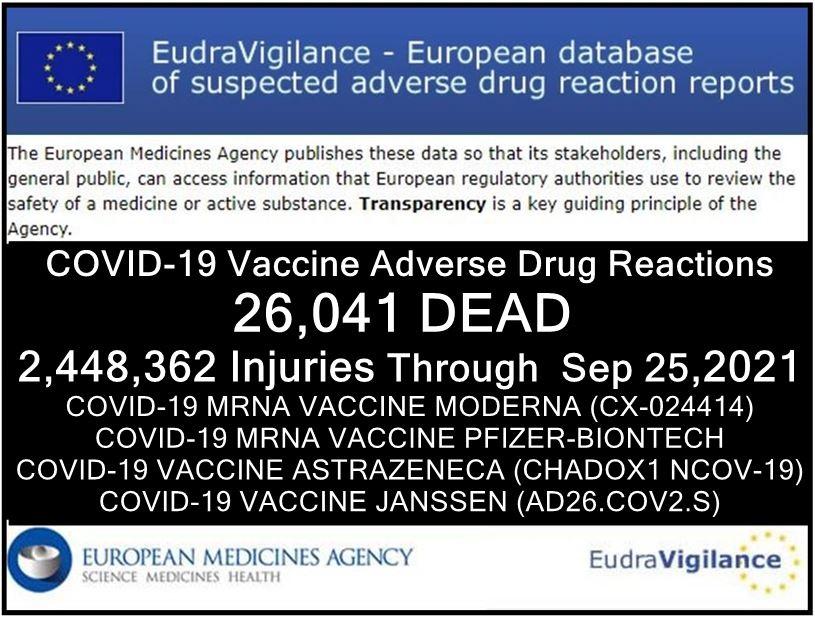
The European Union database of suspected drug reaction reports is EudraVigilance, and they are now reporting 26,041 fatalities, and 2,448,362 injuries, following COVID-19 injections.
A Health Impact News subscriber from Europe reminded us that this database maintained at EudraVigilance is only for countries in Europe who are part of the European Union (EU), which comprises 27 countries.
The total number of countries in Europe is much higher, almost twice as many, numbering around 50. (There are some differences of opinion as to which countries are technically part of Europe.)
So as high as these numbers are, they do NOT reflect all of Europe. The actual number in Europe who are reported dead or injured following COVID-19 shots would be much higher than what we are reporting here.
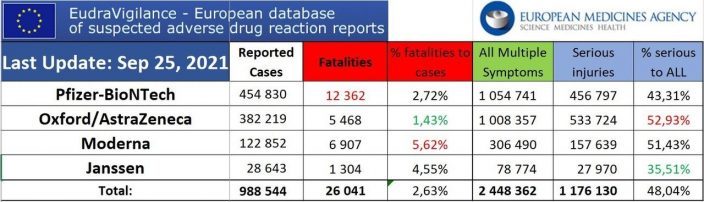
The EudraVigilance database reports that through September 25, 2021 there are 26,041 deaths and 2,448,362 injuries reported following injections of four experimental COVID-19 shots:
- COVID-19 MRNA VACCINE MODERNA (CX-024414)
- COVID-19 MRNA VACCINE PFIZER-BIONTECH
- COVID-19 VACCINE ASTRAZENECA (CHADOX1 NCOV-19)
- COVID-19 VACCINE JANSSEN (AD26.COV2.S)
From the total of injuries recorded, almost half of them (1,176,130) are serious injuries.
“Seriousness provides information on the suspected undesirable effect; it can be classified as ‘serious’ if it corresponds to a medical occurrence that results in death, is life-threatening, requires inpatient hospitalisation, results in another medically important condition, or prolongation of existing hospitalisation, results in persistent or significant disability or incapacity, or is a congenital anomaly/birth defect.”
A Health Impact News subscriber in Europe ran the reports for each of the four COVID-19 shots we are including here. It is a lot of work to tabulate each reaction with injuries and fatalities, since there is no place on the EudraVigilance system we have found that tabulates all the results.
Since we have started publishing this, others from Europe have also calculated the numbers and confirmed the totals.*
Here is the summary data through September 25, 2021.
Total reactions for the mRNA vaccine Tozinameran (code BNT162b2,Comirnaty) from BioNTech/ Pfizer – 12,362 deaths and 1,054,741 injuries to 25/09/2021
- 28,662 Blood and lymphatic system disorders incl. 172 deaths
- 29,569 Cardiac disorders incl. 1,834 deaths
- 277 Congenital, familial and genetic disorders incl. 23 deaths
- 14,027 Ear and labyrinth disorders incl. 9 deaths
- 822 Endocrine disorders incl. 5 deaths
- 16,330 Eye disorders incl. 30 deaths
- 92,590 Gastrointestinal disorders incl. 514 deaths
- 274,633 General disorders and administration site conditions incl. 3,517 deaths
- 1,186 Hepatobiliary disorders incl. 59 deaths
- 10,876 Immune system disorders incl. 65 deaths
- 36,113 Infections and infestations incl. 1,214 deaths
- 13,804 Injury, poisoning and procedural complications incl. 191 deaths
- 26,554 Investigations incl. 387 deaths
- 7,555 Metabolism and nutrition disorders incl. 225 deaths
- 138,223 Musculoskeletal and connective tissue disorders incl. 155 deaths
- 837 Neoplasms benign, malignant and unspecified (incl cysts and polyps) incl. 78 deaths
- 185,082 Nervous system disorders incl. 1,341 deaths
- 1,347 Pregnancy, puerperium and perinatal conditions incl. 39 deaths
- 172 Product issues incl. 1 death
- 19,436 Psychiatric disorders incl. 159 deaths
- 3,605 Renal and urinary disorders incl. 205 deaths
- 24,848 Reproductive system and breast disorders incl. 4 deaths
- 46,177 Respiratory, thoracic and mediastinal disorders incl. 1,443 deaths
- 50,420 Skin and subcutaneous tissue disorders incl. 111 deaths
- 2,007 Social circumstances incl. 15 deaths
- 1,034 Surgical and medical procedures incl. 34 deaths
- 28,555 Vascular disorders incl. 532 deaths
Total reactions for the mRNA vaccine mRNA-1273 (CX-024414) from Moderna – 6,907 deaths and 306,490 injuries to 25/09/2021
- 6,051 Blood and lymphatic system disorders incl. 67 deaths
- 9,283 Cardiac disorders incl. 744 deaths
- 122 Congenital, familial and genetic disorders incl. 3 deaths
- 3,769 Ear and labyrinth disorders incl. 1 death
- 248 Endocrine disorders incl. 2 deaths
- 4,627 Eye disorders incl. 20 deaths
- 26,405 Gastrointestinal disorders incl. 269 deaths
- 82,564 General disorders and administration site conditions incl. 2,617 deaths
- 500 Hepatobiliary disorders incl. 29 deaths
- 2,659 Immune system disorders incl. 11 deaths
- 9,570 Infections and infestations incl. 487 deaths
- 6,759 Injury, poisoning and procedural complications incl. 127 deaths
- 5,811 Investigations incl. 128 deaths
- 2,944 Metabolism and nutrition disorders incl. 158 deaths
- 38,397 Musculoskeletal and connective tissue disorders incl. 139 deaths
- 369 Neoplasms benign, malignant and unspecified (incl cysts and polyps) incl. 42 deaths
- 53,562 Nervous system disorders incl. 706 deaths
- 583 Pregnancy, puerperium and perinatal conditions incl. 8 deaths
- 62 Product issues incl. 2 deaths
- 5,772 Psychiatric disorders incl. 118 deaths
- 1,772 Renal and urinary disorders incl. 114 deaths
- 4,576 Reproductive system and breast disorders incl. 5 deaths
- 13,315 Respiratory, thoracic and mediastinal disorders incl. 682 deaths
- 16,453 Skin and subcutaneous tissue disorders incl. 62 deaths
- 1,366 Social circumstances incl. 28 deaths
- 1,032 Surgical and medical procedures incl. 71 deaths
- 7,919 Vascular disorders incl. 267 deaths
Total reactions for the vaccine AZD1222/VAXZEVRIA (CHADOX1 NCOV-19) from Oxford/ AstraZeneca – 5,468 deaths and 1,008,357 injuries to 25/09/2021
- 12,160 Blood and lymphatic system disorders incl. 226 deaths
- 17,334 Cardiac disorders incl. 623 deaths
- 163 Congenital familial and genetic disorders incl. 6 deaths
- 11,826 Ear and labyrinth disorders incl. 1 death
- 522 Endocrine disorders incl. 4 deaths
- 17,753 Eye disorders incl. 26 deaths
- 97,985 Gastrointestinal disorders incl. 280 deaths
- 265,482 General disorders and administration site conditions incl. 1,320 deaths
- 866 Hepatobiliary disorders incl. 53 deaths
- 4,104 Immune system disorders incl. 25 deaths
- 26,800 Infections and infestations incl. 347 deaths
- 11,472 Injury poisoning and procedural complications incl. 153 deaths
- 22,152 Investigations incl. 129 deaths
- 11,805 Metabolism and nutrition disorders incl. 77 deaths
- 151,690 Musculoskeletal and connective tissue disorders incl. 76 deaths
- 536 Neoplasms benign malignant and unspecified (incl cysts and polyps) incl. 17 deaths
- 209,576 Nervous system disorders incl. 872 deaths
- 456 Pregnancy puerperium and perinatal conditions incl. 11 deaths
- 164 Product issues incl. 1 death
- 18,858 Psychiatric disorders incl. 50 deaths
- 3,752 Renal and urinary disorders incl. 49 deaths
- 13,707 Reproductive system and breast disorders incl. 2 deaths
- 35,537 Respiratory thoracic and mediastinal disorders incl. 654 deaths
- 46,297 Skin and subcutaneous tissue disorders incl. 40 deaths
- 1,328 Social circumstances incl. 7 deaths
- 1,199 Surgical and medical procedures incl. 24 deaths
- 24,833 Vascular disorders incl. 395 deaths
Total reactions for the COVID-19 vaccine JANSSEN (AD26.COV2.S) from Johnson & Johnson – 1,304 deaths and 78,774 injuries to 25/09/2021
- 737 Blood and lymphatic system disorders incl. 32 deaths
- 1,315 Cardiac disorders incl. 129 deaths
- 26 Congenital, familial and genetic disorders
- 687 Ear and labyrinth disorders incl. 1 death
- 47 Endocrine disorders incl. 1 death
- 1,067 Eye disorders incl. 6 deaths
- 7,102 Gastrointestinal disorders incl. 59 deaths
- 20,536 General disorders and administration site conditions incl. 333 deaths
- 98 Hepatobiliary disorders incl. 9 deaths
- 321 Immune system disorders incl. 7 deaths
- 1,943 Infections and infestations incl. 79 deaths
- 743 Injury, poisoning and procedural complications incl. 17 deaths
- 3,998 Investigations incl. 79 deaths
- 465 Metabolism and nutrition disorders incl. 29 deaths
- 12,263 Musculoskeletal and connective tissue disorders incl. 33 deaths
- 37 Neoplasms benign, malignant and unspecified (incl cysts and polyps) incl. 2 deaths
- 16,253 Nervous system disorders incl. 148 deaths
- 26 Pregnancy, puerperium and perinatal conditions incl. 1 death
- 21 Product issues
- 1,059 Psychiatric disorders incl. 11 deaths
- 311 Renal and urinary disorders incl. 15 deaths
- 1,139 Reproductive system and breast disorders incl. 4 deaths
- 2,786 Respiratory, thoracic and mediastinal disorders incl. 148 deaths
- 2,426 Skin and subcutaneous tissue disorders incl. 5 deaths
- 235 Social circumstances incl. 4 deaths
- 572 Surgical and medical procedures incl. 43 deaths
- 2,561 Vascular disorders incl. 109 deaths
Pending International Treaty Empowering The WHO
By Dr Urmie Ray B.A., M.A., Mmath, Ph.d. | Principia Scientific | September 23, 2021
Between 29 November and 1 December 2021, member states are meeting in a special session with the World Health Organisation to discuss, possibly sign, a new treaty on pandemic preparedness and response.
This decision was taken in March 2021 and backed by 26 nations, among which Australia, Canada, Iceland, Norway, Republic of Korea, South Africa, Ukraine, United Kingdom, United States, Uruguay and Member States of the European Union.1
To be noted is the absence of Russia, China, and India among these 26.
The International Health Regulations (2005)[i] signed by 196 countries already provide States the legal right to:
“– review travel history in affected areas;
– review proof of medical examination and any laboratory analysis;
– require medical examinations;
– review proof of vaccination or other prophylaxis;
– require vaccination or other prophylaxis;
– place suspect persons under public health observation;
– implement quarantine or other health measures for suspect persons;
– implement isolation and treatment where necessary of affected persons;
– implement tracing of contacts of suspect or affected persons;
– refuse entry of suspect and affected persons;
– refuse entry of unaffected persons to affected areas; and
– implement exit screening and/or restrictions on persons from affected areas.”
In other words, all the measures applied round the world since 2020, including mandatory vaccination, are in effect legal under this former treaty.
In particular, it critically changes the definition of “quarantine” from that in the 1969 IHR. There, it is used only in the expression “in quarantine” defined to be a “state or condition during which measures are applied by a health authority to a … means of transport or container, to prevent the spread of disease, reservoirs of disease or vectors of disease from the object of quarantine”.[i]
The 2005 revised IHR use the term by itself, and define it as “the restriction of activities and/or separation from others of suspect persons who are not ill or of suspect baggage, containers, conveyances or goods in such a manner as to prevent the possible spread of infection or contamination”.
This represents a subtle but critical shift from protection of the community to restriction of individual liberties.
The implementation of quarantine and other coercive measures on all, including surveillance and vaccination, is legalized: the expression “suspect persons” criminalizes every individual, both healthy and unhealthy.
Indeed, it covers anyone “considered by a State Party as having been exposed, or possibly exposed, to a public health risk and that could be a possible source of spread of disease”. Of significance is the use of “possibly” and “possible”, hence not just anyone definitely known to be a risk factor.
So Why The Need For A New Treaty?
The answer was given by WHO Director-General Tedros Adhanom Ghebreyesus. “It’s the one major change, Tedros said, that would do the most to boost global health security and also empower the World Health Organization.”[i]
The 2005 revised IHR still leave some authority to States and require certain conditions for a health event in a particular State to be considered sufficiently serious globally for the State to be forced to communicate it to WHO. Once communicated, it becomes the prerogative of the director general of WHO to determine whether it “constitutes a public health emergency”, but in collaboration with that particular State.
Although it should be added that in case of disagreement, the director general decides after consultation with the emergency committee of WHO, and passed a certain period no State can reject or emit reservations about the IHR or any later amendments. Still, to some extent, measures implemented remain the result of a dialogue between “IHR focal points” in each country and “WHO IHR contact points”.
What is particularly important is that the above listed measures, although rendered legal by the IHR, can under this treaty, only be recommended by the WHO, not imposed, and that it is up to the States to proceed towards their imposition, and to verify they are followed by means already existing in their respective countries.[ii]
The new treaty would address the above “weaknesses” of the IHR as they are considered to be, by ensuring “independent verification, monitoring, and compliance”. Given the clearly expressed end of empowering the WHO, should one conclude that “independent” means under the authority of WHO rather than the States themselves?[i]
Further the IHR cover “public health hazards and public health emergencies of international concern”, whereas the treaty will concern “all hazards”, not just pandemics. In the latter case, it would take over from the IHR once a pandemic is officially declared by the WHO.[ii]
This said, the treaty would presumably also make clear the idea expressed in the 2007 CDC “Interim Pre-pandemic planning guidance”,[i] namely overruling the need of a pandemic to implement restrictive measures. All that would be needed would be for an event to be declared a “public health emergency of pandemic potential”.
Given that any future event is always hypothetical, does this enable the maintenance of the measures for an indeterminate period? For it can always be claimed that a pandemic will occur especially were the measures lifted. This raises many questions, all the more so as the event would no long need to be of “international concern as in the current IHR”. “Measures”, as advised, should also go beyond the current scope of IHR”, in particular to cover the production and supply of vaccines, diagnostics, and treatments”.[ii]
The treaty would unlike the IHR also go beyond sanitary issues and allow the implementation of measures against “social and economic disruptions” as well as “broader disaster risk”.[i]
Would this in effect not only make it legal to put an end to criticisms, and thus to the freedom of expression, and make it possible to control any public antagonism against restrictive measures through “urgent international assistance”,[ii] namely not just by national police or military forces, but international ones?
In short, would the treaty not provide the international legal framework for derogation from the civil and political rights guaranteed “even in time of emergency threatening the life of the nation” by The Syracuse Principles on the Limitation and Derogation Provisions in the International Covenant on Civil and Political Rights drafted in 1984,[iii] namely:
“the right to life; freedom from torture, cruel, inhuman or degrading treatment or punishment, and from medical or scientific experimentation without free consent; freedom from slavery or involuntary servitude; the right not be be imprisoned for contractual debt; the right not to be convicted or sentenced to a heavier penalty by virtue of retroactive criminal legislation; the right to recognition as a person before the law; and freedom of thought, conscience and religion. These rights are not derogable under any conditions even for the asserted purpose of preserving the life of the nation”?
For the Syracuse Principles only ensure that “No state party shall” in any circumstance “derogate from the Covenant’s” above guarantees”. However, according to the new treaty, would the WHO, possibly together with the help of other international bodies, not become an occupying planetary power, with each State a collaborating subservient unit, like France in 1940, and hence without any power to ensure that non-derogable rights are protected?
Last but not least, “[t]rying to revise the IHR would be a long process and take several years. … In addition, any amendment made to the IHR will enter into force only two years after its adoption. A world in crisis cannot afford to wait this long.”[i] Why such a rush to get the treaty ratified?
It should not be forgotten that among the main contributors of WHO are the Bill and Melinda Gates foundation and the vaccine alliance (GAVI). It established in 2000 and whose initial funding it essentially provided – a “unique public-private partnership … bring[ing] together key UN agencies, governments, the vaccine industry, private sector and civil society”.[i]
References
[1] https://apps.who.int/gb/ebwha/pdf_files/WHA74/A74_ACONF7-en.pdf
[1] https://www.who.int/health-topics/international-health-regulations#tab=tab_1
[1] https://www.who.int/csr/ihr/WHA58-en.pdf
[1] https://www.who.int/csr/ihr/WHA58-en.pdf
[1] Ibid.
[1] https://www.centerforhealthsecurity.org/cbn/2007/cbnreport_02072007.html
[1] Ibid.
[1] Ibid.
US demands Russia boost natural gas deliveries to Europe through Ukraine
RT | September 22, 2021
The US says Russia must increase supplies of natural gas to Europe through Ukraine to curb skyrocketing energy costs, sticking to its negative stance on the launch of Russia’s Nord Stream 2 pipeline.
“The reality is there are pipelines with enough capacity through Ukraine to supply Europe. Russia has consistently said it has enough gas supply to be able to do so, so if that is true, then they should, and they should do it quickly through Ukraine,” Amos Hochstein, senior adviser for energy security at the US State Department, said in an interview with Bloomberg TV.
Hochstein said supplies of gas from Russia to Europe are “inexplicably low compared to both previous years and to what they have the capacity to do.” He also said that Russia’s state energy giant Gazprom’s refusal to book additional gas transit through Ukrainian territory for October “increases the concern.”
The US official also accused Moscow of trying to use Europe’s energy crisis to speed up the launch of the newly constructed Nord Stream 2 pipeline, which runs from Russia to Germany through the Baltic Sea. Hochstein underlined that US President Joe Biden and his administration oppose the launch of the project.
Gas prices in Europe have been hitting records, with October futures on the Dutch TTF exchange reaching record $963.9 per 1,000 cubic meters this month, while on September 20 the estimated price was $911.2.
Russia’s Gazprom has repeatedly pointed to the connection between high gas prices and lower-than-needed reserves in European underground storage facilities ahead of the approaching winter. As of September 19, those reserves were only 72% full, TASS reported, which is nearly 14% lower than in the past five years.
However, Gazprom emphasized last week that its current volume of gas supplies to Europe is in full compliance with the existing contracts. The company has been uneager to book additional volumes in the pipelines running through Ukraine due to high fees.
Gazprom is also counting on the launch of Nord Stream 2, a pipeline capable of delivering 55 billion cubic meters of Russian natural gas annually. The pipeline’s daily capacity of gas supply is comparable to the entire volume of liquefied gas that is now supplied to Europe.
However, Russia may have to wait up to four months for EU certification required to start deliveries. The project has been repeatedly delayed under pressure from Washington and some Eastern European countries, which view increasing energy imports from Russia as a threat to Europe’s energy security.
Inquiry launched as European Commission chief refuses to hand over text messages exchanged with Pfizer CEO
RT | September 17, 2021
The European Ombudsman has demanded that Commission President Ursula von der Leyen explain how she lost text messages that she exchanged with the CEO of Pfizer during talks about vaccine procurement.
European Ombudsman Emily O’Reilly, the EU’s top accountability and governance officer, launched an inquiry into the European Commission’s refusal to hand over the contents of communications between von der Leyen and a CEO of an unnamed pharmaceutical company about a Covid-19 vaccine contract.
As a first step, O’Reilly asked the Commission to explain its policy on keeping records of von der Leyen’s text messages. “The Commission has an obligation to record instant messages relating to important policy or political matters, such as the procurement of Covid-19 vaccines,” O’Reilly’s office wrote in a statement about the case.
In April, the New York Times reported that von der Leyen had been exchanging texts and calls with Pfizer CEO Albert Bourla for a month as part of negotiations about vaccine procurement for the bloc. The paper wrote at the time that personal diplomacy played a big role in securing the vaccine deal.
O’Reilly requested that the Commission hand over the text messages, but the Commission claimed that “no record had been kept of any such messages,” according to the ombudsman’s office.
The office has previously warned about the importance of record-keeping within EU institutions amid an increased amount of remote work in the Covid era. “EU administration is required by EU law to draw up and retain documentation pertaining to its activities, as far as possible and in a non-arbitrary and predictable manner,” the watchdog said in June.
24,526 Deaths 2,317,495 Injuries Following COVID Shots Reported in EU Database of Adverse Reactions
By Brian Shilhavy | Health Impact News | September 14, 2021
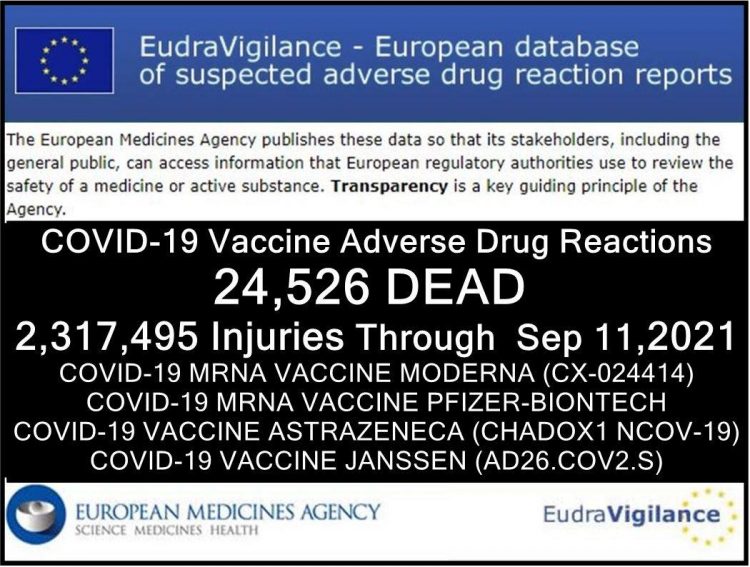
The European Union database of suspected drug reaction reports is EudraVigilance, and they are now reporting 24,526 fatalities, and 2,317,495 injuries, following COVID-19 injections.
A Health Impact News subscriber from Europe reminded us that this database maintained at EudraVigilance is only for countries in Europe who are part of the European Union (EU), which comprises 27 countries.
The total number of countries in Europe is much higher, almost twice as many, numbering around 50. (There are some differences of opinion as to which countries are technically part of Europe.)
So as high as these numbers are, they do NOT reflect all of Europe. The actual number in Europe who are reported dead or injured following COVID-19 shots would be much higher than what we are reporting here.
The EudraVigilance database reports that through September 11, 2021 there are 24,526 deaths and 2,317,495 injuries reported following injections of four experimental COVID-19 shots:
- COVID-19 MRNA VACCINE MODERNA (CX-024414)
- COVID-19 MRNA VACCINE PFIZER-BIONTECH
- COVID-19 VACCINE ASTRAZENECA (CHADOX1 NCOV-19)
- COVID-19 VACCINE JANSSEN (AD26.COV2.S)
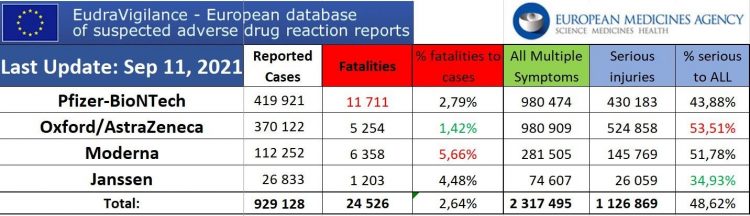
From the total of injuries recorded, almost half of them (1,126,869) are serious injuries.
“Seriousness provides information on the suspected undesirable effect; it can be classified as ‘serious’ if it corresponds to a medical occurrence that results in death, is life-threatening, requires inpatient hospitalisation, results in another medically important condition, or prolongation of existing hospitalisation, results in persistent or significant disability or incapacity, or is a congenital anomaly/birth defect.”
A Health Impact News subscriber in Europe ran the reports for each of the four COVID-19 shots we are including here. It is a lot of work to tabulate each reaction with injuries and fatalities, since there is no place on the EudraVigilance system we have found that tabulates all the results.
Since we have started publishing this, others from Europe have also calculated the numbers and confirmed the totals.*
Here is the summary data through September 11, 2021.
Total reactions for the mRNA vaccine Tozinameran (code BNT162b2,Comirnaty) from BioNTech/ Pfizer – 11,711 deaths and 980,474 injuries to 11/09/2021
- 26,634 Blood and lymphatic system disorders incl. 156 deaths
- 26,940 Cardiac disorders incl. 1,745 deaths
- 253 Congenital, familial and genetic disorders incl. 21 deaths
- 13,005 Ear and labyrinth disorders incl. 9 deaths
- 728 Endocrine disorders incl. 5 deaths
- 15,314 Eye disorders incl. 28 deaths
- 87,239 Gastrointestinal disorders incl. 489 deaths
- 256,117 General disorders and administration site conditions incl. 3,330 deaths
- 1,098 Hepatobiliary disorders incl. 55 deaths
- 10,351 Immune system disorders incl. 64 deaths
- 32,834 Infections and infestations incl. 1,141 deaths
- 12,714 Injury, poisoning and procedural complications incl. 179 deaths
- 24,765 Investigations incl. 368 deaths
- 7,178 Metabolism and nutrition disorders incl. 210 deaths
- 130,077 Musculoskeletal and connective tissue disorders incl. 149 deaths
- 757 Neoplasms benign, malignant and unspecified (incl cysts and polyps) incl. 67 deaths
- 173,079 Nervous system disorders incl. 1,278 deaths
- 1,211 Pregnancy, puerperium and perinatal conditions incl. 36 deaths
- 168 Product issues incl. 1 death
- 17,756 Psychiatric disorders incl. 156 deaths
- 3,348 Renal and urinary disorders incl. 198 deaths
- 19,084 Reproductive system and breast disorders incl. 3 deaths
- 43,232 Respiratory, thoracic and mediastinal disorders incl. 1,376 deaths
- 47,012 Skin and subcutaneous tissue disorders incl. 105 deaths
- 1,805 Social circumstances incl. 14 deaths
- 887 Surgical and medical procedures incl. 31 deaths
- 26,888 Vascular disorders incl. 497 deaths
Total reactions for the mRNA vaccine mRNA-1273 (CX-024414) from Moderna – 6,358 deaths and 281,505 injuries to 11/09/2021
- 5,465 Blood and lymphatic system disorders incl. 59 deaths
- 8,364 Cardiac disorders incl. 687 deaths
- 113 Congenital, familial and genetic disorders incl. 2 deaths
- 3,466 Ear and labyrinth disorders incl. 1 death
- 221 Endocrine disorders incl. 2 deaths
- 4,302 Eye disorders incl. 18 deaths
- 24,595 Gastrointestinal disorders incl. 237 deaths
- 75,804 General disorders and administration site conditions incl. 2,461 deaths
- 458 Hepatobiliary disorders incl. 24 deaths
- 2,485 Immune system disorders incl. 11 deaths
- 8,436 Infections and infestations incl. 416 deaths
- 6,013 Injury, poisoning and procedural complications incl. 121 deaths
- 5,460 Investigations incl. 120 deaths
- 2,693 Metabolism and nutrition disorders incl. 145 deaths
- 35,728 Musculoskeletal and connective tissue disorders incl. 129 deaths
- 333 Neoplasms benign, malignant and unspecified (incl cysts and polyps) incl. 37 deaths
- 49,722 Nervous system disorders incl. 650 deaths
- 538 Pregnancy, puerperium and perinatal conditions incl. 6 deaths
- 59 Product issues incl. 1 death
- 5,316 Psychiatric disorders incl. 110 deaths
- 1,632 Renal and urinary disorders incl. 107 deaths
- 3,558 Reproductive system and breast disorders incl. 3 deaths
- 12,150 Respiratory, thoracic and mediastinal disorders incl. 614 deaths
- 15,102 Skin and subcutaneous tissue disorders incl. 57 deaths
- 1,188 Social circumstances incl. 25 deaths
- 905 Surgical and medical procedures incl. 69 deaths
- 7,399 Vascular disorders incl. 246 deaths
Total reactions for the vaccine AZD1222/VAXZEVRIA (CHADOX1 NCOV-19) from Oxford/ AstraZeneca: 5,254 deaths and 980,909 injuries to 11/09/2021
- 11,826 Blood and lymphatic system disorders incl. 221 deaths
- 16,641 Cardiac disorders incl. 603 deaths
- 158 Congenital familial and genetic disorders incl. 5 deaths
- 11,541 Ear and labyrinth disorders incl. 1 death
- 504 Endocrine disorders incl. 4 deaths
- 17,332 Eye disorders incl. 22 deaths
- 96,191 Gastrointestinal disorders incl. 270 deaths
- 257,766 General disorders and administration site conditions incl. 1,278 deaths
- 831 Hepatobiliary disorders incl. 51 deaths
- 3,987 Immune system disorders incl. 23 deaths
- 24,674 Infections and infestations incl. 330 deaths
- 11,183 Injury poisoning and procedural complications incl. 141 deaths
- 21,578 Investigations incl. 121 deaths
- 11,626 Metabolism and nutrition disorders incl. 73 deaths
- 148,195 Musculoskeletal and connective tissue disorders incl. 74 deaths
- 510 Neoplasms benign malignant and unspecified (incl cysts and polyps) incl. 16 deaths
- 204,423 Nervous system disorders incl. 840 deaths
- 439 Pregnancy puerperium and perinatal conditions incl. 11 deaths
- 158 Product issues incl. 1 death
- 18,501 Psychiatric disorders incl. 47 deaths
- 3,639 Renal and urinary disorders incl. 48 deaths
- 12,993 Reproductive system and breast disorders incl. 2 deaths
- 34,557 Respiratory thoracic and mediastinal disorders incl. 629 deaths
- 45,140 Skin and subcutaneous tissue disorders incl. 36 deaths
- 1,291 Social circumstances incl. 6 deaths
- 1,142 Surgical and medical procedures incl. 22 deaths
- 24,083 Vascular disorders incl. 379 deaths
Total reactions for the COVID-19 vaccine JANSSEN (AD26.COV2.S) from Johnson & Johnson: 1,203 deaths and 74,607 injuries to 11/09/2021
- 690 Blood and lymphatic system disorders incl. 31 deaths
- 1,201 Cardiac disorders incl. 120 deaths
- 25 Congenital, familial and genetic disorders
- 560 Ear and labyrinth disorders incl. 1 death
- 42 Endocrine disorders incl. 1 death
- 1,006 Eye disorders incl. 5 deaths
- 6,822 Gastrointestinal disorders incl. 56 deaths
- 19,539 General disorders and administration site conditions incl. 303 deaths
- 96 Hepatobiliary disorders incl. 9 deaths
- 302 Immune system disorders incl. 7 deaths
- 1,679 Infections and infestations incl. 66 deaths
- 694 Injury, poisoning and procedural complications incl. 16 deaths
- 3,861 Investigations incl. 72 deaths
- 431 Metabolism and nutrition disorders incl. 26 deaths
- 11,861 Musculoskeletal and connective tissue disorders incl. 30 deaths
- 31 Neoplasms benign, malignant and unspecified (incl cysts and polyps) incl. 2 deaths
- 15,493 Nervous system disorders incl. 142 deaths
- 26 Pregnancy, puerperium and perinatal conditions incl. 1 death
- 20 Product issues
- 988 Psychiatric disorders incl. 11 deaths
- 280 Renal and urinary disorders incl. 11 deaths
- 863 Reproductive system and breast disorders incl. 4 deaths
- 2,629 Respiratory, thoracic and mediastinal disorders incl. 136 deaths
- 2,296 Skin and subcutaneous tissue disorders incl. 5 deaths
- 212 Social circumstances incl. 4 deaths
- 546 Surgical and medical procedures incl. 38 deaths
- 2,414 Vascular disorders incl. 106 deaths
23,252 Deaths 2,189,537 Injured Following COVID Shots: EU Database of Adverse Reactions
By Brian Shilhavy | Health Impact News | September 3, 2021
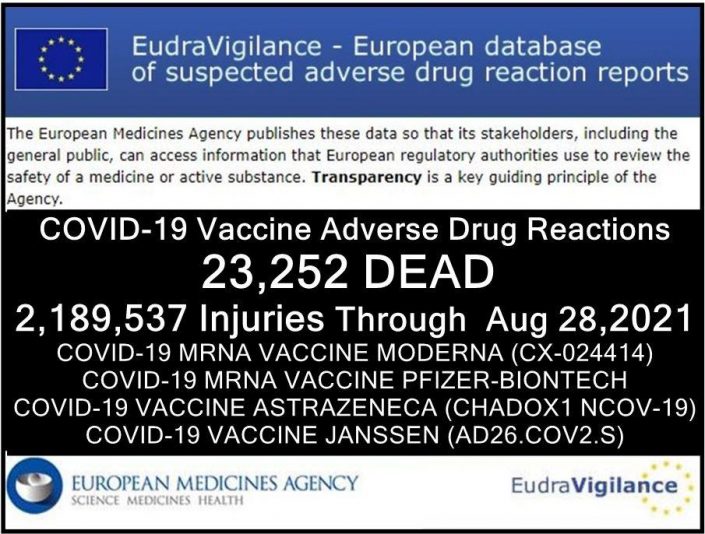
The European Union database of suspected drug reaction reports is EudraVigilance, and they are now reporting 23,252 fatalities, and 2,189,537 injuries, following COVID-19 injections.
A Health Impact News subscriber from Europe reminded us that this database maintained at EudraVigilance is only for countries in Europe who are part of the European Union (EU), which comprises 27 countries.
The total number of countries in Europe is much higher, almost twice as many, numbering around 50. (There are some differences of opinion as to which countries are technically part of Europe.)
So as high as these numbers are, they do NOT reflect all of Europe. The actual number in Europe who are reported dead or injured following COVID-19 shots would be much higher than what we are reporting here.
The EudraVigilance database reports that through August 28, 2021 there are 23,252 deaths and 2,189,537 injuries reported following injections of four experimental COVID-19 shots:
- COVID-19 MRNA VACCINE MODERNA (CX-024414)
- COVID-19 MRNA VACCINE PFIZER-BIONTECH
- COVID-19 VACCINE ASTRAZENECA (CHADOX1 NCOV-19)
- COVID-19 VACCINE JANSSEN (AD26.COV2.S)
From the total of injuries recorded, almost half of them (1,076,917) are serious injuries.
“Seriousness provides information on the suspected undesirable effect; it can be classified as ‘serious’ if it corresponds to a medical occurrence that results in death, is life-threatening, requires inpatient hospitalisation, results in another medically important condition, or prolongation of existing hospitalisation, results in persistent or significant disability or incapacity, or is a congenital anomaly/birth defect.”
A Health Impact News subscriber in Europe ran the reports for each of the four COVID-19 shots we are including here. It is a lot of work to tabulate each reaction with injuries and fatalities, since there is no place on the EudraVigilance system we have found that tabulates all the results.
Since we have started publishing this, others from Europe have also calculated the numbers and confirmed the totals.*
Here is the summary data through August 28, 2021.
Total reactions for the mRNA vaccine Tozinameran (code BNT162b2,Comirnaty) from BioNTech/ Pfizer: 11,266 deaths and 900,032 injuries to 28/08/2021
- 24,626 Blood and lymphatic system disorders incl. 152 deaths
- 24,450 Cardiac disorders incl. 1,683 deaths
- 236 Congenital, familial and genetic disorders incl. 19 deaths
- 11,949 Ear and labyrinth disorders incl. 8 deaths
- 641 Endocrine disorders incl. 5 deaths
- 14,081 Eye disorders incl. 27 deaths
- 80,253 Gastrointestinal disorders incl. 478 deaths
- 236,236 General disorders and administration site conditions incl. 3,176 deaths
- 1,001 Hepatobiliary disorders incl. 53 deaths
- 9,767 Immune system disorders incl. 62 deaths
- 30,314 Infections and infestations incl. 1,101 deaths
- 11,643 Injury, poisoning and procedural complications incl. 173 deaths
- 22,593 Investigations incl. 360 deaths
- 6,702 Metabolism and nutrition disorders incl. 201 deaths
- 119,503 Musculoskeletal and connective tissue disorders incl. 142 deaths
- 702 Neoplasms benign, malignant and unspecified (incl cysts and polyps) incl. 60 deaths
- 159,148 Nervous system disorders incl. 1,242 deaths
- 1,057 Pregnancy, puerperium and perinatal conditions incl. 33 deaths
- 158 Product issues incl. 1 death
- 16,281 Psychiatric disorders incl. 150 deaths
- 3,070 Renal and urinary disorders incl. 187 deaths
- 14,312 Reproductive system and breast disorders incl. 3 deaths
- 40,048 Respiratory, thoracic and mediastinal disorders incl. 1,330 deaths
- 43,727 Skin and subcutaneous tissue disorders incl. 99 deaths
- 1,605 Social circumstances incl. 14 deaths
- 770 Surgical and medical procedures incl. 30 deaths
- 25,159 Vascular disorders incl. 477 deaths
Total reactions for the mRNA vaccine mRNA-1273(CX-024414) from Moderna: 6,029 deaths and 254,648 injuries to 28/08/2021
- 4,952 Blood and lymphatic system disorders incl. 56 deaths
- 7,573 Cardiac disorders incl. 646 deaths
- 103 Congenital, familial and genetic disorders incl. 1 death
- 3,189 Ear and labyrinth disorders
- 202 Endocrine disorders incl. 2 deaths
- 3,970 Eye disorders incl. 14 deaths
- 22,184 Gastrointestinal disorders incl. 222 deaths
- 68,484 General disorders and administration site conditions incl. 2364 deaths
- 425 Hepatobiliary disorders incl. 24 deaths
- 2,159 Immune system disorders incl. 11 deaths
- 7,591 Infections and infestations incl. 385 deaths
- 5,540 Injury, poisoning and procedural complications incl. 113 deaths
- 5,006 Investigations incl. 115 deaths
- 2,478 Metabolism and nutrition disorders incl. 136 deaths
- 31,975 Musculoskeletal and connective tissue disorders incl. 121 deaths
- 311 Neoplasms benign, malignant and unspecified (incl cysts and polyps) incl. 35 deaths
- 45,022 Nervous system disorders incl. 609 deaths
- 497 Pregnancy, puerperium and perinatal conditions incl. 5 deaths
- 51 Product issues
- 4,940 Psychiatric disorders incl. 105 deaths
- 1,510 Renal and urinary disorders incl. 103 deaths
- 2,685 Reproductive system and breast disorders incl. 3 deaths
- 11,165 Respiratory, thoracic and mediastinal disorders incl. 582 deaths
- 13,810 Skin and subcutaneous tissue disorders incl. 51 deaths
- 1,093 Social circumstances incl. 25 deaths
- 827 Surgical and medical procedures incl. 67 deaths
- 6,906 Vascular disorders incl. 234 deaths
Total reactions for the vaccine AZD1222/VAXZEVRIA (CHADOX1 NCOV-19) from Oxford/ AstraZeneca: 4,991 deaths and 965,095 injuries to 28/08/2021
- 11,578 Blood and lymphatic system disorders incl. 203 deaths
- 16,203 Cardiac disorders incl. 583 deaths
- 152 Congenital familial and genetic disorders incl. 4 deaths
- 11,275 Ear and labyrinth disorders
- 489 Endocrine disorders incl. 4 deaths
- 17,011 Eye disorders incl. 20 deaths
- 94,956 Gastrointestinal disorders incl. 252 deaths
- 253,946 General disorders and administration site conditions incl. 1,220 deaths
- 812 Hepatobiliary disorders incl. 48 deaths
- 3,901 Immune system disorders incl. 22 deaths
- 24,029 Infections and infestations incl. 316 deaths
- 10,935 Injury poisoning and procedural complications incl. 139 deaths
- 21,159 Investigations incl. 110 deaths
- 11,489 Metabolism and nutrition disorders incl. 67 deaths
- 146,103 Musculoskeletal and connective tissue disorders incl. 69 deaths
- 498 Neoplasms benign malignant and unspecified (incl cysts and polyps) incl. 15 deaths
- 201,405 Nervous system disorders incl. 793 deaths
- 420 Pregnancy puerperium and perinatal conditions incl. 10 deaths
- 152 Product issues incl. 1 death
- 18,212 Psychiatric disorders incl. 43 deaths
- 3,545 Renal and urinary disorders incl. 46 deaths
- 12,688 Reproductive system and breast disorders incl. 1 death
- 33,846 Respiratory thoracic and mediastinal disorders incl. 602 deaths
- 44,417 Skin and subcutaneous tissue disorders incl. 35 deaths
- 1,253 Social circumstances incl. 6 deaths
- 1,099 Surgical and medical procedures incl. 21 deaths
- 23,522 Vascular disorders incl. 361 deaths
Total reactions for the COVID-19 vaccine JANSSEN (AD26.COV2.S) from Johnson & Johnson: 966 deaths and 69 762 injuries to 28/08/2021
- 644 Blood and lymphatic system disorders incl. 27 deaths
- 1,108 Cardiac disorders incl. 110 deaths
- 25 Congenital, familial and genetic disorders
- 485 Ear and labyrinth disorders
- 37 Endocrine disorders incl. 1 death
- 931 Eye disorders incl. 4 deaths
- 6,462 Gastrointestinal disorders incl. 44 deaths
- 18,312 General disorders and administration site conditions incl. 239 deaths
- 90 Hepatobiliary disorders incl. 8 deaths
- 283 Immune system disorders incl. 7 deaths
- 1,471 Infections and infestations incl. 47 deaths
- 645 Injury, poisoning and procedural complications incl. 12 deaths
- 3,683 Investigations incl. 62 deaths
- 392 Metabolism and nutrition disorders incl. 19 deaths
- 11,232 Musculoskeletal and connective tissue disorders incl. 22 deaths
- 30 Neoplasms benign, malignant and unspecified (incl cysts and polyps) incl. 2 deaths
- 14,569 Nervous system disorders incl. 118 deaths
- 25 Pregnancy, puerperium and perinatal conditions incl. 1 death
- 18 Product issues
- 905 Psychiatric disorders incl. 10 deaths
- 254 Renal and urinary disorders incl. 9 deaths
- 629 Reproductive system and breast disorders incl. 3 deaths
- 2,411 Respiratory, thoracic and mediastinal disorders incl. 84 deaths
- 2,138 Skin and subcutaneous tissue disorders incl. 4 deaths
- 192 Social circumstances incl. 3 deaths
- 522 Surgical and medical procedures incl. 35 deaths
- 2,269 Vascular disorders incl. 95 deaths

*These totals are estimates based on reports submitted to EudraVigilance. Totals may be much higher based on percentage of adverse reactions that are reported. Some of these reports may also be reported to the individual country’s adverse reaction databases, such as the U.S. VAERS database and the UK Yellow Card system. The fatalities are grouped by symptoms, and some fatalities may have resulted from multiple symptoms.
More COVID Shots on the Way
In spite of all these recorded injuries and deaths, most countries around the world are now preparing to roll out a 3rd Pfizer “booster” shot, as well as authorizing the COVID shots for young children, under the age of 12.
While the alleged COVID-19 “virus” has almost NO impact on deaths among young people, tragically, we cannot say the same for these experimental shots.
21,766 Dead Over 2 Million Injured (50% Serious): EU’s Database of Adverse Reactions for COVID-19 Shots
By Brian Shilhavy | Health Impact News | August 18, 2021
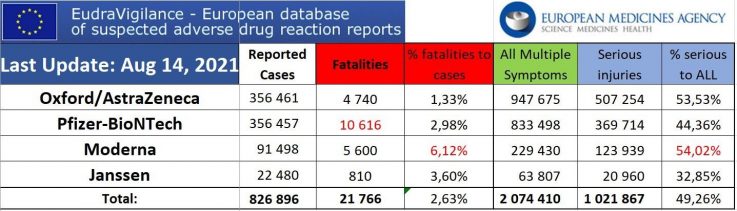
The European Union database of suspected drug reaction reports is EudraVigilance, and they are now reporting 21,766 fatalities, and 2,074,410 injuries, following COVID-19 injections.
A Health Impact News subscriber from Europe reminded us that this database maintained at EudraVigilance is only for countries in Europe who are part of the European Union (EU), which comprises 27 countries.
The total number of countries in Europe is much higher, almost twice as many, numbering around 50. (There are some differences of opinion as to which countries are technically part of Europe.)
So as high as these numbers are, they do NOT reflect all of Europe. The actual number in Europe who are reported dead or injured due to COVID-19 shots would be much higher than what we are reporting here.
The EudraVigilance database reports that through August 14, 2021 there are 21,766 deaths and 2,074,410 injuries reported following injections of four experimental COVID-19 shots:
- COVID-19 MRNA VACCINE MODERNA (CX-024414)
- COVID-19 MRNA VACCINE PFIZER-BIONTECH
- COVID-19 VACCINE ASTRAZENECA (CHADOX1 NCOV-19)
- COVID-19 VACCINE JANSSEN (AD26.COV2.S)
From the total of injuries recorded, half of them (1,021,867 ) are serious injuries.
“Seriousness provides information on the suspected undesirable effect; it can be classified as ‘serious’ if it corresponds to a medical occurrence that results in death, is life-threatening, requires inpatient hospitalisation, results in another medically important condition, or prolongation of existing hospitalisation, results in persistent or significant disability or incapacity, or is a congenital anomaly/birth defect.”
A Health Impact News subscriber in Europe ran the reports for each of the four COVID-19 shots we are including here. It is a lot of work to tabulate each reaction with injuries and fatalities, since there is no place on the EudraVigilance system we have found that tabulates all the results.
Since we have started publishing this, others from Europe have also calculated the numbers and confirmed the totals.*
Here is the summary data through August 14, 2021.
Total reactions for the experimental mRNA vaccine Tozinameran (code BNT162b2,Comirnaty) from BioNTech/ Pfizer – 10,616 deaths and 833,498 injuries to 14/08/2021
- 22,844 Blood and lymphatic system disorders incl. 135 deaths
- 22,132 Cardiac disorders incl. 1,591 deaths
- 208 Congenital, familial and genetic disorders incl. 16 deaths
- 10,953 Ear and labyrinth disorders incl. 8 deaths
- 563 Endocrine disorders incl. 5 deaths
- 12,887 Eye disorders incl. 24 deaths
- 75,021 Gastrointestinal disorders incl. 454 deaths
- 220,575 General disorders and administration site conditions incl. 3,013 deaths
- 893 Hepatobiliary disorders incl. 49 deaths
- 9,094 Immune system disorders incl. 58 deaths
- 27,018 Infections and infestations incl. 1037 deaths
- 10,454 Injury, poisoning and procedural complications incl. 158 deaths
- 20,892 Investigations incl. 342 deaths
- 6,172 Metabolism and nutrition disorders incl. 188 deaths
- 112,364 Musculoskeletal and connective tissue disorders incl. 133 deaths
- 605 Neoplasms benign, malignant and unspecified (incl cysts and polyps) incl. 51 deaths
- 148,477 Nervous system disorders incl. 1,171 deaths
- 910 Pregnancy, puerperium and perinatal conditions incl. 29 deaths
- 152 Product issues incl. 1 death
- 14,950 Psychiatric disorders incl. 141 deaths
- 2,763 Renal and urinary disorders incl. 169 deaths
- 10,909 Reproductive system and breast disorders incl. 3 deaths
- 36,913 Respiratory, thoracic and mediastinal disorders incl. 1,268 deaths
- 40,358 Skin and subcutaneous tissue disorders incl. 92 deaths
- 1,416 Social circumstances incl. 13 deaths
- 651 Surgical and medical procedures incl. 28 deaths
- 23,324 Vascular disorders incl. 439 deaths
Total reactions for the experimental mRNA vaccine mRNA-1273 (CX-024414) from Moderna – 5,600 deaths and 229,430 injuries to 14/08/2021
- 4,341 Blood and lymphatic system disorders incl. 49 deaths
- 6,744 Cardiac disorders incl. 614 deaths
- 89 Congenital, familial and genetic disorders incl. 1 deaths
- 2,916 Ear and labyrinth disorders
- 179 Endocrine disorders incl. 1 death
- 3,579 Eye disorders incl. 13 deaths
- 20,063 Gastrointestinal disorders incl. 205 deaths
- 61,894 General disorders and administration site conditions incl. 2,232 deaths
- 372 Hepatobiliary disorders incl. 20 deaths
- 1,926 Immune system disorders incl. 10 deaths
- 6,597 Infections and infestations incl. 340 deaths
- 4,944 Injury, poisoning and procedural complications incl. 105 deaths
- 4,556 Investigations incl. 107 deaths
- 2,230 Metabolism and nutrition disorders incl. 129 deaths
- 28,909 Musculoskeletal and connective tissue disorders incl. 111 deaths
- 275 Neoplasms benign, malignant and unspecified (incl cysts and polyps) incl. 29 deaths
- 40,922 Nervous system disorders incl. 572 deaths
- 463 Pregnancy, puerperium and perinatal conditions incl. 5 deaths
- 46 Product issues
- 4,510 Psychiatric disorders incl. 96 deaths
- 1,364 Renal and urinary disorders incl. 93 deaths
- 2,012 Reproductive system and breast disorders incl. 2 deaths
- 10,046 Respiratory, thoracic and mediastinal disorders incl. 528 deaths
- 12,375 Skin and subcutaneous tissue disorders incl. 47 deaths
- 966 Social circumstances incl. 20 deaths
- 732 Surgical and medical procedures incl. 56 deaths
- 6,380 Vascular disorders incl. 215 deaths
Total reactions for the experimental vaccine AZD1222/VAXZEVRIA (CHADOX1 NCOV-19) from Oxford/ AstraZeneca: 4,740 deaths and 947,675 injuries to 14/08/2021
- 11,297 Blood and lymphatic system disorders incl. 194 deaths
- 15,757 Cardiac disorders incl. 550 deaths
- 137 Congenital familial and genetic disorders incl. 3 deaths
- 11,013 Ear and labyrinth disorders
- 457 Endocrine disorders incl. 4 deaths
- 16,608 Eye disorders incl. 19 deaths
- 93,703 Gastrointestinal disorders incl. 241 deaths
- 249,973 General disorders and administration site conditions incl. 1,166 deaths
- 770 Hepatobiliary disorders incl. 44 deaths
- 3,770 Immune system disorders incl. 19 deaths
- 23,056 Infections and infestations incl. 298 deaths
- 10,571 Injury poisoning and procedural complications incl. 130 deaths
- 20,678 Investigations incl. 108 deaths
- 11,336 Metabolism and nutrition disorders incl. 65 deaths
- 144,069 Musculoskeletal and connective tissue disorders incl. 66 deaths
- 477 Neoplasms benign malignant and unspecified (incl cysts and polyps) incl. 15 deaths
- 198,450 Nervous system disorders incl. 755 deaths
- 391 Pregnancy puerperium and perinatal conditions incl. 9 deaths
- 146 Product issues incl. 1 death
- 17,784 Psychiatric disorders incl. 40 deaths
- 3,449 Renal and urinary disorders incl. 45 deaths
- 12,080 Reproductive system and breast disorders incl. 1 death
- 33,058 Respiratory thoracic and mediastinal disorders incl. 560 deaths
- 43,592 Skin and subcutaneous tissue disorders incl. 31 deaths
- 1,182 Social circumstances incl. 6 deaths
- 1,040 Surgical and medical procedures incl. 21 deaths
- 22,831 Vascular disorders incl. 349 deaths
Total reactions for the experimental COVID-19 vaccine JANSSEN (AD26.COV2.S) from Johnson & Johnson: – 810 deaths and 63,807 injuries to 14/08/2021
- 585 Blood and lymphatic system disorders incl. 24 deaths
- 988 Cardiac disorders incl. 103 deaths
- 24 Congenital, familial and genetic disorders
- 425 Ear and labyrinth disorders
- 27 Endocrine disorders incl. 1 death
- 836 Eye disorders incl. 3 deaths
- 6,041 Gastrointestinal disorders incl. 28 deaths
- 16,787 General disorders and administration site conditions incl. 201 deaths
- 80 Hepatobiliary disorders incl. 7 deaths
- 260 Immune system disorders incl. 5 deaths
- 1,086 Infections and infestations incl. 27 deaths
- 578 Injury, poisoning and procedural complications incl. 11 deaths
- 3,319 Investigations incl. 56 deaths
- 341 Metabolism and nutrition disorders incl. 13 deaths
- 10,533 Musculoskeletal and connective tissue disorders incl. 19 deaths
- 26 Neoplasms benign, malignant and unspecified (incl cysts and polyps) incl. 2 deaths
- 13,528 Nervous system disorders incl. 101 deaths
- 23 Pregnancy, puerperium and perinatal conditions incl. 1 death
- 19 Product issues
- 794 Psychiatric disorders incl. 9 deaths
- 230 Renal and urinary disorders incl. 9 deaths
- 484 Reproductive system and breast disorders incl. 3 deaths
- 2,155 Respiratory, thoracic and mediastinal disorders incl. 64 deaths
- 1,893 Skin and subcutaneous tissue disorders incl. 3 deaths
- 164 Social circumstances incl. 3 deaths
- 490 Surgical and medical procedures incl. 31 deaths
- 2,091 Vascular disorders incl. 86 deaths
*These totals are estimates based on reports submitted to EudraVigilance. Totals may be much higher based on percentage of adverse reactions that are reported. Some of these reports may also be reported to the individual country’s adverse reaction databases, such as the U.S. VAERS database and the UK Yellow Card system. The fatalities are grouped by symptoms, and some fatalities may have resulted from multiple symptoms.
More COVID Shots on the Way
In spite of all these recorded injuries and deaths, most countries around the world are now preparing to roll out a 3rd Pfizer “booster” shot, as well as authorizing the COVID shots for young children, under the age of 12.
While the alleged COVID-19 “virus” has almost NO impact on deaths among young people, tragically, we cannot say the same for the experimental shots.
Delta Variants, PCR Tests and Cognitive Dissonance
By F. William Engdahl – New Eastern Outlook – 11.08.2021
To paraphrase a famous quip from then Presidential candidate Bill Clinton in a debate with his Republican opponent in 1992, “It’s the vaccine, stupid!” The daily mainstream media and government narrative we are being inundated all over the world with is confusing to most, to put it mildly. So-called Delta or “Indian” variant is spreading like chicken pox we are told, but not what that “spreading” means. Unvaccinated are accused of spreading COVID-19 to those supposedly vaccinated. The USA, UK and EU are leading this confusing and deadly narrative.
Children are told by political appointees to get the jab despite official recommendation from WHO and national medical authorities such as STIKO in Germany to wait. PCR tests that define policy, but which do not tell anything about a person’s having a specific virus, are treated as a “Gold Standard” of infection. Yet as of this writing not one lab has successfully isolated purified samples of the alleged SARS-CoV-2 virus said to cause the COVID-19 disease. How can PCR tests be calibrated if the claimed pathogen is not clear? If we take a step back it becomes clear that we are being subjected to a deliberate worldwide operation in cognitive dissonance whose intended consequences for the future of our civilization are not being told to us.
Resolving dissonance
Cognitive dissonance is a term in psychology for a person’s experience of two contradictory or inconsistent experiences whose inconsistency causes them great stress. The stress is resolved in the brain by the person playing unconscious tricks to resolve the contradiction. The Stockholm Syndrome comes to mind. In this case it is the traditional trust in Authority—governments, WHO, CDC, RKI, Bill Gates and other self-appointed epidemiological experts, in many cases with no medical degree. These authorities are imposing draconian lockdowns, masking and travel restraints and what is rapidly becoming de facto forced vaccination with untested jabs whose adverse effects now number in the millions in the EU and USA.
The ordinary brain says, “Why would the authorities want to harm us? Don’t they want the best for us and the country or the world?” The real experiences of the past 18 months since the World Health Organization declared a pandemic over an alleged virus first proclaimed in Wuhan China suggest that either politicians and health officials across the world have lost their minds, are deliberately evil, or willfully destructive or simply corrupt. To resolve that frightening contradiction, millions of us take an experimental concoction known as mRNA genetically-edited substance assuming then they are protected against infection or severe illness from an alleged deadly pathogen called COVID-19. Some even attack those around them who view the dissonance differently and who refuse a vaccine out of distrust and caution. Yet even the ever-present Dr. Fauci in Washington admits the novel mRNA vaccines do not prevent getting the alleged disease or being infectious, only maybe helps lessen its impact. That is not a vaccine, but rather something else.
Delta Variant?
At this point it is useful to look at several demonstrated facts around this coronavirus and its apparently unlimited “variants.” The current scare in the UK and EU as well as the USA is a so-called Delta variant of the coronavirus. The only problem is that we are not being told by the relevant authorities anything useful about that variant.
Since the alleged Delta variant of an alleged but nowhere scientifically proven Wuhan novel coronavirus is being used to justify a new round of draconian lockdowns and pressure to vaccinate, it is worth looking into the test to determine if a Delta variant is present in a tested person tested with the standard WHO-recommended PCR test.
The Delta Variant back in May was originally called the Indian variant. It was soon blamed for up to 90% of new COVID-19 positive tests in the UK, which also has a significant Indian population. What is not being told is that in just two months the alleged Delta positives in India dropped dramatically from 400,000 daily in May to 40,000 in July. Symptoms were said to be suspiciously like that for ordinary hay fever, so the WHO quickly renamed it the Delta variant according to the Greek alphabet just to muddy the waters more. Similar Delta declines came in the UK. “Experts” claimed it was because terrified Indians stayed at home as only a tiny 1-3% of the population had been vaccinated. In UK experts there claimed it was because so many had been vaccinated that Delta cases plunged. If you get the impression they are just inventing explanations to feed the vaccine narrative, you are not alone.
It gets worse. Virtually no one in the UK, India the EU or the USA who is claimed to have been tested positive for Delta has had a specific Delta variant test as such a direct variant test does not exist. Complex and very costly tests are claimed to exist, but no proof is offered that they are being used to claim such things as “90% of UK cases are Delta…” Labs around the world simply do the standard, highly inaccurate PCR tests and health authorities declare it is “Delta.” There is no simple test for Delta or any other variant. If that were not true, the CDC or WHO or other health institutes should explain in detail those tests. They haven’t. Ask relevant health “experts” how they prove presence of a Delta variant virus. They cannot. Testing labs in the USA admit that they do not test for any variants.
Worthless PCR Tests
Even the PCR test itself is not a test for any virus or disease. The scientist who won a Nobel Prize for inventing the PCR test, Dr. Kary Mullis, went on TV to attack by name NIAID head Tony Fauci as incompetent for claiming the PCR tests could detect any pathogen or disease. It was not designed for that, but rather as a laboratory analytical tool for research. PCR tests cannot determine an acute infection, ongoing infectiousness, nor actual disease. The PCR test is not actually designed to identify active infectious disease, instead, it identifies genetic material, be it partial, alive, or even dead.
A January 21, 2020 published paper by two Germans, Corman and Drosten, was used to create the PCR test immediately adopted by the WHO to be the world standard to detect cases of the novel coronavirus from Wuhan. At that point a mere six persons had been identified having the novel coronavirus. In November 2020 a group of scientific external peers reviewed the Drosten paper and found an incredible number of major scientific flaws as well as brazen conflict of interest by Drosten and colleagues. The scientists noted the Drosten PCR design and paper suffered from, “numerous technical and scientific errors, including insufficient primer design, a problematic and insufficient RT-qPCR protocol, and the absence of an accurate test validation. Neither the presented test nor the manuscript itself fulfils the requirements for an acceptable scientific publication. Further, serious conflicts of interest of the authors are not mentioned. Finally… a systematic peer review process was either not performed here, or of problematic poor quality.” Yet the Drosten PCR design was immediately recommended by the WHO as the world corona test.
The PCR amplifies genetic material by using cycles of amplification until it reaches what is called Cycle threshold (Ct), the number of amplifications to detect genetic material before the sample becomes worthless. Mullis once said if you amplify by enough cycles you can pretty much find anything in anybody as our bodies carry huge numbers of different viruses and bacteria, most harmless. Even Dr. Fauci in a 2020 interviews stated that a CT at 35 or above is worthless. Yet the CDC is believed to recommend testing labs to use a CT of 37 to 40! At that level perhaps 97% of COVID positives are likely false.
Neither the CDC nor the WHO makes public their Ct recommendations, but reports are that the CDC now recommends a lower Ct threshold for testing vaccinated so as to minimize COVID positives in the vaccinated, while recommending a Ct above 35 for the unvaccinated, a criminal manipulation if it is true.
For those interested in the evolution of perverting the PCR tests to supposedly diagnose specific presence of a disease, look into the sordid history beginning in the 1980s of Fauci and his underling then, Dr Robert Gallo, at NIAID, using Mullis’ PCR technology to wrongly claim a person is HIV-positive, a criminal enterprise that resulted in unnecessary deaths of tens or hundreds of thousands of people.
Notably nearly every prominent COVID vaccine advocate from Fauci to WHO head Tedros have come out of the HIV/AIDS swamp and its fake PCR testing. The entire panic measures imposed since 2020 around the world are based on the false premise that “Positive” RT-PCR test means being sick or infected with COVID. The COVID-19 scare that emanated from Wuhan, China in December of 2019 is a pandemic of testing as many doctors have pointed out. There is no proof that a pathogenic virus is being detected by the test. Nor is there a proven reference value, or “gold standard” to determine positive. It is purely arbitrary. Do the research and you will find it.
Pushing Experimental Vaccines
If it is the case that we have destroyed trillions of dollars in the world economy since early 2020 and ruined countless lives based on worthless PCR tests and now the same fraud extends the insanity for an alleged Delta variant, the clear conclusion is that some very influential actors are using that fear to drive experimental genetic vaccines never before tested on humans nor extensively on animals.
Yet the vaccine-related official death toll in the EU and USA continue to break records. As of this writing, according to the official EU database for recording vaccine injuries, EduraVigilance, by August 2 a total of 20,595 deaths had been reported of people who previously received the experimental genetic mRNA jabs! Such numbers have never before been seen. In addition there have been reported 1,960,607 injuries and 50% of them serious including blood clots, heart attacks, menstrual irregularities, paralysis, all following COVID-19 mRNA injections. The USA data at the CDC VAERS database is being manipulated openly, but even they show more than 11,000 post-mRNA vaccine deaths. The major news media never mention this.
Authorities and politicians reply that there is no evidence the deaths or injuries were vaccine related. But they cannot prove that they were not because they prohibit doctors from doing any autopsy. If we are told to follow science, why are doctors being told by health officials to not do autopsies on patients who died AFTER receiving two mRNA vaccines? After thousands of vaccine-related deaths only one autopsy has been reported, that in Germany, and the findings were horrific. The mRNA spike protein had spread through the entire body. The CDC stopped monitoring non-severe COVID-19 cases among vaccinated people in May. That hides the alarming number of vaccinated who get seriously ill.
Something is terribly wrong when respected experienced medical experts are being banned for suggesting alternative hypotheses to the entire COVID drama. When other scientists adhering to the official line call for any criticism of Tony Fauci or other mainstream COVID doctors, they are to be labelled as doing a “Hate Crime.” Or when cheap and proven remedials are prohibited in favor of the costly deadly mRNA vaccines in which Fauci’s NIAID holds a financial interest.
Already vaccine advocates such as Fauci are speaking of the need for booster mRNA shots and warning of yet a new “Lambda variant” looming. How will they test for that? Or are we to take it on faith because he or she is said by CNN or BBC to be a “respected authority”? How far will sane citizens allow this cognitive dissonance to destroy our lives?
F. William Engdahl is strategic risk consultant and lecturer, he holds a degree in politics from Princeton University.
Punishing Scapegoats
By Doug E. Steil | Aletho News | August 12, 2021
Two days ago Merkel and the Bavarian minister announced stringent new measures directed against those who refuse to get their clot shot. For the past few weeks specific media have been inciting hatred against this group, based on lies, more specifically implicit premises that are untrue, as well as illogical or unwarranted conclusions:
• People who got the clot shot are immune to being infected.
• Hence, they are also incapable of infecting others.
• Asymptomatic viral transfer (with high viral load but no sickness) is very common.
• Nearly everyone with no clot shot is at equal risk to get acute viral symptoms.
• At least a 85% “vaccination rate” is required for herd immunity to end the pandemic.
• Those refusing the clot shot are guilty of prolonging the pandemic, harming society.
• These skeptics not going along are parasites who should be shunned from public life.
The recent graph from the central reporting authority in Berlin, the Robert Koch Institute, depicts a 26 week period that highlights the situation very well. The histogram data show gene sequencing information from sampling valid PCR test results, so all the false positives they got are not included here. The government pays labs 200 EUR to sequence a sample.

The gray shades represent the percentage per week that constitutes the derivatives of the virus that emerged in Wuhan, upon which the trial data associated with the clot shot temporary emergency use authorization are based. The blue shades refer to the British variant, and the red to the Indian variant, which have been renamed to get Greek letters. The South African and Brazilian variants barely play a role here.
From an epidemiological perspective it is clear that in Germany the original and British variants have essentially already been eradicated, what one would call “herd immunity” has been attained. Based on information from other countries farther along in the mass experiment, as well as recent admission by the CDC, the clot shot has no effect on the Indian (delta) variant.
Under these circumstances a plausible perception management approach could thus have been:
• Proclaim the experiment was a success because two key variants were wiped out.
• Acknowledge the clot shot is not effective against stemming the Indian variant.
• Discontinue any further inoculations, due to their potential adverse harm.
• Assert that the remaining variant has mild effects and can easily be dealt with.
• Declare an end to the so-called pandemic and the associated restrictive measures.
• Treat all people the same way, yet monitor possible viral spread with thermometers.
However, this was not done because the issue is not about public health but about instituting a totalitarian system that wants to deal harshly with those who are skeptical or critical about the false premises used to bring it on and staunchly refuse to go along with the clot shot experiment. Therefore, the consequences for those not already contaminated twice by the clot shot were instead, as follows:
• The threshold level to get an antigen test for basic activities (haircut, restaurant) was lowered from 50 to 35 (incidences per 100K population per week, based on flawed PCR test).
• People needing to get tested must pay for such tests out of their own pocket beginning October 11.
• In the future, they will likely be excluded altogether from participating in public life. It was suggested they should be shunned by private businesses (restaurants, hotels, cultural venues) as unwelcome customers.
The chosen policy is short-sighted. As the virtuous (obedient) people continue to spread the virus among each other, the skeptics will be blamed for the spread, while those newly infected who thought they were immune will be told that the clot shot is not quite 100% effective, so they will soon need to get a booster shot. Thus, another cycle of madness will be perpetuated, as the totalitarian grip tightens. Authorities want to get rid of the experimental control group consisting of those who did not consent.
EuroMOMO Analysis Indicates That Europe’s Third Wave Was A Blip
By Noah Carl • The Daily Sceptic • August 10, 2021
Has Europe seen two mortality peaks or three? According to many news outlets, the continent experienced a deadly third wave of COVID-19 during the spring of 2021.
“Europe is enduring a grim spring”, says an FT article dated 4th April. “Covid-19 infections, hospitalisations and deaths are rising in many countries”, it goes on to claim. The article presents data suggesting that March saw elevated COVID-19 death rates in a number of European countries.
This characterisation is borne out by Our World in Data’s chart of the daily number of confirmed COVID-19 deaths for the European Union – which is shown below. (The chart for Europe as a whole is highly similar.)
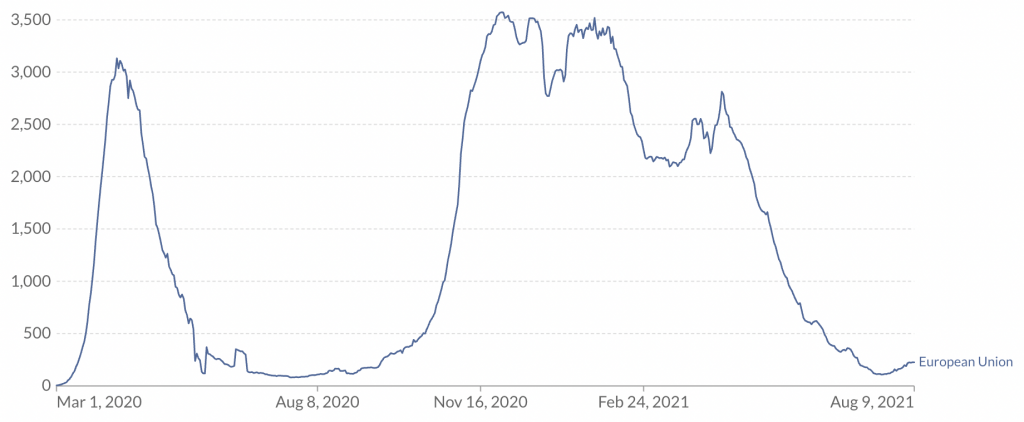
According to the chart, there was a peak of mortality in the spring of 2020, corresponding to the first wave (which afflicted countries such as Italy, Spain and the UK). Then there was another peak of mortality in the winter, corresponding to the second wave (when countries such as Poland, Czechia and Hungary were also afflicted).
And the chart indicates there was an additional peak of mortality in the spring of 2021, corresponding to the third wave. This peak is lower than the first two, but still quite considerable. On 13th April, there were more than 2,800 COVID-19 deaths in Europe (compared to just under 3,600 at the peak of the second wave).
Yet as I’ve noted repeatedly, “confirmed COVID-19 deaths” can be misleading, since some of the people who die of COVID-19 (either shortly after a positive test, or with COVID-19 on the death certificate) would have died anyway. Excess mortality provides a far better gauge of the pandemic’s impact.
Estimates of excess mortality for 26 European countries are provided by researchers at EuroMOMO. The chart below plots excess mortality z-scores (numbers of standard deviations above or below the average) from week 1 of 2020 to week 27 of 2021. I’ve omitted the last three weeks of data, as these are subject to revision.
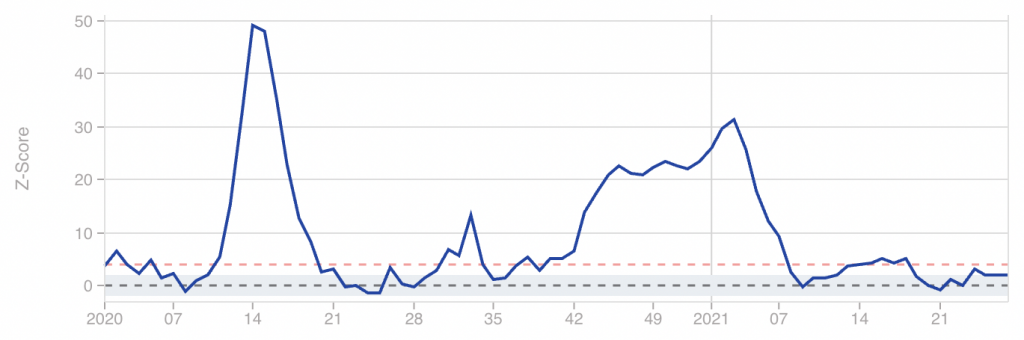
The first and second wave peaks are clearly visible: the former can be seen at week 14 of 2020, and the latter at week 3 of 2021. By comparison, the peak of the third wave (at week 16 of 2021) is barely noticeable.
It does technically rise above the red line, which the researchers oddly classify as a “substantial increase”. However, increases of this magnitude are seen every few months going all the way back to 2017. Hence the third peak cannot be regarded as a major epidemic wave.
Part of the difference between the two charts may be due to the composition of countries. For example, EuroMOMO does not cover Poland, Romania or Czechia. Having said that, the countries it does include make up the vast majority of Europe’s population, so this probably can’t account for much.
The EuroMOMO analysis indicates that Europe has seen two mortality peaks, not three. In terms of excess mortality, the third wave was just a blip.
Featured Video

AIDS Inc. by Gary Null (2007)
or go to
Aletho News Archives – Video-Images
From the Archives
Clash of Civilization, Iran Part II
By Jamal Kanj – Intifada-Palestine.com – January 14, 2011
Israel’s survival kit is: perpetuate conflict, insecurity to rationalize collective hate and finally playing victim.
Devoid of conflict, Israel implodes internally; without hate, Zionism loses its justification; and playing eternal victim to continue blackmailing the West. Absence of this holy trinity, Israel ceases to exist.
From its inception, the house of Zion has mastered exploiting adversarial powers to advance Israel’s cause. For instance, their influence over the Democratic Party in the US began with President Truman’s bid for 2nd term election in 1948.
Responding to strong opposition from Secretary of State General George Marshall and Department experts urging against recognition of Israel, President Truman replied: “I’m sorry gentlemen but I have to answer to hundreds of thousands [Jewish voters] who are anxious for the success of Zionism. I do not have hundreds of thousands of [voting] Arabs among my constituents”
Zionists influence over liberal American politics was matched with the doctrinal school of Conservative theoreticians aligning the Republican Party’s platform with Israel’s objectives. The Neoconservative Zionists, coined Zioncons, invented the “Clash of Civilization” concept to fight Israel’s wars. … continue
Blog Roll
 Aletho News
- 12 Things Your Psychiatrist Was Trained Not to Tell You
- From Unipolar Universalism to Multipolar Civilizational Distinctiveness
- RSF military group defects, joins Sudanese army: State media
- Ireland goalkeeper refuses to play ‘Israel’ as squad weighs boycott
- China pushes back against US on Cuba, Iran
- Ukrainian Soldiers, Potential Mercenaries: Have Gun, Will Travel!
- Burnham’s UN debut… A masterclass in British disinformation
- Iran flights continue despite US aviation sanctions
- Global Tipping Points Lead the World Into a State of Entropy
- The day-after at the White House: USA and Xi Jinping
- If Americans Knew
- Israel forces Gazans to live in constant peril – Daily Update
- Deconstructing Netanyahu’s pants-on-fire UN rant – Daily Update
- Trump betrayed voters with his campaign lies and prioritized a foreign country once he took office
- Netanyahu calls Israel’s war in Gaza ‘opposite of genocide’ in UN speech to near-empty hall
- Settler Kidnappings: Torture, Sexual Abuse and Terrorisation of Palestinian Abductees as Israel Deepens Annexation of West Bank
- Gaza winter nears as 162,000 tents become unusable, raising fears of humanitarian crisis
- Netanyahu says, “It’s the opposite of genocide”; UN says Gaza economy is world’s ‘most severe crisis on record’ – Daily Update
- Israel’s US-Backed Assault on Gaza Has Created the ‘World’s Most Severe Economic Crisis on Record’: UN
- ‘Protecting U.S. Citizens’… From Israel
- ‘This is where I live now, the back of a truck’: a day in the life of a grandmother in Gaza
- No Tricks Zone
- New Study: Earth And Venus Surface Warmth Largely Explained By Convection And Lapse Rate, Not CO2 Or Radiation
- 2025 Nature Paper Claiming Worsening Global Drought Gets RETRACTED …Heavily Flawed
- New Study: ‘Global Drought Shows No Detectable Recent Acceleration Under Climate Warming’
- Economic Masterminds: German Socialists Suggest Taxing Productivity Gains Stemming From Using AI
- The South China Sea Has Not Been Cooperating With The Climate Change Narrative
- Energy Crisis: Germany Enters Heating Season With Historically Low Gas Reserve Fill Levels
- New Study: The Antarctic Ice Sheet Gained Mass From 2020-2024 Due To Staggering Snow And Ice Accumulation
- Study: Ocean Heating Rates From Thousands Of Years Ago ‘Dwarf’ Modern Ocean Heating Rates
- Climate Extremists Target, Attack Large-Scale Power Grid Infrastructure In Germany!
- New Study: Antarctic Ice Melt Has Contributed Less Than 1 Centimeter To Sea Level Rise In The Last 30 Years

