Hungary’s Orban blames Brussels & its climate change policies for soaring EU gas prices
RT | October 8, 2021
The EU should withdraw its policies aimed at tackling climate change as they’re the reason for the record surge in energy prices on the continent in autumn, Viktor Orban, Hungarian Prime Minister, has said.
Energy bills have been spiking for customers across Europe because of bad decisions made by “bureaucrats in Brussels,” who are fighting for ecology by continuously raising the price of energy generated from coal and gas, Orban insisted in a radio interview on Friday.
“These decisions must be withdrawn… at present gas prices are where they should be in 2035. Brussels isn’t the solution today, they are the problem,” he said. “Poles, Czech and we Hungarians demand that the rules should be withdrawn.”
According to the PM, the difficult situation on the energy market would top the agenda at the next EU summit, with Budapest, Warsaw and Prague to present a unified front at the meeting and offer their solutions to the crisis.
Orban again blasted EU climate policy chief Frans Timmermans, who is pushing hard for the EU to cut net greenhouse gas emissions by at least 55% by 2030. He recently warned that the rising emissions from Europe’s transport sector may prevent the bloc from achieving that goal.
“It’s a commissioner called Timmermans, who is posing the biggest threat to us,” the PM said.
The Hungarian leader already attacked Timmermans during his visit to Slovenia on Thursday, saying that “his calculations were incorrect and the EU residents must pay the extra price.” He also slammed the EU’s climate change policies as “foolish.”
Those not paying “the extra price” are actually the Hungarians, as caps on gas and power price hikes for households have been in place in the country after being introduced by Orban’s government in 2010.
The spike in energy bills in the EU, which the experts say was driven by rising gas prices and soaring cost of permits on the bloc’s carbon market, have only increased the split on green transition policies within the 27-member union. While wealthy nations see it as a sign to boost action against climate change, the poorer countries are voicing increasing concerns about the economic fallout of such measures.
Midweek, European gas prices have set a scary record by rising above$1,900 per 1,000 cubic meters – nearly three times higher than in September. The price dropped significantly after Russia said that it was going to boost gas supplies to the bloc, but the situation still remains harsh.
Fully Vaccinated Countries Had Highest Number of New COVID Cases, Study Shows
By Megan Redshaw | The Defender | October 7, 2021
A study published Sept. 30, in the peer-reviewed European Journal of Epidemiology Vaccines found “no discernible relationship” between the percentage of population fully vaccinated and new COVID cases.
In fact, the study found the most fully vaccinated nations had the highest number of new COVID cases, based on the researchers’ analysis of emerging data during a seven-day period in September.
The authors said the sole reliance on vaccination as a primary strategy to mitigate COVID-19 and its adverse consequences “needs to be re-examined,” especially considering the Delta (B.1.617.2) variant and the likelihood of future variants.
They wrote:
“Other pharmacological and non-pharmacological interventions may need to be put in place alongside increasing vaccination rates. Such course correction, especially with regards to the policy narrative, becomes paramount with emerging scientific evidence on real-world effectiveness of the vaccines.”
As part of the study, researchers investigated the relationship between the percentage of population fully vaccinated and new COVID cases across 68 countries and 2,947 U.S. counties that had second dose vaccine, and available COVID case data.
For seven days preceding Sept. 3, researchers computed COVID cases per one million people for each country, as well as the percentage of population that was fully vaccinated.

Relationship between cases per 1 million people (last 7 days) and percentage of population fully vaccinated across 68 countries as of September 3, 2021
Notably, Israel with more than 60% of its population fully vaccinated, had the highest COVID cases per 1 million people during the seven-day period.
Iceland and Portugal, with more than 75% of their populations fully vaccinated, had more COVID cases per 1 million people than countries such as Vietnam and South Africa, where only about 10% of the population is fully vaccinated.
Across U.S. counties, the median new COVID cases per 100,000 people during the seven-day period was similar across the categories of percentage of population fully vaccinated.

Percentage of counties that had an increase of cases between two consecutive 7-day time periods by percentage of population fully vaccinated across 2947 counties as of Sept. 2, 2021
The researchers found a substantial county variation in new COVID cases within categories of percentage of population fully vaccinated. There also appeared to be no significant signaling of COVID cases decreasing in counties where a higher percentages of the population was fully vaccinated.
Of the top five counties with the highest percentage of population fully vaccinated (99.9% – 84.3%), the Centers for Disease Control and Prevention (CDC) identified four as “high” transmission counties.
Three of the four counties classified as “high” transmission had fully vaccinated rates of 90% or higher. Conversely, of the 57 counties classified as “low” transmission by the CDC, 15 had fully vaccinated rates of 20% or lower.
The findings also showed no discernible association between COVID cases and fully vaccinated rates when a one-month lag was considered, to account for the 14-day period it takes for a vaccine to be considered effective.
The authors suggested a correction to the policy narrative is warranted, as increasing vaccination rates is not enough. “Such course correction, especially with regards to the policy narrative, becomes paramount with emerging scientific evidence on real-world effectiveness of the vaccines,” they wrote.
The authors cited data from the Ministry of Health in Israel showing the effectiveness of two doses of Pfizer’s COVID vaccine against preventing SARS-CoV-2 infection was reported to be 39% — substantially lower than the reported trial efficacy of 96%.
Emerging research also shows immunity derived from Pfizer’s COVID vaccine may not be as strong as natural immunity acquired through infection.
A substantial decline in immunity from mRNA vaccines six months post immunization has also been reported along with an increasing number of breakthrough cases among the fully vaccinated, the researchers said.
The authors said stigmatizing populations over vaccines can do more harm than good, and non-pharmacological prevention efforts need to be renewed in order to learn to live with COVID “in the same manner we continue to live 100 years later with various seasonal alterations of the 1918 Influenza virus.”
Breakthrough cases significantly underreported as FDA reviews booster data
The number of vaccinated people testing positive for COVID is on the rise, and doctors in Ohio are reporting more breakthrough cases across hospital systems.
However, only certain types of COVID breakthrough cases are reported at both the state and federal level, leaving patients with mild cases underreported.
“We estimate anywhere from two to 10 times as many positives that are being reported is the real situation,” said Dr. David Margolius, division director of internal medicine at MetroHealth in Cleveland.
“It’s still rare, but I get a dozen COVID positive cases a day in my basket, and usually three or four of them have been vaccinated,” said Margolius.
The Ohio Department of Health and the CDC only report breakthrough cases in patients requiring hospital admission, or cases that resulted in death.
The CDC said it made the change in May in order to “maximize the quality of data collected on cases of greatest clinical and public importance.”
As of Sept. 27, the CDC had received reports from 50 U.S. states and territories of 22,115 patients with COVID vaccine breakthrough infection who were hospitalized or died.
The CDC said the number of COVID vaccine breakthrough infections reported to the agency are an undercount of all SARS-CoV-2 infections among fully vaccinated persons, especially of asymptomatic or mild infections.
In addition, national surveillance relies on passive and voluntary reporting, and data are not complete or representative, according to the CDC.
Massachusetts health officials on Tuesday reported nearly 4,000 new breakthrough cases over the past week, and 46 more deaths, according to NBC Boston.
In the last week, 3,741 new breakthrough cases were reported, with 125 more vaccinated people hospitalized.
This brings the total number of breakthrough cases in Massachusetts to 40,464 — out of 4.63 million vaccinated people — and the death toll among people with breakthrough infections to 300.
According to the Vermont Daily Chronicle, which cited statistics from Vermont’s Department of Health, 76% of the state’s COVID fatalities in September were breakthrough cases, with just eight of the 33 Vermonters who died being unvaccinated.
As of Tuesday, 88% of all eligible Vermonters age 12 and over had been vaccinated with at least one shot.
Health Department spokesperson Ben Truman said most of the vaccine “breakthrough” fatalities were elderly. Because they were among the first vaccinated, Vermont’s elderly “have had more time to potentially become a vaccine breakthrough case,” he said.
According to The Washington Post, Dr. Peter Marks, director of the U.S. Food and Drug Administration’s (FDA) Center for Biologics Evaluation and Research, said Tuesday updated data might make a strong case in support of everyone 18 and older being eligible for COVID vaccine boosters, but the agency will have to see whether its outside advisers agree.
The remarks from Marks came during a webinar as the FDA prepares to meet Oct. 14 and 15 with its outside advisers to discuss authorizing Moderna and Johnson & Johnson COVID booster shots.
Megan Redshaw is a freelance reporter for The Defender. She has a background in political science, a law degree and extensive training in natural health.
© 2021 Children’s Health Defense, Inc. This work is reproduced and distributed with the permission of Children’s Health Defense, Inc. Want to learn more from Children’s Health Defense? Sign up for free news and updates from Robert F. Kennedy, Jr. and the Children’s Health Defense. Your donation will help to support us in our efforts.
European lawmakers, who salivated over Facebook “whistleblower” hearing, plot censorship
By Didi Rankovic | Reclaim The Net | October 7, 2021
Facebook has not had a shortage of whistleblowers over the past years, but most have been ignored and sometimes vilified by mainstream media and the authorities; however, they now have a “star” one, Frances Haugen, who seems to finally be telling them exactly what they want to hear.
And now European countries seem ready to use Haugen’s claims and her testimony this week before the US Congress as an excuse to promote more regulation that would force tech giants to come up with risk assessments every year regarding issues such as misinformation and hate speech.
The gist of Haugen’s testimony, and the reason why she revealed a number of internal Facebook documents prior to that, is the accusation that the social media giant has a negative and harmful effect on society.
So high is the profile now of this former product manager that straight after the congressional testimony, she was on the phone with European Commissioner Thierry Breton, and he was the one to inform the public about their conversation.
Breton, who is known for advocating very far reaching and strict new regulation of US tech giants, said Haugen “confirmed the importance and urgency of why we are pushing to rein in the big platforms.”
The leaked documents that were first reported in the Wall Street Journal – some of which had to do with the practice of white-listing celebrities and their content – now seem to be used as a catalyst in the EU to speed up the process of adopting new rules that aim to deal not only with the platform’s alleged anticomeptitive behavior stemming from their market dominance – but also make to go for more stringent ways of policing their networks – often a euphemism for unchecked moderation and even censorship.
Reports suggest that Haugen and EU officials drafting this legislation are having something of a meeting of minds, since a number of ideas she now has on how to contain Facebook are in agreement with what Brussels has been deliberating and debating for a year.
One of them, the Digital Services Act, would require transparency and disclosure both to regulators and researchers of services, algorithms and content moderation – but in the same breath, “force Facebook and other tech giants to conduct annual risk assessments in areas such as the spread of misinformation and hateful content,” writes the New York Times.
Palestinian factions call for cancellation of Oslo and adoption of national agenda
MEMO | October 7, 2021
Five Palestinian factions called on Wednesday for the cancellation of the Oslo Accords and the adoption of a national agenda agreed upon by their secretaries general in September last year, Sama has reported.
According to the news agency, the five factions are the Democratic Front for the Liberation of Palestine, Islamic Jihad in Palestine, the Vanguard for the Popular Liberation War, the Popular Front for the Liberation of Palestine, and the Popular Front for the Liberation of Palestine – General Command.
They warned against what they called the blackmailing of the UN Relief and Works Agency (UNRWA) and undermining of its status at the expense of the rights of the Palestinian refugees. The EU’s “extortion” against UNRWA to make school textbooks and curriculums “Israel friendly” is intended to make Palestinian students grow up without knowing their national identity, they said.
The factions also reiterated the importance of fast-tracking the adoption of a national resistance strategy instead of Oslo and its related Paris Economic Protocol. The formation of a united leadership for a comprehensive popular resistance effort to push the Israeli occupation out of Palestine is also a priority, they insisted.
“Betting on the delusional international proposals” and dependence on the International Quartet led by the United States “is an extension of a three-decade of failure,” they added. “Political escalation is not achieved through illusory and empty statements, but through the accumulation of material power on the ground.”
With much of Europe facing a worsening squeeze on gas supplies, the West is already looking to blame Russia
By Rachel Lloyd | RT | October 6, 2021
With gas prices rising dramatically across much of Western Europe, and a dip in its transit through Belarus and Ukraine to the EU, many commentators have pointed the finger once again at Russia, as the source for all their woes.
For some, this is evidence that President Vladimir Putin is weaponizing energy to the detriment of the rest of Europe. However, recent events and well-established agreements seem to tell another, less glamorous, story.
Turning off the taps?
The issue being painted as the next big Russian conspiracy is a noticeable drop in gas supplies being moved through Belarus to the EU. Posted on the site of Gazprom – Russia’s state energy corporation and Europe’s largest supplier of natural gas – are numbers that appear to substantiate a 70% dip in volumes reaching the EU, compared with last month.
That number has upset many, especially in the face of Europe’s biggest energy crisis in years. However, the fact is that there are other well-known factors at play using these numbers as evidence that Russian malevolence is more fear-mongering than fact.
Likely the biggest reason is last year’s agreement between Gazprom and its Belarusian subsidiary operator, where it was decided that much less gas would be transited through the Yamal-Europe pipeline in the fourth quarter of 2021. Unsurprisingly, this change was set to start in October of this year, perfectly coinciding with the drop seen today.
Could Moscow really predict a crunch in the European gas market a year in advance? Not likely, especially considering the uncertainty of Covid-19 and its effect on the near future of the world economy and society.
While there may be a dip in gas deliveries right now, when all data is placed on a timeline of the last four years rather than just two misleading months, it’s clear that such anomalies are typical and that there have been similar falls, which have quickly recovered.
Also, overall supplies from Russia to the EU are still on pace with the prior month’s numbers, if not a bit better. The first four days of October show an average of 210 million cubic meters, which is par for the course compared to September and previous months.
The full picture
There are, of course, other variables that need to be considered, some of which existed before the energy crisis first reared its ugly head. In December of 2019, Kiev and Moscow struck a deal on gas transit via Ukraine. As part of it, Russia’s minimum pledged for shipment was changed to 40 bcm annually from 2021 to 2024, down from 65 bcm in 2020 and 86.8 bcm in 2018.
Additionally, the September agreement between Moscow and Hungary has seen the TurkStream pipeline begin pumping supplies to the Central European nation, starting last week. The deal will supply Hungary with 4.5 billion cubic meters of natural gas from Russia annually for the next 15 years. Gas supplies that may have generally transited through Ukraine or the Yamal pipeline are now being funneled through a new route across the Black Sea in order to reach Hungary and Croatia.
There’s also the genuine concern about the cold and snow of the winter season. Russia, known for its harsh winters, can see temperatures drop below -40 centigrade in Siberia – where many of Russia’s gas fields are located. The lower temperatures and harsh conditions of an extreme winter can directly impact oil and gas production and transit.
Typically, to avoid shortages, reserves are filled for storage. However, last year, Russia dealt with an especially long and cold winter and is currently scrambling to stockpile oil and gas to meet its own domestic needs. Gazprom’s oil and gas inventories plummeted to 16% at the end of last winter, well below the standard 35% seen in years prior.
And with the expectation of another brutal snowy season comes the unfortunate understanding that the natural gas powerhouse is not yet in a position to provide more gas to the rest of Europe. In November, when Gazprom should have storage sites replenished, there is hope that Russia can begin to prioritize taking excess volumes and channeling them into the Western European market.
Not orchestrated by Moscow
The unprecedented gas crisis in Europe is currently causing consternation from politicians and economists to those getting their heating bills in the mail. Prices have surged over the past few weeks, often breaking records each day. Current costs are six times higher than last year, with seemingly no end in sight.
However, faulting Putin for the increase is a reach. Demand globally has spiked, potentially as a result of the world economy’s reemergence after the end of global lockdowns. There is more competition among East Asian countries as they angle for a piece of the pie. Just as in Russia, Western European stocks of natural gas were depleted significantly following last winter. There may also be issues developing from Europe’s energy transition.
Delayed by American sanctions in 2019, Nord Stream 2 is beginning to run tests, with natural gas currently being filled in one of the two pipelines. The project will double the current export capacity of gas supplies to Western Europe and is currently awaiting German approval. Had such a delay at the behest of the US not occurred, perhaps gas prices would not be soaring.
In essence, Europe’s current crisis is the result of a perfect storm of conditions – many of which are out of Moscow’s control.
Gazprom “cannot wave a magic wand and deliver extra gas to any place in Europe that requires it on short notice,” notes Vitaly Yermakov, a senior research fellow at the Oxford Institute for Energy Studies. “No matter how hard Gazprom tries, it cannot single-handedly balance such a huge market as Europe.”
Perhaps those countries worst affected should come together and start searching for solutions, rather than just for someone to blame.
Rachel Lloyd is a policy analyst at the Russian Public Affairs Committee (Ru-PAC). She writes about Russia-US relations, international law, and American foreign policy.
There’s a wide range of factors causing massively increased gas prices in Europe, but Russia is not one of them: Kremlin
By Jonny Tickle | RT | October 6, 2021
Russia has nothing to do with the rapidly rising gas prices in Europe, and the country is providing as much as it possibly can to the rest of the continent, the Kremlin said on Wednesday, amid accusations that Moscow is to blame.
Speaking to journalists on Wednesday, spokesman Dmitry Peskov rejected the idea that Russia is playing any part in the rising prices. Earlier that day, the price of gas in Europe once again reached a historical record of $1,900 per 1,000 cubic meters.
“The first and most important thing is that we not only believe, but we insist that Russia is playing no role in what is happening on the gas market in Europe,” Peskov said, noting that Gazprom is pumping as much gas as it can “within the framework of the existing contracts.”
According to the Kremlin spokesman, Russia has avoided huge gas prices due to a well-thought-out strategy, while Europe has made mistakes.
“It’s all very simple. If you bet on the development of wind energy, you create the appropriate infrastructure,” Peskov explained. “But different climate processes happen and suddenly there is less wind. This is what is happening this year in Europe. There is less wind and generation is down.”
Some have accused Moscow of intentionally limiting gas supplies to Europe as a means to speed up the launch of the controversial pipeline Nord Stream 2, which was recently completed.
On Tuesday, the European Commission announced it would look into suggestions that Moscow is trying to boost gas prices. However, according to European Energy Commissioner Kadri Simson, Russia is “fulfilling its long-term contracts.”
U.K. Suffers High Death Toll Despite Massive Spending to Combat Covid
The Daily Sceptic | October 4, 2021
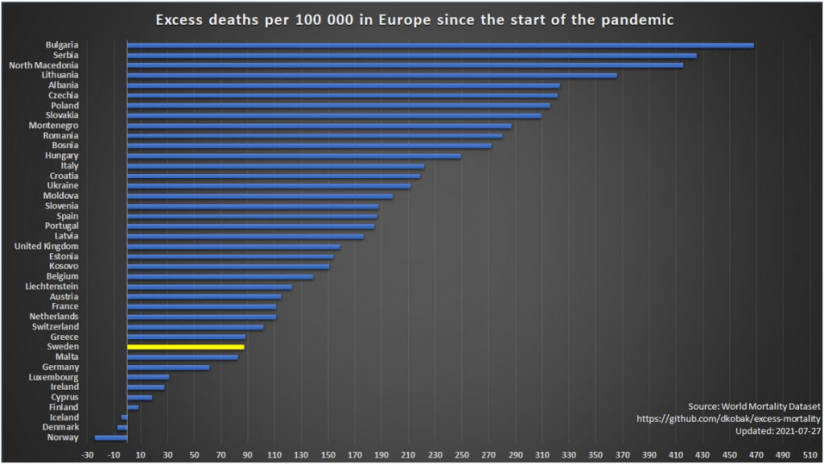
There follows a guest post by a subeditor and long-time Daily Sceptic reader who is keeping his identity anonymous. He has spotted that spectacular healthcare spending and impressive vaccination rates have not brought the U.K. obvious rewards against Covid. (Sweden is highlighted in the graph above because, by imposing the fewest restrictions, it is the closest Europe has to a control.)
Recent figures for European countries from the World Mortality Dataset, depicted in the graph above, reveal that island nations have fared particularly well during the pandemic: Iceland, Cyprus, Ireland and Malta have all recorded low levels of excess deaths. However, there is one noteworthy exception – the U.K.
In fact, even the third poorest country in Europe, Kosovo, riven by war in the late 1990s, and only an independent state since 2008, has performed better. This is despite the Balkan country having, per capita, a fraction of our health service facilities, staff and expertise.
The double-vaccination rate in Kosovo, currently 30% of the population, is a long way behind the U.K. on 66%.
Excess mortality is widely regarded as the best measure of a country’s success in coping with a prolonged health crisis, such as a bad flu season, as it allows for differing evaluations of the causes of death, notably whether they have been ‘with’ or ‘of’ Covid, and disregards arbitrary time limits, such as within 28 days of a positive PCR test. All other deaths, such as those brought on by lockdown measures, are also, of course, included in these statistics.
This evidence shows that spending billions of pounds above normal on health services and staff, and enticing a large proportion of a population to get vaccinated, do not necessarily correlate with a lower number of deaths.
This week’s elections could pave way for Prague to Czech out of EU
By Paul A. Nuttall | RT | October 4, 2021
The elections in the Czech Republic later this week have largely been ignored, but the political situation in the country is not only compelling, it could have ramifications for the rest of Europe, and in particular for the EU.
Czechs go to the polls on Friday and Saturday in legislative elections that will determine who will lead the country for the next four years. These elections have been getting little attention in the international press, mainly because the focus has been on the elections taking place in Germany.
The Czech Republic has been led by a coalition government since 2017. The senior partner in the coalition is the ANO 2011 party, and its leader is the current Prime Minister Andrej Babis.
Babis’ party is described as ‘populist’. An ally of Hungarian Prime Minister Viktor Orban, he recently attended the Demographic Summit in Budapest, where Babis and his counterparts from Poland, Serbia and Slovenia announced their intention to oppose further mass immigration in Europe.
Babis is also opposed to further EU integration and determined not to see the euro replacing the country’s current official currency, the koruna. He claims his party “will not hand over the sovereignty of the Czech Republic to the European Parliament or the European Commission.”
Recent polls put the ANO 2011 party in the lead with 27%. The main opposition parties, SPOLU (an alliance of liberals and conservatives) and the bizarrely named Pirates and Mayors party are polling around 21%. Both are committed to combining their votes in an alliance to force Babis from power.
Indeed, some commentators, who it must be said are firmly opposed to Babis’ politics, are predicting that the Czech Republic could be heading towards a constitutional crisis. However, it is expected that President Milos Zeman will use his constitutional powers to appoint the leader of the largest party as prime minister.
In all likelihood, this will be Babis, and it will give him the first opportunity to form a coalition. However, even if this is the case, he will be facing a big problem, as his current coalition partners have seen their support fall off a cliff recently.
The Social Democrats, who share power with Babis, are only polling between 4% and 6% and may not even make the 5% threshold to have candidates elected to parliament. And this puts Babis in a difficult position because, devoid of his main coalition partner, he will be forced to look elsewhere.
The ‘elsewhere’ in this case is most likely to be the Freedom and Direct Democracy Party (SPD), which is the most Eurosceptic political party in the country and is polling around 11%. The SPD is committed to a direct democracy law that will allow citizens to force referendums, and the one the party wants most is a referendum on Czech membership of the European Union.
SPD leader Tomio Okamura has made it clear that any negotiations for his party to join a future coalition will be conditional on holding such a referendum: “One of the fundamental conditions is for the government manifesto… to include a referendum law including the possibility of a referendum on leaving the EU or potentially NATO.”
Now this places Babis in a difficult position because, although he is a Eurosceptic, he does not envisage the Czech Republic leaving the EU anytime soon. Moreover, he is opposed to the idea of citizen-led referendums, or at least he would like prohibitive barriers implemented, such as a requirement for a huge number of signatories to force a referendum.
Another problem is that a direct democracy law would require the support of a three-fifths majority in both the Chamber of Deputies and the Senate. However, the upper house, which is elected for a six-year term, is dominated by a pro-EU majority.
Nevertheless, the fact that an EU referendum is on the agenda could be seen as an outlier to where the Czech Republic is eventually headed. And let us not forget, the Czechs are not alone here. Recently, there have been noises in Budapest about the need for a referendum on EU membership in Hungary.
Although largely ignored, the elections in the Czech Republic this weekend will be fascinating, but even more enthralling could be the political “horse trading” that follows – the outcome of which could have ramifications for the rest of the EU.
Paul A. Nuttall is a historian, author and a former politician. He was a Member of the European Parliament between 2009 and 2019 and was a prominent campaigner for Brexit.
With blackouts looming, German government’s disaster preparation day promotes ‘cooking without electricity’
RT | October 1, 2021
High demand and the transition to green power has left much of Europe at risk of blackouts. In Germany, state authorities are teaching the public to heat their homes with candles and get used to “cooking without electricity.”
State authorities in North-Rhine Westphalia will hold their first ‘Disaster Protection Day’ on Saturday, with instructors in the city of Bonn teaching citizens how to get by “in the event of a long power failure.” An advert by the federal Civil Protection Office gives a hint of what’s in store, and features an elderly woman wearing several layers of clothing, heating her apartment with candles burning under an upturned flower pot and sealing her windows with reflective foil.
The Civil Protection Office on Friday unveiled an ad campaign focusing on all aspects of crisis preparation, and will soon release a targeted strategy addressing “stockpiling, extreme weather, power failure and emergency baggage.” Meanwhile, officials will present a new book entitled ‘Cooking Without Electricity’ at the event in Bonn on Saturday.
Based on these official communications, blackouts are coming to Germany soon. While the idea of the world’s sixth-most developed country being unable to power itself may seem ludicrous, the problem is Europe-wide, and is the result of a number of factors.
Germany relies heavily on natural gas for heat and power, and supplies were depleted following an unusually cold winter and spring. Globally, gas markets are tight, with increased demand in Asia and an upsurge in air-conditioner use during a hot summer in Europe driving prices to record highs.
Compounding the problem, wind-power generation fell this year, literally due to a lack of wind in Germany. Coal burning has increased to make up this shortfall, yet the cost of European Union ‘carbon credits’ on this fuel is passed on to consumers, with the end result being a spike in energy costs for ordinary Germans, who already pay the highest price per kilowatt hour in the world.
Both the EU and the German government want to rely more heavily on wind and other renewables for power in the future. The EU’s 2030 plan calls for 32% of all energy to be generated from renewable sources, and while Germany already exceeds this target with 44%, the German government plans on eliminating nuclear power by next year and coal by 2038.
Combined, nuclear and coal account for 39% of all electricity generated in Germany. Unless the country can dramatically expand its renewable sector, and count on the wind to power it, their elimination will likely result in even higher prices, and more ‘Disaster Protection Days’ in the coming years.
The same mismatch of supply and demand, coupled with a costly and unreliable transition to green power, has also been seen in other European countries in recent months.
Italians’ electricity bills to rise by 30%, gas up 14%
By Max Civili | Press TV | September 30, 2021
Rome – On Friday, the Italian Energy Authority ARERA announced that electricity bills will rise by almost 30% while gas bills will increase by over 14%, effective from Friday.
Italians are not pleased at all. Some consumer associations have estimated that the sharp rise may cost Italian families up to 2,000 euros a year due to a ripple effect on the entire productive system.
On one side, ARERA has pointed out that without government intervention to stem the rises, spikes in electricity and gas bills would have been 45% and 30% respectively, on the other, people are saying that the executive should have been able to predict the increase and handle the situation more effectively.
In its bid to tackle climate change, the European Union has adopted an Emission Trading Scheme which covers more than 12,000 polluting (sic) companies across the old continent, today.
It consists in the establishment of a market where firms trade emission allowances to cover their annual CO2 emissions, increasing, this way, their expenditures.
Analysts are warning the world is heading into an energy crunch that will likely affect global economies. The prices of fossil fuels such as coal, carbon and gas have all hit record highs lately. This is while crude oil has pushed above 80 dollars a barrel.
Energy price could go much higher if the weather is as cool this winter as some meteorologists predict. It’s not only the people that are worried. Several European energy-intensive industries have claimed that the adoption of the Emission Trading Scheme may entail a significant loss of international competitiveness due to increases in production costs.
Featured Video

AIDS Inc. by Gary Null (2007)
or go to
Aletho News Archives – Video-Images
From the Archives
Clash of Civilization, Iran Part II
By Jamal Kanj – Intifada-Palestine.com – January 14, 2011
Israel’s survival kit is: perpetuate conflict, insecurity to rationalize collective hate and finally playing victim.
Devoid of conflict, Israel implodes internally; without hate, Zionism loses its justification; and playing eternal victim to continue blackmailing the West. Absence of this holy trinity, Israel ceases to exist.
From its inception, the house of Zion has mastered exploiting adversarial powers to advance Israel’s cause. For instance, their influence over the Democratic Party in the US began with President Truman’s bid for 2nd term election in 1948.
Responding to strong opposition from Secretary of State General George Marshall and Department experts urging against recognition of Israel, President Truman replied: “I’m sorry gentlemen but I have to answer to hundreds of thousands [Jewish voters] who are anxious for the success of Zionism. I do not have hundreds of thousands of [voting] Arabs among my constituents”
Zionists influence over liberal American politics was matched with the doctrinal school of Conservative theoreticians aligning the Republican Party’s platform with Israel’s objectives. The Neoconservative Zionists, coined Zioncons, invented the “Clash of Civilization” concept to fight Israel’s wars. … continue
Blog Roll
 Aletho News
- 12 Things Your Psychiatrist Was Trained Not to Tell You
- From Unipolar Universalism to Multipolar Civilizational Distinctiveness
- RSF military group defects, joins Sudanese army: State media
- Ireland goalkeeper refuses to play ‘Israel’ as squad weighs boycott
- China pushes back against US on Cuba, Iran
- Ukrainian Soldiers, Potential Mercenaries: Have Gun, Will Travel!
- Burnham’s UN debut… A masterclass in British disinformation
- Iran flights continue despite US aviation sanctions
- Global Tipping Points Lead the World Into a State of Entropy
- The day-after at the White House: USA and Xi Jinping
- If Americans Knew
- Israel forces Gazans to live in constant peril – Daily Update
- Deconstructing Netanyahu’s pants-on-fire UN rant – Daily Update
- Trump betrayed voters with his campaign lies and prioritized a foreign country once he took office
- Netanyahu calls Israel’s war in Gaza ‘opposite of genocide’ in UN speech to near-empty hall
- Settler Kidnappings: Torture, Sexual Abuse and Terrorisation of Palestinian Abductees as Israel Deepens Annexation of West Bank
- Gaza winter nears as 162,000 tents become unusable, raising fears of humanitarian crisis
- Netanyahu says, “It’s the opposite of genocide”; UN says Gaza economy is world’s ‘most severe crisis on record’ – Daily Update
- Israel’s US-Backed Assault on Gaza Has Created the ‘World’s Most Severe Economic Crisis on Record’: UN
- ‘Protecting U.S. Citizens’… From Israel
- ‘This is where I live now, the back of a truck’: a day in the life of a grandmother in Gaza
- No Tricks Zone
- New Study: Earth And Venus Surface Warmth Largely Explained By Convection And Lapse Rate, Not CO2 Or Radiation
- 2025 Nature Paper Claiming Worsening Global Drought Gets RETRACTED …Heavily Flawed
- New Study: ‘Global Drought Shows No Detectable Recent Acceleration Under Climate Warming’
- Economic Masterminds: German Socialists Suggest Taxing Productivity Gains Stemming From Using AI
- The South China Sea Has Not Been Cooperating With The Climate Change Narrative
- Energy Crisis: Germany Enters Heating Season With Historically Low Gas Reserve Fill Levels
- New Study: The Antarctic Ice Sheet Gained Mass From 2020-2024 Due To Staggering Snow And Ice Accumulation
- Study: Ocean Heating Rates From Thousands Of Years Ago ‘Dwarf’ Modern Ocean Heating Rates
- Climate Extremists Target, Attack Large-Scale Power Grid Infrastructure In Germany!
- New Study: Antarctic Ice Melt Has Contributed Less Than 1 Centimeter To Sea Level Rise In The Last 30 Years

