No opposition from the international community as Israel alters the two-state paradigm
![Israel forces Jerusalemite to demolish his home [Maannews]](https://i2.wp.com/www.middleeastmonitor.com/wp-content/uploads/2020/01/523409C.jpg?resize=650%2C433&quality=85&strip=all&ssl=1)
Israel forces Jerusalemite to demolish his home [Maannews ]
By Ramona Wadi | MEMO | January 21, 2020
The EU is predicting an increase in Israeli demolitions of Palestinian dwellings and structures in the occupied West Bank, thus perpetuating the problem of displacement. Israeli Defence Minister Naftali Bennett has described the plan to apply Israeli sovereignty to Area C as “a real and immediate battle for the future of the Land of Israel.”
In 2019, Israel exceeded the statistics for demolitions and displacement in the previous year. Targeting EU-funded and Palestinian structures alike, the EUobserver stated that Israel had demolished 35 per cent more dwellings and displaced 95 per cent more Palestinians, when compared with 2018.
Despite this, the EU refrains from taking a stance against Israeli colonisation, even as it demands compensation from Israel for the damage to structures funded by the bloc. Last week, Israel demolished a Palestinian home and the foundations of a school in Al-Rifaiyya and Birin respectively.
Bennett’s simplistic justification for the colonisation of Area C attempted to downplay the international consensus. “We are not at the United Nations,” he declared.
Israel’s contempt for international law is well known. However, the ways in which the UN and the EU aid the Zionist state in its trajectory are cast aside. On Monday, the UN Assistant Secretary General for Humanitarian Affairs, Ursula Mueller, called for “continued commitment and consistent and sustained funding to help alleviate the challenges faced by Palestinians in Gaza and the West Bank, including East Jerusalem.”
Mueller’s visit to the occupied Palestinian territories and Tel Aviv illustrated the discrepancy which the UN persists in upholding. In the oPt, the UN official witnessed first-hand the deprivation which left Palestinian communities at risk of losing access to basic necessities, all as a direct result of Israel’s colonisation of their land. In Tel Aviv, however, Mueller “commended Israel on its contribution to global emergency relief efforts.”
In the same way that the UN isolates Palestinians politically, Mueller isolated Palestine from what she means by “global”. The prevailing trend of contributing to Israel’s humanitarian propaganda while refusing to hold it accountable for the decline in Palestinian rights is hypocritical, to say the least.
Bennett’s plans for Area C will increase the humanitarian impact for Palestinians and the financial responsibility will once again fall upon international actors which define Palestine solely through the lens of humanitarian aid.
This generalisation makes it easier to gloss over the human rights violations perpetrated by Israel through enforced military control, impediments to freedom of movement and additional forced displacement, the most recent being the demolition orders for 18 homes in Masafer Yatta.
It is clear that both the UN and the EU are unwilling to act upon their own statistics when it comes to protecting Palestinians and their land. Bennett’s announcement to create “nature reserves” — a frequent euphemism for land theft by the state — in Area C has also fallen on deaf ears, despite the implication of further appropriation of Palestinian territory. With the consequences of Bennett’s action in mind, which part of the two-state compromise is the international community pledging to protect at all costs, indeed to the exclusion of “plan B”?
UN Secretary General Antonio Guterres has repeatedly refused to consider alternatives, if these come from Palestinians, of course. Israel’s altering of Palestine and the international two-state paradigm, once again, is absent from UN concerns, no doubt deliberately so. To put it another way, there is no international opposition to “plan B”, as long as Israel is its architect.
Iran to Review Cooperation with Int’l Nuclear Watchdog In Case of ‘Unjust’ Steps by EU – Reports
Sputnik – 19.01.2020
The European parties to the Iranian nuclear deal earlier launched a dispute resolution mechanism under the agreement, a process that could entail the re-imposition of sanctions on Iran.
Iran’s cooperation with the International Atomic Energy Agency will be reviewed if the EU nations take “unjust” measures after triggering the nuclear deal’s dispute mechanism, Iran’s parliamentary speaker was quoted by the local TV as saying.
“We state openly that if the European powers, for any reason, adopt an unfair approach in using the dispute mechanism, we will seriously reconsider our cooperation with the International Atomic Energy Agency”, a local broadcaster quoted Iranian Parliamentary Speaker Ali Larijani as saying.
On Tuesday, three of the signatories to the JCPOA, namely France, the UK, and Germany, confirmed that they had initiated a dispute mechanism that could see the sanctions against Iran reinstated. The move comes amid Iran’s gradual scale-back on its commitments under the deal, prompted by the US unilateral withdrawal from it in 2018.
Iran’s foreign minister previously condemned the three nations for dancing to the tune of the US. President Trump reportedly threatened the European nations with imposing tariffs on them for their lack of action against Tehran.
Iran recently scrapped its remaining limitations under the JCPOA following the assassination of its top military commander Qasem Soleimani in a US drone strike on 3 January. Tehran has been gradually reducing its commitments under the JCPOA since May 2019 following Washington’s unilateral pullout of the treaty one year earlier and imposition of energy and banking sanctions on the state.
French Popular Uprising: Revolution or Frozen Conflict?
By Diana Johnstone | Consortium News | January 17, 2020
Paris – The people are angry with their government. Where? Just about everywhere. So what makes ongoing strikes in France so special? Nothing, perhaps, except a certain expectation based on history that French uprisings can produce important changes – or if not, can at least help clarify the issues in contemporary social conflicts.
The current ongoing social unrest in France appears to pit a majority of working people against President Emmanuel Macron. But since Macron is merely a technocratic tool of global financial governance, the conflict is essentially an uprising against policies that put the avaricious demands of financial markets ahead of the needs of the people. This basic conflict is at the root of the weekly demonstrations of Yellow Vest protesters who have been demonstrating every Saturday for well over a year, despite brutal police repression. Now trade unionists, public sector workers and Yellow Vests demonstrate together, as partial work stoppages continue to perturb public transportation.
In the latest developments, teachers in Paris schools are joining the revolt. Even the prestigious prep school, the Lycée Louis le Grand, went on strike. This is significant because even a government that shows no qualms in smashing the heads of working class malcontents can hesitate before bashing the brains of the future elite.
Pension System
However general the discontent, the direct cause for what has become the longest period of unrest in memory is a single issue: the government’s determination to overhaul the national social security pension system. This is just one aspect of Macron’s anti-social program, but no other aspect touches just about everybody’s lives as much as this one.
French retirement is financed in the same way as U.S. Social Security. Employees and employers pay a proportion of wages into a fund that pays current pensions, in the expectation that tomorrow’s workers will pay for the pensions of those working today.
The existing system is complex, with particular regimes for 42 different professions, but it works well enough. As things are, despite the growing gap between the ultra-rich and those of modest means, there is less dire poverty among the elderly in France than, for example, in Germany.
The Macron plan to unify and simplify the system by a universal point system claims to improve “equality,” but it is a downward, not an upward leveling. The general thrust of the reform is clearly to make people work longer for smaller pensions. Bit by bit, the input and output of the social security system are being squeezed. This would further reduce the percentage of GDP going into wages and pensions.
The calculated result: as people fear the prospect of a penniless old age, they will feel obliged to put their savings into private pension schemes.
International Solidarity
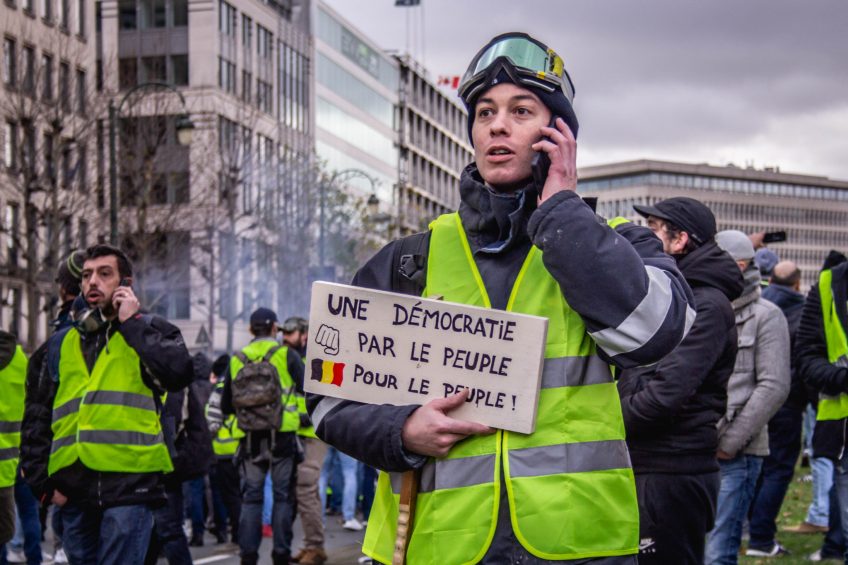
Yellow Vest protest in Brussels, December 2018. (Pelle De Brabander, Flickr, CC BY 2.0, Wikimedia Commons)
In a rare display of old-fashioned working-class international solidarity, Belgian trade unions have spoken out in strong support of French unions’ opposition to Macron’s reforms, even offering to contribute to a strike fund for French workers. Support by workers of one country for the struggle of workers in another country is what international solidarity used to mean. It is largely forgotten by the contemporary left, which tends to see it in terms of opening national borders. This perfectly reflects the aspirations of global capitalism.
The international solidarity of financial capital is structural.
Macron is an investment banker, whose campaign was financed and promoted by investment bankers, including foreign investors. These are the people who helped inspire his policies, which are all designed to strengthen the power of international finance and weaken the role of the State.
Their goal is to induce the State to surrender decision-making to the impersonal power of “the markets,” whose mechanical criterion is profit rather than subjective political considerations of social welfare. This has been the trend throughout the West since the 1980s and is simply intensifying under the rule of Macron.
The European Union has become the principal watch dog of this transformation. Totally under the influence of unelected experts, every two years the EU Commission lays out “Broad Economic Policy Guidelines” – in French GOPÉ (Grandes Orientations des Politiques Économiques), to be followed by member states. The May 2018 GOPÉ for France “recommended” (this is an order!) a set of “reforms,” including “uniformization” of retirement schemes, ostensibly to improve “transparency,” “equity,” labor mobility and – last but definitely not least – “better control of public expenditures.”. In short, government budget cuts.
The Macron economic reform policy was essentially defined in Brussels.
But Wall Street is interested too. The team of experts assigned by Prime Minister Edouard Philippe to devise the administration’s economic reforms includes Jean-François Cirelli, head of the French branch of Black Rock, the seven trillion-dollar New York-based investment manager. About two thirds of Black Rock’s capital comes from pension funds all over the world.
Larry Fink, the American CEO of this monstrous heap of money, was a welcome visitor at the Elysée Palace in June 2017, shortly after Macron’s election. Two weeks later, economics minister Bruno Le Maire was in New York consulting with Larry Fink. Then, in October 2017, Fink led a Wall Street delegation to Paris for a confidential meeting (leaked to Le Canard Enchaîné) with Macron and five top cabinet ministers to discuss how to make France especially attractive to foreign investment.
Larry Fink has an obvious interest in Macron’s reforms. By gradually impoverishing social security, the new system is designed to spur a boom in private pension schemes, a field dominated by Black Rock. These schemes lack the guarantee of government social security. Private pensions depend on stock market performance, and if there is a crash, there goes your retirement. Meanwhile, the money managers play with your savings, taking their cut whatever happens.
There is nothing conspiratorial about this. It is simply international finance at work. Macron and his cabinet ministers are eager to have Black Rock invest in France. For them, this is the way the world works.
The most cynical pretext for Macron’s pension reform is that combining all the various professional regimes into a universal point system favors “equality” – even as it increases the growing gap between salaried people and the super-rich, who don’t need pensions.
But professions are different. At Christmas, striking ballet dancers illustrated this fact by performing a portion of Swan Lake on the cold stones of the entrance to the Opera Garnier in Paris. They were calling public attention to the fact that they cannot be expected to keep working into their sixties, nor can other professions requiring extreme physical effort.
The variations in the current French pension system perform a social function. Some professions, such as teaching and nursing, are essential to society, but wages tend to be lower than in the private sector. These professions are able to renew themselves by ensuring job stability and the promise of comfortable retirement. Take away their “privileges” and recruiting competent teachers and nurses will be even harder than it is already. At present, medical personnel are threatening to resign en masse, because conditions in hospitals are becoming unbearable as a result of drastic cuts in budgets and personnel.
Is There an Alternative?
The real issue is a choice of systems: to be precise, economic globalization versus national sovereignty.
For historic reasons, most French people do not share the ardent faith of British and Americans in the benevolence of the invisible hand of the market. There is a national leaning toward a mixed economy, where the State plays a strong determining role. The French do not easily believe that privatization is better, least of all when they can see it doing worse.
Macron is an ardent devotee of the invisible hand. He seems to expect that by draining French savings into an international investment giant such as Black Rock, Black Rock will reciprocate by pumping investment into French technological and industrial progress.
Nothing could be less certain. In the West these days, there is lots of low interest credit, lots of debt, but investment is rarely creative. Money is used largely to buy what is already there – existing companies, mergers, stock trading (massive in the U.S.) and, for individuals, housing. Most foreign investment in France buys up things like vineyards or goes into safe infrastructure such as ports, airports and autoroutes. When General Electric bought out Alstom, it soon broke its promise to preserve jobs and began cutting back. It also is depriving France of control of an essential aspect of its national independence, its nuclear energy.
In short, foreign investment may weaken the nation in terms in crucial ways. In a mixed economy, profit-making assets such as autoroutes can increase the government’s capacity to make up for periodic deficits in social security, among other things. With privatization, foreign shareholders must get their returns.
The United States, for all its ideological devotion to the invisible hand, actually has a strongly State-supported military industrial sector, dependent on Congressional appropriations, Pentagon contracts, favorable legislation and pressure on “allies” to buy U.S.-made weaponry. This is indeed a form of planned economy, one that fails utterly to meet social needs.
The rules of the European Union prohibit a Member State such as France from developing its own civil-oriented industrial policy, since everything must be open to unhindered international competition. Utilities, services and infrastructure must all be open to foreign owners. Foreign investors may feel no inhibition about taking their profits while allowing these public services to deteriorate.
The ongoing disruption of daily life seems to be forcing Macron’s government to make minor concessions. But nothing can change the basic aims of this presidency.
At the same time, the arrogance and brutal repression of the Macron regime increase demands for radical political change. The Yellow Vest movement has largely adopted the demand developed by Etienne Chouard for a new Constitution empowering citizen-initiated referendums — in short, a peaceful democratic revolution.
But how to get there? Overthrowing a monarch is one thing, but overthrowing the power of international finance is another, especially in a nation bound by EU and NATO treaties. Personal animosity toward Macron tends to shelter the European Union from sharp criticism of its major responsibility.
A peaceful electoral revolution calls for popular leaders with a clear program. François Asselineau continues to spread his radical critique of the EU among the intelligentsia without his party, the Union Populaire Républicaine, gaining any significant electoral strength. Leftist leader Jean-Luc Mélenchon has the oratorical punch to lead a revolution, but his popularity seems to have suffered from attacks even harsher than those unleashed against Jeremy Corbyn in Britain or Bernie Sanders in the U.S. With Mélenchon weakened and no other strong personalities in sight, Marine Le Pen has established herself as Macron’s main challenger in the 2022 presidential election, which risks presenting voters with the same choice they had in 2017.
Asselineau’s analysis, Yellow Vest strategic mass, Mélenchon’s oratory, Chouard’s institutional reforms – these are elements that could theoretically combine (with others yet unknown) to produce a peaceful revolution. But combining political elements is hard chemistry, especially in individualistic France. Without some big surprises, France appears headed not for revolution but for a long frozen combat.
Diana Johnstone is the author of “Fools’ Crusade: Yugoslavia, NATO, and Western Delusions.” Her lates book is “Queen of Chaos: the Misadventures of Hillary Clinton.” The memoirs of Diana Johnstone’s father Paul H. Johnstone, “From MAD to Madness,” was published by Clarity Press, with her commentary. She can be reached at diana.johnstone@wanadoo.fr .
An American Oligarch‘s Dirty Tale of Corruption
By F. William Engdahl – New Eastern Outlook – 12.06.2015
Rarely does the world get a true look inside the corrupt world of Western oligarchs and the brazen manipulations they use to enhance their fortunes at the expense of the public good. The following comes from correspondence of the Hungarian-born billionaire, now naturalized American speculator, George Soros. The hacker group CyberBerkut has published online letters allegedly written by Soros that reveal him not only as puppet master of the US-backed Ukraine regime. They also reveal his machinations with the US Government and the officials of the European Union in a scheme where, if he succeeds, he could win billions in the plunder of Ukraine assets. All, of course, would be at the expense of Ukrainian citizens and of EU taxpayers.
What the three hacked documents reveal is a degree of behind-the-scene manipulation of the most minute details of the Kiev regime by the New York billionaire.
In the longest memo, dated March 15, 2015 and marked “Confidential” Soros outlines a detailed map of actions for the Ukraine regime. Titled, “A short and medium term comprehensive strategy for the new Ukraine,” the memo from Soros calls for steps to “restore the fighting capacity of Ukraine without violating the Minsk agreement.” To do the restoring, Soros blithely notes that “General Wesley Clark, Polish General Skrzypczak and a few specialists under the auspices of the Atlantic Council [emphasis added—f.w.e.] will advise President Poroshenko how to restore the fighting capacity of Ukraine without violating the Minsk agreement.”
Soros also calls for supplying lethal arms to Ukraine and secretly training Ukrainian army personnel in Romania to avoid direct NATO presence in Ukraine. The Atlantic Council is a leading Washington pro-NATO think tank.
Notably, Wesley Clark is also a business associate of Soros in BNK Petroleum which does business in Poland.
Clark, some might recall, was the mentally-unstable NATO General in charge of the 1999 bombing of Serbia who ordered NATO soldiers to fire on Russian soldiers guarding the Pristina International Airport. The Russians were there as a part of an agreed joint NATO–Russia peacekeeping operation supposed to police Kosovo. The British Commander, General Mike Jackson refused Clark, retorting, “I’m not going to start the Third World War for you.” Now Clark apparently decided to come out of retirement for the chance to go at Russia directly.
Naked asset grab
In his March 2015 memo Soros further writes that Ukrainian President Poroshenko’s “first priority must be to regain control of financial markets,” which he assures Poroshenko that Soros would be ready to assist in: “I am ready to call Jack Lew of the US Treasury to sound him out about the swap agreement.”
He also calls on the EU to give Ukraine an annual aid sum of €11 billion via a special EU borrowing facility. Soros proposes in effect using the EU’s “AAA” top credit rating to provide a risk insurance for investment into Ukraine.
Whose risk would the EU insure?
Soros details, “I am prepared to invest up to €1 billion in Ukrainian businesses. This is likely to attract the interest of the investment community. As stated above, Ukraine must become an attractive investment destination.” Not to leave any doubt, Soros continues, “The investments will be for-profit but I will pledge to contribute the profits to my foundations. This should allay suspicions that I am advocating policies in search of personal gain. “
Anyone familiar with the history of the Soros Open Society Foundations in Eastern Europe and around the world since the late 1980’s, will know that his supposedly philanthropic “democracy-building” projects in Poland, Russia, or Ukraine in the 1990’s allowed Soros the businessman to literally plunder the former communist countries using Harvard University’s “shock therapy” messiah, and Soros associate, Jeffrey Sachs, to convince the post-Soviet governments to privatize and open to a “free market” at once, rather than gradually.
The example of Soros in Liberia is instructive for understanding the seemingly seamless interplay between Soros the shrewd businessman and Soros the philanthropist. In West Africa George Soros backed a former Open Society employee of his, Liberian President Ellen Johnson Sirleaf, giving her international publicity and through his influence, even arranging a Nobel Peace Prize for her in 2011, insuring her election as president. Before her presidency she had been well-indoctrinated into the Western free market game, studying economics at Harvard and working for the US-controlled World Bank in Washington and the Rockefeller Citibank in Nairobi. Before becoming Liberia’s President, she worked for Soros directly as chair of his Open Society Initiative for West Africa (OSIWA).
Once in office, President Sirleaf opened the doors for Soros to take over major Liberian gold and base metals assets along with his partner, Nathaniel Rothschild. One of her first acts as President was to also invite the Pentagon’s new Africa Command, AFRICOM, into Liberia whose purpose as a Liberian investigation revealed, was to “protect George Soros and Rothschild mining operations in West Africa rather than champion stability and human rights.”
Naftogaz the target
The Soros memo makes clear he has his eyes on the Ukrainian state gas and energy monopoly, Naftogaz. He writes, “The centerpiece of economic reforms will be the reorganization of Naftogaz and the introduction of market pricing for all forms of energy, replacing hidden subsidies…”
In an earlier letter Soros wrote in December 2014 to both President Poroshenko and Prime Minister Yatsenyuk, Soros openly called for his Shock Therapy: “I want to appeal to you to unite behind the reformers in your government and give your wholehearted support to a radical, ‘big bang’ type of approach. That is to say, administrative controls would be removed and the economy would move to market prices rapidly rather than gradually… Naftogaz needs to be reorganized with a big bang replacing the hidden subsidies…”
Splitting Naftogaz into separate companies could allow Soros to take control of one of the new branches and essentially privatize its profits. He already suggested that he indirectly brought in US consulting company, McKinsey, to advise Naftogaz on the privatization “big bang.”
The Puppet-Master?
The totality of what is revealed in the three hacked documents show that Soros is effectively the puppet-master pulling most of the strings in Kiev. Soros Foundation’s Ukraine branch, International Renaissance Foundation (IRF) has been involved in Ukraine since 1989. His IRF doled out more than $100 million to Ukrainian NGOs two years before the fall of the Soviet Union, creating the preconditions for Ukraine’s independence from Russia in 1991. Soros also admitted to financing the 2013-2014 Maidan Square protests that brought the current government into power.
Soros’ foundations were also deeply involved in the 2004 Orange Revolution that brought the corrupt but pro-NATO Viktor Yushchenko into power with his American wife who had been in the US State Department. In 2004 just weeks after Soros’ International Renaissance Foundation had succeeded in getting Viktor Yushchenko as President of Ukraine, Michael McFaul wrote an OpEd for the Washington Post. McFaul, a specialist in organizing color revolutions, who later became US Ambassador to Russia, revealed:
Did Americans meddle in the internal affairs of Ukraine? Yes. The American agents of influence would prefer different language to describe their activities — democratic assistance, democracy promotion, civil society support, etc. — but their work, however labeled, seeks to influence political change in Ukraine. The U.S. Agency for International Development, the National Endowment for Democracy and a few other foundations sponsored certain U.S. organizations, including Freedom House, the International Republican Institute, the National Democratic Institute, the Solidarity Center, the Eurasia Foundation, Internews and several others to provide small grants and technical assistance to Ukrainian civil society. The European Union, individual European countries and the Soros-funded International Renaissance Foundation did the same.
Soros shapes ‘New Ukraine’
Today the CyberBerkut hacked papers show that Soros’ IRF money is behind creation of a National Reform Council, a body organized by presidential decree from Poroshenko which allows the Ukrainian president to push bills through Ukraine’s legislature. Soros writes, “The framework for bringing the various branches of government together has also emerged. The National Reform Council (NRC) brings together the presidential administration, the cabinet of ministers, the Rada and its committees and civil society. The International Renaissance Foundation which is the Ukrainian branch of the Soros Foundations was the sole financial supporter of the NRC until now…”
Soros’ NRC in effect is the vehicle to allow the President to override parliamentary debate to push through “reforms,” with the declared first priority being privatization of Naftogaz and raising gas prices drastically to Ukrainian industry and households, something the bankrupt country can hardly afford.
In his letter to Poroshenko and Yatsenyuk, Soros hints that he played a key role in selection of three key non-Ukrainian ministers—Natalia Jaresko, an American ex- State Department official as Finance Minister; Aivras Abromavicius of Lithuania as Economics Minister, and a health minister from Georgia. Soros in his December 2014 letter, referring to his proposal for a “big bank” privatization of Naftogaz and price rise, states, “You are fortunate to have appointed three ‘new Ukrainian’ ministers and several natives (sic) who are committed to this approach.”
Elsewhere Soros speaks about de facto creating the impression within the EU that the current government of Yatsenyuk is finally cleaning out the notorious corruption that has dominated every Kiev regime since 1991. Creating that temporary reform illusion, he remarks, will convince the EU to cough up the €11 billion annual investment insurance fund. His March 2015 paper says that, “It is essential for the government to produce a visible demonstration (sic) during the next three months in order to change the widely prevailing image of Ukraine as an utterly corrupt country.” That he states will open the EU to make the €11 billion insurance guarantee investment fund.
While saying that it is important to show Ukraine as a country that is not corrupt, Soros reveals he has little concern when transparency and proper procedures block his agenda. Talking about his proposals to reform Ukraine’s constitution to enable privatizations and other Soros-friendly moves, he complains, “The process has been slowed down by the insistence of the newly elected Rada on proper procedures and total transparency.”
Soros suggests that he intends to create this “visible demonstration” through his initiatives, such as using the Soros-funded National Reform Council, a body organized by presidential decree which allows the Ukrainian president to push bills through Ukraine’s legislature.
George Soros is also using his new European Council on Foreign Relations think-tank to lobby his Ukraine strategy, with his council members such as Alexander Graf Lambsdorff or Joschka Fischer or Karl-Theodor zu Guttenberg, not to mention former ECB head, Jean-Claude Trichet no doubt playing a subtle role.
George Soros, now 84, was born in Hungary as a Jew, George Sorosz. Soros once boasted in a TV interview that he posed during the war as a gentile with forged papers, assisting the Horthy government to seize property of other Hungarian Jews who were being shipped to the Nazi death camps. Soros told the TV moderator, “There was no sense that I shouldn’t be there, because that was–well, actually, in a funny way, it’s just like in markets–that if I weren’t there–of course, I wasn’t doing it, but somebody else would.”
This is the same morality apparently behind Soros’ activities in Ukraine today. It seems again to matter not to him that the Ukrainian government he helped bring to power in the February 2014 US coup d’etat is riddled with explicit anti-semites and self-proclaimed neo-Nazis from the Svoboda Party and Pravy Sektor. George Soros is clearly a devotee of “public-private-partnership.” Only here the public gets fleeced to enrich private investors like Mr. Soros and friends. Cynically, Soros signs his Ukraine strategy memo, “George Soros–A self-appointed advocate of the new Ukraine, March 12, 2015.”
How Europe betrayed Iran: By triggering JCPOA dispute mechanism, EU helps Trump finish job of killing the Iran nuclear deal
By Scott Ritter | RT | January 15, 2020
Europe could have saved the Iran nuclear agreement. Instead, it abused the rule of law by inappropriately triggering its dispute mechanism, all but ensuring the agreement’s demise.
Disingenuous diplomacy
On January 5, 2020, Tehran announced that it would no longer comply with its obligations under the Iran nuclear agreement, officially known as the Joint Comprehensive Program of Action (JCPOA). Iran’s actions are in response to the withdrawal of the US from the JCPOA, and the re-imposition of economic sanctions by the US which had been lifted when the deal came into force.
In response to the Iranian actions, the governments of France, Germany, and the UK – all parties to the deal, along with the European Union (EU) – invoked provisions within the JCPOA, known as the Dispute Resolution Mechanism (DRM), in an effort to bring Iran back into compliance.
The triggering of the DRM by the European countries, however, is a disingenuous move designed to provide diplomatic cover for the EU’s own failures when it comes to JCPOA implementation.
Moreover, given the likely outcome of this process, a convening of the UN Security Council where economic sanctions will be re-imposed on Iran by default, the Europeans have all but assured the demise of the JCPOA, with their so-called diplomacy serving as little more than a facilitator of a larger crisis between Iran and the US that, given the heightened tensions between these two nations in the aftermath of the assassination of Qassem Soleimani, precipitously increases the prospects for war.
Big powers always had an easy way out of deal
When the JCPOA was finalized in July 2015, the world was given hope that the crisis over Iran’s nuclear enrichment capability, which had been threatening to boil over into war, had been resolved, and diplomacy had prevailed over armed conflict.
The JCPOA codified a number of restrictions on Iran’s ability to enrich uranium, including the numbers and types of centrifuges that could be used, where enrichment could take place, what level of enrichment could occur, and how large of a stockpile of enriched nuclear material Iran was allowed to maintain, and an intrusive comprehensive inspection regime designed to verify Iran’s compliance.
These restrictions were designed to ease over time through a series of so-called “sunset clauses,” until all that remained was an enhanced inspection process. In short, the JCPOA legitimized Iran’s right to enrich uranium for peaceful purposes while simultaneously recognizing the concerns of some within the international community regarding the potential for Iran to abuse this enrichment capability for military purposes.
The JCPOA was, in effect, a comprehensive confidence building mechanism intended to build trust between Iran and the international community over time, consistent with the agreement’s preamble, which declared “Iran reaffirms that under no circumstances will Iran ever seek, develop or acquire any nuclear weapons.”
Prior to the implementation of the JCPOA, Iran had been subjected to stringent economic sanctions levied under the authority of the UN Security Council. In exchange for entering into the agreement, these sanctions were lifted.
However, the deal recognized that disputes could emerge regarding the implementation of the agreement, and put in place a dispute resolution mechanism which, if no satisfactory solution was found to an identified problem, would result in these sanctions being automatically re-imposed.
A key aspect of this mechanism was that if any party to the agreement used its veto in the UN Security Council to block a vote related to nonperformance on the part of any party to the agreement, then the economic sanctions would automatically be reinstated.
Washington sabotages JCPOA
For the first two-plus years of the deal’s existence, from July 2015 through to May 2018, Iran was found to be in full compliance with its commitments.
In May 2018, however, the US precipitously withdrew from the agreement, claiming that the eventual expiration of the “sunset clauses” paved the way for Iran to produce a nuclear weapon, and as such the JCPOA was little more than a facilitator of Iranian nuclear malign intent.
The US began re-imposing economic sanctions on Iran, all of which included so-called secondary sanctions which applied to any nation that violated the US sanctions. Iran rightfully viewed the re-imposition of sanctions by the US as a violation of the deal.
Furthermore, when EU companies began balking on their willingness to do business with Iran out of fear of US secondary sanctions, Iran rightfully found the EU to be in violation of the JCPOA as well.
Iran gave the remaining parties to the JCPOA six months following the US withdrawal to develop the necessary mechanisms needed to sidestep the impact of the US economic sanctions.
By November 2018, however, no such mechanisms had been implemented, and when the US targeted Iran’s economic lifeblood by sanctioning oil sales, Iran responded by invoking its rights under Article 26 and Article 36 of the JCPOA, which allows Iran to “cease performing its commitments under the JCPOA, in whole or in part”, for either the re-imposition of new nuclear-related sanctions, or “significant nonperformance” of obligations under the JCPOA, or in this case, both.
Since that time, Iran has been gradually stepping away from the restrictions imposed on it, noting each time that its measures were immediately reversible should the underlying issues be resolved in a manner that complied with the letter and intent of the JCPOA.
Europe’s cowardice
In short, Iran demanded that the EU live up to its obligations to stand up to the US economic sanctions. The EU has consistently failed to do so, resulting in Iran’s gradual backing away from its obligations, leading to the current state of affairs where all of the restrictions imposed by the JCPOA, not including international inspections, which continue unabated, have ceased to be in operation.
When it comes to levying fault for the current state of affairs, there is no “chicken or egg” causality up for debate. Blame lies squarely on both the US for withdrawing from the deal, and the EU for failing to live up to its obligations under the JCPOA regarding economic engagement with Iran.
Iran has long warned the governments of France, Germany, and the UK not to invoke the DRM, noting that the JCPOA does not permit such a move if, as is the case today, Iran is exercising its legal right in response to the illegal and unilateral actions of the US.
There is no realistic expectation that Iran will change its position in this regard. Russia and China have already indicated that Iran is fully within its rights within the JCPOA to back off its obligations regarding restrictions imposed on its nuclear program, citing US and EU non-performance.
By invoking the DRM, the Europeans have, knowingly and wittingly, initiated a process that can only have one outcome, the termination of the JCPOA. In doing so, the EU has breathed life into unfounded US allegations of Iranian nuclear weapons intent, setting up an inevitable clash between the Washington and Tehran that has the real potential of dragging the whole world down with it.
Scott Ritter is a former US Marine Corps intelligence officer. He served in the Soviet Union as an inspector implementing the INF Treaty, in General Schwarzkopf’s staff during the Gulf War, and from 1991-1998 as a UN weapons inspector.
Bumpy Road to New Russia-Ukraine Gas Agreement
By Tim Korso – Sputnik – 31.12.2019
After several years of arguing in courts and disputing the decisions afterwards, Russia’s Gazprom and Ukraine’s Naftogaz have finally signed a new long-term contract on gas transits via Ukrainian territory, which will come into effect on 1 January 2020.
The gas dispute between Russia and Ukraine essentially started over violations of a contract signed back in 2009. It posited that Ukraine would buy a certain amount of Russian gas annually, while Gazprom would transit a certain minimum volume of gas every year through the Ukrainian pipeline. However, at some point after the Ukrainian government was overthrown in the 2014 coup, Kiev stopped buying gas, thereby initiating a gas dispute between countries.
Here is how it erupted and developed over the years, with mutual demands, lawsuits, and attempts to reconcile.
Ukraine’s Violations and Gazprom’s Demands
- Following the coup, Kiev started accumulating debt by not paying for the gas it had obtained from Russia. This was partially due to Moscow discontinuing discounts on gas that had been granted to the country, raising prices from 286 dollars to the market level of 485 dollars per 1,000 cubic metres.
- These discounts were tied to a leasing contract for a Black Sea military base for Russia’s fleet in Crimea, which was voided soon after the 2014 coup.
- The Ukrainian gas debt reached $5 billion and in June 2014, Gazprom started supplying gas to Ukraine on a pre-paid basis only. Kiev refused to buy it on such terms, while demanding a return to the old gas price, stopping its gas purchases from Russia.
- Gazprom filed a suit with the Stockholm Court of Arbitration, demanding that Ukraine’s Naftogaz gas company repay the debt and pay a fine for not buying the minimum gas volume from Russia.
- Gazprom made several proposals for gas prices to Kiev, offering to reduce it to 232 dollars, but Ukraine repeatedly skipped payments throughout 2015. On 25 November 2015, Russia stopped supplying gas to the country for good due to its unwillingness to pay for it.
- The amount demanded by Gazprom from Naftogaz over its debt and unbought gas grew as the dispute continued, increasing from $5 billion to $37 billion by 2017.
- The Stockholm Court of Arbitration decided on 22 December 2017 to partially satisfy Gazprom’s demands, ruling that Naftogaz had to pay $2.019 billion to the Russian company. It dismissed Kiev’s demands for a reduction of gas prices.
Ukraine’s Naftogaz’s Counter-Demands
- Parallel with Gazprom’s demands, Ukraine’s Naftogaz in October 2014 filed its own suit with the Stockholm Court of Arbitration, accusing the Russian company of violating the provisions of the 2009 contract by transiting less than the minimum set volumes of gas annually.
- Naftogaz also demanded that the transit prices set in 2009 be increased.
- The amount demanded by Naftogaz was constantly growing, reaching $27 billion in 2017.
- The Stockholm Court of Arbitration ruled on 28 February 2018 that Gazprom owed $4.673 billion to Naftogaz for transiting less than the required volume of gas through Ukraine’s pipeline system.
Signing of New Contract
While Ukraine was satisfied with the court’s decision, Gazprom appealed the ruling, refusing to pay the consequent $2.56 billion fine. The fine also served as a stumbling block in the negotiations between Gazprom and Naftogaz on a new contract to replace the one signed in 2009 – the Russian company demanded that the two parties mutually nullify their demands in order to sign an agreement. Kiev refused to do so, even though the contract would guarantee gas transits through Ukraine despite the upcoming launch of two new pipelines to Europe from Russia.
In the end, Russia acceded to Ukraine’s demands and signed the new contract on 31 December 2019 while agreeing to pay $2.56 billion, with Russian Prime Minister Dmitry Medvedev calling it a “necessary compromise”. At the same time, the new deal ensures that the two sides will never file any new suits on old contracts in the future and will recall all pending cases from the courts against each other.
Gazprom will transit at least 65 billion cubic metres (over two trillion cubic feet) in 2020 and 40 billion cubic metres (1.5 trillion cubic feet) per year thereafter for four more years through Ukraine under the new contract. Ukrainian President Volodymyr Zelensky stated that Kiev expects to receive at least $7 billion in revenue during the five-year period that the contract covers.
Russia & Ukraine strike last-minute gas transit deal to avoid stoppage of energy supplies to Europe
RT | December 30, 2019
Russian and Ukrainian state energy majors Gazprom and Naftogaz have reached a breakthrough agreement to continue the transit of Russian natural gas to European countries using the Ukrainian pipeline network.
The package deal inked between the Russian company and Ukraine has restored the balance of interests between the parties, Gazprom CEO Alexey Miller said, noting that the Russian energy giant “has made everything possible and has proved one more time that it is a responsible supplier and a reliable partner.”
The agreement will ensure the transit of Russian gas through pipelines on Ukrainian territory for the next five years, Ukrainian President Volodymyr Zelensky has revealed, adding that Kiev is set to receive over $7 billion from Moscow within the deal.
After the current contract expires, the parties will have the option to extend the deal for the next 10 years, Zelensky wrote in a Facebook post late on Monday.
Pursuant to the deal, Ukraine’s Naftogaz will transmit 65 billion cubic meters of Russian gas in 2020 and 40 billion cubic meters annually in the 2021-2024 period, the Ukrainian leader confirmed.
All legal issues that now exist between the two companies have been settled, Gazprom has confirmed in a statement, noting that the parties also agreed not to initiate any lawsuits with respect to the 2009 transit contract that expires in January.
The two sides signed the documents on Monday following a marathon five days of negotiations in Vienna, with the old agreement due to expire on December 31.
Last week, Russia and Ukraine reached an agreement “in principle” to extend the gas contract, and they have been working on the final documents since then. The delegations had to determine how Russia’s Gazprom will cooperate with the Ukrainian operator of the national gas system, and how the transit of the blue fuel will be organized, as well as finalizing an agreement to drop reciprocal claims.
Washington’s Unmasked Imperialism Towards Europe and Russia
Strategic Culture Foundation | December 27, 2019
Washington must think the rest of the world is as stupid as many of its own politicians are. Its passing into law – signed by President Trump this week – of sanctions to halt the Nord Stream-2 and Turk Stream gas supply projects is a naked imperialist move to bludgeon the European energy market for its own economic advantage.
US sanctions are planned to hit European companies involved with Russia’s Gazprom in the construction of the 1,225-kilometer pipeline under the Baltic Sea which will deliver natural gas from Russia to Germany and elsewhere across the European Union. The €9.5 billion ($11bn) project is 80 per cent complete and is due to be finished early next year.
It is quite clear – because US politicians have openly acknowledged it – that Washington’s aim is to oust Russia as the main natural gas exporter to the giant EU market, and to replace with more expensive American-produced gas.
What’s hilarious is the way American politicians, diplomats and news media are portraying this US assault on market principles and the sovereignty of nations as an act of chivalry.
Washington claims that the sanctions are “pro-European” because they are “saving Europe from dependency on Russia for its energy”. The American hypocrisy crescendoes with the further claim that by stopping Russia earning lucrative export revenues, then Moscow will be constrained from “interfering” in European nations. As if Washington’s own actions are not interference on a massive scale.
European politicians and businesses are not buying this American claptrap. The vast overstepping by Washington into European affairs has prompted EU governments to question the nature of the trans-Atlantic relation. About time too. Thus, Washington’s hubris and bullying are undermining its objective of dominating Europe for its own selfish interests.
Russia, Germany and others have defiantly told Washington its weaponizing of economic sanctions will not halt the Nord Stream nor the Turk Stream projects.
As German Foreign Minister Heiko Maas said earlier this month, “it is unacceptable” for the US to brazenly interfere in European and Russian energy trade. The American pretext of supposedly “protecting” the national security of its purported European allies is frankly laughable.
The American agenda is a blatantly imperialistic reordering of the energy market to benefit US economic interests. To pull off this audacious scam, Washington, by necessity, has to demonize and isolate Russia, while also trampling roughshod over its European allies. Europe has partly aided this American stitch-up of its own interests because it has foolishly indulged in the US antagonism towards Russia with sanctions due to the Ukraine conflict, Crimea and other anti-Russia smears.
The legislation being whistled through the American Congress by both Republicans and Democrats (collectively dubbed the War Party) is recklessly fueling tensions between the US and Russia. In trying to gain economic advantages over Europe’s energy, Washington is wantonly ramping up animus towards Moscow.
Apart from the sanctions against Russian and European companies partnering on Nord Stream, the US Congress passed separate legislation which seeks to boost American oil and gas production in the East Mediterranean.
A Radio Free Europe report this week was headlined: ‘Congress Passes More Legislation Aimed At Curbing Russia’s Energy Grip On Europe’.
The headline should more accurately have been worded: ‘Congress Passes More Legislation Aimed At Bolstering America’s Energy Grip On Europe’.
The RFE report states: “The bipartisan Eastern Mediterranean Security and Energy Partnership Act, which was approved on December 19, is the latest piece of US legislation passed this year that aims to diversify Europe’s energy sources away from Kremlin-controlled companies.”
Again, the American double-think is jaw-dropping. Such is the arrogance of a flailing, delusional empire when it can publicly justify with a straight face an energy-market-grab with a veneer of virtue.
US oil and gas giants are moving into the East Mediterranean. Exxon Mobil announced the discovery of a major natural gas field off Cyprus in February this year. American firms are also partnering with Israeli companies to begin gas production in the Leviathan Field located off the coast at Haifa.
There is no doubt that the US sanctions targeting Nord Stream and Turk Stream are part of a bigger concerted pincer movement by Washington to corner the EU energy market of 500 million consumers.
Colin Cavell, a US professor of political science, commented to Strategic Culture Foundation: “What should be hammered down in this continuing debate over which country will be able to deliver oil and natural gas to Europe is the fact that neither the United States nor, and especially, the Republican Party, stand for so-called free trade.”
Free-trade capitalism is supposed to be an ideological pillar of the US. In this ideology, governments should not interfere with market supply and demand. But paradoxically as far as US-imposed sanctions on Russian-European energy companies are concerned the American Congress is “quintessentially anti-free market”, notes Cavell.
In its shameless profiteering, Washington is acting aggressively towards Russia and Europe while flouting its own supposed economic principles and relying on brute force to win its arguments. America’s imperialist agenda towards Europe and Russia is how world wars are instigated.
Trump administration and Moscow shoot down bipartisan DASKA “sanctions bill from hell”
By Sarah Abed | December 23, 2019
In August of 2018, Senators Lindsey Graham (R-S.C.) and Robert Menendez (D-N.J.) first introduced what Graham referred to as a “sanctions bill from hell” targeting Russia and President Vladimir Putin and making it harder for the United States to leave NATO. Despite bipartisan grievances with Moscow the bill didn’t gain much traction.
The measure to push President Trump to take a tougher stance against Russia over alleged election interference, aggression towards Ukraine and involvement in Syria’s proxy war is titled the Defending American Security from Kremlin Aggression Act (DASKA) and would impose strict and broad penalties.
In February of this year, DASKA was reintroduced with Senator Graham stating the following, “Our goal is to change the status quo and impose meaningful sanctions and measures against Putin’s Russia,” and “He should cease and desist meddling in the U.S. electoral process, halt cyberattacks on American infrastructure, remove Russia from Ukraine, and stop efforts to create chaos in Syria.”
During a Senate Floor speech on February 7th, Senator Menendez even went as far as saying that he speculated whether President Trump “is an asset of the Russian government” and concluded his speech by saying, “this Administration’s deference to the Kremlin demands Congress be proactive in shaping U.S. foreign policy toward Russia, especially with respect to sanctions.”
Fast forward to last Wednesday when the U.S. Senate Foreign Relations Committee advanced the bill with a 17-5 vote. The next step is for the legislation to pass the full Senate and House of Representatives before it can be brought to President Donald Trump to sign into law or veto.
However, the White House has already stated their opposition to DASKA, which targets Russian banks, Russia’s cyber sector, new sovereign debt, and would impose measures on its oil and gas sectors. The bill also imposes several requirements on the State Department including generating reports investigating President Putin’s wealth, opposition figure Boris Nemtsov’s 2013 assassination and whether to designate Russia as a state sponsor of terror.
As for NATO, DASKA would ensure that without approval from a Senate supermajority the United States can not leave. This is in response to President Trump’s various comments about wanting to leave and criticism of other NATO members for not spending enough on defense.
The Trump administration and Moscow are on the same page when it comes to DASKA. Russian Foreign Minister Sergei Lavrov called DASKA “senseless” and in a 22-page letter to Congress it was referred to as “unnecessary” and in need of “significant changes”. Although the administration stated that they too want to deter and counter Russian subversion and aggression they strongly oppose the bill in its current form.
It seems rather unlikely that this bill will pass and in the very slight chance that it does these sanctions will not deter Moscow or bring about any significant change in their domestic and foreign policies.
Robert Legvold, the Marshall D. Shulman Professor Emeritus of Post-Soviet Foreign Policy at Columbia University, stated “As has been the experience since the first U.S. and EU sanctions in 2014, the effect on Russian foreign policy behavior will almost certainly be close to zero-other than perhaps encouraging initiatives that the Russian leadership believes may be disruptive in U.S. relations with its European allies.”
Although Democrats and some Republican’s such as Senator Graham sometimes manage to inadvertently bring the Russian and American heads of states together on some issues such as DASKA and President Trump’s impeachment, those moments are usually short lived. As we saw a few days ago, President Trump signed the 2020 National Defense Act with a $738 billion budget which included legislation imposing sanctions on firms laying pipe for Nord Stream 2, an $11 billion gas pipeline project meant to double gas capacity along the northern Nord Stream pipeline route from Russia to Germany, upsetting all parties involved.
Germany firmly rejected the US sanctions and referred to them as incomprehensible as they affect Berlin and other European companies as well. The imposition of sanctions against EU companies who are conducting legitimate business is rejected by the European Union as well. Russia stated that they would stick to the schedule and carry out their projects regardless of sanctions.
The current and previous White House administrations opposed this project over claims that it would embolden President Putin’s influence by increasing his political and economic sway in Europe. With the United States currently ranked as the world’s top oil and gas producer, it’s clear to see that sanctions such as these are meant to influence European allies to buy American instead of Russian oil and products.
On Friday, Allseas the Swiss-Dutch company contracted to do the work announced that it had suspended pipe-laying activities in anticipation of the enactment of the National Defense Authorization Act (NDAA). On Saturday, Allseas stated, “Completing the project is essential for European supply security. We together with the companies supporting the project will work on finishing the pipeline as soon as possible.”
Russian FM Lavrov met with President Trump at the White house earlier this month and mentioned that they covered at least a dozen substantial issues, and that both the White house and Russia are interested in dialogue. It will be interesting to see if President Trump can successfully balance his desire to expand trade ties and continue dialogue with Russia, by pushing back legislation from Congress to increase sanctions under DASKA, all while sanctioning Nord Stream 2 under the NDAA. What level of chess would that be?
Sarah Abed is an independent journalist and analyst.
Brexit Could See the Return of the Falkland Islands to Argentina
By Paul Antonopoulos | December 19, 2019
The Islas Malvinas, or more commonly known as the Falkland Islands, archipelago was invaded by the United Kingdom in 1833 and its occupation has continued to date. Argentina’s claim for sovereignty through diplomatic means has been a state policy since the failed liberation attempt through military means in 1982. Although it lost intensity during the Mauricio Macri government, President Alberto Fernández of the leftist Justicialist Party, reinforced in October his commitment to “renew the claim of sovereignty” of the 750 islands of the archipelago. In a patriotic tone, the then presidential candidate criticized the relations Macri had with the United Kingdom during a debate that took place on October 13.
“In these years the government has been very busy doing business with the United Kingdom and has forgotten sovereignty [over] the Falklands. Over 700 soldiers have died there. In memory of them all I will make things different,” Fernández said during the first Argentine presidential debate.
Fernández will re-establish a Secretariat for the Malvinas, demonstrating that he is taking the issue against the British very seriously. During his swearing in speech before the National Congress on December 10, the new president informed that he will create a Secretariat, with the participation of “all political forces,” the southern province of Tierra del Fuego that is closest to the Malvinas, representatives of the academic world and former fighters of the 1982 war, to concentrate on the reclamation of the occupied archipelago.
Fernández included the claim by the Falkland Islands in his speech when he assumed the presidency and said “there is no more place for colonialism in the 21st century.”
“We know that for this task it does not reach the mandate of a Government, but a medium and long-term State policy, so I will convene a Congress where all political forces participate,” he announced.
Fernández decision to re-establish the Malvinas Secretariat and to convene a Council on the subject restores confidence and firmness in Argentina’s demand against the British after complete servitude by Macri. The importance the new president has given to Argentina’s demand for sovereignty over the islands is a good sign and it is the first time a new president has spoken with such depth to the Malvinas issue when they first take office.
Fernández’s stance demonstrates that the Malvinas do not belong to any president, they are a state matter in which it is necessary to work as a state policy for not only the present, but also looking to the future. The establishment of the Secretariat is aimed to positively re-establish consensus on the basis of and essential demand for sovereignty, leaving the differing approaches in Argentina to the cause and the 1982 war conflict in the past with the aim of looking only towards the future.
It must be remembered that a new Sao Paulo-Malvinas flight opened on Argentine National Sovereignty Day on November 20, a massive slap in the face to the Argentinian veterans from the 1982 war, who did not hesitate to go out protest. LATAM inaugurated the flight which has a stop in the Argentine city of Córdoba. War veterans protested in front of the Foreign Ministry in Buenos Aires against what they described as treachery by Macri. Fernández has an opportunity to gain even more popular support by forcing the cancellation of flights by LATAM to the Malvinas and by ensuring the islands have no lifeline except with their colonial masters in London approximately 13,000 kilometers away.
Conservative Boris Johnson won the British election on December 12, which put the South American islanders on alert. The possibility of the definitive implementation of Brexit will harm the local economy, whose production has the European Union as one of its main markets. Brexit is a favorable situation for Argentina because in the view of the European Union, the Malvinas are an extracontinental territory, something that will complicate the local economy, just as what will happen with British-occupied Gibraltar on the Iberian Peninsula and areas in Cyprus.
In this context Argentina must start seeking new alliances with European countries and condemn the maintenance of a British colony on the complete opposite side of the Atlantic and with total impunity. With Spain wanting the return of Gibraltar and Cyprus wanting the return of Akrotiri and Dhekelia, Argentina can very easily find new allies in the European Union willing to cooperate efforts to reclaim sovereignty over territory occupied by the British. Brexit therefore not only threatens the breakup of the United Kingdom with a push for Scottish independence and Irish unification, but it could potentially see the return of the Malvinas to Argentina.
Paul Antonopoulos is a Research Fellow at the Center for Syncretic Studies.
Trump’s peace plan calls for a ‘New Palestine’ in Gaza
MEMO | December 17, 2019
Details of US President Donald Trump’s peace deal for the Middle East, dubbed the “deal of the century”, have allegedly been obtained by Lebanese TV station Al-Mayadeen.
While the report has not been officially confirmed, the draft specifies the timetable and methods of the plan and discusses a trilateral peace agreement between the Palestinian Authority, Hamas and Israel, according to the Jerusalem Post.
A state named “New Palestine” will be established in the West Bank and Gaza Strip, except for the territories already occupied by Israel. This will force Palestine to pay Israel for protection against international aggression.
Jerusalem will not be divided in the agreement and will instead be shared by Israel and “New Palestine” with Arab residents of Jerusalem registered as residents of the new Palestinian state and not of Israel.
The process of the so-called “deal of the century” project announced by the Trump administration to resolve the Palestinian-Israeli conflict began with the closure of the Palestine Liberation Organisation (PLO)’s office in Washington and US recognition of Jerusalem as the “unified capital” of the state of Israel.
And which has since seen the US embassy moved to Jerusalem; acceptance of the “legitimacy” of Israeli settlements in the occupied Palestinian territories; recognising Israeli sovereignty over the occupied Syrian Golan Heights; efforts to have UNRWA closed down; and recognition of the “Jewishness” of the state.
Al-Aqsa Mosque is currently administered by the Islamic Waqf, an arm of the Jordanian Ministry of Sacred Properties, but secured by Israeli police. According to the reported draft, the responsibility for Al-Aqsa Mosque will be put in the hands of Saudi Arabia.
![Israeli settlers seen in the the Al-Aqsa Mosque Compound, during the Jewish holiday of Sukkot, on 17 October 2019 [Kudüs İslami Vakıflar İdaresi/Handout/Anadolu Agency]](https://i0.wp.com/www.middleeastmonitor.com/wp-content/uploads/2019/10/20191017_2_38793703_48561014-e1571483528570.jpg?resize=933.5%2C622&quality=85&strip=all&ssl=1)
Israeli settlers seen in the Al-Aqsa Mosque Compound, during the Jewish holiday of Sukkot, on 17 October 2019 [Kudüs İslami Vakıflar İdaresi/Handout/Anadolu Agency]
The Jerusalem Municipality would become responsible for the entire city of Jerusalem, but the Palestinian state would be responsible for education and would pay the Israeli municipality taxes and utilities, which means, Jerusalem will remain united under mostly Israeli control, reported the Jerusalem Post.
The project, which demands immediate demilitarisation of Hamas, as the “New Palestine” will be banned from having an army, has already been approved by the US, the European Union and Gulf states, according to Al-Mayadeen.
Within five years, a seaport and airport will be created for the Palestinian state, and until then, Palestinians will be able to use Israeli ports.
The US, EU and Gulf states, will shoulder the financial burden of the plan, which is expected to cost about $30 billion over a five-year period, the ultra-Orthodox Hamodia newspaper reported.
Featured Video

New positive ivermectin evidence
or go to
Aletho News Archives – Video-Images
From the Archives
Fanatical Followers of the Covid Regime: A Jim Jones-Style Cult?
By Professor Roger Watson and Dr. Niall McCrae | The Daily Sceptic | November 15, 2021
As scholars at leading British universities over recent decades, we witnessed the replacement of critical thinking and debate by narrative: facts are discrimination and scientific method is imperialism; truth, instead, is derived from ‘progressive’ values. This educational trend may be a major contributory factor to the ease in which society has been inculcated to the Covid ‘new normal’ of masking, testing, and repeated doses of vaccines for a disease of similar risk to severe influenza.
One doesn’t need much critical reasoning to observe the flawed logic of some vaccination enthusiasts, such as people who respond to experiencing any side effects, however debilitating, by saying “at least I know it’s working”, or, after contracting the disease despite their promised inoculation (over 90% effective, according to initial drug company claims), “I’d have been worse off without the jab.” … continue
Blog Roll
 Aletho News
- EU Council Advances Chat Control 2.0 Scanning Proposal
- Ex-Greek MEP files complaint against Israeli spyware firm over alleged Pegasus surveillance
- Troubling ideas throughout the Torah, Talmud, Mishneh Torah and Tanya
- ‘Grave, alarming’: Iran mission on Trump’s UNGA ‘annihilation’ threats
- Najaf airport to reopen to Iranian flights within 24 hours: Ambassador
- From ‘How Will This End For Iran’ to ‘When America Walks Away’: A tale of two Economist covers
- Tehran blasts ‘baseless’ speculation linking Iran to alleged bomb plot at UK air base
- The Rise And… Rise Of ‘Color Revolutions’
- The Coming GOP Bloodbath?
- Arctic Scare Stories Melt Away
- If Americans Knew
- Netanyahu Asked UAE Leader to Deny Report on Oct. 7 Warning in Secret Visit, Sources Say
- CNN Chief Int’l Correspondent Clarissa Ward on Journalists in Gaza
- Democratic Party Consultants Surround Troy Jackson with Pro-Israel Donors
- Christian Leader Responds To Netanyahu’s Claims Regarding Palestinian Christians
- In Gaza, ‘Whoever Survives the Bombing Won’t Survive the Rubble’
- Israel kills more Palestinians, amid push to resettle Gaza – Daily Update
- Israel forces Gazans to live in constant peril – Daily Update
- Deconstructing Netanyahu’s pants-on-fire UN rant – Daily Update
- Trump betrayed voters with his campaign lies and prioritized a foreign country once he took office
- Netanyahu calls Israel’s war in Gaza ‘opposite of genocide’ in UN speech to near-empty hall
- No Tricks Zone
- New Study: Earth And Venus Surface Warmth Largely Explained By Convection And Lapse Rate, Not CO2 Or Radiation
- 2025 Nature Paper Claiming Worsening Global Drought Gets RETRACTED …Heavily Flawed
- New Study: ‘Global Drought Shows No Detectable Recent Acceleration Under Climate Warming’
- Economic Masterminds: German Socialists Suggest Taxing Productivity Gains Stemming From Using AI
- The South China Sea Has Not Been Cooperating With The Climate Change Narrative
- Energy Crisis: Germany Enters Heating Season With Historically Low Gas Reserve Fill Levels
- New Study: The Antarctic Ice Sheet Gained Mass From 2020-2024 Due To Staggering Snow And Ice Accumulation
- Study: Ocean Heating Rates From Thousands Of Years Ago ‘Dwarf’ Modern Ocean Heating Rates
- Climate Extremists Target, Attack Large-Scale Power Grid Infrastructure In Germany!
- New Study: Antarctic Ice Melt Has Contributed Less Than 1 Centimeter To Sea Level Rise In The Last 30 Years

