Turkish navy ships have intercepted an Israeli research vessel in Cypriot waters, over which Ankara claims jurisdiction, forcing it to leave the area in a move that could negatively impact an ambitious Israeli project to pipe natural gas to Europe.
Quoting unnamed senior Israeli officials, Israel’s channel 13 news reported Saturday that the rare incident occurred two weeks ago when Turkish vessels approached Bat Galim.
Turkish navy officers radioed the Israeli ship and demanded to know its business in the area, and then ordered it to leave. The Israeli vessel had no choice but to comply and depart, said the report.
According to the report, the Israeli ship was conducting research in coordination with Cypriot officials and the Cypriot government.
Over the past year, Turkey has sent military ships as well as drilling ships to search for crude oil in the waters.
Recently, tensions have risen between Turkey, Greece, and Cyprus regarding gas fields discovered in the eastern Mediterranean.
In an interview with Reuters in September, Turkish President Tayyip Erdogan accused Greek Cypriots of trying to deprive Northern Cyprus of its rights.
EU member Cyprus and Turkey have argued for years regarding the ownership of fossil fuels in the eastern Mediterranean, where Ankara says Turkish Cypriots are entitled to a share of the resources.
Tensions rose again last month when Turkey signed agreements with Libya on maritime boundaries and military cooperation in the Mediterranean.
Erdogan said the maritime deal with Libya — which maps out a boundary between the two countries in the energy-rich eastern Mediterranean close to the Greek island of Crete — was in line with international law.
Israel’s Channel 13 said tensions could negatively affect an Israeli project to pipe natural gas to Europe. The pipeline is set to pass through Cyprus and Greece’s territorial waters.
According to the report, an Israeli embassy official in Ankara was summoned last week to be warned that the pipeline would require Turkey’s approval since it has to pass through Turkey’s economic waters.
“The Turks are trying to establish themselves as the ones running the show, and that is very worrying,” an Israeli official told Channel 13.
The media in Tel Aviv have reported that the UAE has invested as much as $100 million in an ambitious Israeli project to pipe natural gas to Europe.
Turkey, which does not have diplomatic ties with the Greek Cyprus, has vowed to prevent what it sees as a unilateral move by Greek Cypriots to claim offshore resources. It says some areas of Cyprus’s offshore maritime zone fall under what Ankara calls the territory of the Turkish Cyprus.
The island has been divided into Turkish Cypriot-controlled northern and Greek Cypriot-controlled southern territories since a brief war in 1974, which saw Turkey intervene militarily in response to a Greek-backed military coup on the island to annex Cyprus to Greece.
Greek Cypriots run the island’s government in the south, while Turkish Cypriots have a breakaway state in the north and say offshore resources belong to them, too.
Israel has signed a multilateral deal for the Eastern Mediterranean Pipeline Project with Greece, Italy and Cyprus. The European Union also supports the project.
Israel is already locked in a bitter dispute with Lebanon over tapping Mediterranean energy resources.
Last February, Israel described as “very provocative” a Lebanese tender for projects in two of the Arab country’s 10 offshore blocks in the Mediterranean Sea.
Israel itself has long been developing a number of disputed offshore gas deposits in the Mediterranean Sea, with the Tamar gas field with proven reserves of 200 billion cubic meters already producing gas, while the larger Leviathan field is expected to go online in the coming months.
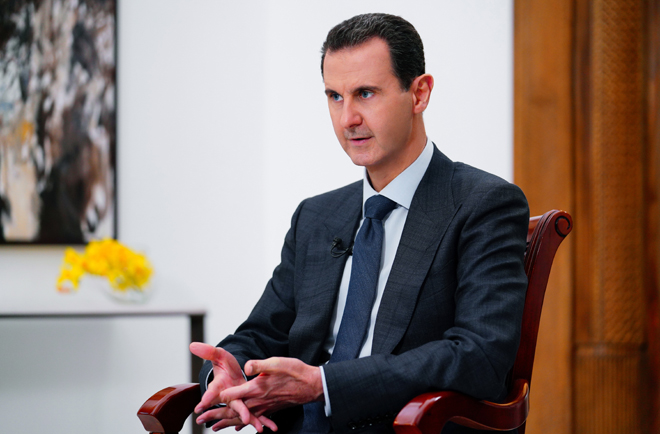
Monica Maggioni is an Italian journalist and is CEO of Rai.com, which broadcasts ‘Rai News 24 TV’, among others. She interviewed Syrian President,Bashar al Assad, on November 26, and the interview was to be broadcast on December 2; however, it was mysteriously postponed.
Behind the scenes, at Rai.com there was conflict over the interview, with Fabrizio Salini declaring the interview was not commissioned, therefore it would not be broadcast, while Antonio Di Bella, director of news, declared it was not suitable to be broadcast, and Italian Senator Alberto Airola requested Maggioni to explain her role in the interview and answer charges of creating a diplomatic incident.
What was so explosive in the interview that the Italian news media wanted to hide from the Italian viewers? Many believe it has to do with questions 8 and 9 and President Assad’s response.
Question 8: At this moment, when Europe looks at Syria, apart from the considerations about the country, there are two major issues: one is refugees, and the other one is the Jihadists or foreign fighters coming back to Europe. How do you see these European worries?
President Assad: We have to start with a simple question: who created this problem? Why do you have refugees in Europe? It’s a simple question: because of terrorism that’s being supported by Europe – and of course the United States and Turkey and others – but Europe was the main player in creating chaos in Syria. So, what goes around comes around.
Question 9: Why do you say it was the main player?
President Assad: Because they publicly supported, the EU supported the terrorists in Syria from day one, week one or from the very beginning. They blamed the Syrian government, and some regimes like the French regime sent armaments, they said – one of their officials – I think their Minister of Foreign Affairs, maybe Fabius said: “we send.” They sent armaments; they created this chaos. That’s why a lot of people find it difficult to stay in Syria; millions of people couldn’t live here so they had to get out of Syria.
The US-NATO-EU attack on Syria is unprecedented in history. General Wesley Clark was told there was a plan to ‘take out Syria’ well before the first protests took place in Deraa. This was an internationally coordinated attack on Syria by the US and Europe. This was a classic ‘regime-change’ project, which was instigated between the US and Israel, but agreed to by the EU and NATO members. From the early stages of the conflict in Syria, the US and Europe provided political, military and logistic support to the ‘rebels’ in Syria and refused to call them terrorists. On 18 August 2011, President Barack Obama stated, “The future of Syria must be determined by its people, but President Bashar al-Assad is standing in their way. For the sake of the Syrian people, the time has come for President Assad to step aside.” This US statement was fully supported by Europe.
In 2013 President Assad stated he was ready for dialogue with the armed terrorists, but only if they surrender their weapons. However, the US-NATO-EU plan to support the terrorists never included a peaceful surrender of weapons, followed by a national dialog, which would end in a peaceful solution to the conflict. The plan only called for weapons, training, and European officers to be continuously available to the terrorists, for ‘regime-change’. Europe only wanted to fuel the fires in Syria, and never planned to be the voice of peace and international law.
What was at first billed as ‘rebels’ and ‘freedom fighters’ soon morphed into sectarian extremists and Radical Islamic terrorists who filled the battlefields under many names and uniforms, but who were all essentially the same terrorists. Their names ranged from the ‘Free Syrian Army’ to ISIS. Radical Islam is a political ideology and is not a religion or a sect. Many experts have called Radical Islam a ‘Death-Cult’, which glorifies the killing of unarmed civilians, as well as armed adversaries, even to the point of eating human flesh while recording it on video.
Presidents Obama and Sarkozy convinced the EU to follow their lead. However, the Syrian people and armed forces fought back.
Some of the refugees left Syria for ideological reasons, they sided with the terrorists and followed the Muslim Brotherhood. Others left for Europe because their homes and livelihoods were destroyed by the terrorists, but many were just economic migrants, and had not lost a home, were from safe areas, and perhaps had never seen any fighting, and they left to seek an income from the charity offered to them in the EU.
EU-NATO support of terrorism in Syria
Bulgaria: Boïko Borissov, Prime Minister from 2014, supplied the drug ‘Captagon’ to the terrorists in Syria on orders of the CIA. The drug causes the terrorists to lose inhibitions and while under the influence they are capable of horrific atrocities.
Germany: A ship with intelligence and satellite capabilities was off the coast of Syria providing the terrorists the locations and movements of the Syrian military, as well as intercepted telephone communications. Wolfgang Ischinger, chairman of the Munich Security Conference, said: “If the West supplies arms itself, it has more chance of influencing how they are used.”
Great Britain: British intelligence provided terrorists with information on Syrian military movements. In 2012, SAS Commandos were conducting covert operations within Syrian territory, and provided terrorists with military aid, including communications equipment and medical supplies, and provided intelligence support from its Cyprus bases, revealing Syrian military movements which were passed on to the terrorists. In 2013, Prime Minister David Cameron said that Britain would send weapons to the terrorists. In August 2016, the BBC published photographs that showed British Special Forces soldiers guarding the perimeter of the terrorist’s base at al-Tanf, on the Syria-Iraq border, and the terrorists were shown to be equipped with four-wheel drive Al-Thalab vehicles and weapons such as sniper rifles, anti-tank weapons, and heavy machine guns.
France: The ‘Friends of Syria’ group was initiated by then-French President Nicolas Sarkozy in 2012. They declared their intent to support the terrorists in Syria, “If the regime fails to accept the terms of the political initiative outlined by the Arab League and end violence against citizens, the Friends of Syria should not constrain individual countries from aiding the Syrian opposition by means of military advisers, training, and provision of arms to defend themselves.” In 2013, French President François Hollande said, that France was ready to begin supplying lethal aid to the terrorists, and by 2014 Hollande confirmed that France had delivered arms to the terrorists, and by 2015 had begun airstrikes in Syria.
Italy: On 28 February 2013, the ‘Friends of Syria’ held their meeting in Rome, and among the 11 members were France, Germany, Italy, UK, and the EU. In a study published in 2019, the number of terrorists from Italy who were in Syria numbered 135 as of July 2018.
The EU: in 2013 Brussels decided assistance to the terrorists would include weapons training. Jane’s Defense Weekly reported a US shipment of 994 tons of weapons and ammunition in December 2015 from Eastern Europe to Syrian rebel groups, including 9M17 Fleyta anti-tank missiles, RPG-7s, AK-47S, DShKs, and PKMs. In early March 2013, a Jordanian security source revealed that the U.S., Britain, and France were training terrorists in Jordan to begin building a militia that would take over after Assad’s fall. By 2019, the EU issued a statement about Syria in which they now claim to call for peace and political negotiations to settle the conflict of almost 9 years duration and to have supported humanitarian and economic assistance there. However, when faced with documented history, this statement is a bald-faced lie. The EU position from the outset of the conflict was to support the armed terrorists and to prevent even chemotherapy drugs to be imported to Syria, because of the EU sanctions, which today prevents any possible rebuilding effort.
Overnight the electoral map of the UK has changed significantly. Scotland is once again bathed in a sea of yellow, as England has been shrouded in blue. With the Scottish National Party obtaining 45% of the vote north of the border, and the Conservatives only 25% it is clear not only is there no mandate for Brexit in Scotland, but as leader Nicola Sturgeon has said, there is now very much a mandate for holding a second referendum on Scottish Independence.
England, on the other hand has put its support resoundingly behind Prime Minister Boris Johnson and his mantra of ‘Get Brexit Done’. With a remarkable 364 seats, as opposed to Labour’s 203 – its worst performance since 1935 – he proclaimed that a ‘political earthquake’ had occurred and that he would end all the squabbling of the last few years he would take the country out of the EU ‘no ifs and no buts’. This was a message that appealed to the majority, clearly sickened by the deadlock of Brexit. Despite the radical spending programme proposed by the Labour party, this election ended up being, as it was promoted, all about Brexit.
And this takes us to the broader context of what is in fact happening in the UK. Indeed, it’s important to see this election in the wider European political landscape. This was not just a Conservative party win, but a victory for nationalism. Not just Scottish Nationalism, but English Nationalism under the banner of Brexit, and Welsh and Irish Nationalism. For the first time ever, Northern Ireland elected more Nationalist MPs than Unionist, in what was also, like Scotland, an anti-Brexit vote, which will spur on more talk of Irish reunification. Welsh Nationalist party Plaid Cymru also held on to its four seats in Wales.
So while it may be portrayed as a landslide victory for the Conservatives, this election more than ever has shown up the cracks forming in the Union. Scottish Nationalism appears to be on an irreversible path to independence, with the question now being not if there will be a referendum on independence, but when. The strong Remain vote up north has only boosted the case for leaving the UK, as Scotland places more importance on being part of Europe, than being part of Britain. England, for its part, has clearly put more emphasis on being out of Europe, than it has on retaining the Union.
Indeed, looking at the western world in general, the popularity of nationalist and right-wing parties is undisputedly on the rise. The AfD in Germany, the National Front in France or Vox in Spain – these parties are all gaining popularity, just as Trump has in the US. And together with Johnson’s Conservatism, they all have something in common, that ‘populist’ appeal that really gets its message across. For regardless of their party leaders’ sins (Boris Johnson has been repeatedly been lambasted as a liar, racist, and misogynist), they have not been enough to deter voters, for whom clearly the nation state is what matters most.
There’s no doubt that Brexit has been a shock for the EU. Arguably Britain had always been a hesitant member, refusing to join the Euro, or join the Schengen zone (which allows borderless travel between states); it never quite developed that European mindset. But the Brexit vote took EU politicians by surprise, sending shockwaves across a Union already under pressure from Eurosceptic parties. They will no doubt breathe a sigh of relief in Brussels that the Brexit stalemate will now be broken with Boris Johnson’s parliamentary majority – finally a deal can be passed – but the reality that one of their major players finally leaving must be making them nervous.
Boris Johnson put faith in the people, and the gamble paid off. But whether he appreciates the real seismic consequences of this ‘political earthquake’ is another question. For cracks are not only emerging between Britain and Europe, but across the United Kingdom itself. It’s the price to be paid for Brexit.
Johanna Ross is a journalist based in Edinburgh, Scotland.
The European Union (EU) is channelling European taxpayers’ money to Israeli entities accused of international law violations, according to a new briefing by human rights campaigners.
The research, carried out by the Brussels-based group European Coordination of Committees and Associations for Palestine (ECCP), was published Tuesday.
“EU research funds have been a very important source of funding for Israeli academics, corporations and state institutions, among them a number of military companies and those involved in illegal Israeli settlements”, stated ECCP in a press release launching ‘EU and Israel: The Case of Complicity’.
“For many years European and Palestinian civil society and human rights organisations have been raising concerns over European taxpayers’ money being channelled to Israeli companies and institutions accused of war crimes and involved in violations of international law and human rights”.
According to ECCP, even at the same time as the EU has been criticising Israeli actions over the years in the occupied Palestinian territory, the body has also been “funding the very companies that sustain these unlawful activities”.
Thus, the human rights campaigners add, “when it comes to Israel the EU continues to violate its own directives and commitments to international law by funding Israeli complicit entities at the expense of Palestinians”.
In one example cited in the research, as part of the last funding cycle known as ‘Horizon 2020’, two of Israel’s largest military companies – Elbit Systems and Israeli Aerospace Industry – received almost 10 million Euros of European taxpayers’ money.
Although Israel is not an EU country, Israeli applicants have been able to access EU research funds on the same basis as member states since 1995 through the EU-Israel Association Agreement.
“While Israel, as the Occupying Power, bears the main responsibility to ensure respect for international law and human rights of the occupied Palestinian population”, ECCP states, “third states which are not party to the conflict, such as the EU and its member states, also have an obligation to not aid, assist or recognise bodies that violate international law”.
The price of gas for Ukraine may be lower if Moscow and Kiev manage to reach a new transit agreement, Russian President Vladimir Putin told at a press conference after the Normandy Four summit in Paris.
Gas for Ukraine “could be cheaper by 25 percent, as compared to what the end consumer currently gets, primarily the industrial consumer, because the price of gas for the domestic consumer, for citizens [of Ukraine], is subsidized, we can’t calculate the price from the subsidized price,” Putin said.
Ukraine’s President Volodymyr Zelensky said in return that there is a good chance that the contract on gas transit from Russia to Europe via Ukraine would be extended after January 1.
Agreement for Russian gas supplies to Ukraine and those transiting to Europe expires at the end of this year. In November, Russia’s Gazprom offered Ukraine to extend the transit contract or enter into a new one for one year.
“There’s no agreement yet, but I’m sure that we have more chances to sign it under better conditions than before,” Zelensky told reporters in Paris, adding that “I insisted on the most favorable, ambitious conditions for Ukraine and Europe, which is ten years.”
He also said the issue of the $2.56 billion compensation has been taken off the table during the talks, and that Kiev “is ready to take it in gas.”
A Swedish court ruled Gazprom must compensate Ukraine’s Naftogaz for the transit of Russian gas through the Ukrainian territory between 2009 and 2017 even though the gas was not, in fact, transited over that period. The court justified its decision by referring to a difficult economic situation in Ukraine. Last month, Russia’s Gazprom lost the appeal.
Despite the European Union attempts to save the Joint Comprehensive Plan of Action, which saw Iran reduce its low-enriched uranium by 98% and eliminate its stockpile of medium-enriched uranium in return for economic relief, JCPOA is hanging by a thread because of Washington’s withdrawal from the deal in October 2017.
The European Statistical Office revealed that from January to September trade between the EU and Iran was at €3.86 billion, a massive 74.92% drop compared to the same period in 2018. The report revealed that Germany (€1.23 billion), Italy (€734.78 million) and the Netherlands (€376.73 million) were Iran’s top three trading partners in EU while trade with Greece (€32.08 million), Luxembourg (€506,316), Spain (€207.36 million), France (€296.5 million) and Austria (€102.11 million) had plunged by 97.13%, 91.38%, 91.17%, 86.79% and 82.38% respectively.
Although Iran’s trade with Cyprus at €6.25 million and Bulgaria at €64.97 million increased by 85.12% and 29.24% respectively year-on-year— the highest among EU states — it still does not offset the massive decline in trade with Greece, Luxembourg, Spain, France and Austria. The major decline in trade is attributed due to European companies’ unwillingness to risk losing business with the U.S. for the sake of the much smaller Iranian market. Effectively, U.S. President Donald Trump’s economic war with Iran is to diminish Iranian-EU trade so that the U.S. may reap benefits from boosting its own oil and other commodities. However, this is set to change.
With this dramatic downturn in trade with the EU, Iran is now pushing to diversify its economy even further to overcome a reliance on oil and take a number of measures in an attempt to counter U.S. economic aggression, including increasing taxes, cutting energy subsidies and borrowing money from friendly states. Iranian President Hassan Rouhani explained on Sunday in parliament that oil revenues are expected to drop by at least 70% and that Iran’s budget next year “is designed to resist against sanctions and to announce to the world that we run this country despite sanctions.”
The Iranian president explained that the new budget will reach $115.3 billion because of the reduction of oil exportation from 2.8 million barrels of oil a day before Trump’s May sanctions to 500,000 barrels a day. In addition, Iran will sell more bonds in the domestic market and plans to increase revenues from taxes by 13%, but these changes come as the International Monetary Fund has already forecast that the Islamic Republic will have a reduction of its economy of about 9.5% this year.
This “budget of resistance,” as described by Rouhani, is “contrary to what the Americans thought. With the pressure of sanctions, our country’s economy would encounter problems, thank God we have chosen the correct path… and we are moving forward.”
Iran’s Deputy Foreign Minister Abbas Araqchi announced on Monday that the European signatories to the JCPOA will not activate the “trigger mechanism” for the time being that could see the return of sanctions against the Islamic Republic. It is unlikely that the EU or Iran will withdraw from what remains of JCPOA as they attempt to bypass U.S. sanctions which can see the besieged country improve its economy through increased trade with Europe.
Not only has the EU pledged to maintain its nuclear deal commitments, in a joint statement late last month, Belgium, Denmark, Finland, the Netherlands, Norway and Sweden said they will attain shares in Instrument in Support of Trade Exchanges (INSTEX), that was launched by Britain, France and Germany in January to allow European companies to trade with Iran without using U.S. dollars so they could be protected from U.S. sanctions.
In their joint statement, they said: “In light of the continuous European support for the agreement and the ongoing efforts to implement the economic part of it and to facilitate legitimate trade between Europe and Iran, we are now in the process of becoming shareholders of INSTEX, subject to the completion of national procedures.”
This is also a part of a wider move to counter strong U.S. efforts to muscle in on the European oil market as U.S. sanctions have scared buyers from acquiring Iranian and Venezuelan crude. The so-called hydro-fracking and shale revolution that began a few years ago has seen the U.S. aggressively seek to export its oil to new markets. It is now unsurprising that earlier this year U.S. crude shipments to Europe reached new records, behind Russia but still more than Nigeria and Libya who are important OPEC members.
Therefore, a major reason for the false allegations by Trump that Iran was violating the JCPOA was to force Iran out of the European market to push the U.S. entrance. It appears that Trump’s plan has failed. Not only has Iran formulated its “budget of resistance,” but with Belgium, Denmark, Finland, the Netherlands, Norway and Sweden becoming shareholders INSTEX, they are prepared to continue their economic relations with Iran while being protected from U.S. repercussions. Effectively, although the U.S. has achieved a short-term reduction in European-Iranian trade, it will not only recover, but also be strengthened as new mechanisms are being made to bypass U.S. banks and dollars.
Paul Antonopoulos is a Research Fellow at the Center for Syncretic Studies.
Damascus – President Bashar al-Assad said that Syria is going to come out of the war stronger and the future of Syria is promising and the situation is much better, pointing out to the achievements of the Syrian Arab army in the war against terrorism.
The President, in an interview given to Italian Rai News 24 TV on November 26,2019 and was expected to be broadcast on December 2nd and the Italian TV refrained from broadcasting it for non-understandable reasons, added that Europe was the main player in creating chaos in Syria and the problem of refugees in it was because of its direct support to terrorism along with the US, Turkey and many other countries.
President al-Assad stressed that since the beginning of the narrative regarding the chemical weapons, Syria has affirmed it didn’t use them.
The President affirmed that what the OPCW organization did was to fake and falsify the report about using chemical weapons, just because the Americans wanted them to do so. So, fortunately, this report proved that everything we said during the last few years, since 2013, is correct.
Following is the full text of the interview;
Question 1: Mr. President, thanks for having us here. Let us know please, what’s the situation in Syria now, what’s the situation on the ground, what is happening in the country?
President Assad: If we want to talk about Syrian society: the situation is much, much better, as we learned so many lessons from this war and I think the future of Syria is promising; we are going to come out of this war stronger.
Talking about the situation on the ground: The Syrian Army has been advancing for the last few years and has liberated many areas from the terrorists, there still remains Idleb where you have al-Nusra that’s being supported by the Turks, and you have the northern part of Syria where the Turks have invaded our territory last month.
So, regarding the political situation, you can say it’s becoming much more complicated, because you have many more players that are involved in the Syrian conflict in order to make it drag on and to turn it into a war of attrition.
Question 2: When you speak about liberating, we know that there is a military vision on that, but the point is: how is the situation now for the people that decided to be back in society? The process of reconciliation, now at what point? Is it working or not?
President Assad: Actually, the methodology that we adopted when we wanted to create let’s say, a good atmosphere – we called it reconciliation, for the people to live together, and for those people who lived outside the control of government areas to go back to the order of law and institutions. It was to give amnesty to anyone, who gives up his armament and obey the law. The situation is not complicated regarding this issue, if you have the chance to visit any area, you’ll see that life is getting back to normal.
The problem wasn’t people fighting with each other; it wasn’t like the Western narrative may have tried to show – as Syrians fighting with each other, or as they call it a “civil war,” which is misleading. The situation was terrorists taking control of areas, and implementing their rules. When you don’t have those terrorists, people will go back to their normal life and live with each other. There was no sectarian war, there was no ethnic war, there was no political war; it was terrorists supported by outside powers, they have money and armaments, and they occupy those areas.
Question 3: Aren’t you afraid that this kind of ideology that took place and, you know, was the basis of everyday life for people for so many years, in some ways can stay in the society and sooner or later will be back?
President Assad: This is one of the main challenges that we’ve been facing. What you’re asking about is very correct. You have two problems. Those areas that were out of the control of government were ruled by two things: chaos, because there is no law, so people – especially the younger generation – know nothing about the state and law and institutions.
The second thing, which is deeply rooted in the minds, is the ideology, the dark ideology, the Wahabi ideology – ISIS or al-Nusra or Ahrar al-Cham, or whatever kind of these Islamist terrorist extremist ideologies.
Now we have started dealing with this reality, because when you liberate an area you have to solve this problem otherwise what’s the meaning of liberating? The first part of the solution is religious, because this ideology is a religious ideology, and the Syrian religious clerics, or let’s say the religious institution in Syria, is making a very strong effort in this regard, and they have succeeded; they succeeded at helping those people understanding the real religion, not the religion that they’ve been taught by al-Nusra or ISIS or other factions.
Question 4: So basically, clerics and mosques are part of this reconciliation process?
President Assad: This is the most important part. The second part is the schools. In schools, you have teachers, you have education, and you have the national curriculum, and this curriculum is very important to change the minds of those young generations. Third, you have the culture, you have the role of arts, intellectuals, and so on. In some areas, it’s still difficult to play that role, so it was much easier for us to start with the religion, second with the schools.
Question 5: Mr. President, let me just go back to politics for an instant. You mentioned Turkey, okay? Russia has been your best ally these years, it’s not a secret, but now Russia is compromising with Turkey on some areas that are part of Syrian area, so how do you assess this?
President Assad: To understand the Russian role, we have to understand the Russian principles. For Russia, they believe that international law – and international order based on that law – is in the interest of Russia and in the interest of everybody in the world. So, for them, by supporting Syria they are supporting international law; this is one point. Secondly, being against the terrorists is in the interest of the Russian people and the rest of the world.
So, being with Turkey and making this compromise doesn’t mean they support the Turkish invasion; rather they wanted to play a role in order to convince the Turks that you have to leave Syria. They are not supporting the Turks, they don’t say “this is a good reality, we accept it and Syria must accept it.” No, they don’t. But because of the American negative role and the Western negative role regarding Turkey and the Kurds, the Russians stepped in, in order to balance that role, to make the situation… I wouldn’t say better, but less bad if you want to be more precise. So, in the meantime, that’s their role. In the future, their position is very clear: Syrian integrity and Syrian sovereignty. Syrian integrity and sovereignty are in contradiction with the Turkish invasion, that is very obvious and clear.
Question 6: So, you’re telling me that the Russians could compromise, but Syria is not going to compromise with Turkey. I mean, the relation is still quite tense.
President Assad No, even the Russians didn’t make a compromise regarding the sovereignty. No, they deal with reality. Now, you have a bad reality, you have to be involved to make some… I wouldn’t say compromise because it’s not a final solution. It could be a compromise regarding the short-term situation, but in the long-term or the mid-term, Turkey should leave. There is no question about it.
Question 7: And in the long-term, any plan of discussions between you and Mr. Erdogan?
President Assad: I wouldn’t feel proud if I have to someday. I would feel disgusted to deal with those kinds of opportunistic Islamists, not Muslims, Islamists – it’s another term, it’s a political term. But again, I always say: my job is not to be happy with what I’m doing or not happy or whatever. It’s not about my feelings, it’s about the interests of Syria, so wherever our interests go, I will go.
Question 8: In this moment, when Europe looks at Syria, apart from the considerations about the country, there are two major issues: one is refugees, and the other one is the Jihadists or foreign fighters coming back to Europe. How do you see these European worries?
President Assad: We have to start with a simple question: who created this problem? Why do you have refugees in Europe? It’s a simple question: because of terrorism that’s being supported by Europe – and of course the United States and Turkey and others – but Europe was the main player in creating chaos in Syria. So, what goes around comes around.
Question 9: Why do you say it was the main player?
President Assad: Because they publicly supported, the EU supported the terrorists in Syria from day one, week one or from the very beginning. They blamed the Syrian government, and some regimes like the French regime sent armaments, they said – one of their officials – I think their Minister of Foreign Affairs, maybe Fabius said “we send.” They sent armaments; they created this chaos. That’s why a lot of people find it difficult to stay in Syria; millions of people couldn’t live here so they had to get out of Syria.
Question 10: In this moment, in the region, there are turmoil, and there is a certain chaos. One of the other allies of Syria is Iran, and the situation there is getting complicated. Does it have any reflection on the situation in Syria?
President Assad: Definitely, whenever you have chaos, it’s going to be bad for everyone, it’s going to have side-effects and repercussions, especially when there is external interference. If it’s spontaneous, if you talk about demonstrations and people asking for reform or for a better situation economically or any other rights, that’s positive. But when it’s for vandalism and destroying and killing and interfering from outside powers, then no – it’s definitely nothing but negative, nothing but bad, and a danger on everyone in this region.
Question 11: Are you worried about what’s happening in Lebanon, which is really the real neighbor?
President Assad: Yes, in the same way. Of course, Lebanon would affect Syria more than any other country because it is our direct neighbor. But again, if it’s spontaneous and it’s about reform and getting rid of the sectarian political system, that would be good for Lebanon. Again, that depends on the awareness of the Lebanese people in order not to allow anyone from the outside to try to manipulate the spontaneous movement or demonstrations in Lebanon.
Question 12: Let’s go back to what is happening in Syria. In June, Pope Francis wrote you a letter asking you to pay attention and to respect the population, especially in Idleb where the situation is still very tense, because there is fighting there, and when it comes even to the way prisoners are treated in jails. Did you answer him, and what did you answer?
President Assad: The letter of the Pope was about his worry for civilians in Syria and I had the impression that maybe the picture in the Vatican is not complete. That’s to be expected, since the mainstream narrative in the West is about this “bad government” killing the “good people;” as you see and hear in the same media – every bullet of the Syrian Army and every bomb only kills civilians and only hospitals! they don’t kill terrorists as they target those civilians! which is not correct.
So, I responded with a letter explaining to the Pope the reality in Syria – as we are the most, or the first to be concerned about civilian lives, because you cannot liberate an area while the people are against you. You cannot talk about liberation while the civilians are against you or the society. The most crucial part in liberating any area militarily is to have the support of the public in that area or in the region in general. That has been clear for the last nine years and that’s against our interests.
Question 13: But that kind of call, in some ways, made you also think again about the importance of protecting civilians and people of your country.
President Assad: No, this is something we think about every day, not only as morals, principles and values but as interests. As I just mentioned, without this support – without public support, you cannot achieve anything… you cannot advance politically, militarily, economically and in every aspect. We couldn’t withstand this war for nine years without the public support and you cannot have public support while you’re killing civilians. This is an equation, this is a self-evident equation, nobody can refute it. So, that’s why I said, regardless of this letter, this is our concern.
But again, the Vatican is a state, and we think that the role of any state – if they worry about those civilians, is to go to the main reason. The main reason is the Western role in supporting the terrorists, and it is the sanctions on the Syrian people that have made the situation much worse – and this is another reason for the refugees that you have in Europe now. You don’t want refugees but at the same time you create the situation or the atmosphere that will tell them “go outside Syria, somewhere else,” and of course they will go to Europe. So, this state, or any state, should deal with the reasons and we hope the Vatican can play that role within Europe and around the world; to convince many states that you should stop meddling in the Syrian issue, stop breaching international law. That’s enough, we only need people to follow international law. The civilians will be safe, the order will be back, everything will be fine. Nothing else.
Question 14: Mr. President, you’ve been accused several times of using chemical weapons, and this has been the instrument of many decisions and a key point, the red line, for many decisions. One year ago, more than one year ago, there has been the Douma event that has been considered another red line. After that, there has been bombings, and it could it have been even worse, but something stopped. These days, through WikiLeaks, it’s coming out that something wrong in the report could have taken place. So, nobody yet is be able to say what has happened, but something wrong in reporting what has happened could have taken place.
President Assad: We have always – since the beginning of this narrative regarding the chemical weapons – we have said that we didn’t use it; we cannot use it, it’s impossible to be used in our situation for many reasons, let’s say – logistical reasons.
Intervention: Give me one.
President Assad: One reason, a very simple one: when you’re advancing, why would you use chemical weapons?! We are advancing, why do we need to use it?! We are in a very good situation so why use it, especially in 2018? This is one reason.
Second, very concrete evidence that refutes this narrative: when you use chemical weapons – this is a weapon of mass destruction, you talk about thousands of dead or at least hundreds. That never happened, never – you only have these videos of staged chemical weapons attacks. In the recent report that you’ve mentioned, there’s a mismatch between what we saw in the video and what they saw as technicians or as experts. The amount of chlorine that they’ve been talking about: first of all, chlorine is not a mass destruction material, second, the amount that they found is the same amount that you can have in your house, it exists in many households and used maybe for cleaning and whatever. The same amount exactly. That’s what the OPCW organisation did – they faked and falsified the report, just because the Americans wanted them to do so. So, fortunately, this report proved that everything we said during the last few years, since 2013, is correct. We were right, they were wrong. This is proof, this is concrete proof regarding this issue. So, again, the OPCW is biased, is being politicized and is being immoral, and those organisations that should work in parallel with the United Nations to create more stability around the world – they’ve been used as American arms and Western arms to create more chaos.
Question 15: Mr. President, after nine years of war, you are speaking about the mistakes of the others. I would like you to speak about your own mistakes, if any. Is there something you would have done in a different way, and which is the lesson learned that can help your country?
President Assad: Definitely, for when you talk about doing anything, you always find mistakes; this is human nature. But when you talk about political practice, you have two things: you have strategies or big decisions, and you have tactics – or in this context, the implementation. So, our strategic decisions or main decisions were to stand against terrorism, to make reconciliation and to stand against the external meddling in our affairs. Today, after nine years, we still adopt the same policy; we are more adherent to this policy. If we thought it was wrong, we would have changed it; actually no, we don’t think there is anything wrong in this policy. We did our mission; we implemented the constitution by protecting the people.
Now, if you talk about mistakes in implementation, of course you have so many mistakes. I think if you want to talk about the mistakes regarding this war, we shouldn’t talk about the decisions taken during the war because the war – or part of it, is a result of something before.
Two things we faced during this war: the first one was extremism. The extremism started in this region in the late 60s and accelerated in the 80s, especially the Wahabi ideology. If you want to talk about mistakes in dealing with this issue: then yes, I will say we were very tolerant of something very dangerous. This is a big mistake we committed over decades; I’m talking about different governments, including myself before this war.
The second one, when you have people who are ready to revolt against the order, to destroy public properties, to commit vandalism and so on, they work against their country, they are ready to go and work for foreign powers – foreign intelligence, they ask for external military interference against their country. So, this is another question: how did we have those? If you ask me how, I would tell you that before the war we had more than 50,000 outlaws that weren’t captured by the police for example; for those outlaws, their natural enemy is the government because they don’t want to go to prison.
Question 16: And how about also the economic situation? Because part of it – I don’t know if it was a big or small part of it – but part of it has also been the discontent and the problems of population in certain areas in which economy was not working. Is it a lesson learned somewhere?
President Assad: It could be a factor, but definitely not a main factor. Some people talk about the four years of drought that pushed the people to leave their land in the rural areas to go to the city… it could be a problem, but this is not the main problem. They talked about the liberal policy… we didn’t have a liberal policy, we’re still socialist, we still have a public sector – a very big public sector in government. You cannot talk about liberal policy while you have a big public sector. We had growth, good growth.
Of course, in the implementation of our policy, again, you have mistakes. How can you create equal opportunities between people? Between rural areas and between the cities? When you open up the economy, the cities will benefit more, that will create more immigration from rural areas to the cities… these are factors, that could play some role, but this is not the issue. In the rural areas where you have more poverty, the money of the Qataris played a more actual role than in the cities, that’s natural. You pay them in half an hour what they get in one week; that’s very good for them.
Question 17: We are almost there, but there are two more questions that I want to ask you. One is about reconstruction, and reconstruction is going to be very costly. How can you imagine to afford this reconstruction, who could be your allies in reconstruction?
President Assad: We don’t have a big problem with that. Talking that Syria has no money… no, actually Syrians have a lot of money; the Syrian people around the world have a lot of money, and they want to come and build their country. Because when you talk about building the country, it is not giving money to the people, it’s about getting benefit – it’s a business. So, many people, not only Syrians, want to do business in Syria. So, talking about where you can have funds for this reconstruction, we already have, but the problem is that these sanctions prevent those businessmen or companies from coming and working in Syria. In spite of that, we started and in spite of that, some foreign companies have started finding ways to evade these sanctions and we have started planning. It’s going to be slow, without the sanctions we wouldn’t have a problem with funding.
Question 18: Ending on a very personal note, Mr. President; do you feel like a survivor?
President Assad: If you want to talk about a national war like this, where nearly every city has been harmed by terrorism or external bombardment and other things, then you can talk about all the Syrians as survivors. I think this is human nature: to be a survivor.
Intervention: And you yourself?
President Assad: I’m a part of those Syrians. I cannot be disconnected from them; I have the same feeling. Again, it’s not about being a strong person who is a survivor. If you don’t have this atmosphere, this society, or this incubator to survive, you cannot survive. It’s collective; it’s not a single person, it’s not a one-man show.
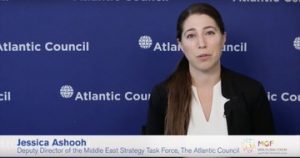
In 2017 Reddit hired Jessica Ashooh as their “Director of Policy”. Her LinkedIn page shows her previous employment was “Deputy Director, Middle East Strategy Task Force” at the Atlantic Council.
The report on which Reddit based their decision to ban users as part of a “Russian campaign” was written by Ben Nimmo, who also works for the Atlantic Council (and the Integrity Initiative).
Essentially, Reddit has a high-up employee who was previously in the pay of the US Department of State (and possibly still is).
It’s a prime example of how the US (and UK) infrastructure create an authoritarian, highly-controlled state, whilst maintaining a veneer of “freedom”. There are other examples too.
Then, in 2018, Google hired Karan Bhatia as their Global Head of Policy, Mr Bhatia had previously worked for the administration of George W. Bush.
It all follows the same pattern of apparent independence concealing an inter-connecting web of control, all dedicated to furthering the same agenda and all being funded by the same central source.
The Atlantic Council is not officially affiliated with the US government, neither is CEIP, they are notionally independent. Likewise, Reddit, Google, Facebook et al. are supposedly independent companies, not in any way controlled by the state.
… and yet you follow the money and it always leads to the same place.
I am pleased to announce the publication of my latest collection of essays. The capsule description of the book carried on the pages of internet booksellers is as follows
“The essays in this book deal with major political, social and cultural events primarily in Europe and Russia during the period 2017 – 2019 in which the author was a participant or eyewitness and has personal impressions to share. Several of the essays are drawn from other genres including travel notes, public lectures and reviews of particularly insightful books on key issues of our times like immigration, Liberalism and war with Russia that have not received the broad public exposure they merit.”
However, there is much more to the story that has relevance to its potential readers set out in the Foreword shown below, starting with the several layers of nuance in the title itself.
Foreword
The title of this book has been chosen with care and a few introductory words of explanation are owed to the reader.
First, the notion of a “Belgian perspective” on international affairs may on its own seem peculiar. In what way, one might ask, can little Belgium, with its population of around 12 million have a perspective that is unique and worthy of consideration? In the same vein, what perspective on foreign affairs in general can a lesser Member State of the European Union have when the most powerful Member State, Germany, denies that it has an independent foreign policy and defers to Brussels, specifically to the EU’s High Representative for Foreign Affairs and Security Policy, who, formally, holds sole responsibility for these matters on behalf of the 500 million plus people from 28 nations? Indeed, in a recent interview relating to the publication of his latest book, the octogenarian former prime minister of Belgium Marc Eyskens pointed out that the rise of the EU Institutions has left national governments with a substantially reduced level of sovereignty and competence comparable to that of a major city rather than of a country.
Meanwhile and in parallel, as the seat of both the NATO headquarters near the Zaventem Airport and of the Supreme Headquarters Allied Powers Europe in Mons, Belgium marches in lock-step with its US-led allies. Belgium’s mainstream media, both television and print media, traditionally support whatever policy line comes from the EU Institutions and NATO.
There have been rare exceptions to this solemn loyalty to the consensus. In particular, in the run-up to the US invasion of Iraq in 2003, Belgium was one of the three “Old Europe” nations, alongside France and Germany, that joined Russia in openly rejecting US policy. For this the nation’s Prime Minister at the time, Guy Verhofstadt, paid dearly, being disqualified from appointment to head the EU Commission, for which he was a leading candidate at the time.
But the aforementioned facts constraining the political elites of Belgium are by no means imperative for Belgian society as a whole. Indeed, as I detail in several essays in this collection, at both ends of society, the high end in their dinner jackets and at the mass, man-in-the-street level, there is very little sympathy for the official foreign and defense policies and a lot of free-thinking going on.
All of which brings us to the question of who is the Belgian whose perspective is set out in this tome. The simple and direct answer is that I am that Belgian.
Readers of my articles posted in various platforms on the internet have seen me described in the past as an American and long-time resident of Brussels. Both statements were and are correct. However, in August 2017 I also became a naturalized Belgian. This ‘second birth’ was more than seven years in gestation. After its successful culmination, I found myself increasingly involved in intra-Belgian, intra-European politics. Consequently, I have written with greater frequency on issues that are specific to the Old Continent. By their nature, these articles have not been picked up and disseminated via the internet platforms based in the United States by which readers know me best. Moreover, in my new guise I have written some of these articles or speeches in French so as to better reach prospective readers around me where I live and practice politics. These materials are also republished in this volume.
Notwithstanding the new elements, as in my preceding three collections of “nonconformist” essays published between 2013 and 2017, the major part of my writings is focused on present-day Russia and its relations with the United States and Europe. Russia is my main field of interest and expertise coming both from book learning and from life experience as a frequent visitor to the country over many decades and also as someone who has both lived and worked there for eight years beginning in 1994. That is something very few of our commentators in the West can say before they launch into ill-informed vitriolic attacks on the “Putin regime” and Russians as a people.
Since all of the essays presented here have been published on the internet in one way or another, it is legitimate to ask what is the added value of republishing them as a book. There are several answers to that question, ranging from the superficial but adequate to an answer that goes to the heart of how I see my social role in writing these pieces.
The superficial but adequate explanation is that everything is transient, nothing more so than the internet, where digital platforms are here today, gone tomorrow, where even one’s own blog site lasts no longer than the latest annual fees payment. And while e-books may be no more durable than the publishing company maintaining and distributing the digital files, physical books deposited in libraries will be accessible to the curious public and to researchers as long as the human race continues on its way, which may or may not be eons depending on your degree of pessimism inspired by this and similar works by my fellow “dissidents” on international affairs.
The deeper explanation is that influencing public opinion towards détente, towards self-preservation and away from confrontation with Russia that can easily end in catastrophe presently does not appear to be actionable. This is so for banal but understandable reasons that have to do firstly with the way the United States is governed internally and secondly how the United States rules over “the free world.”
Over the past twenty years or more, repeated polls taken by Pew and other research institutions have shown that the American public does not support foreign military adventures or a world gendarme role for their country. However, the political establishment pays no heed whatsoever to this clear disposition of the electorate just as the views of the electorate on a great many other issues are ignored by Congress and by the Executive branch. This follows from the financial dimension of getting and staying in power. By campaign funding and lobbying, a tiny number of exceedingly wealthy individuals and corporations effectively make policy at the federal level, and accommodation with the world is not on their agenda.
Meanwhile, whether as a result of awareness of their powerlessness or for other reasons, the broad American public is apathetic as concerns foreign policy. People just don’t want to disturb their peace of mind by contemplating the aggressive, bullying behavior of their government on the international stage. “Our boys” are not being killed abroad in significant numbers. The budgeted military expenses of the USA are being financed by others who buy Washington’s Treasury notes. There is nothing to force a reckoning with what is being done in the name of America abroad. Least of all, with respect to Russia, which has taken with surprising equanimity the sanctions and other punishments meted out to them over their alleged bad conduct in Ukraine and Syria, over their alleged meddling in American and European elections. The notion that the West might be crossing their red lines at some point, that the economic and informational war might spill over into kinetic war that escalates quickly – such thoughts could not be further from the minds of people in the States or in Western Europe, including those who take a real interest in public affairs and think they are au courant.
This is not to say that the essays published here and similar writings by my comrades-in-arms have no readers. On the contrary, our works are republished by portals other than our own. They are referenced on social networks and attract considerable numbers of “hits,” meaning individual readers. Some of the essays in this book have reached an audience numbering in the tens of thousands. But so far the dry residue of this relative success remains inconsequential. No broad-based political movement championing my/our principles of détente has emerged. There are no demonstrations on behalf of peace, while there are American and worldwide demonstrations to fight for renewable energy and for programs to combat climate change, or to fight for gender issues and equality of pay.
So, why write? why publish?
This takes us to the question of self-definition and social role.
We are living through Dark Ages today, notwithstanding all the technical achievements of our science and technology and advanced medicine. At the moral, social and political levels, these are bleak times when “progressive” values trample upon traditional moral and ethical, not to mention religious values, when freedom of expression and other civil liberties have been gutted for the sake of public security and to serve demagogic purposes.
In this context, these writings are intended to be an eyewitness account of the prevailing moral and political decadence for the edification of those in future generations who will have their own battles to fight to safeguard cultural traditions and freedoms. In assuming this role of a chronicler, I seek to continue the work of those who passed this way half a century ago or more and who left behind their own writings of the day, which gave me spiritual encouragement and purpose when I came across them.
At the same time, I do not abandon the hope that my compatriots in America and now also in Europe will come to their senses and explore these writings and the writings of my fellow dissidents to find an antidote to the propaganda about the recent past and present being dispensed by government, by mainstream media and by all too many scholars in the field.
One straw in the wind was a July 2019 editorial in the hawkish, till now fanatically anti-Russian New York Times calling for a rapprochement with Russia before that country aligns definitively with China and recreates a global threat to American interests. Or I refer to the publication of an article co-authored by former Georgia Senator Sam Nunn in the September-October edition of Foreign Affairs magazine, another standard bearer of U.S. hegemony, stating in detail the existential risks we incur by having cut lines of communication with Russia and by entering into a new, uncontrolled arms race with that country. As the Chair of the Senate Committee on Armed Services from 1987 to 1995, he was a leading figure in arms control negotiations. In the new millennium, Nunn has been one of the generally recognized “wise men” in the American political establishment, alongside Henry Kissinger, George Shultz and James Baker.
There is also an impulse for optimism coming from the latest declarations of French President Emanuel Macron, who is striving to assume leadership of the European Union’s policy agenda now that control is slipping from the hands of Germany’s Iron Lady, Angela Merkel in the waning days of her chancellorship. In his speech to French ambassadors following the conclusion of the G7 summit meeting in Biarritz on the weekend of 24-25 August, Macron stated very clearly that Europe must put an end to its policy of marginalizing and ostracizing Russia because the Old Continent needs to work cooperatively with Moscow if it is not to become a powerless bystander to the growing conflict between the United States and China.
Such signs of sobriety and concern for self-preservation suggest that all is not lost in the cause of détente.
For those who have not read my earlier works, I repeat here that my essays are often devoted to major events of the day, but are not systematic or comprehensive. I wrote only when I believed that I had a unique perspective, often from my direct participation in the event as actor or firsthand witness. I have not taken up subjects where all of my peers were piled up on the line or were basing themselves on secondary sources. I consider my own writings to be primary sources in an extended, autobiographical genre.
However, they do not constitute pure autobiography. That is something I am writing in parallel in a book devoted to Russia in the wild 1990s, which I saw at ground level as the country General Manager working from offices in Moscow and St Petersburg for a succession of major international producers of consumer goods and services.
* * * *
On-line bookseller Amazon has been fastest off the mark posting the book for sale in hardbound, paperback and e-book formats through its global network of websites including amazon.com, amazon.fr, amazon.de, amazon.co.uk, amazon.com.au, plus others in Latin America and Asia. Amazon competitor in the U.S. market, http://www.barnesandnoble.com, also offers all three formats. Both websites provide a ‘look inside’ option, facilitating browsing. For e-book purchasers in Europe, an alternative and cheaper vendor is http://www.bol.com. For U.S. purchasers, the least expensive vendors of the e-book at this moment are Barnes & Noble and the publisher’s own online bookstore: https://www.authorhouse.com/en/bookstore/bookdetails/805594-a-belgian-perspective-on-international-affairs
During the Berlin European Council summit in 1999, the European Union declared “its readiness to consider the recognition of a Palestinian state in due course” and conditionally dependent upon the Oslo framework, as well as “Israel’s security and Israel’s acceptance as an equal partner in the region.” Two decades later, the EU is still being prompted to recognise a Palestinian state.
The latest recommendation came from Luxembourg’s Foreign Minister, Jean Asselborn, as a reaction to the US reversing its official position over the legality of Israeli settlements. However, Asselborn himself emphasised the limitations of such a move, describing it as “a mere recognition of the right of the Palestinian people to [their] own state.” Speaking to Reuters, Asselborn insisted that any such recognition “would not be meant against Israel,” but rather a step towards implementing the two-state paradigm.
In other words, such recognition would merely affirm the EU’s consistency with its foreign policy. By no means is EU recognition of a Palestinian state meant to advance Palestinian liberation. Furthermore, the constant political reactions to the US and Israel advancing colonial expansion in Palestine is rendering any possible significance of recognition negligible.
The European Council on Foreign Relations (ECFR) highlighted reasons why the European Parliament should vote in favour of a Palestinian state, mentioning, among other things, the “significant EU financial investment in the two-state solution”. Of particular significance is how the ECFR ties recognition of a Palestinian state to Israel’s purported legitimacy as evidenced by its statement that, “Recognising a Palestinian state based on the 1967 borders reaffirms the EU’s support for the two-state solution and the legitimacy of Israel.” Furthermore, the ECFR opined that such recognition would “likely have a restraining influence” on Palestinians resorting to armed resistance. The Council maintained that in the event of “no progress with Israel, at least all is not lost in the world and that their [the Palestinian] leadership can deliver a diplomatic success.”
What the ECFR fails to mention is that diplomatic successes for Palestinians, conditioned as they are by powerful institutions aligned with Israeli demands, are responses as opposed to claims for rights. The fact that the Palestinian Authority is at the helm, endorsing this labyrinth of half-truths that protects Israel at all costs, creates bleak prospects for the people of Palestine. It is one thing to advocate for the two-state paradigm, and another to impart what the PA is grovelling for at an international level, namely prioritising Israel’s presence and security narrative at the expense of Palestinian land and people, which is what the two-state compromise is all about, as the ECFR spells out.
Even if it were to issue such recognition, the EU will not step away from its commitment to maintain Palestinians as a humanitarian project. State recognition without its equivalence in terms of land, sovereignty and liberated people is as deceptive as the state-building which the EU funds the PA for, in return for its complete acquiescence to the two-state paradigm which keeps Palestinians stateless. Without changing its politics, EU rhetoric and drawn-out symbolic concessions will only serve to highlight the fact that a Palestinian state without Palestinian liberation is an illusion.
Russia’s Far East Investment and Export Support Agency investment manager Vasily Libo revealed on November 1 that China’s foreign investment in the Far East advanced development zone accounted for about 59.1% of foreign investments in the region. This massive investment into the Far East is a strategic move by China as it aims to fully exploit the riches and benefits that this region of Russia can bring.
As the Russian Far East has a huge investment potential, especially with materials, natural resources, fisheries, and tourism, China aims to take advantage of the mostly underdeveloped region. The region is not only resource rich, but is strategically located as it borders China Mongolia and North Korea, and has a maritime border with Japan.
This is undoubtedly Russia’s gateway to Asia.
Many commentators and experts have claimed the 21st Century is the “Asian Century” as China, India, Japan, Indonesia and Russia will be some of the world’s biggest economies by 2030. It is precisely for this reason that Russian President Vladimir Putin has prioritized the rapid development of the Russian Far East and has encouraged foreign investments into the region. Putin in May 2016 offered free land handouts in the Far East to Russians and naturalized citizens, demonstrating that Russia wishes to gain from Asia’s rapid economic development in the 21st century. This can be achieved from the port city of Vladivostok, close to the Chinese and North Korean borders.
The official website of the Far East and the Arctic Development Department explained that China is one of the major investment partners in the Far East and that Chinese investors have participated in 49 projects in advanced development zones and the Vladivostok. Another 40 investment projects with a total value of more than $23 billion US dollars are in the preparatory stage.
The largest projects using Chinese capital include the gold mining project involving China Gold Group, the coal project participated by China Energy, the Nakhodka Mineral Fertilizer Plant, and also the Zhongding United Animal Husbandry Co., Ltd., who are involved in milk production. According to data from the Russian Far East and Arctic Development Department, trade between the Far East and China grew by 26% in 2018, reaching $9.7 billion. In the first half of 2019 it increased by 21% to $4.9 billion. These initiatives are aimed at not only developing the sparsely populated region that has only 7 million people, in which tens of thousands are Chinese citizens who have now migrated to the region in search of opportunities and establish themselves as merchants and entrepreneurs.
For China, the region is just another economic opportunity, while for Russia it plays a critical role in economically engaging with Asia. It is for this reason that the port city of Vladivostok, located conveniently close to China and North Korea, has hosted the Eastern Economic Forum annually ever since its establishment 2015. This is in part to attract and diversify the type of foreign investment in the Far East. However, with China contributing nearly 60% of foreign investment into the region, it would suggest that it has failed in this goal so far.
Although Indian Prime Minister Modi on the eve of Vladivostok’s 5th Eastern Economic Forum this year proposed a trilateral engagement between Moscow, New Delhi and Tokyo by collectively developing the Far East, it appears that China’s economic influence in the region will not be significantly challenged in the near future.
Japan’s investments in the Far East’s economy exceeds $15 billion after many years and will continue to develop, but this is still insignificant compared to the Chinese investment. Rather, the insignificant amount of foreign investment from sources other than China demonstrates that if Moscow wishes to economically engage with Asia through the Far East, it may only be able to do so through the nexus of the Chinese Belt and Road Initiative (BRI).
Because China controls a host of ports throughout Asia, including in Thailand, Cambodia, Malaysia, Indonesia, Myanmar, Sri Lanka and even Australia, Russia’s growing engagement with Asia through Vladivostok has to be done through the BRI network. This port network however can create a corridor that stretches from Vladivostok to Darwin, and all the emerging markets in between like the Philippines, Vietnam, Malaysia, Thailand and Indonesia. This has also caught the attention of Western Europe.
French President Emmanuel Macron made a Facebook post in August where he said “progress on many political and economic issues is evident, for we’re trying to develop Franco-Russian relations. I’m convinced that, in this multilateral restructuring, we must develop a security and trust architecture between the European Union and Russia.” This is a curious choice of words since France has maintained hostile relations with Moscow over Russia’s reunification with Crimea, blaming Russia for the MH17 airline tragedy, and for Russia militarily defending Syria and economically supporting Venezuela.
However, Macron has proven to be a pragmatist and identifies that if the European Union wants to remain relevant in the 21st Century, it must grow its economic relations with Asia. It is for this reason that Macron also expanded on General de Gaulle’s famous phrase that Europe stretches “from Lisbon to the Urals” by saying Europe’s territory stretches to Vladivostok, the port city that is closer to Beijing, Tokyo, and even Darwin, then it is to Moscow, let alone Paris.
Coupled with the Trans-Siberian railway, products from Asia can reach Europe much faster than shipping to Europe, making the development of Vladivostok an interest for Western Europe too. Europe will probably not be enticed enough to develop the Far East, knowing full well that Asian powerhouses like China, India and Japan are already involved in the region. However, it is likely that Europe will be enticed enough to enjoy the benefits of having an open Eurasian corridor that must transverse Russia in its entirety from Vladivostok or other eastern cities to the European side of Russia.
Therefore, China’s development of the Russia’s Far East could push Europe to improving its relations with Russia. The European Union maintains a sanctions regime against Russia, mostly because of pressure from Washington. However, in recent months, there have been continued questions against the necessity to maintain sanctions against Russia from European Union officials and Members of European Parliament. It is likely that as we continue to venture into the “Asian Century,” the Russian Far East will become a thriving area. It remains to be seen whether the inevitability of the “Asian Century” will be recognized by the entirety of the European Union in the near future, but it would be in their own economic interests to recognize this reality quickly. And to recognize this would mean an eventual normalization of relations between the European Union and Russia.
Paul Antonopoulos is a Research Fellow at the Center for Syncretic Studies.
Amidst the excitement over the killing of the ISIS chief Abu Bakr Al-Baghdadi, a development of much impact on international security passed by when Denmark made the innocuous announcement on October 30 that it would permit the proposed Nord Stream 2 gas pipeline to pass through its exclusive economic zone.
Copenhagen modestly explained that it was “obliged to allow the construction of transit pipelines” under the UN Convention on the Law of the Sea.
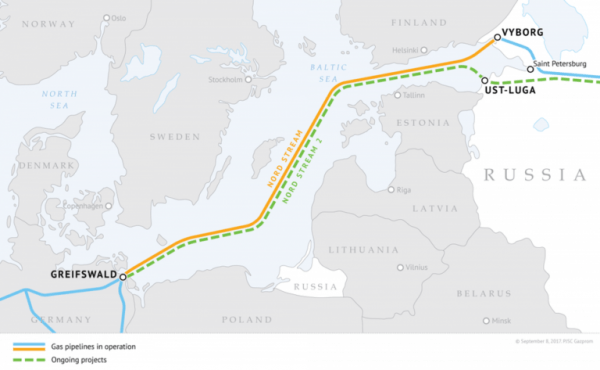
The Nord Stream 2, which will connect Russia’s Leningrad Regionto Germany’s Baltic coast, bypassing the traditional route via Ukraine, aims to double the capacity of the already-built Nord Stream 1 to 110 billion cubic meters (bcm) per year that is more than a quarter of the European Union’s gas consumption.
On October 31, Gazprom, Russia’s energy Leviathan, had said 83 percent of the pipeline construction — more than 2100 km of the pipeline — was complete. The permit to construct in the Danish Exclusive Economic Zone south-east of Bornholm covers a 147-km-long route section.
Pipelay has been completed in Russian, Finnish and Swedish waters, and for the most part in German waters. The construction of both landfall facilities in Russia and Germany is nearing completion. Thus, the development last week signifies that Russia is certain to finish the project by the end of this year.
Despite the rising tensions in Russia’s relations with the United States, a massive energy project is all set to slither along the seabed between Russia and the European Union. The US wants to stifle the serpent in its infancy but Germany and Russia navigated it to the home stretch.
The project is expected to ensure safe and stable supplies of gas to Europe. The competitive Russian gas supplies will enable European customers to save anywhere around 8 billion euros on their gas bill in 2020.
More importantly, according to a study conducted by the University of Cologne EWI, “When Nord Stream 2 is available, Russia can supply more gas to the EU decreasing the need to import more expensive LNG. Hence, the import price for the remaining LNG volumes decreases, thereby reducing the overall EU-28 price level.”
Herein lies the rub. Europe has become a natural gas battleground for the US and Russia. Of course, apart from being a prized market, Europe is also a political battleground between the US and Russia.
Russia traditionally dominated the European market while the European Union appears to be keen to wean itself off Russian gas, given the geopolitical implications of over-reliance on Moscow for its energy security. On the other hand, the US is looking to step up its exports of liquefied natural gas (LNG) to Europe and faces a big resourceful competitor who cannot be dislodged from the market — Russia.
Russia loomed large as the largest supplier of natural gas to the EU in 2018. According to the European Commission’s latest data on EU imports of energy products in October, eleven member states imported in 2018 more than 75 percent of their total national imports of natural gas from Russia.
Russia has multiple pipelines in operation, which gives it a big advantage in cutting down transportation costs for the European consumers, as compared to more expensive LNG imports from the US. Clearly, both geoeconomics and geopolitics are at play here.
The US’ transatlantic leadership is largely conditional on the climate of relations between Europe and Russia in general and between Germany and Russia in particular. Washington is acutely conscious that Nord Stream 2 can provide the underpinning for a stable, predictable relationship between Europe and Russia, which would go against the grain of the Trump administration’s projection of Russia as a revisionist power that the US is determined to counter.
In sum, Washington apprehends that if Nord Stream 2 is completed, it will come as a severe blow to transatlantic relations, although on the face of it, the US has been arguing that the project runs counter to the Western sanctions imposed on Russia following its annexation of Crimea.
Actually, this argument is sheer sophistry, since Europe’s dependence on Russian energy supplies is a legacy inherited from the days of the Soviet Union. Moscow is a stakeholder in preserving its reputation as a stable, reliable supplier of energy to Europe at competitive prices. The crux of the matter is that the European consumer prefers the cheaper Russian gas to the expensive LNG exports from the US.
Meanwhile, the Ukraine crisis alerted Russia to the geopolitical reality that it could be vulnerable to US pressure politically, which in turn prompted its energy pivot to China. Gazprom aims to become China’s top gas exporter by 2035. When the Power of Siberia pipeline (under construction in Eastern Siberia to transport gas to Far East countries) becomes active later this year, it will deliver 38 billion cubic metres of natural gas annually to China, which will make China Russia’s second-largest gas customer after Germany.
However, paradoxically, Russia’s gas exports to Europe are only increasing in recent years. In 2018, Gazprom’s gas sales to Europe and its share of Europe’s gas market reached record highs. This trend can only continue as the Nord Stream 2 and Turk Stream pipelines, which will become active shortly this year, will deliver an additional 86.5 billion cubic meters annually to Europe.
Simply put, Europe’s addiction to Russian gas remains a fact of life and with the continent’s own gas production on the decline, Europe needs to import much bigger volumes of gas and lots of it is going to come from Russia.
The amazing part has been the dogged resistance by Germany to the US pressure tactic to abandon Nord Stream 2. The US even threatened to sanction German companies; US Congress passed resolutions calling for an end to construction of the pipeline. Germany’s manufacturing economy is dependent on imports for 98% of its oil and 92% of its gas supply, and cheap gas is the lifeblood of its export-based economy.
But then, there could be more to it politically than meets the eye. Can it be a coincidence that Germany is also resisting US pressure to shut out Chinese tech giant Huawei from its 5G networks? Like with Nord Stream 2, Washington advanced the same argument apropos Huawei — national security concerns. But Germany snubbed the calls from the US.
The Economist magazine wrote some months ago that the “The Atlantic Ocean is starting to look awfully wide. To Europeans the United Statesappears ever more remote.” To be sure, the coming into fruition of Nord Stream 2 is yet another sign that the transatlantic relationship currently faces significant challenges.
The US-European policy divisions have emerged on a wide range of regional and global issues. Although US and European policies toward Russia remain broadly aligned, Nord Stream 2 turned out to be a key US-European friction point.
By Professor Roger Watson and Dr. Niall McCrae | The Daily Sceptic | November 15, 2021
As scholars at leading British universities over recent decades, we witnessed the replacement of critical thinking and debate by narrative: facts are discrimination and scientific method is imperialism; truth, instead, is derived from ‘progressive’ values. This educational trend may be a major contributory factor to the ease in which society has been inculcated to the Covid ‘new normal’ of masking, testing, and repeated doses of vaccines for a disease of similar risk to severe influenza.
One doesn’t need much critical reasoning to observe the flawed logic of some vaccination enthusiasts, such as people who respond to experiencing any side effects, however debilitating, by saying “at least I know it’s working”, or, after contracting the disease despite their promised inoculation (over 90% effective, according to initial drug company claims), “I’d have been worse off without the jab.” … continue
This site is provided as a research and reference tool. Although we make every reasonable effort to ensure that the information and data provided at this site are useful, accurate, and current, we cannot guarantee that the information and data provided here will be error-free. By using this site, you assume all responsibility for and risk arising from your use of and reliance upon the contents of this site.
This site and the information available through it do not, and are not intended to constitute legal advice. Should you require legal advice, you should consult your own attorney.
Nothing within this site or linked to by this site constitutes investment advice or medical advice.
Materials accessible from or added to this site by third parties, such as comments posted, are strictly the responsibility of the third party who added such materials or made them accessible and we neither endorse nor undertake to control, monitor, edit or assume responsibility for any such third-party material.
The posting of stories, commentaries, reports, documents and links (embedded or otherwise) on this site does not in any way, shape or form, implied or otherwise, necessarily express or suggest endorsement or support of any of such posted material or parts therein.
The word “alleged” is deemed to occur before the word “fraud.” Since the rule of law still applies. To peasants, at least.
Fair Use
This site contains copyrighted material the use of which has not always been specifically authorized by the copyright owner. We are making such material available in our efforts to advance understanding of environmental, political, human rights, economic, democracy, scientific, and social justice issues, etc. We believe this constitutes a ‘fair use’ of any such copyrighted material as provided for in section 107 of the US Copyright Law. In accordance with Title 17 U.S.C. Section 107, the material on this site is distributed without profit to those who have expressed a prior interest in receiving the included information for research and educational purposes. For more info go to: http://www.law.cornell.edu/uscode/17/107.shtml. If you wish to use copyrighted material from this site for purposes of your own that go beyond ‘fair use’, you must obtain permission from the copyright owner.
DMCA Contact
This is information for anyone that wishes to challenge our “fair use” of copyrighted material.
If you are a legal copyright holder or a designated agent for such and you believe that content residing on or accessible through our website infringes a copyright and falls outside the boundaries of “Fair Use”, please send a notice of infringement by contacting atheonews@gmail.com.
We will respond and take necessary action immediately.
If notice is given of an alleged copyright violation we will act expeditiously to remove or disable access to the material(s) in question.
All 3rd party material posted on this website is copyright the respective owners / authors. Aletho News makes no claim of copyright on such material.