Denmark removes final hurdle for Russian gas pipeline to Europe
RT | October 30, 2019
Denmark has given the green light for the Russia-led Nord Stream 2 gas pipeline to pass through its waters. Copenhagen’s delay in granting permission has been the main hurdle to completing the project on time.
“The Danish Energy Agency has granted a permit to Nord Stream 2 AG to construct a section of the Nord Stream 2 natural gas pipelines on the Danish continental shelf southeast of Bornholm in the Baltic Sea,” the agency said in a press release.
It explained that the permit was granted in accordance with Denmark’s obligations under the UN Convention on the Law of the Sea.
“Denmark is obliged to allow the construction of transit pipelines with respect to resources and the environment and if necessary to assign the route where such pipelines should be laid,” it said.
The agency said it concluded that “the southeastern route on the continental shelf is preferable to the northwestern route” as it is the shortest one. It provides the “least risk and impact from an environmental and safety perspective and therefore is the preferable choice.”
The undersea pipeline, designed to deliver Russian natural gas to Germany and other European customers, is set to be finished by the end of the year. The offshore and land sections of the pipeline were connected on the German side last year and a receiving terminal is currently under construction there. Russia has finished laying nearly two thirds of the Nord Stream 2 natural gas pipeline along the bottom of the Baltic Sea.
The project has only needed approval from Danish authorities; other countries on the route of the pipeline – Russia, Finland, Sweden and Germany – have long-since approved it.
The pipeline’s construction has been criticized by the US administration which attempted to derail the project in order to boost sales of American liquefied natural gas (LNG) to Europe.
Is the ‘Greater Albania’ Project Aimed Against Russia in the Balkans?
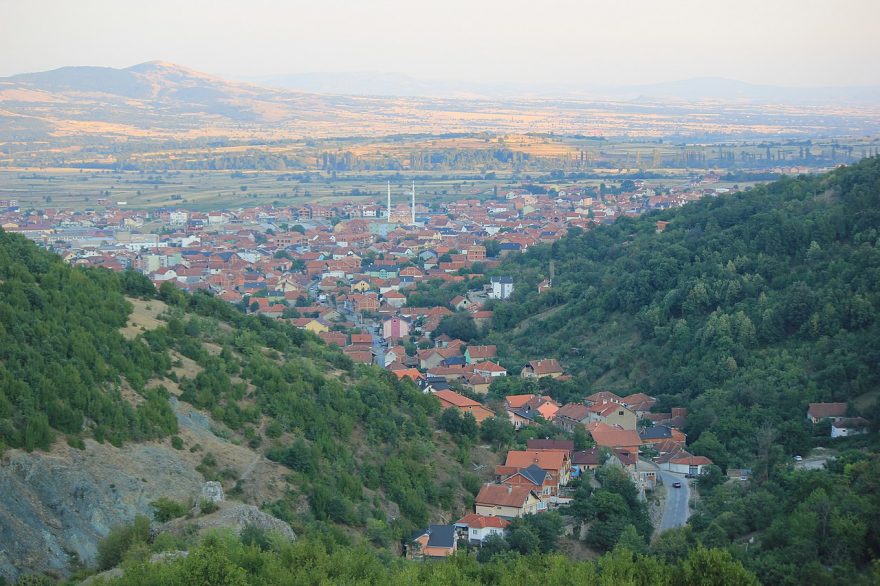
Preševo Valley, Serbia.
By Paul Antonopoulos | October 28, 2019
A project for Greater Albania – conspiracy or legitimate? According to a 2010 Gallup Balkan Monitor report, 83% of Albanians in Albania supported the idea of a Greater Albania, with 81% and 53% of Albanians in Kosovo and North Macedonia respectively supporting such an ambition.
The ultimate goal? To have Kosovo and the Preševo Valley in Serbia, southern Montenegro, Epirus in Greece and western North Macedonia into a single Greater Albanian state. Although this may not be official policy of the Albanian Republic, it is ingrained into the Albanian mythos. The very idea of a Greater Albania has roots in the 1913 Treaty of London that left roughly 40% of the Albanian population outside the newly established Albanian country. This has been something that the U.S. could weaponize against Russian influence in the Balkans.
Despite the heroics of Albanian national figure and anti-Ottoman guerrilla leader Gjergj Kastrioti, more commonly known as Skënderbej, the Albanians became loyal Ottoman subjects and were used as colonists in more restive and disloyal areas of the empire, especially those inhabited by the Serbs, Bulgarians and Greeks. They often became a majority over the initial inhabitants, like what happened in Kosovo and western North Macedonia.
Although the idea of a Greater Albania may seem like an exaggerated conspiracy, to the Serbian people this is anything but. The Serbian mythos finds itself in the 1389 Battle of Kosovo, where despite their courage, Serbian Prince Lazar Hrebeljanović was martyred and his forces routed by the Ottoman invaders. Although the Serbs achieved sovereignty over Kosovo with the downfall of the Ottoman Empire, the region had already become an Albanian majority on Ottoman orders to weaken Serbian identity to the region.
Kosovo became an autonomous region of Serbia after the establishment of socialist Yugoslavia in the aftermath of World War Two and retained its Albanian-majority. The 1990’s proved this was always a weak point of Serbia. With the U.S. sponsoring the violent destruction of Yugoslavia in the early 1990’s, the status of Kosovo was left unresolved, culminating in the terrorist-led war against the Yugoslav state (in which Serbia was the successor of) in 1999.
The terrorist ethnic-Albanian Kosovo Liberation Army (KLA), with the backing of NATO and the Albanian Republic, defeated Yugoslav forces. The United Nations and NATO assumed control of the territory, which eventually declared independence in 2008. Since then the region has become a heroin ‘smugglers paradise,’ and a hub for human trafficking, organ harvesting and arms trafficking.
It is for this reason that in an interview on Saturday, the former Serbian Chief of General Staff, General Ljubisa Dikovic, discussed the project for a Greater Albania. Dikovic believes that the area of the Balkan Peninsula cannot be peaceful because of unresolved issues like Kosovo.
“There can easily be big problems if things get out of hand. I hope that there will be enough wisdom and intelligence and that everyone will do what we do, in terms of strengthening security, cooperation and trust. I am free to say that we are in the lead because I do not see on other sides showing desire to build peace. After all, the issue of ‘Greater Albania’ is a matter of the highest security risk. We can ask why this is happening now with Albania and [North] Macedonia? It might be waiting to create a ‘Greater Albania’,” Dikovic said.
His comments come as the economic situation in Kosovo continues to deteriorate and becomes even more reliant upon foreign aid and donations from the unilateral behaving U.S., their former Ottoman masters in Turkey that had gifted lands to them hundreds of years earlier, and Germany who effectively rules the European Union.
The former military man’s comments also come as Serbia leads Exercise “Slovenian Shield 2019” with Russia. Although some Slavic tribes broke off and headed south into the Balkans sometime at around 600AD, they maintained their Slavic kinship with the Russians and shared Christian Orthodox faith, ensuring Serbia has always had a pro-Russia view. Albanian expansionism has therefore become a natural ally of the U.S. to limit Russian influence in the Balkans.
However, this begs the question then why strong efforts for Albanian independence in Greece, Montenegro and North Macedonia has been weak in comparison to those in Serbia. Greece has been a long-time loyal NATO member, with the exception of the disintegration of Yugoslavia, and therefore does not pose a threat to U.S. hegemony in the Balkans, protecting Greece from destabilization efforts via Albanian expansionism. Although Montenegro and North Macedonia also share Slavic kinship with the Serbs and Russians, as well as the Orthodox faith, they have proven to have Globalist ambitions, wanting to join NATO and the EU.
Serbia remains the only anti-EU/NATO state in the Balkans that is overwhelmingly pro-Russia. It is for this reason that Dikovic wants to renew compulsory military service, stating: “One should not gamble and think that there will be no conflict and risk. It is not only up to us, but we must have an answer to everything.”
Although the overwhelming majority of Albanians want a Greater Albania, it is unlikely to be achieved with Washington’s backing in Greece, Montenegro and North Macedonia as they do not pose a threat to U.S. hegemony in the Balkans, but rather serve it, while not encouraging Russian influence in the region. As Serbia is a pro-Russian island in a hostile region, it will continue to be targeted by Albanian expansionism with U.S. backing. Will this drive for expansionism violently spill over into the Preševo Valley? That remains to be seen.
Paul Antonopoulos is a Research Fellow at the Center for Syncretic Studies.
Former MKO members expose anti-Iran ruse in Albania
Press TV – October 26, 2019
Albanian police on Wednesday claimed that they had foiled planned attacks by Iranian agents against an exiled terrorist group living in Albania, but several former members of the group have come forward to reveal that they are the real individuals being accused of the plot.
Since 2014, some 3,000 MKO members have settled in a camp in Albania after being transferred by the US from Iraq. Earlier this week, Albanian authorities claimed that they had discovered an active cell of the Iranian Quds Force and prevented their “plan of March 2018″ to attack the camp.
In March 2018, two people were held in Albania but set free for lack of evidence. At the time, an opposition leader denounced the announcement as a ploy by Socialist Prime Minister Edi Rama to divert attention from Tirana’s failure to start entry talks with the European Union.
The accusation was similar to those made against Iran in Europe, including by France in October 2018 which accused Tehran of plotting to attack an annual MKO rally outside Paris.
The timing of the accusations was suspicious. They came as European governments apparently sought to save a 2015 nuclear deal with Iran after the US abandoned the agreement.
From the outset, Tehran vehemently dismissed the claims as false flag operations, while those detained in connection with the alleged plots were released later due to lack of evidence.
On Saturday, a Canadian-Albanian historian released a video of his interview with several individuals who said they had defected the MKO, but were now being framed by the terrorist group as Iranian agents sent to attack the camp near Durres, Albania’s main port.
Dr. Olsi Jazexhi, who carried out the interview, explained that a “cold war” is underway in Albania between former MKO members and the ringleaders of the terrorist organization.
Jazexhi, who specializes in the history of Islam, nationalism and religious reformation in Southeastern Europe, described those speaking in the interview as former terrorists who have abandoned terrorism against Iran and decided to lead a civilian life.
He has already aired a TV show called the “Opinion” in Albania, which said the MKO runs its own secret service in the impoverished European country, and that it spies on former members of the organization who live there.
A former member of the MKO in the video, labelled as an agent of Iran, is heard saying, “I don’t want to fight anything, any side. I want my own life, personal life, civilian life and I don’t want to fight.”
“For this reason, the MKO does not want us to live here. They put pressure on us to leave this country because if another member in the MKO comes out for anything or any work and see us we have a free [life], maybe they want to come out and have a free life. For this they make fake news against us, accuse us of being agents and mercenary of Iran,” the man says.
Last year, Albania expelled two Iranian diplomats suspected of “involvement in activities that harm the country’s security.”
Iran denounced the expulsions, saying Albania has fallen prey to a scenario fabricated by the US and Israel and certain terrorist groups.
The MKO has carried out numerous attacks against Iranian civilians and government officials over the past three decades and is listed as a terrorist organization by much of the international community.
Out of the nearly 17,000 Iranians killed in terrorist assaults since the victory of Iran’s 1979 Islamic Revolution, about 12,000 have fallen victim to MKO’s acts of terror.
It’s ‘unthinkable & absurd’ to jail Catalan pro-independence leaders, former UN special rapporteur tells RT
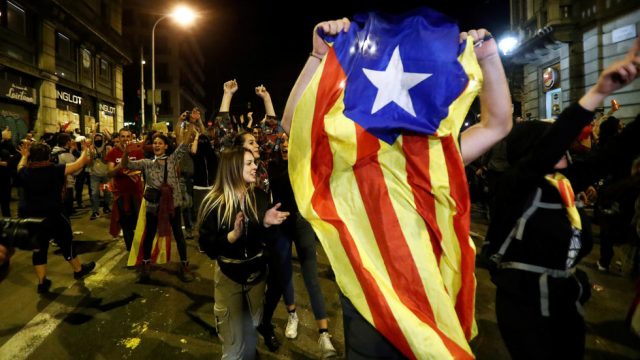
A protest in solidarity with the Catalan pro-independence politicians in Barcelona, Spain, October 20, 2019. © Jon Nazca / Reuters
RT | October 24, 2019
The prosecution of Catalan pro-independence politicians by Spain violates European law and is simply “absurd,” a former high-ranking democracy and human rights expert at the UN has told RT.
“Political prisoners in Spain… It’s absolutely unthinkable!” Alfred-Maurice de Zayas, who served as the UN Independent Expert on the Promotion of a Democratic and Equitable International Order, said in an interview with Rafael Correa on RT Spanish.
He branded the jailing of the leaders of the Catalan independence movement “absurd,” especially since the “Catalans have been protesting for many years in a peaceful, democratic fashion.”
Spain’s northeastern region of Catalonia voted in favor of independence in October 2017. Madrid called the vote illegal and sent in a massive police force to disrupt the referendum.
Chaotic scenes from the ground with officers in full riot gear beating civilians for merely voting, storming polling stations and snatching ballot boxes made the headlines back then, triggering widespread condemnation from international humanitarian organizations.
Following the voting-day crackdown, Spanish authorities detained a group of prominent Catalan politicians who had been involved in staging the referendum. Former Catalan Vice President Oriol Junqueras and eight others were sentenced to between nine and 13 years in prison earlier this month.
Spain is now demanding the extradition of former regional president Carles Puigdemont, who fled to Belgium shortly after the failed independence bid.
“Both Puigdemont and Junqueras were elected with a mandate to carry out this [exact] referendum,” de Zayas stressed.
“So, criminally prosecuting someone for actions that were legitimized through a democratic election is … beyond all reason.”
“It violates Article 2 of the [EU’s] Treaty of Lisbon, which says that such issues must be brought up before the European Commission. Yet, I don’t see any complaints coming from Berlin, Brussels or Copenhagen that declare: ‘Things like that shouldn’t happen in Europe.’”
The lengthy prison sentences for pro-independence politicians sparked peaceful protests in Barcelona, which has been marred by night-time rioting and clashes with police. The mass protests raged for several days in a row, culminating in a general strike last Friday, which attracted at least half a million supporters of independence.
Brexit: Parliament Tethers Britain to a Failing Experiment
Europe is crumbling, & Britain’s elite desperately want to be part of the wreckage
By Kit Knightly | OffGuardian | October 20, 2019
Brexit isn’t going to happen. Left or Right – Lexit or Rexit – it’s over. It’s time to make peace with that idea.
Penned in by the absurd Benn Act, No Deal is off the table, which means Britain will be forced to either remain or accept a deal that’s Remain by another name.
The Letwin Ammendment and Johnson’s unsigned extension request are just morbid theatre. Unnecessary nails in a well-sealed coffin.
It’s all very Weekend at Bernies’ – A lame cast of characters, puppeteering Brexit’s corpse to keep up a tired joke that was never funny to begin with.
Parliament has become an absurd pantomime, where a clown Prime Minister – his majority willfully destroyed – sets up straw men that the “opposition” bayonet with increasingly maniacal glee. No thought is given to policy or consequences, only increasing the tally of Boris Johnson’s parliamentary defeats.
Labour, and the bedraggled, hysterical remainers in the Lib Dems/TIG/Green Party, have become nothing but contrarians – automatically gain-saying anything tabled by the government for the simple joy of humiliating the nation’s Court Jester in Chief.
Corbyn has been so successfully gaslighted by his remain-heavy PLP he doesn’t even realise he’s betraying his life-long principles, his mentor Tony Benn, and entire swaths of the Labour’s Northern heartlands, who all voted to leave.
When a general election does come, it will mean nothing.
Labour will likely be destroyed as working-class voters either flock to the Brexit Party or simply collapse into the apathy of the voiceless, and stay home.
If Labour scrapes together enough voters from Remain country in Scotland and London to claw their way to a small majority, well their socialist manifesto will be crippled by the EU’s austerity policy and restrictions on nationalisation.
In either event, Corbyn will be replaced by a New Labour non-entity of little renown and less worth. The papers will declare socialism dead (again), and maybe clap Corbyn on the shoulder for doing “well, considering” and “changing the conversation”.
We’ll be invited the celebrate the new (inevitably) female leader as a sign of “progress”, while society continues to slip backwards.
Whether the hardcore Remainers get their “People’s Vote” or not, and whichever of the carousel of undesirables happens to be Prime Minister when it all eventually wraps up, Brexit is dead. Parliament killed it.
This on-going, slow-burn sabotage is hard to watch – but it’s not what this article is about.
What it’s about is a question. An important question. One that should weigh heavily on the shoulders of Remainers on the eve of their – for want of a better word – victory:
Do we really want this? Does the EU, right now, really look like something we want to be a part of?
Let’s run down the situation on The Continent.
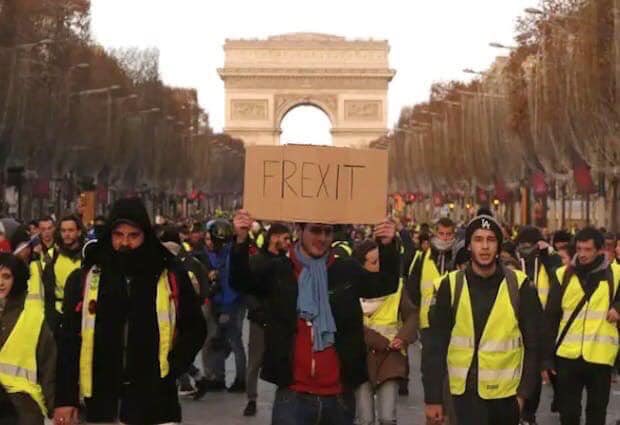
France is miserable, sick of austerity. Sick of spending cuts and falling standards and neo-liberal economics promising a trickle-down that never seems to come.
In Paris – and many other French cities – the Yellow Vests are nearing their fiftieth straight week of protests, and don’t seem to be slowing down (Hopefully they plan something nice for their first birthday).
People have lost eyes, hands, even lives. The Hong Kong protests – so long front-page news in the UK – have been a picnic in comparison.
In Hungary, an elected President is held hostage by the bureaucracy of the EU. Whatever you think of Orban, he was democratically elected to enact the political promises he made during his campaign. That Brussels can sanction him, and threaten to remove Hungary’s voting rights, is perverse. Anti-democracy in the name of democracy.
They say it’s about “protecting European values”, but is it?
That’s pretty hard to believe, considering the situation elsewhere in Europe…

Spain will join France in the flames soon. They already sent thirteen politicians to prison for sedition.
Take a moment to consider that – actual “sedition”.
This comes after sending in riot police to break up a peaceful referendum. Spanish police beat voters, arrested protesters and destroyed ballot boxes.
Madrid has faced no punishment, or even criticism, for this. They – unlike Orban – have escaped any sanction or censure. Police attack Catalonian independence protests on the streets of Barcelona…and Brussels’ silence is deafening.
(Imagine Russia had just jailed 13 opposition politicians for sedition. Imagine Maduro was blinding protestors with rubber bullets. The difference in coverage and attitude would be breathtaking.)
What is the difference between Budapest and Paris? Or Moscow and Madrid?
Well, Orban is anti-EU (as are the Gilets Jaunes). The governments of France and Spain are Pro EU, with a ferocity that fully justifies the capital P.
Follow a pro-EU agenda of austerity, uncontrolled immigration and globalisation and you can blind as many protesters as you want.
The harder you look, the more it seems “European values” is slang for “European power”.
The talk of the EU Army bubbles away on the back-burner, whilst the European Parliament merrily votes through massive funding for “StratCom” programmes to “counter misinformation”.
We hear about peace, but we don’t see it. We hear about prosperity, but we don’t feel it.
Austerity is choking the birthplace of democracy to death, and its – again, for want of a better word – “leaders” are spending tax revenues on propaganda and the military.
Is that going to help a single ordinary citizen out of poverty? Are these moves designed to make life fair, equal or easy for ordinary citizens? Or consolidate and enforce authority?
Look at Europe. Really look at it. It’s burning. And yet Remainers sit amongst the flames and say everything’s fine.
We are lectured on “European Values”, but that phrase has been meaningless for years, and every day edges closer and closer to full-on parody.
Europe is a sinking ship the rats in Parliament refuse to leave.
Kit Knightly is co-editor of OffGuardian. The Guardian banned him from commenting. Twice. He used to write for fun, but now he’s forced to out of a near-permanent sense of outrage.
The EU’s conditional aid and suppression of Palestinian rights
By Ramona Wadi | MEMO | October 14, 2019
The European Union’s incoming Foreign Policy Chief Josep Borrell has already signalled a continuation of the bloc’s prevailing politics when it comes to Palestine – preserve the two-state compromise by ensuring funding to the Palestinian Authority.
“If anyone helps the Palestinians today and their right to have their own state, that is Europe,” Borrell declared at the European Parliament’s Committee on Foreign Affairs. The truth is Europe does neither; it is merely concerned with maintaining its influence when it comes to the two-state compromise and peace-building narratives, all of which serve the EU’s political agenda.
Summarising the gist of the EU’s foreign policy when it comes to Palestine, Borrell tweeted: “The EU contributes almost one million € a day to attend the Palestinian Authority. We must continue to defend a peaceful coexistence and the two states solution.” A succinct description of what EU funding constitutes – providing the PA with the necessary backing to function without the existence of a Palestinian state.
For the EU, maintaining the two-state paradigm at the helm of policy works better than implementation, which is now inapplicable anyway. The pretence of state-building, which the PA forms part of, is also a veneer that shifts focus away from the EU’s lucrative trade deals with Israel. Borrell has already stated, unsurprisingly, that the EU’s trade agreements with Israel will not be broken. In 2017, Israel-EU trade amounted to €36.2 billion, which pales in comparison to EU assistance to the PA.
For Palestinians, therefore, the EU only finances hypotheses – in Borrell’s words, “the possibility of the creation of a Palestinian state that can coexist peacefully with an Israeli state.” The EU can claim to be the biggest donor to the Palestinians, yet it is financing its own agenda, rather than providing the means for Palestinians to demand their legitimate political rights.
The Oslo Accords, which allowed Israel to colonise additional Palestinian land, have not been repudiated by the EU. On the contrary, there has been no contestation of the framework on the grounds that it has stripped Palestinians of what remained of their land and freedom. With the PA a willing accomplice, the EU has never been challenged by Palestinian political bureaucrats to uphold the rights of the Palestinian people. Conversely, the PA reaches out to the EU for assistance in maintaining the violations imposed by Israel and to which the international community turns a blind eye.
Europe is not helping Palestinians towards statehood – it is maintaining the illusion of statehood as an interim project, while Israel colonises what remains of Palestinian territory. The Oslo Accords are vague and so is EU policy towards Palestine. Instead of seeking clear parameters to decolonise Palestine, the EU is adopting the same ambiguities that have transformed Palestinians into a humanitarian project against their will.
The EU is merely financing its unwarranted justification of the two-state paradigm and forcing Palestinians into conditional financial aid. While nothing new is expected when it comes to the EU’s farcical peace and state-building for Palestinians, Borrell has indicated the EU’s agenda upfront – the financing of agendas and illusions to enable Israel’s ongoing colonial project.
How The US Quietly Lost The 1st Amendment
By Tyler Durden – Zero Hedge – 10/12/2019
While many would argue that Americans’ First Amendment rights have long since dwindled from the liberties initially granted in The Bill of Rights, a decision by the European Union’s highest court could well mark the final nail in the coffin of free speech.
As Politico reports, the Court of Justice of the European Union (CJEU) has ruled that Facebook can be ordered to track down and remove content globally if it was found to be illegal in any EU country. In its ruling, CJEU said that EU law allowed local judges to order the world’s largest social network to remove illegal content, as well as delete material that conveyed a similar message under certain circumstances.
The decision is not just a slap in the face of worldwide citizens’ freedom of expression, but a big defeat for Facebook as it will force them to be more responsible for what is appearing on the internet (and thus what is seen by those who make the rules as not appropriate for the genpop).
“This judgement raises critical questions around freedom of expression and the role that internet companies should play in monitoring, interpreting and removing speech,” Toby Partlett, a Facebook spokesman, said in a statement.
“We hope the courts take a proportionate and measured approach to avoid having a chilling effect on freedom of expression.”
Of course, it won’t as EU bureaucrats have hardly shown the ability to undertake measured responses when it comes to cracking down on non-sanctioned thoughts, words, and memes. Facebook officials went to exclaim that:
… the ruling “undermines the longstanding principle that one country does not have the right to impose its laws on speech on another country.”
As Politico details, the ruling stems from a lawsuit filed in 2016 by Eva Glawischnig-Piesczek, an Austrian lawmaker, who had requested that Facebook delete defamatory posts made about her by an anonymous user.
When an Austrian court sided with her, the company initially only removed the content from being viewed in Austria, but subsequent appeals had focused on whether such takedowns should apply globally, and if Facebook should be required to remove similar content once it has been made aware of the defamatory material.
Following the ruling by Europe’s highest court, her case will now be referred back to Austrian judges, who will make the final ruling about how to apply Thursday’s decision.
As one would expect, digital rights campaigners were incensed by the breadth of the decision:
“The court’s decision opens the door for serious restrictions on freedom of expression due to the takedown of legitimate speech. Extending removal to the vague concept of “equivalent” content is harmful because the context as well as motivation of users re-sharing content may significantly differ with each re-upload,” said Eliška Pírková, Europe policy analyst at Access Now, a campaigning group.
Those who believe tyranny cannot come to the United States should take a look around because it’s already here and as the EU court’s decision shows, it is not just Washington that Americans should fear.
EU can order Facebook to remove ‘hate speech’ even if it’s outside Europe, top court says in landmark ruling
RT | October 3, 2019
Facebook must comply with demands from EU nations to remove content deemed illegal, even if the material falls outside of their jurisdiction, a top court has ruled. The decision could undermine freedom of speech on the internet.
The European Court of Justice, the bloc’s top court, said on Thursday that an individual country can order Facebook to remove posts, photographs, and videos, and even restrict access to these materials to people all over the world.
According to the Luxembourg-based court, a national court of any EU country has the right to instruct the social media giant to take down posts considered defamatory in regions beyond its jurisdiction.
The ruling upholds a non-binding opinion from an ECJ adviser in June, which Facebook argued “undermines the longstanding principle that one country should not have the right to limit free expression in other countries.”
The initial opinion came after an Austrian Green party politician sued Facebook, demanding that the platform delete defamatory content about her posted by a user, as well as duplicates of the same material. The complaint was referred to the ECJ by Austria’s High Court. The politician, Eva Glawischnig-Piesczek, insisted that Facebook prevent the content from being viewed worldwide.
This is the second major ECJ ruling in as many months concerning freedom of expression on the internet. In September, the court said that Google does not have to apply the EU’s “right to be forgotten” law globally. The directive requires the tech giant to remove search result listings to pages containing damaging or false information about a person. As a result, Google implemented a feature that prevents European users from being able to see delisted links.
Iran nuclear issue at inflection point

French President Emmanuel Macron met Iran’s President Hassan Rouhani at UN Hqs, New York, Sept 24, 2019
By M. K. BHADRAKUMAR | Indian Punchline | September 30, 2019
The unexpected move by the Pentagon to shift the Combined Air and Space Operations Center (CAOC) at al-Udeid Air Base in Qatar to the Shaw Air Force Base in South Carolina 7,000 miles away from the Middle East took place against the backdrop of the gathering storms in the regional environment. It injects a crisis atmosphere into regional politics.
To put the Pentagon move in perspective, in addition to hosting Qatari forces, the base also hosts the 379th Air Expeditionary Wing of the US Air Force. Other US military has been active in the country as well including the US Navy SEALS. The facility is also used by the British Royal Airforce. The al-Udeid Air Base is one of the few US airbases overseas where B-52 bombers, America’s largest warplane can land due to the long runways.
This is not the first time that the US temporarily relocated the CAOC. The last time it happened was 13 years ago. When tensions erupted between Qatar and Saudi Arabia, there was even talk of relocating the Central Command out of Qatar.
However, in the current scenario, the Pentagon move is undoubtedly related to the US’ mounting tensions with Iran. If push came to shove and a full blown US-Iran conflict erupts, the CAOC would be one of Iran’s priority targets. The CAOC is so critical to providing fire power for the US forces operating in the region that the Pentagon cannot take risks. The US commander of the 609th Air and Space Operations Center has been quoted as saying, “Iran has indicated multiple times through multiple sources their intent to attack US forces.”
How serious are the prospects of a US-Iran military conflict? Iran’s President Hassan Rouhani disclosed after his return to Tehran from New York that the two sides came breathtakingly close to a summit meeting on the sidelines of the UN GA in New York last week. Rouhani said,
“They (Americans) had sent messages to almost all European and no-European leaders that they wanted one-to-one negotiations between the two Presidents, but we had rejected it, saying that negotiations had to be done in the framework of P5+1, and they accepted.”
“Of course, 3 out of the 6 countries, that is the Chancellor of Germany, Prime Minister of Britain, and President of France all insisted for the meeting to be held, saying that the US would lift all sanctions. But the problem here is that under sanctions and maximum pressure, even if we want to negotiate with the Americans within the framework of P5+1, nobody can predict about the end and upshot of the negotiation.”
Significantly, last Tuesday, during the UNGA in New York, Saudi Arabia’s Crown Prince Mohammad bin Salman (MbS) also spoke with noticeable restraint in a rare interview with CBS’ ’60 Minutes’. MbS warned, “If the world does not take a strong and firm action to deter Iran, we will see further escalations that will threaten world interests. Oil supplies will be disrupted and oil prices will jump to unimaginably high numbers that we haven’t seen in our lifetimes.” And he went on to stay that a “political and peaceful solution is much better than the military one.”
Importantly, he was categorical that there should be a US-Iranian summit meeting, and added, “this is what we all ask for.” Conventional wisdom is that Saudi Arabia is petrified that the US may engage with Iran directly. But that is apparently not the case.
No doubt, the Russian President Vladimir Putin’s visit to Saudi Arabia in October will be keenly watched. Prior to the Saudi visit, Putin will be meeting Rouhani on the sidelines of the summit meeting of the Eurasian Economic Union (EAEU) in Yerevan on October 1 when the regional situation and the Iran nuclear deal will certainly be on the agenda of discussion.
This is a defining moment in Russian-Iranian relations too, as Iran is about to sign the formal agreement to join a free trade zone with the EAEU, which of course is a prestigious Kremlin project.
Moscow is cautiously optimistic that “Possibly we will achieve some positive solution (on the 2015 nuclear deal) over several months to come, or else the situation will continue to get worse,” to quote Russia’s representative at international organisations in Vienna, Mikhail Ulyanov during a press conference on Friday to highlight that the Iran nuclear issue is approaching an inflection point.
But Iran is potentially inching its way back [?] in the nuclear weapons business, with a fourth step it is expected to take in early November to reduce its commitments under the 2015 deal. A report in the Guardian last week said the European Union has “privately warned Iran that it will be forced to start withdrawing from the nuclear deal in November if Tehran goes ahead with its threat to take new steps away from the deal… The EU told Iran that it would put the issue of Iranian non-compliance into the agreement’s formal dispute mechanism if the next Iranian move away from the deal is significant… Once the deal’s dispute mechanism is triggered, both sides have 30 days to prove significant non-compliance, and if necessary a world-wide sanctions snap-back occurs.”
The Guardian report put across the European dilemma on the following lines: “The difficulty is that Iran says the steps are reversible, but if they learn about building a nuclear bomb, that is irreversible.”
Iran is no longer finding the support it hoped for in Europe and could be susceptible to broad censure. Conversely, the US is getting the opportunity to restore a modicum of credibility with its allies and the international community, which would broaden the pressure on Iran.
On the other hand, a climb-down by Trump is becoming more difficult in the rising tumult of impeachment proceedings. But while he may appear to have boxed himself in, it is still up to him to offer to Iran that resuming compliance with the 2015 agreement would be met with concrete benefits, like the $15 billion bailout package France’s president, Emmanuel Macron, has proposed.
Such a turn to events between now and November cannot be ruled out. After the UNGA, Trump hinted at willingness to negotiate. He said on Friday, “I don’t want military conflict. We’ve offered to talk, we’ve offered to discuss things… I’ve shown great restraint and hope that Iran likewise chooses peace.”
It is within these broad parameters that events may unfold in the coming months. Meanwhile, Pentagon is doing advance planning by shifting the CAOC away from the zone of conflict.
EU threatens to withdraw from JCPOA
By Richard Sudan – Press TV – September 28, 2019
European leaders have threatened to start withdrawing from the Iran nuclear deal in November if Tehran does not return to full compliance.
President Donald Trump withdrew the US from the Joint Comprehensive Plan of Action (JCPOA) in May 2018, and has since reinstated old sanctions and imposed new ones on Tehran in the hope of crippling its economy and forcing it into falling in line.
Since then, Europe says it has strived to preserve the deal, setting up a financial mechanism called INSTEX to help Iran circumvent US sanctions. But in reality not much has been achieved. Trade with Iran has not surged via INSTEX, and Europe has not stood up to the US over its illegal sanctions and unceremonious withdrawal from the historic deal. And yet Iran is the signatory being asked to cooperate.
Three separate steps have been taken so far by Iran and the fourth is scheduled for November. Tehran wants the US sanctions to be lifted, but as pressure on the Iranian people increases with inflation skyrocketing and vital goods and medicines becoming increasingly scarce, the government is losing patience.
This past week European leaders tried to orchestrate a meeting between Trump and Rouhani at the UN General Assembly. Macron told Rouhani it was an opportunity he shouldn’t miss, but Iran’s president was candid.
So no talks on any level until all US sanctions are lifted. During and after the UN general assembly Europe’s tone became increasingly aggressive towards Tehran. The JCPOA’s European trio blamed Iran for the attacks on Saudi oil refineries and threatened to withdraw from the nuclear deal in November if Iran did not return to full compliance.
Featured Video
New positive ivermectin evidence
or go to
Aletho News Archives – Video-Images
From the Archives
Fanatical Followers of the Covid Regime: A Jim Jones-Style Cult?
By Professor Roger Watson and Dr. Niall McCrae | The Daily Sceptic | November 15, 2021
As scholars at leading British universities over recent decades, we witnessed the replacement of critical thinking and debate by narrative: facts are discrimination and scientific method is imperialism; truth, instead, is derived from ‘progressive’ values. This educational trend may be a major contributory factor to the ease in which society has been inculcated to the Covid ‘new normal’ of masking, testing, and repeated doses of vaccines for a disease of similar risk to severe influenza.
One doesn’t need much critical reasoning to observe the flawed logic of some vaccination enthusiasts, such as people who respond to experiencing any side effects, however debilitating, by saying “at least I know it’s working”, or, after contracting the disease despite their promised inoculation (over 90% effective, according to initial drug company claims), “I’d have been worse off without the jab.” … continue
Blog Roll
 Aletho News
- EU Council Advances Chat Control 2.0 Scanning Proposal
- Ex-Greek MEP files complaint against Israeli spyware firm over alleged Pegasus surveillance
- Troubling ideas throughout the Torah, Talmud, Mishneh Torah and Tanya
- ‘Grave, alarming’: Iran mission on Trump’s UNGA ‘annihilation’ threats
- Najaf airport to reopen to Iranian flights within 24 hours: Ambassador
- From ‘How Will This End For Iran’ to ‘When America Walks Away’: A tale of two Economist covers
- Tehran blasts ‘baseless’ speculation linking Iran to alleged bomb plot at UK air base
- The Rise And… Rise Of ‘Color Revolutions’
- The Coming GOP Bloodbath?
- Arctic Scare Stories Melt Away
- If Americans Knew
- Netanyahu Asked UAE Leader to Deny Report on Oct. 7 Warning in Secret Visit, Sources Say
- CNN Chief Int’l Correspondent Clarissa Ward on Journalists in Gaza
- Democratic Party Consultants Surround Troy Jackson with Pro-Israel Donors
- Christian Leader Responds To Netanyahu’s Claims Regarding Palestinian Christians
- In Gaza, ‘Whoever Survives the Bombing Won’t Survive the Rubble’
- Israel kills more Palestinians, amid push to resettle Gaza – Daily Update
- Israel forces Gazans to live in constant peril – Daily Update
- Deconstructing Netanyahu’s pants-on-fire UN rant – Daily Update
- Trump betrayed voters with his campaign lies and prioritized a foreign country once he took office
- Netanyahu calls Israel’s war in Gaza ‘opposite of genocide’ in UN speech to near-empty hall
- No Tricks Zone
- New Study: Earth And Venus Surface Warmth Largely Explained By Convection And Lapse Rate, Not CO2 Or Radiation
- 2025 Nature Paper Claiming Worsening Global Drought Gets RETRACTED …Heavily Flawed
- New Study: ‘Global Drought Shows No Detectable Recent Acceleration Under Climate Warming’
- Economic Masterminds: German Socialists Suggest Taxing Productivity Gains Stemming From Using AI
- The South China Sea Has Not Been Cooperating With The Climate Change Narrative
- Energy Crisis: Germany Enters Heating Season With Historically Low Gas Reserve Fill Levels
- New Study: The Antarctic Ice Sheet Gained Mass From 2020-2024 Due To Staggering Snow And Ice Accumulation
- Study: Ocean Heating Rates From Thousands Of Years Ago ‘Dwarf’ Modern Ocean Heating Rates
- Climate Extremists Target, Attack Large-Scale Power Grid Infrastructure In Germany!
- New Study: Antarctic Ice Melt Has Contributed Less Than 1 Centimeter To Sea Level Rise In The Last 30 Years


