EU Assures US Brussels Will Not Act Toward Iran Without Washington’s Consent – Treasury
Sputnik – September 25, 2019
US Treasury Secretary Steve Mnuchin said Wednesday that the European Union has assured the United States that Brussels would not do anything – with regard to sanctions against Iran – without Washington’s consent.
The situation in the Persian Gulf region worsened after the United States walked out of the Joint Comprehensive Plan of Action (JCPOA), also known as the Iran nuclear deal, in May 2018 and reinstated harsh sanctions on Iran.
Exactly one year after the US withdrawal, Tehran announced that it would be gradually reducing its nuclear obligations every 60 days until EU signatories to the accord ensured Iran’s interests amid US sanctions. Earlier in September, Tehran embarked on the third stage of its rollback plan.
Iranian President Hassan Rouhani said during a speech at the UN General Assembly on Wednesday that the only way Tehran would enter negotiations with Washington is if it returns to the JCPOA and stops imposing sanctions against the country.
US Special Representative for Iran Brian Hook said earlier that Washington would like to see Brussels impose sanctions on those who support what he described as Iran’s missile and drone programs, adding that there must be an international effort to counter Iran’s activities in the Middle East.
The EU, meanwhile, has established the INSTEX (the Instrument in Support of Trade Exchanges) trade mechanism to ease non-dollar trade with Tehran in the wake of the US sanctions and in an effort to save the JCPOA.
Earlier this month, Brussels agreed to contribute $15 billion to the INSTEX fund. In September, Iranian Deputy Foreign Minister Abbas Araghchi said that the country would resume compliance with the Iran nuclear deal if it received the $15 billion tranche before the end of the year.
On 14 July 2015, Iran and six international mediators — China, France, Germany, Russia, the United Kingdom, and the United States — ratified the historic JCPOA, more commonly known as the Iran nuclear deal, aimed at preventing Iran from designing and manufacturing nuclear weapons.
The deal provides for the gradual lifting of economic and financial sanctions imposed on Iran by the United Nations Security Council, the United States, and the European Union in exchange for Tehran’s guarantees that the country’s nuclear program would remain peaceful.
US President Donald Trump announced on 8 May 2018 that the United States would withdraw from the JCPOA and restore its sanctions on Iran, lifted by Washington as part of the nuclear deal. The restrictions target not only Iran but also other countries that continue to do business with Iran.
The remaining JCPOA signatories slammed the United States’ move and reaffirmed their commitment to respect their obligation under the deal.
Rapprochement with Russia?
By Gilbert Doctorow | September 16, 2019
Starting in July and running to the present day, there have been repeated calls from mainstream media, from leading statesmen and from diplomats, in the United States and in Europe, for some kind of rapprochement with Russia to be put in place. This is remarkable given the continually escalating informational, economic, military confrontation between Russia and the US-led West over the past five years. That confrontation has emerged in two waves of anti-Russian hysteria: the first, after the daring (or brazen) Russian reunification with (or annexation of) Crimea in March 2014, and the second, with still greater momentum towards war, following the November 2016 election of Donald Trump to the presidency, which was accompanied by allegations of Russian collusion with candidate Trump and other meddling in the U.S. election processes.
Since the United States initiated the New Cold War, it is only fitting that the first steps towards its resolution are coming from there. And it is not in the least surprising that these steps were taken in the aftermath of the April 2019 release of the Mueller Report, which showed that the allegations of Russiagate were without merit or not actionable. Trump’s political enemies were compelled to move on to other issues of contention that would serve better in the next presidential campaign, which is quickly approaching.
That is the context in which I place the fairly amazing editorial of The New York Times dated 21 July 2019 entitled “What’s America’s Winning Hand if Russia Plays the China Card?” The NYT, which along with The Washington Post, had been among the most fervent disseminators of Russiagate theories and of poisonous characterizations of the “Putin regime” now was calling for… re-establishing civilized relations with Russia in order to draw the country back from its growing alliance with China.
While the editorial opens by citing a recent Defense Department report on the serious security threat to the U.S. from any Sino-Russian alliance, the fact of such alliance in formation has been obvious to anyone following the growing cooperation between these two countries in energy, aviation, military exercises, common positions taken in the UN Security Council and much more. It was also obvious for years that a major factor encouraging the Russian-Chinese embrace was the political, military and economic pressure each was receiving from the United States going back to the administration of George W. Bush and running through the Obama and Trump administrations. What is new is only the Times’ using this impending geopolitical tectonic shift to justify an extensive reversal of U.S. policy towards Russia. Now we read that “… President Trump is correct to try to establish a sounder relationship with Russia and peel it away from China.”
This is not to say that the NYT raised the white flag and abandoned its identification of Russia as a malevolent rival: “America can’t seek warmer relations with a rival power at the price of ignoring its interference in American democracy.” Nor did it abandon its identification of Russia as a “declining power” which it very inaccurately ranks as “not even in the top 10” economies, when in fact Russia is close to taking the fifth largest economy slot when purchasing power parity is applied.
Specifically, The Times called for cherry-picking topics for cooperation with Russia such as space travel, managing the Arctic and arms control “especially by extending the New Start Treaty.”
I have taken time with this editorial because the reasoning did not come from nowhere. Moreover, the same logic underlies most, though not all of the calls for rapprochement with Russia that have punctuated the past two months on both sides of the Atlantic.
As for where it came from, I would put forward the name of Henry Kissinger, who exerted considerable influence on candidate Trump in 2016 and continued to have his ear in the early days of the new administration. There can be little doubt that Kissinger urged Trump to reach out to Putin precisely to halt the dangerous drift of Moscow towards Beijing under pressure from successive US administrations. After all Kissinger was Nixon’s man who drew China into an informal alliance with the United States, implementing the policy whereby Washington was closer to both Moscow and Beijing than either was to the other. He did not need to wait for Pentagon white papers in 2019 to know what was afoot and what had to be done to avert the worst, which spelled the destruction of his single greatest achievement during his time in power.
At the same time, Kissinger would have been advising only selective cooperation with Moscow, not full-blown détente. This is precisely the position that he and other ‘wise men’ from the Reagan and George H.W. Bush administrations urged upon both candidate Barack Obama and candidate John McCain during the electoral campaign of 2008, when relations between Russia and the United States were fraught with danger relating to the August 2008 war in Georgia. Their recommendations eventually became the “re-set” policy approved by Obama and implemented by Vice President Joe Biden and Secretary of State Hilary Clinton early in 2009.
“Re-set” achieved progress on the various select issues for cooperation chosen by the Americans, in particular on arms control, resulting in the New START that today faces expiration. However, the ‘’re-set,’’ like what the New York Times editors now call for, did not begin to address the overriding issue driving the Russian foreign and military policy which the U.S. finds so unacceptable: Russia’s exclusion from the security arrangements that the Europeans have put in place together with the U.S., an architecture that is in fact directed against them. That very issue was the subject of the single most important diplomatic initiative of Russia’s President in 2008, Dmitry Medvedev: his call for negotiations to establish new security arrangements for Europe, outside of NATO, where Russia could be an equal member. That initiative met with no response whatsoever from either the United States or its European allies, and so the days of ‘’re-set’’ were numbered.
* * * *
In the period just before, during and after the G7 meeting in Biarritz on 24—26 August 2019 there have been several widely noted remarks from senior Euro-Atlantic statesmen on the need to improve relations with Russia.
A week before the summit, French President Emanuel Macron received Vladimir Putin for talks at his summer residence on the Côte d’Azur. Macron “played up efforts ‘to tie Russia and Europe back together’ and underscored his belief that ‘Europe stretches from Lisbon to Vladivostok.’…. In his Facebook post [after the meeting] Macron said …. ’I’m convinced that, in this multilateral restructuring, we must develop a security and trust architecture between the European Union and Russia…” (The Moscow Times, 20 August 2019).
Before and during the G7, Donald Trump told reporters that Russia should be there with them. At the summit’s conclusion, he indicated he was thinking of inviting Russia to the meeting when he hosts the group in Florida next year. Implicitly this means reviving full lines of communications with Russia which were cut at the insistence of Obama to punish Moscow for its misbehavior in Ukraine.
On 27 August, the day after the G7 closed, in the course of a speech to the assembled ambassadors of France in the Elysée palace, President Macron spoke at some length about the need to ‘reconsider’ ties with Russia within the context of facing up to the major challenges of a world in which the West had lost its hegemony. He called the exclusion of Russia from the New Europe following the fall of the Berlin wall a ‘’profound mistake.” He insisted that “if we do not know how to do something useful with Russia, then we will remain with a profoundly sterile tension, we will continue to have frozen conflicts everywhere in Europe, to have a Europe which is the theater of a strategic struggle between the United States and Russia, thus to have the consequences of the Cold War on our soil.” (http://www.liberation.fr ).
Several days later, on 4 September, in an interview with the Financial Times, Finnish Foreign Minister, Pekka Haavisto used his country’s current position as rotating president of the EU to make a similar point, saying “It’s very difficult to imagine a solution [to global crises] without Russia – or a solution that Russia is not somehow an active partner on.”
The FT deemed it worthwhile to quote him extensively:
“Mr Haavisto also said that the uncertainties created by Brexit and statements by US president
Donald Trump’s administration ‘distancing themselves from European affairs” meant EU states
needed to do more themselves to maintain stability in Europe. ‘It creates a space where
European countries need to think … ’how can we guarantee security here and what can we
do… together?’ he said.”
It went on to note: “Finland’s thinking is significant both because of its EU presidency and its unique relationship with Russia.”
Finally, in this listing of statements by public figures advocating better relations with Russia, I call attention to another article in the Financial Times, dated 15 September setting out the contents of an internal diplomatic note written by EU ambassador to Russia Dr. Markus Ederer. Dated 3 September, the addressees of the report were Ederer’s senior colleagues, the managing director for Asia Pacific at the EU’s External Action Service, and the acting managing director for Europe and Central Asia. The paper sets out arguments and options for engaging with Russia ‘taking into account the political environment, but also Russia’s natural relevance for EU-Asia connectivity.” It was drafted in preparation for the forthcoming 27 September meetings in Brussels on EU-Asia links to which Japanese Prime Minister Shinzo Abe has been invited and in which European Commission president Jean-Claude Juncker is expected to take part.
Among the choice quotations from the report which the FT shares with its readers we find:
“[The EU] would have everything to lose by ignoring the tectonic strategic shifts in Eurasia.”
“Engaging not only with China but with Russia, selectively, is a necessary condition to be part of the game and play our cards where we have comparative advantage.”
The FT article calls attention to five areas for prospective cooperation with Russia: the Arctic, digital, the Eurasian Economic Union, regional infrastructure and the ‘Northern Dimension’ joint policy between the EU, Russia, Norway and Iceland. In these areas, the EU could ‘’engage effectively, on concrete, technical matters’’ with Russia. The paper concludes that ‘’[t]he aim would be to set up a ‘framework of exchanges with Russia on longstanding issues in the EU interest’ involving European business and commission officials.”
* * * *
Considering where we stand today in relations with Russia, at a low point more dangerous than any time since the Cuban Missile Crisis of 1962, all of the aforementioned calls for improving relations made by very prominent and influential heads of state, public officials and media deserve a round of applause. The wise saying “jaw–jaw is always better than war–war” attributed to Winston Churchill applies with equal relevance today.
Looking at all the calls for better relations cited above, I believe the leitmotiv of them all is geopolitical considerations rather than fear of war, particularly nuclear war between the major world powers. Arms control is cited as only one of several objectives for cooperation. Concerns about the future alignment of those powers around the global board of governors are predominant. If humankind is said to be driven by the contradictory emotions of fear and greed, it would seem that our global leaders are presently acting in the spirit of greed rather than fear.
In his 27 August speech to the French diplomatic corps, President Macron called for an “audacious” foreign policy, effectively one that would move outside the box of conventional thinking. Correspondingly, thus far he is the only advocate of improved relations with Russia from among world leaders who had broached the subject of a comprehensive détente with Russia rather than cooperation in selective areas of greatest convenience to us. He is the only leader to have raised the question of revising the architecture of security in Europe to accommodate the fellow Europeans to the East.
Those who follow closely the political démarches of President Macron will object that his thinking about Russia has been all over the place since taking office. And I am among the first to consider him a shallow opportunist rather than the tower of intellect that he styles himself. The summit meetings he called with both Presidents Putin and Trump soon after moving into the Elysée palace had only one objective: to position himself as a prospective power broker in resolving the New Cold War in formation; they had no material content.
In the two years that have passed since he assumed power in France, Macron has been unlucky in domestic politics when his ill-considered fuel tax sparked the Gilets Jaunes movement. But he has been very lucky in foreign policy, because the dominant personality in European politics for the past decade or more, German Chancellor Angela Merkel, entered into the twilight period of her reign and the path opened for Macron to take the lead of EU politics with what he now calls an audacious roadmap.
The specific concept that emerges from Macron’s recent statements is an entente between Russia and the European Union based on shared values and creating a third force in global affairs alongside the United States and China. The alternative, which is looming absent any initiative such as Macron is proposing, will be for the EU to remain a junior partner to the USA and for Russia to be a junior partner to China while their two principals square off. Let us hope that in the days and months ahead Macron can muster the consistency of purpose and powers of successful execution to see through to conclusion what he has begun.
Gilbert Doctorow is an independent political analyst based in Brussels. His latest book, “Does the United States Have a Future?” was published on 12 October 2017.
©Gilbert Doctorow, 2019
‘World order based on empires’: EU’s Verhofstadt ridiculed online for bizarre ‘Vote Leave’ rhetoric
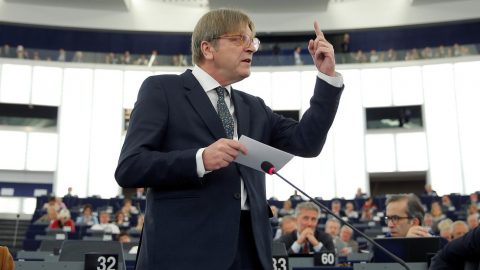
European Union’s chief Brexit coordinator Guy Verhofstadt © Reuters / Vincent Kessler
RT | September 16, 2019
EU Brexit coordinator Guy Verhofstadt’s rant that tomorrow’s world order is “based on empires” has been met with mockery on social media, and with accusations that such rhetoric is ironically out of the ‘Brexiteers’ playbook.’
Belgian MEP Verhofstadt, who was a guest speaker at the Liberal Democrats Party conference in Bournemouth on Saturday, told the audience that the world order is no longer about nation states, but about empires, like the European Union. His words received a rapturous response from the pro-EU party delegates.
The world order of tomorrow is not a world order based on nation states or countries. It is a world order that is based on empires.
Verhofstadt claims that countries like China, India and the US have more characteristics of empires than nation states, because of the size of their populations and their influence on the world, and because of this, the EU has to respond.
However, the MEP’s remarks have been met with amusement and bemusement in equal measure, and with accusations that his rhetoric is that of “a madman.”
Brexiteers on Twitter have been quick to highlight the irony of Verhofstadt’s sentiments. They are astounded that the case for an EU empire has been warmly received by Remain supporters, who have consistently ridiculed Brexiteers for “harking back to Empire days.”
Others suggested the cheers for Verhofstadt were like a party political broadcast for ‘Vote Leave’ — the official campaigning organisation that helped win the 2016 EU referendum for Brexiteers.
Verhofstadt’s comments came as the Liberal Democrats officially decided their new Brexit policy at their conference. They stated that they would revoke article 50 and cancel Brexit altogether, if they won a majority at the next general election.
It’s a bold, if slightly risky position to take, which may embolden their core base of strong Remainers, but could disenfranchise other potential voters including ‘soft’ Leavers who may think such a move would be anti-democratic.
JCPOA Negotiations are a test of the EU’s geo-political credibility
By Padraig McGrath | September 5, 2019
On September 4th, Iranian President Hassan Rouhani said that Iran would give the EU a further 60 days to come back into compliance with its economic commitments under the JCPOA before Iran would initiate a third phase of withdrawal from its own obligations under the deal. On September 29th, the International Atomic Energy Agency confirmed that Iran has been enriching uranium to a purity of 4.35%, which marginally exceeds the limit of 3.67% stipulated under the terms of the JCPOA.
Furthermore, Iran has at this point exceeded the stockpile of 300 kilograms of nuclear fuel which was agreed upon in 2015. These measures are quickly reversible, but likewise, Iran also has the technical capacity to very quickly implement any decision to further suspend its commitments. The Iranian government has said that it has the technical capacity to resume production of 20% enriched uranium within 48 hours, were it to take such a decision.
The stumbling-block in the negotiations is that, with the United States having withdrawn from the JCPOA and re-imposed sanctions on Iran following Donald Trump’s assuming office as US president in 2017, the EU finds compliance with its own JCPOA-obligations extremely difficult, as European banks fear being hit by sanctions themselves if they un-freeze Iranian assets or facilitate transactions relating to Iranian oil-exports. US federal law states that, ultimately, all dollar-denominated banking-transactions worldwide ultimately have to pass through the US banking-system. Therefore, the strategic advantage conferred on the US by dollar-hegemony is not simply that it artificially inflates the value of the dollar, but also that it brings all dollar-denominated transactions worldwide under US legal jurisdiction.
In an attempt to find a workaround, French president Emanuel Macron has proposed that the EU should extend a $15 billion letter of credit to Iran, which would be guaranteed by Iranian oil-exports, thereby compensating Iran for losses of revenue owing to US sanctions. The Iranians have already rejected the first version of this offer, wherein this $15 billion package was classified as a loan rather than as a letter of credit. The distinction is crucial, as classifying the $15 billion package as a letter of credit would prevent the western powers from trapping Iran in a vice-grip composed simultaneously of an oil-embargo in addition to the obligation to service debt. Iran’s Deputy Foreign Minister Abbas Araqchi has explained that such a letter of credit would in effect be a pre-sale of oil.
However, the crucial weakness in this solution is that it will still require a waiver from the US government, which seems improbable considering Trump’s intransigence and US National Security Advisor John Bolton’s opposition to the plan.
Although, in the interests of fairness, we should extend some credit to President Macron for his diplomatic initiatives in an effort to find a way out of the impasse, the situation which exists still amounts to a very serious test of the EU’s credibility as a distinct negotiating-entity. The principal EU negotiator in the talks which led to the 2015 JCPOA-deal, EU High Representative for Foreign Affairs and Security Policy Federica Mogherini, has shown extreme weakness and passivity since the American withdrawal in 2017. Having worked hard to hammer out the terms of a deal, she has subsequently done absolutely nothing to defend it.
The net result is that the EU is currently in violation of its JCPOA-obligations because it has folded in the face of US economic bullying. What exactly is the point of bothering to negotiate with the EU if it is incapable of maintaining an independent policy on foreign relations, finance or security?
Another question thrown up by this diplomatic shambles is, considering that the number of countries worldwide being targeted by unilateral US economic sanctions is ever-increasing, when do we hit a tipping-point wherein this increasingly trigger-happy US policy, hitting the sanctions-button on reflex, has an accelerating effect in de-dollarization as a global process?
Banking-systems are dependent on a certain minimal level of systemic trust. How can the US hope to maintain its financial role in the world economy if everybody else is continuously reminded that their dollar-denominated assets worldwide can arbitrarily be frozen or seized at any time?
Already, the four largest banks in the world are Chinese. The only factor which has so far delayed China’s assumption of the role of the world’s banker is that the Chinese government has not yet decided to make the Yuan a more easily tradable currency. Further preparation is still required before the Chinese decide to flick that switch. Once they eventually do, it’s game over for the Dollar.
It is understandable that the Chinese have not yet decided to make the Yuan as tradable as other reserve-currencies, but their principal concern is not fears of vulnerability to speculators and raids. The capitalization of China’s state-owned financial institutions is such that, together, they could easily mobilize enough volume to defend the Yuan’s value against raids, or for that matter to suppress its value, any time they needed to.
I believe that the preparation which the Chinese government most centrally has in mind prior to any decision to make the Yuan fully tradable is the completion of the fibre-optic component of the Belt and Road Initiative. The strategic importance of these fibre-optic pipelines is the most under-emphasized aspect of Belt and Road. Once this physical infrastructure is in place, it will be possible to entirely circumvent American efforts toward virtual piracy in the form of unilateral sanctions. That will have a transformative effect on the world economy. The erosion of dollar-hegemony has been very gradual over the past 15 years, but if we are to see a sudden acceleration, a tipping-point, then that will be it.
It is quite probable that, in anticipation of this, odes to the Petro-Yuan are already being written in Farsi.
Padraig McGrath is a political analyst with InfoBRICS
EU destroys 700,000 hectares of rainforest for biofuels
Rainforest Rescue | 03/07/19
The European Union wants to protect the climate and reduce carbon emissions from motor vehicles by blending fuels with increasing shares of supposedly eco-friendly “biofuels”.
Last year, 1.9 million tons of palm oil were added to diesel fuel in the EU – in addition to millions of tons of equally harmful rapeseed and soybean oils.
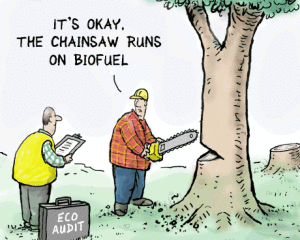 The plantations needed to satisfy Europes’s demand for palm oil cover an area of 700,000 hectares – land that until recently was still rainforest and the habitat of 5,000 endangered orangutans. Despite the clear-cutting, the EU has classified palm oil as sustainably produced.
This policy has now blown up in the legislators’ faces, with scientists confirming what environmentalists and development experts have long asserted: biofuels help neither people nor the environment – and they are most certainly not climate-neutral, as even studies commissioned by the EU show. Biodiesel from palm and soybean oil, but also from European-grown rapeseed, has a larger carbon footprint than diesel from fossil sources.
The EU must scrap its biofuels policy immediately, but the agri-industry is fighting hard to maintain the status quo. Not surprising, when one considers that biofuels are currently subsidized to the tune of 10 billion euros in the EU alone.
Decision making in the European Union is a long process and involves many different actors that bring in studies, reports, arguments, and numbers. Hundreds of industry lobbyists seek to influence this process and they are trying hard to protect their financial interests. Next, the European Parliament and its committees along with the Council of the European Union will need to agree on a compromise based on the proposal published in October 2012.
Please sign our petition to the EU and demand an end to biofuels.
Iraq would face ‘wrath of US’ if oil pipeline projects with Iran go ahead
RT | August 27, 2019
Washington would do anything to prevent an Iran-Iraq oil pipeline from ever being built, even if the Europeans were in favor, policy researchers told RT.
“Iraq would feel the wrath of the US” should it pursue a cross-border pipeline project with its neighbor Iran, believes the head of the British-based consultancy firm Alfa Energy, John Hall.
According to a recent report, Tehran talked with Baghdad about building an oil pipeline through Iraq into Syria. The sides have also reportedly discussed reviving the existing pipeline connecting Kirkuk in Iraqi Kurdistan with the city of Baniyas on Syria’s Mediterranean coast. The pipeline was heavily damaged by US airstrikes in 2003 and has remained defunct since. The proposed project is said to be aimed at providing an alternative route for Iranian oil should the Strait of Hormuz be closed in case of a direct conflict with the US.
Hall said Washington would be “upset” by this idea and will do all it can to dissuade Baghdad, as well as the EU, from participating.
Although European countries would be happy to buy oil from Iran, they won’t do so because of the threat of retribution from the United States. When you’ve got someone like Donald Trump as the president of the US, it’s very difficult knowing what may follow if Europeans try to engage with Iran across the sanctions.
The situation in civil war-torn Syria “has somewhat stabilized,” Iran and Iraq see “serious opportunities” to explore their energy ties, said Irina Fyodorova, a senior Middle East researcher at the Institute of Oriental Studies at the Russian Academy of Sciences.
“It is not the US’ interest to have a pipeline that would be independent from them and their allies in the Persian Gulf,” she told RT.
It is also against US interests to have an Iran-Iraq cooperation that is outside of their control. So there will be actions aimed at hampering the implementation of this project.
One of the steps Washington and its allies could take is boosting their support for anti-government groups in Syria, she said. The researcher added that another problem for the pipeline would be the US-backed Kurdish forces, should it go from Kirkuk.
EU countries, on the other hand, would like to see new ways to bypass US sanctions on Iranian oil, Fyodorova noted, as “getting the oil through a pipeline would be cheaper than having it delivered by tankers.”
“The Europeans love balancing the books. Moreover, it would be a wonderful alternative to the oil the EU is buying from the US.”
Russia Urges US, EU Countries to Withdraw Forces From Syria
Sputnik | August 2, 2019
MOSCOW – Russia is urging the United States and European countries to withdraw forces from Syria, but can see the increase in their military presence there instead, Russian Special Presidential Envoy for Syria Alexander Lavrentyev said Friday.
“We are always calling on the United States and other — European — countries, whose troops are also illegally in Syria, to leave this sovereign state. Nevertheless, they are still justifying it by the need to fight Daesh* and other terrorist groups”, Lavrentyev said at a press conference.
The Russian presidential envoy stressed that these countries were in reality pursuing their own agenda.
“So far we have not been able to convince them to withdraw forces. Despite the words of [US President Donald] Trump that US forces would be pulled out, we can see, on the contrary, the increase in these forces, partly because of the presence of private military companies”, the envoy said.
The number of US troops in Syria has been declining since US President Donald Trump claimed victory over the jihadists in December, promising to withdraw at least 2,000 troops from the country in the near future.
US forces have been operating in Syria as part of an international coalition to fight the Daesh terrorist organisation for about four years without the permission of either Damascus or the UN Security Council.
Brazil’s toxic pesticides ‘affecting people all over the world’ through agricultural exports
RT | July 30, 2019
“EU-banned pesticide[s are] being manufactured in the EU, and then coming back to citizens in the EU, in the food we eat,” environmental journalist and founding member of the Green Economic Institute think tank Oliver Tickell told RT, explaining that as one of the largest soy exporters in the world, Brazil supplies a significant quantity of the feed that cattle and other livestock worldwide consume. European consumers tucking into a juicy steak have no idea that the creature they’re eating might have been nourished on soy sprayed with highly toxic pesticides.
“This is not just a problem for Brazil and Brazilian people and people exposed in the countryside to these pesticides and consumers and farmers,” Tickell warned. “It is actually affecting people all over the world through Brazil’s agricultural exports.”
ANVISA, the Brazilian public health regulatory agency, relaxed pesticide regulations last week so that only those chemicals with lethal potential can be classified as “extremely toxic,” triggering a massive backlash from environmental groups, human rights organizations, and food safety advocates. The fervently pro-business government of President Jair Bolsonaro has already approved 262 pesticides this year, 82 of which are classed as “extremely toxic,” as he follows through on campaign promises to demolish environmental regulations and open up protected rainforest lands to mining and agriculture.
Dozens of pesticides banned or strictly regulated in the EU, including paraquat and chlorpyrifos, were already permitted for use in Brazil before Bolsonaro took power, and the country uses approximately 400,000 tons of pesticides per year, according to Human Rights Watch. While Agriculture Minister Tereza Cristina has flatly denied Brazil uses any more pesticides than any other country, attributing such allegations to “data manipulation” and accusing critics of “terrorism,” EcoWatch claims the country consumes more pesticides per capita than any other nation.
Siemens wins huge defense contract at notorious US Guantanamo base in Cuba
RT | July 26, 2019
A unit of German multinational Siemens has been awarded an $829 million contract from the Pentagon “for energy savings and performance measures” at the US naval base in Guantanamo Bay, Cuba.
According to a statement by the US Department of Defense, the work to be performed provides for the construction, operations and maintenance of energy conservation measures to improve energy efficiency and reliability.
That includes heating, ventilation and air conditioning upgrades, lighting upgrades, commercial refrigeration upgrades, distributed generation, renewable energy photovoltaic for both demand and supply sides, energy storage, power control, supervisory control and data acquisition, water retrofits and wastewater.
Work is expected to be completed by April 2043, the Pentagon said.
“No funds will be obligated with this award, as private financing obtained by the contractor will be used for the 31-month construction (i.e. implementation) phase of the project.”
According to the report, eight proposals were received for the task order. It specified that the Naval Facilities Engineering Command Engineering and Expeditionary Warfare Center, Port Hueneme, California, is the contracting activity for the task order.
The Department of Energy, Office of Energy Efficiency and Renewable Energy, Golden, Colorado, is the contracting activity for the basic contract.
The US naval base in Guantanamo Bay is also known for its notorious prison, which has been widely criticized for violations of human rights. Established in 2002, it is known for indefinite detention without trial and numerous tortures which have led to scores of suicides and unsuccessful suicide attempts by detainees.
EU food authority found hiding health risks of world’s top sweetener
RT | July 24, 2019
The world’s favorite artificial sweetener may pose severe health risks, University of Sussex researchers have found. They claim that the European food authority has been bottling up the alarming data for a while.
The study focused on aspartame, an artificial sweetener used worldwide in everything from diet soft drinks to chewing gum, and sold under brand names including NutraSweet, Candarel and Equal.
UK researchers analyzed the most recent report regarding the safety of the sweetener by the European Food Safety Authority (EFSA). They discovered that the panel dismissed the results of numerous studies detailing the harmful effects of the sweetener, while focusing their final assessment almost entirely on positive studies. For instance, out of the 73 papers that deemed aspartame dangerous, all 73 were thrown out by EFSA, while 84 percent of studies providing no evidence of its harm were found to be true.
Since 1974, when aspartame was approved for consumption in the United States, studies claimed that the sweetener caused a number of health problems, including liver and lung cancer, brain damage, and seizures.
However, the majority of health authorities worldwide claim the sweetener is safe. Sussex scholars believe that many of the studies deemed to be dubious by the EFSA panel provide far better empirical evidence on the harmful effects of the sweetener than those they relied on, so they see the entire assessment as false.
“This research adds weight to the argument that authorization to sell or use aspartame should be suspended throughout the EU, pending a thorough re-examination,” the study states.
EU choices for top posts a reflection of policies that led to its current mess
By John Laughland | RT | July 3, 2019
In spite of everything that has happened in the EU in the last five years, its member states contrived to select four politicians who embody total continuity with all the policies that led the EU into this mess in the first place.
None of the recent calamities have persuaded the bloc to even slightly alter its course. Not the rise of anti-system parties in Italy, Germany, France, Finland and elsewhere. Not the rise of patriotic forces in Poland and Hungary. And not Brexit, which in economic terms is equivalent to the loss of not one member state but 20, and which will destroy the current EU budget arrangements.
The four men and women whose appointments were hammered out on Tuesday are all determined to create a “United States of Europe” (to quote the future new president of the European Commission, Ursula von der Leyen) and therefore to proceed with the very same European integration which is causing so much internal stress in EU member states and its institutions. Moreover, three of the four come from the core EU states, the original founder members in 1951, with no one from the “new Europe” in Eastern or Central Europe. It is as if, in this time of deep crisis, the EU wanted to return to its sources from nearly 70 years ago, instead of re-inventing itself afresh to face the new challenges of the 21st century.
The most striking announcement is of course that of the top job, the German Defence Minister Ursula von der Leyen as Commission president. Because the Commission has a monopoly over the whole legislative and executive process in the EU institutions, this body is the motor which drives the whole machine. The parliament, by comparison, is powerless. The fact that Germany has now acquired control of the most important EU institution is remarkable, not least because it is the first time a German has held this post since the very first Commission president, Walter Hallstein, who had the job between 1958 and 1967. In the intervening decades, and especially since 1990, Germany has emerged as the hegemonic power in the EU and nothing is decided in Brussels without Berlin’s agreement.
Germany also dominates the European Parliament: four out of the seven groups in the parliament, and therefore over two-thirds of the members, are led by Germans. As Angela Merkel prepares to leave office in Berlin, therefore, she can be sure that her legacy will live on, and indeed increase, in Brussels and Strasbourg, where the EU institutions will be controlled by her closest political allies and heirs.
Ursula von der Leyen’s specific contribution, apart from her nationality and her status as a close ally of Angela Merkel, is that she is a committed supporter not only of the concept of a federal Europe but also of an EU army. As defense minister, she previously announced plans to invest €130 billion in Germany’s military over 15 years, and a 10 percent increase in 2019 to bring it up to €50 billion a year. If this re-militarization is dressed up in “European” clothes, then Cold War tensions on the European continent will only rise, something Mrs von der Leyen clearly wants: she is notorious for being one of the worst anti-Russian hawks in Germany and Europe.
Things are hardly better with the least important of the four nominations, that of Josep Borrell as foreign policy chief. Just as von der Leyen has said that Russia is no longer a partner, so Borrell described Russia as “an old enemy” in May: Russia summoned the Spanish ambassador in Moscow to the Foreign Ministry to protest. Borrell shares with von der Leyen a dogmatic yet self-contradictory belief in a “European defense compatible with Nato”: Nato is in reality dominated by the United States. And although he has been critical of the attempt by the US government to force regime change in Caracas, Borrell nonetheless supports the “recognition” of Juan Guaido as president of Venezuela: like his position on defense, this halfway house is also self-contradictory because if Guaido really were the legal president of Venezuela, as Borrell claims, then the young US puppet would have every right to remove Nicolas Maduro by force.
Charles Michel, the new president of the European Council, is the second Belgian to have occupied this essentially honorific post: Herman van Rompuy was appointed as the first president in 2009. (The second was Donald Tusk; Michel is the third.) It is often said of Belgium that it has seven parliaments but no state: now Michel will have 27 governments but still no state. It would be difficult to imagine a more conformist politician than Charles Michel: this born liberal has never uttered an original word in his life. Moreover, like Ursula von der Leyen, he has EU politics in his blood. Like Ernst Albrecht, Ursula von der Leyen’s father, who was a senior official at the European Commission before he became minister president of Lower Saxony (Ursula was born in Brussels and went to the European School), Charles Michel’s father, Louis, was a Belgian foreign minister and European commissioner. Two out of yesterday’s four appointments are therefore dynastic, emphasizing the caste-like European political class, to which one should perhaps add Josep Borrell who is a former president of the European Parliament and a former president of the European University Institute in Florence.
In short, none of the four shines as a personality while several of them have been embroiled in financial scandals – Borrell for failing to declare a €300,000 a year consultancy job in 2012 and Lagarde for approving a state payout to a friend of Nicolas Sarkozy. Leyen has often been accused of incompetence as a minister, more concerned with her perfect hairdo than with running the German Army. All four have survived in politics, in most cases for decades, precisely because they have never deviated from the party line and have instead got where they are by doing as they are told.
As for the man elected president of the European Parliament on Wednesday, he has no power at all. What little power the European Parliament has is vested in its members. David-Maria Sassoli’s election drives a further nail into the coffin of the principle of political representation because he represents a spent force in Italian politics. As a member of the Democratic Party, he stands for the old order which was swept away in Rome in 2018 when the new-left 5 Stars and new-right League built an alliance to thrust aside the old parties. Above all, Sassoli was vice-president in the previous parliament and therefore his election now is also an expression of continuity.
In short, faced with an existential crisis and a severe lack of credibility, the EU’s message to its voters and the world is: Business as usual.
John Laughland has a doctorate in philosophy from the University of Oxford and has taught at universities in Paris and Rome as a historian and specialist in international affairs.
Arak reactor to resume pre-deal activities if EU fails to meet pledges: Rouhani
Press TV – July 3, 2019
President Hassan Rouhani says Iran’s Arak heavy water nuclear reactor — which was agreed to be redesigned under a 2015 nuclear agreement — will resume its previous activities after July 7 if the other signatories to the deal fail to uphold their end of the bargain.
“As of July 7, the Arak reactor would be restored to its former condition, which they (other parties) used to claim was ‘dangerous’ and could produce plutonium” if the other deal partners fail to fully act on their commitments under the accord, Rouhani said at a Wednesday cabinet meeting.
The agreement was initially reached between the P5+1 group of states — the United States, the UK, France, Russia, and China plus Germany — and Iran in Vienna in July 2015. It is officially known as the Joint Comprehensive Plan of Action (JCPOA).
Under the JCPOA, Iran agreed to redesign the 40-megawatt research reactor, which is located in the central Iranian Markazi Province, to cut its potential output of plutonium.
Rouhani said Iran’s decision concerning the reactor could only be reversed “if they (the other signatories) act on all of their commitments concerning the facility.”
The fate of the deal has been in doubt since last May, when the US pulled out and reinstated the anti-Iran sanctions that it had lifted under the document.
Bowing to Washington’s pressure, Europe has been throwing only verbal support behind the agreement ever since, refusing to guarantee the Islamic Republic’s business interests in the face of American bans despite being contractually obliged to do so.
The decision concerning the reactor is among the countermeasures, which Iran began this May in reaction to the US’s withdrawal and the other parties’ failure to keep their side of the agreement.
Rouhani further said Iran would, in addition, surpass the limit placed by the nuclear agreement on the level of purity of the uranium it produces when the July 7 deadline set by Tehran for the remaining deal partners expires.
“The level of uranium enrichment will no longer stay at 3.67 percent,” he said. “This commitment [taken under the nuclear deal] will be set aside, and we will enhance [the enrichment level] to whatever amount, which we deem necessary and need.”
‘Fear fire? Don’t start a flame!’
The chief executive also commented on US President Donald Trump’s reaction to Iran’s recent move to exceed the 300-kilogram limit on its low-enriched uranium production as part of its nuclear responses.
Reacting to the nuclear measure, Trump had said Tehran was “playing with fire.”
“If the US is so afraid of the word ‘fire,’ it should not start a flame then,” Rouhani said, reminding, “This fire could only be doused by returning to commitments and United Nations Security Council resolutions.” The JCPOA was ratified in the form of Security Council Resolution 2231 upon conclusion.
‘Worst deal? Why blame Iran then?’
He also referred to Trump’s hostile stance on the JCPOA, which the US president has, on several occasions, called the “worst deal ever.”
If Washington considers the nuclear deal to be a bad one, what was the reason behind its unease at Iran’s suspending its commitments to it? Rouhani asked. Similarly, if the deal can be rated as a good pact and Iran is advised to remain a part of it, “why do the US and Europe [themselves] fail to observe it?” he also questioned.
Rouhani further said Iran’s retaliatory actions were “never emotional” in nature, but meant to preserve the deal by prompting others to honor their obligations.
The countermeasures would be reversed as soon as the other partners begin to observe to their contractual commitments, he added.
Zarif: Europe duties far exceed INSTEX
Foreign Minister Mohammad Javad Zarif, who had also joined the meeting, told reporters afterwards that the Europeans have undertaken 11 commitments to the country under the JCPOA.
These include Iran’s oil sales, which the US has been trying to block through the sanctions, secure financial returns from the sales and investment in Iran, as well as facilitation of transport, aviation, and shipping activities involving the country, he noted.
Zarif described the Instrument in Support of Trade Exchanges (INSTEX)— which Britain, France, and Germany announced in January to enable non-dollar trade with Iran — as just a prelude to implementation of the 11-fold commitments.
The JCPOA obliges the European partners to prove their commitment to the nuclear deal in action, Zarif said, adding that the Islamic Republic would commit to the agreement in exactly the same way as those countries would.
“If Europe commits to the JCPOA, we will do so, too,” he stated.
The top diplomat also commented on Trump’s “playing with fire” remarks.
“If he (Trump) feels entitled to issue such a reaction, he should first reverse [the US’s] violation of the JCPOA and its withdrawal from it as well as the illegal sanctions that are tantamount to economic terrorism against 82 million Iranians,” Zarif said.
Featured Video

New positive ivermectin evidence
or go to
Aletho News Archives – Video-Images
From the Archives
Fanatical Followers of the Covid Regime: A Jim Jones-Style Cult?
By Professor Roger Watson and Dr. Niall McCrae | The Daily Sceptic | November 15, 2021
As scholars at leading British universities over recent decades, we witnessed the replacement of critical thinking and debate by narrative: facts are discrimination and scientific method is imperialism; truth, instead, is derived from ‘progressive’ values. This educational trend may be a major contributory factor to the ease in which society has been inculcated to the Covid ‘new normal’ of masking, testing, and repeated doses of vaccines for a disease of similar risk to severe influenza.
One doesn’t need much critical reasoning to observe the flawed logic of some vaccination enthusiasts, such as people who respond to experiencing any side effects, however debilitating, by saying “at least I know it’s working”, or, after contracting the disease despite their promised inoculation (over 90% effective, according to initial drug company claims), “I’d have been worse off without the jab.” … continue
Blog Roll
 Aletho News
- EU Council Advances Chat Control 2.0 Scanning Proposal
- Ex-Greek MEP files complaint against Israeli spyware firm over alleged Pegasus surveillance
- Troubling ideas throughout the Torah, Talmud, Mishneh Torah and Tanya
- ‘Grave, alarming’: Iran mission on Trump’s UNGA ‘annihilation’ threats
- Najaf airport to reopen to Iranian flights within 24 hours: Ambassador
- From ‘How Will This End For Iran’ to ‘When America Walks Away’: A tale of two Economist covers
- Tehran blasts ‘baseless’ speculation linking Iran to alleged bomb plot at UK air base
- The Rise And… Rise Of ‘Color Revolutions’
- The Coming GOP Bloodbath?
- Arctic Scare Stories Melt Away
- If Americans Knew
- Netanyahu Asked UAE Leader to Deny Report on Oct. 7 Warning in Secret Visit, Sources Say
- CNN Chief Int’l Correspondent Clarissa Ward on Journalists in Gaza
- Democratic Party Consultants Surround Troy Jackson with Pro-Israel Donors
- Christian Leader Responds To Netanyahu’s Claims Regarding Palestinian Christians
- In Gaza, ‘Whoever Survives the Bombing Won’t Survive the Rubble’
- Israel kills more Palestinians, amid push to resettle Gaza – Daily Update
- Israel forces Gazans to live in constant peril – Daily Update
- Deconstructing Netanyahu’s pants-on-fire UN rant – Daily Update
- Trump betrayed voters with his campaign lies and prioritized a foreign country once he took office
- Netanyahu calls Israel’s war in Gaza ‘opposite of genocide’ in UN speech to near-empty hall
- No Tricks Zone
- New Study: Earth And Venus Surface Warmth Largely Explained By Convection And Lapse Rate, Not CO2 Or Radiation
- 2025 Nature Paper Claiming Worsening Global Drought Gets RETRACTED …Heavily Flawed
- New Study: ‘Global Drought Shows No Detectable Recent Acceleration Under Climate Warming’
- Economic Masterminds: German Socialists Suggest Taxing Productivity Gains Stemming From Using AI
- The South China Sea Has Not Been Cooperating With The Climate Change Narrative
- Energy Crisis: Germany Enters Heating Season With Historically Low Gas Reserve Fill Levels
- New Study: The Antarctic Ice Sheet Gained Mass From 2020-2024 Due To Staggering Snow And Ice Accumulation
- Study: Ocean Heating Rates From Thousands Of Years Ago ‘Dwarf’ Modern Ocean Heating Rates
- Climate Extremists Target, Attack Large-Scale Power Grid Infrastructure In Germany!
- New Study: Antarctic Ice Melt Has Contributed Less Than 1 Centimeter To Sea Level Rise In The Last 30 Years

