The Economic Entrails at the Heart of the ‘Deal of the Century’
By Alastair Crooke | Strategic Culture Foundation | June 25, 2019
It is nothing new to say that the ‘Deal of the Century’ is – and always was – in essence an economic project. Indeed, it seems that its political ramifications are viewed by the White House as little more than the ineluctable consequences to an a priori economic architecture, already in the process of being unfolded.
In other words, it is the economic facts on the ground that are intended shape the political outcome — an attenuated political landscape that anyway has been minimised by Trump’s pre-emptive removal of key pieces of any Palestinian negotiating leverage.
The financial squeeze on the Palestinians is well attested. On the one hand, the Palestinian Authority (historically dependent on Saudi subvention) is gently slipping into bankruptcy; whilst Gaza is held in virtual abject dependency through the drip-feed of subventions channelled into Gaza by Qatar, with Israeli permission — the size of this latter monthly ‘lifeline’ subvention being carefully adjusted by Israel according to what it judges to be the norms of (generally Hamas) ‘good conduct’.
So, on the one hand there is the financial siege that is intended to make the Palestinians pliant to the ‘quality of life package’ which the ‘deal’ is supposed to bring — the Bahrain summit later this month being its shopfront. But there is another less well recognised side to the Deal which is summarised in the title to a McClatchy article entitled, White House sees Egyptian energy forum as a ‘roadmap to Middle East peace’.
In a later piece, McClatchy publishes the newly declassified map of the US East Mediterranean energy ‘roadmap’. And here the fuller picture becomes clear: the US sponsored ‘gas forum’, “according to three senior administration officials, that map [the] declassified one, obtained by McClatchy – has motivated members of the [US] National Security Council to prioritize the formation of a gas forum in the Eastern Mediterranean that would simultaneously boost and entangle the economies of several countries that have been at odds for decades”.
Well, let’s translate that little euphemism: ‘boost and entangle’. What that formula translates into is — the means to integrate Israel into the economic regional sphere is firstly, through energy. Yet, it is not intended to integrate Israel alone into this Egyptian economic sphere, but also to make Jordan, the PA (and maybe even Lebanon), too, partially dependent on Israeli energy – alongside putative partners, Italy, Greece, and (the Greek-linked part) of Cyprus — with the US offering to help flesh out the structure of the ‘gas forum’ with U.S. expertise.
This is the heart of ‘the deal’. Not just political normalisation for Israel into the region, but the making of economic dependency of the Egyptians, Palestinians, Jordanians (and possibly – but not so likely – Lebanon) on the US East-Med gas ‘hub’.
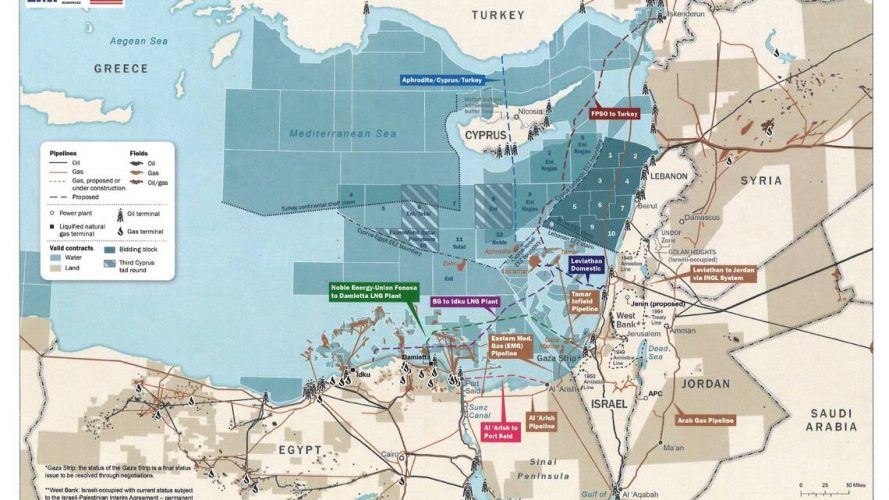
Source: McClatchy
And, inevitably there is a sub-plot to all this, (as McClatchy notes):
“On this front, the administration enjoys support from unlikely allies. Eliot Engel, the Democratic chairman of the House Foreign Affairs Committee … said the Mediterranean gas forum project was a strategic opportunity for the U.S. to stymie Russian influence efforts over local energy resources. “I think that [Russian President Vladimir] Putin and Russia can’t and should not be able to control the situation,” Engel stated”.
So, the US Administration is pursuing two bipartisan congressional efforts to ‘stymie’ Russia in the region: One is a bill promoting energy partnerships in the Eastern Mediterranean; and a parallel bill which threatens to sanction European firms supporting the construction of the Nord Stream 2 pipeline taking Russian gas into Germany.
There are however, two obvious big ‘catches’ to this notion of both ‘stymying’ Russia, whilst simultaneously normalising Israel economically into the region. The first, as Simon Henderson of the Washington Institute notes, [is the notion that] the area’s underlying geology could help Europe offset, or even replace, its dependence on Russian gas “seems farfetched at the present level of discoveries. Several more giant fields like Leviathan or Egypt’s Zohr would have to be found before this reality changes”:
“The idea that East Mediterranean energy could impact on the European energy balance in such a way as to dent Russian market share is a fantasy – Europe’s thirst for gas is so huge, and Russia’s ability to provide that gas is so great, that it’s a wild dream to even hope we can achieve it given the limited reserves discovered thus far,” Henderson said. “Hoping you can find gas is not the same as finding gas”.
In short, an Egyptian ‘hub’ serving exports, might only ‘work’, as matters stand, through patching some of the smaller East-Med discoveries – together with a large Israeli contribution – through pipelines into the two Egyptian gas liquefying plants near Port Said and Alexandria. But LNG availability globally is high, prices are hugely competitive, and it is by no means certain that ‘the hub’ can be commercially viable.
And here is the main catch: Geo-politics. Anything aimed at integrating Israel into the region is bound to be sensitive. So, whilst US officials are optimistic about Egypt’s leadership of their ‘gas forum’ in the wake of President Sisi’s April meeting with Trump – Egypt – a mainstay to the separate US Iran confrontation plan – shortly afterward the visit, rather notably withdrew from the strategic military alliance the Trump administration was trying to build to confront Iran: The Middle East Strategic Alliance (MESA), to the consternation of US officials.
When it comes to energy deals, however, even having a treaty with Israel does not put an end to public sensitivities about rapprochement with Israel, Henderson notes. Notwithstanding any ‘peace treaty’, many Jordanians still oppose the prospect of using (Israeli) Leviathan gas to provide for large-scale electricity generation, beginning early next year. Amman has tried to deflect such anger by calling the supplies “northern gas” or “American gas”, emphasizing Noble’s role in producing it.
But here is the other side to the issue: Clearly, Egypt does not want to be a part of any anti-Iranian US-led alliance (MESA). But equally, why should Egypt – or Jordan, or for that matter, or any other member of the ‘gas forum’ – wish to be tightly aligned with an US anti-Russian strategy for the region? Egypt may have signed up to the US ‘gas hub’ project. But at the very same time, Egypt also was signing a $2 billion contract to buy more than twenty Russian Sukhoi SU-35 fighter aircraft. Do ‘hub’ members really judge an Egyptian ‘hub’ to be a rival to Russian gas in Europe?
Probably not: For ultimately, the idea that a putative energy hub can ‘stymie Russia’ indeed is fantasy. The EU shows, for example, no particular interest in the US supported $7 billion mooted pipeline linking the eastern Mediterranean through Cyprus, to Greece. The undersea terrain is too problematic, and the cost too high.
Israel too, hopes to find more gas (of course). But the deadline for bids on nineteen of its offshore blocks has been pushed back to mid-August – seemingly reflecting a lack of investor interest. For now, the oil majors seem more tempted by the Cypriot blocks – up for bid.
But politics again: being a part of America’s ‘gas forum’ in which the Nicosia (i.e. the Greek-linked) government is a key member, explicitly places the forum and its members on a potential collision course with Turkey, who will not readily yield on its ambitious claims on the East Med basin (it has just announced that it will establish naval and air bases in Northern Cyprus). Nor will Lebanon, either. Sisi and Erdogan share a mutual, personal dislike, but will the others wish to be drawn into that quarrel?
Russia anyway, seems not greatly interested in the production possibilities of the Mediterranean Middle East. Rather it is focused on a pipeline corridor stretching from Iran and Iraq to Europe via Turkey or (eventually) Syria.
In sum then, the Kushner – Trump ‘Deal’, in respect to the integration of Israel into the regional energy economy seems destined to draw the same skepticism and distrust, as does the ‘Deal’s’ other parts.
No Evidence Russia Meddled in Brexit via Facebook, Company’s VP Nick Clegg Says
Sputnik – June 24, 2019
While the British government has consistently accused Russia of interfering in the 2016 national referendum on the UK’s withdrawal from the EU by using fake accounts on social media, Facebook, which has conducted multiple investigations into the matter, has repeatedly stressed that it found no substantial evidence to back up the claims.
There is “absolutely no evidence” that Russia swayed the 2016 Brexit vote using Facebook, Nick Clegg, the company’s vice president for Global Affairs and Communications, told the BBC on Monday.
Clegg, who served as the UK’s deputy prime minister from 2010 to 2015, explained that the company had conducted analyses of its data and found no “significant attempt” to influence the outcome of the national referendum.
He, likewise, dismissed the claim that Cambridge Analytica, a leading data mining firm, influenced Britons’ decision to vote Leave.
“Much though I understand why people want to sort of reduce that eruption in British politics to some kind of plot or conspiracy – or some use of new social media through opaque means – I’m afraid the roots to British Euroscepticism go very, very deep”, he elaborated.
In fact, he contended that opinions had been influenced more by “traditional media” over the past 40 years rather than by new social media.
The British government has repeatedly accused Russia of interfering in the 2016 referendum on EU membership and spreading “fake stories” in the media to “sow discord in the West”, but has failed to provide any evidence to corroborate the claim. Moscow has consistently dismissed the allegations as groundless.
Facebook undertook several probes over the claims and has on multiple occasions stated that the investigation produced no substantial results: in December 2017, the company said that it had found only $0.97 of ad spending originating from the “notorious Russian troll factory“.
Two months later, after Facebook was urged to continue the probe, the tech titan told a British parliamentary committee that a further investigation to try and “identify clusters of coordinated Russian activity around the Brexit referendum that were not identified previously” had as well been unproductive.
Twitter has likewise announced that it found no evidence proving Russia’s alleged meddling.
The investigations were fuelled by a report from UK-based communications agency 89up, published in February 2018 that accused the Russian media of having a strong anti-EU sentiment prior to the Brexit referendum.
The report claimed that the social reach of these outlets was “134 million potential impressions, in comparison with a total social reach of just 33 million and 11 million potential impressions for all content shared from the Vote Leave website and Leave.EU website respectively”. The company also alleged that the Russian media’s purported interference in the EU referendum was worth up to 4 million pounds ($5 million).
The United Kingdom held the Brexit referendum on 23 June 2016, where almost 52 percent of Britons backed the decision to withdraw from the European Union.
Anti-Palestinian repression in Germany: Palestinian writer Khaled Barakat banned from speaking
Samidoun Palestinian Prisoner Solidarity Network | June 23, 2019
The repression of Palestinian rights advocacy in Germany continued last night, Saturday, 22 June, as Palestinian writer Khaled Barakat was banned by the Berlin authorities from delivering a speech on the so-called “deal of the century” spearheaded by Donald Trump and the Arab and Palestinian response. He was also banned from engaging in all political activities and events in Germany until 31 July, whether directly (in-person) or “indirectly” (over video.) This outrageous attack on freedom of expression is only the latest assault on Palestinian rights carried out by the German government.
The event was originally scheduled to take place on Friday, 21 June, organized by an Arab community discussion group that regularly hosts speakers on important events in the Arab world. The city-owned venue reportedly received complaints about the event from pro-Zionist and pro-Israeli apartheid organizations, and informed the hosts that they could not hold the event. The event was instead relocated to a Sudanese community center on Saturday, 22 June. With the Bahrain conference to promote so-called “economic peace” at the expense of Palestinian rights expected in the coming days, the talk was of particular importance.
However, without notice or explanation, there were large numbers of police stretching from the closest U-Bahn station to the venue and blocking the street. When Barakat approached with Samidoun international coordinator Charlotte Kates, they were stopped by police and told the event would not take place tonight because it had been prohibited. They were then taken in a police van to a larger police station, where they were met by a German-Arabic translator, more police and two representatives of the Foreigners’ Office of Berlin.
Barakat was presented with an 8-page document and told that he was not allowed to give speeches in person or over video, participate in political meetings or events or even attend social gatherings of over 10 people; he was told that violations were punishable by up to a year in prison. Under German law, non-citizens can be barred from political activity if it could harm the “security or stability” of Germany. The accusations, which purport to show that his political activity is “dangerous,” do not do so; instead, there is mainly a list of speeches and events as well as a 2014 interview with Rote Fahne News, the publication of the MLPD (Marxist-Leninist Party of Germany.) Despite claiming that Barakat’s speech could increase tensions or “political conflict” between Jews and Palestinians and Arabs in Germany, the document points to absolutely no negative repercussions whatsoever of all of his previous speeches in the country.
The document also accuses Barakat of being a member of the Palestinian leftist party, the Popular Front for the Liberation of Palestine (PFLP). Despite noting that the PFLP is, in fact, not banned in Germany, it notes that it is listed on the EU terrorist list and thus presents a danger, even though none of the listed allegations indicate any danger at all. It could not be more clear that this is the latest attempt on Palestinian expression and advocacy and the further restriction of freedom of speech, expression and association in Germany.
Barakat and Kates were also told that their residency in Germany would not be renewed and would “come to an end,” although they were not presented with that decision.
This incident comes amid an ongoing campaign by the Israeli Ministry of Strategic Affairs, the so-called “anti-BDS ministry,” to attack Palestinian and solidarity organizations, especially leftists. Barakat has been singled out by this ministry on multiple occasions, as has Samidoun and its work. It also comes following a series of attacks on Palestinian rights and freedom of speech in Germany, including:
- the political ban and stripping of the Schengen visitor visa targeting Rasmea Odeh, former Palestinian political prisoner and community leader
- the anti-BDS resolution passed by the German Bundestag (parliament) denouncing BDS as “anti-Semitic”
- the criminal prosecution of activists for interrupting an Israeli official speaker involved in the war on Gaza at Humboldt University
- the cancellation of performance invitations to American rapper Talib Kweli and Scottish rappers Young Fathers for their support for the boycott, divestment and sanctions (BDS) movement
- the forced resignation of the director of the Jewish Museum in Berlin for tweeting a link to a statement against the Bundestag’s anti-BDS resolution written by Jewish scholars
It should be noted that this repression comes hand in hand with political attacks on the Arab and Muslim communities in Germany spearheaded by the far-right rhetoric of the AfD and other parties, but with the active complicity of the official “left,” which continues to support the suppression of Palestinian community organizing and Palestine solidarity in defense of a colonial, apartheid, racist system. It also comes amid ongoing criminalization of popular movements in Europe, including trials of trade union leaders and refugee solidarity organizers in various countries.
Samidoun Palestinian Prisoner Solidarity Network expresses our deepest outrage at the political ban against Khaled Barakat. We believe that it indicates a serious danger that outright bans, police repression and residency revocation are becoming a police state norm for suppressing unwanted Palestinian political speech that defends rights, justice and liberation.
On Friday, 28 June, a protest is being organized against the Bundestag’s anti-BDS resolution under the slogan Palästina Spricht (Palestine Speaks), and we urge all to attend and participate. Internationally, your statements and voices of solidarity are critical in helping to fight back against this intensified repression. These attacks will not silence Khaled Barakat or the Palestinian people – but it is critical that we build our international movement to defend Palestine, especially as it is targeted for liquidation.
Germany vs. Iran – Has Germany Sold Out to the Devil?
By Peter Koenig – New Eastern Outlook – 22.06.2019
Madame Angela Merkel – the head of Europe’s strongest economy, of the leader of the European Union, said that there was strong evidence that Iran attacked the two tankers in the Gulf of Oman. Ten days ago, German Foreign Minister, Heiko Maas, travelled to Tehran, officially to “save” the Nuclear Deal (Joint Comprehensive Plan of Action – JCPoA), but in reality, to ‘negotiate’ with Tehran ways so Germany and by association other EU members, might still do business with Iran, against some “concessions” by Iran, in order to appease Washington.
Iran’s President Rouhani reacted quickly. FM Maas got the cold shoulder and was dismissed. And rightly so. Maas was not really representing Germany – but the United States. Iran gave the EU an “ultimatum” of 60 days to stick to their commitments on trading with Iran according to the Nuclear Deal – despite the US reneging on it – or else, Iran may bypass some of the conditions under the JCPOA accord. The EU – not being independent and her member countries having lost all sovereignty by submitting to the dictate first from Brussels, second from the tyranny of Washington, didn’t like the ultimatum, and said so in a joint statement. They added a weak and meek phrase, “We call on countries not party to the JCPoA to refrain from taking any actions that impede the remaining parties’ ability to fully perform their commitments;” not even daring calling the country by name, for whom the statement was destined, i.e. the US of A.
Germany’s position is as absurd as it has ever been since Merkel and the entire Bundestag accepted the sanctions imposed by Washington on Russia in 2014 – and replicated them along with the rest of the EU – even to their own detriment and to the detriment of the entire EU. Chancellor Merkel and apparently the entire Bundestag, again, go along with Washington’s equally absurd and false accusation that Iran has attacked the two tankers, one Japanese owned, the other Norwegian. The latter belonging to a close friend of Iran’s, and the Japanese one, hardest hit – exactly at the time when Japan’s PM Shinzō Abe, was visiting the Ayatollah in Tehran to discuss how to maintain the Nuclear Deal – trading – despite the sanctions and threats of Washington, hence, a friendly visit.
—
A blind person can see that these were two false flags – so thinly masked, with badly fabricated US ‘video evidence’ that even according to CIA and US military brass did not deliver conclusive evidence. In fact, none at all. Madame Merkel – why do you not first ask the obvious question “Cui bono?”— Who benefits? Certainly not Iran – but the aggressor, the US which has been planning and preparing for war with Iran for decades, ever since the first Iraq war under Father Bush, in 1991. At the 2003 invasion of Iraq – Bolton openly expressed his dreams to demolish Iran. He and Pompeo are liars and war criminals, who run the White House and pretend to run the Pentagon – and who act in impunity. Their power seems limitless. Trump – seems to be a mere puppet.
Getting Merkel on board of the flagrant US lie that Iran was attacking two tankers in the Gulf of Oman, is a strategic hit, enhancing the lies’ credibility and, thus, making a US attack on Iran more palatable to the rest of the world. Yet, apparently this was not enough. The Pentagon sent an unmanned high-altitude Global Hawk drone into Iranian airspace, a provocation Iran could not resist and shot the drone down, but not before sending warning signals, about which today nobody talks. The world shouldn’t know that Iran had the noblesse to warn the US about the drone being in their airspace. As can be expected the White House gnomes deny that the drone was invading Iranian airspace, but pretend it was in international air space, when it was shot down.
This raised the ante for Washington to launch an attack on Iran. All was planned to be carried from Thursday to Friday (20 to 21 June), and at last minute Trump stopped it. Is it true? – It could be, because somebody a bit ‘higher up’ than Trump and his warrior minions, must have realized the danger that such an attack may pose to the rest of the world – or actually that it could trigger a nuclear conflict. However, that the attack plan was stopped doesn’t mean it was canceled. Maybe it was just postponed.
In the meantime, the US Federal Aviation Administration (FAA) has ordered all US airlines to avoid the Gulf of Oman and the Gulf of Hormuz. And, as could be expected, the airlines of Washington’s “true” puppet allies have followed suit, i.e. Australia’s Qantas Airways Ltd, Singapore Airlines Ltd, Germany’s Lufthansa, British Airways, Air France and its Dutch KLM affiliate, as well as Malaysia Airlines, said they were re-routing flights to avoid the area. Others may follow under direct or tacit pressure of the US. The Japanese airline ANA said they were considering alternative routings. Effectively, the US was able to declare a no-fly zone over a significant area of Iran.
Let’s make no mistake, all the visible key figures at the helm of the White House – are run in the back by Israel, by Netanyahu and the Chosen People he represents, those who also run Wall Street and the western world’s banking and financial system. Israel would like to see Iran in rubbles, or better, in eternal chaos, the goal that was set for Iraq, Afghanistan and that the US was and still is dreaming for Syria. This bunch of evil elite pulls the strings and hopes to soon pull just ONE string for global hegemony, under a ONE World Order.
—
Back to Germany. Instead of jumping off the sinking ship of Washington and its faithful entourage of the willing, as rats would do, and as the vast majority of the German people would prefer, let alone German and European business, Madame Merkel and apparently all her circles, including Berlin’s Parliament, follow the US flagrant lie propaganda. Why? – Well, this is the deal: There are many ways to “buy” top politicians, with threats or with money or by outright inflicting fear through ‘proxy-assassinations’.
Once Germany is on board – the rest of Europe will follow suit. In that case, Washington – Trump and consortia – think they have Iran totally strangled, by blocking all trade and all financial transactions, plus confiscating Iranian assets abroad – on top of imposing stiff tariffs, so that Iran can no longer afford importing vital goods for manufacturing – or for sheer survival from the west. Once a country is weak, it can be taken over easily. So, the western, AngloZionist thinking goes.
Iran – her Fifth-Columnists aside – is strong and has already proven that it is detaching from the west. Even trying to adhere and fight for the Nuclear Deal which the west, i.e. Europe is incapable of respecting for lack of backbone, is a waste of time. To demonstrate that Iran has alternatives, Mr. Rouhani was attending the Shanghai Cooperation Organization (SCO) summit in Bishkek, Kyrgyzstan, on 13 and 14 June 2019, by invitation of China, the leader of the 8-member “club”.
SCO stands for promoting peace, trade and a non-aggressive defense strategy (the antidote to the NATO-type military aggression). As of now, Mr. Rouhani is an observer for his country, Iran which is in an advanced stage in the process of entering the SCO as a full member. This could happen later this year or in 2020. Iran would recover her sovereignty, her economic potential and would – and will – be able to detach from the west, pretty much as did Russia and China, the two super-powers under constant assaults of sanctions, denigration and false accusations.
Turkey – is in a similar situation. If Turkey is admitted by the SCO – also very likely – their NATO exit will be imminent. What that will mean for the rest of NATO, at this point we can only guess and dream of, especially since there is an ever-stronger people’s movement throughout Europe to exit NATO. It is particularly strong in Italy and paradoxically also in Germany. The vast majority of Germans want to exit NATO, but the government doesn’t listen. “So far” doesn’t listen. The German anti-NATO movement has been gaining strength ever since the anti-nuclear energy protests in the early seventies which were followed and intensified in the late 1970’s early 1980s against nuclear arms stockpiled in Germany by the US, particularly those stored at the US Air Force base of Ramstein, near Kaiserslautern.
The “so-far” is a precursor to a break with NATO, as the pressure against the USAF base Ramstein, against NATO, is mounting, and that, when Madame Merkel decides firmly to go with the sinking ship – risking to pull Germany and her people down the drain for sheer senseless and outdated obedience to the succumbing tyrant. How absurd!
While Iran is making smart moves, gradually away from western economics, from trading with the west – and moving eastwards – where the future is – Germany backtracks, literally into the orbit of a dying beast, into what is ever-more detectible – a decaying empire.
When will Germany wake up? When the first bombs fall on her cities – a WWI and WWII redux? Except this time, it may not be just the falling of conventional bombs. It may be nuclear meeting nuclear at Ramstein. Madame Merkel, your obligation to the people who apparently elected you is larger than you think and larger than yourself – and much larger than whatever goes on in your mind to follow a defeated warrior and rogue nation into hell.
Peter Koenig is an economist and geopolitical analyst. After working for over 30 years with the World Bank he penned Implosion, an economic thriller, based on his first-hand experience.
EU Blasted for Ever Closer Co-Operation with Terror Regime in Israel
By Stuart Littlewood | American Herald Tribune | June 13, 2019
155 European Researchers and academics have delivered a stinging rebuke to Federica Mogherini, High Representative of the European Union for Foreign Affairs & Security Policy and Vice-President of the European Commission, and Carlos Moedas, European Commissioner for Science, Research & Innovation.
In a beautifully crafted letter they express the outrage felt throughout the world, and especially in European countries including the UK, at the EU’s policy of rewarding the war crimes and crimes against humanity committed by Israel. Each new act of unspeakable brutality, each new onslaught of disproportionate force against civilians brings fresh privileges, fresh co-operation, fresh embraces from an enthusiastic EU elite.
Perhaps the most shameful thing about Europe’s relations with Israel is the EU-Israel Association Agreement which came into force in 2000. This is about special trading and other privileges and its purpose is to promote (1) peace and security, (2) shared prosperity through, for example, the creation of a free trade zone, and (3) cross-cultural rapprochement. It governs not only EU-Israel relations but Israel’s relations with the EU’s other Mediterranean partners, including the Palestinian National Authority.
To enjoy the Association’s privileges Israel undertook to show “respect for human rights and democratic principles” as set out as a general condition in Article 2, which says: “Relations between the Parties, as well as all the provisions of the Agreement itself, shall be based on respect for human rights and democratic principles, which guides their internal and international policy and constitutes an essential element of this Agreement.”
“Essential” being the operative word. Respecting human rights and democratic principles is not optional. Article 2 allows steps to be taken to enforce the contractual obligations regarding human rights and to dissuade partners from pursuing policies and practices that disrespect those rights. The Agreement also requires respect for self-determination of peoples and fundamental freedoms for all.
Well, that’s a joke for a start. Given Israel’s contempt for such principles the EU, had it been an honourable group, would have enforced Article 2 and not let matters slide. They would have suspended Israel’s membership until the regime fully complied. Israel relies heavily on exports to Europe so the EU could by now have forced an end to the brutal occupation of the Holy Land instead of always rewarding it.
The signatories to the letter to Mogherini and Moedas aptly quote the warning by Israel’s own human rights group B’Tselem: “If the international community does not come to its senses and force Israel to abide by the rules that are binding to every state in the world, it will pull the rug out from under the global effort to protect human rights in the post-WW2 era.”
Here is that excellent letter:
To Ms. Federica Mogherini – High Representative of the European Union for Foreign Affairs and Security Policy
To Mr Carlos Moedas – European Commission, DG for Research and Innovation
Brussels, June 4, 2019
Re: Letter from European researchers and academics concerning Israel’s participation in Horizon Europe
Dear Ms. Federica Mogherini, Dear Mr. Moedas,
We researchers and academics from Europe are writing to you in order to express our deep concern about the participation of Israel and its military companies in EU Research Programs. While we write, new Israeli raids flare up and the smoldering remnant of Gaza protesters of the Great March of Return, already forgotten and forsaken. More than 270 unarmed civilians were killed during the March of return, including women, children and persons with disabilities and thousands more were injured [28.939, of whom 7.247 by live fire]. They were only demanding their rights enshrined in international law: end of the illegal blockade and for the right of return to their ancestral homes from which they were expelled.
A report of the United Nation’s Independent Commission of Inquiry published earlier this year concluded that the Israeli army might have committed war crimes and crimes against humanity by indiscriminately killing health workers, journalists and unarmed protesters who did not pose any imminent threats to the soldiers.
Relentless violence rages again after 11 years of inhumane siege and three military assaults that shattered the fabric of normal life. Gaza is declared to be uninhabitable by 2020 according to a report by the UN, but this “environmentally defined” deadline reflects only the intentionality of an imposed series of emergencies, followed each time by a further decrease in health, energy, food independence and commerce after each episode of armed aggression since 2007.
The hermetic siege combined with the systematic large scale military destruction is slowly strangling nearly the two million inhabitants of Gaza. None of the basic civilian infrastructure such as hospitals and power plants, was ever sufficiently rebuilt after each of the three military assaults due to severe restrictions by the blockade. Electricity is available only a few hours a day, 98% of water is not drinkable, and many hospitals periodically stop functioning due to lack of medication, spare parts of machinery, electricity and fuel. Permission for patients to leave in order to receive life-saving treatment elsewhere has been continually declining in time. Tools for education, number of teachers, and rebuilding of schools are severely impaired. The inhabitants of Gaza have been consistently denied basic human rights and human dignity.
The disproportionate use of force on the civilians amounting to war crimes has also been systematic throughout all, long and short term, military operations, including the almost daily assaults to fishermen and agricultural workers.
These facts have been meticulously documented in authoritative reports by the UN and human rights organizations and widely condemned by the international community. Yet Israel’s policies of aggression and repression have continued.
This ongoing impunity is allowing Gaza, the world’s largest open air prison, to be used as a military testfield. In each offensive Israel deployed, tested and perfected new high-tech military weapons and surveillance systems. These new cutting edge high-tech products are exhibited and sold as “battle-tested”, an exclusive label Israeli home land security industry boasts. Israel became the world’s top arms exporter per capita.This grave violation of human rights is thus highly profitable for Israel’s war industry disclosing another side of the claim of “only self-defense” and the interests beyond the lack of measure in the aggressions on Palestinians of Gaza.
Nonethelss, in spite of continual and serious breaches of international law and violation of human rights, and regardless of the commitment for upholding human rights of European countries, Israel enjoys an exceptionally privileged status in dealing with Europe also through the Association Agreement and has been receiving grants from the European Commission in the area of research and innovation (FP7 and its successor Horizon 2020).
Funds are granted even to Israeli arms producers such as Elbit Systems and Israel Aerospace Industries Ltd. (IAI), the producers of lethal drones that were used in the Gaza military assaults against civilians, together with numerous academic institutions that have close ties with Israeli military industry.
We appeal to the European Union to impose a comprehensive military embargo on Israel, as long as Israel continues to blatantly violate human rights. We are deeply disturbed that public funds contributed by European tax payers are channeled to a country that not only disregards human rights but also uses most advanced knowledge and technology for the very violation of human rights. We believe that knowledge and innovation should serve progress in humanity and society, not to develop dual use or military research of a country that has a record history of grave human rights violations. This is not compatible with the values Europe upholds.
In 2017 more than 150 European trade unions, political parties, human rights organizations and faith groups from over 16 European countries issued a call urging the EU to uphold its legal responsibilities and exclude Israeli military companies from EU Framework Programs.
We support Amnesty International call for a military embargo on Israel issued last year following the attacks on the unarmed protesters of the Great March of Return using maiming bullets and brutal means by the Israeli army, unnecessary in that context.
Youth of Gaza appealed to you to stop funding Israeli manufacturers of weapons and surveillance system that guard their open-air prison, maimed them and destroyed their future. In support of their outcry we call upon European Union and European Commission to suspend the Association Agreement with Israel and exclude Israel as an eligible partner for Horizon Europe (successor of Horizon 2020), as long as it refuses to comply with the rules of international law. We also share the concern of B’Tselem, Israeli human rights organization, which stated “If the international community does not come to its senses and force Israel to abide by the rules that are binding to every state in the world, it will pull the rug out from under the global effort to protect human rights in the post-WWII era.”
Signatories*:
1.Dr. Nozomi Takahashi, Center for Inflammation Research, VIB-Ghent University, Belgium
2.Prof. Marc Van Ranst,Department of Microbiology, Immunology and Transplantation, KU Leuven,Belgium
3.Dr. Leander Meuris, Medical Biotechnology, VIB-Ghent University, Belgium
4.Prof. Tarek Meguid,
5.Prof. Em. John Dugard, Universities of Leiden and the Witwatersrand (UN Special Rapporteur onthe human rights situation in the Occupied Palestinian Territory 2001-2008)
6.Prof. Em. Herman De Ley, Ghent University, Belgium
7.Dr. Andrea Balduzzi, Università di Genova, Italy
8.Prof.Giuliano Donzellini, University of Genua, Italy
9.Prof.Sergio Morra,University of Genua, Italy
10.Prof. Paolo Bartolini, University of Genua, Italy
11.Dr.Angela Waldegg, Austria
12.Prof. Salvatore Palidda,University of Genua, Italy
13.Andrea Sbarbaro,office worker (psychologist),University of Genua, Italy
14.Prof.Marcello Maneri, University of Milano-Bicocca, Italy
15.Dr.Syksy Räsäne, University of Helsinki, Finland
16.PhD. Prof. Haseeb Shehadeh, University of Helsinki, Finland
17.Paola Manduca, Former Associate Professor Genetics,University of Genoa, Italy
18.Prof. Em.Giorgio Forti, Unuversità degli Studi di Milkano, Italy
19.Adjunct Professor Pertti Multanen, University of Tampere, Finland
20.Dr. Angela Flynn, University College Cork, Ireland
21.Docente ordinario Giuseppe Mosconi, Università di Padova, Italy
22.Prof.Anna Boato, Uniiversità di Genova, Italy
23.Dr. Ronit Lentin, Trinity College Dublin, Ireland,
24.Mathias Urban, Desmond Chair of Early Childhood Education, Dublin City University, Ireland
25.Prof. Sancia Gaetani, Già Istituto Nazionale Nutrizione, Italy
26.James Roche, Lecturer,Technoligical University Dublin, Ireland
27.Prof. Angelo Baracca,University of Florence, Italy
28.Prof.Giorgio M. Giallocosta, University of Genoa, Italy
29.Prof PhD Alessandro Bianchi, Department Informatics – Univ. Bari, Italy
30.Em. Prof Elisabetta Donini, University of Turin, Italy
31.Prof. Luca Queirolo Palmas,University of Genoa, Italy
32.Rosella Franconi, Senior scientist, Italy
33.Pediatric surgeon Bruno Cigliano, University “Federico II” Naples-Italy
34.Prof. Vittorio Agnoletto,University of Milan, Italy
35.Em. Prof.Andrea Frova, Università di Roma “La Sapienza”, Physics Dept, Italy
36.Em. Prof. Mariapiera Marenzana, Ministry of Education, Italy
37.Massimo Di Rosa, Italy
38.Prof. Iain Chambers, University of Naples, “Orientale”, Italy
39.Dr. Paola Rivetti, Dublin City University, Ireland
40.Prof. Lidia Curti, University of Naples, Italy
41.Phd. Kati Juva, Helsinki University Central Hospital, Finland
42.Hessel Christiane, Epouse de l’Ambassadeur de France Stéphane Hessel, France
43.Phd. Bruno Lapauw, Ghent University, Belgium
44.Prof. Matthieu Lenoir, Ghent University, Belgium
45.Prof. Stef Craps, Ghent University, Belgium
46.Prof. Dr. De Baerdemaeker Luc, Ghent University, Belgium
47.Ana Cabal, University of Antwerp, Belgium
48.Dr. Kristina Mercelis, Belgium
49.Arch assistant. Geert Pauwels, Vrije Universiteit Brussel, Belgium
50.R. Van Laere, Royal academy for Archaeology of Belgium
51.Prof. Karel Arnaut, KU Leuven – IMMRC, Belgium
52.Prof. Dr.Willie van Peer, University of Munich, Austria
53.Prof. Dr. Em. Frans Daems,University of Antwerp, Belgium
54.Omar Jabary Salamanca, Ghent University, Belgium
55.Prof. Jan Delrue, KU Leuven University, Belgium
56.Em. Prof. Christian Kesteloot, KU Leuven University, Belgium
57.Prof. Em. Aviel Verbruggen, University of Antwerp, Belgium
58.Medical student Serhat Yildirim,Ghent University , Belgium
59.Prof. Emer. Piet Mertens, KU Leuven, Belgium
60.Associate Professor Nadia Fadil, KU Leuven, Belgium
61.Em. Prof. Dr. Patric Jacobs, Ghent University, Geology Deparment, Belgium
62.Honourary Professor Michel Vanhoorne, Ghent University, Belgium
63.Docent Jan Wyns, Belgium
64.Em. Prof. Marc David, Universiteit Antwerpen, Belgium
65.Prof. Pieter Rombouts, Ghent University, Belgium
66.Mireille Gleizes, Belgium
67.Dr. Barbara Van Dyck, University of Sussex, UK
68.Em. Prof. Claude Veraart, University of Louvain (UCL), Belgium
69.Professeur Honoraire Pierre Gillis, Université de Mons, Belgium
70.Researcher Patrick Italiano, University of Liege, Belgium
71.Professeur Ordinaire Honoraire André Gob, Université de Liège, Belgium
72.Researcher Jacques Moriau, ULB, Belgium
73.Philosopher Marc Vandepitte, Technische Scholen Mechelen, Belgium
74.Abdessalam Faraj, Belgium
75.PhD Gillet S. University of Namur, Belgium
76.Em. Prof. Mateo Alaluf, Université Libre de Bruxelles, Belgium
77.Prof. Em. Biesemans Monique, Vrije Universiteit Brussel, Belgium
78.Em. Prof. Fred Louckx, Vrije Universiteit Brussel, Belgium
79.Prof. Marc Jacquemain, University of Liege, Belgium
80.Prof. Germain Marc, Université de Lille, France
81.Professeur-chercheur Lucienne Strivay, Université de Liège, Belgium
82.Prof. Gilles-Maurice de Schryver, Ghent University, Belgium
83.Researcher Andrew Crosby, Université libre de Bruxelles, Belgium
84.Prof. Bert Cornillie, KU Leuven, Belgium
85.Docent Dario Giugliano, Accademia di Belle Arti di Napoli, Italy
86.Prof. de Beer Daniel, Université Saint-Louis, Belgium
87.Researcher M Louise Carels, Université de Liège, Belgium
88.Prof. Victor Ginsburgh, Université libre de Bruxelles, Belgium
89.Em. Prof. Heinz D. Hurwitz, Université Libre de Bruxelles, Belgium
90.M.A. Maria Aurora De Angelis, SOAS University of London, UK
91.Dr. Jef Peeters, KU Leuven, Belgium
92.Em. Prof. Magda Devos, University of Ghent, Belgium
93.Em. Prof. Norbert Van den Bergh, Gent University, Belgium
94.Em. Prof. Stefan Kesenne, University of Antwerp, Belgium
95.Prof. Dr. Em. Madeline Lutjeharms, Vrije Universiteit Brussel, Belgium
96.Marie Scheirlinck, Belgium
97.Koen Verrept, VUB, Belgium
98.Prof. Roberto Beneduce, University of Turin, Italy
99.Prof. Patricia Willson, Université de Liège, Belgium
100.Em. Prof. Christiane Schomblond, Université Libre de Bruxelles, Belgium
101.Em. Prof. Florimond De Smedt, Vrije Universiteit Brussel, Belgium
102.Professeur Honoraire Mormont Marc, Université de Liège, Belgium
103.Dr. Zahidi, University of Antwerpen, Belgium
104.PhD Leena Saraste, Finland
105.Em. Prof. P. Marage, Université Libre de Bruxelles, Belgium
106.Em. Prof. Michel Gevers, Université catholique de Louvain, Belgium
107.Senior Research Associate Giselle Corradi, Ghent University, Belgium
108.Tiziana Terranova, Italy
109.Honorary Prof. Albert Martens, Katholieke Universiteit Leuven, Belgium
110.Em. Prof. Vandermotten Christian, Université Libre de Bruxelles, Belgium
111.Prof. Jean-Claude Gregoire, Université libre de Bruxeles, Belgium
112.Researcher Xavier May, Université Libre de Bruxelles, Belgium
113.Dr. Duez Colette, University of Liege, Belgium
114.Phd Tanneke Herklots, the Netherlands,
115.Em. Prof. Marc De Meyere, Gent University, Belgium
116. Researcher Antonio Mazzeo, Italy
117. Prof. Michele Carducci, UniSalento – Lecce, Italy
118. Prof. Carine Defoort, KU Leuven, Belgium
119. Dr. Chiara Cardelli, Institute for Quantum Optics and Quantum Information Vienna, Austria
120. Prof. Em. Pieter Saey, Gent University, Belgium
121. Independent scholar Celeste Ianniciello, Italy
122. Em. Prof. Jonathan Rosenhead, London School of Economics, UK
123. Prof. Dr. Em. Erik Van der Straeten, Belgium
124. Prof. James Dickins, University of Leeds, UK
125. Dr. Tajul Islam, University of Leeds, UK
126. Dr. Barry Heselwood, University of Leeds, UK
127. Patrik Lasure, Pax Christi Vlaanderen, Belgium
128. Wim Nerinckx, Belgium
129. René Weemaels, Belgium
130. André Posman, Belgium
131. Technician Kelly Lemeire, University of Ghent, Belgium
132. Em. Prof. Schomblond Christiane, Université Libre de Bruxelles, Belgium
133. Dr. Gie Van Den Berghe, University Gent, Belgium
134. Rasha Soliman, University of Leeds, UK
135. Simona Antonova, UMC Utrecht, the Netherlands
136. PhD Michail Mamantopoulos, Belgium
137. Dr. Tom Moerenhout, Graduate Institute of International and Development Studies, Switzerland
138. Prof. Dirk Vandermeulen, KU Leuven, Belgium
139. Em. Prof. Heinz Hurwitz, Université Libre Bruxelles, Belgium
140. Sénateur Honoraire Galand Pierre, Belgium
141. Prof. Megan Povey, University of Leeds, UK
142. Branch President UCL UCU Sean Wallis, University College London, UK
143. Dr. M Akhtar, University of Leeds, UK
144. Tom Hickey, University of Brighton, UK
145. Dr. Karen Evans, University of Liverpool, UK
146. Dr. Anne Alexander, University of Cambridge, UK
147. Dr Anandi Ramamurthy, Sheffield Hallam University, UK
148. Prof. Franco Montanari, University of Genoa, Italy
149. Dr. Stephanie Kourula, Belgium
150. Em. Prof. Chris Roberts, University of Manchester, UK
151. Researcher- PhD student Ainhoa Ruiz Benedicto, Centre Delàs d’Estudis per la Pau, Spain
152. Tica Font, Centre Delàs d’Estudis per la Pau, Spain
153. Researcher Edgard Vega, Centre Delàs d’Estudis per la Pau, Spain
154. Ph Dr. Retired Assistant Professor Xavier Bohigas, Uinversitat Politècnica de Catalunya, Catalonia-Spain
155. Prof. Jan Dumolyn, University of Ghent, Belgium
* Institutions are added for identification purposes only. All signatories have signed the letter in a personal capacity
Election? What Election? EU Elite Will Censor Their Way Out of This Mess (or Die Trying)
By Helen Buyniski | Aletho News | June 7, 2019
The neoliberal establishment is wringing its hands in the wake of European elections that proved a resounding victory for populist parties across the continent, casting around for someone to blame but utterly incapable of realizing their own interference has doomed them. Doubling down on the censorship, they are determined to provoke the catastrophe they need to make free speech history.
The NGO-industrial complex was operating at maximum capacity in the weeks leading up to the election, shutting down hundreds of Facebook pages deemed “fake” or “hate speech” in the hope of controlling the messages reaching voters before they made the terrible mistake of voting for a candidate who represents their interests.
Led by Avaaz, which claims to be a “global citizens’ movement monitoring election freedom and disinformation,” this well-heeled fifth column whipped the press into paranoid frenzies with reports like “Fakewatch,” which breathlessly documented 500 “suspicious” pages and groups it claims are “spreading massive disinformation.” The groups have little in common other than their alleged “link[s] to right-wing and anti-EU organizations,” a capital offense for the promoters of “democracy,” which can only be permitted where it doesn’t stray from the center-left path of most #Resistance.
“Far-right and anti-EU groups are weaponizing social media at scale to spread false and hateful content,” the study warns, gloating that after sharing its findings with Facebook, the platform shut down an “unprecedented” number of pages on the eve of the election (77 out of the 500, according to VentureBeat, which has credulously signal-boosted every utterance of Avaaz as if it is divine truth from the Oracle of Delphi). Avaaz’s reports frame the problem as an affliction of the right wing only, even though disinformation is second nature to political operatives at both ends of the spectrum (and, more importantly, in the sanctified center).
The Computational Propaganda Project, an Oxford-based research group, made no secret of its elitist leanings, declaiming, “On Facebook, while many more users interact with mainstream content overall, individual junk news stories can still hugely outperform even the best, most important, professionally produced stories,” as if users have no choice but to consume “professionally-produced” Oxford-approved material or wallow in junk content. And Facebook’s own statistics bear out the hypothesis that coordinated inauthentic behavior has surged – the site removed almost 3.4 billion “fake” accounts from October 2018 to March 2019, more than the number of actual users.
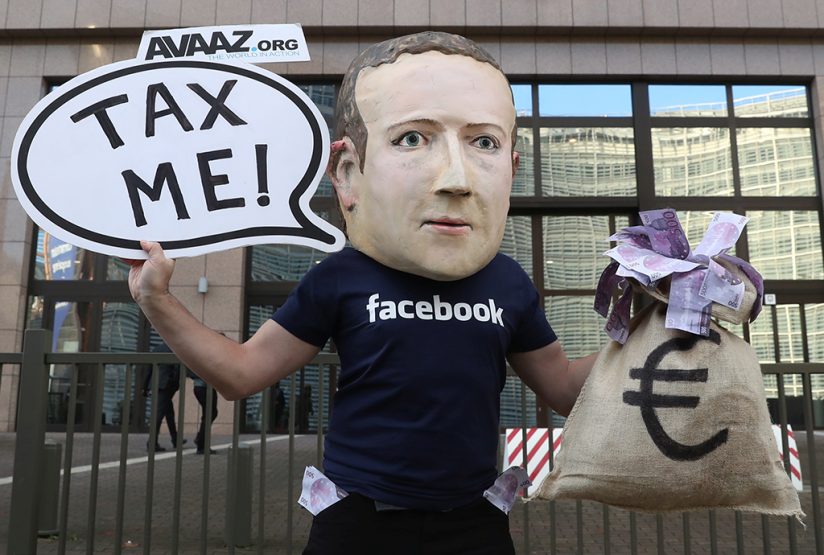
Activist wearing a mask depicting Facebook CEO Mark Zuckerberg demonstrates during the EU finance ministers meeting at EU headquarters in Brussels, Belgium, December 4, 2018. REUTERS/Yves Herman
But Facebook is not simply targeting fake accounts for takedown. Last Sunday, as Europeans prepared to head out to the polls, Facebook froze the largest group used by the Yellow Vests to organize protests and share information, silencing its 350,000+ members at a critical moment in French politics. More than one group member, reduced to commenting on existing posts, pointed out that President Emmanuel Macron met with Facebook chief executive android Mark Zuckerberg three weeks earlier to discuss a first-of-its-kind collaboration in which French government officials are being given access to material censored from users’ newsfeeds, essentially permitting them direct control of what the French are allowed to see on social media. Facebook, then, is providing France with the same techno-fascist services it provides the US government: Facebook will take on the burden of actually censoring dissent, thus skirting any pesky free-speech laws that might otherwise trip up a government that attempted to do the same.
Avaaz focused on the Yellow Vests in its coverage of the French elections, complaining RT France was getting huge quantities of views compared to native French media – perhaps because native French media have been doing Macron’s bidding and attempting to minimize the protests. By framing RT as a perpetrator of “information warfare,” the NGO was making a deliberate effort to have it deplatformed under one of Macron’s controversial police-state laws passed in 2018, by which any outlet spreading so-called “false information” can be gagged for three months leading up to an election. Yet Macron’s own interior minister, Christophe Castaner, lied on Twitter when he claimed the Yellow Vests had attacked the Pitié-Salpêtrière hospital in Paris, and RT was the first outlet to publish the truth about the incident. Who is the disinfo agent?
When the election results came in, Avaaz and its political allies in the neoliberal center could only gape in disbelief. Surely they had wiped La Liga and the Front National (now National Rally) from social media, salting the earth in their wake? How had they won? And what happened in Germany, where Angela Merkel’s CDU performed worse than ever in European election history? Merkel could blame YouTube – 70 influential video stars put out a call to their followers to shun her coalition – but the creators also called for shunning the far-right AfD, so the platform couldn’t be demonized as a tool of the ever-present Nazi Threat. That didn’t stop her party from trying, of course – CDU party leader Annegret Kramp-Karrenbauer complained about online “propaganda” and promised to “tackle this discussion quite aggressively.”
The populist parties won in large part because of the establishment’s unseemly embrace of fascist tactics, from the UK’s totalitarian information warfare disguised as “protecting citizens” or France’s visceral police violence, maiming protesters as if for sport. Europeans voted out of disgust with an establishment so insecure in its control of the narrative that it has sought to annihilate all signs of dissent, dismissing euroskepticism as Russian astroturfing and xenophobia and plugging its ears to the legitimate grievances of its subjects. The National Rally may have beat Macron’s jackbooted thugs, who in the past two months have hauled half a dozen journalists in for questioning by intelligence agencies for publishing stories that embarrassed the regime, but nearly half of French voters refused to vote for anyone at all, according to an Ipsos poll, and Germany’s Greens mopped the floor with Merkel’s coalition among young voters.

The triumph of Nigel Farage’s Brexit party in the UK is the product of a populace wrestling with cognitive dissonance, forced to realize that the “constitutional monarchy” they believed they lived in isn’t so constitutional after all, having jettisoned its democratic mask to cling to the EU under the guise of good old British pragmatism. Even passionate Remainers are happy to see Theresa Maybe go, though it remains to be seen whether her successor will be any more inclined to honor the result of 2016’s referendum. Meanwhile, the Guardian’s embarrassing attempt to shame Farage over a handful of appearances on the Alex Jones show – the paper claimed any reference to “globalists” and “new world order” were dog-whistles for the dreaded “antisemitic conspiracy theories” – proves the establishment media will never regain narrative primacy as long as alternatives exist. Jones, for all his flaws (and they are legion), has a massive audience; the Guardian, despite being propped up by the UK government’s Operation Mockingbird-esque “Integrity Initiative” (and the award for most ironic name ever goes to…), does not.
With the vast American election-fraud apparatus scrambling to prepare itself for 2020, now enabled by Pentagon-funded, Unit-8200-approved Microsoft “election security” software from the makers of the wrongthink-babysitter browser plugin NewsGuard, the US ruling class seems to be poised to make the same mistake as its global peers. Facebook, working hand in hand with the Atlantic Council, has banned and shadowbanned legions of anti-neoliberal activists over the past year, selectively applying (and inventing) new rules in an effort to keep popular content-creators jumping through hoops instead of influencing the discourse. Facebook has been allowed its place of privilege because as a “private corporation” it is legally permitted to violate users’ free speech rights in ways the US government cannot. But if Facebook can’t deliver a victory for the “right guys” this time around, it will be punished. Indeed, a massive anti-trust probe appears to be in the offing, 14 years of Zuckerberg apologies notwithstanding.
The site learned back when it tried to roll out a “disputed” tag for “wrongthink” stories that people were actually more likely to click on those stories; it learned the lesson again when its hugely expensive Facebook Watch news show featuring Anderson Cooper flopped last year. Zuckerberg is on the record begging for government regulation; will Facebook and Twitter use the outcome of this round of elections as a springboard for further crackdowns?
YouTube already has – thousands of creators found their channels demonetized and riddled with takedown notices this week in what has been dubbed the #VoxAdpocalypse after a pathologically whiny Vox blogger became the face of the mass deplatforming, but the censorship appears to be more of a response to Macron’s Orwellian “Christchurch call” to censor “extremism” – that ill-defined conveniently-variable catch-all whose borders are perpetually expanding to engulf all inconvenient speech – aided and abetted by the ADL than Google taking pity on a thin-skinned professional victim.
A sinister coalition of MEPs, “civil society” groups, and the Transatlantic Commission on Election Integrity – a who’s who of war criminals, psychopaths, and oligarchs that includes Michael Chertoff, John “death squad” Negroponte, Victor Pinchuk, and Anders Fogh Rasmussen – has already demanded “parliamentary inquiries into the impact of the use and abuse of technology platforms on democracy and elections.” It’s no coincidence that several of these “election integrity” enthusiasts sit on the board of NewsGuard, which is currently trying to weasel into the EU’s internet regulatory framework by playing up the “disinformation” threat.
The blue-check intelligentsia has been trying for years to convince the hoi polloi that “conspiratorial” thinking is somehow detrimental to democracy. Former Obama labor secretary Robert Reich told Buzzfeed exactly that – “If we become a conspiracy society, we all carry around a degree of paranoia and that’s not healthy for democracy.” But this divorces cause from effect, as if “conspiracy theorists” have formulated their theories out of whole cloth – as if there isn’t evidence for these theories piled knee-deep, as if once-trusted institutions haven’t proven themselves time and again to be as trustworthy as tabloid tales of Elvis risen from the grave. If paranoia is unhealthy for democracy, how is a media incentivized to lie, misdirect and obfuscate any better?
The populist wave has been conflated with an uptick in “hate” in an attempt to delegitimize and demonize it. Outside of groups like the ADL, whose statistics are easily debunked, there is no credible evidence bigotry is on the rise, but as an actual Nazi once said, tell a big enough lie often enough, and it might as well be real. Beginning around 2012, the establishment media began relentlessly flogging the “white privilege” narrative in an effort to fan the flames of interracial conflict. Political science doctoral student Zach Goldberg performed an analysis of several terms using the LexisNexis database and found evidence of heavy narrative manipulation – “whiteness” was mentioned in four times as many news articles in 2017 as in 2012, “white privilege” was mentioned ten times as often in 2017 as in 2012, and “racism” was mentioned ten times as often in the New York Times alone in 2017 as in 2012. Yet even as the media has seemingly talked of nothing else, actual prejudice – by whites against non-whites, at least – has declined since 2008, according to a University of Pennsylvania study published last month, and the FBI’s own statistics show hate crimes against most minority groups are on the decline. Because few European governments separate “hate crimes” from “normal” crime statistics, information on bigotry in Europe often comes solely from NGOs and “civil society” groups that rely for their funding on the perception that Hate is on the march. Populists are capable of prejudice like anyone else, but it is their defining characteristic – a “prejudice” against oligarchy – that motivates the smears churned out by the media.
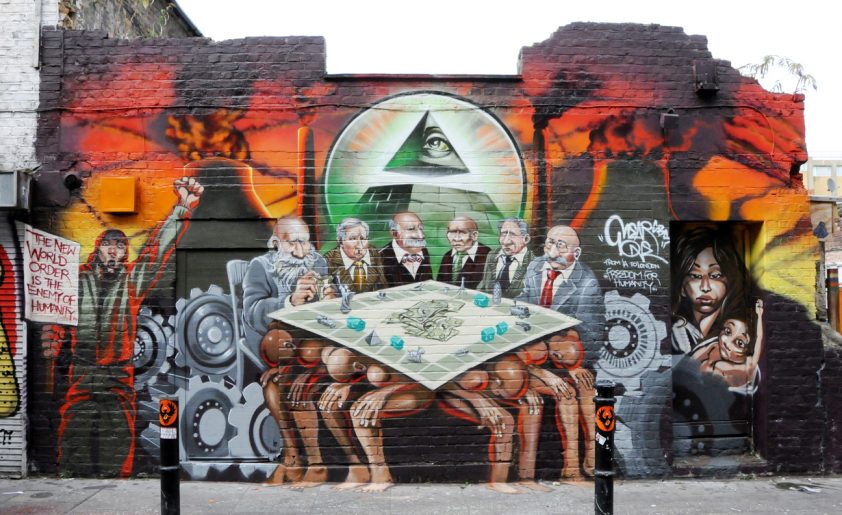
Protest votes like Trump and Brexit are cries for help from a disenfranchised populace. The European elections boasted the highest turnout in decades, and the ruling class ignores the results at its peril. When the election ritual no longer satisfies a population’s need to feel it is exerting its free will on society, we get public hexings of political figures, people reasoning black magic is more likely to solve their problems than voting. This is the same desperation that leads people like Arnav Gupta to set themselves on fire in front of the White House. Europeans have demonstrated unequivocally that they are sick of unaccountable dictatorship from Brussels, where EC President Jean-Claude Juncker, never one for sympathy with the little guy, sneers at the “populist, nationalists, stupid nationalists” who are “in love with their own countries.” They are sick of being displaced from their homes by a seemingly endless tide of migrants, just as those migrants themselves are displaced from their homes by a seemingly endless tide of American wars. Both groups are victimized by the IMF’s neoliberal austerity policies, epitomized by Juncker, who has done more than perhaps any one person to help Europe’s corporate “citizens” dodge taxes while nickel-and-diming the humans.
Instead of addressing these legitimate grievances, those in power on both sides of the Atlantic tighten the screws on online discourse – out of sight, out of mind. YouTube declares conspiracy theorizing a form of hate speech and plays whack-a-mole with a documentary confirming everyone’s long-standing suspicions that “save-the-migrants” NGOs are cashing in on the desperate human tide. Big Tech promises to work even more closely with Big Brother to crack down on dissident speech, tarring its victims as Nazis while hoping no one will point out such collusion is one of the defining characteristics of fascism.
These measures are guaranteed to further radicalize the discontent. Deleting social media accounts does not delete the people behind them, and France has already proven that starving a protest movement of media attention only makes it angrier. The ruling class may welcome their rage, aiming to use the inevitable outbreak of violence to choke off the last avenues of free expression, but once the guillotines come out, it isn’t the masses’ heads that will be rolling in the streets.
Believe It Or Not, Two Of The Smallest Actors In Europe Are Bullying Russia
By Andrew Korybko | EurasiaFuture | 2019-06-02
It sounds absurd at first listen, but Malta and Kosovo — two of the smallest actors in Europe — are bullying Russia by preventing its military overflights to Venezuela and attacking one of its UN staff members, respectively, which appear to be part and parcel of an American-backed perception management plan to weaken Moscow’s soft power and ultimately undermine its Afro-Eurasian “balancing’ act.
The Mainstream Media is full of stories about Russia supposedly “bullying” smaller nations, while Alt-Media never tires of talking about how the US is doing the same, but neither of them have yet to address the curious fact that two of the smallest actors in Europe have recently bullied Russia. Malta prevented Moscow from making military overflights to Venezuela, while Kosovo just attacked one of its UN staff members with impunity. Although both incidents were separately reported on in the Mainstream and Alternative Medias, they haven’t been tied together as part of the same American-backed perception management plan to weaken Moscow’s soft power. There’s a prevailing notion that Great Powers are supposedly too strong to be bullied by small states, let alone an entity that Russia doesn’t even recognize as “independent”, but that line of thinking has been debunked after what Malta and Kosovo recently did to Russia, which makes Moscow look weak in the eyes of the world.
That’s not just the author’s own interpretation either, since the popular Alt-Media outlet South Front published a piece about the Kosovo incident in which they analyzed the following (bold text is from the original):
“The goal of the action was to demonstrate to the Serbs that they would receive and can receive no real support from Russia. This provocation is intended to demonstrate to the Balkans, Europe and the entire world that the current Russian political leadership has no real will and instruments to impact the situation in the Balkans… All waiting for a Russian response. In the established situation, Russia would save its face in the event of changing the current language of statements to the language of ultimatums and real actions against both the Kosovo and Albanian leadership. If Russia sit down under this provocation, its positions on the international scene would be undermined. Russia would lose its image among the Serbs even further, and the “European integration” concept would get an additional momentum.”
South Front is correct in its assessment, even if it’s hinting at a “wishful thinking” outcome of Russia actually doing something tangible to Kosovo in response. That’s not going to happen, exactly as it also didn’t when it came to Malta’s provocation either.
Russia simply doesn’t have the political will to kinetically respond to either of them, let alone disproportionately, which isn’t necessarily a sign of weakness in and of itself for those who understand these realistic limitations but could easily be framed as such for the unaware and very impressionable international audience. The intent in doing so is to craft a “David vs. Goliath” narrative of European “underdogs” “standing up” to Russia and even to President Putin personally, which in turn is designed to disrupt Moscow’s Afro-Eurasian “balancing” act by inspiring other countries and especially Great Powers to test the limits of its responses. In tangible terms, some of Russia’s new partners and even traditional rivals alike might start playing “hard ball” with it to see how far they can go in promoting their interests at Moscow’s strategic expense, which could undermine its carefully crafted foreign policy precisely at the point when it’s experiencing two very sensitive systemic transitions at home and might therefore cause many unexpected problems for it.
The EU should be calling out Israeli colonialism for its violence and incitement
By Ramona Wadi | MEMO | May 28, 2019
Palestinian school textbooks are once again under public scrutiny, this time after a report published by Israel’s Institute for Monitoring Peace and Cultural Tolerance in School Education (IMPACT-se) claimed that material was “more radical than previously published”. The EU has since confirmed that it will be funding an assessment to be carried out “by an independent and internationally recognised research institute.”
According to IMPACT-se, “This new curriculum deliberately omits any discussion of peace education or reference to any Jewish presence in Palestine before 1948.” EU Foreign Affairs Representative Federica Mogherini said that the study will identify “possible incitement to hatred and violence and any possible lack of compliance with UNESCO standards of peace and tolerance in education.”
Once again, the Palestinians are being coerced into adopting standards determined by the political actors that have normalised Israel’s colonial presence in Palestine. The question is not whether there is any reference to Jewish presence in Palestine, but why there is such concentrated opposition to Palestinians asserting their own history and identity, both bludgeoned by Israel in the ongoing Nakba.
Lest anyone forgets, the entire international community has, in one way or another, endorsed the Zionist narrative when it comes to Palestine. This narrative leaves no space for Palestinians to assert their indigenous presence in Palestine before 1948; the “land without a people for a people without a land” myth and subsequent variations of it were used by the Zionists to justify their intent to colonise Palestine, as well as its implementation. It is the Zionist narrative that has eliminated Palestinians. In escaping from that premise, it is clear that Palestinians have an obligation towards their own people, history and memory if they are to fight against the complete disappearance of their own identity as a distinct people under Israeli oppression supported by the international community.
![Image of Israel supporters rally in London against UN resolution [ Zionist Federation/Facebook]](https://i2.wp.com/www.middleeastmonitor.com/wp-content/uploads/2017/01/2016_1_7-pro-Israel-activists-demostrate-against-UN-Council-Vote.jpg?resize=500%2C333&quality=75&strip=all&ssl=1)
Israel supporters rally in London against UN resolution [ Zionist Federation/Facebook]
It is imperative that Palestinians set their own agenda by their own standards. Israel has done so in contempt of human rights violations and its actions are now normalised as “security concerns” and “self-defence” by the international community. Palestinians have legitimate reasons to pursue their own liberation trajectory – a right granted by international law – yet they are constantly expected to abide by international norms which do not address the specifics of Israel’s ongoing colonial expansion and violence.
UNESCO describes peace education as “promoting peace-building through education in situations of both conflict and peace.” The terminology used is ideal for the international community, which has spent decades reinventing Israel’s colonialism in Palestine as the “Israeli-Palestinian conflict” that can purportedly be solved through “peace negotiations”. There couldn’t have been a better combination for the EU to promote its diplomacy. UNESCO’s promotion of normalised discourse to alter the possibilities of education is a harmful agenda for Palestinians and an opportunity for the EU to portray itself as abiding by international norms.
Since there is no collective criticism of these accepted norms, any action that shows the slightest hint of legitimate repudiation in favour of a stance that clearly speaks for the oppressed – in this case, the Palestinian people – the EU can continue to recruit individuals and institutions to reinforce what is accepted at an international level. Palestinian textbooks and their content, however, have not emerged from a vacuum. The EU should not be funding studies that impede Palestinians from asserting their right to historic Palestine in their own educational curriculum. On the contrary, it should be calling out Israel’s presence in Palestine as a permanent form of colonial violence and incitement.
Iran Ready for Talks with Regional States, No Such Prospect for US
Al-Manar | May 28, 2019
Noting Iran’s proposal for signing a non-aggression pact with regional countries, FM spokesman Mousavi said there is currently no prospect for talks with US.
“The Persian Gulf littoral states are among the most important neighboring countries for Iran; therefore, what foreign minister Zarif has put forward- i.e. the non-aggression pact- is not a new topic,” Sayyed Abbas Mousavi said in a news conference on Tuesday.
“Iran does not want to be in an insecure and stressful region,” he underlined.
Iran, in the past years, has always reiterated its readiness to sign a non-aggression pact with regional countries in a bid to build trust and confidence, and help eliminate concerns originating from other countries’ fear-inducing tactics. Most recently, Foreign Minister Zarif in a meeting with Iraqi President Barham Salih in Baghdad on Saturday repeated the suggestion to Persian Gulf states to sign a non-aggression pact. The move was praised by Russian FM Sergey Lavrov as the first step to reduce regional tensions.
Addressing Trump’s recent claims that the US is “not looking for regime change” in Iran, rather all pressures are aimed at preventing Iran from achieving nuclear weapons, Mousavi said that “Iran is not interested in empty rhetoric and pays more attention to behaviors and will decide and act upon them.”
“We do not have any talks with the US, and our basis is on respecting international pacts to which the US can return,” Mousavi said.
The US’ illegitimate withdrawal [from the nuclear deal] and some of its illusions have ruined any chance for negotiations, he said, adding that currently there is no prospect for talks with Washington. “We should wait for new developments,” he added.
Elsewhere, he noted Zarif’s recent regional tour to India, Turkmenistan, Syria, Japan, Pakistan and Iraq, saying the visits have been in line with clarifying Iran’s stance. He also voiced hope that a new round of talks would commence with Iran’s northern neighbors at the ministerial and even head of state levels.
Mousavi then criticized European’s flimsy commitment to implementing JCPOA, saying that Iran always gives diplomacy a chance, but that does not mean pinning its hope on Europe.
He added that Iran expects Europeans to act within the set 60-day deadline by Iran and if they do not do so Iran will take the next step regarding its reduction of commitments to the JCPOA.
Addressing the latest situation of EU’s trade mechanism INSTEX, Mousavi said that the first transaction between Iran and Europe has been done. Some Iranian INSTEX-experts have traveled to Europe and have conducted some negotiations. A group of European INSTEX managers will travel to Iran in future to continue talks, he added.
About other countries proposing to mediate between Iran and US amid heightened tensions, Mousavi said that “we are not at that level yet, since having other countries to mediate needs some requirements. It is vital to pay attention to the roots of Iran-US tensions, which are in the reinforcement of sanctions on Iran, US’ illegal withdrawal form JCPOA and its economic terrorism.”
He also noted that Zarif’s meetings with US senators cannot be translated as holding talks with the US since Congress members are not considered as US government officials.
Hungary’s Foreign Minister Calls Western Europe ‘Hypocrites’ for China Criticism
teleSUR | May 23, 2019
Hungary’s foreign minister Thursday accused major Western European nations of “hypocrisy” and “hysteria” for criticizing central European countries’ business dealings with China, and defended Hungary’s use of Huawei 5G mobile phone technology.
Sixteen central and eastern European countries, including 11 European Union members, held a summit with China in April during which it pledged to increase trade and provide more support for big cross-border infrastructure projects.
The area is part of China’s Belt and Road Initiative, which aims to link China by sea and land with Southeast and Central Asia, the Middle East, Europe and Africa.
France and Germany oppose such independent moves, which they fear might make Europe appear disunited at a time when the EU is trying to forge a more defensive strategy towards China.
On Tuesday, speaking to reporters in Paris, France’s Finance Minister Bruno Le Maire criticized “negotiations of 16 states from the east with China in parallel to negotiations that the EU is leading with China”.
But Hungarian Foreign Minister Peter Szijjarto, who is serving in the government of far-right Prime Minister Victor Orban, rejected such criticism, saying Germany and France do far more business with China than the central European states, and often negotiate directly with Beijing.
“There is such a bad hypocrisy in the European Union when it comes to China,” Szijjarto told Reuters on the sidelines of an OECD meeting in Paris. “The 11 central and eastern European member states … represent 9.9 percent of EU trade with China.”
“When the German chancellor and French president meet China’s leadership nobody thinks that’s a problem,” he said. “Nobody raises a question about how it is possible that they sell 300 aircraft to China, which is a bigger deal than the (entire) trade represented by the 11 central European countries.”
He said it was also unfair for Western European states to criticize Hungary for using technology from Chinese firm Huawei in its 5G mobile phone networks, when those networks were being built under license by German and British companies, Deutsche Telekom and Vodafone.
Hungary’s government has been at odds with Brussels for the erosion of media and judicial independence, attacks on civil organizations, treatment of migrants, laws against poverty, and the ousting of educational institutions like the progressive Central European University.
EU Establishment Set for Popular Rebuke in Elections
Strategic Culture Foundation | May 24, 2019
Over this weekend 28 member states of the European Union go to the polls in an impressive exercise of democracy. Polling takes place over four days, ending on Sunday. The full results won’t be finalized until next week. But already it is widely anticipated that so-called populist parties across the bloc will make significant gains in winning seats in the 751-member chamber of the European Parliament.
One glaring anomaly is that Britain is participating in these elections, even though, in theory, it was supposed to have departed the EU in March. The Brexit wrangling has persisted without a clear result, meaning that the United Kingdom is obliged to hold EU parliamentary elections like the other 27 member states. European parliamentarians elected in Britain may not actually take their seats in Brussels or Strasburg because the Brexit process when complete – whenever that happens – will make their seats redundant.
Another anomaly is that the 2019 elections have been overshadowed with political and media claims in the run-up to the polls that Russia would launch an “interference campaign” to sway voters to vote for political parties opposed to the EU status quo.
Yet on the eve of the ballots being cast, Western news media and various EU security pundits have had to admit that there has been no evidence of the anticipated “Kremlin influence campaign”. Such an alleged Russian meddling campaign in the EU is an echo of the long-running, baseless narrative applied to the US presidential elections in 2016. No evidence has ever been produced to substantiate either scenario.
Russia has consistently and vehemently denied any such notion of “peddling influence” over Western voters. But the great anomaly is that Western media and European security agencies are having to admit that there is no indication that Russia has targeted the EU elections with a campaign of media interference.
The rise of nationalist, anti-immigrant, Eurosceptic, anti-austerity, anti-war, anti-capitalist political movements across Europe is simply due to this: a surge in anti-establishment parties. The surge of protests among European citizens against a neoliberal establishment has nothing to do with alleged “Russian interference” and everything to do with an inherent democratic deficit in the 28-member bloc.
By trying to blame Russia for “malignly influencing” EU citizens and funding “anti-EU parties”, as the government scandal in Austria sought to do this week, is an act of desperate denial politics by the EU establishment as to its own dire political and economic failings. Such official denial and scapegoating of Moscow is only fueling even more popular protest and instability within the EU.
French President Emmanuel Macron this week typically blamed “collusion between nationalist parties and foreign interests for threatening the existence of Europe”. Macron’s elitist views are symptomatic of the establishment malaise which is actually at the core of the problem in the EU’s crumbling cohesion and authority.
Britain’s Brexit referendum held in 2016 was a forewarning of the popular dissent across the EU towards an establishment in Brussels perceived as anti-democratic, beholden to big finance and Neo-liberal capitalist austerity, as well as kowtowing to a Washington-led consensus for illegal overseas wars and NATO expansionism.
The EU status quo has led to massive problems of immigration from pandering to America’s illegal warmongering in the Middle East and North Africa. European citizens have become awake to those problems and are opposed to the degeneration of Europe as an adjunct of Washington’s imperialism. That dissent is also manifest in many European citizens being opposed to the EU’s compliance with US-led sanctions and hostility towards Russia. The fact of that does not mean that Russia is somehow influencing opposition movements. It is simply a fact that European citizens are in revolt against an anti-democratic status quo that is all too often servile to a transatlantic axis that is not in their fundamental democratic interests, like so many other policies that the EU status quo slavishly adheres to.
Emmanuel Macron and other EU establishment figures may push the fantasy that the bloc is under threat from “far-right nationalist parties in cahoots with the Kremlin”.
The fact is that the EU is simply perceived by a growing number of its 512 million citizens as a monolith that is unresponsive to democratic needs. That’s why they are rebelling against the status quo by voting for a range of anti-establishment parties. If the EU can’t recognize the democratic impulse from within its own bloc then its future is destined for further disruption as the Brexit movement portends. Blaming “external enemies” like Russia for its own inherent political problems is being proven for the desperate denial that it is.
The people are speaking this weekend. The EU establishment better listen.
Girl Reportedly Bullied by Teacher, Classmates for Refusing to ‘Climate Strike’
Sputnik – 23.05.2019
A Swedish girl who refused to join her classmates in skipping school for the sake of the climate has ended up being labelled as a “climate denier”, which her mother described as “mass psychosis”.
A high-school pupil who refused to attend a so-called “school strike for climate” has been bullied not only by her classmates, but the teacher as well, the magazine Det Goda Samhället reported.
When the girl’s classmates decided to join the “climate strike” spearheaded by teenage activist-turned-superstar Greta Thunberg, “Sanna” declared she didn’t want to attend and was given a tongue-lashing from the teacher.
“The teacher said ‘Sanna’ was uncommitted and failed to understand the seriousness of the climate threat. She asked her to reconsider her decision, and she said it openly, for the entire class to hear. ‘Sanna’ felt like the teacher was trying to ridicule her in front of the others”, “Lena”, the girl’s mother, told Det Goda Samhället.
Because of the teacher’s actions, the rest of the class also turned against “Sanna”, who ended up being boycotted by her own friends and accused of being a “climate denier”, “Lena” recalled.
When the mother called the school’s administration, she herself was questioned by the female principal.
“She said it was sad that ‘Sanna’ went against the rest of the class and refused to participate in something this positive. I could read between the lines that she thought I had a wrong attitude myself”, “Lena” explained.
The mother called the situation a “mass psychosis” and said it was “very unpleasant”.
“If you are not a fan of Greta Thunberg and her ‘school strikes’ for the sake of climate, then you should be boycotted and bullied. This is totally sick”, the mother explained.
According to her, “Sanna” now refuses to go to school, she is worried and afraid of what may happen.
Greta Thunberg is a Swedish climate activist who rose to international fame for her weekly “school strikes” held outside of the Swedish parliament. As her movement rose to prominence, hundreds of thousands of students in over a hundred countries across the globe have followed her example.
For her relentless activism and penchant for doomsday rhetoric, Thunberg received a lot of traction, having met with EU officials, top-ranking businessmen and even the Pope, and was decorated with a lot of prizes and awards. In March 2019, she was nominated for the Nobel Peace Prize by Norwegian MPs. In May 2019, at the age of 16, she starred on the cover of the Time magazine. In her home country, she was appointed the woman of the year by two of the country’s largest newspapers, Expressen and Aftonbladet.
In Scandinavia, she is known as “Climate Greata” and receives a lot of media coverage and is almost universally venerated by the political establishment despite her repeated criticism of their actions as insufficient. Sweden’s goal to become carbon neutral by 2045 has been called “the world’s most ambitious climate law”.
However, her name also sparks a lot of controversy. First, many are sceptical of Thunberg’s stance due to her diagnoses of Asperger’s, obsessive-compulsive disorder (OCD), and selective mutism. Second, her name is often misused. In late 2018, Ingmar Rentzhog, founder of the non-profit We Don’t Have Time Foundation, who claims to have “found” and “developed” Thunberg, recruited her to become an unpaid youth advisor and used Thunberg’s name and image without her knowledge or permission to raise millions.
Featured Video
New positive ivermectin evidence
or go to
Aletho News Archives – Video-Images
From the Archives
Fanatical Followers of the Covid Regime: A Jim Jones-Style Cult?
By Professor Roger Watson and Dr. Niall McCrae | The Daily Sceptic | November 15, 2021
As scholars at leading British universities over recent decades, we witnessed the replacement of critical thinking and debate by narrative: facts are discrimination and scientific method is imperialism; truth, instead, is derived from ‘progressive’ values. This educational trend may be a major contributory factor to the ease in which society has been inculcated to the Covid ‘new normal’ of masking, testing, and repeated doses of vaccines for a disease of similar risk to severe influenza.
One doesn’t need much critical reasoning to observe the flawed logic of some vaccination enthusiasts, such as people who respond to experiencing any side effects, however debilitating, by saying “at least I know it’s working”, or, after contracting the disease despite their promised inoculation (over 90% effective, according to initial drug company claims), “I’d have been worse off without the jab.” … continue
Blog Roll
 Aletho News
- EU Council Advances Chat Control 2.0 Scanning Proposal
- Ex-Greek MEP files complaint against Israeli spyware firm over alleged Pegasus surveillance
- Troubling ideas throughout the Torah, Talmud, Mishneh Torah and Tanya
- ‘Grave, alarming’: Iran mission on Trump’s UNGA ‘annihilation’ threats
- Najaf airport to reopen to Iranian flights within 24 hours: Ambassador
- From ‘How Will This End For Iran’ to ‘When America Walks Away’: A tale of two Economist covers
- Tehran blasts ‘baseless’ speculation linking Iran to alleged bomb plot at UK air base
- The Rise And… Rise Of ‘Color Revolutions’
- The Coming GOP Bloodbath?
- Arctic Scare Stories Melt Away
- If Americans Knew
- Netanyahu Asked UAE Leader to Deny Report on Oct. 7 Warning in Secret Visit, Sources Say
- CNN Chief Int’l Correspondent Clarissa Ward on Journalists in Gaza
- Democratic Party Consultants Surround Troy Jackson with Pro-Israel Donors
- Christian Leader Responds To Netanyahu’s Claims Regarding Palestinian Christians
- In Gaza, ‘Whoever Survives the Bombing Won’t Survive the Rubble’
- Israel kills more Palestinians, amid push to resettle Gaza – Daily Update
- Israel forces Gazans to live in constant peril – Daily Update
- Deconstructing Netanyahu’s pants-on-fire UN rant – Daily Update
- Trump betrayed voters with his campaign lies and prioritized a foreign country once he took office
- Netanyahu calls Israel’s war in Gaza ‘opposite of genocide’ in UN speech to near-empty hall
- No Tricks Zone
- New Study: Earth And Venus Surface Warmth Largely Explained By Convection And Lapse Rate, Not CO2 Or Radiation
- 2025 Nature Paper Claiming Worsening Global Drought Gets RETRACTED …Heavily Flawed
- New Study: ‘Global Drought Shows No Detectable Recent Acceleration Under Climate Warming’
- Economic Masterminds: German Socialists Suggest Taxing Productivity Gains Stemming From Using AI
- The South China Sea Has Not Been Cooperating With The Climate Change Narrative
- Energy Crisis: Germany Enters Heating Season With Historically Low Gas Reserve Fill Levels
- New Study: The Antarctic Ice Sheet Gained Mass From 2020-2024 Due To Staggering Snow And Ice Accumulation
- Study: Ocean Heating Rates From Thousands Of Years Ago ‘Dwarf’ Modern Ocean Heating Rates
- Climate Extremists Target, Attack Large-Scale Power Grid Infrastructure In Germany!
- New Study: Antarctic Ice Melt Has Contributed Less Than 1 Centimeter To Sea Level Rise In The Last 30 Years

