Maimed Yellow Vest Protestors: Worse Than Getting Shot
By Tim Kirby | Strategic Culture Foundation | May 2, 2019
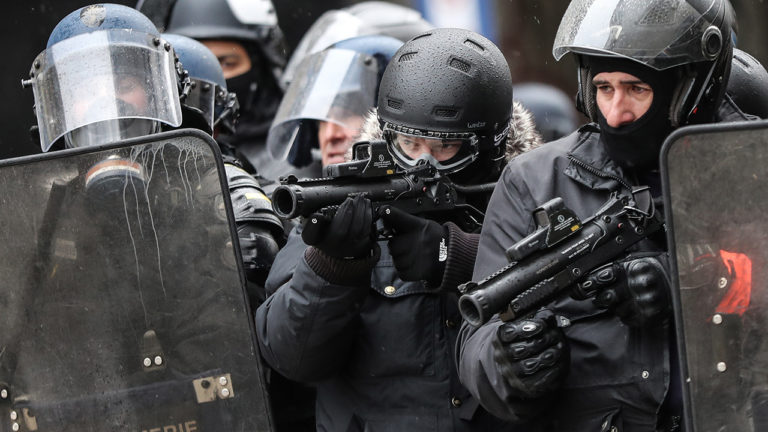
The French marched off to war in 1914 in glorious lines of infantry in baby blue coats and bright red trousers to be mowed down by the finest technology the Industrial Revolution had to offer. For us now it is easy to see how insane this was and how flawed the understanding of both the commoners and even the experts was in terms of how combat and war actually worked at the time. This naive view of modern tactics certainly applies to street conflicts we are seeing in France as part of the Yellow Vest protests. The so-called non-lethal (and less-lethal) arms of the French authorities gives them a tactical advantage far beyond that of any assault rifle.
Thanks to the media we have become accustomed to video of protestors getting sprayed by water or having their ranks dispersed thanks to tear gas, leaving everyone wet or coughing respectively but otherwise unharmed. However this humane picture does not meet up with the realities of this civilian vs. cop style warfare.
If we are to take the Yellow Vest protestors at their word then at least 22 of them have lost an eye (from “less-lethal” Flash-ball guns) and 5 have had their hands blown off with 154 being “seriously injured”. Obviously the protestors will want to maximize their statistics but there are plenty of videos from the various actions/demonstrations showing horrible injuries which are too numerous to all be fakes. So the numbers may be off but the overall general tendencies of these injuries do occur from the French authorities in the Human Rights defending EU is a proven fact. The simple reality is that despite a nice marketing phrase non-lethal weapons cripple and on occasion kill.
In order to understand the tactical advantage that non-lethal weapons offer the government (not the individual police but the state itself) we need to put aside our emotional response to seeing French people having their limbs blown off. We have to not jump into ranting about the flagrant hypocrisy of the EU when it comes to human rights and rationally break down how the conflicts between Yellow and Blue vests could look if the arms situation were different.
Scenario A: What if the Yellow Vests were armed?
If the organizers of the Yellow Vests (all movements are organized by someone regardless of what the media tells you) were able to arm their masses with rifles this would indeed lead to horrific short-term violence that would leave a permanent stain on French history. Often hundreds or thousands of protestors are met by dozens of police and handfuls of soldiers, if the protestors were on par with their adversaries in terms of guns, then their numerical advantage would shatter the police’s will to fight.
No policemen are going to fight to the last man against a force 20 times their number, which they may partially agree with dying for nothing, nor will they open fire with tanks in the centers of their own cities. Human psychology would allow them to kill foreigners in some distant country in this manner but not at home.
In this instance of near certain death from pure numbers the police would either “stay home” or possibly switch sides overtly or covertly.
Obviously a full civil war could start from this situation, but in a street warfare sense, escalating from protest to actual hot war is technically a winning scenario as it advances them closer to attaining/changing power.
Scenario B: What if the police fought like an army?
One key component of many Color Revolutions is getting the “bad leader” to be blamed for some sort of direct use of lethal bloody media-friendly massacre. If the French police actually used assault rifles against the protestors this would demonize them to the point of justifying a Revolution. This would not just cause a civil conflict but be a national call to arms to join it, which would be a bad move on the state’s part.
Furthermore, only sociopaths can fire rifles into unarmed crowds (who are not posing a direct threat) of people who speak their own language (i.e. their own “kind”). If the French police just decided to give the order to shoot them all, then in this instance many of the French police would find rifle and bayonet worthless as they would have no desire to shoot.
The result would be a handful of deaths from each protest but the utter collapse of legitimacy of the state and possible “retreats” of police forces unwilling to fire on “their own”.
Scenario C: The “non-lethal” reality we see today.
Psychologically it is much easier for the French police to use non-lethal (in their minds) weapons against the protestors. In the subconscious mind of the policeman he can justify shooting into masses much easier with this type of weapon because in theory it “shouldn’t” kill anyone and if it does it was an “accident”. This is much easier on our psyche and morals than shooting someone in the chest with a Lebel Rifle.
Research by the University of Cambridge supports this tendency. They found that police are far more likely to use force when it is supposedly from non-lethal weapons. This non-lethal status of weapons like tasers (which can and do kill people all the time) makes them so much easier to apply on the populace especially when the subconscious of the police officer tells him that, the guy he fried the other day with a taser died as an accident, one in every so many thousand people just has a weak heart.
So looking at non-lethal weapons tactically they offer the massive psychological advantage of being able to attack without an attack registering in the conscience of the user. As stated above they are also very media and propaganda friendly when anyone who dies from them is just “an accident” giving the government the ability to retain legitimacy while gouging out they eyes of its own populace. Real guns fail at both of these points completely.
Conclusion:
One bizarre irony in our strange postmodern times is that if the Yellow Vests were actually being shot at by real guns and being killed they would be far closer to achieving some sort of systemic change. Being mutilated by all sorts of gadgets and devices of one sort or another makes it easy for the police to do their job psychologically without generating the levels of sympathy and horror from live rounds hitting the innocent that the protestors need to shatter or change the system.
The French Flash-Ball gun should be made the symbol for the EU for it provides crushing repression of the masses with great PR spin to make it seem humane and caring. It is for our safety after all that they use these right?
Yellow vest protests hit Strasbourg in sign of trouble for EU
Press TV – April 28, 2019
The “yellow vest” protests in France have spread to Strasbourg, the seat of the European Parliament, on the 24th consecutive weekend of a revolt which shows no sign of abating.
Thousands gathered near European Union institutions late Saturday, with organizers hoping to make the protest international a month ahead of EU-wide parliamentary elections.
Police fired tear gas to push back protesters trying to march on the European Parliament building and eyewitness footage showed arrests being made.
Authorities had banned protests and barricaded the neighborhood where the parliament and other EU institutions are located.
Protests were held elsewhere across France, coming two days after President Emmanuel Macron outlined policy proposals including tax cuts worth around 5 billion euros in response to the revolt.
The Interior Ministry said around 23,600 protesters took part in rallies across the country, including Paris, Lyon, Bordeaux, Dijon and Toulouse.
The protests, named after motorists’ high-visibility yellow jackets, began in November over fuel tax increases but morphed into a nationwide movement against government policies.
The yellow vests coalition includes numerous anti-Europe protesters, many of whom are calling for a ‘Frexit’, which would see France leave the EU.
Thousands of police and soldiers are drafted into the French capital every Saturday, when there is regular fighting and fires being lit.
The situation is now so extreme that vast areas of Paris – including the district around the Elysee Palace – are shut off every weekend.
The trouble has extended to other major cities, including Bordeaux and Toulouse, where hundreds have been arrested, or injured by police weapons ranging from flash ball rubber bullets to batons.
Macron has pledged more money for rural areas, but he is still regularly described as a “President of the Rich” who is primarily interested in supporting big businesses.
He has already scrapped wealth taxes, and made it far easier for companies to hire and fire employees.
Macron had originally planned to deliver a reform speech to the nation a week ago, but it was postponed because of the fire at Notre Dame Cathedral in Paris.
Some 1 billion euros has now been pledged for the rebuilding of the medieval place of worship – prompting the yellow vests to ask why other funds cannot be found to deal with their own grievances.
On Jews Being United
By Gilad Atzmon | April 18, 2019
In his Times of Israel article “What All Anti-Semites Have In Common,” Andres Spokoiny, president and CEO of the Jewish Funders Network, tells us everything we shouldn’t know about the current state of the Jew/Goy divide.
“Today,” Spokoiny complains, “many Jews are willing to overlook and even excuse anti-Semitism when the bigots hate a certain type of Jews.” In the good old days, anti-Semitism was a uniting force. “Anti-Semitism used to be the big Jewish unifier. Jews were always fractious and quarrelsome, but when it came to anti-Semitism, everybody agreed. Anti-Semites hated us without distinction, so in the face of a common threat, we would recognize the danger and unite.” Spokoiny is nostalgic, he wants to see the Jews reunited into a fist of resistance against anti-Semitism.
In the eyes of Spokoiny, the three types of contemporary anti-Semitism, be it Left, Right or Islamic (“which is not only fascistic but outright genocidal,” according to Spokoiny) are in fact one by nature: “there’s just one type of anti-Semitism that simply dresses its ugly persona in different ideological garments.” So it isn’t just the Jews that should be reunited; the Goyim, or shall we say the rest humanity, aren’t diverse either, their oppositions to Jewish politics, Israel or Zionism are only a matter of “different ideological garments.”
In Spokoiny’s universe, the Jews are hated for being Jews. It is not that some oppose Israel for being racist, expansionist and genocidal. It is not because some may be upset that the Israeli Lobby dominates Western foreign affairs in the open. It is not because American and British boys and girls are sent to fight and die in Zio-con wars, it is not because some have noticed that it was a bunch of prominent Jewish intellectuals who have managed to reshape the Western ethos by means of so-called progressive ideologies. It is not because the media seems to be biased in favour of a criminal state, which happens to be a Jewish one. In Spokoiny, reasoning and self-reflection are pushed aside. In his universe some just hate Jews blindly, irrationally and for no reason.
But Spokoiny may as well be right. There is a common element in the Left-wing, Right-wing, Christian and Islamic opposition to Jewish politics, culture and ideology: opposition to choseness is how Bernard Lazare described it in his 1894 Zionist text Antisemitism: Its History and Causes. There is a shared common ground that unites all those so-called ‘anti-Semites.’ The alleged ‘enemies of the Jews’ are people who want the Jewish past to be subject to scrutiny like all other historical chapters, Israeli barbarism to be curtailed, Wall Street to be restricted, Palestine to be free. They want globalisation to be halted, immoral interventionism to die out. The so-called ‘anti-Semites’ actually follow the Zionist promise, they want Jews to finally assimilate and become ‘people like all other people.’ The so-called ‘enemies of the Jews’ are upholding the most enlightened rational universalist ethical positions. They treat Jews as ordinary people and expect their state and institutions to subscribe to ethical standards.
Spokoiny hates Alain Soral, the French intellectual who was sentenced this week to one year in prison by a French court for “negationisme” (history revisionism).
In the eyes of French Jewish institutes and Spokoiny, Soral is the ultimate enemy. He has managed to present a unifying message that appeals to the Left, the Right and Muslim immigrants. Soral calls for a universal reconciliation, between them all under a French nationalist egalitarian ethos. The French Jewish institutions see Soral’s call as a vile anti-Semitic message as it doesn’t seem to accommodate Jewish exceptionalism. However, some Jews have joined Soral’s movement. But they clearly demoted themselves to French patriots. They left chosenism behind, they see themselves primarily as French.
“We in the Jewish community need to believe him (Soral).” Spokoiny writes, “We need to stop participating in the divide-and-conquer game of those who hate us.” In other words, Spokoiny wants to see Jews as one monolithic identity. One that sticks together and exercises its power. If Spokoiny or anyone else thinks that such politics may eradicate anti-Semitism, he or she must be either naïve or just stupid. What Jews need to do is to self-reflect, to ask themselves why anti-Semitism is rising again. Jews must identify their own role in this emerging reality. Rather than constantly blaming their so called ‘haters,’ Jews may want to repeat the early Zionist exercise and ask what is exactly in Jewish culture, identity and politics that makes Jewish history into a chain of disasters.
EU finds no ‘evidence’ Kaspersky Lab software spies for Russia, despite claims by US
RT | April 18, 2019
A recently published document reveals the European Commission has no evidence that Kaspersky Lab software spies on users on behalf of the Russian government, despite the EU and US labeling it “malicious.”
“The Commission is not in possession of any evidence regarding potential issues related to the use of Kaspersky Lab products,” reads a letter from an EC representative to a Belgian member of parliament, dated last Friday.
The European Commission was responding to a request by Belgian MEP Gerolf Annemans who asked last month if it knows “of any reason other than certain press articles that justifies the labelling of Kaspersky as ‘dangerous’ or ‘malicious’.” Annemans also wanted to know if other programs and devices, other than those of Kaspersky, were also flagged as “malicious.”
Reacting to the latest EU letter, Kaspersky said, “this is another evidence not to let the geopolitical agenda fool you with fake news.”
The EU’s proclamation of Kaspersky software as “malicious” did not happen in a vacuum. The announcement came at a time of unprecedented Russian hysteria, originating in the US. In 2017, Special Counsel Robert Mueller’s ‘Russiagate’ investigation was in its infancy, talk of collusion dominated the airwaves… and Kaspersky wasn’t left untouched either.
The Department of Homeland Security banned all federal agencies from using Kaspersky software in September 2017, citing national security concerns but providing no evidence. Company founder and Chief Executive Eugene Kaspersky denounced the move as “baseless paranoia at best,” and the company filed a lawsuit.
Later, Kaspersky found its ads banned from Twitter and its products pulled from store shelves at Best Buy. Eugene Kaspersky called the Twitter ban a case of “blatant censorship.”
What If Mainstream Media’s Message About Putin Was Delivered in Orwell’s Language?
By Patrick ARMSTRONG | Strategic Culture Foundation |16.04.2019
The West is under attack by Putin; he is at war with us and wars demand extreme measures. Putin’s influence is spreading: everywhere he is nibbling away at the foundations of democratic society. He is the dictator of Russia; still evil, still an empire; Russians are genetically driven to co-opt and penetrate and gain favour: it’s who they are and what they do. Russian scum! Putin interferes in referendums and elections all over the democratic world. A world that, for no good reason except his own needs, he calls his enemy. When his bots swung the US election and made his puppet POTUS, the world community began to wake up to the threat. Putin is bent on restoring the USSR and, until he can, he assembles an empire of losers, basket-cases and rogue states. When the weather is cold, we should fear him more. Putin’s whole existence depends on having an enemy and we are that enemy. We must defend against Putin’s threat to democracy; he threatens our democracy because he hates democracy and he fears democracy. We must defend against these multi-faceted, aggressive, unacceptable, bullying, continual and sinister attacks on the Rules-Based International Order which our democracies uphold. (Added to which, he’s short and can’t hide the fact and that makes him a megalomaniac.)
I humbly offer a few proposals so that we can better defend our precious heritage of democracy against his attacks.
• Putin hates democratic elections and seeks to twist them to his ends. He will interfere in Your Democracy’s elections. If your Ruling Party loses, it’s because Putin wanted it to lose and interfered with the voting: if your Ruling Party loses, Putin wins. Therefore, the “election” must be annulled and the Ruling Party must stay in power. That way Putin loses and we all win.
• Putin seeks to sow division in Your Democracy. Disagreement with the Ruling Party’s policy helps Putin divide us. Russian bots are ceaselessly trying to sow division; therefore you, as a True Democrat, must resist all attempts to disagree with your Ruling Party. Remember, disagreeing with the Ruling Party is what Putin wants you to do and that means he wins; agreeing with the Ruling Party means we all win and Putin loses.
• As a corollary, objectively speaking, if you disagree with the Ruling Party, you are agreeing with Putin and he wins. Putin hates what the Ruling Party stands for and you, as a True Democrat, shouldn’t hate what Putin hates. So love the Ruling Party: we all win and Putin loses.
• Putin and his legions of trolls engage in hybrid warfare an important part of which is the spreading of fake news. Putin and his trolls know that, while full mind control may not be possible or practical, sowing doubt is much easier. The True Democrat will never risk the chance of having his opinions infiltrated and therefore will be careful to read only news that has been first authenticated by responsible news outlets. Reading unauthenticated stories can let Putin into your brain. Keep him out and we all win.
• Putin uses social media to spread fake news and sow division in Your Democracy. It was one of the most important of his tools in winning the election for his stooge Trump. Putin is subtle – he even uses children’s cartoons and he has weaponised humour – and we must be protected if we don’t want him to win. The True Democrat will encourage efforts to regulate social media by trusted and reliable authorities such as the aptly-named Minister of Democratic Institutions in Canada. If Putin wins, we all lose!
• Putin needs useful idiots in Your Democracy to further his aims. Therefore the True Democrat will continually examine his thoughts to see whether any doubt or divisions are taking root: Putin wants us all to live in his “paranoid and polarized world“. If you find any division in your mind, Putin has put it there and you should make full confession to the authorities so that the rot may be stopped early and the damage repaired. The True Democrat will monitor his neighbours for signs of infection. Always remember that doubting the Ruling Party is what Putin wants you to do: stop doubting and we all win and Putin loses.
• Your Democracy’s security services work hard to protect our freedoms against Putin’s attacks. Putin wants us to criticise and impede the work of these brave men and women who put their lives on the line for us. Only Putin is served when these institutions are attacked. Support our brave men and women in all that they do to protect us. In that way we all win and Putin loses.
• From time to time, although they never start wars, democracies must use military force to end evil in the world. Putin is on the side of evil – he opposes the Rules-Based International Order – and he supports, when he is not actually causing, most of the evil and suffering in the world. As a dictator himself, he invariably sides with dictators who are torturing their populations. Dictators are repugnant to True Democracies and, therefore, they must occasionally take up arms in order to secure peace and order and punish the dictator’s “cruel indifference to the suffering of his people“. True Democrats understand this and support the Ruling Party in its occasional but justified uses of limited force. Objectively speaking, opposing these wars is the same as supporting Putin. True Democrats understand that wars must be fought for the sake of peace so we can all win and Putin can lose.
War against Putin is Peace
Freedom to Question is Slavery to Putin
Ignorance of Putin is Strength
Italian banking major to pay hefty US fine for Iran sanctions-busting
RT | April 16, 2019
European subsidiaries of Italy’s biggest bank UniCredit have pleaded guilty to US charges of violating sanctions against Iran and other countries. The lender has agreed to pay $1.3 billion to settle the six-year probe.
UniCredit’s units in Germany, Austria and Italy admitted to illegally moving of hundreds millions of dollars via the US financial system on behalf of sanctioned entities, according to the US Treasury Department. The violations reportedly included sanctions programs against [alleged] weapons of mass destruction proliferation.
The resolution, which is among the largest ever related to US sanctions laws, followed last week’s $1.1 billion settlement reached by London-based banking multinational Standard Chartered with American and British authorities over similar misconduct.
The latest case revealed that UniCredit’s subsidiary in Germany processed more than 2,000 payments totaling over $500 million through US financial institutions. In addition, over two years through 2012 all the three of the bank’s units reportedly carried out transactions, withholding information on sanctioned persons or countries from the US authorities.
The US Treasury Department noted that the illegal cash proceedings were carried out to several states subject to US penalties, including Burma, Cuba, Libya, Sudan, and Syria.
Since 2004, some 15 European lenders paid about $18.5 billion to US authorities to resolve claims over violating Washington’s sanctions programs. A record $8.9 billion settlement was reached by French international banking group BNP Paribas in 2015.
Zarif’s reminder to E3: No prohibition on enrichment under JCPOA
Press TV – April 15, 2019
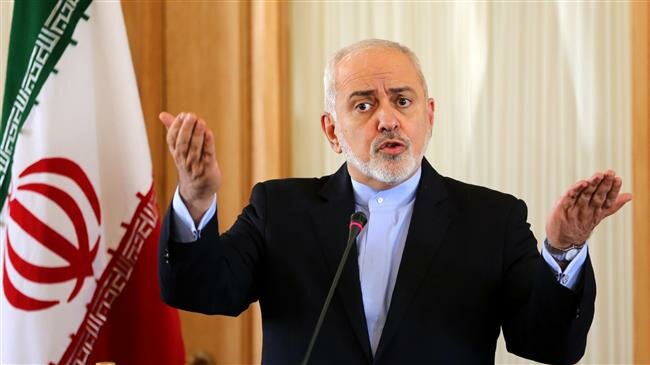
Iran’s Foreign Minister Mohammad Javad Zarif has reminded the Europeans that a 2015 nuclear deal, known as the JCPOA, does not prohibit the country from enriching uranium.
Zarif’s reprimand in a Monday tweet came after French Ambassador to the US Gerard Araud said Tehran should not need to be “massively enriching uranium after the JCPOA.”
“Reminder to our E3 partners in #JCPOA: There is NO prohibition on the enrichment of uranium by Iran under #NPT, JCPOA or UNSCR 2231,” Zarif tweeted, addressing France, Germany and Britain.
The three European countries opted to remain in the nuclear deal after US President Donald Trump abandoned it last May and reimposed sanctions on the Islamic Republic.
Araud tweeted Saturday that “sanctions could be reimposed” on Iran once the nuclear deal expires after 10 years, prompting the Islamic Republic to summon France’s ambassador to Tehran.
“Neither now, nor in 2025 or beyond. Might be useful for European partners to actually read the document they signed on to, and pledged to defend,” Zarif retorted on Monday.
In January, France’s Foreign Minister Jean-Yves Le Drian threatened Iran with sanctions if it did not address what he alleged as international concerns over Tehran’s ballistic missile program.
“We are ready, if the talks don’t yield results, to apply sanctions firmly, and they know it,” Le Drian said.
Earlier this month, Britain, France and Germany accused Iran of “developing missile technology in violation of UN resolution,” and called for a full UN report in a letter delivered to UN chief Antonio Guterres.
The EU trio also claimed that Iran’s launch of a space vehicle and unveiling of two new ballistic missiles in February were inconsistent with UN Security Council Resolution 2231, which was adopted just after the signing of the 2015 nuclear agreement.
Resolution 2231 calls on Iran “not to undertake any activity related to ballistic missiles designed to be capable of delivering nuclear weapons.”
Iran denies having any such program and the International Atomic Energy Agency (IAEA) has repeatedly confirmed the peaceful nature of Tehran’s nuclear activities.
In his Saturday tweet, deleted later, Araud said, “As we said in 2002 that enriching uranium without a credible civilian program was illegal under the NPT, we’ll be able to react likewise in 2025 if necessary. Sanctions were imposed. Sanctions could be reimposed.”
Iran’s Foreign Ministry called Araud’s remarks “unacceptable” and in “open violation” of the nuclear deal.
The ministry’s Hossein Sadat Meidani called for an explanation from Paris, saying that if the case is not addressed, Tehran will pursue it based on the mechanisms envisaged in the JCPOA.
Iranian Deputy Foreign Minister Abbas Araqchi also warned France of adverse effects of Araud’s remarks, saying such statements amount to blatant violation of the nuclear accord.
Under the JCPOA, Iran undertook to put limits on its nuclear program in exchange for the removal of nuclear-related sanctions imposed against the country.
Last month, IAEA head Yukiya Amano once again reaffirmed Iran’s compliance with its commitments under the deal.
Zarif Slams EU over Not Fulfilling Nuclear Deal Commitments
Iranian Foreign Minister Mohamamd Zarif
Al-Manar | April 14, 2019
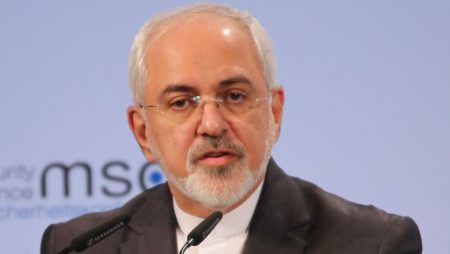
Iran’s Foreign Minister Mohamamd Javad Zarif slammed the EU on Sunday over delays in the implementation of the new mechanism for non-dollar trade with the Islamic Republic.
In comments on Sunday, the top Iranian diplomat deplored the European signatories to the 2015 Iran nuclear deal for failing to fulfill their commitments under the agreement, saying it is long overdue.
The Europeans are far behind on fulfilling their commitments under the Joint Comprehensive Plan of Action (JCPOA), Zarif said, adding: “They (EU) should not assume that the Islamic Republic of Iran will be waiting for them.”
Describing INSTEX -a payment channel that the three EU signatories to the JCPOA have set up to maintain trade with Iran- as a preliminary measure, Zarif said the Europeans need to work hard for a long time to honor their commitments.
The Iranian minister further noted that Iran has maintained close ties with its neighbors and has launched mechanisms similar to the INSTEX with many other countries.
“While the European countries have proposed INSTEX to maintain business ties with Iran in defiance of the US sanctions, the payment channel has not been put into practice yet,” he added.
On the other hand, Zarif said Iran will ask the international community to take a position on the US designation of its Revolutionary Guards as a terrorist organization.
“Today … we will send messages to foreign ministers of all countries to tell them it is necessary for them to express their stances, and to warn them that this unprecedented and dangerous U.S. measure has had and will have consequences,” Zarif was quoted as saying by state news agency IRNA.
The Iranian diplomat said he had also sent letters to United Nations Secretary-General Antonio Guterres and the United Nations Security Council to protest against “this illegal U.S. measure”.
Euro-Med to EU: Stop funds for project serving Israeli settlements
Ma’an – April 13, 2019
BETHLEHEM – The Euro-Mediterranean Human Rights Monitor (Euro-Med) sent an urgent letter to the European Union’s European Commission regarding their participation in funding EuroAsia Interconnector, a power transmission project aiming to build the infrastructure necessary to link energy sources between Israel, Cyprus, and Greece.
The project, expected to be implemented in June 2019 with an estimated budget of 3.5 billion Euros, will not only link the electricity infrastructure between Israeli cities with Greece and Cyprus, however, will also include illegal settlements in the occupied Palestinian territories, including occupied East Jerusalem.
According to a Euro-Med press release, the EU has been labeled as one of the financiers and supporters of the project that nurtures and strengthens settlements built illegally on Palestinian lands in the West Bank and Jerusalem, a move that shows sheer disregard for international law and amounts to complicity in Israeli war crimes and crimes against humanity.
Audrey Ferdinand, Euro-Med’s legal researcher, said, “The EU must adhere to its legal obligations under international law, including by not violating its own long-held commitment to a two-state solution.”
Ferdinand stressed, “While Israel is working on projects to boost its energy sources, it denies Palestinians access to basic needs such as energy and clean water,” calling on the EU to “respect its international obligations and not to establish partnerships with states violating international human rights law and international humanitarian law for decades.”
Euro-Med expressed deep shock and surprise at the contradictory policies and non-neutral practices of the European Union. On the one hand, it funds projects to help Palestinians suffering under occupation, it also funds projects that serve Israeli settlers, calling the move as setting for a “double-standard logic.”
Euro-Med called on the European Union to seriously reconsider its policies that are biased to the Israeli authorities at the expense of the Palestinian people, to uphold its human rights obligations and to rise above the discourse of selfish interest, to stop the project, especially as Israel continues to expand its illegal settlement activities in the West Bank and East Jerusalem, and not reward them for such infamous record of human rights abuse.
Russia Profits as US Takes Venezuelan Oil off the Market in Europe
By Irina Slav – Oilprice.com – April 12, 2019
European refiners are switching to Russian sour grades as U.S. sanctions have shrunk Venezuela’s similar-grade exports, Reuters reports, adding that the Russian sour crude is getting increasingly expensive.
Citing sources from the trading industry, Reuters says the situation has been made worse by the fact that OPEC members have cut mainly their output of heavier, more sour grades under the OPEC+ agreement aimed at stimulating a price rise.
U.S. crude is not an alternative as it is overwhelmingly light and sweet, while refineries in Europe are equipped to process heavier grades as well as light ones to make refined products.
The news is the latest reminder that the world is tipping towards a shortage of heavy, sour crude, which is the staple kind of Venezuela crude and which many refineries need to produce fuels and other products.
“Urals is anchored in a positive zone versus dated Brent and there is no indication it will fall to a discount any time soon,” one of the Reuters’ sources said. That’s a complete reversal of the traditional differential between light and heavy oil, with the latter typically trading at a discount to Brent, a light blend.
Sanctions on Iran are further complicating life for European refiners as they have restricted exports of sour grades that Iran also produces in addition to its very popular superlight crude, also called condensate.
According to Reuters, U.S. sanctions have removed 800,000 bpd of heavy crude from the global market, leaving refiners scrambling for alternatives in a limited pool that, besides Russia and Middle Eastern producers, also includes Canada and Mexico as large producers of these grades of crude. The former is having its own problems with a pipeline capacity shortage and a production cut that has boosted prices, and the latter has yet to reverse a fall in oil production.
Is the U.S. Prepared to Accept a Defeat in Venezuela?
By Marco Teruggi – Pagina 12 – April 12, 2019
The attack should have been short since the Maduro administration was not strong enough to resist. This was the conviction of the United States as they carried out a strategy to overthrow him: they built a President 2.0 Juan Guaido; they gave him a fictionalized government, international recognition, a collective narrative among mass media companies, accelerated economic sanctions at different levels. Overlapping these variables, different results were expected to be achieved on their path of getting a forced negotiation or the toppling of the government.
Events did not take the planned course. First and most important, the breaking of the Bolivarian National Armed Force (FANB): a crucial element that should have happened but did not. A series of tactics were implemented for it, from internal conspiracy with the support of a lot of dollars, visas and guarantees, or the strategy of a latent threat of a possible U.S. intervention. A combination of bluff – an unloaded weapon pointed at your head – with built up dates to try to achieve a rupture, such as on February 23rd.
The second event that should have occurred, despite the difficulty in defining a target, was Guaido supposedly building mass support in the streets. He boasted that 90 per cent of the population supports him. Pictures of his mass mobilization capacity show that the initial momentum on January 23, when his self-proclamation was acknowledged by Donald Trump through a tweet, lost strength. A major reason for this was the crisis of expectations that resulted from the unfulfilled promise of an immediate outcome. Another is that it was an artificial, communicational, diplomatic construction which could not gather more than the right’s historical rank-and-file supporters, characterized by a specific social, geographic class, living conditions, idiosyncrasy and symbolism. The opposition looked too much like themselves.
Third was the attempt to take the poor to the streets; blackouts and the water shortages were the most favorable of the scenarios to provoke this. But the outcome was not what they expected either. The clearer and wide reaching reality was the majority trying to solve their problems, individually, collectively, together with the Venezuelan Government. Sustained protests, fostered almost completely by the right, were scarce and without capacity to spread in the country.
Each of these variables has feedback points. The crisis of expectations is the result, for instance, of the fact that the Armed Force has not broken, that Guaido speaks of a hastiness that does not occur, with the conclusion that if they don’t succeed in any of their three targets, the last resort is an international intervention headed by the United States. That same interventionist narrative moves away from those who see Guaido as an alternative to the current political and economic situation. Calling on the majorities to achieve an international operation comes across evident obstacles.
Overthrowing Maduro does not seem possible in the correlation of national forces. It has been proven that the attack will not be short and that Chavismo, which is more than a Government, has enough strength to resist. If it was just a national affair, Guaido would lose strength to the point that he wouldn’t even be part of the list of opposition leaders that carry the burden of defeat. The problem is that this new coup attempt was devised over a point of no return with the United States building of a parallel government facade, acknowledged by the European Union, the United Kingdom, Israel, Canada, and right-wing governments in Latin America. What to do with Guaido when the plan is not successful due to initial miscalculations?
The question is due to the US, its current Administration is a mixture of Donald Trump-neoconservative leaders, and the so-called deep state; that is to say, real, invisible structures of power that constitute and safeguard that country’s strategic development in the geopolitical struggle. A defeat in Venezuela would be charged to the Administration in a pre-election period and it would suffer a double blow with Maduro’s continuity, or the lack of ability make a key Latin American country fall in line, and its implications in the international arena.
The deep state has grown stronger recently through tweets and speeches of U.S. spokespeople like Special Representative for Venezuela Elliott Abrams, Secretary of State Mike Pompeo, National Security Advisor John Bolton, and Southern Command’s commanding general Craig Faller. Their different statements have shifted towards painting Venezuela as an operational base for Russia, Iran, Cuba and China, while the Maduro administration would be subordinated to each of these governments and their corresponding intelligence and military services —particularly to the first three.
The United States has announced its following steps based on that narrative. Pompeo is going to Chile, Paraguay, Peru and Colombia; Abrams to Spain and Portugal; and they convened a third meeting in the United Nations Security Council to talk about Venezuela’s situation. They have not announced the goals of the different moves yet. It is possible though to predict that there is a private and public dimension to the agreements. A possibility would be for the US to declare the Venezuelan government a transnational criminal organization and branding colectivos (Chavista grass-roots organizations) as terrorist groups that “undermine the Constitution and territorial integrity of Venezuela,” according to Bolton’s description. New possible actions would result from each of these elements.
That increase in pressure, tightening the blockade, and isolation has not led yet to the possibility of a military intervention, despite the repeated “all options are on the table.” Abrams himself sidestepped that hypothesis last Thursday. Therefore, how are they planning to achieve the outcome proposed with the combination of these actions? The United States needs to establish means, on-the-ground operational capacity, and domestic and diplomatic agreements. In this regard, the European Union stance was expressed by its high representative for foreign affairs, Federica Mogherini, who affirmed that “new free and credible presidential elections should be held as soon as possible.”
Would the U.S. be willing to accept a negotiated outcome in which Maduro remains in power? So far, that does not look possible. They don’t seem willing to accept a geopolitical defeat in Venezuela either. The U.N. Security Council met on Wednesday to deal with this aspect. At the same time, the right called for more mobilizations. The pieces are still in motion.
Translation by Resumen Latinoamericano, North America bureau
Edited by Venezuelanalysis.com
Facebook Pulls Plug on Anti-Immigration News Site Ahead of Danish Elections
Sputnik – 12.04.2019
The Danish alternative news outlet 24Nyt has had its Facebook page with over 34,000 followers closed. State-owned Danish Radio (DR) has acknowledged its role in the shutdown.
According to 24Nyt, Facebook announced that its page “doesn’t follow Facebook’s policy”, which is the standard message for users and organisations who have their profiles switched off. “It is known that people and media critical of immigration are exposed to Facebook’s censorship”, 24Nyt suggested.
The same day, 24Nyt started a new Facebook page that was also subsequently shut down.
Later, state-run Danish Radio acknowledged its part in the shutdown of their independent competitor.
A week ago, DR contacted Facebook and presented a dossier of 24Nyt’s actions on their platform, triggering an investigation. Facebook later confirmed that 24Nyt’s page had been closed with info from that exact investigation, but without disclosing the reason.
Danish Radio described 24Nyt as a page “that urged to fight against established media and left-wing bias”. Danish Radio also admitted that over the past two years, 24Nyt had had a “significant impact” on Facebook, which is now “over”.
Social media expert Johan Farkas of Malmö University called the measure “extraordinary”.
“It is highly unusual that Facebook throws out a Danish media. As far as I know, this is a first”, Farkas said.
24Nyt was banned from Facebook only weeks or months before the Danish election, which is to be held no later than June this year.
“We have discovered that Facebook chose to close our site. Immediately afterwards, I was called by a journalist from Danish Radio. He wanted to know if I knew what the basis for Facebook’s decision was. I didn’t. Shortly afterwards, DR published an article on his website where they wrote that Facebook closed us down based on the material they received from them. We believe that this is very problematic, of course, because DR is a tax-financed media that does not have the task of silencing independent network media, or otherwise engaging in political activism”, 24Nyt’s editor-in-chief André Rossmann told the Swedish news outlet Samhällsnytt.
24Nyt is was founded in 2017 by Jeppe Juhl of the New Right party. The site is run by private enthusiasts and is funded by advertising revenues and donations. 24Nyt makes no secret that they are an opinion-based media. It bills itself as a “system-critical online newspaper with ‘dangerous opinions’ opposed to mainstream media”. Admittedly, they attempt “through strong opinions to open up the social debate trapped in an echo-chamber”. Their website informs that they are against “open EU borders and Muslim mass immigration”, “Islamisation of Danish society”, “totalitarian EU”, and “political correctness”.
Leading tech companies have been repeatedly accused of quietly suppressing conservative political views. Earlier this week, Republican lawmakers publicly accused the “big three” (Facebook, Google, Twitter) of political bias and suppression of free speech. The way Senator Ted Cruz (R-TX) put it, tech companies abuse their de-facto monopoly to promote left-leaning values.
Dozens of alt-media pages with millions of subscribers, including InfoWars and the Free Thought Project were previously banned from Facebook.
Featured Video
New positive ivermectin evidence
or go to
Aletho News Archives – Video-Images
From the Archives
Fanatical Followers of the Covid Regime: A Jim Jones-Style Cult?
By Professor Roger Watson and Dr. Niall McCrae | The Daily Sceptic | November 15, 2021
As scholars at leading British universities over recent decades, we witnessed the replacement of critical thinking and debate by narrative: facts are discrimination and scientific method is imperialism; truth, instead, is derived from ‘progressive’ values. This educational trend may be a major contributory factor to the ease in which society has been inculcated to the Covid ‘new normal’ of masking, testing, and repeated doses of vaccines for a disease of similar risk to severe influenza.
One doesn’t need much critical reasoning to observe the flawed logic of some vaccination enthusiasts, such as people who respond to experiencing any side effects, however debilitating, by saying “at least I know it’s working”, or, after contracting the disease despite their promised inoculation (over 90% effective, according to initial drug company claims), “I’d have been worse off without the jab.” … continue
Blog Roll
 Aletho News
- EU Council Advances Chat Control 2.0 Scanning Proposal
- Ex-Greek MEP files complaint against Israeli spyware firm over alleged Pegasus surveillance
- Troubling ideas throughout the Torah, Talmud, Mishneh Torah and Tanya
- ‘Grave, alarming’: Iran mission on Trump’s UNGA ‘annihilation’ threats
- Najaf airport to reopen to Iranian flights within 24 hours: Ambassador
- From ‘How Will This End For Iran’ to ‘When America Walks Away’: A tale of two Economist covers
- Tehran blasts ‘baseless’ speculation linking Iran to alleged bomb plot at UK air base
- The Rise And… Rise Of ‘Color Revolutions’
- The Coming GOP Bloodbath?
- Arctic Scare Stories Melt Away
- If Americans Knew
- Netanyahu Asked UAE Leader to Deny Report on Oct. 7 Warning in Secret Visit, Sources Say
- CNN Chief Int’l Correspondent Clarissa Ward on Journalists in Gaza
- Democratic Party Consultants Surround Troy Jackson with Pro-Israel Donors
- Christian Leader Responds To Netanyahu’s Claims Regarding Palestinian Christians
- In Gaza, ‘Whoever Survives the Bombing Won’t Survive the Rubble’
- Israel kills more Palestinians, amid push to resettle Gaza – Daily Update
- Israel forces Gazans to live in constant peril – Daily Update
- Deconstructing Netanyahu’s pants-on-fire UN rant – Daily Update
- Trump betrayed voters with his campaign lies and prioritized a foreign country once he took office
- Netanyahu calls Israel’s war in Gaza ‘opposite of genocide’ in UN speech to near-empty hall
- No Tricks Zone
- New Study: Earth And Venus Surface Warmth Largely Explained By Convection And Lapse Rate, Not CO2 Or Radiation
- 2025 Nature Paper Claiming Worsening Global Drought Gets RETRACTED …Heavily Flawed
- New Study: ‘Global Drought Shows No Detectable Recent Acceleration Under Climate Warming’
- Economic Masterminds: German Socialists Suggest Taxing Productivity Gains Stemming From Using AI
- The South China Sea Has Not Been Cooperating With The Climate Change Narrative
- Energy Crisis: Germany Enters Heating Season With Historically Low Gas Reserve Fill Levels
- New Study: The Antarctic Ice Sheet Gained Mass From 2020-2024 Due To Staggering Snow And Ice Accumulation
- Study: Ocean Heating Rates From Thousands Of Years Ago ‘Dwarf’ Modern Ocean Heating Rates
- Climate Extremists Target, Attack Large-Scale Power Grid Infrastructure In Germany!
- New Study: Antarctic Ice Melt Has Contributed Less Than 1 Centimeter To Sea Level Rise In The Last 30 Years

