Budapest vetoes Ukraine-NATO summit, says Kiev’s new law a ‘stab in the back’
RT | October 28, 2017
Budapest has vetoed the upcoming NATO-Ukraine summit, the Hungarian foreign minister said, adding it is impossible to support the country’s bid to join the alliance after Kiev adopted a controversial education law “brutally mutilating” minority rights.
“Hungary cannot support Ukraine’s integration aspirations, so it vetoed the NATO-Ukraine summit in December,” Foreign Minister Peter Szijjarto said on Friday.
Szijjarto said there is no way to bypass Hungary’s veto, as a unanimous vote of all members is needed to call a meeting of NATO-Ukraine Commission (NUC). The commission is the decision-making body responsible for developing the NATO-Ukraine relationship.
Ukraine enjoyed a non-aligned status up until 2014, meaning the country abstained from joining military blocs and nurtured ties with both Russia and the West. Things changed dramatically after the Euromaidan coup, with the new government taking a decidedly pro-Western course.
Earlier in July, Kiev officially proclaimed that NATO membership is a key foreign policy goal. Draft legislation supported by the parliament asserted that the move would help Ukraine “strengthen national security, sovereignty and territorial integrity” and “stop Russian aggression.”
In the Friday statement, Szijjarto also said Budapest had been the most vocal supporter of Kiev’s NATO accession bid, but considered the adoption of a new Ukrainian education law that outlaws education in minority languages as a “stab in the back.” The law is a serious step backwards in safeguarding “minority rights,” the minister said, adding that “we cannot leave it without speaking up.”
Earlier in September, the minister also announced that Budapest “will block all steps within the European Union that would represent a step forward in Ukraine’s European integration process.”
The law that all classes in secondary schools will be taught in Ukrainian is expected to gradually enter into force between September 2018 and September 2020. It was approved by parliament in early September and signed into law by President Petro Poroshenko.
It is expected to affect hundreds of thousands of children studying in over 700 public schools which offer instruction in minority languages. The majority of these children are ethnic Russians, but other minorities include Romanians, Hungarians, Moldovans, and Poles. The law provides minor concessions for “EU languages,” English, and some minorities that have no national states of their own.
Why the United Socialist Party of Venezuela (PSUV) Won the Election
By James Petras | Axis of Logic | October 27, 2017
Introduction
Every major newspaper, television channel and US government official has spent the past two years claiming that the United Socialist Party of Venezuela (PSUV), founded by the late Hugo Chavez, had become a marginalized political party, supported only by ‘hard core Chavistas’ and public employees. The US government, under Presidents Obama and Trump, backed gangs of violent demonstrators, who rampaged through the streets, as ‘the true democratic representatives’ of the will of the voters. Secretary General of the Organization of American States Luis Almagro, a veteran running dog for Washington, railed against President Nicholas Maduro, denouncing him as a ‘dictator’ and openly demanded that the Venezuelan people and neighboring Latin American regimes unite to oust him – even through violence. President Trump imposed brutal economic sanctions designed to strangle the economy and guaranteed Washington’s support for the rightwing opposition, the self-styled Democratic Unity Roundtable, (‘Mesa de la Unidad Democratica’ – or MUD).
MUD took advantage of the economic crisis facing Venezuela with the sharp decline of the price oil, of its main export. MUD has spent the past three years attacking the government and mobilizing its supporters through street violence and parliamentary maneuvers to paralyze the government’s socio-economic agenda. Vital public services, like power stations, were frequent targets of MUD-orchestrated sabotage, even leading to the assassination of public employees, like police and firefighters.
MUD rejected the government’s proposal for peaceful negotiations with the opposition. President Maduro asked for a dialogue with the US, which was sponsoring MUD, but President Trump replied with his usual bombast and threats of violent intervention.
The economic blockade and drop in oil prices had devastating consequences: Inflation hit triple digits in Venezuela. There were increasing food shortages, long lines and valid consumer complaints. As a result, the opposition coalition won the Congressional elections of 2015 and immediately tried to impeach President Maduro. Rather than using their electoral mandate to govern and address the country’s problems, they focused exclusively on forcing ‘regime change’. This monomania led to voter dissatisfaction with MUD and, contrary to Washington’s hopes, predictions, threats and sanctions, the PSUV won the gubernatorial elections by a wide margin in October 2017.
The opposition was decisively defeated. Over a thousand independent outside observers, who had monitored the Venezuelan elections and voting procedures, declared the elections to be the free and valid expression of the citizens will. The opposition immediately rejected the result. The entire US-EU press predictably converged on Caracas, screaming ‘fraud’, echoing the rabid right-wing politicos in the US, the OAS and Europe. They saw no need to back their claims with ‘evidence’.
In truth, the Opposition-MUD was roundly defeated: They had secured only 39% of the vote and only 5 of the 23 governorships. The PSUV, for its part, increased its voter support from 44% in the 2015 to 54% in October 2017.
The real question, which is being ignored, is how the PSUV won and the Opposition lost, given the enormous outside support for MUD and the economic crisis in Venezuela? Why did the opposition lose 2.7 million votes in two years following their much-ballyhooed parliamentary victory? How could the US, the OAS and the EU miss this trend and waste their money and credibility?
Ten Reasons for the Socialist Victory and the Rightist Defeat
Understanding the reasons for the Socialist victory requires that we first analyze the strengths and weakness of the MUD.
- The PSUV retained its committed and loyalist core, despite hardships endured by the masses of Venezuelans, because of the socialists long-term, large-scale socio-economic programs advancing the citizens’ welfare over the previous decade and a half.
- Many low-income voters feared that, once in power, the rightwing extremists in MUD would reverse these social advances and return them to the pre-Chavista era of elite domination, repression and their own marginalization.
- Many right-of center-voters were appalled by MUD’s support for violence and sabotage, leading to the destruction of public buildings and private businesses and paralyzing public transportation. They decided to abstain and/or vote for the PSUV, as the party of law and order.
- Many independent voters supported the PSUV as the greater defender of Venezuelan sovereignty. They were appalled by the opposition coalition – MUD’s endorsement of Washington’s economic sanctions and blockade and President Trump’s brutal threats to intervene to force ‘regime change’.
- Probably most decisive for the shift to the left by many former MUD voters was the right-wing opposition’s failure to offer any positive alternative. Apart from promoting violence and dismantling the Chavista social programs, MUD lacked any concrete program or policies to address the ongoing economic crisis. It was clear to voters that MUD’s constant harping on the ‘failures’ of the PSUV offered no viable way out of the crisis.
- The MUD was not able to use its electoral majority in Congress to obtain overseas economic aid to provide social services, or to arrange trade deals or loans. Washington was only willing to subsidize MUD’s campaign for violent regime change but not to support any opposition congressional proposals for Venezuela’s schools or its health system. MUD was stuck in a self-perpetuating cycle, telling people what they already knew, with no serious proposals to address the people’s everyday problems.
- MUD constantly denigrated the memory of President Hugo Chavez, whose legacy represented the ‘best of times’ for millions of Venezuelans. Many voters recalled the decade of Chavez’s Presidency – his generous welfare policies, his own humble origins, his courage, his folksy sense of humor and his links to the grassroots. This was in stark contrast to the MUD leaders’ ‘Miami mentality’, their fawning over US consumerism and Washington’s militarism, their servility to the upper class’s cultural elitism and contempt for the dark-skinned mestizo population.
- The MUD congressmen and women focused their time in Congress with sectarian political name-calling when they weren’t busy plotting regime change in the posh upper class salons of the Caracas’ elite. They failed to articulate any realistic grassroots solution to everyday problems. Their complaints over ‘dictatorship’ carried little weight since they held the majority in Congress and did nothing for the electorate.
- The MUD’s unsuccessful attempts to incite a military coup among Venezuela’s patriotic military officers alienated moderate liberal-democrats, some of whom either ‘jumped ship’ to support the Left or, more likely, abstained in October’s election.
- President Maduro’s moves toward negotiating favorable trade and investment deals with Russia, China and Iran encouraged voters to imagine that viable alternatives to the crisis were on the government’s agenda.
Many voters may have placed more trust in Maduro’s promise of serious new programs and policies to revive the economy. But more significantly, the PSUV’s established programs and future prospects were more appealing than MUD’s predictable denunciations of election fraud; and almost two-thirds of the electorate chose to participate in October’s elections. These ‘fraud’ charges only worked with MUD’s true believers who had either abstained, virtually ensuring a victory for the Left, or had voted and therefore made themselves ‘accessory to electoral fraud’, which they had denounced.
Conclusion
The MUD lost the state governor elections of October 2017, less than 2 years after they had won the congressional elections, by demonstrating their incompetence, their propensity for violence against serious democratic adversaries and their incapacity to fulfill any programmatic promises.
The PSUV won because of the Chavez legacy, the decision by middle-of-the-road voters to support a pragmatic ‘lesser evil’ over a violent opposition ‘greater evil’ promising chaos. Many voters are desperate for new and better policies to address Venezuela’s current economic challenges. Finally, many Venezuelans rejected US President Trump and OAS President Almagros’ blatant, arrogant assumption that they knew what was best for the people of Venezuela – even if it meant blood in the streets.
In the end, the Chavez legacy of successful class and national struggles carried more weight with the voters than the negative, chaotic impotence of a subservient opposition. The US/Venezuelan mass media’s efforts to undermine the government were defeated because the people responded to the socialist message that US-led economic warfare, and not government mismanagement, was the key cause of their social and economic decline. They had experienced more than a decade of independent foreign policy and Bolivarian socialist programs to compare with the chaos of ‘regime change’ promised by Washington and the opposition.
The Left won the battle for now but the war continues.
Please note James Petras’s most recent book:
THE END OF THE REPUBLIC AND THE DELUSION OF EMPIRE
ISBN: 978-0-9972870-5-9
$24.95 / 252 pp. / 2016
EBOOK ISBN: 978-0-9972870-6-6
ORDER E-BOOK: $19.00
© Copyright 2017 by AxisofLogic.com
Access to Alternative Sources ‘Made Mainstream Media Lose Their Credibility’
Sputnik – October 26, 2017
The results of a poll commissioned by Sputnik and conducted by Ifop in the US have revealed that the majority of Americans believe that their mainstream media unfairly cover international and domestic events. Foreign journalists have explained why the MSM have lost the trust of their audience.
“The results of the survey clearly demonstrate that the US mass media enjoy less and less credibility among Americans. People do understand that newspapers and broadcasters in their country have become a tool in the hands of big businesses and politicians. There is another issue, however, that with all the understanding, people are not immune to the influence of these media sources,” Professor Julián Jiménez, Spanish blogger and mass media analyst surmised to Spanish website Sputnik Mundo.
He referred to the recent poll commissioned by Sputnik and conducted by Ifop, the renowned French pollster, which revealed that as many as 59 percent of Americans think that MSM media coverage of international and domestic affairs is biased, untrustworthy and is heavily influenced by politicians and big business.
According to the expert, the Spanish also share this distrust of the national media, neither believing in the objectivity and independence of their domestic media. At the same time, the general public can be heard repeating word-for-word the lies they hear about Russia, Venezuela or Catalonia from the very same media sources they have admitted they don’t trust.
Professor Jiménez suggested that the level of distrust towards the mass media in the EU is even higher than that in the US, however, very few Europeans are eager to spend their time on searching for alternative information or to dig for the truth.
“I think there is a direct link between the decline in trust towards the national media in the US and the EU and the campaign which has been launched against RT and Sputnik. These two media sources provide far more objective and comprehensive coverage of national and international events, unlike the one-sided and predictable reporting of the mainstream media,” he told Sputnik.
That is why the authorities and mainstream media use various absurd pretexts to hinder the access of these two outlets to the western audience, the expert explained. It has reached the point where El Pais, the most circulated daily newspaper in Spain, has accused RT and Sputnik of instigating the Catalan crisis in its attempt to undermine their reputation. This is a particularly dangerous line to take because while people are being put on the wrong scent, the real problems that initially ignited this conflict will only worsen. And these are purely internal problems and not engineered from abroad, he concluded.
Fernando Martínez, a journalist from the Dominican Republic, who worked for a long time in the US, has offered his opinion on the results of the survey, suggesting that the mainstream media, including in the US, have lost their competitiveness now that many diverse sources of information around the world are available for free.
According to the reporter, before the spread and the development of the Internet, the US was able to easily dominate the world’s media agenda by using simple tricks – half-truths or half-lies.
“This reminds me of The Matrix movie, in a sense that the fictional reality, which had been built by the US media for decades, is falling to pieces before our very eyes. To a large extent, it is due to media sources such as RT and Sputnik. That is why western politicians are accusing Russia of virtual information terrorism. They are so alarmed that these outlets, whose budgets pale in comparison with the western international media, so easily win the audience. However their secret is very simple: they opt to tell truth,” Martínez opined.
Commenting on the recent reports that both media sources have come under intense scrutiny of authorities in the US, the journalist ruled out that they could be banned either in the EU or overseas. Russia has made it clear that it would respond symmetrically to such a decision and neither Washington nor Brussels would want to lose the Russian audience. That is why they limit themselves to threats without resorting to any radical moves, he concluded.
Report: Israel Secretly Using US Law Firm to Fight BDS Activists
By Richard Edmondson | Fig Trees and Vineyards | October 25, 2017
The Israeli news site Haaretz is reporting that the Zionist state’s government has contracted with a U.S. law firm to help it in its fight against the Boycott Divestment and Sanctions movement.
The firm named in the report is Sibley Austin, reportedly the sixth largest corporate law firm in the US. Though based in Chicago, it also has offices overseas, including one in Munich, Germany, and according to documents obtained by Haaretz, it is helping the Israeli Strategic Affairs Ministry fight BDS activists both in North America and in Europe.
“The Justice Ministry and the Strategic Affairs Ministry have declined to reveal the nature of these activities, for which the state has paid hundreds of thousands of dollars over the past two years,” says the Haaretz report. “The ministries call the activities ‘diplomatically extremely sensitive.’”
The Stategic Affairs Ministry is the government body given responsibility for coordinating the fight against “delegitimization,” and the agency’s director describes “gathering intelligence and attacking” as being among its endeavors, Haaretz reports.
Government bids for a law firm to help spearhead the fight against BDS were reportedly put out in early 2016, though the report states that a “detailed description of the services was censored from the document.” The reason was that publication of the information might lead to “damage to the country’s foreign relations and damage to the ability of these bodies to provide the requested service,” says the article.
Apparently Sibley Austin was not the first law firm engaged for the effort. The report mentions one other firm, unnamed, that was hired previously. It also states that the Israeli government has refused to publicize the contracts, leading Haaretz to speculate:
The secrecy surrounding the contracts raises the suspicion that the work involves not only writing legal opinions but also preparing lawsuits against BDS supporters, as Israel does not want to be revealed as supporting such actions, to avoid the perception that it is interfering in the internal affairs of other countries.
The comment about “gathering intelligence and attacking” apparently has at least one Israeli human rights lawyer concerned. Eitay Mack, who has defended the rights of Palestinians and who has also fought for release of information on the government’s anti-BDS efforts, says, “It is deeply worrying that the military terminology used by senior officials in the Strategic Affairs Ministry is being used in the fight against civilians abroad who criticize the State of Israel.”
The report goes on to note that, “Sidley Austin did not reply to questions on whether it was working for the Israeli government.”
Russia-China Tandem Changes the World
By Gilbert Doctorow | Consortium News | October 23, 2017
Much of what Western “experts” assert about Russia – especially its supposed economic and political fragility and its allegedly unsustainable partnership with China – is wrong, resulting not only from the limited knowledge of the real situation on the ground but from a prejudicial mindset that does not want to get at the facts, i.e. from wishful thinking.
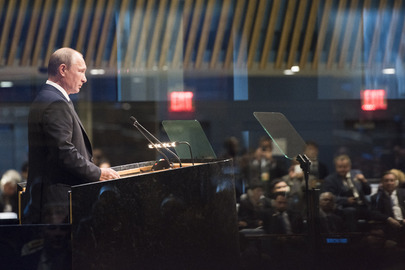
Russian President Vladimir Putin (UN Photo)
Russia may not be experiencing dynamic growth, but over the past two years it has survived a crisis of circumstance in depressed oil prices and economic warfare against it by the West that would have felled less competently managed governments enjoying less robust popularity than is the case in Vladimir Putin’s Russia. Moreover, as stagnant as Russia’s GNP has been, the numbers have been on a par with Western Europe’s very slow growth.
Meanwhile, Russian agriculture is booming, with the 2017 grain harvest the best in 100 years despite very adverse climatic conditions from early spring. In parallel, domestically produced farm machinery has been going from strength to strength. Other major Industrial sectors like civil aircraft production have revived with the launch of new and credible models for both domestic and export markets.
Major infrastructure projects representing phenomenal engineering feats like the bridge across the Kerch straits to Crimea are proceeding on schedule to successful termination in the full glare of regular television broadcasts. So where is this decrepit Russia that our Western commentators describe daily?
The chief reason for the many wrongheaded observations is not so hard to discover. The ongoing rampant conformism in American and Western thinking about Russia has taken control not only of our journalists and commentators but also of our academic specialists who serve up to their students and to the general public what is expected and demanded: proof of the viciousness of the “Putin regime” and celebration of the brave souls in Russia who go up against this regime, such as the blogger-turned-politician Alexander Navalny or Russia’s own Paris Hilton, the socialite-turned-political-activist Ksenia Sochak.
Although vast amounts of information are available about Russia in open sources, meaning the Russian press and commercial as well as state television, these are largely ignored. The sour grapes Russian opposition personalities who have settled in the United States are instead given the microphone to sound off about their former homeland. Meanwhile, anyone taking care to read, hear and analyze the words of Vladimir Putin becomes in these circles a “stooge.” All of this limits greatly the accuracy and usefulness of what passes for expertise about Russia.
In short, the field of Russia studies suffers, as it also did during the heyday of the Cold War, from a narrow ideological perspective and from the failure to put information about Russia in some factually anchored framework of how Russia fits in a comparative international setting.
Just what this means was brought into perspective last week by a rare moment of erudition regarding Russia when professor emeritus of the London School of Economics Dominic Lieven delivered a lecture in Sochi at the latest Valdai Club annual meeting summarizing his take on the Russian Revolution of 1917.
Lieven, arguably the greatest living historian of imperial Russia, is one of the very rare birds who brought to his Russian studies a profound knowledge of the rest of the world and in particular of the other imperial powers of the Nineteenth Century with which Russia was competing. This knowledge takes in both hard and soft power, meaning on the one hand, military and diplomatic prowess and, on the other, the intellectual processes which are used to justify imperial domination and constitute a world view if not a full-fledged ideology.
Self-blinded ‘Experts’
By contrast, today’s international relations “experts” lack the in-depth knowledge of Russia to say something serious and valuable for policy formulation. The whole field of area studies has atrophied in the United States over the past 20 years, with actual knowledge of history, languages, cultures being largely scuttled in favor of numerical skills that will provide sure employment in banks and NGOs upon graduation. The diplomas have been systematically depreciated.
The result of the foregoing is that there are very few academics who can put the emerging Russian-Chinese alliance into a comparative context. And those who do exist are systematically excluded from establishment publications and roundtable public discussions in the United States for not being sufficiently hostile to Russia.
If that were not the case, one could look at the Russian-Chinese partnership as it compares firstly with the American-Chinese partnership created by Richard Nixon and Henry Kissinger, which is now being replaced by the emerging Russian-Chinese relationship. Kissinger was fully capable of doing this when he wrote his book On China in 2011, but Kissinger chose to ignore the Russian-Chinese partnership though its existence was perfectly clear when he was writing his text. Perhaps he did not want to face the reality of how his legacy from the 1970s had been squandered.
What we find in Kissinger’s description of his accomplishments in the 1970s is that the American-Chinese partnership was all done at arm’s length. There was no alliance properly speaking, no treaty, in keeping with China’s firm commitment not to accept entanglement in mutual obligations with other powers. The relationship was two sovereign states conferring regularly on international developments of mutual interest and pursuing policies that in practice proceeded in parallel to influence global affairs in a coherent manner.
This bare minimum of a relationship was overtaken and surpassed by Russia and China some time ago. The relationship has moved on to ever larger joint investments in major infrastructure projects having great importance to both parties, none more so than the gas pipelines that will bring very large volumes of Siberian gas to Chinese markets in a deal valued at $400 billion.
Meanwhile, in parallel, Russia has displaced Saudi Arabia as China’s biggest supplier of crude oil, and trading is now being done in yuan rather than petrodollars. There is also a good deal of joint investment in high technology civilian and military projects. And there are joint military exercises in areas ever farther from the home bases of both countries.
I think it is helpful to look at this partnership as resembling the French-German partnership that steered the creation and development of what is now the European Union. From the very beginning, Germany was the stronger partner economically with France’s economy experiencing relative stagnation. Indeed, one might well have wondered why the two countries remained in this partnership as nominal equals.
The answer was never hard to find: with its historical burden from the Nazi epoch, Germany was, and to this day remains, incapable of taking responsibility in its own name for the European Union. The French served as the smokescreen for German power. Since the 1990s, that role has largely been transferred to the E.U. central bodies in Brussels, where key decision-making positions are in fact appointed by Berlin. Yet, France remains an important junior partner in the German-driven process.
The Russian-Chinese Tandem
One may say much the same about the Russian-Chinese tandem. Russia is essential to China because of Moscow’s long experience managing global relations going back to the period of the Cold War and because of its willingness and ability today to stand up directly to the American hegemon, whereas China, with its heavy dependence on its vast exports to the U.S., cannot do so without endangering vital interests. Moreover, since the Western establishment sees China as the long-term challenge to its supremacy, it is best for Beijing to exercise its influence through another power, which today is Russia.
Of course, in light of the E.U.’s Brexit troubles and Trump’s abandonment of world leadership, it is undeniably possible that China will step out of the shadows and seek to assume direction of global governance. But that would be problematic. China faces major domestic challenges including the transition of its economy from being led by exports to relying more on domestic consumption. That will absorb the attention of its political leadership for some time.
Kissinger, who has been an adviser to Trump, whispers in Trump’s ear about the importance of separating Russia from China, but Kissinger’s limited and outdated knowledge of Russia has caused him to underestimate the powerful motives behind the Russian-Chinese relationship. America’s less gifted and informed pundits are even more clueless.
For one thing, given the sustained hostility directed at Russia from the West in general and from Washington in particular, it is inconceivable that Putin would be wooed away from Beijing by some flirtatious “come hither” gestures from the Trump administration even if that were politically possible for Trump to do. One of Putin’s outstanding features is his loyalty to his friends and his principles as well as to his nation’s interests.
As Putin revealed during his address and Q&A at the Valdai Club gathering this past week, he now bears a deep distrust of the West in light of its having taken crude advantage of Russia’s weakness in the 1990s and by its expansion of NATO to Russian borders and other threatening actions. Whatever hopes Putin once may have held for warmer relations with the West, those hopes have been dashed over the past several years.
Putting personalities aside, Russian foreign policy has a commonality that is rare to see on the world stage: actions first, diplomatic charters later. Russia’s political relations with China come on top of massive mutual investments that have taken many years to agree on and execute.
In the same way, Russia is proceeding with Japan to work towards a formal peace treaty by first putting in place massive trade and investment projects. It is entirely foreseeable that the first step to the treaty will be the start of construction in 2018 of a railway bridge in the Far East linking the Russian island of Sakhalin with the mainland. The general contractor and engineering team is also in place: Arkady Rotenberg and his SGM Group. That bridge is the prerequisite for Japan and Russia signing a $50 billion deal to build a railway bridge linking Sakhalin and Hokkaido. This bridge will draw the attention of the whole region to Russian-Japanese cooperation. It could be the foundation for a durable and not merely paper peace treaty resolving the territorial dispute over the Kurile Islands.
Lost Opportunities
In light of these realities, it is puerile to speak of detaching Russia from China with the promise of normalized relations with the West. The opportunity to do that existed in the 1990s, when President Boris Yeltsin and his “Mr. Yes” Foreign Minister Andrei Kozyrev did everything possible to win U.S. agreement to Russian accession to NATO immediately following accession by Poland. To no avail.
Then again early in Putin’s presidency, the Russians made a determined effort to win admission to the Western alliance. Again to no avail. Russia was excluded, and measures were taken to contain it, to place it in a small box as just another European regional power.
Finally, following the confrontation with the United States and Europe over their backing of the 2014 coup in Ukraine, followed by the Russian annexation/merger with Crimea, and Russian support for the insurgency in Ukraine’s Donbas region, Russia openly was cast as the enemy. It was compelled to mobilize all of its friendships internationally to stay afloat. No state was more helpful in this regard than China. Such moments are not forgotten or betrayed.
The Kremlin understands full well that the West has nothing substantial to offer Russia as long as the U.S. elites insist on maintaining global hegemony at all costs. The only thing that could get the Kremlin’s attention would be consultations to revise the security architecture of Europe with a view to bringing Russia in from the cold. This was the proposal of then President Dmitry Medvedev in 2010, but his initiative was met by stony silence from the West. Bringing in Russia would mean according it influence proportionate to its military weight, and that is something NATO has opposed tooth and nail to this day.
It is for this reason, the failure to seek solutions to the big issue of Russia’s place in overall security, that the re-set initiative under Barack Obama failed. It is for this reason that Henry Kissinger’s advice to Donald Trump at the start of his presidency to offer relief from sanctions in return for progress on disarmament rather than implementation of the Minsk accords regarding the Ukraine crisis also failed, with Vladimir Putin giving a firm “nyet.”
Implicit in the few American “carrots” being extended to Russia these days is its acceptance of the anti-Russian regime in Ukraine and its authority over the heavily ethnic Russian areas of the Donbas and Crimea, concessions that would be politically devastating to Putin inside Russia. Yet, that “normalization” would still leave the much milder but still nasty “human rights” sanctions that the U.S. imposed in 2012 through the Magnitsky Act, driven by what the Kremlin regards as false propaganda surrounding the criminal case and death of accountant Sergei Magnitsky.
The sting of the Magnitsky Act was to discredit Russia and prepare the way for it being designated a pariah state. It came amidst an already longstanding campaign of demonization of the Russian president in the U.S. media. In fact, to begin to find a halfway normal period of bilateral relations, you would have to go back to before George W. Bush’s invasion of Iraq, which Russia denounced along with Germany and France. The latter two powers got a tap on the wrist from Washington. For Russia, it was the start of a period of reckoning for its uncooperativeness with American global domination.
Demonizing Russia
As for Europe and Russia, the question is very similar. To find mention of a strategic relationship, firstly from the German Foreign Ministry, you have to go back to before 2012. And what constituted normality then? At the time, renewal of the E.U.-Russia cooperation agreement was already being held up for years, nominally over a difference of views on the provisions of E.U. law governing gas deliveries through Russian-owned pipelines. Behind this difference was the total opposition of the Baltic States and Poland to anything resembling normal relations with Russia, for which they received full encouragement from the U.S.
The rallying cry was to put a stop to Russia’s status as “monopoly supplier” to Europe as regards gas, but also oil. Of course, no monopoly ever existed, nor does it exist today, but determined geopolitical actors never let such details stand in the way of policy formulation.
This hostility also played out in the contest of wills between the E.U. and Russia over introduction of a visa-free regime for travel by their respective citizens. Here the opposition of Germany’s Angela Merkel, justified by her vicious characterization of Russia as a mafia state, doomed the visa-free regime and by the same token doomed normal relations.
All of this unfinished business has to be addressed and put right for there to be any possibility of the U.S. and the E.U. ending their hostility toward Russia and for the Kremlin to regain any trust toward the West. Even then, however, Russia would not surrender its valued relationship with China.
In my view, the de facto Russian-Chinese alliance matches the de jure US-West European alliance. The net result of both is the partition of the world into two camps. We now have, in effect, a bipolar world that broadly resembles that of the Cold War, though still in a formative stage since many countries have not signed on definitively to one side or another.
Of course, more-or-less neutral states were also a feature of the Cold War, creating what was called the group of Nonaligned Nations, led back then by India and Yugoslavia. Yugoslavia no longer exists, but India has continued its tradition of let both poles court it, trying to eke out the greatest benefit to itself.
To be sure, a great many political scientists in the U.S., in Europe and in Russia as well, insist that we already have a multipolar world, saying that power is too diffuse in the world today, especially considering the rise of non-state actors after 1991. But the reality is that very few states or non-states can project power outside their own region. Only the two big blocs can do that.
The theoreticians defending multipolarity speak of a return to the balance of power of the Nineteenth Century, invoking the Congress of Vienna as a possible model for today’s world governance. This is an approach that Henry Kissinger laid out in 1994 in his book Diplomacy.
Within Russia, this concept has found support in some influential think tanks and is most notably associated with Sergei Karaganov, head of the Council of Foreign and Defense Policy. Nonetheless, I maintain that everyday realities of power will decide this question. And is there anything inherently wrong with this de facto bipolar world, assuming the tensions can be managed and a major war averted?
In my view, two large blocs are more likely to keep global order because the scope of activities by proxies can be reined in – as often happened during the Cold War – by big powers not wanting their various clients to disrupt a functioning world order. The tails are less likely to wag the dog.
Moreover, as regards the Russia-China strategic partnership or alliance, Western observers should take comfort and not take alarm. The rise of China is a given whatever the constellation of great powers may wish. The close embrace of Russia and China also can serve as a moderating influence on China, given Russia’s greater experience in world leadership.
For all of the above positive and negative reasons, the Russia-China relationship should be viewed with equanimity in Western capitals.
Gilbert Doctorow is an independent political analyst based in Brussels. His latest book, Does the United States Have a Future? was just published.
US Targets Russian Nord Stream-2 Gas Project: Déjà Vu Story
By Peter KORZUN | Strategic Culture Foundation | 23.10.2017
The US Countering Iran’s Destabilizing Activities Act of 2017 contains a separate section called the Countering Russian Influence in Europe and Eurasia Act (“CRIEEA”). CRIEEA authorizes – and at times requires – the President to impose significant new sanctions on the Russian energy, financial, and defense sectors, imperiling the completion of the Russian Nord Stream 2 gas pipeline. It also hits European businesses involved in the project. The legislation can impact a potentially large number of European companies doing legitimate business under EU measures with Russian entities in the railways, financial, shipping or mining sectors, among others. Now the US punitive measures could include the pipelines crossing the territory of Ukraine, as well as pipeline projects in the Caspian region and the development of the Zohr gas field off the coast of Egypt. The law negatively affected the US relationship with European allies.
Russian President Vladimir Putin believes that the world is witnessing an increasing number of examples of politics crudely interfering with economic, market relations. In his address to the final plenary session of the 14th annual meeting of the Valdai Discussion Club on October 19, Putin said “Some do not even conceal that they are using political pretexts to promote their strictly commercial interests. For instance, the recent package of sanctions adopted by the US Congress is openly aimed at ousting Russia from European energy markets and compelling Europe to buy more expensive US-produced LNG although the scale of its production is still too small.”
The US is striving to control the EU decision-making process. According to Washington’s logic, building a pipeline to reduce costs and raise reliability and efficiency proves that Russia is politically motivated, unlike the US with its new law adopted to pave the way for American LNG exports to Europe using coercive measures! The US staunch allies ready to cede economic profits for Washington’s friendship – Poland, the Baltic States, and, since recently, Denmark – are mobilized to hinder Nord Stream-2. Not an EU member, but a member of Energy Community, Ukraine also goes to any length to obstruct the project.
Poland tried to reverse the EU decision through courts but to no avail. In July, a court in Duesseldorf, Germany, lifted restrictions on Russian gas company Gazprom’s access to the German Opal gas pipeline, online documentation by the court showed, echoing a ruling on July 21 by the European Union General Court.
Defying the US pressure, the EU exempted OPAL gas pipeline (delivering gas from Russian Nord Stream to Europe) from the Third Energy Package after 6 years of debates. The decision opened the way for Russian plans to expand Nord Stream’s capacity and bypass both Ukraine and Poland as a gas transit route. The Western companies have immediate interests in Nord Stream 2, which is a joint venture between Gazprom (50% share) and five of the largest European energy companies: E.ON, OMV, Shell, BASF/Wintershall and Engie (each 10% share).
Actually, this is a déjà vu story. Washington has a long history of meddling into European energy policy. The Yamal and Nord Stream 2 gas projects present several striking similarities. In 1980-81, the Yamal pipeline (Urengoy-Pomary-Uzhgorod) project was presented to be negotiated between the Soviet Union (Soyuzgazexport) and Western Europeans (Ruhrgas and Gaz de France). Back then, West Germany’s Chancellor Helmut Schmidt was willing to preserve the achievements of Willy Brandt’s Ostpolitik. The USSR and West Germany concluded an agreement on the deal in November 1981.
The joint project was fiercely fought by President Ronald Reagan. He saw Yamal through a geopolitical lens and considered it one of the Soviet Union’s significant tools aimed at spreading Moscow’s influence over the Europeans, and in particularly over NATO. The US launched a coordinated diplomatic offensive aimed at convincing European allies to abandon their participation in the Yamal project. It offered to supply West Germany with energy in the form of coal, but his proposal was turned down as not viable economically.
Those were the days of great tensions between the West and the East marked by NATO’s deployment of intermediate range ground-based missiles in Italy, the UK, West Germany, the Netherlands and Belgium. In 1979, the USSR launched an operation in Afghanistan.
The US insisted the Yamal project threatened NATO security just like nowadays Nord Stream-2 does amid the Russia-West divisions over Ukraine and a host of other issues. President Reagan used the geopolitical tensions as a pretext to deprive the Soviet Union of profits. With Germany refusing to bow, the US administration used the Polish crisis in 1980-1981 to impose sanctions banning sales of equipment to the USSR.
In December, 1981, President Reagan banned all the gas and oil equipment and technology exports produced in the United States to the Soviet Union. In June, 1982, the US administration announced the extension of the sanctions on all foreign companies exporting equipment involving American technologies. The US sanctions drove a wedge between the United States and its Western European allies, as the latter refused to follow the lead. The landmark deal went through to be joined by France, Austria and Italy. West German, French, Italian and British companies won multi-million contracts for pipes and various equipment orders. The America embargo was lifted in 1982. In 1984, the Yamal pipeline became operational to benefit all.
Today, the US uses Ukraine instead of Poland but the goal and the methods to achieve it remain the same.
If Germany had not had the advantage of stable gas supplies from Russia, it would not have become the locomotive driving the European economy and the EU leader defining the decision making process. Other European countries have also gained a lot. Today, the demand for Russian gas keeps on growing to make Moscow increase supplies via the pipeline going through Ukraine and Nord Stream. Europe badly needs the stable supplies, if it wants to achieve economic progress. To protect its vital interests it has to defy the United States. The history appears to repeat itself.
The war on RT: A childish crusade pushing a dangerous agenda
A new George Soros funded report calls guests on RT, ranging from Donald Trump to Bernie Sanders, “useful idiots”.
By Adam Garrie Adam Garrie | The Duran | October 21, 2017
A so-called NGO known as the European Values Think-Tank, has published a “report” blasting regular guests on RT as “useful idiots” who are helping “an instrument of hostile foreign influence”. The group, whose largest source of funding is George Soros, claims that RT’s goals include “undermining public confidence in the viability of liberal democracy”. Other epithets thrown at RT include calling the broadcaster, “a second-rate news network with an abysmal reputation and dubious audience numbers”, “the Russian propaganda machine” and a “disinformation tool”.
While European Values presents itself as an NGO, sources of funding for the group include the governments of the United States, United Kingdom and European Union. These state-funding sources mean that the Think-Thank is not an NGO (non governmental organisation), but rather, a body which has established financial ties to powerful governments, in addition to receiving most of its funds from George Soros and his Open Society body.
The report concludes with a list of the “useful idiots” in question, mainly drawn from US and European politicians and well known activists who have appeared on RT. The list is a not only incomplete but has some blindly inaccuracies. For example RT’s show “Politicking with Larry King”, a show hosted by the world famous former CNN host, is erroneously referred to as “Politicking with Larry David”. Larry David is of course a comedian known for his work with Jerry Seinfeld. Also, the list describes former British Member of Parliament George Galloway as the “former” host of Sputnik: Orbiting the World, even though Galloway continues to host his RT show.
The list of “useful idiots”, in spite of its incomplete nature, is still highly diverse. The list includes figures such as: Donald Trump(current US President), Ralph Nader (American consumer rights advocate and former left-wing Presidential candidate), Nigel Farage (member of EU Parliament and Brexit campaigner), Bill Richardson (former New Mexico governor and former Ambassador to the United Nations), Dr. Ron Paul (former US presidential candidate and libertarian author/thinker/host) Jill Stein (former left-wing US presidential candidate), Bernie Sanders (US senator, former US presidential candidate), Wesley Clark (former US general and one time Democratic presidential condenser), Sean Spicer (former White House Press Secretary), Hans Blix (former UN chief weapons inspector and former Swedish Foreign Minister), Keith Vaz (British politician and immigrants rights campaigner), Ann Widdecombe (British politician and social conservative activist), Gary Johnson (former US Presidential candidate for the Libertarian party), Pat Buchanan (former White House aid in the administrations and Richard Nixon and Ronald Reagan, former US presidential candidate), Robert Reich (former Clinton administration Labor Secretary, liberal activist), Lincoln Chafee (former US Senator and Rhode Island governor, known for leaving the Republican party and becoming a Democratic as his values become more liberal), Ken Livingstone (former left wing mayor of London), Jeremy Corbyn (current leader of the UK opposition Labour Party), YanisVaroufakis (former Greek finance minister), Marine Le Pen (former French presidential candidate), Romano Prodi (centrist/neo-liberal former Italian Prime Minister and former EU Commission President), Jessee Ventura (former governed of the US state of Minnesota) David Davis (Britain’s lead Brexit negotiator), Michael Flynn (highly decorated US General, former National Security Advisor)…
The list above is just a partial list taken from the anti-RT dossier produced by “European Values”. As is plainly evident, the list features well known names from the left, centre and right of US and European politics. It would be logically impossible for figures who have campaigned against one another and who hold a plethora of competing ideologies and political positions, to all be working uniformly in the name of a single agenda of any kind, “Russian” nor otherwise. The fact that not a single person on this list is Russian, is a further sign of the report’s flawed nature.
Furthermore, by calling such prominent figures “useful idiots” of the “Kremlin”, the report’s authors could possibly open itself to libel charges from the individuals who have been publicly disparaged in a grotesquely inaccurate manner.
The nature of the report which appears hastily compiled, with a mountain of factual inaccuracies and wild claims presented without evidence and without actually visiting any RT facilities or speaking with any RT employees or guests, is shambolic.
But more to the point, the report is deeply childish. In an age of the internet and satellite television, the average news consumer has more options than at any time in human history. It is possible to read media from Russia, the US, Japan, China, Australia, Nigeria, Egypt, Saudi Arabia, Syria, Qatar, Lithuania, Germany, France, Mexico, Poland, Chile and Canada… all while riding the bus.
If anything, the vast availability of a diverse amount of information, should de-mystify the fact-finding process and indeed for most people, this is what has happened.
The basic fact that all media outlets have an editorial line seems to be lost on the “report’s” authors and furthermore, they don’t quite seem to understand how RT contacts their gusts.
As someone who is a frequent guest on RT, I will explain the process. A producer from RT and occasionally an RT host will contact me either via email, social media messages, SMS or with a phone call. They’ll ask if I am available to comment on a given topic and a certain time. Once this is agreed upon and I arrive at the studio, I sit and wait to be called into the studio where I’m fitted with earpiece and mic and go on air. At no time has anyone at RT told me what the nature of my responses should be, no one has told me to omit stating certain beliefs that I am known to hold and at no time have I been given a list of questions prior to being interviewed by an RT employee.
Other individuals I have spoken to have told me, without prompting, that their experiences are exactly the same. Furthermore, speaking for myself, if anyone from any media outlet told me what to say or how to say it, not only would I not play along, but I would raise the issue angrily on social media at once and happily criticise such an organisation on any other media network that would hear me out. This is because, I take pride in my statements and anyone trying to tell me how to rephrase my views would in my mind, be insulting me in the gravest manner possible.
But while the nature, context and style of the Soros funded “report” is childish, the logical conclusion of the report is dangerous. The report is encouraging censorship of RT and ostensibly of the guests listed as “useful idiots”. Furthermore, the report is attempting to destroy the personal and professional credibility of RT guests in a manner that is at the very least, totally unethical.
This sort of censorship through character assassination and degradation, is dangerous. The authors and sponsors of the European Values Think-Tank ought to take a lesson from Russian media which is incredibly diverse in both the large private sector as well as the public sector. The radio station Echo of Moscow and the multi-lingual Moscow Times newspaper and website, are as liberal and critical of the Russian status quo as anything in Europe, sometimes more so.
These outlets (just to name two prominent ones) are allowed to operate freely and both have their audience who are not bullied by the Russian government into viewing alternative sources. If someone wants to listen to Echo of Moscow and only Echo of Moscow, no one in Russia is going to care. If only this open attitude was espoused by the authors from the European Values Think-Tank, then they would be showing signs of maturity that they clearly do not possess at this point in time.
As for my personal opinion, I believe RT is a good source of information and objectively, I have never seen a report on RT that is factually false, although I often disagree with various guests on RT. Of course, I agree with others. This is par for the course with any media outlet. If someone doesn’t want to watch RT, the good news is that no one is forcing you to do so.
But please, do not try to tell others not to watch RT, do not bully people into rejecting request for interviews from RT and above all, do not slander people on a personal level, just because you disagree with their opinions.
It’s hard to believe that such a thing needs to be said in the 21st century, but the regression of liberalism from a movement about ideas (whether one agrees with them or otherwise) into a movement about cutting off the ideas of others, is fundamentally an attempt to return to a dark age.
Washington’s economic war against Russian gas supplies to Europe unacceptable – Gerhard Schroeder
RT | October 20, 2017
The United States would like to weaken Russia’s energy cooperation with the European Union, said former German Chancellor Gerhard Schroeder, adding it’s unacceptable to create barriers to Russian gas deliveries to the German market.
“It’s wrong if the Americans and the European Union somehow resist each other on this issue. And still there are attempts to create some difficulties for this project [Nord Stream 2 gas pipeline – Ed.],” he told Rossiya 24 news channel.
According to Schroeder, “the fact the Americans will try entering the German market with the help of sanctions and to dominate with its liquefied shale gas is nothing but the signs of an economic war, and such war is unacceptable.”
Germany is interested in gas which it “will receive for sure and which will be cheaper than shale gas,” said Schroeder.
The ex-chancellor said German authorities were right to call the Nord Stream 2 gas pipeline purely an economic project which should not be politicized.
Last week, European Commissioner for Competition Margrethe Vestager said the EU has no legal means to stop the pipeline that will deliver natural gas from Russia to Germany.
The Nord Stream 2 pipeline will double the capacity of the existing Nord Stream pipeline, which goes under the Baltic Sea to Germany. The Gazprom-led project is opposed by the Baltic States and Poland.
During the EU summit on Friday, Polish Prime Minister Beata Szydlo described the Nord Stream 2 pipeline as a threat to European energy security.
Russian President Vladimir Putin said this week Moscow faces obstacles constructing the new route despite the fact that diversification of gas supplies is cost-effective, beneficial to Europe and serves to enhance the security of supplies.
The Kremlin has repeatedly said the pipeline is strictly about business, accusing the United States of trying to thwart the project, as it wants to export its own liquefied natural gas to Europe.
Israel is pushing its luck with the EU
By Professor Kamel Hawwash | MEMO | October 20, 2017
When it comes to the various stakeholders in the Israeli Palestinian conflict Israel has guaranteed American support in almost whatever it does. Other stakeholders, including the EU, have consistently criticised Israeli government policy but consistently failed to back it up with any action. That is, possibly, until now.
The Obama administration was castigated by the pro-Israel lobby for its supposed lack of support for Israel despite granting it a 10-year $38 billion military aid package, the likes of which no other state could dream to secure. In fact, over half the aid the US hands to other states goes to Israel.
Obama missed a trick on not making the aid package conditional upon any progress in the talks between the Israelis and Palestinians, or a halt to settlement construction, which the US sees as “illegitimate”. Neither Netanyahu’s brazen snub to Obama when he addressed the US Congress without coordination with the White House, nor the humiliation of American Vice President Biden – who while on a visit to Jerusalem in 2010 was met with an announcement that Israel planned to build 1,600 home for Jewish Israelis in units in the illegal settlement of Ramat Shlomo which is attached to Jerusalem – was enough to trigger such conditioning.
The US is a member of the Middle East Quartet now renamed the ‘Office of the Quartet,’ which brings the EU, Russia and the United Nations together. It describes its mandate as “to help mediate Middle East peace negotiations and to support Palestinian economic development and institution-building in preparation for eventual statehood”. The Quartet’s last key report was published in 2016. The report focussed on violence and incitement, Gaza and Palestinian governance and settlement expansion, land designations, and denial of Palestinian development.
In the area designated C under the Oslo Accords, Israel maintains full control over both security and planning. The denial of Palestinian development is enacted mostly through the denial of permits for building construction. The Quartet noted that “only one permit for Palestinian housing construction in Area C was reportedly approved in 2014, and there do not appear to have been any in 2015. In the five-year period from 2009 to 2013, only 34 building permits were approved for Palestinians in Area C, out of at least 2,000 submissions”.
The report further noted that there were over 11,000 demolition orders pending against Palestinian structures, three quarters of which are on private Palestinian land. The report acknowledged that “as Palestinians are consistently denied permits to build legally, they are left with few options but to build without permits”.
There was a significant increase in the number of Palestinian structures demolished across the West Bank in the first four months of 2016, with some 500 demolitions of Palestinian structures by the Israeli authorities and nearly 800 Palestinians displaced, more than what was carried out throughout the entire year of 2015. Although many of these were not dwellings, the loss of structures such as water wells, solar panels, and animal shelters has impacted the livelihoods of over 2,500 people in the first half of 2016. The trend continued in 2017 and to this day.
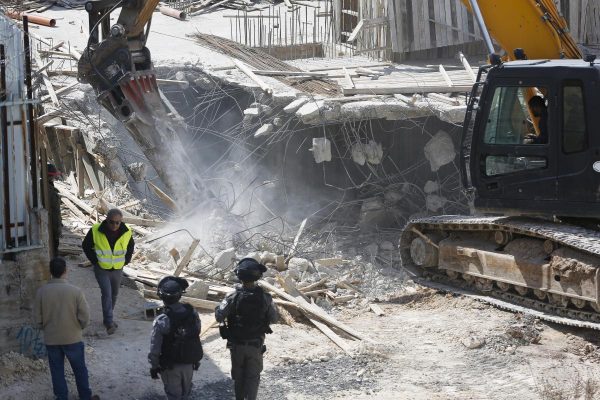
Israeli security forces gather around as a Palestinian home is being demolished in Jerusalem on 14 March 2017 [Mostafa Alkharouf/Anadolu Agency]
Israel makes no distinction between structures it considers to be illegal that are funded by Palestinians and those that are funded by non-Palestinians, those built without planning permission or those agreed upon in bilateral agreements with the Palestinians.
Gaza’s International Airport, which opened in 1998, was destroyed by Israel in 2001. It was built with funding from Japan, Egypt, Saudi Arabia, Spain, and Germany. To this day the airport remains in ruins and no sanctions were ever taken against Israel by either Germany or Spain.
In January of this year Israeli forces demolished some 15 structures in Khirbet, including homes and the only school in the small hamlet, which is located on the outskirts of the village of Beit Furik in the Jordan Valley in the north-eastern occupied West Bank.
In July the Dutch government lodged a protest with Israel over the confiscation of electricity equipment, which was said to be a hybrid power system of both diesel and solar power. The electrification project in the southern Bethlehem region was donated by the Dutch government and cost about 500,000 euros ($590,806), 350,000 euros ($413,564) of which went to Jubbet Al-Dhib, according to the report in the Israeli daily Haaretz. The Dutch Foreign Ministry requested Israel return the equipment and is “currently assessing what next steps can be taken,” the ministry’s statement to Haaretz said.
In August Israeli troops dismantled a structure built for a nursery for 25 Palestinian children in the village of Jabal Al-Baba near Jerusalem claiming it was built without a permit. This followed the demolition a few days earlier of a small primary school in the southern West Bank and the removal of solar panels used to power another school. This drew criticism from the EU which expressed “strong concern about the recent confiscations of Palestinian school structures undertaken by Israel in Bedouin communities in the occupied West Bank,” adding that “every child has the right to safe access to education and states have an obligation to protect, respect and fulfil this right, by ensuring that schools are inviolable safe spaces for children”.
But has Israel pushed its luck too far with the EU?
Despite Israel’s destruction of facilities funded by the EU, history shows it has protested to Israel but has not taken action. However, this could be about to change.
Reports have emerged that eight EU countries, led by Belgium, have drafted a letter to be delivered to senior Foreign Ministry officials demanding compensation amounting to €30,000 ($35,456) for confiscating and demolishing structures and infrastructure built by them in Area C of the West Bank, which is under full Israeli control. This follows Israel’s refusal to return the confiscated equipment as demanded by the eight countries which are members of the ‘West Bank Protection Consortium,’ a body through which they coordinate humanitarian assistance to Area C.
The letter stresses that “the demolition and seizure of humanitarian equipment, including school infrastructure, and the interference in the transfer of humanitarian assistance contravenes Israel’s obligations under international law and causes suffering to the Palestinian residents”.
However, Israel claims that European activity in Area C is not humanitarian assistance but “illegal development that is being done without coordinating with Israel and with the aim of strengthening the Palestinians’ hold on Area C”. This claim was previously made in 2015 by Benjamin Netanyahu who ordered the demolition of some 400 Palestinian structures built in the West Bank with European funding.
While the international community has often talked the talk about Israeli crimes, this is a rare example of action that could at least make Israel think twice before acting. While this is a small step by eight EU countries it could mark a significant and necessary change in policy from condemnation of Israeli policies to tangible action. EU citizens should be outraged that contributions from their taxes to alleviate Palestinian suffering and build peace, are being wasted by Israel while goods from illegals settlements continue to make their way to EU supermarket shelves.
If the EU is serious about peace and its support for a two-state solution then it can use existing instruments to exercise its influence. This includes suspending the EU-Israel Association Agreement for Israel’s failure to adhere to a clause which states that “relations between the parties, as well as all the provisions of the agreement itself, shall be based on respect for human rights and democratic principles”.
Israel’s clear failure to respect Palestinian human rights should finally trigger a suspension of this agreement.
Read more: Israel advances 1,300 new settlement homes for second day in a row
Canada Rejects Venezuela Vote, EU Mulls Sanctions & Russia Congratulates Government
By Rachael Boothroyd Rojas | Venezuelanalysis | October 18, 2017
Twenty-eight European Ministers jointly agreed to “establish the legal framework” for pursuing sanctions against the Venezuelan government Monday in the wake of the country’s regional elections, Europa Press has reported.
Venezuela’s government won eighteen out of twenty-three states in regional elections this past Sunday, but the results have been disputed by the right-wing opposition, the US, Canada and France, on the basis of alleged foul play.
Opposition spokespeople have so far been unable to corroborate their allegations of fraud, while international electoral observers have testified to the veracity of the results. Venezuelan political commentators have said that mass abstention of opposition voters due to disillusionment with their leaders was the reason for the shock result.
Speaking at an EU meeting in Luxembourg Monday, EU Foreign Policy chief Federica Mogherini cautiously described the election results as a “surprise” and asked for investigations to “clarify what happened in reality”.
Ministers also agreed to advance in the preparation of “selective, gradual and reversible” sanctions against members of Venezuela’s Nicolas Maduro administration, with some apparent reticence from Portugal.
The EU has been discussing the potential implementation of sanctions against individuals within the Venezuelan government since the US imposed economic sanctions against Venezuela in August. Canada also followed suit shortly after with asset freezes targeting top Caracas officials.
Venezuelan President Nicolas Maduro responded to the decision Tuesday, accusing Mogherini of only listening to opposition voices in Venezuela, and inviting her to call him or arrange a meeting in Brussels.
Meanwhile, Canada officially added its voice to the international chorus of condemnation against the regional election results Tuesday.
In an official statement, Canadian Foreign Affairs Minister Chrystia Freeland said that “Sunday’s elections were characterized by many irregularities that raise significant and credible concerns regarding the validity of the results.”
She also added her government would continue to “stand for the Venezuelan people and for the defence and restoration of democracy in Venezuela.”
Freeland had already tweeted on Monday that her government was “”very concerned by yesterday’s polling centre closures & relocations – clearly favouring #Venezuela regime, hindering free + fair elections”. Her stance was criticized by Canada’s Communist Party.
Canada is a member of the so-called Lima Group – a regional organization made up of right-wing regional governments opposed to the Maduro administration, including Argentina, Brasil, Canada, Chile, Colombia, Costa Rica, Guatemala, Honduras, Mexico, Panama, Paraguay, and Peru.
On Tuesday, the Lima Group likewise claimed that the elections were marred by irregularities, and demanded a full “independent audit” of results. Venezuelan President Nicolas Maduro had already called for an audit of 100 percent of votes Sunday.
The Lima Group is due next to meet in Canada on October 26, when it will discuss Venezuela’s regional elections and the ongoing stand-off between the government and opposition.
But not all international governments have condemned the elections, and the Maduro administration has received supportive statements from Russia, Cuba, Bolivia and other Latin American leaders.
For its part, Russia said the elections represented a new opportunity to address the “pressing economic and social problems facing the country” and criticised the opposition’s refusal to accept the results.
“The population demonstrated its commitment to civilized, first of all electoral, ways of settling political differences,” reads a statement from the Russian Foreign Ministry.
“Given this, the opposition’s refusal to recognize the results of the voting and calls for more street protests and tougher international sanctions are fraught with negative consequences. This may frustrate the emerging scenario of compromise and trigger another spiral of violence and confrontation,” the ministry added.
In addition, Russia urged Venezuelan political forces to refrain from violence, and spoke in support of dialogue between the opposition and national government “to stop attempts at destructive interference from outside.”
“The counter-productiveness of force and sanction pressure on Venezuela is obvious,” the ministry underscored.
Meanwhile, the government of Cuba also congratulated the Maduro government on the election win.
“Dear Nicolas: I congratulate you for the results of state elections. Venezuela has shown another example of peace, democratic vocation, courage and dignity,” Cuban President Raul Castro said in a letter published by Cuba’s Foreign Relations Ministry.
Bolivian President Evo Morales also took to Twitter to say that “In Venezuela, peace triumphed over violence, the people triumphed over the empire. [Organization of American States Secretary-General] Luis Almagro lost, along with his boss [US President] Trump”.
En Venezuela triunfó la paz frente a la violencia, triunfó el pueblo frente al imperio. Perdió Luis Almagro con su jefe Trump.
— Evo Morales Ayma (@evoespueblo) October 16, 2017
In similar statements, former Ecuadorean President Rafael Correa said that the election results had “exposed” how biased international media coverage is on Venezuela.
Many international media outlets had predicted that Venezuela’s opposition would sweep to victory on Sunday, in a repeat of the 2015 National Assembly elections.
‘Permanent War Economy’: EU Defense Policy ‘Outsourced’ to Arms Industry
Sputnik – October 17, 2107
A report issued by Belgian campaign group Vredesactie (Peace Action) has documented how Europe’s defense industry played a pivotal role in the development of military strategies, with plans closely modeled on proposals made by major arms firms.
In 2016, the European Union took an unprecedented step, setting up the Preparatory Action on Defense Research — a military program worth US$1.05 billion — and proposing the establishment of a European Defense Fund, which allocates almost US$50 billion to the research, development and procurement of weapons over 10 years. While civil society, the academic world, and the European Parliament, were almost entirely excluded from policy discussions, the European arms industry left a “heavy footprint” in negotiations.
In essence, as the militarization of the 28-member bloc has accelerated rapidly, the arms industry has had access to every stage of decision-making processes, from setting agendas to drawing up the provisions of various action plans, Vredesactie has found.
“Rather than a reflection of what security means and how to ensure it, the European strategy is dominated by developing and selling new capabilities. Supporting the defense industry has become a goal in itself. Meanwhile, actual security challenges remain unanswered and mistakes from past policy choices perpetuated, at a high cost,” the report stated.
Over the course of their investigation, Vredesactie uncovered minutes of a 2015 meeting of the so-called Group of Personalities (GoP), a working group set up by the Commission, whose subsequent report laid the foundations of the European Defense Action Plan. At the meeting, a Commission civil servant said the goal of the group’s report was to “overcome resistance towards a defense research program.”
No Representation
GoP membership was heavily skewed towards the defense industry, with “barely any” independent voices represented, “let alone” critical voices such as peace groups or human rights organisations. The only member of the European Parliament that participated, center-right German Michael Gahler, is “known for his pro-military views” and a board member of a defense lobby organization.
Vredesactie noted the setting up of a Group of Personalities was “rare” and seems to have been deliberately used to evade “even basic levels of transparency” — the GoP was not registered as an expert group, and expert groups are to a certain extent subjected to rules regarding transparency (e.g. dates of meetings, agendas and minutes are publicly available).
“In the case of the GoP not even these basic rules were enforced. The reasons stated by the Commission for setting up the GoP have been inconsistent. The Commission at first declared the GoP is an expert group and therefore did not include any representatives from civil, but the Commission later denied [this], stating it provided political and strategic advice. In reality the GoP laid down the ideological foundation for the further militarization of Europe,” the report continued.
Disturbing Dynamic
The report concludes there is a “disturbing dynamic” going on at the EU level — what originally began life as a project to ensure continental peace between former perpetually-warring powers, has mutated into a bloc “subsidizing an industry which exports war.”
“The European Defense Fund creates a self-fulfilling and continuous loop between supply and demand, funded with public money. This creates the specter of a European permanent war economy, which has to be constantly funded by public means to remain competitive. The military technologies developed now, shape the wars of the future — the EU has already started developing autonomous systems through the Pilot Project and the Preparatory Action, despite warnings from both the scientific community as well as the European Parliament,” the report cautioned.
Furthermore, the disastrous impact of arms exports on the world has “not even [been] considered by European leaders,” instead viewed as a sign of a “thriving defense industrial base.” Modest calls for an upgrade of arms export control policies have not been heeded, and the European Defense Fund “will not lead to more security — because it is not meant to lead to more security.”
“The fund is an industrial stimulus fund for the major European arms-multinationals, located in only a few European countries. The undue influence of these companies at every level of the decision-making process has led to an outcome which solely takes economic considerations into account. This raises questions on the democratic legitimacy of these policies. Similarly, most Europeans are opposed to increased military expenditures and do not think ‘hard power’ is effective in combating terrorism,” the report concluded.
Featured Video
The American Retreat from Vietnam
or go to
Aletho News Archives – Video-Images
From the Archives
Secret document reveals plans for civil war in Lebanon, Israeli false flags, and invasion
By Randi Nord | Geopolitics Alert | April 5, 2019
Beirut – During his visit with US Secretary of State, Mike Pompeo, Lebanese President Michael Aoun reportedly received a US-Israeli document detailing plans for creating a civil war in Lebanon with covert false flag operations and possible Israeli invasion.
Although the source of the document is Israeli and created in partnership with Washington, no one knows who presented it to Aoun. The Lebanese TV station, Al-Jadeed, initially reported the document on Lebanese TV and a video on its website. Geopolitics Alert translated the report for this article. … continue
Blog Roll
 Aletho News
- ‘Distance yourselves from Israel’: IRGC urges US population to question govt policies
- America’s Greenland deal has a radioactive backstory
- The RAF Fairford ‘terror plot’: Unpacking escalation in the UK echo-chamber
- EU Council Advances Chat Control 2.0 Scanning Proposal
- Ex-Greek MEP files complaint against Israeli spyware firm over alleged Pegasus surveillance
- Troubling ideas throughout the Torah, Talmud, Mishneh Torah and Tanya
- ‘Grave, alarming’: Iran mission on Trump’s UNGA ‘annihilation’ threats
- Najaf airport to reopen to Iranian flights within 24 hours: Ambassador
- From ‘How Will This End For Iran’ to ‘When America Walks Away’: A tale of two Economist covers
- Tehran blasts ‘baseless’ speculation linking Iran to alleged bomb plot at UK air base
- If Americans Knew
- Ex-Biden officials are desperate for a Gaza scapegoat
- Israeli “settlers” Invade Al-Aqsa; Pour Boiling Water on 75-Year-Old
- Israel Has Kidnapped Another American Teenager
- US arms sales to Israel worth $21.6 billion in 20 months
- Three Palestinians Killed in Israeli Attacks on Gaza
- Revealed: German “Anti-Semitism Expert” Driving Crackdown on Palestine Solidarity is Former Israeli Spy
- Egypt’s Warning to Israel Before Oct 7
- Israel’s siege signals another cruel winter for 1.8 million Gazans – Daily Update
- Netanyahu Asked UAE Leader to Deny Report on Oct. 7 Warning in Secret Visit, Sources Say
- CNN Chief Int’l Correspondent Clarissa Ward on Journalists in Gaza
- No Tricks Zone
- New Study: Earth And Venus Surface Warmth Largely Explained By Convection And Lapse Rate, Not CO2 Or Radiation
- 2025 Nature Paper Claiming Worsening Global Drought Gets RETRACTED …Heavily Flawed
- New Study: ‘Global Drought Shows No Detectable Recent Acceleration Under Climate Warming’
- Economic Masterminds: German Socialists Suggest Taxing Productivity Gains Stemming From Using AI
- The South China Sea Has Not Been Cooperating With The Climate Change Narrative
- Energy Crisis: Germany Enters Heating Season With Historically Low Gas Reserve Fill Levels
- New Study: The Antarctic Ice Sheet Gained Mass From 2020-2024 Due To Staggering Snow And Ice Accumulation
- Study: Ocean Heating Rates From Thousands Of Years Ago ‘Dwarf’ Modern Ocean Heating Rates
- Climate Extremists Target, Attack Large-Scale Power Grid Infrastructure In Germany!
- New Study: Antarctic Ice Melt Has Contributed Less Than 1 Centimeter To Sea Level Rise In The Last 30 Years

