What does Trump’s Jerusalem decision actually mean?
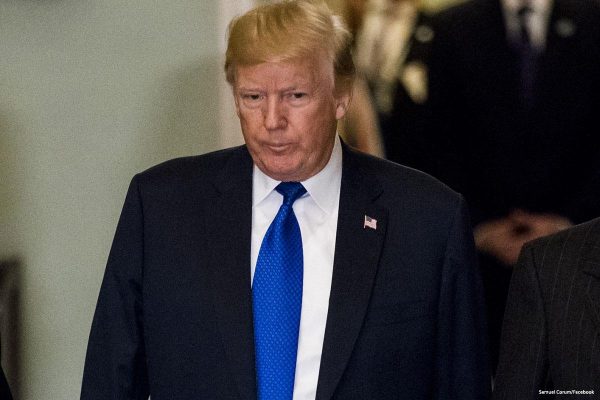
US President Donald Trump at the white house, November 28, 2017 [Samuel Corum/Facebook]
By Hassan Ben Imran | MEMO | December 13, 2017
“We cannot solve our problems by making the same failed assumptions and repeating the same failed strategies of the past… Israel is a sovereign nation with the right, like every other sovereign nation, to determine its own capital.” So said Donald Trump last week.
With such logical fallacies and ignorance of basic legal facts, as well as the fundamental principles of the UN Charter, the US President decided that it is time for a new “formula” and recognised “Jerusalem as the capital of Israel”. He overlooked the fact that Israel is far from being “like every other sovereign nation.”
No sovereign nation in modern times has ever declared independence following the ethnic cleansing of the indigenous population; and no sovereign nation has broken international law concerning Jerusalem in order to annex it and claim the city as the eternal capital of the Jewish people. Trump would be totally correct in his assumption had he been talking about any ordinary sovereign nation, but certainly not Israel.
In 1967, Israel completed its occupation of Palestine, including East Jerusalem; it is still the occupying power. Everything that Israel does in the occupied Palestinian territories, including Jerusalem, is done to make the occupation permanent. This colonialism peaked in 1980 when the Knesset (Israeli parliament) amended the Basic Law (5740 – 1980) to annex East Jerusalem and declare that “[t]he complete and united Jerusalem is the capital of Israel”.
With a sense of self-guilt, Israel worked hard to gain international recognition of its “new capital”. Knowing the grave legal and political consequences of such an ill-advised move, even its closest allies refused to acknowledge this “capital”. It was only in 1995 that the US Congress decided (or perhaps was made to decide) to recognise the Israeli annexation, although successive US Presidents have signed a six-monthly waiver to delay the implementation of the Congress decision. Israel had to wait until there was someone like Donald Trump in the White House to make the formal announcement.
The status of Jerusalem under international law
Few cities have received as much international attention as Jerusalem. This has entrenched its status in international law.
Despite the Israeli and now, sadly, the US efforts to change the status of Jerusalem through domestic legislation, media campaigns and diplomacy, several UN resolutions have affirmed and reaffirmed the opposite of what Israel sought. International law is clear on this; no state may claim, exercise or show any aspect of sovereignty over any territory through occupation.
After the occupation of East Jerusalem in 1967, Israel began a systematic campaign to force out its Palestinian citizens and change its identity, even before formally annexing the territory. This was condemned by all, including the UN Security Council, where the US abstained and did not use its veto power.
In 1971, the UN Security Council issued Resolution 298 “[deploring] the failure of Israel to respect the previous resolutions adopted by the United Nations concerning measures and actions by Israel purporting to affect the status of the City of Jerusalem” and “[Confirming] in the clearest possible terms that all legislative and administrative actions taken by Israel to change the status of the City of Jerusalem, including expropriation of land and properties, transfer of populations and legislation aimed at the incorporation of the occupied section, are totally invalid and cannot change that status.”
It was so firm a stance by the Security Council that the US refrained from blocking it. One resolution after another came from the Council, the top decision-making body in the UN structure whose resolutions are meant to be binding on all the member states of the international organisation, reaffirming the same position. The most recent was Resolution 2334 passed in December 2016 rejecting the Israeli measures related to settlements, including those in East Jerusalem, and recognising those measures as grave breaches of international law.
Furthermore, in its Advisory Opinion on the Construction of the Wall in 2004, the International Court of Justice affirmed that East Jerusalem, as a part of the occupied West Bank, is an occupied territory that belongs to the Palestinians who are entitled to self-determination.
The status of East Jerusalem as an occupied Palestinian Territory has been affirmed and upheld by almost all of the UN member states, the exception being Israel, of course, and possibly now the US following Trump’s announcement.
Can Trump change the legal status of Jerusalem?
It is ironic that the only positive aspect of Trump’s decision was that he avoided using the term so loved by the Israelis: “complete and united Jerusalem”. This was used by Israel in its 1980 annexation legislation. This is not entirely reassuring, however, as it could be manipulated given that he mentioned Jerusalem with no further detail in the full knowledge that Israel annexed the eastern sector of the city.
The major risk here is the creation of customary law recognising the “undivided” status. International Customary Law, a source of international law according to the ICJ Statute, has two essential elements which, if fulfilled, may change the legal status of Jerusalem: state practice and opinio juris. As clarified in the North Sea Continental Shelf cases, state practice has to be frequent, repetitive and consistent, as well as being conducted or used by a significant number of states participating (given the size of the international community, the practice does not have to encompass all states or be completely uniform, there just needs to be a significant degree of participation). Opinio juris is the belief that an action was carried out as a legal obligation with the full awareness of its legal consequences, which must be in existence in order for the custom to be regarded as law.
International law is about the agreement of the relevant or involved parties, and the US has been the broker of the Palestine-Israel peace process, making it a directly-involved party. As such, the US seems to fulfil both requirements, state practice and opinio juris. Even so, there has to be a significant number of states following the new US measures in order to be able to contest the current legal status of Jerusalem. The US might be pushed by the pro-Israel Lobby to exert pressure on states relying on its military assistance or financial aid to recognise the new “status quo”. This would certainly embed Israel’s occupation of Palestinian land further and encourage the state to violate international law even more than it does now.
Probable consequences
This would have dire consequences, not only for the peace process, but also the city of Jerusalem and its Muslim and Christian population. It would encourage the Israeli authorities to annex more of the occupied Palestinian territories, change their identity and complete the ethnic cleansing of their people. Even the Muslim and Christian religious authorities in Jerusalem might not be safe and could be merged with those of the occupation.
This would be even worse if other countries are forced by circumstances to follow America’s lead on the issue. Countries which depend on US aid or military protection are vulnerable to pressure from the Trump administration.
Moreover, in a worst-case scenario, the weakness of the current Palestinian leadership may lead it to proceed with the peace process under the “new terms” which keep Jerusalem off the negotiation agenda.
What is to be done?
Trump’s dangerous move needs to be met with a serious response from the Palestinians and all those who believe in the justness of their cause. The Palestinian leadership, along with the Hashemite Kingdom of Jordan, which is the official Custodian of the Holy Sites in Jerusalem, should take the issue to the UN General Assembly, and file a complaint to the Security Council. There should also be a request through the UN General Assembly for an Advisory Opinion from the International Court of Justice on the new US measures.
Clear resolutions or even statements from intergovernmental organisations, such as the EU, Organisation of Islamic Coordination (OIC), Non-Aligned Movement and Association of South-East Asian Nations (ASEAN) affirming the status of the city as occupied territory and refusing to accept the US move would halt any possibility for any change in Jerusalem’s legal status. It would also discourage other countries from giving-in to US pressure.
The ICJ has jurisdiction to settle international disputes and adjudicate on contentious issues. Palestine or Jordan may bring the case to the ICJ on the basis that the US has breached international law in a move which has a direct impact on them both. Even if the US refuses to appear before the Court, this would weaken its position.
And within the US itself?
Article VI, Clause II of the US Constitution states that “all Treaties made, or which shall be made, under the Authority of the United States, shall be the supreme Law of the Land”. Despite the federal government enjoying sovereign immunity according to US law, there are several exceptions that could apply in this case. President Trump is obviously breaching treaties, such as the UN Charter and the Fourth Geneva Convention of 1949, that are, according to Article VI, Clause II of the Constitution, “a supreme Law of the Land” and so he should be held to account under US law.
In conclusion, Donald Trump’s announcement about Jerusalem is an attack on international law and reinforces the sense that the “law of the jungle” rules in the Middle East. The international community has both the institutions and the tools to ensure the application of international law; it is time for them to be activated.
Israeli security interests dominate EU diplomacy
By Ramona Wadi | MEMO | December 12, 2017
The EU Foreign Policy Chief has told Benjamin Netanyahu that there will be no mass relocation of embassies to Jerusalem. Federica Mogherini insisted that this will be the case in response to the Israeli Prime Minister’s comment that most European countries would follow Donald Trump’s unilateral decision to move the US Embassy from Tel Aviv.
However, there was no recognition from the EU regarding the shift in political dynamics, particularly with regard to the negotiations and the two-state paradigm. On the contrary, Mogherini exposed the EU’s intent to persist in diplomatic engagement within the obsolete framework, for the sake of Israel’s security interest.
As quoted in the Times of Israel, Mogherini stated: “We believe it is in Israel’s interest, especially its security interest, to find a sustainable and comprehensible solution to the Israeli-Palestinian conflict. This is why the European Union will increase its work… to relaunch the peace process, even if it seems [that these are] difficult times.”
In keeping with its usual stances, Wafa news agency also reported that the EU is seeking compensation of €30,000 from Israel for the confiscation and destruction of structures funded by Brussels. The news would have been a diversion, even at a less drastic moment, given that the EU is apparently willing to go on paying for Israel’s penchant for demolition. However, in the current circumstances, the EU’s demand is more of an assertion that the cycle of abuse and plunder is set to continue as usual, with demands unmet by Israel and the further depletion of Palestinian rights.
Despite refuting Netanyahu’s statement, which speaks about a hypothetical future and within the context of a majority of countries prioritising relations with Israel above ending its colonisation of Palestine, Mogherini’s reasons do not frame the response as any kind of solidarity with the Palestinians. The EU has embarked upon the most convenient narrative and the easiest one to articulate. If it can promote the two-state compromise as the best option to protect Israeli interests, the essence behind such reasoning does not oppose Trump’s action. In different ways, the US and the EU have promoted a distorted concept of peace which complements each other’s and, particularly, Netanyahu’s aims of using the euphemism as a veneer for Israel’s ongoing violence.
The EU might be less willing to overtly affirm agreement. Its reticence, however, should not be misconstrued as support. Eliminating the possibility of considering — let along affirming — decolonisation as the necessary process for peace, turns every decision taken by the EU into an advantage for Israel. There is no need for other diplomatic belligerence to affirm support for the Zionist state’s colonial project; the reiteration of Israeli security interests dissociated from the circumstances created by the colonial entity itself is enough.
A current rejection of Netanyahu’s hypothesis is a weak response to the threat unleashed by Trump. If the EU is to take a stance of unequivocal rejection, it has to match its rhetoric with a complete change of policy which would construct peace according to Palestinian demands based upon international law. Relaunching the peace process as the means to protect Israeli security interests makes a mockery of the losses suffered by Palestinians since the initial colonial process started more than 100 years ago and conveys flagrant contempt for the legitimate rights of the indigenous population of occupied Palestine.
Most Europeans Want Better Relations With Russia, Not Sanctions War – Poll
Sputnik | November 23, 2107
As the European Union continues to bear the economic brunt of its sanctions policy towards Russia, a recent poll by Sputnik has revealed that an absolute majority of Britons, Germans, French and Poles want better relations between Brussels and Moscow.
The French Institute of Public Opinion (Ifop) has conducted an opinion poll at Sputnik’s behest, in an attempt to gauge the attitude of Europeans towards the deteriorating relationship between the EU and Russia.
Relations between Brussels and Moscow took a turn for the worse in 2014 amid the crisis in Ukraine, resulting in a perpetuating cycle of sanctions and counter-sanctions which tax the economies of European states.
Ifop interviewed a total of 3,228 respondents of 18 years old or older in the UK, France, Germany and Poland, asking them a single question: “As a result of sanctions and counter-sanctions the political as well as economic relations between Russia and the EU continue to deteriorate. Would you like relations between the EU and Russia to improve in the near future?”
The vast majority of respondents favored improvement in relations between Brussels and Moscow, with 87 percent of Germans, 85 percent of Poles, 79 percent of French and 68 percent of Britons answering “Yes.” It is noteworthy that the economies of the four countries are among those hit hardest by sanctions and Russia’s responsive countermeasures in terms of economic losses.
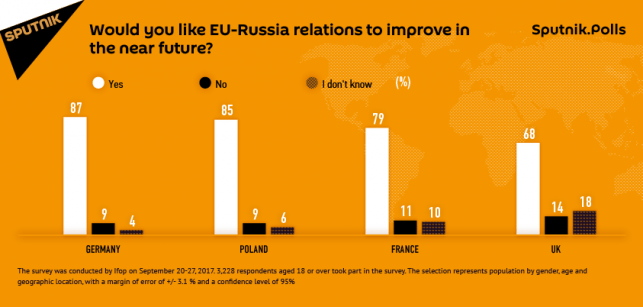
Vast Majority of Germans, Poles, French, Britons Want to Improve Ties With Russia
In Germany, which has lost “tens, if not hundreds of billions euros” and nearly 60,000 jobs due to anti-Russian sanctions, according to a study, 90 percent of male respondents in Germany turned out to be more inclined towards better relations with Russia. In France and the UK, which have reportedly lost €2.1 billion ($2.5 billion) and €3.1 billion ($3.7 billion) in exports respectively, 82 percent and 71 percent of male respondents favored better relations between Brussels and Moscow, the poll has shown.
The relationship between Russia and the European Union soured after Crimean peninsula seceded from Ukraine and reunified with Russia following the March 2014 referendum. The Western countries, including the EU members, have not recognized the legitimacy of the vote, imposing several rounds of sanctions on Russia.
Russia-gate Spreads to Europe
By Robert Parry | Consortium News | November 16, 2017
Ever since the U.S. government dangled $160 million last December to combat Russian propaganda and disinformation, obscure academics and eager think tanks have been lining up for a shot at the loot, an unseemly rush to profit that is spreading the Russia-gate hysteria beyond the United States to Europe.

British Prime Minister Theresa May
Now, it seems that every development, which is unwelcomed by the Establishment – from Brexit to the Catalonia independence referendum – gets blamed on Russia! Russia! Russia!
The methodology of these “studies” is to find some Twitter accounts or Facebook pages somehow “linked” to Russia (although it’s never exactly clear how that is determined) and complain about the “Russian-linked” comments on political developments in the West. The assumption is that the gullible people of the United States, United Kingdom and Catalonia were either waiting for some secret Kremlin guidance to decide how to vote or were easily duped.
Oddly, however, most of this alleged “interference” seems to have come after the event in question. For instance, more than half (56 percent) of the famous $100,000 in Facebook ads in 2015-2017 supposedly to help elect Donald Trump came after last year’s U.S. election (and the total sum compares to Facebook’s annual revenue of $27 billion).
Similarly, a new British study at the University of Edinburgh blaming the Brexit vote on Russia discovered that more than 70 percent of the Brexit-related tweets from allegedly Russian-linked sites came after the referendum on whether the U.K. should leave the European Union. But, hey, don’t let facts and logic get in the way of a useful narrative to suggest that anyone who voted for Trump or favored Brexit or wants independence for Catalonia is Moscow’s “useful idiot”!
This week, British Prime Minister Theresa May accused Russia of seeking to “undermine free societies” and to “sow discord in the West.”
What About Israel?
Yet, another core problem with these “studies” is that they don’t come with any “controls,” i.e., what is used in science to test a hypothesis against some base line to determine if you are finding something unusual or just some normal occurrence.
In this case, for instance, it would be useful to find some other country that, like Russia, has a significant number of English speakers but where English is not the native language – and that has a significant interest in foreign affairs – and then see whether people from that country weigh in on social media with their opinions and perspectives about political events in the U.S., U.K., etc.
Perhaps, the U.S. government could devote some of that $160 million to, say, a study of the Twitter/Facebook behavior of Israelis and whether they jump in on U.S./U.K. controversies that might directly or indirectly affect Israel. We could see how many Twitter/Facebook accounts are “linked” to Israel; we could study whether any Israeli “trolls” harass journalists and news sites that oppose neoconservative policies and politicians in the West; we could check on whether Israel does anything to undermine candidates who are viewed as hostile to Israeli interests; if so, we could calculate how much money these “Israeli-linked” activists and bloggers invest in Facebook ads; and we could track any Twitter bots that might be reinforcing the Israeli-favored message.
No Chance
If we had this Israeli baseline, then perhaps we could judge how unusual it is for Russians to voice their opinions about controversies in the West. It’s true that Israel is a much smaller country with 8.5 million people compared to Russia’s 144 million, but you could adjust for those per capita numbers — and even if you didn’t, it wouldn’t be surprising to find that Israel’s interference in U.S. policymaking still exceeds [by many orders of magnitude] Russian influence.
It’s also true that Israeli leaders have often advocated policies that have proved disastrous for the United States, such as Prime Minister Benjamin Netanyahu’s encouragement of the Iraq War, which Russia opposed. Indeed, although Russia is now regularly called an American enemy, it’s hard to think of any policy that President Vladimir Putin has pushed on the U.S. that is even a fraction as harmful to U.S. interests as the Iraq War has been.
And, while we’re at it, maybe we could have an accounting of how much “U.S.-linked” entities have spent to influence politics and policies in Russia, Ukraine, Syria and other international hot spots.
But, of course, neither of those things will happen. If you even tried to gauge the role of “Israeli-linked” operations in influencing Western decision-making, you’d be accused of anti-Semitism. And if that didn’t stop you, there would be furious editorials in The New York Times, The Washington Post and the rest of the U.S. mainstream media denouncing you as a “conspiracy theorist.” Who could possibly think that Israel would do anything underhanded to shape Western attitudes?
And, if you sought the comparative figures for the West interfering in the affairs of other nations, you’d be faulted for engaging in “false moral equivalence.” After all, whatever the U.S. government and its allies do is good for the world; whereas Russia is the fount of evil.
So, let’s just get back to developing those algorithms to sniff out, isolate and eradicate “Russian propaganda” or other deviant points of view, all the better to make sure that Americans, Britons and Catalonians vote the right way.
Investigative reporter Robert Parry broke many of the Iran-Contra stories for The Associated Press and Newsweek in the 1980s.
Russia’s Alleged Meddling in Catalan Vote: Playing the Blame Game

By Alex GORKA | Strategic Culture Foundation | 14.11.2017
Few people are able to recognize their own mistakes. Many prefer to deny the truth becoming willfully oblivious to obvious facts. Why assume responsibility if there is such a thing as blame shifting – a true-and-tried method to get away with it? Pointing a finger at someone else to divert attention serves the purpose. There is method to this madness and Western politicians have been resorting to the blame-shifting tactic increasingly often. Each and everything going awry in the world is the fault of Russia. The drive of peoples for independence is a good example. Take Catalonia to illustrate the point.
The Spanish government said on Nov.10 that it had noted news manipulation about the Catalan crisis on social media originating from Russia’s territory. Spain’s government spokesman Inigo Mendez de Vigo said disinformation on social networks was a “serious issue.” According to Spanish Defence Minister Maria Dolores de Cospedal, the government had established that “many messages and interventions via social networks come from Russian territory.” She did not offer any specific examples to confirm the affirmation. Foreign Minister Alfonso Dastis said there was evidence of activity by Russian networks and hackers. The trolls are said to be spreading misinformation across social media to further “destabilize” Spain and the EU.
The issue was even raised at the EU foreign and defense ministers meeting on Nov.13-14, where Spain briefed the EU on the alleged interference. The debate comes after eight member states urged EU foreign service chief Federica Mogherini to build up the counter-propaganda cell in her service.
Spanish media have many times attacked Russia Today (RT) and Sputnik Spanish language services for instigating tensions in Catalonia, supporting the separatist movement. El Pais daily wrote an editorial on Nov. 10 denouncing “the intense campaign by Russian media that are close to the Kremlin,” whose “propaganda machine” it accused of siding with the pro-independence movement.
NATO leadership chimed in. On Nov.9, US General Curtis Scaparrotti, the commander of NATO forces in Europe, called on Russia to stop “meddling” into European elections. He was concerned over Russia’s “malign influence” in other countries. The Atlantic Council, a US-based think-tank close to NATO, has published a report suggesting that Russia was seeking to meddle in support of Catalan independence and to discredit the Spanish central government’s position that the referendum on independence held on Oct. 1 was illegal. El Pais, the Washington Times and Politico all issued publications alleging that an army of Russian bots had perfected their techniques of online influence and thus ensured the October 1 vote went down the path of separation.
If the accusations were true, it would mean that Russia-backed media networks operate to undermine Russia’s official position on the issue made clear in a Foreign Ministry’s statement. Russia has consistently voiced its respect for Spain’s territorial integrity.
Can anyone of sane mind believe that Russia’s “meddling” is the real reason to make over 40 percent of Catalans support independence? Has Russia been behind the 95-year-old independence movement in Catalonia? Has Russia made the Catalans’ language and culture distinct? Did Russia make Francisco Franco oppress the Catalan people? Has Russia provoked the economic crisis in Spain, which has served to magnify calls for Catalan independence? Has Russia made Catalans believe that the current tax structure is unfair? Has Russia made Madrid unwilling to renegotiate Catalonia’s autonomy agreement? Has Russia written Spain’s constitution, which expressly prohibits a region from breaking away unilaterally? Did Moscow order Spanish police to use brutal force, while preventing the unconstitutional vote? If it didn’t count, why take such pains to stop it?
Several world leaders and political figures condemned the violence specifically. Did Russia make them do it? Did Russia make the EU abstain from mediation effort? And, finally, does Russia stand to gain from an independent Catalonia?
With many publications on the issue, no evidence has been produced to demonstrate a link between the Russian government and Catalonia vote. Obviously, the use of the “Russian meddling” narrative seems to work as a distraction from the wrongdoing of the Spanish government. The fantasy provides a convenient scapegoat to avoid responsibility of the Spanish government for missing opportunities to launch meaningful political dialogue with Catalonia and mishandling of the vote. Spain is by far not the only country to use the narrative to its own advantage. As Karl Sharro, a well-known British architect and satirist, commented on the results of UK elections, “The most disappointing thing about the UK election is there wasn’t even a hint of Russian interference. It’s like we don’t matter at all.”
Nigel Farage calls on EU to investigate George Soros funding, collusion
RT | November 14, 2017
Nigel Farage says while Russia is accused of funding Britain’s ‘Leave’ campaign, financier George Soros’ recent $18 billion donation to pro-EU charity Open Society has escaped scrutiny. “This is where the real international political collusion is,” Farage says.
Speaking to the European Parliament in Strasbourg on Tuesday, Farage told fellow MEPs he believes that when it comes to international collusion, “we are looking in the wrong place.” He says Soros’ influence in Brussels is “truly extraordinary,” adding: “I fear we could be looking at the biggest level of international, political collusion in history.”
Farage, the leader of the Europe of Freedom and Direct Democracy Group, believes Soros has spent billions in the EU to undermine the nation state. “When we are talking about offshore money, when we are talking about political subversion, when we are talking about collusion, I wonder if we are looking in the wrong place.
“And I say that because George Soros recently gave Open Society, which of course campaigns for freedom of movement of people and supranational structures like the European Union, $18 billion. And his influence here and in Brussels is truly extraordinary.”
Farage said Open Society boasts it held 42 meetings in 2016 with the European Commission, and has published a book of reliable “friends” in the European Parliament. There are 226 names on the list, he says. He told those MEPs he would be writing to them to establish whether they had accepted money or help from billionaire investor and liberal campaigner Soros.
“If we’re going to have a debate, and talk about full, political and financial transparency, well let’s do it. So I shall be writing today to all 226 of you, asking some pretty fair questions: Have you ever received funds directly or indirectly from Open Society? How many of their events have you attended? Could you please give us a list of all the representatives including George Soros?”
He is also calling on the European Parliament to set up a special committee to look into the issue. “I say this at a time when the use of money and the implications it may have had on the Brexit result or the Trump election has reached virtual hysteria.
“Just last week, the Electoral Commission launched an investigation to find out whether the Leave campaign took offshore money or Russian money. This came about as a result of questions asked in the House of Commons by one Ben Bradshaw, someone linked to an organization called ‘Open Society.’”
In October, Soros transferred the “bulk of his wealth” to Open Society, it confirmed. Writing on his website, the financier said: “My success in the financial markets has given me a greater degree of independence than most other people. This allows me to stand on controversial issues: in fact, it obliges me to do so because others cannot.”
UK PM Takes Russia’s Alleged Attempts to Intervene in Elections ‘Very Seriously’
Sputnik – 01.11.2017
UK Prime Minister Theresa May has voiced London’s concern over Russia’s alleged attempts to interfere in the electoral or democratic processes of any country.
“We take very seriously issues of Russian intervention or Russian attempts to intervene in the electoral processes or in the democratic processes of any country,” May told the House of Commons.
The British prime minister’s statement comes in the wake of the ongoing investigation in the US into Russia’s alleged interference in the 2016 presidential election dubbed a “witch hunt” by Donald Trump.
Asked if the UK authorities were cooperating with US Special Counsel Robert Mueller in his inquiry into Russia’s alleged meddling in the 2016 US presidential election, May pointed out that London was working closely with Washington.
“As part of that relationship, we do cooperate when required,” May said.
The statement comes amid the launch of a UK Electoral Commission investigation into the funding of the campaign supporting Brexit by a pro-Leave campaigner.
Russia’s Alleged Meddling
Moscow has repeatedly denied Russia’s interference in the US election which is being investigated separately by US Congress and Special Prosecutor Robert Mueller, calling the claims “groundless” and “absurd.”
In the wake of US media reports claiming about the alleged Russia’s meddling in the November 2016 election, media outlets in several European countries, including France and Germany, have began speculating about Moscow’s “attempts” to interfere in their countries’ affairs.
Commenting on the growing number of foreign states’ accusations of alleged attempts by Moscow to undermine democracy, Foreign Minister Sergei Lavrov has called the claims ridiculous, emphasizing that there was no proof that Russia was involved in the election processes of the United States, Germany, France, or the United Kingdom.
READ MORE:
UK Electoral Commission Opens Probe Into Brexit Campaigner Banks
German Election: Futile Hunt for ‘Russian Meddling’ Continues
France Finds No Traces of Russian Hackers in Attack on Macron’s Campaign
Money Rains Over Swedish Mainstream Media to Stop ‘Fake News,’ ‘Russian Trolls’
Sputnik – 30.10.2017
The Swedish state has invested millions of kronor in its attempt to stop foreign meddling in the upcoming 2018 election. For Sweden, which is somewhat preoccupied with the fictitious “Russian threat,” Moscow’s interference almost goes without saying.
Several of Sweden’s media giants will receive SEK 13.5 million ($1.6 million) in state support from the research and development funding agency Vinnova to stop “fake news” from affecting the 2018 general election. According to Vinnova’s press release, the companies will develop a service for “fact-checking” of, among other things, viral posts on social media.
The list of grant recipients includes Swedish Radio, Swedish national broadcaster SVT, as well as media groups Bonnier (which runs the Swedish dailies Dagens Nyheter, Expressen and Dagens Industri, as well as commercial TV network TV4) and Schibstedt (which runs the dailies Aftonbladet and Svenska Dagbladet ). The idea is that together they will counteract fake news and unfounded statements from being spread to influence the Swedish election.
Given the amount of money invested and the sheer scope of collaboration involving the bulk of Sweden’s mainstream media, Vinnova called the cooperation “unique.”
According to Vinnova, the project will, among other things, highlight journalistic investigations and critically examine statements made in the political debate as well as information disseminated on social media.
“The project is aimed at developing a digital tool that automates the flow of information and the process of fact-checking in news editorial boards that can be used to raise the quality and reduce the risk of fake or irrelevant facts reaching the audience,” Vinnova said.
Previously, the very same mainstream media, as well as high-ranking officials, including Prime Minister Stefan Löfven, Defense Minister Peter Hultqvist and Sweden’s ambassador to Russia Peter Ericsson, voiced repeated fears of Russian meddling in the upcoming election — allegations that Russian Foreign Minister Sergei Lavrov dismissed as “ridiculous.”
Nevertheless, Sweden, where the “Russian threat” is a fixture on the domestic agenda, seems to persist in its delusion of “Russian meddling.” Most recently, Sydsvenskan senior columnist Per T Ohlsson argued that the risk of Russian influence was “imminent,” especially in the view of Sweden’s reinvigorated NATO cooperation, as well as Stockholm’s stance on the Ukrainian conflict.
“The Russian trolls are already here,” Per T Ohlsson wrote, reinforcing the hackneyed cliché of Russian ‘troll factories’ flooding the web with pro-Russian comments to sow discord.”
Swedish Security Police SÄPO saw “indications of Russia’s intention to influence political and decision-making and public opinion” as early as 2015, warning of “distorting, erroneous and corruptive” messages being spread on social media.
“Russia has already shown an interest in the political debate in Sweden. We have an important geographical location on the Baltic Sea and a long history towards Russia. Sweden is also a member of the EU and has a relationship with NATO,” Björn Palmertz, senior analyst at Sweden’s Defense University, told the Aftonbladet daily, arguing that Sweden was just a puzzle piece in Russia’s general foreign policy strategy to “provide fuel for fragmentation and social challenges.”
The Swedish Civil Contingencies Agency (MSB), which plans to receive SEK 60 million ($7 million) from the Swedish government to bolster the nation’s psychological defense, recently launched a project of its own to prevent foreign meddling.
“For a foreign force seeking to influence the Swedish election, there are great opportunities,” MSB project leader Sebastian Bay told Aftonbladet.
Featured Video
The American Retreat from Vietnam
or go to
Aletho News Archives – Video-Images
From the Archives
Secret document reveals plans for civil war in Lebanon, Israeli false flags, and invasion
By Randi Nord | Geopolitics Alert | April 5, 2019
Beirut – During his visit with US Secretary of State, Mike Pompeo, Lebanese President Michael Aoun reportedly received a US-Israeli document detailing plans for creating a civil war in Lebanon with covert false flag operations and possible Israeli invasion.
Although the source of the document is Israeli and created in partnership with Washington, no one knows who presented it to Aoun. The Lebanese TV station, Al-Jadeed, initially reported the document on Lebanese TV and a video on its website. Geopolitics Alert translated the report for this article. … continue
Blog Roll
 Aletho News
- ‘Distance yourselves from Israel’: IRGC urges US population to question govt policies
- America’s Greenland deal has a radioactive backstory
- The RAF Fairford ‘terror plot’: Unpacking escalation in the UK echo-chamber
- EU Council Advances Chat Control 2.0 Scanning Proposal
- Ex-Greek MEP files complaint against Israeli spyware firm over alleged Pegasus surveillance
- Troubling ideas throughout the Torah, Talmud, Mishneh Torah and Tanya
- ‘Grave, alarming’: Iran mission on Trump’s UNGA ‘annihilation’ threats
- Najaf airport to reopen to Iranian flights within 24 hours: Ambassador
- From ‘How Will This End For Iran’ to ‘When America Walks Away’: A tale of two Economist covers
- Tehran blasts ‘baseless’ speculation linking Iran to alleged bomb plot at UK air base
- If Americans Knew
- Ex-Biden officials are desperate for a Gaza scapegoat
- Israeli “settlers” Invade Al-Aqsa; Pour Boiling Water on 75-Year-Old
- Israel Has Kidnapped Another American Teenager
- US arms sales to Israel worth $21.6 billion in 20 months
- Three Palestinians Killed in Israeli Attacks on Gaza
- Revealed: German “Anti-Semitism Expert” Driving Crackdown on Palestine Solidarity is Former Israeli Spy
- Egypt’s Warning to Israel Before Oct 7
- Israel’s siege signals another cruel winter for 1.8 million Gazans – Daily Update
- Netanyahu Asked UAE Leader to Deny Report on Oct. 7 Warning in Secret Visit, Sources Say
- CNN Chief Int’l Correspondent Clarissa Ward on Journalists in Gaza
- No Tricks Zone
- New Study: Earth And Venus Surface Warmth Largely Explained By Convection And Lapse Rate, Not CO2 Or Radiation
- 2025 Nature Paper Claiming Worsening Global Drought Gets RETRACTED …Heavily Flawed
- New Study: ‘Global Drought Shows No Detectable Recent Acceleration Under Climate Warming’
- Economic Masterminds: German Socialists Suggest Taxing Productivity Gains Stemming From Using AI
- The South China Sea Has Not Been Cooperating With The Climate Change Narrative
- Energy Crisis: Germany Enters Heating Season With Historically Low Gas Reserve Fill Levels
- New Study: The Antarctic Ice Sheet Gained Mass From 2020-2024 Due To Staggering Snow And Ice Accumulation
- Study: Ocean Heating Rates From Thousands Of Years Ago ‘Dwarf’ Modern Ocean Heating Rates
- Climate Extremists Target, Attack Large-Scale Power Grid Infrastructure In Germany!
- New Study: Antarctic Ice Melt Has Contributed Less Than 1 Centimeter To Sea Level Rise In The Last 30 Years

