Germany at a turning point
By M K Bhadrakumar | Indian Punchline | September 25, 2017
The elections to the German Bundestag on Sunday throw up big surprises. Chancellor Angela Merkel will lead the next coalition government, too – her fourth successive win – but in all other respects, the results signify that Germany’s post-World War II politics is at a turning point.
First and foremost, the two mainstream parties that have dominated German politics have now come to represent only 53% of the electorate. The level of fragmentation is stunning for a country that is synonymous with the ‘middle path’. Second, Merkel’s CDU (Christian democrats) has lost support and her coalition partner SPD (social democrats) suffered a humiliating defeat. Third, the right-wing nationalist AfP – reviled as ‘neo-Nazis’ – won over 13% votes and secured 94 seats in the 709-member Bundestag, the first time such a thing is happening in Germany’s post-World War II political history.
Then, there are the sub-plots. The SPD has vowed to sit in the opposition, which means Merkel may have to form the next government with the rightist CSU (Christian socialists) and leftist Green Party as coalition partners, which makes an improbable alliance of convenience. The CDU-led government’s economic policies are likely to be subjected to pulls and counter-pulls from the two coalition partners CSU and Green Party, which are at loggerheads ideologically.
Interestingly, AfP’s main support base happens to be the former communist East Germany and, thus, an ‘East-West’ divide is surfacing after the German unification a quarter century ago.
Again, CDU lost popular support for the wrong reasons. Under the CDU-led government, the German economy did remarkably well. What cost Merkel heavily has been her refugee policies, which have been perceived as appeasement of Muslims opening the door to an influx of Islam in Germany. Merkel eventually took a tougher line on deportations but it was too little, too late. The issues of asylum, integration and deportation and the perceived ‘Islamisation’ of Germany dogged Merkel’s entire election campaign.
The ultra-nationalist AfD framed its campaign on the provocative platform, “Islam does not belong to Germany.” The party’s program calls for a ban on minarets and considers Islam to be incompatible with German culture.
The AfD leader Alexander Gauland has openly called for Germans to reclaim their history: “We have the right to be proud of the achievements of the German soldiers in two world wars.” The outgoing foreign Minister and SPD leader Sigmar Gabriel warned voters ahead of the poll against having “real Nazis in the German Reichstag for the first time since the end of World War Two”. Germany’s Central Council of Jews said its worst fears had come true in Sunday’s election.
The German policies are almost certain to be affected. Merkel will be under pressure to step up deportation of refugees. The AfD has tasted blood and sensing the national mood, it will surely intensify the ultra-nationalist campaign. Surely, the German discourse is poised to become much more homophobic, much more anti-migrant, much more-anti-Muslim. This will cast shadows on Germany’s relations with Turkey.
Again, Merkel’s approach to Russia will be keenly watched. The AfD – like most ultra-nationalists in Europe, is, ironically, “pro-Russia”. If the Russian strategy has been to discredit western democracies and break them into shambles, there ought to be quiet satisfaction in Moscow over what is unfolding in Germany.
At any rate, a weakened Merkel is not a bad thing for Moscow. (President Vladimir Putin and Merkel had an uneasy personal relationship.) Merkel will now be more susceptible from pressures from the German industry, where Russia has influential lobbyists, for normalization of business ties with Moscow.
The biggest impact of the German election will be felt on European integration processes. Merkel has been out on the back foot and she was a flag-carrier EU integration. Germany’s influence within the EU weakens in the period ahead. And, without a strong axis with Germany, France alone cannot lead European integration. In sum, coming on top of Brexit, EU will be rudderless without Germany’s leadership under an assertive Merkel.
Human Rights: The Latest Weapon Against Venezuela
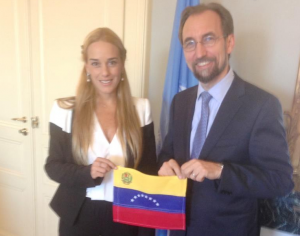
UN High Commissioner for Human Rights and Lilian Tintori, wife of opposition leader Leopoldo López who is currently serving a 13 year sentence (in house arrest) for his responsibility in the deadly violence of the 2014 guarimbas.
By Ricardo Vaz | Investig’Action | September 21, 2017
The mainstream media have a crucial role to play in the war against Venezuela, creating a distorted narrative and a constant frenzy that are crucial for any regime-change operation. With violent protests having failed to topple the government and to stop the Constituent Assembly, the plan switched to military threats and economic sanctions. But these come directly from an unpopular US administration, and a more impartial-looking figure was needed. The High Commissioner for Human Rights, Jordanian Prince Zeid bin Ra’ad al Hussein, stepped up to the plate with the backing of more than 100 NGOs. We tackle the manipulation of human rights for imperial purposes, but first we examine how the term “NGO” is woefully inadequate to describe these organisations.
*****
So much more than NGOs
On occasion of the 36th Session of the UN Human Rights Council, 116 “NGOs”1 signed a letter demanding that Venezuela be a priority for the Office of the High Commissioner for Human Rights (OHCHR). The effort was spearheaded by none other than Human Rights Watch (HRW). HRW has a long and documented history of bias and outright lies in their reports on Venezuela, which is no surprise given their blatant revolving door with the US government. Among the signatories are several usual suspects such as Provea or Foro Penal, whose president Alfredo Romero was a recent speaker in a “US Democracy Support” forum.
Another organisation on the list is Transparencia Venezuela, which includes as sources of funding the EU, several embassies and the parent organisation Transparency International. And although Transparency International is much shadier than it sounds, at least we can laud their transparency in listing their backers. The list includes the US State Department, the National Endowment for Democracy (NED), George Soros’ Open Society, even corporations such as Shell. One more that stands out, and is quoted regularly by the media, is the International Commission of Jurists, which sounds very noble and independent until you discover that they were initially funded by the CIA.
The issue here is with the term “non-governmental organisation”, which are always presented by the media as faultless, impartial actors. While there are many scenarios in which independent organisations can step in and provide invaluable services, this is hardly the case of groups funded by the NED (or USAID, or similar agencies) to “promote democracy” or “defend human rights” in countries like Venezuela. These are merely extensions of the US and western foreign policy apparatus, working as the local infrastructure that is necessary in regime change operations as well as a source for the media to build its biased narrative.
At the end of the day, it is the term “non-governmental organisation” that falls very short of describing the nature and activities of these groups. If an organisation in Venezuela, or anywhere else, is funded by the US government, in what world is it a “non-governmental organisation”? One cannot prove that all the “NGOs” standing with HRW are western-funded, but advancing western interests is very much advancing corporate interests, and it is doubtful that anyone would do that for free.
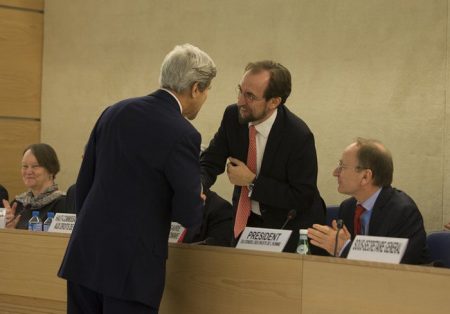
UN High Commissioner for HR shaking hands with former US Secretary of State John Kerry. (If by accident their speeches were switched nobody would notice!)
Weaponizing human rights
While one should not judge a book by the cover, it might be useful to consider the background of the UN High Commissioner for Human Rights, Prince Zeid bin Ra’ad al Hussein. A member of the royal family of Jordan, he comes from a Hashemite dynasty whose calling card has been its pliancy to imperial interests in the Middle East. And having served as ambassador to the US and permanent representative to the UN, he is, much like Jordan, someone the US can rely upon.
His most recent statement, which could just as well have been written by the US State Department, was delivered during the 36th Session of the Human Rights Council. It takes aim at every inconvenient country, from Iran to North Korea, while important US allies like Bahrain or Egypt are invited to “engage more productively” with his office. Israel is treated with kid gloves, and somehow the blame for the humanitarian crisis in Gaza is supposed to be shared between Israeli and Palestinian authorities. And there is no mention whatsoever of Saudi Arabia, where surely there are no human rights issues… Even when addressing the catastrophe in Yemen there is only a passing mention to “coalition airstrikes”.
And then the High Commissioner gets to Venezuela, sounding like any opposition leader or US official on “human rights violations” during anti-government protests or the “crushing [of] democratic institutions”, and suggesting an investigation into possible “crimes against humanity”. Never mind Colombia, where for years the army killed thousands of civilians and dressed them as rebels to collect rewards. Never mind Saudi Arabia, conducting double tap strikes2 against funerals in Yemen, or the US “torturing some folks,” or Israeli soldiers killing children because they were “running like terrorists.” The High Commissioner is worried that crimes against humanity have been committed in Venezuela!
This statement comes on the heels of a OHCHR report about Venezuela that Joe Emersberger described as “embarrassingly shoddy and biased.” It barely mentions any violence coming from the opposition ranks, and while offering a tally of deaths allegedly caused by government forces and the bogeyman colectivos, there is no detailed breakdown to be compared with other accounts such as the one by Venezuelanalysis. Remarkably, given the importance of the issue and the damning verdict that the OHCHR wishes to pass, no investigators from the UN body set foot in Venezuela. Instead the report relies on carefully selected testimonies and the “NGOs” we just discussed.
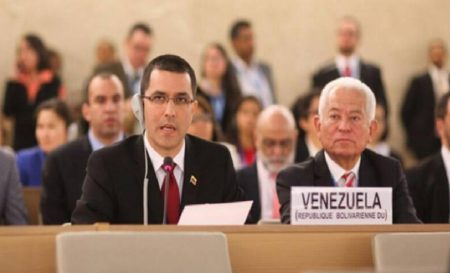
Venezuelan Foreign Minister Jorge Arreaza condemned the manipulation of human rights to attack Venezuela and the lies in the recent OHCHR report.
True NGOs strike back
While the amenable High Commissioner and the poorly-named “NGOs” put on their show to further the regime-change operation in Venezuela, others were not about to take it sitting down. True NGOs, independent organisations that are not pawns in imperialist machinations, and which are truly committed to human rights, condemned foreign meddling in Venezuela and the politicisation of human rights. One example was Swiss-based CETIM, an organisation focused on supporting social movements in the Global South. Concerning Venezuela, it released a statement that said:
[…] we declare ourselves for an immediate return to calm and to dialog, for the respect of Venezuelan peoples’ right to self-determination and the deepening of the process of democratic transformation that they have freely and courageously undertaken for two decades […]
Another organisation that reacted to the recent actions of the OHCHR was the International Association of Democratic Lawyers (IADL), through its representative at the UN, Micòl Savia, during one of the plenary meetings of the 36th Session of the Human Rights Council (intervention #35 in this link)
The IADL expresses its most profound dismay at the recent OHCHR report […]. Given its severity, we are particularly concerned by the High Commissioner’s mention of […] crimes against humanity, which lacks any legal grounds or sense of proportion. […]
The report is selective and biased, and represents a further example of the unfortunate politicisation that affects the work of the OHCHR, undermining its credibility and standing. Use of firearms, explosives, setting up barricades, people burned alive, attacks against hospitals, […], is this the model of “peaceful protests” that this council wants to promote?
Judge, jury and executioner
In the end the bias and lack of standards, or outright falsehood, of these claims and reports does not matter, because if the target is Venezuela they only have to look credible. The media will then do the rest, creating a background by repeating that “Venezuela has been accused by the UN of human rights abuses”, regardless of the shoddiness of the accusations, and this will be the basis to justify future escalations and aggressions as the empire pulls out all the stops to get rid of the biggest threat in its “backyard”.3
This is a good time to stress that legal systems are not moral or just by definition, but a reflection of who holds power, and this is especially true of international law. Though the struggle for an arena where all countries have the same weight is imperative, we are fooling ourselves if we are counting on international bodies to be impartial upholders of justice (just look at Palestine). Recent international tribunals have only served to reinforce the US/western narrative, either as a posteriori justification for past wars such as the one in Yugoslavia, or to justify upcoming ones against troublesome leaders like Gaddafi.
We should clarify that our argument is not some kind of moral relativism, whereby we defend that the alleged crime A should not be investigated until justice is served for (the much worse) crime B. We are not arguing that nobody can be guilty of crimes against humanity until Henry Kissinger is tried, although it is hard to take any international tribunal seriously if the most blatant crimes are immune from prosecution. But what is definitely absurd and unacceptable is to have the US empire, either directly or through its proxies, be the judge trying other people and countries.
Notes
- The HRW statement, and all pieces about it, refer to 116 NGOs; however, the organisations listed only total 115…
- Double tap strikes comprise an initial strike on a target followed by another one targeting first responders.
- In its article about this issue, the Guardian refers to a high-profile jailed opposition leader called Leonardo López (his name is Leopoldo López). Given the overall bias and lack of standards, this is probably fitting.
Italy Ramps Up Weapons Supplies to Saudi Arabia in Spite of EU Calls for Embargo
Sputnik – September 16, 2017
European countries such as Italy continue to increase arms exports to Saudi Arabia in spite of European Parliament resolutions calling for an embargo on sales to Riyadh in light of violations of human rights and international law in Yemen.
A recent European Parliament resolution which calls for an arms embargo against Saudi Arabia is no deterrent to Italy, which continues to increase its arms sales to the Middle East despite concerns that the flow of weapons is contributing to instability there.
Enrico Piovesana, an Italian journalist and director of the Center for Monitoring of Arms Expenditures (MILEX), told Sputnik Italia that Italy’s exports have risen dramatically.
“According to the most recent data, for 2016, income from arms exports doubled in comparison with the previous year, from €7.9 billion ($9.4 billion) to €14.16 billion. This figure is even more impressive if we compare it with data for 2014: €2.6 billion.”
“This is significant growth, and the Italian foreign ministry considers it a triumph: in its last report, it said that this sector has finally emerged from the [economic] crisis thanks to the flexibility of its supply.”
According to the Stockholm International Peace Research Institute (SIPRI), Italy was the world’s eighth largest arms exporter in 2016.
Italy is also third on the global ranking of arms exporters by number of countries to which it exports, Piovesana said.
“Saudi Arabia is the sixth largest client for Italian weapons producers,” he explained.
The non-binding resolution passed by the European Parliament on Wednesday is the third call in two years by EU parliamentarians to enforce EU Council rules on the arms export control and impose an embargo on exports to Saudi Arabia.
On September 5, the UN Human Rights Office issued a report recording violations and abuses of human rights and international humanitarian law which occurred in the two-and-a-half years since Saudi Arabia and its coalition partners launched a bombing campaign in Yemen to overthrow the Houthi rebels who ousted former President Abdrabbuh Mansour Hadi.
Between March 2015 and 30 August 2017, at least 5,144 civilians have been documented as killed and more than 8,749 injured, according to the UN figures. Some 3,233 of the civilians killed were reportedly killed by Coalition forces, whose airstrikes continued to be the leading cause of civilian casualties.
Giorgio Beretta, an analyst from the Union of Italian Disarmament Associations, told Sputnik that Italian-made bombs are known to have been used in airstrikes on civilians.
“The UN report talks about documentation confirming the use of Italian bombs in civilian areas in Yemen. These are bombs manufactured by the Italian company RWM, which were produced and exported with the permission of the Italian government. Both the Gentiloni government and the previous Renzi government gave permission for the export of these bombs.”
“Some EU countries, such as Sweden and the Netherlands, have suspended the supply of military equipment to Saudi Arabia. Other countries, such as Germany, decided to suspend the supply of weapons that could be used by Saudi Arabia in the conflict with Yemen. The UK, France and Italy continue to deliver supplies. In 2016, Italy delivered nearly 20,000 aerial bombs worth more than €411 million, which is the country’s largest supply of bombs since the end of World War II. It is absolutely clear that this is a political decision,” Beretta said.
Saudi Arabia has become the world’s second largest arms importer after India, with an 8.2% share in the market. While Italy has increased its supplies, they are still dwarfed by the US, which exports 52% of Riyadh’s imports, and the UK, which exports 27%, according to the SIPRI.
“It should be noted that that Italy is not the largest supplier to Riyadh. Trump signed a contract to sell $110 billion million of weapons to the Saudis. But nevertheless, supplies from the EU are important since there are European components in many military systems that Saudi Arabia buys.”
Beretta said that the European Parliament’s resolution and the EU Council’s Common Policy on arms exports are rather toothless in the face of lobbying from arms producers.
“International norms, as well as EU norms, don’t provide for sanctions for those who violate the International Arms Trade Treaty, as well as for those who contradict EU position. This is a big mistake, but it’s not surprising [because] these same countries exerted strong pressure to prevent the introduction of sanctions measures. At the international level, the only competent authority that can actually impose or remove sanctions is the UN Security Council. At the EU level, this is the EU Council.”
“However, there is another way: in the case of Riyadh, if one of the member countries violates the embargo, another country may legally refuse to sell arms to them. For example, if the UK violates this possible embargo, Italy could stop supplying arms to London. It can break the vicious circle. But let’s not forget that lobbyists and large arms corporations will exert pressure and try to prevent sanctions measures for violators of the embargo,” Beretta warned.
Anti-Russian sanctions cost Europe $100bn – UN Special Rapporteur
RT | September 13, 2017
Over the last three years, the European Union has been losing at least $3.2 billion every month due to the anti-Russian penalties, according to a report by a UN Special Rapporteur Idriss Jazairy.
“The most credible approximation is of $3.2 billion a month,” says the report on the negative impact of the unilateral coercive measures, as quoted by Sputnik.
Jazairy stressed that Russia had sustained a direct loss of nearly $15 billion a year or a total of $55 billion so far.
“The resulting overall income loss of $155 billion is shared by source and target countries,” he added.
EU sanctions against Russia were introduced in 2014 over the country’s alleged involvement in the conflict in eastern Ukraine and Crimea. The penalties targeted Russia’s financial, energy, and defense sectors, along with some government officials, businessmen, and public figures.
Moscow responded by imposing an embargo on agricultural produce, food and raw materials on countries that joined the anti-Russian sanctions. Since then the sides have repeatedly broadened and extended the restrictive measures.
Russia is the EU’s fourth-largest trading partner after the US, China and Switzerland. The country is also Europe’s biggest natural gas supplier, as well as one of its biggest oil suppliers.
The penalties have been severely criticized by European politicians and businessmen as both politically ineffective and economically harmful for both Russia and Europe.
Sweden: Giving Up Neutrality Against People’s Will
By Peter KORZUN | Strategic Culture Foundation | 13.09.2017
Sweden, a non-NATO nation, has launched its largest military exercise in over 20 years. The drills are being conducted at Russia’s doorstep amid rising military activity in the Baltic Sea region. The timing (Sept. 11-29) is outright provocative as Aurora 2017 is taking place at about the same time (Sept. 14-20) as Zapad 2017, a major Russian exercise in Belarus.
The three-week Aurora 17 is held across Sweden, including the strategic Baltic Sea island of Gotland, not far from the Russian exclave of Kaliningrad, and the areas around Stockholm and Goteborg. It is conducted in the air, on land and at sea. About 20,000 servicemen, and over 40 Swedish civil authorities, will take part in the drills across the country, including around 1435 troops from the US, Denmark, Norway, France, Estonia, Lithuania and non-NATO Finland. It strikes the eye that Finland, a non-NATO state, has significantly larger participation (270 servicemen) than other European NATO members. For instance, France sent 120 soldiers Denmark, Norway, Lithuania and Estonia sent between 40-60 each.
«They haven’t done something like this in 25, 30 years», said Ben Hodges, commanding general, United States Army, Europe. The United States has sent a Patriot missile battery, helicopters and a National Guard tank company. This is the first time ever American armored vehicles and air defenses were deployed on Swedish soil. In June, the Swedish military also announced its intention to replace all of its aging air defense systems and potentially buy US-made Patriot missiles, citing an alleged threat from Russian Iskander-M missile systems stationed in Kaliningrad.
The war games have also raised the possibility of Sweden joining NATO to formally end its traditional neutrality that kept it out of military conflicts since 1814. The issue will be debated in the country’s 2018 election – if the three centre-right allies get their way, the country will join the alliance.
Sweden has been a member of the NATO program «Partnership for Peace» since 1994. It has taken part in NATO missions in Afghanistan, Balkans and Libya.
Since 2009, Sweden has been committed to the defense of EU members – another breach of neutrality. Mainly EU members are also parties to NATO, it’s impossible to separate them in war. In fact, Stockholm has committed itself to comply with Article 5 of the Washington Treaty regarding European members of the North Atlantic Alliance. Swedish troops and equipment have been used in the EU operation in Mali.
In May 2016 the Swedish parliament ratified the Host Nation Support Agreement with NATO, allowing the pact to store equipment in Sweden and be able to use the country for transport and transit of forces if a crisis should occur in the region. The agreement does not mention nuclear weapons. With the document in force, there is no guarantee that nuclear weapons will not be deployed on Swedish soil. Aurora 2017 is the first time the Host Country Agreement has been used.
In June 2016, Sweden signed a treaty with the US that aims to increase military capability and interoperability between the parties. Specifically, the two nations will conduct training and exercises with an eye to the «distinct political signal» that combined operations will send. Armament cooperation and research and development of future technologies will focus on undersea warfare and air defense, the document notes.
In late 2016, Sweden’s civil protection agency organized under the Ministry of Defense issued an official letter to country’s local authorities to prepare for a possible war with Russia. Sweden is increasing defence spending, and plans to reintroduce conscription from January 2018. Four thousand men and women will be drafted into the defense forces.
Though not formally a member, Sweden is also a part of NATO Rapid Reaction Force. It participates in the joint NATO air transport fleet to be used in conflicts anywhere in the world.
Two top defense officials – Micael Bydén, Supreme Commander of the Swedish Armed Forces, and Chief of Defence Staff Dennis Gyllensporre, have recently supported the idea of changing the military stance to ‘treaty-bound’ defense commitments, in effect meaning full-fledged membership in NATO. They were backed by Allan Widman, Chairman of the Swedish parliament’s defense committee. Visiting Washington in May, Prime Minister Peter Hultqvist said: «We are building a security network of defence cooperation». No doubt that Aurora 2017 is part of this effort.
Seven out of eight Swedish parliamentary parties believe that Aurora 17 will strengthen the country’s capacity to deal with a potential attack and will deepen its military cooperation with other countries, while the Left Party and peace organizations have warned of a spiraling arms race.
Despite media efforts and statements by politicians and officials, the Swedish people oppose the idea of NATO membership. According to a June survey published by Svenska Dagbladet newspaper, public support for the idea of Sweden becoming a NATO member has dropped from 41 to 33 percent in less than a year. Forty-nine percent of Swedes, who took part in the survey published by the Svenska Dagbladet newspaper, said they don’t want their country to join the US-led military bloc. Thirty-three percent supported the possible NATO bid, while 18 percent said that they were undecided. In 2015, 41 percent said that they were in favor of Sweden applying for NATO membership, with 39 percent rejecting the move and 20 percent undecided. Social Democrats, the Greens and Left Party voters showed the strongest opposition to NATO accession.
Politicians may say one thing and do another but one cannot change reality. In practice, Sweden has become a full-fledged NATO member and it has been done against the people’s will. With the defense commitment within the framework of EU and the bilateral agreement with the United States mentioned above in the article, Sweden is no different from other states of the alliance. Moreover, it’s one of the most active participants in the bloc’s military activities with a contribution exceeding by far some founding members. It is Sweden, a non-NATO, country who organized Aurora 2017, openly challenging Russia, which will conduct Zapad exercise under surveillance of Western observers according to the provisions of Vienna Document. Despite the obvious facts, Sweden is saying it’s not a NATO event once it was organized by a non-member nation.
It’s easy to predict that the US air defense systems will be stationed in Gotland to be guarded by American personnel. Instructors will also be there. Then reasons will be found to justify the presence of US military in other areas on Swedish soil under the pretext of «rotation» to hold exercises like it is done in Norway where American Marines are stationed permanently in breach of tried-and-true foreign policy principle excluding the stationing of foreign military on Norwegian soil.
No doubt, the policy does not make Sweden safer as Russia will deliberate an appropriate response. In June, Russian President Vladimir Putin warned that «If Sweden joins NATO; it will negatively affect our relations because it will mean that NATO facilities will be set up in Sweden so we will have to think about the best ways to respond to this additional threat».
This neutrality policy was, and still is, hugely popular in Sweden. But to call a spade a spade, Sweden is no longer neutral in practice. It has become a leading NATO nation, whose official non-alignment does not reflect reality. One should believe deeds not words. Aurora 2017 is a good example of the fact that the Swedish neutral status has become a thing of the past.
Constitutional Crisis Brews in Moldova as Government Tests President’s Authority
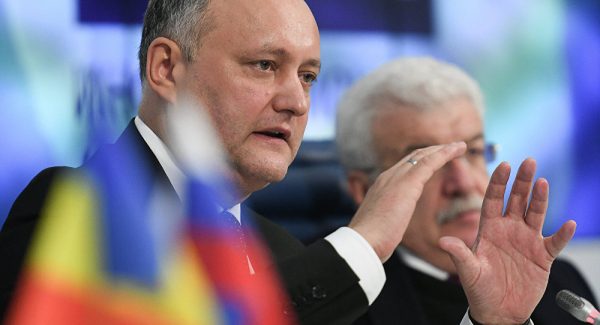
Sputnik – 4 10.09.2017
Moldovan President Igor Dodon is demanding the resignation of Deputy Defense Minister Gheorghe Galbura for defying a presidential order to block the deployment of Moldovan troops to Ukraine to participate in NATO-led military drills. Speaking to Sputnik, regional expert Boris Rozhin warned that the country is on a path to a constitutional crisis.
The Moldovan government approved sending several dozen troops to Ukraine last week, ignoring Dodon’s decree to block the deployment. Dodon described the move as an ‘usurpation of power’ by the cabinet.
Speaking to Radio Sputnik about what’s likely to happen next, Boris Rozhin, an expert at the Center of Military-Political Journalism, said that the Moldovan government will be likely to try to ignore or challenge the president’s demand for Galbura’s resignation.
“This confrontation over sending the military abroad is an indication that the constitutional crisis in Moldova is deepening,” the expert said. “The parliament and the government are refusing to recognize the president’s authority as commander-in-chief to give orders to the country’s armed forces.”
“This issue will be considered at a meeting of the country’s Security Council, and most likely, by the constitutional court, as Dodon’s decision to dismiss the deputy defense minister will either be ignored or contested,” Rozhin added.
The expert believes that this confrontation between the branches of Moldova’s government is likely to continue until the next parliamentary elections, tentatively set for November 2018.
“The confrontation can be resolved through a decision of the constitutional court, which confirms or rejects Dodon’s right to issue orders to the Armed Forces, or deepen further and continue until the next parliamentary elections,” Rozhin said.
“After that, a reformatting of the legislature may take place. At the moment, the ruling establishment does not reflect the alignment of forces in Moldovan society, which has grown tired of the government’s push for European integration, which did not bring the hoped for economic and social improvements for ordinary people.”
As the constitutionally designated commander-in-chief, Dodon vetoed the government’s decision to send 57 National Guard troops to Ukraine for NATO exercises, reminding them that Moldova is a neutral state. Ignoring the president’s order, the contingent left for Ukraine anyway. The president also signed a decree which said that Moldovan military forces would not be allowed to be sent abroad for military exercises, training or any similar events without approval from the president.
The present crisis is not the first public conflict between Dodon and the cabinet o ministers. Earlier, the government asked the UN General Assembly to consider the removal of Russian peacekeeping troops from the breakaway republic of Transnistria. Dodon called the initiative an “empty PR move.” The president and the cabinet have faced off over Russia repeatedly, the government proposing a series of unfriendly gestures, with the president, in turn, saying that he would like to bring the country closer to Moscow.
Dodon, often described by Western political observers as ‘pro-Russian’, won presidential elections in 2016, defeating his pro-West, pro-EU opponent Maia Sandu. Moldova’s parliament and government are dominated by the pro-EU Democratic Party of Moldova, a social democratic party closely associated with oligarch Vladimir Plahotniuc, and a collection of independent MPs.
Commenting on the political situation in the country, political observer Viktor Marakhovsky wrote that it would be more correct to call Dodon ‘pro-Moldovan’ than ‘pro-Russian’, because the pro-EU elites he is up against have effectively “privatized political power in exchange for international grants, figuratively speaking.” Not only do they seek to give up sovereignty to EU structures; some have spearheaded a campaign pushing for Romania’s absorption of Moldova, a campaign actively supported by Bucharest.
Marakhovsky thinks that Dodon’s best hope will be to organize a referendum to ask Moldovans to approve the expansion of the president’s powers, fresh elections and returning the subject of the history of Moldova to the country’s schools, replacing ‘the history of Romania’ subject presently being taught.
Simonyan Slams Reporters Without Borders for Calling RT ‘Enemy of Journalism’
© Flickr/ Marieke Guy
Sputnik – August 28, 2017
RT Editor-in-Chief Margarita Simonyan struck back at Reporters Without Borders, which called the channel “an enemy of journalism” allegedly exploiting the EU parliament resolution against Russian media outlets comparing them to Daesh terrorist group propaganda.
RT and Sputnik Editor-in-Chief Margarita Simonyan said Monday that Reporters Without Borders (RSF) is discrediting the work of advocacy groups by calling the broadcaster “an enemy of journalism.”
“Following such horrific remarks Reporters Without Borders should quietly self-dissolve, so as not to disgrace true human rights defenders,” Simonyan told the RT commenting on Deloire’s remarks.
On August 26, RSF Secretary General Christophe Deloire in an interview with Telerama magazine cited Simonyan’s appeal for protection against the European parliament’s 2016 resolution on countering alleged Russian anti-EU propaganda and media, including RT and Sputnik, as an example of how “enemies of journalism are exploiting the principles adopted to protect it.”
In November 2016, the European Parliament passed a resolution where it described the two media outlets as a threat to Europe’s unity and drew a parallel between them and propaganda disseminated by Daesh terrorist group. The document calls for extra European Commission funding for counter-propaganda projects.
Sputnik responded by calling the move a direct violation of media freedom and human rights, while Russian President Vladimir Putin commented on the matter by pointing out that the document indicates a degradation of democracy in the West.
Sputnik contacted RSF for the organization’s comments on the resolution, only to be told that the organization had taken a decision to no longer give interviews to Rossiya Segodnya.
‘Smokescreen’ or Reality? Why Macron’s Prediction on EU’s Breakup May Come True
Sputnik – 26.08.2017
Commenting on President Emmanuel Macron’s recent statement about the EU’s possible disintegration without a social dumping reform, a French expert warned in an interview with Sputnik that such a prediction may come true at the end of the day.
Earlier this week, Macron said that the EU may break up if it fails to overhaul a rule allowing companies to send temporary workers from low-wage countries to richer nations without paying their local social charges.
Henri Sterdyniak is one of the authors of a manifesto, which was published back in September 2010 by a group of economists criticizing neo-liberalism. The document was all about the inflexibility of European economic policy during crises.
The authors slammed the “organization of competition among European workers” and warned that there is a real risk that the European countries will “retreat into in themselves.”
So did these predictions come true? Sterdyniak told Sputnik France that the answer to this question is certainly “yes.”
“The main proof of this was Brexit. Another important aspect is the massive influx of workers from Eastern Europe, as well as the growing popularity of [the right-wing] National Front in France and the Alternative for Germany (AfD) party in Germany,” he said.
“There are a number of factors that show that the popular masses in the developed countries of Western Europe believe that their well-being is threatened by globalization and, especially, by the construction of European architecture,” Sterdyniak added.
He pointed to a “rather strange situation” when “on the one hand, Macron criticizes the very practice of sending EU workers to other EU member states, but on the other – he does not say anything about globalization and the delocalization of industries, which are of greater importance.”
“The consequences of such a practice are much less dramatic than the implications of globalization and competition created by imports of goods from low-wage countries,” he pointed out.
Sterdyniak was echoed by Dany Lang, a lecturer at the University of Paris 13 and the University of Saint-Denis in Belgium.
He believes that Macron’s statements about the tightening of European rule are a “smokescreen” on the eve of a reform of the French labor code.
According to Lang, Macron’s goal is to try to boost his approval rating by making such statements now that “he is working out a new labor code which will severely damage social rights.”
“So let’s see whether any actions will follow these statements,” Land said, pointing to the fact that Poland, one of the main countries sending its workers to France, is not involved in the discussion.
“I think that the European ideal has significantly surrendered its positions. The austerity policy is carried out with unprecedented ruthlessness, particularly in Greece. I do not see why and how the reform of sending workers abroad will help improve the situation,” he said.
According to him, “Emmanuel Macron has no right to uphold social rights given his views and beliefs.”
“There is something paradoxical about a desire to trample social rights across France while saying that you want to protect them at the level of Europe,” Lang said.
Prime Ministers of Czech Republic Bohuslav Sobotka, Poland Beata Szydlo, Hungary Viktor Orban, and Slovakia Robert Fico, join hands to cut a cake to celebrate 25th anniversary of the establishment of the
“The [French] government decrees on labor legislation will be made public in a few days. As for Macron’s statements, they add to the creation of a ‘smokescreen,’ which aims to prevent the discussion on the French labor code,” Lang concluded.
In the run-up to his visit to Bulgaria, Macron said Thursday, “Some political or business circles seek to use the EU’s funds while at the same time developing a system of social and fiscal dumping.”
He warned that “this will lead to the dismantling of the European Union” if the upcoming EU summit fails to clinch a reform agreement.
‘Europe is lost’: Barcelona’s chief rabbi urges Jews to move to Israel
RT | August 19, 2017
In the aftermath of this week’s terrorist attacks in Barcelona, the city’s chief rabbi has warned his community that Jews in the region are doomed because of the threat of radical Islam.
At least 14 people were killed and over 100 injured in two separate terrorist attacks in Barcelona and the nearby coastal town of Cambrils. Islamic State (IS, formerly ISIS/ISIL) claimed responsibility for the attack on Las Ramblas in Barcelona.
“I tell my congregants: Don’t think we’re here for good, and I encourage them to buy property in Israel,” Rabbi Meir Bar-Hen said in an interview with Jewish news agency JTA.
“This place is lost. Don’t repeat the mistake of Algerian Jews, of Venezuelan Jews. Better [get out] early than late.”
Bar-Hen said the attacks highlighted the presence of a large Muslim community with “radical fringes” in the region, and alleged Spanish authorities are reluctant to confront Islamist terrorism.
The rabbi cited the recent decision to allow Palestinian Leila Khaled to enter Spain for a book festival as apparent evidence of his claim. Khaled was involved in high-profile airplane hijackings in 1969 and 1970.
The rabbi, who was keen to stress that he was speaking in a private capacity and not on behalf of the community, also said this applied more widely to Europe as a whole.
“Europe is lost,” he concluded.
The Federation of Jewish Communities of Spain appear not to share Bar-Hen’s pessimistic outlook. The organization issued a statement Thursday, saying: “Spanish Jews trust the State Security Corps that work daily to prevent radical fanatics and Islamists from sowing chaos and pain in our cities.”
The group also urged politicians to “deal intelligently and determinedly with the struggle against fanaticism and in favor of freedom and democracy.”
AIPAC video describes decades-long role in US laws against BDS
If Americans Knew – August 14, 2017
AIPAC, the American Israel Public Affairs Committee, is a powerful Washington DC lobbying organization. In this 2016 video, AIPAC describes how it has successfully worked to create U.S. laws against boycotting Israel over its multitudinous violations of human rights and international law.
The video doesn’t mention the anti-boycott legislation working its way through Congress right now (S.720 / H.R. 1697) that AIPAC helped draft: iak.salsalabs.org/antiboycottbill
Such anti-boycott laws hurt everyone.
They interfere with Americans’ fundamental consumer rights and freedom of speech, often harm American businesses and thereby the U.S. economy, and damage American international relations.
They prevent peace and perpetuate violence in the Middle East. By helping to sustain Israel’s enormous power over Palestinians, they cause Israeli leaders to believe two things: they can ignore international law, and they don’t need to negotiate with Palestinians in good faith to reach a fair and lasting peaceful resolution.
Ultimately, AIPAC’s actions have hurt Palestinians, Israelis, Americans, and the many of others impacted by the Israeli-Palestinian conflict and by Israel’s various wars against its neighbors.
Featured Video
The American Retreat from Vietnam
or go to
Aletho News Archives – Video-Images
From the Archives
Secret document reveals plans for civil war in Lebanon, Israeli false flags, and invasion
By Randi Nord | Geopolitics Alert | April 5, 2019
Beirut – During his visit with US Secretary of State, Mike Pompeo, Lebanese President Michael Aoun reportedly received a US-Israeli document detailing plans for creating a civil war in Lebanon with covert false flag operations and possible Israeli invasion.
Although the source of the document is Israeli and created in partnership with Washington, no one knows who presented it to Aoun. The Lebanese TV station, Al-Jadeed, initially reported the document on Lebanese TV and a video on its website. Geopolitics Alert translated the report for this article. … continue
Blog Roll
 Aletho News
- Department of War Awards $20.7 Billion Contract to Raytheon for Air-to-Air Missiles
- ‘Distance yourselves from Israel’: IRGC urges US population to question govt policies
- America’s Greenland deal has a radioactive backstory
- The RAF Fairford ‘terror plot’: Unpacking escalation in the UK echo-chamber
- EU Council Advances Chat Control 2.0 Scanning Proposal
- Ex-Greek MEP files complaint against Israeli spyware firm over alleged Pegasus surveillance
- Troubling ideas throughout the Torah, Talmud, Mishneh Torah and Tanya
- ‘Grave, alarming’: Iran mission on Trump’s UNGA ‘annihilation’ threats
- Najaf airport to reopen to Iranian flights within 24 hours: Ambassador
- From ‘How Will This End For Iran’ to ‘When America Walks Away’: A tale of two Economist covers
- If Americans Knew
- New Report: “Scholasticide and Genocide in Gaza: Assessment, Testimonies and Legal Analysis”
- Ex-Biden officials are desperate for a Gaza scapegoat
- Israeli “settlers” Invade Al-Aqsa; Pour Boiling Water on 75-Year-Old
- Israel Has Kidnapped Another American Teenager
- US arms sales to Israel worth $21.6 billion in 20 months
- Three Palestinians Killed in Israeli Attacks on Gaza
- Revealed: German “Anti-Semitism Expert” Driving Crackdown on Palestine Solidarity is Former Israeli Spy
- Egypt’s Warning to Israel Before Oct 7
- Israel’s siege signals another cruel winter for 1.8 million Gazans – Daily Update
- Netanyahu Asked UAE Leader to Deny Report on Oct. 7 Warning in Secret Visit, Sources Say
- No Tricks Zone
- New Study: Earth And Venus Surface Warmth Largely Explained By Convection And Lapse Rate, Not CO2 Or Radiation
- 2025 Nature Paper Claiming Worsening Global Drought Gets RETRACTED …Heavily Flawed
- New Study: ‘Global Drought Shows No Detectable Recent Acceleration Under Climate Warming’
- Economic Masterminds: German Socialists Suggest Taxing Productivity Gains Stemming From Using AI
- The South China Sea Has Not Been Cooperating With The Climate Change Narrative
- Energy Crisis: Germany Enters Heating Season With Historically Low Gas Reserve Fill Levels
- New Study: The Antarctic Ice Sheet Gained Mass From 2020-2024 Due To Staggering Snow And Ice Accumulation
- Study: Ocean Heating Rates From Thousands Of Years Ago ‘Dwarf’ Modern Ocean Heating Rates
- Climate Extremists Target, Attack Large-Scale Power Grid Infrastructure In Germany!
- New Study: Antarctic Ice Melt Has Contributed Less Than 1 Centimeter To Sea Level Rise In The Last 30 Years

