Fools Rush In: Europe Pursues Israel Gas Deal for Political Not Economic Reasons
Sputnik – April 24, 2017
An Israel-Europe gas pipeline deal elevates Israel to the status of a major Mediterranean energy exporter. However, critics suggest the move is about more than mere economics, and serves a number of greater geopolitical objectives – namely, immunizing Israel from criticism and sanctions, and damaging relations between Europe and Russia further.
Ministers from Israel, Greece, Italy and Cyprus, as well as the European Union Commissioner for Climate Action and Energy, signed a joint declaration in April, codifying a commitment to constructing a gas pipeline that will bring newly discovered natural gas in Israel [sic] to Europe.
The pipeline, described by Israeli Energy Minister Yuval Steinitz as “the longest and deepest subsea gas pipeline in the world,” is expected to be in operation by 2025.
Designated as a “project of common interest” by the EU, the pipeline has been marketed by both sides as an ideal alternative to the bloc’s continuing dependence on Russian energy — an overt indication the deal is being pursued for political rather than economic purposes. After all, high infrastructure costs coupled with low gas prices will almost by definition make it considerably dearer than the existing energy relationship between Russia and Europe.
The Atlantic Council Global Energy Center has even suggested the proposed project may never come to fruition, once the commercial difficulties inherent in making it operational become reality. Current European energy demands in no way commercially justify an additional gas supply source for the continent.
Furthermore, independent Palestinian human rights advocacy group Al-Haq has said the pipeline agreement will benefit corporations which directly profit from the occupation of Palestine — incentivizing Israel to maintain its current policy of illegal settlement expansion and its blockade of Gaza. If constructed, the pipeline will pump gas from Israel’s giant Leviathan field, the discovery of which in 2010 transformed Israel from a net importer of energy into a potential regional energy player — the field is estimated to hold around 20 trillion cubic feet of gas. Despite Lebanon arguing Leviathan sits partially in Lebanese waters, Israel has pushed ahead with international deals, selling 39.7 percent to US-based Noble Energy.
In March, Jordan became the first country to sign up for Leviathan gas. The move ignited waves of protest, on the basis the agreement would increase Jordan’s dependency on Israel, and potentially finance Israel’s occupation of Palestine.
Such concerns go beyond reflexive prejudice. Israeli Prime Minister Benjamin Netanyahu has noted the potential of gas deals to insulate the country from international condemnation and action.
“Ensuring the supply of gas is essential not only to the country’s functioning, but also to its existence. I regard the gas supply as a foundation of national security. A country that exports things crucial for other countries has far more power. The ability to export gas makes us more immune to international pressure. We don’t want to be vulnerable to boycotts,” Netanyahu said.
Moreover, in a report, Annexing Energy, Al-Haq noted it was “impossible” to geographically isolate gas fields in mainland Israel and characterize them as separate from the country’s ongoing conflict with Palestine.
“In 2011, Noble Energy, the lead operator of the Leviathan field, unilaterally extracted gas from a joint Palestinian gas field without Palestinian permission as required under customary international law and the Oslo Accords. Israel has also employed a brutal and unlawful naval operation to protect Noble Energy’s gas platforms beside the Gaza Strip, routinely attacking, killing and injuring civilian Palestinian fishermen who fish in the vicinity of Israel’s illegally imposed six-nautical-mile closure of Palestine’s territorial waters,” the report said.
In a perverse twist, the deal also comes at a time when Gaza continues to reel from a major energy crisis, which has seen power cuts lasting as long as 18 hours, and results from Israel blocking the region from developing its own resources.
The Al-Haq report concluded that if Palestinians were permitted to do so, their own energy needs would be satiated, and they would be economically self-sufficient, freed from their current aid dependency.
The Main Issue in the French Presidential Election: National Sovereignty
By Diana Johnstone | CounterPunch | April 21, 2017
Paris – The 2017 French Presidential election marks a profound change in European political alignments. There is an ongoing shift from the traditional left-right rivalry to opposition between globalization, in the form of the European Union (EU), and national sovereignty.
Standard media treatment sticks to a simple left-right dualism: “racist” rejection of immigrants is the main issue and that what matters most is to “stop Marine Le Pen!” Going from there to here is like walking through Alice’s looking glass. Almost everything is turned around.
On this side of the glass, the left has turned into the right and part of the right is turning into the left.
Fifty years ago, it was “the left” whose most ardent cause was passionate support for Third World national liberation struggles. The left’s heroes were Ahmed Ben Bella, Sukarno, Amilcar Cabral, Patrice Lumumba, and above all Ho Chi Minh. What were these leaders fighting for? They were fighting to liberate their countries from Western imperialism. They were fighting for independence, for the right to determine their own way of life, preserve their own customs, decide their own future. They were fighting for national sovereignty, and the left supported that struggle.
Today, it is all turned around. “Sovereignty” has become a bad word in the mainstream left.
National sovereignty is an essentially defensive concept. It is about staying home and minding one’s own business. It is the opposite of the aggressive nationalism that inspired fascist Italy and Nazi Germany to conquer other countries, depriving them of their national sovereignty.
The confusion is due to the fact that most of what calls itself “the left” in the West has been totally won over to the current form of imperialism – aka “globalization”. It is an imperialism of a new type, centered on the use of military force and “soft” power to enable transnational finance to penetrate every corner of the earth and thus to reshape all societies in the endless quest for profitable return on capital investment. The left has been won over to this new imperialism because it advances under the banner of “human rights” and “antiracism” – abstractions which a whole generation has been indoctrinated to consider the central, if not the only, political issues of our times.
The fact that “sovereignism” is growing in Europe is interpreted by mainstream globalist media as proof that “Europe is moving to the right”– no doubt because Europeans are “racist”. This interpretation is biased and dangerous. People in more and more European nations are calling for national sovereignty precisely because they have lost it. They lost it to the European Union, and they want it back.
That is why the British voted to leave the European Union. Not because they are “racist”, but primarily because they cherish their historic tradition of self-rule.
The Socialist Party shipwreck
As his five-year presidency drew to its ignominious end, François Hollande was obliged by his drastic unpopularity to let his Parti Socialiste (PS) choose its 2017 presidential candidate by primary. In a surprising upset, the Socialist government’s natural candidate, prime minister Manuel Valls, lost to Benoit Hamon, an obscure member of the PS left wing who refused to vote for the unpopular, neo-liberal, anti-labor laws designed by Hollande’s economic advisor, Emmanuel Macron.
To escape from the unpopularity of the PS, Macron formed his own movement, “En Marche!” One after another, Valls, Hollande and other prominent PS leaders are tiptoeing away, leaving Hamon at the helm of the sinking ship. As Hamon justifiably protests against their betrayal, the party bigwigs pledge their support to Emmanuel Macron.
Macron ostentatiously hesitates to welcome his shopworn converts into the fold, fearing that their conversion makes it too obvious that his “En Marche!” is a clone of the right wing of the PS, on the way to becoming the French subsidiary of the U.S. Democratic Party in its Clintonian form. Macron proclaims that he is neither left nor right, as discredited politicians from both left and right jump on his bandwagon, to his embarrassment.
Hamon himself appears to be unaware that the basic cause of the Socialist Party’s shipwreck is its incompatible devotion to two contrary principles: traditional social democracy, and the European Union (EU). Macron, Hollande and their fellow turncoats at least have made their choice: the European Union.
The Twilight of the Traditional Right
The great advantage of Republican candidate François Fillon is that his policies are clear. Unlike Hollande, who tried to disguise his neoliberal policies as something else, and based his claim to be on the left on “societal” issues (gay marriage), Fillon is an unabashed conservative. His policies are designed to reduce the huge national debt. Whereas previous governments (including his own, when he was President Sarkozy’s Prime Minister) beat around the bush, Fillon won the Republican nomination by a program of sharp cutbacks in government spending. Fillon claims that his austerity measures will lead French capitalists to invest in France and thus save the country’s economy from being completely taken over by foreign corporations, American retirement funds and Qatar. This is highly doubtful, as there is nothing under EU rules to encourage French investors to invest in France rather than somewhere else.
Fillon departs from EU orthodoxy, however, by proposing a more independent foreign policy, notably by ending the “absurd” sanctions against Russian. He is more concerned about the fate of Middle East Christians than about overthrowing Assad.
The upshot is that Fillon’s coherent pro-capitalist policy is not exactly what the dominant globalizing elite prefers. The “center left” is their clear political choice since Tony Blair and Bill Clinton revised the agendas of their respective parties. The center left emphasis on human rights (especially in faraway countries targeted for regime change) and ethnic diversity at home fits the long-term globalist aims of erasing national borders, to allow unrestricted free movement of capital. Traditional patriotic conservatism, represented by Fillon, does not altogether correspond to the international adventurism of globalization.
The Schizophrenic Left
For a generation, the French left has made “the construction of Europe” the center of its world view. In the early 1980s, faced with opposition from what was then the European Community, French President François Mitterrand abandoned the socializing program on which he been elected. Mitterrand nursed the hope that France would politically dominate a united Europe, but the unification of Germany changed all that. So did EU expansion to Eastern Central nations within the German sphere of influence. Economic policy is now made in Germany.
As the traditional left goal of economic equality was abandoned, it was superseded by emphatic allegiance to “human rights”, which is now taught in school as a veritable religion. The vague notion of human rights was somehow associated with the “free movement” of everything and everybody. Indeed the official EU dogma is protection of “free movement”: free movement of goods, people, labor and (last but certainly not least) capital. These “four freedoms” in practice transform the nation from a political society into a financial market, an investment opportunity, run by a bureaucracy of supposed experts. In this way, the European Union has become the vanguard experiment in transforming the world into a single capitalist market.
The French left bought heavily into this ideal, partly because it deceptively echoed the old leftist ideal of “internationalism” (whereas capital has always been incomparably more “international” than workers), and partly due to the simplistic idea that “nationalism” is the sole cause of wars. More fundamental and complex causes of war are ignored.
For a long time, the left has complained about job loss, declining living standards, delocalization or closure of profitable industries, without recognizing that these unpopular results are caused by EU requirements. EU directives and regulations increasingly undermine the French model of redistribution through public services, and are now threatening to wipe them out altogether – either because “the government is bankrupt” or because of EU competition rules prohibit countries from taking measures to preserve their key industries or their agriculture. Rather than face reality, the left’s reaction has mostly been to repeat its worn-out demand for an impossible “Social Europe”.
Yet the dream of “social Europe” received what amounted to a fatal blow ten years ago. In 2005, a referendum was called to allow the French to approve a Constitution for united Europe. This led to an extraordinary popular discussion, with countless meetings of citizens examining every aspect of this lengthy document. Unlike normal constitutions, this document froze the member States in a single monetarist economic policy, with no possibility of change.
On May 29, 2005, French voters rejected the treaty by 55% to 45%.
What seemed to be a great victory for responsible democracy turned into its major failure. Essentially the same document, renamed the Lisbon Treaty, was ratified in December 2007, without a referendum. Global governance had put the people in their place. This produced widespread disillusion with politics as millions concluded that their votes didn’t matter, that politicians paid no attention to the will of the people.
Even so, Socialist politicians continued to pledge undying allegiance to the EU, always with the prospect that “Social Europe” might somehow be possible.
Meanwhile, it has become more and more obvious that EU monetarist policy based on the common currency, the euro, creates neither growth nor jobs as promised but destroys both. Unable to control its own currency, obliged to borrow from private banks, and to pay them interest, France is more and more in debt, its industry is disappearing and its farmers are committing suicide, on the average of one every other day. The left has ended up in an impossible position: unswervingly loyal to the EU while calling for policies that are impossible under EU rules governing competition, free movement, deregulation, budgetary restraints, and countless other regulations produced by an opaque bureaucracy and ratified by a virtually powerless European Parliament, all under the influence of an army of lobbyists.
Benoit Hamon remains firmly stuck on the horns of the left’s fatal dilemma: determination to be “socialist”, or rather, social democratic, and passionate loyalty to “Europe”. While insisting on social policies that cannot possibly be carried out with the euro as currency and according to EU rules, Hamon still proclaims loyalty to “Europe”. He parrots the EU’s made-in-Washington foreign policy, demanding that “Assad must go” and ranting against Putin and Russia.
Jean-Luc Mélenchon Grasps the Nettle
Not only is the drab, conformist Hamon abandoned by his party heavies, he is totally upstaged on the left by the flamboyant Jean-Luc Mélenchon, a maverick ready to break the rules. After years as a PS loyalist, Mélenchon broke away in 2005 to oppose the Constitutional Treaty, gaining prominence as a fiery orator. In 2007, he left the Socialist Party and founded the Parti de Gauche (Left Party). Allied with the much weakened Communist Party, he came in fourth in the first round of the 2012 Presidential election with 11% of the vote. This time he is running for President with his own new movement, La France Insoumise, which can be translated in a number of ways, including “the France that does not submit”.
Submit to what? Mainly, to the euro and to the antisocial, neoliberal policies of the European Union that are ruining France.
French flags and la Marseillaise have replaced the Internationale at Mélenchon rallies. “The Europe of our dreams is dead,” he acknowledges, vowing to “end the nightmare of dictatorship by banks and finance”.
Mélenchon calls for outright disobedience by violating EU treaties that are harmful to France. That is his Plan A. His Plan B is to leave the EU, in case Plan A fails to convince Germany (the current boss) and the others to agree to change the treaties. But at best, Plan B is an empty threat to strengthen his hand in theoretical negotiations. France is such a crucial member, he maintains, that a French threat to leave should be enough to force changes.
Threatening to leave the EU is just part of Mélenchon’s vast and complicated program which includes calling a national convention to draft a constitution for France’s “sixth Republic” as well as major ecological innovation. Completely changing both France and the European Union at the same time would require the nation to be in a revolutionary effervescence that is by no means visible. It would also require a unanimity among the EU’s 28 member States that is simply impossible.
But Mélenchon is canny enough to have recognized the basic problem: the enemy of jobs, prosperity and public services is the European Union. Mélenchon is by far the candidate that generates the most excitement. He has rapidly outdistanced Hamon and draws huge enthusiastic crowds to his rallies. His progress has changed the shape of the race: at this moment, he has become one of four front-runners who might get past the first round vote on April 23 into the finals on May 7: Le Pen, Macron, Fillon and himself.
The Opposites are (almost) the Same
A most remarkable feature of this campaign is great similarity between the two candidates said to represent “the far left”, Mélenchon, and “the far right”, Marine Le Pen. Both speak of leaving the euro. Both vow to negotiate with the EU to get better treaty terms for France. Both advocate social policies to benefit workers and low income people. Both want to normalize relations with Russia. Both want to leave NATO, or at least its military command. Both defend national sovereignty, and can thus be described as “sovereignists”.
The only big difference between them is on immigration, an issue that arouses so much emotion that it is hard to discuss sensibly. Those who oppose immigration are accused of “fascism”, those who favor immigration are accused of wanting to destroy the nation’s identity by flooding it with inassimilable foreigners.
In a country suffering from unemployment, without jobs or housing to accommodate mass immigration, and under the ongoing threat of Islamist terror attacks, the issue cannot be reasonably reduced to “racism” – unless Islamic terrorists constitute a “race”, for which there is no evidence. Le Pen insists that all French citizens deserve equal treatment regardless of their origins, race or religion. She is certain to get considerable support from recently nationalized immigrants, just as she now gets a majority of working class votes. If this is “fascism”, it has changed a lot in the past seventy years.
What is significant is that despite their differences, the two most charismatic candidates both speak of restoring national sovereignty. Both evoke the possibility of leaving the European Union, although in rather uncertain terms.
The globalist media are already preparing to blame the eventual election of a “sovereignist” candidate on Vladimir Putin. Public opinion in the West is being prepared for massive protests to break out against an undesired winner, and the “antifa” militants are ready to wreak havoc in the streets. Some people who like Marine Le Pen are afraid of voting for her, fearing the “color revolution” sure to be mounted against her. Mélenchon and even Fillon might face similar problems.
As a taste of things to come, on April 20, the EU Observer published an article entitled “Russia-linked fake news floods French social media”. Based on something called Bakamo, one of the newly established “fact-check” outfits meant to steer readers away from unofficial opinion, the article accused Russian-influenced web sites of favoring Marine Le Pen, Jean-Luc Mélenchon, François Fillon, Francois Asselineau, and Philippe Poutou. (They forgot to mention one of the most “sovereignist” candidates, Nicolas Dupont-Aignan, currently polling in sixth place.) Since a large majority of the eleven candidates, including three of the four front-runners, are strongly critical of the EU and of NATO and want to improve relations with Russia, it would seem that Putin wouldn’t have to make a great effort to get a more friendly French government next time around. On the other hand, the EU Observer article is only a small sample of blatant “interference in the French election” on the part of the globalists on behalf of their favorite, Emmanuel Macron, the most enthusiastic Europhile.
The Future of France
Among those listed as alleged Russian favorites, François Asselineau is by far the most thorough critic of the European Union. Systematically ignored by the media since he founded his anti-EU party, the Union Populaire Républicain (UPR), ten years ago, François Asselineau has thousands of ardent supporters who have plastered his poster all over the country. His tireless didactic speeches, reproduced on internet, have driven home several key points:
– there is no way to improve the EU from the inside, because any change would require unanimity among 27 member states who disagree on key issues.
– the only solution for France is to use Article 50 of the EU treaties to withdraw entirely, as the United Kingdom is currently doing.
– only by leaving the EU can France save its public services, its social benefits, its economy and its democracy.
– it is only by restoring its national sovereignty that genuine democratic life, with confrontation between a real “left” and “right”, can be possible.
– by leaving the EU, France, which has over 6,000 treaties with other countries, would not be isolated but would be joining the greater world.
Asselineau is a single issue candidate. He vows that as soon as elected, he would invoke Article 50 to leave the EU and immediately apply to Washington to withdraw from NATO. He emphasizes that none of the other critics of the EU propose such a clear exit within the rules.
Other candidates, including the more charismatic Mélenchon and Le Pen, echo some of Asselineau’s arguments. But they are not ready to go so far as to advocate a clear immediate break with the EU, if only because they realize that the French population, while increasingly critical of the euro and alienated from the “European dream”, is still fearful of actually leaving, due to dire warnings of disaster from the Europeists.
The first round campaign is an opportunity for Asselineau to present his ideas to a wider audience, preparing public opinion for a more coherent “Frexit” policy. By far the most fundamental emerging issue in this campaign is the conflict between the European Union and national sovereignty. It will probably not be settled in this election, but it won’t go away. This is the major issue of the future, because it determines whether any genuine political life is possible.
Diana Johnstone is the author of Fools’ Crusade: Yugoslavia, NATO, and Western Delusions. Her new book is Queen of Chaos: the Misadventures of Hillary Clinton. She can be reached at diana.johnstone@wanadoo.fr
Tillerson in Moscow: False dawn in US-Russia ties?
By M K Bhadrakumar | Indian Punchline | April 13, 2017
The early reports on the US Secretary of State Rex Tillerson’s talks in Moscow on Wednesday have a positive ring but how far it is real, time only can tell. Indeed, almost in real time as soon as Tillerson’s all-important meeting in the Kremlin with President Vladimir Putin (which lasted for over two hours) got over, President Donald Trump remarked that from the feedback he got, “things went pretty well, better than expected.”
Trump noted that Tillerson had a “very successful meeting in Russia” as the “end result” will show – “which will be in a long period of time, perhaps.” Interestingly, Trump said this in the presence of the visiting NATO Secretary-General Jens Stoltenberg at the joint press conference in the White House, adding,
- It would be wonderful, as we were discussing just a little while ago (with Stoltenberg), if NATO and our country could get along with Russia. Right now, we’re not getting along with Russia at all. We may be at an all-time low in terms of a relationship with Russia. This has built for a long period of time. But we’re going to see what happens. Putin is the leader of Russia. Russia is a strong country. We’re a very, very strong country. We’re going to see how that all works out.
Make no mistake, Trump knows his job. He knows Stoltenberg’s mission was to amplify the cacophony over “Russian aggression”. So, perhaps, he deliberately went into a stream of consciousness:
- And I’ll also see about Putin over a period of time. It would be a fantastic thing if we got along with Putin and if we got along with Russia. And that could happen, and it may not happen, it may be just the opposite. I can only tell you what I would like to do. I would love to be able to get along with everybody. Right now, the world is a mess. But I think by the time we finish, I think it’s going to be a lot better place to live. And I can tell you that, speaking for myself, by the time I’m finished, it’s going to be a lot better place to live in — because right now it’s nasty.
Meanwhile, in Moscow, Russian Foreign Minister Sergey Lavrov described his negotiations with Tillerson as “substantial and very frank.” Obviously, there were sharp differences — future of Syrian President Bashar Al-Assad, for instance. He said Moscow is “realistic” that much effort is needed to overcome the obstacles in the Russia-US ties but “we seek to do that… (and Putin) reaffirmed our will to do that.”
Tillerson himself described the meeting with Putin as “productive” where they discussed “approaches to improving our channels of communication and there was a “lengthy exchange of views” regarding Syrian situation and “shared perspectives on possible ways forward.” Tillerson underscored that mutual trust is very low and the two countries have differences over a broad range of issues. He said,
- The world’s two foremost nuclear powers cannot have this kind of relationship… We need to attempt to put an end to this steady degradation, which is doing nothing to restore the trust between our two countries or to make progress on the issues of the greatest importance to both of us.
Unsurprisingly, Syria topped the agenda of talks. (Ukraine took a back seat, though.) The Russian side seems to have shown willingness to revive the “de-confliction” procedure in the military operations in Syria. The two sides agreed on an investigation by the OPCW at The Hague over the chemical attack in Idlib on April 4. Equally, US-Russia consultations will resume with a view to find a solution to the Syrian conflict.
Yet, reading the transcript of the Lavrov-Tillerson press conference in Moscow yesterday, the overpowering sense is one of deja vu. We’ve been there before, haven’t we? The issues and problems in the Russian-American relationship are so deep-rooted and are not only bilateral but also regional – and some even have global character. This is the main difference between what Trump is attempting with Russia and China respectively. Paradoxically, China-US issues are rather straightforward in comparison – identifiable, quantifiable, and possible to be prioritised – if only the rivalry could be overcome in “win-win” spirit.
Unlike with US-China relations, however, the diplomatic channels between Washington and Moscow are clogged, historically as well as thanks to the deliberate policy moves by the Barack Obama administration. The good part is that both Lavrov and Tillerson acknowledged the need to improve the state of affairs. Moscow is manifestly keen to have sustained dialogue, explore possibilities for cooperation, and even seeks “joint activities” (as Lavrov put it.) But it takes two to tango.
The Trump administration is far from stable and Russophobia is pervasive within the American establishment. Any significant improvement in the relations will take time. Tillerson himself somehow gives the impression of being too decent a fellow to elbow aside roughnecks like Senator John McCain. His influence within Trump’s foreign-policy team also remains unclear. To be sure, Russophobes will now begin sniping at the nascent beginning made by Tillerson in Moscow.
The Russian diplomacy needs to slow down on the American front a bit and work its way back and re-engage Europeans. The G7 meet in Luca on Tuesday showed that Germany and Italy understand the imperative need to work with Russia to find a solution to the Syrian conflict under UN auspices. Federico Mogherini, EU foreign policy chief, is due to visit Moscow on April 24.
Denmark proposes law change to block Russian gas to Europe
RT | April 11, 2017
The European Commission has refused to comment on a proposal by the Danish government to modify the country’s laws allowing it to block the construction of a Russian natural gas pipeline to Europe.
Earlier this week, a bill was put to the Danish parliament to make sure foreign, and security policy is considered when assessing the approval of projects such as Nord Stream-2.
According to the Danish energy ministry, the present regulations do not allow Denmark to decide on permits for transit pipelines to pass through Danish waters due to foreign policy considerations.
“We want to have the possibility to say yes or no from a perspective of security and foreign policy,” said Energy and Climate Minister Lars Christian Lilleholt, adding that it was the only possible way to veto such projects due to environmental concerns.
Denmark’s right-wing minority government will reportedly negotiate with other parties to win support for the proposal.
The Nord Stream- 2 pipeline aims to double the existing capacity delivering natural gas from Russia to Germany and Northern Europe under the Baltic Sea.
The pipeline bypasses Ukraine, which the Kremlin says proved to be unreliable for both the exporter and the importer. The gas transit contract between Moscow and Kiev expires in December 2019 and has not yet been extended.
Last month, EU officials announced plans to enter security negotiations with Moscow over the project, saying the bloc no longer had legal grounds to stop it.
The move followed years of delays over EU concerns the project would strengthen Russia’s dominance of the European gas market and minimize Ukraine’s participation.
G7 ‘Unlikely to Support’ US-UK Push to Slap More Sanctions on Russia
Sputnik – April 10, 2017
In an interview with Sputnik, Russian political analyst Alexey Zudin expressed doubt over the G7 countries’ willingness to agree with the UK Foreign Secretary’s latest demand to inflame the sanction war with Russia.
The interview came after The Times reported that during the upcoming G7 foreign ministers’ meeting in Italy, British Foreign Secretary Boris Johnson will urge the G7 member states to tighten sanctions against Russia following the latest developments in Syria.
The newspaper said that “Britain is pushing western nations to impose new sanctions on Russia if it fails to cut ties with President Assad as the conflict over Syria escalates.”
According to The Times, the document was prepared ahead of the G7′ ministerial meeting which kicks off in Lucca, Italy, later on Monday. The newspaper said that Johnson wants the G7 to issue a joint statement after an alleged chemical attack in Syria, according to which Russia should stop supporting Syrian President Bashar Assad and withdraw its troops from Syria.
In case of Moscow’s refusal, new sanctions will follow in addition to those already slapped on Russia in connection with the situation in Ukraine, according to The Times.
Alexey Zudin, of the Moscow-based Institute for Social, Economic and Political Studies think tank, said that this move, initiated by Washington and London, is unlikely to be supported by other G7 countries.
“It is unlikely G7 members will agree to this, at least for now. It seems that the absence of proof [pertaining to the Syria chemical attack] has not put off the main initiator, the US, and its closest ally Britain, which is not the case with other G7 countries who are hardly likely to support the American position,” Zudin said referring to “clear collaboration between Washington and London on the issue.”
According to him, this move is timed to coincide with the visit of US Secretary of State Rex Tillerson to Moscow, which begins on April 11.
“It would be pointless for Tillerson to start his visit with a direct threat to his Russian colleagues, about the US preparing a new package of anti-Russian sanctions, which is why this role was delegated to UK Foreign Secretary Boris Johnson,” Zudin concluded.
Meanwhile, Kremlin spokesman Dmitry Peskov said that Moscow is not aware of any possible new US sanctions against Russia over Syria, as neither President Donald Trump or his administration have made any statements.
“Not knowing what is at issue, and we really do not know what is at issue, it is difficult to talk about any reaction,” Peskov told reporters.
US Ambassador to the United Nations Nikki Haley said on Sunday that Trump and members of his team “have started to have” conversations related to imposing sanctions on Russia and Iran in connection to their support for Damascus.
“Yes, there was a statement by the US ambassador, but we have not heard about any statements to this effect from President Trump or his representatives,” Peskov said.
Last Thursday night, at least five people were killed and seven others injured after the United States launched 59 Tomahawk cruise missiles at the Syrian military airfield in Ash Sha’irat, located about 40 kilometers (25 miles) from the city of Homs.
US President Donald Trump said the attack was a response to the alleged use of chemical weapons in Syria’s Idlib province on Tuesday, which Washington blames on the Syrian government.
Syrian President Assad argued that his government has no chemical weapons left, and never used the stockpile Syria used to maintain.His government handed over this stockpile, which included precursors to the nerve gases sarin and VX as well as hydrogen fluoride, to the Organization for the Prohibition of Chemical Weapons (OPCW), a global chemical weapons watchdog, in 2013 amid international pressure.
All of the weapons were then destroyed by the OPCW, which completed this task in January 2016.
SEE ALSO:
Trump Considering Sanctions Against Russia, Iran for Supporting Syria
New Sanctions Against Russia ‘Part of a Deal Between Trump, US Establishment’
As the US and EU disintegrate, is it time for a French renaissance?
By Gearóid Ó Colmáin | April 6, 2017
Things were looking good for days. President Donald Trump had reportedly sent US senator Tulsi Gabbard on a fact-finding mission in Syria and wanted to know if President Assad would cooperate with the US in defeating ISIS. Assad was willing to cooperate with the new American president. US Secretary of State Rex Tillerson’s recent statement in Ankara that the US had renounced its desire to remove Assad seemed to mark a major policy shift in the right direction.
French presidential favourite Marine Le Pen was unequivocal in her desire to work with the Syrian government to defeat Takfiri terrorism. France’s Popular Republican Union party (UPR) recently invited journalist Vanessa Beeley to address their election campaign where she delivered an inspiring speech on Syria. Francois Asselineau, the party’s leader, is the most progressive and anti-imperialist candidate in the French election.
For a few days, it seemed as though the tide was turning in favour of peace and good sense. Then, as peace negotiations with the Syrian government were progressing, the Syrian gas saga returned with a vengeance.
If you are new to the topic of Syria, there are a few matters which need to be cleared up here. The country’s leader, Bashar Al-Assad, is democratically elected. He is neither dictatorial nor brutal. All of the “sources” which the mainstream Western media use to write their stories on Syria come from organisations such as the ubiquitously cited Syrian Observatory for Human Rights (SOHR). SOHR is neither Syrian nor a human rights organisation. It is a one-man show run by Rami Abdel Rahman, an anti-government exile based in Coventry England. He hasn’t been in Syria for more than two decades. Almost all Western media sources come from this man!
So, the intrepid and indefatigable purveyors of “serious” journalism in France’s Le Monde were busy yesterday doing what they do best: war propaganda. Having implanted the belief in the uncritical reader’s brain through headlines accusing the Syrian government of gassing its own people – this time in Khan Cheikoun in the outskirts of Idlib – according to “the sources”, the real story emerges from the rubble of the aforementioned “sources”: the Syrian Army have intensified operations against “rebels” in the area contiguous to Idlib and Hama in recent weeks.
“The Operation” writes Le Monde’s Benjamin Barthes “which enabled the insurgents to come to at least within 10 kilometres of their aim, was led by the Jihadists of the Fatah Al Sham Front, an emanation of Al Qaida”. So there you have it! Le Monde has just told you once again that the “rebels” and “insurgents” are in fact led by an “emanation of Al-Qaida.
Our governments are supposed to be fighting Al-Qaida, supposed to be protecting us from them. The Syrian government – which NATO admitted in 2013 has the support of the majority of the Syrian people – claims to have bombed a chemical weapons depot in Khan Cheikoun. The information has been confirmed by the Russian military.
Even if you believe Bashar Al-Assad is secretly a devil “killing his own people”, surely the man is intelligent? If he wants to stay in power, getting the United States off his back would be a major help, would it not? So, just days after the United States looked like it was going to work with Assad against ISIS, he just couldn’t resist spraying that gas on innocent children and all the war-weary generals of the Syrian Arab Army are cowering in the barracks, abjectly carrying out every whim of the Damascene butcher and now facing a carpet bombing campaign by NATO! How did such a crazy fool manage to stay in power so long!?
Yesterday morning on France Inter radio station, academic dullards were pontificating about “post-truth”, “fake news” and of course, “conspiracy theories”. Russian media in France is increasingly coming under the spotlight. Some pundits have accused Moscow of destabilising European opinion. But critical minds always seek clarity and the French are a most critically-minded people. The war lobby is howling in Washington and Brussels and a silence of cruel complicity was observed in Western capitals following the terrorist attacks in St Petersburg on Monday. We have been taught to hate Russia.
In the French presidential debates on the 4th of April there were only two candidates the establishment fear: François Asselineau and Marine Le Pen. Of the two, Asselineau is unquestionably superior. Unlike Le Pen, Asselineau wants to leave NATO and not just the Military Command Structures. He wants leave the EU and not just have a time-wasting referendum on it. Asselineau wants to reform the Conseil de Resistance Nationale (the National Council of the Resistance) – the post war council formed by patriots and communists to reconstruct France.
Asselineau’s UPR could be the surprise in this election. No genuine communist could vote for that perfidious caitiff, that execrable little Trotskyite trashbag Jean-Luc Mélenchon! The pseudo-leftist defends wars of aggression as long as they have their UN mandates and ‘humanitarian’ cover. Mélenchon is the incarnation of everything that is putrid and pathetic on the “Left.” In fact, he is not left-wing at all. He is a right-wing demagogue who pipes the far-left tune – another Alexis Tsipras, another Sorosite, fake social-democratic class traitor!
Yesterday morning the republican presidential candidate was drilled by France Inter’s war-monger-in-chief Patrick Cohen concerning the French government’s response to the alleged gassing in Syria. Fillon, who has faced an avalanche of dubious allegations due to his connections with pro-Assad Lebanese businessmen and his desire for peace with Russia, said tellingly that the Syrian leader makes “incredible mistakes”. Fillon seemed to suggest that Assad couldn’t be that stupid and demanded “proof”- to the chagrin of Patrick Cohen!
Trump has now excluded Chief Strategist Steve Bannon from the National Security Council. The CIA and Joint-chiefs of Staff are also back in the council. The US Deep State is triumphant and the White House is pushing UN war resolutions against Syria. In France we need a patriotic leader capable of challenging the Empire; we need the National Council of the Resistance. In the aftermath of American populist failure, now is the time to build the European popular front!
‘State-imposed thought police’: German politicians, activists slam bill on hate speech & fake news
RT | April 5, 2017
The German government has approved a new bill on combating hate speech and fake news, under which social networks could face hefty fines if they fail to remove offensive content promptly. Critics denounced the bill as a violation of free speech.
The bill, introduced by German Justice Minister Heiko Maas, is aimed at forcing social network giants such as Facebook or Twitter to take more responsibility for the content posted by users and to make it compliant with German law.
“We do not accept the fact that companies in Germany do not adhere to the law. Therefore in future, if it doesn’t get better, we will impose high fines on these companies,” Maas told German broadcaster ARD’s ‘Morgenmagazin’ show.
“Social-network providers are responsible when their platforms are misused to propagate hate crimes and fake news,” he wrote in an emailed statement to Bloomberg.
Earlier, Maas had already warned that online companies that fail to delete content tagged as offensive by some users within the timeframe set in the new bill would face fines of up to €50 million (US$53 million).
Executives of social media groups also risk individual fines of up to €5 million ($5.3 million) in case of non-compliance.
The proposed legislation says that “openly offensive” content should be deleted by social networks within 24 hours after being reported by users, while content whose nature is not clearly offensive should be examined and removed within a week if its illegality is confirmed.
The legislation also stresses that the authorities should take a “cautious approach” towards fining online giants, and only in cases when they regularly fail to remove explicitly offensive content. Social networks should not be punished if the violations of the new regulations take place only in some “specific individual cases,” it states.
The list of offensive materials includes various forms of hate speech and online incitement of hatred as well as fake news, libel, and defamation, along with child pornography and terrorism-related activities.
However, the task of identifying, examining and removing such content is in fact handed over to social network administrators and the users themselves.
At the same time, the bill obliges social networks to provide users with “an easily recognizable, directly reachable, and constantly available” complaint process for “prosecutable content.”
The legislation also obliges online giants to provide reports to the German authorities concerning how many complaints they receive from users, how many offensive posts they remove and how quickly they do it.
The reports, which should be provided every three months, must also include data on how many employees are tasked with dealing with offensive content in each social network company.
Earlier, Maas admitted that an attempt to make social networks remove offensive content on a voluntary basis “has failed,” as he explained the necessity for the new measures, German media report.
According to a survey conducted by the Justice Ministry, Facebook deleted about 46 percent of offensive and illegal content between July and August 2016, while between February and January 2017 this figure dropped to 39 percent. Twitter reportedly removed only 1 percent of content deemed illegal in recent months. YouTube, however, deleted as much as 90 percent of such material over the same period, as reported by Deutsche Welle.
‘Freedom of expression ends where criminal law begins’
The bill provoked a wave of criticism from opposition politicians, media companies and various network activists.
Renate Kuenast, the Green Party’s legal expert, criticized the legislation by saying that it would effectively limit the freedom of expression.
“My fear, and that of many others, is that in the end the version [Maas] is now presenting will limit freedom of opinion because it will simply become delete, delete, delete,” she said, as cited by Deutsche Welle.
She also said that the hefty fines envisaged in the bill would work as “almost an invitation to not only delete real insults, but everything for safety’s sake.”
Her words were partly echoed by Google representatives, who warned that the proposed legislation could lead to “overblocking.”
YouTube CEO Susan Wojcicki called the proposed fines “a heavy burden for the [social network] platforms,” adding that “the platforms could remove content that should not be removed” out of fear of being fined, Der Spiegel reports.
The German Publishers Association (VDZ) went further and denounced the justice minister’s proposal as an attempt to create a “state-imposed private thought police.”
Even some NGOs, such as the Amadeu Antonio Foundation, which campaigns against right-wing parties, racism and anti-Semitism, said that the new bill is “in fact a limitation of the freedom of expression.”
In the comments on his new proposal, Maas acknowledged that freedom of expression “has huge significance in our democracy,” adding at the same time that “freedom of expression ends where criminal law begins” and stressing that the new bill would be only the beginning.
According to the German media, the parliament plans to pass the new bill before the summer break. Some critics explain such a “rush” by the government’s desire to make it a law before the elections in September.
Western sanctions against Syria block humanitarian relief
Dr Alexander Yakovenko | RT | April 4, 2017
Russia strongly opposes sanctions imposed by the US and EU on Syria, which punish ordinary Syrians and prevent the delivery of aid to a country facing an unprecedented humanitarian crisis.
The sanctions and war have severely destabilized the Syrian economy, transforming a once prosperous country into an aid-dependent nation. They block access to aid, particularly medicines. Medical equipment, fuel, food, building materials, are desperately needed today.
A report by the UN Economic and Social Commission for Western Asia describes the sanctions as some of the most complicated and far-reaching ever imposed. For example, sanctions on Syrian banks have made the transfer of money into the country nearly impossible, preventing, among other things, aid groups from paying local staff and suppliers. Pharmaceutical factories that haven’t been destroyed by the fighting have been forced to shut down because of the sanctions-related restrictions on raw materials and foreign currency. US trade restrictions on Syria prescribe items that contain 10 percent or more of US content, including medical equipment, which is banned from sale to Syria.
According to independent reports, the sanctions became the main reason for the shortage of goods and rampant inflation, plunging over 80 percent of Syrians into poverty.
The work of Syrian charities and humanitarian organizations is severely impeded under the pretext that they have links to the people from the so-called inner circle of President Bashar Assad. One can recall the campaign in the British media criticizing the UN for cooperating with the Syrian Government in the distribution of humanitarian aid.
Unfortunately, on March, 20 the EU imposed a new set of sanctions on Syria, showing disregard for the aspirations of the Syrians for the better future. The statements of our Western partners about the need to alleviate the suffering of the Syrian people contradicts their sanction policy. We hope that common sense and compassion will prevail over political and ideological considerations.
The West has been wrong on Syria from start to finish. Maybe, now is the time to bring its narrative in line with reality on the ground and the real needs of Syrians.
Dr Alexander Yakovenko, Russian Ambassador to the United Kingdom of Great Britain and Northern Ireland, Deputy foreign minister (2005-2011). Follow him on Twitter @Amb_Yakovenko
Russian FM Lavrov’s March 29, 2017 interview with National Interest Magazine
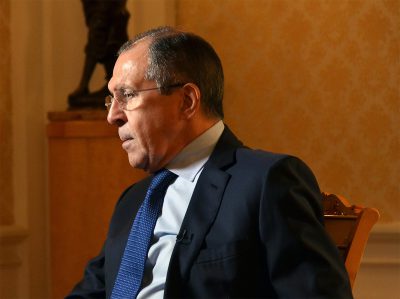
Question: I’d like to start by asking you about your forthcoming meeting with US Secretary of State Rex Tillerson, we’ve read in the press that the two of you may be meeting soon.
Sergey Lavrov: So they say.
Question: Could you perhaps tell us about your expectations and goals in dealing with Secretary Tillerson?
Sergey Lavrov: Well, after the American election, soon after Election Day President Putin and President-elect Trump talked over the phone. It was a good but very general discussion touching upon the key issues in our relations, and of course the key international issues. And they agreed that they would continue being in touch and after the inauguration they talked again, and they reconfirmed the need to look for ways which would be effective in handling international problems. And of course to see what could be done to bring the bilateral relations to normalcy. They also agreed that Mr. Rex Tillerson and I would look into the agenda in some more details, and would also discuss the preparation for the presidential meeting which should take place when both countries, both leaders feel comfortable.
And we met with Rex in mid-February in Bonn on the margins of the G-20 ministerial meeting, and covered quite a lot of the bilateral agenda. I briefed him about the relationship on bilateral issues with the Obama administration, the problems which accumulated during that period. We did not go into the substance of this, I just briefed him so that his team, which is still being assembled, could take a look at these issues and determine what kind of attitude they would have on them. And we discussed Syria, Iran, the Korean Peninsula, the Middle East in general, relations between Russia and the West, it was a very general, but rather substantive discussion, obviously it was the first contact and Mr. Rex Tillerson is just getting into the shoes of his new capacity. We discussed the possibility of personal meeting and have been continuing these discussions. As soon as we finalize them it will be announced.
But my feeling is that from the point of view of personal relationship, we feel quite comfortable. I feel quite comfortable, I believe Rex had the same feeling, and our assistants should work closer but of course this could only be done when the team in the State Department is complete.
Question: Of course. If I could follow up on your answer there, you mentioned bringing normalcy to the U.S.-Russia relationship. What do you think “normal” is?
Sergey Lavrov: “Normal” is to treat your partners with respect, not to try to impose some of your ideas on others without taking into account their own views and their concerns, always to try to listen and to hear, and hopefully not to rely on a superiority complex, which was obviously the case with the Obama administration. They were obsessed with their exceptionality, with their leadership. Actually the founding fathers of the United States, they also spoke of their leadership, and they believed that the American nation was exceptional, but they wanted others just to take the American experience as an example and to follow suit. They never suggested that the United States should impose, including by force, its values on others.
And the Obama administration was clearly different. Actually, long before Ukraine, long before Crimea, in early December 2012, there was an OSCE ministerial meeting in Dublin. And Hillary Clinton was Secretary of State and was the head of the delegation, we had a bilateral meeting with her, she was trying to persuade me on something which was a difficult issue on the agenda, but I recall this situation because in the margins of this ministerial meeting she attended a meeting in the University of Dublin, and she delivered a lecture in which she said something like: “We are trying to figure out effective ways to slow down or prevent the move to re-Sovietize the former Soviet space.” December 2012.
What kind of action she was considering as the move to re-Sovietize the space, I really couldn’t understand. Yes, there were discussions about Ukraine, about Kazakhstan, Belarus and Russia, forming the Customs Union, and if this was the reason, then of course it showed very obviously the real attitude of the Obama administration to what was going on in the former Soviet space and the area of the Commonwealth of Independent States, its obvious desire to take over this geopolitical space around Russia without even caring what Moscow might think.
This was the reason for the crisis in Ukraine, when the U.S. and European Union bluntly told the Ukrainians: either you are with us, or you are with Russia against us. And the very fragile Ukrainian state couldn’t sustain this kind of pressure, and what happened- happened: the coup, and so on and so forth (if you want I can discuss this in some detail later). But my point is that they considered normal that the people in Obama’s team should call the shots anywhere, including around such a big country as the Russian Federation. And this is absolutely abnormal in my view.
At the same time, when we visited Venezuela with our naval ships, they were raising such hell, as if no one could even get closer to what they believe should be their backyard. This mentality is not adequate for the twenty-first century. And we of course notice that President Trump is emphasizing the need to concentrate on U.S. interests. And foreign policy for him is important as long as it serves the United States’ interests, not just some messiah projects doing something just for the sake of showing that you can do it anywhere. It’s irrational, and in this he certainly holds the same position as we do in Moscow, as President Putin does, that we don’t want to meddle in other people’s matters. When the Russian legitimate interests are not, you know involved.
Question: You just mentioned at the end of your statement that the United States shouldn’t meddle in others’ affairs, and obviously many Americans today feel that Russia has meddled in American affairs, in the 2016 election. Your government has denied that. But how do you explain what happened in the United States? Do you feel that Russia had any involvement or any responsibility at all for what transpired?
Sergey Lavrov: I believe that these [are] absolutely groundless accusations – at least I haven’t seen a single fact that this was substantiated. I believe these accusations were used as an instrument in the electoral campaign, which for some reasons seemed to the Democratic Party to be an efficient way to raise support among the American people, playing on their feelings that no one shall meddle with American affairs. This is a Russophobic instrument. It was a very sad situation because we never wanted to be unfriendly with the American people, and apparently the Obama administration, the elite in the Democratic Party, who made every effort during the last couple of years to ruin the very foundation of our relationship, decided that the American people should be brainwashed without any facts, without any proof. We are still ready to discuss any concerns of the United States.
As a matter of fact, in November 2015, long before this hacker thing started, we drew the attention of the U.S. administration to the fact that they kept hunting Russian citizens suspected in cybercrime in third countries, and insisting on them being extradited to the United States, ignoring the treaty on mutual legal assistance which exists between Russia and the United States, and which should be invoked in cases when any party to this treaty has suspicions regarding the citizen of another one. And this was never done.
So what we suggested to them in November 2015, that we also don’t want to see our citizens violating law and using cyberspace for staging all kinds of crimes. So we would be the last one to try to look aside from them. We want them to be investigated and to be disciplined. But since the United States continued to avoid invoking this treaty on legal assistance, we suggested to have a meeting between the Justice Department and the Russian prosecutor-general, specifically at the expert level, on cybercrime. To establish confidential, expert, professional dialogue to exchange information.
They never replied; when we reminded them that there was a request, they orally told us that they were not interested, but in December 2016, more than one year after our request was tabled, they said, “Okay, why don’t we meet?” But this came from Obama administration experts, when they already were on their way out, some technical meeting took place, it was not of any substance but at least they responded to the need to do something about cyberspace.
And of course on cybercrimes the discussions in the United Nations are very telling. When we are leading the debate on negotiating an instrument which would be universal and which would be mandatory for everybody, the U.S. is not really very much eager, and is not very enthusiastic.
Speaking of meddling with others’ matters, there is no proof that Russia was in any way involved either in the United States, or in Germany, or in France, or in the United Kingdom – by the way, I read yesterday that the Swedish prime minister is becoming nervous that they also have elections very soon and that Russia would 100 percent be involved in them. Childish, frankly speaking. You either put some facts on the table or you try to avoid any statements which embarrass you, even if you don’t believe this is the case.
It’s embarrassing to see and to hear what we see and hear in the West, but if you speak of meddling with other countries’ matters, where facts are available—take a look at Iraq. It was a very blunt, illegal intervention, which is now recognized even by Tony Blair, and those who were pathetically saying that they cannot tolerate a dictator in Iraq. Take a look at Libya, which is ruined, and I hope still has a chance to become one piece. Take a look at Syria, take a look at Yemen: this is the result and the examples of what takes place when you intervene and interfere. Yes, I’m sure you can say about Ukraine, you can say about Crimea, but for this you have to really get into the substance of what transpired there.
When the European Union was insisting that President Yanukovych sign an association agreement, including a free-trade zone with zero tariffs on most of the goods and services crossing the border between Ukraine and the European Union, and at that point it was noted that Ukraine already had a free-trade area with Russia, with some different kind of structure, but also with zero tariffs. So if Russia has zero tariffs with Ukraine, Ukraine would have the same with European Union but we have some protection, under the WTO deal with the European Union, so the only thing we said: guys, if you want to do this, we would have to protect our market from the European goods which would certainly go through Ukraine to Russia, trying to use the zero-tariff arrangement. And the only thing suggested, and Yanukovych supported, is to sit down the three—Ukraine, EU and Russia—and to see how this could be handled. Absolutely pragmatic and practical thing. You know what the European Union said? “None of your business.”
Then-President of the European Commission Mr. Jose Manuel Barrosso (my favorite) stated publicly that we don’t meddle with Russia’s trade with China, so don’t meddle with our deal with Ukraine. While the situation is really very different and the free-trade area argument was absolutely ignored. And then Mr. Yanukovych asked for the signature of this deal to be postponed, for him to understand better what will be the consequences—for his industry, for his finances, for his agriculture—if we would have to protect ourselves from potential flow of cheap goods from Europe. That’s so, and then the coup was staged, in spite of the fact that there was a deal between Yanukovych and the opposition, witnessed by Germany, France and Poland.
Next morning, this deal was torn apart under the pretext that Yanukovych disappeared, and therefore all commitments were off. The problem is that he did not leave the country, he was in another city of the country. But my main point is that the deal which they signed with him was not about him; it was about his agreement to go to early elections – and he would have lost these elections – but the deal started by saying, “We agree to create a government of national unity.”
And next morning, when they just tore apart this deal, Mr. Arseniy Yatsenyuk then a leader in Ukraine’s Batkivshchyna party and others who signed the deal with the President, they went to this Maidan, to the protestors, and said, “Congratulations, we just created the government of the winners.” Feel the difference: “government of national unity” and “government of the winners”. Two days later, this parliament, which immediately changed their position, announced that the Russian language is no longer welcome.
A few days later, the so called the Right Sector, the group which was an instrument in the violence in Maidan—they said that Russians have nothing to do in Crimea, because Russians would never honor the heroes of Ukraine, like Bandera and Shukhevych, who were collaborating with Nazis. These kinds of statements led to the people in the east of Ukraine just to say: “guys, you did something unconstitutional, and we don’t believe this is good for us”, so leave us alone, let us understand what is going on in Kiev, but we don’t want any of your new ideas to be imposed on us. We want to use our language, we want to celebrate our holidays, to honor our heroes: these eastern republics never attacked anyone. The government announced the antiterrorist campaign in the east, and they moved the regular army and the so-called voluntary battalions in the east of Ukraine. This is not mentioned by anyone. They are called terrorists—well, they never attacked a person.
And investigations of what actually happened on that day of the coup is going nowhere, the investigation of the murder in Odessa on the second of May, 2014, when dozens of people were burned alive in a trade-union office building, is moving nowhere. Investigation of political murders of journalists and opposition politicians is not moving anywhere. And they basically passed amnesty for all those who were on the part of the opposition during the coup. And they prosecute all those who were on the part of the government.
But even now they want to prosecute Yanukovych in absentia, but one interesting thing maybe for your readers to compare: there was a deal on the twenty-first of February, next morning they said, Yanukovych is not in Kiev, so our conscience is clean and we do what we please, in spite of the commitment to national unity. About the same time there was a coup in Yemen. President Hadi fled to Saudi Arabia. Not to some other city in Yemen, but he fled abroad.
More than two years passed, and the entire progressive international community, led by our Western friends, insists that he must be brought back to Yemen and that the deal which he signed with the opposition must be honored by the opposition. My question is why Ukraine’s situation is treated differently from the situation in Yemen. Is Yemen a more important country? Are the deals which you sign and the need to respect your word and your deals, more sacred in Yemen than in Ukraine? No answer.
Sorry for getting into all these details, but people tend to forget, because they’re being brainwashed every day with very simple phrases like “Russia is aggressor in Ukraine,” “annexation of Crimea” and so on and so forth, instead of laboring your tongues, people should go there. Those who go to Crimea, see for themselves how the people live there, and they understand that all these hysterical voices about violation of human rights, about discrimination vis-à-vis Crimean Tatars, is a lie.
Question: Maybe coming back, just for a moment, to the U.S. election, and setting aside the question of evidence, because your government has its perspective, the U.S. intelligence community has its perspective—I don’t think those differences are likely to be reconciled. Setting that question aside, many Americans believe that Russia did interfere in the election; it’s contributed to a particular political climate in the United States. Do you view that as an obstacle to the U.S.-Russia relationship, and do you believe there is anything that Russia can or should do to try to address these widespread concerns?
Sergey Lavrov: You said a very interesting thing. You used the word “perspective.” You said, “Russia has its own perspective; the American intelligence community has its own perspective.” Perspective is something which many people have. We speak about facts, about proofs. And with all these perspectives, these hearings which sometimes are shown on CNN, on Russian TV, I haven’t heard any, any proof. Except the confirmation that the FBI and the NSA started watching what the Trump team is doing sometime in July. I heard this recently.
And I take this as acceptance by those who were doing this, for whatever reason, and they clearly said that this was not because of the suspicion that he had something to do with Russia but this was a routine process during which they find a trace leading to the Trump headquarters. Fine, this is a fact: they admitted that they started this. So what? If by admitting this they make their perspective regarding Russia a fact, I cannot buy this.
And then you said, they have their own perspective, and that the American people believe Russia had something to do with the American elections. Categories like perspective and belief are not very specific. And we speak about some very serious accusations. I understand that in the West, people who indeed profess Russophobic feelings, and unfortunately they are—they used to be very powerful, they are still very powerful even when they lost the elections: and Russophobic trends are obviously seen even in the Republican camp. You know, it’s very easy to find some external threat and then to put all the blame on this particular external threat.
When in 2014 the Malaysian plane was shot down over Ukraine, two days later I think, in the UN Security Council, when we insisted on adopting a resolution demanding further investigation, the American officials said yes, we believe investigation must be held, but we already know the result.
What about the presumption of innocence? The same happened on Litvinenko, the poor guy who was poisoned in London, when from the very beginning they said, we will have an investigation but we know who did it, and they never made this trial public. And they never accepted the offer of assistance which we were ready to provide. And so on and so forth.
Now, yesterday, this terrible murder of the Russian and Ukrainian citizen, who used to be an MP in Russia, and did not stay in the current parliament, and President Poroshenko two hours after the guy was murdered says that this was a terrorist attack from Russia—who also blew up the munition depot near Kharkov. It was said a few hours later by the president of a democratic country, whom our American and European friends call a beacon of democracy. I thought democracy was about establishing facts when you have suspicions.
And democracy is about division of power, and if the the chief executive takes upon himself the functions of the legal system, of the judicial system, that does not fit with my understanding of how Western democracy works. We’re ready to discuss anything, any facts, I mean. We’re ready to assist in investigations of whatever issues our partners anywhere might have. Whether this is going to be an obstacle to normal relations, I don’t think so. I believe the Russian people, at least if we are asked, I would say no, if it depends on us. I understand that there are some people in the United States who want this to become an obstacle, and who want to tie up the team of President Trump on the Russian issue, and I believe this is very mean policy, but we see that this is taking place.
What can Russia do to help? Unfortunately, not much. We cannot accept the situation, but some absolutely artificial hysterical situation was created by those who severed all of the relationship—who dropped the deal on the Bilateral Presidential Commission between Moscow and Washington with some twenty-plus working groups, a very elaborate mechanism of cooperation—and then after they have done this, after they prevent the new administration from doing away with this absolute stupid situation, to ask us to do something? I don’t think it’s fair.
We said what we did, that we are ready to work with any administration, any president who would be elected by the American people. This was our line throughout the electoral campaign, unlike the acting leaders of most European countries who were saying absolutely biased things, supporting one candidate, unlike those who even bluntly warned against the choice in favor of the Republican candidat, and this somehow is considered normal. But I leave this on the conscience of those who said this and then immediately chickened out and then started praising the wisdom of the U.S. electorate.
We said that we would be ready to come back to the relationship and to develop the relationship with the United States to the extent, and to the depths, to which the administration is ready to go. Whatever is comfortable for our partners, we will support and provide it. We talk on the basis of mutual respect and equality, trying to understand the legitimate interest of each other and to see whether we can find the balance between those interests. We will be ready to cover our part of the way, as President Putin said, but we will not be making any unilateral steps. We offered cooperation on very fair terms, and we will judge by the deeds of course.
Question: Perhaps we can pivot to international affairs. In the United States there’s been discussion of a new Cold War; you, for your part, recently talked about a post-West international order, which as you may imagine is not something that many in the United States and other Western countries would readily embrace. In fact, some may even be strongly inclined to resist the emergence of a post-West order. What do you think a post-West order is, and do you think that it makes confrontation between Russia and the United States, or Russia and the West, inevitable?
Sergey Lavrov: Well first, I don’t believe that we are having another Cold War. Ideologically, we’re not different, we’re not apart. Yes, there are nuances in how the countries in the West and Russia and its neighbors are run. But all in all the basis is democracy, which is elections, basically, and organizing the system, the way you respect the opposition and it’s also market economy. Again with «give and take» you know in some countries the state is much more involved in economy than in others but this happened in France some time ago, in the UK some time ago, so this is all secondary details, I would say. There’s no ideological differences as far as democratic principles and market economy are concerned. Second, these days, unlike the days of the Cold War, we have much clearer common threats, like terrorism, like chaos in the Middle East, like the threat of the proliferation of weapons of mass destruction. This was never the case during the Cold War days, which was a very negative balance with sporadic conflicts in periphery. This time we have global universal threats, not sparing anyone and this is what we witness almost daily, with these terrorist attacks in the Middle East and Europe, there was one in the United States, and so on and so forth.
So this absolutely makes it necessary to reassess where we are and what kind of cooperative structure we need. Post-West system, post-West order: I mentioned this term in Munich at the Munich Security Conference, and I was really surprised that people immediately made me the author, the coiner of this term, because the title of the conference contained “post-West order”—with a question mark, yes. I put the question mark aside for one very simple reason: if we all agree that we cannot defeat terrorism, organized crime, drug trafficking, climate change without a universal coalition, if we all agree that this is the case, and I believe we do, then it would certainly be necessary to recognize that the world is different, compared to the many centuries than when the West was leading with culture, philosophy, military might, economic systems, and so on and so forth.
We all have, China, the whole Asia-Pacific region, which President Obama, by the way, said is the place where the U.S. would be shifting, which in itself means that he was not thinking of the West order but post-West order. And, of course, Latin America, Africa, which is hugely underdeveloped but has the potential with resources and labor, young and vigorous, still untapped. Secretary of State Rex Tillerson just a few days ago in Washington convened a coalition to fight terrorism—sixty-eight countries if I am not wrong, double the number of the countries in the West. This meeting was post-West order, or a manifestation of post-West order. So I don’t believe the Western countries should be really offended or should feel that their contribution to the world civilization has been underestimated—not at all. It’s just the time when no one can do it alone, and that’s how we feel. It’s a polycentric world. Call it multipolar, call it polycentric, call it more democratic—but this is happening. And economic might, financial might and the political influence associated with all this, they’re much more evenly spread.
Question: Let’s zero in on Syria. You mentioned the terrorism issue and certainly the struggle with ISIS is an important focus for the U.S., for Russia. There has been, as I’m sure you’re aware, some skepticism in the United States about Russia’s role in Syria. President Donald Trump, when he was a presidential candidate, certainly referred many times to a desire to work with Russia in Syria. How do you envision the opportunities and constraints on the U.S. and Russia in working together in Syria, and do you have any specific new ideas about how to do that?
Sergey Lavrov: First, when this coalition was created by the Barack Obama administration (the coalition which was convened in Washington just a few days ago) it was understood that out of sixty-some countries only a few would be actually flying air force and hitting the ground. Others were mostly political and moral support, if you wish, solidarity show—which is fine, it’s important these days as well to mobilize the public opinion in as many countries as you can. We were not invited. The Iranians were not invited. Some others were not invited, who I believe should be important partners in this endeavor. But this was motivated by some ideological considerations on the part of the Barack Obama administration. I just don’t want to go into the reason for why they assembled this particular bunch of people.
But what I can attest to is that one year into the creation of this coalition, it was very sporadically using the air force to hit some ISIL positions. They never touched the caravans who were smuggling oil from Syria to Turkey and, in general, they were not really very active. This changed after we responded to the request of President Assad, who represents, by the way, a legitimate government –member of the United Nations. After we joined, President Vladimir Putin and President Barack Obama spoke in New York in September 2015, and President Putin clearly told him that we would be doing this and we were ready to coordinate, and they agreed to have these deconfliction discussions, which did not start soon actually, not through our fault. But when we started working there the U.S.-led coalition became much more active. I don’t want to analyze the reason for this. I’m just saying before we moved there with our air force, the U.S. coalition was very rarely hitting ISIL positions and almost never hitting the positions of Jabhat al-Nusra, which many people believe has been spared just in case at some point they might be needed to topple the regime. And this feeling, this suspicion, is still very much alive these days, when Jabhat al-Nusra already twice changed its name, but it never changed its sponsors who continue to pump money and whatever is necessary for fighting into this structure. And people know this. So when we moved there, at the request of the government, we suggested to the U.S. to coordinate our efforts. They said, “No, we can only go for deconfliction,” and deconfliction procedures were developed and are being applied quite well, but we believed it was a shame that we couldn’t go further, and coordinate targets and what have you. And then my friend, John Kerry, who was very sincere in his desire to overcome the ideological—not ideological, but to overcome some artificial barriers, and to indeed start military coordination—we spent almost from February 2016 to September 2016 when, eventually, we had a deal to separate the armed groups, with whom the U.S. and the allies cooperate, from ISIL and Jabhat al-Nusra, and then to coordinate the targets and basically to strike only those targets which would be acceptable to both Russians and the Americans. Quite a few people really understood the quality of this deal.
I put myself in the shoes of those who were criticizing us for hitting wrong targets. You remember, there was so much criticism. So the deal we reached with Kerry, when none of us could strike unless the other supports, was solving this problem. And the fact that the Pentagon just disavowed what Kerry did, and Obama could not overrule the Pentagon, meant for me only one thing: that he, the president of the United States, Barack Obama, was motivated by the desire to have some revenge on Russia, for whatever reason and for whatever situation, rather than to capitalize over the deal reached between John Kerry and us, to make the war against terror much more efficient in Syria. But let God judge him.
Now, whether we have an opportunity to resume the cooperation: yes we do. Yes, President Donald Trump said that fighting terrorism is his number one international goal, and I believe this is absolutely natural. We will be sharing this approach, I am sure, and it’s also, in this sense, coming back to our first question which we discussed, about intervention in other parts of the world, terrorism is a universal threat. So when you interfere to fight terrorist manifestations, it’s in the interest of your country. It’s another matter that you have to be faithful to international law. And the coalition, of course, led by the United States, was never invited to Syria. We were, Iran was, Hezbollah was. Still, the Syrian government, while complaining that the coalition were there uninvited, they said, “If and since you’re going to coordinate with Russians, with those who fight ISIL and Nusra, we take it as this is what you want, to defeat terrorism, not to do anything else in Syria.” So deconfliction procedures continue to be applied.
You might have heard that the chief of general staff of the Russian Army, General Gerasimov, met with General Dunford.
Question: Twice, I understand.
Sergey Lavrov: Twice, at least, and they talked over the phone. And this is something the military discussed. I assume that if their discussions go beyond deconfliction, I don’t want to speculate, this would be a welcome sign that we can really do what is necessary to bring about the situation when everyone who confronts ISIL and Nusra on the ground acts in coordination. If not under the united command—this, I think is unachievable—but in a coordinated manner.
The Turks have troops on the ground. Iran, Hezbollah are invited by the government. Russian air force with some ground special military police helping keep law and order in the Sunni quarters of Aleppo and Damascus, the military police from Russia is largely composed of Russian Sunnis from the northern Caucasus—Chechens, Ingush and others.
The U.S. Air Force and the coalition air force; U.S. special forces on the ground. Apparently there are French and U.K. special forces on the ground. The military groups who are part of the so-called Free Syrian Army, the military armed groups who are part of the Kurdish detachments—there are so many players: I listed all those who declare that ISIL and Nusra are their enemies. So some harmonization is certainly in order, and we are very much open to it.
When the United States dropped from the deal, which we negotiated with John Kerry, we shifted to look for some other opportunities and we had the deal with Turkey later—which was later supported by Iran—which brought about some kind of cessation of hostilities between the government and a group of armed opposition. And we created, in Astana, a parallel track supportive of the Geneva negotiations concentrating on mechanisms to monitor the cessation of hostilities, to respond to violations, also to build up confidence by exchanging prisoners, and so on and so forth.
It is not welcome by quite a number of external players who try to provoke and encourage the radicals, radical armed groups in Syria, to make trouble and to stage some terrorist attacks. They launched a huge offensive now in the northern part of the Hama province, and they basically coordinate with Jabhat al-Nusra, under its new name. So it’s also a game for influence in Syria, unfortunately, which prevails in the minds of the people who promote such an approach, rather than the need to get united to fight terrorism, and then to have a political deal. It’s the fight for influence on the battleground, and this is unfortunate. We don’t need this now. What we need is to strengthen the cessation of hostilities and to support strongly the political process in Geneva, concentrated on the new constitution, which would be accompanied by a division of power between the government, the opposition, all ethnic groups, then elections and so on and so forth. But all this would be absolutely meaningless if people sacrifice the fight against terror for the sake of their goal, their obsession, with regime change.
Question: In Iran, the Trump administration seems to have signaled an intent to try to enforce the Iran nuclear deal, the JCPOA, more strictly, perhaps to be more assertive in challenging Iran’s regional role. And I’d be curious about your reaction to that and the degree to which Russia could work with, or not work with, the United States on either of those things. Then there is Ukraine. Clearly a very complex problem, the Minsk Process I think to many outside observers really seems to have stalled. Is that process dead? Is there any way to move forward?
Sergey Lavrov: On Iran, the Joint Comprehensive Plan of Action was a product of collective work—it’s a compromise. But the key things were never compromised. It’s a compromise which allows for all of us, with the help of the International Atomic Energy Agency, to be sure that Iran’s nuclear program is going to be peaceful, that all the elements which cause suspicion would be removed, and handled in a way which gives us all certainty and gives us control over the implementation of those arrangements.
I don’t think that the Trump administration is thinking in the same terms as the slogans during the campaign, that Iran is the number one terrorist state; we don’t have a single fact to substantiate this claim. At least when we were facing a huge terrorist threat, when we were under terrorist attack in the 1990s in the northern Caucasus, we detected and discovered dozens and hundreds of foreign terrorist fighters from very close neighborship to Iran, but not from Iran at all. And we know that the political circles in quite a number of countries were really encouraging these terrorist groups to go into the northern Caucasus. Iran had never challenged the sovereignty of the Russian Federation, never used its own links with Muslim groups to provoke radicalism and to create trouble. What we do now with Iran and those that cooperate with us and the Syrian army is fighting terrorists in Syria. Iran is a powerful player on the ground, legitimately invited by the government. Iran has influence over Lebanese Hezbollah, which is also legitimately on the ground. And if we all want, you know, to topple, to defeat terrorists in Syria, there should be some coordination. I have already touched upon this.
The IAEA regularly reports on this Joint Comprehensive Plan of Action implementation. The latest report once again confirmed that there are no violations of the part of Iran, and that the deal is being implemented in line with the commitments of Tehran and all others. It’s another matter that the steps which were promised in return to the implementation, namely sanctions relief, are not being undertaken by all Western participants as fast and as fully as was promised. But that’s another matter.
On the Minsk agreements, I believe that the Ukrainian government and President Poroshenko personally want them dead. They want them dead in a way which would allow them to blame Russia and the people in the east of Ukraine. They certainly encountered huge opposition from the radicals, and the radicals believe that this government is weak enough just to wait it out and to have either early elections or to have another Maidan. The biggest mistake of President Poroshenko, I am convinced, was that after he signed this agreement in February 2015 in Minsk, and he came back with the success, with the support of Germany, France, then the Security Council in New York endorsed this deal, and he should have used this moment to impress upon his parliament, upon the opposition, that this was a good deal supported by the European Union, where he wanted to join.
Instead, he started apologizing in front of his opposition when he got back to Kiev saying, you should not think this is serious, I did not commit myself to anything in the legal way—in the legally binding way—this is not what you read. And so on and so forth. He cornered himself in the situation of an absolutely irresponsible politician who signed one thing and who was saying that this is not what he signed one week later when he came back. The opposition felt that this was his weakness and they started carving out of his position anything which was still reasonable. The fact that every day he is in contact with President Vladimir Putin, they talk over the phone sometimes, they talk on the margins of the meetings of the Normandy Format when the leaders have their meetings; the last one was in October in Berlin last year. But my impression is that he tries to be constructive, to find ways to come back to the Minsk implementation. But the next day he comes back to Kiev or goes abroad, and goes public saying things which are absolutely aggressive and are absolutely unfair.
One very simple example: the Minsk agreement, they provide for preparation for elections on the special status of these territories, the status itself is listed in the deal, and the law on this special status is already adopted by the Rada, but it is not in force. Then amnesty, because you don’t want to have a «witch hunt», and the constitutional confirmation that this special status is permanent. That was all. And after this is done, the Ukrainian government restores full control over the entire Russian-Ukrainian border. They are saying now: no elections, no special status, no constitutional change, no amnesty, until we first take control of the border. But everyone can read the Minsk agreement—it’s only three pages. And it says absolutely clearly that the border transfer is the last step, and everyone understood why when this was negotiated. Because if you just under these circumstances, with all these animosities, with all these so-called voluntary battalions, Azov, Donbass and all the radicals, not reigned in by the government—when you just say, okay, take the border and we trust you that will do everything else, these people would just be victims. They will be suffocated and burned alive like the people in Odessa. So the political guarantees are crucial, and Germany, France and others understood this very well, just like the Americans understood this very well, because we did have parallel track—parallel to the Normandy Format—with the U.S. and we are ready to revive it again.
But one very simple example. October 2015, Paris: the Normandy leaders meet. And there is very specific discussion regarding the law on special status. The logic and sequence of the Minsk agreement is that you first have the special status, and then you have elections. Because people would normally want to know what kind of authority those for whom they are going to vote would have. Poroshenko said, no, we first have to have elections. Then I, Poroshenko, would see whether the people elected are to my liking. And if they are, then, we will give them the special status.
Which is rather weird. But still, we decided just to move forward, we would be ready to have some compromise on this thing, in spite of the fact that it was absolutely clearly spelled out in the Minsk agreement. And then the former foreign minister of Germany, who was participating in the meeting, Frank-Walter Steinmeier, who is now president of Germany, he said, why don’t we have a compromise formula which would mean that the law on the special status is adopted, but it enters into force on the day of elections temporarily, and it would enter into force, full fledged, on the day when the OSCE reports that elections were free and fair, and in line with democratic OSCE standards?
Everyone says okay. Poroshenko says okay. One year later, in October 2016 in Berlin, the same group of people, the leaders with the ministers. And President Putin is saying the formula of Steinmeier is still not embodied in any papers, in the Contact group process, because the Ukrainian government refuses to put in on paper. Poroshenko said, well, but it is not what we agreed, and so on and so forth. And then Putin said, well this is Mr. Steinmeier, ask him about his formula, and he reiterated this formula: temporary entry into force on the day of elections, full entry into force on the day the OSCE confirms they were free and fair. Merkel said the same, Hollande said the same, that this was absolutely what we agreed.
And then Poroshenko said, okay, let’s do it. October 2016 is almost half a year ago. And we are still not able, because of the Ukrainian government opposition in the contact group, to fix this deal on paper. So I can go for a long time on this one, but I am sure that those people who are interested can go and who follow the developments in Ukraine, they understand why we are not at the point of Minsk implementation.
The Ukrainian government wants to provoke the other side to blink first and to say, enough is enough, we drop from the Minsk deal. That’s why the economic blockade, that’s why the prohibition for the banks to serve the population in the east. By the way, in the Minsk agreements, two years ago we discussed the difficulties in banking services for this part of Ukraine and Germany and France committed themselves to organizing mobile banking, and they failed because they could never get cooperation from the Ukrainian authorities.
Well, I leave it to your readers to study what is going on, what is happening in Ukraine, Syria and elsewhere.
http://www.mid.ru/en/foreign_policy/news/-/asset_publisher/cKNonkJE02Bw/content/id/2710445
Featured Video
The American Retreat from Vietnam
or go to
Aletho News Archives – Video-Images
From the Archives
Secret document reveals plans for civil war in Lebanon, Israeli false flags, and invasion
By Randi Nord | Geopolitics Alert | April 5, 2019
Beirut – During his visit with US Secretary of State, Mike Pompeo, Lebanese President Michael Aoun reportedly received a US-Israeli document detailing plans for creating a civil war in Lebanon with covert false flag operations and possible Israeli invasion.
Although the source of the document is Israeli and created in partnership with Washington, no one knows who presented it to Aoun. The Lebanese TV station, Al-Jadeed, initially reported the document on Lebanese TV and a video on its website. Geopolitics Alert translated the report for this article. … continue
Blog Roll
 Aletho News
- There’s a drought in academia: A drought in honest research on the subject of drought and other weather extremes
- Department of War Awards $20.7 Billion Contract to Raytheon for Air-to-Air Missiles
- ‘Distance yourselves from Israel’: IRGC urges US population to question govt policies
- America’s Greenland deal has a radioactive backstory
- The RAF Fairford ‘terror plot’: Unpacking escalation in the UK echo-chamber
- EU Council Advances Chat Control 2.0 Scanning Proposal
- Ex-Greek MEP files complaint against Israeli spyware firm over alleged Pegasus surveillance
- Troubling ideas throughout the Torah, Talmud, Mishneh Torah and Tanya
- ‘Grave, alarming’: Iran mission on Trump’s UNGA ‘annihilation’ threats
- Najaf airport to reopen to Iranian flights within 24 hours: Ambassador
- If Americans Knew
- New Report: “Scholasticide and Genocide in Gaza: Assessment, Testimonies and Legal Analysis”
- Ex-Biden officials are desperate for a Gaza scapegoat
- Israeli “settlers” Invade Al-Aqsa; Pour Boiling Water on 75-Year-Old
- Israel Has Kidnapped Another American Teenager
- US arms sales to Israel worth $21.6 billion in 20 months
- Three Palestinians Killed in Israeli Attacks on Gaza
- Revealed: German “Anti-Semitism Expert” Driving Crackdown on Palestine Solidarity is Former Israeli Spy
- Egypt’s Warning to Israel Before Oct 7
- Israel’s siege signals another cruel winter for 1.8 million Gazans – Daily Update
- Netanyahu Asked UAE Leader to Deny Report on Oct. 7 Warning in Secret Visit, Sources Say
- No Tricks Zone
- New Study: Earth And Venus Surface Warmth Largely Explained By Convection And Lapse Rate, Not CO2 Or Radiation
- 2025 Nature Paper Claiming Worsening Global Drought Gets RETRACTED …Heavily Flawed
- New Study: ‘Global Drought Shows No Detectable Recent Acceleration Under Climate Warming’
- Economic Masterminds: German Socialists Suggest Taxing Productivity Gains Stemming From Using AI
- The South China Sea Has Not Been Cooperating With The Climate Change Narrative
- Energy Crisis: Germany Enters Heating Season With Historically Low Gas Reserve Fill Levels
- New Study: The Antarctic Ice Sheet Gained Mass From 2020-2024 Due To Staggering Snow And Ice Accumulation
- Study: Ocean Heating Rates From Thousands Of Years Ago ‘Dwarf’ Modern Ocean Heating Rates
- Climate Extremists Target, Attack Large-Scale Power Grid Infrastructure In Germany!
- New Study: Antarctic Ice Melt Has Contributed Less Than 1 Centimeter To Sea Level Rise In The Last 30 Years

