All Sanctions Imposed Against Russian Companies Illegal – Moscow
Sputnik – 28.03.2017
MOSCOW – All sanctions imposed against Russian companies, including Rosneft, are illegal, Russian Deputy Foreign Minister Aleksei Meshkov said Tuesday.
“Only one thing can be said about this – all sanctions taken against Russian companies are illegal. I would propose to this court to familiarize itself with the UN charter. Only the UN Security Council has the political right to announce sanctions against countries and foreign companies,” Meshkov told reporters.
Earlier in the day, the European General Court in Luxembourg ruled that the sanctions adopted by the EU Council against Rosneft were valid.
Rosneft commented on the sanctions by saying that they are groundless and politicized.
French presidential candidate Le Pen predicts death of EU
Press TV – March 26, 2017
France’s far-right presidential candidate Marine Le Pen says the European Union will “die” and she vows to save France from globalization.
During a Sunday campaign rally in Lille, Le Pen said that the upcoming elections will be the next stage in a global popular rebellion.
“The European Union will die because the people do not want it anymore … arrogant and hegemonic empires are destined to perish,” she added.
She stressed that the time has arrived to overcome globalists, and added that her main rivals in the French presidential elections, conservative Francois Fillon and centrist Emmanuel Macron, were both guilty of treason because of their pro-EU and pro-market stances.
Le Pen added that she would replace the EU with a different Europe which she said would be called “the Europe of the people.”
“It must be done in a rational, well-prepared way,” she said in interview with Le Parisien daily. “I don’t want chaos. Within the negotiation calendar I want to carry out … the euro would be the last step because I want to wait for the outcome of elections in Germany in the autumn before renegotiating it,” she added.
McCain: ‘New World Order Under Enormous Strain’ Without US, EU Leadership
Sputnik – 27.03.2017
US Senator John McCain said on Friday that the world desperately needs the US and Europe to unite once more to preserve globalism.
The current chairman of the armed services committee in the US Senate said that Washington should restore cooperation with the EU — long one of America’s “most important alliances.”
The remarks came at the Brussels Forum, a conference organized by the transatlantic think tank German Marshall Fund. The globalist ideologue, who once was a presidential candidate for the Republican Party, has once again put himself in direct opposition to President Trump by saying that it is essential for the allies to develop more connectivity and cooperation.
“I trust the EU,” he said, elaborating that EU and NATO were “the best two sums in history” and have maintained global peace for the last 70 years.
“We need to rely on NATO and have a NATO that adjusts to new challenges.”
Earlier in January the new US President Donald Trump complimented the UK on its “smart” decision to withdraw from the EU and dubbed NATO an “obsolete” coalition.
McCain said he supported Trump’s calls on Europe to increase defense spending for NATO, but added that Americans should “also appreciate the fact that over 1,000 young [European] people have given their lives in Afghanistan or Iraq.”
“I don’t know what price tag you put on that,” he said. “That’s quite a contribution I would say, if you ask their mothers.”
McCain hesitated to prejudge Trump’s presidency based on his first months in office but said that he should fill intelligence gaps and address what the Senator believes was Russia’s attempts to influence the outcome of the US election in November.
McCain also accused Russia of trying to influence approaching elections in France and Germany, and the president of Russia Vladimir Putin in particular in trying to restore the Russian empire, despite providing no evidence for those allegations.
Russia Ready to Discuss Nuclear Arsenal Reduction – Lavrov
Sputnik – 23.03.2017
MOSCOW – Russia is ready to discuss the possibility of reducing nuclear arsenals, Foreign Minister Sergey Lavrov said at a Russian Armed Forces General Staff Military Academy lecture Thursday.
“We are ready to discuss the possibility of further reducing nuclear capabilities, but only taking into account all the factors and not just the number of strategic offensive weapons,” Lavrov said.
Meanwhile, he added that Russia is ready for dialogue with the United States on the reduction of strategic nuclear weapons and believes that more countries need to be involved in the process.
“We are ready, but the conversation must be conducted taking into account all factors that affect strategic stability,” Lavrov said at a Russian Armed Forces General Staff Military Academy lecture.
He underscored the need to wait for Washington to finalize its priorities in the area, and stressed the need for more countries’ involvement in the reduction of nuclear arms.
Both Russia and the United States agreed in 2010, under the New Strategic Arms Reduction Treaty (START) treaty, to decrease the number of deployed nuclear warheads to 1,550 and the number of deployed missiles and bombers to 700. The agreement will expire in 2021, and could be prolonged for no more than five years.
US President Donald Trump has been critical of the deal that he regards as “bad” and “one-sided,” raising concerns.
On February 24, Alexey Pushkov, a senior member of the Russian parliament’s upper house, said Trump’s pledge to boost US nuclear capacities could send the world back into the 20th century by challenging all treaties on strategic arms reduction. On February 28, Russian Deputy Minister of Defense Alexander Fomin said Moscow and Washington should work together under the existing treaty.
On March 8, head of US Strategic Command (STRATCOM) Gen. John Hyten said a potential cancellation of the New START could lead to an arms race.
EU foreign policy chief Federica Mogherini said on Monday that the European Union favored deeper cooperation between the United States and Russia on nuclear non-proliferation efforts.
In a society of “believers” & “deniers” we all become Inquisitors
By Catte | OffGuardian | March 11, 2017

The two minute hate redefined for the Facebook age
Light often arises from a collision of opinions, as fire from flint & steel”Benjamin Franklin, 1760
“The peculiar evil of silencing the expression of an opinion is, that it is robbing the human race; posterity as well as the existing generation; those who dissent from the opinion, still more than those who hold it. If the opinion is right, they are deprived of the opportunity of exchanging error for truth: if wrong, they lose, what is almost as great a benefit, the clearer perception and livelier impression of truth, produced by its collision with error.” John Stuart Mill
The “collision of opinion” so endorsed by enlightenment thinkers, is not currently encouraged. If someone says something stupid or blatantly false our first response is no longer to try to prove them wrong – it’s to silence them. To quote Jonathan Pie we focus on “stopping debates instead of winning them.” A good recent example of that is the bizarre trial-by-media of Polish right-wing MEP Janusz Korwin-Mikke.
Let’s be clear. JKM seems to hold a pretty reactionary and unpleasant set of views, about women and much else. Speaking as a woman, I’m not a fan of that. Here is the gentleman, talking about the gender pay gap, in the discourse that ignited the current eruption of outrage:
His English is broken, his reasoning shaky and his conclusions pretty flawed. He’s a self-created straw man, waiting to be knocked over by any reasonably intelligent or astute opponent. But what has the response in the media been?
Yes, that’s right, not a series of rational refutations, but a chorus of offended people hurling abuse and demanding the clown be censored.
Piers Morgan, who invited Korwin-Mikke on to Good Morning Britain did little more than exchange playground insults with the man. Korwin-Mikke says his opinions are based on “scientific studies”. Did Morgan bother to ask what these “studies” might be? Did he offer counter-evidence that proves the nonsense Korwin-Mikke is talking?
No. He just called him “stupid” and a “sexist pig”. Ok, maybe JKM is both those things, but that’s not the point. If he’s wrong he should be shown to be wrong, with rebuttal, not ad hominem. What Morgan did, and was lauded for, isn’t debate, it’s an ignorant brawl, or the two-minutes hate. The fact the hate-figure on this occasion is some man with unpleasant ideologies and dodgy data does not make it a great day for democracy.
The call is mounting for Korwin-Mikke to be “kicked out” of the European parliament. The Soros-funded fake grassroots group Avaaz is leading this campaign, and lying about him into the bargain, publishing photos of him doing a Nazi salute, without bothering to tell anyone he was, as the Independent grudgingly confirms in its text, doing this as a derogatory commentary on current German policies, and not as a tribute to Hitler (yes, it was still inappropriate, but that doesn’t justify a blatant falsehood being propagated in pursuance of a witch hunt). Avaaz’s campaign already has over 700,000 signatories. And indeed Korwin-Mikke is going to be dealt with by the EP itself, who have promised:
… a penalty commensurate with the gravity of the offence”
Offence? Is it actually illegal now to say untrue things about women? We’re going to punish this guy, not prove him wrong?
So, who cares, right? So, one misogynistic fool gets falsely maligned and hounded in the tabloids and maybe even “kicked out” of parliament, who is any the worse for it?
To which the obvious reply is – do you really think it will end there? Do you think the neoliberal press and toxic propagandists such as Avaaz are busy fostering this atmosphere of anti-intellectual intolerance just so they can deal with a handful of women-haters or other nasties?
The point is, once you have installed the culture of suppression, you can use it in any way you like.
The insidious new meme being developed in “progressive” places like the Guardian, and other neoliberal strongholds is that free speech is all very well, but has its limits. Not, you understand, the already established limits defined by law which make it clear free speech does not include the right to threaten, defame or incite violence. No, these are new and woolly limits that involve misty concepts like “hate” (not hate-speech, which is also defined by certain laws, but “hate”, which isn’t), and “consensus facts.” We are told that people who transgress these vague new limits need to be stopped – for the good of society. We are told we are living in a time of unprecedented “hate”, even though prosecutions for hate-crime are dropping. We are told we need to take a stand, “stamp out” this “hate” and make a statement of zero tolerance.
On the surface that’s a reasonable thing. No one sane wants to encourage hate or to be a “hater”. But what we may not notice is that the “progressives” advocating this approach never say exactly what they mean by “hater”. “Hater” of what exactly? Ethnic minorities? Women? Trans people? White men? Oligarchs? Israel? Corrupt politicians? The NSA? What if the corrupt politician is a woman? What if the NSA spokesman is black?
And exactly how far can we go to stamp out “hate”? Is it acceptable – for example – to rescind an elected representative’s right to sit in the European Parliament if he’s branded a “hater”? Who would be empowered to make this decision? The parliament itself? Oligarch-funded pressure groups with hordes of unverified signatories? What are the exact definitions? Where is the line drawn? We aren’t told, and that’s probably not an oversight.
“Denier” is another word like “hater.” “Deniers” are the boogeymen to sell us the idea that free speech is dangerous, not just for minorities, but also for the preservation of truth. The same people who talk about “haters” frequently ask how we can allow “deniers” to keep muddying the argument about [insert contentious issue here], when the world/human health/the future of the universe is at stake.
The starting point is always the fallacy that we can establish truth to a degree that makes further discussion of evidence unnecessary and doubt a sort of crime. Once we know the Truth, the argument goes, we don’t really need free speech any more. In fact free speech in a time of established Truth becomes a regressive force, since it will enable those who don’t believe the Truth, or who are paid to besmirch it, to lead the unwary from the path of certainty into darkness and doubt.
If that sounds like religious fundamentalism it’s because essentially that’s what it is. It’s the fundamentalism of a post-deist world. Just as anti-rational, just as anti-factual, just as atavistic as any other expression of certitude that requires unqualified acceptance as the first article of faith. But this particular “fundamentalism” is being used cynically as another way of levering public opinion away from real free speech and toward “modified” free speech, where the right to air your opinion is conditional upon a lot of poorly defined, and often faith-based ideas about public health and social responsibility.
Let’s pause for a moment and evaluate.
Why do so many of the same neoliberals who support environmental disasters such as global wars and nuclear energy, also swarm the issue of climate change, and so vocally agitate for the silencing or denigration of “deniers”? Why when the absolutely not “denialist” IPCC is openly admitting there can at present be no certainty about the extent or direction of longterm global temperatures, is any kind of demurring from the belief that manmade climate change is not only real but deadly, presented to us in the liberal media as something malign or insane that should not be given airtime?
If the IPCC’s 2013 report on everything from the net warming potential of C02 to the true extent of ice-loss in the Arctic, is a long list of best guesses ranging from “high probability” to “low probability”, with no mention of certainty, how do we even begin to justify dismissing and demonising people whose views of these probabilities may be different?
Note, I’m not saying “why do people believe in the reality of manmade climate change”? I absolutely understand why they do. It’s a very reasonable thing to believe. I’m asking specifically why we are being encouraged to consider doubt or even nuance is invalid and should be expunged, when the IPCC and scientists on both sides acknowledge that doubt and nuance of varying degrees, and indeed complete absence of knowledge, inevitably goes with the territory?
Is the demand for the exclusion of certain points of view based on a) the fear the public may get confused by conflicting viewpoints and accidentally let the planet burn up, or b) the recognition this is a nice thin end of a very thick wedge?
Just as no one sane wants to encourage hate, no one rational wants to destroy the planet. It’s a pretty easy sell to persuade us that we shouldn’t listen, or give air time, to lunatics or shills who apparently want to let the oceans swallow the land and the skies boil. I mean, I don’t want that to happen, do you? Faced with a stark alternative, where we either censor the bad guys or let them usher in the end of the world, which side are we going to pick? Green David versus Goliath the Oil Monster, is a no-brainer, add in George Monbiot, or someone, pointing to the undeniably egregious suppression of the connection between smoking and lung cancer as proof that narrow special interests can confuse arguments and hinder progress, and we’re sold. Let’s silence the pesky deniers and save the planet.
The argument is superficially persuasive because it’s partly true. Big Tobacco did use its clout to suppress inconvenient research and pay off scientists to lie or obfuscate, and this had a very negative impact on public health over many years. It’s reasonable to want to avoid that in future.
But let’s stop and think for a moment. How, in heaven’s name, is the fact Big Tobacco managed to suppress research and manipulate the debate an argument for censoring anyone? What this case proves is the need for more openness and debate, not less. It proves that good science will win out over false representation, when both sides are given equal opportunity to be heard. It was Big Tobacco’s big bucks that kept the truth from coming out, not the principle of free speech. Imagine, forty years ago, Philip Morris International had been able to not simply suppress and distort but to label its critics “tobacco deniers” and demand their voice be banned from the airwaves for the good of humanity?
Are we supposed to believe this kind of suppression is a step forward, just because right now the perceived “good guys” are doing it? Or that the new age of “consensus-driven”, Avaaz-sponsored grass-roots endorsed censorship would only be used by the weak against the strong, truth against lies? Are we supposed to believe, once we have set a precedent of denying the “deniers” and the “haters” their platform, the neoliberal media won’t pretty soon be labeling anyone their bosses don’t like a “denier” or a “hater” and demanding they be silenced or sent to jail? And, if we can be persuaded to stop listening to one side of this argument can’t we most likely be persuaded to stop listening to one side of any argument.
Are we supposed to overlook the fact that while Goliath the Oil Monster certainly does fund climate skeptics, “Green David” is backed by some of the richest and most influential people on the planet?
No, once again, I’m not saying manmade climate change isn’t real. I’m saying, quite specifically, that the current drive to politicise and censor this debate has nothing to do with protecting truth or saving the planet and everything to do with attacking the most important principle of freedom. I’m saying Bill Gates, Jeff Bezos, Mark Zuckerberg, George Soros, Richard Branson, Reid Hoffman, Tom Steyer, the UN, NASA, NOAA, the IPCC, the EU, the Democratic Party et al can probably compete on equal terms with Big Oil. I’m saying their message is getting across and the idea that manmade global warming is some underfunded grassroots campaign that needs special pleading to defend its corner is just another way of persuading people that censorship can be progressive. I’m saying let’s stop buying that schtick.
I’m saying we need to reassert the fact that truth doesn’t require to be defended by censorship, government prosecution, or simplistic one-sided arguments. Truth thrives in open debate and the exchange of ideas. It dies when one side is denied a voice because “If the opinion is right, they are deprived of the opportunity of exchanging error for truth: if wrong, they lose, what is almost as great a benefit, the clearer perception and livelier impression of truth, produced by its collision with error.”
And that is only more true when the truth may have a dozen billionaires and the entire neoliberal establishment advocating for it.
I’m saying that in a society of “believers” and “deniers” we all become Inquisitors, of each other and ourselves. We are currently encouraged by our betters to be Brown Shirts, dumb as a bag of hammers, zero-tolerant and proud of it, beating down unacceptable minority views with a big populist stick. We are urged, not to arrive at opinions through analysis, but to just know what’s true, because the right people say so, because our Facebook friends give it a lot of likes, because it just is ok? We don’t engage with different opinions we scream at them until they go away or get put down.
I’m saying that as a modern day Milgram experiment this push to get intelligent, caring people to act like Salem witch hunters is interesting, demonstrating that the smartest, sanest person can be enjoined to act against their deepest ideals and even common sense, if given the proper cues.
We’re forgetting that the point of free speech is it guarantees a voice to the weaker party, the oppressed, the otherwise disenfranchised. And in the age of the internet this principle can be put into practice to a degree unimaginable.
This is why the powerful and the wealthy are currently trying to persuade us to fear and distrust each other. To hate in the name of anti-hate, silence in the name of progress. Bit by bit. Voice by voice. Until the only sound left is the dispossessed lunatic scream.
The horrible thing about the Two Minutes Hate was not that one was obliged to act a part, but that it was impossible to avoid joining in. Within thirty seconds any pretence was always unnecessary. A hideous ecstasy of fear and vindictiveness, a desire to kill, to torture, to smash faces in with a sledge hammer, seemed to flow through the whole group of people like an electric current, turning one even against one’s will into a grimacing, screaming lunatic. And yet the rage that one felt was an abstract, undirected emotion which could be switched from one object to another like the flame of a blowlamp George Orwell, 1984
PS: Just once again and to be quite sure any skim-readers get the message – No, I am still NOT saying man made climate change is a lie.
Facebook begins ‘fake news’ crackdown with ‘disputed’ story tag roll out
RT | March 5, 2017
Facebook has begun rolling out its much hyped ‘fake news’ crackdown initiative, launching its ‘disputed’ news tag on stories deemed false by fact checking organisations working with the social media giant.
The tool appears to have been unveiled without fanfare in the US, but some users have shared screenshots of it in action on Twitter.
Facebook has added a question to its help center page entitled “How is news marked as disputed on Facebook?.” The section notes, however, that this feature is not yet available to everyone. It is unclear how many people currently have access to the ‘fake news’ debunking feature.
Facebook introduced their solution to false stories last December amid outcries that so-called fake news influenced the outcome of the US presidential election. These unproven claims have been disputed by a Stanford University/NYU study.
As part of the plan, the tech giant partnered with fact checkers that are signatories of Poynter’s International Fact Checking Code of Principles. These include ABC News, FactCheck.org, the Associated Press, Snopes and Politifact.
Stories flagged by Facebook users as ‘fake news’ are passed on to these fact checkers for verification. If the fact-checkers agree that the story is misleading, it will appear in News Feeds with a “disputed” tag, along with a link to a corresponding article explaining why it might be false.
These posts then appear lower in the news feed and users will receive a warning before sharing the story.
Similar efforts are planned in Europe amid threats from the EU to clamp down on the spread of misinformation. Facebook recently revealed fact checking partnerships in Germany and France ahead of respective elections in each country.
Concerns have been raised, however, over the implications of such practices on freedom of speech.
Project Censored, a non-profit that aims to fight censorship through promoting media literacy, views Facebook’s fake news crackdown as “problematic.”
“What Facebook, and the Washington Post’s ill advised list of fake news sites, has attempted to do is make lists of news outlets that are “fake,” Nolan Higdon, faculty advisor at Project Censored told RT.
“However, this is problematic because some news sites have both journalists doing credible work and those disseminating propaganda. While some consumers may be swayed by the digestible notion of “these sites good, these sites bad” lists; it does not solve the problem of people consuming propaganda, “ he added.
The key is education, Higdon insisted, explaining the importance of teaching individuals to examine a media outlet critically.
“Simply creating an arbitrary list of whose websites can and cannot be viewed on Facebook or considered ‘news’ is normalizing censorship instead of informing individuals.”
NATO’s scaremongering about ‘Russia threat’ to Baltic States ‘is all about money’
RT | March 2, 2017
The US security establishment is trying to justify its existence, says Daniel McAdams of the Ron Paul Peace Institute, commenting on a new report which lists how NATO can help the Baltic States counter Russian ‘hybrid warfare.’
The American global policy think-tank, the RAND Corporation, published a report that claims NATO should do more to counter the potential Russian threat and strengthen the Baltic countries’ forces. The US government-funded body issued a report titled “Hybrid Warfare in the Baltics: Threats and Potential Responses.”
The document raises concern over “Russian use of “hybrid warfare” best understood as covert or deniable activities, supported by conventional or nuclear forces, to influence the domestic politics of target countries.”
The author of the report, Andrew Radin claims “these tactics are of particular concern in the Baltic countries of Estonia and Latvia, which have significant Russian-speaking minorities.” He warns that there is concern Russia will seek to use these minorities to gain influence in the region, “use covert action to seize territory, use subversion to justify a conventional attack, or otherwise use deniable or covert means to gain influence in the Baltics and undermine the EU and NATO.”
RT discussed the report with McAdams and asked him why potential “Russian aggression” is in the spotlight again. Is there a real threat?
In his view, what we are seeing is just another example of the national security establishment in the US “having to justify its existence.”
“The report itself outlines many things that NATO has to do to help the Baltics. The Baltics are absolutely irrelevant to the security of NATO. Their only relevance is geographic. They are close to Russia. Therefore, NATO can hold exercises on Russia’s border to provoke Russia. As far as the Baltics, look at Latvia, for example, if it is so concerned about Russian warfare or hybrid warfare, why do they spend 0.9 percent of their GDP on defense? They are clearly not worried. It really is just a ploy to get more free things from NATO. And for NATO to keep itself alive after it should have been shut down,” McAdams said.
In his opinion, “hybrid warfare” – the report refers to – is a term used when there’s no evidence that Russia has done anything wrong.
It was hybrid warfare when Russia “invaded Ukraine.” And that is just because we didn’t see any Russian military in Ukraine. It was hybrid warfare with “the little green men” in Crimea. Well, those little green men in Crimea were already there legally as part of the leased base in Sevastopol. All of these things are made up, it’s part of NATO’s ongoing aggression toward Russia, provocation of Russia and it is desperate to keep itself alive, to keep its budgets rising,” the analyst said. “And sadly, unfortunately, we are seeing that the US president who was rightly critical of NATO, calling it outdated, said in his recent speech to Congress that he loves NATO and thinks it’s great. So, unfortunately, it looks like it is going to be propped up for a while longer. And yes, it is about money,” he added.
NYT’s Fake News about Fake News
By Robert Parry | Consortium News | February 22, 2017
A grave danger from the Western mainstream media’s current hysteria about “fake news” is that the definition gets broadened from the few made-up stories that are demonstrably false – often fabricated by kids to get more clicks – to include reasonable disputes about the facts of a complex controversy.
This danger has grown worse because The New York Times, The Washington Post and other major Western news organizations have merged their outrage over “fake news” with the West’s propaganda campaign against Russia by claiming without evidence that the Russian government is somehow putting out false stories to undermine Western democracy.
However, when news organizations actually track down “fake news” outlets, they are usually run by some young entrepreneurs from outside Russia who saw made-up stories as a way to increase revenue by luring in more readers eager for “information” that supports their prejudices.
Yet, a front-page Times article on Tuesday, citing “fake news” as a threat to Europe, contains what arguably is “fake news” itself by claiming that many of the purported 2,500 stories “discredited” by the European Union’s East Stratcom operation have “links to Russia” although the Times doesn’t identify those links.
The article by Mark Scott and Melissa Eddy then goes on to blur these two separate concepts: “In a year when the French, Germans and Dutch will elect leaders, the European authorities are scrambling to counter a rising tide of fake news and anti-European Union propaganda aimed at destabilizing people’s trust in institutions.”
But it is this mushing together of “fake news” and what the Times describes as “anti-European Union propaganda” that is so insidious. The first relates to consciously fabricated stories; the second involves criticism of a political institution, the E.U., which is viewed by many Europeans as elitist, remote and disdainful of the needs, interests and attitudes of average citizens.
Whether you call such criticism “propaganda” or “dissent,” it is absurd to blame it all on Russia. When it comes to “destabilizing people’s trust in institutions,” the E.U. — especially with its inept handling of the Great Recession and its clumsy response to the Syrian refugee crisis — is doing a bang-up job on its own without Russian help.
Yet, rather than face up to legitimate concerns of citizens, the E.U. and U.S. governments have found a convenient scapegoat, Russia. To hammer home this point — to make it the new “groupthink” — E.U. and U.S. leaders have financed propaganda specialists to disparage political criticism by linking it to Russia.
Even worse, in the United States, the Times and other mainstream publications – reflecting the views of the political establishment – have editorialized to get giant technology companies, like Facebook and Google, to marginalize independent news sites that don’t accept the prevailing conventional wisdom.
There is an Orwellian quality to these schemes — a plan for a kind of Ministry of Truth enforced by algorithms to weed out deviant ideas — but almost no one whose voice is allowed in the mass media gets to make that observation. Even now, there is a chilling uniformity in the endless denunciations of Russia as the root of all evil.
Though the Times’ article treats the E.U.’s East Stratcom operatives as 11 beleaguered public servants sticking their fingers in the dike to protect the citizenry from a flood of Russian disinformation, “stratcom” actually is a euphemism for psychological operations, i.e., the strategic use of communications to influence the thinking of a target population.
In this case, the target populations are the European public and – to an ancillary degree – the American people who get to absorb the same propaganda from The New York Times. The real goal of stratcom is not to combat a few sleazy entrepreneurs generating consciously false stories for profit but to silence or “discredit” sources of information that question the E.U. and U.S. propaganda.
More Stratcom
NATO has its own Stratcom command based in Latvia that also is assigned to swat down information that doesn’t conform to Western propaganda narratives. The U.S. Agency for International Development and the U.S.-funded National Endowment for Democracy also pour tens of millions of dollars into media operations with similar goals as do major Western foundations, such as currency speculator George Soros’s Open Society. Last December, the U.S. Congress approved and President Obama signed legislation to create an additional $160 million bureaucracy to combat “Russian propaganda.”
In other words, the West’s stratcom and “psychological operations” are swimming in dough despite the Times’ representation that these “anti-disinformation” projects are unfairly outgunned by sinister forces daring to challenge what everyone-in-the-know knows to be true.
If these “stratcom” operations were around in 2002-2003, they would have been accusing the few people questioning the Iraq-has-WMD certainty of putting out “fake news” to benefit Saddam Hussein. Now, journalists and citizens who don’t buy the full-Monte demonization of Russia and its President Vladimir Putin are put into a similar category.
Instead of trusting in the free exchange of ideas, the new attitude at the Times, the Post and other Western news outlets is to short-circuit the process by smearing anyone who questions the official narratives as a “Putin apologist” or a “Moscow stooge.”
Beyond being anti-democratic, this anti-intellectual approach has prevented serious examination of the facts behind the West’s war or words against Russia. To shut down that debate, all you need to do is to say that any fact cited at a Russian news outlet must be false or “fake news.” Any Westerner who notes the same fact must be a “Putin puppet.”
Western “stratcom” doesn’t even want to allow Russian media to criticize politicians who are criticizing Russia. The Times article lamented that “Many false claims target politicians who present the biggest obstacles to Moscow’s goal of undermining the European Union.” The Times, however, doesn’t offer any examples of such “false claims.”
Instead, the Times writes that Russian news channels had “targeted the [French] presidential candidate Emmanuel Macron, who belongs to the party and is running on a pro-European Union platform.”
But what does that mean? Is it now an act of aggression when newscasts in one country criticize a leader of another country? If so, are the European news channels that have “targeted” U.S. President Donald Trump somehow deserving of U.S. government retaliation? Doesn’t the E.U. – and by extension The New York Times – accept the idea of political disagreement and debate?
This closed-mindedness is especially dangerous – indeed existentially risky – when applied to a confrontation between nuclear-armed powers. In such a case, the maximum amount of debate should be encouraged, instead of what amounts to blacklisting dissidents in the West who won’t toe the official propaganda lines.
Media Censors
Disturbingly, the leading forces in this suppression of skepticism are the most prestigious newspapers in the United States and Europe. Even after the disastrous experience with the Iraq War and the bogus WMD groupthink, Western news outlets that were party to that fiasco have virtually excluded well-reported articles and documentaries that question the U.S. and E.U. narratives of the New Cold War.
For instance, there has been almost no presentation in the mainstream Western media of an alternative – and I would argue more complete and accurate – narrative of the Ukraine conflict, taking into account the country’s complex history and deep ethnic divisions.
It is essentially forbidden to refer to the violent overthrow of elected President Viktor Yanukovych three years ago as a “coup” or a “putsch” or to cite evidence of a U.S.-backed “regime change,” such as an intercepted phone call between U.S. Assistant Secretary of State Victoria Nuland and U.S. Ambassador to Ukraine Geoffrey Pyatt in which they discussed how to “glue” and how to “midwife” the installation of a new leadership in Kiev.
In the supposedly “free” West, you can only refer to the post-coup events in Crimea, in which the people of the largely ethnic Russia area voted overwhelmingly to secede from Ukraine and rejoin Russia, as a “Russian invasion.” No skepticism is allowed even though there were no images of Russian troops wading ashore on Crimea’s beaches or Russian tanks crashing across borders. The “invasion” supposedly happened even though no invasion was necessary because Russian troops were already in Crimea under the naval basing agreement at Sevastopol.
Amid the West’s current hysteria about “Russian propaganda,” U.S. and E.U. citizens are not even given the opportunity to watch well-reported documentaries about key moments in the New Cold War, including an eye-opening investigative report debunking the Western propaganda myth constructed around the death of Russian accountant Sergei Magnitsky or a well-produced historical account of the Ukraine crisis.
Western news outlets and governments even take pride in blocking such dissenting views and contrary information from reaching the American and European publics. Like East Stratcom — the E.U.’s Brussels-based 11-member team of diplomats, bureaucrats and former journalists — establishment institutions see themselves bravely battling “Russian disinformation.” They see it as their duty not to let their people hear this other side of the story.
If that is what the West’s institutions have come to — dismissing reasonable criticism and thoughtful dissent as “Russian disinformation” — is it any wonder that they are losing the confidence of their people?
Investigative reporter Robert Parry broke many of the Iran-Contra stories for The Associated Press and Newsweek in the 1980s.
Featured Video
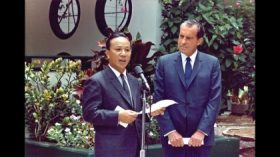
The American Retreat from Vietnam
or go to
Aletho News Archives – Video-Images
From the Archives
Secret document reveals plans for civil war in Lebanon, Israeli false flags, and invasion
By Randi Nord | Geopolitics Alert | April 5, 2019
Beirut – During his visit with US Secretary of State, Mike Pompeo, Lebanese President Michael Aoun reportedly received a US-Israeli document detailing plans for creating a civil war in Lebanon with covert false flag operations and possible Israeli invasion.
Although the source of the document is Israeli and created in partnership with Washington, no one knows who presented it to Aoun. The Lebanese TV station, Al-Jadeed, initially reported the document on Lebanese TV and a video on its website. Geopolitics Alert translated the report for this article. … continue
Blog Roll
 Aletho News
- There’s a drought in academia: A drought in honest research on the subject of drought and other weather extremes
- Department of War Awards $20.7 Billion Contract to Raytheon for Air-to-Air Missiles
- ‘Distance yourselves from Israel’: IRGC urges US population to question govt policies
- America’s Greenland deal has a radioactive backstory
- The RAF Fairford ‘terror plot’: Unpacking escalation in the UK echo-chamber
- EU Council Advances Chat Control 2.0 Scanning Proposal
- Ex-Greek MEP files complaint against Israeli spyware firm over alleged Pegasus surveillance
- Troubling ideas throughout the Torah, Talmud, Mishneh Torah and Tanya
- ‘Grave, alarming’: Iran mission on Trump’s UNGA ‘annihilation’ threats
- Najaf airport to reopen to Iranian flights within 24 hours: Ambassador
- If Americans Knew
- New Report: “Scholasticide and Genocide in Gaza: Assessment, Testimonies and Legal Analysis”
- Ex-Biden officials are desperate for a Gaza scapegoat
- Israeli “settlers” Invade Al-Aqsa; Pour Boiling Water on 75-Year-Old
- Israel Has Kidnapped Another American Teenager
- US arms sales to Israel worth $21.6 billion in 20 months
- Three Palestinians Killed in Israeli Attacks on Gaza
- Revealed: German “Anti-Semitism Expert” Driving Crackdown on Palestine Solidarity is Former Israeli Spy
- Egypt’s Warning to Israel Before Oct 7
- Israel’s siege signals another cruel winter for 1.8 million Gazans – Daily Update
- Netanyahu Asked UAE Leader to Deny Report on Oct. 7 Warning in Secret Visit, Sources Say
- No Tricks Zone
- New Study: Earth And Venus Surface Warmth Largely Explained By Convection And Lapse Rate, Not CO2 Or Radiation
- 2025 Nature Paper Claiming Worsening Global Drought Gets RETRACTED …Heavily Flawed
- New Study: ‘Global Drought Shows No Detectable Recent Acceleration Under Climate Warming’
- Economic Masterminds: German Socialists Suggest Taxing Productivity Gains Stemming From Using AI
- The South China Sea Has Not Been Cooperating With The Climate Change Narrative
- Energy Crisis: Germany Enters Heating Season With Historically Low Gas Reserve Fill Levels
- New Study: The Antarctic Ice Sheet Gained Mass From 2020-2024 Due To Staggering Snow And Ice Accumulation
- Study: Ocean Heating Rates From Thousands Of Years Ago ‘Dwarf’ Modern Ocean Heating Rates
- Climate Extremists Target, Attack Large-Scale Power Grid Infrastructure In Germany!
- New Study: Antarctic Ice Melt Has Contributed Less Than 1 Centimeter To Sea Level Rise In The Last 30 Years

