Windows 10 Devices Continue to ‘Collect Everything You Do, Say and Write’
Sputnik – 21.02.2017
European Union data protection authorities have expressed fresh concerns about the privacy of Microsoft’s Windows 10 operating system, despite tweaks being made to the OS after questions were raised about its treatment of personal data last year.
In a letter, the Article 29 Working Group said it still has “significant concerns” about how Microsoft collects and processes users’ personal data, and whether it obtains fully informed consent from users to do so.
“There is an apparent lack of control for users to prevent collection or further processing of such data. As a result, the Working Party specifically requests further explanatory information from Microsoft, as to how the opt-outs, default settings and other available control mechanisms presented during the installation of Windows 10 operating system provide a valid legal basis for the processing of personal data under the Data Protection Directive 95/46/EC. This is especially of concern where Microsoft would rely on consent as a legal basis for the processing of personal data,” the statement said.
Windows 10 launched in July 2015, and almost immediately garnered criticism for the use of default settings to harvest voluminous amounts of user data, such as web browsing history, WIFI network names and passwords, in order to display personalized adverts as users browse the web or play games. User data is also fed in to train Microsoft’s Cortana digital assistant.
While users were given the ability to opt-out of data collection, the process for doing so was criticized for being complex and opaque, comprising 45 pages of privacy policy documents, with opt-out settings spread across 13 different screens and housed on an external website.
In response, the Article 29 Working Party instigated an investigation, as did several national data protection authorities, including France’s CNIL. Their independent conclusions were much the same; the company must stop excessive data collection.
Among the breaches CNIL accused Microsoft of were failing to obtain notice for data transfers, breaking cookie law requirements, having inadequate security protections for personal data, failure to file an authorization request for processing personal data for fraud prevention purposes, and breach of cross-border data transfer restrictions.
CNIL set a deadline of January 31 for Microsoft to comply with their recommendations, although the Working Group’s warning suggests the tech giant is yet to fulfil their obligations, meaning it can be fined. In all, Microsoft could face fines of up to US$3.2 million for breaches of domestic privacy laws.
The EU General Data Protection Regulation, due to come into force May 2018, increases the potential penalties for companies breaching EU data protection law, with fines of up to four percent of annual turnover for enterprises found to be non-compliant.
The issue of informed consent in respect of data sharing has also seen Facebook and WhatsApp fall foul of European regulators; the companies were forced to suspend data sharing after making a change to WhatsApp’s privacy policy that pushed users to consent to sharing information such as their mobile phone number with the messaging app’s parent company.
In a statement, European Digital Rights said Microsoft “grants itself very broad rights to collect everything you do, say and write” on Windows 10-equipped devices in order to sell more targeted advertising or to sell your data to third parties.
“The company appears to be granting itself the right to share your data either with your consent “or as necessary.” Microsoft’s updated privacy policy is not only bad news for privacy. Your free speech rights can also be violated on an ad hoc basis,” the statement said.
Europe’s United Market is a ‘Project for the Business Establishment’
Sputnik – February 11, 2017
The euro currency is a major factor accelerating the process of economic and political disintegration within the European Union, according to Belgian left politician Peter Mertens.
The European Union is now “disintegrating,” Paul Magnette, Minister-President of the Belgian French-speaking region of Wallonia, said in a recent interview with L’Echo.
“We are nearing a process of political disintegration, with some countries becoming ungovernable,” the politician said.
Magnette also criticized the euro currency as poorly thought-out, which accelerated “social and financial deregulation.”
Magnette has been known as a vocal critic of the Comprehensive Economic and Trade Agreement (CETA), a free trade deal between the EU and Canada. In the interview, he also spoke out for withdrawal from the bloc of such countries as Romania, Bulgaria, Poland and Hungary, following the Brexit example.
Magnette’s remarks are especially surprising, taking into account the fact that such criticism came from a left-wing and pro-European politician.
Peter Mertens, the leader of the Workers’ Party of Belgium, underscored that in Belgium criticism of the current state of European integration comes from left-wing political forces, not from the right, like in France or in the Netherlands.
“From the very beginning, the euro has been a problem. The currency was designed to serve the interests of Germany, Europe’s strongest economy. It was clear that the European united market was not people’s will. It was a project for the business establishment,” Mertens said in an interview with Sputnik French.
The politician shared Magnette’s suggestion that the eastward expansion of the European Union was not conducted properly.
“In 2007-2008, several Eastern European countries joined the EU. The main reason was that German companies were looking for a cheap labor force. At the same time, it was clear that such countries as Bulgaria and Romania were not as economically developed as Central Europe. As a result, now there are two polarities in the EU, between the north and the south and between the west and the east,” Mertens pointed out.
He also agreed with Magnette that the introduction of the euro only deepened the social and economic divisions within the EU.
“In my opinion, the euro currency system was built under Germany’s surveillance. And I think that to a certain extent the current EU is autocratic and authoritarian,” he said.
Nevertheless, Mertens warned that a withdrawal of Eastern European countries from the EU would not resolve the crisis.
“We should not forget that we need to protect those countries. Now, some political forces call for cooperation only with economically developed countries. But we should continue our cooperation with Poland and other Eastern European countries,” he said.
Mertens also said that criticism of the European Union should not be monopolized by right-wing political movements.
“These concerns [about the crisis in the EU] can be expressed in many ways. For example, criticism can be expressed by the nationalists or the far-rights, like in France and the Netherlands. But it can also come from the left, like in Spain or Wallonia. The common idea is that the current political elites do not represent their people anymore,” Mertens concluded.
Hundreds of Belgian Artists and Academics Urge Government to End Participation in EU Project Cooperating with Israeli National Police
IMEMC News & Agencies – February 3, 2017
 In Belgium, 482 professors and researchers, and more than 190 artists, have written an open letter calling on their authorities to withdraw from participating in a European Union funded research project called LAW TRAIN, in which Belgium and Spain cooperate with the Israeli National Police.
The project, aimed at developing joint interrogation methods, is coordinated by an Israeli university with particularly deep ties to Israel’s army and notorious security services. The signatories of this open letter highlight that Israeli methods are tested on Palestinians. Israel’s illegal detention of Palestinian political prisoners, and the systematic abuse and torture perpetrated by Israeli security forces during interrogations, is well documented. And, in 2016 alone, Israelis interrogated at least 7,000 Palestinians, including over 400 children.
This open letter is part of broader efforts by the Belgian Coalition To Stop Law Train, and broader European-wide efforts against the participation of the Israeli military, homeland security and police sector in research and development funded by the European Union. Other forms of mobilizing have included direct actions, conferences, and lobbying.
Is Trump Unpredictable? The View from Russia – 2
By Elena PONOMAREVA | Strategic Culture Foundation | 03.02.2017
With Trump’s arrival in the White House, European leaders were the first to talk of «a new historical era» (Angela Merkel) and the fact that «the old world of the 20th century is over» (Frank-Walter Steinmeier). The alarmism running through these statements is fuelling discussions about the uncertainty and unpredictability of the new American president. In my view, however, judgements on his «unpredictability» should be tempered slightly. At the very least because if a political entity is «unpredictable» and everything surrounding it suddenly becomes uncertain, then one can easily imagine that planning would be impossible, leaving nothing to do but wait and see what Trump is going to do next and then react. Ultimately, this way of thinking will prevent countries from developing their own national strategies.
If there is any «unpredictability» with regard to Trump, then it is only in comparison with the White House’s previous policies, which the new administration will not be pursuing. When Richard Nixon was impeached, it heralded a creeping coup d’etat that resulted in supporters of cosmopolitan finance capital coming to power in the US. Over the past quarter of a century, the interests of American banksters have brought about the large-scale demolition of industry and the middle class in their own country. A huge number of Americans with links to the real economy were never going to be happy with such a state of affairs, and this is where the interests of certain groups of manufacturers coincided with the interests of parts of the middle class and skilled workers. Trump’s arrival in the White House is a victory for this group of manufacturers and workers and is seriously changing the rules of the game that have existed for almost forty years. And in this sense, Trump’s victory could be considered revolutionary.
At the same time, however, Trump’s rhetoric and his ‘soothing’ remarks should not be idealised for a number of reasons.
Firstly, whatever extraordinary personal qualities the president may have, the US political system is designed in such a way that he needs the support of its major segments. Trump is not an island; he is a man of the system, or, to be more precise, a certain part of it. Only «collective Trump» was able to become the president of the United States. Wealth and connections are an indispensable part of big politics and if these are used to achieve supreme power, then this supreme power will, in turn, be used to serve the interests of all those who helped the rise of a new political star.
Secondly, by promoting ‘their’ presidential candidate, stakeholders already have a strategy, a plan of action, the audit results of resources and capabilities. What’s more, domination and influence are primarily ideas that produce money and galvanise other resources. Trump’s team has such ideas. They are balanced and well thought out and show the new US president’s ‘business approach’ to politics. And, equally importantly, Donald Trump is committed. Unlike Barack Obama, Hillary Clinton and other hired managers of the ‘global elite’, he is sure that he’s right.
Thirdly, the laws governing the development of society, the class struggle, and social solidarity are still in place. As the richest president ever, Trump will not indulge in altruism or hand out money on the streets. His goal is to streamline economic and political institutions, which he’s already doing. The world views he expressed in his inauguration speech are acquiring clear outlines.
Among the recent news stories demonstrating his readiness to back up his words with deeds is his decision to introduce a tax on Mexican oil. This looks like the protection of domestic oil producers with a view to revolutionising the offshore oil and gas sectors. And let it contradict the rules of ‘free trade’ – for Trump and those who brought him to power, these rules mean absolutely nothing. The most important thing is to revitalise the US economy and improve the country’s industrial capacity.
By combining nationalism and protectionism, prioritising America’s internal problems, and appealing to labourers, blue collar workers and America’s Rust Belt, Trump is building on the authority of America’s seventh president, Andrew Jackson (who, incidentally, was the founder of the Democratic Party). Jackson’s ideology and policies are fundamentally different from the Wilsonian principles so dear to those in charge of the Federal Reserve System (it’s no coincidence that America’s 28th president, Woodrow Wilson, who is quite rightly considered to be the founder of the liberal world order project, is on America’s biggest bank note ($100,000)).
By following in Jackson’s footsteps, Trump is putting national interests rather than global leadership at the heart of his policies, and this is an interesting point that will not necessarily coincide with the interests of Russia and may actually go against them. During his inauguration speech, Trump said: «We will seek friendship and goodwill with the nations of the world, but we do so with the understanding that it is the right of all nations to put their own interests first. We do not seek to impose our way of life on anyone, but rather to let it shine as an example for everyone to follow». These words are worth thinking about.
Fourthly, the respected American analyst Edward Luttwak is convinced that the emergence of a politician like Trump was a reaction to what went before and was 90% unavoidable.
In fact, much of what went before has led to catastrophic changes in global politics. Anti-modern forces have replaced secular regimes in the Muslim world. The strategy of ‘controlled chaos’ chosen by the Democrats has not only helped destroy secular states, but has also given rise to anti-system forces where aggression and destruction, archaism and barbarity have infiltrated Europe along with hundreds of thousands of refugees who no longer have borders. With his global expansion policy, Obama drove the European Union into a trap and contributed to its weakening and imbalance. The split within the American elite and the support for Trump are largely down to a reluctance to repeat Europe’s experience. Hence the tough anti-immigration rhetoric and the new administration’s desire to destroy the Islamic State. That’s on the one hand.
On the other, «collective Trump» knows all too well that expansion does not just bear fruit in the form of military bases, a vassal mentality in the leaders of other countries, cheap goods, and the triumph of the dollar on all continents. Expansion is also a heavy burden that threatens to tear such forces apart. A little breathing space is needed to make a breakthrough and «shine as an example for everyone». Efforts need to be concentrated and regrouped and resources need to be optimised. The entire history of the US has been an alternation of two trends: a period of expansion, of enlargement (under the Democrats Wilson, Roosevelt, Truman and Kennedy) followed by a period of ‘contraction’, of concentration (under the Republicans, with the exception of George W Bush).
Trump as a reaction to what went before is, above all, this much-needed breathing space; it is America focussing on its internal problems; it is a period to digest what has been eaten. Trump’s America could be regarded as America getting ready for a new leap, for new heights. Hence its focus on its own internal problems. This focus is temporary, however. There is no point in portraying Trump as an isolationist. He will implement a foreign policy that will strengthen the US and there are a number of ways that this could happen. By weakening the European Union and China, for example, or by abandoning an active policy towards Ukraine. Ukraine had already become an old suitcase without handles for the Obama administration – difficult to carry, but a shame to throw away. Getting rid of something in politics is the same as losing face, but Trump is not in danger of losing face – he can easily swap Ukraine for other options.
As far as Russia is concerned, Trump’s arrival mostly opens a window of opportunity. While the US digests its thick broth of globalisation, brought to the boil by Obama, Russia will be able to solve a few of its own problems. The most important thing is that it has a clear understanding of these problems, and a clear understanding of America’s new strategy. And with such an understanding, there will be no «unpredictability».
See also:
The New Trump Administration – a New Strategy or a New Paradigm? The View from Russia – 1
Booming Black Market in Bundeswehr Rifles Funds Iraqi Refugees’ Flight to Europe
Sputnik – 04.02.2017
Last month German media revealed that German weapons supplied to Kurdish Peshmerga in northern Iraq are being sold on the black market, where they may end up in the hands of terrorist groups.
NDR and WDR reporters in the cities of Erbil and Sulaymaniyah in Iraqi Kurdistan discovered German weapons being sold on the black market there, engraved with the initials “Bw,” meaning Bundeswehr.
Weapons on sale included Heckler and Koch G3 rifles on sale for $1450 and $1800, and Walther P1 pistols with an asking price of $1200.
One arms dealer told a reporter that he could procure the Heckler & Koch G36 assault rifle for $5000.
These weapons sales have also financed the flight of refugees from Iraq to Germany, an Iraqi Kurdish refugee living in Germany told the news program.
Former Peshmerga Mustafa S said that he is one of hundreds of fighters who have sold their weapons to finance their escape from Iraq.
“Mustafa S said that he knows around 100 Peshmerga who have sold their weapons in recent months in order to flee. The situation has become unbearable for many. The low oil price, lack of payment from the Iraqi central government and the battle against Daesh, which guzzles about five million dollars daily, have brought the Kurdish regional government to the brink of bankruptcy. (Mustafa) himself had not been paid for five months and did not know how he was going to pay rent, food, and medicine for his disabled daughter. Now, he lives with his wife and their six children in a home for asylum seekers in East Germany,” Tagesschau reported.
Deputy Chairman of the Die Linke opposition party in the German Bundestag Tobias Pfluger called on the government to stop supplying arms to the Peshmerga. He told Sputnik that the deliveries are counter to the German constitution.
“The interesting thing is that the training missions that are connected with these weapons deliveries break several domestic federal laws. German and EU legislation, the War Weapons Control Act and the Foreign Trade and Payments Act, prohibit direct deliveries to war zones,” Pfluger explained.
The German Defense Ministry has delivered an estimated 2,400 tons of arms and munitions to Kurdish Peshmerga fighters since it began to supply the militia in summer 2014. A government spokesman told NDR and WDR that the government of Iraqi Kurdistan is responsible for the weapons’ misuse.
The German Defense Ministry is committed to the “proper verification of supplied weapons,” and their use in accordance with international law.
However, since the Ministry is unable to trace individual arms, “the sale of individual weapons cannot be excluded with absolute certainty.”
Pfluger said that assurances from local forces that the arms will remain in their possession are “worthless.”
“It is completely perverse that they have to sign a so-called confirmation of retention. That is nothing other than a completely worthless piece of paper because we know that the weapons show up on the markets in Iraq and Syria. In this respect, we say that this commitment must be ended, it is an intensification of the war and is in no way something that creates peace there.”
Peace activist and spokesman for Aktion Aufschrei — Stop the arms trade! Jurgen Grasslin told Sputnik Deutschland that German guns have ended up far removed from their intended destination.
“The federal government usually has no idea where their weapons are actually delivered to, when they are exported. My research, based on (studies of) numerous countries and trips to crisis regions and war zones over the past 30 years, shows clearly that weapons roam. Weapons do not stay in the place where they are delivered.”
Grasslin, author of a book entitled “The Black Book of Arms Trading: How Germany Profits from War” (Schwarzbuch Waffenhandel: Wie Deutschland am Krieg verdient), alleges that German arms deliveries constitute “complicity in murder.”
“If Daesh is firing German weapons, and of course weapons from other countries, that is more than a scandal, it is a breach of the law. It is complicity in murder. You are delivering to a war zone. You know that these weapons don’t stay in the hands of the recipients, and that they land in the hands of the worst terrorist groups, for example Daesh. The people who authorize these arms exports must be named, that is namely members of the Bundessicherheitsrat (Federal Security Council) or Federal Government. The first to be named should be Chancellor Angela Merkel and her deputy Sigmar Gabriel, who lead the Bundessicherheitsrat and are thus responsible for these armed forces.”
Theresa May to push EU members to up NATO spending
RT | February 3, 2017
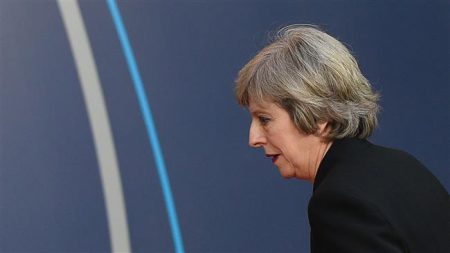
UK Prime Minister Theresa May will use the upcoming EU summit in Malta to demand Europe strengthen its commitment to NATO and spend more on defence.
May is expected to conduct a series of one-on-one meetings with EU leaders, including Germany’s Angela Merkel and Spain’s Mariano Rajoy, in order to secure “new, positive and constructive” relationships with the Union.
The prime minister, however, is not expected to attend the part of the talks in which Brexit will be discussed. Instead, she is using the summit as an opportunity to press the EU’s NATO members to fulfil their defence expenditure requirements.
According to a 2016 NATO report, only five of its 28 members actually reached the required defence spending limit of two percent. The list of those failing to spend enough includes Germany, France, and Spain.
Britain’s push for Europe to open its wallet comes after a meeting between Theresa May and US President Donald Trump last Friday.
At a joint press conference, May agreed with Trump that NATO spending should be “fairly shared” among its members.
Trump has in the past criticised NATO as being “obsolete” and “costing too much money.”
The president has also suggested that the US may not come to the assistance of NATO members who do not satisfy the two percent requirement.
May, however insisted she had received a “100 percent” commitment to NATO from the Trump administration. She also promised to “encourage fellow European leaders” to comply with their obligations.
It remains unclear how Britain will convince EU leaders to increase defence spending, as relations with Brussels have been significantly affected by Brexit. One possible way might be to emphasise the threat to European security that is supposedly posed by Russia.
Earlier this week, UK Defence Secretary Michael Fallon urged other NATO states to fulfil defence spending targets in order to effectively counter alleged Russian attempts to destabilise the continent.
Fallon has accused Russia of “becoming a strategic competitor to the West” and mounting a sophisticated information and cyber campaign against various NATO members.
Moscow has categorically denied these allegations, describing them as “baseless” and a “witch hunt.”
Read more:
The New Trump Administration – a New Strategy or a New Paradigm? The View from Russia – 1
By Dmitry MININ | Strategic Culture Foundation | 02.02.2017
The first moves by the new US president, Donald Trump, have demonstrated that he is taking his campaign promises seriously and is working to fundamentally restructure the American economic system.
Changes that were seen immediately after Trump’s inauguration: the official White House website deleted its pages that formerly proclaimed support for sexual minorities and the fight against climate change, instead reaffirming its commitment to the goals of energy independence, increased economic growth, and bringing jobs back to the US.
An executive order was signed to withdraw from the Trans-Pacific Economic Partnership. This presidential decision received the immediate and unqualified support of the biggest American labor unions – the AFL-CIO and the Teamsters – once considered Democratic strongholds and which had previously been wary of Trump. Geopolitics is giving way to geoeconomics.
On Jan. 24 Trump met with the heads of the three largest US automakers: General Motors; Ford; and Fiat Chrysler, urging them to expand production in the US rather than abroad. He warned that he would attempt to introduce a 35% import tariff on any company that moved its manufacturing overseas and then imported its products back into the US. But if they agreed to his demands, he promised «big league» regulatory and tax relief in order to give American companies an incentive not to move their plants abroad.
All of these actions are evidence of Trump’s determination to limit the expansion of the virtual economy and to begin the country’s reindustrialization. The transformations he has envisioned are so sweeping that it is more fitting to speak of a whole new stage of technological evolution, rather than merely a new approach. It appears that herein lies the root causes of the fierce resistance to Trump found among the ranks of the «global elite».
It would be an oversimplification to think that the new president is bent on taking America backward. His logic is the logic of a new industrialism, in which material production retains its innovative features, but produces tangible, rather than virtual assets. It is, in any case, a move away from a «bubble economy». According to Trump, the economy of a powerful country like the US should be deeply diversified, not one-dimensional as it has become.
There is currently quite a popular school of thought that claims that our society is at a particular stage of technological evolution (some consider this the «third», while others – the «fifth»), which is based on the development of digital technology. A transition to the next phase should be in the offing, which will be dominated by nano- and biotechnology. And the first to make the transition wins. The US has structured its development since the 1970s in accordance with this linear blueprint. It seemed attractive to focus on the high value-added information business, relegating dirty and labor-intensive manufacturing to other countries. The prevailing view – supported by the ideology of globalism – held that since IT-technology originated in the US, Americans would always call the shots.
This self-confidence has undermined the economic foundations of US power. The rest of the human race has risen to meet the Americans’ challenge successfully. A plurality of economic «poles» is appropriate for a politically multipolar world, but the fact that other economic «power centers» are banking on building more multifaceted economic systems is even more important.
Many years ago the US lost its position as a world leader in the production of material goods, and it survives mainly as a broker of financial and technological services, and also thanks to its virtual economy. Manufacturing and agriculture make up only 20% of US GDP – approximately $3.6 trillion out of $18 trillion. In China, those sectors are responsible for half of GDP, or $5.5 trillion out of $11 trillion. In this respect, the Chinese are already seriously outpacing the Americans – and that is according to the current exchange rate, without adjusting to take into account purchasing power parity, which would show that China is even further ahead of the US.
Liberal economists will say that in today’s economy, national wealth depends not so much on material output as on the development of the tertiary sector – the provision of services to final consumers or to other businesses, as well as the securing of patents, standards, etc. And this is true when speaking of the prosperity of the general public, but sovereign power is predicated upon quantities of material goods. And that low output affects, for example, export figures, and consequently – a nation’s ability to maintain an economic presence in the world. America’s total foreign-trade numbers now lag behind those of China, but even those indices are mainly based on imports – when it comes to exports the US is not even in second place. The EU exported $2.26 trillion worth of goods in 2014 (excluding intra-EU trade), China (in 2016) – $2.02 trillion (plus exports to Hong Kong – $0.49 trillion), and the US – $1.47 trillion. The global leader, which is only the third-largest exporter, is condemned to rely on military force to preserve its status, which is in turn detrimental to its ability to remain competitive.
There was an assumption that the decline in material production would be offset by the IT sector, but that is not happening. The Chinese company Lenovo became the global leader in PC sales in 2012, overtaking its biggest rival – America’s Hewlett-Packard. And in 2014, Lenovo took top honors for its sales of laptops as well. The world’s largest manufacturer of telecommunications equipment is also a Chinese company – Huawei, beating out the international giant Ericsson in 2012. And India is on its way to dominating the global software industry.
The emphasis on the virtual economy has also had unforeseen political consequences. For example, the concept of «soft power» is widely believed to be able to offset certain weakened or absent elements of a state’s traditional economic power. But conversely, the enthusiasm for «soft power» has evolved into an ideologization of foreign policy, replacing standard diplomatic tools with ubiquitous manipulation. As a result, US foreign policy is now faced with an even larger number of problems and conflicts. Paradoxically, despite its proclaimed «softness», Washington has increasingly been forced to resort to «hard» interventions abroad in order to maintain its global hegemony.
Trump’s answer to this appears quite reasonable. A country that is fully developed does not need additional proof of its power in the form of interventions. The rest of the world will recognize its real power and always take that into account. As international politics become less ideological, they will also become less prone to conflict.
But it is still too early to judge whether Trump is up to this task. Given the global dissemination of information technologies, it would hardly be possible, for example, to completely «reverse» financial globalization. Trump’s America needs partners, but they should not be chosen with the idea of «teaming up against someone», but with the goal of «teaming up for the sake of something». And there can be no question that Russia has its own interests and its own niche in that.
See also:
Norway surprised by Russia’s entry visa rejections to delegates blacklisted months ago
RT | February 2, 2017
Norway has summoned Russia’s ambassador to explain why two of its legislators were denied entry visas. Though the officials were placed on “counter-sanctions” lists and denied entry long ago, Norway has somehow found the rejections “incomprehensible.”
An official note containing the same objections preceded the ambassador’s summoning.
“The Foreign Ministry today summoned the Russian ambassador to repeat the protests,” the Norwegian Foreign Ministry said on Wednesday.
Norway’s Foreign Minister Børge Brende condemned Russia’s denial of the visas in strong terms. The rejected legislators are Bård Vegar Solhjell, the leader of Norway’s Socialist Left party, and Trine Skei Grande, the leader of the country’s Liberal Party.
“These are two distinguished, top-level Norwegian officials, excellent representatives of Norway,” Brende told the reporters, saying “it’s incomprehensible that they not be allowed to enter Russia.”
Although the minister acknowledged that Russia has the right to determine who can enter the country, saying that it’s “obviously up to every country to decide who can enter,” he slammed the denial as “biased, unreasonable and inconceivable.”
The Russian embassy in Oslo has confirmed that the visa requests were rejected as a part of a “mirror response” to Norway adopting the same sanctions that the EU has imposed on Russian citizens, as well as policies discriminating against Russian citizens who want to visit Spitsbergen island.
The list of officials from the EU and other countries who have been banned from entering Russia was provided to Brussels well ahead of time, with advice to inform all those affected, a Russian embassy spokesman stressed. Norway’s FM himself has admitted that the denials were something to be “expected” and that Norway’s reaction to the visa rejections thus appears quite surprising.
Coincidently, the outrage over Russia’s “hostile actions” came just hours after the country’s Police Security Service (PST) determined that Russia poses a “major threat” to Norway, along with Islamism.
Norway joined the EU’s sanctions against Russia and Russian citizens back in 2014 in response to what it called “Russia’s violations of human rights in Ukraine.” The situation escalated in April of 2015 when Russia’s Deputy PM Dmitry Rogozin visited Norway’s Island of Spitsbergen while on a trip to open the ‘North Pole-2015’ station. Norwegian authorities were riled by the visit, as Rogozin was on Europe’s anti-Russia sanction list.
Norway then adopted a measure authorizing the immediate deportation of sanctioned Russian citizens from the archipelago. Though Russia’s Foreign Ministry has protested the regulation, calling it discriminatory and in violation of an agreement on international cooperation on Spitsbergen, it was made permanent last September.
Analyzing Current Trends: Russia and West on the Threshold of Drastic Changes in Relationship
By Andrei AKULOV | Strategic Culture Foundation | 02.02.2017
The prospects for improvement of Russia-US relations become a matter of grave concern for European politicians. With Donald Trump’s «America First» policy, Europe may be left on its own. The calls for lifting the sanctions against Russia are getting louder – loud enough to make this issue become a part of EU’s shaping external strategy.
Italy’s former Prime Minister and European Commission ex-President Romano Prodi called on Europe to scrap immediately the anti-Russian sanctions, rather than wait for US president Donald Trump to do it first. His opinion on the sanctions is very illustrative. According to the patriarch of European politics, «The fact that it is necessary to lift the sanctions with Russia immediately. I am deeply convinced of this. You can sacrifice themselves for the sake of reaching a consensus, but when neither of which Solidarity has no question, there is no point in continuing to fight. One wise Calabrian proverb says, who pretend to be sheep, the wolf will eat that. First you need to play the card of not allowing American to occupy a privileged position in its relations with Russia».
Confusion reigns in Germany. Trump attacks Berlin despite the fact that Germany has always been loyal to Washington. It was the first to impose sanctions on Russia, even though it was contrary to its own immediate interests. Vice Chancellor Sigmar Gabriel warned of a «drastic radicalization» in American politics and said Berlin stood ready to fill the void left by an isolationist Washington. Frank-Walter Steinmeier, the current Minister for Foreign Affairs and Chairman-in-Office of the Organization for Security and Co-operation in Europe (OSCE), believes that «by choosing Donald Trump, the old world of the 20th century is over». «The order of the 21st century and the way the world of tomorrow will look is not settled; it is completely open […] I know we have to adjust to troubled times, to some unpredictability and new uncertainties», Mr. Steinmeier wrote in his piece published by Bild on January 23.
Other Europeans see things in the same light. «Hostile inauguration speech. We can’t sit around &hope for US support & cooperation. Europe must take its destiny & security in its own hands», Guy Verhofstadt, the former Belgian Prime Minister, wrote on Twitter in his comments on Donald Trump’s inaugural address. Speaking after meeting German Chancellor Angela Merkel on January 23, the frontrunner in France’s presidential election Francois Fillon said, «European Union sanctions on Russia are pointless, warning Russia and the United States under Donald Trump could forge links that exclude the EU». He warned against US President Donald Trump talking with Russia at Europe’s expense. «It would be damaging for Europe if Trump went above our heads, which is not inconceivable», the presidential hopeful stressed.
As one can see, European political heavyweights emphasize that Europe needs drastic changes in its relationships with the US and Russia. The US may belittle the EU by using the sanctions as a bargaining chip to make what President Trump calls «good deals». First Washington made the EU introduce the sanctions detrimental to its economy. Then the US would «allow» the EU to lift the restrictive measures as fresh winds started to blow in Washington! Thus, the US benefited from making Europe impose the sanctions and now it will reap the full advantage derived from making Brussels lift them! From point of view of geopolitical interests, in both cases the US will gain to make Europe lose.
This scenario is quite feasible. To prevent it from happening, the EU must move really fast to be one step ahead of Trump. By restoring normal relationship with Russia, Brussels will gain as a geopolitical actor. As a result, it will have a much more advantageous position to start from when it comes to shaping its new relationship of new configuration with Washington.
It would be a right thing to do at the time the «establishment» forces are under attack from all sides by the right and the left. The points of criticism include immigration policies, the integration process going too fast to make countries lose national identity and anti-Russian sanctions that have resulted in economic damage without exerting any influence whatsoever on Russia’s foreign policy. This is the time when Europe is at crossroads facing the prospects of most drastic changes since WWII. This is also the time when the «big brother» is intent to leave it fend for itself.
Mr. Trump has never promised anything to Europeans and he is adamant in his desire to change the existing order of things. The incoming elections in the Netherlands, France and Germany are going to undermine the position of ruling elites. Looks like Romano Prodi hit the nail right on the head – there is no time to lose. The time to normalize the relations with Moscow is now.
Featured Video
The American Retreat from Vietnam
or go to
Aletho News Archives – Video-Images
From the Archives
Secret document reveals plans for civil war in Lebanon, Israeli false flags, and invasion
By Randi Nord | Geopolitics Alert | April 5, 2019
Beirut – During his visit with US Secretary of State, Mike Pompeo, Lebanese President Michael Aoun reportedly received a US-Israeli document detailing plans for creating a civil war in Lebanon with covert false flag operations and possible Israeli invasion.
Although the source of the document is Israeli and created in partnership with Washington, no one knows who presented it to Aoun. The Lebanese TV station, Al-Jadeed, initially reported the document on Lebanese TV and a video on its website. Geopolitics Alert translated the report for this article. … continue
Blog Roll
 Aletho News
- There’s a drought in academia: A drought in honest research on the subject of drought and other weather extremes
- Department of War Awards $20.7 Billion Contract to Raytheon for Air-to-Air Missiles
- ‘Distance yourselves from Israel’: IRGC urges US population to question govt policies
- America’s Greenland deal has a radioactive backstory
- The RAF Fairford ‘terror plot’: Unpacking escalation in the UK echo-chamber
- EU Council Advances Chat Control 2.0 Scanning Proposal
- Ex-Greek MEP files complaint against Israeli spyware firm over alleged Pegasus surveillance
- Troubling ideas throughout the Torah, Talmud, Mishneh Torah and Tanya
- ‘Grave, alarming’: Iran mission on Trump’s UNGA ‘annihilation’ threats
- Najaf airport to reopen to Iranian flights within 24 hours: Ambassador
- If Americans Knew
- New Report: “Scholasticide and Genocide in Gaza: Assessment, Testimonies and Legal Analysis”
- Ex-Biden officials are desperate for a Gaza scapegoat
- Israeli “settlers” Invade Al-Aqsa; Pour Boiling Water on 75-Year-Old
- Israel Has Kidnapped Another American Teenager
- US arms sales to Israel worth $21.6 billion in 20 months
- Three Palestinians Killed in Israeli Attacks on Gaza
- Revealed: German “Anti-Semitism Expert” Driving Crackdown on Palestine Solidarity is Former Israeli Spy
- Egypt’s Warning to Israel Before Oct 7
- Israel’s siege signals another cruel winter for 1.8 million Gazans – Daily Update
- Netanyahu Asked UAE Leader to Deny Report on Oct. 7 Warning in Secret Visit, Sources Say
- No Tricks Zone
- New Study: Earth And Venus Surface Warmth Largely Explained By Convection And Lapse Rate, Not CO2 Or Radiation
- 2025 Nature Paper Claiming Worsening Global Drought Gets RETRACTED …Heavily Flawed
- New Study: ‘Global Drought Shows No Detectable Recent Acceleration Under Climate Warming’
- Economic Masterminds: German Socialists Suggest Taxing Productivity Gains Stemming From Using AI
- The South China Sea Has Not Been Cooperating With The Climate Change Narrative
- Energy Crisis: Germany Enters Heating Season With Historically Low Gas Reserve Fill Levels
- New Study: The Antarctic Ice Sheet Gained Mass From 2020-2024 Due To Staggering Snow And Ice Accumulation
- Study: Ocean Heating Rates From Thousands Of Years Ago ‘Dwarf’ Modern Ocean Heating Rates
- Climate Extremists Target, Attack Large-Scale Power Grid Infrastructure In Germany!
- New Study: Antarctic Ice Melt Has Contributed Less Than 1 Centimeter To Sea Level Rise In The Last 30 Years

