Soros-funded NGOs aiming to bring down Hungarian govt – foreign minister
RT | January 30, 2017
The activities of organizations funded by US billionaire investor George Soros in Hungary are “anti-democratic,” as they want to undermine the government in Budapest, the foreign minister of Hungary told RT.
Soros “would like this government to fail, he would like to kind of fire this government because he doesn’t like our approach, doesn’t like our policies,” Foreign Minister Peter Szijjarto told RT’s Sophie Shevardnadze.
“We find it very anti-democratic if someone from abroad would like to influence Hungarian voters on whom to vote for,” he asserted.
Several days before the interview, the Hungarian parliament began to discuss a bill allowing authorities to audit NGO executives and request detailed reports on their foreign donations.
Earlier in January, chairman of the ruling Fidesz party Szilard Nemeth said that “these organizations must be pushed back with all available tools, and I think they must be swept out, and now I believe the international conditions are right for this with the election of the new president [Donald Trump].”
Last September, Nemeth, who is also the deputy chairman of Hungary’s National Security Committee, submitted a list of 22 NGOs “connected to the Soros network for the purpose of having these organizations screened.”
Foreign Minister Szijjarto said it is obviously the right of his country to be protected from foreign influence. “This is what we have heard a lot from the US for the last months – that external influence is so dangerous… So, it’s a good reason – if this is the American position, it can be our position as well.”
Hungary, which lies at the very heart of Europe, last year became a main passageway for hundreds of thousands of migrants and refugees eager to reach northern European countries. The government, led by right-wing President Viktor Orban, responded by erecting fences along Hungary’s borders and introducing strict border controls. Budapest has consistently refused EU-backed mandatory resettlement quotas, calling them a blow to member states’ sovereignty.
Szijjarto cited intelligence reports alleging that “there were organizations which helped illegal migrants find ways to Hungary, to find where they could violate our border, to find out how to apply for asylum status, and these reports have said that George Soros was in the background of these organizations.”
Countries to Hungary’s east and south are concerned about Soros’ operations, too. In Macedonia, an organization called Stop Operation Soros (SOS) has been launched. Its founder, Nikola Srbov, accused Soros of hijacking civil society, calling upon followers to “fight against one-mindedness in the civil sector, which is devised and led by Soros,” according to Vecer newspaper.
Russian prosecutors branded the Open Society Foundation (OSF), a major Soros asset, and Open Society Institute’s Assistance Foundation threats to the country’s constitutional order and national security in 2015, and banned them from providing grants to Russian partners.
Groups run by Soros have also been accused of meddling in Ukrainian affairs and supporting the 2013 Euromaidan protests that led to the ouster of democratically-elected President Viktor Yanukovich.
Go figure: Soros-funded watchdog says populist politicians ‘undermine fight against corruption’
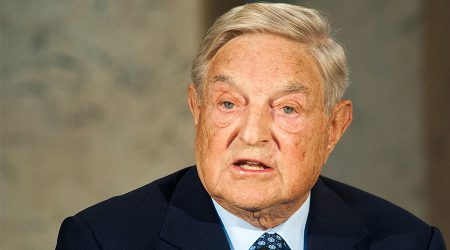
George Soros Image © Maurizio Gambarini / http://www.globallookpress.com
By Robert Bridge | RT | January 30, 2017
With the EU elite threatened by a populist insurgency aiming to end free and easy immigration programs and promote nationalism over globalism, an influential think tank says populism will only – wait for it – fuel the fires of corruption.
Transparency International, a Berlin-based anti-graft group, warned in its annual Corruption Perceptions Index about the purported perils of populism, a political animal that on occasion rolls through nations like a force of nature to contend with the excesses of an out-of-touch, elitist minority.
“Populism is the wrong medicine,” stated TI chair Jose Ugaz, without offering any alternative prescriptions. “In countries with populist or autocratic leaders, we often see democracies in decline and a disturbing pattern of attempts to crack down on civil society, limit press freedom, and weaken the independence of the judiciary.”
“Instead of tackling crony capitalism, those leaders usually install even worse forms of corrupt systems,” Ugaz continued.
With regards to corruption, the watchdog attempts mind-reading by asserting that populist politicians “have no intention of tackling the problem [of corruption] seriously.”
The report takes to task some firebrand politicians, including Donald Trump (USA), Marine Le Pen (France), Jaroslw Kaczynski (Poland) and Victor Orban (Hungary), among others, who are currently topping the popularity charts among their constituents by declaring open season on the moribund establishment.
Transparency International sounded the alarm over these political “con artists” who are “reactive, nativist and often right-wing…” while alleging that these disruptive newcomers “have been able to exploit the disenchantment of people with ‘the corrupt system’ and present themselves as the only ‘way out’ of the vicious cycle described… ”
While deliberating upon the potential risks associated with the new agitators on the block, the report conspicuously failed to mention the reasons why so many voters today are disaffected with the same old run-of-the-mill politicians, who are guilty, it must be said, of far worse crimes than mere corruption.
In all too many cases we are talking about complicity in actual atrocities, from bloody regime change in places like Iraq, Libya, Afghanistan, with efforts underway in Syria, to the wholesale destruction of Western civilization due to the unchecked immigration of war refugees without the consent of the governed. If NATO member states are feeling pangs of guilt over their direct complicity in the serial murders of nation states, forcing the refugees of these war zones onto the territory of their people is undoubtedly not the answer.
In light of these unsavory actions on the part of many NATO countries, concerns over high level corruption may seem a bit exaggerated and misplaced. At the risk of sounding cynical, separating corruption from the world of politics is tantamount to separating the chicken from the egg, and, as the popular riddle reminds us, very difficult to say what came first.
And speaking of corruption. The scale of corruption in the Clinton camp, revealed by WikiLeaks in the run up to the 2016 presidential election, is simply astounding and should be enough to preclude any lectures on good behavior by the folks at Transparency International.
For starters, it was revealed in November that the Clinton Foundation received a $1 million ‘gift’ from Qatar without telling the State Department, thereby breaking an agreement requiring it to reveal all foreign donations. The check was reportedly a gift to former President Bill Clinton in 2011 for his 65h birthday. A meeting was to take place between him and Qatari officials at some point, according to an email published last month, but it is not clear if this ever happened.
At the same time, it was also established that Saudi Arabia and Qatar were not only donating heavily to the Clinton Foundation but were also arming and funding the militants of Islamic State. Now if that isn’t the worst case of political corruption then I don’t know what is.
It is, therefore, no coincidence that populist politicians, simply responding to the market demand for fresh leadership, appeared around the world at just about the same time. The fact that France has its own version of Donald Trump in the form of Marine Le Pen would only come as a surprise to those people who don’t follow world events, or who are not told the truth about them.
Now that so many Western politicians and their affiliated parties are facing the threat of eviction this year (The most influential EU member states are witnessing a fierce struggle in the ranks amid the spectacular rise of anti-establishment, far-right politicians, like Le Pen in France, Geert Wilders in Holland and Frauke Petry in Germany), it is somewhat ironic that Transparency International would release a report warning voters that they are about to be hoodwinked by rabble-rousing, right-wing demagogues.
But there is a simpler explanation for the one-sided nature of this report, and it is due to a massive conflict of interest on the part of its sponsors.
Take it away, George
If you were doing consumer research on a particular product, would you trust the manufacturer of that product to carry out the research, or would you prefer some independent body to handle the job? I think most people would agree that the most reliable, trustworthy method would be to commission some third party with no connections to the company to provide its consensus. That would dramatically reduce the chances of inaccurate results due to something called ‘self-interest.’
And therein lies the glaring problem not only with this report but with Transparency International as a watchdog group.
A brief perusal of its supporter list should remove any doubt as to why Transparency International is extremely wary about populist politicians rocking the European boat of power.
Aside from receiving from a number of foreign governments (Germany, United Kingdom, United States, Ireland, Estonia and Finland, to name a few), TI is sponsored by the some of the most dubious names in democracy today, brought to you by none other than investor and philanthropist George Soros himself.
The Open Society Institute (OSI) and Open Society Initiative for West Africa (OSIWA) ranks just behind the National Endowment for Democracy (NED), a soft power non-profit sponsored by the US government, on the list of TI’s supporters.
Clearly, this is the last organization one should trust for providing an objective look at the rise of new political parties across the world. Indeed, George Soros himself has been largely responsible for the massive influx of refugees to the European Union, going so far as to offer cash incentives to refugees who wish to make the long, dangerous journey from the Middle East to the European continent.
Never mind that none of these displaced peoples, who have every right to our sympathy, will live in the same neighborhood as Mr. Soros, who can well afford all the personal protection that is certainly desirable when embracing such reckless policies. But for the average European citizen, who must accommodate these millions of new people who do not share the same religious, social and cultural predilections, nor in many cases the same high level of education, this social experiment carried out on the whim of a billionaire is the epitome of reckless behavior.
In fact, it should come as no surprise that the TI report singled out Hungarian Prime Minister Victor Orban. Just this month, Szilard Nemeth, a vice president of the ruling Fidesz party, said it would use “all the tools at its disposal” to “sweep out” NGOs funded by the Hungarian-born financier, which “serve global capitalists and back political correctness over national governments.”
But all that pales in comparison to an award that Transparency International bestowed upon none other than former US Secretary of State Hillary Clinton in 2012 for “her emphasis on the importance of increasing transparency and countering corruption as part of US foreign policy, with the award addressed solely to those contributions.” Needless to say, that award drew a lot of raised eyebrows around the world.
There is a breathtaking degree of conflict of interest in this TI report, which, like so many closed halls of power in the EU today, is just begging for the transparent light of day.
Robert Bridge, an American writer and journalist based in Moscow, Russia, is the author of the book on corporate power, “Midnight in the American Empire”, released in 2013.
EU expands task force aimed at combatting alleged Russian propaganda
RT | January 25, 2017
An EU agency, East Stratcom, will receive an influx of cash and personnel to fight what the West calls Russian propaganda news, Deutsche Welle reports. The decision to give the controversial body a boost comes ahead of 2017 elections in several European countries.
The task force, which was formed as part of the European External Action Service (EEAS) in early 2015 to tackle what the EU sees as Russian propaganda, will now receive extra resources, Germany’s Deutsche Welle (DW) reported, citing a spokesperson for the EU Foreign Affairs and Security Policy.
So far, there are 10 people working for the agency, DW said, explaining that they are searching for what they believe to be fake news and then writing “disproof” statements.
Despite the fact that the origins of the stories are “very hard to trace,” as DW suggests, and “whether Russia is behind them is hard to tell,” EU officials have decided to reinforce the organization ahead of upcoming elections in key European states this year, citing fears of external meddling.
German Chancellor Angela Merkel is alleged to be facing a heightened Russian disinformation campaign ahead of the German elections this year, AFP reported. Citing its source at East Stratcom, AFP said that the task force had found Merkel to have already been under increasing attack last year. The same source alleged that upcoming elections in France and the Netherlands could also be externally targeted.
Meanwhile, an MEP told RT that the organization battling the perceived Russian threat “is not credible.”
Stelious Kouloglou, an MEP for the Greek ruling center-left Syriza party, said: “It’s a weapon of psychological welfare, it’s a weapon of propaganda, so it’s not credible to me both as a journalist and as a European deputy.”
Just to blame somebody else for the problems Europe faces “is very bad for Europe,” the Greek politician said. “Europe is going in the wrong direction, and it’s not Moscow’s fault,” Kouloglou told RT. “We don’t look at our problems and just blame others, play the blame game,” he added.
“If Trump won, it’s not because of the Russian intervention, whether it was real or not. Trump won because he exploited the mistakes that have been made by the American oligarchy, by the 1 percent of those who are getting richer, although 99 percent of the population of the US are getting poorer. The same direction Europe is going. So, we can’t blame somebody else. If we do that, it will be a fatal mistake and the extreme right will profit from that. We have to address the real problems Europe is facing,” Kouloglou said.
In November, the EU Parliament debated and then voted on a resolution that sought to establish measures “to tackle Russian and Islamic State propaganda.” The controversial non-legislative document called for the EU to “respond to information warfare by Russia,” which was placed alongside propaganda by the Islamic terrorist group. RT was cited as one of the alleged propaganda “tools,” with the resolution authors claiming Moscow has an influence on media markets and societies in the EU and other countries.
Karl Rove’s Prophecy

Karl Rove. Credit: Jay Godwin/Wikimedia Commons
Karel van Wolferen • Unz Review • January 23, 2017
In a famous exchange between a high official at the court of George W. Bush and journalist Ron Suskind, the official – later acknowledged to have been Karl Rove – takes the journalist to task for working in “the reality-based community.” He defined that as believing “that solutions emerge from your judicious study of discernible reality.” Rove then asserted that this was no longer the way in which the world worked:
We’re an empire now, and when we act, we create our own reality. And while you’re studying that reality – judiciously, as you will – we’ll act again, creating other new realities, which you can study too, and that’s how things will sort out. We’re history’s actors . . . and you, all of you, will be left to just study what we do. (Ron Suskind, NYTimes Magazine, Oct. 17, 2004).
This declaration became popular as an illustration of the hubris of the Bush-Cheney government. But we could also see it as fulfilled prophecy. Fulfilled in a manner that no journalist at that time would have deemed possible. Yes, the neoconservatives brought disrepute upon themselves because of the disaster in Iraq. Sure, opposition to the reality Rove had helped create in that devastated country became a first rung on the ladder that could lead to the presidency, as it did for Barack Obama. But the neocons stayed put in the State Department and other positions closely linked to the Obama White House, where they became allies with the liberal hawks in continuing ‘spreading democracy’ by overthrowing regimes. America’s mainstream news and opinion purveyors, without demurring, accommodated the architects of reality production overseen by Dick Cheney.
This did not end when Obama became president, but in fact with seemingly ever greater eagerness they gradually made the CIA/neocon-neoliberal created reality appear unshakably substantial in the minds of most newspaper readers and among TV audiences in the Atlantic basin. This was most obvious when attention moved to an imagined existential threat posed by Russia supposedly aimed at the political and ‘Enlightenment’ achievements of the West. Neoconservatives and liberal hawks bent America’s foreign-policy entirely to their ultimate purpose of eliminating a Vladimir Putin who had decided not to dance to Washington’s tune so that he might save the Russian state, which had been disintegrating under his predecessor and Wall Street’s robber barons.
With President Obama as a mere spectator, the neocon/liberals could – without being ridiculed – pass off as a popular revolution the coup d’état they fomented in the Ukraine. And because of an unquestioned Atlanticist faith, which holds that without the policies of the United States the world cannot be safe for people of the Atlantic basin, the European elites that determine policy or comment on it joined their American counterparts in endorsing that reality.
As blind vassals the Europeans have adopted Washington’s enemies as their own. Hence the ease with which the European Union member states could be roped into a system of baseless economic sanctions against Russia, much to the detriment of their own economic interests. Layers upon layers of anti-Russian propaganda have piled up to bamboozle a largely unsuspecting public on both sides of the Ocean.
In the Netherlands, from where I have been watching all this, Putin was held personally responsible in much of the media for the shooting down of a Malaysian airliner flying over the Ukraine, which killed 298 people. No serious investigation was undertaken. The presentation of ‘almost definitive’ findings by the joint investigation team under Dutch leadership has neither included clues supplied by jet fighter cannon holes in the wrecked fuselage nor eyewitness stories, which would make the government in Kiev the prime suspect. Moscow’s challenging the integrity of the investigation, whose agreed-upon rules included publication of findings only if Kiev agreed with them, were met with great indignation by the Dutch Foreign and Prime Ministers.
As the fighting in Syria reached a phase when contradictions in the official Washington/NATO story demanded a stepping back for a fresh look, editors were forced into contortions to make sure that the baddies stayed bad, and that no matter how cruel and murderously they went about their occupation in Aleppo and elsewhere, the jihadi groups fighting to overthrow the secular Assad government in Damascus remained strictly labeled as moderate dissidents worthy of Western support, and the Russians as violators of Western values. Architects of an official reality that diverges widely from the facts you thought you knew must rely on faits accompli they achieve through military or police violence and intimidation, in combination with a fitting interpretation or a news blackout delivered by mainstream media.
These conditions have been widely obtained in the Atlantic basin through a gradual loss of political accountability at top levels, and through government agencies protected by venerated secrecy that are allowed to live lives of their own. As a result American and European populations have been dropped into a fantasy world, one under constant threat from terrorists and an evil dictator in Moscow. For Americans the never ending war waged by their own government, which leaves them with no choice but to condone mass murder, is supposedly necessary to keep them safe. For Europeans, at least those in the northern half, the numerous NATO tanks rolling up to the border of the Russian Federation and the massing of troops in that area are an extra guarantee, on top of the missiles that were already there, that Vladimir Putin will restrain his urges to grab a European country or two. On a smaller scale, when every May 4th the 1940-45 war dead are remembered in the Netherlands, we must now include the fallen in Afghanistan as if they were a sacrifice to defend us against the Taliban threat from behind the Hindu Kush.
Ever since the start of this millennium there has been a chain of realities as prophesied by Karl Rove, enhanced by terrorist attacks, which may or may not have been the work of actual terrorists, but whose reality is not questioned without risking one’s reputation. The geopolitical picture that they have helped build in most minds appears fairly consistent if one can keep one’s curiosity on a leash and one’s sense of contradiction sufficiently blunt. After all, the details of the official reality are filled in and smoothed out all the time by crafty campaigns produced in the PR world, with assistance from think tanks and academia.
But the question does reappear in one’s thoughts: do the politically prominent and the well-positioned editors, especially those known for having once possessed skeptical minds, actually believe it all? Do those members of the cabinet or parliament, who can get hot under their collar as they decry the latest revelation about one or other outrage committed by Putin, take seriously what they’re saying? Not all of them are believers, I know that from off the record conversations. But there appears to be a marked difference between the elite in government, in the media, in prominent social positions, and ordinary people who in these recent times of anguish about populism are sometimes referred to as uneducated. Quite a few among the latter appear to think that something fishy is going on. This could be because in my experience the alert ones have educated themselves, something that is not generally understood by commentators who have made their way through the bureaucracy of standard higher education.
A disadvantage of being part of the elite is that you must stick to the accepted story. If you deviate from it, and have your thoughts run rather far away from it, which is quite inevitable once you begin with your deviation, you can no longer be trusted by those around you. If you are a journalist and depend for your income on a mainstream newspaper or are hired by a TV company, you run the risk of losing your job if you do not engage in self-censorship.
Consequently, publications that used to be rightly known as quality newspapers have turned into unreadable rags. The newspaper that was my employer for a couple of decades used to be edited on the premise that its correspondents rather than authorities were always correct in what they were saying. Today greater loyalty to the reality created in Washington and Langley cannot be imagined. For much of northern Europe the official story that originates in the United States is amplified by the BBC and other once reliable purveyors of news and opinion like the Guardian, the Financial Times and the (always less reliable) Economist.
Repetition lends an ever greater aura of truth to the nonsense that is relentlessly repeated on the pages of once serious publications. Detailed analyses of developments understood through strings of false clues give the fictions ever more weight in learned heads and debates in parliament. At the time of writing, the grave concern spread across the opinion pages on my side of the Atlantic is about how Putin’s meddling in upcoming European elections can be prevented.
The realities Rove predicted have infantilized parliamentary debates, current affairs discussion and lecture events, and anything of a supposedly serious nature on TV. These now conform to comic book simplicities of evil, heroes and baddies. They have produced a multitude of editorials with facts upside-down. They force even those who advise against provoking Moscow to include a remark or two about Putin being a murderer or tyrant, lest they could be mistaken for traitors to Enlightenment values or even as Russian puppets, as I have been. Layers of unreality have incapacitated learned and serious people to think clearly about the world and how it came to be that way.
How could Rove’s predictions so totally materialize? There’s a simple answer: ‘they’ got away with momentous lies at an early stage. The more authorities lie successfully the more they are likely to lie again in a big way to serve the purposes of earlier lies. The ‘they’ stands for those individuals and groups in the power system who operate beyond legal limits as a hydra-headed entity, whose coordination depends on the project, campaign, mission, or operation at hand. Those with much power got away with excessive extralegal use of it since the beginning of this century because systems of holding the powerful to account have crumbled on both sides of the Atlantic. Hence, potential opposition to what the reality architects were doing dwindled to almost nothing. At the same time, people whose job or personal inclination leads them to ferret out truth were made to feel guilty for pursuing it.
The best way, I think, to make sense of how this works is to study it as a type of intimidation. Sticking to the official story because you have to may not be quite as bad as forced religious conversion with a gun pointed at your head, but it belongs to the same category. It begins with the triggering of odd feelings of guilt. At least that is how I remember it. Living in Tokyo, I had just read Mark Lane’s Rush To Judgment, the first major demolishing in book form of the Warren Report on the murder of John F. Kennedy, when I became aware that I had begun to belong to an undesirable category of people who were taking the existence of conspiracies seriously. We all owe thanks to writers of Internet-based samizdat literature who’ve recently reminded us that the pejorative use of the conspiracy label stems from one of the greatest misinformation successes of the CIA begun in 1967.
So the campaign to make journalists feel guilty for their embarrassing questions dates from before Dick Cheney and Rove and Bush. But it has only reached a heavy duty phase after the moment that I see as having triggered the triumph of political untruth.
We have experienced massive systemic intimidation since 9/11. For the wider public we have the absurdities of airport security – initially evidenced by mountains of nail-clippers – reminding everyone of the arbitrary coercive potential that rests with the authorities. Every time people are made to take off their belts and shoes – to stick only to the least inane instances – they are reminded: yes, we can do this to you! Half of Boston or all of France can be placed under undeclared martial law to tell people: yes, we have you under full control! For journalists unexamined guilt feelings still play a major role. The serious ones feel guilty for wanting to ask disturbing questions, and so they reaffirm that they still belong to ‘sane’ humanity rather than the segment with extraterrestrials in flying saucers in its belief system. But there is a confused interaction with another guilty feeling of not having pursued unanswered questions. Its remedy appears to be a doubling down on the official story. Why throw in fairly common lines like “I have no time for truthers” unless you feel that this is where the shoe pinches?
You will have noticed a fairly common response when the 9/11 massacre enters a discussion. Smart people will say that they “will not go there”, which brings to mind the “here be dragons” warning on uncharted bits of medieval maps. That response is not stupid. It hints at an understanding that there is no way back once you enter that realm. There is simply no denying that if you accept the essential conclusions of the official 9/11 report you must also concede that laws of nature stopped working on that particular day. And, true enough, if you do go there and bear witness publicly to what you see, you may well be devoured; your career in many government positions, the media and even academia is likely to come to an end.
So, for the time being we are stuck with a considerable chunk of terra incognita relating to recognized political knowledge; which is an indispensable knowledge if you want to get current world affairs and the American role in it into proper perspective.
Mapping the motives of those who decide “not to go there” may be a way to begin breaking through this disastrous deadlock. Holding onto your job is an honorable motivation when you have a family to maintain. The career motivation is not something to scorn. There is also an entirely reasonable expectation that once you go there you lose your voice publicly to address very important social abuse and political misdeeds. I think it is not difficult to detect authors active on internet samizdat sites who have that foremost in mind. Another possible reason for not going there is the more familiar one, akin to the denial that one has a dreadful disease. Also possible is an honorable position of wishing to preserve social order in the face of a prospect of very dramatic political upheaval caused by revelations about a crime so huge that hardly anything in America’s history can be compared to it. Where could such a thing end – civil war? Martial law?
What I find more difficult to stomach is the position of someone who is worshiped by what used to be the left, and who has been guiding that class of politically interested Americans as to where they can and cannot go. Noam Chomsky does not merely keep quiet about it, but mocks students who raise logical questions prompted by their curiosity, thereby discouraging a whole generation studying at universities and active in civil rights causes. One can only hope that this overrated analyst of the establishment, who helps keep the most embarrassing questions out of the public sphere, trips over the contradictions and preposterousness of his own judgments and crumples in full view of his audience.
The triumph of political untruth has brought into being a vast system of political intimidation. Remember then that the intimidater does not really care what you believe or not, but impresses you with the fact that you have no choice. That is the essence of the exercise of brute power. With false flag events the circumstantial evidence sometimes appears quite transparently false and, indeed could be interpreted as having been purposeful. Consider the finding of passports or identity papers accidentally left by terrorists, or their almost always having been known to and suspected by the police? What of their death through police shooting before they can be interrogated? Could these be taunting signals of ultimate power to a doubting public: Now you! Dare contradict us! Are the persons killed by the police the same who committed the crime? Follow-up questions once considered perfectly normal and necessary by news media editors are conspicuous by their absence.
How can anyone quarrel with Rove’s prophecy. He told Suskind that we will forever be studying newly created realities. This is what the mainstream media continue to do. His words made it very clear: you have no choice!
A question that will be in the minds of perhaps many as they consider the newly sworn in president of the United States, who like John F. Kennedy appears to have understood that “Intelligence” leads a dangerously uncontrolled life of its own: At what point will he give in to the powers of an invisible government, as he is made to reckon that he also has no choice?
Karel van Wolferen is a Dutch journalist and retired professor at the University of Amsterdam. Since 1969, he has published over twenty books on public policy issues, which have been translated into eleven languages and sold over a million copies worldwide. As a foreign correspondent for NRC Handelsblad , one of Holland’s leading newspapers, he received the highest Dutch award for journalism, and over the years his articles have appeared in The New York Times , The Washington Post , The New Republic , The National Interest , Le Monde , and numerous other newspapers and magazines.
#StopCETA: Thousands protest EU-Canada trade deal in demos across Europe
RT | January 22, 2017
Protesters in more than a dozen European states have taken to the streets in scheduled demonstrations against the yet-to-be-approved CETA trade agreement, charging it will result in the loss of jobs, lower safety standards, and grant freer rein to corporations.
“The people and the planet are not merchandise,” read a banner carried at the front of a column of demonstrators in Madrid.
In Dublin, protesters dressed as politicians from the ruling Fine Gael party handed over a “blank check” to a man dressed as a “corporation,” wearing a skull mask.
A procession of 130 tractors and as many as 18,000 people marched through the heart of Berlin before symbolically handing over a petition at the German agricultural ministry. The demonstration, organized by Germany’s Green Party and environmentally-conscious farmers wasn’t exclusively aimed at CETA, but the treaty received prominent mentions in the list of complaints.
Other notable rallies, documented on social media, were staged in Paris, Madrid and several other Spanish cities, Ourense in Portugal and Brussels.
TTIP, and TiSA, two other unratified pro-free trade treaties were also condemned.
The broad coalition of anti-globalists, environmentalists and labor movements that was behind what they called the Decentralized Day of Action against CETA, which had been negotiated for seven years, prior to being signed last October, outlined three main objections to CETA, the Comprehensive Economic and Trade Agreement.
The first was regulatory harmonization between Canada and the EU which would mean goods are produced to the same standard, and can be easily imported without additional certification.
“With the excuse of improving trade between the countries, regulations designed to protect the environment, workers’ rights, public services and consumer standards, will be reduced to the minimum common denominator,” said StopCETA.net.
The second is the additional legal protection given to foreign investors.
“Multinational corporations will have the right to sue governments if laws or regulations are introduced that cause them loss of profits,” continued the organizers.
And the third argument focused on the secrecy of the treaty, which was negotiated behind closed doors, and which will need to be ratified by the European Parliament this spring, before being approved by the national legislatures of the 28 EU member states.
Proponents of CETA argue that it will boost trade between Canada and Europe by 20 percent, and annually add €12 billion to the EU economy and €8.4 billion to Canada’s economy.
After several decades in which trade barriers were removed by governments with scant consultation with the public, there’s been growing resistance to new agreements from both above and below.
The Transatlantic Trade and Investment Partnership (TTIP), a deal similar to CETA, but involving the much larger US economy, has also been met with fierce public resistance in Europe, and Donald Trump has signaled that dismantling TTIP is one of his priorities as President of the US.
The Trade in Services Agreement (TiSA) that plans to open up the service industries of 23 mostly developed countries to foreign companies and individuals, has gone through 21 rounds of negotiations since 2013, with no final document published yet, and no deadline for the end of talks.
Ukraine May Have a New President in Waiting, But He’s Another Oligarch
Sputnik | January 21, 2017
In December, Ukrainian billionaire Victor Pinchuk wrote an explosive op-ed in The Wall Street Journal, laying out how Ukraine can end its conflict with Russia. Pinchuk’s plan is simple: Kiev must close its eyes on Crimea, proceed with elections in Donbass, and forget NATO. Unfortunately, elites in Kiev see his ideas as nothing less than treasonous.
Pinchuk’s appeal, published in the opinion pages of the WSJ on December 29, laid out his vision on how the new administration in Washington can try to sort out the mess in Kiev in the interests of improving relations with Moscow.
Kiev, the billionaire steel magnate wrote, must be willing to compromise, including making a genuine effort to end the civil war that’s being waged in the country’s east. Ukrainian authorities must accept local elections in the breakaway territories, and live up to their commitments under the Minsk agreements, as must Russia, the oligarch added. Crimea, he said, “must not get in the way of a deal that ends the war in the east on an equitable basis.”
Kiev sent the Ukrainian army to deal with unrest in eastern Ukraine in April 2014, after protesters refused to recognize the legitimacy of authorities who came to power in the February 2014 coup d’état. In March 2014, Crimean authorities organized a referendum, asking the peninsula’s residents if they wanted Crimea to rejoin Russia. A whopping 96% voted ‘yes’, and Moscow soon accepted the peninsula’s request.Pinchuk also made proposals on other, related fronts, suggesting that Ukraine “should consider temporarily eliminating EU membership from our stated goals for the near future.” As for NATO membership, he stressed that Kiev should “accept that Ukraine will not join NATO in the near- or midterm.” For now, he said, the country should choose neutrality. He even hinted that Kiev would be “ready to accept an incremental rollback of sanctions on Russia” if that helps to restore peace, unity and security to the country.
Pinchuk’s ideas didn’t include anything radically outside the reigning political orthodoxy in Ukraine. He didn’t propose recognizing Crimea as part of Russia, and maintained that Moscow was to blame for “initiating” the conflict in the east.
Nevertheless, as expected, the billionaire’s op-ed caused uproar both in the Ukrainian media and in political circles. Ukrainian President Petro Poroshenko thundered that Kiev would never compromise on Russian ‘aggression’, and stressed that he would never abandon plans to join NATO and integrate into the EU. Pundits called the op-ed “An offer to surrender,” condemned Pinchuk’s “tone of appeasement” and defiantly proclaimed that Ukrainians would never accept his peace proposals.
Eventually, Pinchuk was even forced to apologize for publishing the article, blaming heavy editing and WSJ’s provocative headline, which read ‘Ukraine Must Make Painful Compromises for Peace With Russia.’So what was actually behind this political storm in a teacup? According to Radio Sputnik contributor Daria Cherednik, Kiev was mistaken to see Pinchuk’s op-ed a “treacherous blow to the back,” since the jab was actually “direct, open, and frontal – right in the stomach.”
With the publication of the editorial, Cherednik wrote, “all Poroshenko’s horses and all of his men were suddenly alarmed overnight, since the throne under the king had clearly started to wobble.” In fact, she added, not only was the throne wobbling, “but a contender has appeared for the king’s seat. At least that’s how it appeared to the Ukrainian president himself, and to his entourage saw things,” accusing Pinchuk of “filing down the throne’s legs.”
Pinchuk, the journalist recalled, has long been a notable figure in Ukraine’s circles of power. He’s married to the daughter of former President Leonid Kuchma, and is valued at $1.5 billion, making him the third richest person in Ukraine. “But most importantly,” Cherednik added, “he hasn’t been tainted in any political scandal.”Pinchuk “even managed to help finance Hillary Clinton’s election campaign without creating problems with Donald Trump,” the journalist wrote. The oligarch had indeed used the Victor Pinchuk Foundation to make millions of dollars in contributions to the Clinton Foundation, but also paid $150,000 to the Trump Foundation in exchange for a speech by then-candidate Trump in September 2015.
The billionaire’s op-ed in the WSJ was perceived as a stab in the back for obvious reasons, Cherednik stressed. “How else could the current Ukrainian establishment perceive Pinchuk after such ‘seditious speeches’? It would be one thing if he presented his ideas on some local television channel, something that could be cast off as insane and forgotten. But he published his thoughts in an American newspaper. What if the White House reads the article (it surely has) and thinks that Victor Pinchuk is a reasonable figure who’s able to negotiate, and therefore a very suitable candidate for the presidency?”
Kiev certainly didn’t appreciate Pinchuk’s “creative” approach, Cherednik suggested. “Poroshenko and his staff even refused to participate in the traditional breakfast organized by the businessman in Davos on Thursday. And that’s a shame. David Cameron and Henry Kissinger decided that this would be quite a worthy event and did not reject the invitation.” Ultimately, the journalist noted, President Poroshenko was left “standing outside the door at Davos salivating, not just because of the lost opportunities for a delicious meal, but also for the lost company.”
British Fingerprints in Dirty Tricks Against Trump
By Finian CUNNINGHAM | Strategic Culture Foundation | 21.01.2017
Britain’s divisive Brexit politics are playing out through the new US presidency of Donald Trump. It seems that a faction within the British political establishment which is opposed to Britain leaving the European Union has joined forces with American intelligence counterparts to hamper Trump’s new administration.
By hampering Trump, the pro-EU British faction would in turn achieve a blow against a possible bilateral trade deal emerging between the US and Britain. Such a bilateral trade deal is vital for post-Brexit Britain to survive outside of the EU. If emerging US-British trade relations were sabotaged by disenfranchising President Trump, then Britain would necessarily have to turn back to rejoining the European Union, which is precisely what a powerful British faction desires.
What unites the anti-Trump forces on both sides of the Atlantic is that they share an atlanticist, pro-NATO worldview, which underpins American hegemony over Europe and Anglo-American-dominated global finance. This atlanticist perspective is vehemently anti-Russian because an independent Russia under President Vladimir Putin is seen as an impediment to the US-led global order of Anglo-American dominance.
The atlanticists in the US and Britain are represented in part by the upper echelons of the intelligence-military apparatus, embodied by the American Central Intelligence Agency and Britain’s Military Intelligence (Section) 6 (MI6).
Notably, incoming US President Donald Trump has expressed indifference towards NATO. This week he repeated comments in which he called the US-led military alliance «obsolete». Trump’s views are no doubt a cause of grave consternation among US-British atlanticists.
It is now emerging that British state intelligence services are involved much more deeply in the dirty tricks operation to smear Trump than might have been appreciated heretofore. The British involvement tends to validate the above atlanticist analysis.
The dirty tricks operation overseen by US intelligence agencies and willing news media outlets appears to be aimed at undermining Trump and, perhaps, even leading to his impeachment.
The former British MI6 agent, named as Christopher Steele, who authored the latest sexual allegations against Trump, was initially reported as working independently for US political parties. However, it now seems that Steele was not acting as an independent consultant to Trump’s political opponents during the US election, as media reports tended to indicate.
Britain’s Independent newspaper has lately reported that Steele’s so-called «Russian dossier» – which claimed that Trump was being blackmailed by the Kremlin over sex orgy tapes – was tacitly given official British endorsement.
That endorsement came in two ways. First, according to the Independent, former British ambassador to Russia, Sir Andrew Woods, reportedly gave assurances to US Senator John McCain that the dossier’s allegations of Russian blackmail against Trump were credible. Woods met with McCain at a security conference in Canada back in November. McCain then passed the allegations on to the American FBI – so «alarmed» was he by the British diplomat’s briefing.
The second way that Britain has endorsed the Russian dossier is the newly appointed head of MI6, Sir Alex Younger, is reported to have used the material produced by his former colleague, Christopher Steele, in preparing his first speech as head of the British intelligence service given in December at the agency’s headquarters in London. That amounts to an imprimatur from MI6 on the Russian dossier.
Thus, in two important signals from senior official British sources, the Russian dossier on Trump was elevated to a serious intelligence document, rather than being seen as cheap gossip.
Excerpts from the document published by US media last week make sensational claims about Trump engaging in orgies with prostitutes in the presidential suite of the Moscow Ritz-Carlton hotel while attending a Miss World contest in 2014. It is claimed that Russian secret services captured the alleged lewd activity on tape and will now be able to leverage this «kompromat» in order to blackmail Trump who becomes inaugurated this week as the 45th president of the United States.
Several informed analysts have dismissed the Russian dossier as an amateurish fake, pointing out its vague hearsay, factual errors and questionable format not typical of standard intelligence work. Also, both Donald Trump and the Kremlin have categorically rejected the claims as far-fetched nonsense.
While most US media did not publish the salacious details of Trump’s alleged trysts, and while they offered riders that the information was «not confirmed» and «unverifiable», nevertheless the gamut of news outlets gave wide coverage to the story which in turn directed public attention to internet versions of the «sensational» claims. So the US mainstream media certainly lent critical amplification, which gave the story a stamp of credibility.
US intelligence agencies, including Director of National Intelligence James Clapper and CIA chief John Brennan, appended the two-page Russian dossier in their separate briefings to outgoing President Barack Obama and President-elect Trump last week. Those briefings were said to mainly focus on US intelligence claims that Russian state-sponsored hackers had carried out cyber attacks to influence the US election last November.
Therefore, US intelligence, their British counterparts and the mass media all played a concerted role to elevate low-grade gossip against Trump into a seemingly credible scandal.
Trump has been waging a war of words with the US intelligence agencies, snubbing them by cutting back on presidential briefings and rubbishing their claims of Russian hacking as «ridiculous». Recently, Trump appeared to shift towards accepting the US intel assessment that Russia had carried out cyber attacks. But he balked at any suggestion that the alleged hacking was a factor in why he won the election against Hillary Clinton.
At a news conference before the weekend, Trump turned up the heat on the US intelligence agencies by blaming them for leaking to the media their briefing to him on the notorious Russian dossier. Trump compared their tactics to that of «Nazi Germany». CIA chief John Brennan couldn’t contain his anger and told media that such a comparison was «outrageous».
Trump may have savaged the Russian blackmail allegations as «fake news». But there are indications that US and British intelligence – and their reliable media mouthpieces – are not giving up on their dirty tricks operation, which has all the hallmarks of a vendetta.
Pointedly, James Clapper, the outgoing US Director of National Intelligence, has said that the secret services have not arrived at a judgment as to whether the Russian blackmail claims are substantive or not. British state-owned BBC has also reported that CIA sources believe that Russian agents have multiple copies of «tapes of a sexual nature» allegedly involving Trump in separate orgies with prostitutes in Moscow and St Petersburg.
In other words this scandal, regardless of veracity, could run and run and run, with the intended effect of undermining Trump and crimping his policies, especially those aimed at normalizing US-Russia relations, as he has vowed to do. If enough scandal is generated, the allegations against Trump being a sexually depraved president compromised by Russian agents – a declared foreign enemy of the US – might even result in his impeachment from the White House on the grounds of treason.
Both the American and British intelligence services appear to be working together, facilitated by aligned news media, to bolster flimsy claims against Trump into allegations of apparent substance. The shadowy «deep state» organs in the US and Britain are doing this because they share a common atlanticist ideology which views Anglo-American dominance over the European Union as the basis for world order. Crucial to this architecture is NATO holding sway over Europe, which in turn relies on demonizing Russia as a «threat to European security».
Clamping down on Trump, either through impeachment or at least corrosive media smears, would serve to further the atlanticist agenda.
For a section of British power – UK-based global corporations and London finance – the prospect of a Brexit from the EU is deeply opposed. The Financial Times list of top UK-based companies were predominantly against leaving the EU ahead of last year’s referendum. Combined with the strategic atlanticist ideology of the military-intelligence apparatus there is a potent British desire to scupper the Trump presidency.
But, as it happens, the American and British picture is complicated by the fact that the British government of Prime Minister Theresa May is very much dependent on cooperation and goodwill from the Trump administration in order for post-Brexit Britain to survive in the world economy outside the EU.
The British government is committed to leaving the EU as determined by the popular referendum last June. To be fair to May’s government, it is deferring to the popular will on this issue. Premier May is even talking about a «hard Brexit» whereby, Britain does not have future access to the European single market. Fervent communications between Downing Street and the Trump transition team show that the British government views new bilateral trade deals with the US as vital for the future of Britain’s economy. And Trump has reciprocated this week by saying that Britain will be given top priority in the signing of new trade deals.
In this way, the British establishment’s divisions over Brexit – some for, some against – are a fortunate break for Trump. Because that will limit how much the British intelligence services can engage in dirty tricks against the president in league with their American counterparts. In short, the atlanticist desire to thwart Trump has lost its power to act malevolently in the aftermath of Britain’s Brexit.
That might also be another reason why Donald Trump has given such a welcoming view on the Brexit – as «a great thing». Perhaps, he knows that it strengthens his political position against deep state opponents who otherwise in a different era might have been strong enough to oust him.
Trump and Brexit potentially mean that the atlanticist sway over Europe is fading. And that’s good news for Russia.
‘Facebook deals first blow in the fake war against fake news’
RT | January 19, 2017
Governments are using media organizations as proxies in an effort to control the information citizens can get from the Internet, says former MI5 officer Annie Machon. The fake war against fake news is predicated on a big lie, she added.
RT has been blocked from posting content to its Facebook page during the live broadcast of Barack Obama’s final news conference over an alleged copyright infringement.
The suspension was triggered by one of the social network’s algorithms, which is alerted according to what’s being submitted.
RT has a contract with the Associated Press and streamed a news feed. The agency has confirmed RT had the right to retransmit the video, so the problem must lie with Facebook.
The head of Russia’s telecoms watchdog is warning of “active response measures” if RT’s work is restricted by the American media or the social networks.
Facebook has not replied to inquiries, and the restrictions on posting remain.
RT: The news outlet was mentioned as triggering a Facebook alert and says it’s not them. So just how sensitive has Facebook’s media clampdown tool become?
Annie Machon: I think this is the first blow in Facebook’s self-proclaimed war against so-called fake news. Both Facebook and Google in the wake of the shadowy PropOrNot list of 200 news organizations around the world that are supposedly peddling fake news, but actually just offering an alternative to the corporate US media, and RT was included in that. Facebook and Google in the aftermath said that they would start to censor all these outlets. I think that is what we are seeing with Facebook now is that they are using the excuse of copyright to censor legitimate news channel and stop them from covering a world event that the rest of the world is going to watch without any problem on other channels.
RT: At the World Economic Forum in Davos the Facebook representative said that their organization is dedicated, as they put it, to tackling so-called fake news and the whole phenomenon that we’ve heard of lately. Do you think this is part of that?
AM: I think it is part of that. And it is not just Facebook and Google who said they are going to take on the so-called fake news. It is also the European Union who issued a diktat last November saying that they were going to set up a body to counter fake news. We see countries like France and Germany already peddling this idea that there is going to be hacking and counter-democratic activity in the run up to their elections this year. So, they are using this. But I think it is interesting to see that the copyright has been used as a pretext for this censorship. I’ve been saying for years that the media organizations are being used by the governments as proxy organizations in terms of trying to control the information we can ingest over the internet and the information we can actually access over the internet.
RT: The suspension is imposed ahead of Trump’s inauguration and won’t be lifted until the day after it. What do you make of that? Is it a coincidence?
AM: Absolutely not. It is a first blow in the so-called battle – fake battle against fake news. And let’s just remind ourselves how this so-called concept of fake started. Somehow information was leaked from the DNC last year and the people who received that information, WikiLeaks said very clearly it was not a hack, it was actually a leak. And yet the corporate media in America has said again, “No, this was Russia hacking the DNC.” And then somehow it became Russia hacking the American elections, Russia hacking voting computers, Russia hacking the energy grid in America. None of this has been proven. Some of it has been actively proven to be false. But when Obama expelled the 35 Russian diplomats from America back to Russia before Christmas, that sort of solidified as fact that the Russians had done something wrong. There is no proof whatsoever. So this fake war against fake news is predicated on a big lie.
I think there are strings have been pulled in the background, shall we say. Particularly, in America. And the big media and internet corporations in America have been proven year after year to be very much in bed with the US state and with the US secret state. We know this of course because of the revelations of Edward Snowden. You know, all the big social media giants signed up to allow access to their databases by the secret agencies in America, starting with Microsoft back in 2006. We know that they are complicit; we know that they have been compromised. So, who can tell where this is going to go. There is a sort of all-out fight between the president-elect anyways and his so-called intelligence agencies.
RT: The original source mentioned as alerting Facebook denies it raised a copyright flag. AP confirmed RT had the rights for transmission. Facebook is the only entity yet to answer. Why isn’t it being more pro-active to remedy this considering this being a pretty big media news?
Chris Bambery, political analyst: It is pretty big media news, and I am really puzzled. Donald Trump is about to become President, and he is painted by much of the world’s media and spy agencies as being President Putin’s chum. And yet there is this continuing escalation of the Cold War with Russia, even hours before Trump is elected. Facebook is a giant American transnational. It is not known for its own transparency over these things. It does lead one to suspect that there are sections of our US elite who really do not like Donald Trump and want to create difficulties between the incoming presidency and Russia.
RT: RT’s troubles with Facebook come a day after the online news alert service Dataminr refused to renew our contract with them. That stems back to the CIA also being denied access and saying the same should apply to RT claiming we’re tied to Russian intelligence. Is that the real reason, do you think?
CB: On that basis, if you are being blocked because you receive state funding, the BBC World service is funded by the British Foreign Office, so why would that not be blocked? And I am sure Radio Free Europe and various other outlets have received funding from the American state. So, if that is to be criteria than a lot of leading news agencies would be off social media, and off air. This is going to feed into the conspiracy theories because it is so bizarre and strange.
Well, the biggest fake news story I’ve seen was the so-called dossier about Donald Trump, and they didn’t seem to be blocking that, which was all over Facebook. Again, I find it rather strange.
Read more:
Facebook blocks RT from posting until after Trump inauguration
Dataminr terminates RT access to Twitter news discovery tool, gives no official reason
Trump’s Remaking of US Foreign Policy
By Gilbert Doctorow | Consortium News | January 16, 2017
Over the weekend, President-elect Trump received two journalists from mainstream European print media — The Times of London and the German magazine Bild — for a joint interview in New York City’s Trump Tower. The event was videotaped and we are seeing some remarkable sound bites, particularly those of interest to the British and German publics.
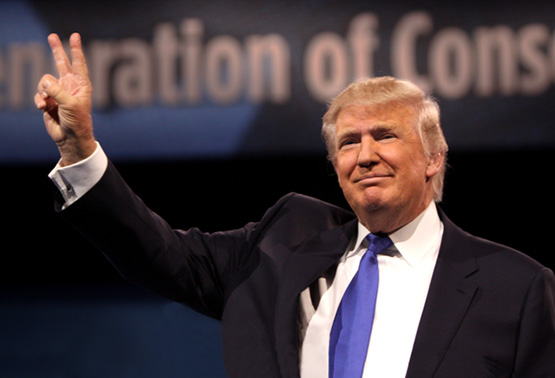
President-elect Donald J. Trump donaldjtrump.com
For the government of British Prime Minister Theresa May, nothing could have sounded sweeter than Donald Trump’s statement that she would be invited for talks in the White House shortly after he is sworn in on Jan. 20 and that he seeks very quickly to reach agreement on a bilateral free trade pact. The effect of the pledge itself, even ahead of its successful implementation, assures the British that the sting of severing ties with the European Union will be greatly offset by new commercial possibilities in the world’s biggest economy; in this way, it strengthens May’s hand enormously as she enters into talks with the E.U. leadership over the detailed terms of what will apparently be a “Hard Brexit.”
Further adding to her leverage with the E.U. were Trump’s remarks suggesting that the E.U. will face stern trade pressure, beginning with Germany and its automobile industry, to do more to manufacture in the U.S. That precisely raises the relative importance of the U.K. market, which the E.U. will otherwise lose if it imposes severe penalties on Britain in negotiations over Brexit.
For the general public’s consumption, Donald Trump used the interview to explain his special affection for Britain, speaking about his Scottish mother’s delight in the Queen and her watching every royal event on television for its unequaled pageantry. But we may expect that Prime Minister May will find there is a bill to pay for the “special relationship” with the U.S. under President Trump.
Rather than the British media’s early speculation that Prime Minister May would be the one to set the misguided Trump straight about the nefarious Vladimir Putin, she may now have to become a leading European advocate for détente with Russia at Trump’s behest. In this connection, British Foreign Minister Boris Johnson’s advice to Congress during his visit to Washington last week that Official Washington “stop demonizing Putin” may well have been a straw in the wind.
For the Germans, Trump also offered a bit of flattery, saying how much he respected their Chancellor Angela Merkel. However, as he went on, he virtually flattened the Iron Lady’s reputation by calling her open-door policy of admitting migrants into Germany and the E.U. a catastrophe. He noted that Merkel’s controversial position had swayed the election results in Britain on Brexit and may lead to the departure of other countries from the E.U. Given his staff’s consultation with Marine Le Pen, a visiting French candidate for the presidency from the right-wing Front National, Trump’s list surely includes France.
Finally, among the sound bites that will be featured in media coverage of the interview, we hear Donald Trump describe NATO as an outdated organization that needs overhaul. However, apart from his reiterated insistence that Member States must pay their fair share, which he claims only Britain and four others from the 28 Member States are currently doing, the interview offers no specifics on what kind structural change, if any, he seeks for NATO. We only hear that NATO has not been prepared to deal with the threat of international terrorism.
Views on Russia
But it was in another area, Trump’s remarks on Russia and the terms he named for possibly lifting sanctions, that we find convincing proof that the President-elect’s approach to foreign affairs is not just the sum of isolated tactical considerations but a complete reinvention of the guiding principles of U.S. foreign policy. What we are witnessing is a shift to a new strategic, geopolitical paradigm.
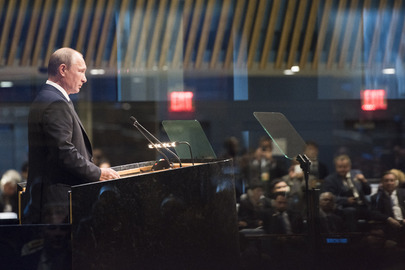
Russian President Vladimir Putin (UN Photo)
In the past couple of decades, going back to the second term of President Bill Clinton, the ideology of neoconservatism with its stress on “democracy promotion” as being the whole of national interest, dictated policy decisions that amounted to the tail wagging the dog. The Baltic States were admitted into NATO in its 2004 enlargement because they wanted it. The decision to station U.S., German and other NATO brigades in Poland and other states along the Russian border taken last July in Warsaw and implemented, in the case of Poland, by U.S. forces in the past several days, was justified by the anxiety of these countries over the possibility of Russian aggression, even though NATO’s action has been highly provocative vis-à-vis Russia and brought the major nuclear powers ever closer to direct confrontation.
In the interview, Trump changed entirely the metrics by which sanctions on Russia would be lifted. Instead of fulfillment of the Minsk Accords over Ukraine’s ethnic Russian Donbas region – which nationalist hardliners in Kiev had the power to block – Trump conditioned the relaxation of sanctions on progress in curbing the nuclear arms race and moving toward significant nuclear disarmament, issues that are fully within the power of the Kremlin to implement.
To be sure, these issues today are more complex than they were in the heyday of disarmament talks. The recent obstacles include the U.S. anti-ballistic missile installations in Poland and Romania, the forward stationing of NATO human and materiel resources in the former Warsaw Pact countries, and the standing invitations to Ukraine and Georgia to enter NATO. So any negotiations between Washington and Moscow will be very complex.
But Trump’s statement shows that he is focused on the big picture, on the triangular relationship between Washington, Moscow and Beijing that he believes to be of vital importance in keeping the peace globally, rather than on some amorphous reliance on expanding democracy globally on the unproven assumption that democracies among themselves are peace-loving.
These elements in Donald Trump’s thinking, quite unexpected in a businessman, bring him very close to the Realism of Richard Nixon and Henry Kissinger, while his setting nuclear disarmament as a key goal, aligns him with Ronald Reagan and — strange to say — with Barack Obama at the very start of his presidency.
If Donald Trump can stave off the jackals from the Western mainstream media and the U.S. foreign policy establishment – a combination that has formed a snarling circle around him even before he takes office – he may have a chance to make historic changes in international relations toward a more peaceful world.
Gilbert Doctorow is the European Coordinator of The American Committee for East West Accord Ltd. His latest book, Does Russia Have a Future? was published in August 2015.
Trump: US may lift Russian sanctions in exchange for nuclear reduction deal – Times, Bild
RT | January 16, 2017
US President-elect Donald Trump has hinted that the US could lift its sanctions against Russia, called Merkel’s migrant policy “a catastrophic mistake” and branded NATO “obsolete” in a new interview for The Times and Bild.
The interview was given in the President-elect’s office in Trump Tower, just days before his inauguration.
Trump was quite straightforward in speaking out in favor of some common ground with Moscow.
“They have sanctions on Russia — let’s see if we can make some good deals with Russia. For one thing, I think nuclear weapons should be way down and reduced very substantially,” Trump said to the two media outlets.
At the same time, sanctions aren’t affecting Russia well, [and] “something can happen that a lot of people are going to benefit,” he added.
Moving on to other topical issues, Trump slammed Angela Merkel’s migrant policy as “a catastrophic mistake,” saying that Germany shouldn’t have taken “all these illegals.”
“Nobody even knows where they come from,” Trump added.
Trump wasn’t optimistic about the fate of the EU, either, saying that there is basically one country that benefits from staying in the bloc.
“You look at the European Union and it’s Germany. Basically a vehicle for Germany. That’s why I thought the UK was so smart in getting out.”
Trump thinks it was the refugee influx that was “the final straw that broke the camel’s back” for the EU.
“I believe others will leave. I do think keeping it together is not going to be as easy as a lot of people think. And I think that if refugees keep pouring into different parts of Europe, it’s going to be very hard to keep it together because people are angry about it,” he said.
Another block that, according to Trump, has long outlived its usefulness, is NATO, as it is “obsolete,”“was designed many years ago” and some of its members aren’t paying in enough.
“The countries aren’t paying their fair share so we’re supposed to protect countries. There’s five countries that are paying what they’re supposed to. Five. It’s not much,” Trump said.
US policies came under fire afterward, with Trump branding the US-Iran nuclear agreement “one of the dumbest deals” he’s ever seen, and then calling the invasion of Iraq “possibly the worst decision, ever made in the history of our country. It’s like throwing rocks into a beehive.”
However, there was at least one thing Trump was very enthusiastic about – and that’s Brexit.
Citing the fall in the British pound, Trump said “business is unbelievable in a lot of parts of the UK, as you know. I think Brexit is going to end up being a great thing.”
Also, the president-elect said he was planning to make a trade deal with the UK “very quickly.”
“I’m a big fan of the UK, we’re going to work very hard to get it done properly.”
Last but not least, Trump was asked about his social media presence and whether he would tune it down after the inauguration. In short, the answer is no.
“@realDonaldTrump I think, I’ll keep it. I’ve got 46 million people right now — [on] including Facebook, Twitter and Instagram, so I’d rather just let that build up.”
And the tweeting is here to stay, the president-elect said.
“I thought I’d do less of it, but I’m covered so dishonestly by the press that I can put out Twitter – and it’s not 140, it’s now 280 – and as soon as I tweet it out — this morning on television, Fox — ‘Donald Trump, we have breaking news.’”
Read more:
Trump ready to look at currently ‘terrible’ US-Russia relations with ‘fresh eyes’ – Pence
Facebook’s aim: combat fake news with fact checkers & ‘untrustworthy’ shame label
RT | January 15, 2017
Facebook is gearing up to battle the problem of “fake news” on social media with a new name-and-shame system involving independent fact checkers being trialed in Germany.
The social media giant has employed the services of Correctiv, a nonprofit group involved in investigative journalism and news auditing, as an independent fact checker.
According to Facebook, new updates to the social site for German users can be expected in the coming weeks. It could see content shared by outlets deemed to be purveyors of false information sent to the back of the Facebook algorithm queue.
The changes include tabs that allow users to report suspected fake news, as well as labels that name-and-shame organizations believed to be peddling fraudulent information.
Facebook insists the system will work through third-party fact auditors associated with Poytner’s International Fact Checking Code of Principles.
“If the fact-finding organizations identify contributions as fraudulent, they are provided with a warning label that identifies them as untrustworthy. The warning contains a link to the corresponding article as well as a justification for this decision,” Facebook says.
“Messages classified as untrustworthy may also appear later in the newsfeed,” they added.
Correctiv announced the partnership via their official Facebook page and the fake news phenomenon as a major threat to politics in Germany.
“Fake news – especially on Facebook – is already one of the major threats [to] our society. That is clear. We fear these threats will become even more massive in the comings months. Whether it be in the NWR election [North Rhine-Westphalia state election] or the election of the Bundestag next autumn,” the company said.
A Facebook statement read: “It is important to us that posts and news posted on Facebook are reliable.”
“We are pleased with this progress, but we know there is still a lot to be done. We continue to work on this challenge and will introduce these innovations in other countries in the near future.”
It comes after Facebook founder Mark Zuckerberg asserted he is taking the issue of misinformation seriously, but admitted the social nature of the business meant the company erred on the side of “letting people share what they want whenever possible.”
“We need to be careful not to discourage sharing of opinions or to mistakenly restrict accurate content. We do not want to be arbiters of truth ourselves, but instead rely on our community and trusted third parties,” he said last November.
Last year, German Social Democratic Party politician Thomas Oppermann suggested social media sites like Facebook should face individual fines of up to €500,000 for the spread of fake news.
READ MORE:
German politicians want €500k fines if Facebook fails to remove fake news within 24hrs
Featured Video
Dan Dicks with James Corbett on Solutions Watch
or go to
Aletho News Archives – Video-Images
From the Archives
Secret document reveals plans for civil war in Lebanon, Israeli false flags, and invasion
By Randi Nord | Geopolitics Alert | April 5, 2019
Beirut – During his visit with US Secretary of State, Mike Pompeo, Lebanese President Michael Aoun reportedly received a US-Israeli document detailing plans for creating a civil war in Lebanon with covert false flag operations and possible Israeli invasion.
Although the source of the document is Israeli and created in partnership with Washington, no one knows who presented it to Aoun. The Lebanese TV station, Al-Jadeed, initially reported the document on Lebanese TV and a video on its website. Geopolitics Alert translated the report for this article. … continue
Blog Roll
 Aletho News
- There’s a drought in academia: A drought in honest research on the subject of drought and other weather extremes
- Department of War Awards $20.7 Billion Contract to Raytheon for Air-to-Air Missiles
- ‘Distance yourselves from Israel’: IRGC urges US population to question govt policies
- America’s Greenland deal has a radioactive backstory
- The RAF Fairford ‘terror plot’: Unpacking escalation in the UK echo-chamber
- EU Council Advances Chat Control 2.0 Scanning Proposal
- Ex-Greek MEP files complaint against Israeli spyware firm over alleged Pegasus surveillance
- Troubling ideas throughout the Torah, Talmud, Mishneh Torah and Tanya
- ‘Grave, alarming’: Iran mission on Trump’s UNGA ‘annihilation’ threats
- Najaf airport to reopen to Iranian flights within 24 hours: Ambassador
- If Americans Knew
- New Report: “Scholasticide and Genocide in Gaza: Assessment, Testimonies and Legal Analysis”
- Ex-Biden officials are desperate for a Gaza scapegoat
- Israeli “settlers” Invade Al-Aqsa; Pour Boiling Water on 75-Year-Old
- Israel Has Kidnapped Another American Teenager
- US arms sales to Israel worth $21.6 billion in 20 months
- Three Palestinians Killed in Israeli Attacks on Gaza
- Revealed: German “Anti-Semitism Expert” Driving Crackdown on Palestine Solidarity is Former Israeli Spy
- Egypt’s Warning to Israel Before Oct 7
- Israel’s siege signals another cruel winter for 1.8 million Gazans – Daily Update
- Netanyahu Asked UAE Leader to Deny Report on Oct. 7 Warning in Secret Visit, Sources Say
- No Tricks Zone
- New Study: Earth And Venus Surface Warmth Largely Explained By Convection And Lapse Rate, Not CO2 Or Radiation
- 2025 Nature Paper Claiming Worsening Global Drought Gets RETRACTED …Heavily Flawed
- New Study: ‘Global Drought Shows No Detectable Recent Acceleration Under Climate Warming’
- Economic Masterminds: German Socialists Suggest Taxing Productivity Gains Stemming From Using AI
- The South China Sea Has Not Been Cooperating With The Climate Change Narrative
- Energy Crisis: Germany Enters Heating Season With Historically Low Gas Reserve Fill Levels
- New Study: The Antarctic Ice Sheet Gained Mass From 2020-2024 Due To Staggering Snow And Ice Accumulation
- Study: Ocean Heating Rates From Thousands Of Years Ago ‘Dwarf’ Modern Ocean Heating Rates
- Climate Extremists Target, Attack Large-Scale Power Grid Infrastructure In Germany!
- New Study: Antarctic Ice Melt Has Contributed Less Than 1 Centimeter To Sea Level Rise In The Last 30 Years


