Is Obama Staging a Color Revolution in the US?
By Martin Berger – New Eastern Outlook – 12.11.2016
The recent victory of now President-elect Donald Trump has taken a lot of Americans by surprise. But it would be safe to say that the corporate ruling elites that went all in on Hillary Clinton were literally shocked by her defeat. Without her at the head of the state they fear they may not be able to carry on spreading the corruption, which is believed to be at the foundation of the Clinton clan, or carry on waging wars upon other states which includes arming terrorists responsible for killing thousands of civilians around the world.
And even though the corporate elites have formally acknowledged Trump’s victory, they are pressuring the current government to fight the next US President tooth and nail, until all resources are exhausted.
Over the last eight years, the Obama administration has acquired a long list of tricks that were used against undesired governments in various parts of the world, while the most effective among them is the so-called “color revolutions,” where essentially a coup d’etat is achieved by media manipulation and large mobs. US intelligence services are now prepared to unleash such a revolution on the home front, since they are fairly concerned about their future under Trump, as the Washington Post would report.
The fact that Obama still believes in Trump’s inability to replace him in the White House has already been announced by the White House Press Secretary Josh Earnest. At the same time, he would point out, while commenting on the anti-Trump protests in the US, that the right for freedom of expression must be exercised without violence, clearly alluding to the current administration’s arsenal of “peaceful” tools that would allow it to get rid of Trump.
That is why we already are witnessing a wave of “protests” being unleashed under the control of the Obama administration. The corporate media and social networks are openly arrayed against the incoming 45th US President. These very tactics have been used by US intelligence agencies in Brazil, Nicaragua, Hong Kong, Thailand, as well as across the Middle East and Eastern Europe to unleash a “color revolution”. In some countries, such actions have brought foreign government under the direct control of the White House, as we can see it in Ukraine, Brazil and several other countries.
As a result, we are now being told about thousands of protesters in US cities rallying against the Trump election victory. These claims were followed by a petition published on Change.org that demands the US authorities change the results of the recent election, demanding the electoral college be revised, and that the election results be overturned on December 19. It is being reported that this petition has already been signed by a total of two million people.
It goes without saying that an attempt to launch a “color revolution” in the United States is being supported by a number of Europe states in addition to the US, including France and Germany, since the political order there is concerned about the impunity they’ve been enjoying coming to an end, with Trump failing to openly signal continued open US support for them. The British Independent wants Trump to be impeached, citing law professor Christopher Peterson, who would claim that there is a strong case for the beginning of legal proceedings that would stop Donald Trump from being president. The impeachment process is usually initiated when a president of a state has committed some sort of a serious offense, but Trump hasn’t been able to do anything yet, since he hasn’t been inaugurated. Still the Independent believes there must be some legal ground for his impeachment.
It’s clear the train of “color revolution” is under full steam in the US today. What will come up from this attempt to ignore the US Constitution, remains to be seen.
Steelworkers urge EU protection against imports
Press TV – November 9, 2016
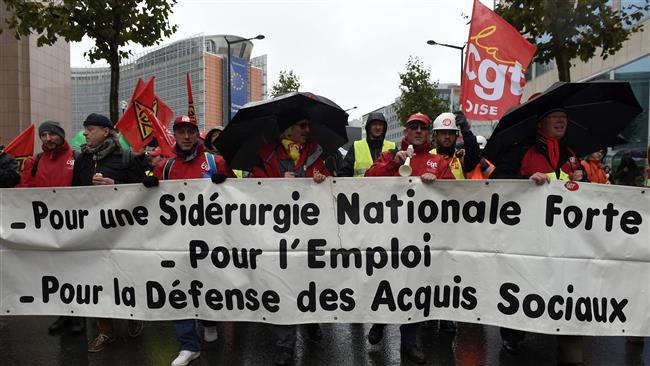
Steelworkers from across the European Union have held a protest in front of the EU headquarters in Brussels to demand protection, as cheap foreign import mostly from China keeps threatening job security in the industry.
The protesters on Wednesday urged the EU to impose tough restrictions on steel imports from China and adopt better regulations for the market.
Reports said at least 5,000 people from various EU countries attended the demonstration.
Recent studies show that an estimated 330,000 people are working in Europe’s steel factories, the lowest in the history of the industry in the continent. That comes as many think Europe owes its industrial revolution to the boom in steel production.
The European Union has moved to adopt policies that could prevent the import of cheap products to its market. The aim is to cut the flow of steel from China, which has swamped the European markets at dumping prices.
Luc Triangle, the general secretary of Industrial Europe union, said the EU must do more to ensure the rights of the steelworkers were protected.
“You cannot throw workers in the arena of globalization without any protection,” Triangle added.
EU Competitiveness Commissioner Jyrki Katainen said the policies were meant to create a fair competition in the European steel market, noting, “Free trade must be fair, and only fair trade can be free.”
Workers have already staged mass protests in developed EU countries such as Germany, saying the widening trend of cheap imports from China and a global oversupply of the product have already created many uncertainties about the prospects of the industry.
About 50,000 steel workers attended such rallies in three German cities, including the capital Berlin, in April, denouncing the EU’s unfair environmental regulations.
Hillary versus Donald: Ding Dong, The Witch Is Dead! Victory for the Wizard of Oz!
By Diana Johnstone | Global Research | November 9, 2016
“There’s no place like home.”
That’s the lesson. Even when home is Kansas.
The real meaning of this election is not, as bitterly disappointed Hillary supporters still maintain with tears in their eyes and fear in their throats, a victory for racism and sexism.
The real meaning of this upset is that Wall Street’s globalization project has been rejected by the citizens of its homeland.
This has major implications for the European nations that have been dragged along into this ruinous project.
Hillary Clinton was the candidate of the military industrial complex and international finance capital. She designed herself to be the figurehead of those forces, as queen of regime change. She aspired to be the one to remake the world in the image Wall Street dictates. It was a project enthusiastically and expensively supported by the one percent who profit from arms contracts and the trade deals they write themselves for their own interests.
To distract from the genuine significance of her candidacy, the Clinton campaign appealed to the desire for respectability of educated city dwellers, portraying Trump supporters as racist yokels motivated by a hateful desire to scapegoat minorities as revenge for their own inadequacies. They were “deplorables”, and you wouldn’t want to be one of them, would you?
Trump was sexist, because he referred to certain women as “bimbos”. Elizabeth Warren called him out for this, on a platform where Hillary sat listening, mouth wide open in delight – she who had referred to Bill’s girlfriends as “bimbo eruptions”. Sleaze and hypocrisy drowned out policy discussions. The worst the Clinton campaign could come up with was an eleven-year-old locker room exchange – just words, hardly comparable to Bill’s chronic actions.
Still, millions who were taken in by the Clinton campaign line are devastated, terrified, convinced that the only reason Trump won was the “racism” and “sexism” of that lower caste in globalized society: white heterosexual working class males.
But no, Virginia, there were other reasons to vote for Trump. Racism and sexism are surely low on the list.
Trump voters were scandalized by Hillary’s lies and corruption. Many of them would have voted for Bernie Sanders if they had the choice. That choice was taken away from them by Democratic Party manipulators who were sold on their own advertising campaign to elect “the first woman President.” A brand new product on the Presidential election market! Be the first to vote for a woman President! New, improved!
Bernie’s success already showed that millions of people didn’t want that woman. But the Democratic Party manipulators and their oligarch sponsors went right ahead with their plans to force Hillary Clinton on an unwilling nation. They brought this defeat on themselves.
Contrary to what you could believe by reading the New York Times, there were even intellectuals who voted for Trump, or at least refused to vote for Hillary, for the simple reason that Trump appears less likely to lead the world into its third and final Great War. He said things giving that impression, but such statements were ignored by mainstream media as they worked overtime to inflate the ogre image. No war with Russia? You must be a Putin puppet!
Trump voters had several reasons to vote for Trump other than “racism”. Most of all, they want their jobs back, jobs that have vanished thanks to the neoliberal policy of transferring manufacturing jobs to places with low wages.
But racism is the only motive recognized by the globalized elite for rejecting globalization. British citizens who voted to leave the European Union in order to recover their traditional democracy were also stigmatized as “racist” and “xenophobe”. Opposition to racism and xenophobia is the natural moral defense of a project of global governance that deprives ordinary citizens of any important power of decision.
This extraordinarily vicious campaign has brought out and aggravated sharp divisions within the United States. The division between city and countryside is most evident on the electoral maps. But these real divisions are exacerbated by a campaign that portrayed Donald Trump as a racist madman, a new Hitler about to bring fascism to America. The antiracism of this campaign, denouncing “hate”, has actually spawned hate.
No, Virginia, Trump is not Hitler. He is the Wizard of Oz. He is a showman who pulled off an amazing trick thanks to the drastic moral and intellectual decline of the American political system.
He is neither as dangerous as his opponents fear, nor as able to “make American great again” as his supporters hope. He is the Lesser Evil. What will become of him in Washington is anybody’s guess.
Copyright © Diana Johnstone, Global Research, 2016
Protests in Western Sahara against solar and wind plant construction
MEMO |November 8, 2016
Protests erupted yesterday in the Western Sahara over the construction of renewable energy plants without the permission of the Sahrawi people.
The protests, which took place in the capital Laayoune, coincided with the United Nation’s COP22 conference on climate change yesterday in Marrakech.
Siemens and Enel are building solar and wind plants in the region
“Siemens should not back Morocco’s occupation of Western Sahara through energy infrastructure,” the Western Sahara Resource Watch (WRSW) said on social media.
Siemens has constructed 22 new renewable energy plants in the Western Sahara, which power over 95 per cent of mineral extraction plants in the Sahrawi region.
The World Bank, the European Investment Bank, and the European Union have previously refused to finance development projects in Western Sahara.
“If we support those investments, it would look like we are supporting the Moroccan position. We are neutral regarding that conflict,” a banker told Reuters.
The contested region has recently been engrossed in tensions between Morocco and the Sahrawi Polisario Front which has been ongoing since 1975.
Facebook investigated by German prosecutors for failing to stop ‘hate speech’
RT | November 4, 2016
Facebook’s founder Mark Zuckerberg and other senior executives are being investigated in Germany after a lawyer filed a complaint accusing them of allegedly allowing racist and violent posts to remain on the social networking site.
The social media giant was accused of doing little to stop racism, Holocaust denial and violent threats on the site, according to Der Spiegel.
A Bavarian lawyer initiated the case by reporting Facebook to the police, accusing the company’s management of allowing such hateful posts to stay on the site without any consequences.
Chief Operating Officer Sheryl Sandberg, European policy director Richard Allan and company head in the Berlin office Maria Kirschsieper, are also under investigation.
German law requires Facebook to delete any content considered to be inciting hatred. Earlier this year, the company was also hit with a criminal complaint, but authorities said at the time they were unable to investigate because the accused, Zuckerberg, was not residing within German borders when it was brought to light.
German politicians have criticized Facebook for reportedly failing to take action against hate speech on the site.
In October, Volker Kauder, a member of Angela Merkel’s Christian Democratic Union, said Facebook and other social media giants should face penalties for not taking action against hate speech, following the rise of xenophobic comments amid the refugee crisis in Europe.
Kauder said he had “run out of patience” with how social media giants were dealing with abusive content.
Many users of Facebook, Twitter and Google said that despite pledges from the companies to remove hate speech within 24 hours from their sites, users complaints were not adequately dealt with, the Local reports.
Facebook did not comment on the investigation status but said “the allegations lack merit and there has been no violation of German law by Facebook or its employees.”
Misplacing priorities and freedom of expression
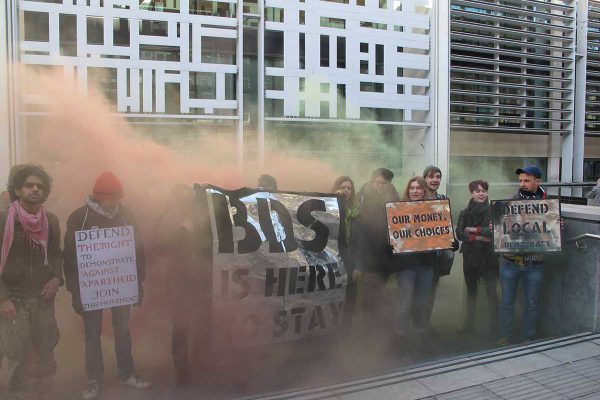
BDS supporters protest anti BDS activities in London
By Ramona Wadi | MEMO | November 3, 2016
It would be slightly premature to consider the statement by the EU Representative for Foreign Affairs and Security Policy, Federica Mogherini, regarding the right of EU citizens to boycott Israel as some sort of victory. At first glance, it might look as if activism has overcome a significant hurdle, given the Israeli government’s obsession with suffocating the Boycott, Divestment and Sanctions movement (BDS). A study of the brief statement actually suggests otherwise, and all in the name of freedom of expression.
Mogherini asserted that the EU “stands firm in protecting freedom of expression and freedom of association in line with the Charter of Fundamental Rights of the European Union”, even when such information or ideas “offend, shock or disturb the State or any sector of the population.” You just knew that there was a “but” coming: she made it equally clear that “the EU rejects the BDS campaign’s attempts to isolate Israel and is opposed to any boycott of Israel.” The EU official missed the point, of course; Israel isolates itself by its contempt for international laws and conventions, along with its brutal military occupation and colonisation of Palestine.
Commenting on Mogherini’s statement, BDS Europe Campaigns Officer Riya Hassan voiced the expectation that the EU should respect “its obligations under international law and its own principles and laws by, at the very least, imposing a military embargo upon Israel,” as well as a suspension of the EU-Israel Agreement signed in 1995. The latter stipulates regulations regarding political dialogue, economic cooperation, security and cooperation on social matters, based upon the premise in Article 2 of the agreement that all provisions “shall be based on respect for human rights and democratic principles.” Israel has no such respect; it is a colonial entity and the EU functions as a protector of colonialism. The entire agreement should thus be declared null and void, or amended according to each entity’s characteristics, without the need to drag pretentious terms such as democracy into the equation.
Through Mogherini’s recent statement we have a clear example of how the EU actually demeans human rights and freedom of expression by utilising the discourse meant to uphold them. The entire essence of the EU’s true intentions lies in its opposition to BDS. Hence, any concession given by the EU should not be misconstrued as support, or upholding the right to freedom of expression. It is merely a recurring political ploy that ridicules the very essence of freedom. At the same time, it is through these clauses that BDS has managed to retain ground. Notwithstanding the genuine efforts of the masses which have embarked upon collective and individual efforts to boycott Israel, the fragile compromise upon which the global boycott outlook rests may well become tarnished if it continues to laud statements blatantly supportive of Israel while grudgingly allowing dissent as proof of freedom of expression.
Hence, Mogherini’s statement is not welcome. It is a calculated contribution to the debate that places Israel’s interests above the legitimate demands and legal rights of the Palestinians. BDS should distance itself from the litany of symbolic gestures that have taken precedence over genuine, active support for the anti-colonial struggle unless, that is, the movement seeks to become just another actor that thrives upon Palestinian demands as the means for the entity’s survival. If the movement’s chartered course is in the slightest way intertwined with that of the EU, however insignificant it may seem on the surface, Palestine may well be destined to accumulate festering wounds; the objective — which is already compromised due to the two-state subjugation rhetoric — will in the meantime become ever more distant from the land and the indigenous people.
Europe’s Battle: Nationalists vs. Elites
By Andrew Spannaus | Consortium News | October 26, 2016
In recent years “nationalism” has become a bad word in Europe, a synonym of closure, racism and wars. Over the past 20-25 years European elites have instead embraced a concept of globalization based on a world without economic, physical and social borders.
This view assumes the gradual affirmation of a set of shared values internationally, consisting of human rights and economic freedom, that however much the remaining closed, autocratic regimes may try, will inevitably become the standard for the entire world.
It is essentially the argument put forward by Francis Fukuyama in “The End of History:” liberal democracy and free markets have won the ideological war, and represent the culmination of human evolution.
The political events of 2016 are upending this view of the globalization of human rights and economic liberalism. The American electorate has supported a series of outsiders – most notably Donald Trump, who has run his campaign in direct opposition to the U.S. political and financial class, invoking economic protectionism and a stronger national identity.
Against expectations, the population of the United Kingdom voted to leave the European Union, marking an irreparable break in the supposedly inevitable process of European unification. And across Europe support is growing for more extreme, anti-system political forces, that threaten not only to withdraw from the common currency – the Euro – but also to seal the borders in response to economic and security threats associated with immigration.
Establishment’s Failure
It is no exaggeration to speak of the failure of the entire transatlantic political establishment. Since the 1970s, Western economies have undergone a post-industrial transformation that has favored short-term gain over long-term investment. The notion of economic freedom has translated principally into support for deregulation and speculative finance.
Central Banks have made unlimited resources available to the financial sector while large areas of the real economy struggle to survive, feeding discontent among the population. It is true that new economic sectors have arisen, along with widespread changes made possible by technologies that were inconceivable until a few years ago, but the overall effect has been to hollow out the middle class and create large-scale income equality.
In Europe, the principal vehicle of this process has been the economic policy of the European Union. From the implementation of the Maastricht Treaty in 1993, European nations have been stuck in a monetary straitjacket, that prevents governments from taking effective economic action. In the name of market principles, liberalization has been implemented that favors large financial interests while lowering standards of living for the middle class.
Countries are constitutionally required to move towards a balanced budget, with the European Commission and the European Central Bank essentially having veto power over national policies. This has translated into harsh austerity, including the massive budget cuts and tax increases inflicted on countries such as Greece, Spain and Italy in recent years.
Despite paying lip service to the need for change, the economic and political elites have refused to abandon this approach, that not only ignores the suffering of the population, but actually makes the problem worse. In fact the austerity causes a drop in economic activity and thus exacerbates budget problems, leading to a vicious cycle that Europe seems unable to stop.
A Big Backlash
The resulting backlash is calling into question the process of European integration as a whole, provoking a strenuous defense by the elite of institutions that are said to have guaranteed “50 years of peace” after the Second World War.
It is true, of course, that there are some benefits to E.U. integration, and that nobody wants to return to a situation of conflict among the member states. But the current policies are quite different than the fruitful cooperation that existed until the 1990s, when the financial elite began its move to exert supranational control.
Now, the failed economic policies of the past 20 years are no longer sustainable. Governments are forced to negotiate over .1 percent of the budget deficit with the bureaucracy in Brussels, while the need for public and private investment runs in the trillions.
The pro-finance, anti-production policies must change not for ideological reasons or to serve some specific interest group; they must change because there is no other choice. People are revolting against a political class that does not respond adequately to widespread economic and social discontent. In times of economic distress the population becomes more vulnerable to demagogues, raising the risk of dangerous outcomes, as seen with Fascism and Nazism in the 1920s and 1930s.
Currently, there are unprepared and unpredictable political forces with growing support across Europe, that in some cases represent a threat to the democratic rights and values that the European Union aims to promote. Defending the orthodoxy of E.U. policy against popular movements that target failed economic policies, will only further damage precisely those values on which Europe is said to stand.
What to Do
At this point Europe needs a return to measures that promote productive investment and innovation, rather than cut social welfare programs and encourage further deregulation.
There are two potential directions: a wholesale change in the policies of the E.U. institutions, without modifying their essential structure, or a step back from the process of cancellation of national sovereignty.
The first option seems unrealistic, for various reasons. These include the constitutional nature of many economic and budget constraints, and the stubbornness demonstrated by the European ruling class in recent years; a class that, despite numerous alarm bells, does not at all seem ready to abandon an elitist view of globalization.
The response to the Brexit vote is a glaring example. Representatives of the E.U. institutions lashed out with arrogance and bitterness, essentially accusing half of the British population of being ignorant, racist and isolationist. It’s a comforting excuse based on partial truths, that avoids reflection on Europe’s own mistakes.
At this point a return of decision-making power to national governments is becoming inevitable: not in order to stop international cooperation, or to reject shared values, but because the model pursued by the supranational institutions and their allies in the financial world has failed, and risks producing both serious internal conflicts, and unacceptable strategic failures in an increasingly complex world.
Andrew Spannaus is a freelance journalist and strategic analyst based in Milan, Italy. He is the founder of Transatlantico.info, that provides news, analysis and consulting to Italian institutions and businesses.
Belgium’s Wallonia rejects ‘undemocratic’ EU ultimatum on CETA
RT | October 24, 2016
Wallonia is not going to be pressured into agreeing the EU-Canada trade deal according to the leader of the French-speaking Belgian region Paul Magnette. The EU has given Belgium an ultimatum to end its objection to the agreement by Monday.
“Every time you try to put an ultimatum it makes a calm debate and a democratic debate impossible,” Magnette said at a meeting in Brussels.
“We don’t need an ultimatum,” he told reporters. “We will not decide anything under an ultimatum or under pressure.”
On Sunday the leader of the Wallonia region told the Belga news agency the ultimatum from the EU “is not compatible with the exercise of democratic rights.”
“We are not against a treaty with Canada,” Magnette said. “But we won’t have one that jeopardizes social and environmental standards and the protection of public services and we want absolutely no private arbitration mechanisms.”
Magnette was referring to an introduction of a secret corporate court system, empowering big business to sue states for policies that threaten their profits.
Belgium has been given until Monday to resolve an internal disagreement holding back the CETA trade deal with Canada. The pact needs the backing of all 28 EU countries to be passed. Belgium cannot sign without Walloon support.
The EU has warned that unless Belgium makes its position clear, it will cancel this week’s EU-Canada summit. Belgian Prime Minister Charles Michel is expected to make a speech on Monday, an EU source told Reuters.
Wallonia is a region of 3.6 million people, and has become an obstacle in the controversial free trade agreement between the European Union and Canada. The region has refused to approve the deal, fearing an influx of Canadian pork and beef products would undermine local farmers.
CETA promises to eliminate tariffs on 98 percent of goods traded between the EU and Canada. The agreement encompasses regulatory cooperation, shipping, sustainable development and access to government tenders.
Supporters of CETA say the deal will be worth $13 billion a year to the EU and $9 billion to Canada.
Opponents say the trade deal will violate workers’ rights and benefit the interests of the wealthy elite and corporations.
The EU has warned a failure to complete the agreement after seven years of negotiations will jeopardize the bloc’s trade policy.
Israel refuses to sign US document regulating export of killer drones – report
RT | October 24, 2016
Israel is reportedly refusing to sign a US document on the use and export guidelines of armed drones, fearing it would hurt its defense industries. The State Department paper aims to establish international standards in the production and selling of UAVs.
The one-page document, titled “Joint Declaration for the Export and Subsequent Use of Armed or Strike-Enable Unmanned Aerial Vehicles (UAVs),” covers a number of topics regarding the selling and usage of drone systems, according to Defense News.
Those topics include applying international law and human rights when using UAVs; following existing arms control laws in selling armed drone systems; considering the buyer country’s history on “adherence to international obligations and commitments”; following “appropriate transparency measures”; and ensuring the sold unmanned system’s capabilities are “transferred and used responsibly by all states.”
The document has been provided to countries which are considered to be US allies and has already been signed by over 40 nations, including Austria, Germany and Italy.
Israel, however, has so far refused to sign the document, with sources in the country’s defense industry telling Haaretz that the sector is concerned it could limit the nation’s export business.
Israel is potentially already facing a loss of business when it comes to drone exports, following the admission of India to the multilateral Missile Technology Control Regime by the US – a move which removes barriers to the sale of American UAVs to the country.
Following India’s admission into the regime, Delhi has shown an interest in acquiring the US-made Predator drone rather than Israeli UAVs.
Another threat to Israel’s share of the drone market includes a lawsuit by the American firm General Atomics, which is aiming to block the lease of the Israeli Heron TP drone to Germany.
However, a senior air force official told Haaretz that Israel still has one advantage when it comes to drones – the promise for the country’s drone squadron to train buyers of Israeli UAVs, as Israel’s air force is considered a world leader in the field.
In addition to its efforts to maintain its stronghold in the market, Israel is also seeking to have limitations placed on information regarding its deployment of drones. When German MPs demanded answers regarding Berlin’s lease of Heron TP drones earlier this year, they were denied information and told the matter was considered confidential by Israel, and that any information was subject to limitations imposed by Tel Aviv.
Featured Video

Dan Dicks with James Corbett on Solutions Watch
or go to
Aletho News Archives – Video-Images
From the Archives
Secret document reveals plans for civil war in Lebanon, Israeli false flags, and invasion
By Randi Nord | Geopolitics Alert | April 5, 2019
Beirut – During his visit with US Secretary of State, Mike Pompeo, Lebanese President Michael Aoun reportedly received a US-Israeli document detailing plans for creating a civil war in Lebanon with covert false flag operations and possible Israeli invasion.
Although the source of the document is Israeli and created in partnership with Washington, no one knows who presented it to Aoun. The Lebanese TV station, Al-Jadeed, initially reported the document on Lebanese TV and a video on its website. Geopolitics Alert translated the report for this article. … continue
Blog Roll
 Aletho News
- Sheikh al-Asadi warns of Iraqi government compliance with US demands
- How to MAKE THE CONSPIRATORS PAY for their crimes! Dan Dicks with James Corbett on Solutions Watch
- There’s a drought in academia: A drought in honest research on the subject of drought and other weather extremes
- Department of War Awards $20.7 Billion Contract to Raytheon for Air-to-Air Missiles
- ‘Distance yourselves from Israel’: IRGC urges US population to question govt policies
- America’s Greenland deal has a radioactive backstory
- The RAF Fairford ‘terror plot’: Unpacking escalation in the UK echo-chamber
- EU Council Advances Chat Control 2.0 Scanning Proposal
- Ex-Greek MEP files complaint against Israeli spyware firm over alleged Pegasus surveillance
- Troubling ideas throughout the Torah, Talmud, Mishneh Torah and Tanya
- If Americans Knew
- New Report: “Scholasticide and Genocide in Gaza: Assessment, Testimonies and Legal Analysis”
- Ex-Biden officials are desperate for a Gaza scapegoat
- Israeli “settlers” Invade Al-Aqsa; Pour Boiling Water on 75-Year-Old
- Israel Has Kidnapped Another American Teenager
- US arms sales to Israel worth $21.6 billion in 20 months
- Three Palestinians Killed in Israeli Attacks on Gaza
- Revealed: German “Anti-Semitism Expert” Driving Crackdown on Palestine Solidarity is Former Israeli Spy
- Egypt’s Warning to Israel Before Oct 7
- Israel’s siege signals another cruel winter for 1.8 million Gazans – Daily Update
- Netanyahu Asked UAE Leader to Deny Report on Oct. 7 Warning in Secret Visit, Sources Say
- No Tricks Zone
- Two More Paleo Reconstructions Affirm Meters-Higher Sea Levels Across Ireland, Brazil 7000-6000 Years Ago
- New Study: Earth And Venus Surface Warmth Largely Explained By Convection And Lapse Rate, Not CO2 Or Radiation
- 2025 Nature Paper Claiming Worsening Global Drought Gets RETRACTED …Heavily Flawed
- New Study: ‘Global Drought Shows No Detectable Recent Acceleration Under Climate Warming’
- Economic Masterminds: German Socialists Suggest Taxing Productivity Gains Stemming From Using AI
- The South China Sea Has Not Been Cooperating With The Climate Change Narrative
- Energy Crisis: Germany Enters Heating Season With Historically Low Gas Reserve Fill Levels
- New Study: The Antarctic Ice Sheet Gained Mass From 2020-2024 Due To Staggering Snow And Ice Accumulation
- Study: Ocean Heating Rates From Thousands Of Years Ago ‘Dwarf’ Modern Ocean Heating Rates
- Climate Extremists Target, Attack Large-Scale Power Grid Infrastructure In Germany!

