If EU leaders can be so wrong on Russia & Syria, no wonder the bloc is in crisis
By Finian Cunningham | RT | October 21, 2016
Russophobic rants by some European Union leaders and their willful distortion of events in Syria is a reflection of why the 28-member bloc is careering toward disaster. We are witnessing a crisis of appallingly inept leadership.
German, British and French leaders were among the most hawkish voices at the EU leaders’ summit in Brussels this week, denouncing what they claimed were Russian “war crimes” in Syria and calling for additional economic sanctions on both Moscow and Damascus.
German Chancellor Angela Merkel said Russian-backed Syrian air strikes were “inhumane and cruel,” while Britain’s Prime Minister Theresa May took the “most shrill prize” with her condemnation of Moscow’s “sickening atrocities.”
French President Francois Hollande echoed their calls for the EU to slap more sanctions on Russia – in addition to those the bloc has implemented over the Ukraine conflict.
This came only days after Belgian F-16 fighter jets reportedly killed six civilians in the Aleppo countryside, adding to a catalog of illegal aggression committed in Syria by French, British and American warplanes bombing the country without any legal mandate.
In the end, good sense among certain member states prevailed, and the EU summit concluded without imposing additional punitive measures. As the Financial Times reported: “Italy’s Renzi forces a retreat from new sanctions on Russia… Germany, France and UK rein in demand for fresh EU sanctions over Aleppo bombardment.”
Italy, Spain, Austria, Hungary, Greece, Malta and Cyprus were some of the EU members wary of escalating economic and political problems already incurred from loss of trade with Russia over the Ukraine debacle.
Britain’s premier May gave a particularly asinine speech in Brussels. She called for a “robust and united European stance in the face of Russian aggression.” This from the leader of a government currently embroiled in bitter rows over its divorce from the EU.
So, the British leader wants to bequeath even more tension and economic hardship between the people of Europe and Russia, just before she packs up Britain’s membership.
In the Russophobic rousing, European Council President Donald Tusk also excelled. Despite the EU summit rejecting the adoption of more sanctions against Russia over Syria, Tusk was later threatening that such measures remained an option. Tusk had regaled the summit with a list of alleged Russian “misdemeanors” including “air-space violations, disinformation campaigns, cyber-attacks, interference in the EU’s political processes and beyond. Hybrid tools in the Balkans, to developments in the MH17 investigation.”
Then he declared: “Given these examples, it is clear that Russia’s strategy is to weaken the EU.”
Please note that Tusk is supposed to be a leading light for the EU as it negotiates a raft of existential problems, from intractable international trade deals, migration and border disputes, anti-EU political parties, and ongoing economic stagnation for 500 million citizens.
But if Tusk and other EU leaders like Merkel and Hollande can come out with such inane views on Russia, what chance has the bloc got in dealing effectively with other challenging issues? No wonder, EU citizens are losing respect and faith in political leaders when they are seen to be so utterly incompetent and detached from reality.
Yet to make matters even worse, Tusk and his Russophobic ilk turn around and blame the imploding EU crisis on alleged Russian plots to “weaken and divide.”
Just ahead of the EU leaders’ summit in Brussels, Merkel and Hollande met Russian President Vladimir Putin in Berlin for a conference on the Ukraine crisis. The Kiev regime’s President Petro Poroshenko was also in attendance.
The Berlin meeting did not result in any progress toward resolving the Ukraine dispute. While the German and French leaders wanted to penalize Russia over alleged violations in Syria, they seemed oblivious to hundreds of attacks by Kiev’s armed forces on civilian centers in breakaway eastern Ukraine. The assassination of a military commander in the self-declared Donetsk People’s Republic last week by suspected Kiev agents has heightened fears of a return to all-out war.
Where are Merkel and Hollande’s condemnations and calls for sanctions on the Kiev authorities whom they patronize with billions of dollars in financial aid and NATO military support?
Also, Merkel, Hollande and Britain’s May have little to say about recorded “cruel, inhumane, sickening” massacres in Yemen committed by the Saudi coalition bombing that country. Their silence no doubt is owing to the fact that their governments sell billions of dollars worth of weapons to the Saudi regime even as it slaughters women and children in Yemen.
And, indeed, let’s talk about Syria and the besieged northern city of Aleppo.
The crimes that European leaders allege against Russia and its Syrian ally are based on unverified claims issued by dubious networks evidently under the control of the anti-government militants. The militants besieging east Aleppo are dominated by head-chopping terrorist groups like the internationally proscribed Jabhat Al-Nusra.
When Russia unilaterally implemented a temporary ceasefire this week in Aleppo, an innovative live-streaming broadcast from the appointed humanitarian corridors proved once again the real nature of the violence.
Civilians trapped in the militant-held areas were shown to be held as “human shields” by the insurgents. While buses and other vehicles were waiting to ferry civilians out of the conflict zone, video footage recorded militants shelling and sniping at the humanitarian aid effort.
Those violations corroborated what citizens in east Aleppo have been saying for a long time – that they are being held against their will by the gunmen. Besieged people are even calling on the Syrian and Russian forces to continue in their operations to break the hostage situation and liberate that part of the city.
All across Syria, hundreds of villages and towns have been liberated by the Syrian army and its Russian allies since Putin ordered his air force to intervene in the stricken country at the end of last year.
One of the recent successes was the town of Qudsaya near the capital Damascus. Last week, thousands of residents rallied in the main square cheering President Bashar Assad, the Syrian army and Russia for their “liberation” after the foreign-backed mercenaries were routed from the town.
The foreign backers of the mercenary army that has plunged Syria into horror since March 2011 – with perhaps half a million dead – include the supposedly leading EU members Britain and France. Hollande is on record for admitting that France supplied weapons to insurgents in Syria as far back as 2012, when the siege of Aleppo began, and in breach of a European arms embargo.
What is going on in Syria is a military victory over a foreign-sponsored terrorist war on that country. Russia’s role in the liberation of Syria is principled and commendable.
Those who should be facing prosecution for war crimes include pious, pompous government leaders, past and present, in London and Paris.
If such prominent EU governments can be so wrong and distorting about something so glaringly obvious as Syria and Russia’s support, then no wonder the EU is in free-fall over so many other pressing matters. With criminally incompetent politicians in power, the EU is a bus with its driver slumped at the wheel.
UK spying agencies collected Britons’ data for 17 years: Court
Press TV – October 18, 2016
UK spying agencies secretly and unlawfully collected and stored personal data of Britons for 17 years, according to a court ruling.
MI5, MI6 and GCHQ collected data on everyone’s communications between 1998 and 2015, according to the Investigatory Powers Tribunal, the watchdog for intelligence agencies.
The agencies tracked individual phone and web use and other confidential information without having adequate safeguards or supervision, senior judges ruled on Monday.
They did not abide by article 8 protecting the right to privacy of the European convention of human rights (ECHR), they added.
“The BPD (bulk personal datasets) regime failed to comply with the ECHR principles, which we have above set out throughout the period prior to its avowal in March 2015. The BCD (bulk communications data) regime failed to comply with such principles in the period prior to its avowal in November 2015, and the institution of a more adequate system of supervision as at the same date,” the ruling stated.
Spying agencies, however, will still be able to continue to do so due to small tweaks to the law that allow them to flout the ruling.
Millie Graham Wood, legal officer at Privacy International, said “today’s judgment is a long overdue indictment of UK surveillance agencies riding roughshod over our democracy and secretly spying on a massive scale.”
“There are huge risks associated with the use of bulk communications data,” Wood said. “It facilitates the almost instantaneous cataloging of entire populations’ personal data.”
According to Privacy campaigners, the ruling was “one of the most significant indictments of the secret use of the government’s mass surveillance powers” since Edward Snowden, a former contractor of the US National Security Agency, who first released the extent of American and British surveillance of citizens in 2013.
Secret documents leaked by Snowden also revealed that the GCHQ and the NSA had monitored more than 1,000 targets in at least 60 countries between 2008 and 2011 by secretly accessing cable networks carrying the world’s phone calls and internet traffic.
Swedish MEPs in Soros’ Servitude
Sputnik – 14.10.2016
Swedish politicians, who are known for their penchant for multiculturalism and diversity, have been found to be the most loyal allies of Hungarian-American business magnate George Soros who chairs the Open Society Foundation, leaked documents reveal.
The Open Society Foundation was found to have hired a consulting firm to evaluate members of the European Parliament and assess their support of the foundation’s values until the end of their tenure in 2019, Swedish news outlet Fria Tider reported, referring to the leaked document.
An itemized list of European MPs indicated that Swedish politicians are by far the most loyal to George Soros’ political ambitions. As many as 13 of the 20 Swedish MEPs (equivalent to 65 percent) were classified as “loyal allies.” Remarkably, the list of Swedish Soros loyalists includes representatives of parties from both ends of the political spectrum, who happen to be opponents on the home arena.
Among others, Lars Adaktusson of the Christian Democrats Party, Anna Maria Corazza Bildt of the Conservative Party, Peter Ericsson of the Green Party, Fredrick Federley of the Center Party and Soraya Post of the Feminist Initiative, were pointed out as loyalists. On the opposite side of the list, Eastern European countries like the Czech Republic, Lithuania and Hungary were placed, with only 2 of 21, 1 of 11 and 1 of 21 Soros loyalists among its MEPs.
Previously, 86-year-old financier George Soros, was found to have sponsored Swedish far-left activists Expo to train leftists within the framework of the pan-European election campaign.
Additionally, Swedish entrepreneur Daniel Sachs was found to receive a grant from Soros for combatting “nationalism” during the 2014 parliamentary elections. In 2014, millions of dollars were handed out to various European organizations by the Open Society in an attempt to manipulate the outcome of the elections held in Europe that year, Fria Tider earlier reported, citing the DC Leaks portal, where some 2,500 documents from the Open Society were made public.
In 1992, Soros became famous in Sweden after an extensive currency speculation affair against the Swedish krona, which subsequently triggered a mass shift of deposits to other currencies for fears of the krona’s collapse. In 1998, six years thereafter, Soros was invited to Sweden. In addition to a dinner with the Royal family, a meeting with Swedish magnate Peter Wallenberg and a lecture at the School of Economics, he also held a lecture to at the Stockholm International Peace Research Institute (SIPRI).
Irish bank closes Palestine solidarity group’s account
MEMO | October 4, 2016
The Bank of Ireland has been criticised after shutting the account of the Ireland Palestine Solidarity Campaign (IPSC), the latest in a string of similar moves by European banks.
IPSC has formally complained, following the closure of its account which it uses to lodge donations, and intends to take a case to the Financial Services Ombudsman.
Earlier this year, the Bank of Ireland requested information from IPSC about its funding and how funds were spent, in response to which, IPSC submitted its audited accounts.
According to IPSC, the Bank of Ireland has “failed to give a specific explanation of why it was closing the accounts.”
Kevin Squires, IPSC coordinator told TheJournal.ie : “Bank of Ireland’s silence speaks volumes. Honestly it’s hard to not view this as part of a wider campaign which has seen banks close accounts in the UK, Austria and France.”
“In the last year or so we have had €1,200 go to Palestine to pay for Palestinian scarves, which is a tiny amount. That’s trade with Palestine. It’s not like we’re sending money to people there.”
Vice-President of Sinn Fein and a Teachta Dala for Dublin Central, Mary Lou McDonald, said the decision was “outrageous”.
“The Ireland Palestine Solidarity Campaign are an established advocacy group that have spent years protesting against the treatment of the Palestinian people. To close their account citing that they associate with a ‘high risk country’… this is not only outrageous; this is insulting to the Palestinian people.”
“Bank of Ireland cannot stay silent on this matter,” she added.
The following is from a statement by the IPSC:
This denial of banking rights, the ensuing loss of income and the potential reputational damage to the IPSC comes in the context of similar seemingly coordinated attacks on Palestine solidarity organisations across Europe and the United States. Numerous bank accounts belonging to such organisations have been closed in France, Germany, Austria and the UK. It is difficult to escape the conclusion that this attack on the IPSC’s ability to bank – which is, in effect, the ability to function at all – is political in nature and forms part of this wider attack on organisations that advocate for peaceful action to secure Palestinian rights enshrined in international law.
Israel has boasted of conducting a global campaign of ‘lawfare’ – using legal and other punitive threats to silence and attack supporters of Palestinian rights. This attack on the IPSC It appears to be part of this campaign, a politically motivated measure to silence a human rights organsiation that campaigns for Boycott, Divestment and Sanctions (BDS) against Israel until it fulfils its obligations under international law – a campaign the Irish government views as an entirely “legitimate” means of protest “intended to pressure Israel into ending the occupation.”
“White Helmet” “Save Aleppo” Protest Proves How Easy it is to Dress Up Actors as “War Victims”
By Tony Cartalucci – Land Destroyer – October 3, 2016
Recent protests held across North America and Europe staged by supporters of armed militants in Syria have staged scenes in Western streets eerily similar to those featured in the photos and videos of the US-European funded “Syrian Civil Defence” also known as the “White Helmets.”
 |
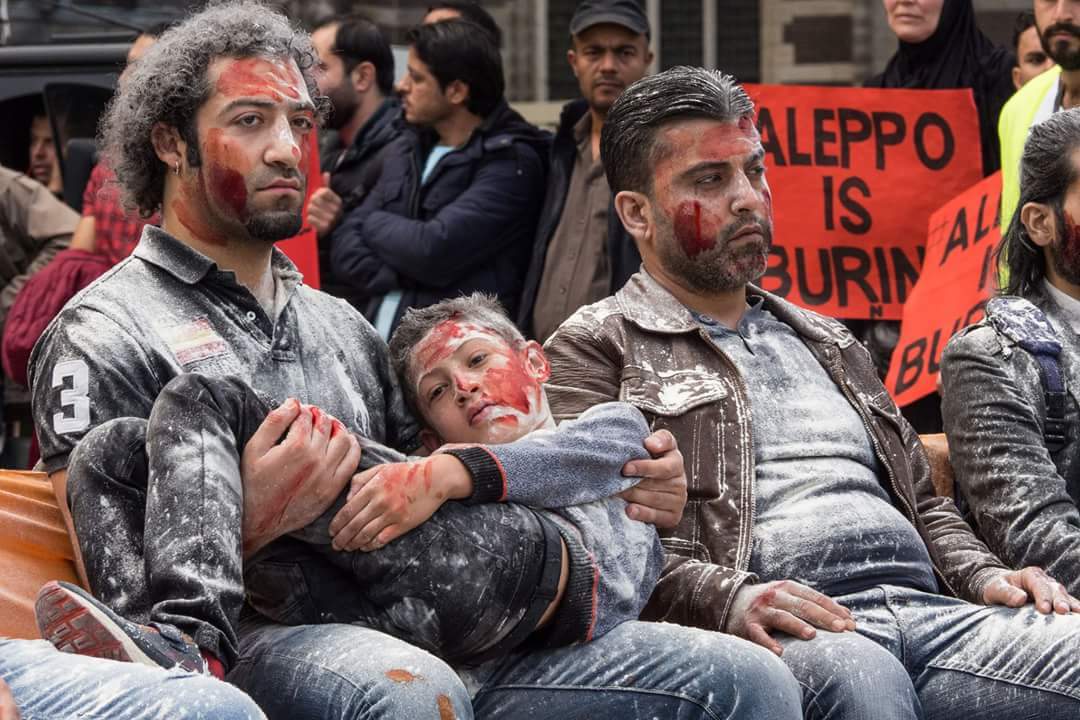
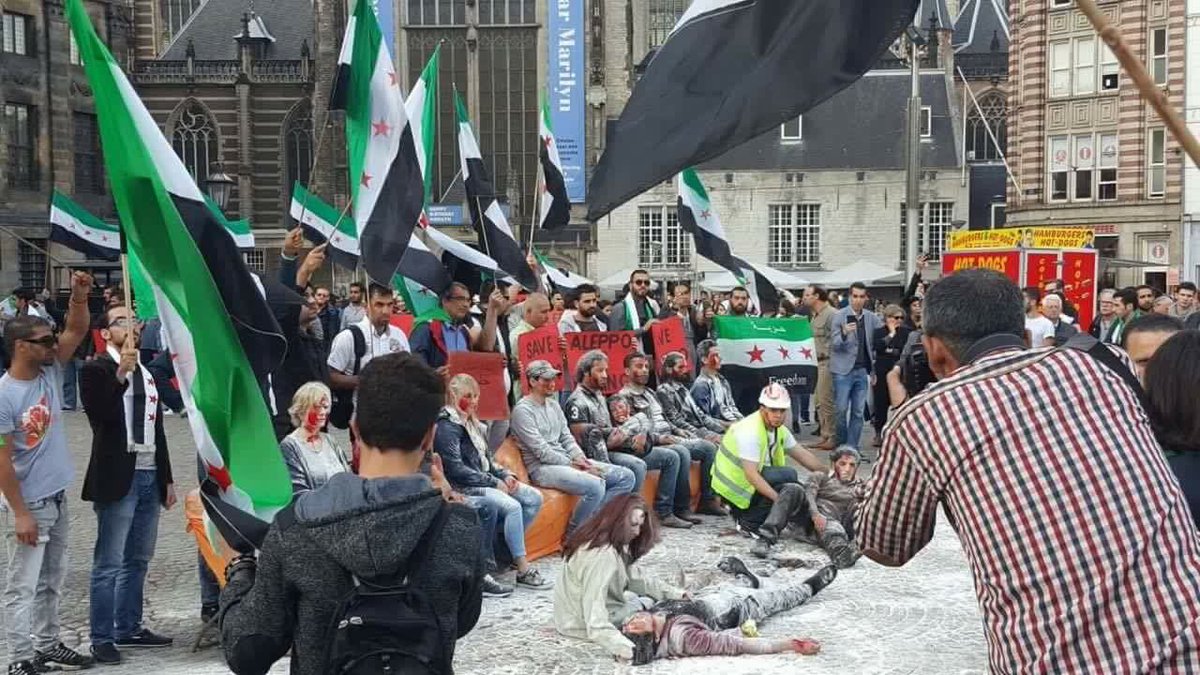
This is not Aleppo, Syria, but rather the streets of Europe where a recent “save Aleppo” protest was staged. Actors posing in fake dust and blood proved just how easy it is for anyone to create “war victims” anytime, anywhere. |
Saudi state media, Al Arabiya English would report in an October 1, 2016 article titled, “Worldwide protest against Assad, Russia to ‘save Aleppo’,” that:
The stalling talks between international powers on Syria – with Russia ramping up its air raid campaign – has ignited worldwide protests calling for an end to the horror in Aleppo.
Protestors in Turkey, France, Netherlands, America and Canada took to the streets opposing Bashar al-Assad’s and Russia’s crimes in Aleppo, carrying posters that read “Stop bombing Aleppo” and “Save Aleppo”.
Al Arabiya’s ironic hand-wringing over Syria as Riyadh devastates Yemen with its own aerial bombardment and ground incursion, attempts to portray eastern Aleppo as a horrific cauldron where “where more than 250,000 civilians are trapped without food or clean water.”
And while undoubtedly war is raging in eastern Aleppo, it should be noted that the vast majority of Aleppo’s population – 1.75 million in fact – live in the government-controlled majority of Aleppo. But despite this reality, the West and its allies – including Saudi Arabia – have attempted to use their sway over international public opinion to exaggerate Syrian security operations and fabricate a “humanitarian catastrophe” to serve as yet another pretext for wider Western intervention.
Central to this appeal to public opinion has been the so-called “White Helmets,” also referred to as the “Syrian Civil Defence” despite the nation of Syria already having a legitimate, professional civil defense force.
Posing as an impartial rescue force, the “White Helmets” are transparently auxiliaries serving exclusively side-by-side armed militants including US State Department, UN, and EU designated foreign terrorist organizations. Their primary function is not “rescuing” anyone, but to manage a public relations campaign aimed at swaying public and political opinion, leveraging “humanitarian” sympathy worldwide.
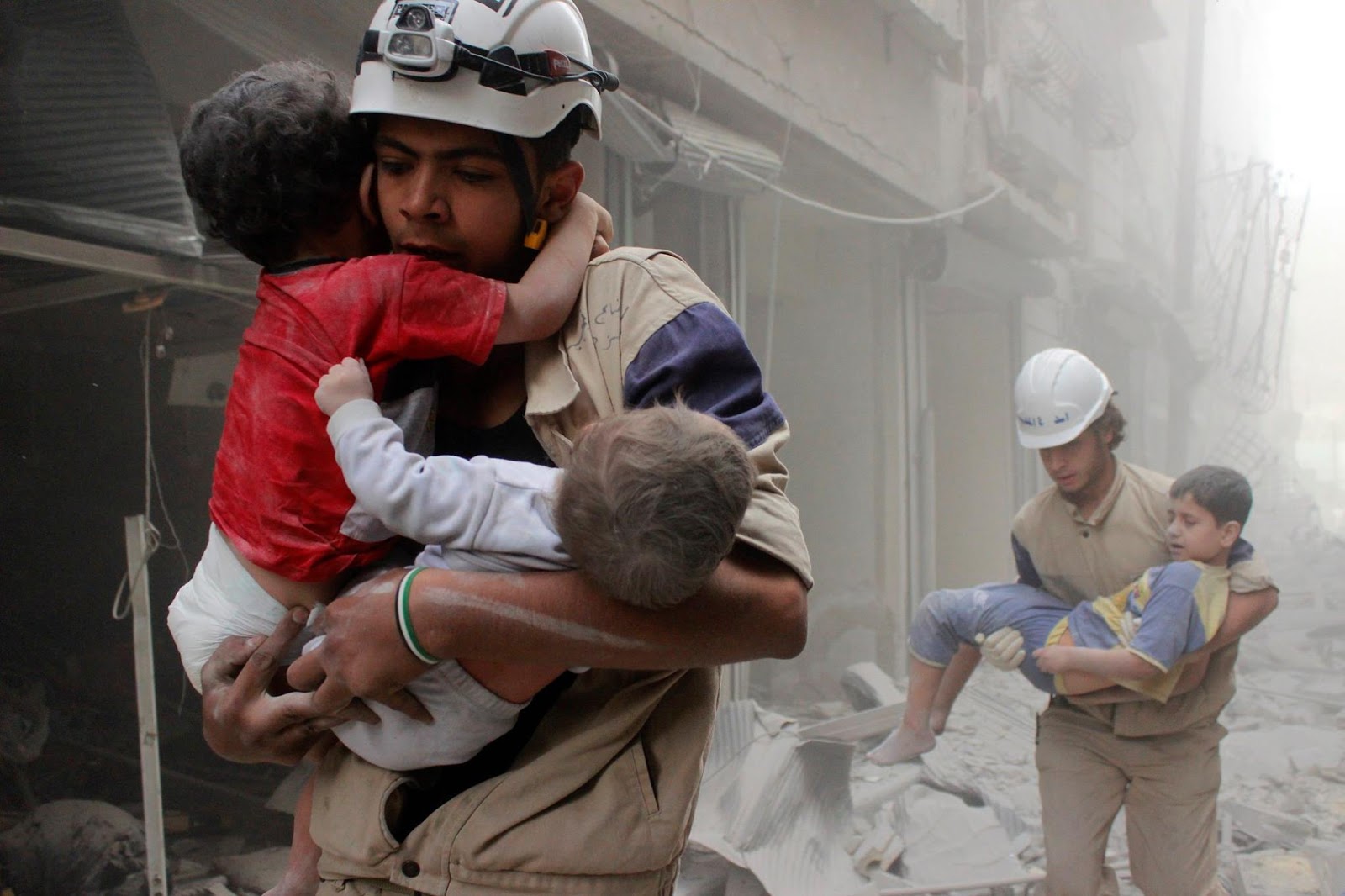
Their primary means of doing this is publishing photos and videos of their members – wearing elaborate, matching uniforms and driving brand new ambulances – pulling dust and blood covered victims from rubble allegedly brought down upon them by Syrian and Russian airstrikes.
The veracity of their photos, videos, and many claims have never been independently verified, and in many cases, evidence suggests that much of what they present to the public across their extensive, well-funded social media presence has been fabricated.
The recent coordinated “save Aleppo” protests held across Europe and North America, perhaps revealed just how transparently fabricated and fictional the “White Helmet’s” work really is. During one protest, photos retweeted by the official “White Helmet’s” Twitter account showed actors dressed up as “war victims,” covered in fake dust and blood, appearing almost indistinguishable from the alleged “victims” the “White Helmets” regularly “save” in Syria.
The protest, staged in European streets far from the Syrian conflict, even included children – likewise covered in fake dust and blood – cradled in the arms of adults, posing with despondent looks upon their faces. Also part of the staged scene were actors dressed like the “White Helmets” themselves.
 |
The only difference between admittedly staged scenes in European streets during a recent “save Aleppo” protest, and the daily output of the Western created and funded “White Helmets” acting troupe in Syria is that in Syria, the devastation of war provides a much more convincing “set” for the actors to perform on. |
While the acting troupe that organized this protest may have thought they were cleverly “bringing the conflict to the streets of Europe” to invoke global sympathy for their cause, what they really proved was just how easy it really is for the “White Helmets” to create “war victims” anytime, anywhere.
In Syria, where years of US-backed violence has left many parts of the country devastated, such staged scenes playing out with the devastation of war as a backdrop become all the much more convincing. With “White Helmet” videos heavily edited before reaching the public, they are able to create tragic scenes of war, anytime, anywhere – even in the streets of Europe thousands of miles away from where Syrian and Russian warplanes are operating.
Their primary goal and that of the special interests funding them tens of millions of dollars, is to manipulate the hearts and minds of the global public in support of Western-backed armed militants – not “save lives” nor bring peace to Syria.
Hamas should be removed from EU terror list: Lawyer
Press TV – September 22, 2016
A top European Union lawyer says Hamas should be dropped from the bloc’s blacklist, citing lack of concrete evidence showing the involvement of the Palestinian resistance movement in alleged terrorist activities.
Eleanor Sharpston, an advocate general at the European Court of Justice (ECJ), urged on Thursday the removal of both Hamas and the Liberation Tigers of Tamil Eelam (LTTE), a Sri Lankan rebel group, from the EU terror list.
The EU “cannot rely on facts and evidence found in press articles and information from the internet, rather than in decisions of competent authorities, to support a decision to maintain a listing,” Sharpston said.
In 2001, the EU adopted regulations to combat terrorism. Under the rules, the bloc imposed travel bans and asset freezes against Hamas and the LTTE.
In 2014, however, the General Court of the European Union, the second-highest court in the bloc, ordered both Hamas and the LTTE to be struck off the bloc’s terror list in two separate decisions. The court said the EU had based its decision, regarding the blacklist of the groups, on publicly available information rather than on any finding by a competent authority.
The Council of the EU, representing the governments of member states, in turn appealed the court ruling.
Elsewhere in her remarks, the top EU lawyer called on the ECJ to reject the appeal.
Given that “some of the reasons advanced could not justify the decision to maintain the listing of LTTE and Hamas,” the General Court was correct to dismiss the EU appeal when it could find no other sufficient reasons for their listing, Sharpston said.
Accordingly, the ECJ “should annul the measures maintaining Hamas and LTTE on the EU list of terrorist organizations on procedural grounds,” she added.
Hamas has ruled the impoverished and the Israeli-blockaded Gaza Strip since 2006, when it scored a landslide victory in legislative polls.
An American in Latakia: “this was no revolution”
By Lily Martin | OffGuardian | September 21, 2016
As an eye witness to the entire war in Syria, from March 2011 to present, I can state this was no revolution. I am an American citizen living permanently in Syria, which is my husband’s birthplace. I have been here 24 years.
A real revolution would have the support of the people, inside Syria, not Syrians living in Paris and London for the past 40 years. To have a real grassroots uprising, you need the support of the people living inside Syria, who would share your views.
If it had been a real uprising/revolution, the whole process could have taken 3-6 months, because the Army would have followed the will of the people, given the fact the Syrian Army is made up of Syrians of all ethnic and religious sects. The Syrian Army is a true representative of the Syrian population. If the population wanted the goals stated by the ‘protesters’, which was to establish Islamic law in Syria, and to abolish the current secular government, the Army would have eventually followed along, expressing the will of the people.
However, you had a small minority in the Syrian population who were for regime change, but this very small group was backed by USA, UK, NATO, EU, and the Arab Gulf Monarchies. Money talks, as we say in America.
Yes, Syria is home to many Radical Islamic ideology followers, as is UK, USA and Europe. However, their numbers are still in the minority. In a democracy, the majority rule. The Syrian opposition does include non-Islamist political people, mainly communists and other secular thinkers, but those people have never held a gun, and have never advocated violence, destruction or armed revolution. It has been strictly the Radical Islamic ideology followers who have supported armed rebellion. Because their numbers were, and are still, so small comparing to the rest of the 20 million Syrians, they never had a chance to win, and can not win on the ground. Their ‘revolution’ has just been an attack on the unarmed civilian population who do not agree with them.
We are hoping that a peaceful negotiated settlement, with positive changes and reforms, can be made through joint talks between the UN, and both sides of the Syrian conflict. This is our chance for peace.
Finally, this morning Sept 14, 2016 on the BBC they announced a UK Members of Parliament commission, studying the role of the UK in the war in Libya, had concluded the UK role was wrong, shameful and “opportunistic, and for regime change”. Meaning, the UK under PM Cameron should not have participated in the NATO and US attack on Libya, which was not a humanitarian effort, but an ‘opportunistic attack for regime change’, as stated on BBC. This is the same story of Syria. Perhaps in 5 years time, we may watch BBC announcing a UK Parliament commission, studying the UK role in the death and destruction in Syria.
My question to myself, and all others: Why can’t we study these types of decisions BEFORE we commit to destroying lives and countries abroad? I asked this question out-loud at the breakfast table this morning, and my son who is an MBA graduate, answered back, “Mom, because UK always takes their orders from USA, regardless of the consequences”.
That view should be the focus of every UK citizen and politician, on how UK can stand alone, and make decisions in the future which benefit UK, and not follow USA blindly, down a road of regret.
Lilly Martin is an American citizen, living permanently in Syria for 24 years. She is a retired medical professional, and now a homemaker and activist-writer during the Syrian conflict. Her son is the journalist Steven Sahiounie. She lost her home to terrorists in Kessab on March 21, 2014.
Astonishing as it may seem, chanting ‘Viva Palestina’ could soon be a ‘hate crime’
MEMO | September 21, 2016
“Viva Palestina” is an enduring chant along with “Long Live Palestine” and “Long Live Gaza”, all of which are often used by human rights activists and others who want to show their support and goodwill for the long life and well-being of the state and its people. However, using such slogans and messages of solidarity could soon become a hate crime in Scotland, a nation which has often been praised for its refusal to give unconditional support to Israel and its brutal military occupation of Palestine.
To the astonishment of legal observers and human rights activists, a landmark trial is set to go ahead in Aberdeen after Scottish Palestine Solidarity Campaign (SPSC) member Alister Coutts, 56, was charged with “acting in a racially aggravated manner with intent to cause distress and alarm”. His “crime” was to utter “Viva Palestina” next to the Jericho Cosmetics stall in the city’s Union Square shopping mall.
His arrest, charge and impending court appearance has now fuelled speculation that pro-Israel Zionist groups in Scotland are exerting undue pressure on the authorities to “get tough” with SPSC and other Palestinian-supporting groups. Following an initial crime investigation the police will send a report to the local Procurator Fiscal, who will consider the content and decide whether to take any further action.
While such decisions are said to be taken in the public interest, the disclosure of a host of secret email exchanges between the Crown Office and Procurator Fiscal service on one hand, and Zionist organisations on the other, has alarmed SPSC, which says that they reveal the existence of a “cosy relationship” between the public prosecutor and the pro-Israel lobby in Scotland. The emails came to light after a Freedom of Information request was made to the Crown Office and Procurator Fiscal Service in Edinburgh. SPSC officials are now scrutinising the content of the dossier before making public its findings.
“It is extremely sinister for anyone to be charged with expressing the idea of saying ‘long live’ to a community,” commented SPSC co-founder Mick Napier. “The charge therefore seems to have a patina of wishing harm to the Palestinian people. If so, this is certainly breaking new ground in the Scottish legal system; that by saying ‘Viva Palestina’ you are considered to be attacking someone.”
After Coutts had said “Viva Palestina” a policeman arrived and ordered him to leave the shopping mall, a request which, his defence team will argue, was in itself illegal. As soon as he stepped outside, he was handcuffed, held for seven hours and charged.
“He is now deemed to be a racist for saying Viva Palestina in the vicinity of a cosmetics stall,” Napier pointed out. “In the meantime, we are examining what some might regard as the overly-chummy emails.”
The trial, expected to commence next month, comes amidst the backdrop of a nationwide campaign by SPSC against the Israeli-linked cosmetics firm Jericho SkinCare. The group accuses the firm of using minerals extracted from the Dead Sea on the coast of the illegally-occupied West Bank, which is Palestinian territory. SPSC notes that the extraction and commercialisation of resources from an occupied territory breaches UN conventions and it has launched a boycott campaign against a number of cosmetic firms linked to the practice and is lobbying for them to be removed from Scottish shopping centres.
According to Canadians for Justice and Peace in the Middle East (CJPME), Dead Sea products are linked closely to the commercial viability of Israel’s illegal settlements and are targeted as part of the global boycott movement. The organisation has produced a fact sheet outlining the legal position. Jericho SkinCare’s website states that the company’s products are “based on Dead Sea minerals”.
A Crown Office spokesman said that he was unable to comment on ongoing criminal cases [sic] but added: “The Crown Office and Procurator Fiscal Service corresponds with many community and faith groups, particularly in relation to the impact of hate crime in their communities. All prosecution decisions are taken following an independent and thorough assessment of the available evidence.”
Let’s see what this translates to in practice.
IMF: Mideast conflicts have erased development gains for whole generation
Press TV – September 16, 2016
The International Monetary Fund (IMF) says conflicts in the Middle East are not only devastating economies in countries such as Iraq, Libya, Syria and Yemen, but they have also erased “development gains for a whole generation.”
The fund issued a report titled the Economic Impact of Conflicts and the Refugee Crisis in MENA (Middle East and North Africa) on Friday, where it said conflicts were killing economies in the countries gripped by war and sapping growth in neighboring countries and those hosting millions of refugees.
Middle Eastern and North African countries battered by fighting have suffered average losses of 6-15 percentage points in the gross domestic product (GDP) in three years, compared to a 4-9 percentage-point average worldwide, according to the report.
The IMF report showed that the drops in economic output in Syria, Libya and Yemen in recent years have far exceeded the worldwide average.
Syria’s gross domestic product level is currently less than half the level it was five years ago before the start of the conflict, the IMF stated.
The report showed Yemen lost 25-35 percent of its GDP in 2015 alone, in the wake of the deadly Saudi campaign.
Oil-dependent Libya saw its GDP fall 24 percent in 2014, the IMF said.
Physical infrastructure damage, now estimated at $137.8 billion in Syria and more than $20 billion in Yemen, has reduced trade and output in neighboring countries, according to the report.
Countries bordering high-intensity conflict zone showed an average annual GDP decline of 1.4 percentage points worldwide, with a bigger drop of 1.9 percentage points in the Middle East and North Africa region.
Refugees’ plight
The fleeing of more than half of Syria’s 22 million population, 6.6 million internally and more than five million to other countries, has magnified economic losses, dramatically escalating poverty, unemployment and school dropouts in countries that were already struggling, the IMF said.
Many of the refugees seeking asylum in other countries are skilled workers and professionals forced by war and persecution to leave the conflict zones in hope of better lives.
However, according to the IMF, because refugees often have fewer rights than local populations, those landing in developing countries are often absorbed into already disadvantaged local communities forming a new underclass comprising refugees and the existing poor in the host country, which in turn leads to a detrimental effect on the host countries.
For those refugees that land in Europe, where the influx of refugees has only had a small impact on economy, there have been some positive effects on the host countries, according to the report.
More funds needed
The IMF report has revealed the huge scale of the refugee crisis and the pressure it put on several United Nations institutions, especially the United Nations High Commissioner for Refugees (UNHCR) and the World Food Programme.
The two UN organizations have been playing a leading role in the provision of humanitarian assistance, both to internally displaced people and refugees.
However, the IMF report says funding has not kept up with the sharp increase in needs.
For instance, the World Food Programme and the UNHCR have had to cut their services to refugees in Jordan due to funding constraints, which may have contributed to the acceleration of refugee flows to Europe from late 2014, according to the report.
The IMF report urged policymakers to scale up humanitarian aid in conflict zones and neighboring countries hosting refugees and prioritize fiscal spending to protect human life and serve basic public needs.
The report comes as the UN General Assembly is preparing to host a summit on refugees in New York next week.
The UN plans to use the summit as a platform to urge governments, private donors, and humanitarian agencies to support the organization in its efforts to ease suffering of the victims of world conflicts.
Analysts believe the MENA conflicts and the following refugee crisis are the outcome of the West’s policies in the Middle East and North Africa.
Featured Video

Dan Dicks with James Corbett on Solutions Watch
or go to
Aletho News Archives – Video-Images
From the Archives
Secret document reveals plans for civil war in Lebanon, Israeli false flags, and invasion
By Randi Nord | Geopolitics Alert | April 5, 2019
Beirut – During his visit with US Secretary of State, Mike Pompeo, Lebanese President Michael Aoun reportedly received a US-Israeli document detailing plans for creating a civil war in Lebanon with covert false flag operations and possible Israeli invasion.
Although the source of the document is Israeli and created in partnership with Washington, no one knows who presented it to Aoun. The Lebanese TV station, Al-Jadeed, initially reported the document on Lebanese TV and a video on its website. Geopolitics Alert translated the report for this article. … continue
Blog Roll
 Aletho News
- Sheikh al-Asadi warns of Iraqi government compliance with US demands
- How to MAKE THE CONSPIRATORS PAY for their crimes! Dan Dicks with James Corbett on Solutions Watch
- There’s a drought in academia: A drought in honest research on the subject of drought and other weather extremes
- Department of War Awards $20.7 Billion Contract to Raytheon for Air-to-Air Missiles
- ‘Distance yourselves from Israel’: IRGC urges US population to question govt policies
- America’s Greenland deal has a radioactive backstory
- The RAF Fairford ‘terror plot’: Unpacking escalation in the UK echo-chamber
- EU Council Advances Chat Control 2.0 Scanning Proposal
- Ex-Greek MEP files complaint against Israeli spyware firm over alleged Pegasus surveillance
- Troubling ideas throughout the Torah, Talmud, Mishneh Torah and Tanya
- If Americans Knew
- New Report: “Scholasticide and Genocide in Gaza: Assessment, Testimonies and Legal Analysis”
- Ex-Biden officials are desperate for a Gaza scapegoat
- Israeli “settlers” Invade Al-Aqsa; Pour Boiling Water on 75-Year-Old
- Israel Has Kidnapped Another American Teenager
- US arms sales to Israel worth $21.6 billion in 20 months
- Three Palestinians Killed in Israeli Attacks on Gaza
- Revealed: German “Anti-Semitism Expert” Driving Crackdown on Palestine Solidarity is Former Israeli Spy
- Egypt’s Warning to Israel Before Oct 7
- Israel’s siege signals another cruel winter for 1.8 million Gazans – Daily Update
- Netanyahu Asked UAE Leader to Deny Report on Oct. 7 Warning in Secret Visit, Sources Say
- No Tricks Zone
- Two More Paleo Reconstructions Affirm Meters-Higher Sea Levels Across Ireland, Brazil 7000-6000 Years Ago
- New Study: Earth And Venus Surface Warmth Largely Explained By Convection And Lapse Rate, Not CO2 Or Radiation
- 2025 Nature Paper Claiming Worsening Global Drought Gets RETRACTED …Heavily Flawed
- New Study: ‘Global Drought Shows No Detectable Recent Acceleration Under Climate Warming’
- Economic Masterminds: German Socialists Suggest Taxing Productivity Gains Stemming From Using AI
- The South China Sea Has Not Been Cooperating With The Climate Change Narrative
- Energy Crisis: Germany Enters Heating Season With Historically Low Gas Reserve Fill Levels
- New Study: The Antarctic Ice Sheet Gained Mass From 2020-2024 Due To Staggering Snow And Ice Accumulation
- Study: Ocean Heating Rates From Thousands Of Years Ago ‘Dwarf’ Modern Ocean Heating Rates
- Climate Extremists Target, Attack Large-Scale Power Grid Infrastructure In Germany!

